



Abstract
We have developed a paleomagnetic secular variation (PSV) record from Zaca Lake, California, that spans the last ~3200 years. The record is derived from detailed (2 cm) sampling of core 09-1C, which is 873 cm in length. The paleomagnetic remanence is carried jointly by magnetite and greigite. The greigite appears to form in the anoxic bottom water of the lake and/or at the sediment/water interface. The paleomagnetic remanence has a very simple characteristic remanence, which demagnetizes straight to the origin between ~10 and 80 mT. This remanence has strong serial correlation and a pattern of variability that strongly matches 15 other published PSV records from Western North America. In all, 23 radiocarbon-dated PSV features, which were identified in the core, provide an independent timescale for dating the Zaca Lake core and an independent means of correlating Zaca Lake sediments to other Holocene lakes of the Western United States. We have also compared our paleomagnetic chronology with a previously published radiocarbon-based chronology from Zaca Lake (Feakins et al., 2014; Kirby et al., 2014). Our chronology is not significantly different from the radiocarbon-based chronology for the last 2000 years. However, the radiocarbon dates appear to be anomalously young in the older part of the lake record where correlatable PSV features suggest ages that are ~300–500 years older than the radiocarbon dates. Our analysis suggests that the PSV feature ages are a better estimator of lake sediment age in this interval.
Introduction
The space/time pattern of Holocene climate variability in Western North America is characterized by a broad range of frequencies (e.g. Benson et al., 2002; Cook et al., 2007). If we are to better establish that pattern of climate variability and assess its causes, we need a gridwork of high-resolution paleoclimate records that are very well dated and correlatable. Paleomagnetic secular variation (PSV) is a dating tool that can provide an independent chronostratigraphy for individual paleoclimate records and a basis for independently correlating these records with a resolution of ±50–100 years over the spatial scale of Western North America. We present here a PSV record from Zaca Lake (Figure 1), which can be absolutely dated through correlation with other PSV records from Western North America (Figure 1). This PSV record also permits isochronous correlation to other paleoclimate records from Western North America with PSV records and an independent means of assessing the timing of climate/environmental variability in these Holocene records with high resolution. These results will be presented in a companion paper in preparation.

Map of Western North America showing the location of Zaca Lake (ZAC, black diamond) and other notable Holocene records of climate and paleomagnetic field variability. Black circles indicate sites of published paleomagnetic field secular variation records used by Lund (1996) and Lund et al. (in preparation) to correlate and date the paleomagnetic record at Zaca Lake. SBB is Santa Barbara Basin.
Zaca Lake setting
Zaca Lake (34.78°N, 120.03°W) is located in the San Raphael Mountains (730 m elevation) of Southern California (Figure 1) about 50 km northwest of Santa Barbara Basin (SBB in Figure 1), a key site for Holocene paleoclimate studies in Western North America (e.g. Behl, 1995; Kennett and Ingram, 1995; Schimmelmann et al., 2006). Zaca Lake is a small (7 ha), steep-sided, and flat-bottomed lake with a maximum water depth of 13 m (Dickman, 1987). The lake was probably formed in Early Holocene time by the landslide dam of a local stream.
Zaca Lake is nestled in a deep valley that is protected from wind so that the lake has persistent thermal stratification ~10 months per year. The lake is fed by local streams, surface runoff, and mineral springs, some of which have high concentrations of hydrogen sulfide and phosphorus (Dickman, 1987). Yearly stream flow and runoff are usually matched by greater evaporation (and groundwater loss?) such that the lake is normally a closed-basin lake. Overflow happens intermittently associated with the biggest winter storms. Rocks surrounding Zaca Lake are predominantly Miocene carbonate/silica-rich deep-sea sediments of the Monterey Formation (e.g. Omarzai et al., 1993) and Paleogene marine forearc-basin clastic-rich sediments.
Zaca Lake is currently a eutrophic lake with annual algal blooms in the summer months (Dickman, 1987; Sarnelle, 1993, 1997), which produce calcium carbonate laminae that are 0.5–1 mm in thickness. These laminae are interlayered with millimeter-scale clastic-rich layers derived from surface runoff and local streams. Some notable, but thin, turbidites are present, which probably reflect more significant rainfall events. The deep lake waters are normally anoxic because of thermal stratification. A notable zone of sulfur-producing bacteria grows in the water column at 8–10 m water depth. Occasionally, a complete (or near-complete) overturn of the deep (and anoxic) lake water causes deposition of an iron-sulfide-rich lamina, which is 1–3 mm in thickness (Dickman, 1987; Sarnelle, 1993, 1997). The iron-sulfide layer appears to be a mixture of pyrite (FeS2) and mackinawite (FeS), which are non-magnetic, and a remanent magnetic phase, probably greigite (Fe3S4, see rock magnetic discussion below). (This may be analogous to greigite-forming processes in the stratified water column of Salt Pond, Massachusetts, described by Canovas (2006) and Moskowitz et al. (2008).) Zaca Lake also has frequent whiting events in the spring and summer that deposit inorganic carbonate (Sarnelle, 1993).
Two long piston cores were collected near the lake center (12 m water depth) in 2009 (Feakins et al., 2014; Kirby et al., 2014). The stratigraphy of the two cores can be easily correlated between them. We have concentrated our efforts on core ZACA-09-1C, which is 873 cm in length. Various lines of evidence (see below) indicate that no significant surface sediment was lost during the coring process.
Rock magnetism
Sediment flux to Zaca Lake is derived primarily from the Neogene diatomaceous shales of the Monterrey Formation and Paleogene marine forearc-basin detrital-rich sediments. Previous paleomagnetic studies of these rocks in Southern California (e.g. Hornafius, 1985; Omarzai et al., 1993) have identified magnetite as the primary detrital magnetic phase. We thus expected magnetite to be the primary detrital magnetic phase in Zaca Lake. Magnetic separates from several horizons of core 09-1C verify that magnetite is present. The lake chemistry indicates, however, that iron sulfides are also routinely present in the sediments. The basal-lake water column is anoxic, and it is presumed that lake bottom sediment pore waters are anoxic as well. Hydrogen sulfide is present throughout the water-column hypolimnion (typically 7–13 m water depth) with concentrations as high as 36 mg/L (Dickman, 1987) measured near the sediment/water interface. Core 09-1C was persistently black in appearance right up to the sediment/water interface, when first split for paleomagnetic sampling. That black color changed to a light gray color within hours of exposure to air. This behavior is common in suboxic to anoxic sediments, and the color change is normally associated with oxidation of a non-magnetic iron-sulfide phase, mackinawite (FeS) (e.g. Neretin et al., 2004). Mackinawite is considered to be a precursor to pyrite (FeS2), which is also present routinely in these sediments (Dickman, 1987; Sarnelle, 1993, 1997).
Core 09-1C was first u-channel sampled (a column of sediment 2 cm × 2 cm in cross-section, and the length of each core segment was removed and encased in plastic). Paleomagnetic measurements were made on the u-channels by first measuring their natural remanence (NRM) and then stepwise demagnetizing the NRMs at 5 and 10 mT alternating magnetic field (af). After these preliminary measurements, the u-channels were cut up into 2 cm × 2 cm × 2 cm cubes for more detailed paleomagnetic and rock magnetic analysis. The sample NRMs were first af demagnetized in 10 mT steps from 10 up to 60 mT, and then an artificial, anhysteretic remanence (ARM) was applied and measured (0.05 mT bias field; 100 mT af). The ARMs were then af demagnetized sequentially in 10 mT steps up to 40 mT. Finally, magnetic susceptibilities (chi) of the individual cubes were measured. The magnetic intensities of the NRM, ARM, and Chi are plotted in Figure 2. The intensities all strongly covary and alternate in intensity over more than an order-of-magnitude range on a decimeter scale. High-intensity intervals in the uppermost 5 m of the core correlate with clastic-rich sediment intervals, while low intensities correlate with high percentages of carbonate (>60–80%) in the sediment. The carbonate is likely autochthonous because of enhanced periods of either inorganic whiting events (Sarnelle, 1993) or associated with cyanobacterial blooms (Dickman, 1987; Sarnelle, 1993, 1997). Thus, the uppermost 5 m of rock magnetic intensity variability may simply be the result of variable carbonate dilution.

ARM, Chi, and NRM intensities for Zaca Lake core ZACA-09-1C. All intensities strongly covary over an intensity range of almost 2 orders of magnitude. The variation is strongly related to relative proportion of clastic sediments (high clastic content = high intensities) versus autochthonous carbonate content (high carbonate content = low intensities).
Under anoxic bottom water/porewater conditions, we might consider that the finest grained magnetic minerals (less than a few microns) would be dissolved (e.g. Leslie et al., 1990). However, these sediments are predominantly silts with mean grain sizes of 10–15 µm (Kirby et al., 2014). Most magnetic grains are too large to be subject to magnetic mineral dissolution (e.g. Hunt et al., 1995; Leslie et al., 1990). The overall magnetic coercivity determined by af demagnetization of the NRMs and ARMs also suggests that the magnetic minerals are relatively coarse grained (pseudo-single domain to multidomain).
More detailed rock magnetic experiments were conducted on representative samples to better characterize the magnetic mineralogy of the Zaca sediments. Temperature dependence of low-field magnetic susceptibility was measured on whole rock samples and magnetic separates. Figure 3a and b shows temperature-dependent susceptibility data for both the whole rock and a magnetic separate from the paleomagnetic sample at 37 cm sediment depth. During heating of the whole rock sample (Figure 3a), we observe two distinct Hopkinson peaks, one at ~240°C and another at ~480°C, followed by a sharp decrease in susceptibility as temperatures approach the curie temperature of magnetite (580°C); these results suggest the presence of a remanent magnetic sulfide phase, probably greigite (Fe3S4) and magnetite (e.g. Blanchet et al., 2009; Roberts, 1995). The cooling curve for this sample lies well above the heating curve and shows only magnetite indicating the creation of new magnetite during heating, most likely as a result of thermal alteration (oxidation) of the clay matrix (e.g. Hunt et al., 1995). The thermomagnetic heating curve for the magnetic separates from sample 37 (Figure 3b) shows clear evidence of a magnetic sulfide phase, which loses its magnetization by 400°C, and a predominant magnetite phase, which loses its magnetization by 580°C.
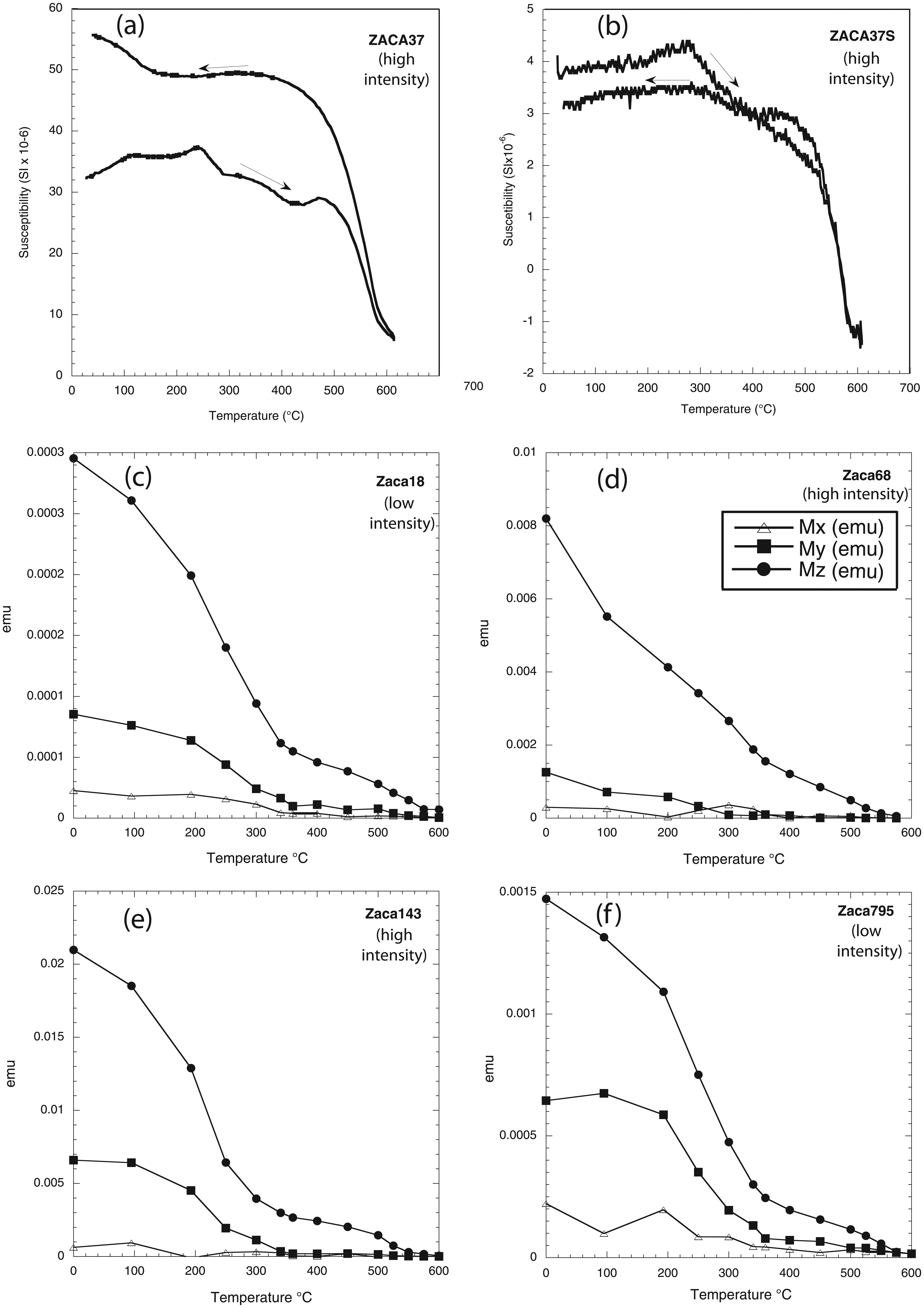
Rock magnetic evidence for magnetic mineralogy: (a) magnetic susceptibility intensity versus heating for a bulk sample from 37 cm, (b) a magnetic separate from the same level, and (c)–(f) thermal demagnetization of three-component IRMs to assess the magnetic coercivity and mineralogy of remanent material in Zaca Lake sediments. It is noted for each sample (Zaca18 indicates 18 cm depth in Zaca core) whether they come from high-intensity (low carbonate) or low-intensity (high carbonate) intervals (see text for more details).
To complement this analysis, we also examined the thermal demagnetization behavior of multi-component isothermal remanent magnetizations (IRM) (Lowrie, 1990; Lowrie and Heller, 1982). Three isothermal remanences (1000, 300, and 120 mT) were applied to the samples sequentially along the z, y, and x axes. Each of the three orthogonal axes has remanence acquired only in a specific coercivity range: 0–120 mT, 120–300 mT, and 300–1000 mT. The three-component IRMs were then stepwise thermally demagnetized to greater than 600°C. Selected results are shown in Figure 3c–f. In all cases, results show a predominance of the low coercivity fraction, which shows an inflection in the unblocking temperature spectrum at 250°–350° and a maximum unblocking temperature of 580°C. These results indicate the presence of a remanent magnetic sulfide, probably greigite and magnetite. The contribution of the intermediate coercivity component to the total remanence is variable. The unblocking characteristics of this component, unblocking between 200° and 350° with remanence sometimes persisting above 400°, are typical of greigite plus magnetite. The high-coercivity component is virtually absent in all samples, indicating a lack of high-coercivity minerals such as goethite and hematite.
It is clear from these experiments that most samples have a mixture of magnetite and a remanent iron-sulfide phase, presumably greigite (plus two non-magnetic iron-sulfide phases, mackinawite, FeS, and pyrite, FeS2). Pyrite is documented (Dickman, 1987; Sarnelle, 1993, 1997) to be present at the sediment/water interface and concentrated in thin layers associated with intermittent lake overturn and breakdown of the sulfur-bearing bacterial layer in the water column. The anoxic water column also has ferrous (Fe2+) iron present (Dickman, 1987; Sarnelle, 1993, 1997). So, iron-sulfide formation is virtually guaranteed to have occurred during lake overturn and breakdown of the sulfur-bearing bacteria. All three iron-sulfide phases would probably have formed in the water column or at the sediment/water interface, with mackinawite and greigite being precursors to pyrite formation if enough sulfur was present (Cutter and Kluckholm, 1999). Greigite may form single-domain grains through bacterial mediation (magnetosomes or extra-cellular greigite) (e.g. Chang et al., 2014; Reinholdsson et al., 2013) or it may form inorganically as a precursor to pyrite as soluble Fe and S combine in the water column. Greigite is stable upon core splitting and sampling, while another iron sulfide, mackinawite, which is present and also formed at or above the sediment/water interface, is oxidized on core splitting/sampling.
Paleomagnetism
Core 09-1C was initially sampled by u-channel sampling of the individual core segments. The initial NRMs of the u-channels were measured, and then the u-channels were stepwise demagnetized in afs at 5 and 10 mT and measured. The results indicated that a high-resolution PSV record could probably be recovered from the sediments. On that basis, the u-channels were cut up into a contiguous sequence of 2 cm × 2 cm × 2 cm cubes for further paleomagnetic and rock magnetic analysis; this method of sampling should provide significantly higher resolution (2 cm) measurement versus that of the u-channel measurement system (7–10 cm).
All samples were remeasured at 10 mT and then stepwise af demagnetized and measured in 10 mT steps to 60 mT. Selected samples were then af demagnetized and measured at 70, 80, 100, and 120 mT as well. The u-channel intensity results were normalized to the sediment cube measurements by comparing the 10 mT results, which were measured with both systems. Figure 4 shows the variety of intensity variation under af demagnetization. The NRM intensity loss under af demagnetization is reasonably coherent over most of the core. Most samples have median destructive fields (MDFs) of 30–40 mT, in keeping with a mixed magnetite/greigite remanence in mostly silt-sized particles. Selected sample intervals had lower MDFs, indicative of a coarser magnetic grain-size distribution; these samples came from the historic interval (0–150 cm) where runoff may have changed because of human activities and from a notable low lake interval (650–820 cm).
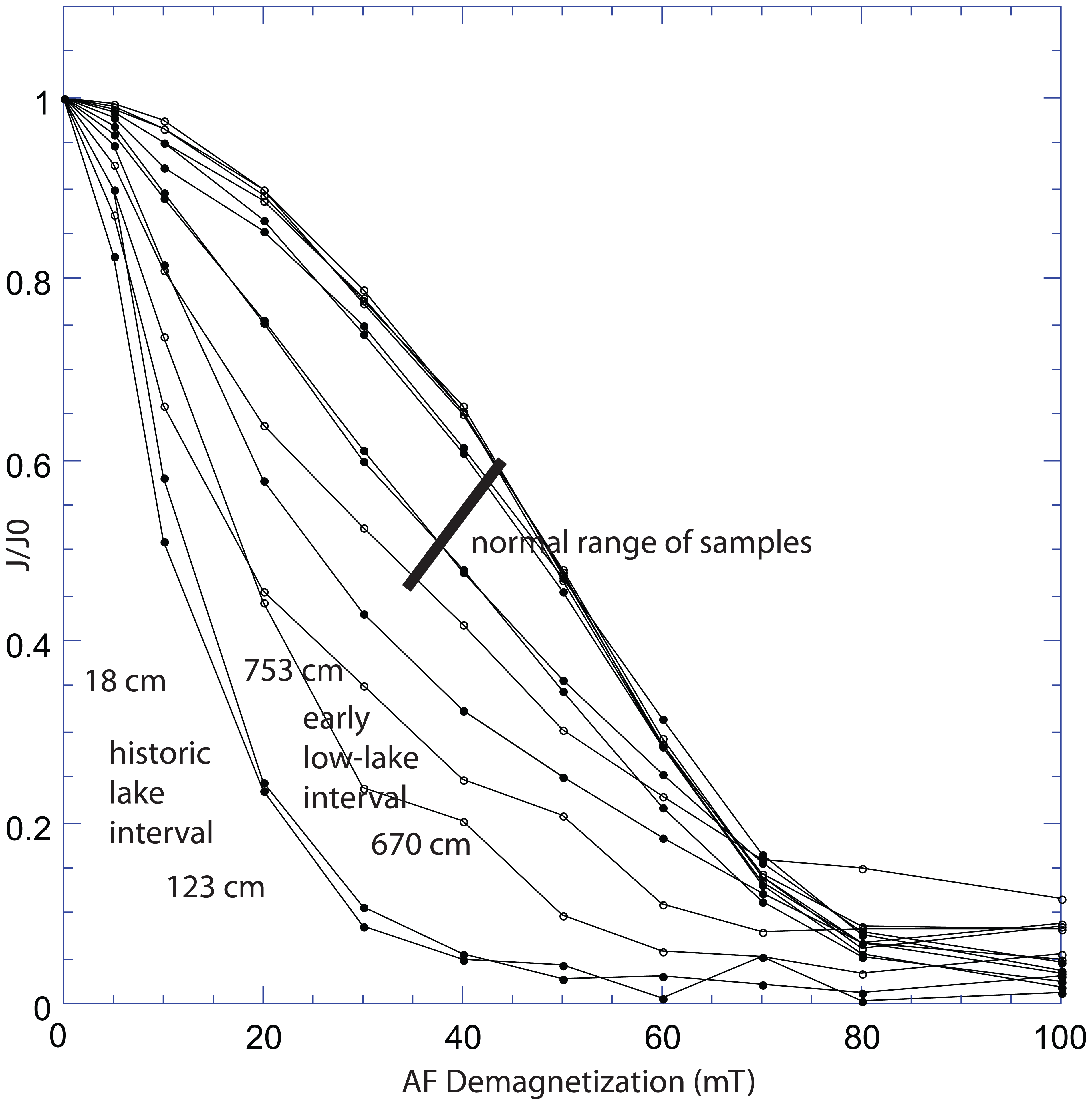
Coercivity spectra of NRMs upon af demagnetization to 100 mT. Most samples (normal range) have median destructive fields (MDFs) of 30–40 mT. These samples come from both high- and low-intensity intervals. Selected samples from two intervals have lower MDFs because of coarser average magnetic mineral grain size: (1) near the surface (0–150 cm) and associated with deforestation associated with European settlement, and (2) near bottom (~650–800 cm) where we interpret the lake to have been at a low stand.
Figure 5 shows the directional variation of selected samples under af demagnetization. It is clear that almost all samples have a single paleomagnetic direction that is demagnetized between 10 and 80 mT, which demagnetizes toward the origin. This simple characteristic remanence typically has maximum angles of deviation (MAD angles) of less than 3°. There is commonly a ‘viscous’ magnetic overprint, which is demagnetized by 10 mT, but on occasion the overprint may extend to 20 mT. The simple characteristic remanence is associated normally with more than 70% of the total NRM and indicates that both detrital magnetite and authigenic greigite have the same direction.

Zijderveld diagrams illustrating the variation in NRM directions during pattern of stepwise NRM demagnetization. The long, straight-line interval between 10 and 80 mT is the characteristic remanence and tends to demagnetize straight toward the origin. There is evidence for a second direction that is removed by demagnetization up to 10–20 mT, which we associate with a viscous remanence. It is noted for each sample whether they come from high-intensity (low carbonate) or low-intensity (high carbonate) intervals.
Figure 6 shows the characteristic remanences for core 09-1C. There is a clear pattern of PSV described by the inclination and declination variability with strong serial correlation among directions located near to one another. The inclinations and declinations have a notable oscillatory pattern, which we think we can uniquely correlate to similar PSV records elsewhere in the region. All of the paleomagnetic evidence from the core indicates the presence of an NRM that is recorded at or soon after deposition and has strong serial correlation throughout, which we think reflects the local pattern of secular variation for this site.

Characteristic remanences from core ZACA-09-1C with inclinations at top and declinations at the bottom. Selected correlatable PSV features are labeled I1-7 and D1-7.
Paleomagnetic chronostratigraphy
Fifteen well-dated high-resolution PSV records, Holocene in age, have been recovered from sites surrounding Zaca Lake. They are shown in Figure 1 (black circles). Several studies (Benson et al., 2002; Li et al., 2000; Lund, 1996; Lund et al., in preparation) have correlated paleomagnetic features among these records and provided a labeling sequence for specific highs/lows in inclination and east/west extremes in declination. Lund (1996) has documented that these features were synchronous to within ±50–100 years across the continental United States. More recent Holocene PSV studies in the Western United States (Benson et al., 2002; Li et al., 2000) are consistent with that analysis. Therefore, correlation of PSV features to Zaca Lake should provide age estimates that are within ±50–100 years of other dated PSV records from the continental United States. Lund (1996) and Lund et al. (in preparation) have compiled the ages of the paleomagnetic features in all these records and provided an average paleomagnetic age to each feature. Those paleomagnetic features and their associated ages are listed in Table 1. In all, 23 individual paleomagnetic features in Core 09 1-C, which are correlatable to these other published records, are labeled in Figure 7. Figure 7 plots the PSV record from Zaca Lake (based on the paleomagnetic chronology in Table 1) versus two previously published PSV records (LSC, FIS) summarized in Lund (1996). The comparable PSV inclination and declination features are noted in all three PSV records.
Ages and depths of PSV features.
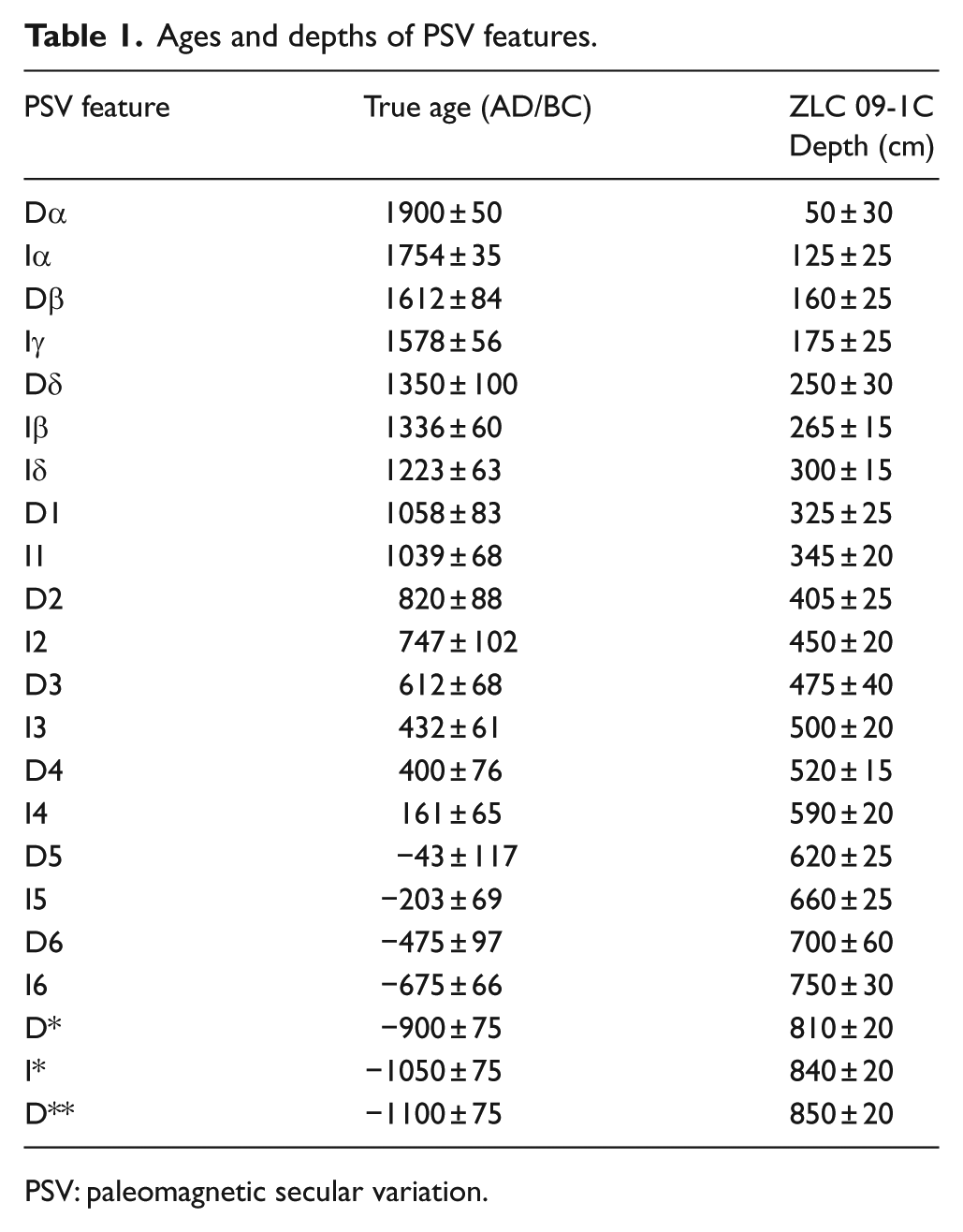
PSV: paleomagnetic secular variation.
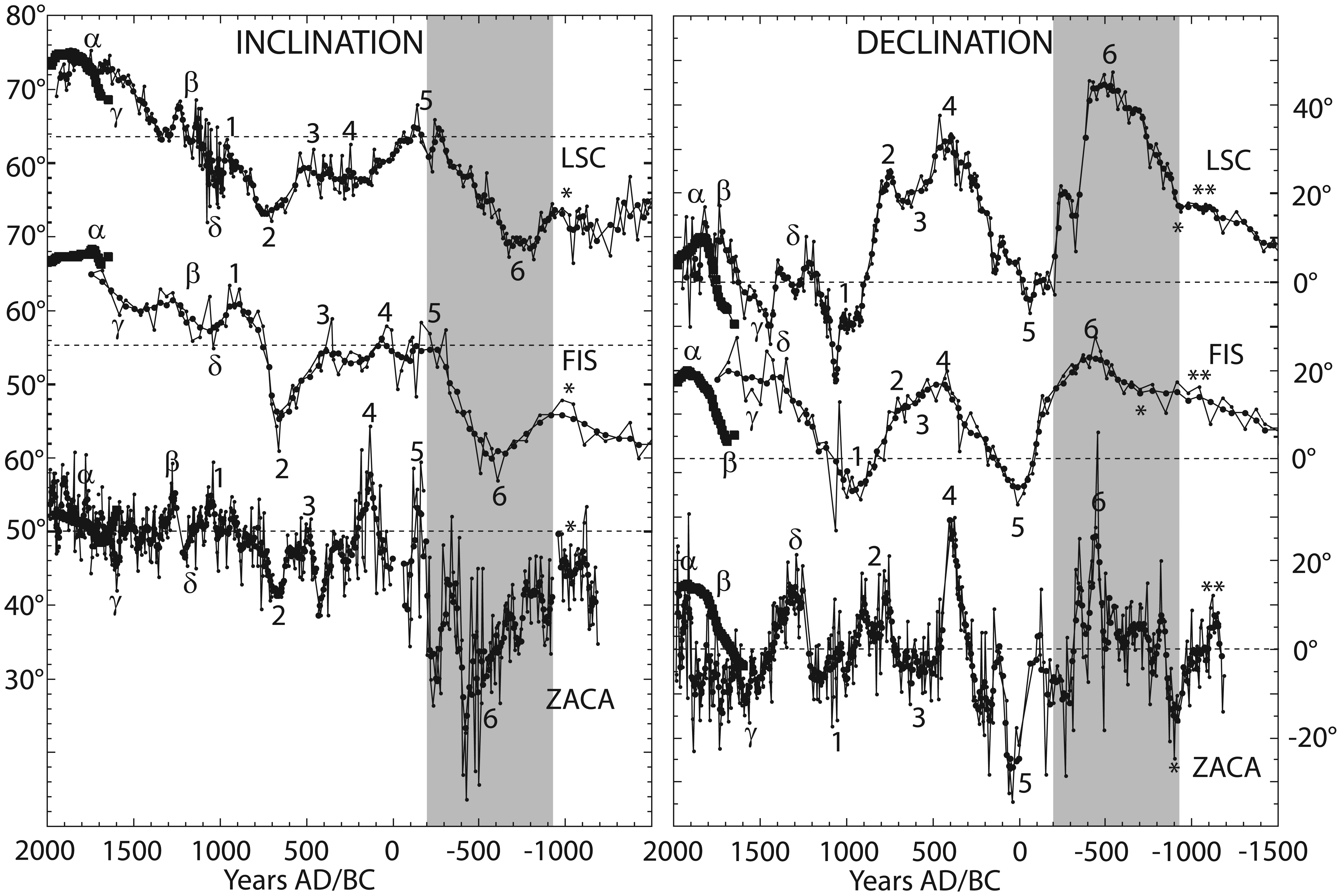
PSV records from two Western US sites (LSC, FIS) compared with the PSV record from Zaca Lake. The chronology for the Zaca Lake records is shown in Table 1. Note 23 individual PSV features that are correlatable among the three records. The chronologies of LSC and FIS are based on average ages determined by Lund (1996).
Figure 8 plots the paleomagnetic ages versus depth for core 09-1-C. There is a simple linear time/depth relationship for the last 2000 years and a distinctive lower, but linear, time/depth relationship for the deepest sediments (Figures 7 and 8, gray zone) associated with an extended interval of low lake conditions (Kirby et al., 2014). The lowermost interval is associated with a distinctive, broad low magnetic intensity region between ~650 and 820 cm, which can be noted in Figure 2.

Our PSV-based chronostratigraphy for Zaca Lake (solid squares) with the radiocarbon-based chronostratigraphy of Feakins et al. (2014) (open circles). We also note four radiocarbon dates (open diamonds) that are considered anomalous and not used in the Feakins et al. (2014) timescale.
Comparison with other chronologies
Feakins et al. (2014) and Kirby et al. (2014) have developed an independent chronology of Zaca Lake based, primarily, on radiocarbon dating. All of their radiocarbon dates are plotted in Figure 8 (open circles or diamonds), where they can be compared with the paleomagnetic age estimates (Figure 8, solid squares). Open circles in Figure 8 are those dates used by Feakins et al. (2014) and Kirby et al. (2014) in their age model; open diamonds are dates they deemed anomalous and did not use.
The paleomagnetic and radiocarbon age estimates are not significantly different in the last 2000 years. But the lowermost radiocarbon date (~840 cm), which they accept as reasonable, indicates that the lowermost section of the core is somewhat younger than that indicated by paleomagnetic chronostratigraphy, a difference of about 300–500 years. Three other radiocarbon dates at ~800 cm (Figure 8), which are close in stratigraphic depth to the oldest ~840 cm radiocarbon date (but were not used by Feakins et al. (2014) or Kirby et al. (2014)), are all anomalously young. It may be that groundwater flow through this interval has added some young carbon making all these dates anomalously young to some extent. Alternatively, we interpret the low magnetic intensity interval between ~650 and 820 cm (Figure 8, gray zone) to be associated with a very low lake interval. It is likely that bottom-growing plants would have been present in this interval and that roots extending down into the lake bottom sediments could have added some amount of young carbon. It is clear that the three radiocarbon dates near 800 cm and directly above the accepted radiocarbon date at ~840 cm are anomalously old by almost 1000 years. We think that the oldest radiocarbon date at 850 ± 40 BC (~840 cm) has some of the same anomalous characters as the three younger radiocarbon dates near 800 cm. Our PSV ages for this interval suggest ages 300–500 years older. That dating is consistent with other PSV records from Western North America (Figure 7). We think that this is good evidence that the PSV ages older than AD 0 should be used rather than the oldest radiocarbon date in building any composite chronology for Zaca Lake.
Discussion
Figure 7 shows that the PSV chronostratigraphy is not significantly different from the radiocarbon-based chronology for the last 2000 years. We consider this to be a corroboration of both dating methods and provides strong support for the quality of the Zaca Lake chronostratigraphy for the last 2000 years.
In addition, this corroborates our estimate that the magnetic remanence is locked-in within <20 cm (<50 years) of its deposition. This means that the detrital magnetic material (magnetite) is locked-in because of dewatering/sediment compaction by that depth. It also means that the authigenic growth of greigite is also largely complete by that depth. This fits our view that most of the greigite forms in the water column or directly on deposition at the sediment water interface. The fact that mackinawite is present throughout our core also supports the idea that almost all iron-sulfide authigenesis occurred very early on; if not, then we would expect to see mackinawite disappear with core depth as it transforms to greigite or pyrite. The fine-grained (carbonate-rich) nature of the sediment probably precludes significant mobilization of Fe2+ or S ions in pore water to significantly change the iron-sulfide mineralogy that was developed initially.
The two chronologies differ significantly in the deeper part of the lake. Three of the radiocarbon dates in that interval are anomalously young (by almost 1000 years) and inverted versus other radiocarbon dates. We have presumed the oldest radiocarbon date at ~840 cm used by Feakins et al. (2014) and Kirby et al. (2014) is reasonable. But we have shown that the paleomagnetic feature ages correlate strongly with similar features in the Western United States and offer a dating scheme that is somewhat older than that radiocarbon date. Our preference is to consider the oldest radiocarbon date at ~840 cm to also be anomalously young because of the addition of some anomalously young carbon (by the same method that created three ~1000-year anomalously young radiocarbon dates directly above it – from bottom-dwelling plant roots!), and that the paleomagnetic chronostratigraphy for the interval 0–1200 BC is preferable.
The independent paleomagnetic chronostratigraphy also provides an independent basis for correlating Zaca Lake sediments, with their detailed evidence for late Holocene paleoclimate variability (Feakins et al., 2014; Kirby et al., 2014; Lund and Platzman, in review), to 15 other lakes from Western North America, most of which also have detailed paleoclimate variability. The 23 independent and isochronous PSV features provide an independent means of correlating among these records and assessing the detailed space/time pattern of paleoclimate variability within the Western United States, which does not depend on the quality of individual dating schemes in each lake. Our companion paper (in preparation) will focus on the details of that space/time pattern of variability for the California region.
Summary
We have developed a PSV record from Zaca Lake that spans the last ~3200 years. The record is derived from detailed (2 cm) sampling of core 09-1C, which is 873 cm in length. The paleomagnetic remanence is carried jointly by magnetite and greigite. The greigite appears to form in the anoxic bottom water of the lake and/or at the sediment/water interface. The paleomagnetic remanence has a very simple characteristic remanence, which demagnetizes straight to the origin between ~10 and 80 mT. This remanence has strong serial correlation and a pattern of variability that strongly matches 15 other published PSV records from Western North America. In all, 23 correlatable PSV features in Zaca Lake sediments provide an independent timescale for dating the Zaca Lake core and an independent means of correlating Zaca Lake sediments to other Holocene lakes of the Western United States. We have also compared our paleomagnetic chronostratigraphy with previously published radiocarbon dates from Zaca Lake. Feakins et al. (2014) and Kirby et al. (2014) developed an age model primarily from the radiocarbon dates that is not significantly different from the PSV chronostratigraphy for the last 2000 years. However, the radiocarbon dates appear to be anomalously young in the older part of the lake record where correlatable PSV features provide a compelling evidence for ages that are ~300–500 years older than the oldest radiocarbon date. Our analysis suggests that the PSV feature ages are a better estimator of lake sediment age in this interval. The 23 PSV features and associated environmental variability at Zaca Lake will be compared with other PSV-dated paleoenvironmental records, which contain the same 23 isochronous PSV features, in a companion paper.
Footnotes
Funding
The author(s) received no financial support for the research, authorship, and/or publication of this article.