



Abstract
In this paper, we present high-resolution early Holocene pollen, plant macrofossil, charcoal, diatom, biogenic silica, and loss-on-ignition records from a mountain lake in the South Carpathians in order to reveal ecosystem response to the 8.2-ka climatic oscillation. We found significant changes both in terrestrial vegetation and lake diatom assemblages in the northern slope of the Retezat Mts between c. 8300 and 8000 cal. yr BP. Rapid changes in relative frequencies and pollen accumulation rates of the major deciduous pollen types associated with peaks in microcharcoal accumulation rates suggested that vegetation disturbance mainly took place in the mixed-deciduous forest zone, where woodland fires partially destroyed the populations of Fraxinus excelsior, Quercus, and Corylus avellana and facilitated the establishment of Carpinus betulus in the forest openings. The diatom record furthermore showed the spread of a planktonic diatom species, Aulacoseira valida, at 8150 cal. yr BP, coincidently with a short-lived expansion of C. betulus. Since diatom blooms mainly occur in spring in the Retezat Mts, increased spring water depth and increased water turbulence were inferred from these data. The expansion of C. betulus against F. excelsior and C. avellana at the same time suggested a modest increase in available moisture during the growing season. Taken together, these data imply that during the 8.2-ka event, winter and spring season available moisture increased, while summers were characterized by alternating moist/cool and dry/warm conditions.
Introduction
Short-term climatic fluctuations and associated ecological changes have been detected in many parts of the globe during the Holocene (~11,600 cal. yr BP to the present) (Magny et al., 2007; Mayewski et al., 2004). These climatic fluctuations, often called rapid climate change (RCC) events, occurred repeatedly and each spanned a short time period, generally 100–300 years (Alley et al., 2003; Mayewski et al., 2004; Stocker, 2000). The analysis of lake sediments, especially in Western Central Europe, provided insights into the characteristics of environmental conditions and biotic responses during these Holocene RCCs (Haas et al., 1998; Joerin et al., 2006; Kofler et al., 2005; Magny, 2007; Tinner and Lotter, 2001; Valsecchi et al., 2010). Among the Holocene RCCs, the RCC around 8200 cal. yr BP (the 8.2-ka event) is one of the strongest and most widespread early Holocene climatic anomalies that has been particularly well studied in Europe using multi-proxy analyses (Alley et al., 1997, 2003). According to Magny et al. (2003) and Magny (2007), Europe was characterized by a tripartite pattern of hydrological change during the 8.2-ka event. The mid-European latitudes experienced wetter conditions, while Northern and Southern Europe were characterized by drier climate (Figure 1). Magny (2007) explained this tripartite division by a reinforcement of cyclonic activity over the mid-European latitudes related to a stronger thermal gradient between high and low latitudes and a southward displacement of the Atlantic Westerly Jet (Figure 1). Although the results of this meta-analysis have recently been challenged in NW Europe by the paleolimnological study of Bjerring et al. (2013) that found a complex water depth and lake productivity response between 8400 and 8210 cal. yr BP, proxy records in Western Central Europe generally attest to spring cooling and increasing available moisture (Tinner and Lotter, 2001). The Retezat Mts in the South Carpathians is located at the southern boundary of the mid-European latitudes (Figure 1); however, it lies deep in the continental interior, in an area from where previously no climatic proxy data were available for the 8.2-ka event, or discussed this event in scope of other Holocene RCCs (Drăguşin et al., 2014; Feurdean et al., 2008, 2013; Tămaş et al., 2005) (Figure 1).

Location of our study site, Lake Brazi (Retezat Mts, South Carpathians) in Central Europe (modified after Tóth et al., 2012). The mid-latitude zone of Europe was characterized by wetter conditions during the 8.2-ka event (between the black broken lines) (Magny, 2007). Sites used for comparison are also shown. (1) Our study site, Lake Brazi in the Retezat Mts in the South Carpathians; (2) Preluca Tiganului and Steregoiu on the western flank of the Gutaiului Mountains (Feurdean and Bennike, 2004; Feurdean et al., 2008); (3) Lake Trilistnika and Lake Sedmo Rilsko in the Rila Mountains, Bulgaria (Lotter and Hofmann, 2003; Tonkov et al., 2008); (4) Lake Sarup in Denmark (Bjerring et al., 2013); (5) Lake Kälsjön in Sweden (Randsalu-Wendrup et al., 2012). Lakes located in the Alps: (6) Schleinsee (Tinner and Lotter, 2001); (7) Soppensee (Tinner and Lotter, 2001); (8) Lago Piccolo di Avigliana (Finsinger et al., 2006). Cave sites in Romania: (9) V11 and Ursilor Caves in the Apuseni Mountains (NW Romania) (Onac et al., 2002; Tămaş et al., 2005).
The primary goal of this study is to test whether the Western Central European mid-latitude spring cooling and moisture increase that was caused by the 8.2-ka event reached into the Eastern Central European sector. Such easterly locations have not been included in Magny’s compilation, and it is still questionable whether the influence of the Atlantic Westerly Jet reached as far as the Eastern Central European continental interior. One key question is thus, ‘How available moisture has changed during the most prominent climatic perturbation of the Holocene in Eastern Central Europe?’
Intensive multi-proxy paleoecological investigations started in the Retezat Mts in 2007, and since then, a series of publications have dealt with its Lateglacial and early Holocene environment using multi-proxy paleoecological analyses of glacial lacustrine sediments (plant macrofossils, pollen, siliceous algae, Cladocerans, chironomids, as well as geochemical and ancient DNA analyses) (Buczkó et al., 2009; Korponai et al., 2011; Magyari et al., 2009, 2011, 2012, 2013; Tóth et al., 2012, 2015). A high-resolution Holocene siliceous algae record has also been published recently from Lake Brazi (Buczkó et al., 2013).
In this study, we aim to detect ecosystem response to the 8.2-ka climatic oscillation using loss-on-ignition (LOI) inferred organic content, pollen, stomata, micro- and macrocharcoal, plant macrofossil, biogenic silica (BiSi), and diatom records. We focus on the changes in pollen and diatom composition to reconstruct vegetation, lake-level, and productivity changes in the northern slopes of the Retezat Mts and thereby determine the prevailing climatic effects during the 8.2-ka event. We hope that the results of this study will contribute to understanding how ecosystems have responded to this abrupt climate change in Eastern Central Europe.
Study site
Lake Brazi (Tăul dintre Brazi in Romanian) is situated on the northern slope of the Retezat Mts in the South Carpathians (Figure 2). The lake is set in the subalpine spruce forest belt at 1740 m a.s.l. Its surface area is 0.4 ha, and the maximum water depth is about 1 m. In August 2011, conductivity values were between 14 and 17 µs/cm, pH between 6.2 and 6.7, and daytime water temperature between ~18.7°C and 19°C. The lake is ice-covered in the winter (from late November/early December to late March/early April). It is surrounded by mixed conifer forest with common characteristic species of Norway spruce (Picea abies) and stone pine (Pinus cembra). The lakeshore is covered by a floating Sphagnum moss carpet on which dwarf pine (Pinus mugo) shrubs are abundant. In addition, the lakeshore supports populations of Vaccinium vitis-ideae, Vaccinium myrtillus, Rhododendron myrtifolium, Eriophorum vaginatum, Juncus filiformis, and several Sphagnum species (Magyari et al., 2012).

The location of Lake Brazi (1740 m a.s.l.) in the Retezat Mountains. Map (a) shows the location of the Retezat Mts in the Carpathians, while map (b) shows the location of Lake Brazi and the vegetation zones on the northern slopes of the Retezat Mountains.
Materials and methods
Sediment sampling
The sediment core TDB-1 was taken in the central part of Lake Brazi with a modified Livingstone piston corer in 2007. Sediment lithology was described in the laboratory (details in Magyari et al., 2009).
Radiocarbon dating
In all, 20 radiocarbon dates are available from Lake Brazi (Table 1). For this study, seven new AMS radiocarbon dates were obtained in the Hertelendi Laboratory of Environmental Studies at ATOMKI in Hungary (Molnár et al., 2013). 14C dates were calibrated by CALIB Rev 6.1.0 (Stuiver et al., 2011). Outlier 14C dates were detected in a Bayesian age–depth modeling program BACON (Blaauw and Christen, 2011).
Radiocarbon dates from Lake Brazi, core TDB-1.

Since sediment accumulation rates were very different in the Lateglacial and Holocene sections of the core (Magyari et al., 2009, 2012), we calculated age–depth relationships for the Holocene section of the core separately (110–505 cm). In this paper, we use the results of the linear age–depth modeling as provided by the software Psimpoll 4.27 (Bennett, 2007), which uses linear interpolation between the median values of the 2σ calibrated age ranges. For this age–depth model, we used 12 radiocarbon dates between 550 and 110 cm.
Pollen and stomata analysis
In order to examine the sediment section that encompasses the 8.2-ka event at higher resolution, we analyzed every centimeter between 387 and 414 cm (22 samples between 7795 and 8325 cal. yr BP). Altogether 149 samples were analyzed in the sediment section between 530 and 289 cm (pollen zones B-6-7-8, that is, 10,500–4950 cal. yr BP), resulting in average time resolutions of 22.31 years in pollen zones B-6, B-7 and B-8. Samples of 1 cm3 were prepared for pollen analysis in the laboratory using standard methods, but excluding acetolysis (Bennett and Willis, 2001). Pollen, spores, and stomata were counted and identified under a Nikon Eclipse E 600 light microscope at 400× and 1000× magnification. At least 500 terrestrial pollen grains were counted in each slide. For pollen identification, the pollen atlases of Reille (1992, 1995, 1998) and the pollen identification key of Moore et al. (1991) were used. To facilitate description and interpretation, pollen diagrams were drawn using Psimpoll 4.27 (Bennett, 2007). Local pollen assemblage zones were determined using optimal splitting by information content on the terrestrial pollen taxa. The statistical significance of the pollen assemblage zone boundaries was tested by comparison with the broken stick model (Bennett, 1996). This way, eight Holocene pollen zones were identified.
We distinguished four stomata types, P. abies, Abies alba, P. cembra, and P. mugo stomata. Pinus stomata were identified to species level (P. cembra and P. mugo) using the key in Magyari et al. (2012). Stomata abundance was expressed as percentages relative to the terrestrial pollen sum.
Plant macrofossil analysis
Samples for macrofossil analysis were taken at 2 cm intervals from the Lateglacial and early Holocene part of core TDB-1 (between c. 15,700 and 10,000 cal. yr BP). The Holocene section of the core was subsampled at 4 cm intervals. After short soaking in 10% NaOH and wet-sieving through 250 and 180 µm meshes, identifications were made under a stereomicroscope (Olympus SZ 51 at 10× magnification), using the reference material of the MTA-MTM-ELTE Research Group for Paleontology and various identification keys (Bojnanský and Fargaśová, 2007; Katz et al., 1965). Needles, seeds and other vegetative parts of terrestrial plants were counted, while other sediment components (e.g. Cladocera, chironomids) were counted in five random quadrats and expressed as number of remains in 10 cm3 sediment. Here, we present concentrations of woody macrofossils between 4900 and 10,500 cal. yr BP.
Siliceous algae analysis
The core was subsampled at 4 cm intervals for diatom analysis, except between 420 and 396 cm (8475–7900 cal. yr BP), where samples from every centimeter were studied. Samples were prepared using standard digestion procedures (Battarbee, 1986). Approximately 350 valves were counted from each sample using a Leica DM LB2 microscope with 100 HCX PLAN APO objectives. Diatom counts were converted to percentage data and results were plotted using Psimpoll 4.27 (Bennett, 2007). Details of diatom taxonomy are discussed in Buczkó et al. (2013). In addition, Chrysophycean stomatocysts (C) were enumerated without being identified; they are expressed relative to the number of diatom frustules (D) counted (C:D ratio). Diatoms were classified into four groups according to their life forms (aerophytic, benthic, periphytic, and planktonic). For more details, see Buczkó et al. (2013) and Magyari et al. (2013). For the quantitative diatom-inferred pH reconstruction (DI-pH), a transfer-function based on locally weighted weighted averaging (LWWA) was used. The DI-pH model was developed from a combined modern dataset available from the European diatom database (EDDI, Juggins, 2001). The modern diatom training set consists of 622 samples and covers a pH range of 4.3–8.4 with a mean pH value of 6.21. This combined pH calibration model has a root mean square error of prediction (RMSEP) of 0.38 pH units, a jackknife r2 of 0.83, a mean bias of −0.001 pH units, and a maximum bias of 0.51 pH units.
LOI and BiSi analyses
LOI was used to measure the organic content of the sediment at 1–4 cm intervals. Loss-in-weight upon ignition was measured at 550°C on 1 cm3 subsamples ignited for 3 h.
BiSi was used to evaluate the productivity of siliceous algae. BiSi was extracted from homogenized dry sediment samples at 4 cm intervals. Details of the measurement technique are discussed in Buczkó et al. (2012).
Charcoal analyses
For macrocharcoal analysis, contiguous 1 cm3 samples were taken in the upper 440 cm of the core and treated chemically (5% KOH and NaOCl) and physically (sieved gently with a 160-µm mesh size under a soft water jet). The bleached material retained on the sieve was then analyzed under a binocular microscope (Leica M80 at 60× magnification) equipped with a camera and connected to a computer with an image-analysis software (Regent Instruments Canada Inc., 2009) that allowed a semi-automatic enumeration of charcoal particles. Microcharcoal particles were enumerated on pollen slides, following Finsinger and Tinner (2005) and Tinner and Hu (2003) at 400× magnifications.
The two biomass-burning rate proxies are complementary in that the source areas of micro- and macrocharcoal can be significantly different. Whereas microcharcoal particles can be indicative for regional biomass burning within a radius of up to several tens of kilometers (Duffin et al., 2008; Tinner et al., 1998), macrocharcoal particles >160 µm in size mainly reflect local biomass burning within few kilometers from a sedimentary basin as small as Lake Brazi (Peters and Higuera, 2007; Whitlock and Larsen, 2001). Hence, a lack of synchrony between the peaks of the micro- and macrocharcoal curves may support the notion that the different size classes of charcoal represent biomass-burning events on different spatial scales (Breman et al., 2011).
Results
Sediment chronology
Figure 3 shows the results of linear age–depth modeling. Overall, we excluded five dates from the age–depth modeling using the outlier detection function of the Bayesian age–depth modeling software Bacon. These five dates (shown in gray in Table 1) were stratigraphically inconsistent with the majority of the 14C dates (Figure 3). The sediment section between dated levels 391 cm (7755 cal. yr BP) and 450 cm (9200 cal. yr BP) includes the 8.2-ka event. Between these two radiocarbon dates, spanning more than 1000 years, we assumed uniform sediment accumulation rate. Results of the LOI analysis (Figure 3) suggest that abrupt changes in sediment accumulation did not characterize this time interval; only one sample showed higher LOI value at 8100 cal. yr BP, suggesting that sediment accumulation was likely not linear in this sediment section. The deposition time is 24.5 yr/cm in this section, that is, each sediment sample represents ~25 years. We note, however, that the modeled calibrated BP ages of the sediment samples have some uncertainty because of the relatively low number of 14C dates around the 8.2-ka event. A smooth spline age–depth model was used in a separate study focusing on the Holocene fire history, but the two models agree well in the early Holocene (maximum age difference <30 years; Finsinger et al., 2014). We only use average fire return intervals calculated on this timescale from this study.
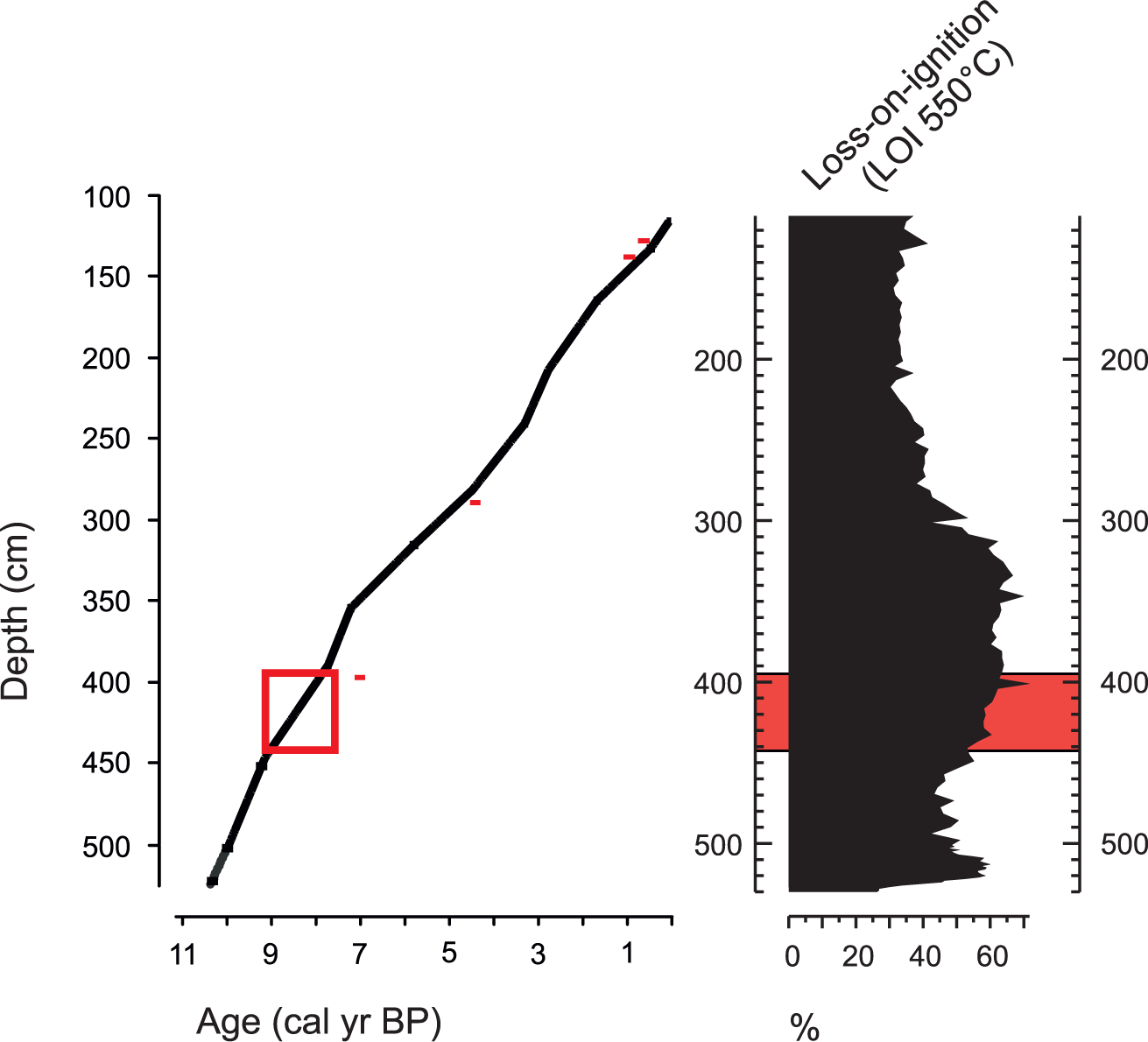
Age–depth model for the Holocene section of the Lake Brazi TDB-1 core (between 111 and 521 cm). The model is based on 12 14C dates, calibrated using CALIB Rev 6.1.0 and age–depth modeling using linear interpolation in Psimpoll 4.27. Note that the top of the sediment is at 111.14 cm; sediment depth calculation included the lake water column. Loss-on-ignition values are also shown on the right. The red rectangles (gray in the printed version) highlight the sediment section that encompasses the 8.2-ka event.
Pollen stratigraphy, pollen-inferred vegetation changes and fire history
The pollen percentage diagram is presented in Figure 4 and Supplementary Appendix 2 (available online). Figure 4 includes the major terrestrial pollen types, with particular attention to those that show distinct changes around the 8.2-ka event. Eight statistically significant local pollen assemblage zones (B-4 to B-11) were identified in the Holocene part of the record (Supplementary Appendix 2, available online). Here, we describe in detail only three pollen assemblage zones: one which predates (B-6), one which includes (B-7), and one which postdates (B-8) the 8.2-ka event (Figure 4). The main characteristics of these pollen zones, such as arboreal and non-arboreal pollen, micro- and macrocharcoal, total terrestrial pollen accumulation rates (PARs), and the dominant trees and shrubs, are summarized in Supplementary Appendix 1 (available online), while fire return intervals (FRIs) and background charcoal are displayed in Figure 5.

Changes in relative frequencies of the main pollen taxa and stomata, as well as the micro- and macrocharcoal accumulation rates, core TDB-1, Lake Brazi, Retezat Mts, Romania. Macrocharcoal accumulation rates were recalculated to constant sample interval (40 years).

Background and fire return intervals (FRIs, years between consecutive detected fire episodes) as previously quantified in Finsinger et al. (2014). Calculated on interpolated (40 years) macroscopic charcoal accumulation rates that are based on charcoal-area (CHARa) and charcoal-number (CHARc) measurements.
B-6 pollen zone, 530–436 cm, 10,450–8870 cal. yr BP
This pollen assemblage zone is characterized by high relative frequencies of arboreal pollen (91%). The percentages of P. mugo and P. abies are comparably high. P. abies attained high values (average 19%) and reached its highest value (29%) around 10,000 cal. yr BP, suggesting its abundance around the lake. This inference is corroborated by the stomata record (Figure 4), which also suggests the local abundance of P. abies along with P. cembra, P. mugo, and occasionally A. alba. The relative frequencies of P. mugo decrease (~10%) toward the end of the zone. This is also the last time when A. alba stomata are recorded (around 9300 cal. yr BP), pointing to its presence on the lakeshore. The pollen of deciduous tree taxa are found in significant quantities in the lake sediment that can be attributed to uphill transport into the subalpine and alpine zones from lower altitudes (Ortu et al., 2006). Ulmus has high relative frequencies (average 22%), but it declines at the end of the zone (12%). The dominance of Ulmus, Fraxinus excelsior, and Quercus suggests the presence of continental mixed-deciduous woodlands at lower elevation. These taxa, except Ulmus, reach their highest values around the middle of this zone. Around 9690 cal. yr BP, Corylus increases gradually and attains 23% by 8775 cal. yr BP. It is associated with the decrease in other deciduous taxa, especially Ulmus. Corylus likely expanded in the mixed-deciduous forest zone and likely also mixed with P. abies in the lower subalpine zone. Some herbaceous pollen taxa occur throughout this zone, for example, Poaceae, Sedum, and Artemisia.
The overall trends of the two charcoal records are comparable. Microcharcoal accumulation rates attain the highest values in the entire record around 9600 cal. yr BP, while macrocharcoal accumulation rates slightly later, at 9300 cal. yr BP. These peak values in association with the generally high background charcoal values and mean FRI around 1300 years (Figure 5) suggest the occurrence of local and regional fire episodes and generally higher early Holocene regional fire activity.
B-7 pollen zone, 436–334 cm, 8870–6520 cal. yr BP
This pollen assemblage zone is characterized by continuing high relative frequencies of arboreal pollen (95%). On the basis of the pollen and stomata records, the forest around the lake was dominated by P. abies with admixture of P. mugo and P. cembra as attested by the occurrence of their stomata. The absence of A. alba stomata suggests its withdrawal from the lakeshore. The pollen percentages of P. mugo rapidly decreased from values of 10% to significantly lower values at about 8700–8600 cal. yr BP. Other trees, such as Quercus, F. excelsior, and Ulmus, had stable pollen values, and we infer that they played a significant role at lower altitudes, reflecting the stability of the mixed oak forest zone. The main feature of the zone is the increasingly high pollen frequencies of Corylus (maximum 36% at 8000 cal. yr BP), suggesting its expansion in the lower altitude mixed-deciduous forest zone and likely also in the spruce zone similar to other mountain ranges in the Eastern Carpathians (Feurdean, 2005; Feurdean et al., 2008; Tanţău et al., 2011).
Macrocharcoal accumulation rate values were generally lower and showed distinct, but lower amplitude peaks than in the preceding pollen zone. The microcharcoal record showed small peaks between 7400 and 7100 cal. yr BP and distinct peaks in the high-resolution section spanning across the 8.2-ka event. Interestingly, the two charcoal records showed different patterns around the 8.2-ka event: whereas macrocharcoal accumulation rates were high between 8450 and 8300 cal. yr BP (see also the lowest FRI values on Figure 5 around 8500–8300 cal. yr BP; 100–200 years) and thereafter rapidly declined until 7700 cal. yr BP, five large microcharcoal peaks were detected between 8300 and 8050 cal. yr BP. This likely suggests that although regional fire activity increased between 8300 and 8050 cal. yr BP, the surroundings of Lake Brazi were not affected by local forest fires at that time. In association with the 8.2-ka event, we found characteristic changes in the relative frequencies and PARs of several deciduous trees, shrubs, and herbs (Figure 6). Monolete fern spores and Poaceae show distinct pollen percentage and PAR peaks during most of the microcharcoal peaks, suggesting the opening up of the vegetation and early succession after the forest fires, likely at lower altitudes. The percentages of deciduous pollen taxa (Quercus, F. excelsior, Ulmus) show comparable declines; however, PAR values increase along with microcharcoal peaks between 8300 and 8200 cal. yr BP. Since this increase is present in nearly all pollen taxa, this likely does not indicate real population increases, but an abrupt change in sediment accumulation rates.

Changes in (a) pollen percentages and (b) pollen accumulation rates of the selected pollen taxa, micro- and macrocharcoal accumulation rates between 8000 and 8500 cal. yr BP from Lake Brazi, core TDB-1.
The stomata record attests to changes in the local vegetation around the 8.2-ka event as well (Figure 4). Around 8250 cal. yr BP, P. abies stomata temporarily disappeared, while P. cembra stomata reached maximum relative frequencies. Around 8150 cal. yr BP, the relative frequencies and PARs of Carpinus betulus increased temporarily (from 1% to 6%), suggesting its rapid short-lived population expansion at lower altitudes between 8200 and 8100 cal. yr BP. C. betulus likely colonized forest openings. However, it seems to have failed expanding further, as pollen percentages decreased rapidly back to values <1%. During this interval, two other taxa, Corylus and F. excelsior, showed significant relative frequency decreases. If we look at their PAR values (Figure 6), it becomes clear that F. excelsior showed real population size decrease, while Corylus populations likely did not decrease on the northern slope since its percentage decrease is not accompanied by PAR decline; on the contrary, PAR values increase, suggesting minor population increase. Also, a typical feature of this pollen zone was the episodic occurrence and pollen percentage increase in C. betulus three more times: at 8750, 8550, and 7500 cal. yr BP. These episodic increases were associated with Corylus declines, suggesting that the short-term growth of C. betulus was likely connected to forest disturbances, but these were not always associated with detectable fire events.
B-8 pollen zone, 334–291 cm, 6520–4920 cal. yr BP
Total arboreal pollen percentages remained high in this zone. P. abies, Pinus Subgenus Haploxylon, and P. Subgenus Diploxylon pollen frequencies were stable, suggesting stable vegetation composition around the lake with the stomata-inferred dominance of P. abies and P. cembra. Pollen frequency changes furthermore suggested that C. betulus expanded at lower altitudes from 6640 cal. yr BP onward (see Supplementary Appendix 1, available online). Both local and regional fire activity decreased as attested by the increasing FRI and decreasing background charcoal values (Figure 5).
Macrofossil-inferred local vegetation between 9100 and 6900 cal. yr BP
According to the macrofossil diagram (Figure 7), three conifer species were present around the lake between 9100 and 6900 cal. yr BP: P. abies, P. mugo, and P. cembra. Macrofossils of two more conifer species, Larix decidua and A. alba, were present prior to 9900 cal. yr BP, suggesting that the early Holocene forest around Lake Brazi was species rich, and likely had a more open character.

Changes in the concentration of woody plant macrofossils between 4900 and 10,500 cal. yr BP in core TDB-1, Lake Brazi, Romania.
P. abies was the most abundant in the studied period, pointing to its dominance on the lakeshore. P. mugo needles were found in low concentration; however, its male blossoms were more abundant, suggesting continuous presence. P. cembra needles were found less regularly without other vegetative parts, suggesting low abundance on the lakeshore. Around 8200 cal. yr BP, compositional change was not seen in the macrofossil record; P. abies bud scales attained exceptionally high concentration at 8300 cal. yr BP; this peak, however, represents a loose bud in the sample. The only notable changes are the temporary disappearance of P. mugo after 8200 cal. yr BP, between 8000 and 7800 cal. yr BP, and the absence of P. cembra between 8700 and 8050 cal. yr BP. The stomata-inferred increase in P. cembra and decrease in P. abies around 8250 cal. yr BP are not supported by the macrofossil record; only P. abies shows slightly decreased concentrations. Note, however, that the macrofossil record has lower time-resolution. P. abies concentrations increase steadily from 8130 cal. yr BP, likely indicating denser spruce forests around the lake after this time.
LOI, BiSi, and siliceous algae records
The siliceous algae record is presented in Figure 8 along with DI-pH, C:D ratio, BiSi, LOI, and major diatom life form groups. Here, we describe two diatom assemblage zones (DAZ-8 and DAZ-9; Buczkó et al., 2013), of which the first one precedes and the second one includes the 8.2-ka event. Changes in LOI and BiSi are also discussed.

Relative frequencies of selected diatom taxa, loss-on-ignition, biogenic silica, diatom life form groups, and Chrysophyte:Diatom (C:D) ratios from Lake Brazi, core TDB-1. On the right, diatom-inferred pH (DI-pH) values are also shown. DAZ: Diatom Assemblage Zone. Aulacoseira valida and Aulacoseira pfaffiana relative frequency curves have blue fillings (gray in the printed version); these two planktonic/tychoplanktonic taxa show the strongest response at the 8.2-ka event.
DAZ-8, 482–437 cm, 9650–8890 cal. yr BP
Diatom assemblages with relatively low number of species (average 21.8 ± 5.5; minimum 15; maximum 26) are typical in this zone. Stauroforma exiguiformis is the dominant taxon and often reaches relative frequencies around 80%. Aulacoseira alpigena is also a persistent element of the diatom assemblages; its abundance shows a slow increase at the end of this zone. LOI values are ~50% (44–55%), BiSi is ~15% (13–18%), and DI-pH is around 6.3–6.9, indicating slightly acidic water.
DAZ-9, 437–320 cm, 8890–6000 cal. yr BP
After 8900 cal. yr BP, several distinct changes appear in the diatom composition. Diversity increases (average number of taxa 27.8 ± 4.8; minimum 18; maximum 37). Several species appear for the first time and remain present afterward, for example, Psammothidium curtissimum, Aulacoseira pfaffiana, A. valida. On the other hand, S. exiguiformis decreases after 9070 cal. yr BP and attains a minimum at 8150 cal. yr BP (~5%). An important feature of this zone is the local maximum of A. valida (~20%) at 8150 cal. yr BP that coincides with the minimum percentage of S. exiguiformis. A. pfaffiana appears abruptly at 8150 cal. yr BP. Staurosira venter shows temporary decrease at the same time, but after that it reaches maximum values around 8100 cal. yr BP (~42%). LOI values increase from 55% to ~60% at the beginning of the zone with a single peak value (70%) at 8000 cal. yr BP. Notable is that BiSi values decrease gradually between 8900 and 8100 cal. yr BP, with a local minimum at 8000 cal. yr BP, and values are between 6% and 8% during the 8.2-ka event. DI-pH values (6.6–6.9) indicate slightly acidic water in this zone. Further rapid changes in this zone involve the increase in planktonic/tychoplanktonic diatoms and C:D ratios at 8150 cal. yr BP along with the increase in A. valida.
Discussion
Interpretation of the ecosystem changes around the 8.2-ka event
The high-resolution pollen, stomata, and charcoal records allowed identifying distinct vegetation composition changes in the Retezat Mts during the studied RCC event. The early Holocene forest between c. 9600 and 8900 cal. yr BP was composed of P. abies, P. cembra, and P. mugo around Lake Brazi likely with a minor admixture of A. alba. Since this latter tree species has an upper elevation limit of 1400 m in the Retezat today (Nyárádi, 1958), we infer that summer temperatures were higher than at present in the Retezat in this period, likely in association with higher than present summer insolation (Berger and Loutre, 1991; Feurdean et al., 2013). At lower altitudes, mixed-deciduous forests were dominated by Ulmus, Quercus, Tilia, and F. excelsior. A major compositional change occurred around 8900 cal. yr BP. The increase in Corylus pollen suggests the formation of a Corylus dominated mixed open forest zone. The spread of Corylus around 9500 cal. yr BP, which displays in the continental interior of Europe an altogether different pattern compared with Northwest Europe (Giesecke et al., 2011), was detected in several other Carpathian pollen diagrams (Feurdean, 2005; Feurdean et al., 2013; Tanţău et al., 2011) and was connected to macroclimate change (Feurdean et al., 2008). Finsinger et al. (2006) found a positive correlation between the increase in Corylus pollen and fire activity in the Southern Alps. The coincidence between the prominent peak in the micro- and macrocharcoal records and the onset of the Corylus pollen increase in the Retezat Mts around 9500 cal. yr BP (Figure 4) may suggest that fires possibly played an important role in the initial population expansion of the light-demanding Corylus. However, the charcoal record does not support the view that fires played an important role in the long-term population increase that peaked about 1500 years later, as suggested by Huntley (1993). Despite the decreasing trend of the summer insolation curve after 9500 cal. yr BP, a chironomid-based summer temperature reconstruction from the same sediment record indicates that July temperatures were highest between 9500 and 8700 cal. yr BP (Tóth et al., 2015). We may thus hypothesize that warmer/drier summers were sufficient to favor the expansion of Corylus even in the absence of higher fire activity.
Within this Picea–Corylus dominated pollen phase, distinct changes occurred between c. 8300 and 8100 cal. yr BP, when microcharcoal accumulation rates increased repeatedly, without marked macrocharcoal increases, suggesting episodic forest fires in the region, likely in the lower elevation mixed-deciduous forest zone, but lower fire activity around the lake. Moreover, we found ambiguous changes in the representation of P. cembra around the lake with the stomata record indicating its increasing abundance, while the macrofossil record suggested sporadic appearance. The increase in C. betulus at ~8150 cal. yr BP occurred coincidently with the third microcharcoal peak, but the appearance and first increase in C. betulus were coincident with the first microcharcoal accumulation peak at 8300 cal. yr BP (Figures 4 and 6), and some of its earlier and later temporary appearances also coincided with increased micro- and macrocharcoal intervals (e.g. at 7600, 8500, and 10,900 cal. yr BP, but not at 8750 cal. yr BP; see Figure 4 and Supplementary Appendix 2, available online). One possible interpretation of these changes is that C. betulus colonized the forest openings of the mixed-deciduous forests, but was soon overtaken by Corylus and F. excelsior as its PAR values and relative frequencies both decreased. Alternatively, the closure of the forest openings decreased its pollen production and uphill pollen transport in low fire activity periods; hence, it became less visible in the subalpine pollen record.
In the context of the 8.2-ka RCC event, the coincident vegetation response was the short-lived further expansion of C. betulus. It is evident from the organic content, vegetation (Figure 8), and chironomid-inferred July temperature records of the same deposit (Tóth et al., 2015) that the 8.2-ka event is incised in the most productive, warmest summer interval of the Holocene in the Retezat Mts, when reconstructed July temperatures were 1.5–1.9°C above modern values. In this context, the temporary expansion of C. betulus can be interpreted in two alternative ways. According to the first interpretation, increased forest fire activity and secondary succession in the forest areas affected by fire facilitated the establishment and temporary expansion of C. betulus on the northern slopes of the Retezat Mts from 8300 cal. yr BP. Studies on fire sensitivity have shown that C. betulus generally benefits from ground fires (Tinner et al., 2000). As it was favored against F. excelsior and Corylus avellana that are also early successional, fire-adapted species, other interspecific competitions, or climatic factors might have also played a role in the temporary increase in C. betulus at 8150 cal. yr BP and also at the earlier temporary expansion. Bioclimatic parameters of the affected woody species suggest that C. betulus has the lowest tolerance to winter cold (Tc min: −8°C), while its drought resistance is weaker than the other two species (α* = 0.7 against 0.65 for F. excelsior and 0.55 for C. avellana; Sykes et al., 1996). These parameters suggest that the temporary expansion of C. betulus during the 8.2-ka climatic anomaly was likely a response to increasing moisture availability between 8200 and 8100 cal. yr BP, the interpretation of which is supported by the coincident increase in planktonic/tychoplanktonic diatoms suggesting water-level increase in the same period. Under this scenario, the role of the repeated regional forest fires was the creation of space for its early establishment (~8300 cal. yr BP), while the subsequent increase in available moisture helped its temporary spread. This interpretation is also supported by the macrocharcoal record that shows low fire activity between 8300 and 7800 cal. yr BP (average fire return interval increased from 200–300 years to 1200 years, Figure 5) that may be related to moister summer conditions in the subalpine zone during the 8.2-ka event. As far as the summer temperatures are concerned, the chironomid-inferred July temperature reconstruction from Lake Brazi does not indicate decrease around 8200 cal. yr BP, but before, between 8700 and 8500 cal. yr BP, when C. betulus showed also episodic advances at two times, while the diatom-based δ18O record indicated winter moisture increase between 9000 and 8500 cal. yr BP (Magyari et al., 2013; Tóth et al., 2015). Note, however, that the resolution of the δ18ODIAT and chironomid reconstructions is much lower (~80 years) than the pollen, diatom, and charcoal records (~20–25 years). The terrestrial proxies-based interpretation of the ecosystem and climatic changes around the 8.2-ka event is also supported by coincident changes in the lake ecosystem. The high-resolution proxy records for organic and BiSi content and for diatom compositional change (Figure 8) suggest that the 8.2-ka event disrupted or ended a phase of decreasing diatom production (indicated by decreasing BiSi values) between 8900 and 8250 cal. yr BP. Second, the temporary increase in planktonic/tychoplanktonic diatoms at ~8150 cal. yr BP, exactly at the time when C. betulus pollen increased, suggests that during the major diatom bloom period in spring the lake had high turbulence and increased water depth, which is inferred from the rapid increase in A. valida. An increase in this floating and strongly silicified diatom species has also been detected in North American lake deposits during the 8.2-ka event, where it was also interpreted to be indicative of water turbulence and/or increased water depths in spring (Spooner et al., 2002). Moreover, a recently built training set, based on diatom distribution in 40 South Carpathian lakes, clearly shows positive and significant correlation between increasing water depth and increasing relative frequencies of A. valida (Buczkó, unpublished) further supporting that the temporary increase in A. valida indicates water depth increase at ~8150 cal. yr BP. On the other hand, increasing water turbulence may also explain the increase in A. valida without an accompanying water-level increase, as it was formerly discussed in Buczkó et al. (2013) using examples from prairie lakes in North America. However, a local training set was not yet available at that time. All in all, the diatom data suggest that during the spring season, the lake received increased water discharge (either by increasing spring rainfall or snowmelt) at the same time when vegetation reorganization pointed to increasing moisture availability. The proxy records also suggest that after this short episode, the lake system reverted to benthic diatom assemblages, decreased BiSi, and increasing LOI values, all suggesting rapid decrease in water depth and expanding lakeshore mire vegetation. It may also be inferred from these data that available moisture likely increased in the early part of the vegetation season, while at least in some years late summers were warm and dry allowing for the prevalence of occasional fires in the region.
Although the above interpretation of the high-resolution proxy records is convincing since terrestrial and lake proxies are in agreement, we cannot exclude an alternative explanation of the short-lived C. betulus expansion between 8200 and 8100 cal. yr BP. Although we pointed out some differences in the climatic tolerance of the woody species that showed relative frequency and accumulation rate changes during the short climatic perturbation, the difference between the available moisture tolerance of the two most antagonistically behaving species, F. excelsior and C. betulus, is relatively little. F. excelsior is often more abundant in wet alluvial soils, given its tolerance to seasonal inundation (Borhidi et al., 2012), but it is also a characteristic component of low-built scree forests in the Carpathian foreland that are exposed to strong winds, high summer insolation, and poor soils, that is, extreme habitats (Borhidi et al., 2012). Furthermore, F. excelsior requires less accumulated heath during the vegetation season and tolerates lower winter temperatures than C. betulus – these properties allow the species to expand much further north in Europe (Sykes et al., 1996). Therefore, the expected cooling at 8200 cal. yr BP is unlikely to have been the main factor alone that favored the expansion of C. betulus (Alley et al., 1997; Wiersma and Renssen, 2006). We discussed above that C. betulus benefits from increasing soil moisture, while the light-demanding F. excelsior and C. avellana can better cope with enduring drought stress under strongly continental climatic conditions that characterized the early Holocene in the Carpathians (Feurdean et al., 2013). Climate simulations suggest that early summers were up to 4°C warmer and much drier in the Carpathian region in the early Holocene (Feurdean et al., 2013). C. betulus cannot cope with hot and dry summers, but its seedlings are light-demanding; therefore, its establishment requires canopy gaps that were overall frequently provided in the early Holocene high fire activity and low fire return interval ecosystems of the Carpathian region (Feurdean et al., 2012, 2013; Finsinger et al., 2014). So an alternative explanation of the short-lived spread of C. betulus at 8200 cal. yr BP can be the alteration of relatively dry/warm summer years that triggered canopy fires with cool/moist summer years that in association with the gradually increasing winter temperatures enabled the (1) establishment and (2) temporary spread of C. betulus at low–mid altitudes. This second alternative interpretation of the proxy records differs from the first in emphasizing the complexity of the climate change that involved alternating warm/dry summer years and cool/moist summer years during the 8.2-ka event. Irrespective of which data interpretation is accepted, the main increment of the climatic perturbation was the establishment and temporary expansion of a new canopy component in the early Holocene forests, which finding agrees well with the conclusion of other studies (Tinner and Lotter, 2006) that pointed out the importance of short-lived climatic perturbations in the establishment of new canopy components in climax forests.
Regional comparisons
The onset of the increased regional biomass-burning rates in the deciduous forest zone of the Retezat Mts at ~8300 cal. yr BP predates the maximum cooling of 3.3 ± 1.1°C in Greenland at c. 8175 cal. yr BP (Kobashi et al., 2007), but agrees with the outburst date of Lake Agassiz, 8470 ± 300 cal. yr BP (Hillaire-Marcel et al., 2007), even when we take into account the age–depth model’s uncertainty (Figure 3). The spread of C. betulus and increase in the planktonic A. valida at 8150 cal. yr BP, on the other hand, lag maximum cooling above Greenland only by 25 years, which is within the dating uncertainty of the Lake Brazi record. Overall, the terrestrial ecosystem changes in the Retezat Mts seem to start around 8300 cal. yr BP and culminate at 8150 cal. yr BP, which timing is consistent with several other European biotic proxy records. For example, a high-resolution isotopic record and sedimentological changes in a Danish lake (Bjerring et al., 2013) also found a two-stage lake-level response around the 8.2-ka climatic anomaly. Their results indicated a lake-level decrease followed by an abrupt increase, with both events taking place within the window of 8390–8210 cal. yr BP. Since their results partially disagreed with Magny’s inference of increased humidity during the 8.2-ka event in Northern Europe (Figure 1). Bjerring et al. (2013) concluded that the hydrological effects of the 8.2-ka event may be substantially more complex than suggested by the latitudinal borders. In a Swedish lake (Lake Kälsjön), the increase in Aulacoseira species in the planktonic diatom assemblages was dated between 8500 and 8200 cal. yr BP and was explained by wind-induced turbulence (Randsalu-Wendrup et al., 2012) similarly to Lake Brazi, but over a prolonged time interval. Cooling was inferred from the spread of a centric planktonic diatom at c. 8200 cal. yr BP as well as from the temporary decrease in Betula and Pinus PARs.
Comparing the vegetation responses established in this study to the climatic anomaly with similar records from Europe reveals several similarities with responses in the Carpathians and Balkans (Feurdean et al., 2008; Panagiotopoulos et al., 2013), but antagonistic vegetation changes in Northern and Northwestern Europe all emphasizing the role of cooling further north and west (Kofler et al., 2005; Ralska-Jasiewiczowa et al., 1998; Seppä, 1998, 2007; Tinner and Lotter, 2001; Veski et al., 2004).
In Northern Europe, the pollen influx decline of spring-temperature sensitive trees was recorded in Lake Rõuge in Estonia between 8250 and 8150 cal. yr BP with a simultaneous increase in Betula accumulation rates suggesting lower temperatures in early spring (Veski et al., 2004). This inference was also corroborated by quantitative pollen-based climate reconstruction that showed a 2°C drop in annual mean temperatures. Seppä et al. (2007) found a major decrease in pollen percentages of thermophilous tree taxa (especially Corylus, Alnus, and Ulmus) south of 61°N and interpreted it as reflecting decreasing temperature in spring. These data suggest that Northern and Northeastern Europe experienced climate cooling during the 8.2-ka event, consistently with general circulation modeling results (Wiersma et al., 2011).
Further south in the Alps, the pollen percentage of Corylus decreased significantly (from 40% to 16%) and large-scale expansion of Pinus, Betula, Tilia, Fagus sylvatica, and A. alba was detected at Soppensee and Schleinsee (Tinner and Lotter, 2001). The authors suggested that climatic cooling reduced drought stress and this allowed more drought-sensitive and taller growing species to out-compete C. avellana by forming denser forest canopies. This vegetation reorganization had a long-lasting consequence and suggested increasing available moisture during the vegetation season, partially in agreement with our results in the South Carpathians for the period limited to the 8.2-ka event. However, while at Soppensee charcoal was not correlated with pollen, the microcharcoal record from Lake Brazi shows good correlations with some of the pollen types, suggesting causal relationships between episodic fires and vegetation composition between 8355 and 8000 cal. yr BP. Furthermore, the terrestrial vegetation response was much stronger in the Alps and involved the expansion of five tree species, all pointing to cooler and moister summer conditions, while in the South Carpathians we found the expansion of a single tree species (C. betulus) that attested to modest available moisture increase, but no significant summer temperature decrease could be inferred from its spread. We infer from this comparison that the differences in the terrestrial vegetation response between the two large European mountain ranges are attributable to their different continentality levels; summer cooling in the Alps was likely more significant during the 8.2-ka event leading to the expansion of tall-growing but cool-summer tree species, while in the South Carpathians the expanding tree species suggested the alteration of warm/dry summer years with cool/moist summers and available moisture increase in the early part of the vegetation season. More significant cooling in the Alps is also attested by stalagmite oxygen isotope data (e.g. Boch et al., 2009) that indicate rapid cooling by ~3°C at 8175 cal. yr BP.
Pollen and plant macrofossil records that show similar changes to Lake Brazi include the Steregoiu peat bog in the Northwest Carpathians, where the pollen records suggested that between 8300 and 8400 cal. yr BP, P. abies, Ulmus, and Corylus increased in combination with the episodic expansion of Fagus sylvatica (Feurdean and Bennike, 2004; Feurdean et al., 2008). The latter species has similar ecological requirements to C. betulus, but it is late successional and has higher moisture requirement. These findings suggest more significant moisture availability increase in NW Romania during the 8.2-ka climatic oscillation, which inference is well supported by the climatic differences between the two areas. The mountains of NW Romania are influenced more strongly by the Atlantic westerlies and less by Mediterranean water sources (Drăguşin et al., 2014), which difference means that in times of intensifying westerly circulation, this area receives more precipitation from the Atlantic ocean. Another NW Romanian low altitude site that showed vegetation response around 8200 cal. yr BP is Turbuta. Here, the temporary spread of C. betulus shows up in the pollen record around 8200 cal. yr BP, similarly to Lake Brazi, but the authors do not interpret this pollen compositional change (Feurdean et al., 2007). Similarly to Brazi, the episodic expansion of C. betulus likely responds to forests disturbance at low altitude and the species was likely facilitated by increased winter/spring moisture in this area.
In connection with the fire events, a recent Holocene fire regime study from lowland Transylvania clearly showed that the 8.2-ka event appeared in an early Holocene fire zone (10,100–7100 cal. yr BP) that was characterized by frequent high-intensity fires (mean fire return interval: 112 years, fire frequency: 9 fires/100 years; see Feurdean et al., 2013). This study also showed modeled early summer temperatures with the highest values between 11,500 and 8300 cal. yr BP, that is, the driest/warmest summer interval ended by the time of the 8.2-ka event. Although fire activity was high before 8200 cal. yr BP, this study recognized the 8.2-ka event as a short-lived decline in biomass burning that the authors associated with cool/moist summers. It is notable that these inferences are based on the macrocharcoal record that agrees well with the Lake Brazi macrocharcoal record and suggest decreasing fire activity in the vicinity of both sites. Other Holocene RCC events were also recognized as low fire intervals (e.g. 4200, 2800 cal. BP) by Feurdean et al. (2013) and associated with cool/moist summers. Overall, the regional picture of fire histories seems to be consistent when the same proxies are applied, but the Lake Brazi microcharcoal record deviates, and at least in the Retezat Mts suggests the episodic occurrence of fires during the 8.2-ka event. Climatic changes around the 8.2-ka event have also been inferred from stalagmite isotope records in the Romanian Carpathians. These show a minor decrease or no significant change in δ18O composition (e.g. Ursilor and V11 caves in Romania; Onac et al., 2002; Tămaş et al., 2005), suggesting no significant change in annual temperatures. However, δ13C values increased in the V11 and Sofular Caves, the latter of which is located further south in the southern Black Sea coast. This record was interpreted as being indicative of a prominent decrease in moisture availability over a prolonged time interval from c. 8400 to 7800 BP (Göktürk et al., 2011). This period agrees well with increased organic content in Lake Brazi, what we interpreted as a trend of gradually decreasing lake levels in the same period. However, we detected a short and modest lake-level increase within this period, at 8150 cal. yr BP; a correspondent decrease in δ13C values is, however, missing in the Sofular record (Göktürk et al., 2011), suggesting that springs were not moister during the 8.2-ka event in the southern Black Sea coast. In summary, the isotopic records from the region suggest that the 8.2-ka event appears within a longer dry period in the southern Black Sea area and remains undetectable in the isotope records.
Finally, we mention the findings of pollen and diatom studies from the Rila Mountains that are located south of the Retezat (Figure 1). These mountains are under relatively strong Mediterranean climatic influence, but still receive precipitation from Atlantic water sources (Tonkov et al., 2008). In these mountains, a short-term steep decline was detected in arboreal PARs at 8230 cal. yr BP, mainly in Pinus Subgenus Diploxylon, suggesting either dying or depressed flowering of pine trees and shrubs at high altitude in this period (Tonkov et al., 2016). In addition to this likely direct vegetation response, A. alba expanded directly after 8200 cal. yr BP, and vegetation disturbance around 8200 cal. yr BP likely facilitated its expansion (Tonkov et al., 2008). Since A. alba is the most demanding species regarding its moisture requirement among conifers (Tinner and Lotter, 2001; Tonkov et al., 2008), these data suggest that the Rila Mts also experienced climatic cooling and associated available moisture increase during the 8.2-ka event, which facilitated the spread of the more moisture demanding late successional A. alba. Climatic conditions after the 8.2-ka event, however, likely remained less continental in the Rila, further helping the advance of A. alba. It is also notable that A. alpigena, the planktonic diatom species showing the strongest response in lake Brazi at 8150 cal. yr BP, increased in abundance in Lake Sedmo Rilsko (2250 m a.s.l.; Lotter and Hofmann, 2003) around 4500 cal. yr BP. Although its increased abundance was longer lasting and appeared much later than the 8.2-ka event, it was associated with the expansion of Fagus sylvatica and increasing diatom productivity in the Rila Mts, and the authors interpreted these changes as indicative of increasing moisture availability (Lotter and Hofmann, 2003), which interpretation agrees well with our inference at Lake Brazi.
Did available moisture increase in the South Carpathians during the 8.2-ka event? Testing the hypothesis of Magny (2007)
The interpretation of the 8.2-ka event is complicated by the fact that both temperature and hydrological conditions appear to have been altered; therefore, it is difficult to disentangle whether hydrological or temperature changes are the main source of available moisture changes during this event. Since most early Holocene Central European hydrological studies agree on that water levels in lakes of forested regions were controlled primarily by winter precipitation (Carcaillet and Richard, 2000; Roberts, 1998) and a recently published diatom oxygen isotope record from Lake Brazi (Magyari et al., 2013) also suggests that fluctuation in the δ18ODIAT values reflects alternating contribution by winter precipitation, we can safely infer that as long as the planktonic/tychoplanktonic diatom maximum indicates water-level increase at 8150 cal. yr BP in Lake Brazi, it was a response to increased winter/spring precipitation. This interpretation would agree with Magny’s meta-analysis results of lake-level anomalies in Europe around the 8.2-ka event that indicated a more humid climate accompanied by lake-level increases in mid-Central Europe (Figure 1, see Magny et al., 2003). It is obvious, however, that our lake proxies are strongly skewed toward the winter half year, whereas the terrestrial proxies are skewed toward the vegetation season (mainly summer), and the two systems show slightly different change. Our inference from this result mirrors the conclusion of Bjerring et al. (2013) that climate change was more complex and likely seasonally different during the climatic anomaly. This inference is also supported by the pollen studies of Seppä et al. (2007) that showed a strong vegetation response in Northern Europe up to 61°N, but no response in the sub-arctic areas. They suggested that this might be explained by cooling mostly during the winter and spring, to which the ecosystems in the south responded sensitively since cooling occurred at the onset of the growing season. In contrast, in the sub-arctic area, where the vegetation remains dormant longer, the cold event is not reflected in pollen-based or lake sediment–based records. Such interpretation is consistent with our results, but our proxies rather sensitively showed the changes in available moisture during winter/spring in positive direction.
Overall, if the increase in planktonic diatoms at 8200 cal. yr BP was not merely the result of increasing wind turbulence but a response to increased water depth, then our biotic proxy-based climatic and lake-level inferences support Magny’s interpretation of this climatic anomaly in that we infer increasing lake levels in the mid-European sector. However, we argue on the basis of our other biotic proxies (pollen and charcoal) that this lake-level rise principally resulted from increased precipitation during winter or spring, which was followed by alternating dry and moist summers, that is, the continentality of the area was maintained, but there were climatic years with weaker continentality, or available moisture increased mainly in the early part of the vegetation season.
Conclusion
We provide in this study high-resolution multi-proxy analyses on a South Carpathian mountain lake sediment profile in order to study biotic responses of the mountain vegetation to the 8.2-ka climatic oscillation. We show that significant changes both in terrestrial vegetation and lake diatom assemblages appeared between c. 8300 and 8000 cal. yr BP and involved the short-lived spread of C. betulus and A. valida in association with regional fire events. Ecosystem responses overall suggest that water depth and turbulence increased at 8150 cal. yr BP in Lake Brazi in response to increased winter/spring precipitation. Terrestrial vegetation disturbance mainly took place in the mixed-deciduous forest zone, where woodland fires partially destroyed the populations of F. excelsior, Quercus, and C. avellana, and facilitated the establishment of C. betulus in the forest openings.
We conclude that during the 8.2-ka event, winter and spring season available moisture increased, while summers were characterized by alternating moist/cool and dry/warm conditions in this region.
Our results are relevant for predicting vegetation and lake responses to the expected future climate warming. Climate models project weaker summer precipitation as well as higher summer temperatures for the next century in Eastern Central Europe (Beniston et al., 2007; Kjellström et al., 2007; Lorenzoni and Pidgeon, 2006). Our results suggest that the most critical issue in the mid-altitude forested regions will likely be the increasing abundance and intensity of forest fires that may lead to significant vegetation reorganization in the deciduous forest zone of the Carpathians.
Footnotes
Acknowledgements
We are thankful to Jordan Fevre for carrying out the macrocharcoal analysis. This is MTA-MTM-ELTE Paleo contribution no. 183.
Funding
This study was supported by OTKA NF 101362, K 83999, the Bolyai Scholarship (held by Enikő Magyari), the Humboldt fellowship (held by Enikő Magyari), and the French ANR (project OBRESOC; ANR-09-CEP-004-01/OBRESOC).