



Abstract
Deciphering the climate changes that influenced the glacial fluctuations of the last millennium requires documenting the spatial and temporal patterns of these glacial events. Here, we estimate the change in equilibrium line altitudes (ELAs) between the most prominent glacial advance of the last millennium and the present for four alpine glaciers located in different climatic regimes along the Andes. For each glacier, we reconstruct scenarios of climatic conditions (temperature and precipitation anomalies) that accommodate the observed ELA changes. We focus on the following glaciers: an alpine glacier in the Cordillera Vilcanota (13°S), Tapado glacier (30°S), Cipreses glacier (34°S), and Tranquilo glacier (47°S). Our results show that the range of possible temperature and precipitation anomalies that accommodate the observed ELA changes overlap significantly at three of the four sites (i.e. Vilcanota, Cipreses, and Tranquilo). Only Tapado glacier exhibits a set of climate anomalies that differs from the other three sites. Assuming no change in precipitation, the estimated ELA changes require a cooling of at least 0.7°C in the Cordillera Vilcanota, 1.0°C at Tapado glacier, 0.6°C at Cipreses glacier, and 0.7°C at Tranquilo glacier. Conversely, assuming no change in temperature, the estimated ELA changes are explained by increases in precipitation exceeding 0.52 m yr−1 (64% of the annual precipitation) in the Cordillera Vilcanota, 0.31 m yr−1 (89%) at Tapado glacier, 0.22 m yr−1 (27%) at Cipreses glacier, and 0.3 m yr−1 (27%) at Tranquilo glacier. By mapping the ELA changes and modeling the potential climate forcing across diverse climate settings, we aim to contribute toward documenting the spatial variability of climate conditions during the last millennium, a key step to decipher the mechanisms underlying the glacial fluctuation that occurred during this period.
Keywords
Introduction
It has been recognized that during the last millennium, glaciers worldwide experienced major advances (e.g. Grove, 2004; Porter and Denton, 1967). Although, in both hemispheres, these glacial fluctuations broadly coincide with the European ‘Little Ice Age’ (AD 1850–1250) (Osborn and Briffa, 2006), at a centennial/decadal time scale, the inter-hemispheric synchrony of these glacial events is still under debate (Solomina et al., 2016). Thus, despite significant research efforts, the pattern, timing, and cause of these glacial fluctuations still remain elusive. Among the predominant hypotheses to explain the climatic changes underlying these glacial events are (1) reduction of solar irradiance (e.g. Denton and Karlén, 1973), (2) volcanism (e.g. Miller et al., 2012), (3) reorganization of the ocean circulation systems (e.g. Broecker, 2000), (4) large-scale climate internal variability (e.g. Moreno et al., 2014), or (5) some combination of the above. A comprehensive understanding of the spatial pattern of climate change during the last millennium is a key step for examining these hypotheses.
A multi-proxy global reconstruction of climate shows that the temperatures between CE 1400 and 1700 (the coldest period during the last millennium) exhibit a significant spatial variability (Mann et al., 2009). In this climate reconstruction, as in many others, the Southern Hemisphere is still underrepresented. Paleoclimatic archives from South America (e.g. Boninsegna et al., 2009; Christie et al., 2011; Le Quesne et al., 2009; Masiokas et al., 2006; Morales et al., 2011; Moy et al., 2009; Villalba, 1994) are being integrated into preliminary reconstructions (Neukom et al., 2010, 2011). However, existing proxy records are spatially restricted, especially at high elevations.
Glacier systems offer one way to expand the network of proxy records of the last millennium climate in the Southern Hemisphere since they are distributed along the entire Andes (Pfeffer et al., 2014) and have been shown to be sensitive indicators of climate change (Dyurgerov and Meier, 2000; Leclercq et al., 2014). Unfortunately, the records of glacial fluctuations during the last millennium in the Southern Hemisphere are relatively scarce and have an uneven spatial distribution (Grove, 2004; Jomelli et al., 2009; Masiokas et al., 2009). Furthermore, reconstructing past climates based on the glacial record has been hindered because it has been shown that glaciers located in different climatic regimes may respond with differing magnitudes to similar climatic perturbations (Favier et al., 2004; Kaser, 2001; Sagredo et al., 2014; Seltzer, 1994).
Here, we outline an approach to address these issues and reconstruct climate scenarios during the last millennium (temperature and precipitation), using alpine glaciers located in four different climatic regimes along the Andes. With this study, we aim to understand the spatial variability of equilibrium line altitude (ELA) changes and associated climate conditions during this time period. A comprehensive mapping of these variables, based on network of sites and along a wide range of latitudes, is critical for testing hypotheses regarding the mechanisms underlying the glacial events that occurred during the last millennium.
Study areas
The Andes extend for 9000 km through western South America, spanning a broad range of latitudes and altitudes, which in turn encompasses a large range of climatic conditions (Garreaud et al., 2009). Based on statistical analyses (i.e. cluster and principal component analysis) of temperature, precipitation, and humidity, Sagredo and Lowell (2012) classified the glacierized regions of the Andes into seven distinct climatic groups (Figure 1). Modeling experiments show that each of these groups has a distinctive response to perturbations in temperature and precipitation (Sagredo et al., 2014). Here, we report on glacier reconstructions from four of these climatic groups: Cordillera Vilcanota (13°S) located in the outer tropics, Tapado glacier (30°S) in the subtropics, Cipreses glacier (34°S) in northernmost mid-latitudes, and Tranquilo glacier (47°S) in central Patagonia (Figures 1 and 2). These glaciers were part of the sample used by Sagredo and Lowell (2012) to define the climate groups, and are considered to be climatically representative of their region. To minimize local influences, these sites were selected based on the following criteria: (1) small valley glaciers, with faster response time to climate change; (2) simple geometry, minimizing the number of tributaries; (3) accessibility; and (4) independence from major ice bodies (i.e. ice fields or ice caps). Table 1 summarizes the main characteristics of the study sites.

Classification of Andean glaciers (modified from Sagredo and Lowell, 2012). The sample includes 234 glaciers distributed throughout the Andes (12°30′N–55°S). Each dot represents a single glacier. Plots (in matching colors) represent mean climatic conditions within each group. The horizontal axis represents the month of the years. The bars represent monthly precipitation (mm), solid lines show mean monthly temperature (°C), and dashed lines represent mean monthly humidity (%). All climatic information was extracted from CRU CL 2.0 climate model, 10′ latitude/longitude resolution (New et al., 2002). Study sites are represented by the stars. Numbers represent sites used in the discussion (1: Cordillera Real, Bolivia; 2: Cordillera Blanca, Peru; and 3: El Peñón and El Azufre glaciers, Argentina).

Study sites: (a) Cordillera Vilcanota, (b) Cerro Tapado, (c) Río Cipreses valley, and (d) Río Tranquilo valley. Stars show the specific location of the study areas.
Summary of the main characteristics of the study sites. Climate groups following Sagredo and Lowell (2012). We also included the range of AAR values used to calculate the present and late-Holocene ELAs (see the ‘Methods’ section).

AAR: accumulation area ratio; ELA: equilibrium line altitude.
Cordillera Vilcanota
The Cordillera Vilcanota (13°45′S, 71°05′W) is a small mountain range that extends east-west for almost 50 km and forms part of the eastern Cordillera of the southern Peruvian Andes (Mark et al., 2002) (Figure 1). Its highest peak is Nevado Ausangate (6372 m a.s.l.). The climate in this area is characterized by a single marked wet season during the austral summer months (DJFM) and a prolonged ablation season (Rodbell et al., 2009). Approximately 15 km to the southwest, at Quelccaya Ice Cap (the largest ice mass in the tropics), systematic meteorological observations at 5680 m a.s.l. have shown that the mean annual temperature in this area is approximately −4.1°C (2004–2013) (D. Hardy, 2015, personal communication) and that mean annual accumulation is 0.86 ± 0.15 m water equivalent (2005–2015) (Hurley et al., 2015). The Cordillera Vilcanota is composed of granitic, sedimentary, and volcanic rocks (Audebaud, 1973). Our study focused on a small valley glacier in the Jasccara Valley (13°48′S, 70°59′W; herein Vilcanota site, Figure 2a), located in the southeastern Cordillera Vilcanota. With an estimated area of 0.74 km2, this alpine glacier is 1.3 km long and has a steep profile with elevations ranging from ~5450 to 5070 m a.s.l. The ELA in the north side of the range is estimated at 5100 m a.s.l. (Mercer and Palacios, 1977), just 30 m above the toe of the modern glacier.
Tapado glacier, Cerro Tapado
Cerro Tapado (30°08′S, 69°55′W), with a maximum elevation of 5536 m a.s.l., is located south of the climatic region known as the Arid Diagonal (De Martonne, 1934) (Figure 1). Although high elevations at Cerro Tapado sporadically receive summer precipitation from the southeast, most precipitation in this area is linked to winter cut-offs of cold air-masses from the Pacific (Ginot et al., 2002; Marengo et al., 2004; Vuille and Ammann, 1997). Despite being located in an arid and generally ice-free environment, the southeast slope of Cerro Tapado hosts an ~1.5-km-long glacier (Schotterer et al., 2003) (Figure 2b), which reaches elevations as low as 4700 m a.s.l. With a surface area of ~1.2 km2, this glacier is the largest ice mass in the area. It has an estimated ELA of 5300 m a.s.l. (Kull et al., 2002). The forefield of Tapado glacier is occupied by several rock glaciers of different ages.
Cipreses glacier, Sierra del Brujo
Sierra del Brujo (34°36′S, 70°17′W) is a small range located in central Chile, in the transition zone between the arid Andes and extremely wet Patagonia (Figure 1). The region exhibits mild, wet winters (~4 months long) and dry summers. Summers are semi-permanently affected by a high-pressure cell over the southeast Pacific Ocean, which prevents precipitation belts from reaching the area. During the winter, the westerlies can reach this region and generate frontal and orographic precipitation (Bown et al., 2008). The closest meteorological station located in Sewell (34°05′S, 70°24′W, 2155 m), 40 km north of Sierra del Brujo, reports a mean annual temperature of 10.4°C and total annual precipitation of 891 mm (Dirección Meteorológica de Chile, 2001). The Sierra del Brujo, composed of granodioritic rocks, is one of the most glacierized regions in the Central Andes of Argentina and Chile. This study focuses on Cipreses glacier (34°34′S, 70°21′W; Figure 2c), which extends north-south for ~9 km through the middle of Sierra del Brujo, with elevations ranging from ~4340 to 2580 m a.s.l. Including tributary glaciers, Cipreses glacier comprises an area of ~21 km2. The lower portion of the glacier is debris-covered. No information regarding the ELA has been estimated for this or other glaciers in the area.
Tranquilo glacier, Monte San Lorenzo
Monte San Lorenzo (47°35′S, 72°19′W) is an isolated granitic massif located ~70 km to the east of the southern limit of the Northern Patagonian Icefield, more than 165 km from the coast (Figure 1). This mountain is the third highest summit in the southern Andes with an elevation of 3706 m a.s.l. The Monte San Lorenzo area has a transitional maritime to continental climate with a wide-annual thermal amplitude and a narrow range of mean monthly precipitation (Falaschi et al., 2013). The closest meteorological station located in Cochrane (47°14′S, 72°33′W, 182 m a.s.l.), 30 km to the northwest of Monte San Lorenzo, reports a mean annual temperature of 8.1°C and total annual precipitation of 731 mm (Aravena, 2007).
Monte San Lorenzo is one of the most extensively glacierized mountains in the region, with an ice-covered area of ca. 139 km2 (Falaschi et al., 2013). Based on satellite images from 2005 to 2008, Falaschi et al. (2013) estimated the snowline to be ~1700–1750 m a.s.l. on the western sector of the massif and ~1800 m a.s.l. on the eastern side. This study focuses on Río Tranquilo valley, a north-south oriented valley on the northern flank of Monte San Lorenzo. A recent glacier inventory shows the existence of 16 small glaciers (<5 km2) in the headwalls of the valley, adding a total ice surface of 15 km2 (Falaschi et al., 2013).
Methods
Glacier reconstruction and chronology
Former glacier extents and paleo-glacier surfaces were reconstructed using moraines and trimlines. We analyzed aerial photographs, satellite imagery (ASTER, Quickbird), and digital elevation models (ASTER GDEM Worldwide Elevation Data) to identify and map glacial landforms (for details, see Supplementary material, Appendix 1, available online). All remote interpretations were field checked.
To constrain the age of the former glacial fluctuations, we determined direct ages of moraines using surface exposure (10Be and 36Cl) dating. At the Vilcanota site, and Cipreses and Río Tranquilo glaciers, we collected rock samples (~1 kg) for 10Be measurements from the surface of boulders atop moraine crests. Our sampling focused on large boulder (preferably >1 m), well embedded in the moraine, and that did not show evidence of post-depositional movement, surface erosion, or exhumation (see Supplementary material, Appendix 2, available online). Samples were removed from boulder surfaces (upper 5 cm) using a hammer and chisel or the drill and blast method of Kelly (2003). Beryllium was isolated from whole-rock samples in the cosmogenic laboratory at Dartmouth College. 10Be/Be isotope ratios were measured at the Center for Accelerator Mass Spectrometry at Lawrence Livermore National Laboratory (CAMS LLNL). 10Be ages were calculated based on the methods incorporated in the CRONUS-Earth online exposure age calculator version 2.2, with version 2.2.1 of the constants file (Balco et al., 2008). 10Be ages were calculated using the Southern Hemisphere mid-latitude 10Be production rate documented by Putnam et al. (2010) in New Zealand, which has been shown to be valid for sites in Patagonia (Kaplan et al., 2011), as well as for high-altitude tropical locations (Kelly et al., 2015). 10Be ages were calculated with time-dependent scaling after Lal (1991) and Stone (2000), although other scaling schemes (Desilets and Zreda, 2003; Dunai, 2001; Lifton et al., 2008; Pigati and Lifton, 2004) agree within 5% (not shown). All 10Be ages were calculated assuming no erosion. This assumption is likely valid giving the relatively young moraine ages and since selected boulders exhibiting minimal evidence of erosion. 10Be exposure ages are shown and discussed with analytical errors only.
In the case of Tapado glacier, where the predominant rock type is quartz poor, we determined moraine ages using 36Cl dating. The moraines were barren of large boulders, and therefore, we opted to sample cobbles (~10 cm in diameter) from the surfaces of moraine ridges and other geomorphic features. This approach has been shown to yield cosmogenic ages indistinguishable from those collected from boulders on the same moraine, if collected where exhumation from depth or temporary burial of the cobbles is unlikely (Briner, 2009). To determine the whole-rock chemistry of the samples, we conducted elemental analysis at Activation Laboratories, Ltd. (ON, Canada; see Supplementary material, Appendix 3, available online). Cl samples were processed and 36Cl ratios and total chloride were measured by isotope dilution and accelerator mass spectrometry (AMS) at Purdue Rare Isotope Measurement (PRIME) Laboratory at Purdue University. Ages were calculated using the CRONUSCalc 36Cl online exposure age calculator, Version 2.0 (Marrero et al., 2016) using the Lifton-Sato-Dunai (LSD) nuclide-dependent scaling scheme (Lifton et al., 2014), which has been shown to produce 36Cl ages that agree well with similarly scaled, locally calibrated Holocene 10Be and radiocarbon ages at high-altitude, low-latitude sites (Phillips et al., 2016). To check the consistency between 36Cl and 10Be ages reported, we also calculated the 36Cl ages using a time-varying Lal (1991)/Stone (2000) scaling scheme, which yielded identical 36Cl ages to the LSD scheme (within 1.2% on average, and well within analytical uncertainty). Only sample ages calculated with the LSD scaling scheme are reported here. We note that calibration sites for 36Cl production rates, particularly for whole-rock samples in this age range, are sparse (Phillips et al., 2016), so all input variables are provided in CRONUSCalc format in the data repository for ease of recalculation using other schema and calibration datasets as they become available. All 36Cl ages were calculated assuming zero erosion. We interpret all surface exposure (10Be and 36Cl) ages presented as the start of glacial retreat from the moraine from which the sample was collected.
Additionally, at the Vilcanota site, we collected radiocarbon samples from organic remains embedded in a moraine ridge. Radiocarbon measurements were carried out at the National Ocean Science Accelerator Mass Spectrometry Facility (NOSAMS). All radiocarbon ages were converted to calendar years BP (cal yr BP) using CALIB 7.02 and the SHCal13 calibration curve (Reimer et al., 2013). After calibration, radiocarbon ages discussed in this paper were corrected in order to make them comparable to our cosmogenic dates; this implies using the year 2010 as our reference for the present (CE 1950 + 60 yr = CE 2010).
For this analysis, to make consistent comparisons, we focused on the most extensive glacial advance (outermost moraines) that occurred during the last millennium, as identified by our chronology. Hereinafter, we refer to this event as the last millennium maximum (LMM), recognizing that the timing of this event may differ among the study areas.
Modern and paleo-ELAs
Paleo-glacier surfaces were reconstructed based on marginal features that indicate the past extents of the glacier and the elevations of its former margins. We paid particular attention to identify geomorphic evidence indicating the presence of tributary glaciers that may have merged with the main glacier during the LMM. Such evidence would have an important impact on the reconstruction of paleo-surfaces and, in turn, on the calculation of the basin’s hypsometry. Finally, we reconstructed the LMM glacier surface by fitting a planar surface over the former margins of the glacier. This approximation, although it does not capture the typical glacier surface topography (i.e. convex near the terminus, horizontal at mid-elevations, and concave near the headwall), can be considered a first-order approximation. The hypsometry of the glaciers was calculated based on the ASTER GDEM2 Worldwide Elevation Data (1.5 arc-second resolution). Present-day ice extents were mapped using Google Earth images taken in 2013 and 2015 (see Supplementary material, Appendix 1, available online).
To determine modern and former ELAs, we apply the accumulation area ratio (AAR) method, which assumes that the accumulation area of a glacier occupies a fixed portion of a glacier’s total area (Porter, 2001). The ELA is calculated by applying an estimated AAR value to a hypsometric curve of the glacier. Thus, this method is not only easy to apply but also takes into consideration the hypsometry of the glaciers in the ELA estimation.
The AAR values, however, vary from one region to another (Benn et al., 2005; Benn and Lehmkuhl, 2000). For example, steady-state AAR values for mid- and high-latitude glaciers range from 0.5 to 0.8 (Meier and Post, 1962), with typical values between 0.55 and 0.65 (Porter, 1975). AAR values tend to be higher for the inner tropics (AAR = ~0.8, Kaser and Osmaston, 2002). To accommodate this issue, we calculated the ELA values using a range of ratios derived from previous studies (Table 1). For our tropical site, Cordillera Vilcanota, we used AAR values ranging from 0.7 to 0.8, which are considered representative for tropical glaciers (Kaser and Osmaston, 2002). For Tapado glacier, in the subtropics, based on recent mass balance data (Kinnard, C., 2012, personal communication) and modeling results (Kull et al., 2002), we used AAR values ranging from 0.4 to 0.5. Finally, for the two mid-latitude glaciers, Tranquilo and Río Cipreses, we applied the range of AAR values most commonly used for mid-latitude glaciers of 0.55–0.65 (Bahr et al., 2009; Porter, 1975).
The AAR method was designed to calculate ELAs for glaciers under steady-state conditions. Thus, the calculations of ELAs of modern glaciers, which we consider to reflect ‘transient’ conditions, are likely lower than the actual ELA. Calculating the offset between the transient (minimum) ELA value and the actual ELA value is outside the scope of this study, but might be the subject of future work.
The change in ELA was calculated by subtracting the modern ELA from the paleo-ELA, using the mean, minimum, and maximum AAR values estimated for each zone. This method assumes that the AAR value for each glacier remains the same from the LMM to the present. We also assumed that the differences in glacial extent and ELA among sites are driven by mean climatic conditions and not simply by stochastic climate variability.
We recognize that debris-covered glaciers exhibit a complex interaction with climate (e.g. Reid and Brock, 2010). ELA calculations could be affected by this issue; debris cover reduces ablation and can affect glacial response on short time-scales. However, only one of our study sites (Cipreses glacier) currently exhibits debris cover. Since this debris cover occupies less than 10% of the total ice surface, we suggest that its impact on our conclusions is negligible.
Paleoclimatic reconstruction
The difference between the modern and LMM ELAs provides the basis to reconstruct scenarios of climatic conditions (temperature and precipitation) using a surface energy and mass balance model (SEMB model; Rupper and Roe, 2008). Details, uncertainties, and validation of the SEMB model can be found in Rupper and Roe (2008) and Sagredo et al. (2014). Below we briefly summarize the model.
For a given set of climatic conditions at a location, the SEMB model uses nested surface energy balance and surface mass balance algorithms to seek the altitude at which there is both a surface energy balance and a mass balance, defined here as the modeled ELA. The surface energy balance model solves for the energy available for ablation at a monthly resolution, using the following equation:

where Qm is the energy available for melting snow/ice, S is the shortwave radiation flux absorbed at the surface, L is the net longwave radiation flux, Qs is the sensible heat flux, and Ql is the latent heat flux. Heat conduction is neglected because it is likely small compared with the terms we considered (Kayastha et al., 1999). The detailed equations describing S, L, Qs, and Ql can be found in Rupper and Roe (2008) and correspond to energy balance equations commonly employed in glaciology (e.g. Cuffey and Paterson, 2010; Kayastha et al., 1999; Mölg and Hardy, 2004; Plummer and Phillips, 2003; Senese et al., 2012).
The surface energy balance algorithm seeks a surface temperature that balances the given monthly air temperature, such that surface shortwave radiation is equal to outgoing longwave radiation and turbulent heat fluxes. If the resulting surface temperature is less than zero, then melt is zero and sublimation is proportional to the turbulent latent heat flux. If the surface temperature is zero, then both melt and sublimation are zero. Finally, if the surface temperature required to achieve energy balance is greater than zero, then the surface temperature is forced back to zero and the excess energy is used to calculate total melt.
The total annual ablation is calculated as the sum of the monthly sublimation and melt. In the surface mass balance algorithm, the model seeks the air temperature whereby total annual ablation equals annual accumulation. The ELA is found by using the local lapse rate to calculate the altitude at which this air temperature lies. The local temperature lapse rate was calculated based on the difference between the temperature at the geopotential height closest to the surface and the temperature at the geopotential height one level higher, using National Centers for Environmental Prediction–National Center for Atmospheric Research (NCEP-NCAR) reanalysis data as input (Kalnay et al., 1996).
Here, we solve for the suite of combined temperature and precipitation perturbations that accommodate the ELA change since the LMM. Model parameters and constants are the same as in Sagredo et al. (2014).
For all required SEMB model climate inputs, we used gridded monthly climatologies from the period 1961–1990. In particular, we used the gridded climatological output from CRU CL 2.0 (New et al., 2002) (Table 2). CRU CL 2.0 is a 10′ latitude/longitude resolution dataset of mean monthly surface climate over global land areas, interpolated from station means for 1961–1990. This dataset provides high-resolution information regarding those climatological variables (2-m air temperatures, annual precipitation, relative humidity, and wind speed) that are likely sensitive to local conditions. Unfortunately, this dataset does not provide all necessary inputs for the SEMB model. The remaining inputs were obtained from the NCEP-NCAR reanalysis output (Kalnay et al., 1996) (Table 2). NCEP-NCAR reanalysis uses an analysis/forecast system to perform data assimilation (2.5° resolution) using past data from 1948 to the present. The monthly mean reanalysis output for the period 1961–1990 was linearly interpolated to a 10′ resolution, thus providing the monthly climatologies consistent with the CRU input data used. Although uncertainty exists with these datasets, especially at high elevations, Sagredo et al. (2014) showed that the combined use of high-resolution CRU CL 2.0 climatological data and NCEP-NCAR reanalysis output, applied to our SEMB, captures the spatial pattern of modern ELAs across the Andes.
List of the model variables and units used.

NCEP-NCAR: National Centers for Environmental Prediction–National Center for Atmospheric Research.
Results
LMM reconstruction
Below, we describe the general glacial geomorphology and chronology used to define past glacial extents at the four study areas, with a focus on the features interpreted to date to the LMM.
Vilcanota site
Geomorphic evidence suggests that glaciers ice in the Jasccara basin expanded and deposited a series of moraines on the valley walls and bottom. We identified at least six moraine complexes in the area (Figure 3a). The Jasccara I and II moraines are associated with advances of the glaciers at the headwalls of the basin (9 and 7 km upvalley). The Tributary I, II, and III moraine complexes are the result of glacial fluctuations of the small tributary valleys on the northeast slope of the Jasccara valley. The Aljachaya moraine complex, on the other hand, was deposited by a glacier flowing out of the Aljachaya valley.

Moraine complexes: (a) Cordillera Vilcanota, (b) Cerro Tapado, (c) Río Cipreses valley, and (d) Río Tranquilo valley. Each line represents an individual moraine ridge. Considering the complexity of the landscape in the forefield of Tapado glacier, other geomorphic units were also identified in panel (b). The dashed line in panel (d) represents a subtle ridge plastered against the inner slope of the RT6 moraine complex; we suggest that this subtle ridge corresponds to the LMM.
We obtained two radiocarbon dates of peat embedded in the outermost ridge of the Tributary I moraine. One age from the top and one from the bottom of this peat deposit yield ages of 560–590 and 1120–1330 cal yr BP, respectively (Table 3). These ages suggest that peat was growing upvalley from the Tributary I moraines during these times and that ice was smaller than the Tributary I extent from ~1330 to 560 cal yr BP. The peat was likely incorporated into the moraine after ~560 cal yr BP as the glacier advanced over the area where the peat was growing. Thus, these dates represent maximum-limiting ages for the Tributary I moraines. These dates agree with four samples from boulders on the crest of the Tributary I moraines that yield 10Be ages of 720 ± 20, 310 ± 10, 240 ± 20, and 160 ± 10 yr BP (Tables 4 and 5, and Figure 4a), with progressively younger ages more proximal to the glacier. These ages constrain the timing of glacier retreat from the Tributary I moraine. Based on these data, we suggest that the Tributary I moraines mark the LMM ice extent at the Vilcanota site and that this occurred at <560 yr BP. Similar dates constrain the LMM at Quelccaya Ice Cap, confirming our findings (see section ‘Discussion’; Stroup et al., 2014, 2015).
AMS radiocarbon and calibrated ages from Vilcanota. All radiocarbon dates were converted to calendar years BP using CALIB 7.02 and the SHCal13 calibration curve (Stuiver and Reimer, 1993).

AMS: accelerator mass spectrometry.
Geographical and analytical data for 10Be samples. Ratios are normalized to the 07KNSTD standard. Shown are 1σ analytical AMS uncertainties. Density = 2.6 gm/cm3. Samples were prepared at Dartmouth College. Carrier concentration = 1.314 ppt.

AMS: accelerator mass spectrometry.
10Be ages (yr BP) from Vilcanota, Cipreses, and Tranquilo sites. Ages calculated based on methods incorporated in the CRONUS-Earth online exposure age calculator, version 2.2, with version 2.21 of the constants file (see text, Balco et al., 2008), which includes renormalization of Table 3 results relative to 07KNSTD (Nishiizumi et al., 2007). Ages were calculated using the time-dependent version of Stone/Lal scaling scheme (Lal, 1991; Stone, 2000) with the production rate of Putnam et al. (2010). We report internal and external uncertainties that include scaling to the latitude and altitude of the sites.

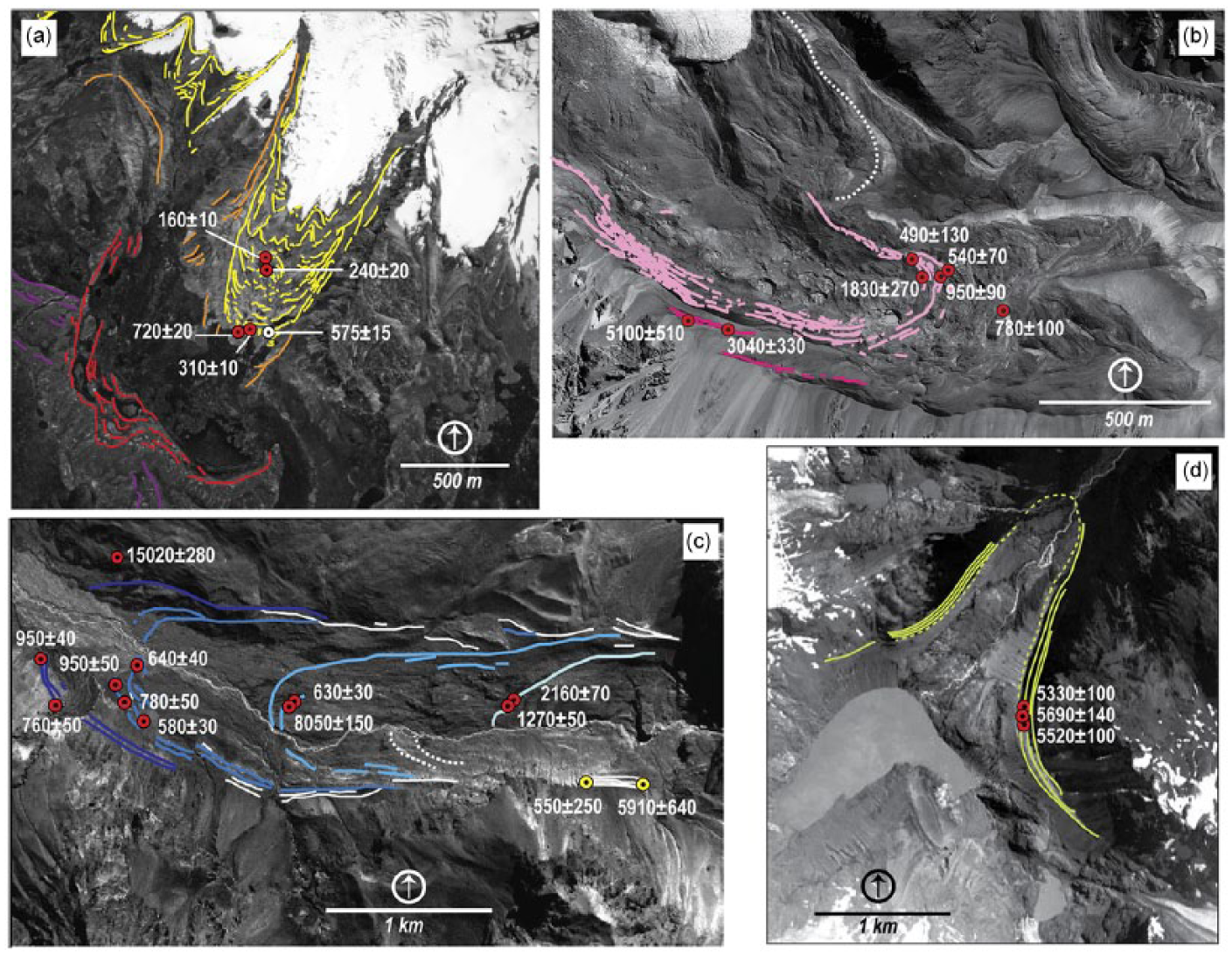
Dates constraining the age of the most prominent glacial advance that occurred during the Last Millennium Maximum (LMM) at each study site: (a) Cordillera Vilcanota, (b) Cerro Tapado, (c) Río Cipreses valley, and (d) Río Tranquilo valley. Red and white circles represent the location of the cosmogenic (ka) and radiocarbon ages (range of cal yr BP) obtained in this study, respectively. Yellow circles show the location of radiocarbon ages (cal yr BP) from Röthlisberger (1987).
Tapado glacier
As is common in lower precipitation regions, landforms below the glacier accumulation area also include mass wasting features. Debris-covered ice, ice-cored moraines, lobulated (and lineated) terrain, and several generations of massive rock glaciers occupy the forefield of Tapado glacier (Figure 3b). We distinguished a series of semi-continuous conspicuous moraine ridges (1–4 m high) that form an elongated arch in the forefield of Tapado glacier (Figure 3b, in pink) that appear to have undergone minimum disturbances since formation. We interpret this unit (herein: Tapado I) as a moraine complex formed by an advance of Tapado glacier over debris-covered ice. Distal to the Tapado I moraines are remnants of at least three or four older lateral moraines (Figure 3b, in fuchsia).
Four 36Cl samples collected from the crest of Tapado I moraines yield ages of 490 ± 130, 540 ± 70, 950 ± 90, and 1830 ± 270 yr BP (Table 6, Figure 4b). One 36Cl sample collected from the surface of an ice-cored moraine, just outside of the Tapado I moraine, resulted in an age of 780 ± 100 yr BP. Samples from the lateral Tapado II moraines yielded ages of 3040 ± 330 and 5100 ± 290 yr BP. Despite the scatter in these dates, we can distinguish at least two groups of ages: one group associated with the Tapado I moraine, with ages ranging between 500 and 1000 yr BP (one outlier), and another group associated with the Tapado II moraines, with two ages that are considerably older. Based on these results, we suggest that the Tapado I moraine was deposited sometime during the first half of the last millennium and that it represents the LMM limit. The Tapado II moraine, on the other hand, was probably deposited by a single or multiple glacial advances during the Holocene, prior to the deposition of Tapado I (the scatter of the ages precludes further interpretation)
Geographical and analytical data and ages for the 36Cl samples. Ages calculated using CRONUSCalc online calculator (Marrero et al., 2016) using Lifton-Sato-Dunai scaling (Lifton et al., 2014). We report external uncertainties.

Cipreses glacier
The upper section of the valley exhibits abundant evidence of former fluctuations of Cipreses glacier. We identified at least four past ice extents, marked by the Medina II, Medina I, Arriero, and Alto Cipreses moraine complexes (Figure 3c). These moraines are located approximately 5, 4.5, 2.7, and 2 km from the present-day ice margin, respectively.
The outermost complex, Medina II, includes two sets of moraines that occur only on the valley walls. Approximately 1.5 km upvalley, Medina I complex is also formed by two sets of moraines, ~50 m apart. The outermost Medina I is a single ridge, ~1.5 m high. The inner Medina I moraines comprise at least 5 cross-cutting ridges 3–5 m high. The Medina I moraines are dissected and partially buried by outwash. The next younger moraine complex, the Arriero moraines, consists of two very well-defined moraines and a series of discontinuous and subdued inner ridges. The Alto Cipreses moraine is a single ridge, ~3 m high, located in the northern side of the river (Figure 3). It is characterized by a lack of matrix and an abundance of large boulders (>1.5 m high). The boulders atop all the moraine complexes lack lichens and do not exhibit evidence of post-depositional erosion.
We obtained 10Be samples from boulders located atop all four moraine complexes (Tables 4 and 5, and Figure 4c). Next, we describe our chronological results from the stratigraphically oldest moraine complex to the youngest. Two 10Be samples from the Medina II moraine complex yield ages of 950 ± 40 and 760 ± 50 yr BP. Immediately proximal to this, three 10Be samples from Medina I moraines yield ages of 950 ± 50, 780 ± 50, 640 ± 40, and 580 ± 30 yr BP. Given the cluster of ages that range from 580 ± 30 and 950 ± 50 yr BP, we suggest that Medina I and Medina II moraines were deposited during the first half of the last millennium. The present data, however, do not allow us to distinguish these two moraine groups. Upstream, two 10Be samples from the innermost Arriero moraine yield ages of 8050 ± 150 and 630 ± 30 yr BP. While the youngest of these ages falls within the spread of the ages of the Medina I and Medina II moraines, the other is apparently too old, based on the young stratigraphic position of this moraine, and we consider it an outlier. Finally, two samples from Alto Cipreses moraine complex yield ages of 2160 ± 70 and 1270 ± 50 yr BP. The abundance of large clasts and the lack of a fine matrix in this moraine may suggest that this landform was formed from a rockfall on the glacier surface, which was later transported to the ice margin, therefore providing ages older than the time of moraine deposition. Finally, one 10Be sample, collected from a ridge of unconsolidated sediments (of unknown origin) ~100 m distal to the Medina II moraine complex, yielded an age of 15,020 ± 280 yr BP. This age could either correspond to an outlier or confirm that the Medina II moraines represent the LMM. We favor the latter interpretation, as the distal ridges exhibit significant differences in weathering and vegetation. We suggest that collectively these data indicate that the Cipreses glacier was expanded during the first half of the last millennium (between ~950 and 550 yr BP) and that Medina II moraines represent the most extensive advance of the Cipreses glacier since 15,020 yr BP (Tables 4 and 5, and Figure 4c). Note that this chronology differs from previous interpretations (Le Quesne et al., 2009; Röthlisberger, 1987), a matter addressed in the discussion.
Tranquilo glacier
Geomorphic evidence indicates that several small glaciers at the headwalls of Río Tranquilo valley expanded and coalesced in the past, forming a single Tranquilo glacier. This glacier flowed downvalley and deposited a series of moraines on the walls and bottom of the Río Tranquilo valley. At least six moraine complexes are well expressed in the valley (Figure 3d). The inner moraine (RT6) comprise between five and seven ridges that cross cut each other and enclose the valley ~3.5 km from the present ice margin (continuous light green lines in Figure 4d). Just inside RT6, we identified some small remnants of moraine ridges (RT7; dashed line in Figure 4d). The area within these moraines exhibits little to no vegetation and soil development.
We collected three rock samples from boulders on a single ridge of the RT6. These samples yielded 10Be ages of 5690 ± 140, 5520 ± 100, and 5330 ± 100 yr BP (Tables 4 and 5, Figure 4d). The consistency of these dates likely reflects that this moraine was deposited in a single event, and that the sampled boulders do not exhibit 10Be inheritance. Furthermore, they indicate that any later ice extent was located within RT6. Based on this, we assume that the remnants of moraine ridges inside RT6 represent the LMM limit and use this glacier extent for subsequent ELA analysis. Because we did not find boulders suitable for 10Be dating on these ridges, the age of the LMM is still unknown in the area.
Modern and paleo-ELAs
Based on the ice margins delineated in Figure 5, we estimated the present and LMM ELA for each glacier. Table 7 reports the ELAs corresponding to the preferred AAR value for each region. Figure 6 shows the range of ELA changes using the preferred AAR values.

Oblique Google earth image showing the present-day (blue) and Last Millennium Maximum (red) ice margin: (a) Cordillera Vilcanota, (b) Cerro Tapado, (c) Río Cipreses valley, and (d) Río Tranquilo valley. Orientation of the images is shown by the circled arrows, which point to the North.
Modern and LLM equilibrium line altitudes. Values were calculated using different AAR values (see the ‘Methods’ section).


Hypsometry of the studied glacier. Solid lines represent modern hypsometry of the glaciers: (a) Cordillera Vilcanota, (b) Cerro Tapado, (c) Río Cipreses valley, and (d) Río Tranquilo valley. Dashed lines represent reconstructed hypsometry of the Last Millennium Maximum. Vertical dotted lines intersect the X axis in the AAR value selected for each site. Horizontal dotted lines intersect the Y axis in the corresponding ELA.
We estimated the following ELA changes from the modern to the LMM: Vilcanota site 130–140 m, Tapado glacier 140–220 m, Cipreses glacier 100–160 m, and Tranquilo glacier 130–170 m. When comparing the magnitude of these ELA changes, only the estimates for Vilcanota and Tapado glacier do not overlap.
Climatic implications
Next, we consider the range of possible combination of temperature and precipitation anomalies required to change the ELA from the modern to LMM values (Figure 7).

Combination of temperature and precipitation anomalies (with respect to the present) that accommodate the ELA change from the Last Millennium Maximum to the present for the range of AARs used at each particular site. Color scheme is the same as in Figure 1. Inset: for reference, we included present-day temperature and precipitation variability (1σ) and values corresponding to 25%, 50%, 75%, and 100% of precipitation.
Assuming that ELA changes are because of only temperature, at the Vilcanota site, the ELA change can be explained by a cooling of at least 0.7°C. Considering a change in precipitation only, the LMM ELA can be explained by an increase of more than 0.52 m yr−1 (representing a 64% of the present-day annual precipitation). At Cipreses and Tranquilo glaciers, the ELA changes can be explained by cooling of at least 0.6°C and 0.7°C or by precipitation increase of at least 0.22 (27%) and 0.30 m yr−1 (27%), respectively. Finally, at Tapado glacier, where the maximum ELA depression was observed, the ELA change can be explained by a temperature decrease of at least 1.0°C (assuming no changes in precipitation) or by a precipitation increase of more than 0.31 m yr−1 (89%, and no change in temperature). For the later site, negative anomalies of precipitation were not included because the SEMB model does not perform adequately when subjected to extremely low values of precipitation (Sagredo et al., 2014) (Figure 7).
Some of the changes in precipitation determined above could be considered unlikely. For example, at Tapado glacier, the change of precipitation required to decrease the ELA to its LMM elevation (without changing temperature) represents an increase in precipitation of 89%. For reference, Figure 7 (inset) shows the precipitation anomalies (m yr−1) that represent a 25%, 50%, 75%, and 100% increase of annual values; in addition, we included the present-day temperature and precipitation interannual variability (±1 standard deviation of the mean conditions for the period 1961–1990).
Overall, the model results show that the range of possible temperature and precipitation anomalies that accommodate the observed ELA changes at all four sites studied show minimum overlap. Conversely, this overlap is very high when comparing only the glaciers at Vilcanota, Cipreses, and Tranquilo sites. This implies that the climatic anomalies responsible for the drop in ELA at Tapado glacier are the most distinct.
Discussion
Next, we discuss our results derived from each of the steps involved in this research: timing of the LMM, ELA estimations, and climate reconstruction.
Chronology of the LMM
The chronology of the LMM relies on three different dating techniques, each of which has an analytical uncertainty (Tables 3, 5 and 6). The relatively small number of dates available from the various geological contexts makes use of formal statistical tests impractical at the moment (Balco, 2011). Nevertheless, we suggest that the post-depositional processes that may impact surface exposure ages (e.g. Applegate et al., 2012; Balco, 2011) are minimal because of the relatively short period of time that has passed since the LMM. Next, we contrast our dating results with prior studies where available.
On the northwest side of Cordillera Vilcanota, in the Upismayo valley, Mark et al. (2002) showed that the innermost moraine complex of the area was deposited after 340–560 cal yr BP (328 ± 46 14C yr BP). In addition, at Quelccaya Ice Cap (15 km to the southwest of Vilcanota site), Stroup et al. (2014, 2015) showed that the LMM in the Qori Kalis and Chalpacocha valley occurred at >520 ± 60 yr BP. Similar results were obtained by Phillips et al. (2016), who constrained the LMM in the adjacent Huancané valley between 670 and 410 yr BP. These studies agree with our findings, supporting the idea that the LMM at the Vilcanota site occurred at <590 yr BP.
At Cipreses glacier, Röthlisberger (1987) radiocarbon dated two paleosols underlying lateral moraines in the upper portion of the valley (Figure 4c). The samples yielded ages of 5330–6610 cal yr BP (5180 ± 295 14C yr BP) and 360–860 cal yr BP (625 ± 155 14C yr BP), and represent maximum-limiting ages for the formation of the moraines. Unfortunately, these moraines are difficult to correlate with the aforementioned moraine complexes located downvalley, precluding comparison with the results of this study. Le Quesne et al. (2009) and Araneda et al. (2009) used historical records to infer that the Cipreses glacier margin was located near Medina II in CE 1842, implying that all the moraine complexes described above were deposited during the last ~170 years. Reexamining the evidence presented in these studies, we determined that the most conclusive record establishing the ice margin position comes from the description of Pissis’ expedition to the area. Pissis (1875) determined that by 1858, the ice margin was located at an elevation of 1758 m a.s.l. This suggests that Cipreses glacier was near the Arriero moraines, and that Medina I and Medina II moraines were ice-free by the time of this observation. This hypothesis can be extrapolated to 1842, considering that Araneda et al. (2009) determined that by that time the ice was only 100 m downstream from the position identified by Pissis. Based on this, as well as our new dates, we suggest that the Medina I and Medina II moraines were deposited during the first half of the last millennium (between ~950 and 550 yr BP).
At Tranquilo glacier, we obtained three consistent 10Be ages of ~5500 on the RT6 complex. These dates are statistically indistinguishable from the maximum age of 5280 ± 350 cal yr BP (4590 ± 115 14C yr BP) obtained by Mercer (1968) for a glacial advance in the eastern flank of the same massif (47°36′S, 72°14′W).
Finally, the available dates suggest that while Tapado and Cipreses glaciers reached their LMM sometime during the first half of the last millennium, at Vilcanota this occurred at ~500 yr BP. We do not have chronological control over the LMM at Tranquilo glacier. Taken at face value, these preliminary data hint that the glaciers included in this study did not necessarily reach their LMM at the same time. However, we suggest that more chronological data are required to assess the synchrony (asynchrony) of these glacial events. For this reason, hereafter, we refer to the time when each glacier reached its maximum extent of the last 1000 years as the local LMM.
ELA estimates
ELA estimates for the study sites depend on reliable AAR values, which are known to vary from one climate regime to another. To overcome this problem, for each site we used a particular range of ELA values that are representative of each climate regime.
The results shown here suggest a significant overlap of the ELA changes across sites located in different climatic regimes along the Andes. Next, we compare our estimated ELA changes with previous studies. Note that the exact timing of the glacial events compared here may vary from site to site, but all reflect the ELA depression during the most extensive advance of the last millennium.
At the Vilcanota site, the estimated ELA change since the local LMM is in good agreement with those calculated for neighboring areas. To the south, in the Cordillera Real, Bolivia (16°S, Figure 1), Rabatel et al. (2008) calculated an ELA change of ~150 m since the local LMM (~AD 1650), with a total range of 70–190 m. This result is very similar to our findings for the Vilcanota site (ΔELA 130–140 m). To the north, in Cordillera Blanca, Peru (Figure 1), Jomelli et al. (2008) proposed that glaciers reached similar maximum extents in CE 1350 and 1650. The ELA change between these maximum extents and the modern day was estimated to be ~180 m (Jomelli et al., 2008), somewhat larger than the findings presented here.
At the Cipreses glacier, our results also agree with previous studies within the same climate regime. At the El Peñón and El Azufre glaciers, in Central Argentina (35°S, Figure 1) (Espizua, 2005), the change in ELA since the local LMM was estimated to be 105 and 110 ± 50 m, respectively. These estimations fall within the range of ELA changes calculated for Cipreses glacier (100 to 160 m). No other studies have reported LMM ELAs for the climatic region of Tapado or Tranquilo glacier, precluding further comparisons. At least for the climate zones occupied by the Vilcanota site and Cipreses glacier, it can be argued that our estimates for ELA are compatible with other published results, which would suggest that our sites are capturing a regional signal rather than local anomalies.
Climate reconstruction
The ELA changes described above were used to reconstruct scenarios of climatic conditions during the LMM. We used the SEMB model to calculate the combination of temperature and precipitation anomalies that accommodate the ELA changes since the local LMM. The SEMB model was designed for application in large regions (Rupper and Roe, 2008). Factors such as the spatial resolution of the model inputs, the selection and application of constants in different areas, and the omission of topographic (e.g. hypsometry and slope) and glacio-dynamic effects in the calculation of the ELA increase model uncertainties when applied to smaller areas or single glaciers (Rupper and Roe, 2008). However, if it is assumed that the ELA change at each glacier site is representative of its climatic region, which is supported by a comparison of our data with previous studies, the SEMB model provides a first approximation of the range of climatic conditions during the local LMMs in the study areas. The results indicate that the range of possible temperature and precipitation anomalies overlap significantly at three of the four sites. This implies that if we assume that the LMM was synchronous across these three study areas (Vilcanota, Cipreses, and Tranquilo sites), it is possible that the climate anomalies responsible for the LMM were similar in the southern outer tropics, northernmost mid-latitudes, and Central Patagonia. It is unclear to us whether the climate anomalies reconstructed for Tapado glacier are distinct because (1) of a true spatial variability in the climate conditions during the LMM, (2) we are actually comparing non-contemporaneous glacial events, or (3) because of problems in the delimitation of former ice margins, which would impact local ELA reconstruction.
It has been shown that glaciers in the Andes exist under various climatic conditions, which control their responses to climate change. By combining a geomorphological reconstruction of glacial advances, dating of these glacial advances, and applying the same SEMB model to glaciers located in different climatic regimes, we provide new insights toward the understanding of the climatic conditions that influenced glacier extents at their local LMMs along the Andes of South America. Our results fill information gaps and provide new data to understand Holocene climatic variability at a regional, hemispheric, and inter-hemispheric scale.
Summary and final remarks
We reconstructed LHM climate conditions at four alpine glaciers located in different climate regimes along the Andes based on calculations of ELA changes and the application of a full SEMB model.
The LMM occurred at ~500 yr BP at the Vilcanota site, and sometime during the first half of the last millennium at Tapado and Cipreses glaciers. We do not have chronological control for the LMM at Tranquilo glacier. The existing evidence is not sufficient to conclude that the LHM occurred synchronously across the study areas.
There is a significant overlap in the ELA changes since the local LMM estimated for the four study areas (Vilcanota site: 130–140 m; Tapado glacier: 140–220 m; Cipreses glacier: 100–160 m; and Tranquilo glacier: 130–170 m).
Assuming that the LMM was synchronous at Vilcanota, Cipreses, and Tranquilo sites, the SEMB model results suggest that it is possible that the climate anomalies responsible for the LMM were similar in the southern outer tropics, northernmost mid-latitudes, and Central Patagonia. It is unclear yet why Tapado glacier (in the subtropics) exhibits a distinct set of climate anomalies associated with the LMM.
Our results contribute toward creating a broader network of climate proxy records, which can provide the foundations to test hypothesis regarding the mechanisms underlying the glacial events that occurred during the last millennium.
Footnotes
Acknowledgements
EA Sagredo acknowledges support from Fulbright-Conicyt Doctoral Fellowship and the Department of Geology at the University of Cincinnati. We thank Jennifer Howley for assistance in the cosmogenic nuclides laboratory at Dartmouth College. Our appreciation goes to Tomás Gómez, Jesús Soto, Justin Stroup, John Thompson, Samuel Beal, Yves, and Elena Cheiman, as well as the Crispín family for providing field assistance; and Fundación Altiplano MSV, Centro de Estudios Avanzados en Zonas Áridas (CEAZA), and Centro de Estudios del Cuaternario (CEQUA) for logistic support. We thank Brian H Luckman (UWO) and Colby A Smith for valuable discussion and insightful comments on the manuscript. Two anonymous reviewers provided constructive comments that improved the manuscript.
Funding
This work was funded by National Science Foundation Grants EAR-1003072, EAR-1003460; Fondecyt Iniciación 11121280; CONICYT USA2013-0035; and Iniciativa Científica Milenio NC120066.
References
Supplementary Material
Please find the following supplemental material available below.
For Open Access articles published under a Creative Commons License, all supplemental material carries the same license as the article it is associated with.
For non-Open Access articles published, all supplemental material carries a non-exclusive license, and permission requests for re-use of supplemental material or any part of supplemental material shall be sent directly to the copyright owner as specified in the copyright notice associated with the article.
