



Abstract
Processes behind the shift from hunting-gathering to food production lifestyle are multifaceted and not yet completely understood. The Mediterranean coast of NW Africa provides an eclectic transitional pattern, namely, a very hesitant transition to food production. The distribution and abundance of early Neolithic domesticated species is disparate and region specific. Climate and environmental change have been often considered as an important influencing factor for this transition. This hypothesis was tested using archeological shells of the rocky intertidal gastropod Phorcus turbinatus recovered from the Ifri Oudadane site in NE Morocco. The oxygen isotope composition (δ18O) of the shell was used to examine whether the hesitant transition to food production was linked to a local climate shift in the Mediterranean Maghreb. Intrashell δ18O values suggest a marked temperature increase from >7.6 to ~7.0 cal. ka BP, the time when Neolithic innovations first appear on site. An additional increase in temperature from ~7.0 to <6.8 cal. ka BP matches with the beginning of the main occupation phase and the doubtless breakthrough of cultivation at Ifri Oudadane. This apparent warming trend, although considered preliminary, seems to match well with warming tendency observed in several published regional climate proxies. Therefore, a temperature shift may have played a role in the timing and implementation of food production in the area. Last growth episode δ18O values suggest that shellfish were harvested throughout most of the year, with noticeable intensification during the cooler half of the year. This preliminary pattern was fairly consistent throughout the Epipaleolithic and early Neolithic phases, pointing to a probable near year-round site occupation rather than a single season settlement. Future research on Ifri Oudadane and other NW African archeological records are much needed to assess whether these patterns persist in Morocco and other Epipaleolithic and early Neolithic settlements in the western Mediterranean Maghreb.
Introduction
Since more than 200,000 years ago, anatomically modern humans have obtained their food through hunting and harvesting surrounding resources but, around the early Holocene, many groups across the world transitioned to a sedentary food-producing lifestyle (Oliver, 2012; Pearsall, 2008; Piperno, 2011; Smith, 2001; Weninger et al., 2000, 2009). The causes that may have triggered such cultural transition have been the focus of attention during decades by archeologists and anthropologists (e.g. Richardson et al., 2001). Several hypotheses have been vividly debated since the 1950s to explain the rise of agriculture, also called the Neolithic Revolution, including increase in human population density, societal or behavioral changes, excessive hunting that diminished prey resources, and so on (see review in Weisdorf, 2005). One of the major compelling hypotheses proposed to explain the rise of food production practices is climate and environmental change, which would have directly or indirectly impacted the surrounding environments either improving or diminishing the conditions for growing domesticated plants and herding animals. Richardson et al. (2001) argued that during the Pleistocene, climatic conditions were cold and dry, with low atmospheric CO2 levels, which all combined inhibited agricultural practices. At the beginning of the Holocene, warmer temperatures enhanced vegetation growth, and human groups adapted to this climate change by shifting resource exploitation and modifying their lifestyles. This apparent correspondence between the transition to food production and climate change has been documented in several regions in the Mediterranean (Cortés-Sánchez et al., 2012; Weninger et al., 2000, 2009). However, human groups occupying different territories of the world have initiated food production practices at different times and perhaps, triggered by differing factors.
Epipaleolithic hunter-gatherer economies were present in Northwest Africa until the Holocene, but at around 7.6 cal. ka BP, the first and oldest evidence of a Neolithic food production lifestyle was recently documented (Linstädter et al., 2015; Linstädter and Kehl, 2012; Morales et al., 2013). However, the Mediterranean coast of NW Africa witnessed an eclectic transitional pattern, namely, ‘a very hesitant transition’ to food production. Considering that (1) early indications for food production are only limited to the littoral, without evidence from inland sites, and (2) other sites of similar age, like the nearby Hassi Ouenzga, do not offer any evidence of food production or domesticated species, the timing of this transition remains debated. Only after the beginning of the seventh millennium cal. BP, domesticated species become more evident and unambiguous (Linstädter et al., 2016).
Early Neolithic crops are highly disparate and region specific. Morales et al. (2016) compared macrobotanical remains of three early Neolithic (ENA) assemblages from various sites in NW Africa. They observed that legumes (Vicia faba) dominated in El Kril site, a different wheat species was more common at the shelter of Kaf Taht el-Ghar, and crop species were generally less abundant at Ifri Oudadane. Accordingly, it has been hypothesized that the usage of wild species was still important for people occupying Ifri Oudadane site, even though domesticated species were already present and cultivation practices were evident (Morales et al., 2013).
The relatively low percentage of crops, site formation features, and complications of species identification suggest that convincing evidence for food production only occurred after ~7.3 cal. ka BP (Zilhão, 2014). Even though there is some debate regarding the timing of the appearance of domesticated plants in the area, prehistoric human activities were intense as evidenced by (1) pollen and non-pollen palynomorphs (NPP) data (Zapata et al., 2013); (2) a change in the black carbon regime (Lehndorff et al., 2015); (3) the presence of calcite spherulites, which reflect the penning of animals in the shelter (Linstädter and Kehl, 2012); and (4) the appearance of pottery (Linstädter and Wagner, 2013). All in all, although food production at Ifri Oudadane likely started at ~7.6 cal. ka BP (Morales et al., 2013), evidence of large-scale use of wild resources suggest that food production was not widespread until after ~7.0 cal. ka BP (Linstädter et al., 2016).
The transition to food production in the Iberian Peninsula has to be understood as part of the Neolithization of Europe mainly supported by migration processes as evidenced by archeological and genetic data (Pinhasi et al., 2012). In the case of the Maghreb, no evidence confirms the same impact of migration. It has been speculated that the so-called Neolithic Innovations became accessible to local hunter-gatherer groups through societal networks and was implemented with enhanced environmental conditions (Linstädter, 2016). However, little to no evidence of local climate change during the Epipaleolithic to early Neolithic transition has been observed in the Maghreb, in part, because of the limited archeological sites that are accessible and have been undisturbed by current human interference. This cultural transition in NW Africa, hence, has been interpreted as the result of cultural developments with no clear or convincing links to climate change (Zapata et al., 2013).
This study tests the hypothesis that the Epipaleolithic–early Neolithic transition in NE Morocco was influenced by changes in climate. To examine this hypothesis, we generated oxygen-stable isotope profiles (δ18O) of the marine rocky intertidal gastropod Phorcus turbinatus (Born, 1778) (Trochidae) recovered from the archeological site Ifri Oudadane, NE Morocco. Shells of Phorcus turbinatus are one of the most common archeological materials preserved in Holocene sites around Southern Europe and Northern Africa and have been successfully used to infer local climate change at various regions in the Mediterranean (see recent review in Colonese et al., 2011).
The δ18O values of archeological mollusk shells have fruitfully been used to reconstruct prehistoric climates and identify season of shellfish collection since the 1970s (Schifano, 1983; Schifano and Censi, 1983; Shackleton, 1973, 1974). Published work using living and ancient specimens of the species Phorcus turbinatus and other Phorcus species has recurrently demonstrated that this taxon precipitates its shell in isotopic equilibrium with host waters, and accordingly, the δ18O values extracted from pristine inner aragonitic layers of their shells primarily reflect the sea surface temperature (SST) during calcification when water δ18O values can be assumed or inferred independently (Bosch et al., in press; Colonese et al., 2009; Mannino et al.,2007, 2008; Milano et al., 2016; Parker et al., 2017; Prendergast et al., 2013; Prendergast et al., 2016). The extensive and well-preserved accumulations of harvested Phorcus turbinatus by Epipaleolithic and early Neolithic people from NE Morocco offer an excellent opportunity to evaluate local variations in SSTs during this relevant cultural period in the human history of NW Africa.
Materials and methods
Ifri Oudadane
The studied archeological site, Ifri Oudadane (Figure 1), was discovered during roads work and has been repeatedly excavated since 2006 (Lehndorff et al., 2015; Linstädter et al., 2015; Linstädter and Kehl, 2012; Linstädter and Wagner, 2013; Zapata et al., 2013). Ifri Oudadane is a rock shelter ~5-m high and ~15-m wide located in a coastal marble cliff ~50 m a.s.l. (above sea level), located at 35°12′N and 03°14′W. Linstädter and Kehl (2012) observed two main distinctive cultural periods. The oldest layer covers the Epipaleolithic period (Figure 1) and consists of a ~100-cm-thick layer containing remains of bones from wild animals and lithic tools. This layer ranges in age from ~11.0 to ~7.6 cal. ka BP (Linstädter et al., 2015; Linstädter and Kehl, 2012; Morales et al., 2013; Zapata et al., 2013). The youngest layer (Figure 1) consists of a ~1.5-m-thick phase containing significant amounts of charcoal, pottery fragments, and bones of domesticated animals, covering the Neolithic occupation period. The Neolithic layer ranges in age from ~7.6 to ~5.7 cal. ka BP. This phase can be subdivided into four sub-layers (Linstädter et al., 2015; Linstädter and Kehl, 2012; Morales et al., 2013; Zapata et al., 2013): (1) the sub-layer ENA, a ~20-cm-thick layer containing impressed pottery, the first crop remains, and the first bone fragments of domesticated ovicaprids dated between ~7.6 and ~7.0 cal. ka BP; (2) the sub-layer early Neolithic B (ENB), the main occupation phase, ranging in age from ~7.0 to ~6.7 cal. ka BP; (3) the latest early Neolithic occupation (ENC) dated between ~6.6 and ~6.3 cal. ka BP, and (4) an ephemeral late Neolithic stay at about 5.7 cal. ka BP (Linstädter et al., 2015; Linstädter and Kehl, 2012). Archeological data available so far indicate that the Epipaleolithic people were foragers and included a high marine component of fish and marine mollusks in their diet. Foraging continued during the Neolithic even though food production was initiated and included intensive exploitation of marine resources as well. As a result, Phorcus turbinatus shells were consistently collected and deposited throughout this intriguing cultural transition.
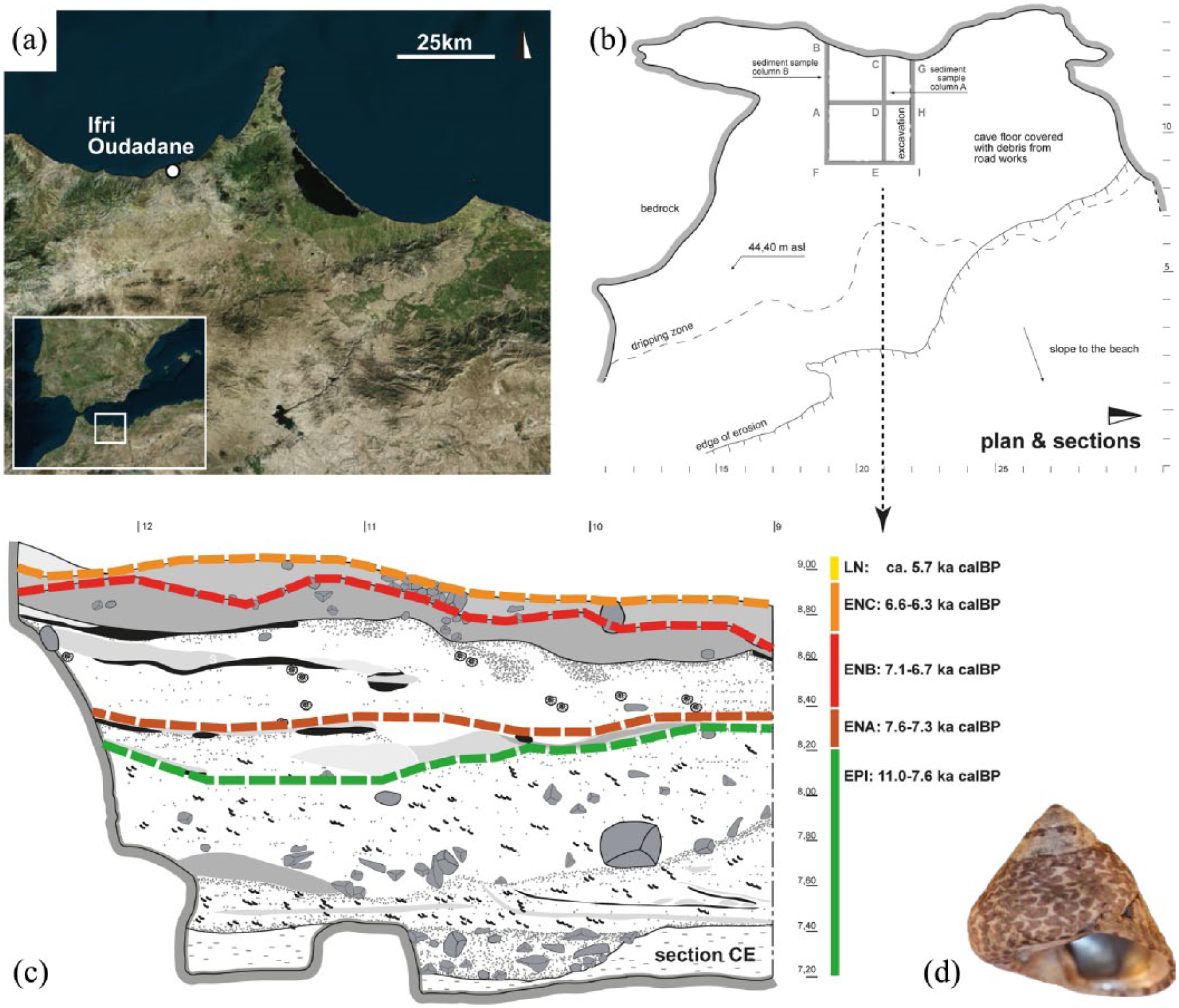
(a) Geographical location of Ifri Oudadane site, NE Morocco; (b) plan and section of the site studied; (c) stratigraphy of the archeological site, including radiocarbon ages; and (d) photograph of archeological Phorcus turbinatus from Ifri Oudadane.
Current environmental conditions
Today’s climate near Ifri Oudadane is dominated by hot summers, mild winters, with a marked wet season between the fall and spring. The vegetation in the region is dominated by maquia-type forest characterized with shrubs and trees including mastic trees, pines, araar, junipers, oaks, and wild olives (Charco, 2001; Fennane et al., 2007; Morales et al., 2016). Recent human interference includes significant deforestation and reduction of natural resources.
Ifri Oudadane faces the Alboran Sea of the westernmost basin within the Mediterranean Sea (Figure 1). Seawater circulation in the Western Mediterranean results from the interactions of water masses from the Atlantic and the Mediterranean through the Strait of Gibraltar (Pierre, 1999; Vargas-Yáñez et al., 2002). As a result, the Alboran Sea currently displays distinct seasonal SST variation between ~14.8°C in the winter and ~23.8°C in the summer, with a mean annual SST of ~18.5°C.
Pierre (1999) exhaustively measured the oxygen-stable isotope (δ18O) values of surface seawater in the Mediterranean Sea. These results indicate that the sea surface δ18O values at seawater depths <5 m in the Alboran Sea range from +0.7‰ to +1.2‰ (SMOW), with an average value +1.0‰ (SMOW) based on the five measurements within the westernmost Mediterranean Sea (Pierre, 1999). In this work, we assume that the Holocene ocean water near the coast of Ifri Oudadane exhibited a relatively constant value of approximately +1.0‰ (SMOW).
Phorcus turbinatus
The marine mollusk assemblage recovered from the Ifri Oudadane site includes up to 38 species (Linstädter et al., 2015), while terrestrial gastropods are represented by a few but highly abundant species (Hutterer et al., 2014). While limpets (Patellidae) dominate the Epipaleolithic layers, and topshells (Trochidae) dominate the Neolithic layers, Phorcus turbinatus was constantly exploited throughout the record and used as a food resource (Linstädter et al., 2015). In this study, we focused on Phorcus turbinatus, representing the westernmost isotopic study of this species.
The rocky intertidal marine gastropod Phorcus turbinatus is presently distributed throughout the Mediterranean basin (Crothers, 2001). The species has been listed under Monodonta or Osilinus in the past, both of which are synonyms of Phorcus (Donald et al., 2012).
Several studies conducted in the Mediterranean and elsewhere have demonstrated that Phorcus turbinatus (Bosch et al., in press; Colonese et al., 2009; Mannino et al., 2007, 2008, 2011; Prendergast et al.,2013, 2016; Shackleton, 1974) and other species of Phorcus (Gutiérrez-Zugasti et al., 2015; Mannino et al., 2003; Parker et al., 2017) are reliable high-resolution paleoclimatic archives. The shell of Phorcus turbinatus is formed by an outer prismatic aragonitic layer and an inner nacreous aragonitic layer (Milano et al., 2016), the latter with marked cyclic growth increments. Calcification is initiated since the free-swimming larval stage and continues throughout organism’s lifespan. This species appears to grow continuously throughout the year, although growth rates appear to vary along ontogeny, with older individuals tending to produce narrower annual increments in the shell margin than younger stages (Colonese et al., 2009; Mannino et al., 2008). A mean annual growth rate between ~16.2 and ~19.1 mm per year has been estimated for Phorcus turbinatus populations living in Italy (Mannino et al., 2008). Slower growth rates have been documented during the summer months (Mannino et al., 2008). Adult specimens range in maximum size between 15 and 38 mm and can reach up to 41 mm (Crothers, 2001).
Shell sampling procedure
Analyzed shells did not show evidence of recrystallization or secondary overgrowths in the inner nacreous layer, and therefore, it is assumed that the investigated Holocene shell material is pristine and suitable for geochemical analyses.
Shells were cleaned with distilled water and by ultrasonication and dried at room temperature overnight. Specimens were sampled using two sampling strategies: (1) intrashell sampling along shell growth direction and (2) shell margin sampling at the last growth episode. The first approach allowed us to examine high-resolution SST variations per cultural period, whereas the second methodology was used to assess season of site occupation and season of shellfish collection practices.
Intrashell sampling strategy
Three selected entire shells, one from each of the three main cultural periods, were used for intra-annual isotopic analysis along shell growth direction. Each shell yielded ~35 carbonate sample aliquots, with a total of 105 carbonate aliquots for the three shells combined. The intrashell sample methodology was adapted after Mannino et al. (2008). The outer prismatic layer was removed from the edge of the outer whorl with a manual Dremel© drill, and then samples were drilled sequentially from the inner nacreous layer following the direction of growth using a 0.6-mm drill bit. Samples were collected every ~1 mm throughout ontogeny, resulting in a monthly–submonthly resolution. Milled carbonate samples weighted near 150 μg, on average. This sampling strategy was used to reconstruct high-resolution SST at three cultural time periods (Epipaleolithic, ENA, and ENB).
Shell margin sampling strategy
The shell margin of the inner aragonitic layer, which should record the SST at the time of the last growth event closest to snail’s collection date (Shackleton, 1973), was milled slowly using a manual Dremel drill with a 0.6-mm-diameter bit, as described in Colonese et al. (2009). A total of 55 shells were analyzed, 20 from the Epipaleolithic layer, 18 from the ENA layer, and 17 from the ENB layer. This strategy was employed to determine the approximate season of shellfishing practices and therefore seasons of site occupation. This sampling approach was designed as a preliminary assessment to evaluate the total range of SST during shellfishing at the main three cultural episodes. This proxy was then used to infer the approximate time of site occupation. Because only one sample was gathered from each shell, specific details regarding collection during seasons remain to be assessed in future investigations.
Stable oxygen isotope analyses
Carbonate samples were analyzed using a Kiel III Carbonate Device coupled to a Finnegan MAT 252 Isotope Ratio Mass Spectrometer (IRMS) at the Illinois State Geological Survey (University of Illinois, Urbana-Champaign). Carbonate material was digested with 100% phosphoric acid during 10 minutes at 70°C and then the resulting CO2 product was passed to the IRMS for mass 44, 45, 46 measurement alternately with that of a calibrated reference CO2 gas. All oxygen isotope results are reported in δ notation relative to the international standard VPDB. δ values are defined as follows:

Reproducibility was ~0.09‰ based on recurring measurements of international standards NBS-18, NBS-19, and L-SVEC.
Kruskal–Wallis test was used to test whether groups of samples significantly differ in median oxygen isotope values. Statistical analyses were performed using PAST 3.12 software (Hammer et al., 2001) considering statistical significance at α = 0.05.
Paleotemperature calculations
Measured shell δ18O was used to calculate SSTs using the empirically derived temperature equation for biogenic aragonite of Grossman and Ku (1986) with a correction for the conversion of SMOW to PDB by Dettman et al. (1999). For temperature calculations, a constant value of seawater δ18O of +1.0‰ (n = 5) was adopted based on modern sea surface water measurements at <5 m of depth conducted by Pierre (1999) in the Alboran Sea. This approach seems valid as planktonic foraminifera δ18O data from the Alboran Sea suggest relatively stable seawater δ18O values during the studied time interval of the early Holocene (Martrat et al., 2007):

The reported analytical precision for shell δ18O values of ±0.1‰ corresponds to an approximate error of about ±0.5°C in the calculated SST from the shell.
Results
Intra-annual oxygen isotope profiles
The three analyzed shells (n = 105 carbonate aliquots in total) exhibited several distinctive oxygen isotope cycles along ontogeny with annual maximum and minimum values representing at least one full year of growth (Table 1; Figure 2).
Intra-annual oxygen-stable isotope values and SST calculations of three Phorcus turbinatus shells retrieved from Ifri Oudadane archeological site, NE Morocco.

SST: sea surface temperature.

Intra-annual oxygen-stable isotope values along (a–c) shell growth direction and (d–f) sea surface temperature (SST) calculations from three shells retrieved from three distinctive cultural phases in Ifri Oudadane record, NE Morocco.
The individual recovered from the Epipaleolithic phase was retrieved from the stratigraphic position Pos.1516-C. A macrobotanical remain of a dwarf palm placed ~5 cm above the position of the shell was AMS 14C-dated at ~7.6 cal. ka BP (Morales et al., 2013). Thus, the shell should be slightly older than ~7.6 cal. ka BP. The intra-annual δ18O values ranged from +0.4‰ to +2.8‰ (Figure 2), averaging +1.5 ± 0.6‰ (n = 35). Calculated SSTs varied between 22.2°C and 11.5°C (Figure 2) and averaged 17.3 ± 2.7°C (n = 35). The scale of seasonality recorded in this shell was 10.7°C.
The shell retrieved from the ENA phase was recovered from the stratigraphic position Pos.1353-A. A domesticated wheat remain from the same position was AMS 14C-dated at ~7.0 cal. ka BP (Morales et al., 2013). Intra-annual δ18O values varied between −0.2‰ and +1.9‰ (Figure 2), averaging +0.8 ± 0.7‰ (n = 36). The calculated SSTs ranged from 24.7°C to 15.5°C (Figure 2), with an average SST value of 20.2 ± 2.9°C (n = 36). The yearly temperature range within the shell was determined to be 9.2°C.
Finally, the shell recovered from the ENB period was gathered from the stratigraphic position Pos.1070-B, which is about 10 cm below two samples of barley that were AMS 14C-dated at ~6.8 cal. ka BP (Morales et al., 2013). Thus, the shell should be younger than ~6.8 cal. ka BP old. Intra-annual δ18O values fluctuated from −1.9‰ to +1.1‰ (Figure 2), averaging +0.0 ± 0.9‰ (n = 34). The calculated temperatures ranged from 31.9°C to 18.9°C (Figure 2), averaging 23.8 ± 3.8°C (n = 34). The magnitude of seasonality detected in this shell was 13.0°C.
Shell margin oxygen isotope values
The δ18O values measured at the last growth episode of all early Holocene archeological specimens recovered from Ifri Oudadane (n = 55 in total) ranged from −0.5‰ to +2.7‰ (Table 2). Holocene SST calculations at the last growth episode ranged from 25.8°C to 12.2°C (Table 2).
Shell margin oxygen-stable isotope values (n = 55) and SST calculations of Phorcus turbinatus shells from Ifri Oudadane site, NE Morocco.

SST: sea surface temperature.
During the Epipaleolithic phase, shell margin δ18O values ranged from −0.3‰ to +2.5‰ (Figure 3a). The calculated SSTs ranged from 25.0°C to 12.8°C (Figure 3b).

Published paleoclimatic proxies: (a) Greenland ice core by Johnsen et al. (1997), (b) planktonic foraminifera oxygen isotope values from a deep-sea core ODP977a in the Alboran Sea by Martrat et al. (2007), and (c) alkenone temperature estimates from a deep-sea core ODP977a in the Alboran Sea by Martrat et al. (2007). Arrows indicate the studied Epipaleolithic–early Neolithic B cultural transition between ~8.0 and ~6.8 cal. ka BP.
During the ENA phase, shell margin δ18O values ranged from −0.4‰ to +2.7‰ (Figure 3a). The estimated SSTs varied from 25.6°C to 12.2°C (Figure 3b).
Finally, during the ENB period, shell margin δ18O values fluctuated from −0.5‰ to +2.3‰ (Figure 3a). The calculated SSTs ranged from 25.8°C to 13.7°C (Figure 3b).
Discussion
Phorcus turbinatus time-series δ18O
The intra-annual oxygen isotope profiles of the three measured archeological specimens from NE Morocco followed a quasi-sinusoidal configuration (Figure 2). The shape of cycles seems to have recorded maximum and minimum SST values and are relatively comparable with those observed in other Phorcus shells from elsewhere in the Mediterranean (e.g. Bosch et al., in press; Mannino et al., 2007; Prendergast et al., 2016). However, the shell from the ENB cultural phase shows cycles that are less comparable with other published Phorcus data (Figure 2a and d). From the isotopic and calculated SST cycles, we can infer that Phorcus turbinatus exhibited a lifespan of 1–2 years. The total range of intrashell δ18O values was 3.0‰, 2.1‰, and 2.5‰ for the Epipaleolithic, ENA, and ENB shells, respectively. This range of δ18O values within each shell is comparable with the range of values reported for other archeological Phorcus turbinatus shells from Holocene Central and Eastern Mediterranean sites (Bosch et al., in press; Prendergast et al., 2016).
The two analyzed archeological specimens from the Epipaleolithic and the ENA layers deposited shell at SSTs between 11.5°C and 24.7°C (Figure 2). Such range of SST values is within the SST range reported for early Holocene shells from NW Sicily, 12.1°C and 29.4°C (Mannino et al., 2007), and Neolithic shells from Libya, 12.9°C and 26.4°C (Prendergast et al., 2016). However, the ENB shell tracked SSTs significantly higher than other published data in the region, between 18.9°C and 31.9°C.
Modern Phorcus turbinatus from the central Mediterranean (Malta, Italy, and Libya) appears to grow relatively fast and continually between 15°C and 27°C (Colonese et al., 2009; Mannino et al., 2008; Prendergast et al., 2013, 2016), although growth rates may be reduced during the coldest and hottest temperatures (Colonese et al., 2009). Archeological specimens from this and previous studies suggest that ancient Phorcus turbinatus captured temperatures slightly outside the range of present-day values. However, the calculated SST in the shell δ18O can be variable within the same species because of possible variations in past seawater δ18O and climatic characteristics of different locations.
Intrashell δ18O values of archeological Phorcus turbinatus from Ifri Oudadane show a clear warming trend from >7.6 to <6.8 cal. ka BP (Figure 4). On average, the SSTs recorded in these three shells, including all cycles and maximum and minimum values, increased from ~17.3°C during the Epipaleolithic up to ~23.8°C in the ENB. Although these results are based on three shells only, and therefore, additional shells should be analyzed in future studies to verify the magnitude of this warming trend, the trend of our preliminary results is consistent with other published paleoclimate proxies (Figure 5). A clear warming trend has also been observed between ~8.2 and ~6.0 cal. ka BP from other independent studies from nearby and higher latitudes regions of the North Atlantic (Figure 5). For example, data from deep-sea cores in the Western Mediterranean (Cacho et al., 2001; Martrat et al., 2007) and ice-core data from Greenland (Johnsen et al., 1997) document a clear increase in temperature between ~8.2 and ~6.0 cal. ka BP (Figure 5). Furthermore, pollen records from Morocco suggest up to ~4°C warmer January and July temperatures during the early Holocene (between ~10 and ~6.5 cal. ka BP) than at present (Cheddadi et al., 1998). The preliminary warming trend documented in the intra-annual SST estimates from Phorcus shells seems to be coherent with other proxy data in the region and suggests that increasing temperatures from ~8.0 to ~6.0 cal. ka BP in NE Morocco are supported by several independent studies. However, the scale of temperature change recorded in the shells analyzed here seems larger than other regional proxies in SW Europe and NW Africa, including pollen (Cheddadi et al., 1998; Davis et al., 2003) and alkenone records (Cacho et al., 2001; Martrat et al., 2007). This discrepancy could be explained by the fact that the ENB shell could have recorded anomalous/extreme temperature conditions. This shell shows a consistent trend from cooler SST in the apex to warmer SST toward the lip (Figure 2d), which may suggest that this individual may have experienced some stress during its lifespan, perhaps distorting the signal of environmental SST. Additional shells from the record remain to be analyzed to test these possibilities. However, the Epipaleolithic and ENA shells appear to exhibit a credible range of temperatures and suggest warming conditions from average SST of 17.3°C during >7.6 cal. ka to 20.2°C during ~7.0 cal. ka, when first domesticated plants appeared in the archeological record. Albeit these data should be considered preliminary until new shells are analyzed to verify the magnitude of temperature change, they also suggest that archeological Phorcus shells from Morocco hold promising local climate information useful to continue investigating climate transitions between Epipaleolithic and early Neolithic cultural periods.

Sea surface temperature (SST) estimates from three archeological shells from Ifri Oudadane, NE Morocco, sampled sequentially along shell growth direction. Present-day SSTs in the Alboran Sea are also presented for comparison with archeological samples. Modern SSTs from the Alboran Sea were taken from the NOAA: National Oceanic and Atmospheric Administration website (www.nodc.noaa.gov/cgi-bin/OC5/woa13/woa13.pl) and from Lopez-Garcia and Camarasa-Belmonte (2011).

(a) Shell edge oxygen-stable isotope values and (b) sea surface temperature (SST) calculations of Phorcus turbinatus shells recovered from three distinctive cultural periods at Ifri Oudadane archeological site, NE Morocco.
The estimated amplitude of seasonality in the Epipaleolithic shell was 10.7°C, in the ENA shell was 9.2°C, and in the ENB shell was 13.0°C. This degree of seasonality documented in shells from NE Morocco is consistent with the seasonality detected in other Phorcus shells in the Mediterranean region, which ranges from 12.5°C (Colonese et al., 2009) to 10.7°C (Schifano and Censi, 1983). Interestingly, the degree of seasonality during the early Holocene in NE Morocco, as documented in the three analyzed shells, seems larger than the present-day monthly average SST range in the Alboran basin, with only up to ~8.9°C of temperature fluctuation (Lopez-Garcia and Camarasa-Belmonte, 2011). Our monthly–submonthly-resolution proxy suggests that during the early Holocene, the Alboran Basin may have experienced an increased seasonality with respect to the present. Increased early Holocene seasonality could be explained by changes in insolation and mixing of seawater masses. The magnitude of seasonality is mainly impacted by seasonal insolation, with increasing amplitude resulting from an increased summer insolation. It has been suggested that around 6000 years ago, higher summer insolation resulted in increased seasonality in the Northern Hemisphere (Fischer and Jungclaus, 2011), which coincides with the time of widespread food production in Ifri Oudadane. Moreover, increased seasonality could be explained by a larger mixing of seawater masses coming from the Atlantic Ocean through the Strait of Gibraltar after the last deglaciation or after the 8.2 event.
Neolithic human groups were highly dependent on the natural environment, and changes in climate (both average trends and amplitude of seasonality) could have impacted the subsistence strategies, lifestyle, and food availability. During the early Holocene in NE Morocco, Phorcus shells suggest conditions became warmer and the amplitude of seasonality was possibly larger than today (Figures 2 and 4). This warming climate may have enhanced the conditions for cultivation of domesticated plants and perhaps affected the migration patterns of other animal prey. Accordingly, the food production mode of life may have been in part facilitated and established in the region as a result of local changing climate.
Shellfish collection practices
It has been speculated that Ifri Oudadane was only seasonally occupied during the early Holocene (Morales et al., 2013). This assumption is in agreement with some published studies conducted in the central Mediterranean that suggest that Mesolithic and early Neolithic Phorcus turbinatus exploitation was primarily done during the winter season, with some additional foraging during the early spring or late fall (Colonese et al., 2009; Mannino et al., 2007; Prendergast et al., 2016). The shell margin δ18O values (n = 55 in total) from Ifri Oudadane indicate that shellfishing practices occurred throughout most of the year, with shell edge SST estimates ranging from 12.7°C to 26.2°C (Table 3). Moreover, shell margin SST calculations also suggest that no statistical differences are observed in shellfishing practices (Kruskal–Wallis, p = 0.26) among cultural phases (Figure 3a and b). Accordingly, marine resource exploitation in NE Morocco appears to have remained fairly similar throughout the early Holocene despite the rise of food production practices, as also observed in other late Pleistocene and early Holocene records in Libya (Prendergast et al., 2016) and Lebanon (Bosch et al., in press).
Early Holocene SST at the time of shellfish collection in Ifri Oudadane, NE Morocco based on shell margin oxygen isotope values of Phorcus turbinatus.

n: number of shells analyzed; SST: sea surface temperature.
Even though measured specimens yielded large ranges of SSTs at the shell margin (from 12.7°C to 26.2°C), we can deduce a decrease in harvesting intensity during the hottest parts of the year (see Table 3; Figure 3b). From these available pilot data, we postulate that shellfishing took place almost year-round, with a noticeable increase during the cooler half of the year, since almost half of the analyzed shells were gathered at calculated SSTs below 17°C (Table 3). Using these data as a proxy for site occupation, it is inferred that the site was probably occupied for most of the year rather than during a single season. This study also shows that shellfishing practices were intensified during the half cooler part of the year (Tables 2 and 3; Figure 3a and b), as other human groups did in Central and Eastern Mediterranean (Bosch et al., in press; Colonese et al., 2009; Mannino et al., 2007; Prendergast et al., 2016). The present pilot results indicate that even though the prehistoric humans living in NE Morocco experienced the transition from hunting-gathering (11.0–7.6 cal. ka BP) to food production lifestyle (after 7.0 cal. ka BP), shellfish exploitation strategies appear to have remained relatively comparable. Even though shellfish was probably not the major dietary contribution to Epipaleolithic and early Neolithic human groups (Prendergast et al., 2016), the exploitation pattern of this resource persisted similar throughout the investigated cultural phases.
Conclusion
Time-series oxygen-stable isotopes (δ18O) of archeological Phorcus turbinatus shells from Ifri Oudadane site (NE Morocco) suggest that SSTs gradually warmed up from the Epipaleolithic to the early Neolithic cultural phases, and that the amplitude of seasonality was possibly larger than today. This apparently changing climate scenario could have affected Epipaleolithic and Neolithic settlers in the region and directly or indirectly may have influenced the timing and development of food production in Morocco. Although the results reported here are still preliminary and additional shells should be analyzed to further test and verify observed climate trends, the data seem coherent with other regional pollen and alkenone proxies in the western Mediterranean and NW Africa. This study also reinforces the potential of archeological Phorcus turbinatus shells as seasonal paleoclimate archives. Last growth episode δ18O values from numerous shells point to near year-round shellfishing practices, with higher harvesting intensity during the cooler half of the year at all cultural periods. This supports an almost year-round occupation of Ifri Oudadane site rather than a short, seasonal occupation as previously speculated. Although the origins of food production are documented in the studied record, season of shellfishing activities seems to have remained relatively stable throughout all cultural phases.
Footnotes
Acknowledgements
The authors would like to express their thanks to Abdessalam Mikdad from INSAP (Institut National des Sciences de l’Archeologie et du Patrimoine) in Rabat, Morocco, for long-term, amicable cooperative work and the providing sample material. Laboratory facilities were provided by Zoologisches Forschungsmuseum Alexander Koenig, Bonn. Oskar Schröder assisted in the sorting and processing of the shells. Alex Wall helped with shell sample preparation for isotope analysis. The meticulous and critical revisions of two anonymous reviewers are greatly appreciated.
Funding
This research was funded by the University of Cincinnati LEAF seed grant award (2014) to Y.Y. The fieldwork of J.L. and R.H. was supported by the DFG-funded CRC 806.