



Abstract
Quantitative reconstruction of past plant abundance from fossil pollen data is still a challenging task for palynologists. During the last decades, mechanistic methods have been developed to convert pollen assemblages from peat and lake deposits into vegetation abundance at regional and local scale. Coastal areas are particularly sensitive to climate and environmental hazards. Thus, quantitative estimates of past vegetation are important to better understand their history and address potential effects of future environmental changes. However, assumptions of the mechanistic models of pollen dispersal and deposition originally designed for near-circular lakes and bogs located inland are violated when applied to coastal sites because of different basin shape and wind direction distribution. This study investigates how to adapt a model of pollen dispersal and deposition developed for lakes to coastal lagoons. A new geometry is defined, and it is demonstrated how some of the major formulas from previous models can be used without any modification in this singular context.
Keywords
Introduction
Pollen proportions, classically used to reconstruct past vegetation, are affected by inherent biases. In addition to the nonlinearity between pollen proportions and vegetation abundances, the pollen–vegetation relationship is influenced by factors such as the size and type of sedimentary basins and inter-taxonomic differences in pollen productivity and dispersal characteristics (Prentice, 1985; Sugita, 1994). Over the last few decades, advances in the theory of pollen analysis have helped overcome some of these fundamental issues. The nonlinearity issue was first dealt with the R-value model (Davis, 1963) and by the Extended R-Value (ERV) model (Parsons and Prentice, 1981; Prentice and Parsons, 1983; Sugita, 1994). Those models have led to more objective ways of estimation of relative pollen productivity of plants that are necessary for quantitative reconstruction of past vegetation (see synthesis of Broström et al., 2008 and Mazier et al., 2012). Sugita (2007a, 2007b) introduced the landscape reconstruction algorithm (LRA) – a theory-based approach for quantitative reconstruction of past vegetation and land cover using pollen records from lakes or bogs surrounded by continuous vegetation cover. The LRA consists of two models, REVEALS model (Regional Estimates of VEgetation Abundance from Large Sites) and LOVE (LOcal Vegetation Estimates), to quantify regional and local past vegetation abundance. By relaxing some of model assumptions, this study aims to show the applicability of REVEALS for reconstruction of windward vegetation along coastal areas using pollen records from lagoons.
The REVEALS model aims to reconstruct vegetation composition within 50–100 km radii using pollen records from large sites (100–500 ha). To convert raw pollen counts into regional vegetation abundance, REVEALS requires parameter inputs such as site size (radius) and type, fall speed of pollen, pollen productivity estimates, and their standard errors. The model requires a pollen dispersal and deposition function to describe the amount of pollen remaining airborne at increasing distances from single point source. It assumes the wind above the canopy to be the main agent of pollen transport. Palynologists have used Sutton’s (1953) equation for atmospheric diffusion of small particles on a two-dimensional plane, released from a point source at ground level (Prentice, 1985; Tauber, 1965); it is a particular form of analytic Gaussian-plume model (Jackson and Lyford, 1999) for assessing diffusion in turbulent air within the planetary boundary layer (Sutton, 1947, 1953). The proposed models of pollen deposition using Sutton’s model are site-type-dependent. Prentice (1985) adapted Sutton’s model for pollen deposition on wetland (bogs and marshes); it estimates pollen deposition at the center of a sedimentary basin where the horizontal mixing after deposition is negligible. Sugita (1993) modified Prentice’s model later for pollen deposition on the entire surface of a basin; this model is appropriate for lakes, because it is assumed that redistribution of pollen occurs in lakes before sedimentation caused by water circulation and sediment focusing (e.g. Davis, 1973).
REVEALS has been evaluated in northern Europe and proved to be robust, despite the simplicity of its assumptions (Hellman et al., 2008; Soepboer et al., 2010). Nevertheless, some of the assumptions, such as the basin geometry (considered as circular) and isotropic winds, are unrealistic in coastal areas. In general, coastal lagoons are often defined as elongated bodies of water, and their long axis is parallel to the shoreline in general. Moreover, because of the difference of heat capacity between the land and the sea, the prevailing wind is blowing perpendicularly to the coast – a major departure from the wind-isotropy assumption.
Coastal areas are among the most sensitive places with respect to climate hazards, while they often lack well-preserved sedimentary records because of intensive modifications of the coastal landscapes by human populations. Thus, extracting as many information as possible from the available sequences is crucial and, to this end, reliable quantitative estimates of past vegetation using REVEALS can be informative to address potential effects of the oncoming climate change on coastal vegetation. Therefore, extending the model application to coastal areas is crucial. This paper defines a new model geometry suitable for lagoons and shows its implication on the model equations and conditions of applicability.
Theory behind the model
Defining a new model geometry
For REVEALS to be applicable using pollen records from coastal lagoons, new model geometry is necessary to allow a simple mathematical formalism with realistic model assumptions. It requires information on the basin shape, the type of pollen source, their relative positions, and the wind pattern.
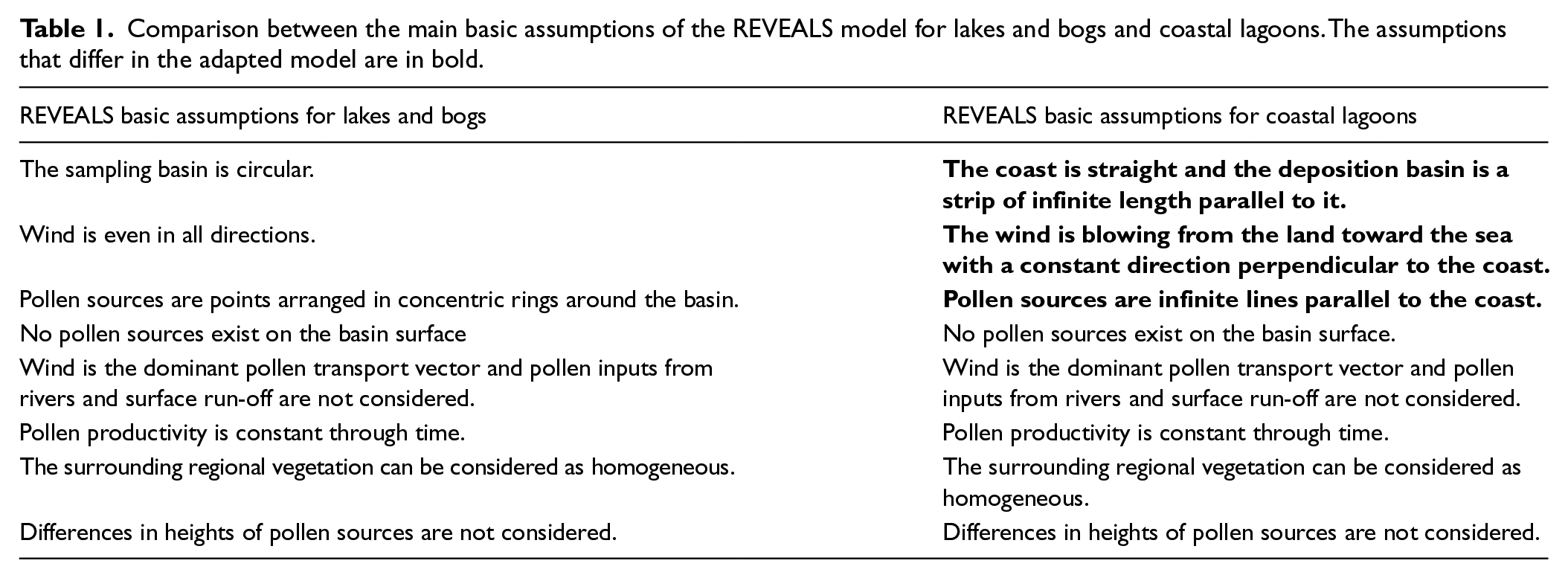
We assume that (1) the shape of coastal lagoons is elongated with its long axis parallel to the shoreline, (2) prevailing wind is blowing perpendicularly to the coast from the land to the sea, and (3) no plant grows on the sea surface, thus pollen coming from the leeward side is negligible. Table 1 compares the basic assumptions of the original REVEALS model for lakes or bogs and those of the modified model for coastal areas.
Comparison between the main basic assumptions of the REVEALS model for lakes and bogs and coastal lagoons. The assumptions that differ in the adapted model are in bold.
The two model geometries are represented in Figure 1.
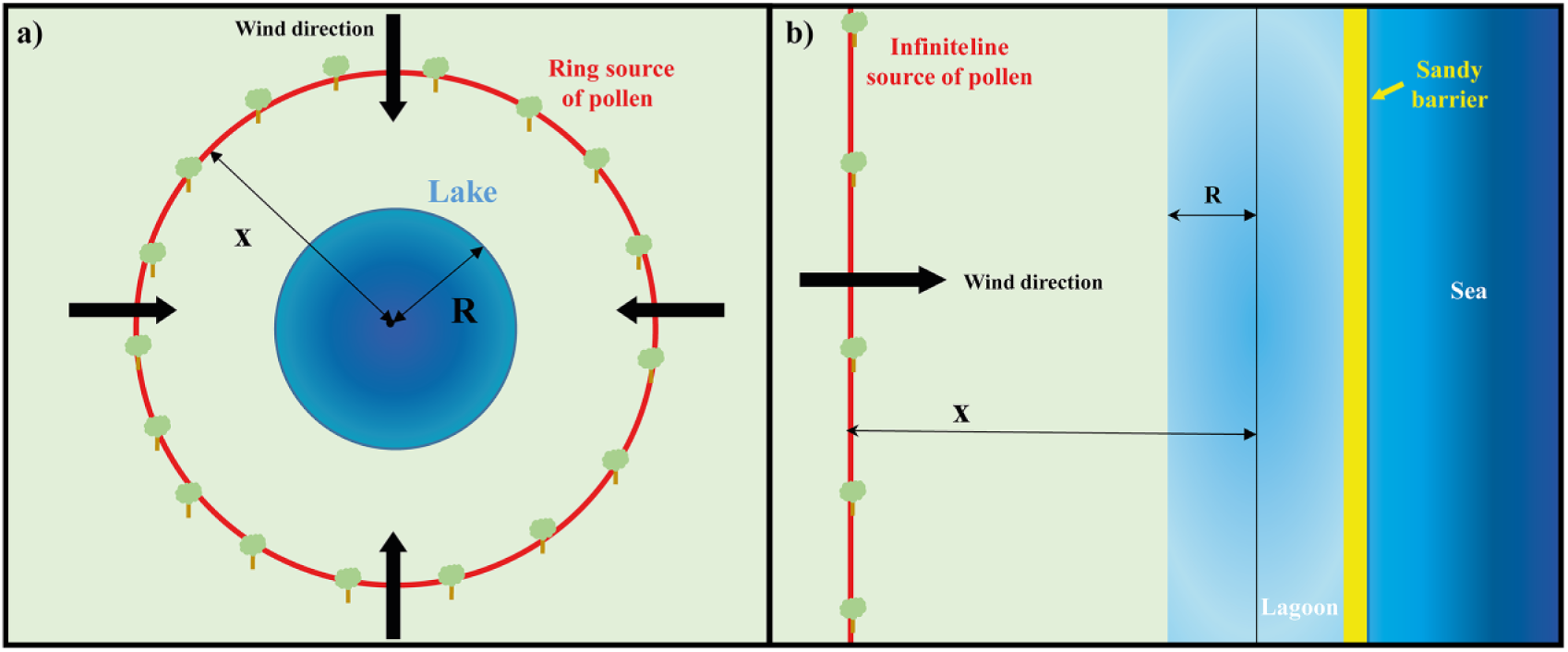
Comparison of the model geometry of REVEALS (a) for lakes and bogs and for (b) coastal lagoon.
Diffusion in the turbulent atmosphere of a cloud of pollen grains from an instantaneous line source of infinite length
The REVEALS model for lakes and bogs assumes that pollen sources are points arranged in concentric rings within an isotropic wind pattern (Sugita, 1993). The model for coastal lagoons proposed in this study assumes that pollen sources are infinite lines within a unidirectional wind pattern (Figure 1). The equations describing the diffusion of airborne particles in a turbulent airflow are different in the case of a point source and an infinite line source (Sutton, 1953). However, the dispersal and deposition function,
Simulating the pollen rain collected in an infinite strip basin
Let line

where

where
The REVEALS model deals with large basins by assuming that the regional vegetation distribution is homogeneous. Applying the same assumption, the pollen loading into a lagoon can be approximated by:

where
Note that the formula of the pollen loading into a lagoon

Estimation of the width of the pollen source area
The proportion of taxon i coming to a sedimentary basin from within a distance x relative to the total pollen loading of this taxon can be calculated as (Prentice, 1988; Sugita, 1993):

where
In the previous paragraph, it appears that:

Therefore,
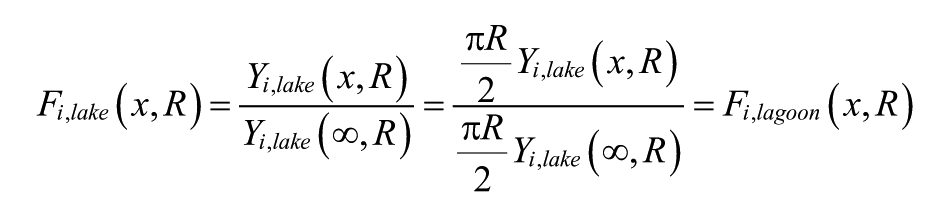
The width of the pollen source area of a lagoon can be computed using the same formula as the pollen source area of a lake.
Estimation of regional vegetation composition
In the REVEALS model, the general formula for the estimated proportion of vegetation composition of taxon

where
The assumptions necessary to demonstrate this formula are given in Sugita (2007a):
It is possible to define a maximum distance,
Pollen proportion of species

The regional proportion of vegetation composition of taxon

All those assumptions are applicable to the proposed model for coastal lagoons. Therefore, this general formula of the estimated regional proportion of vegetation composition of a taxon

The dispersal-deposition coefficient of taxon

Therefore,

Consequently,
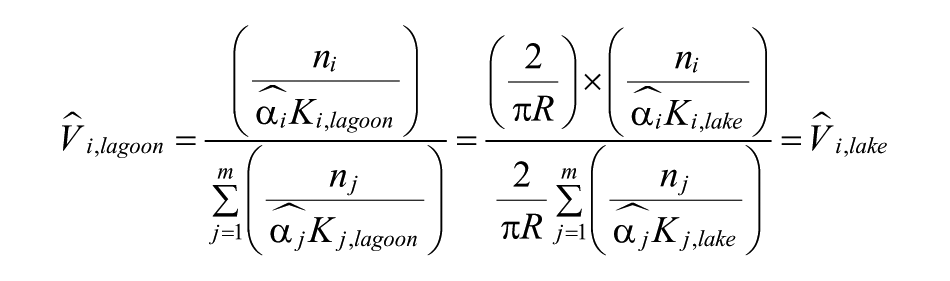
The formulas of the estimated proportion of vegetation composition for lakes and lagoons of the taxon
Discussion
For the sake of simplicity, the assumptions of this variant of REVEALS for coastal lagoons are kept as close as possible to those of the original model. Just as in the case of inland near-circular lakes and bogs, the assumptions made to adapt REVEALS to coastal lagoons are only a simplified representation of reality and are, therefore, never perfectly verified. However, before applying REVEALS to a particular site, one must always check that the gaps between model and reality must not be too large. Such issue must be discussed on a case-by-case basis, and a comprehensive review on the site setting and conditions necessary for the REVEALS applications is beyond the scope of this report. Nevertheless, we would like to draw attention to some points that we consider important.
First, it is crucial to make sure that waterborne-pollen inputs into the basin, coming through rivers or from the sea, are negligible. For example, relatively small lagoons located within the delta of a wide river just as lagoons widely open to the sea must be excluded. Good baseline knowledge of the history of the basin hydrology and sedimentation helps address this pollen-source issue. The model also assumes that the lagoon is considered as a strip of infinite length. This assumption is of course unrealistic. However, if the regional winds are blowing in a direction perfectly perpendicular to a straight coast and if the regional vegetation is truly homogeneous, the length of the basin doesn’t really matter. Thus, it is crucial to check the annual distribution of regional wind directions respectively to the orientation of the coast before applying the adapted model presented in this article.
Size and shape of sedimentary basins, either bogs or lakes, matter for the REVEALS formulation and applications. The original REVEALS model assumes to use pollen records from large near-circular lakes and bogs. When sedimentary basins are large, for example, >100–500 ha, site-to-site variation in pollen records becomes negligible even if vegetation structure is highly patchy and heterogeneous (Sugita, 1994, 2007a); thus, the assumption of homogeneous vegetation in the region is justified for the model applications. When large coastal lagoons are concerned, however, the spatial structure and zonation of the regional coastal vegetation, partially influenced by an altitudinal gradient perpendicular to the coast line, may affect the validity of the ‘homogeneous vegetation’ assumption and, thus, the reliability of the REVEALS application. Furthermore, in the case of relatively small basins, the specific and local vegetation growing on the edge of the lagoons would violate the assumption as well. We assume that use of pollen records from multiple small sites reduces the impacts on the model reliability of the violation of the ‘homogeneous vegetation’ assumption, as suggested in Sugita (2007a). Further studies are, however, required.
Conclusion
This paper demonstrates that changing the model geometry for coastal sites is not affecting the dispersal and deposition function, the pollen source area formula, and the estimated proportion of regional vegetation composition.
This result is important for the Mediterranean region where lagoons are common. Extending REVEALS applicability will allow improvements in the understanding of the coastal vegetation history in the Mediterranean basin where rich archeological records are available.
It will be also helpful for past climate modeling. Indeed, climate models need large-scale vegetation data in order to be accurately calibrated. Because these models are global or at least macro-regional, the ability to provide quantitative vegetation reconstruction in multiple types of context and areas is crucial.
Supplemental Material
Appendix_A – Supplemental material for Extending the applicability of the REVEALS model for pollen-based vegetation reconstructions to coastal lagoons
Supplemental material, Appendix_A for Extending the applicability of the REVEALS model for pollen-based vegetation reconstructions to coastal lagoons by Julien Azuara, Florence Mazier, Vincent Lebreton, Shinya Sugita, Nicolas Viovy and Nathalie Combourieu-Nebout in The Holocene
Footnotes

References
Supplementary Material
Please find the following supplemental material available below.
For Open Access articles published under a Creative Commons License, all supplemental material carries the same license as the article it is associated with.
For non-Open Access articles published, all supplemental material carries a non-exclusive license, and permission requests for re-use of supplemental material or any part of supplemental material shall be sent directly to the copyright owner as specified in the copyright notice associated with the article.
