



Abstract
Ground stone technology for processing starchy plant foods has its origins in the late Pleistocene, with subsequent intensification and transformation of this technology coinciding with the global emergence of agriculture in the early Holocene. On the island of New Guinea, agriculture first emerges in the highland Wahgi Valley, potentially from c. 9 kya, and clearly evident by 6.5 kya. Approximately 400 km further east in the highland Ivane Valley, long-term occupation sequences span the Holocene and late Pleistocene, but there is currently no direct evidence for wetland agriculture. Here, we report rare evidence for ground stone implements from a secure mid-Holocene archaeological context in the Ivane Valley. The Joe’s Garden site has flaked and ground stone artefacts with significant starch assemblages dating to approximately 4.4 kya. We present the first empirical evidence for the function of stone bowls from a New Guinea highland setting. Usewear and residues indicate the grinding and pounding of endemic starch-rich plant foods. Geometric morphometric analysis of starch grains shows that at least two taxa were processed: Castanopsis acuminatissima (nut) and Pueraria lobata (tuber). This regional example adds to our understanding of the trajectories of diverse plant food exploitation and ground stone technology development witnessed globally in the Holocene.
Introduction
From an overall perspective, coastal links rather than trans-highlands social networks seem more important in explaining the distribution of mortar, pestle and figure finds in the New Guinea highlands. Highlanders participated in a number of interaction spheres that extended inland from the coast. The four largest coast to highlands interaction spheres extended inland from (1) the Sepik-Ramu inland sea into the central highlands …, (2) from the Huon Gulf into the eastern highlands, (3) from the Huon Gulf into the upper Watut and (4) from the Oro coast into the highland valleys of Oro and Central provinces. (Swadling et al., 2008: 273)
Ground stone tools – in this case mortars (stone bowls) and pestles (aka elsewhere as lower and upper paired stones, metates and manos) – are a common feature of Holocene archaeological records across the globe. They are intimately linked with the emergence of agriculture, increasing population densities, diversifying plant resource exploitation and more broadly with climatic amelioration following the last Glacial cycle (Belfer-Cohen and Hovers, 2005; Fitzgerald and Jones, 1999; Kolvet, 2008; Liu et al., 2016; Ranere et al., 2009; Scholze, 2011; Zhang et al., 2011). While grinding stones have their origins in the Pleistocene (e.g. Denham et al., 2009; Fullagar et al., 2008; Piperno et al., 2004), they proliferated in the Holocene and became synonymous with agriculture and plant processing, particularly starchy plant species (Kolvet, 2008; Liu et al., 2010; Piperno et al., 2000, 2004).
In tropical zones, agriculture is expressed in part through the domestication of root crops, particularly yams (Coursey, 1972), and has an established antiquity reaching back to the early Holocene (e.g. Benz, 2001; Piperno et al., 2000). The Kuk Swamp site in the New Guinea highlands documents exploitation of starchy tubers, yams and fruits within the upper montane forests of the tropical highland zone at altitudes of >1500 m a.s.l. from as early as 9 kya (Denham et al., 2003; Fullagar et al., 2006). Unlike other contexts where grinding technology is clearly associated with systematic exploitation of starchy plants (e.g. Piperno et al., 2000), ground stone implements in New Guinea are rarely found in secure archaeological contexts and their function has been the subject of speculation for decades (Swadling and Hide, 2005).
The aim of this paper is to investigate the function and/or use of a stone bowl mortar and associated artefacts from the Holocene level at Joe’s Garden in the New Guinea highland Ivane Valley. The results are discussed in the context of our current knowledge of highland sequences and plant use in this zone, highlighting the importance of both underground storage organs (USOs) and nuts as important food sources.
Mortars and pestles in New Guinea
Stone mortars and pestles that have been manufactured by pecking and grinding ‘for the purpose of producing an object of specific size and shape’ (see Odell, 2004: 75) are a prominent feature across New Guinea and its offshore islands. Their distributions are well-defined, though the majority are only known as surface finds (Swadling et al., 2008; Swadling and Hide, 2005). These mortars, aka ‘stone bowls’, and pestles vary greatly in form and decoration, have been manufactured from stone or wood, and are regionally distinctive (Supplementary Figure 1, available online; Swadling, 1986: 50–59).
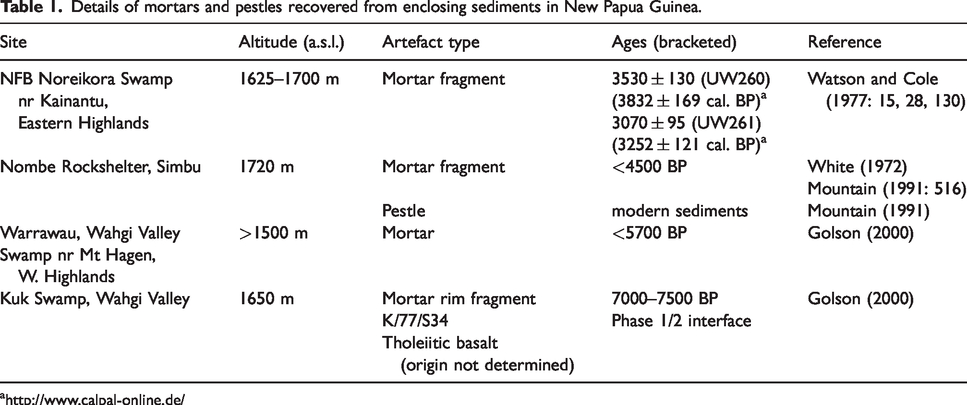
Only four stone bowls have been recovered from enclosing sediments in New Guinea, all are single fragments, date to between c. 7.5 and 3.5 kya and were found in the highlands (Table 1, Figure 1). All four mortar fragments have been recovered from the highlands ≥1500 m a.s.l. The oldest bowl fragment (K/77/S34, Figure 1a) is from Kuk Swamp (Denham et al., 2003), and was recovered from the interface between Phases 1 and 2, with an attributed age of c. 7.5–7 kya (Golson, 2000). The bowl was manufactured from tholeiitic basalt, an exotic raw material from outside the Wahgi Valley, maybe from within New Guinea (e.g. Ford, 2017), and perhaps outside of New Guinea (see discussion in Sullivan et al., 2017: 418–421). Microscopic examination revealed no diagnostic usewear or visible residues (Fullagar and Golson, 2017).
Details of mortars and pestles recovered from enclosing sediments in New Papua Guinea.

Stone bowl/mortar fragments from excavated contexts and known distributions of surface finds. (a) Kuk Swamp Phase 1, Wahgi Valley, Western Highlands (Denham et al., 2017: 198). The Kuk sample is likely to represent a very small portion of the original bowl (Golson, 2000: 232, 237). (b) Warrawau Stone Bowl Wahgi Valley, Western Highlands (Golson, 2000: 248). (c) Site NFB fragment, Kainantu, Eastern Highlands, (redrawn from Watson and Cole, 1977: 15; Image: Sara Boesser). (d) Nombe Rockshelter, Simbu Province (courtesy of Peter White; White, 1972: 135). (e) Distribution of mortar and pestle surface finds across New Guinea (after Torrence and Swadling 2008: 604).
The stone bowl fragment from Kuk Swamp (Figure 1a) occurs alongside more expedient examples of plant processing implements (cobble pounders) that have grinding wear traces and use-related residues (Fullagar et al., 2006; Fullagar and Golson, 2017). The remaining three fragments (Figure 1b–d) are all from different locations in the highlands, at altitudes >1500 m a.s.l. Unlike the Kuk Swamp find, these are not associated with wetland agricultural deposits and the Nombe example is from cave sediments. The youngest bowl fragment (NFB/1344, Figure 1c) is from Kainantu in the Eastern Highlands, with age estimates between 3000 and 4000 years cal. BP (Watson and Cole, 1977: 15), and currently represents the most recent age (from enclosing sediments) for this technology in New Guinea.
Apart from the stone bowls described above, two formally manufactured pestles were recently recovered from enclosing sediments at the Waim site in the Bismarck Range west of Madang, and have associated dates between 4 and 5 kya (Shaw et al., 2020). A pestle was also recovered from Nombe Rockshelter (Supplementary Figure 2, available online), but its age is unknown. The unprovenanced Ambum stone from the Ambum Valley, Enga Province returned a radiocarbon age (from rootlets found on the stone) of c. 3.5 kya (see reference in Swadling, 2005), and provides a possible minimum age for this artefact.
Mortars and pestles as a mid-Holocene phenomenon in New Guinea
Swadling et al. (2008) observed that in the Sepik-Ramu basin on the New Guinea north coast, the distribution of mortars as surface finds is spatially coincident with the palaeoshoreline of an inland sea formed during a mid-Holocene high sea stand from c. 7500 to 4000 BP (Chappell, 2005). No stone bowls or pestles have been found within the inland sea margin, nor have they been recovered from enclosing sediments and are not known from the floodplain after 4 kya (Swadling et al., 2008). The known ages of excavated specimens recovered from the highlands also fall within this period (Table 1), leading Swadling and Hide (2005) to suggest that stone bowls may be a proxy indicator of mid-Holocene deposits.
Notably, the first proposal for mortar use was by Neuhauss (see Neuhauss, 1911 in Swadling et al., 2008), who proposed their use in preparation of taro puddings, which are known ethnographically for ceremonial gatherings. More recently, Swadling and Hide (2005) observed the co-occurrence of mortar finds with taro cultivation in the highlands, with either rarely being found over 2000 m a.s.l. While not discounting the possibility that some mortars may have been used for this purpose, stone bowls were also known (in recent times) to be buried in gardens as they were believed to have spiritual powers to improve the crop harvest (see Berndt, 1954). This observation may explain, in part, why current distribution overlaps with land turned over to taro cultivation. In our experience, stone mortars and pestles, as well as other flaked and ground stone artefacts, commonly turn up during garden preparation for sweet potato crops.
Bulmer and Bulmer (1964) and Bulmer (1964) undertook a study of mortars and pestles from the highlands and suggested that their relatively small size made them more suitable for pounding tree nuts such as Castanopsis acuminatissima and/or Elaeocarpus (cf. womersleyi). Interestingly, both of these species have been recorded as important medicinal plants in the Eastern Highlands – with preparation described as ‘scraped’ and ‘concoction’, respectively (Jorim et al., 2012). Other researchers have argued for a range of plants being processed such as Pueraria lobata or Kudzu bean (Watson, 1964, 1968), Bauhinia sp. (Telban, 1988), unspecified taxa, probably monocotyledonous for coating spears (Chappell, 1964) and Kava in the Admiralty Islands (Ambrose, 1991). The changes in plant exploitation wrought by the introduction of sweet potato, a few 100 years ago, and perhaps the influence of Austronesian arrivals prior to 3000 years ago has made resolution of this problem challenging.
Our current understanding of mid-Holocene highland plant exploitation practices comes from the Kuk Swamp archaeological record (Denham et al., 2003; Fullagar et al., 2008), where bananas, taro and yams have been identified from microfossil remains. Key questions that we now need to explore are the function of stone bowls and pestles, correlations with the Kuk Swamp chronological record, and variations across their distributional range. Mode of use, the exploited plant taxa and subsistence strategies may well be implicated in their decline, which is broadly coincident with the timing of Austronesian expansion into the Pacific and its associated Lapita culture, which included the first appearance of pottery assemblages on New Guinea (Beaumont et al., 2019; Gaffney et al., 2015). Notably, the appearance of pottery roughly parallel similar developments visible archaeologically in the New World tropics (see Pearsall, 1995).
Here we present the results of a functional analysis of artefacts, and an assay (for phytoliths and starch) of an associated soil sample recovered from Level 2 at the Joe’s Garden site in the highland Ivane Valley of the Owen Stanley Ranges in Papua New Guinea. Independent technological, usewear and residue analyses have been compiled to establish artefact type, mode of use and specific plant taxa being processed. One of the challenges of investigating the function of this artefact class is identifying starchy residues to specific plant taxa. Recent methodological developments have largely overcome these identification issues, thereby increasing our confidence in identifying plant use (Coster and Field, 2015, 2018). The results are discussed in the context of highland New Guinea archaeology, the manufacture-ground stone mortar and pestle complex, and mid-Holocene plant use.
Site setting
The Ivane Valley is a broad U-shaped valley situated at 2000 m a.s.l. It is located about 140 km northwest of Port Moresby in the Owen Stanley Ranges, which is part of the central cordillera that runs east–west along the length of New Guinea (Figure 2a). Today the region receives about 2500 mm annual rainfall, seasonally between November and April (McAlpine et al., 1983). The annual mean temperature is 21°C and vegetation is dominated by temperate rainforest on the valley slopes and open grasslands on the lower slopes. A permanent swamp covers much of the valley floor (28 km2) and supports low swamp forest vegetation.
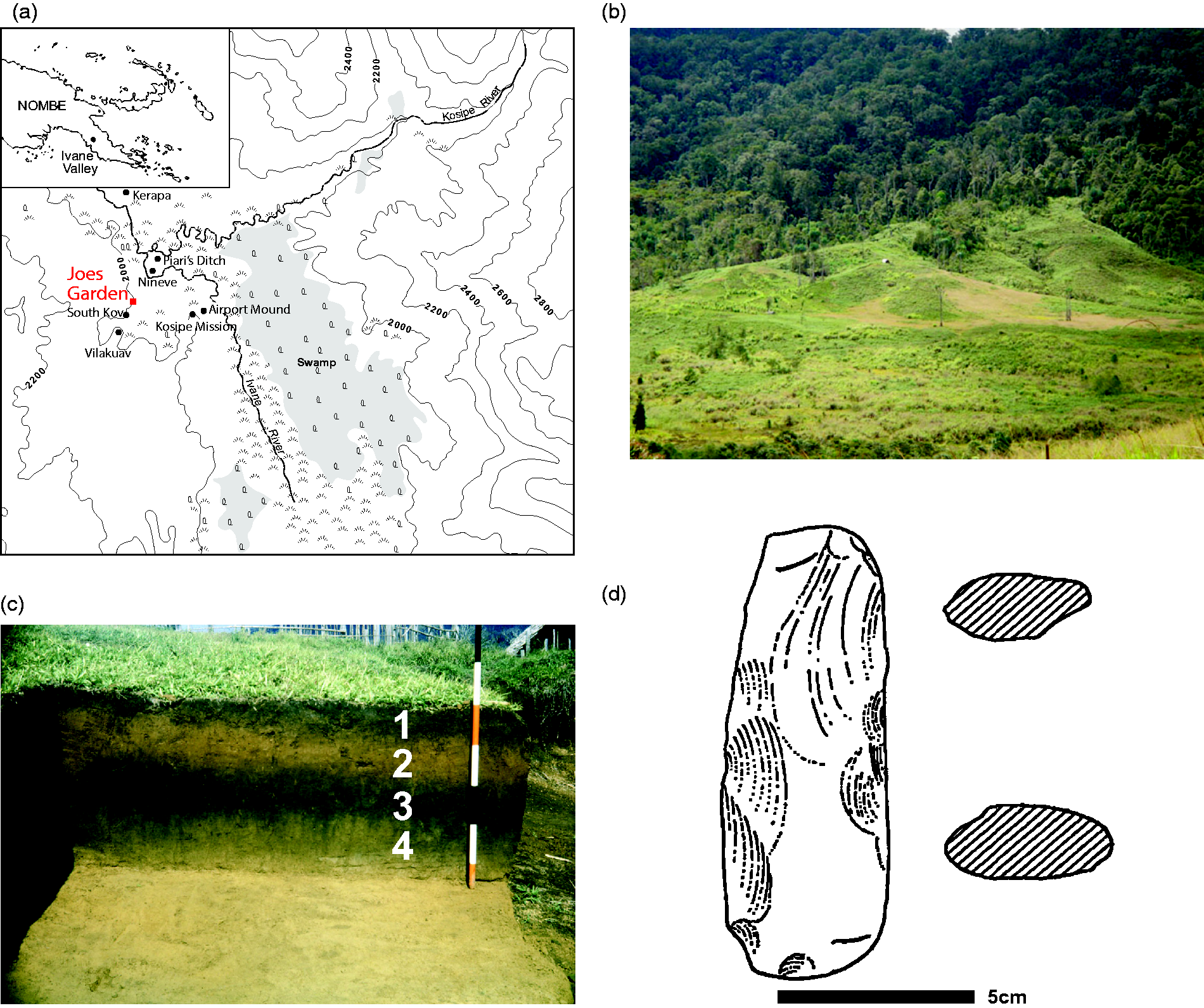
Joe’s Garden (site code: AAXC). (a) Map of Ivane Valley. (b) The site is situated on a spur above a tributary feeding the Ivane River. (c) Stratigraphic profile, first documented in the nearby Kosipe Mission site. (d) A ground edge axe was recovered from Layer 2, in the nearby Kosipe deposits.
Excavation of open sites in the valley was carried out episodically between 1960 and 2009 (Fairbairn et al., 2006; Summerhayes et al., 2010; White et al., 1970), establishing the presence of people in the Ivane Valley from 49,000 to 46,000 cal. BP (Figure 2), while vegetation reconstructions have provided a picture of environmental change through this period (Hope, 2009). The Ivane Valley archaeological sequence is one of the oldest radiocarbon-dated suite of sites known from Sahul (Pleistocene Australia-New Guinea landmass), and the earliest from this elevation, indicating a human presence, though discontinuous, since initial colonization.
The site is situated on a spur above a tributary feeding the Ivane River (Figure 2b) and lies in close proximity to two other sites of similar age: South Kov Ridge (AAXE) and Vilakuav (AAXF) (Summerhayes et al., 2010). Like other sites in the Ivane Valley, the Joe’s Garden sequence has yielded flaked stone assemblages broadly representative of other mainland Papua New Guinea Pleistocene sites (Ford, 2017).
The stratigraphic profile (Figure 2d), first documented in the nearby Kosipe Mission site (AER), is common to all the archaeological sites documented in the valley in the vicinity of the Kosipe River (Summerhayes et al., 2010; White, 1972). Multiple volcanic tuff layers have been identified in this sequence and correlate to eruptions from Mt Lamington, 140 km to the east and confirm the sequence described below. In general terms, the Ivane Valley stratigraphic sequence can be described as follows:
Layer 4: the lowest archaeological horizon comprises grey clay, and is absent from the Joe’s Garden sequence. Layer 4 at nearby South Kov Ridge is dated to 45,540–42,760 cal. BP (Wk 23,354), and at Vilakuav to 48,690–42,970 cal. BP (Wk 270,720) (Summerhayes et al., 2010).
Layer 3: a black brown soil that has been divided into two sub-units representing two ash fall events from Mt Lamington eruptions. The lower unit, Layer 3b is dated to 39,610–37,060 cal. BP (Wk 23,347) and Layer 3a to 27,620–26,260 cal. BP (Wk 27,075). Layer 3 is the lowest archaeological horizon at Joe’s Garden. While flaked and unmodified stone were present in Layers 4 and 3 in all the Ivane Valley sites, no ground stone has been identified (Ford, 2017). Carbonized remains of Pandanus spp. have been found in Layer 3 at several sites. Direct dating of a Pandanus spp. drupe from the Kosipe Mission site (AER) returned an age of 36,280–34,570 cal. BP (Wk.17,261) (Summerhayes et al., 2010).
Layer 2: a brown orange clay, containing Mt Lamington tephra. The age of Layer 2 is bracketed by dates of 8380–8200 cal. BP (Wk 23,358) and 4520–4250 cal. BP (Wk 23,357), and documents the reappearance of people in the valley after it was abandoned during the Last Glacial Maximum. A charcoal sample collected in association with the mortar fragment returned an age of 4410–4160 cal. BP (3855 ± 30, Wk 23,348) (Summerhayes et al., 2010). A ground edge axe was recovered from Layer 2 by White (1972) in the nearby Kosipe deposits (Figure 2d). Tephra from Layers 1 and 2 have been correlated with the Silimbu ash from the mid-Holocene Mt Lamington eruption (White et al., 1970) and subsequently confirmed by Summerhayes (unpublished results).
Layer 1: a disturbed overburden comprising (modern) garden soils.
Palaeoenvironment
Hope (2009) compiled an environmental history of the Ivane Valley from a series of cores collected across the Kosipe swamp. The record begins around 80–70 kya, prior to the development of a swampy lake, with peat formation beginning around 42–38 kya, the swamp persisting to the present-day. The palaeoenvironmental record documents periods of forest clearance and a fire history since c. 42 kya, changes that have been attributed to human activities (Hope, 2009). Despite the presence of the large swamp on the valley floor, there are no indications of landscape modification to facilitate wetland plant management or agriculture, as seen at Kuk Swamp, 400 km to the northwest (Denham et al., 2003). Furthermore, evidence for dryland agriculture is also absent in the archaeological record in the Ivane Valley, though the recovery of preserved Pandanus spp. drupes from several of the Ivane Valley sites suggests it was important from pre-LGM levels onwards (Fairbairn et al., 2006; Summerhayes et al., 2010).
A mixed montane forest was present during the mid- to late-Holocene, dominated by Castanopsis sp. and Elaeocarpus sp., two tree species that are ubiquitous in highland vegetation sequences (e.g. Haberle, 2007; Hope, 2009). Castanopsis sp. pollen frequency increased around 6 kya, along with a more diverse forest composition. Pandanus spp. was present continuously through the sequence, and correlates with a decrease in Nothofagus spp. pollen frequencies, indicating an improvement (warming) in climatic conditions.
Materials and methods
Archaeological assemblage
The Joe’s Garden Layer 2 artefact assemblage (n = 11) consists of flaked and ground stone as well as manuports (unmodified stone carried by people into these sites). All of the stone raw materials utilized in this layer were available in the Ivane Valley, either as river cobbles from nearby water courses or as part of the local volcanics (Mt Davidson or Talama) (see Ford, 2011). The single ground stone artefact – a stone bowl fragment – was recovered during excavation (Figure 3). Notably, White et al. (1970) had previously excavated a ground stone axe-adze from Layer 2 at the nearby Kosipe Mission (Figure 2b). No ceramics have been identified in any of the Ivane Valley deposits, and at Joe’s Garden, the acidic nature of the sediments appears to have precluded the preservation of faunal remains. Macrobotanical remains recovered during excavation are carbonized (see Summerhayes et al., 2010). A total of six artefacts and one soil sample from the Joe’s Garden excavations were submitted for analysis (Figure 3).

Stone artefacts from Joe’s Garden, Ivane Valley PNG examined in the functional analysis. Artefact 1 is the stone mortar fragment. Artefact descriptions are in text.
Usewear analysis
The artefacts were examined under a stereo-zoom microscope (model Olympus SZ61, magnification range 1.8×–80×) with an adjustable, external fibre optic light source. Artefacts were also examined under a vertical incident light microscope (Olympus BX51, magnifications 50×, 100×, 200× and 500×). Usewear images were captured with an Olympus Infinity 2 digital camera and recorded as TIF files. Multifocal images were later stacked using Helicon Focus software.
Ancient starch and phytolith analysis
Artefacts were sampled either by pipette, where a small amount of distilled water was applied to the artefact surface and removed after some careful dislodging of residue with a nylon pipette tip; or by immersing the edge of the artefact in an ultrasonicator bath for 1 min. Samples were transferred to centrifuge tubes and concentrated by centrifugation at 3000 r/min for 3 min. Starches were extracted by the addition of sodium polystungstate (specific gravity (SG): 2.35) and centrifuged at 1000 rpm/min for 15 min. The starch fractions were transferred to clean tubes and subsequently rinsed by centrifugation in distilled water (3×), then acetone (1×), and mounted in 50% glyercol:water solution. Laboratory and handling contamination were minimized with artefacts being bagged in situ. Powder-free gloves were used to handle the artefacts while sampling. All samples were processed in parallel with a negative control, and in all cases no starch was found in the negative control sample.
The soil sample was processed using standard protocols (Piperno, 2006). Around 4 g (4.4 g) of sample was deflocculated in Calgon (sodium metahexaphosphate) for 24 h, then water rinsed by centrifugation (3×) following sieving using 125 and 53 µm mesh Endecott sieves. Subsequent processing by heavy liquid separation proceeded as for the artefact samples.
A modern comparative reference collection of starch producing plants from the Ivane Valley included plant species from economic and non-economic taxa, and was compiled from field collections and Herbarium samples (Supplementary Figure 3, available online).
Classification using geometric morphometric measures
The identification of starch grains to plant taxa was achieved with robust statistical classifiers using quantitative predictor information based on geometric morphometric measures of the individual starch grains in a curated reference collection. The quantitative predictor information used measured attributes such as area, perimeter, maximum length, and Fourier transform. The measured attributes used varied with each potential classifier. The outputs (predicted identifications) were then further assessed with expert input (Coster and Field, 2015, 2018).
Importantly, and in contrast with other starch studies, the method used manually traced grain outlines which facilitated the use of multiple attributes to be quantitatively and accurately extracted from the grain shape. This approach contrasts with previous attempts by other researchers using shape attributes (see Wilson et al., 2010), where the algorithm for automatic edge detection smoothed the outlines of the subject grains making separation of any reference set unviable.
Each starch grain (both archaeological and reference) in this study was manually traced from a micrograph using a WACOM Intuos Pen Tablet (CTH-480). A minimum of 100 grains were documented for each reference sample and all of the complete unknown starch grains extracted in the residue analysis. The position of the hilum was also marked. Other morphological features such as fissures, lamellae and facets were recorded.
A number of classifiers (linear discriminant, quadratic discriminant, k-means and decision trees) were developed using grain attributes that best separate the reference grains from one another. For any study, the individual attributes will vary depending on the makeup of the reference set (Figure 4). In this study, the classifier that best distinguished between the species in the reference set was a quadratic discriminant, using five attributes (predictor variables): perimeter, circle metric, hilum position and angle. The reference species were subdivided into three sub-groups with a voted output. The classifier was verified by re-substitution and reverse cross-validation errors (Supplementary Figure 4, available online) after Coster and Field (2015). The unknown grains isolated from soil samples and artefacts were then analysed.
The classifiers developed in this study were based on all the different combinations of predictor variables (63 combinations of maximum length, area, perimeter, circularity, hilum offset, hilum angle and the components of the radial Fourier decomposition of the grain edge). The output of the classifiers was either the original species populations or sub-groups of the species populations to account for within-species variability (because of geometry or orientation). In the latter case, two different methods of re-combination of the sub-group output into a species prediction were also considered (maximum score output on the sub-group; and a voted output on the sum of the sub-group scores for each species).
Phytolith analysis
As part of the larger regional study, sediment sequences were collected from archaeological sites in the Ivane Valley, including Joe’s Garden. Phytolith analysis was undertaken for all of these sequences and these environmental sequences will be reported elsewhere. To contextualize the Joes Garden Layer 2 artefacts, the phytolith analysis of the sediment sample from the Holocene horizon, Level 2, is included here.
Phytolith preparations were examined at 200×–400× using a Zeiss binocular transmitted brightfield microscope. A minimum of 200 phytoliths/samples were counted. Phytolith identification was based on reference material which was collected in the Ivane Valley, the Lae herbarium (PNG), the National Herbarium Canberra, as well as a larger SE Asian reference collection held at Santa Clara University (Kealhofer and Piperno, 1998). The phytolith data for Layer 2 provides background environmental information about the plants present in the Ivane Valley and more locally around Joe’s Garden.
Stone tool tasks and function
Technological and usewear analysis
Artefact 1 (FIELD ID: JG07L2F) (Figures 3 and 4; Table 2) is a fragment of a kaersutite-phyric tholeiitic basalt stone bowl that was probably produced by pecking with a small stone hammer and subsequently ground smooth on the inside. The outside of the bowl is predominantly a natural, waterworn cobble surface, with some minor alterations including peck marks and striations. The mortar fragment includes a portion of the rim and the inside base (∼4 cm deep, from rim to base). The inside has flat zones 5–10 mm wide, which extend across the fragment and have striations running parallel to their long axis. We interpret these as production traces from grinding to shape the bowl, particularly as the top of the inside rim is slightly bevelled.

Dendrogram of the reference species and their separation using a quadratic discriminant classifier. Notably, species that are close to the axis on the right were difficult to separate and had correlating low CVEs and confident identifications were limited. The dendrogram also shows that Castanopsis acuminatissima and the Dioscorea species were relatively easy to separate from other species in the set.
Summary results for the functional analysis of the artefacts from Joe's Garden (the details for the soil content is presented in Supplementary Table 2.
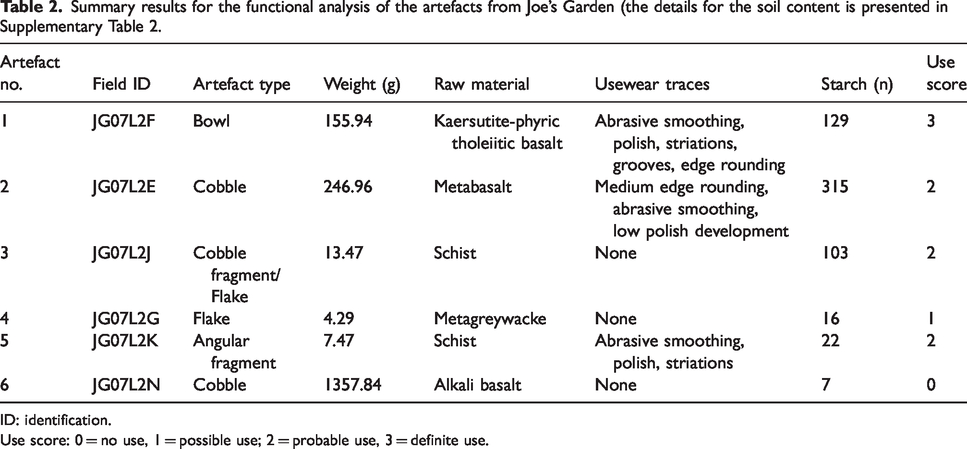
ID: identification.
Use score: 0 = no use, 1 = possible use; 2 = probable use, 3 = definite use.
There are small pits that are more common on the inside flat base and become less frequent towards the outer rim of the mortar. Grains surrounding the pits are rounded. On the inside mortar surface there are numerous, short straight striations at various orientations and over the smoothed surface (Figure 5f). Striations are also present on the exposed ilmenite crystals (black iron titanium oxides) in the basalt (Figure 5d and e). We interpret these striations on the ilmenite (Figure 5e) and the inside shoulder (Figure 5f) as wear from a pestle (the upper hand-held grinding/pounding stone). The usewear documented on the inside base of this mortar fragment is consistent with wear traces documented on experimental basalt tools used to process and crack nuts (Dubreuil, 2004: 1616). Similar usewear traces were observed on a diorite pestle from Nombe Rockshelter, which had abundant striations and pit marks on the pounding surface (Supplementary Figure 2, available online).
There are 10 macroscopically visible striations or grooves, mostly less than 1 mm deep and positioned close to a broken edge on the inside of the mortar fragment (Figure 5d and e). The deepest, Groove 2, is ∼2 mm deep and has a V-shaped cross section. The other grooves are shallower with U-shaped sections. All the incisions are straight, apart from Groove 7, which has two curves, and extends across the width (∼4 cm) of the fragment. The mix of shallow and deep grooves is puzzling, but they are close to one edge-rounded margin that appears to have been used for scraping. Moreover, differential weathering suggests that these grooves did not all occur at the same time. Some of the grooves could be from grinding, pounding, pressing and twisting the pestle during use before the bowl broke into fragments.
Artefact 2 (FIELD ID: JG07L2E) (Table 2; Figure 3; Supplementary Figure 5, available online) is an irregularly shaped waterworn metabasalt cobble. It has three large fractures and a possible percussion impact point on one side of the cobble (Supplementary Figure 5b). Small flake scars and edge-rounding suggest possible use of the broken cobble. The artefact has no evidence of deliberate retouch or surface grinding. On some surfaces and the edges, there is an organic film that mimics use-polish but dissolves in ethanol (Supplementary Figure 5e and f).
Artefact 3 (FIELD ID: JG07L2J) is a schist flake from a waterworn river cobble (Table 2; Figure 3, Supplementary Figure 6, available online). The platform (14 mm × 4 mm) forms an angle of ∼90° with a wedging initiation and axial termination, consistent with hard impact. Usewear is present on the platform and along the external platform edge (EPE) in the form of edge rounding, polish and micro-striations. The usewear and location along the EPE suggest a ‘use-flake’ (see Hayes et al., 2014). Schist is unlikely to be tough enough to make an effective hammer stone, but would make an effective implement for pounding soft plant tissue (e.g. Fullagar and Golson, 2017: 377). Its usewear and morphology suggest that the flake detachment was probably initiated from the lower/contact surface of a pestle during use.
Artefact 4 (FIELD ID:JG07L2G) (Table 2; Figure 3) is a small metagreywacke flake (wedging initiation and axial termination). The stone has a percussion ridge (cracks and flake scars) on the proximal edge. The lateral and distal margins are rounded with relatively fresh fractures that appear to be from recent damage. Their low edge-rounding, along the percussion ridge, is probably from flake production, not use.
Artefact 5 (FIELD ID:JG07L2K) (Table 2; Figure 3) is a schist flake, which has opposing percussion ridges (cracks and numerous flake scars initiated from both ends) typical of bipolar flaking. It is likely to be a compression flake initiated by wedging (Cotterell and Kamminga, 1987). A smooth, flat to undulating surface on the right lateral margin, dorsal side, looks macroscopically like it might be a flake from the margin of a ground stone implement. No traces of grinding were found on this surface, which is probably a naturally weathered cortex. We recorded striations along and parallel to this edge, which is rounded with patchy zones of smoothing/polish, suggesting use as a cutting tool.
Artefact 6 (FIELD ID: JG07L2N) (Table 2; Figure 3) is an unmodified weathered cobble made from alkali basalt, with no traces of manufacture or use.
Residue analysis (ancient starch)
All six artefacts and soil sample yielded starch grains (Table 1, Supplementary Table 2, available online). Artefacts 1, 2 and 3 had assemblages in excess of 100 grains and were recovered from about 1–2 cm2 of the artefact surface (∼0.1 g). The starch assemblage from Artefact 1 (mortar) consists primarily of nuts/fruit of C. acuminatissima, a member of the Fagaceae (Oak) family, with small contributions from P. lobata (Kudzu Bean), which is a subterranean tuber (Figure 6). These plant taxa are endemic to New Guinea. Artefact 2 (a waterworn metabasalt cobble), also yielded substantive numbers of starch grains from the nut/fruits of C. acuminatissima (108/315) and the tubers of P. lobata (33/315) with minor contributions from Musa ingens (banana), Cyathea sp. (tree fern) and Psophocarpus tetragonolobus (winged bean). M. ingens (banana) starch grains from the fruit were detected in negligible amounts on two other artefacts and in the soil, but diagnostic phytoliths typical of Musaceae were not found in the soil sample from this level. Musa starch levels were such that it is likely to be an indicator of a presence at the site rather than processing. Homalomena spp. starch was present on all artefacts and in the soil and is considered to be an environmental contaminant.
There is a 10-fold difference between the amount of material recovered from the soil sample and that from the stone artefacts, clearly illustrating the high concentration of use-related starch from the edge/surface of the three finds. The lower concentrations of starch from the second set of three (Artefacts 4, 5 and 6) are comparable to the soil yield and are considered unlikely to be use-related.
In all, 148 of the 315 grains documented from Artefact 2 (including 0 and 1 strike categories, see Coster and Field, 2018) were attributed to a species in the reference set. A success rate of about 50% was reflected in all samples analysed, and is commensurate with other studies (e.g. Field et al., 2016). Those grains not identified may belong to a species in the reference set but failed to meet the stringent classification criteria we adopted, or alternatively, were derived from species not in our reference set that we have yet to sample (Coster and Field, 2015).
The local environment at Joe’s Garden
The immediate environment of Joe’s Garden was open, likely with a few trees and shrubs (Supplementary Table 3). Grass phytoliths dominate the assemblage (Poaceae forms dominated by saddles, or bambusoid grasses). While these taxa disproportionately contribute abundant phytoliths to the sediment record, the limited number of clear arboreal phytolith types suggests most of the non-grass phytoliths are likely related to disturbance or other herbaceous taxa (e.g. small round sphere (SRS) forms). Unlike either the current or Pleistocene conditions, there is little evidence for any substantial arboreal component nearby (Hope, 2009; Kealhofer and Field, unpublished results). Also, of the four levels sampled, Layer 2 (8—4 kya) contained the most abundant grass assemblage. These findings are consistent with the patterns identified by Hope (2009: 2275), where an increase in secondary species from 6000 cal. BP have also been interpreted as an indicator of possible clearing and disturbance.
Discussion
There have been three important outcomes from the functional analysis of stone tools from Joe’s Garden, Ivane Valley in the New Guinea highlands:
Establishing, for the first time, the function of formally manufactured stone mortars from New Guinea and use of particular resources. While the function of this particular class of stone implement has been speculated upon for decades, it is now clear that the formally manufactured mortar and other tools from Joe’s Garden were used for starchy plant processing. Identifying starch grains from tree nuts (C. acuminatissima) and tuberous roots (P. lobata/P. tetragonolobus) on the stone mortar confirms the likely uses proposed by Bulmer and Bulmer (1964) and Watson (1964, 1968). Demonstrating the long-term survival of use-related starchy residues in an open site in a montane setting at 2000 m a.s.l. Starch grains have also been identified on stone tools in the Ivane Valley that have been dated to >30,000 years (Summerhayes et al., 2010) and builds on the work undertaken at Kuk Swamp (Fullagar et al., 2006). There has been considerable discussion of how and why starch grains preserve in sediments and on the edges/surfaces of stone tools over long time periods and the studies in highland New Guinea confirm the resilience of these microfossils in equatorial/tropical contexts (e.g. Field et al., 2016; Fullagar et al., 2008; Piperno et al., 2004). The in situ phytolith evidence provides clear evidence of an open woodland during site formation, and provides much needed detail not available from the swamp pollen records (Hope, 2009).
Manufacture-ground mortars and pestles in New Guinea
The mid-Holocene heralded a time of environmental and cultural change in New Guinea. A number of natural events, including volcanic uplift and eruptions coupled with the resultant loss of coastal wetlands and sea level changes along the north coast, disrupted coastal communities around this time, arguably coinciding with the disappearance of manufacture-ground stone mortars and pestles by around 3.5 kya. The ubiquitous nature of formally manufactured stone mortars and pestles in New Guinea and offshore islands suggests the technology was widely adopted, a likely marker of mid-Holocene deposits and with a maritime component. Nonetheless, broadscale events may have had far-reaching effects on communities from the coast to the highlands, coupled with the arrival of Austronesian speakers/Lapita cultural complex around 3300 cal. BP heralded significant changes to New Guinea societies.
Mortar function
As stone mortars and pestles vary greatly in their form and decoration across New Guinea, so may have the function of these implements and their use for processing particular plant or other resources. It is also possible that stone raw material availability and projected function perhaps also had a role in dictating their final form. With so few excavated examples known, exploration of these issues has been constrained, and questions remain about their origin, specific form, function and distribution through time. The advent of ancient starch analysis has been an important tool in understanding how ground stone implements such as mortars and pestles were used, as well as providing important new insights to complex processing of starchy plants. These plant foods were an important dietary component and are consistently associated with formally manufactured ground stone implements. While these implements have been documented archaeologically during the late Pleistocene in different regions (e.g. Fullagar et al., 2008; Lippi et al., 2015), they proliferated in the Holocene (e.g. Pearsall, 1995; Ranere et al., 2009).
In the New Guinea highlands, a combination of tree nuts (C. acuminatissima) and USOs (P. lobata) were targeted, providing the first empirical evidence for processing of these important economic staples. While P. lobata is well documented as an economically important plant food, identifying C. acuminatissima (Fagaceae) as part of this suite has been particularly significant, primarily because of the lack of physical evidence (macro or micro remains) to suggest any antiquity for its use. C. acuminatissima has long been considered a likely starch staple (e.g. Bulmer, 1964), and is still eaten and processed by pounding in contemporary highland communities, including the Ivane Valley.
The findings from Joe’s Garden have clarified what has been a decades-long discussion about mortar and pestle function in New Guinea. Previous studies of the role of starchy plants in subsistence have mainly focused on the use of taro, banana and some yams (see Denham et al., 2003; Summerhayes et al., 2010). Castanopsis sp. has not featured as an important economic species, yet it may have played an important, if up until now an invisible, role in highland diets over the millennia. These small, hazelnut-sized fruits are seasonal (November–December in the highlands, see Bourke, 1996), are usually cooked (boiled) but are sometimes eaten raw; they are commonly found in lower montane forests (500–2000 m) and have been observed growing in villages around the Ivane Valley sites. Widely available across the highlands, C. acuminatissima has been recorded as eaten on hunting trips, but has never been clearly identified as a common starchy staple. As both the Waim pestles (Shaw et al., 2020) and the Ivane mortars document use of C. acuminatissima tree nuts, it would appear that consumption of these tree nuts was widespread and perhaps a common feature of highland subsistence. Notably, C. acuminatissima is ubiquitous in highland pollen sequences across New Guinea (e.g. Haberle, 2007; Hope, 2009) and notably, in the highland Kaironk Valley in Madang Province at least one stand of C. acuminatissima has conservation status.
Over the last c. 300 years, the predominance of sweet potato in subsistence gardening practices has led to a range of economic starchy plants falling into disuse because of the high productivity of this recent introduction. However, not all technologies and foods were simply replaced. Some starchy food plants, including P. lobata (Kudzu bean) are still accessed during times of drought when sweet potato crops have failed, as seen in recent years (Allen and Bourke, 2009). Perhaps the example of sweet potato introductions may also provide insight into the decline of stone mortars and pestles, as the introduction of pottery may correlate to a shift in the way plant foods were exploited and processed. Along with other innovations associated with the arrival of Austronesian speakers around 3300 years ago, the practical need for stone mortars and pestles in starchy food preparation was superseded by this newly introduced technology (see Summerhayes, 2019).
Conclusion
Functional analyses of manufacture-ground mortars and pestles have identified a number of starchy plant foods subject to complex processing during the mid-Holocene in highland New Guinea. While these mortars and pestles vary in form and decoration, further work is needed to understand the functional variation of this artefact type. The discovery of C. acuminatissima and P. lobata on a mortar fragment and possible pounding tool in the Holocene Ivane Valley record directly contribute to our understanding of the complexity of Holocene economic strategies in the inter-montane valleys of highland New Guinea, especially the processing of starchy foods.
Like other members of the Fagaceae (Oak) family from North America and Eurasia that are economically important, our study has shown that tree nuts, in this case C. acuminatissima, may have been an important staple in the mid-Holocene subsistence economy. The starchy tree nuts of Castanopsis sp. may well have been an important staple during the wet season and its use may complement the exploitation of Pandanus spp., which has long been recognized as a significant economic resource, the fruits being high in protein and oil. The widespread distribution of Castanopsis sp. across the highland zone, the targeted planting of this tree in villages, and defined seasonal availability lends weight to a subsistence pattern centred on cultivated forest trees. Other economically important edible tree nut species known from ethnographic records include Finschia chloroxantha and E. womersleyi and are likely to have been part of this suite of practices across the tropical zone of Sahul and Holocene New Guinea, perhaps facilitating the movement of people and influencing settlement patterns over time.

Artefact 1, Usewear. (a) Striations around the inside rim, scale bar: 5 mm. (b) Pitting and striations on the outside base, scale bar: 2 mm. (c) View of inside base showing grooves, scale bar: 5 cm. (d) Detail of striations numbered 1–9; 10 is outside this field of view; descriptions in text. (e) Usewear (polish and striations) on the inside base, scale bar: 0.05 mm. (f) Detail of the inside base between striations 6 and 7, showing smoothing and striations in the dark raised phenocryst, scale bar: 1 mm.

Examples of archaeological starch grains from Artefact 1 (mortar) adjacent to starch grains from the predicted species using the quadratic discriminant classifier. (a, d, g, j) Archaeological unknowns. (b, c, e, f) C. acuminatissima. (h, i, k, l) Homalomena sp. There can be considerable variation in morphology across a single species and the classifier uses a population approach to the attribution to a specific plant taxa; this is then further confirmed by an expert visual check.
Supplemental Material
sj-pdf-1-hol-10.1177_0959683620919983 - Supplemental material for Functional studies of flaked and ground stone artefacts reveal starchy tree nut and root exploitation in mid-Holocene highland New Guinea
Supplemental material, sj-pdf-1-hol-10.1177_0959683620919983 for Functional studies of flaked and ground stone artefacts reveal starchy tree nut and root exploitation in mid-Holocene highland New Guinea by JH Field, GR Summerhayes, S Luu, ACF Coster, A Ford, H Mandui, R Fullagar, E Hayes, M Leavesley, M Lovave and L Kealhofer in The Holocene
Footnotes
Acknowledgements
The authors thank the National Museum and Art Gallery and the National Research Institute in Port Moresby, and the National PNG Forest Research Institute in Lae for assistance and ongoing support. Michael Burnside and Thomas Magun provided technical assistance. Thanks are due to Ben Shaw and Pam Swadling for reading and commenting on an earlier draft, any mistakes are truly our own. The MicroTrace Laboratory at the University of Wollongong and Brian Jones are also acknowledged for discussion of stone properties. Thanks are also due to Matthiu Prebble and Geoff Hope for access to the Doug Yen/Tom Loy starch collection held at the Australian National University, to Sara Boesser, Jack Golson and Peter White for permission to reproduce the images of mortar fragments and to M-J Mountain for permission to examine the Nombe pestle.
Funding
The author(s) received the following financial support for the research, authorship and/or publication of this article: The project was funded by an Australian Research Council Discovery Project (DP110102828 awarded to JHF and GRS); the University of New South Wales; and the Marsden Fund Council funding administered by the Royal Society of New Zealand awarded to GRS.

Supplemental material
Supplemental material for this article is available online.
References

Supplementary Material
Please find the following supplemental material available below.
For Open Access articles published under a Creative Commons License, all supplemental material carries the same license as the article it is associated with.
For non-Open Access articles published, all supplemental material carries a non-exclusive license, and permission requests for re-use of supplemental material or any part of supplemental material shall be sent directly to the copyright owner as specified in the copyright notice associated with the article.
