



Abstract
Oceanic characteristics of the Holocene are used to understand climatic patterns and phenomena that affect marine and human communities. Likewise, past marine conditions can be reconstructed from surface sea temperature (SST), using stable oxygen isotopes in bivalve shells. The objective of this study was to calculate Holocene summer SSTs for La Paz Bay, by analyzing δ18O of 14C dated bivalve shells (Chione californiensis) from a Holocene camp site located in Cañada de La Enfermería, Baja California Sur, México. Aragonite was extracted from the shells’ umbo, representing the summer growth season during the first year of life. δ18O value of C. californiensis is −1.9 ± 0.1‰ at present, and varied between −1.3‰ and −2.6‰ during the last 9 ky. In 9469 BP, 8396 BP, and 7708 BP, δ18O values were similar to those of the present. In 7857 BP, 7805 BP, and 7804 BP, δ18O was 18O depleted (0.6–0.9‰), indicating warmer summer SSTs versus the present. In 7070 BP, 6945 BP, and 2087 BP, δ18O was enriched in 18O (0.3–0.4‰), suggesting colder SSTs versus the present. This study coincides with other paleotemperature studies for the region and allows us to address the effect of changing SST on this marine resource, its use by human communities of the past, and its effects on human presence in the area with respect to climate variability.
Keywords
Introduction
Early Holocene archeological evidence indicates that the settlement of Baja California was mainly carried out by coastal groups from western Canada and the northwestern United States, as well as groups from the Western Pluvial Lakes tradition, which adapted to coastal life as they arrived in the Cape region around 12,000 BP (Fujita, 2010; Porcasi and Fujita, 2011),
La Paz Bay contains a diversity of archeological sites, suggesting a process of early settlement (Figure 1). These sites present mounds of discarded domestic waste, composed mainly of faunal remains and lithic materials. Their analysis reveals great dependence on marine mollusks, echinoderms, crustaceans, fish, cetaceans, turtles, marine mammals, and the complementary use of terrestrial plant and animal resources (Fujita and Ainis, 2018). Coastal shell sites are valuable reference points of prehistoric times and have been used as environmental monitoring tools (Braje et al., 2009; Leng and Lewis, 2016), providing a wide-spectrum and high-resolution archive of changes in ocean temperature and chemical conditions, under which these mollusk shells were formed (Colonese et al., 2012; Gordillo et al., 2015; Schöne, 2008; Schöne and Gillikin, 2013).

Location of the archeological site Cañada de La Enfermería, La Paz, B.C.S., Mexico. The segmented line represents the coastline at −16.25 m ca. 8000 BP, relative to the actual coastline.
The bivalve genus Chione is widely represented in natural and archeological sites of the Gulf of California (Goodwin et al., 2001; Meldahl, 1995; Meldahl and Cutler, 1992), Pacific coasts (Laylander and Iversen, 2006; Rick et al., 2004), and other parts of the world (Edie and Surge, 2013; Keyes, 1960). Moreover, Chione californiensis (C. californiensis) is one of the most representative species in archeological sites of La Paz Bay (Ainis et al., 2019; Rosales-López et al., 2003), making it a proxy for paleoceanographic studies, and enabling for a detailed view of the marine environment from which the inhabitants of the region extracted this resource. This bivalve is distributed in the Pacific Ocean from Punta Mugu, California, USA to Panama. It lives mainly in the intertidal zone (up to a depth of 69 m) and can frequently be found buried a few centimeters below the sediment surface (Prado-Ancona, 1998). It can live up to 18 years and decreases shell growth after four years. Its distribution and abundance are related to temperature, salinity, dissolved oxygen, as well as the amount of organic matter and sediment granulometry (García-Dominguez et al., 1994).
Sea surface temperature (SST) largely determines the distribution and availability of this species, with an optimal threshold between 24°C and 27°C for the genus Chione (Celis-Hernández, 2011). The reproduction of C. californiensis in La Paz Bay lasts 8 months, interrupted during winter between 18°C and 23°C (García-Dominguez, 1991). Additionally, the species presents an optimum growth period in the summer season (García-Dominguez, 1991), during which there is a deep nutricline and a stratified water column (Obeso-Nieblas et al., 2014).
Most organisms that precipitate calcium carbonate do so under conditions of isotopic equilibrium with seawater. This mechanism, mainly dependent on temperature, determines the proportion of oxygen isotopes in biogenic carbonate at a rate of 0.24‰ per °C (Epstein et al., 1953). A study on mollusk δ18O of Mid-Holocene shell middens in Santa Rosa Island, California found a significant SST change of 2°C between 6000 BP and 4300 BP (Rick et al., 2006). Similarly, for the Colorado River Delta, Gulf of California, late-Holocene exploitation of coastal resources by humans and environmental conditions were inferred through δ18O analysis of shell middens. Values ranged from −3.05‰ to 0.7‰, with an average of −0.87‰ for 2500 BP (Celis-Hernández, 2011). Additionally for the same region, the species Chione cortezi (currently accepted name Chionista fluctifraga) was cross calibrated to infer SST through δ18O analysis, establishing an annual seasonal difference of 3.38‰ (15.9°C) (Schöne et al., 2003).
Studies on SST variability and its implications on past marine ecosystems are limited for the La Paz Bay. However, coccolithophore and silicoflagellate records suggest water column variability due to nutricline oscillation between 9000 BP and 6000 BP (Staines-Urías et al., 2015), warm SSTs due to the incursion of tropical waters during 5528 BP, 4500 BP, 3750 BP and in the recent past, as well as cold SSTs between 3495 BP and 2250 BP (Álvarez et al., 2012).
The present study aims to reconstruct the paleo-environment of La Paz Bay (Gulf of California) and analyze subsistence strategies of human communities that inhabited the region through stable oxygen isotope analysis of C. californiensis shells collected from a Holocene camp site in a subtropical bay of the southern Gulf of California.
Environmental and archeological setting
Study area
The Gulf of California is a unique, narrow, and semi-closed marginal sea. Moreover, it is the only evaporative basin of the Pacific Ocean, where evaporation process historically dominate regional oceanographic dynamics (Beron-Vera and Ripa, 2002). The La Paz Bay is an important body of water within the Gulf. It is influenced by southern Gulf of California mesoscale processes, which largely determine its hydrographic conditions (Obeso-Nieblas et al., 2008). The SST of La Paz Bay varies seasonally with a maximum of 28°C during summer and autumn seasons, later decreasing to 19°C at the end of winter (Obeso-Nieblas et al., 2014). Specifically, in the island complex of Espíritu Santo, summer in situ SST reached 27.5°C ± 1°C and decreased below 22°C during winter (Aguiñiga et al., 2010).
Geological and archeological setting
La Cañada de La Enfermería is located in the southern region of La Paz Bay, Gulf of California (24°13′14.00″N; 110°16′56.00″W) (Figure 1). It lies on a canyon terrace 3 km from the coast and 70 m above sea level, covering an area of approximately 9000 m2, separated by a seasonal stream that runs from north to south. The area is situated on the margin of a structural elevation to the east of the La Paz Valley. It is composed of lithic tuff strata belonging to the Upper Miocene Comondú Formation and is adjacent to a Mesozoic Granitic batholith. It’s topographic elevation drops sharply toward the La Paz Bay with canyons up to 100 m deep, cutting the Comondú Formation from east to west, and generating stream beds that drain significant volumes of water into the bay during the rainy seasons (Padilla-Arredondo et al., 1985). Here several seasonal streams and natural dams were identified, which periodically store abundant fresh water (Figure 2). In addition, the surrounding hills provide various types of lithic raw materials for tool making, and multiple rock shelters that offer protection. Archeological excavations produced a large number of fauna and lithic artifacts dated between 10000 BP and 1800 BP, including projectile points, knives, scrapers, perforators, metate hands, beads, shell hooks, and coral polishers. Its stratigraphy suggests numerous occupational episodes that span much of the Holocene, indicating that it may have been a meeting place for various groups in the region (Figure 3) (Fujita et al., 2018).

General view of Cañada de La Enfermería (a) and excavation units S1 and S2. Natural freshwater damns (b) (modified from Fujita et al., 2018).

Bivalve and lithic artifact remains at excavation unit 1 (a), and Stratigraphic layers (b) at excavation unit 2, Cañada de La Enfermería, La Paz bay.
Materials and methods
Collection and dating of bivalves
The collection of shells at Cañada de La Enfermería was carried out in 2015 and 2016 as part of the INAH archeological project Registration and Excavation of the archeological sites of the municipality of La Paz, B.C.S. The non-disturbed stratigraphic layers (with no apparent sign of mixing) of two excavation units (Figures 2a and 3) were dated with one mollusk 14C analysis per layer at the National Institute of Anthropology and DirectAMS, yielding estimated dates between 10000 BP and 1500 BP (±29 to 179 years). Due to laboratory protocols, the dated bivalve shells were utilized in their entirety (Fujita et al., 2018). Additionally, representative bivalve specimens from each stratigraphic layer were taxonomically identified to species (Coan and Valentich-Scott, 2012).
Bivalve shell isotope analysis
Given the continuous presence of C. californiensis in the stratigraphic layers and its representativeness at a regional level, the species was selected as a proxy for this study.
Three well preserved specimens of C. californiensis with similar sizes were selected from each dated stratigraphic layer (9469 BP, 8396 BP, 7857 BP, 7805 BP, 7804 BP, 7708 BP, 7070 BP, 6945 BP, 2087 BP). Additionally, three live specimens were collected in August 2020 in the La Paz Bay, as reference to present day conditions, totaling 28 individuals for 10 dates (nine stratigraphic layers and the present).
The genus Chione in the Gulf of California is represented by species analogous to C. californiensis (i.e. C. fluctifraga and C. Cortezi) with shells composed exclusively of calcium carbonate in the form of aragonite (Goodwin et al., 2001; Schöne et al., 2006). In order to obtain aragonite for oxygen isotope analysis, the surface layer of each shell was cleaned to remove organic residues (Culleton et al., 2006 C. californiensis). The shells were then placed in a 1.5% sodium hypochlorite solution for 24 h and rinsed with distilled water in an ultrasonic bath, removing residual impurities. Finally, aragonite was obtained using a microdrill, extracting approximately 1 mg of calcium carbonate powder from the inner face of each shell, in close proximity to the umbo, guaranteeing similar age intervals. This extraction point corresponds to the optimal growth season (summer) of (García-Dominguez, 1991) during the first year of life (Robbins, 2006) (Figure 4).

Chione californiensis microsampling of shells from the past (a) and present (b). The calcium carbonate extraction point (using a 5 mm drill bit) can be seen adjacent to each shell’s umbo, corresponding to the species optimal growth season (summer) during its first year of life.
The aragonite microsamples were processed and analyzed at the University of Wyoming’s Stable Isotope Facility. Samples were placed in exentainer tubes, purged with ultrapure He to evacuate all air, and digested with 100% orthophosphoric acid at 25°C for 8 h. The CO2 generated was analyzed in a Thermo Gas Bench-II, and subsequently the oxygens’ isotopic ratio was determined using a Delta V plus mass spectrometer (McCrea, 1950). Results were expressed in δ notation (‰ vs VPDB). The analytical precision of three standards used were 0.19-18UWY, 0.09-6UWY, and 0.07-17UWY‰, respectively.
Paleotemperatures
For paleotemperature calculations Grossman and Ku’s (1986) empirical relationship, modified by Schone et al. (2001) for Chione cortezi was used:

where T is expressed in degrees Celsius, δ18O (‰ vs VPDB) is the isotopic value of aragonite and δ18Osw (‰ vs SMOW) is the average change in δ18O for the Pacific Ocean with a value between −0.01 and 0‰ (LeGrande and Schmidt, 2009).
Results
Through the use of the paleotemperature equation, modified by Schone et al. (2001), the isotopic equilibrium of aragonite was calculated considering an average SST of 28°C (Aguiñiga et al., 2010; Obeso-Nieblas et al., 2008) and a seawater isotopic value of 0‰ (LeGrande and Schmidt, 2009). The δ18O value of the aragonite at isotopic equilibrium was −1.9‰, very similar to measured value of the C. californiensis shells of the present (−1.9 ± 0.1‰). Therefore, C. californiensis δ18O is in isotopic equilibrium with its environment and can be used as a paleotemperature proxy. Similarly, Schöne et al. (2006) found that Chione fluctifraga, an analog species from the northern Gulf of California, is also in isotopic equilibrium with its environment.
Chione californiensis δ18O averages are presented for one modern date (La Paz Bay specimens collected in 2020) and nine archeological intervals (dated stratigraphic layers) of Cañada de La Enfermería (Table 1). Modern δ18O values averaged −1.9 ± 0.1‰, while past average values ranged between −1.6 ± 0.3‰ and −2.2 ± 0.4‰ (Table 1, Figure 5).
Chione californiensis sample ID, graph reference, average δ18O values and standard deviation for specimens of La Cañada de La Enfermería, La Paz Bay. Sea surface temperature (SST in °C) estimated using Grossman and Ku’s (1986) paleotemperature equation. Age range (Fujita et al., 2018) and average (years BP, 1-SIGMA).


δ18O mean values and standard deviations versus age of C. californiensis specimens from the archeological excavation site Cañada de La Enfermería, Bahía de La Paz, México. Numbered circles correspond to sample references (Table 1). The dotted box represents δ18O variation in the present.
Specifically, average δ18O values for 9469 BP and 8396 BP were very similar to present values (both −1.9‰). During the period between 7857 BP and 7804 BP, average δ18O values exhibited 18O depletion of up to 0.3‰ with respect to the modern value (−1.9‰), progressively increasing from −2.2‰ to −2.0‰. δ18O values for the year 7708 BP further increased toward present values (−1.9‰). This tendency continued during 7070 BP (−1.7 ± 0.2‰) and 6945 BP (−1.7 ± 0.1‰). In 2087 BP, δ18O values reached a maximum average (for the data series) of −1.6 ± 0.3‰. Finally, between 2087 BP and the present, δ18O values decreased by 0.3‰.
Inferred summer SSTs for the Cañada de La Enfermería archeological record varied from 27.2°C ± 1.4°C to 30.1°C ± 1.8°C, presenting a range of 2.9°C for the last 9469 years (Table 1, Figure 6). The average summer SSTs in 9469 BP (29.1°C ± 0.6°C) and 8396 BP (28.8°C ± 0.4°C) were very similar to the inferred SST of the present (28.7°C ± 0.6 °C). SST between 8396 BP (28.8 °C ± 0.4°C) and 7857 BP (30.1°C ± 1.8°C) increased by 1.3°C then quickly (within 149 years) decreased to 29.1 ± 1.6°C by 7708 BP, resulting in a SST very similar to that of the present (29.1°C). This decreasing tendency continued from 7070 BP (28.1°C ± 0.4°C) and reaching 28.2°C ± 0.9°C by 6945 BP (0.5°C below the present value) before the archeological record subsides marking the beginning of a 4858-year long hiatus. Subsequently, the first late-Holocene archeological record indicates that in 2087 BP the SST reached a minimum (for the entire data series) of 27.2 °C ± 1.4°C, increasing thereafter by 1.5°C until reaching its present value.
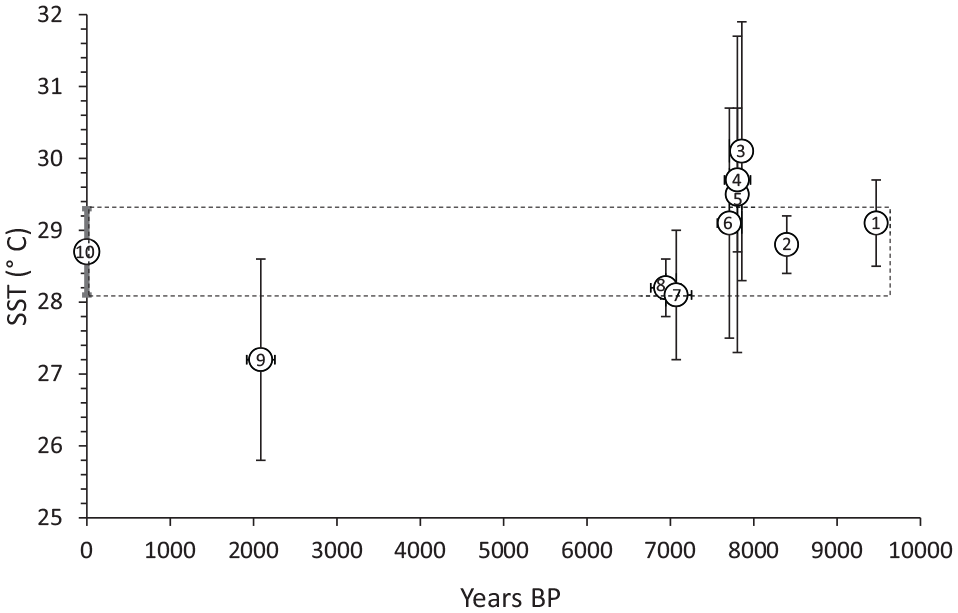
Inferred summer SST mean values and standard deviations versus age of C. californiensis specimens from the archeological excavation site Cañada de La Enfermería, Bahía de La Paz, México. Numbered circles correspond to sample references (Table 1). The dotted box represents the SST variation in the present.
Discussion
The global Holocene climate has been highly variable, with specific regions responding differently or asynchronously to rapid climate change events that is, Optimal Climate Medieval or Little Ice Age (Boretto et al., 2013; Wanner et al., 2008). However, Holocene climate changes have been strong enough to generate significant effects on ecosystems and human populations (Mayewski et al., 2004). The stable isotope data from Cañada de La Enfermería provides important insight on oceanographic conditions throughout the Holocene. The results obtained here indicate SST change throughout this epoch, and possible effects on ancient human populations of La Paz Bay.
Surface sea temperatura (SST): La Paz Bay
Precipitation of aragonite and/or calcite in various marine organisms including bivalves is dependent on temperature and seawater isotopic composition (Epstein et al., 1953). Therefore, the use of bivalves as SST proxies requires their isotopic equilibrium with the environment throughout their life span (Schone et al., 2001). Using SST and salinity records of La Paz Bay (Aguiñiga et al., 2010; Obeso-Nieblas et al., 2008), as well as the modified paleotemperature equation by Schone et al. (2001). Aragonite δ18O values was calculated in equilibrium with seawater. The δ18O value in equilibrium obtained was −1.8 ± 0.2‰, very similar to the C. californiensis δ18O value of −1.9 ± 0.1‰ (n = 3) for the present. This suggests that δ18O values of C. californiensis are adequate for inferring past SSTs of La Paz Bay, as has been suggested for other bivalves in the Gulf of California (Celis-Hernández, 2011; Schöne et al., 2003) and California (Rick et al., 2006).
The C. californiensis δ18O values of the present indicate a mean summer SST of 28.6°C ± 0.6°C, which is closely similar to the mean in situ SST of the bay and the island complex of Espíritu Santo (Aguiñiga et al., 2010), validating C. californiensis as an adequate SST proxy of La Paz Bay. Additionally, the δ18O values of the C. californiensis specimens from the past can also be considered SST indicators.
SST of 9469 BP and 8396 BP
The calculated summer SST of 9469 BP (29.1°C; −1.9 ± 0.2‰) and 8396 BP (28.8°C; −1.9 ± 0.1‰) were very similar to the summer SST of the present (28.7°C; −1.9 ± 0.1‰). During the summer season, oceanographic conditions in the bay are characterized by a stable and stratified water column dominated by the tropical surface water mass (Obeso-Nieblas et al., 2008). Although these oceanographic conditions limit marine productivity due to a deep nutricline, the SST recorded for this time interval is optimal for C. californiensis growth (García-Dominguez, 1991). Our results suggest that the summer seasons of 9469 BP and 8396 BP presented similar oceanographic conditions. Paleoceanographic records for these periods suggest the presence of warm tropical waters with SSTs > 25°C in the Gulf of California (Barron et al., 2005; McClymont et al., 2012), as well as low primary productivity and reduced upwelling in the southwestern margin of the Baja California peninsula. Moreover, the periods of 9469 BP and 8396 BP were characterized by climatic and oceanographic conditions very similar to those during the El Niño event in the Soledad basin (Marchitto et al., 2010), confirming the inferred conditions of low productivity and warm temperatures for the Pacific Northeast by Barron et al. (2012). Similarly, during this period in La Paz Bay, the abundance of coccolithophore species in deep water cores suggests a stable and deep nutricline with moderate productivity (Staines-Urías et al., 2015).
SST between 7857 BP and 7070 BP
According to our results, the period between 7857 BP (30.1°C; −2.2 ± 0.4‰) and 7070 BP (28.1°C; −1.7 ± 0.2‰), corresponding to the Mid-Holocene Climatic Optimum, presented a local progressive decrease of 2°C in summer SSTs. The change in surface water column conditions may be associated to the incursion and dominance of cooler Gulf of California waters (Monreal-Gomez et al., 2001) versus warmer equatorial surface waters (Obeso-Nieblas et al., 2008), a process which is dominant during the summer season when surface water exchange between the gulf and the bay generally increases (Guevara-Guillén, 2011). Moreover, during this period radiolarian associations in the bay were characterized by Gulf of California species, also suggesting cold and slightly more saline waters (Pérez-Cruz and Urrutia-Fucugauchi, 2009). Similarly, reduced El Niño events were also inferred by the abundance of coccolithophores and silicoflagellates in the bay (Álvarez et al., 2012; Staines-Urías et al., 2015).
In a regional context, during this period oceanographic conditions for the Gulf of California presented great variability within the water column, inferred from the association of diatoms, silicoflagellates and coccolithophores, as well as geochemical variables that is, organic carbon and biogenic opal versus calcium carbonate. Specifically, biogenic opal content exhibited an increase from 22% to 27% in the period between 7857 BP (30.1°C; −2.2 ± 0.4‰) and 6945 BP (28.2°C; −1.7 ± 0.1‰)(Álvarez et al., 2012; Arellano-Torres et al., 2020; Barron et al., 2005; Pérez-Cruz and Urrutia-Fucugauchi, 2009), suggesting a shallowing thermocline, coinciding with an increased presence of the diatom R. tesselata and the silicoflagellate D. stapedii, both indicators of a colder and slightly more saline water column (Barron et al., 2005; Schrader et al., 1986). Additionally, La Niña-like oceanographic conditions and decreased SSTs were recorded for the Gulf of California (Barron et al., 2005), the eastern margin of the Baja California peninsula (Arellano-Torres et al., 2020; Marchitto et al., 2010), and the present study.
SST of 2087 BP
The calculated summer SST of La Paz Bay for 2087 BP (27.2°C; −1.6 ± 0.3‰) was the coldest for the study with respect to the present SST (28.7°C; −1.9 ± 0.1‰). In the bay, decreases in SST have been associated with the upwelling of cold subsurface waters. Additionally, cold thermal fronts of up to 2°C have been recorded inside the bay during the summer season (Coria-Monter et al., 2018). Moreover, in La Paz Bay, O. pulchra and other cold water species presented maximum relative contributions between 2800 BP and 1800 BP (Álvarez et al., 2012), indicating important mixing processes which decrease SST (Barron et al., 2005; Ricaurte-Villota et al., 2013). In general, the late-Holocene has been considered a period of intense El Niño activity (Moy et al., 2002), occasionally interrupted by intense La Niña events (Herguera et al., 2003), and widely documented throughout the northeastern Pacific basin (Barron and Anderson, 2011). During this period the silicoflagellate O. pulchra exhibited a relative abundance >60% for the Gulf of California, indicating a shallow thermocline with high primary productivity.
Human presence
The reconstruction of ancient human societies of the Baja California Peninsula is not an easy task. However, the evidence unearthed by archeologists indicates that human populations in Cañada de La Enfermería depended almost exclusively on the availability of marine resources and fresh water (Fujita et al., 2018). These resources justified frequent travel toward the coast by women, children, and the elderly, generally responsible for the collection of mollusks in ancient native cultures (Palacios-Peñaranda, 2017). The relative and uniform temporal distribution of the stratigraphic layers of Cañada de La Enfermería suggest numerous episodes of occupation throughout most of the past 10,000 years (Fujita et al., 2018). This camp site also followed a chronological occupation pattern similar to that of most mid-Holocene middens of the bay, exhibiting an occupational pause between circa 6585 BP and 2220 BP (Fujita, 2010; Fujita et al., 2018). The absence of archeological records during this period suggests a change in environmental and oceanographic conditions, and/or in the dietary strategies of natives, which led to the abandonment of the area, most likely in search of alternative food sources (Michelot, 2015).
This transition window between the middle and late-Holocene has been recognized as a period of extreme climate change, which includes the events 5200 BP (Magny and Haas, 2004) and 4200 BP (Kathayat et al., 2017), characterized by global cooling and drought, which had drastic global effects on human civilizations (Booth et al., 2005; Cullen et al., 2000; Kathayat et al., 2017, 2018; Liu and Feng, 2012; Magny and Haas, 2004; Roland et al., 2014; Scroxton et al., 2020).
Archeological and paleoenvironmental records of the California Channel Islands for the period between 7500 BP and 3800 BP suggest severe climatic change and effects on its inhabitants, caused by general warm and dry conditions accompanied by low marine productivity, with a period of cold temperatures and severe aridity between 6300 BP and 4800 BP. The impact of this fluctuation on human communities varied according to island’s size, fresh water availability, local productivity with respect to population size, and degree of isolation (Kennett et al., 2007), generating changes in feeding strategies and in some cases the abandonment of entire villages (Glassow et al., 1994; Rick et al., 2006).
Similarly, the Gulf climate was generally warmer and more humid during this period, with decreased marine primary productivity for the southern Gulf of California (Douglas et al., 2001). Moreover, sedimentary records for the Guaymas Basin indicate seasonal tropical water incursions, suggesting a significant SST increase during 5400 BP and 5600 BP (Barron et al., 2005; Keigwin, 2002). Jointly, these changes could explain why humans abandoned Cañada de La Enfermería during much of the Middle Holocene, to then repopulate the area after 2220 BP, coinciding with a change toward colder and drier climatic conditions, and an increase in marine primary productivity as the spring monsoon winds intensified (Douglas et al., 2001).
Palaeoenvironmental evolution
The results of this study indicate that the summer SST of La Paz Bay has varied significantly throughout the Holocene. Early Holocene (9469 BP and 8396 BP) summer SSTs (29.1°C; −1.9 ± 0.2‰ and 28.8°C; −1.9 ± 0.1‰, respectively) were similar to modern summer SST (28.7°C; −1.9 ± 0.1‰), during which oceanographic characteristics were analogous to present conditions, coinciding with the studies by Barron et al. (2005) and McClymont et al. (2012) for the Gulf of California. Subsequently, our results suggest that summer SSTs quickly increased by 7857 BP (30.1°C; −2.2 ± 0.4‰), then slowly decreased until 7070 BP (28.1°C; −1.7 ± 0.2), corresponding to the Mid-Holocene Climatic Optimum, and coinciding with incursions of cold water from the Gulf of California (Pérez-Cruz and Urrutia-Fucugauchi, 2009). For the next 5000 years, evidence of human presence in the bay is scarce, suggesting extreme climatic change that drove human populations to more habitable areas. By 2087 BP (27.2°C; −1.6 ± 0.3‰), humans had once again established themselves in the bay as summer SSTs declined, and upwellings of cold and productive subsurface waters predominated (Álvarez et al., 2012).
Conclusions
The δ18O values obtained indicate a transition to warmer summer SSTs between 8400 BP and 7800 BP, and a slight change toward colder summer SSTs around 6900 BP. Additionally, in 2087 BP δ18O values were the most enriched, suggesting colder summer SSTs.
Chione californiensis calculated summer SSTs of the present were similar to in situ summer SSTs, confirming that the calculated paleotemperatures also correspond to summer seasons. Considering the results obtained, C. californiensis is an adequate proxy to reconstruct the paleo-environment of the bay of La Paz.
The human occupational pause evidenced in La Cañada de La Enfermería between 6585 BP and 2220 BP coincides with a period of extreme global climate change, which for the southern Gulf of California exhibited warmer and more humid conditions as well as decreased marine primary productivity.
Footnotes
Funding
The author(s) disclosed receipt of the following financial support for the research, authorship, and/or publication of this article: Financial support for this study was provided by the proyects SIP2020-0708 and SIP2021-0421 of the Instituto Politécnico Nacional (IPN), as well as the “Beca de estímulo Institucional de Formación de Investigadores BEIFI.” The bivalve samples were provided from the Projects “Poblamiento de América visto desde la isla Espíritu Santo, B.C.S.” and “Registro y Excavación de sitios arqueológicos del Municipio de La Paz, B.C.S.” by the Instituto Nacional de Antropología e Historia (INAH). Fernando Arenas González is supported by Master’s scholarship funded by Consejo Nacional de Ciencia y Tecnología (CONACYT), México. Special thanks to Dr. René Vellanoweth of California State University, Los Angeles for partly financing 14C dating, and Karim Bulhusen Muñoz for the constant feedback and archeological expertise.
