




Abstract
Many ecosystems today in temperate zones are the result of colonization of barren substrates deposited or exposed as a result of deglaciation, around the start of the Holocene. Direct evidence of post-glacial colonization, in the form of life traces such as tracks and burrows, is typically rare and erased by later succession unless buried deeply within a short time interval, as is possible in dune sands. Tiger beetles (Coleoptera: Cicindelidae) are an example of early successional tracemaking colonists widely distributed in open habitats worldwide and are well known from coastal and inland dunes in Europe today. Coastal dunes at the Vistula Spit in Poland, dating back to the time of post-glacial stabilization of modern Baltic Sea levels, contain buried long, narrow, subfossil burrows, which are variable in shape. Some of them resemble linear or J-shaped burrows made by living cicindelids both in situ in exposed drift sands within the inland European Sand Belt and in laboratory settings after being wild-caught. A new locality for the modern Viennese tiger beetle Cylindera (Cicindela) arenaria viennensis, Schrank, 1781, whose larval burrowing was examined for reference, is reported at Mnin in the Przedbórz Upland, Poland, where there was a suitable substrate made up of aeolian sand deposited earlier in the Holocene but opened up by mining. The subfossil burrows at the Vistula Spit, if they were made by cicindelids and other early successional species, could represent similar colonization of comparable pioneer habitats dating back millennia when those coastal dunes were young. Although the body fossil record of tiger beetles is very poor, ichnological evidence of their potential presence may be useful for inferring their biogeographical history, complementing prior knowledge from modern distributions or phylogenetic histories.
Introduction and background
Many modern ecosystems and biogeographic patterns recognizable today date as far back as the start of the Holocene, after the end of the Last Glacial Period. In particular, many high latitude or temperate zone regional biotas have their origins in the colonization of bare grounds directly after ice sheet retreat, or with the stabilization of climactic or physical conditions afterward. Many lines of evidence, such as pollen (e.g. Bennett, 1986) or faunal skeletal elements (e.g. Sommer and Benecke, 2004; Ukkonen, 1993) have been previously used to interpret the presence and expansion of these biotas. Life traces or trace fossils (ichnofossils) such as animal tracks, nests and burrows may be plentiful but overlooked in biological research (Brewer and Falk, 2021; Hsieh and Plotnick, 2020) pertaining to ecological or evolutionary history, especially if scholarly work on the topic is mostly geological or sedimentological (Plotnick, 2012). Though traces of pioneer colonists in or on new substrates are usually ephemeral and quickly wiped out through being overprinted or reworked by later successors, in rare situations, rapid burial of them from sudden deposition of material (as can happen in dune sands) may preserve them long-term as part of the sedimentary record.
Insects are often some of the earliest colonists of bare substrates, owing to their fast reproduction, short generation times, and ease of dispersal (Gressitt, 1974). Among the insects, beetles which often have specialized habitat or environmental requirements have been heavily relied on in many studies about ecological changes across the Holocene (Elias, 1991; Olsson and Lemdahl, 2009; Ponel et al., 2013; Schafstall et al., 2020; Whitehouse, 2006; Zhang and Elias, 2019). Elias (1991) mentions that, when suitable habitats become available, beetles can often respond even faster than plants, which have been traditionally used as paleoenvironmental indicators. Though fragile and poorly mineralized, their body fossils, along with data from phylogenetics or modern geographical ranges, have been used for evidence of past migrations, but many of their traces (Genise, 2016) such as burrows, which remain buried in earlier sedimentary horizons can also serve this purpose.
Tiger beetles (Coleoptera: Cicindelidae) are a group of well-known predatory insects found in terrestrial ecosystems across the world (Cassola and Pearson, 2000), commonly in open, warm environments such as dunes and sandy beaches (Gough et al., 2019; Pearson, 1988; Pearson and Cassola, 2005; Pearson and Vogler, 2001). With their diverse histories of colonizing various environments around the world, tiger beetles have been used as a study group for understanding biogeography as well as conservation biology on islands (Sota et al., 2011). Many species of tiger beetle today are highly localized to small regions and specific habitats (Cassola et al., 2000; Gowan and Knisley, 2014; Pearson et al., 2015; Pineda and Kondratieff, 2003). For example, Cicindela galapagoensis Horn, 1920 is endemic to the Galápagos Islands (Cassola et al., 2000) and the western US has several well-studied endemics such as the very rare Cicindela albissima Rumpp, 1962, described in Gowan and Knisley (2014) as being restricted to an area <3 km2 in the Coral Pink Sand Dunes in southern Utah (Knisley et al., 2014). Yamamoto and Sota (2020) found different geographical populations of Chaetodera laetescripta Motschulsky 1860, across Japan, adapted to particular substrates with background-matching camouflage so that beetles were lighter or darker in color depending on the local sand. They mentioned how this variation would have arisen since the Pleistocene colonization of the island archipelago.
Although the oldest body fossils of tiger beetles are Early Cretaceous in age (Cassola and Werner, 2004; Zhao et al., 2019), some research has suggested that their ancestors existed by the Triassic with possible crown-group members by the Jurassic (Baca et al., 2021; Pearson and Ghorpade, 1989). Overall, due to their fragile exoskeletons, even compared to other beetles (Smith et al., 2006), body fossils are extremely uncommon with only a few other Cenozoic examples known to date, such as in Eocene Baltic and Rovno amber, Quaternary asphalt deposits from the Caucasus region, Trinidad, and California, and Pleistocene late glacial deposits from the UK and North America (Matalin et al., 2021; Nagano et al., 1982; Wiesner et al., 2017).
Due to their burrowing lifestyle as larvae, however, tiger beetles may be well-represented in the ichnofossil record quite far back in time. Proposed examples date to the Triassic (Ahlbrandt et al., 1978; Do Nascimento and Netto, 2019; Netto, 2007), with Skolithos serratus Howell (1957), from the Caturrita Formation in Brazil being attributed to them by Do Nascimento and Netto (2019) based upon micromorphological analysis revealing scratch marks consistent with their anatomy. Do Nascimento and Netto also consider that these ichnofossils suggest a Gondwanan origin for genera of the family Cicindelidae. Other continental ichnofossils from the Mesozoic and Cenozoic, in particular those assigned to Skolithos Haldeman (1840) and cf. Cylindricum isp. (Linck, 1949), have been attributed to tiger beetles (e.g. Hasiotis, 2004; Scott and Smith, 2015; Scott et al., 2009; Stanley and Fagerstrom, 1974), but these assessments can be uncertain or disputed (e.g. Bromley et al., 2007) due to the variety of invertebrate taxa that produce similar morphologies.
Modern tiger beetle larval tunnels generally range from 15 to 200 cm deep, varying by species, age, season, and substrate, with diameters slightly wider than their tracemakers (Martin, 2013; Pearson, 1988; Pearson and Vogler, 2001). Dow (1916), researched burrows using plaster casting and described some morphological differences between those of different species of modern Cicindela, suggesting that biological taxonomic identification, even to species level, may be possible with these traces in appropriate substrates.
Larvae dwell in and ambush prey from inside these burrows, which are regularly expanded as they grow. Burrows are plugged for protection from environmental stresses such as heat, cold, drought, and flooding as well as during molting or pupation when the animal is vulnerable. Their depths are often controlled by the need to access moisture in arid areas or hibernate below the freezing line in cold areas (Knisley et al., 2018; Lin and Okuyama, 2014; Pearson, 1988; Pearson and Vogler, 2001). Larvae usually take from 1 to 4 years to emerge as adults which, due to their lifestyle on the surface, tend to be less notable as tracemakers within sediment. Nonetheless adults may also still continue to burrow for reasons such as shelter from harsh weather or hibernation (Pineda and Kondratieff, 2003) in addition to leaving trackways in places such as dunes (Martin, 2013). For instance, Brustur (2001) found Cicindela traces in the form of small, circular depressions, one after the other, in a series on the slope of a fine aeolian sand microdune at Sf. Gheorghe Beach in the Danube Delta, Romania, and describes how this results from the beetle moving shallowly underground while taking a route parallel to the slope, as the sand behind it collapses.
Tiger beetles have been previously well-described as elements of the insect fauna in open, dry habitats within Europe. For instance, Cicindela hybrida Linnaeus, 1758, was described as one of the few mobile diurnal predators in pioneer inland drift sand habitat there (Nijssen and Siepel, 2010), often being reliant on anthropogenic disturbance to maintain its presence (Warren and Büttner, 2008). Likewise, C. hybrida, C. sylvatica Linnaeus, 1758, and C. campestris Linnaeus, 1758 were found in inland dune communities in the Veluwe region, the Netherlands, by Noordijk et al. (2008) with the former two characterized as drift sand species and the latter a heathland species. Andersen (2000) collected, in southern and central Scandinavia, the tiger beetles C. campestris from anthropogenic open habitats, C. hybrida from supralittoral sand dunes and C. maritima Dejean, 1822 from freshwater fringes, alongside a diversity of related ground beetles, and used them to investigate the origin and history of open-habitat taxa in western Europe, such as their colonization of bare landscapes after deglaciation and later. In contemporary times, several tiger beetle species live in Poland, with Burakowski et al. (1994) having described seven species as being present in the country – Cicindela campestris, C. hybrida, C. maritima, C. sylvatica, C. sylvicola Dejean, 1822, Cylindera (previously Cicindela) arenaria viennensis Schrank, 1781, and Cylindera (Cicindela) germanica Linnaeus, 1758 – with another three having possible occurrences – Cicindela chiloleuca Fischer, 1822, C. lunulata Fabricius, 1781, and C. soluta Dejean, 1822. The relatively rare Cicindela maritima was recorded at the Vistula Spit among other places along the Baltic coast in the 21st century (Aleksandrowicz and Putchkov, 2015) in light of a decline in numbers in its overall range since the start of the 20th century (Irmler, 2010). Some Holocene dunes at the Vistula Spit contain long, narrow burrows that have not been previously described or attributed to any insect but may potentially belong to one of the cicindelid species. They can be compared to modern tiger beetle burrows observed farther inland in dunes in the interior of the country.
Observations
Modern burrows in the inland European Sand Belt
Modern cicindelid larval burrows were observed on the floors of sand pits produced by mining, located in the inland dunes around Mnin and Gnieździska in the Przedbórz Upland, in south-central Poland during autumn 2020 and summer 2021 (Figure 1). These dunes are part of the broad depositional environment of periglacial aeolian sediments that originated around c. 15,500 cal. year BP, known as the European Sand Belt, which ranges across parts of Europe from the United Kingdom to western Russia (Łapcik et al., 2021). Although the inland dunes and sand sheets of this belt were heavily overgrown and stabilized by vegetation under the Allerød interstadial, human influence, beginning with Mesolithic hunter-gatherer activity and followed by intensifying land use such as grazing, deforestation, and mining, allowed some dunefields to be active so that considerable areas of exposed sand persisted (Tolksdorf and Kaiser, 2012; Łapcik et al., 2021) through the Bronze, Iron and Middle Ages, up to the last few centuries. This would have created early successional habitats, suitable for living tiger beetles, throughout this time span in various parts of the belt. At the time of the study, most dunefields had been forested again with pine plantations since the late 19th and 20th, leaving only relatively small and scattered areas of exposed drift sand to remain today, as seen at the study site. Thus, at least some inland dunes or drift sands, in one form or another, were exposed throughout the Holocene to the present day in cold-temperate Europe, presenting analogs for what early post-glacial colonization in the region might have been like.
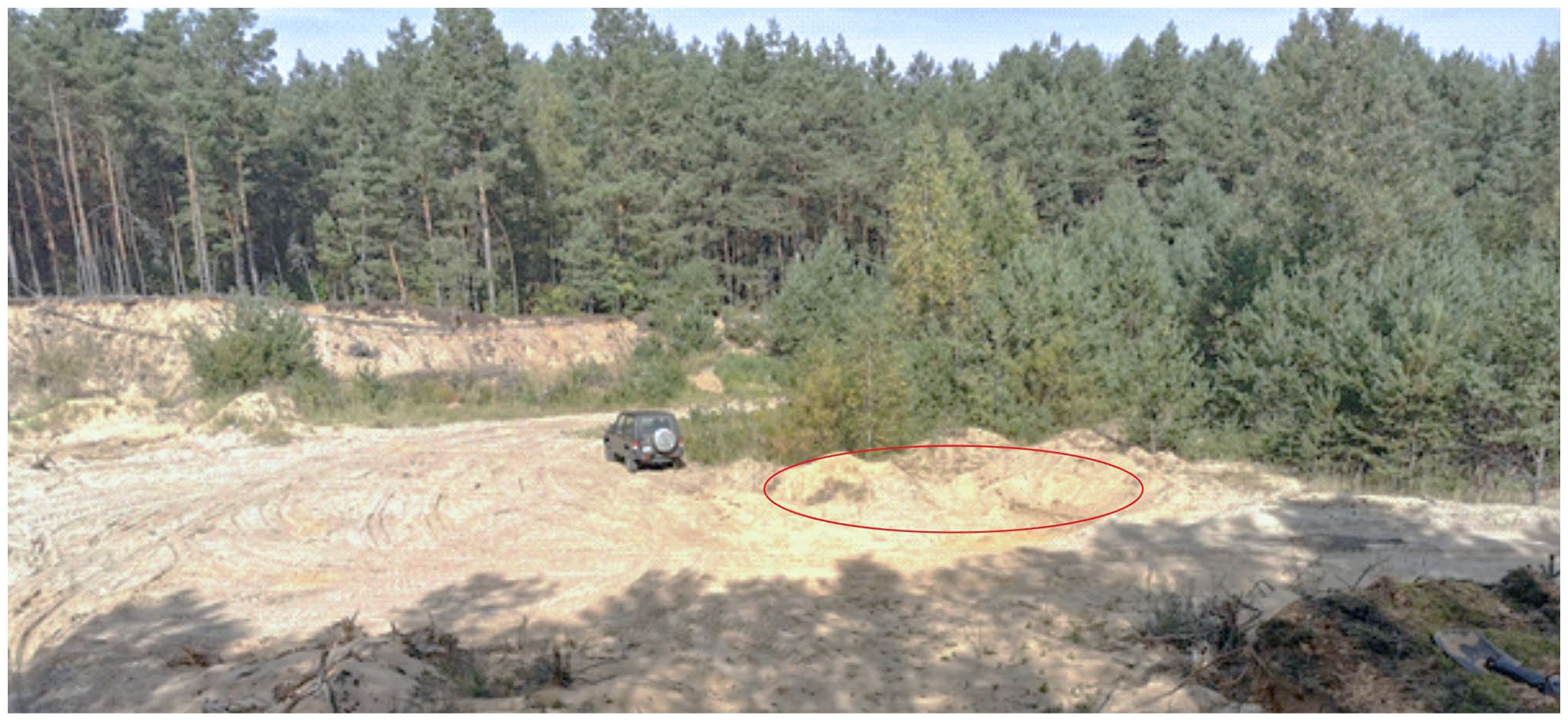
Site where cicindelid burrows were observed and Cylindera arenaria viennensis was collected (circled), near Mnin, south-central Poland, showing suitable habitat for the species created through mining of, and exposure of periglacial-origin aeolian sand. Similar substrates may have been colonized and occupied by cicindelids at other times during the Holocene when active and mobilized dunes or sand fields of the European Sand Belt were more widespread.
The burrows (Figure 2) were generally located in bare areas with grasses and shrubs nearby, within damp sandy layers, of well-sorted medium-grained quartz sand, which seemed relatively homogenous and unperturbed by plant roots. The burrow openings were sometimes accompanied by pellets of sand (Figure 2c) and, as previously described (Beaton et al., 2021), these pellets were seen piled towards one side of the entrance. The burrow openings were approximately 2–5 mm in diameter when viewed from the surface (Figure 2a–c) and generally round, though deviations from a perfectly circular shape may arise from substrate heterogeneity, obstacles, or possibly the need to accommodate the mandibles as they lie flat with the head and thorax at the surface, as previously described in Pearson and Vogler (2001). When excavated, burrows were found to be within this range of diameters throughout, and to be quite straight for distances of approximately 10–20 cm downward (Figure 2d–f), resembling the trace fossil Skolithos. Towards their bottoms, however, they would often transition to being curved or angled (e.g. Figure 2f).

Cicindelid larval burrows observed at field site near Mnin in 2020 and 2021, where the laboratory specimen was also collected. (a–c) Burrow openings. (d, e) Relatively straight burrow or part of burrow, which has been sectioned. (f) View of a sectioned burrow which is straight for some distance and then curved or angled toward its bottom.
Identified tracemaker and experimental burrows
Excavation of a cluster of burrows in the field near Mnin in August 2021 revealed that at least 13 contained live cicindelid larvae inside. A cluster was observed in the same area of approximately 4 m2 in both autumn 2020 and summer 2021, though burrows were excavated and found to be empty in September 2020. An individual larva identified as belonging to Cylindera arenaria viennensis (Schrank, 1781; previously Cicindela arenaria viennensis), represents a new reported occurrence in this locality (50°58ʹ52″N 20°10ʹ15″E), with other nearby burrows potentially belonging to the same species, given their proximity. The C. a. viennensis larva, collected in 2021, was kept at room temperature of 21°C in the laboratory where its burrowing was investigated in a custom-made glass-paned container separated by wooden slat and filled with laminated sand. Alternating layers were composed of natural medium-grained (x̄, mean = 0.33 mm; σ, standard deviation = 0.094 mm) quartz sand of Polish inland dune origin, pink-colored aquarium sand (x̄, mean = 0.46 mm, σ, standard deviation = 0.14 mm) and blue-colored aquarium sand (x̄, mean = 0.57 mm, σ, standard deviation = 0.18 mm). The nature of the insect’s burrowing and its effect on the sediment layers was photographed (Figure 3).

Experimental burrows produced by Cylindera arenaria viennensis larva. (a) Partially completed burrow. (b) Burrow which has completely utilized the full height of sand in the container, more than 20 cm.
In captivity, the tiger beetle larva produced a burrow in a relatively short span of time, with the burrow reaching down to the bottom of the container within 24 h after it first started digging. The burrow was around 2–5 mm wide, similar to the diameters of the burrow openings seen in the field, and within the range of previous described larval burrow diameters for other cicindelids, many which are commonly 1–5 mm (Bauer, 1991; Hoback et al., 1998; Meyer, 1981). It was made somewhat at an incline (Figure 3a) as the animal dug downward (examples in the field, Figure 2 vary in their straightness) and also curved strongly toward the horizontal direction about a centimeter before it excavated directly along the wooden frame that formed the floor of the container (Figure 3b). Therefore, the larva used the full depth of layered sand available in the container, which was somewhat over 20 cm. The beetle’s preference for burrowing in deep sandy layers unobstructed by tree roots, stones, and other buried objects is well-known. How often burrows reroute in response to obstacles in natural settings, as well as what amount of sediment compaction or difficulty of excavation might be sensed or felt by the animal as it approaches them, in order to provoke a shift in direction, is still not clear. Natural burrows deviating strongly from straight tubular forms may be rare so that the very curved (J or U-shaped) or inclined burrows at the Vistula Spit (see section below) may be thus less likely to be cicindelid in origin and made by other beetles (Mikuś and Uchman, 2013) or other invertebrates instead, while straighter subfossil examples are more likely to have been made by them.
The animal’s burrowing was consistent with many of the observations previously described in the literature (Pearson and Vogler, 2001). It was seen to grasp, drag, or push sediment to the surface with its mandibles and front parts of its body, and could do so in a variety of positions facing different directions. Sand was often grasped using the mandibles and carried as packets or pellets. The excavated material brought up to the surface and dumped on both sides of the entrance was piled up in mounds that could be quite high (Figure 3b) reaching the top of the glass in the container, with the space between the mounds treated as an extension of the burrow. These piles were built in a way where lamina of excavated colored sand were visible in some places, forming V-shaped layers that tilted down toward the inside of the burrow, though in other parts, the sand could also be quite mixed from collapse of steep slopes in addition to variation in how the animal dumped material. Sand pellets could be either packed closely around the burrow entrance to create new burrow walls, dropped nearby, or flicked or thrown away with some force. It is likely that the artificially confined space led to this architecture, which contrasts with the sand piles seen on one side of burrow entrances which were observed in the field. The animal often dug intermittently, regularly stopping and shifting its posture or position in the burrow Hooks on the larva’s back anchor it to the sides of its burrow, allowing it to both stay in place and change position readily inside, and may leave diagnostic impressions (Do Nascimento and Netto, 2019), but these were not likely to register or be observable in this situation given the grain size of the sand, or be distinguishable from other modifications to the burrow wall such as scraping off or packing material into it.
Subfossil burrows at the Vistula Spit
At the Polish part of the Vistula Spit on the southern Baltic coast (54°21′34.1″N, 19°18′40.4″E), in an outcrop exposed as a result of excavation during construction of the Vistula Spit canal, subfossil burrows up to 20–30 cm in their longest dimension were observed (Figure 4). In the vertical cross-section, they could be J and U-shaped, subvertical or vertically linear, and pipe-like, resembling Skolithos. The latter examples would somewhat resemble in form those made by the Cylindera arenaria viennensis larva experimentally in the laboratory, and those seen in the field in inland dune sand. Starting from one lamina, they penetrated multiple quartz sand and glauconite sand layers (as the experimental burrows did with colored sand) and were also infilled with these sands. The Vistula Spit burrows were often between 5 and 10 mm in width, wider than, but still within, range of the modern study burrows. Such burrow widths could possibly be made by older cicindelid individuals of the third instar before pupation, perhaps by one of the species still present in the region or others. Some larger cicindelid species today also have burrows described as being in this width range (for instance, Chaetodera regalis Dejean 1831 in South Africa; Mawdsley and Sithole, 2009), and the Skolithos serratus that Do Nascimento and Netto (2019) attributed to tiger beetles averaged 10 mm in diameter, while also reaching a maximum of 40 cm in depth.
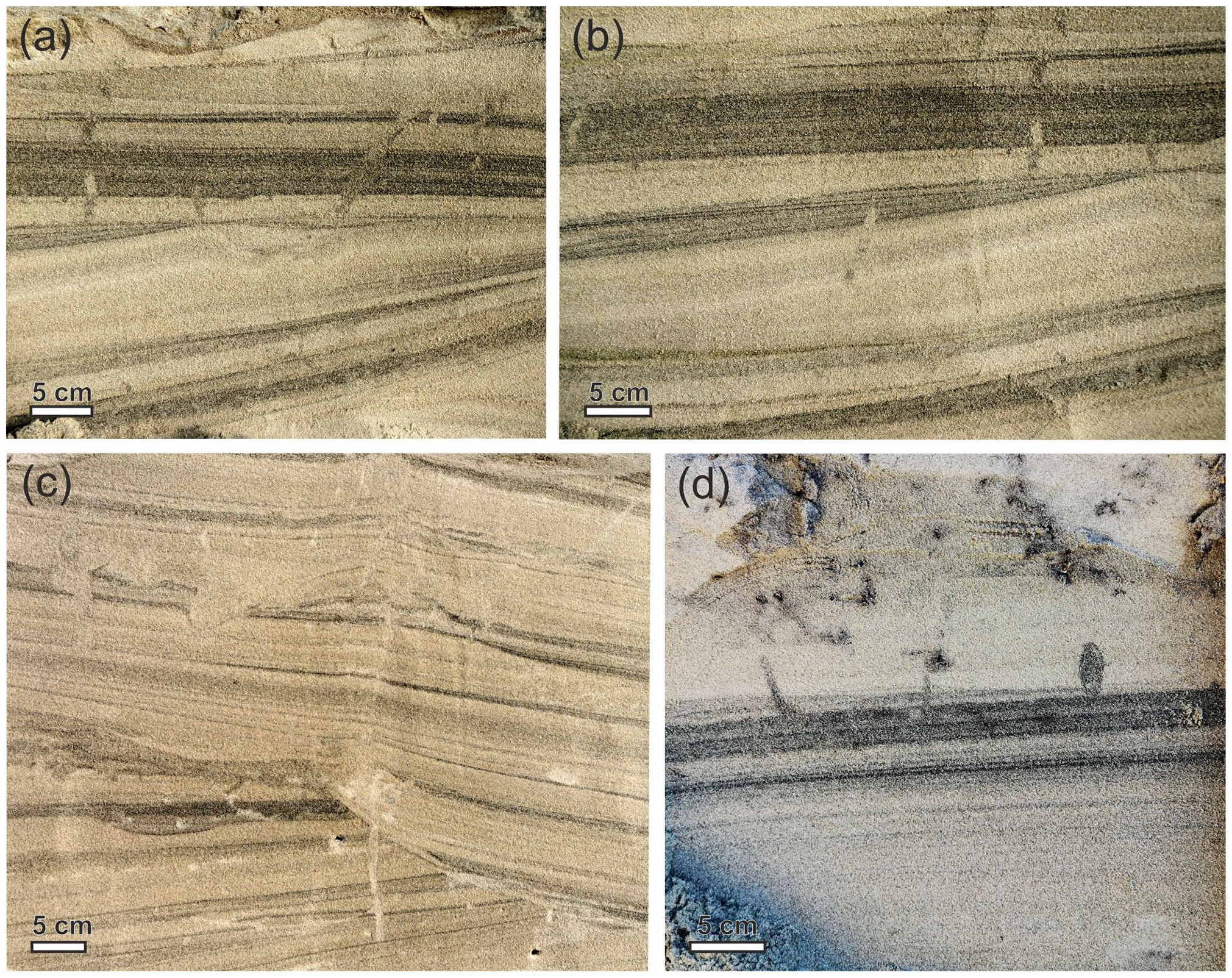
(a–d) Burrows in unconsolidated quartz and glauconite sand layers within the Holocene dunes at the Vistula Spit, northern Poland, likely produced by insects, some of the straighter examples of which may potentially have been made by cicindelids.
Although many invertebrate tracemakers can make simple, long, linear, or curved burrows, tiger beetles are one of the potential candidates for makers of the straighter burrows in Figure 4, among the relatively sparse insect fauna of pioneer habitats known in European dunes (Andersen, 2000; Nijssen and Siepel, 2010). Many of the Vistula Spit subfossil burrows also show evidence of bioturbation or disturbance nearby, which could also be consistent with the movement of adult beetles (Figure 5a and b). Other early colonizers of the dune sands in these types of habitat are ant lions (Figure 5c–e), and sand earwigs Labidura riparia (Figure 5f and g) whose traces were observed previously in similar modern and potentially subfossil states in similar dune habitats in the region (Hsieh et al., 2022). However, many of these other early potential insect traces would have much lower preservational potential long-term in the geological record than cicindelid larval burrows, since they are finer, shallower or surficial, and easily erased by disturbance.
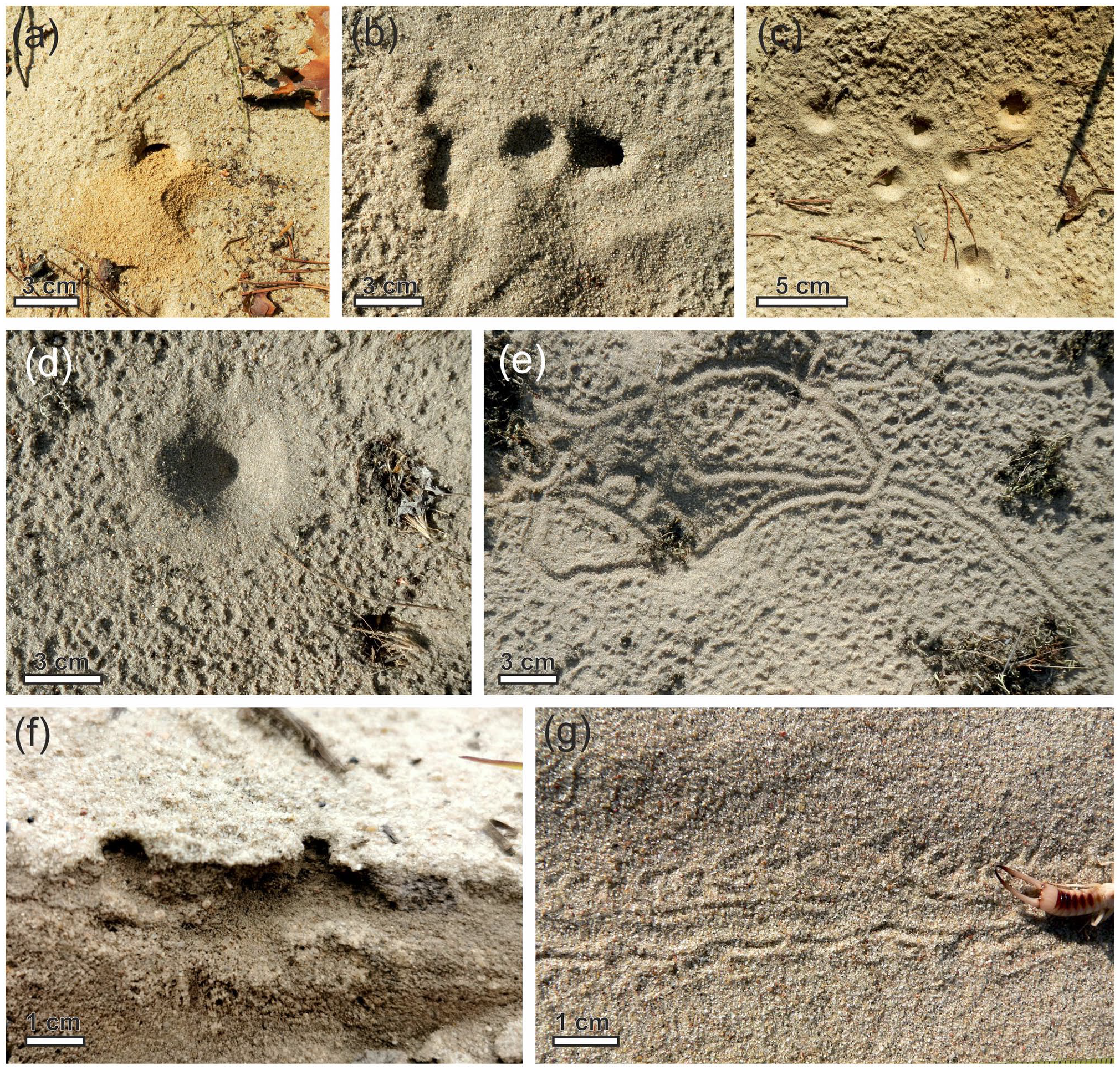
Photographs of other modern traces of early insect colonization of sandy substrates from temperate European dunes, besides cicindelid larval burrows. (a) Shallow shelter burrows by adult cicindelids at Dobra (Sandomierz Basin) Poland and (b) at Ochotnik (Przedbórz Upland), Poland. (c) Ant lion pits at Dobra and (d) Ochotnik. (e) Crawling trails of ant lions at Ochotnik. (f) Double-entranced burrows of sand earwig Labidura riparia at Oddziały (Przedbórz Upland), Poland. (g) Trackway of Labidura riparia at the Curonian Spit, Lithuania.
Discussion and conclusions
Early colonization of the Vistula Spit
Containing coastal dunes, heaths, and grasslands, the Baltic seashore was described as a unique and unstable habitat for insects by Ivinskis and Rimšaitė (2005) and a place where migrating insects may establish or use as a jumping-off point to spread to other regions. Modern seashore habitats in their present locations would be expected to date back to when sea level stabilized after post-glacial changes. Uścinowicz et al. (2021) considered that the formation of the oldest dunes at the Vistula spit begun ca. 7000–6000 years ago, with the highest dunes formed about 4000–2000 years ago, and the youngest dunes in the past 2000 years. The subfossil burrows in this study were observed in the area of the oldest dune deposits (Figure 6) which based on relative location and position, were likely as old as 7000–4000 years BP and were buried under the younger dune ridge. The oldest buried dunes where the burrows were seen represent the first generation of dunes to form at the spit (Figure 6a) and existed close to sea level and the water table, before being buried by younger dunes. The interdune areas would have been vegetated, forming fairly well-developed paleosols (Figure 6b), and deeper interdune areas included peat bogs (Figure 6c) which would have been sources of water and organic matter for early insect colonists more generally, helping them expand to other areas. Analogous areas of vegetated damp sand near the water table (Figure 6d) existed around the site where the modern study specimen and burrows were observed and the species Cylindera arenaria viennensis has been observed in proximity to water bodies, in places ranging from riverbanks to flooded pits in Europe (e.g. Brigić et al., 2021; Paill et al., 2018; Stan and Serafim, 2021).
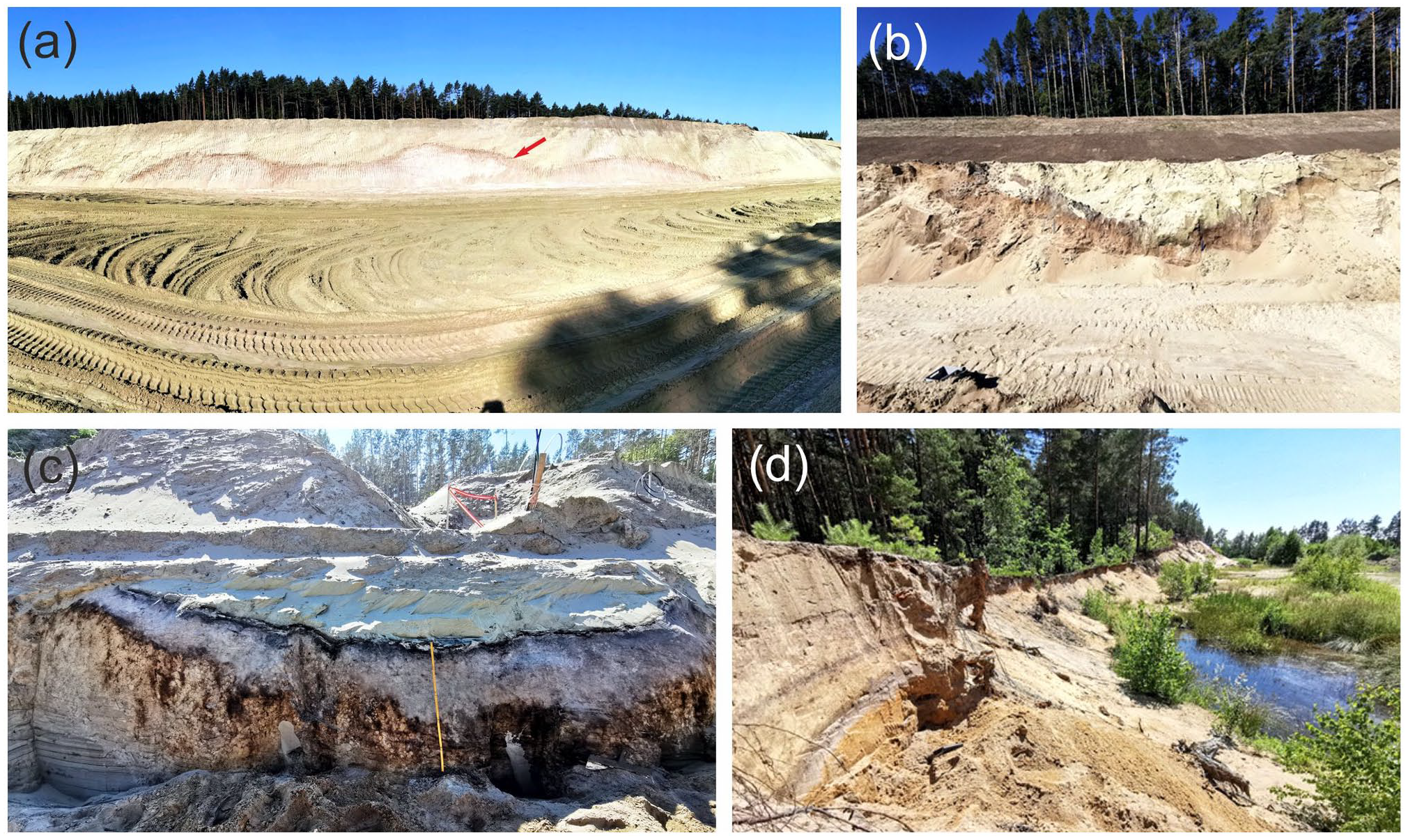
Dune deposits in which the Vistula Spit burrows in Figure 4 were found, and interpretations about the paleoenvironment it represented. (a) Large section exposed from canal construction showing buried dune hillocks covered with a paleosol layer (shown with arrow). (b) Paleosol and (c) peat bog deposits from buried interdune areas of these oldest dunes. Measuring stick is 1 m. (d) Topographically low wet areas and ephemeral pools near the water table on the floors of the sand pit at Ostrowik, Poland, representing a modern analogous microhabitat to (b) or (c); similar microhabitats could be seen, during wetter seasons or years, at the floor of the sandpit in Mnin where the Cylindera arenaria viennensis larva of this study was collected.
If some of the subfossil structures from the first generation of dunes are indeed from burrowing tiger beetle larvae, they may provide some evidence of their relatively rapid colonization of the Baltic coast at the Vistula Spit soon after appropriate subaerial habitat developed. Alternatively, they may be from other insects or invertebrates that are likewise suitable colonists of these unstable, shifting, dunes. These subfossil burrows were only found in the oldest dune sedimentary complex and absent from later, younger dunes (deposited on top of the earlier ones) that were higher and drier, being a considerable distance above the water table. The development of insect burrows within the early Vistula Spit dunes also overlaps with the Atlantic period or Holocene climactic optimum (Kalis et al., 2003) which was warm and wet, compared to time intervals earlier and later in the Holocene, and thus potentially favorable for groups such as tiger beetles expanding their range around northern or cold-temperate Europe.
Tiger beetle colonization of post-glacial regions
Similar habitats for tiger beetles exist in the inland dunes of the European Sand Belt today whose geological origin, nature and timing of formation in the Holocene were rather different from the coastal Baltic ones, and which currently depend on anthropogenic influence to remain sparsely vegetated. The occurrence of Cylindera arenaria viennensis within a mining pit at the study locality in the said region attests to the suitability of these dune sands as habitat far inland in Europe if exposed bare sands are available. Previously C. arenaria viennensis has been described as a dune species (Szujecki, 1987) and was reported from other parts of Poland, including the suburban areas of Warsaw and Mazovia (Czechowski, 1981), the Sandomierz Lowland (Cieślak, 2004), Wielkopolska-Kujawy Lowland, and the Małopolska Upland (Milkowski and Sienkiewicz, 2006; Żurawlew and Markiewicz, 2021). Subfossil burrows attributed to cicindelids might be expected to be present in many areas in the European Sand Belt in earlier horizons representing times in the Holocene when active post-glacial dunefields were more widespread.
Ichnological data can be a useful complement to body fossils or data on present day distributions which have been previously used as evidence for post-glaciation colonization by tiger beetles or related ground beetles in regions such as North America, Scandinavia and western Europe (Andersen, 2000; Nagano et al., 1982). For instance, body fossil remains of the claybank tiger beetle Cicindela limbalis Klug, 1834, were described from basal clays of an infilled kettle depression at a late glacial site in Brampton, west of Toronto, Canada, representing a time shortly after the ice retreat which happened around 13,000 years ago (Morgan and Freitag, 1982). As the plant assemblage it was associated with had mixed tundra and prairie elements and C. limbalis today is a boreal species, with no cicindelid known from true tundra in North America, the authors concluded that its species survived south of the ice front and likely re-colonized deglaciated terrain while the area was open-ground pioneer habitat but did not have a tundra climate. Similar situations may potentially have occurred in other places in the world, such as in Europe, around the same time or later. Hypotheses related to the timing of colonization of animals often require synthesizing biological and geological information, for example, knowledge of dispersal abilities, habitat preferences, and evolutionary history along with amount of suitable habitat which may be controlled by factors such as glacial extent, sea level changes and land bridge availability. Cicindelids frequently burrow in substrates like sand and mud with high preservational potential, and have high taxonomic diversity in lowland areas which also happen to be well-studied and important environments of sedimentary deposition. For instance, data from Australia, the Indian subcontinent, the Balkans and the Mediterranean region revealed that lower attitude places, often adjacent to water bodies, such as sea coasts, lakeshores and riversides hosted greater tiger beetle species richness than mountainous areas (Jaskuła, 2011; Pearson and Cassola, 1992; Pearson and Ghorpade, 1989).
Tiger beetles have been described as a popular and charismatic group of insects to collect or study for a variety of reasons such as their colorful adult morphology, local or regional variation, as well as their importance to nature conservation and crop pest control (Knisley and Gwiazdowski, 2021; Pearson, 1988). Although they have a long history of being researched in disciplines like ecology, evolutionary biology, and biogeography, the scarcity of their fragile bodily remains as fossils results in a noticeable lack of information from a paleontological perspective, forcing many inferences about their history to rely on present-day distributions (Pearson, 1988). The beetles are fast colonizers of new areas, occupying suitable habitats within the span of years or less (Knisley, 2011) as in the case of bare grounds formed by scraping away vegetation (Cornelisse et al., 2013) or depositing new sediment. Fenster et al. (2006) found that adults of the northeastern beach tiger beetle Habroscelimorpha dorsalis dorsalis (Say, 1817), formerly Cicindela dorsalis dorsalis, in the US moved onto newly deposited (as a result of nourishment projects with dredged sand) beaches at Chesapeake Bay, Virginia and produced numerous larvae, within only months. Kritsky et al. (1999) examined tiger beetles on artificial sand dunes, which were spoil heaps of different ages from sand mining in Ohio. They found five species to already occupy 1-year-old sand piles, increasing to nine (half the number of species occurring in Ohio) on 30-year old sites, before declining to four for sites after the fifth decade, which was likely related to the washing away of sand, leaving gravel behind, and to vegetation growth. Farther back in geological time, including in the post-glacial early Holocene, many naturally formed beaches or dunes might be expected to be occupied just as quickly, with the chance that older, buried, cicindelid burrows, if well-preserved, could be used to constrain their date of earliest presence on or in them. Dow (1916), while discussing plaster-casting insect burrows, mentioned that Cicindela burrows have a similar general plan but described some variation among species, even making a prediction that each species of Cicindela might be potentially differentiated by its larval burrows. However, there has been very little research following up on this question and it may be possible that in this way, particular histories of individual tiger beetle genera or species might remain interpretable from older sedimentary records.
In most situations, such evidence of early-stage colonization would be obliterated as succession continued, with the development of soils and rooted vegetation (Figure 7), and as later-arriving tracemakers reworked layers where earlier traces would have been found. Only in situations where newly colonized surfaces are then rapidly buried would they preserve well, as in the Vistula Spit examples (Figure 4). The chances of finding early colonists’ traces, like those of tiger beetles, would depend on how long open habitats of bare sediment remained in early successional stages, while avoiding soil development or heavy vegetation before being more deeply buried. Generations of tiger beetles inhabiting or returning to the same area (as previous studies and this study’s observation, of a small patch of a few square meters being occupied by burrows from 1 year to the next, have found) over a long span of time, while aeolian processes continue to operate to deposit dune sand, can lead to high concentrations of traces within their sedimentary layers given the right conditions. Even fairly ephemeral, small-scale structures (Davies and Shillito, 2021), like tiger beetle burrows, might have a reasonable chance of burial and preservation if they repeatedly re-appear often enough. Subfossil and fossilized life traces may thus provide a potentially underexplored resource to answer questions regarding how and when these interesting insects, as well as other taxa, first arrived in or recolonized various regions around the world.

Excavated vertical section from a stabilized inland dune at Gortatowiec, central Poland, showing soil development, well developed root traces, and bioturbation as a result of floral and faunal colonization during later successional stages. These processes usually erase signs of earlier colonization (such as the subfossil burrows in Figure 4, or recent traces in Figure 5) in the sedimentary record. Measuring stick is 1 m.
Footnotes
Acknowledgements
Waldemar Obcowski is thanked for his contribution to photography and image preparation. Stanisław Knutelski is thanked for identifying the insect specimen in this study.
Funding
The author(s) disclosed receipt of the following financial support for the research, authorship, and/or publication of this article: The research is financed by the National Science Centre, Poland, from the programme Daina 1, Grant Agreement No. 2017/27/L/ST10/03370.
