




Abstract
The study of wooden artifacts recovered in dry context is scarce. The objective of this work is to identify morphometric patterns in wooden artifacts and to evaluate their relationship with the technological manufacturing processes. To this end, wooden artifacts were analyzed from the site Cerro Casa de Piedra 7, through the 3D scanning, calculation of curvature directions and archaeobotanical analysis. These artifacts are associated to hunter-gatherer groups and different occupations of the early Holocene. The results obtained show, on the one hand, the efficiency of the use of these techniques in the analysis of wooden artifacts recovered in completely dry contexts. The use of 3D scanning techniques showed that they can improve the analysis of manufacturing traces and/or use of wooden artifacts and the possibility of simulating the obtained results by computer. On the other hand, they show the existence of morphometric patterns, sustained in time, which are related to the manufacturing of the artifacts from the Cerro Casa de Piedra 7. In summary, the archaeobotanical analysis methodology presented and developed in this work allows its application to the study of different woody materials regardless of their chronology and recovery site.
Keywords
Introduction
The recovery of wooden artifacts in completely dry contexts, without significant fluctuations in temperature and humidity is very scarce. Generally, the recovery of wooden artifacts occurs in waterlogged contexts and in archeological deposits with highly humid sediments (e.g. Bosch et al., 2000, 2011; Caruso Fermé et al., 2021; Cesari et al., 2012; Chatzitoulousis, 2006, 2008a, 2008b; Facorellis et al., 2014; Fugazzola Delpino, 2002; Fugazzola Delpino and Mineo, 1995; Guilaine and Et Briois, 2005; Huerta PIqué i et al., 2014; Knapp, 2010; López Bultó, 2015; Lopez Bulto et al., 2020a, 2020b; Palomo et al., 2013; Sampson et al., 2012). In these cases, as the wood is submerged in water during long periods of time, it loses part of its components (cellulose and hemicellulose) due to hydrolysis, acquiring a soft consistence without mechanic resistance (e.g. Chinchilla et al., 2017; Rodanés Vicente and Alcolea Gracia, 2017). The recovery of artifacts in this kind of contexts needs certain conservation techniques. During the recovery-conservation period, these artifacts may undergo tensions and contractions of the woody fibers causing not only small deformations but also irreversible damages. On the contrary, in completely dry contexts, without significant oscillations in temperature and humidity, the recovery of wooden artifacts is much smaller (e.g. Amarós, 1974; Cardale de Schrimpff and Falchetti, 1981; García et al., 2014; Horta, 2010, 2013; Latcham, 1938; Lull et al., 1999, 2014; Núñez, 1984; Sprovieri and Rivera, 2014; Van Dalen Luna, 2011; Veny, 1977). In this type of contexts, the studies carried with recovered artifacts in the Patagonian archeological sites, allowed to observe different kinds of traces showing the realization, for example the polishing and shining of the wood surface (e.g. Caruso Fermé, 2012; Caruso Fermé et al., 2014; Caruso Fermé, 2015; Caruso Fermé et al., 2015; Caruso Fermé, 2021). The studies also showed the recurring presence of certain technological features and traces that suggest the existence of production sequences related to the development of a wood technology. (Caruso Fermé, 2021; Caruso Fermé et al., 2021; Caruso Fermé and Aschero, 2020).
The objective of this work is to identify morphometric patterns in wooden artifacts and to evaluate their relationship with the technological manufacturing processes. To this end, wooden artifacts were analyzed from the site Cerro Casa de Piedra 7, through the 3 D scanning, calculation of curvature directions and archaeobotanical analysis. These artifacts are associated to hunter-gatherer groups from different occupations of the early Holocene.
3D scanning: Uses and applications in archeological research and heritage-cultural field
3D scanning methods allow to capture and represent physical objects as digital entities in a 3D digital virtual space: 3D models or digital models in 3D (Barceló and Moitinho de Almeida, 2012; Dell Unto, 2014; Dey, 2018; Frischer, 2014; Moitinho de Almeida and Barceló, 2012; Moitinho de Almeida et al., 2013; Moitinho de Almeida and Rieke-Zapp, 2017).
3D scanning techniques are relatively common nowadays. In the cultural and patrimonial environment, are used for different purposes (e.g. Abel et al., 2011; Bourdier et al., 2015; Campana, 2014; Dellepiane et al., 2013; De Reu et al., 2014; Eren and Lycett, 2016; Hanke et al., 2008; Kuzminsky and Gardiner, 2012; Lerma et al., 2010; Lobb et al., 2010; McPherron et al., 2009; Slizewski and Semal, 2009). For the enhancement of different research lines, as for example cave art scanning, morphometric studies and parameter quantification (Angás et al., 2013; López et al., 2010). In this direction, there are several works in which 3D techniques are applied for use-wear analysis in lithic materials since they produce 3D data with high-definition images, more accuracy and quantitative data (e.g. Caricola et al., 2018; Evans and Donahue, 2008; Evans et al., 2014; Stemp and Chung, 2011; Stevens et al., 2010).
The Cerro Casa de Piedra 7 site (also abbreviated as CCP7)
Cerro Casa de Piedra is a small elevation of volcanic origin located south of Perito Moreno National Park (PMNP), province of Santa Cruz, Argentina (Figure 1). It is located at 900 m asl and at a distance of approximately 500 m from the south side of the River Roble, a forest-steppe ecotonal area close to Lake Burmeister. On the northern slope of Cerro Casa de Piedra, there are some caves. The Cerro Casa de Piedra 7 site was initially a large overhang which offered good conditions for human settlement. Seismic events caused the collapse of several sectors of this overhang, forming smaller eaves and a cave: CCP7.
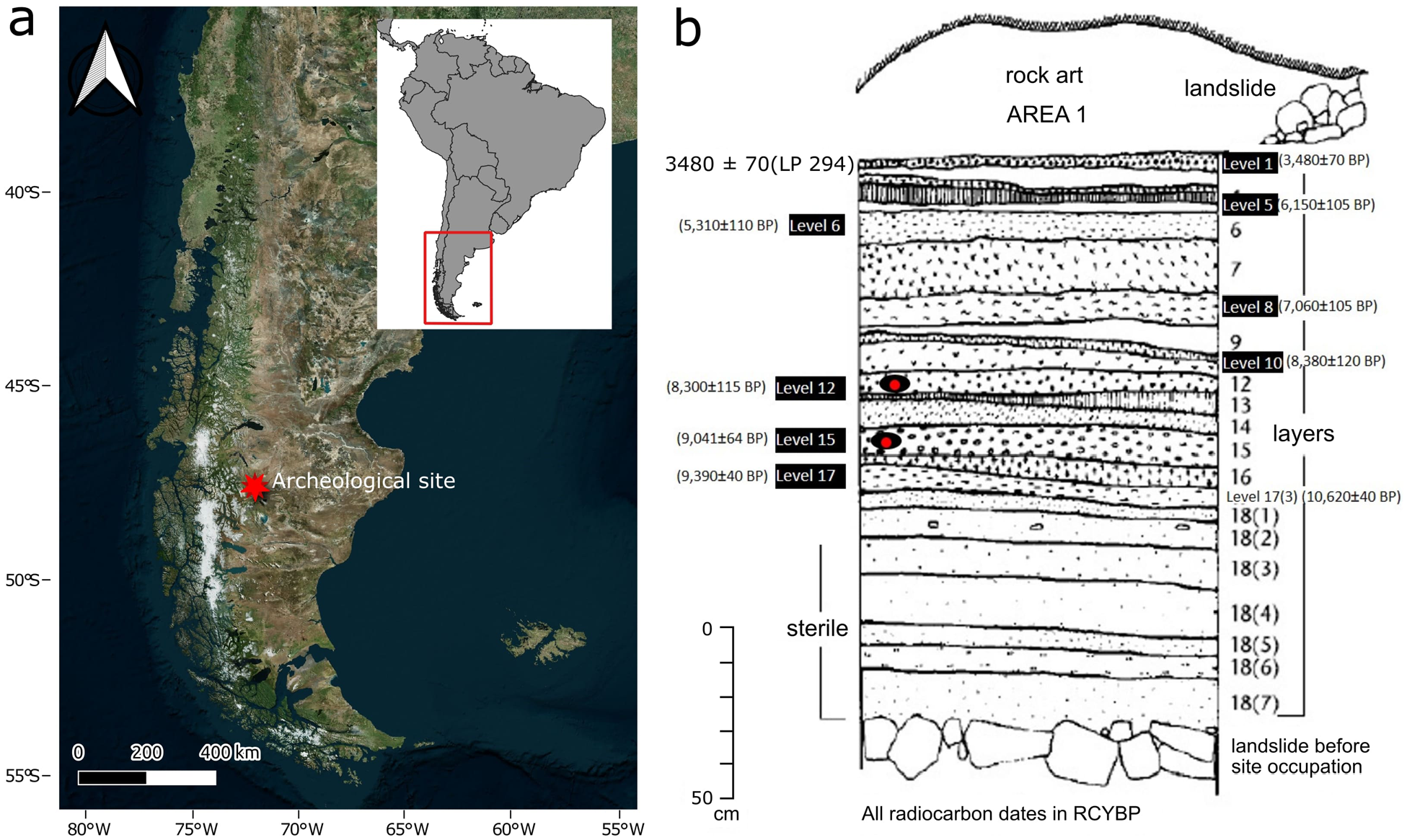
(a) Location of Cerro Casa de Piedra 7 site. (b) Stratigraphy and radiocarbon dating of CCP7 site RCYBP: radiocarbon years Before Present. The origin of studied samples.
The archeological excavations began in the western sector of the site CCP7 (area 1) (Aschero et al., 1992, 1992). Later, a prospection in central sector of the cave was performed (area 2). Area 1 is the largest and deepest excavation. Area 2 is much smaller and the stratigraphy does not match that of area 1.
From 1990 systematic excavations were carried out during different campaigns. The CCP7 stratigraphic sequence is composed of 19 radiocarbon-dated layers between ca. 10,690±120 and 3400 years BP (Aschero, 1996; Civalero and Aschero, 2003). The study of fauna shows the existence of animal remains whose environment is mostly steppe -Lama guanicoe-, others woody -Hippocamelus bisulcus- and others from wood and steppe – Anatidae-. This could suggest the exploitation of preys of both environments without many search and carrying costs (De Nigris, 2004). The bony collections studied show a continuous consumption of Lama guanicoe through time, followed by Hippocamelus bisulcus, even though the proportions of both species do not seem to be constant through time (De Nigris, 2004). Civalero and De Nigris (2005) stated that during the early Holocene at Cerro Casa de Piedra 7 site there was a broadspectrum use of available subsistence resources seen in the increase in processing and consumption marks on bone, a higher incidence of scrape marks along guanaco ribs (Lama guanicoe). On the other hand, the presence of non-local lithic material -obsidians and siliceous rocks- registered in Cerro Casa de Piedra 7 (Civalero et al., 2006) also evidences that the hunter-gatherers that inhabited this cave moved regularly in wide spaces. The diversity found within the carbonized wood of the early Holocene (CCP7: level 17) coincides with the views of Civalero and De Nigris (2005) who suggested a premeditated adjustment on the side of the hunter-gatherer groups in regards to their technological and subsistence strategies to minimize risk and uncertainty. The archeological data is complemented by an overlapping series of paintings on the cave’s walls. The walls of the site Cerro Casa de Piedra 7 are characterized by representations of both hands and guanaco (Lama guanicoe). The colors of the images are: black, red, and white. Depending on the colors of each image, we observe differences in the orientation of the painted sequences (Aschero, 1996). On the basis of the relation between animal representations and the negative handprints it is possible to hypothesize that juvenile, infant and adult people (possibly women) are co-participating in the observation and/or in the execution of the rock art (Aschero, 1996).
Archeological studies suggest that hunter gatherers used CCP7 as a residential base for ca.7000 years and it is assumed that they abandoned it around 3500 years BP when the mentioned collapse occurred dividing CCP7 in two and leaving no archeological evidence behind (Aschero, 1996). A recent wood charcoal dating gave 1927 ± 41 years BP δ13 C= −26.69 (UGA 868, corrected date) (Civalero et al., 2006), which suggests an occasional and brief occupation during the late-Holocene. The archeological registration of CCP7 suggests a settlement-mobility pattern of the residential type, evidenced by marked space structuring and a redundant site occupation (Aschero et al., 1992, 2005).
The wooden artifacts from CCP7
The exceptional preservation of plant material registered at CCP7 site and its long sequence of human occupation (e.g. Aschero, 1996; De Nigris, 2004) are ideal to study the wood technology among hunter-gatherer groups. The three wooden artifacts were recovered during the excavation works in CCP7.
The artifacts were recovered in area 1.The artifact N°2886 was recovered on the stratigraphic level 15 (9041 ± 64 BP) and the artifacts Nº1390 and Nº372 on level 12 (8300 ± 115 BP) (see Figures 1 and 2). The taxonomic analysis previously carried out on of these wooden artifacts evidenced in all cases the use of the same shrub species Berberis sp. (Caruso Fermé, 2012; Caruso Fermé et al., 2015; Caruso Fermé, 2015 ). Similarity in the anatomical microscopic characteristics of wood, of the species belonging to the Berberis genus, makes identification at the microscopic level difficult. For this reason, the identification of these samples was made up to genus level. This result evidences the selection and use of this shrub as raw material from early times, among the hunter-gatherers Patagonian groups at least from 9.390 ± 40 BP (Caruso Fermé, 2019; Caruso Ferme, 2021; Caruso Fermé and Civalero, 2014, 2019).
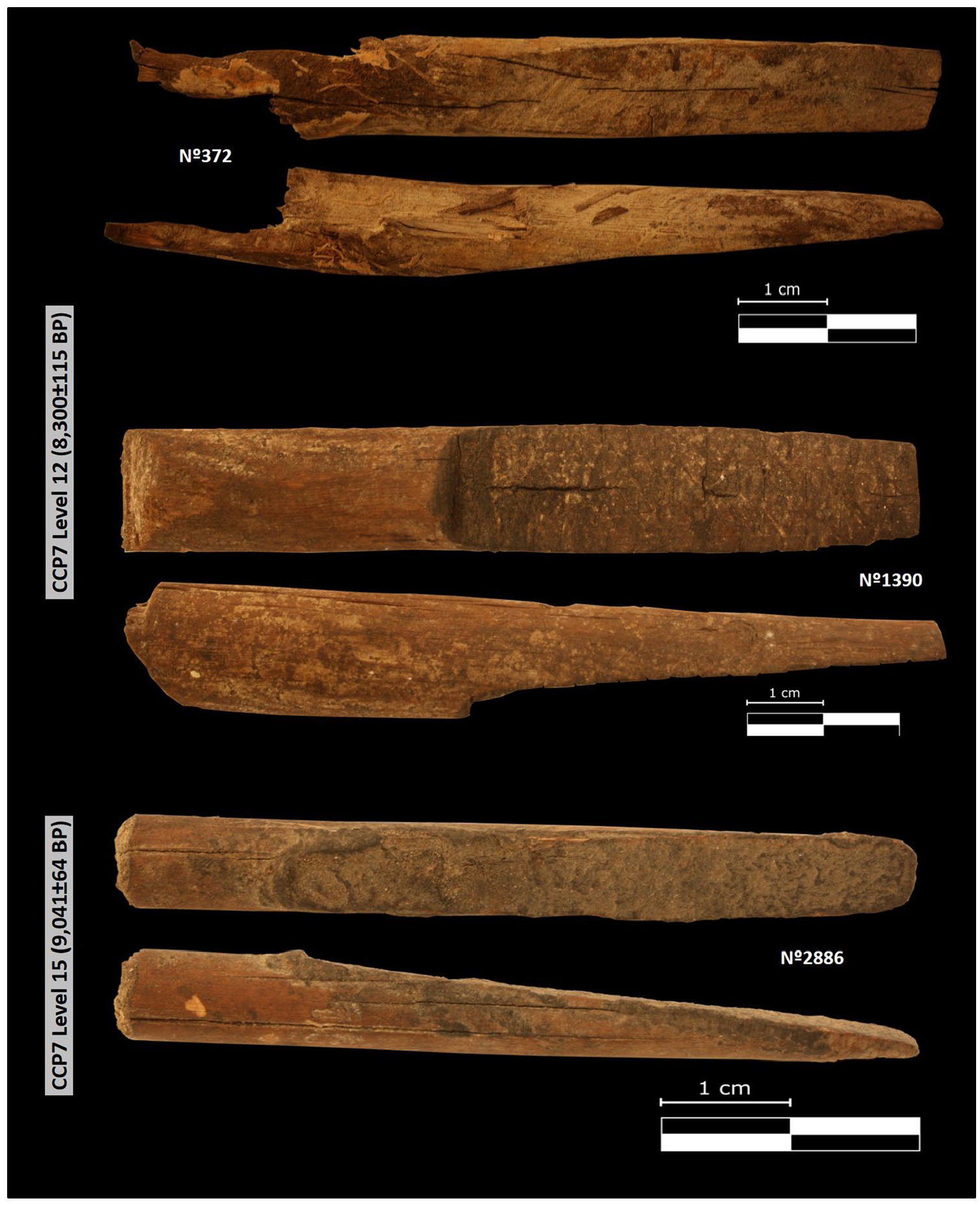
Wooden artifacts from Cerro Casa de Piedra 7 site (Santa Cruz. Argentina).
The use-wear analysis previously carried out on these wooden artifacts allowed the record of different types of traces. Some of them associated to the activities of use or management. This analysis enabled to identify certain type of traces, such as a bright polish over the edges and the presence of a polish (in longitudinal and horizontal direction) in concrete areas of the surface. The record of these types of polish, their localization and orientation could evidence activities related to the hafting of these artifacts (Caruso Fermé and Aschero, 2020; Caruso Fermé et al., 2021). These results suggest that these artifacts would be linked to the need for providing a good support to a certain type of piece that would subsequently be typed up giving a better hold (Caruso Fermé and Aschero, 2020; Caruso Fermé et al., 2021). In summary, these results are key to generate new discussions on the different types of couplers and ties employed in the artifacts belonging to hunter-gatherers Patagonian groups.
Therefore it could be considered that they were part of a composed tool, for example handles of artifacts to carry on cutting activities, pressure ones, multifunctional activities. In this work, we take this further and explore whether a detailed recording of the surface morphology via 3D scanning further confirms those observations or adds any further insight to our original observations.
Methods
Due to the fragility of the studied artifacts, it was decided to use a portable scanner without any contact with structured white light technology (model “Go! Scan 20” of Creaform) for their scanning.
Within the framework of research project “An interdisciplinary approach to the study of the technological organization of woody material among hunter-gatherer groups in Argentine Patagonia” (PICT 2015-2541), a protocol for wooden artifacts scanning was designed. Such study is under publishing process. Following the protocol guidelines, the process was performed with moderate light, not targeted to the artifact and without using materials which might produce reflection. A manually operated revolving platform was used to avoid the manipulation of the artifacts and so be able to regulate time according to the progress of each scanning. The artifacts were placed on a structure to move the edges away from the work platform and so be able to have the complete capture of those areas and get a greater overlapping surface between scans. Two scans of each artifact were performed. The digital models were processed with VXmodel software and exported in OBJ format because it is a file accessible from different editing programs and allows to store geometric and texture information. Data processing was performed by joining the two scans of each artifact and the application of several functions with the purpose of eliminating isolated parts, refilling small spaces, eliminating peaks and simplifying the mesh by reducing the number of triangles that make up the artifact.
Once the 3D digital model was obtained, the geometric and morphological measurements of each artifact such as length, width and thickness were registered. These registrations allowed the evaluation of the relationships among the different variables by means of the plotly and pandas in Python libraries (McKinney, 2010). Box plotting is a descriptive data analysis method to graphically demonstrate locality, spread, and skewness groups of numerical data through their quartiles. The interquartile range (IQR) gives the distance between the upper and lower quartiles, obtaining a measure of spread of the data. Information about the magnitude and the direction of the relationship among different variables was obtained applying the calculation of the Pearson correlation coefficient. The p-value is the probability of having found the current result if the correlation coefficient were zero (null hypothesis). The correlation coefficient is called statistically significant if the p-value < α. An α of 0.05 indicates that the risk of concluding that there is a correlation, when in fact there is no correlation, is 5%.
For post-processing and analysis of 3D triangular meshes Meshlab software was used. To increase the visibility of the cuts, the function Smooth Laplacian was applied first to smooth the mesh. This procedure allows to average each vertex positions with weighted position of neighbor vertices (Sorkine, 2005). Once the resulting mesh is obtained, in order to study the curvature, the Calculation of Curvature principal directions with Pseudoinverse Quadric Fitting method were used. The curvature at a point on a surface measures how much the surface deviates from the tangent plane at that point. These curvatures take on values that are generally not equal in all directions around the point. In general, there is an orientation where the curvature is maximum (k1) and another (perpendicular) where the curvature is minimum (k2). Those are called principal curvatures. Mean curvature is defined as: H = (κ1+κ2)/2. The quadric fitting method is based on the idea that the geometry of the smooth surface can be approximated locally using a quadratic polynomial surface (McIvor and Valkenburg, 1997).
Likewise, some technological features were registered, as for example glue remains, thermal alteration signs, presence of knots and types of cuts. Based on the characteristics and directionality of the cuts, in relation to the piece of wood where they were made, they were classified as bevel cut and perimeter cut. Finally, the edges of the different cuts present in the artifacts were characterized as well as the wearing out level of the extremes and surface of the wood.
The previously described methodology was designed and applied to the study of wooden artifacts since it allows to detect possible wearing out at a higher scale, edges and surface patterns. It is important to point out that the incorporation of 3D scanning techniques for the study of wooden artifacts, unlike use-wear analysis techniques made with microscopes and binocular amplifiers, permits a non-segmented analysis of the artifacts, giving a view of the whole artifact.
Results
The three wooden artifacts studied are in good conservation conditions and do not show alterations produced by microorganisms. None of them presents signs of thermal alteration or bark remains. Only in the artifact Nº1390 was registered the presence of two knots, evidence of secondary branches being extracted. Two of the artifacts, Nº 1390 and Nº2886, still have traces of mastic (adhesive) on the surface of the bevel cut. That is, on a previously prepared surface as will be explained later.
The artifacts’ scanning allowed the analysis of 3D triangular meshes, enhancing the visibility of fine cuts and the possibility of obtaining the geometry of each one of them.
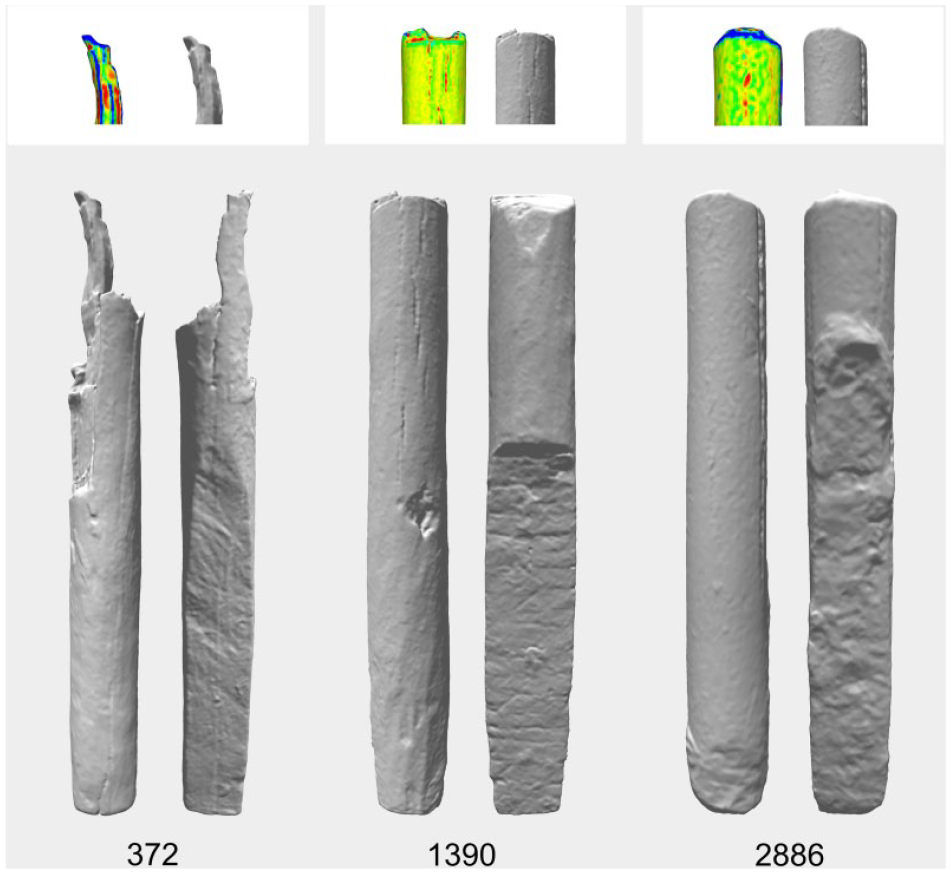
The distal extreme of the three artifacts was cut in a perimetral manner. Following this cut, there is another beveled one. The proximal extreme, unlike the distal one, does show differences among the artifacts. In Artifact Nº 372 this extreme is segmented whereas Artifact Nº2886 has a perimetral cut. Artifact Nº 1390 shows a combination of two types of cuts: beveled and perimetral (Figure 3).

Different cuts types present in the wooden artifacts from Cerro Casa de Piedra 7 site (Santa Cruz. Argentina).
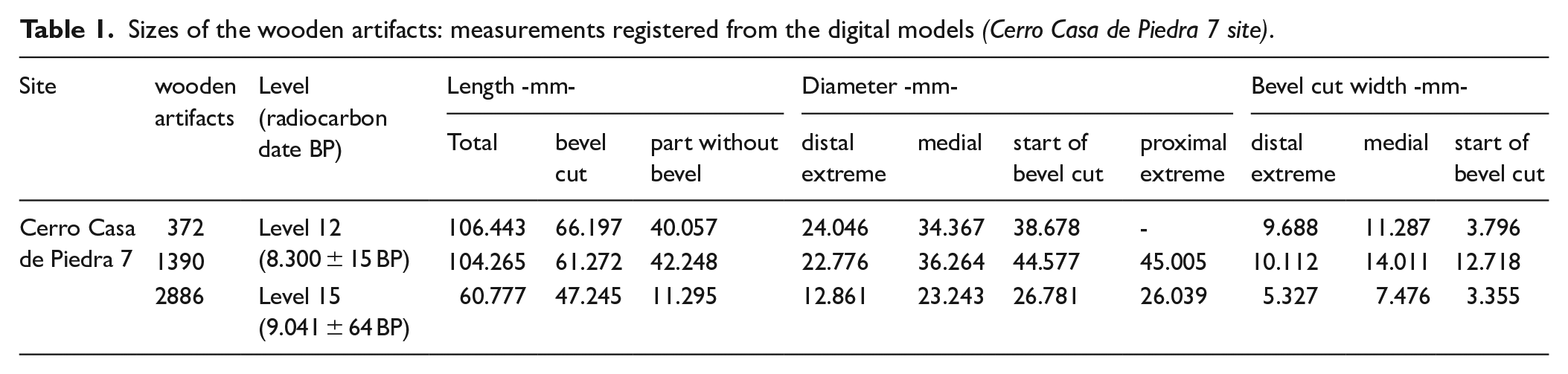
The 3D model allowed more accurate registration of the length, the width, and the diameter of each artifact. The length and width were registered in a straight line (Figure 4). The total length of the three artifacts varies within a range of 106.443 and 60.777 mm, whereas the total length of the beveled cut fluctuates between 66.197 and 47.245 mm. The width of the surface, which includes the bevel cut, oscillates along it. It is greater in its middle part (see Table 1). The diameter of the three artifacts decreases from the distal to the proximal extreme because of the beveled cut.
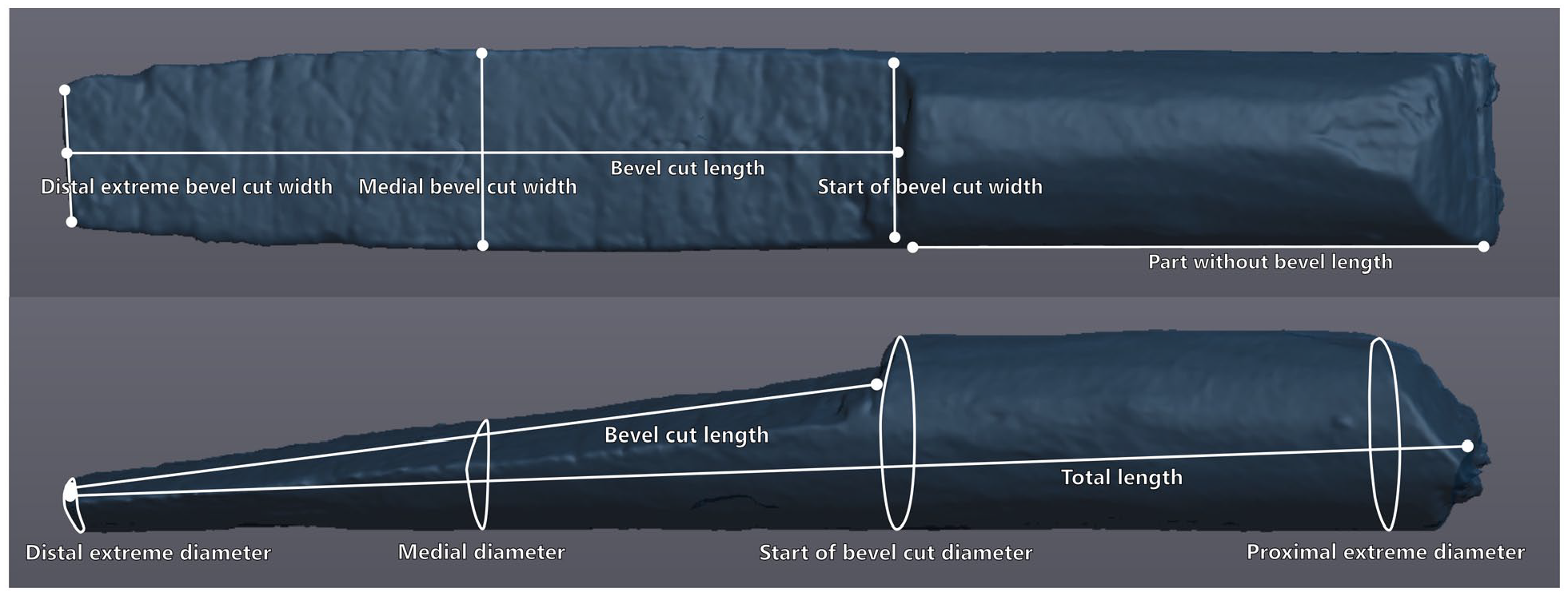
Digital models with the registered measurements (wooden artifact Nº 1390: Cerro Casa de Piedra 7 site).
Sizes of the wooden artifacts: measurements registered from the digital models (Cerro Casa de Piedra 7 site).
The beveled cut occupies most part of the three artifacts. The 3D model allowed to calculate the area percentage of this cut in relation to the area of each artifact, being them 21.30%, 22.85% and 26.58%.
Box plotting allowed the registration of key values, atypical values, and symmetrical data in the different artifacts. It was then possible to find values showing similarities and some presenting bigger differences. Graph 1 shows that the most similar values in the three artifacts are represented with smaller interquartile range (IQR) whereas the larger IQR shows greater difference. In this way, the most significant similarities in the proportions in relation to the total length of the three artifacts can be seen in the diameter of the extremes and width of the beveled cut. The diameter of the proximal extreme of artifacts Nº1390 and Nº2886 are represented by 43.1% and 42.8% respectively. It is necessary to remember that artifact Nº372 has a fragmented extreme. The similarity values in the distal extreme of the three artifacts show a 21.1% minimum and 22.5% maximum. Finally, the width of the beveled cut in the three artifacts, in the middle section and distal extreme show a percentage lower than 1.5%. On the contrary, it is also possible to see less proximate values in the artifacts, in relation to those previously described. These values refer to the mean diameter of the three artifacts and the diameter and width of the place where the beveled cut finishes, with a distance between their measurements of 5.9%, 7.7% and 8.2%. Finally, the most distant values among the three artifacts can be seen in the proportion bevel/non bevel which is 21.9% of the distance between themselves.
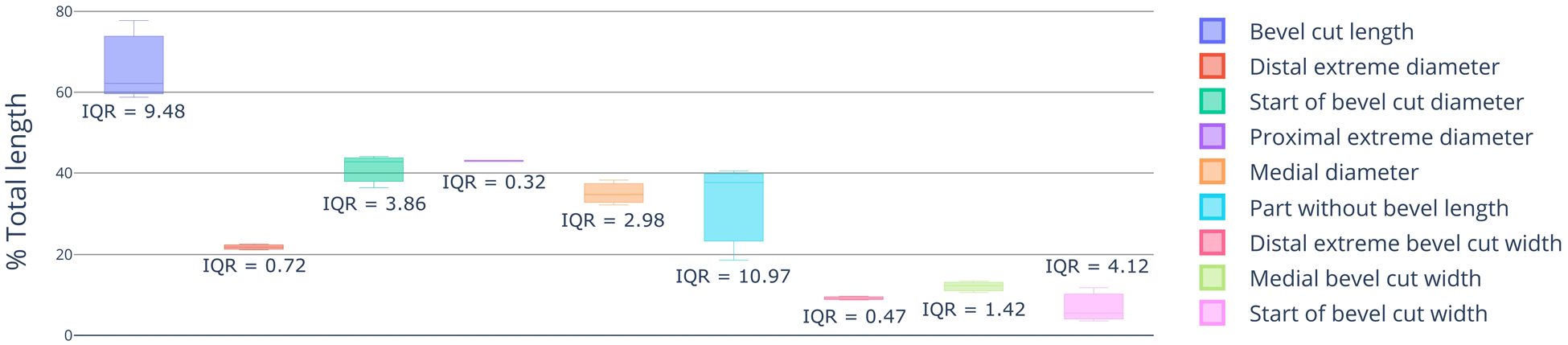
Box diagram representation of the direct proportionality relation between the total length and the registered measurements (mm) of artifacts Nº372, Nº 1390, Nº2886 (Cerro Casa de Piedra 7 site).
In sum, the obtained results show that for manufacturing the three artifacts the original morphology of a branch was used as support. That is to say, the woody support used for the manufacture of the artifacts was not obtained by prior processing of a branch or trunk. On the other hand, the results show morphometric similarities as far as the sizes of beveled cuts in relation to the space they cover in each artifact. The proportions related to the total area corresponding to the width of the beveled cut (distal extreme, medial, and start of the cut) reveal proximate values among the three artifacts, with a IQR lower than 0.09 (Graph 2). On the contrary, the proportions related to the length of the beveled cut do not show such proximate values. As far as the diameter, the proportions evidence more similarity among the artifacts but not at the same level as in the widths since their IQR’s are greater than 0.16.
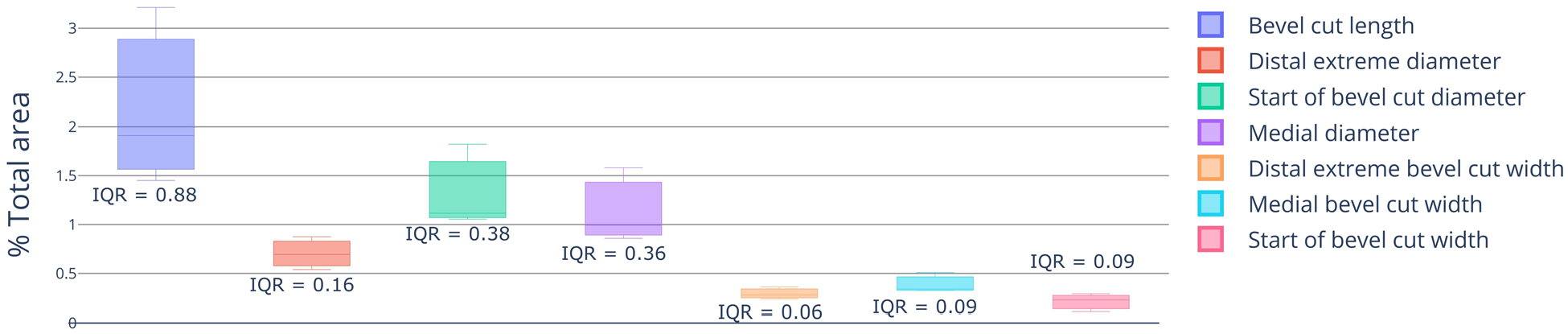
Box diagram representation of the direct proportionality between the artifact total area and the registered measurements (mm) of artifacts Nº372, Nº 1390, and N º 2886 (Cerro Casa de Piedra 7site).
The calculations of curvature directions performed with Pseudoinverse Quadratic Fitting method, permitted to obtain 3D models with colored vertices according to the orientation of the calculated curvature. To simplify the analysis, we work with the mean curvature (MC), which is a scalar value that does not depend on orientation, and represents the mean value between the maximum and minimum curvatures. The scalar values for the curvatures are stored as a quality value at the vertex and plotted in a histogram (Figure 5) in order to show the values distribution. Based on these estimations, it was possible to identify and differentiate flat areas (MC ~ 0), concave vertices (MC < 0) and convex vertices (MC > 0) in each artifact.
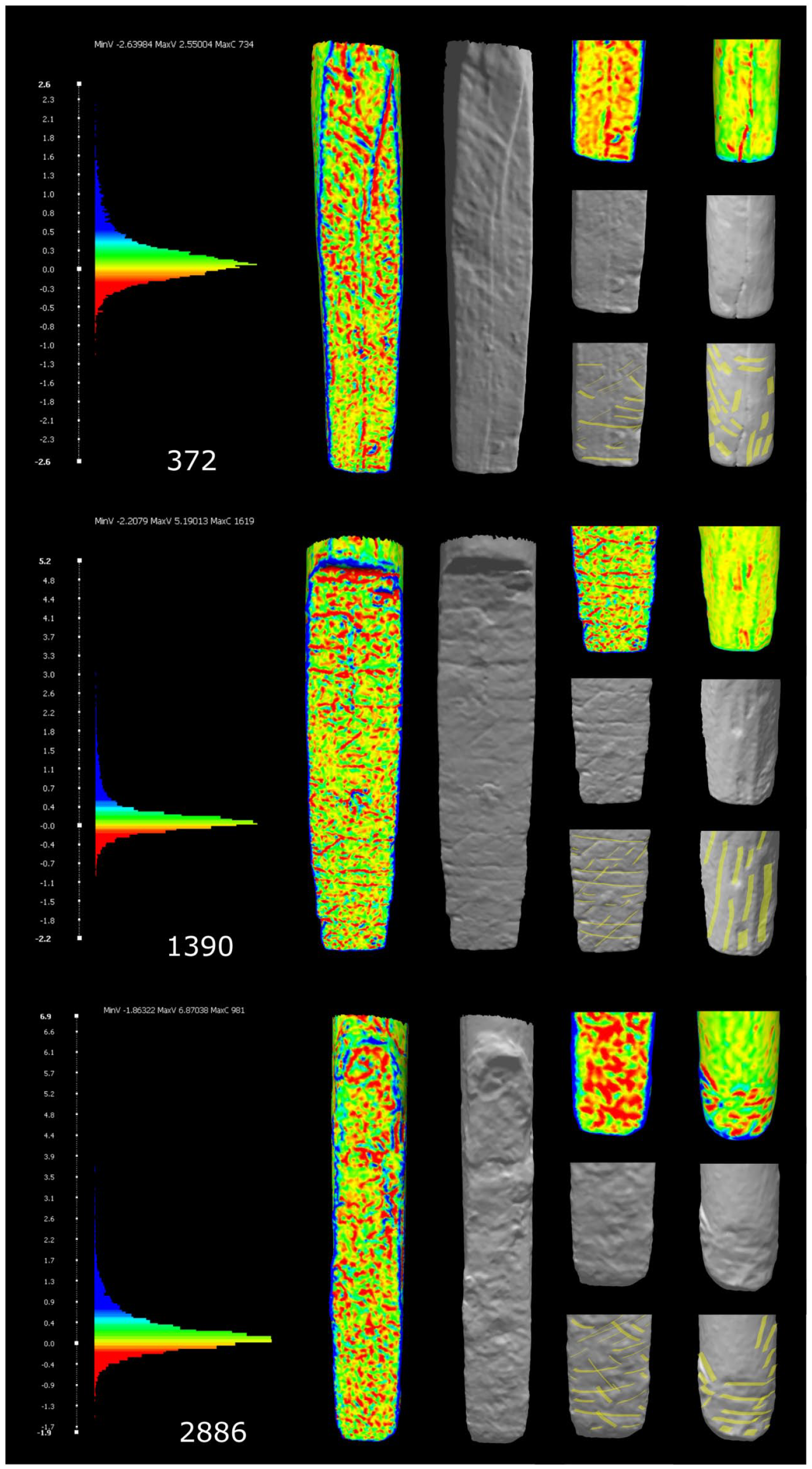
Analysis of the curvature orientation in the digital models and their distribution histograms – blue: convex vertices; red: concave vertices; yellow: flat surfaces (wooden artifacts Nº372, Nº 1390 and Nº2886. Cerro Casa de Piedra 7 site).
The calculations of curvature directions performed method, permitted to obtain 3D models with colored vertices according to the concavities and convexities. Based on these, it was possible to identify and differentiate flat, concave, and convex areas in each artifact.
The three artifacts show areas where the wood surface is almost flat (in yellow -Figure 5-). These areas correspond to the sides of the artifacts and all the face opposite to the beveled cut. The edges that make up the beveled cut and the proximal extreme of artifacts Nº1390 and Nº 2886, show convex vertices (in blue -Figure 5-).
The calculations of curvature directions method allowed to identify the presence of a group of numerous traces on the surface of the beveled cut in the three artifacts. These traces become evident due to the presence of fine cuts (Figure 5) concentrated in the beveled cut. The traces have a crosswise and parallel direction. In artifact Nº372 they can directly be seen on the wood surface. In artifacts Nº1390 and Nº2886, given the depth of the traces, they can be seen in the mastic (glue) remains that still cover them. In artifacts Nº1390 and Nº2886 it was also possible to register the presence of other oblique traces, in this case, on the mastic surface. Such traces appear in an isolated manner crossing the previously described traces. It is important to say that in the case of artifact Nº2886, the mastic thickness still present on the surface of the beveled cut generated some difficulties to clearly see the underlying form in the 3D model. However, the different traces could be registered.
Longitudinal traces were identified on the surface of the three artifacts. They follow the natural orientation of the wood fibers (Figure 6). Some previous archaeobotanical works suggest that the characteristics and arrangement of these traces show the action of wood debarking (Caruso Fermé, 2012; Caruso Fermé et al., 2015; Caruso Ferme, 2013; Caruso Fermé and Aschero, 2020; Caruso Fermé et al., 2021). Likewise, the flat areas of Figure 6 suggests that once the bark had been eliminated, the surface of the artifacts was polished using some porous material. Apart from the longitudinal traces, another type of trace (crosswise direction) was registered. The oblique traces together with longitudinal ones, also suggest the further debarking of wood. (Caruso Fermé, 2015; Caruso Fermé et al., 2021; Caruso Fermé and Aschero, 2020). In artifacts Nº1390 and Nº2886 the oblique traces are found in the two sides and in different parts of the face opposite to the beveled cut, whereas in artifact Nº372 they were registered in only one of the sides. It is important to say, however, that given the amount of residue present on the surface of the artifact, its level of analysis was lower than in the case of artifacts Nº1390 and Nº2886.
Illuminated digital models which highlight the presence of different types of traces at the front, rear and both extremes of the wooden artifacts Nº372, Nº 1390, Nº2886 (Cerro Casa de Piedra 7 site).
The artifacts’ extremes also show the modifications of the wood surfaces described before. In the distal extreme and in parts of the face opposite to the beveled cut, there are longitudinal and oblique traces. Besides, in its distal extreme, artifact Nº2886 shows the presence of different types of traces. On one side, the existence of a group of oblique, deep and thick traces that extend from one edge to another of the extreme. On the other side, the presence of a group of short isolated traces.
The representation of each vertex according to its curvature allows the identification of alterations in the edges of the different artifacts. Some discontinuity is observed lengthwise the edge of the beveled cut in the three artifacts (Figure 7-in blue-).). The presence of these cuts is the result of the intersection of oblique and parallel traces existing in the area that cover the beveled cut with the concave vertices of the edge.
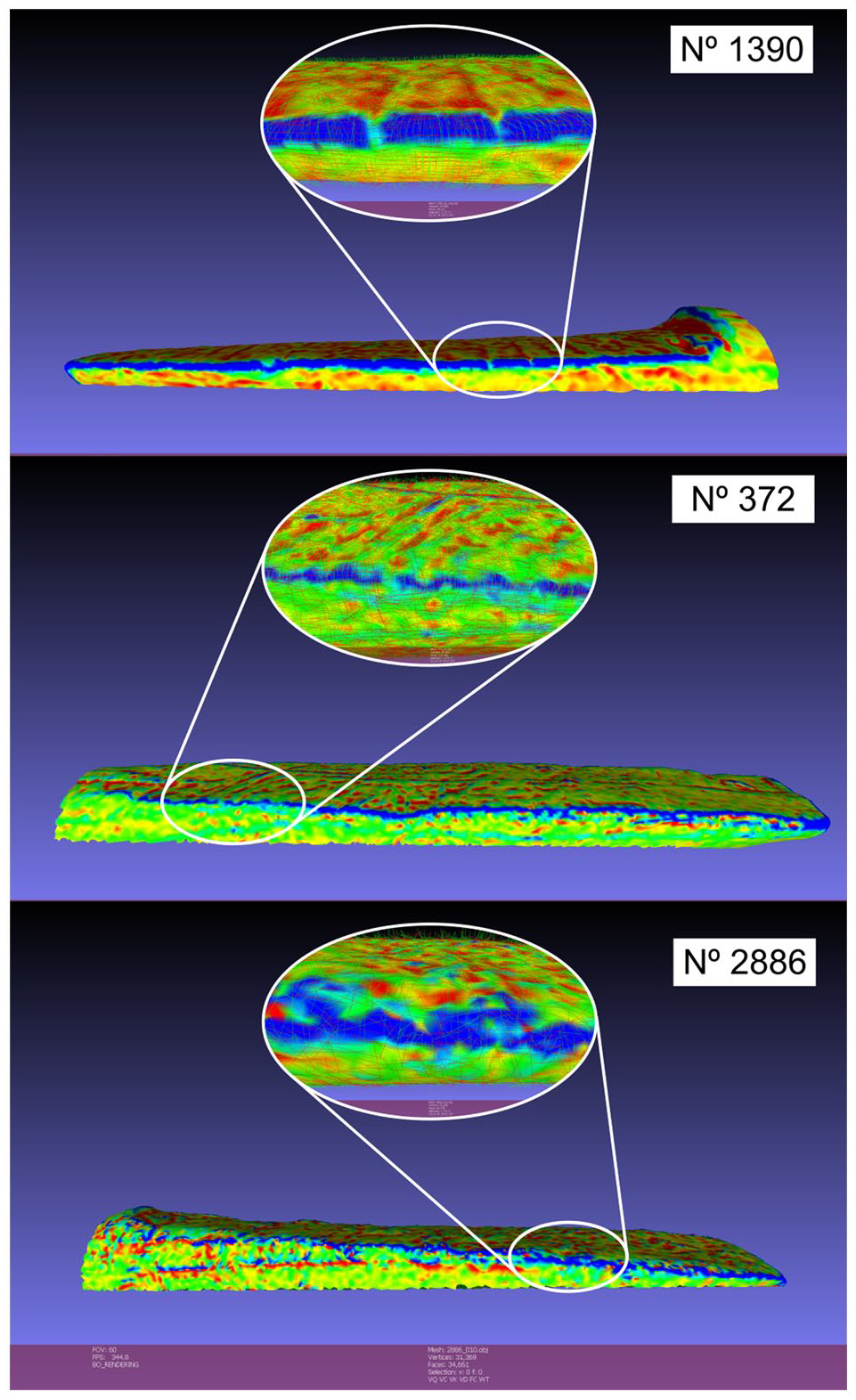
Curvature analysis in digital models. The blue vertices show the discontinuity of the edges in each wooden artifact Nº372, Nº 1390 and N º 2886 (Cerro Casa de Piedra 7 site).
Pearson’s correlation coefficient (r) shows that the correlation coefficient between the lengths (beveled cut length and part without beveled length) is statistically significant, with a p-value = 0.03 and a r = −1. The correlation index among the artifacts’ diameters (distal extreme diameter, start of beveled cut diameter and medial diameter) is higher than 0.9 and, in case of the widths (distal extreme beveled cut width, medial beveled cut width and start of beveled cut width), it is higher than 0.8. It is clear there is a linear relation, as one variable increases, the other variable tends to also increase, if positive, or decrease if negative (Graph 3).
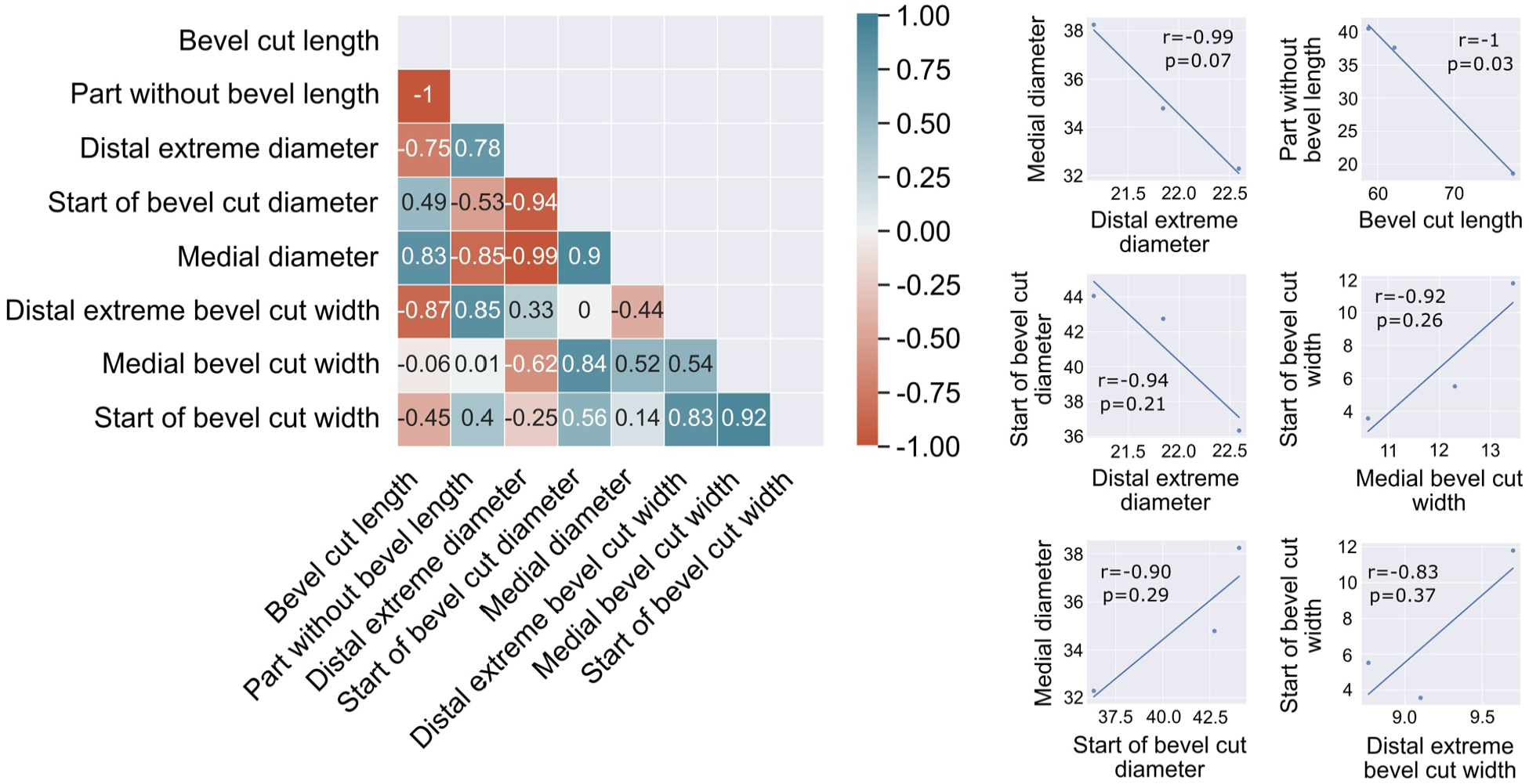
Matrix of the Pearson correlation quotients and linear relation among the registered measurements in the wooden artifacts Nº372, Nº 1390, and N º 2886 (Cerro Casa de Piedra 7site).
Discussion
The characteristics of the recovered materials in Cerro Casa de Piedra 7 site were excellent for the development of archaeobotanical studies combining 3D scanning techniques and surface analysis. As mentioned above, the incorporation of 3D scanning techniques, unlike use-wear analysis permits a non-segmented analysis of the artifacts.
The scan of the wooden artifacts from the CCP7 site took several work sessions. Once the scans were obtained, the post-processing and cleaning of the mesh was complex. However, we obtained as a result a way of working that can be replicated. Thus, the results obtained reflect the diversity of statistical and 3D analysis that can be applied to materials with these characteristics, making possible the future use of the same models with new methods.
Model of 3D digital surface: Morphometric patterns of the wooden artifacts
The 3D models and the calculation of curvature directions method allowed to identify flat zones along the entire of the wooden surface of each artifact and the presence of convex vertices in the proximal extremes.
The calculation of curvature directions method allowed to register the presence of numerous traces on the beveled cut surface. They become evident upon the presence of concave vertices. The discontinuity registered throughout the edge of the beveled cut is the result of the intersection of the existing traces in the area of this cut. On the other hand, there are also different kinds of traces in the distal extremes and zones opposite to the beveled cut. In some cases, it can be observed how the deep and thick oblique traces extend themselves from one edge to another of the artifact extreme. The analysis of wear due to use previously carried out on these artifacts showed activities related to use. This analysis showed the presence of bright polishing throughout the edge of the proximal extreme and lengthwise and horizontal polishing in concrete areas of the surface (Caruso Fermé, 2012; Caruso Fermé and Aschero, 2020).
The processing of the obtained data shows the morphometric characteristics with different degrees of similarity and difference among the three artifacts. The direct proportionality ratio between the total length of each of the artifacts and the rest of the registered morphometric variables- diameter, length and width of the beveled cut- allowed to see the differences and similarities. The results show that, the most significant similarities among the three artifacts are seen in the diameters of both extremes and in the width of the beveled cut. While the most remarkable difference is seen between the proportion of the beveled cut and the area without this cut.
The application of the Pearson’s correlation coefficient permitted to evaluate the degree of existing association among the morphometric variables before mentioned. It is important to point out that due to the volume of the sample studied, the use of this test was considered to be appropriate. The correlation coefficient between the lengths is statistically significant and although not all the results obtained are statistically significant, it is evident they follow the same direction and rationality. Then, it can be anticipated that a statistically significant correlation coefficient in larger samples might be obtained. Therefore, the Pearson correlation coefficient clearly shows the presence of a linear relation among the parameters of length, diameter and width of the three artifacts.
Finally, the application of statistical methods and curvature directions analysis in 3D models allowed obtaining new information about the similarities between the artifacts. The box plotting method and the calculation of the IQR allowed to verify the similarity between the measurements of the diameters and the measurements of the bevel cuts was verified. Pearson’s correlation coefficient allowed us to verify the relationship between the lengths, diameters and widths of the bevel cut of the artifacts.
Conclusion
The archeological works in which 3D scanning techniques are used generally focus on documentation about the conservation state of the artifact, experimental works and the creation of virtual collections. The 3D scanning of archeological material is strongly connected with the promotion and preservation of archeological heritage. This work consisted of the archaeobotanical study of wooden artifacts recovered in the Cerro Casa de Piedra 7 site (Santa. Cruz, Argentina), combining 3D scanning techniques.
The results obtained show the efficiency of the use of these techniques in the analysis of wooden artifacts recovered in completely dry contexts, without restoration process and use of products that may alter the wood surface. The 3D scanning techniques applied for technological and use-wear analysis in of wooden artifacts adds any further insight to our original observations. These techniques allowed us to obtain more accuracy and quantitative data. The 3D archaeobotanical analysis here presented constitutes the first work oriented to the study of wooden technology in societies with high mobility such as the hunter-gatherer groups related to occupations of the early Holocene.
The digital models processed allowed us to store geometric and texture information of the artifacts. The results achieved also make it possible to obtain 3D digital geometric replicas of each of the artifacts, document their state of conservation and create virtual collections. These data will allow the artifacts to be studied later, allowing greater preservation and optimization of heritage management. Likewise, the work post-processing and analysis of the 3D triangular meshes with different software offers a new perspective to discuss methods and techniques applied to the study of wooden archeological artifacts. The methodology developed represents a methodological progress for archeological research projects in South America as well as for archaeobotany in general.
In summary, the archaeobotanical analysis methodology presented and developed in this work allows its application to the study of different woody materials regardless of their chronology and recovery site. The information obtained combining both technologies will allow to identify specific morphometric patterns and therefor associate or differentiate among themselves the different wooden artifacts studied.
Footnotes
Acknowledgements
Special thanks go to Gustavo Martinez (INCUAPA-CONICET) for their comments on the original manuscript. Finally, we thank the editors and reviewers for the readings and the suggestions, which greatly improved our paper.
Funding
The author(s) disclosed receipt of the following financial support for the research, authorship, and/or publication of this article: This research was supported by PICT-2015-2541 (FONCYT), Agencia Nacional de Promoción Científica y Tecnológica (Argentina) and by CONICET scholarship (CIC 2018-2019).
