



Abstract
This paper presents the results of a study conducted with the aim of identifying competencies needed by special librarians in Iran at three different levels of library and information science education. A list of competencies was initially identified from the literature and 21 semi-structured interviews with managers of special libraries in Iran. Then, a panel of experts was employed to validate 122 competency statements by using a seven-point Likert type scale. The results demonstrated that the panelists validated the importance of 55 competencies required by special librarians with Associate degree qualification, while all 122 competencies were validated as necessary for special librarians with Bachelors and Masters degree qualifications. The findings also indicated that the main competencies that were expected from special librarians with any qualification are information technology competencies. In addition, communication and interpersonal skills were identified as the second most important competencies for special librarians with Associate and Bachelors degree qualifications. However, for special librarians with a Masters degree qualification, the next priorities were information organization and research competencies.
Introduction
In the last two decades, libraries have been undergoing many changes, and special libraries are no exception to this trend; as Rehman (2000) noted, special libraries are agents of change in the library and information science (LIS) field. In this regard Hayati (2005) highlighted that, in comparison to other library settings, special libraries in Iran are experiencing unprecedented changes, where applicants to the post of librarian are expected to meet certain requirements.
Practically, the greatest change that library and information professionals are facing is technological change (Hayati, 2005). Today’s developments in information and communication technology (ICT) are the main factors for the many changes in library services (Ameen, 2011; Ramzan and Singh, 2010). Roles and expectations of librarians and information professionals have changed as a result of ICT. As Singh and Pinki (2009: 333) noted: ‘Present IT based environment has demanded new job requirements, new roles, adequate competence and different kinds of skills from the professionals which would help them to develop new products and services in response to new developments’. This changing environment of special libraries’ worklife demands new and up-to-date competencies for librarians. Hence, determining which competencies should be taught in education and training programs is a question that needs to be addressed on a continuous basis.
Library and information science education in Iran
Although the history of Iran shows that the country has had well organized libraries for a long time, it had no facilities for formal training and education programs in library science until the 1920s (Kiani, 2009). Kiani has divided the growth and development of LIS education in Iran into four historical periods.
The first period (1939 to 1965) was the time that some workshops and short courses were organized for the training of librarians in Iran by American library educators. In 1955, the University of Tehran established a short course that was sponsored by the American Specialist Program and the Smith-Mundt Act Brewster. One year later, in 1956 a similar course was started in Shiraz University (Hayati and Fattahi, 2005). At that time, the curriculum placed considerable emphasis on cataloging. Akers (1955), cited in Hayati and Fattahi (2005), observed that the majority of the participants in the workshops were intermediate high school graduates who lacked the required basic competencies to become effective librarians.
The second period (1966 to 1978) was the period in which formal library education in Iran began. In 1966, the University of Tehran, following a suggestion by an American professional librarian, Margaret Hopkins, established the first library science department in Iran for Masters of Library Science. The curriculum for this degree program
The third period (1979 to 1995) was a time of growth and development of library education in Iran. As mentioned earlier, the initial library curricula in Iran were based on the American library system. After the Iranian revolution, the Supreme Council of Cultural Revolution tried to revise courses, rules, procedures and total functioning of the universities. Therefore, new universities, including new LIS departments, were established throughout the country through government legislation (Kiani, 2009).
The fourth period was from 1997 to 2007, and it generally continues until today. During this period, the number of universities and departments increased immensely. By the end of 2007, there were 84 LIS departments in Iran, excluding the established LIS departments at the University of Elmi-Karbordi (University of Applied Science and Technology) (Kiani, 2009).
Levels of library and information science education in Iran
LIS departments in Iran basically offer four levels of LIS education programs, i.e. Associate, Bachelors, Masters, and PhD. These departments are placed in 57 governmental universities and 27 non-governmental universities (Kiani, 2009). Details of the levels are as follows.
Associate in LIS. This level offers a two-year course after graduating from high school. Students at this level will acquire a set of basic skills and knowledge in LIS. It prepares students to work in small libraries as paraprofessional librarians (Kiani, 2009).
Bachelors in LIS. The main aim of this level is to equip students with the knowledge and skills necessary to work in junior/middle professional positions in large academic, public or special libraries. The duration of this level is four years after graduating from high school (Kiani, 2009).
Masters in LIS. This is a postgraduate course offered after a Bachelors degree. This program is of two years’ duration and aims to educate students for direct and accomplished expert tasks in libraries and research in the field (Kiani, 2009).
Doctorate (PhD) in LIS. This is an advanced level after the completion of a Masters degree in the field. This level includes a collection of research and education activities. The aim of this level is to educate innovative and effective specialists to teach and conduct research in different educational and research institutes (Kiani, 2009).
Concept of competencies
Prior to launching into the specific details of this study, it is important to review and explain the concept of competency. Review of the literature in the field of library science has shown that most of the definitions stated that competencies are a blending of knowledge, skills and attitudes.
For example, Griffiths and King (1986: 31–33) in New Directions in Library and Information Science Education gave an operational definition for competencies as including three components: knowledge, skills, and attitudes. They stated precisely that: ‘Knowledge is having information about, knowing, understanding, being acquainted with, being aware of, having experience of, or being familiar with something, someone or how to do something’; ‘Skill is the ability to use one’s knowledge effectively’; and ‘Attitude is a mental or emotional approach to something or someone’.
Murphy (1991: v) remarked that competency is ‘the dynamic interplay of knowledge, understanding, skills, valued attitudes and interests’. She also notes that: ‘competencies are usually described as the knowledge, skills and attitudes required to accomplish a job effectively’. The Special Libraries Association (SLA) (1998: 4) in the final report of their survey entitled Competencies for Special Librarians of the 21st Century defined competencies as ‘combination of skills, knowledge, and behaviors important for organizational success, personal performance, and career development’.
Generally, as indicated above, most definitions state that competencies are composed of knowledge, skills, and attitudes. However, in validation of competencies, Rehman (2000) believes that knowledge and skills should be considered. He reasons that: ‘identification of behavioral profiles is difficult, validation is problematic, and the whole exercise is without any real application potential’ (p. 37). Furthermore, according to Spencer and Spencer (1993), knowledge and skills are visible competencies and readily identifiable and measurable, whereas attitudes are less visible and less easy to measure. Therefore, in this study in order to identify required competencies for special librarians two dimensions of competencies consisting of knowledge and skills were chosen.
Problem statement
The competencies needed by librarians today are evolving to address the changes occurring in librarians’ work environment and settings. In this changing and unpredictable information environment, LIS departments that are involved in preparing librarians for positions in libraries must strive to meet the needs of their graduates’ real job settings. They also have to prepare graduates with the highest capacity and equip them with the suitable competencies to succeed at work. Singh and Pinki (2008: 399) argue that in this technological environment, education programs ‘ must be a proper blend of traditional library skills and other skills such as communication, ICT, Internet searching, managerial, negotiation, collaboration, survival, marketing, adaptability, flexibility, information literacy, professional ICT skills etc’. Blankson-Hemans and Hibberd (2004) mentioned that it is commonly understood that the library science curriculum prepares students in conventional information skills like indexing, retrieval, research, and perhaps library management. They also noted that the gaps identified in the education of information professionals’ competencies, particularly for special libraries, were due to the focus on conventional library and information skills training.
The LIS curriculum in Iran is also addressing this gap. A review of the literature showed that a number of Iranian authorities have attempted to indicate a lack of match of existing LIS curricula with the changing environment and developments. They emphatically recommended that the Iranian LIS curriculum at different levels of academic education needed general revision and changes in contents and structure (Fattahi, 2000; Hassanzadeh, 2004; Hayati, 2005; Jowkar and Hamdipour, 2001; Kiani, 2009; Mohammadi, 2005; Nokarizi, 2004; Tahavori, 2006; Torkiantabar, 2010).
An overview of the literature reveals that there are some deficiencies in the current LIS curricula in terms of providing graduates with the competencies they need to work as librarians. According to Hayati (2005), the first LIS curriculum in Iran was developed by foreign library schools with some minor changes which emerged from the educators’ reflections and viewpoints. However, due to deficiencies in contextual considerations the curriculum received many complaints from librarians and graduates that it was insufficient for the actual competency demands of the workplace context. Moreover, Tahavori (2006) argued that the academic education of LIS in Iran began almost 40 years ago and, compared to the initial curricula, the present LIS curriculum has not changed noticeably.
As a result, libraries are facing the challenge of incapable staff. According to Noruzi Chakoli (2004), a shortage of professional staff prepared for information production, collection, and dissemination as well as librarians possessing information literacy skills is a challenge in special libraries which hinders their development in Iran.
In summary, with such a changing world, there is a need to review and identify a set of the competencies that could be relevant and useful for LIS education. This would also be helpful to managers of LIS departments, workplace managers and administrators, and special librarians, who are the actual beneficiaries of different aspects of competencies.
Objective of the study
The main objective of this study was to identify competencies required by special librarians in Iran at three different levels of education. Since entry to the library profession in Iran is through three different levels of Associate, Bachelors, and Masters degrees, the study identified the competencies required by special librarians at these three levels of education by employing a panel of experts (special library managers). The findings provided a general groundwork for an evaluation of the LIS curricula for the requirements of special libraries. This objective was achieved by addressing this question: what are the competencies required by special librarians at three different levels of LIS education (Associate, Bachelors and Masters)?
In this study, ‘special library’ was defined as: ‘A library established and funded by a commercial firm, private association, government agency, nonprofit organization, or special interest group to meet the information needs of its employees, members, or staff in accordance with the organization’s mission and goals’ (Reitz, 2004).
Literature review
Although the history of competencies goes back more than three decades, competencies are continuously a hot subject in career and education discussions. In this regard, Houghton-Jan (2007: 8) noted that: ‘As a result of the growing use of competency descriptions as a management and development tool in general industry, institutions of all kinds began to fold competency descriptions into their workplaces’. In addition, she mentioned that in the LIS field, the use of competency descriptions really started to gain momentum in the 1980s.
One of the largest and earliest competency studies in the field was conducted by Griffiths and King (1986) from 1983 to 1986. Brody (1998) described this as the seminal research on professional competencies for academic, public, and special libraries. This project was undertaken to identify current and future competencies needed by librarians and information professionals.
As the oldest and largest library association in the world, the American Library Association (ALA) (2008) in Core Competences of Librarianship presented core competencies for librarians who are working in schools, academic, public, special, and governmental libraries. In this document, the ALA explained the basic competencies to be acquired by individuals graduating from an ALA accredited Masters’ program in Library and Information Studies. ALA divided these core competencies into eight clusters, i.e. foundations of the profession, information resources, organization of recorded knowledge and information, technological knowledge and skills, reference and user services, research, continuing education and lifelong learning, and administration and management.
As a major contribution, in 1996 the Special Libraries Association (SLA) published one of the main documents on competencies required by librarians newly recruited to the field. Regarding the competencies required by special librarians, the SLA stated: The unique competencies of the special librarian include in-depth knowledge of print and electronic information resources in specialized subject areas and the design and management of information services that meet the strategic information needs of the individual or group being served. (p. 1)
In addition, the document listed 11 professional and 13 personal competencies. They specified that professional competencies referred to the ‘special librarian’s knowledge in the areas of information resources, information access, technology, management and research, and the ability to use these areas of knowledge as a basis for providing library and information services’ (p. 4), while personal competencies referred to ‘a set of skills, attitudes and values that enable librarians to work efficiently; be good communicators; focus on continuing learning throughout their careers; demonstrate the value-added nature of their contributions; and survive in the new world of work’ (p. 5).
The American Association of Law Libraries (AALL) (2010) in Competencies of Law Librarianship specifies 62 competency statements divided into ‘core competencies’ and ‘specialized competencies’. The specialized competencies were in the areas of library management, reference, research and client services, information technology, collection development, cataloging and teaching.
Besides the library associations, other researchers have attempted to identify competencies required by special librarians. In a survey conducted by Buttlar and Du Mont (1996), results indicated that there was a very strong overlap in ratings of competencies needed by junior (one to three years’ experience) and experienced (five or more years’ experience) special librarians. The results also showed that the top five competencies rated as essential by junior special librarians were: knowledge of sources in all formats, effectively searching online databases, conducting an appropriate reference interview, developing and maintaining a budget plan, knowledge of networking options, knowledge of computer operating systems, and collection management skills. Furthermore, the top five competencies rated as essential by experienced special librarians were: communicating effectively in writing, knowledge of sources in all formats, conducting an appropriate reference interview, effectively searching online databases, and applying critical thinking skills to library problems.
In defining competencies for special librarians, Rehman et al. (1997) interviewed 50 top and middle managers of the 10 largest special libraries to validate the competencies (knowledge and skills) needed by library and information professionals (undergraduate and postgraduate) at entry level positions. The results showed that the abilities to relate information facility to the organizational mission and profile, managerial competence, effective exploitation of information technology, subject expertise, and a great deal of emphasis on the service aspect of librarianship were the most important requirements for future special librarians in Malaysia.
Rehman et al. (1998) also conducted a comprehensive study in Malaysia to identify foundation competencies for entry level library and information professionals (undergraduate and postgraduate) in the various work settings of academic, public, and special libraries. The results indicated that knowledge and skills competencies related to information dynamics, information technology applications, understanding of organizational environment and mission, and management capabilities were considered essential for future professionals. In addition, they found that an effective and intelligent application of information technology was clearly the main priority. Moreover, the results indicated that capabilities related to automation, databases skills, development of information systems and utilities, and effective application of new technology were the hard core content for preparing information professionals for the future.
Nor Shahriza (1995) conducted her study to find out if a set of competencies could be identified in relation to undergraduate and postgraduate education levels. In this study, data were collected from 130 professional librarians who worked in academic, public, and special libraries. She found that most of the competencies were perceived to be suitable for the postgraduate level. These competencies were in the areas of management, information technology, resource development, information services, and generalities. In addition, a small number of competencies were identified for undergraduate level. These competencies were in the areas of management, resource development, information services, and technical services. Furthermore, the results showed that the majority of common competencies were in the area of technical services.
Reagon (2005) identified the competencies needed by the South African entry level LIS graduates. She performed a documentary analysis to uncover competencies that were mentioned in the literature. The results indicated that the competency areas that were cited most frequently in the literature were: information services, information systems, interpersonal, communication skills and behavioral skills. Furthermore, in order to explore managers’ personal and in-depth perspectives about the competencies needed by entry level graduates, Reagon interviewed six managers from public, academic, and special libraries. The interview results showed a distinct similarity with the findings of the documentary analysis. Competencies in the areas of information services, information systems, interpersonal, communication and behavioral skills were identified as key competencies for entry level graduates by managers.
In Canada, findings of the 8Rs Study, The Future of Human Resources in Canadian Libraries, indicated that for entry-level special librarians the essential competencies included: can flexibly respond to change, innovativeness, can deal with range of users, can handle high volume workload, people skills (interpersonal skills), communication skills, generalist skills (i.e. can work in a number of different areas), information technology skills, leadership potential, and managerial skills (Ingles et al., 2005).
One of the most comprehensive sources reviewed is the Competency Index for the Library Field which was compiled by WebJunction (2009). In order to prepare this index, the WebJunction team reviewed competency statements from many library organizations, such as SLA and ALA. The index is made up of sections on library management, personal and interpersonal, public services, technical services and technology (core technology and systems and IT).
The literature also shows there are some competencies that are suggested for all librarians. For instance, Field (2009) cites communication skills, team member, the role of leader, and lifelong learner as essential competencies required for any specialization. Stern (2009) explains that for librarians to perform any task well; they need a set of basic skills, including: time management, critical thinking, decision making, service quality improvement, problem solving, communication skills, maintaining a teamwork orientation, and understanding the organization’s mission and priorities.
The review of the literature indicates that there are few competency studies in Iran. A significant study that was supported by the National Library of Iran, Mazinani (1998), surveyed the competencies required by librarians working in Iranian academic libraries and information centers. The results indicated that the top five priorities of competencies for librarians with a Masters qualification were: information technology, familiarity with integrated library management system, familiarity with information banks, familiarity with computer technology, and ability to store and retrieve information. The top five priorities of competencies for librarians with a Bachelors qualification were: familiarity with integrated library management systems, familiarity with information technology, familiarity with information banks, ability to store and retrieve information, and familiarity with special reference sources. The top five priorities of competencies for librarians with an Associate qualification were: familiarity with information technology, familiarity with special reference sources, familiarity with integrated library management systems, familiarity with computer technology, as well as the ability to select, order and acquire serials.
In another study in Iran, Hayati (2005) carried out an investigation to define competencies needed by library educators, library managers, and librarians. He found that respondents were very concerned about knowledge in the areas of cataloging, information services, circulation, collection development and serials, respectively, and skills of information services, cataloging, circulation, serials and collection development.
In summary, as the literature shows, the majority of these studies attempted to identify competencies needed by librarians with a postgraduate qualification at the entry level position. Rehman (2000) believes that the identification of competencies is very desirable, but it needs to be done in relation to the formal education levels existing in different countries. Rehman (2008) also argues that, although SLA, ALA, and others have determined that general sets of competencies could be suggested, these cannot be prescribed for all across the world. Furthermore, although there are many studies which identified competencies for librarians in different library settings, ‘There is no one-size-fits-all for competencies’ (WebJunction et al., 2010: 6). Therefore, as mentioned earlier, although several studies, to some extent, have contributed to the development of some competency frameworks, the transferability of these frameworks to some other contexts need further research. Thus, this study aimed to contribute to this area in an Iranian context.
Approaches involved in competency studies
According to Griffiths and King (1986) as cited in Luo (2008), there are two approaches involved in competency studies: identification and validation. Competency identification can be achieved through several methods, which consist of, but are not limited to: literature review (Rehman, 2000), expert panel (Griffiths and King, 1986), task analysis (Griffiths and King, 1986), and job analysis (Elgohary, 2003). Luo (2007) observed that competency validation is an extra step in analyzing the value of recognized competencies in a profession. Furthermore, Rehman et al. (1997, 1998) noted that validation of competencies is the process of identifying the need or lack of need for a particular competency statement. In other words, once competencies for a career are identified, to ensure that the competencies are appropriate for that career, it is necessary to validate them.
What the review of the literature indicates is that most of the competency studies were conducted by using the identification approach. In addition, it shows that little research has been performed to date on validation of competencies for librarians, especially in a special library setting, such as those that were carried out by Rehman et al. (1997, 1998).
Research design
Method
This research was conducted in three phases: review of the literature, interview, and survey. An extensive review of the literature was undertaken in order to become familiar with the conceptual foundations and the main studies on competencies in the field. In addition to the data gathered in the literature review another phase was to interview managers of special libraries in Iran to gather more contextual information about competencies and then that was used for the full data-gathering phase of the survey instrument.
In this study, one of the common approaches to the validation of competencies, Expert Consensus Validation Method (Hammerly, 1999) was used, involving qualified participants as panelists to assess the integrity and quality of the results of the study. Since in this study experts’ opinions were sought, the panel was selected on a purposive basis. In this study, the purposive sampling populated the sample with experts meeting the following criteria as indicated by Rehman (2000: 38): Those who have to validate must possess a blend of academic, professional and managerial credentials that may give them the insight needed for the exercise of validation. Possession of the basic professional degree, a minimum of five years of relevant experience, and some supervisory or managerial responsibility might be the criteria that may be applied.
In order to identify the panelists with the above characteristics, the Directory of Special and University Libraries of Iran (Taavoni et al., 2003) and National Library of Iran’s website (http://www.nlai.ir) were used as the existing relevant references. These sources were checked and finally it was realized that there were 64 individuals who could participate in this study. It should be noted that all these participants were from the government sector (government ministries and other types of government organizations).
Survey instrument
In this study, the questionnaire was designed based on a list of competency statements which were developed from the literature review and 21 semi-structured interviews with managers of special libraries in Iran who were selected purposively. Through the literature, broad areas of knowledge and skill competencies were identified from various sources. They were then categorized under the headings of management, collection development, information organization, information services, information technology, research and communication and interpersonal skills. These areas subsequently were used to lead the interviews. It should be noted that the competency statements identified through the literature were very broad, whereas interviewees emphasized specific competency statements in some areas such as collection development and information technology competencies. Furthermore, competencies related to budgeting, financing and commercial awareness were not considered by the interviewees at all. A majority of them noted that since their parent organization used a centralized budgeting system, usually only the library manager was involved, so there was no need for librarians to be familiar with these competencies.
The lists of competencies identified through the literature and interviews are presented in Appendices A and B.
Once the questionnaire was designed, a content validity exercise was conducted by seven faculty members of LIS departments. Based on their feedback, the questionnaire was revised. In addition, a pilot study using a random purposive sample of six special library managers resulted in some adjustments to the questionnaire. The revised version of the questionnaire contained a total of 122 competency statements.
In the questionnaire, participants were asked to indicate the importance of each competency statement for all three levels of education. A seven-point Likert scale was employed for each of the 122 statements with the first point being ‘not important at all’; the seventh point being ‘the most important’.
Data collection and analysis
The questionnaire was sent to the sample of 58 individuals via email. Of the 58 questionnaires distributed, 50 returned completed questionnaires were usable.
In order to analyze the data for this study, SPSS was employed. This study used descriptive statistics for describing the panelists’ views about the importance of competency statements. For validation purpose, the scale value 4.00 was fixed as the cut-off point (the minimum rating for importance), which means that a competency statement would be considered as needed if it received an average mean score of 4.00 and above.
Findings
This section of the article presents the knowledge and skill competencies identified and their respective mean scores. These are presented in the seven areas with respective mean scores and arranged in a descending order, indicating their perceived importance. Knowledge and skill components for each area have been listed separately.
The tables under each category present the mean scores of the competencies from the perspectives of the respondents, and whether these competencies are needed by special librarians at different levels of education as well as the extent to which these competencies are required.
Management-related competencies
Table 1 shows the mean scores of importance of four knowledge and 11 skill competencies for the three levels of education.
Mean scores of management competencies.
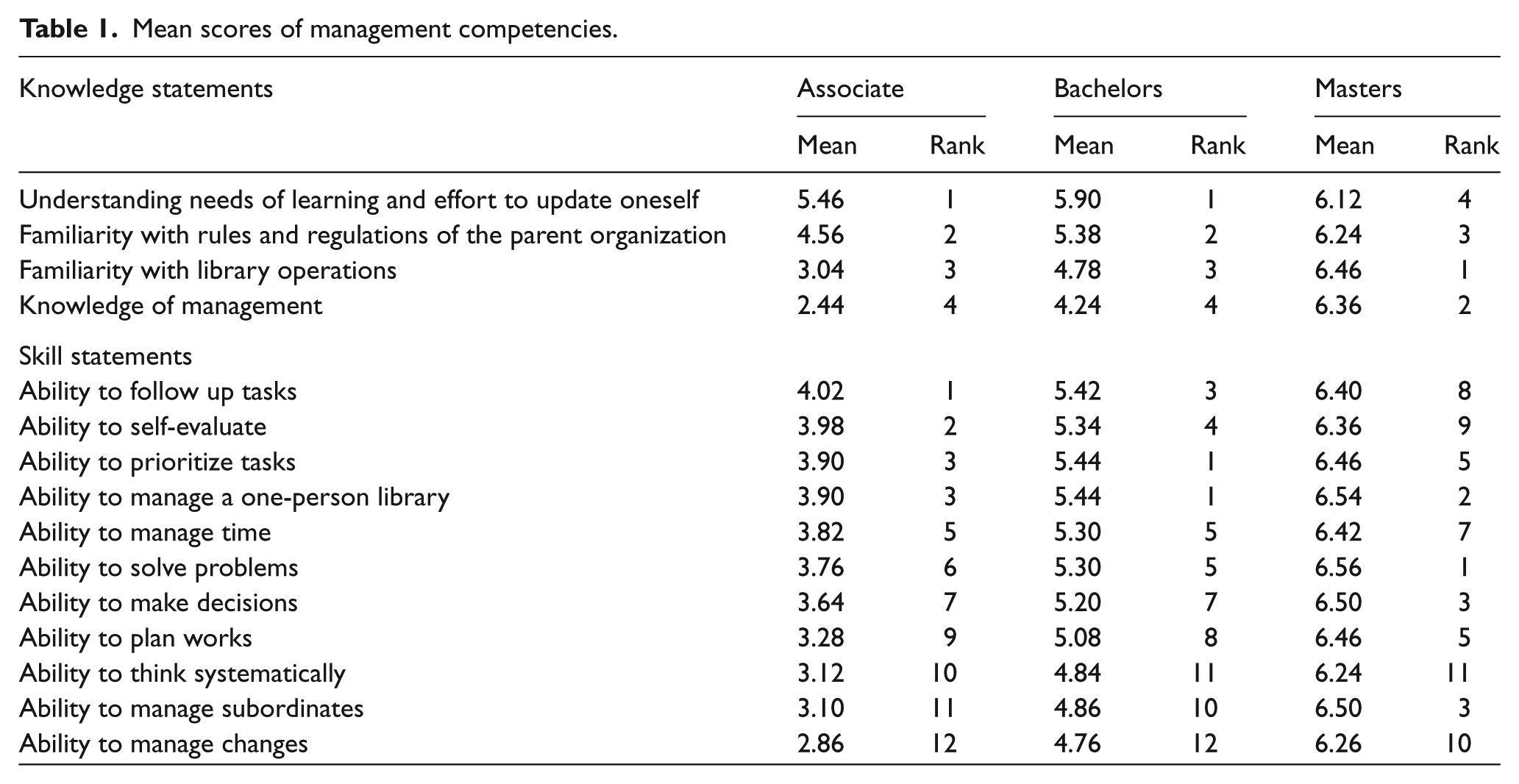
As the table indicates, two of the four knowledge competencies were validated as necessary competencies for the Associate degree level. Understanding needs of learning scored the highest mean score of 5.46. This was followed by Familiarity with rules and regulations of the parent organization with the mean score of 4.56. At this level of education, among the skill statements only Ability to follow up tasks was validated, which got the mean score of 4.02. Other skill competencies at this education level were not validated as required competencies as they received mean scores below 4.00.
At Bachelors degree level, Understanding needs of learning obtained the highest mean score (5.90). This was followed by Familiarity with rules and regulations of the parent organization (5.38). Two other validated competencies were Familiarity with library operations (4.78) and Knowledge of management (4.24). For skill competencies at this education level, first in rank, with the highest mean score were Ability to prioritize tasks and Ability to manage a one-person library with the same mean score of 5.44. These were closely followed by Ability to follow up tasks (5.42). Five other skill competencies were validated as they received mean scores between 5.34 and 4.76.
As Table 1 shows, for Masters degree level, first in importance was Familiarity with library operations, which had the highest mean score of 6.46. This was followed by Knowledge of management; Familiarity with rules and regulations of the parent organization; and Understanding needs of learning with mean scores of 6.36, 6.24 and 6.12 respectively. Among the 11 skill statements, at the Masters degree level, skills related to problem solving, managing a one-person library, decision making, and managing subordinates topped the list with mean scores of 6.50 and higher. The rest of the skill components attained mean scores of between 6.46 and 6.24.
Collection development-related competencies
Table 2 presents the data relating to the mean scores of importance ratings of 15 knowledge statements and 10 skill statements in collection development competencies.
Mean scores of collection development competencies.
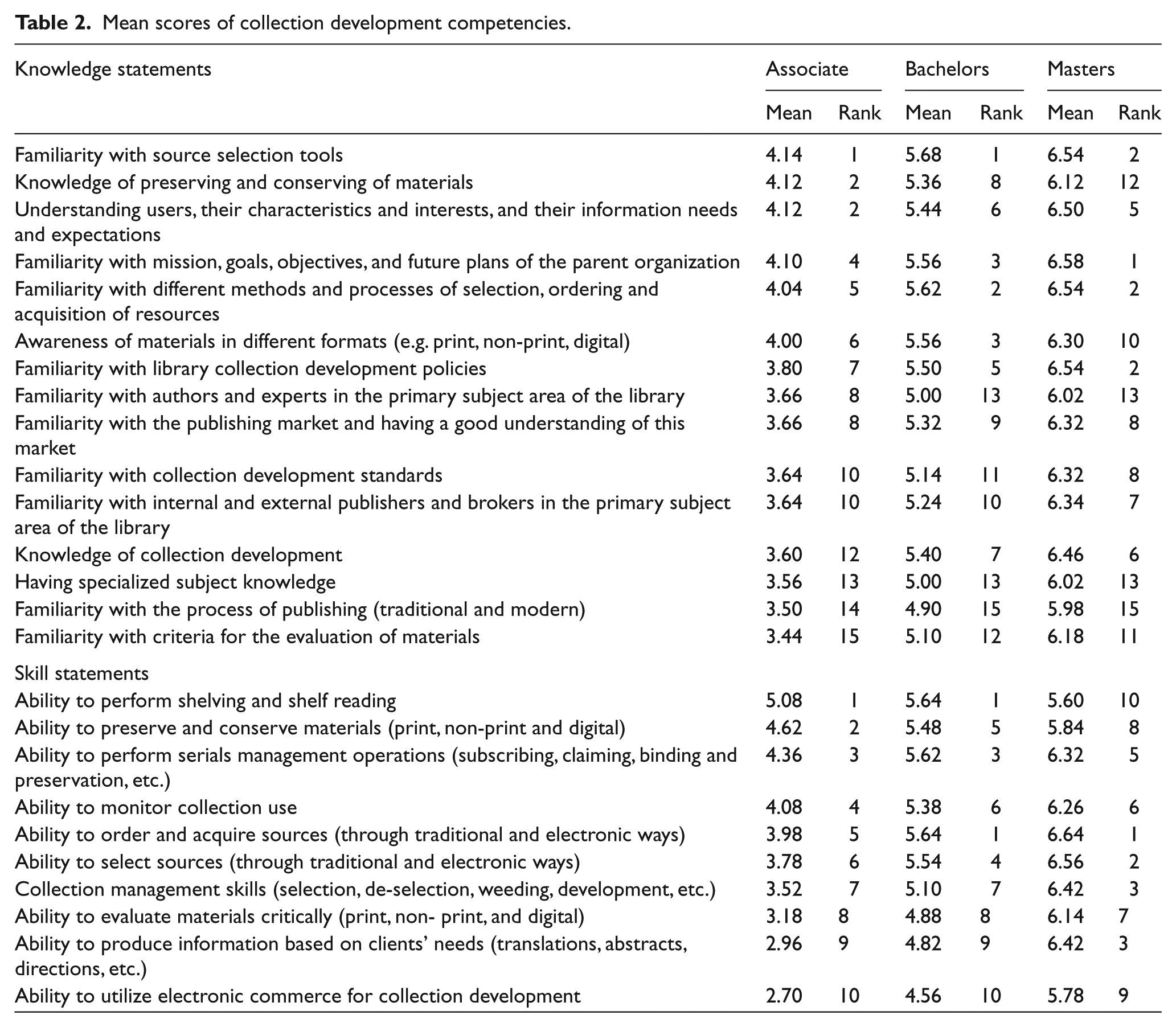
At the Associate degree level, six out of the 15 knowledge competencies were validated by the panelists as required competencies. With the mean score of 4.14, Familiarity with source selection tools topped the list. This was closely followed by knowledge related to preserving and conserving of material (4.12); and understanding users, their characteristics and interests, and their information needs and expectations (4.12). Three other validated competencies were: Familiarity with mission, goals, objectives, and future plans of the parent organization; Familiarity with different methods and processes of selection, ordering and acquisition; and Awareness of materials in different formats.
Among the 10 skill competencies, four competencies validated for this education level belonged to the collection development category. Ability to perform shelving and shelf reading topped the list with the mean score of 5.08. Ability to preserve and conserve materials; Ability to perform serials management operations; and Ability to monitor collection use were the skill statements which were validated with mean scores 4.62, 4.36, and 4.08 respectively. Other skill competencies were not validated as necessary competencies as they obtained mean scores below 4.00.
For the Bachelors degree level, out of the 15 knowledge competencies belonging to the collection development category, Familiarity with source selection tools scored the highest mean score (5.68). The next important knowledge competencies were: Familiarity with different methods and processes of selection, ordering and acquisition of resources; Familiarity with mission, goals, objectives, and future plans of the parent organization; Awareness of materials in different formats; and Familiarity with library collection development policies. Nine other knowledge competencies received mean scores between 5.44 and 4.90 and were placed at the bottom of the list.
At this level of education, among the skill competencies Ability to perform shelving and shelf reading; and Ability to order and acquire sources topped the list, as both received the highest mean score of 5.64. These were closely followed by Ability to perform serials management operations with the mean score of 5.62. The other seven skill competencies obtained mean scores between 5.54 and 4.56.
Among the knowledge statements, at Masters degree level, Familiarity with mission, goals, objectives and future plans of the parent organization had the highest mean score (6.58). In terms of importance, this was followed by: Familiarity with source selection tools; Familiarity with different methods and processes of selection, ordering and acquisition of resources; and Familiarity with library collection development policies. All received a high mean score of 6.54. The other validated knowledge competencies got the mean scores between 6.50 and 5.98.
Out of the 10 skill competencies concerning collection development at Masters level, first in importance was Ability to order and acquire sources (6.64). This was followed by Ability to select sources with the mean score of 6.56. The rest of the validated skill competencies obtained the mean scores between 6.42 and 5.60 and were put at the bottom of the list.
Information organization-related competencies
Table 3 presents the mean scores of importance ratings of five knowledge and ten skill statements in the area of information organization.
Mean Scores of information organization competencies.
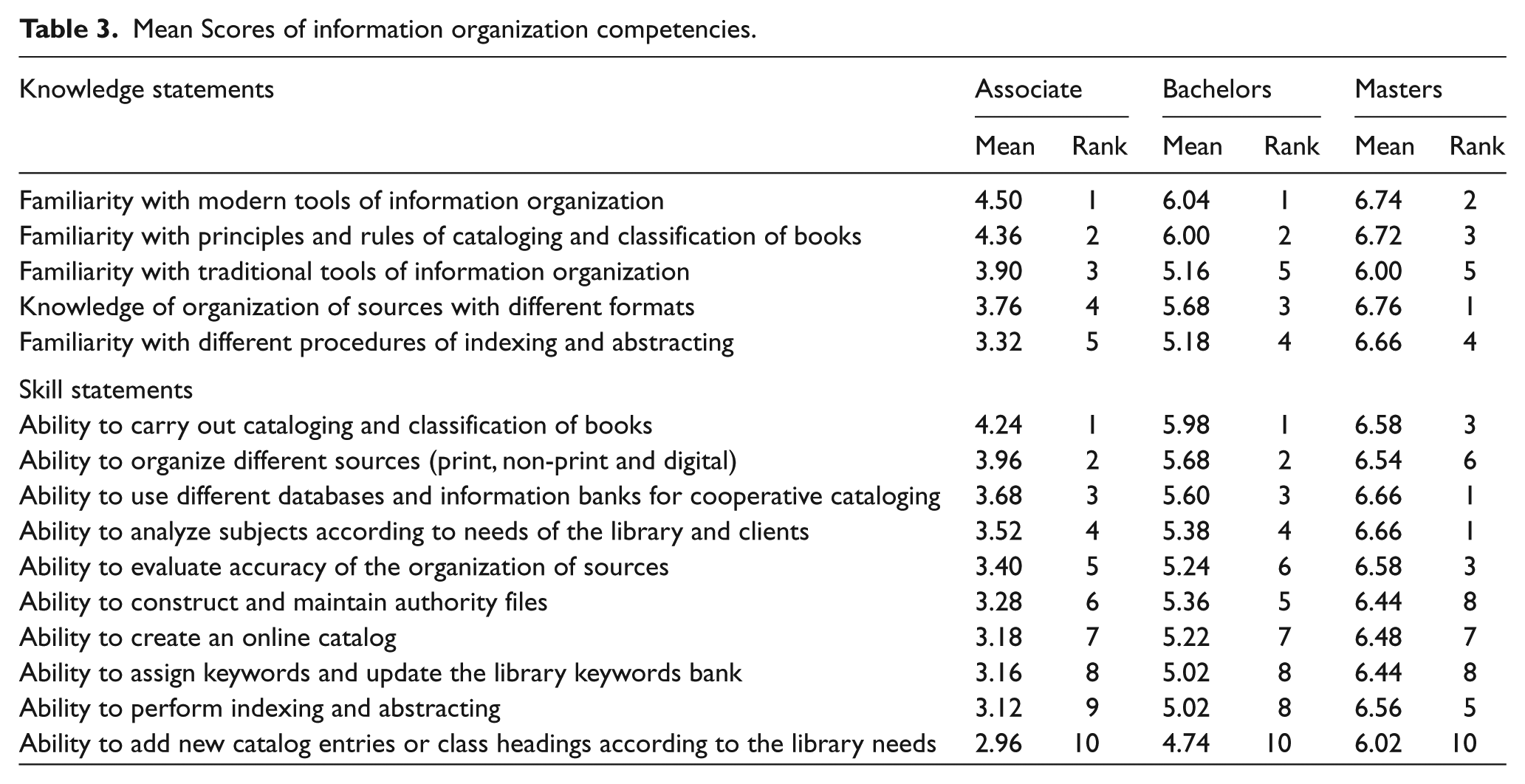
The data in Table 3 indicated that two out of the five knowledge competencies validated for the Associate degree level belonged to the information organization category. Familiarity with modern tools of information organization obtained the highest mean score of 4.50. This was followed by Familiarity with principles and rules of cataloging and classification of books with the mean score of 4.36. For skill components at this degree level, only Ability to carry out cataloging and classification of books with the mean score of 4.24 was validated by the panelists as a required competency.
Among the knowledge competencies, at Bachelors degree level, the highest mean score was obtained by Familiarity with modern tools of information organization (6.04). This was closely followed by Familiarity with principles and rules of cataloging and classification of books (6.00). Three other validated competencies obtained mean scores between 5.68 and 5.16, which were placed at the end of the list.
Table 3 shows that at Bachelors degree level, out of the 10 skill components, Ability to carry out cataloging and classification of books obtained the highest mean score of 5.98. This was followed by Ability to organize different sources (5.68) and Ability to use different databases and information banks for cooperative cataloging (5.60). The other validated skill competencies received mean scores in the range between 5.38 and 4.74.
For the Masters degree level, the competency which topped the list was Knowledge of organization of sources with different formats (6.76). This was closely followed by Familiarity with modern tools of information organization (6.74). Three other competencies: Familiarity with principles and rules of cataloging and classification of books; Familiarity with different procedures of indexing and abstracting; and Familiarity with traditional tools of information organization received mean scores 6.72, 6.66, and 6.00 respectively.
At this education level, skill competencies including: Ability to use different databases and information banks for cooperative cataloging; and Ability to analyze subjects according to needs of the library and clients obtained the same mean score of 6.66. The next important skill competencies were: Ability to carry out cataloging and classification of books; and Ability to evaluate accuracy of the organization of sources, both with the mean score of 6.58. Six other validated skill competencies for this level of education received mean scores in the range of between 6.56 and 6.02.
Information services-related competencies
Table 4 shows the mean scores of importance ratings of information services competencies for three levels of education inclusive of Associate, Bachelors, and Masters.
Mean scores of information services competencies.
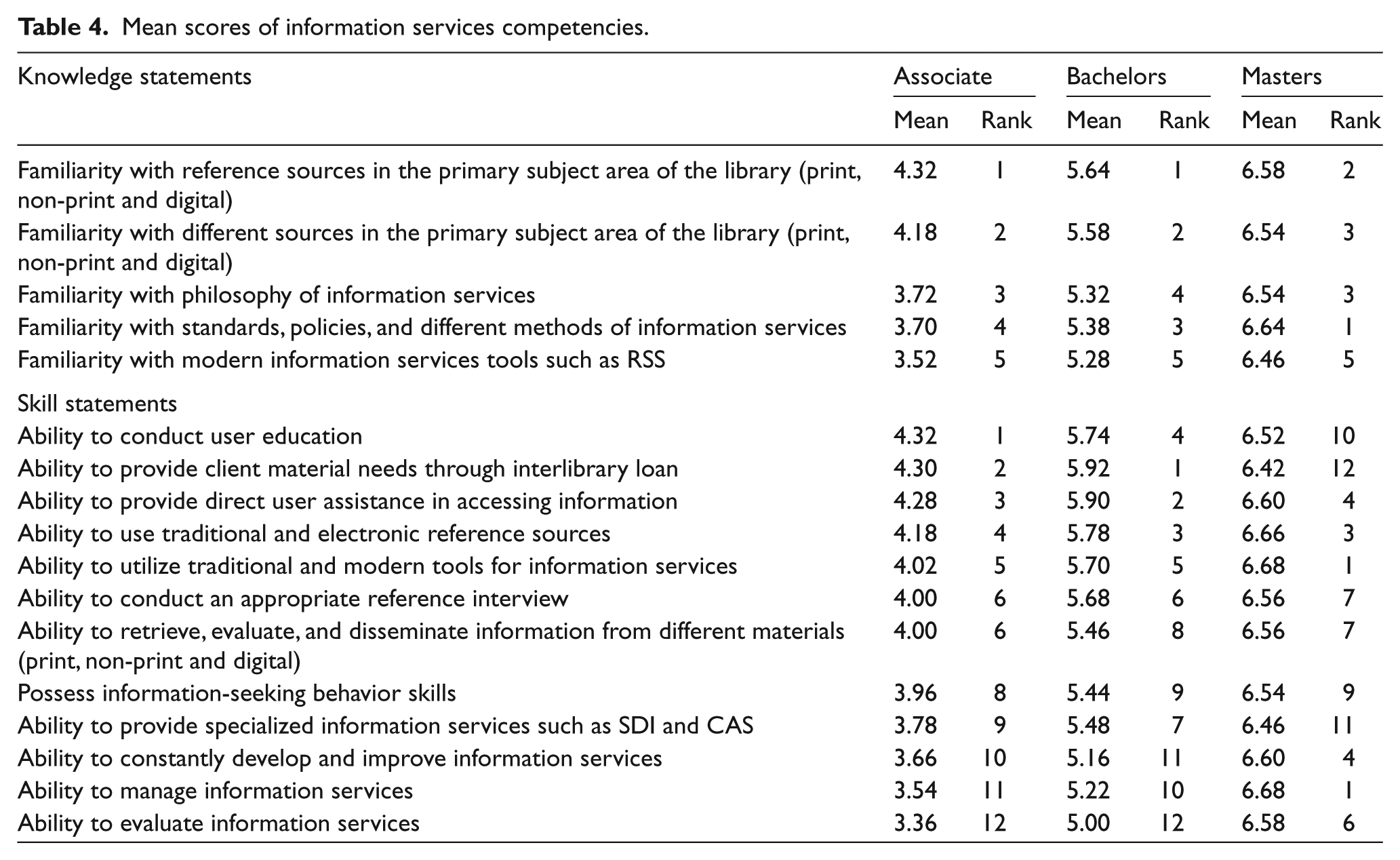
At the Associate degree level, out of the five knowledge competencies in information services category, only Familiarity with reference sources (4.32) and Familiarity with different sources (4.18) were validated by the panelists as necessary competencies.
In addition, at this level of education, seven out of the 12 skill competencies were validated by the participants as required competencies. Among these competencies, Ability to conduct user education topped the list with the mean score of 4.32. This was closely followed by: Ability to provide client material needs through interlibrary loan (4.30); and Ability to provide direct user assistance in accessing information (4.28). Four other skill competencies obtained mean scores between 4.18 and 4.00, and were put at the bottom of the list.
Among the knowledge competencies for Bachelors degree level, ranking first in importance was Familiarity with reference sources with the mean score of 5.64. In terms of importance, this was followed by Familiarity with different sources (5.58). The next important knowledge competencies were: Familiarity with standards, policies, and different methods of information services (5.38); Familiarity with philosophy of information services (5.32); and Familiarity with modern information services tools (5.28).
At this level of education, among the skill components, Ability to provide client material needs through interlibrary loan and Ability to provide direct user assistance topped the list with mean scores of 5.92 and 5.90, respectively. The other validated skill competencies obtained mean scores in the range between 5.78 and 5.00.
As Table 4 shows, at Masters degree level, Familiarity with standards, policies, and different methods of information services had the highest mean score of 6.64. The next important knowledge competencies were: Familiarity with reference sources (6.58); Familiarity with different sources in the primary subject area of the library (6.54); and Familiarity with philosophy of information services (6.54). Familiarity with modern information services tools was the last on the list with the mean score of 6.46.
Among the skill competencies at this level of education, Ability to utilize traditional and modern tools for information services and Ability to manage information services topped the list with the same mean score of 6.68. In terms of importance, these were followed by: skills related to using traditional and electronic reference sources (6.66); providing direct user assistance (6.60); and developing and improving information services (6.60). The other validated skill competencies obtained mean scores between 6.58 and 6.42.
Information technology-related competencies
Table 5 indicates the mean scores of importance ratings of eight knowledge and 14 skill statements on information technology competencies.
Mean scores of information technology competencies.
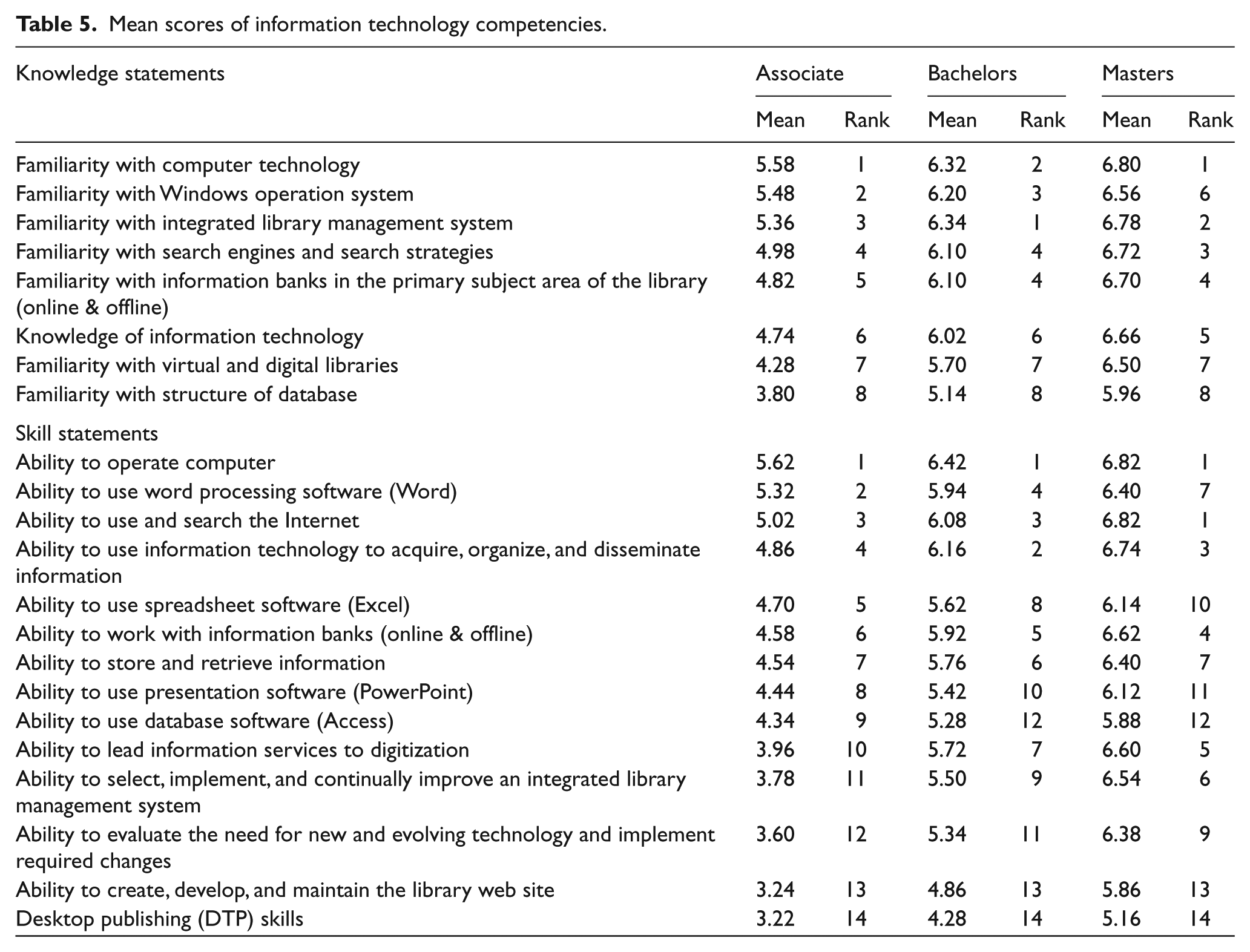
For the Associate degree level, seven out of the eight knowledge competencies were validated by the participants. Familiarity with computer technology was found to be the most important requirement with a mean score of 5.58. The next important knowledge statements were: Familiarity with Windows operation system (5.48); and Familiarity with integrated library management system (5.36). Four other validated competencies received mean scores between 4.98 and 4.28.
At the Associate degree level, nine out of the 14 skill competencies were validated by the participants as necessary competencies. The three skill competencies that received mean scores exceeding 5.00 and topped the list were: Ability to operate computer (5.62); Ability to use word processing software (5.32); and Ability to use and search the Internet (5.02). Other next validated skills obtained mean scores in the range between 4.86 and 4.34 and were put at the bottom of the list.
Among the knowledge competencies, at Bachelors degree level, Familiarity with integrated library management system scored the highest mean score of 6.34. This was followed by knowledge related to computer technology (6.32) and Windows operation system (6.20). Five other knowledge competencies received mean scores between 6.10 and 5.14.
As Table 5 shows, for skill competencies at this level of education, Ability to operate computer had the highest mean score of 6.42. Ability to use information technology to acquire, organize and disseminate information (6.16) and Ability to use and search the Internet (6.08) were perceived to be the next important skill competencies on the list. The other validated skills received mean scores ranging from 5.94 to 4.28.
At the Masters degree level, among the knowledge competencies, first in importance was Familiarity with computer technology with the highest mean score of 6.80. In terms of importance, this was followed by: Familiarity with integrated library management system (6.78); Familiarity with search engines and search strategies (6.72); and Familiarity with information banks (6.70). The rest of the knowledge competencies received mean scores of between 6.66 and 5.96.
At this degree level, among the skill competencies, Ability to operate computer and Ability to use and search the Internet were found to be the most important, as both received the highest mean score of 6.82. The next important skills were: Ability to use information technology to acquire, organize, and disseminate information; Ability to work with information banks; Ability to lead information services to digitization; and Ability to select, implement, and continually improve an integrated library management system. All had mean scores ranging between 6.74 and 6.54. Eight other important skills obtained mean scores in the range from 6.40 to 5.16.
Research-related competencies
Table 6 presents data relating to the mean scores of importance ratings of six knowledge and six skill statements with regard to research competencies. At the Associate degree level, the participants considered all of the knowledge and skill statements of research competencies to be unimportant.
Mean scores of research competencies.
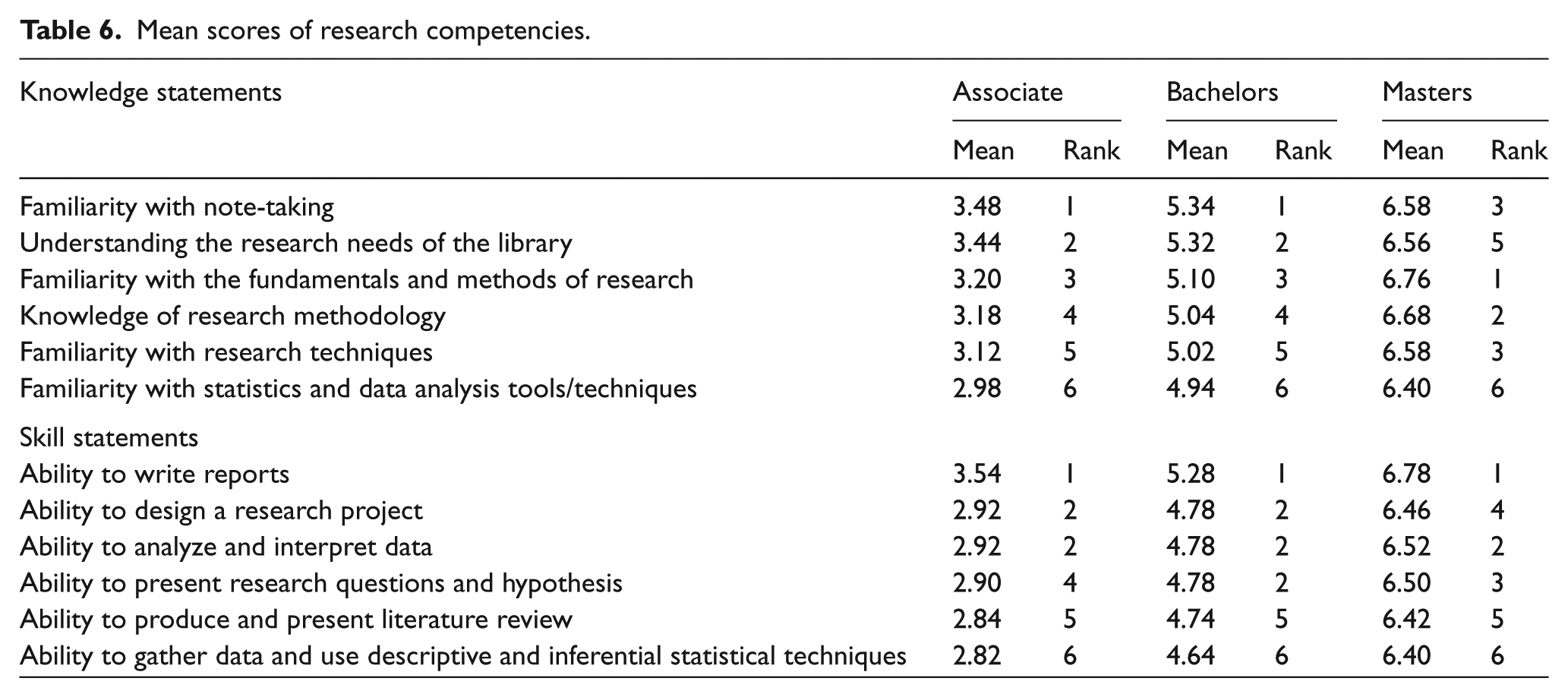
Among the knowledge competencies for Bachelors degree level, Familiarity with note-taking obtained the highest mean score of 5.34. This was followed closely by Understanding the research needs of the library with the mean score of 5.32. Four other validated competencies were: Familiarity with the fundamentals and methods of research (5.10); Knowledge of research methodology (5.04); Familiarity with research techniques (5.02); and Familiarity with statistics and data analysis (4.94). At this education degree level, for skill components, Ability to write reports had the highest mean score of 5.28. The other five research skills received mean scores in the range between 4.78 and 4.64.
At the Masters degree level, as Table 6 shows, Familiarity with the fundamentals and methods of research attained the highest mean score of 6.76. This was followed by: Knowledge of research methodology; Familiarity with note-taking; Familiarity with research techniques; Understanding the research needs of the library; and Familiarity with statistics and data analysis tools/techniques; with mean scores between 6.68 and 6.40.
At this degree level, concerning research skills, Ability to write reports topped the list with the mean score of 6.78. The other two important skill statements were: Ability to analyze and interpret data; and Ability to present research questions and hypothesis, with mean scores of 6.52 and 6.50, respectively. The rest of the skill competencies received mean scores in the range from 6.46 to 6.40.
Communication and interpersonal-related skills
Table 7 shows the mean scores of importance of 16 communication and interpersonal skill competencies for the three levels of education.
Mean scores of communication and interpersonal skills.
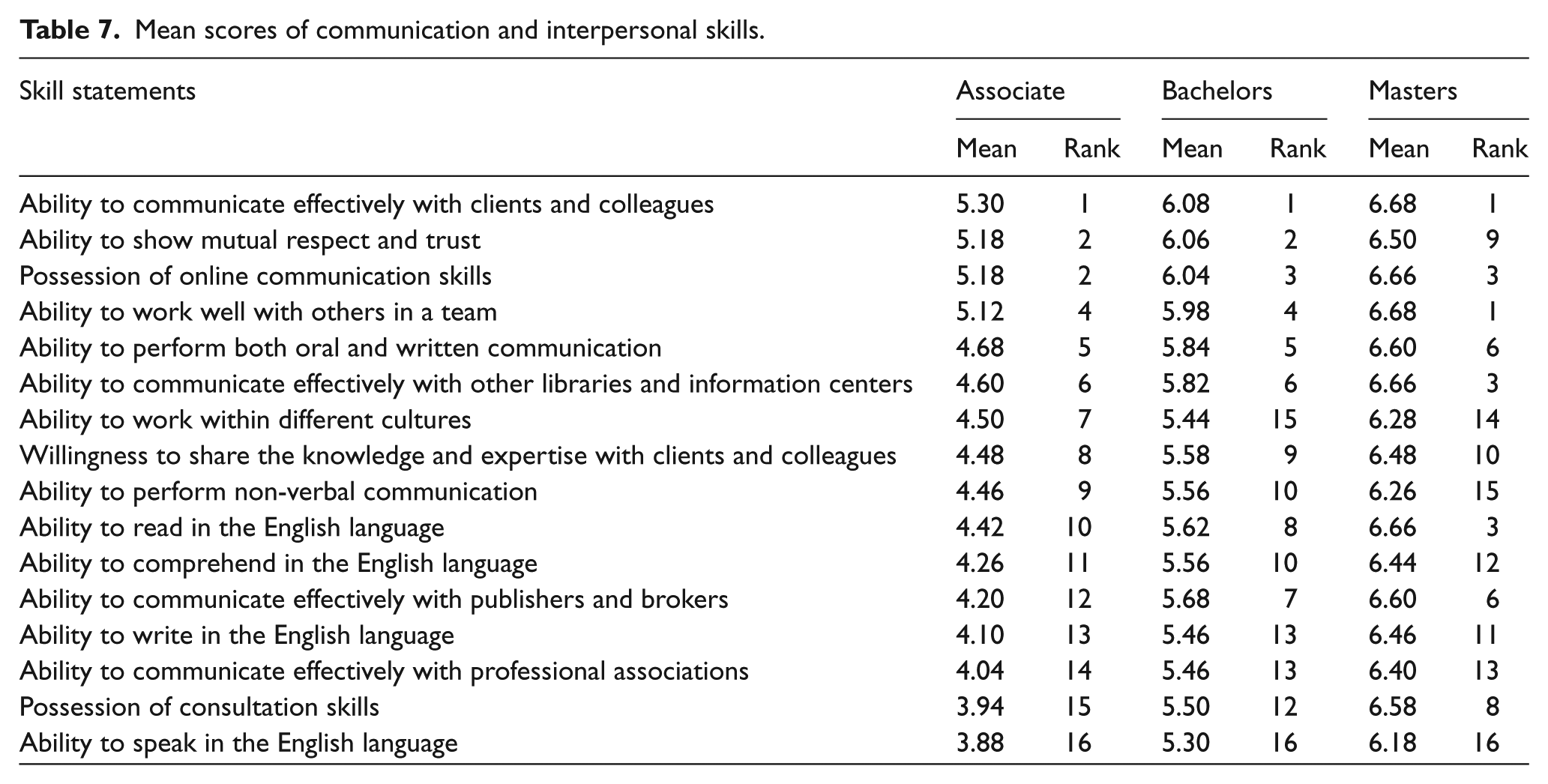
As Table 7 shows, 14 out of the 16 communication and interpersonal skills were validated as required competencies for special librarians with an Associate degree qualification. Ability to communicate effectively with clients and colleagues scored the highest mean score of 5.30. Ability to show mutual respect and trust; and Possession of online communication skills were placed in the next ranks, both receiving a mean score of 5.18. Another equally important skill statement was Ability to work well with others in a team with the mean score of 5.12. The next skill components were: Ability to perform both oral and written communication (4.68); and Ability to communicate effectively with other libraries and information centers (4.60). Eight other validated skills obtained mean scores in the range of between 4.50 and 4.04 and were placed at the bottom of the list.
At Bachelors degree level, among the skill competencies in this category, Ability to communicate effectively with clients and colleagues received the highest mean score of 6.08. This was closely followed by: Ability to show mutual respect and trust; and Possession of online communication skills with mean scores of 6.06 and 6.04, respectively. Other skill competencies obtained mean scores between 5.98 and 5.30.
Among the communication and interpersonal skills for Masters degree level, Ability to communicate effectively with clients and colleagues; and Ability to work well with others in a team were found to be the most important requirements with the same mean score of 6.68. These were followed closely by: Possession of online communication skills; Ability to communicate effectively with other libraries and information centers; and Ability to read in the English language. All received the same mean score of 6.66. The next important skills were: Ability to perform both oral and written communication; Ability to communicate effectively with publishers and brokers; Possession of consultation skills; and Ability to show mutual respect and trust, with mean scores exceeding 6.50. Other skill components received mean scores between 6.48 and 6.18.
Summary of the findings and discussion
This study investigated the knowledge and skills competencies needed by special librarians in relation to three different levels of LIS education. The results revealed that the panelists validated the importance of 55 competencies that qualified as being required by special librarians with an Associate degree qualification. On the other hand, the participants validated the importance of all 122 competencies which qualified as being needed by special librarians with Bachelors and Masters degree qualifications. The complete list of validated and prioritized competency statements is presented in Appendix C.
Table 8 lists the top 15 competency statements for three levels of education. As the table indicates, for Associate and Bachelors degree, nine (60 %) and for Masters degree, seven (46.6 %) of the top 15 competencies were categorized under the information technology area. The second category emphasized by the panelists for those with Associate and Bachelors degrees was communication and interpersonal skills (four items or 26.6 %). For the Bachelors degree level, the third priority was information organization competencies (two items or 13.3 %). Moreover, as the table shows, the second priority for the Masters degree level was information organization (three items or 20 %) and research competencies (three items or 20 %).
Top 15 competencies.
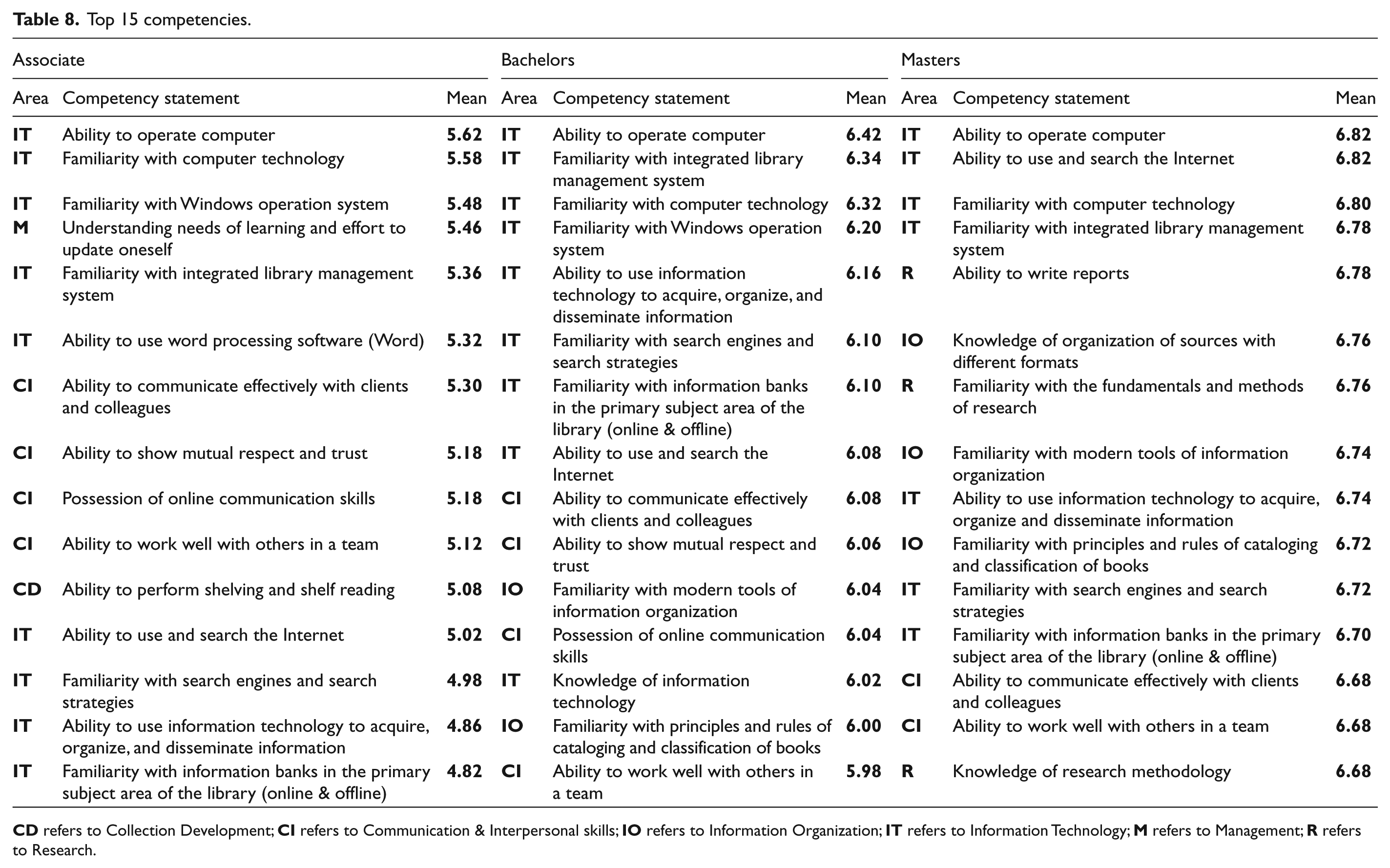
These findings indicate that the main competencies expected from special librarians with any qualification are information technology competencies, especially basic competencies such as the Ability to operate computer and Familiarity with computer technology. These findings are generally congruent with the literature where a number of studies have addressed the importance of information technology competencies for postgraduate librarians (AALL, 2010; ALA, 2008; Buttlar and Du Mont, 1996; Ingles et al., 2005; Nor Shahriza, 1995; SLA, 1996; Webjunction, 2009). In addition, Mazinani (1998) and Rehman et al. (1997, 1998) surveyed competencies required by librarians and identified information technology competencies as important for both undergraduate and postgraduate librarians.
This was an expected outcome. As Ameen (2011: 175) noted ‘a vast majority of the professionals need extensive ICT competencies learning’. There is a consensus among the majority of authorities that the rapid growth of information and communication technologies (ICTs) is the main cause of changes in the field. The ICT-based environment has created changes, which require their own knowledge and skills. Hanson-Baldauf and Hassell (2009) noted that in modern society, ICTs are becoming essential tools. They also mentioned that from the perspective of many experts, competencies related to ICTs are ‘a prerequisite for participation in society and the workforce’ (p. 3).
Based on the results, information organization and research are the next areas which were highly emphasized by panelists for special librarians with a Masters degree qualification. This suggests that special librarians with a postgraduate qualification as compared to undergraduate librarians were expected to be more competent in the areas of information organization and research. However, among the top 15 competencies, information organization competencies were also stressed by the panelists for special librarians with a Bachelors degree qualification.
Furthermore, research competencies were emphasized for special librarians with a Masters degree qualification, while these competencies were not validated as necessary competencies for special librarians with an Associate degree qualification at all. For Bachelors degree, although research competencies were validated as required, they obtained low scores. A number of studies have indicated the importance of research competencies for postgraduate librarians, such as SLA (1996), ALA (2008), Webjunction (2009) and AALL (2010).
In this study, as Table 8 shows, unlike special librarians with Associate and Bachelors degree qualifications for whom communication and interpersonal skills were identified as the second important competency area, there was less emphasis on this area for librarians with a Masters degree qualification, although evidence from the literature indicated that communication and interpersonal skills are very important for postgraduate librarians. Studies by SLA (1996), Ingles et al. (2005), Reagon (2005), ALA (2008), Webjunction (2009) and AALL (2010) have all stressed that communication skills are highly required for postgraduate librarians. Furthermore, they have been highlighted by different authors such as Field (2009) and Stern (2009) as important for all librarians.
Contributions of the study
The products of this research extend the body of knowledge and make several contributions to the current literature by providing an insight into required competencies for special librarians in Iran in relation to different levels of education; they also suggest some ideas on objective criteria for the evaluation of the existing LIS education programs. The results of this study provide a framework of competencies that can be used to design or re-visit the LIS curricula in a way that supports the development of graduates who aim to work in special libraries in Iran. Furthermore, the framework can be useful for self-evaluation and self-improvement of LIS graduates who aim to work in special libraries.
This study provides the stakeholders with some contextual knowledge on competencies which should be taken into account when designing LIS curricula in Iran. At a broader level, this study contributes to the current research on special librarians competencies in a developing country, i.e. Iran, as a less researched context.
Conclusion
LIS education in Iran has been offered at different levels of education, i.e. Associate, Bachelors, Masters, and PhD. The literature review showed that most of the competency studies in the field have focused on competencies needed by librarians with postgraduate qualifications. Therefore, the results of this study are important because they have presented an insight into criteria for evaluation of the existing LIS education and training programs in relation to special librarian needs.
However, there is a need to replicate this study in order to identify the required competencies for other library settings. The results of this study suggested that LIS departments in Iran should attempt to re-evaluate the curriculum at different levels of education to ensure that the courses place more emphasis on information technology competencies (knowledge and skills) and communication and interpersonal skills. Although information technology competencies can be easily incorporated into the curriculum, communication and interpersonal skills would require careful planning in order to comply with the LIS curriculum. DeArmond et al. (2009) suggest that LIS programs must introduce communication and interpersonal skills in a practical way such as role play or drama, since it is difficult to teach these elements in a classroom setting. The introduction and use of such activities as group work and presentations can contribute towards improving interpersonal skills.
Footnotes
Appendix A
Appendix B
Appendix C
Acknowledgements
We are very grateful to the managers of special libraries for taking time from their busy schedule to participate in this study. In addition, the authors would like to express their appreciation to Professor Dr Amanda Spink, Professor Dr Abbass Horri, Associate Professor Dr Najla Hariri and Dr Shaheen Majid for their insightful comments.
This study draws on Peyvand Robati doctoral research which was conducted in the University of Malaya and receives finance support and fellowship from this university. We would like to acknowledge the support.
Funding
This research received no specific grant from any funding agency in the public, commercial of not-for-profit sectors.