




Abstract
Inquiry-based learning describes a range of learner-centred pedagogies increasingly employed in higher education where students learn through engaging in open-ended research and inquiry. It is acknowledged that this type of pedagogical approach requires advanced information literacy capabilities in students, and that there is a need to support the development of information literacy in inquiry-based learning curricula. This paper reports on the evaluation of a selection of curriculum development projects undertaken at a UK university that implemented inquiry-based learning and information literacy development. Data was collected using a ‘Theory of Change’ evaluation methodology and analysed using a qualitative thematic approach. It was found that educators need to make explicit to students the need to develop information literacy to support their inquiries, and that dedicated approaches to facilitation from peers, librarians and academics are helpful when designing inquiry-based learning.
Introduction
Inquiry-based learning
The foregrounding of inquiry in undergraduate education can be traced to the Boyer Commission report (Boyer, 1998), which criticized didactic teaching for not preparing students sufficiently for further study nor for professional careers. The report proposed that learning, teaching and research should be more closely integrated and that undergraduate students should experience learning through inquiry from the start of their studies at university. Inquiry-based pedagogies create a ‘culture of inquiry’ as ‘teachers become learners, learners are self and peer-taught and everyone becomes a researcher’ (Gordon, 2010: 79). The integration of inquiry into the undergraduate curriculum is seen to be a way of enhancing the linkages between teaching and research (Healey and Jenkins, 2009). Rather than being seen as recipients of an education process, students become partners in the process of learning (Kahn and O’Rourke, 2004). In addition IBL develops students’ ‘self authorship’, seen to be an essential goal of undergraduate education (Hodge et al., 2008: 8).
Inquiry-based learning (IBL) is a powerful learner-centred pedagogy used widely in all levels of education. The term ‘IBL’ is used to describe a range of teaching and learning strategies that are driven by students pursuing their own research and inquiries (Kahn and O’Rourke, 2004). IBL is characterized by inquiry that is open-ended where a variety of responses can be proposed (Kahn and O’Rourke, 2004). IBL is based on constructivist educational theories and the belief that learners construct meaning from their learning activities, and that this understanding cannot be transmitted from teacher to learner (Biggs, 2003). IBL is therefore characterized by teaching approaches in which the lecturer acts as a facilitator who encourages students in their learning activities (Cleland and Walton, 2012). However, research has shown that the adoption of IBL can raise issues of power and control for lecturers, and can be more demanding on their time (Deignan, 2009). In line with constructivist theories of learning and teaching, it is suggested that the active acquisition of knowledge leads to the increased likelihood that the learning will become intellectually embedded (Hutchings, 2007).
Information literacy
Information literacy can be defined as ‘the adoption of appropriate information behaviour to identify, through whatever channel or medium, information well fitted to information needs, leading to wise and ethical use of information in society’ (Johnston and Webber, 2003: 336). The use of the term ‘information literacy’ (IL) to refer to these competencies has been in use since the late 1970s and has been recognized internationally as an essential competency for modern society and lifelong learning by UNESCO (2003) in the Prague declaration and (2006) in the Alexandria proclamation (Horton, 2010). IL has been recognized as a key competency for learners in higher education (HE), and promoted in the US through the creation of the Association of College and Research Libraries competency standards (ACRL, 2000). These standards stress the importance of IL in a learner-centred, inquiry-based curriculum, and also the importance of building IL within the context of the subject being taught. In the UK the SCONUL ‘Seven Pillars’ (SCONUL, 1999) model of IL was created as a practical model to assist in strategy, design and delivery of IL in HE. The Seven Pillars model was updated in 2011 to reflect a widened conception of information literacy in education, while acknowledging the centrality of IL to effective learning in HE (SCONUL, 2011). It is however worth noting that the use of IL standards and models can promote a skills-based conception of IL that is not consistent with conceptions of information use as a social process (Jacobs and Berg, 2011). IL development is now a major sphere of activity for academic librarians, although it is noted that there are overlaps with a number of other terms being used to describe critical thinking and higher level cognitive skills in the HE environment such as digital literacy and academic literacy (Secker and Coonan, 2011). The librarian literature is replete with examples of scholarship into the teaching, development and assessment of IL; however, it is clear that IL has moved beyond library instruction, and instead is taught and developed by diverse HE stakeholders, for example learning developers, e-learning specialists and academic staff (Secker and Coonan, 2011).
There is little research-based literature published on the relationship between inquiry and information literacy; inquiry-based pedagogies for IL or IL development to support IBL. There is a small body of literature explored in more depth below relating to problem-based learning (PBL) and IL (e.g. Dodd, 2007; Fosmire and Macklin, 2002) where IL development, facilitated by librarians is integrated into PBL curricula. There is again a very small body of literature reporting inquiry-based learning and the role of IL in supporting student inquiry (e.g. Gehring and Eastman, 2008; Mazella and Grob, 2011) and the use of IBL to develop IL (Hepworth, 2009). With a few exceptions (Bowler and Street, 2008; Dodd, 2007; Gehring and Eastman, 2008; Hepworth, 2009) which feature empirical data collection, much of the literature (e.g. Fosmire and Macklin, 2002; Mazella and Grob, 2011; Pelikan, 2004; Snowball, 1997) is practitioner based and offers observation and reflection rather than independent research. In addition the interventions described are most often limited to a single course or discipline (e.g. Mazella and Grob, 2011; Walton and Hepworth, 2011). Hepworth and Walton’s (2009) book contains an interesting discussion of inquiry and the relationship with IL, and offers some detailed examples of inquiry-based pedagogies for IL development; however, there is no empirical data relating to the practical implementation of these strategies. This paper offers some examples of inquiry-based pedagogies for the development of IL in university students that have been applied in a variety of subject contexts.
Context
This research took place within the context of the ‘Centres for Excellence in Teaching and Learning’ teaching enhancement programme, which saw the creation of 74 centres based in universities across the UK. The purpose of this programme, the largest ever funded in the UK, was to reward excellent teaching practice and invest in that excellence for the benefit of students, teachers and institutions. More specifically the data is drawn from one such centre: Centre for Inquiry-based Learning in the Arts and Social Sciences (CILASS) at the University of Sheffield where the pedagogical focus on IBL, networked learning and IL provided a framework for over 100 curriculum development projects carried forward at departmental and individual level in a broad spread of discipline areas across the University.
The CILASS position on the relationship between IBL and IL is discussed in more detail in McKinney and Levy (2006). In summary, although information-seeking capabilities are essential for students undertaking IBL, it is the ‘higher order’ competencies (Bruce, 1997; SCONUL, 1999) of evaluation, critical thinking, synthesis and the creation of new knowledge that were the foci for development activity at the CETL. Papers were invited for the Librarians Information Literacy Annual Conference (LILAC) in 2009 on the CILASS-sponsored theme of IL and IBL, and this indicates the interest in this area from the IL community. Workshops and papers submitted under this theme from the US (Cohen et al., 2009); Finland (Helminen and Heino, 2009) and the UK (Mogg, 2009; Walton and Pope, 2009) are testament to the international interest in this area.
This paper presents selected findings from the evaluation the CILASS educational development programme at the University of Sheffield. A ‘Theory of Change’(ToC) evaluation methodology was used to capture the learning from CILASS activities at both overall programme and individual project level. In this research, data gathered from a selection of curriculum development projects which featured a strong IL flavour will offer some insight into the relationship between IBL and IL, and how the development of IL capabilities in students can support them in their inquiries. The outcomes from some individual projects from the CILASS programme with an IL focus have been reported in the literature (e.g. McKinney et al., 2011; Rowe et al., 2009). However, these are rooted in the particular discipline context and restricted to reporting one intervention; they do not provide an overview of the diversity of inquiry-based pedagogies for IL drawn from a range of discipline represented in this paper.
The present paper presents a meta-analysis of data from research questions that were drawn from the CILASS programme level Theory of Change:
Have students developed their awareness and understanding of IL and its value?
Have students developed their personal IL capabilities?
What feedback have students given about the quality of their IL learning experience?
What inquiry-based approaches to IL development have been developed?
How have staff embedded IL development explicitly and in structured ways into their IBL pedagogy? What design and facilitation approaches have they adopted?
The following section will briefly review the literature on IBL and IL; then the methods used to collect and analyse the data will be explored. The main findings from the research will be presented, which will then be discussed in relation to pedagogical theory and IL research. This paper will make specific recommendations regarding how inquiry-based pedagogies can be used for IL development.
Literature review
IBL is often seen as an over-arching term that covers various approaches to learning that are driven by inquiry such as PBL, case-based learning and field-work (Hutchings, 2007). In PBL students work collaboratively to solve a complex problem, and are facilitated through a number of clearly defined stages (Hmelo-Silver, 2004). IBL is seen to be a more flexible pedagogy where the stimulus for learning can be much broader and the processes learners go through are not prescribed as they are in PBL (Hutchings, 2007).
Spronken-Smith and Walker (2010) define the core features of IBL based on leading authors’ educational research as: learning driven by questions and problems; learning based on constructing knowledge and understanding; active learning; student-centred learning where the teacher is a facilitator; where the student directs the learning.
The label IBL can be used to describe a plethora of teaching approaches, and looking at the various conceptions and definitions of IBL extant in the literature a common feature is that the approaches to learning are question or problem driven. However, there has not been much systematic research into what sort of tasks are conceived as being inquiry driven (Aditomo et al., 2011). The review by Aditomo et al. found that inquiry could involve literature-based research, scholarly research involving the collection of empirical data; simplified research where research questions and methods have been designed by tutors; discussion tasks; simulations of professional practice including roleplaying. The authors found that many inquiry tasks did not involve genuine knowledge creation.
To further explore the research-teaching nexus, in the matrix designed by Healey and Jenkins (2009), students can be involved in research in four ways, only one of which involves the student as researcher, but all involve the student in the culture of research and inquiry in their discipline. It is noted that while students should experience pedagogical approaches that encompass activity in all four aspects to allow for different learning styles, often the educational experience of students is weighted towards being an audience rather than a participant in research. Involving students in research at an undergraduate level is seen to be a way to ‘reinvigorate the undergraduate curriculum’ Healey and Jenkins (2009: 9). Levy and Petrulis (2012) suggest that students can have varying conceptions of inquiry and that it is valuable to introduce them to controlled inquiry from level 1 and that this has benefits in terms of developing independence and self-belief.
One of the most common approaches taken is for students to engage in inquiry in a group. Socio-cultural theories of learning and teaching, initially proposed by the Russian theorist Vygotsky in the 1920s, privilege the role of social and cultural interaction in learning and development, leading to a belief that learning can be facilitated through collaboration with peers (John-Steiner and Mahn, 1996). Group inquiry can enable students to generate ideas more easily, and with greater depth than an individual student, and in addition offers students the opportunity to develop so called ‘transferable skills’ particularly in communication and team-related skills (Hutchings, 2007). Students recognize the value of collaborative learning as preparation for team working in their professional lives (Livingstone and Lynch, 2000). Students who have experienced group-inquiry learning believe they have developed greater interpersonal skills and greater social awareness (Justice et al., 2009).
Peer tutoring is based on socio-cultural and social constructivist theories of cognitive development (Topping, 1996) and takes a learner-centred approach that emphasizes the important roles played by social relations, community and culture in learning and cognition (Wang, 2007). Vygotskian theories have also had an influence on the use of peer support mechanisms in HE. The ‘zone of proximal development’ (ZPD) was conceived as the difference between what a learner can accomplish alone and what they can accomplish with the support of a more experienced peer (Topping, 1996; Wang, 2007). Thus with peer support students can achieve greater learning. There is some debate about what constitutes peer tutoring or mentoring, and the term has been used to describe a variety of approaches; however, the central aim seems to be to involve students in the teaching and learning process as a means to support professional and personal development and improve learning (Falchikov, 2001). Peer mentoring programmes can increase student engagement and build cross-level student communities (Ody and Carey, 2009).
There are two examples in the literature of university libraries in the US establishing peer-tutoring programmes based in the library to support the librarians’ IL development and teaching activities. Holliday and Nordgren (2005) describe a library peer mentor programme where students were employed to assist librarians at the reference desk and in IL teaching sessions; and Deese-Roberts and Keating (2000) describe a library strategies peer-tutoring pilot project where student tutors support their peers through one-to-one sessions and assist librarians in IL teaching activities.
A different, module-specific, model of peer mentoring for IL development is reported in the literature by Bolton et al. (2009) who describe an initiative in the UK HE context where students taking a Level 1 module receive peer-mentoring support from students taking a related Level 3 module. Students are supported by their peer tutors in a PBL exercise involving information search and retrieval activities. Training for the student mentors takes place within the context of their module and features aspects such as the role of the mentor, active learning strategies, developing critical thinking and IL.
It is well known that students use each other as information sources; a survey of students’ use of resources conducted at Liverpool Hope University (Verity et al., 2007) found that 90% of respondents would use the support of other students in order to find relevant resources for their studies, and 63% would consult their peers to find out about new forms of and availability of electronic material.
A common feature of student-student mentoring is the benefit to mentors in terms of developing their own IL capabilities (Deese-Roberts and Keating, 2000; Holliday and Nordgren, 2005. In one case (Bolton et al., 2009) this was stated to be an unanticipated outcome of the project. Studies have shown that students acting as peer mentors are required to review and enhance the skills they are required to ‘teach’ and in addition develop their cognitive abilities to simplify and clarify their material (Topping, 1996).
The ability to develop inquiry-based approaches to learning has been facilitated by the increased access to information prevalent in our networked world, and there is a resultant need for students to develop IL capabilities, for example in finding, filtering and analysing data and information (Hodge et al., 2008) Models of IBL foreground interaction with information as an essential feature of inquiry learning, for example Justice et al. (2007) which defines stages of ‘identifying resources and gathering information’; ‘assessing information’ and ‘weighing evidence and synthesizing understanding’ as part of the inquiry process. A model of IBL developed through research at the University of Sheffield into first-year students’ conceptions of inquiry (Levy and Petrulis, 2012) also highlights information search, in IBL (see Figure 1).
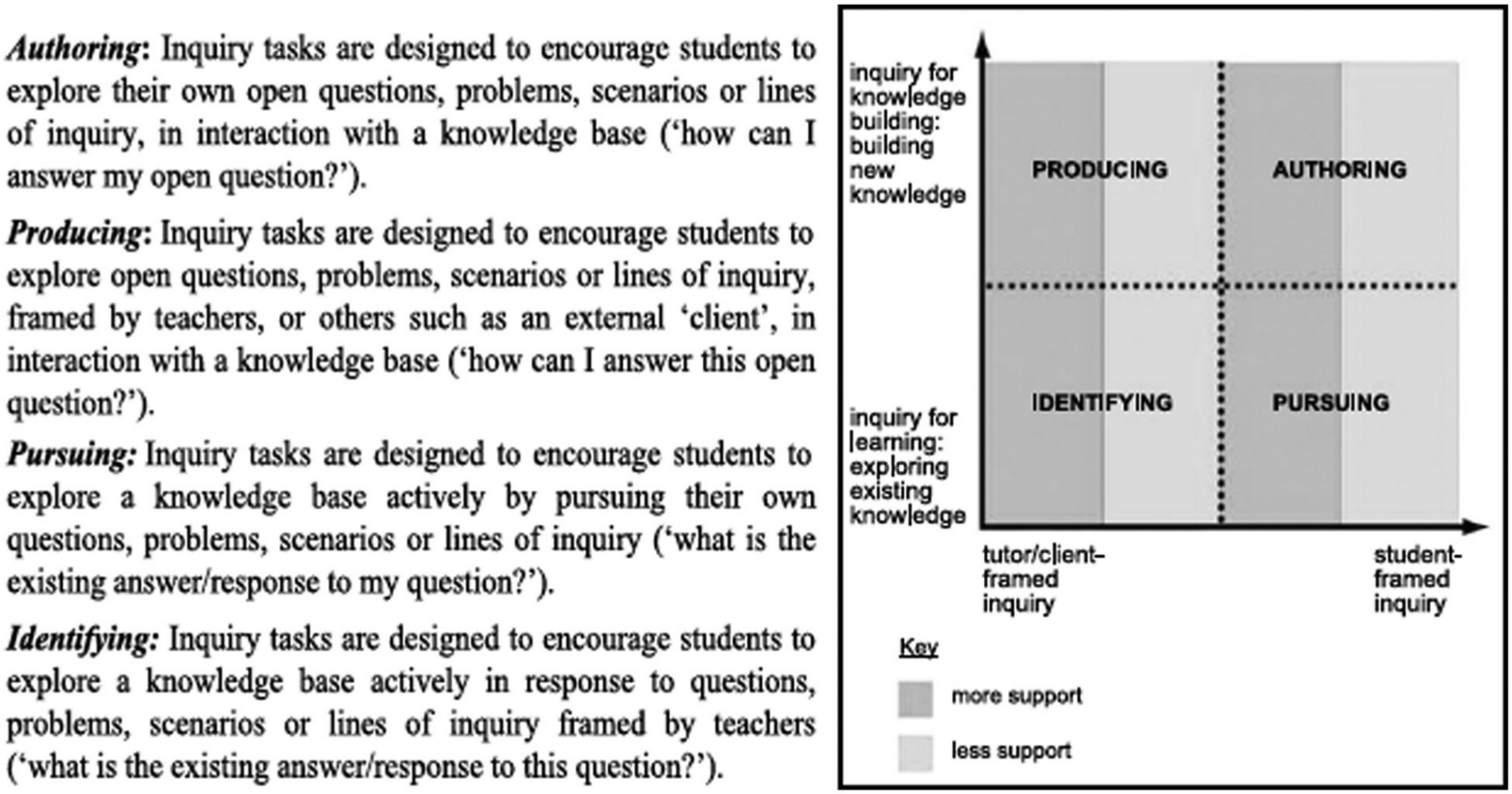
Modes of inquiry-based learning.
Students who participated in this research reported extensive engagement with information resources as part of their information-gathering activities for inquiry-learning and some viewed learning as a process of knowledge acquisition through gathering information (Levy and Petrulis, 2012).
An early review of PBL and libraries in the Health Sciences revealed that students undertaking PBL, where the focus of student activities is on independent information gathering and learning, use the library more often than students learning on traditional transmission curricula; opt to use online information services and journals as information sources; present more sophisticated information queries at service points; and demonstrate greater abilities to search for and find information (Rankin, 1996). A further study of the IL capabilities of students learning through PBL found that students were more discerning in their use of information sources and could integrate information they found into the construction of their knowledge (Dodd, 2007). PBL has been used by librarians as a pedagogical ‘hook’ to create opportunities to embed IL development within the curriculum and this has led to extended librarian-faculty collaboration (Fosmire and Macklin, 2002). PBL pedagogy has been used in librarian-led IL classes where students were set problems relating to the use and support of PBL in HE (Pelikan, 2004) and clinical problems have been also been used in search skills training sessions (Snowball, 1997). Walton and Hepworth (2011) in their study of Level 1 learners found that learner-centred, collaborative and PBL environments were effective in IL teaching.
The relationship between inquiry pedagogies and IL has been written about extensively in the context of schools and school librarians. For example Wray (2006) describes modelling information search activities with 6-year-old students engaged in an inquiry-based task. The students engage even at this young age with information-intensive activities such as using indexes to support information searching in printed texts. The American Association of School Librarians (AASL) recommends that young learners have the skills and abilities to engage with inquiry-based learning and highlights the importance of building skills in knowledge creation and critical thinking through the research process (AASL, 2007). There is an important role for the school librarian in fostering a culture of inquiry for learners (Stripling, 2008) and in collaborating with teachers to adopt inquiry-based pedagogies (Diggs, 2009). WebQuests are open-ended learner-centred inquiry activities often employed by school librarians to teach information literacy (MacGregor and Lou, 2006).
Further, in the HE context, Hepworth (2009) describes an IBL module where students chose a topic of investigation related to information science. Students’ learning was scaffolded through the inquiry process with a number of IL-related assignments, for example creating a mind map. A pre- and post-intervention IL diagnostic test was used to encourage reflection on IL and to assess IL development. The average mark achieved by students on this test improved from 50% to 80% over the course of the module. In addition qualitative student feedback revealed a positive response to IBL indicating that they could see the benefit of the IL development for their future university career. A series of IL-related inquiry-based assignments were also used to support an IBL module in the context of biology (Gehring and Eastman, 2008). Qualitative analysis of the work students produced for these assignments revealed that the tasks were successful in building IL (called fluency here), although it was found that the support from a specific tutorial on search techniques was also useful. IBL was used to model the research process in an English course where students conducted archival research, which featured a collaboration between a librarian and an academic (Mazella and Grob, 2011). Students contributed various types of material (annotated bibliographies, answers to specific questions and other assignments) to a course blog. Students were supported with specific librarian-delivered tutorials covering the resources they were expected to use and in addition the librarian had input into the pedagogical planning for the module. The authors report very positive personal outcomes form their collaboration although there is little comment on student perceptions of the inquiry, other than that gained in confidence in using special collections.
Methodological framework
The data for this research were gathered through the use of the (ToC) impact evaluation methodology that was employed at both overall programme level and at individual project level within the CILASS programme. ToC is a theory-based participative evaluation methodology that was originally developed at the Aspen Institute to evaluate complex community change projects. The methodology involves the prediction by stakeholders of the anticipated changes that will take place to achieve participant-defined project goals (Anderson, 2005). ToC methodologies have been used to evaluate educational development projects (e.g. Saunders et al., 2006) and a ToC approach was adopted to evaluate all curriculum development projects at the University of Sheffield from 2005.
Hart et al. (2009) lay out the rationale for using ToC combined with the use of EPO (
The ToC methodology has a number of distinctive features. It is seen to be participatory in that stakeholders negotiate the scope and shape of the evaluation activities for each project, and define the criteria against which the success of the project is judged. It is a flexible methodology that allows for changes and adaptations to projects that can be incorporated into the overall evaluation at any stage, supported by the heavily reflective approach taken by project leaders. ToC encourages a collaborative approach to evaluation by involving many project stakeholders in both the definition of indicators and their evaluation, thus building capacity for organizational learning. In this respect librarians, educational developers, students, IT experts and other professional services colleagues can be involved in the design, implementation and evaluation of curriculum development initiatives.
Hart et al. (2009) note that a challenge for ToC evaluation is to develop meaningful criteria, called ‘performance indicators’ against which to measure the success of the project. Helsby and Saunders (1993) recommended the use of EPO indicators (Enablers, Process, Outcomes) as a way to define where stakeholders wish to go with a project (Outcomes), what must be done to achieve this (Processes) and what support is needed (Enablers). These were incorporated into a process whereby project stakeholders would create a single A3 ‘poster’ for their project comprising five columns (see Figure 2).

Theory of Change Project ‘poster’.
In this way it is hoped that a ‘causal narrative’ (CILASS, 2009) can be developed for each project defining what has to be done and how it should be supported to achieve defined project outcomes.
It was felt that ToC was appropriate for CILASS at overall programme level and at project level as it is inherently inquiry based, fitting with the pedagogical focus of the programme as a whole. In addition ToC has the advantage of providing a standard framework in which to analyse the learning gained across a diversity of individual projects and can facilitate the kind of meta-analysis presented here. The implementation of ToC for CILASS projects followed a standard pattern: Following an agreement to fund a project, the stakeholders would work with a CILASS research associate to define their ToC poster. Each indicator would then be accounted for in an evaluation plan that could incorporate the collection of diverse forms of data, including reflective interviews with stakeholders; quantitative and/or qualitative feedback from students and formal documentation. Data collection and analysis was performed by CILASS research associates, project leaders and student ambassadors. Scholarship relating to project activities was strongly encouraged and evaluation data were often used in the creation of conference papers, journal articles and project case studies (e.g. Cox et al., 2008; Rossiter and Biggs, 2008; Wood, 2009).
Data sampling rationale and collection
A purposive sample of 12 CILASS-funded projects was selected from the total pool of 122 projects to provide the data set for this analysis. These projects were chosen to represent a broad spread of discipline areas and include projects taken forward by the University Library. The projects were selected for the research on the basis of their strong IL flavour, and fall into two broad categories:
those that had a specific focus on developing IL competencies through the mode of IBL;
those that focused on developing IL competencies to support students in their discipline inquiry more widely.
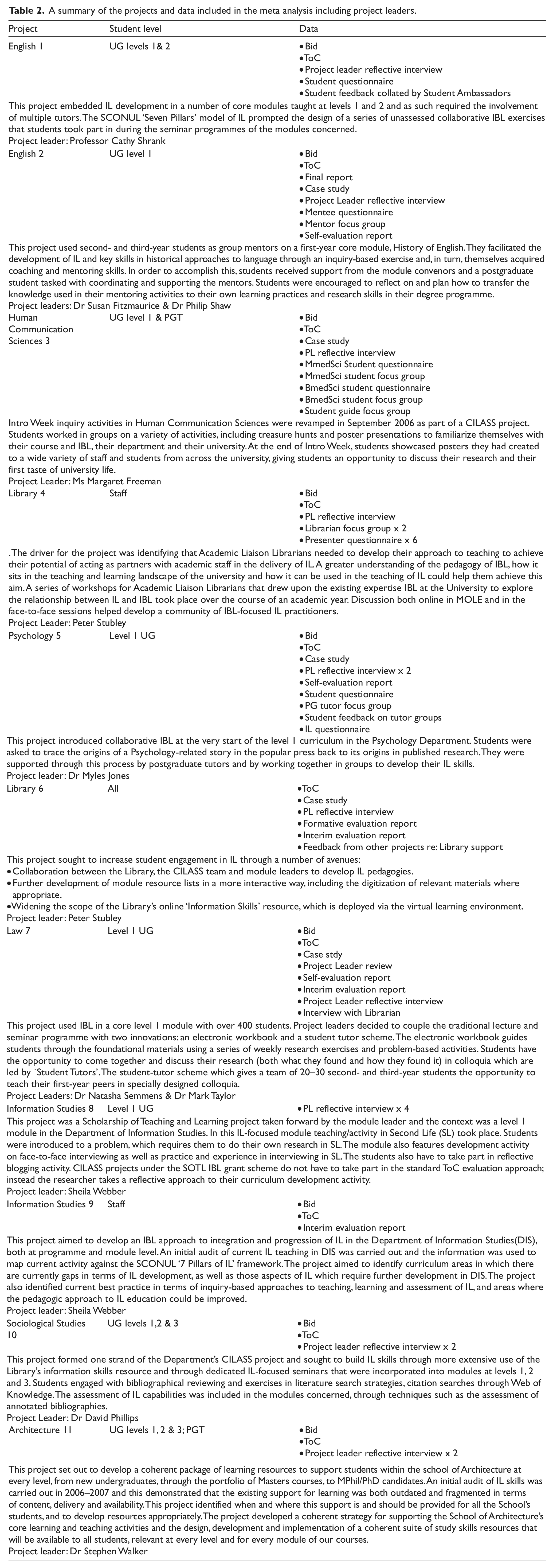
The evaluation plan for each project was unique and was defined by the individual project leader through using the ToC poster as a framework to identify key project indicators. As a result there is a great deal of variety in the data set that accompanies each project. The data set for the analysis comprises all documents created through the implementation of the ToC evaluation methodology for each project. This includes: all official documentation relating to the projects such as funding application forms; interim and final monitoring and evaluation reports; ToC posters; qualitative and quantitative student impact data gathered through focus groups and questionnaires; staff impact data gathered through reflective interviews and focus groups, and the learning development case studies that have been generated by project leaders from this data (e.g. Freeman, 2007). A list of the projects that are included in this analysis and the data collected for each project can be found in Appendix A, Table 2.
Data analysis
A thematic qualitative analysis of the data was facilitated through the use of Atlas-ti software. IL related indicators were identified from ToC posters and other project documentation, and these indicators provided a framework for the analysis of IL Enablers, Processes and Outcomes in project evaluation data. In addition key themes relating to IBL pedagogies and IL were identified emerging from the total pool of data. The results section below is structured using the ToC framework; in each section we first present indicators drawn from ToC posters and subsequently the evaluation data that was collected that relates to the indicators.
Results
Current situation
The ‘current situation’ that prompted each project is described in both initial project funding bid documents and from the relevant column in the ToC posters, and a number of IL-related drivers for projects were identified from these two sources. Project leaders identified both student and departmental development needs relating to IL and IBL, and a number of these drivers were common across discipline and department boundaries, summarized in Table 1.
Summary of IL-related drivers for curriculum development projects.

Project leaders had varying perceptions of the level of searching ability of their students prior to coming to university. Some thought that students lacked even basic search skills while others considered students quite accomplished Internet searchers who simply needed support in weaning themselves off the Internet as the sole source of information and support in transferring search skills to the academic resources. The prominence given to IL-related drivers in these project bid documents and ToC posters is a clear indication of the high level of importance given to IL by these project leaders.
Enabling factors
Three key enabling factors were identified from the data as necessary support IL development in an inquiry context: the use of models of IL; support from learning developers; and support from the Library, and these are detailed below.
Models of information literacy
The SCONUL ‘Seven Pillars’ model of IL (SCONUL, 1999) was used strategically throughout the CILASS programme to facilitate discussion with prospective and actual project leaders regarding the definition of and scope of IL. The model is also used in the University Library and is widely used in the UK HE sector as a framework for IL strategy and the development of library and independent resources to support IL development.
Only one project leader (Psychology 5) used the model explicitly with students and tutors to explain and define IL, and there is evidence from reflective interviews that project leaders found the model useful and relevant in terms of developing conceptions of IL (English 1; Law 7; Psychology 5). Three projects used the Seven Pillars model as a framework for an IL strategy to support inquiry across programmes (Information studies 9; English 1 and Architecture 11).
Support from learning developers
As part of the programme support for IL a dedicated role of ‘Learning Development and Research Associate (LDRA): Information Literacy’, was created, whose purpose was to provide pedagogical support for curriculum development projects in IBL in general and in IL specifically. The remit of the role also included support for summative and formative project and programme evaluation; and taking forward the CILASS research agenda in relation to IL. A further discussion of the LDRA role can be found in McKinney et al. (2009) and Little (2009).
Support from the Library
Support from the Library in terms of the creation or adaptation of VLE-based IL tutorials, creation of other IL support materials; involvement in project planning, and specific student support activities were identified as enabling factors in several projects. The Library’s online Information Skills tutorials, available on the University Virtual Learning Environment: MOLE, aim to provide a self-study route for students for IL development and skill testing. In addition librarians provided other face-to-face and online support for students engaging in IBL.
Processes
The focus here is specifically on activities that were described in the ‘Processes’ column of the Theory of Change’ poster. First a description of inquiry-based pedagogies for IL gathered from ToC project funding application and project case studies is presented (more detailed descriptions of project activities can be found in the Appendix, Table 2). Following that evaluation data that reveals student and staff opinion of these approaches is discussed. This is followed by a more in-depth exploration of peer support, reflective approaches and collaborative inquiry as examples of inquiry-based pedagogical approaches that were used more extensively in these projects.
Inquiry-based activities to build information literacy
The activities that students have engaged in through these projects are varied. For example, students have:
undertaken small experiments and compared their results with published material, requiring them to search for similar experiments in the literature (HCS 3);
searched for information for a particular brief, constructed a bibliography and discussed the validity of the information they found in seminars (Journalism 12);
traced the sources of information from a particular news item (Journalism 12);
found and written a review of a journal article of interest to them (Sociological Studies 10);
searched for a news story in the discipline field that was purportedly based on real research data on a topic that was of interest to them, then found the original research article that the news story was based on. Reflected on search strategies used and compare and contrast the quality of information between the news story and the research article (Psychology 5);
interviewed a ‘client’ (another student) about their information need, performed a literature search and presented the results in a bibliography. Reflected on the task (Information Studies 8);
selected three words from a sonnet being studied and look these up in the OED online. Reflected on whether what they have found out about the meaning and origin of the word has changed their perception or opinion of the sonnet (English 1);
developed research questions from a passage of text and searched for resources that would help them answer their research question. Constructed a bibliography of relevant resources and discussed online and in class (English 1).
Students provided mixed feedback about their IBL learning experiences and how useful it was in developing their IL. Some responses indicated that the inquiry not only built IL capabilities but also significantly advanced discipline knowledge: However, I found the actual task of finding and evaluating corresponding journal articles interesting and helpful to my knowledge and understanding of psychology in a wider sense.(Psychology 5)
Other students felt they had extended their engagement with the literature for their discipline in a positive way, facilitated by the IL skills they had developed: I found the research tasks encouraged me to seek out further texts than those supplied on the reading list by providing me with new formats to searching for texts. (English 1)
Students on the Psychology 5 project, in response to the statement ‘I found this inquiry-based task enjoyable and motivating’ provided a mixed response with 38.9% (n=43) ‘undecided’. The same statement was included on a student questionnaire in the Human Communication Sciences 3 project, where 67% (n=18) of the UG and 58% (n=11) of the PG students agreed or agreed strongly.
Some students expressed dissatisfaction with the inquiry tasks they were assigned but recognized the value of the IL capabilities they had gained: They [the tasks] were tedious but they did provide me with the skills needed for the assessments. (English 1) I didn’t see the point of it, as it did not appear to be benefiting us. as well as this, the assigned task was not stimulating. However, it did enable us to try using WoK [Web of Knowledge], which will be useful throughout the degree. (Psychology 5)
Other students (HCS 3 and Sociological Studies 10) felt that they already had the skills that the IBL activities were designed to build and as such felt the activities lacked value for them.
Some student evaluation data suggests that in some cases, students would have preferred a more transmission style of teaching to build IL: Tasks quite useful, but a sheet/instructions on how to reference would have been more useful. (English 1)
While others expressed the view that IBL, while interesting, should only be employed alongside more transmission styles of teaching: Inquiry-based learning, it can help, but I’d like to say – don’t go too far, don’t move away from actually teaching – it can complement, like, it can help. (English 1)
Evaluation data gathered from project leaders and other staff stakeholders suggest that IBL has been successful in building IL competencies in students. However it was noted that staff need to be explicit about the links between IBL activities to build IL and the rest of the curriculum or students can fail to make the connections themselves. One way to do this is to stress the usefulness of IL in supporting students in approaching assessed work, even that of other modules. For example, one project leader noted that, through the project activities, students seemed to have developed a much better awareness of the function of bibliographies, and that this had led to that cohort of students producing better bibliographies for assessed work in other modules. It is important to be explicit with students about the IL aspects of the IBL they are being asked to engage with. This enables students to develop a conception of what IL is and that then helps them apply it across modules and develop their competencies further. One project leader commented that for her, IBL and IL are intrinsically linked in that good IL is fundamental to the success of IBL.
Peer support
In two projects students from more advanced levels of the same course provided peer mentoring for students engaged in the IBL project. The HCS 3 project used paid ‘student guides’ over the week-long induction week project. Each student guide worked with a small group of mentees to support them in an initial inquiry. The English 2 project used volunteer student mentors to provide guidance to level 1 students over the first few weeks of semester in a particular module. Both guides and mentors supported students in their inquiry by familiarizing them with institutional information resources and the Library. The Law 7 project also featured peer support but in a less structured way. The Law students were encouraged to contribute to group learning through responding to posts on a module-wide discussion forum, and student-led colloquia were used to support students in their learning. While module tutors and the Librarian also contributed to the discussion forum, students were encouraged to engage in a collaborative peer support process.
Student response to the inclusion of peer support in these projects has been largely positive, both from those giving and those receiving the support. Students taking part in a structured mentoring programme (English 2) felt personal fulfilment in that they had been able to ‘give something back’ and could see the benefit of their experience to a potential future career in teaching. They also felt they had enhanced their IL capabilities through the teaching process: If you are teaching somebody else, you are improving your own skills for your own benefit.
Students acting as guides in the Human Communication Sciences 3 project also reported feeling that they had gained facilitation skills. They felt they had refreshed their own IL- and IBL-related capabilities through having to familiarize themselves with resources prior to the activities starting. The way in which the student guides in this project facilitated the inquiry of the new students was seen to be very positive: They didn’t really tell us what to do, we sort of came up with our own ideas and they helped us put them together.
The guides were also praised for their approachable nature, and students reported feeling much more comfortable soliciting support from other students rather than from staff members.
Students who received peer support found it valuable to be able to draw on the personal experiences of students who were studying the same discipline but at a more advanced level. They benefited from being able to discuss approaches to inquiry within the discipline, including although not limited to sourcing and processing discipline-specific information.
So rather than just giving us information, she was helping us with the way we would do it later on in the course. (Human Communication Sciences 3) It helped to have a different perspective from someone more experienced on many issues of which we as a group enquired about. (English 2)
The Law 7 MOLE discussion boards were broadly praised by students for the peer, librarian and tutor support available. Students liked the ‘rapid response’ nature of the boards and felt that they gained confidence from seeing that other students were having the same issues with the inquiry tasks as themselves. They found the anonymous nature of one of the boards allowed them to raise questions without fear of looking stupid in front of their peers.
A reflective approach to information literacy development
Several projects asked students to take a reflective approach to the development of IL, and this was seen by project leaders to be an effective way of ensuring that students recognize that they have developed certain IL competencies through engaging in project activities. Students on the Psychology 5 project were asked to reflect on the search strategies they had used to find news and academic journals, and how effective they were at finding relevant information. They also had to reflect on the differences in the quality of information between provided by newspapers and by academic journals. Students on the Law 7 project had to complete a reflective learning diary as part of the project activities, and students on the Sociological Studies 10 project had an additional reflective seminar where they were invited to speak about their experience of bibliographic inquiry. Students on the Information Studies 8 project complete an assessed reflective portfolio about their learning on the module using the SCONUL ‘Seven Pillars’ model as a framework for information literacy development.
Unfortunately very little student evaluation data was collected relating to these reflective approaches; however, reflective evaluation from the module leader on the Psychology 5 project indicates that those students who engaged more deeply with the reflective process produced work of a higher standard.
Collaborative inquiry
Four of the projects included in this analysis involved students in collaborative inquiry: Psychology 5, English 1, English 2 and the HCS 3. Generally group size has been 3–5 students and in all projects students were placed in working groups by members of staff.
Students from the Human Communication Sciences 3 project found the opportunity to meet their course colleagues and engage with them valuable, particularly from a ‘social’ point of view. Collaborative working helped students spread the workload of the inquiry and made assessment seem less daunting. Responses to questionnaires used to gauge students’ opinion of group work show a mixed response. Of the students on the Psychology 5 project 48.8% (n=55) agreed with the statement ‘I enjoyed working collaboratively face-to-face’ but 25.7% (n=29) were ‘undecided’. However, 77% (n=87) of students agreed, or agreed strongly that they would feel confident in doing group work in the future. Similar questions were asked of students on the Human Communication Sciences 3 project where responses were more positive with 85% (n = 23) of the undergraduate and 48% (n= 9) of the postgraduate students agreeing with the statement: ‘My experience of inquiry-based learning has made me enthusiastic about working collaboratively with others’.
The negative feedback about collaborative inquiry was tempered by acknowledgement that the tasks themselves were useful, but the logistics of organizing group meetings and ensuring equal contributions from group members led to a poor opinion of collaborative inquiry. One student expressed a view that they felt held back by less able group members: It meant I was unable to ‘get on’ and finish because I had to keep e-mailing my group members to get their work and ideas too. (Psychology 5)
Other negative views of group work seem to stem from a perception that working collaboratively did not enhance understanding of the subject or facilitate skills development.
Outcomes and impact
In this section the outcomes and impact identified as aims in Project Theories of Change are discussed before a closer examination of whether student and staff evaluation data reveals if these have been met.
Project Theories of Change defined various IL-themed outcomes related to students, most commonly related to the development of personal IL capabilities. In some cases particular attributes of IL were highlighted as expected outcomes, for example the ability to critically evaluate information and synthesize information. Developing abilities to effectively use library resources was also a key outcome. Information literacy was explicitly linked to inquiry-based learning in project outcomes, both as a ‘skill’ for inquiry and also in terms of students developing into confident and autonomous learners.
Evaluation data revealed the development of personal IL capabilities and recognition by students of the value of IL.
Development of information literacy capabilities
Staff reported a better standard of referencing in assessed work and greater range of sources referenced was observed in students (English 1). There was evidence that students seemed more comfortable in using a wider range of sources than previously (English 2). The ability to go beyond material provided in reading lists gave an indication of enhanced IL abilities (Psychology 5). The high quality of work that demonstrated significant reflection on search strategies and evaluation of information from different sources was also observed (Psychology 5). However there was acknowledgement from staff that it is not always possible to attribute an improvement in IL competencies solely to the activities that students undertake in just one module.
Students on the Psychology 5 project felt they had learnt how to use a specific database, the Web of Knowledge (71.7% agreed or agreed strongly (n= 81)), but were less confident in their abilities to evaluate the information they found (58.4% (n=66) agree or agree strongly, 29.2% (n=33) undecided). Students on the Human Communication Sciences 3 project were asked to say to what extent they thought the activities had developed their IL skills, and the most popular answer was ‘some’ from both UGs (52%, n=14) and PGs (42% n=8). An IL competency questionnaire used in the Psychology 5 project pre- and post the inquiry exercise revealed some demonstrable improvement in IL abilities, these are reported in more depth by McKinney et al. (2011).
Students reported feeling that they had developed their search skills and strategies for both library and Internet resources, and that these were useful skills to have for future academic work: Learning how to use e-journals and Google scholar as it will help with future essays. (Journalism 12)
However, there is some evidence that some students did not feel they developed their IL through the projects. For example, some of the Masters students on the Human Communication Sciences 3 project felt they did not extend their IL capabilities beyond what they had learnt in their undergraduate degree. Other students felt they had not learnt to reference correctly and lacked confidence that they could select appropriate resources (English 1).
Students recognize the value of information literacy
It is apparent from evaluation data that students could see the value in developing a knowledge of resources for university study, for example: Very helpful, enabled me to get used to researching and using online resources. (English 1) Finding out how to access database for more journals. (Journalism 12)
Students could see that IL skills were extendable and valuable beyond the academic environment: I learnt how to refine searches not only for my course, but for everyday life. (Journalism 12)
There was acknowledgement that academic work in general was improved by greater IL capabilities: I intentionally went beyond JSTOR to improve the quality of my essay. (English 1)
There is evidence from students that they can see the value of the IL capabilities they have gained and how they will be useful in their academic life: OED task was useful, esp. for future. (English 1) I felt that the electronic workbook and learning diary did take up a lot of my time however it was, with retrospect, very useful in the skills that it helped me to develop. (Law 7)
Data from students also suggests that they are able to see the value of the IL capabilities they have gained such as ability to use the library resources effectively on one module being directly transferrable to other future modules. Students taking part in the activities in the Psychology 5 project linked the skills they had gained with being able to do research in the future, suggesting that they have been made aware of the research component of their degrees and have positively linked the information search and evaluation skills they have developed with the research process.
However, there is limited evidence from these projects that students could see the long-term benefits of being information literate beyond their university careers.
Discussion and recommendations
Here the main learning points from the analysis as a whole are summarized and recommendations are offered for the development of inquiry-based approaches to IL development and IL development to support inquiry more widely. The value of the ToC impact evaluation framework is also discussed.
Models of IL, and in particular the Seven Pillars model are used widely to inform curricula for IL (Cochrane, 2006; Head and Jackson, 2011; Secker and Coonan, 2011); and the model has been used to inform IL and library strategies within HE and FE institutions (Gallacher, 2009). The model also can serve as an effective means of introducing academic staff to the concept of IL, which is often not widely understood outside the library community (Gallacher, 2009), although research has shown that academics value the competencies labelled as IL (Weetman, 2005). The original Seven Pillars model that was employed in these projects has been criticized for being too linear, for creating a false dichotomy between IT and information skills and between lower- and higher-order IL (Andretta, 2005); however, these concerns have been addressed in the updated version of the model. If models of IL are shared also with students it can enhance the academic status of IL (Johnston and Webber, 2003) and introduce students to the broad scope of IL. This research has demonstrated that through the use of IL models, educational developers and librarians can develop a shared vocabulary for IL with academic colleagues who can in turn use the model to develop a shared vocabulary of skills development with students. Students benefit from having a label to pin to their burgeoning capabilities and this can be facilitated through a reflective process structured around responding to an IL model.
Discipline-sensitive approaches
Research has shown that conceptions of pedagogy for IL are discipline dependent, based in part on the disciplinary differences in information environment, resources and research practices (Boon et al., 2007; Webber et al., 2005;). Research has also shown that inquiry-based pedagogies are discipline dependent and reflect differences in knowledge-structures and epistemologies (Healey, 2005; Wood and Levy, 2008). It is not surprising therefore that a variety of approaches to inquiry-learning and IL development have been demonstrated by the projects in this research. It is important therefore when designing inquiries for IL development or supporting the development of IL in inquiry-based curricula to be sensitive towards these disciplinary differences, particularly from the perspective of Professional Services colleagues such as Librarians who might work across a number of disciplines. It has been suggested also that an interdisciplinary librarian can construct a ‘powerful pedagogical partnership’ with discipline specialists with each contributing differing expertise to enhance student learning (Holschuh Simmons, 2005: 299). However, we can also see from similarities in activities undertaken through projects that activities can be re-purposed relatively easily for new discipline contexts.
Peer support
A distinctive approach that can be drawn from these projects is that of the perceived success of peer mentoring to support IL development in the inquiry context. All students, perhaps without realizing it, significantly develop their IL competencies during their studies at university, and are well placed to share this knowledge through a mentoring process. Previous research has shown that students like to use other students as a resource to support their information search activities (Verity et al., 2007). New students can find other students more approachable than staff (Bolton et al., 2009), and find that their peers have targeted knowledge that can be of benefit to them. It is acknowledged that peer tutoring provides learning opportunities for both tutees and tutors and can develop tutors’ IL capabilities (Deese-Roberts and Keating, 2000; Holliday and Nordgren, 2005; Topping, 1996), and this is supported by the findings from this research which indicate that mentors further developed their IL and developed other transferable skills through the mentoring process.
Collaborative inquiry and information literacy
Collaborative inquiry is much favoured as a suitable pedagogy for IBL (Spronken-Smith, 2009), drawing on socio-cultural theories of education. Vygotskian theories privilege the role of social interaction as a means of transforming experiences into learning (John-Steiner and Mahn, 1996). However, the evaluation data from these projects, and in other research into inquiry at the University of Sheffield (Levy and Petrulis, 2012), reveal that collaborative inquiry can cause logistical and support issues for students and some students struggle to see the value of collaborative projects, particularly where groups are dysfunctional. Students can find it difficult to adapt to collaborative inquiry if they lack experience of group work and their prior experiences of learning environments in schools and colleges were more individualized and competitive (Asgari and Dall’Alba, 2011; MacDonald, 2005). Students are more comfortable with familiar modes of learning, meaning that the role of the tutor in supporting and facilitating inquiry is much greater than in transmission curricula (Deignan, 2009). This research has shown the value of support for (collaborative) inquiry from both academics and librarians in, for example, discussion boards and one-to-one advice sessions. Indeed, it is recommended in other studies on group work that students need support with developing skills and techniques for team working in order to be successful at it (Livingstone and Lynch, 2000).
Reflection, inquiry and information literacy
When IBL is open ended and students are expected to shape their own inquiry they benefit from structured feedback and support mechanisms. This does not necessarily have to take place in the context of assessment, and in fact evidence from these projects suggests that reflective discussion with peers, guided by tutors can be a good alternative to feedback via assessment. Opportunities to reflect can support further self-directed learning (MacDonald, 2005) and reflection is seen to be a key aspect of the research process than students engage in with IBL (Hutchings, 2007). Knowledge-sharing activities in relation to IL seem to be a suitable strategy for building IL competencies.
Student feedback suggests that inquiry-based tasks that build IL are sometimes perceived to be ‘jumping through hoops’, but with the acknowledgement that the competencies they have gained are useful. The design and timing of Inquiry-based interventions to build IL then seems to be a critical aspect of the students’ perception of the task at the point at which they undertake it. However, where student feedback was gathered more longitudinally or well after the IL intervention, then students’ perception of the usefulness of the IL competencies they had developed increased. The challenge for educational development then is to ensure that inquiries that build IL are meaningful and embedded in the curriculum in such a way as to facilitate the process of recognition of the value of IL. Reflective activities and discussion (as mentioned above) seemed to play a key role in facilitating student realization about the value of IL. Research has shown that reflective writing can help educators track IL development (Nutefall, 2005) and it is thought that reflective writing can be beneficial in helping students develop metacognitive skills and develop personal strategies for enhancing and monitoring their thinking and feelings (Branch 2003).
Theory of Change as an impact evaluation framework
Using the ToC framework as a means for organizing this paper has revealed that despite efforts to the contrary, not all projects achieved a clear narrative across the five columns of the ToC. This, combined with other more instrumental reasons based on time poverty and differing levels of engagement, has led to a situation where evaluation data is not sufficient to address all enabling factors, processes and outcomes.
The ToC approach to impact evaluation has made explicit the positive outcomes from IL-focused educational development and helped signpost areas for improvement. If librarians or educational developers with specific expertise in IL are present at the initial stages of the evaluation process, i.e. defining the ToC, this can help embed IL more deeply in the project activities, foreground pedagogical approaches to developing IL and embed the support for IBL in terms of supporting students in building their IL.
Conclusion
In this paper the relationship between IBL and IL has been explored, with the caveat that this has been within the limits of this small selection of curriculum development projects. The findings have demonstrated that there is a need to consider IL development in the context of design for IBL, and that inquiry pedagogies can be used to teach IL. The role of librarians and IL experts in the curriculum development process has also been considered.
Models of IL, despite some limitations, are an effective means of introducing staff and students to IL and help to legitimize IL as an academic and research-based concept. Librarians and IL educators should have an input into curriculum design for IBL so that IL development to support student inquiry can be embedded in learning design. The evaluation also demonstrates that librarians can play a significant role in supporting students with their inquiries. As a general point it has been identified that students need support and expert facilitation from both academics and librarians in order to discover their own path through the inquiry.
When considering where IL development should take place, the findings show that Inquiry-based pedagogies to develop IL need to be embedded in the subject context in order to be meaningful to students, so that they can be situated alongside subject-based learning and skills and knowledge developed in tandem.
Tutors need to make explicit to students that IL development is a focus of a particular activity and discuss the concept of IL with them. It is furthermore important to explain the links between IBL activities to build IL and the rest of the curriculum or students can fail to make the connections themselves. The research has shown that peer mentoring is a successful means of supporting the development of IL in the IBL context, and that this has benefits for both mentees and mentors. The experience of these projects has shown that peer support and mentoring can be developed in a variety of ways.
Further research to investigate the relationship between IBL and IL in different institutional and subject contexts would be very welcome to determine if the features identified in this research are generalizable to wider contexts.
Footnotes
Appendix A
A summary of the projects and data included in the meta analysis including project leaders.
| Project | Student level | Data |
|---|---|---|
| English 1 | UG levels 1& 2 | • Bid • ToC • Project leader reflective interview • Student questionnaire • Student feedback collated by Student Ambassadors |
| This project embedded IL development in a number of core modules taught at levels 1 and 2 and as such required the involvement of multiple tutors. The SCONUL ‘Seven Pillars’ model of IL prompted the design of a series of unassessed collaborative IBL exercises that students took part in during the seminar programmes of the modules concerned. Project leader: Professor Cathy Shrank |
||
| English 2 | UG level 1 | • Bid • ToC • Final report • Case study • Project Leader reflective interview • Mentee questionnaire • Mentor focus group • Self-evaluation report |
| This project used second- and third-year students as group mentors on a first-year core module, History of English. They facilitated the development of IL and key skills in historical approaches to language through an inquiry-based exercise and, in turn, themselves acquired coaching and mentoring skills. In order to accomplish this, students received support from the module convenors and a postgraduate student tasked with coordinating and supporting the mentors. Students were encouraged to reflect on and plan how to transfer the knowledge used in their mentoring activities to their own learning practices and research skills in their degree programme. Project leaders: Dr Susan Fitzmaurice & Dr Philip Shaw |
||
| Human Communication Sciences 3 | UG level 1 & PGT | • Bid • ToC • Case study • PL reflective interview • MmedSci Student questionnaire • MmedSci student focus group • BmedSci student questionnaire • BmedSci student focus group • Student guide focus group |
| Intro Week inquiry activities in Human Communication Sciences were revamped in September 2006 as part of a CILASS project. Students worked in groups on a variety of activities, including treasure hunts and poster presentations to familiarize themselves with their course and IBL, their department and their university. At the end of Intro Week, students showcased posters they had created to a wide variety of staff and students from across the university, giving students an opportunity to discuss their research and their first taste of university life. Project Leader: Ms Margaret Freeman |
||
| Library 4 | Staff | • Bid • ToC • PL reflective interview • Librarian focus group x 2 • Presenter questionnaire x 6 |
| . The driver for the project was identifying that Academic Liaison Librarians needed to develop their approach to teaching to achieve their potential of acting as partners with academic staff in the delivery of IL. A greater understanding of the pedagogy of IBL, how it sits in the teaching and learning landscape of the university and how it can be used in the teaching of IL could help them achieve this aim. A series of workshops for Academic Liaison Librarians that drew upon the existing expertise IBL at the University to explore the relationship between IL and IBL took place over the course of an academic year. Discussion both online in MOLE and in the face-to-face sessions helped develop a community of IBL-focused IL practitioners. Project Leader: Peter Stubley |
||
| Psychology 5 | Level 1 UG | • Bid • ToC • Case study • PL reflective interview x 2 • Self-evaluation report • Student questionnaire • PG tutor focus group • Student feedback on tutor groups • IL questionnaire |
| This project introduced collaborative IBL at the very start of the level 1 curriculum in the Psychology Department. Students were asked to trace the origins of a Psychology-related story in the popular press back to its origins in published research. They were supported through this process by postgraduate tutors and by working together in groups to develop their IL skills. Project leader: Dr Myles Jones |
||
| Library 6 | All | • ToC • Case study • PL reflective interview • Formative evaluation report • Interim evaluation report • Feedback from other projects re: Library support |
| This project sought to increase student engagement in IL through a number of avenues: • Collaboration between the Library, the CILASS team and module leaders to develop IL pedagogies. • Further development of module resource lists in a more interactive way, including the digitization of relevant materials where appropriate. • Widening the scope of the Library’s online ‘Information Skills’ resource, which is deployed via the virtual learning environment. Project leader: Peter Stubley |
||
| Law 7 | Level 1 UG | • Bid • ToC • Case stdy • Project Leader review • Self-evaluation report • Interim evaluation report • Project Leader reflective interview • Interview with Librarian |
| This project used IBL in a core level 1 module with over 400 students. Project leaders decided to couple the traditional lecture and seminar programme with two innovations: an electronic workbook and a student tutor scheme. The electronic workbook guides students through the foundational materials using a series of weekly research exercises and problem-based activities. Students have the opportunity to come together and discuss their research (both what they found and how they found it) in colloquia which are led by ‘Student Tutors’. The student-tutor scheme which gives a team of 20–30 second- and third-year students the opportunity to teach their first-year peers in specially designed colloquia. Project Leaders: Dr Natasha Semmens & Dr Mark Taylor |
||
| Information Studies 8 | Level 1 UG | • PL reflective interview x 4 |
| This project was a Scholarship of Teaching and Learning project taken forward by the module leader and the context was a level 1 module in the Department of Information Studies. In this IL-focused module teaching/activity in Second Life (SL) took place. Students were introduced to a problem, which requires them to do their own research in SL. The module also features development activity on face-to-face interviewing as well as practice and experience in interviewing in SL. The students also have to take part in reflective blogging activity. CILASS projects under the SOTL IBL grant scheme do not have to take part in the standard ToC evaluation approach; instead the researcher takes a reflective approach to their curriculum development activity. Project leader: Sheila Webber |
||
| Information Studies 9 | Staff | • Bid • ToC • Interim evaluation report |
| This project aimed to develop an IBL approach to integration and progression of IL in the Department of Information Studies(DIS), both at programme and module level. An initial audit of current IL teaching in DIS was carried out and the information was used to map current activity against the SCONUL ‘7 Pillars of IL’ framework. The project aimed to identify curriculum areas in which there are currently gaps in terms of IL development, as well as those aspects of IL which require further development in DIS. The project also identified current best practice in terms of inquiry-based approaches to teaching, learning and assessment of IL, and areas where the pedagogic approach to IL education could be improved. Project leader: Sheila Webber |
||
| Sociological Studies 10 | UG levels 1,2 & 3 | • Bid • ToC • Project leader reflective interview x 2 |
| This project formed one strand of the Department’s CILASS project and sought to build IL skills through more extensive use of the Library’s information skills resource and through dedicated IL-focused seminars that were incorporated into modules at levels 1, 2 and 3. Students engaged with bibliographical reviewing and exercises in literature search strategies, citation searches through Web of Knowledge. The assessment of IL capabilities was included in the modules concerned, through techniques such as the assessment of annotated bibliographies. Project Leader: Dr David Phillips |
||
| Architecture 11 | UG levels 1, 2 & 3; PGT | • Bid • ToC • Project leader reflective interview x 2 |
| This project set out to develop a coherent package of learning resources to support students within the school of Architecture at every level, from new undergraduates, through the portfolio of Masters courses, to MPhil/PhD candidates. An initial audit of IL skills was carried out in 2006–2007 and this demonstrated that the existing support for learning was both outdated and fragmented in terms of content, delivery and availability. This project identified when and where this support is and should be provided for all the School’s students, and to develop resources appropriately. The project developed a coherent strategy for supporting the School of Architecture’s core learning and teaching activities and the design, development and implementation of a coherent suite of study skills resources that will be available to all students, relevant at every level and for every module of our courses. Project leader: Dr Stephen Walker |
||
Acknowledgements
The author would like to acknowledge the contribution made by all the CILASS project leaders (Professor Cathy Shrank, Dr Susan Fitzmaurice, Dr Philip Shaw, Ms Margaret Freeman, Mr Peter Stubley, Dr Myles Jones, Dr Natasha Semmens, Dr Mark Taylor, Ms Sheila Webber, Dr David Phillips, Dr Stephen Walker) who designed and delivered the inquiry-based learning curriculum development projects described in this paper and kindly agreed for their data to be included in this meta-analysis study.
Funding
This research received no specific grant from any funding agency in the public, commercial, or not-for-profit sectors.