



Abstract
The purpose of this study is two-fold: first, to examine the historical development of prison libraries in Turkey in the context of relevant legislation; and second, to determine the current state of prison library services in Turkey on the basis of the results of a survey which was conducted throughout the country between January and April 2011. There are regulations, without the force of law, which provide for the establishment, management, and control of libraries in correctional facilities and there is a uniform organizational structure countrywide. However, the 2011 survey showed that, in practice, prison libraries are unsuccessful in providing a professional service.
Introduction
It is important to create an atmosphere inside correctional institutions that is similar to that outside the institutions in order for the facility to provide ‘normalization’ in pursuit of its aim of reintegrating inmates into society through rehabilitation. Provision of communication with the inmate and his/her family, as well as allowing access to information sources, including mass media, prepares the inmate for life outside. Clearly, this process will help the inmate’s rehabilitation as the process of normalization seeks to overcome habits that are produced by prison culture and to protect the inmate from other negative impacts (Easton, 2011: 141). An important tool in this process of normalization and rehabilitation is the prison library.
There is no consensus as to what constitutes a prison library. Its definition is hidden in the process of its historical development, the exploration of which helps us understand how and why a correctional facility appears. The process of the development of prisons and correctional facilities and prison libraries runs in parallel with the value given to the individual in the society, the contemporary understanding of penology, and the historical improvement of the public library service. In fact, library services offered to inmates or members of the public take shape within the framework of the same economic and social forces (Vogel, 1995: 1). A prison library organizes its services and resources in order to meet inmates’ needs for information, recreation, education, and leisure time. In this way, the prison library provides a positive contribution to the process of normalization as the inmate obtains the right of using a prison library as if using a public library. If the inmate has never been to a library, he/she will be prepared for such a visit after release. It is the experience of almost every country that most of its inmates have very low levels of education, training, and skills and have rarely used a library in their daily lives. Therefore, the time individuals spend in an institution as a result of their sentence can be converted into an opportunity for rehabilitation through educational and training programs, and libraries are important pillars in such programs (Kennedy, 2008: 172).
This article’s main aim is to determine the current state of the prison library service in Turkey by examining the results of a survey that was conducted throughout the country between January and April 2011. In addition, it briefly examines the historical improvement of prison libraries in Turkey in the context of relevant legislation. As a study of prison libraries in Turkey has never been conducted, this is a descriptive survey. Conducting comparative studies within the domain of Turkey and its prisons will broaden our knowledge of the prison library service and provide more effective services to inmates.
For the purposes of this article, the term ‘prison library’ is used to refer to libraries in all types of correctional facility, whether they be classified as F-type, which are maximum-security; E-type and special type, which are medium-security; open prisons and juvenile reformatories, which are minimum-security; or detention centres.
A brief history of Turkish prison libraries
An understanding and history of correctional facilities in Turkey is to be arrived at by an analysis of two separate periods: the period of the Ottoman Empire (1299–1922) and the period of the Turkish Republic (1923–), which was established as a result of the independence struggle.
From the beginning of the Ottoman Empire to the Tanzimat (meaning ‘organization’) period (1839–1876), the basis of legal provision was generally shaped by Sharia law – a religious code for living, Islamic law (Akbulut, 2003: 167). However, there was also ‘customary law’, which consisted of the rules imposed by the Sultan in fields where Islamic law was not used (Durhan, 1999: 216). Thus, Sharia law and customary law were in force together but in separate fields (Acun, 1999: 161) and both the death penalty and physical penalties were frequently applied up until the 19th century. As Islamic law does not provide for prison sentences, there were no correctional facilities for executing the punishment of loss of liberty. Guilty persons were detained in castle towers, under government buildings, or in mansion log rooms, which were used as the home addresses and offices of the top managers in the city (Kurt, 2006: 52–53).
Naturally, the law and penal system was directly influenced by the radical reform, modernization, and westernization movements, which started in the 18th century and gained momentum in 19th-century Ottoman political life, particularly in the Tanzimat period (Akay, 1998: 33; Şen, 2005: 49–50). Physical punishment methods, which had been used for hundreds of years in accordance with penal laws, were removed as the legal systems of western countries influenced the penal system of the Tanzimat period. Correctional facilities, where the punishment of loss of liberty was executed, were being reformed in Europe at almost the same time (Temel, 2009: 111). Correctional facilities’ management and control was given to the Ministry of the Interior and enforced by city governors (Demirbaş, 2008: 137).
Archival records indicate that there was an increase in reform efforts in correctional facilities in the Ottoman Empire, especially after 1876. Reading and writing were taught to convicts and there were attempts to impart occupational skills that could be used in employment after release (Şen, 2005: 100–101). However, there is no evidence of libraries in these facilities, despite ongoing activities based around education, professional skills, reading, and writing, etc. until the beginning of the 20th century (Adak, 2006: 50). The earliest source about the existence of prison libraries in the Ottoman Empire is an archive document dated 1913 (1329 in the Julian calendar). In this archive document it is stated that Ibrahim Efendi, the manager of Istanbul Sultanahmet Prison (Hapishane-i Umumi), was rewarded for his establishment of a regular and well-functioning library and that this library set an example for correctional facilities in that period (Başbakanlık Osmanlı Arşivi/Prime Ministry Ottoman Archive, 1913; Demir, 2011; Öner, 2003: 5). In the Ottoman period, as overcrowding in inadequate buildings brought about basic problems in terms of health and security (Tekin and Özkes, 2008: 187), it can be assumed that the issue of libraries was not high on the agenda.
During the period of the Turkish Republic, it was determined that a basic goal was that the law should be weaned from the religious to the secular sphere. A civil code was promulgated on 17 February 1926, based on the civil code of Switzerland, and correctional facilities were connected to the Ministry of Justice (in 1929) by radical changes in the enforcement regime via the Turkish criminal code, which came into force in 1926. The Ministry of Justice regarded the requirement for convicts to work as the major basic tool for rehabilitation and it created regulations regarding this topic. The Ministry also started dealing more closely with the problems of correctional facilities (Demirbaş, 2008: 143; Kurt, 2006: 5; Turan, 1989: 457).
The oldest piece of legislation that supported the provision of a library service in correctional facilities in the period of the Republic is the Regulation about Management of Correctional Facilities and Detention Houses and Execution of Sentences (Ministry of Justice, 1967). In Articles 189 and 193 of this regulation, which was amended in 1983, 1987, 1989, 1994, and 2004, it says that: In all institutions, a library which has books which will provide rehabilitation for inmates and increase their public and professional knowledge, will introduce Ataturk’s reforms and principles, Turkish history, Turkish culture, and Turkish literature, and give love of human, nation and country to them, and provide for the establishment of their spiritual development … The books, journals, and newspapers in this library can be sent by the Ministry of Justice. They can also be provided as a donation by the Public Prosecutor. Published works and publications to be put in the library can also be provided by permission of the management as long as this is not forbidden at trial. If donated books, journals, newspapers, etc. … are examined by the institution manager and have the qualities which are described in the article above, they can be given to the library after a signature is made and approved by the Public Prosecutor … Education staff [teachers] in the institution manage the library. One of the inmates with a higher level of education is to be assigned by the institution’s management to be an assistant in library duties to the teacher … It should be stated in which ways books are given to the inmates and how long they will keep the books and other matters in the internal regulation.
This regulation, which contains no selection criteria and does not name the librarian, was repealed and a new regulation was enacted (Ministry of Justice, 2006). The basic changes in the new regulation were that the librarian was shown as a member of the institution’s staff and the library service was described as a training and educational service. The new regulation described the librarian’s responsibilities and tasks and stipulated that when the librarian was not assigned in the library, teachers should adopt the librarian’s tasks. In addition, it stated that a library or a bookcase (a couple of bookshelves) would be established in correctional facilities according to the size of the institution; there should be resource books for lessons, and books provided to inmates to read in their free time in order for them to acquire the habit of reading and develop their horizons. It was stated that the principles and procedures of using the libraries, bookcases, and mobile public library were to be determined by another regulation. Here, it is worth mentioning that the authors of this paper strongly disagree with nonsensical discrimination between libraries and bookcases and support the adoption of a centralized library under the supervision of professional librarians in all prisons. Because all incarcerated persons have the right of access to library materials.
In modern-day Turkey, the source of basic legislation that is the basis for the management and regulation of prison libraries is the Ministry of Justice’s directive dated 12 July 2005 (Ministry of Justice, 2005a). This replaced the regulation dated 9 November 1983 (Ministry of Justice, 1983). This directive sought to establish the law of 13 December 2004, No. 5275, which was prepared in order to show the procedures and principles for the improvement and training of inmates in correctional facilities, facilitate the implementation of legislation, and resolve problems in its application (Ministry of Justice, 2004).
The principles and procedures related by the dispatch apply to the administration, equipping, functioning, security, and conditions of the use of libraries established in correctional facilities in accordance with the Ministry of Justice’s directive of 2005. According to Article 5 of the second part of this directive, libraries are established in correctional facilities that have senior managers. Senior managers are people who manage the large correctional facilities. They make all decisions that affect the operation of the organization, and are in touch with the General Directorate of Prisons and Detention Houses. Bookcases are established in other facilities in order to provide reading resources for use during inmates’ free time, facilitate and consolidate the realization of training and treatment objectives, and provide the resources that are needed for staff in correctional facilities to pursue their studies of training and treatment (Ministry of Justice, 2005a). The main features of this directive are as follows:
An independent room or a suitable place shall be provided for the library or bookcase; it is to be decorated according to its aim, and security requirements for all the equipment therein are to be subject to troubleshooting by the institution’s management.
Periodicals and books that are needed for the institution’s library and bookcases are to be supplied from appropriation sent by the Ministry to the institution, from publications sent by the Ministry to the institution, from donations made to the correctional facilities’ management, from the Offices of the Prosecutor, or from the inmates’ and detainees’ donations.
The number and the type of periodicals and books purchased, librarians’ and teachers’ selections, and inmates and detainees’ requests are to be determined and approved by the Education Board.
In the libraries and bookcases, there should be books that are resources for lessons in the improvement and training programs, which should increase the inmates’ and detainees’ public and professional knowledge, which should strengthen love of nation and country, which should provide for their spiritual development, which are suitable for Ataturk’s nationalism, reforms and principles, which should permit good use of their free time, which should encourage them to acquire a reading habit, and develop their horizons in terms of culture. Any publication, such as publications forbidden by the trial, or those not forbidden but which may cause security problems, or any publication containing obscene news, writing, photos, or interpretation cannot be accepted. [The authors believe that these expressions are ambiguous and prone to subjective interpretations.]
Books and periodicals can be borrowed from the libraries and bookcases which are connected to other ministries in order to be used. A publication can be borrowed from the mobile libraries according to the conditions of the regulations for a month.
The librarian is responsible for the library. If there is no librarian, one of the teachers is to be responsible for it. If there is no teacher, another member of the correctional personnel should be assigned. Inmates and detainees who show good conduct and have a higher level of education can work in order to help the librarian, with the approval of the Administration and Observation Board.
Inmates and detainees who show good conduct can use the library for reading the publications and conducting research with the approval of the Administration and Observation Board. However, the number of inmates using the library at the same time is to be determined by the Administration and Observation Board in a way that does not endanger the security of the institution. During the inmates’ and detainees’ studies at the library, sufficient numbers of security staff should be present. [It is worth mentioning here that the authors strongly believe that ‘access to library services should be restricted only for documented infringement of library rules. Prisoners with unrestricted movement within the facility should be able to visit the library’ (Lehmann and Locke, 2005: 7).]
Periodicals and books in the library and bookcases are to be lent to the inmates and detainees in order to read in their rooms and wards for 15 days, and this period can be lengthened by the librarian if it is required.
The main source of other legislation that supports prison library services in Turkey is the Ministry of Culture and Tourism. In the regulations for public libraries, which were published in 1982 (Ministry of Culture and Tourism, 1982) and renewed in January 2012 (Ministry of Culture and Tourism, 2012), the Ministry of Culture and Tourism detailed how it would provide administration and control of public libraries . It stated that: ‘services are brought with the approval of the governorship to the places where there are communities such as holiday camps, youth camps, plateaus, spas, hospitals, prisons, hostels, old age asylums, military institutions, etc. in which people are gathered’ and that cooperation between public libraries and prison libraries should be supported.
As understood from the historical development outlined above, the contemporary rule of law was adopted with the newly established Turkish Republic. Prison libraries took their place in correctional facilities as the result of a revised understanding of punishment. During the period of the Republic, despite the critiqued directives in the framework of legislation created by both the Ministry of Justice and the Ministry of Culture and Tourism, it can be seen that establishing libraries in correctional facilities has been supported. Whether this legal support has been reflected in practice and if so, how it has been reflected, is an issue that needs to be determined. In this context, the results of the survey that was conducted throughout Turkey between January and April 2011 reveal the current state of prison libraries in Turkey.
Demographic characteristics of inmates and detainees in Turkey
In Turkey, the Ministry of Justice is responsible for providing services in correctional facilities. It fulfills this task through the General Directorate of Prisons and Detention Houses. As of January 2011, there were 122,404 inmates and detainees in 417 correctional facilities in Turkey. Of this population, 118,067 (96.4%) were men and 4337 (4.6%) were women. When we look at the inmates’ and detainees’ schooling profiles, it can be seen that 62,818 people graduated from primary school (five years) and from primary education (eight years) (51.32%), 35,807 graduated from junior high school/senior high school and vocational school at junior high school level (29.25%), 5177 were illiterate (4.18%), 4169 were literate but did not graduate from school (3.41%), and 3348 were highly educated. There is a category of 11,145 people whose educational status was not known (9.11%) (Ministry of Justice, 2010).
This data shows that 0.16% of the Turkish population was in a correctional facility and at 142 per 100,000 of national population, the imprisonment rate in Turkey was at about the mid-point worldwide (Walmsley, 2011).
Methodology
There are collections of books (consisting of some shelves) that are not considered as libraries in 225 of Turkey’s 417 correctional facilities. Permission from the General Directorate of Prisons and Detention Houses of the Ministry of Justice was obtained to survey only the correctional facilities that have libraries. The final version of the survey, which consisted of 34 closed and open-ended questions, was sent via email to 192 correctional facilities that have libraries between January and April 2011. The questionnaire was directed to the person in charge of the library. One of the authors visited 21 institutions in Istanbul and Bursa in order to undertake observations and interview ‘librarians’ alongside the survey. The analyzed population consisted of 192 libraries (n=192), with 137 replies received. Consequently, the sample of the survey consisted of 137 libraries (n=137). Accordingly, the return rate of the survey was 71.3%. This is a relatively high response rate for a survey of this type. The collected data was coded, tabulated using tables and percentages and analyzed with the support of a statistician using SPSS version 11.5 for Windows. Some questions, mostly regarding technical workflow, are outside the scope of this article. The survey addressed the following topics:
physical access to the library
staffing and training
size of the collection/subject and selection criteria
budget
cooperation with other libraries
staff perceptions of library-related problems.
The current state of prison libraries in Turkey: Results and analysis
Physical access to the library
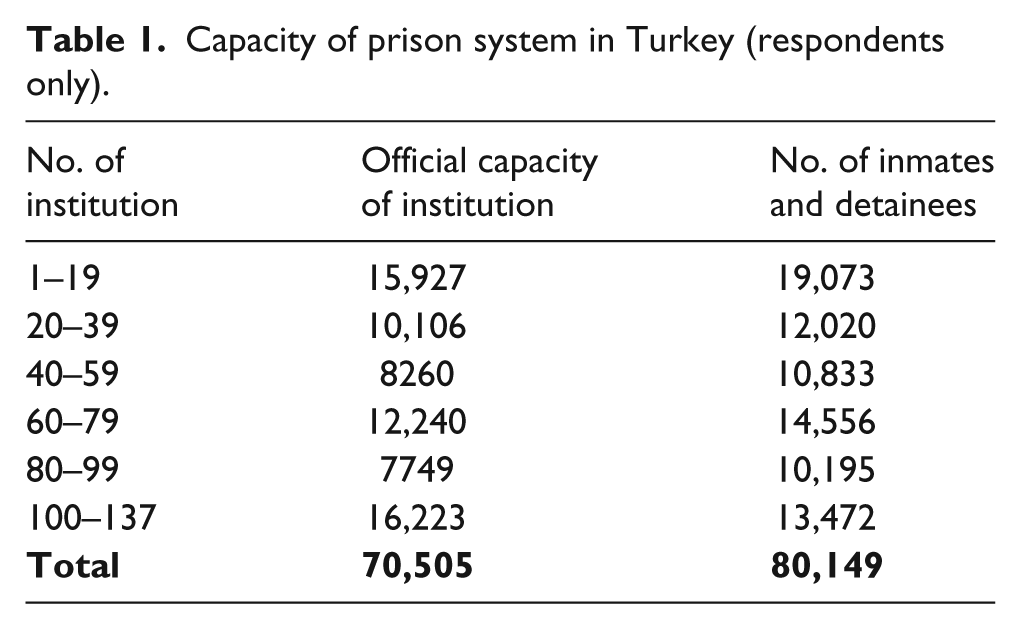
The inmate and detainee capacity of the 137 institutions that responded to the survey was 70,505 persons; the total number of inmates and detainees resident in these institutions was 80,149. Thus, the correctional facilities in Turkey had 114% occupancy rates. As revealed in Table 1, 100 (73%) of 137 institutions hosted inmates and detainees over their capacities.
Capacity of prison system in Turkey (respondents only).
The survey data shows claims of inmates and detainees taking shelter in most correctional facilities in Turkey that overcapacity and the insufficiency of mechanisms that provide security in the libraries mean that inmates are not allowed to physically use prison libraries. As they cannot enter the library, they are permitted to borrow books for up to 15 days by choosing from alphabetical author lists taken to the rooms and wards of the institution. These lists are prepared by education staff. Inmates need to complete a printed form and send it to the library. The number of books an inmate can check out at a time ranges from one to five.
As noted in the second section above, there is a statement in the Ministry of Justice’s (2005a) Directive for Prison Libraries and Bookcases, which says that: Inmates and detainees who show good conduct can use the library by reading the publications and conducting research with the approval of the Administration and Observation Board. However, the number of inmates using the library at the same time is to be determined by the Administration and Observation Board in a way that does not endanger the security of the institution. During the inmates’ and detainees’ studies at the library, sufficient numbers of security staff should be present.
This instruction leaves library usage to the interpretation of the correctional facilities’ administrators. The vast majority of these administrators believe that sufficient security cannot be maintained and, in addition, that physical access to the library can pose a threat to both the institution and the inmate or detainee (for example, the risk of an inmate or detainee meeting his or her enemy). Thus, it can be assumed that this justification underpins the administrators’ reluctance to allow physical use of the library. This was one of the key findings from the 21 interviews and prison visits. One of the authors also contacted the State Department of Justice by telephone to confirm that physical access to the library posed a threat to both the institution and the inmate or detainee, and the official at the State Department of Justice confirmed this.
Moreover, when institutions were asked about the total weekly opening hours of the libraries, the overwhelming majority of respondent institutions stated that the library was open for five days per week, generally during standard working hours (93.4%), while some said that the library was also open at weekends (6.5%). So despite detainees not being allowed to enter the libraries due to security concerns, the fact that respondent libraries were open every day of the working week during working hours reveals that physical use of the library does not in practice go beyond a pretence.
Staff and training
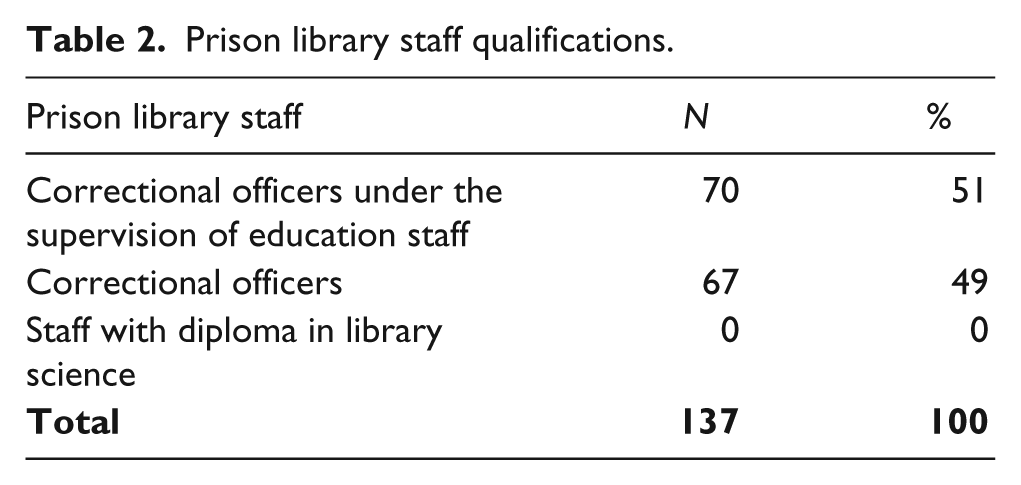
When the respondents were asked who was responsible for managing and controlling the prison library, the responses revealed that no university-educated librarian was employed in their field by prison libraries in Turkey. Currently, no qualified professional librarians are employed by the prison system.
As can be seen in Table 2, in 70 respondent institutions out of 137, the library is the responsibility of correctional officers supervised by the education staff (51%). In the remaining 67 institutions, the responsibility is completely undertaken by correctional officers (49%). In addition, one of the institutions explained that responsibility for the library was shared by a psychologist along with education staff and correctional officers, and another said that it was shared by two inmates.
Prison library staff qualifications.
Leaving library management to correctional officers (who do not have professional qualifications) under the supervision of education staff prevents the improvement of user and technical services. From the interviews conducted in Bursa and Istanbul it emerged that the education staff perceived library responsibilities as a secondary task, which shows the extent of the problem. Moreover, if we consider that most of the respondent institutions (95.6%) answered ‘yes’ to the question, ‘Do you need to train the library staff?’, undertaking to give those responsible for the library on-the-job training about basic library operations and processes emerges as a priority requirement in the short term.
Size of the collection/subject and selection criteria
Prison library collections in Turkey are of modest size and cover a narrow range of subject areas. According to Table 3, there are between 2500 and 4999 books in the libraries of 47.8% of respondents and between 1000 and 2499 books in 30.4% of libraries. The number of books in the remaining 8.6% is a maximum of 999. So, 137 institution libraries’ total number of books is 413,983. If we consider there are 80,149 inmates and detainees, this works out at about five books per person – a level much lower than the IFLA recommendations. The IFLA Guidelines for Library Services to Prisoners (Lehmann and Locke, 2005: 7–9) recommends 10 titles per inmate. It should also be noted that most of these materials are outdated, and in poor physical condition.
Size of book collection in Turkish prison libraries (2009).
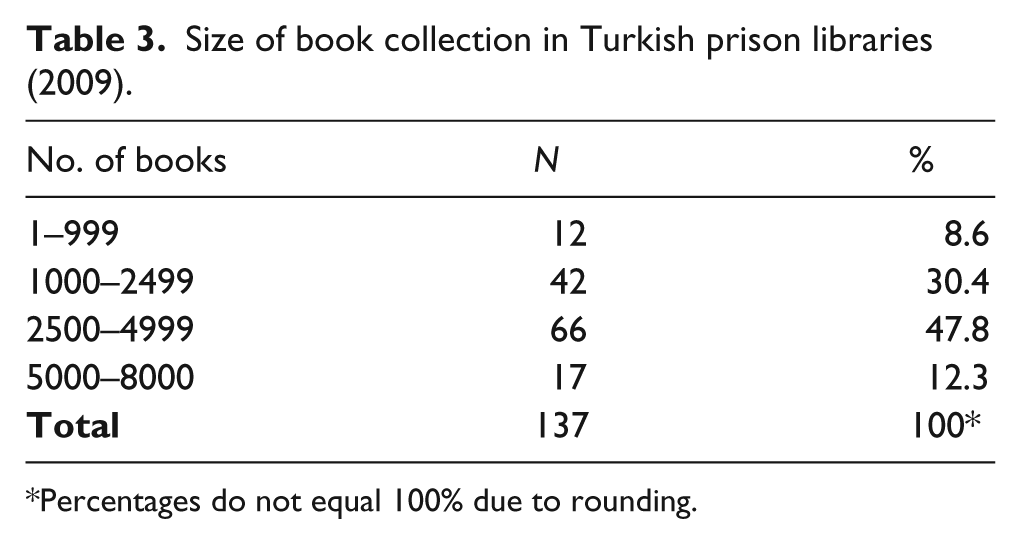
Percentages do not equal 100% due to rounding.
Respondents were asked whether they subscribed to a journal and it emerged that there were no journal subscriptions in any library. There are a few journals in 69% of prison libraries, but there is no journal at all in 31.4% of them. In addition, it should be stated here that there is no non-book material in any of the libraries. If we consider that the vast majority of prison libraries (77.4%) are supplied only by donation, with only a small number of them acquiring resources by means of purchase and exchange, it is not surprising that the type and number of publications is limited. Except from the donations stated in the Ministry of Justice’s directive of 2005, it should be remembered that inmates donate their own reading materials to the library, which they have purchased with their own money or received as gifts from family and friends, when they leave prison. It should also be noted that inmates may purchase book and non-book materials and have personal subscriptions to newspapers. They may also receive these items by mail. All inmate mails are inspected by the staff. The books of private donations of prisoners appear in the book lists that circulate among the prisoners for choosing a title.
When the subject areas of the library collections are examined, most of them generally consist of fiction (88.2%). The most popular subject areas after fiction are religion and metaphysics (9.2%). The lack of material on legal subjects and non-book material constitutes an important gap in provision. The respondent institutions stated that 220,533 books were in circulation in 2009, which means that the number of loaned books per inmate or detainee averages three annually. As inmates and detainees are not allowed to enter the libraries, bringing book lists to units and delivering materials are almost the only functions of these libraries.
In the Ministry of Justice’s (2005a) directive, it is stated that: The number and the type of periodicals and books purchased, librarians’ and teachers’ selections, and inmates’ and detainees’ requests are to be determined and approved by the Education Board. In the libraries and bookcases, there should be books that are resources for lessons in the improvement and training programs, which should increase the inmates’ and the detainees’ public and professional knowledge, which should strengthen love of nation and country, which should provide for their spiritual development, which are suitable for Ataturk’s nationalism, reforms and principles, which should permit good use of their free time, which should encourage them to acquire a reading habit, and develop their horizons in terms of culture. Any publication, such as publications forbidden by the trial, or those not forbidden but which may cause security problems, or any publication containing obscene news, writing, photos, or interpretation cannot be accepted
These statements are no doubt inclusive in terms of evaluating the inmates’ and detainees’ requests regarding the selection of purchased materials, but they are far from being clear and precise in terms of publication selection principles. So, it can be determined that selection is not dependent on professional selection criteria but on a directive which permits subjective factors.
Budget
Building and developing a library collection requires a regular and continuous budget. The survey data shows that prison libraries in Turkey do not have their own material budgets. The following statement, which is derived from Article 7 of the Ministry of Justice’s (2005a) directive, must be remembered here: Periodicals and books that are needed for the institution’s library and bookcases are to be supplied from appropriation sent by the Ministry to the institution, from publications sent by the Ministry to the institution, from donations made to the correctional facility’s management, from the Offices of the Prosecutor, or from the inmates’ and detainees’ donations.
This directive does not predict a separate material budget; instead, the library evaluates its requirements in the general budget and leaves purchasing decisions to the will of the institution. In this context, this instruction is applicable only in cases of donation. Interviews with library staff and the answers given to the survey’s open-ended questions show that library materials are supplied through ‘the Money Escrow Account’ used for the education unit’s spending. Inmates are not allowed to possess money while they are incarcerated. In order to allow inmates to buy things they want, their money is held in their inmate account. Gifts from family and friends are the typical sources for these funds. Inmates may use the money in their account to purchase items through the prison shops. There is also a regulation on the use of this account (Ministry of Justice, 2005b).
Cooperating with other libraries
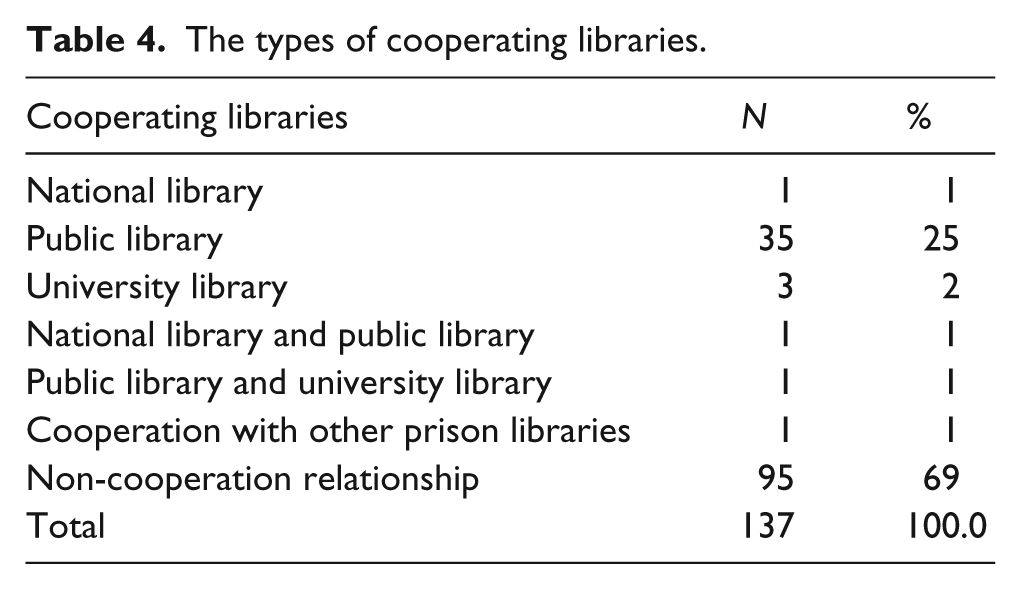
Respondents were asked, ‘Do you have any form of cooperation with other libraries?’ According to Table 4, 42 of the respondent institutions explained that they had cooperation with other libraries (30.7%) while 95 institutions stated that they did not have any cooperation (69.3%). From this, it is clear that the vast majority of the institutions do not collaborate with any other library. In addition, it emerged that not only do they not collaborate with other types of libraries (such as the National Library or a university library) but that, in particular, they do not collaborate with each other. When it was asked in what areas prison libraries had working relationships with other libraries, it was revealed that the most used services were, respectively, lending and donation, followed by consulting services on the topic of catalog-classification − the Dewey Decimal Classification system.
The types of cooperating libraries.
The authors believe that not employing professional librarians in these libraries explains, to a large degree, why there is no cooperation among prison libraries. The National Judiciary Network Project (UYAP) is worth mentioning here. This is an e-justice platform as a part of the e-government, which has been developed in order to ensure a fast, reliable, soundly operated and accurate judicial system. As a central network project it includes all of the courts, public prosecutors services, prisons, other judicial institutions, and other government departments in Turkey. In the system of UYAP there are sub-modules available under the basic modules of prosecution, criminal courts, civil courts, administrative justice, prisons, supervised liberty, forensic medicine, administrative acts, belongings and fixtures, finance and educational procedures (National Judiciary Informatics System, 2012). Online public access catalog is also a product of this system. Having an online public catalog, this e-justice platform is very useful and important, both in terms of the quality of service given in the libraries and for providing a cooperative environment and opportunity for collaboration. However, the OPAC is far from having professional standards; its restructure would contribute to an increasing quality of service and efficiency. Moreover, modern information and communication technology allows not only the installation of all the correctional facilities’ own intranets but the integration of library catalogs into public libraries’ networks. So, the employment of librarians, as well as utilization of these opportunities, must be located in the vision of related institutions’ managers.
According to the data on cooperation given above, prison libraries in Turkey generally do not work in cooperation with any other library. The type of library most commonly collaborated with is the public library. In the Ministry of Culture and Tourism’s regulations (1982, 2012) borrowing a collection with the approval of the governor is stipulated in one of the articles. However, this does not ensure the existence of regular and continuous cooperation, neither is it reflected in practice. This is because the operation of this service is left, to some degree, to the initiative of the public library management. Whether this service is actually delivered by public library management depends on current conditions and resources or the level of their development. Despite the Ministry of Justice’s directive of 2005, which stipulates that books and periodicals can be borrowed from both the libraries and bookcases connected to the other ministries and mobile libraries in the context of related regulations, a continuous institutional cooperation is not seen in practice, except for a few notable examples.
Staff perceptions of library-related problems
Those responsible for prison libraries were asked open-ended questions through which they could express general problems. The most common problems perceived by respondents were the lack of current publications and the non-purchasing of books (45.2%). The other problems identified were the lack of professional librarians (25.5%), use of the library for other purposes such as a class, etc., air-conditioning and heating problems (20%), and lack of knowledge of the Dewey Decimal Classification System plus lack of professional knowledge and education (10.2%). Insufficient and/or outdated donations (6%), lack of budget (5.1%), lack of cooperation with other libraries, and not receiving support from public libraries (2.2%) were less frequently recurring problems. In addition, inmates and detainees showing insufficient interest in the library (2.2%), books being used loutishly by inmates and detainees (0.7%), a lack of periodical subscriptions (0.7%), and not being satisfied with the UYAP system (0.7%) were also stated as problems. The answers given to these questions displayed libraries’ basic problems and repeated concerns given in replies to the survey.
Conclusions
In the process of historical development, an improvement in the level of civilization in a society has been accompanied by an evolution in understanding of criminals, from the notion of gaining revenge to that of rehabilitation. One of the most obvious consequences of this evolution is the emergence of correctional facilities where the punishment of loss of liberty is executed. In modern criminal law, the main purpose of this loss of liberty is not revenge, but cure. One of the most important institutions to help in the rehabilitation of inmates and detainees is, in a sense, the prison library, which is a product of the modernization of understanding of criminals.
Almost at the same time as Europe, physical punishment methods were abolished in the 19th-century Ottoman Empire, and were replaced by correctional facilities where loss of liberty punishments were executed. However, there were no correctional libraries until the beginning of the 20th century. The issue of library provision did not arise in the context of the poor condition of penitentiary buildings in the Ottoman Empire, and the implications for capacity, health, and security. Like many other problems, this was left to the Turkish Republic. A new legal order was adopted by the Turkish Republic and radical changes were made by the regime to the Turkish penal code. Prison libraries took their place in correctional facilities as institutions that were a product of a transformed concept of the criminal and as a tool that would contribute to the process of normalization for inmates and detainees.
In contemporary Turkey, establishing and developing prison libraries is under the authority and responsibility of the Ministry of Justice. The Ministry fulfills this task through the General Directorate of Prisons and Detention Houses. It can be seen that establishing libraries in correctional facilities is supported by both the Ministry of Justice and the legal framework of the legislation enacted by the Ministry of Culture and Tourism in order to contribute to the inmates’ and detainees’ rehabilitation. The prison library service is seen as an extension of the public library service.
Although there is a nonsensical discrimination between libraries and bookcases in the Ministry’s directive of 2005, and the presence of non-professional selection criteria is among the first critiqued stipulations, there is generally legal support and a uniform organizational structure throughout the country that establishes and controls library services in correctional facilities. However, data from the survey shows that prison libraries in Turkey are far from proving to be a professional success in practice. In the organizational structure of the General Directorate of Prisons and Detention Houses, prison libraries are classified as educational institutions. However, the libraries’ deficiencies in terms of personnel, budget, and collections, and problems with user service, mean that the concept of the prison library has remained on paper rather than in serving its purpose as a provider of educational, rehabilitative, and vocational activities.
In Turkey, there are long-established traditions of university-level library education, professional literature, and professional associations, but library law that provides unified management and supervision of all types of libraries has as yet to be enacted. In this context, libraries are not seen as one of the compulsory services of the state and they are mostly left to the vagaries of political will. Of course, the existing problems in prison libraries are not exempt from these broad problems. However, the General Directorate of Prisons and Detention Houses, which classifies prison libraries as educational institutions in its organizational structure, should be able to contribute to the solution of many of these problems in Turkey on a large scale by supporting prison libraries and establishing institutional coordination and association with the public libraries.
Footnotes
Funding
This research received no specific grant from any funding agency in the public, commercial, or not-for-profit sectors.