



Abstract
Cultural heritage institutions increasingly consider Creative Commons licences as a useful model for overcoming the barriers created by traditional copyright frameworks and for opening up archives, databases and collections for public use. However, there is little empirical evidence to support this claim. This article therefore focuses on the use of Creative Commons among cultural heritage institutions in Flanders (the northern part of Belgium) and presents the results of two sector surveys held in 2008 and 2012. Using two data points, the study provides an overview of the evolution of the use of Creative Commons and reveals the copyright policies of cultural heritage institutions.
Introduction
The Internet is often portrayed as a metaphorical reservoir where citizens have unlimited, free access to books, audiovisual productions, photographic reproductions and other creative works. Moreover, it is often assumed that a one-click network makes all knowledge and information freely accessible across the world – at least, this is the widespread perception that many people have and probably the ultimate dream of many information managers in the field (as well as commercial platforms, including Google). In practice, a significant proportion of valuable cultural heritage collections remains excluded from this colossal display. Museums, libraries and other organizations in the cultural heritage field are confronted daily with practical challenges to bringing text, sound and video collections into the digital world and exploiting new-media services based on archives in the cultural heritage domain (see Ongena et al., 2012). Common restrictions may be financial or organizational in nature or may relate to privacy concerns, but all too often, existing copyright and related rights frameworks pose obstacles to the development and implementation of a successful digital information strategy (Evens and Hautekeete, 2011). Indeed, the public availability of cultural heritage requires prior consent from authors, which in turn forms the main barrier to the digitization and long-term preservation of cultural heritage (Navarrete, 2014).
Throughout the entire ‘value chain’ of information management, cultural heritage organizations are faced with challenges and risks relating to intellectual property rights management. Under European copyright law (e.g. the 2001 Copyright Directive), numerous activities in digital information management, such as reproducing original works (copying), migrating to a more recent technological standard or publishing works online, require that these organizations have obtained exclusive intellectual property rights, including copyright, access rights, moral rights and database rights (Anderson, 2013). When works enter the public domain because the terms of copyright protection have expired, digitization and preservation pose few juridical difficulties. The practice of copying copyright-protected cultural works by cultural heritage institutions, however, is illegal under European regulatory frameworks and is not covered by fair use exceptions (e.g. for research and educational purposes). It therefore requires the prior consent of the rights holders who must agree to the proposed access. Since identifying rights holders – needed for explicit permission to publish online – is a time-consuming and expensive process, many information managers opt not to digitize or disclose works (Axhamn and Guibalt, 2011). Therefore, adequate digital rights management, that is, paying attention to administrative metadata tags (e.g. ownership and level of permission to copy), is required to reveal the copyright status of the works (Coyle, 2005; Muir, 2006).
It is not the intention of this article to delve into the legal issues mentioned above; instead, the purpose is to put forward a possible remedy that solves, at least partially, this ‘digital deficit’ within cultural heritage organizations. Following the open source movement, several open content licences, of which Creative Commons is the best-known example, have mushroomed in recent years. These licences enable greater flexibility in the use of copyright-protected works and counter the increased commercial enclosure of knowledge and information in the online domain. Multiple initiatives within the fold of UNESCO (e.g. the Vancouver Declaration) and the European Union (e.g. Europeana) have proposed Creative Commons as a possible solution to ensure the digitization and preservation of cultural heritage. Cultural heritage institutions increasingly consider Creative Commons as a useful way of overcoming the barriers created by traditional copyright frameworks and for opening up archives, databases and collections. However, there is little empirical evidence to support this claim. This article therefore focuses on the use of Creative Commons among cultural heritage institutions in Flanders (the northern part of Belgium) and presents the results of two sector surveys held in 2008 and 2012. In addition to providing an evolutionary overview of the use of Creative Commons licences, the study questions why cultural heritage institutions have decided either to use or reject the licences and how the licences might help information managers in overcoming legal barriers so as to develop long-term preservation and distribution strategies.
Copyright and copyleft licensing
Intellectual property rights play an important role in information management and are predominantly studied from a legal perspective. According to Benkler (2002), the origin of intellectual property rights must, however, be situated within the economic sphere. Copyright regimes prescribe that the creator (or rights holder) of an original work (literary, academic and/or cultural) ultimately decides on the (practical and especially financial) conditions under which this work is published, copied, distributed or adapted. Copyright law stipulates that copyright protection automatically comes with the creation of a work and does not need to be obtained through official registration with any government office. As a result, the copyright holder is entitled to exclusive control in relation to the future use, distribution and reproduction of the work. Copyright proponents claim that such protection is a precondition for the creation of information and knowledge in society as it allows for financial compensation for the further use of the work. One of the central ideas behind copyright is that the assured reward for the author stimulates the creativity from which society ultimately benefits (Doyle, 2013). Hence, copyright is said to guarantee future innovation and creativity through the granting of a monopoly to the author for a limited period of time that allows him/her to earn a living from uses of the work.
However, the daily practice of information management suggests that the effects of copyright on innovation and creativity are at least more nuanced. Copyright grants creators long-lasting monopoly power to control the future use, distribution and reproduction of works. Opponents of copyright claim that instead of stimulating innovation and creativity, intellectual monopoly rather stifles it. Boldrin and Levine (2008) convincingly demonstrate that such intellectual monopoly negatively affects the quantity of creative works produced and decreases social welfare. It is argued that society benefits from the free circulation of creative works whereas excessive copyright protection puts too much emphasis on the economic interests of creators. In this context, Netanel (2008) points to the ‘copyright paradox’ and makes a plea for a greater balance between economic and societal copyright interests. On the one hand, copyright protection must be sufficiently strong to ensure support for the production of creative works. On the other hand, copyright needs to leave room for many transformative and educational uses of existing works. The fact is that copyright regimes have not changed since the Berne Convention, which dates back to 1886, and major developments in society are questioning the underlying mechanisms of copyright.
The Internet drastically reshapes the relationships between creators, distributors and consumers of knowledge and information, resulting in user-led, collaborative projects, such as Wikipedia and Linux, where the distinction between ‘production’ and ‘consumption’ no longer holds. Bruns (2008) refers to the concept of ‘produsers’ to describe the hybrid role of users involved in the production and distribution of information. Benkler (2006) has coined the term ‘commons-based peer-production’ to describe a new model of socio-economic production in which the creative efforts of significant numbers of people lead to large, community-driven projects, mostly outside the scope of traditional hierarchical organizations. Such alternative social production modes, which are opposed to market-based production, are often conceived without financial compensation for contributors. As new technologies allow users to remix (mash-up), classify (tag) and distribute (peer-to-peer) information and knowledge, the legitimacy of traditional copyright is being questioned. As a result of this pressure, a ‘free’ and ‘open’ counter-movement has emerged, allowing creators (of software, culture, data, etc.) to release original works in less restrictive formats than those imposed by copyright legislation. It has been repeatedly argued that such non-exclusive licensing models ultimately lead to higher levels of ‘digital creativity’ than conventional copyright (Sonvilla-Weiss, 2010).
Whereas traditional copyright grants creators the exclusive control over the future use, distribution and reproduction of their works, counter-movements, such as the Free Software Foundation, the Open Source Initiative and the Free Culture Movement, are based on non-exclusive copyleft licensing. Copyleft – as opposed to copyright – is a licensing scheme in which the creator surrenders some but not all rights under copyright law and imposes some restrictions on the future use, distribution and reproduction of his/her work (Lessig, 2004). This means that the creator’s prior permission is not required as long as the use, distribution and reproduction of the work complies with the terms agreed by the author. In contrast to the opt-out copyright system where every copy requires prior permission, copyleft proposes an opt-in system that requires the author to register his/her work and indicate the terms under which the works can be published, copied, distributed or adapted. According to Lessig (2006), such a shift from opt-out to opt-in decreases the transaction costs of clearing rights. Copyleft therefore responds to the explosion of ‘copyright events’, let loose by digital technologies, which require a more flexible approach (Carroll, 2005).
The principles of copyleft can be found in several counter-movements that have tremendously changed the use and distribution of knowledge and information in the digital society. The Free Software Foundation promotes the freedom to create, distribute and modify computer software by opening up underlying source codes. Its founder, Richard Stallman, created the GNU General Public License (GPL) to develop a free operating software, which forms the basis of Linux. The Foundation has many similarities with the Open Source Initiative which promotes the use of non-patented software, including Open Office, Mozilla Thunderbird and Firefox (Fitzgerald and Oi, 2004). The Free Culture Movement builds further on these ideals by extending the free software principles to the domain of culture. In the wake of this movement, Creative Commons licences were developed in order to spread cultural and creative works under copyleft via the Internet (Garcelon, 2009). In recent years, spin-off movements have promoted the free circulation of academic research (open access) and the online availability of government databases (open data) that can be freely used to develop enriching media applications.
Creative Commons licences
As mentioned previously, Creative Commons was born in the wake of the Free Culture Movement which aimed to promote the use and distribution of culture in the digital society. The licences were inspired, in part, by the Free Software Foundation’s GNU General Public License. Creative Commons was founded in 2001, and the licences were drafted according to United States Copyright Law. Since their introduction, Creative Commons licences have been enthusiastically adopted by many creators around the world – Creative Commons International was launched in 2003 with the aim of adapting Creative Commons licences to national copyright legislations (Maracke, 2010). In the years following the release, Creative Commons has grown exponentially around the world, with licences currently being ported to over 50 jurisdictions. Creative Commons licences are compatible with existing copyright law, and the agreements are therefore legally binding. In July 2014, the European Commission endorsed Creative Commons as a best practice but warned against the development of customized licences which could break its interoperability and harmonization across Europe.
A crucial feature of Creative Commons licences is that the author ultimately chooses the conditions under which people are allowed to publish, copy, distribute or adapt his/her work. In this context, there is a shift from an ‘all rights reserved’ approach, in which the author has exclusive control over his/her work, to a ‘some rights reserved’ approach, whereby the author allows a great amount of freedom to the community to further use, distribute or reproduce his/her work (Lessig, 2006). Hence, Creative Commons advocates for the protection of the author’s interests but also provides a large degree of freedom to future producers to engage with the work in a creative manner and ensure that information can be spread widely in society. It connects copyright law and consumer law by protecting the right holder’s interests and simultaneously increasing consumers’ access and use of the content. Importantly, since there are no formal contracts, Creative Commons brings in aspects of contract law into copyright law. However, the licences are non-contractual agreements between creators, who agree to restrict their control, and consumers, who agree to respect the use conditions (for a detailed discussion, see Helberger and Guibault, 2012).
In general, Creative Commons licences are composed of four different conditions. First, an author can copy, distribute, display and perform the original work and derivate works on the condition that his/her name is mentioned, including for non-commercial purposes (Attribution: BY). Second, an author can copy, distribute, display and perform the original work and derivate works for non-commercial purposes (Non-Commercial: NC). Third, an author can copy, distribute, display and perform the original work provided that the original work is not altered or edited (No Derivate: ND). Fourth, an author can distribute the derivate works under an identical licence (Share Alike: SA). There are six Creative Commons licences based on these four conditions. The greater the imposed conditions for future use, the more restrictive the licence becomes and the less freedom for future use authors get.
Because of its presumed simplicity, Creative Commons enables intermediaries to form online communities around shared content licensed under copyleft. Using the Internet as a global platform to increase public access to knowledge and information, Creative Commons facilitates archives and libraries in better performing their traditional role as content curators and in building new business models based on information sharing (Carroll, 2005). The growing interest in Creative Commons in the heritage sector is shown by the increasing number of projects set up by these organizations. Based on a trial project in the Netherlands, the Dutch National Archive concluded that through its partnership with Flickr, the Commons helped it to increase the public reach of its historical photography collection (Moortgat, 2009). Since then, Flickr has set up similar partnerships with reputable heritage institutions around the world, including the Library of Congress, the National Archives and Getty Images. Europeana, the online portal which aggregates collections from over 2000 cultural heritage institutions in Europe, actively supports Creative Commons in the European cultural sector (e.g. by releasing its Public Domain Mark complementing CC0).
Conducting a survey of 107 respondents, Hatcher (2007) investigated the awareness and use of open content licences such as Creative Commons in the UK cultural heritage community. The study found that 59% of all institutions were aware of these licences but that only a minority of 10% used such licences, with another 12% of all institutions planning to use the licence in the future. Although many institutions expressed their intention to use open content licences in the future, no follow-up research was undertaken to verify the stated interest in open content licences. Nevertheless, this study was the main inspiration for our research on the use of Creative Commons among cultural heritage institutions in Flanders. Unlike the UK study, our research includes two data points from sector surveys in 2008 and 2012 and is therefore able to provide empirical evidence of the expected increase in Creative Commons licences in the cultural heritage sector.
Methodology and sample
This article presents the results of two sector surveys held in 2008 and 2012. The goal of the surveys was to assess the state of digitization of cultural heritage in Flanders in order to gain a profound insight into the copyright policies developed within cultural heritage institutions and to map the (progress in) use of Creative Commons licences in the field. The questionnaires were structured in multiple parts and included digital collection, distribution strategies and copyright policies. Since both surveys were designed in a similar way and contained, for the most part, the same questions (except for the questions concerning copyright policies), the results of the 2008 and 2012 sector surveys could be compared. Each survey was part of a research project addressing the challenges of distributing cultural heritage and was supported by sector organizations that helped to distribute the survey among cultural heritage institutions in Flanders. In order to ease the collection, cleaning and analysis of the research data, an online survey was set up and sent to the cultural heritage institutions via email. Before the launch of both surveys, a sector workshop was organized to discuss the problem of digitizing cultural heritage and to encourage the organizations to participate in the survey. About 400 (in 2008) and 300 (in 2012) institutions in the cultural heritage field in Flanders were invited to fill out the questionnaire (contacts were arranged by the respective sector organizations); however, self-selection bias could not be avoided. The data were cleaned and analysed using the statistical software package SPSS. In total, 81 and 63 cultural heritage institutions participated in the study in 2008 and 2012, respectively (Table 1).
Survey sample according to category (2008 and 2012).
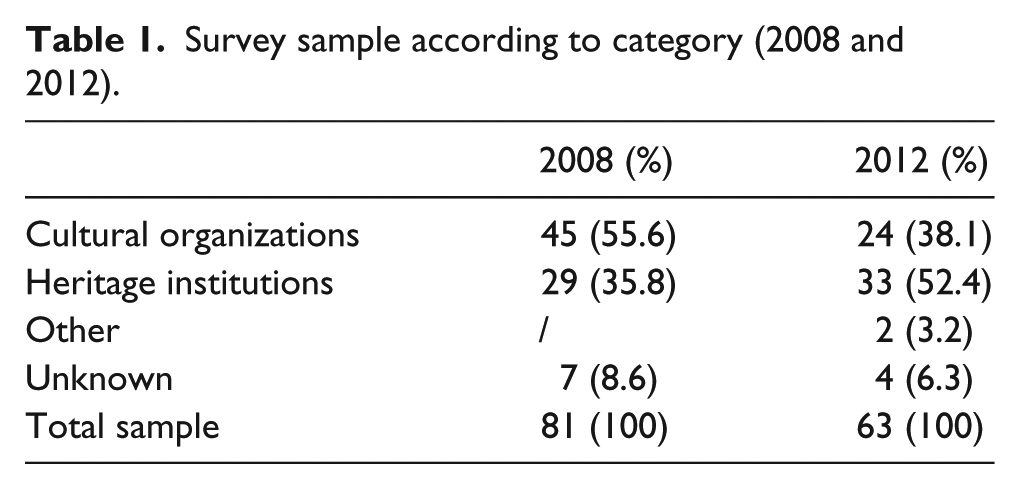
Most of the survey participants were general managers, creative directors, information managers and communications staff. Despite this heterogeneity in roles within the respective organizations, all respondents were involved in the digitization and preservation process and were in the right position to provide the information needed. The questionnaire was fully anonymous so that no institution could be identified; respondents only had to indicate their respective fields (e.g. performing arts). As a few institutions failed to do so, they were labelled ‘unknown’. Within the samples, a distinction was made between heritage institutions (museums, archives, libraries, etc.) and cultural organizations (arts centres, visual arts, performing arts, etc.). We acknowledge this distinction is rather artificial as it could be argued that these are all cultural heritage institutions. Nevertheless, this classification helps in identifying differences between organizations with different functions regarding digitization and long-term preservation. For instance, whereas heritage institutions mainly focus on ensuring the preservation of cultural heritage, cultural organizations are especially involved in the creation of cultural heritage. One might expect that heritage institutions face more difficulties with digitizing cultural heritage since, in most cases, they have no rights ownership of the heritage they collect and preserve. Also, in the 2008 survey, cultural organizations were in the majority; however, heritage institutions formed the majority of the 2012 survey sample. As the number of heritage institutions in the sample remained more or less stable, the number of cultural organizations declined in the 2012 survey. This lower proportion of cultural organizations in the 2012 sample, compared to 2008, was due to the lower involvement of sector organizations in audiovisual art and music.
Taking into account the relatively small sample of participating institutions involved in cultural heritage in Flanders, the results are by no means a representative overview of the cultural heritage sector in the region. A response rate of about 20% does not allow one to make general claims about digitization and preservation policies within all cultural heritage institutions in Flanders. Still, the results show an exploratory insight into the problem of digitizing cultural heritage and give a first indication of the use of Creative Commons in the field. In addition, a comparison between the 2008 and 2012 survey data reveals interesting patterns in the evolution of Creative Commons in Flanders. Indeed, the study was able to provide an evolution of the use of Creative Commons among cultural heritage institutions in Flanders and to assess the success of these licences in the heritage field. The results of the study are limited to Flanders (home to the Dutch-speaking community) and account for the 2008–2012 period. In 2004, Belgium was the seventh European country to include Creative Commons within its legal framework, but enthusiasm for these new licences rapidly declined. Although there are almost no cross-national studies on the implementation of Creative Commons in Europe, there is no doubt that Creative Commons in Belgium (and Flanders) is still in its infancy. According to Zeinstra (2014), who monitors Creative Commons within the Europeana database, 16.6% of all 636,122 Belgian works available in Europeana are licensed under Creative Commons. Sweden (44.76% of a total of 2.9 million works are licensed under Creative Commons), the Netherlands (31.57% of a total of 3.5 million works) and Germany (29% of a total of 3.7 million works) outperform the other European countries in the Europeana database.
Results
The results of the 2008 and 2012 sector surveys are discussed in the remainder of the article. First, the level of progress in the digitization of cultural heritage collections is outlined. Second, the copyright policies of the institutions surveyed are discussed, and finally, an overview of the interest in and use of Creative Commons among cultural heritage institutions in Flanders is provided.
Digitizing cultural heritage
In order to get a view on the rate of digitization of cultural heritage collections, respondents were asked to identify the types of materials that have already been digitized and made accessible via the Internet. A distinction was made between photographs (pictures, postcards, posters, maps), sound (music, recordings, spoken word), video (movies, trailers, shots), text (manuscripts, press clips, magazines), databases (collection of related information) and metadata (descriptive, structural and administrative tags). In general, organizations tend to digitize mostly photographs, with text coming in second (Table 2). Sound and video materials remain the most difficult to digitize (due to a shared, complex copyrights ownership structure) although the results show a large increase between 2008 and 2012. Indeed, the most important conclusion that can be drawn from the data is an overall increase in the number of organizations involved in the digitization of cultural heritage. For example, 80.7% of all organizations said they were offering photographs in digital format – a 7.2% increase compared with 2008 (from 75.3%). The biggest increase (58.3% growth) was recorded for metadata; over half of the organizations surveyed now provide metadata either via their own websites or via online aggregators, including Europeana. For instance, VTi (Institute for the Performing Arts) has been indexing all performing arts productions since 1993, adding as much metadata as possible (http://data.vti.be). The relational database links with press cuttings, photo and video, archival documents etc. and is integrated with external data sources. The data are freely available and published under a CC-BY-NC-SA licence.
Digital heritage collection according to type of material (N: 74 – N: 63).
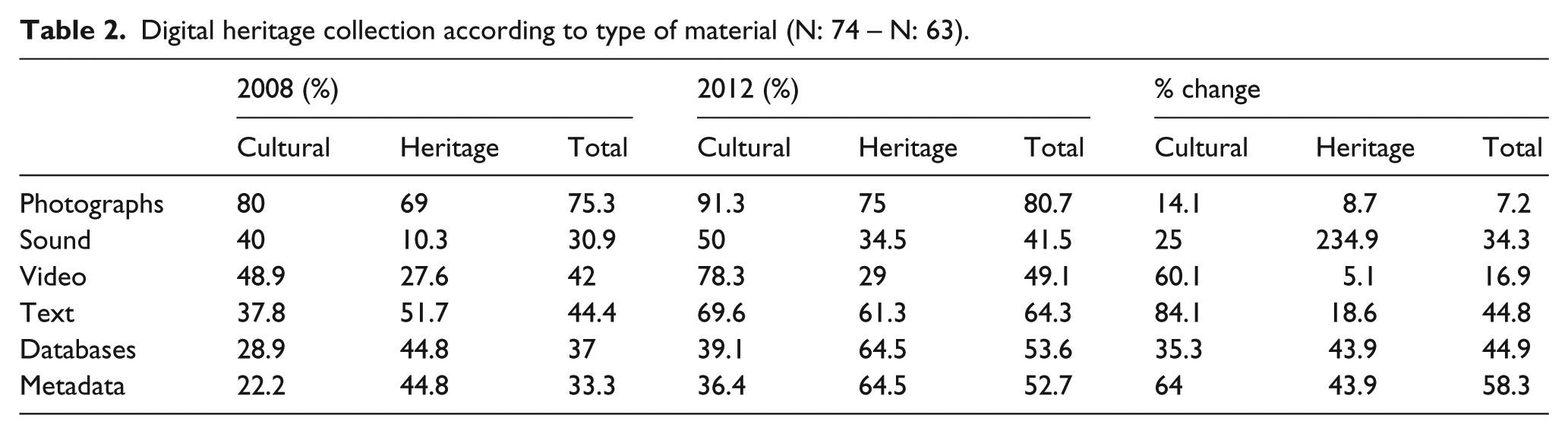
Comparisons between heritage institutions and cultural organizations suggest that the latter offer a substantially higher proportion of sound and especially video sources. Cultural organizations have also caught up with heritage institutions where text materials are concerned. In addition, a higher proportion of cultural organizations state they provide photographs online. In contrast, in recent years, heritage institutions have focused on the digitization of databases and metadata. Despite a decent growth among cultural organizations, heritage institutions mainly provide access to digital databases using metadata schemes (Dublin Core is the common standard used among heritage institutions, but it seems inappropriate for indexing audiovisual productions). With respect to optimal searches and retrievals (often through a customized Google-like system), institutions are contextualizing collections as metadata but failing to implement a sector-wide metadata standard which would be necessary to establish a horizontal, cross-sectoral metadata aggregator for cultural heritage in Flanders. However, the fact that cultural organizations are putting a significant amount of effort into bringing databases and metadata online is promising for the future. In order to boost the digitization and long-term preservation of cultural heritage, the Flemish Government founded VIAA in 2012, the Flemish Institute for Archiving (http://www.viaa.be). VIAA digitizes, stores and provides access to audiovisual materials, photos, documentaries, etc. and collaborates with partners from the cultural, heritage and media sectors. VIAA seeks to archive the cultural heritage of Flanders in a sustainable manner and to provide (protected) digital access to schools, in public libraries and to research institutions.
Copyright policies
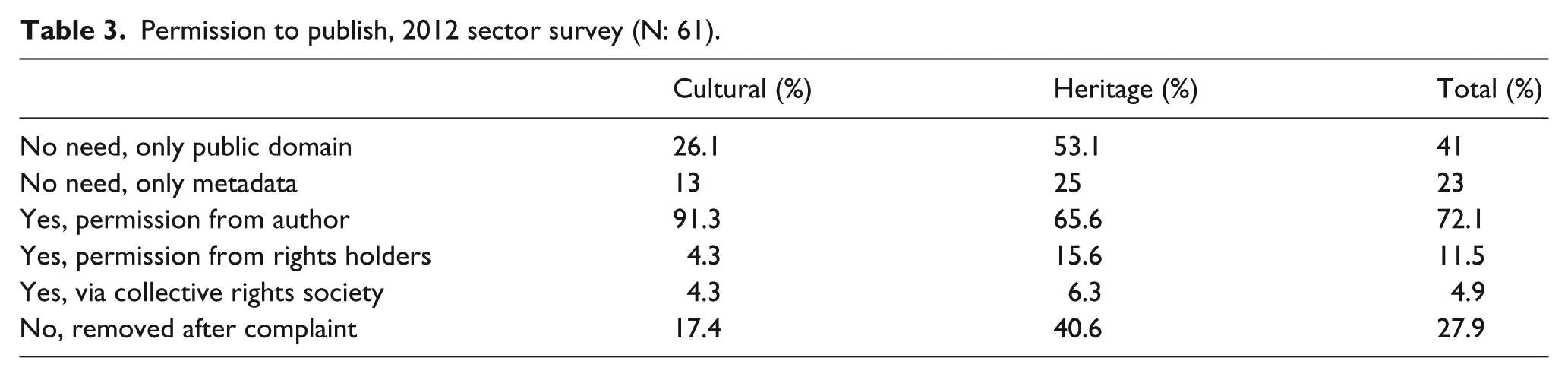
An increasing number of organizations are bringing their collections and databases online, though not necessarily in a lawful manner. The 2008 sector survey revealed that 16% of all organizations surveyed had no clue about the copyright status of the works in their collections and that some 9% had been involved in a lawsuit following the illegal use, distribution and reproduction of copyright-protected works. However, uncertainty about the copyright status of a work might induce organizations to play safe and avoid digital distribution of this work. Therefore, the 2012 sector survey questioned whether and how the organizations had obtained the necessary permission prior to making the works publicly available. Table 3 suggests that most organizations surveyed (72.1%) obtained prior permission from authors and that 27.9% adopted a ‘trial and error’ approach – putting works online if they could not identify the copyright status and removing the works following a complaint from the author or collective rights society. Heritage institutions are more likely to deal with works in the public domain for which no prior permission is required. The results reveal a relatively conservative approach with respect to copyright clearance and digital archiving. Cinematek (Royal Belgian Film Archive), which is currently digitizing its collection of over three million press cuttings, provides an example of this (http://www.cinematek.be). Every document is scanned in high-definition resolution, enriched with metadata using OCR (Optical Character Recognition) and stored on a server for long-term preservation. Despite this high level of investment, digital files can only be consulted in the library because Cinematek has not made the necessary legal arrangements with the copyrights holders of the documents. To provide online access to the general public, publishers and collective rights societies must give their consent.
Permission to publish, 2012 sector survey (N: 61).
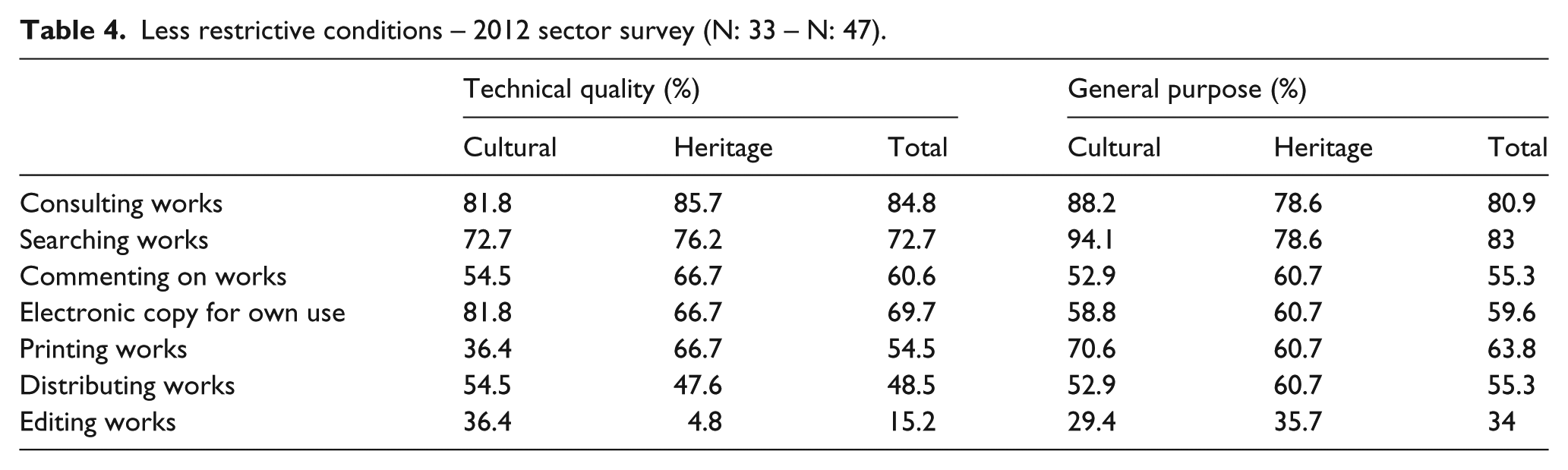
Since traditional copyright legislation is often seen as too rigid for a successful digital strategy, the 2012 survey sector gauged the attitude of the organizations in relation to less restrictive conditions for digital distribution strategies. These questions were included since open content licences, such as Creative Commons, are generally assumed to enable more flexibility than traditional copyright and to provide a possible solution for information managers involved in digital archiving and preservation. Hence, we questioned the extent to which the technical quality of the distributed works (e.g. less restriction for low-res materials compared to high-res works) and the general purpose of the online distribution (e.g. fewer restrictions for non-commercial use compared to commercial use) should be assessed in terms of different user actions. With regard to technical quality, 52% favoured less restrictive conditions for low-res works (e.g. pictures of a lower quality but good enough to give an impression of the work). Regarding general purpose, 74% favoured less restrictive conditions for non-commercial use (education, research, etc.). These results indicate that the organizations surveyed favoured a less restrictive and more flexible application to copyright under certain circumstances and suggest that these organizations might be open to using Creative Commons licences to enable less restrictive conditions for certain user actions.
Table 4 shows that all organizations in favour of less restrictive conditions especially demand such conditions for user actions, including for consulting works, searching works and copying works for own use. The ability to edit the work is the least supported user action by the organizations surveyed, which suggests that these organizations did not advocate users’ alteration or editing of original works and distributing them as derivate works. In relation to technical quality, the organizations are likely to provide original works in low-res so that users can consult and search them (e.g. low-res streaming video); however, they are reluctant to see low-res versions of original works being distributed or printed (as they do not want to undervalue the works). In a similar vein, the organizations are not in favour of editing the works, even when these works are provided for non-commercial purposes. Most organizations supported the idea of less restrictive conditions for consulting or searching works for non-commercial purposes. The printing and distribution of works were more favourable in the case of non-commercial purposes than in cases where the technical quality was lower. However, the results suggest that many organizations are relatively positive about creating less restrictive conditions for user actions that go beyond those enabled by traditional copyright. In the remaining part of the article, the interest in and (progress in) use of Creative Commons licences are discussed.
Less restrictive conditions – 2012 sector survey (N: 33 – N: 47).
Creative Commons licences
A total of 54.2% of all organizations surveyed in 2012 claimed to be interested in using Creative Commons as part of their digital strategy (Table 5). This is a spectacular increase compared with the 2008 survey sector in which about 30% indicated an interest in using Creative Commons. Interest remained higher among heritage institutions than cultural organizations, but the increase in interest was higher among cultural organizations. However, the data show a more nuanced picture when one considers the actual use of Creative Commons in the cultural heritage sector. Whereas in 2008 heritage institutions were clearly leading in terms of their use of Creative Commons, cultural organizations have now caught up with heritage institutions, which saw a 25% decrease in the use of Creative Commons. In general, the actual use of Creative Commons increased slightly from 26.4% to 28.8% for all organizations surveyed. The data also indicate that most organizations started using Creative Commons around 2007 and that only a few organizations started using the licences in the last year. This supports our claim that the increase in Creative Commons use among cultural heritage organizations in Flanders is slowing down and that Creative Commons might enter its maturity phase in which attracting new organizations might prove difficult.
Interest in and use of Creative Commons (N: 72 – N: 59).

The website Erf-goed.be (http://www.erf-goed.be) convincingly demonstrates how heritage institutions benefit from Creative Commons licences. The website is a mash-up of Google Maps and Flickr and provides a database of scheduled monuments and landscapes in Flanders. Erf-goed.be (Dutch for ‘heritage’) aims to document and map Flanders’ heritage and provide access via the Internet. As it would be too expensive (both in terms of time and money) to photograph over 10,000 scheduled heritage sites, the website encourages people to take pictures of these monuments and publish them on Erf-goed.be. To avoid legal problems, contributors are asked to use the CC-BY-NC-SA licence (the licence most commonly used in Flanders). Such crowdsourcing initiatives help to raise awareness of the importance of cultural heritage and promote community engagement. Based on similar European initiatives, the Open Culture Data project encourages cultural organizations to share their data sets with the public so as to stimulate the development of new applications (http://www.opencultuurdata.be). These databases are often developed for specific purposes (e.g. collection management) but remain mostly limited to internal purposes. By providing open access, cultural heritage institutions allow people to be creative with data, develop enriched applications and reach new audience groups. In 2013, the first ‘Apps for Culture’ event was organized where registered software developers could get to work with the data. Such initiatives clearly illustrate the added value of Creative Commons and help to spread the word among cultural heritage institutions.
In the final section of the questionnaire, organizations were asked about the benefits and challenges of using Creative Commons as part of their digital strategy. Flexibility for end-users and rights holders (fewer restrictions compared to traditional copyright regimes and opportunities for wider distribution), international interoperability (adapted to national legislation but compatible with other national Creative Commons licences), administrative simplicity (simple icons indicating the copyright status of the work and what the user is allowed to do with it) and easy access to creative works (maximal access and use of the work is guaranteed) were mentioned as the most visible advantages of using Creative Commons. In contrast, (perceived) uncertainty with regards to the legal status of Creative Commons (the licences are still challenged by some lawyers) and the lack of support by collective rights societies that favour an exclusive approach to copyright were considered the main barriers. Indeed, collective rights associations are discouraging their members from using Creative Commons for two main reasons. First, it is often argued that Creative Commons excludes any form of commercial exploitation of the work (which is only true when the non-commercial condition is chosen). Second, Creative Commons deals, in fact, with individual rights as opposed to collective rights. In addition, the author must explicitly choose a Creative Commons regime, a requirement which hampers the use of Creative Commons. Authors need to decide whether they will adopt the ‘all rights reserved’ or the ‘some rights reserved’ approach. If the author decides that there are no less restrictive conditions for certain user actions, cultural heritage institutions become stuck in a copyright regime in which prior permission from the author is needed. Here, the role of the collective rights societies is crucial. Since they have little interest in supporting Creative Commons, authors are often ‘forced’ to sign standard agreements that cover the rights management of all their creative works if they want to be represented by the collective rights society and earn royalties. It is therefore often impossible for the author to release one work under Creative Commons and leave the remainder with the collective rights society. In the Netherlands, however, the collective rights society, Buma/Stemra, has already pioneered Creative Commons licences, allowing its members to share their works under Creative Commons while Buma/Stemra controls the commercial use of these works. This example shows that collective rights societies and flexible rights management are not mutually exclusive and could actually complement each other.
Conclusion
Since cultural heritage institutions are struggling with the barriers imposed by copyright against the effective implementation of a digital strategy, copyleft licences are increasingly being considered an attractive alternative to traditional copyright. To verify this statement empirically, this study has focused on the use of Creative Commons among cultural heritage institutions in Flanders and presented the results of two sector surveys held in 2008 and 2012. The two data points enabled the study to provide an evolutionary overview of the interest in and (progress in) use of Creative Commons in the field and to empirically check the assumed increase in the use of Creative Commons licences in the cultural heritage sector. Without suggesting a causal relationship from the modest increase in the use of Creative Commons, the results indicate a spectacular increase in the number of organizations involved in digitizing cultural heritage between 2008 and 2012. This is an important finding and somehow contrasts with the dramatic utterances from information managers that it would be practically impossible to distribute copyright-protected works digitally. Nevertheless, the organizations surveyed clearly indicated the need for less restrictive conditions where creative works of lower technical quality are concerned and when digital distribution serves non-commercial purposes. This makes a strong case for Creative Commons, the use of which has increased marginally to about 30% of all organizations in the cultural heritage sector in Flanders. This figure might be an overestimation of the actual use because of self-selection bias, but it suggests that Flemish cultural heritage institutions consider Creative Commons a valid alternative to copyright.
Due to the rigid copyright legislation that limits the flexibility demands of new-media environments (both on the European and national level), copyleft licences were put forward as the new holy grail by activists of the ‘open’ Internet community. Following the open source movement, it has been said that Creative Commons enables greater flexibility in the use of copyright-protected works and counters the increased commercial enclosure of knowledge and information. The licences were specifically designed to support the owner(s) – because the initiative clearly lies with the author of the original work – regarding access and dissemination of creative works over the Internet. Due to the extensive use of Creative Commons licences, a chain effect has been created whereby ‘free’ works circulate over the Internet, and mass distribution is stimulated. With the help of this viral network effect, the public domain gradually expands. The relevance of copyleft licences for cultural heritage institutions in terms of their mediating role in the digital society should not be underestimated since it helps them to develop and implement a full digital strategy. Creative Commons may not offer a solution to all challenges, but it certainly is a useful step towards an open, digital collection policy. Since the initiative remains with the original author, it is necessary to convince these stakeholders of the benefits of these licences. Authors have a vested interest in fanning out their works to reach the widest possible audience (and so do cultural heritage institutions). Moreover, Creative Commons does not prevent commercial exploitation of creative works (although some collective rights societies argue that this is the case), ultimately preserving a fair balance between the economic and social interests of authors, cultural heritage institutions and society as a whole. In effect, this article has contributed to a better understanding of Creative Commons and illustrated its relevance for cultural heritage institutions as they should be concerned about how to maximize their presence in the digital society and how to engage more closely with their audiences.
Footnotes
Funding
This article is based on the research projects, PokuMOn and Archipel, both granted by iMinds and EWI-IWT.