



Abstract
Despite the critical role of peers in the socialization of doctoral students, relatively few researchers have studied types of peer relationships and information exchanged between doctoral students. This study aims to explore doctoral students’ perceptions of their peer relationships and informal peer mentoring within a library and information science program. The authors applied Kram and Isabella’s peer relationship framework developed in organizational settings to examine peer relationship types of library and information science doctoral students. Interviews with 12 doctoral students reveal the existence of cohort, social/academic peer, and other peer groups, which can be mapped onto Kram and Isabella’s continuum of peer relationships, categorized as special, collegial, and information peers; however, this framework suffers from a limitation in explaining dysfunctional peer relationships identified in the study. In regard to differences between peer relationships and peer mentoring, respondents tend to perceive mentoring as a developmental function that takes place in peer relationships. Moreover, the authors propose five types of information exchanged between doctoral students, which are (a) basic, (b) administrative, (c) professional, (d) social, and (e) personal information, and they suggest that peer relationships influence the topical diversity and degree of disclosure in information exchange.
Keywords
Introduction
Socialization in graduate education is “the processes through which individuals gain the knowledge, skills, and values necessary for successful entry into a professional career requiring an advanced level of specialized knowledge and skills” (Weidman et al., 2001: iii). Multiple studies point out that peers as well as faculty play roles in the process of doctoral students’ socialization (Austin, 2002; Gardner, 2007). Certain aspects of peer relationships have commonalities with mentoring as they support individual development (Kram and Isabella, 1985), and some scholars have focused on peer mentoring relationships (e.g. Lin and Hsu, 2012). However, traditional mentoring is typically characterized by significant age difference, while peer mentoring relationships are often described as egalitarian (Bennion, 2004; Jacobi, 1991). While some studies have differentiated peer from traditional mentoring, relatively few have looked at the differences between peer mentoring and peer relationships, particularly in an academic environment.
In academic settings, many scholars have studied the experiences, functions, and outcomes of peer relationships and mentorships in higher education, and have found a number of benefits, including instructional support, degree completion, participation in academic activities, and emotional support (Hadjioannou et al., 2007; Noonan et al., 2007; Silva et al., 2006). Not only mentees but also mentors benefit from peer mentoring, providing an opportunity for them to develop both professional and communication skills (Budge, 2006; Lin and Hsu, 2012). In library and information science (LIS), Sugimoto (2012a) identified academic and emotional functions of peer mentoring in doctoral education. Nevertheless, such studies have not sufficiently differentiated mentoring relationships from other kinds of peer relationships, and very few have investigated information activities in peer relationships within graduate education. Further, while some information behavior researchers acknowledged the important role of people, including faculty members and peers, as information sources (Barrett, 2005; Catalano, 2013; George et al., 2006; Veinot, 2010), they have typically been described as intermediaries who simply provide referral services (Lee et al., 2014).
This study explores doctoral student perceptions of peer relationships and informal peer mentoring within an LIS program at a large southeastern research university. The authors use Kram and Isabella’s (1985) peer relationship framework, developed in workplace settings, to examine the peer relationships of LIS doctoral students, and attempt to describe the types of information shared among doctoral students with peers. The research questions asked in the study are:
RQ 1: What types of peer relationships exist between LIS doctoral students? How do LIS doctoral students conceptualize those peer relationships?
RQ 2: What characterizes peer mentoring between LIS doctoral students?
RQ 3: What types of information are exchanged in peer relationships between LIS doctoral students? Are there any differences between the types of information exchanged in different types of peer relationships?
This study can deepen our understanding of the nature of peer relationships and mentoring in LIS doctoral education, and of information exchange within those relationships. Ultimately, this study can contribute to the facilitation of the successful socialization of doctoral students. The success of doctoral student socialization is critical, since unsuccessful socialization often results in doctoral student attrition (Gardner, 2010).
Literature review
Theoretical framework
This study relies on Kram and Isabella’s (1985) theoretical framework for peer relationships, which outlines the functions and types of peer relationships in personal and professional development. Through the analysis of 25 relationship pairs identified by 15 individuals, the study identified career-enhancing and psychosocial functions of peer relationships. Career-enhancing functions include information sharing about “technical knowledge and perspective on the organization,” “career strategizing,” and “job-related feedback” (p. 117). Psychosocial functions provide “confirmation,” “emotional support,” “personal feedback,” and “friendship” (p. 117). Researchers also found that peer relationships are mutual, meaning that each individual can be “giver as well as … receiver” (p. 118) of mentoring functions. Moreover, Kram and Isabella identified three types of peer relationships: “information peer,” “collegial peer,” and “special peer,” each “characterized by a particular set of development functions, a unique level of trust and self-disclosure, and a particular context in which the relationship had evolved” (p. 118). With an information peer, individuals usually exchange information about work and organization; this relationship has low levels of self-disclosure and trust. Individuals with a collegial peer have a moderate level of trust and self-disclosure. The primary functions of a special peer are confirmation, emotional support, personal feedback, and friendship. This framework contributes to specifying the types and functions of peer relationships.
Peer relationships and mentoring in graduate education
Relatively few studies have examined either peer relationships or peer mentoring in higher education. Further, research on peer relationships has been less common in graduate education than in undergraduate education (Chui et al., 2014). Budge (2006) speculated that the lack of research on peer mentoring is because the concept is relatively new and it is a type of non-traditional mentoring. Nevertheless, multiple scholars have acknowledged the critical roles of peer relationships or mentoring in undergraduate and graduate education (Austin, 2002; Gardner, 2007; Seegmiller, 2003; Townsend et al., 2011).
Several researchers studied the nature of peer relationships in doctoral programs; for example, Chui et al. (2014) investigated the peer relationship experiences of doctoral students in counseling psychology, interviewing 12 participants who had completed one or two years of doctoral work and asking them to complete the measure of peer relationship scale via email. Participants reported both positive and negative peer experiences in classroom, clinical work, research, and social settings. Despite some negative aspects, Chui et al. presented the critical roles of peers, providing instrumental and emotional support. They found that participants consider their peers to be more comfortable and helpful than clinical supervisors or research advisors when discussing “difficult topics.” Chui et al. also discovered the importance of physical proximity in developing and maintaining peer relationships. However, Chui et al. did not identify the different types of peer relationships, and they operationalized peer narrowly as doctoral students in the same cohort group. Moreover, Hadjioannou et al. (2007) found that the student-led group provided doctoral students with instructional advice and support; assistance for participating in the academic community and discourse; informal (practical) information; improvement in writing; and emotional support. Doctoral life was often characterized by negative words such as stress, isolation, and loneliness. Their study demonstrated the positive roles of peer groups in managing such negative experiences, and thus contributing to the socialization of doctoral students.
Other researchers focused on the benefits of formal peer mentoring in graduate education (Allen et al., 1999; Grant-Vallone and Ensher, 2000). For instance, Grant-Vallone and Ensher (2000) surveyed 29 mentor/mentee pairs and found that both mentors and mentees received high levels of psychosocial and instrumental support through the relationship. In particular, they found peer mentors provided more psychosocial than instrumental support to their mentees. Allen et al. (1999) attempted to evaluate the effectiveness of a peer mentoring program in a Master of Business Administration (MBA) program at a large southeastern university. In their study, two or three second-year MBA students acted as mentors to five or six first-year students. The study suggested that protégés received more psychosocial than career-related support from their formal peer mentors. Overall, they found peer mentoring relationships to be effective in the socialization of new students.
Some authors reported the functions of peer mentoring specific to doctoral students (Lin and Hsu, 2012; Silva et al., 2006). Silva et al. (2006) reported on a peer mentorship program for new teaching associates (TAs) in the language program at Ohio State University. The program offered a mentoring model in which experienced TAs provided assistance and guidance to new TAs during the term. The peer mentorship was quite successful, providing positive experiences for the new TAs. Peer mentors also benefited from mentoring because it gave them “the opportunity to reflect on their own teaching” (p. 245). Furthermore, Lin and Hsu (2012) investigated the perceptions of doctoral students on peer mentoring relationships, interviewing 12 doctoral student peer mentors in science and engineering at a Taiwanese university, where some faculty advisors appointed doctoral student mentors to one or more Masters students; these mentors reported both positive and negative effects. For instance, the peer mentoring system helped mentors develop their leadership and research ideas, but sometimes caused mentees not to “pursue self-learning or develop problem solving abilities” (Lin and Hsu, 2012: 567). Overall, the study revealed the positive functions of peer mentoring, identifying the instrumental (e.g. lab activities, coursework) and psychosocial roles of peer mentors, with peer mentors working to improve their skills, and occasionally acting as liaisons between advisors and mentees.
Several mentoring studies have been conducted within LIS doctoral education; for example, Sugimoto (2012a) addressed characteristics of academic mentoring in American Library Association-accredited LIS schools with doctoral programs, studying the experiences of two sub-populations: advisors (associate or full professors) and advisees (assistant professors). Sugimoto identified the roles and relationships of doctoral committee members, and described peer mentoring in doctoral education, characterized by both formal and informal collaborations. Such peer collaborations provide academic and emotional support, which are important for the development of doctoral students. Sugimoto (2012b) also analyzed behavioral and procedural features of LIS doctoral students in academic mentoring by applying the mentoring phases suggested by Kram (1983), and proposed a new doctoral mentoring process/actor model. Sugimoto applied Kram’s mentoring frameworks to faculty mentoring in doctoral education, though the model was not applied to peer relationships in doctoral programs.
Researchers have studied doctoral students’ peer relationships and mentoring, especially in the context of formal mentoring programs. However, these studies did not look at peer relationships and mentoring holistically, and few studies have examined the kinds of informal peer mentoring situations that take place naturally and spontaneously between students.
Method
This extension of a pilot study (Lee et al., 2014) is an exploratory case study aiming to explore characteristics of peer relationships and mentoring, and information exchanged within those relationships, in the context of a doctoral program without a formal mentoring program. Formal mentoring, for the purposes of this study, is organized by an institution, while informal mentoring develops naturally, without a defined structure (Eby and Lockwood, 2005).
Data collection
The population is defined as doctoral students in the School of Information at a large southeastern university; the sample frame encompasses all currently enrolled students (38, including 11 international and 27 American students). A purposeful convenience sampling was used. In this strategy, it must be determined “which constituencies need to be represented and with what level of diversity” (Ritchie and Lewis, 2003: 97). For this reason, participants’ year, nationality, and gender in the doctoral program formed the selection criteria. While there is no definitive answer for the correct number of interviews to conduct, Guest et al. (2006: 78–79) found that samples of six to 12 might suffice for determining “meaningful themes.” Here, interviews were conducted with 12 students (see Table 1), 1 at which point no new meaningful information emerged and the saturation point was reached (Rubin and Rubin, 2012).
Description of interview participants.
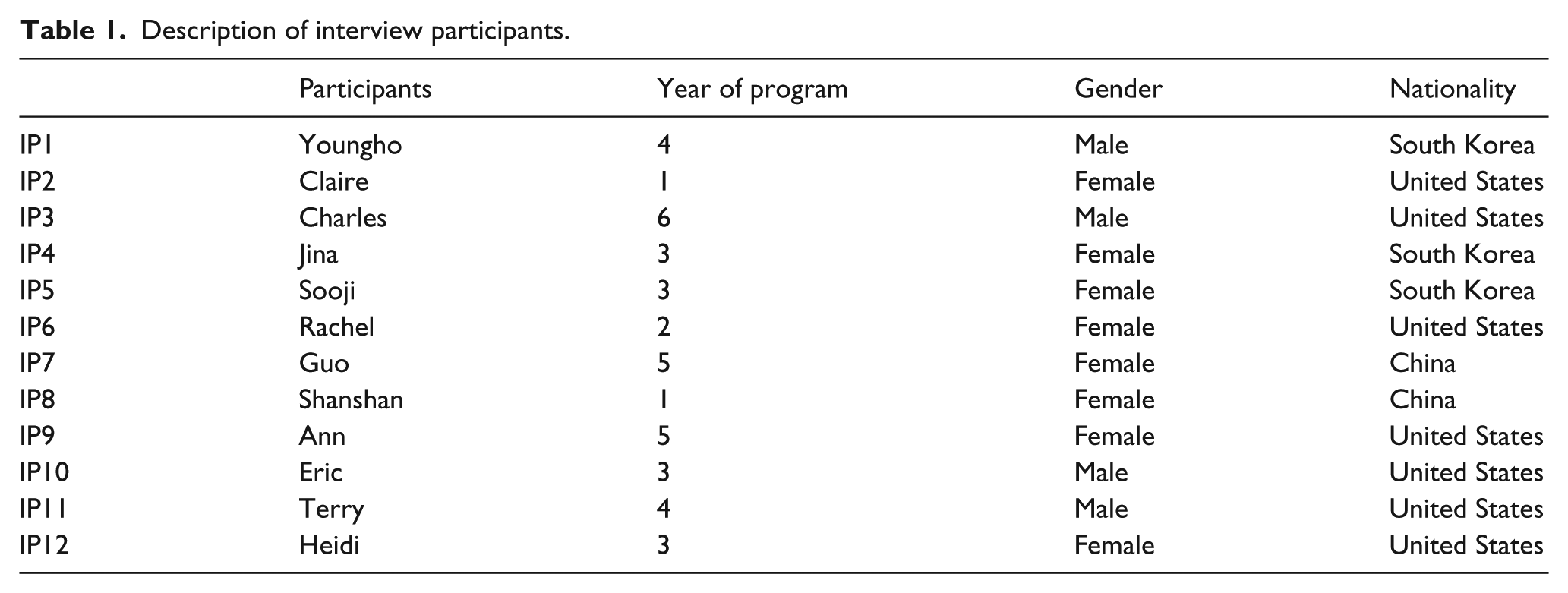
The researchers interviewed each student individually in available conference rooms during the spring, summer, and fall semesters of 2014, asking about development, maintenance, and types of their peer relationships (see Appendix 1). All participants signed the informed consent form, and interviews took between 30 minutes to one hour and were audio recorded.
Data analysis
Data analysis was concurrent with data collection, allowing the researchers to modify their strategies and collect better data throughout the process. Analysis was inductive, which is beneficial for discovering new patterns (Miles et al., 2014). Researchers coded all interview transcripts independently, subsequently comparing and discussing the coded transcripts and making interpretations collaboratively. Two stages of coding were conducted to examine different types of peer relationships. In the first stage, the researchers assigned topics to data (descriptive coding) and extracted phrases from the interviews (Miles et al., 2014). In the second stage, the researchers grouped codes into the categories based on Kram and Isabella’s framework. Further, the constant comparative method proposed by Glaser and Strauss (1967) was used to identify types of information.
Findings
Types of peers
Participants reported several types of peer groups. First, all interviewees described cohort relationships that developed naturally as a result of time spent together in classes at the beginning of doctoral work. However, the participants in relatively earlier stages of the program (first and second year students) described closer relationships with their cohort members than those in later stages. For example, both first-year respondents mentioned their close relationships with their cohort, with one saying “With my cohort, I have both a professional and a personal relationship. Again, we’re very close.” Similarly, Rachel, a second year student, reported a close relationship with cohort members: “I think the ones that I am closest to are the ones that I started the program with. We went through the hardship of the [required] coursework together.” However, respondents beyond their second year tended to report less close relationships with their cohort. Youngho, a fourth year respondent, noted: In the first semester, we had eight students in the semester, and that group, that cohort group, was the most important group for me because basically we had to take the same courses together. From the second year or third year, I think I talked with … I spent more time with, people who have similar interests.
Other respondents also reported very close relationships with cohort members in the early stage of doctoral work. However, Ann, a fifth year student, noted that she still maintains a close relationship with one member of her cohort.
Other common types of peer groups were based on shared personal, social, or academic interests. For example, some described peers who play sports or games, hear live music, or eat meals together. Claire, in her first year, said, “A big part of this group … was discovering that a lot of those people like the music that my boyfriend’s band played.”
Jina, Rachel, and Heidi all have children and mentioned a group of moms. Heidi remarked, “I tend to gravitate toward friends with kids because our situation is relatable.” Furthermore, participants frequently described peers with shared research interests; for example, Charles observed: “Angela is another youth services person, so we bonded over that.” Guo similarly mentioned a research group within the program for those involved in social informatics.
Noticeably, some, especially international students, perceived two peer groups: an international student group, and an American student group. Shanshan remarked that a language barrier somehow separates peer groups as she has some difficulties in using English to express all of her thoughts. Youngho supported this: “As an international student … I feel like awkward with American students just to not know how to react or how to say something first.” He remarked on the importance of an international group for adjusting to life in the United States; however, he also pointed out the passiveness of international students, saying: “I haven’t often seen international students try to organize some gatherings for doctoral students.” Charles, an American, reinforced the observation, observing that: “A lot of the international students just work and there’s not a lot of social interaction.”
Respondents also identified peers who do not belong to any of the groups suggested above. They are casual and friendly, but they do not know each other well. Ann remarked, “I just know them by their name and vaguely what they’re up to.” Also, Claire said, “I don’t make a concerted effort to keep those relationships … I just happen to see those people when I’m here.” Several respondents described dysfunctional aspects of peer relationships; one mentioned a peer group he does not get along with and with which he does not share information; he further described peers with whom he does not engage, as they have radically different personal and academic perspectives.
Peer relationships and mentoring
Relationships between peer relationships and peer mentoring
Some respondents did not see a difference between peer mentoring and peer relationships, saying: “Having a peer relationship is so entwined with the mentoring that you don’t even necessarily realize you’re getting the mentoring at the same time” (Claire); “I don’t feel they are different” (Jina); “They are the same” (Shanshan). The respondents agreed that any of their peers had the potential to serve as mentors if they could provide academic or personal help. In addition to academic mentoring, many respondents responded that mentoring takes place for social or personal help. For example, Youngho remarked that he considered even trivial things like learning how to connect to the printer to be mentoring. Jina viewed all the mothers in the program as her mentors, as she gets information from them about caring for her daughter. Guo thought offering medical recommendations to her peers was mentoring, and Shanshan even mentioned she can provide mentoring to others about Chinese culture or tea. However, not all peer relationships result in peer mentoring. As described by Rachel, “Peer relationships don’t always involve mentoring … I think I have peers in the doctoral program that don’t necessarily mentor me, but they just are here.” That is to say, respondents in this study perceive peer mentoring as a developmental function that can, but does not always, occur in peer relationships.
Characteristics of peer mentoring
Participants described some definitional characteristics of peer mentoring. Mentoring in peer relationships consists of advice – seeking, giving, and receiving. Though this can happen in any peer relationship, respondents assigned greater weight to the advice from peer mentoring. Many participants agreed that peer mentoring occurs regardless of seniority, with peer mentoring occurring within their own cohort; participants described their peer mentors as those within their group with experience from which they could learn. As described by Claire, “It isn’t necessarily someone with more experience, as in more experience in the program. It just might be someone that has a different experience than you.”
The idea of the senior students as indirect mentors is also reflected in responses from Jina, who does not view herself as a mentor, but says: “I think indirectly I want to be the good role model for the younger students.” Claire echoes the idea that every senior student could be a mentor: “In some ways, all of the older students act as a mentor at some time.” This might be due to the belief that senior students are more likely to have more experience in the program than students who are in the early stages.
In addition to experience, individual trustworthiness, which often comes from reliability and quality of work, is another core element enabling peer mentoring. Ann explained that while she can, and does, get advice from other peers, it is only the advice of her mentors that she both seeks and trusts: At first you hear a lot of voices … like everybody has something to tell you, and just kind of weeding those people out who mean well but, it’s not really – their advice is not necessarily honestly the best … and finding those one or two voices that could put things in a way that I understood and made the most sense to me, and so I come to start seeking out those people consistently.
Charles described a peer mentor as a peer who he trusts as an academic: somebody who has a record or demonstrated quality of their work … I think it’s somebody who’s got time for you and somebody you know who has quality work so that you know you’re going to get good advice.
Peer mentoring can serve both career/academic and psychosocial functions to a mentee, as with Rachel, who describes reaching out for emotional support and receiving academic support as well: Recently I was really, really stressed with a class, and I was just at the point where I was just crying. I texted [a peer mentor] and he was like, “just focus on one part of it.” I’m like, “I know to do that,” he’s like, “yeah, I know that you know how to do it, just focus on one thing and get it done”.
Sometimes, however, a peer mentor only serves one function, such as with Guo, who noted that she is mentored by a cohort member, though “not about academia, but about living (and) the social life.”
Other perspectives on peer mentoring
Several respondents conceived of a mentor as older and more experienced. For instance, Heidi pointed out: When you think of the mentor, you think of a teacher or authority figure who has that position as opposed to being on an equal plane. Peer to peer, though, may be more equal than somebody with a different formal title or position.
While Eric agreed that someone providing him with advanced knowledge was a mentor in a broader sense, he perceived ideal peer mentoring as a formalized teacher-student relationship between two individuals.
Types of information exchanged
Students exchanged various types of information, which can be grouped into five categories: (a) basic, (b) administrative, (c) professional, (d) social, and (e) personal information (see Table 2). Basic information concerns essential needs of doctoral student life, and is particularly important to new international students, many of whom observed that they acquired basic information from their peers about apartments, utilities, local restaurants, or medical facilities.
Types of information exchanged in peer relationships.
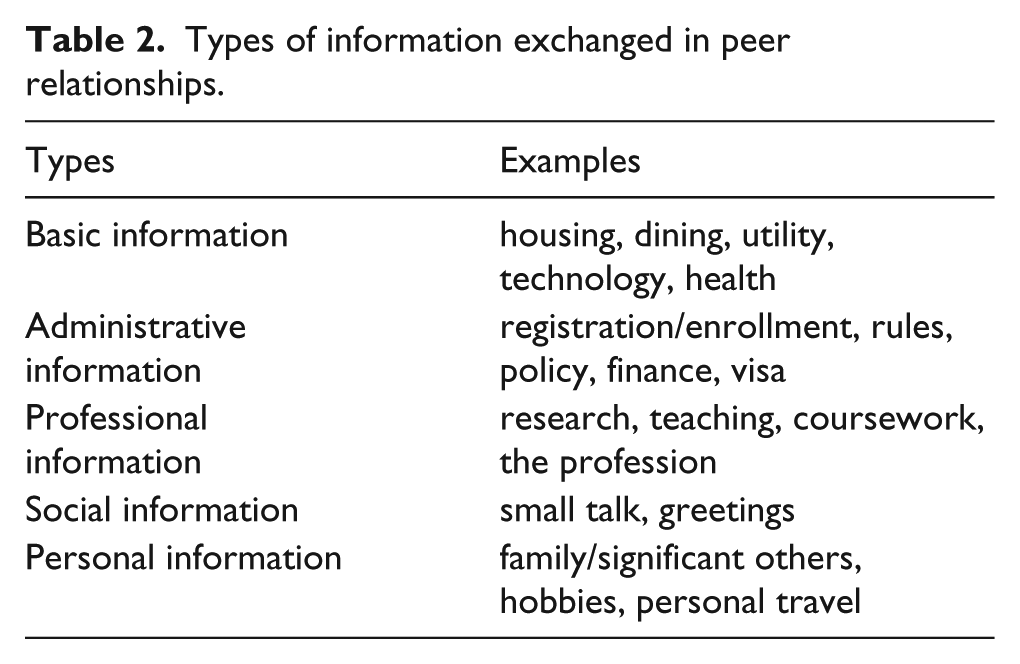
Administrative information covers procedural or financial aspects of doctoral work. Respondents in earlier stages of their studies mentioned the importance of this information type. A first-year student described missing a change in program requirements even though it was written out in the guidelines: This year in the program is the first year that they have not required a minor. That’s a new thing. However, what we did not realize is we still need that nine hours of coursework, so we thought we were going to be done with our coursework in the summer … Michelle, a peer, pointed out to me and she said, “I think you’re wrong and you really should check in to this …” She was right and that was important information. (Claire)
In addition, respondents often talk about school or department policies relevant to their studies, such as funding policies, exams, or the IRB application process. International students also exchange administrative information about the US educational system, visa status etc.
Professional information covers the task domain of doctoral students, including information about research, coursework, teaching, and the profession. Most respondents reported exchanging professional information with peers. Youngho stressed the importance of this type of information, noting: “It is the very basic, the very first talking point to share information, because it is official, important, and common interests for all of us ….” He further discussed information exchange about research ideas, his teaching philosophy, and course assignments with his peers. Others also shared professional information including research, teaching, exams, dissertation work, faculty members, and the job market, indicating that students appear to be adjusted to the professional world through this type of information exchange.
Social information is related to casual and social talk, including simple greetings in the hallway or small talk at a social gathering. For instance, Charles emphasized the role of social information exchange, saying: “Social interaction is kind of like the first hurdle, barrier, or boundary that you have to cross in order to develop of deeper relationship with somebody.” His response is in contrast to Youngho who treats academic information as the starting point for sharing information.
Personal information concerns private life and relationships, including family issues, significant others, hobbies, or vacation plans. This type of information is typically exchanged in close peer relationships, addressing potentially sensitive issues. For example, Rachel said, “Angela might know if I’m disappointed by something an editor said, or if I’m ticked off with a professor, but I might not let everybody know that.” Jina, however, answered that she does not share personal information with peers, perhaps reflecting individual differences.
All types of information except personal information were shared in every peer relationship, while personal information was only shared in close peer relationships. However, the degree to which each type of information was shared was not the same across relationships. In particular, relational strength affected the scope and depth of information exchange. Rachel commented, “When you first meet people you share certain things and you start to see how the relationship works, and then based on that you decide what to share.” In addition to the quantity and quality of information exchanged, several respondents considered information exchange to be more affectively oriented with close peers and more cognitively oriented with unfamiliar peers. For instance, Charles stated that: Within the inner circle, we talk more about how we feel about what we are working on or how we feel about being in the program … I don’t discuss how I feel about it, about my work, with those people [unfamiliar peers].”
Similarly, Claire and Rachel also noted that they talk about more emotional aspects of academic work only with close peers.
Other findings
Some factors that may influence development and maintenance of peer relationships were identified in this study. Almost every respondent agreed on the significance of physical proximity in building and maintaining peer relationships. This is consistent with the finding that respondents’ close relationships with cohort members become more distant in the later years of their studies, as they have no shared coursework. For instance, Claire pointed out, “What strengthens your peer relationships is when you actually see people in class.” In addition to class, several respondents also mentioned spaces specifically designated for doctoral students, such as the doctoral lab or lounge. Rachel described the development of a relationship with her closest peer, saying, “She was sitting next to me in the doctoral lab, but she is a parent also. She has a daughter that’s close to my daughter’s age.” Heidi also emphasized the importance of proximity: “You have to be present. You don’t build relationships through text or Skype … I think proximity [is important].”
Furthermore, respondents described individual factors, such as marital and international student status, gender, age, and personality. Several respondents with children experienced difficulty in building and maintaining peer relationships because of family responsibilities. Also, two female respondents felt more comfortable with ongoing relationships with female students. Both international status and age were mentioned by Guo: “We all come from China … we are all kind of close in terms of age. So it was easier to build a relationship than with senior doctoral students or doctoral students from other countries.” Heidi noted the role of personalities in developing peer relationships and information sharing, saying that “[If] you are not really leaving yourself open to learning new things, that can impact what information is shared with you and how well you can form relationships.”
Discussion
Application of Kram and Isabella’s Framework
Kram and Isabella’s (1985) framework described three types of peer relationships: special, collegial, and information peers. Although there were no clear boundaries among different types of peer relationships, they were often characterized by varying levels of trust or self-disclosure. In our study, respondents mentioned several types of peer relationships: cohort groups, social groups, academic/research groups, international student groups, and others. Such peer groups are organized according to Kram and Isabella’s framework as follows.
Special peers
Doctoral students in earlier stages were likely to describe their cohort members as close (i.e. special) peers. However, as they progressed in their studies, close relationships within their cohorts grew more distant, and they tended to be closer with peers who had shared social or research interests. Although not all international students who speak English as a second language were close to each other, they tended to feel comfortable with and have very close relationships with other international students. Respondents’ close peer groups were not static but dynamic, influenced by individual or environmental factors such as social/academic interests, physical proximity. Consistent with Kram and Isabella’s description, respondents reported that they trusted those who would be considered special peers with shared experiences. Claire explained the relationship between trust and shared experience: “The more shared experience we have, the more that I will trust them, and the more that I trust them, the more I will share with them.”
Collegial peers
A collegial peer in the Kram and Isabella framework can be characterized by a moderate level of trust and self-disclosure. This type of relationship in our study covers peer relationships formed by similar personal, social, or academic interests. Within a collegial peer relationship, respondents often meet with their peers for specific purposes such as research projects, doctoral seminars, classes, or informal gatherings. Other than these purposes, they rarely meet collegial peers off campus. Considering the dynamic nature of peer relationships, doctoral students’ relationships with cohort members in the early stages of their work sometimes change from close to collegial relationships.
Information peers
In Kram and Isabella’s framework, individuals often exchange information about work and organization with their information peers. In our findings, the respondents described such peers with whom they did not interact often but who, when they did, had some social or academic conversation. This type of relationship has low levels of trust and self-disclosure between peers, and the respondents did not make an effort to maintain or develop their relationships. Noticeably, a respondent described that he did not get along with somebody if he/she had radically different personal or academic beliefs. No meaningful information is exchanged in this type of relationship, suggesting the need for an additional type of peer group in the framework. Future work is required to determine whether this fourth peer type, “dysfunctional peer,” is needed.
Overall, the existence of cohort, social/academic peers, and other peers was confirmed by the interviews, and can be mapped onto Kram and Isabella’s continuum of peer relationships, categorized as special, collegial, and information peers.
Peer relationships and mentoring
Several participants noted that peer mentoring can take place at different levels of peer relationships. That is, peer mentoring may occur between information peers, collegial peers, or special peers, depending on the topic or issue at hand. This concept was reinforced by participants, who noted that all doctoral students can act as peer mentors to other students given the right circumstances. Many participants agreed that peer mentoring was a developmental aspect within peer relationships, taking place spontaneously in given a context. Unlike peer relationships, however, participants took advice from peer mentoring more seriously, and they had high trust with peer mentors. Peer mentors were typically characterized as trustworthy, knowledgeable, and experienced, traits not necessary in peer relationships.
Information exchange in peer relationships and mentoring
Respondents exchange five types of information (basic, administrative, professional, social, and personal) with each other. However, interviews revealed that different types of peer relationships can influence the topical diversity and degree of disclosure in information exchange. Three different types of peer relationships are characterized by different levels of trust, and in more trusting relationships, respondents exchange more diverse and personal/emotional information. This is consistent with Pettigrew’s finding that strong ties support “affective needs associated with information sharing” (Pettigrew, 1999: 803). The affective role of information sharing is important for doctoral students as their lives are often lonely, anxious, alienated, and ambiguous (Gardner, 2007; Hadjioannou et al., 2007; Hartnett and Katz, 1977). In addition to emotional support, respondents expressed the academic role of information sharing from their peers; for example, professional information directly supports academic progress and achievement, while administrative information indirectly impacts academic work. That is to say, each type of peer relationship has value for students’ social and academic integration, which supports the findings of prior studies that show instrumental and emotional benefits of peer relationships (Chui et al., 2014; Grant-Vallone and Ensher, 2000; Lin and Hsu, 2012).
Individual or environmental factors also have an impact on the formation of peer relationships, and may influence information exchange between peers. For instance, it is likely that international or married students have a relatively narrow range of peer relationships, and several female respondents preferred to stay in relationships with female students. Such individual factors are often used as a lens for identifying special and collegial peers among various peers. To facilitate the identification process and provide a wide range of peer relationships, some environmental factors are controllable by program level. For example, as suggested in the study, physical proximity enables students to discover shared interests, facilitating information exchange, which is consistent with the finding of Chui et al. (2014). This implies that institutional efforts for providing students with the opportunity for face-to-face interactions may provide a foundation for building and developing relationships.
Limitations and conclusions
The findings of the study are not generalizable to other programs or settings, as they are limited to students’ peer relationships and their information exchange within a specific LIS program with no formal mentoring program. This qualitative study does not describe the extent to which information is exchanged in different types of peer relationships, which may be answerable from a quantitative study. Further, the study might suffer response bias, as respondents may have been reluctant to report negative experience with their peers; for this reason, some dysfunctional peer groups might have been underreported. During the interviews, a respondent noted a dysfunctional peer relationship; such a relationship does not fit into Kram and Isabella’s framework, warranting future research focusing on possible dysfunctional aspects of peer relationships.
Nevertheless, this study presents the applicability of Kram and Isabella’s peer relationship framework developed in organizational settings in the context of doctoral education, and it attempts to link peer relationships of doctoral students to content dimensions. The study suggests that interactions between doctoral peers include information exchange relevant to professional and career concerns of those students; however, as relationships between students grow and deepen, the types of information exchanged follow suit, with increasingly personal information becoming part of the mix. In other words, for doctoral students, the social, personal, and professional aspects of their lives are inextricably intertwined. This study also suggests that, despite the fact that they have most often been characterized as intermediaries in the information-seeking activities of doctoral students, peers play an important role as information sources in their own right.
In general, the closer doctoral students are with each other, the more they share information, which may provide them with academic and emotional support. While individual characteristics such as marital or international student status may influence in building and maintaining peer relationships, interview findings suggest an organizational role for encouragement of peer relationships, such as providing students with sufficient face-to-face interaction opportunities. To foster trusting peer relationships within doctoral programs, there should be more systematic efforts to help students discover shared social or academic interests.
While relatively few researchers have addressed the role of peers in doctoral education, this study suggests that peer doctoral students can be useful information sources for other students, facilitating their socialization processes to the department, institution, and discipline. Future work will test the findings of the current study in different LIS schools and other disciplines, will examine the validity of five types of information, and will also look at doctoral students’ perceptions of peer relationships and mentoring in a program where there is a formal mentoring program.
Footnotes
Appendix 1
Declaration of Conflicting Interests
The author(s) declared no potential conflicts of interest with respect to the research, authorship, and/or publication of this article.
Funding
The author(s) received no financial support for the research, authorship, and/or publication of this article.