




Abstract
The aim of this study is to demonstrate how the archivist and all the professionals dealing with the municipal archives can be intrapreneurs in the organization where they perform duties, through their creativity, better services, using their personal involvement and ingenuity in creating products or new services. The results obtained, based on a quantitative approach with the data-collecting instrument of a questionnaire sent to a sample of 311 Portuguese municipal archives, showed evidence of a gradual change in work mentality and in archive and archivists’ procedures, noting a certain awakening to the practice of intrapreneurship. In identifying the main practices stimulating intrapreneurship in the archives studied, it was possible to identify some explanatory dimensions (factors) of this phenomenon: (1) autonomy, pro-activeness, creation of products and climate, (2) orientation towards goals, competence and risk, (3) market, social and decision, (4) functionality and status, and (5) reward and competitiveness. This study is seen as being of the greatest importance, due to the information and knowledge society becoming increasingly important for the economy, especially following one of the most serious crises in Portugal’s history. It was therefore necessary to find out to what extent these information professionals are intrapreneurs within their archives, taking advantage of existing resources but also of their wisdom and competences in its service.
Introduction
Due to society’s progress and the current premises of polyvalence, organizations or entities, and firms, but also liberal professionals such as trainers, lawyers, solicitors and other consumers of information nowadays have to unite a range of essential competences. As Ferreira (2003: 43) states, ‘communication, information science, computing and information management are areas that accompany each other’. These professionals can work in any sector of activity (Li and Song, 2012). Archives, libraries and documentation and information centres, as well as information and computer systems, are absolutely essential for spreading the information processed in sector knowledge, according to what is wanted (Huiling, 2005).
In current society, the amount of documentation produced is immense and the need to keep and orient archives is fundamental for human survival, as the conveyor of a cultural, scientific, social, economic and political legacy. Cultural inheritance, expressed in the person or entity as the producer of Information, has in archive services ‘the organization, access and spread of the information they hold’ (Fernandes, 2012: 191). Increasingly, access to information, whether institutional, historical, business, entertainment, informative, political, technical, technological or family, is an individual and collective imperative to be safeguarded, for whoever intends to follow up a project and/or obtain classified information in its strictest sense, and this lies in the hands of the archivist (Fernandes, 2012; Rodrigues and Marques, 2008). At this new informational dawn, the historical-technical paradigm has given way to the scientific-informational one (Freitas, 2012: 13–17). Zhu (2005: 52) wrote that ‘archives as a part of the social information system are marching toward informationization’.
Any archive sector is a source of information which, if duly directed and framed, becomes attractive for focusing new areas of business. This is where intrapreneurship becomes extremely important. This way of creating something new inside organizations, crossing apparently unsurmountable barriers, leads to the constant search for the product or service the customer or user wants. According to Molina and Callahan (2008) and Baruah and Ward (2014), intrapreneurship is a relatively recent field of exploration, where academic efforts have focused mainly on identifying the premises and differentiating them from entrepreneurship.
The term intrapreneurship was created by Pinchot in 1978. According to Pinchot (1986), intrapreneurship is a method of using the entrepreneur’s spirit where many of the best people and resources are to be found, i.e. in large organizations. McKee (1992) and Molina and Callahan (2008) tell us that this new scenario demands committed employees who are not only able to learn quickly in a changing environment, but also able to use innovation in new and challenging situations. As Auruskeviciene et al. (2006) state, new product or service development can be considered a critical success factor that differentiates successful organizations from unsuccessful ones.
Intrapreneurship is a term that describes the innovation practice within an organization whereby employees undertake new business activities and pursue different opportunities (Baruah and Ward, 2014). Also the constant improvement of services in terms of method procedures and processes to access the documentary heritage means professionals in this area must also become innovators and intrapreneurs. Archivists have the capacity to become so. The entrepreneur is a creative person, an innovator, who develops his project outside organizations, whereas the intrapreneur does so within his organization, with its resources and means. However, being an intrapreneur is not necessarily having the spirit or desire to create something new.
The economic crisis that hit Portugal in the first 10 years of the new millennium caused the government to cease hiring professionals linked to culture, including archivists. These restrictive measures regarding the hiring of professional archivists meant that serving archivists had to reinvent themselves and resort to intrapreneurship to recreate existing services and create new forms and models of work, as well as creating new products. The first three-monthly report of 2015 by the General Directorate of Public Administration and Employment reports that the number of staff employed in libraries, archives, museums and other cultural activities fell from 1.724 to 1.406 between 31 December 2011 and 31 December 2014 (SEEP, 2014: 7).
The archive field and the archivist are not inert, but rather evolutionary and progressive, opening the door to intrapreneurship, i.e. the act of being entrepreneurial within the institution or entity where duties are performed. According to Pinchot (1986: 36–43), intrapreneurs, like entrepreneurs, are not necessarily inventors of new products or services. Their contribution is in taking new ideas or even working prototypes and turning them into profitable realities. Just as the archivist should be pro-active and intrapreneurial, so too should be the librarian be incentivised to this end. According to Cottam (1987), the librarian/archivist also needs intrapreneurial managers and employees with vision, since they both share the essence of the profession, providing information.
Therefore, the justification for approaching this organizational phenomenon is related to the dearth of studies (Li and Song, 2012; Wang and Shen, 2009; Yan, 2008) focusing on the dynamics, the privileged position, of archive professionals for intrapreneurship, but also the importance of the archive in society. Indeed, in a 21st century of major technological, social and professional transformations and the emergence of a knowledge economy, it is urgent to situate archivists in this paradigm.
Debates about the current role of the archivist are becoming more and more frequent in the literature (Rodrigues and Marques, 2008), but little research exists about the intrapreneurship phenomenon. Thus, the main aim of this study is to demonstrate how the archivist and all professionals dealing with the archive can be intrapreneurs inside their municipal archive, through their creativity, better services, using their involvement to create products or new services. In this study a municipal archive is defined as a local authority department. For example, we can identify the municipal archives of Lisbon and Porto as the most important in Portugal.
This study is of great importance, in that it intends to reveal the archivist’s potential and indicate whether they are intrapreneurs in creating products, in improving existing services or in elaborating guidelines for defining good practices, with a view to providing a service of excellence.
The remainder of the paper is organized as follows: the next section presents a review of the literature on intrapreneurship and its dynamics in the archive context. This is followed by a description of the methodology used in the study. The next section presents the results of this cross-study and the discussion. Conclusions, implications, limitations of the study and suggested future lines of research are presented in the last section.
Literature review
Intrapreneurship: Origin and definition
The researcher responsible for the appearance of the term ‘intrapreneur’ was Pinchot in his work Intrapreneuring: Why You Don’t Have to Leave the Corporation to Became an Entrepreneur, published in 1986. However, Pinchot says in his preface (p. xviii), that it was in the autumn of 1978 that he formed the basic principles of intrapreneurship and gave it that name. In more recent times, Mohanty (2006) observes that the concept of intrapreneurship has essentially become an approach that can be systematically adopted in an attempt to define specific strategies and action plans that can help to incorporate significant employee contributions. Scholars such as Antoncic and Hisrich (2001, 2003), Guth and Ginsberg (1990), Ping et al. (2010), Rule and Irwin (1988) and Zahra (1995) have explored these entrepreneurial dynamics within existing organizations and later conceptualized it as intrapreneurship.
Morris and Kuratko (2002) highlighted some key differences between entrepreneurship and intrapreneurship. For instance, an entrepreneur has to take the risk and sole responsibility when it comes to starting up a business, whereas the organization takes the risk on behalf of an intrapreneur. Pinchot (1986: 54–56) drew up a set of indicators that identify potential intrapreneurs as opposed to business-people and traditional managers. These indicators are not stagnant but guide pragmatic thought (see Table 1).
Indicators about managers, entrepreneurs and intrapreneurs.
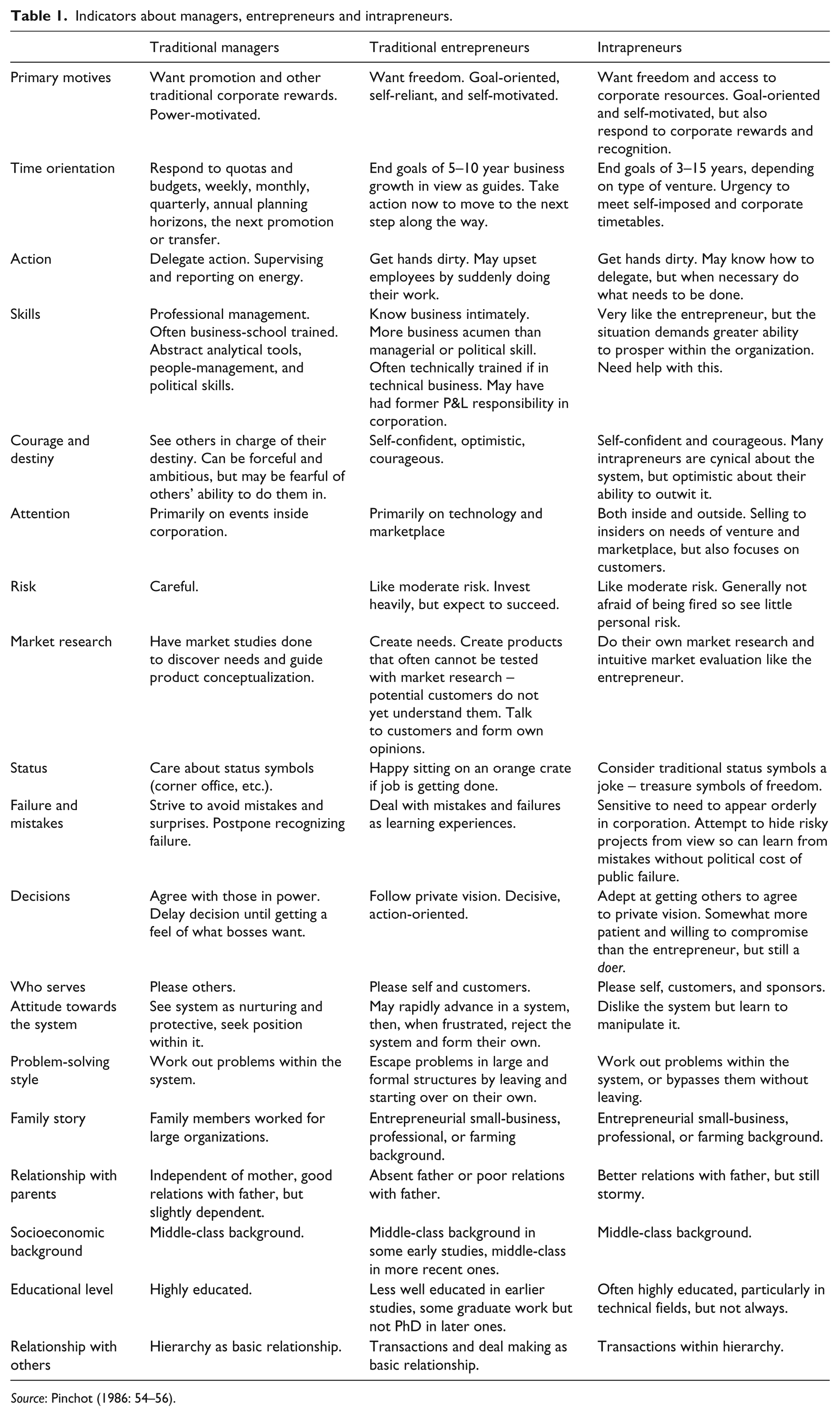
Source: Pinchot (1986: 54–56).
Zahra (1995) also tells us that when the term intrapreneurship first appeared in 1978, it gained credibility, helping to improve organizational performance, through greater opportunity for success in competitive and complex scenarios. Intrapreneurship is an operation processed within an organization or entity using its resources. Maier and Zenovia (2011) refer to this, in that entrepreneurs and intrapreneurs play a decisive role as they help the organization (recently created or already existing) to get new business or enter new markets.
Stevenson and Jarillo (1990) and Karimi et al. (2011) state that intrapreneurship is entrepreneurship within an existing organization. It can be seen as a process by which individuals inside organizations pursue opportunities without regard to the resource they currently control. Baruah and Ward (2014) defined intrapreneurship simply as entrepreneurship inside an organization. In this framework, Hisrich and Peters (1998) defined this concept as the entrepreneurial spirit.
Other authors (e.g. Antoncic and Hisrich, 2001, 2003) say that intrapreneurship was equated with constructs similar to those of undertaking internally or undertaking corporately. They attribute a concept of corporate entrepreneurship to intrapreneurship, i.e. undertaking inside the firm worked for.
Morris and Kuratko (2011) highlight some differences in relation to intrapreneurship and entrepreneurship. While in the latter, the entrepreneur, as a business-person, assumes all the risk and responsibility, for the former, the firm assumes the risks on behalf of the intrapreneur, but keeps the intellectual rights.
However, perhaps the most pragmatic way to consider intrapreneurship in the light of (Portuguese) society is in the statement by Maier and Zenovia (2011), saying that intrapreneurship is in domestic entrepreneurs, i.e. in small organizations, in that they guide their organization, always focusing on creativity and innovation.
Antoncic and Hisrich (2003) conclude that whatever the size of organizations or firms, intrapreneurship has significant importance in their economic and organizational development. They also mention that intrapreneurship should be a primary and guided activity, so as to project services, structures, technologies and products in new directions, or in some way, innovate. Authors such as Antoncic (2007), Kanter (1984) and Peters and Waterman (1982), have also considered intrapreneurship to be a characteristic of successful organizations.
Nevertheless, whether in recently established firms or successful entities, the aim is the same: to attain proposed objectives and credible results in developing the business, in relation to either services or products. Here, collaborators or employees can play an important role in the firm’s objectives. As stated by Karimi et al. (2011: 636), ‘intrapreneurship, generally, refers to the development of new business ideas and opportunities within large and established corporations. In most cases, it describes the total process whereby established enterprises act in an innovative, risk-taking and pro-active way’.
For Antoncic (2007:310):
the pursuit of creative or new solutions to challenges confronting the firm, including the development or enhancement of old and new products and services, markets, administrative techniques and technologies for performing organizational functions, as well as changes in strategy, organizing, and dealing with competitors, may be seen as innovations in the broadest sense.
Then, Koen (2000) says that intrapreneurs, like entrepreneurs, are concerned about creating new business – a potentially difficult process for those who hesitate to make risky decisions.
Rae (2006) claims that the external environment fosters different kinds of changes which provide opportunities as well as threats to intrapreneurs who want to develop novel products and services. Molina and Callahan (2008: 391) argue that ‘intrapreneurship plays a key role in the proposed model because it joins individual learning as a link between influences from the external environmental and the internal environment, represented as organizational learning in the proposed model’. Also according to Molina and Callahan (2008: 392), ‘intrapreneurs learn as individuals first, and then share this knowledge with their teams. Teams enable intrapreneurs to engage their particular backgrounds or specializations under a strategic perspective to support a firm’s goals’.
It is in this sense that intrapreneurs are individuals focused on formal and informal learning, taking advantage of any type of knowledge that is a bridge for their need to create, innovate, rise up. According to Molina and Callahan (2008), intrapreneurs are therefore likely to be orientated towards informal and non-formal types of learning activities.
Among recent developments, Gündoğdu (2012) advanced a different view about the already well delimited and defined concepts of intrapreneurship. He proposes a new integrating prototype concept, incorporating both, to which he gave the name ‘innopreneurship’. This new concept, which should go through a metamorphose, aims for harmonious integration of entrepreneurship, intrapreneurship and innovation, inasmuch as traditional business-people would no longer have any chance of achieving success in this new phase of the economic situation. So innopreneurship would be the credible, balanced response for small organizations and for success, so as to meet the evolving expectations of different customers.
This differentiating, although progressive, view would have to be accompanied by additional intrapreneurship characteristics, and Scheepers (2011) describes an environment where formal knowledge and encouragement for different talents and competences were taken into consideration, there was organizational freedom, and where financial resources were allocated to new initiatives in order to find the road to innovation.
To strengthen this paradigm of Sheepers (2011) and Antoncic (2007), an organizational culture is added and suggested, one which welcomes new projects with intrapreneurial characteristics such as more openness to the quality of communication, formal control, intensive monitoring of working atmosphere, management support, organizational values and support.
But how is it possible to be an entrepreneur, or better, an intrapreneur, with all the difficulties raised in organizations nowadays? If some firms and entities are likely to accept free thought and the collaborator’s autonomous performance in creating, sharing knowledge and ideas, innovating or even suggesting, the incentives are still tiny and many are the obstacles to intrapreneurship.
Intrapreneurship in the archive context
Now in the 21st century, it is patently clear that information has become one of the greatest assets for all organizations, users and firms. Moraes and Filho (2006) state that at the present time, known as the knowledge society, the main source of wealth creation is based on the creation, distribution and manipulation of information.
This way of viewing society, shared by values of knowledge, progress and pragmatic development, makes information and access to it a unique differentiating factor. Information is power, and whoever obtains important and useful information will have a competitive advantage. As claimed by Cohen (2002), change in the economy lies in the way information is used.
In this connection, information and access to it, in the contents of archives, libraries and document centres, provided in the form of a product, is one way of reducing uncertainties and doubts. Information takes on the greatest importance in services or products, because it helps businesses in decision-making, and customers and users of the service. However, not all information is pertinent for everyone in the same way. In fact, archivists have an increasingly important role in the knowledge and information society. It is no wonder that the Spark & Honey Agency mentions on its site that one of the 20 most sought after professions in the future will be the archivist of private content. 1
Providing an information product or service in an archive is possible, however paradoxical it may seem, given that many do not see information as something transactionable. According to Araújo and Bufrem (2008: 9), the information that can be useful to firms is anything that leads to a ‘decision-making process of industrial firm management, service and commercial provision in the following categories: companies, products, finance, statistics, legislation and market’. These categories of information can serve as material for firms and private individuals interested in research and using data that can be important and decisive for successful business policies. These are categories that serve to draw casuistic and useful conclusions for the firm or institution’s future. According to Araújo and Bufrem (2008: 10) the information professional, namely the archivist, can serve as an important interlocutor in the search for useful information products. The future is built on the past, and there is no present without a future.
Information is all the documentary flow, of a testimonial value or not, which manages the economy and decision processes. And many examples can be found in terms of the knowledge economy. Depending on firms’ organizational structure and their policy strategies, they adopt more of one type of information than another.
For instance, many Portuguese firms today, with all possibilities for progress already exhausted, and without perspectives of creating something revolutionary and completely new, innovate existing products with more added value, taking advantage of pre-labelling and pre-advertising information which has existed for 20, 30 or 40 years. As Marcelo (2010: 32) states, there is seen to exist:
at present a phenomenon of reviving old Portuguese brands. A tendency that represents ‘national nostalgia’, which has created a great demand from consumers for repackaging from the 1920s to the 1950s and the mushrooming of commercial outlets devoted to selling those products.
This work is only possible through researching in an archive or document centre together with a great deal of intrapreneurship, in order to provide the best information possible, in the best format possible. And here, because we are dealing with an interval of decades, this would mean researching in the permanent or historical phase of documentary content.
However, it is not only in the recreation of ‘old’ products that we can find information and knowledge. The whole economy is information, or knowledge. According to Amaral (2011: 87), a ‘significant component of the activity of electronic commerce and e-firms relates marketing to providing information products. Examples of these information products are electronic newspapers and magazines, newsletters, e-books, digital music, audio and video, software, images’.
Society becomes therefore the focus and objective of these professionals’ work and the services they provide. The intrapreneurial profile creates here a positive division between a normalized service and a specialized and personalized one. The usefulness of the information provided is of special relevance, not only in the context of today’s relentless progress but also in its use for the progress of society’s knowledge.
The need for information applied to journalistic news is one of the many areas where intrapreneurship in archives makes a major contribution. Despite the media having their own means to obtain information, libraries and archives are of great importance. Both libraries, with their reference works, monographs and collections, and intermediate archives, with their documentary contents about sectors, such as minutes, reports, and documents of an administrative, economic and political nature serve the purposes of journalistic articles. This does not exclude digital repositories of information for consultation and retrieval, especially institutional ones, because they supply diversified information of quality, albeit without personalized help.
These situations lead us to interpret the role of the archivist and archiving at the centre of information management. Although the archivist needs knowledge of management and administrative techniques, Couture (1998: 72) mentions that ‘he does not need to depend completely and solely on management as a discipline. Archive work is a discipline in its own right with its own basic theories, its own interventions and its own work methods’.
The role of the archivist, indissoluble from the archiving function, has its own specificity. Couture (1998: 70) states that:
archiving can be approached in three ways: one solely administrative (records management) with the main concern of considering the document’s primary value; a traditional way which stresses exclusively the document’s secondary value; or finally, a new way, of global integration with the aim of simultaneously dealing with the document’s primary and secondary value.
It is precisely in these three ways, centred on the mission of the organization, entity or firm, that archiving integrated in the area of information management, is able to show its potential through being effective in organizing information.
Indeed, whatever the value of the document, all the services of public or private organizations, concerning finances, human resources, administration or others, need the archivist and the information manager, inasmuch as they are indispensable to the normal functioning of their activity and allow rationalization of means and resources.
Any obstacle in terms of intrapreneurship has some effect on the workings of an archive, as this has all the characteristics to benefit from intrapreneurial advantages. The atmosphere, information resources, information professionals, digital and analogue communication channels, and all the technological means of documentary treatment and storage, are advantages and means indissoluble from the potential of innovation which, allied to knowledge and intrapreneurial behaviour, can make archive organization an example of progress and success. Lankinen et al. (2012) observed that intrapreneurs have the potential to find new combinations of resources that build a competitive advantage which can help them thrive in hostile environments.
The archive, as an activity of promoting the conservation of knowledge, is, according to Medeiros (2010: 44), ‘essentially linked to the practice (set of techniques) of storing, conserving and organizing records of human knowledge’. Therefore, with its own dynamics, intrapreneurship tackles the area of documentary and information sciences looking for knowledge to satisfy users’ practical, focused needs.
Capurro (2003) concludes that information science, the evolutionary nomenclature of documentary sciences, ranges from a physical paradigm focused on treating and organizing information to feed computer systems, to a cognitive one, where the objective is still focused on treating and organizing information, but processes are based on the psychological paradigm, to satisfy individual users, reaching a social paradigm in which processes are based on the social/cultural context, aiming for the construction of contextualized information.
It becomes clear that user satisfaction with archive services, whether current, intermediate or definitive, relates to the constant search for solutions aiming to provide customers/users with an appropriate and correct service concerning the information they are looking for. According to Bysted and Jespersen (2014), increasing employees’ innovative work behaviour is a complex process and they believe it involves developing an internal climate supportive of idea generation and fulfilment through the use of participative and decentralization mechanisms. Besides these mechanisms, culture, communication, trust and support play a prominent role in giving employees/archivists the enthusiasm and spirit to function as an organizational team, and Scheepers (2011) believes this helps in achieving organizational objectives.
According to Silva (2006), the discussion of the impact of information and communication technologies ended up by shifting information science, which until then had been concerned with safeguarding, towards a ‘post-custodial paradigm’. That is, the concern of archives in the 21st century will be to provide customers/users with personalized services. To a certain extent, it is encouragement of social intrapreneurship, directed towards social and community progress. In this context, Vieira and Gauthier (2000) argue that social entrepreneurs are those who create social values through innovation and the strength of financial resources, irrespective of their origin, aiming for social, economic and community development (…) they have the vision, the creativity and the determination to redefine their field (…) they are the pioneers of innovation regarding solutions to social problems and cannot rest until they have changed the existing model of society completely. Indeed, this became a new paradigm for considering archives and how intrapreneurship can project the knowledge economy and develop new services and products.
According to Gama and Ferneda (2010: 151), the ‘documentary archive is dotted with information resources directed towards appropriating organic information for diverse purposes’. And here lies the unique condition for provision of a differentiated service. All the information held by an archive is knowledge economy with potential for exploitation. All the information, especially in the archive’s intermediate and permanent phase, becomes particularly appealing to certain professionals. Indeed, the economy can be inferred by the archive dynamics, when it is an active part of a developing and progressive society. Archive information is of the greatest importance for a country’s social, commercial, cultural and industrial development. And the more culturally evolved countries are, the easier it becomes to appreciate information professionals such as the archivist. In this area, Portugal has enormous potential due to its socio-cultural, infrastructural, cultural and documentary conditions. As can be seen in Souza (2006: 28), the ‘social visibility of the librarian and information scientist has a direct relationship, above all, with how society is organized economically (by the size and complexity of goods and service production)’.
Briefly, the archive can become a place of intrapreneurship with a view to improved service provision and the creation of new mechanisms or products, helping to obtain practical results for firms or enquiring bodies.
Research methodology
Sample
The study began with a request for collaboration sent to 311 Portuguese local authorities, to obtain answers from entities possessing a municipal archive. As the number of local authorities with municipal infrastructure and equipment devoted to archiving was not known exactly, since many of them are still at a stage of building that infrastructure, it was decided to contact all local authorities registered with ANMP (National Association of Portuguese Local Authorities) requesting collaboration in completing the email questionnaire if they had a municipal archive. The number of local authorities to which an e-mail was sent was 311, representing the whole country. So the population was formed of all Portuguese local authority archives. More precisely, the focus of this study was on intrapreneurship practices in their most varied aspects, in municipal archives as autonomous units of local authorities.
Data collection and variable measurement
Any research project, whether of a quantitative or qualitative nature, implies data collection by the researcher. Given the dispersion and distance of cultural or archive equipment in Portugal, making it technically and practically impossible to visit them all, an email questionnaire was decided on. For the questionnaire, questions were drawn up in connection with the indicators given by Pinchot (1986), but others were also inserted from the literature review set within the same characteristics. However, due to being a study of an exploratory and descriptive nature, it had to be done through the variables obtained through the literature review and their indicators needing confirmation or otherwise, in order to prove the existence of intrapreneurship practices among Portuguese archivists.
Therefore, the questionnaire was elaborated considering the characteristics/variables taken from the review, as in Table 2.
Variables used in the questionnaire.
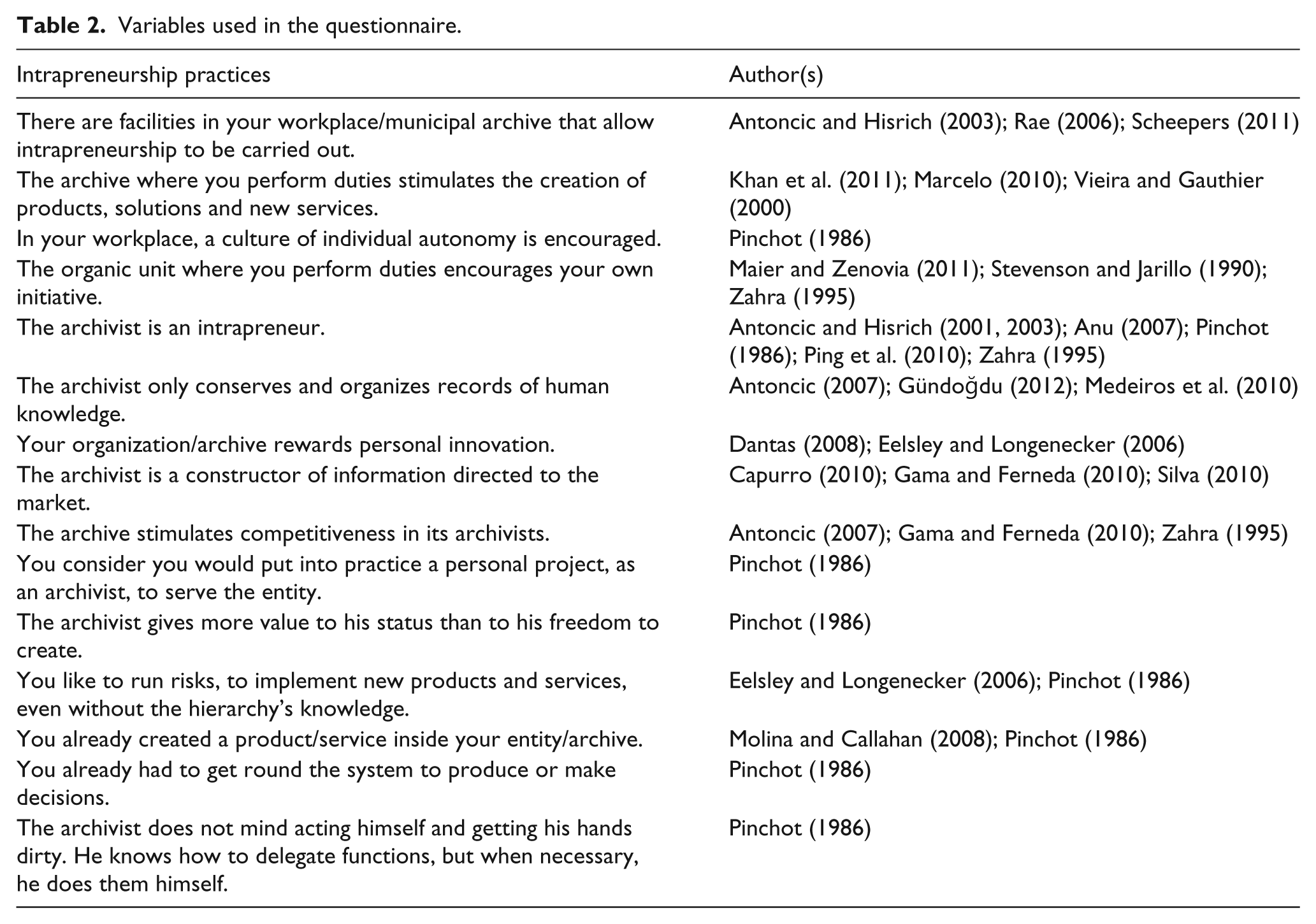
The questionnaire was made up of three sections. The first contained 10 questions on socio-demographic and professional aspects, aiming to acquire incisive data on the archivist in charge and on the archive itself, so as to understand its general organic-functional framework. In Section 2 of the questionnaire, 15 questions were drawn up using a Likert scale, related to variables and indicators taken from the conceptualization of intrapreneurship (Table 2). Measurement of the variables was based on a Likert scale to determine the degree of subjects’ agreement. The Likert scale used had the following values from 1 to 5: 1 – Totally agree, 2 – Agree, 3 – Disagree somewhat, 4 – Totally disagree and 5 – No opinion.
After inviting participation by the local authorities equipped with an archive and employing professional archivists, of the 311 contacted by email, only 89 answered, corresponding to a response rate of 28.6%. The questionnaire was sent out in the first week of July 2014.
Data analysis
The data gathered from the questionnaire survey were treated with two types of statistics, namely descriptive and multivariate analyses. In order to describe and summarize the dataset collected, descriptive statistics was used (Polit and Hungler, 1995). This method focused on a set of numerical data, mainly through absolute and relative frequencies, as well as the average and standard deviation.
Given the diversity of variables studied, it would be difficult to analyse how important archivists consider their contribution to the phenomenon of intrapreneurship. In these circumstances, a multivariate analysis was also used, i.e. the aim was therefore to find dimensions underlying those variables that would allow identification of ‘factors’ related to it.
Factor analysis was used for this purpose. Here, we applied the varimax orthogonal rotation method developed by Kaiser (1958). Through this type of multivariate statistical analysis, the broad set of variables regarding intrapreneurship practices we identified in the literature was reduced and grouped into a set of values of linearly uncorrelated components that are likely to be explanatory (Hair et al., 2009). According to the principal components analysis method, the first factor resulting from applying this method explains the greatest percentage of total sample variance. The second factor corresponds to the second biggest percentage of total variance and so on, finding no correlation between factors. In addition, factors whose own value (Eigenvalue) is above 1 are considered.
To check acceptability of this technique, we applied the Kaiser-Meyer-Olkin sample suitability measure and the Bartlett Sphericity (Dziuban and Shirley, 1974). According to Reis (1997), these two types of test are used to check the validity of factor analysis. Finally, in order to verify the internal consistency of the scale used in this survey, we calculated Cronbach’s alpha.
Results and discussion
Sample characterization: Archivist and archive
Tables 3 and 4 show the composition of the sample in terms of absolute numbers and percentages (descriptive statistics) about archivists and archives in the sample.
Characteristics of the archivist.
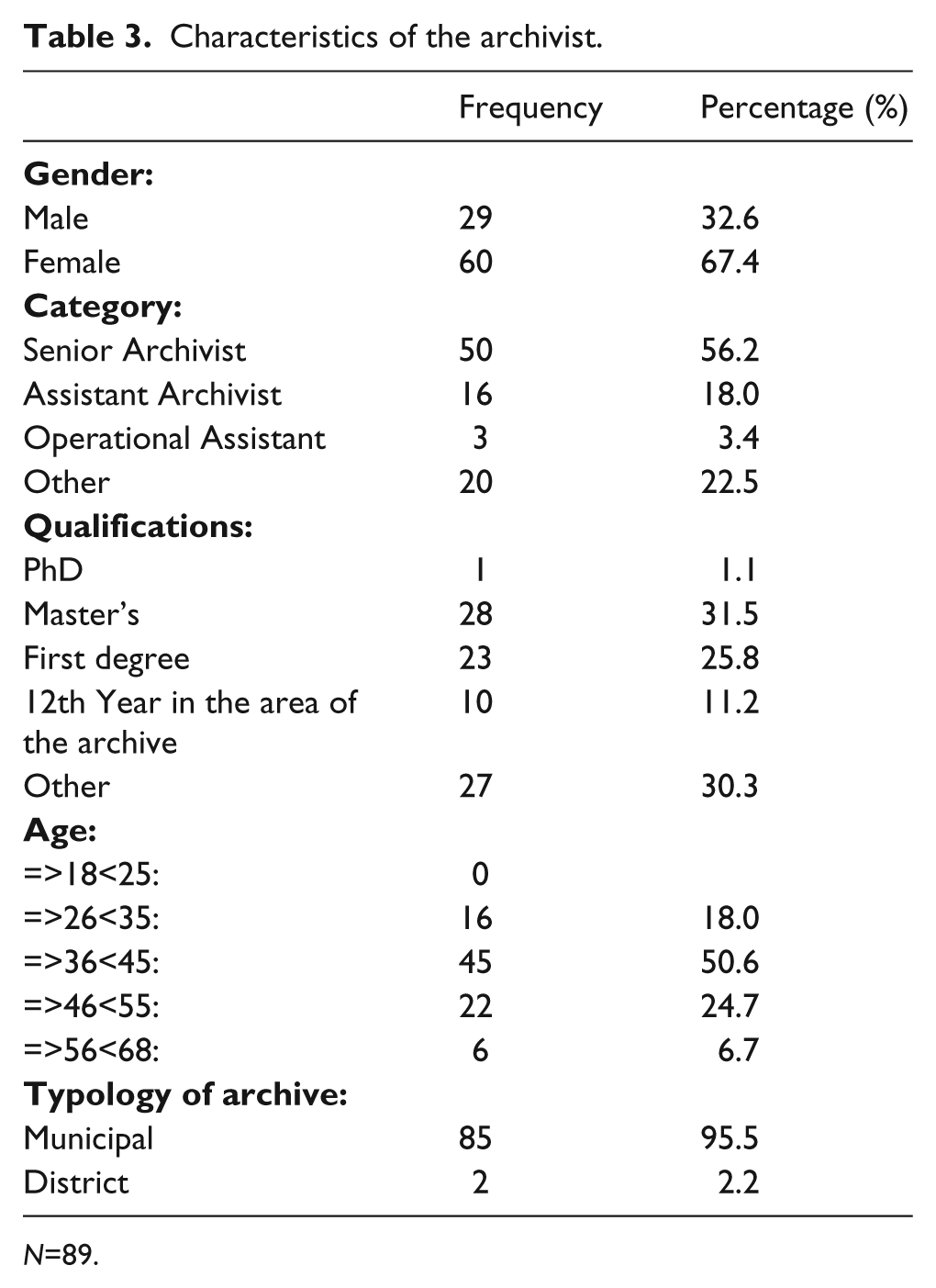
N=89.
Characteristics of the archive.
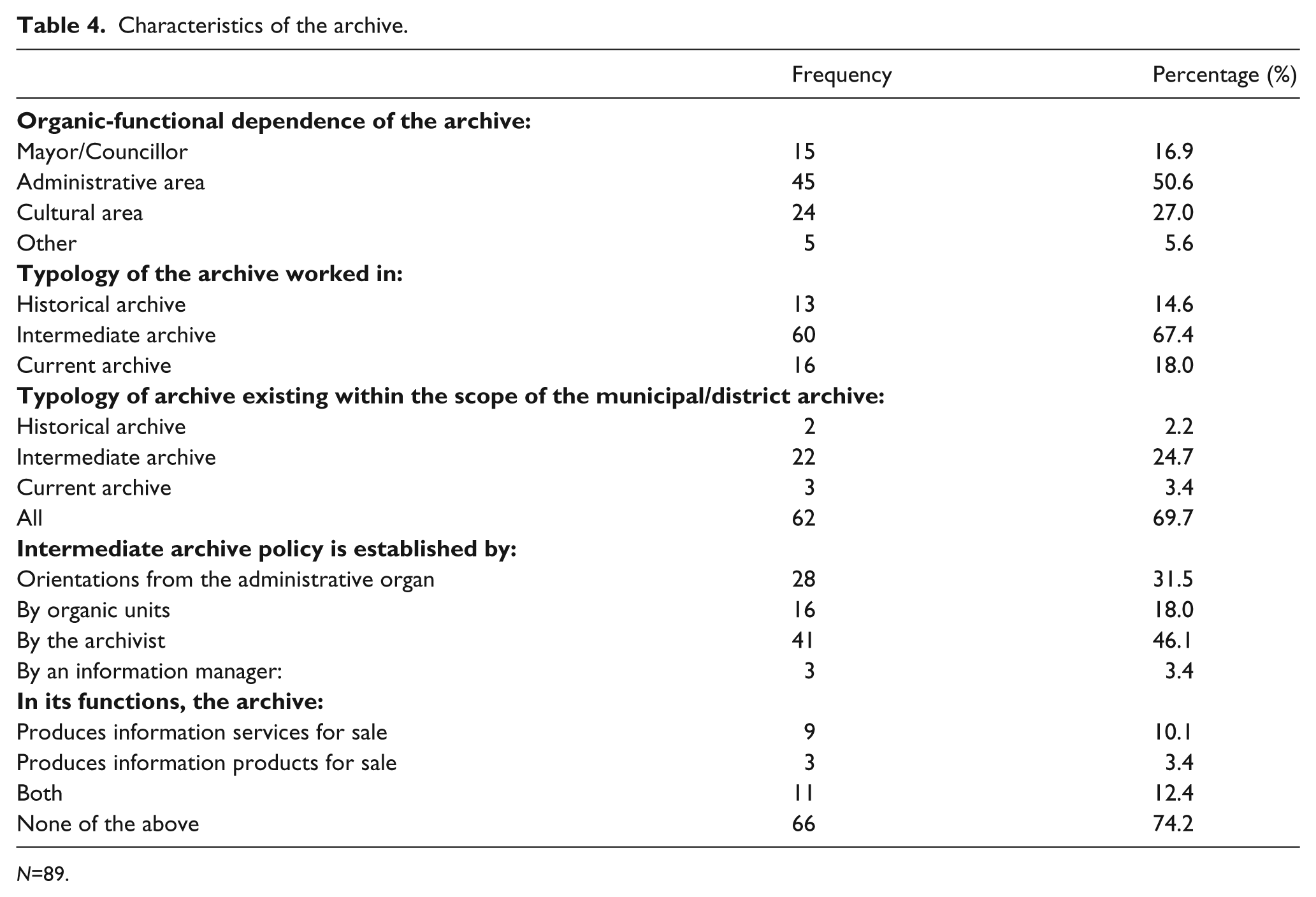
N=89.
Intrapreneurship practices in archives
In order to determine the existence of intrapreneurial factors and practices in the archivists in the sample, factor analysis was used. This statistical technique, according to Pereira (2004), sets out from an initial set of variables and tries to identify a smaller set of hypothetical variables.
The factors/practices of intrapreneurship considered overall in the archives studied and considering the classification of these factors’ agreement in terms of their average (expressed in Table 5), are all well above what would be expected, i.e. from 3 onwards, on a descending scale from 5 to 1, revealing a high rate of intrapreneurship. The tendency towards risk is therefore shown, indicating intrapreneurship.
Descriptive statistics of the results obtained and factor analysis.

KMO =0.704; Bartlett Sphericity Test: 369.768; g.l. =105; p <0.000 Fi (i= 1,2,…5).
Note: The Likert scale used had the following values from 1 to 5: 1 – Totally agree; 2 – Agree; 3 – Disagree to some extent; 4 –Totally disagree and 5 – No opinion.
Considering the mean values described in Table 5, we find the variable of ‘The archivist does not mind acting alone and getting his hands dirty. He knows how to delegate functions, but when necessary, he does it himself’, obtained the value of 1.596, i.e. the highest average agreement registered. This variable, together with ‘He has created a product/service inside his entity’, ‘He considers he would put into practice a personal project, as an archivist, to serve the entity’, and ‘He considers the archivist is a constructor of information directed to the market’, obtained the second, third and fourth highest means of 2.112, 2.135 and 2.236 respectively.
It is also of note that the variable of ‘There are conditions inside the workplace/archive that allow intrapreneurial practice’ had a mean value of 2.764. However, in next place emerges the variable of ‘The archive stimulates competitiveness in its archivists’, with a mean of 3.056, which gives cause for reflection.
Aiming to reduce the number of variables related to intrapreneurial practice in archives, as mentioned, factor analysis was performed. With the factors extracted and since there are five own values (Eigenvalues) above 1, using the Kaiser criterion, five factors are retained. The five factors together explain 64.11% of the variance of the initial variables.
In order to verify the internal consistency of the scales used in our survey, we calculated Cronbach’s alpha. Regarding intrapreneurship practices, the Cronbach alphas are between 0.557 and 0.829 (Table 5). According to Churchill (1979), for the type of exploratory study we undertake, Cronbach alpha values of 0.60 or higher are interpreted as acceptable. Also according to Davis (1964: 24), a Cronbach alpha is accepted as reliable above 0.50, for a forecast of groups of 25 to 50 individuals and DeVellis (1991) mentions that for some studies in social sciences, a reliability estimate of 0.60 is acceptable provided the results are analysed with reservations.
The designation attributed to these five factors/dimensions and a brief description and discussion of them now follows.
In Factor 1, in particular, Autonomy, pro-activeness, product creation and climate, the variables reflect intrapreneurial characteristics. There may be services or products that can be developed with a view to supporting entities and publics who seek them, but also to diversify income. Here, the archive encourages personal initiative, a particular premise of intrapreneurship. The products and services provided by a municipal archive include promoting access to administrative documents, with due care in adhering to the assumptions expressed in Law no. 46/2007, regulating access to administrative documents and their re-use.
A municipal archive being unique, and full of technical and technological resources and specialized personnel, the promotion of the creative and collaborative spirit should not be overlooked. Culture and access to information nowadays occurs in different ways, especially using digital resources. Pro-activeness in favour of development and dissemination of archive documents is imperative in an increasingly demanding information society with less time to waste. Indeed, according to Rodrigues and Marques (2008) and Fernandes (2012), archive services have a mission to promote the organization, access to and spread of information.
Therefore, in this factor/dimension, there is the perception that intrapreneurial characteristics exist, and they can be exploited with a feeling of pro-activeness and risk with proposals for new services, solutions and products to serve market research, and opinions about the formation of document and archive centres.
Regarding Factor 2, in Orientation towards goals, competence and risk, we have variables/practices reflecting orientation towards goals to be reached, feeling competent to deal with them and decision-making behind the hierarchy’s back. This factor demonstrates the opportunity for change, in the competences attributed and taking risks in favour of one’s organization. However, there is a certain inertia, which can be explained by a degree of disillusionment or lack of interest in the profession. Nevertheless, the archivist shows s/he is not afraid to get her/his hands dirty and do things her/himself, with this being the parameter that reached greatest consensus.
Indeed, in the variables in this factor, the archivist is seen to have no problem in dealing with more complex or hard to solve matters her/himself, and is therefore not reluctant to get his hands dirty. This is due to a large extent to the fact that document management, besides being an intellectual activity, is also a manual one with the organization of paper documents. In this connection, it can also be observed that archivists have already created products or services in their entity, something which is not really surprising, inasmuch as the resources they have available stimulate innovation and the search for something new, and also challenge their competence for the common good.
It is therefore noted that the risks of implementing or launching new services and products without the hierarchy’s knowledge are guarded against, but there is a willingness to take risks in a project they believe in.
As for Factor 3, Market, social and decision, includes ideas of the archivist as a constructor of information directed to the market and this professional is considered an intrapreneur. In this connection, we arrive at the conclusion that the archivist is not merely someone who stores documents, but an information professional seen increasingly as a constructor of information that can and should be directed to the market (Rodrigues and Marques, 2008). Indeed, as information represents transactionable goods, embodying power and decision, the archivist can develop new supplies of services and products for the market, with the raw material s/he has available, to make institutional or business options more efficient and effective. In fact, that situation is clear in her/his willingness to create her/his own product to serve the entity. S/he is moved by an intrapreneurial desire. That ambition is revealed in the variables analysed in relation to the factor in question.
However, Factor 4, Functionality and status, shows how the archivist, as an information professional, does not give great importance to her/his status and we should not underestimate her/his awareness of the increasing importance this profession will have in the future, particularly due to the growth of digital bases and the need for organization of this in favour of the organization’s efficiency and effectiveness.
The archivist firmly rejects the limited activity of merely organizing and conserving records of human knowledge. Indeed, in the variables providing this information, it is clearly shown that the archivist does not see her/himself as just an organizer of records of human knowledge. The duties s/he performs go far beyond a service of presenting documents to any department, but initiate a new stage of using, analysing, assessing, explaining, forming and supplying personalized, transversal, incisive and decisive information.
In Factor 5, Reward and competitiveness, the archivist is perceived to feel rewarded for performing his duties, which is natural if there are incentives and goals for these professionals to attain, whether of a monetary nature or not. But average competitiveness is observed in the area, this being a normal phenomenon and not unconnected to the precarious nature of work at present, and also the lack of appropriate categorization, despite the need to satisfy the specificities of the positions occupied, together with the prevalence of polivalence in public organizations, causing uncertainty and consequently greater efforts to achieve better functioning. Although archivists feel rewarded, there are not sufficient data to assess whether the type of reward is qualitative or quantitative. In fact, according to Eelsley and Longenecker (2006: 3), no collaborator will feel disposed to run risks and collaborate in creating opportunities for services or products if there is no reward system.
Nevertheless, we can gather that the feeling of reward archivists claim to have may not be enough to stimulate competitiveness, as it is not much exploited. It is assumed, however, according to the conclusion of Khan et al. (2011:10) that intrapreneurial activities have an impact on sales, profit and return on investment. It is therefore natural that the archivist feels rewarded by the activities created, developed or improved, with this always being an individual and casuistic analysis.
According to Khan et al. (2011: 2), intrapreneurs are people with a great sense of self-motivation, and are guided by a desire to innovate in services or products, within the limits of the organization. However, Sidje et al. (2013: 1) claim there are two indicators for intrapreneurship to be developed. The first is the perception held of organizational conditions and the second is intrapreneurial behaviour. In this connection, we can deduce that the absence of a single pattern in relation to intrapreneurship strengthens the possibility of one or both of these elements being missing.
Conclusions and implications
A study of this type applied to archivists in order to determine the existence of intrapreneurship in this professional class was revealed to be of the greatest importance. As the information and knowledge society is increasingly important for the economy, especially following one of the most serious crises in the history of Portugal, it is crucial to find out to what extent these information professionals are intrapreneurs within their entity, taking advantage of existing resources but also of their knowledge and competences to serve it. It was also important to assess existing conditions for intrapreneurial practices within cultural facilities such as Portuguese municipal and regional archives.
The aim of this study was to demonstrate how the archivist and all the professionals dealing with the archive can be intrapreneurs within their own organization, through their creativity and better services, stimulating their personal involvement and ingenuity to create products or new services. In this context, special emphasis was given to finding out if intrapreneurial practices exist among the archivists studied here.
The results showed that we are seeing a gradual change in work mentality and in the procedures of Portuguese archives and archivists, noting a certain awakening to the phenomenon of intrapreneurship. In identifying the main practices stimulating intrapreneurship in archives, it was possible to retain some innovative dimensions (factors) explaining this phenomenon: (1) autonomy, pro-activeness, creation of products and climate, (2) orientation towards goals, competence and risk, (3) market, social and decision, (4) functionality and status, and (5) reward and competitiveness. Indeed, conditions exist in archives and among archivists for intrapreneurship through the dimensions obtained.
Based on the empirical evidence, we also conclude there is no single way of being an intrapreneur, but it sets out from two strong arguments. In personal terms, there must be a behavioural disposition towards challenges and innovation and in organizational terms openness to error, releasing resources, new projects and a climate conducive to intrapreneurship.
The study also presents practical implications. From the evidence obtained, it is recommended that those in charge of archives and local authorities should stimulate intrapreneurship by implementing the following public policies:
Creating new services for the entity, without fear of making mistakes, because the mistake is the matrix of development.
Improving procedures and communication among peers, in order to share knowledge and build innovation, accept and listen to suggestions, because all have something to give and perfect, giving leadership new ideas, not sitting back and being aware that there is a return on all innovation.
Finding out about the entity’s mission in detail and how to exploit its objectives in full in creating services and products. Incentivize and motivate the whole team and organization in a project.
Promoting a culture of organizational growth, respecting all intellectual opinions in form and content.
Renewal of existing services and products and creation of others with gains for the public and customers. Be inventive and pro-active in processes, methods, methodologies and techniques.
Creation of appropriate departments to support decision-making in firms, courts, schools, associations and people, with segmented information/documentation, selected and treated with exclusively political, industrial, financial, agricultural, technological (essential to avoid initial mistakes with start-ups), judicial and commercial purposes, and about products and services, to be an inspiration to adapt, re-adapt and create or re-create something new. Innovation is the key.
Promoting and incentivising, issuing studies about the formation of document and archive centres, research about new concepts of cultural products, a personalized help service in academic projects, palaeographic translation on request, specialized Web programming directed internally to the archives and to differentiated information, specialized information products and contents according to sectors.
And finally, incentivise the challenge to create something new and original.
In this connection, much can be done in the archives, in organizational and structural terms. The road to intrapreneurship in archives and archivists is essentially travelled in the symbiosis between environment, resources and innovation, synoptically. However, underlying this essence is an organizational culture of mentalities, in terms of the disposition to learning and innovation, with the entity’s consent and with the individual’s idiosyncratic willingness to be an intrapreneur, in this case that of the archivist.
In spite of the insights gained, this study is not without limitations. One of them is the lack of specialized literature and essays connected to this specific area of intrapreneurship among archivists, perhaps due to the lack of sensitivity to the importance of these information professionals and what they can add in terms of economic value. Nevertheless, despite the difficulties felt in undertaking this research, the work was guided by the optimizing aspects of archivists and their competences, by their importance in society and by the intrapreneurial indicators/practices they possess, with the potential to use this conceptual aspect to serve their entity.
Our study also confirmed the existence of conditions for intrapreneurial practices in archives. However, we perceived a serious lack of knowledge in society about what archives and archivists do in general and exactly what their functional setting is in organizations, therefore suggesting this aspect should be studied in the future.
Furthermore, with archivists being information professionals with vast documentary knowledge in their keeping, it would be useful for future research to study the correlation between intrapreneurship and the concept of information consultants in Portugal, their differentiation and points of contact, in order to fill a gap and make contributions towards separating the archivist from an information manager, as an information consultant or information broker, despite both being information professionals.
Another suggestion, given the great void and difficulty in determining the degree of intrapreneurship between males and females in Portugal, would be to study its causes/effects/consequences.
Finally, as Reid (2010: 5) says, ‘access to an archive gives a person a greater sense of individual identity and his place in the country’s history. Archives help governments to govern, to build a sensible community, to learn inside and outside the classroom …’.
Footnotes
Acknowledgements
The authors thank the anonymous reviewers for their very helpful comments which contributed to developing this paper.
Declaration of Conflicting Interests
The author(s) declared no potential conflicts of interest with respect to the research, authorship, and/or publication of this article.
Funding
The author(s) disclosed receipt of the following financial support for the research, authorship, and/or publication of this article: The authors are pleased to acknowledge financial support from Fundação para a Ciência e a Tecnologia (grant UID/ECO/04007/2013) and FEDER/COMPETE (POCI-01-0145-FEDER-007659).