




Abstract
This paper examines the views of a group of experts on the term “information literacy life cycle” and the application of information literacy standards and models in the Ibero-American context. Using the Delphi method, it explores the views of a group of experts made up of INFOLIT academics and professionals. The results show that the concept of “life cycle” is not generally accepted by the participant experts, that there is agreement regarding INFOLIT essential stages and that the experts know and apply international standards and models on INFOLIT, alongside some models developed from their own countries. All in all, the paper aims to contribute to a broader international panorama on information literacy.
Introduction
The information and knowledge society puts forward information access as a requirement to close socio-economic gaps among people, countries and continents. It is an essential quality issue for professionals who are ready to learn every day how to do research and take decisions based on the use of appropriate and updated information; information that grows exponentially due to the development of information and communication technology (ICT), the emergence of new media, the development of virtual spaces and the rise of Web 2.0 and 3.0 services as a philosophy for information generation and use.
A new culture has emerged where each person, as an independent social being and as part of a whole that is society, has to prepare himself or herself in order to assume his or her role regarding life, profession and information use. For this, it is necessary to develop a process, in society as a whole, that evolves from traditional literacy to new forms of information literacy (INFOLIT) at all levels of the education system and within organizations for those who are already in the labor market. These approaches should also be aimed at particular communities, such as third age, people with visual impairments, disabled people, prison populations and other groups with particular social characteristics who have their right to access, use and organize information for their activities and own responsibilities.
In this sense, UNESCO states that the notion of literacy is now conceived as a complex and dynamic concept, a lifelong learning process, with contents and applications that are under constant revision and expansion. In the same way, UNESCO developed the programme “Information for All” (IFAP). 1 In the Information Literacy Meeting of Experts in Alexandria (2005) it was declared that “information for all” could not be achieved if we do not assume the need for “information literacy for all” (Garner, 2006). Therefore, the information literacy paradigm emerges as a process that gives each person the skills needed to use the available information in all its potentialities, anywhere, including libraries and virtual environments.
This paper aims to put forward the views of a group of experts from Ibero-America regarding two key concepts for the development of information literacy: firstly, the INFOLIT life cycle, and, secondly, the application of standards and models. This study is part of a Delphi macro-study that deals with several aspects on INFOLIT from the Ibero-American view (Ponjuán et al., 2015).
Literature review
Since the 1980s, diverse organizations have taken on an active role regarding the concept and components of information literacy. In this sense, the following definitions are clarifying:
IL is an intellectual framework for recognizing the need for understanding, finding, evaluating, and using information … (Bundy, 2004: 4) Information Literacy encompasses knowledge of one’s information concerns and needs, and the ability to identify, locate, evaluate, organize and effectively create, use and communicate information to address issues or problems at hand … (UNESCO-IFLA-NFIL, 2005) There are dozens, perhaps even hundreds of definitions of Information Literacy, and each author and organization lists its own component steps, stages or phases. Virtually all definitions, however, have in common one aspect, which is that there are several steps or stages through which the application of the Information Literacy process progresses, in a more or less progressive sequence. That is why we call this multi-stage process a “life cycle”. (Horton, 2007: 8–9)
The concept of “life cycle” comes from Natural Science and it is used in professional literature, from different viewpoints. Regarding Information Science, we should mention Hernon (1994), who provides a detailed analysis of the use of this concept in diverse areas. There are several studies on the data life cycle (Committee on Earth Observation Satellites-CEOS, 2011; Loshin, 2007), documents life cycle (Atherton, 1985-1986; Brooks, 1940), information life cycle (Burk and Horton, 1988, Hernon, 1994), and knowledge life cycle (McElroy, 2003; Wiig, 1993). The US National Commission on Libraries and Information Science (2002) used the concept to refer to the different stages or steps that have to be taken into account in information literacy.
Publications on INFOLIT standards and models are present in the international literature, but in Ibero-America the contributions on this topic are scarce. Therefore, this study is relevant in order to understand the situation there.
With regard to standards, those published by the American Library Association (ALA) (1989) are the ones mostly used internationally. This association has published diverse standards for specific sectors, such as Higher Education (ALA-ACRL, 2000a), Science and Technology (ALA-ACRL, 2000b), etc., identifying the stages that any person should manage in order to be considered information literate.
In Great Britain and Ireland, SCONUL (Society of College, National and University Libraries) (1999) created a working group on information literacy, which developed the model Seven Pillars of Information Literacy, revised subsequently (SCONUL, 2011).
In Australia, activities related to information literacy began at school libraries, from the 1970s, and from the 1980s in New Zealand. In 2000, the first draft of INFOLIT standards for Australia and New Zealand was presented by ANZIIL at a workshop developed in South Australia University (Bundy, 2004).
Martin (2013) carried out a study on innovative concepts and results for learning information literacy principles. The study analyses all these models and their different stages, and it assesses their interrelationship with diverse ways of learning. It also compares and relates each stage of the ACRL life cycle with the British models. And finally, it highlights a series of key materials drawn from the analysis of the four English language models (ALA, ACRL, SCONUL, ANZIIL):
A New Curriculum for Information Literacy (ANCIL, 2011)
Society of College, National and University Libraries’ Seven Pillars of Information Literacy (SCONUL, 2011)
A National Information Literacy Framework Scotland (Scottish framework) (Irving and Crawford, 2007)
Information Literacy Framework for Wales (Welsh framework) (Welsh Information Literacy Project, 2011)
It is significant that ANCIL defines the process according to diverse stages that begins with the student’s transition to higher education and reaches its highest point with the transition from higher education to the labour market (including daily life skills). These stages include:
transition from school to higher education
becoming an independent learner
development of academic literacies
mapping and assessing the information scene
discovering resources for each discipline
information management
information ethical dimension
knowledge presentation and communication
information abstracting and creation of new knowledge
information literacy social dimension.
The standards from different professional organizations always include the skills needed for each stage of the life cycle, and in some cases the indicators for the assessment regarding the achievement of the skills for each stage.
Besides prestigious international institutions, independent researchers have also investigated this topic. Thus, for instance, Erzegovac (1998) analysed the diverse skills that should be present in each stage of the INFOLIT life cycle:
the information need complex (IL1);
the search/access/interpretation complex (IL2);
the retrieval complex (IL3);
the evaluation/critical thinking complex (IL4);
the use/authoring complex (IL5).
The author includes these approaches in a programme locally developed, with a user-oriented view, and not from a technological perspective.
Catts and Lau (2008) constructed a very comprehensive view of information literacy indicators, that also reviews different models and the skills present at each stage of the INFOLIT life cycle.
Ibero-American countries work on the implementation of models and standards for information competences training developed in different contexts. As Lloyd and Williamson (2008: 9) put forward: “This suggests a new agenda for IL research, in particular: the importance of understanding how IL is conceptualized in a range of contexts deepening the understandings of the commonalities and differences of IL experience across a range of contexts”.
In Mexico, we should highlight the guidelines prepared by Cortés and Lau (2004), which gather the basic models that diverse agencies concerned with INFOLIT should know, focusing on institutions that are mainly academic. Tiscareño and Cortés (2014: 123) consider that “INFOLIT standards are a topic that specialized literature puts forward as essential for assessment, and though they have been designed mainly for programmes, they also provide a conceptual framework and guidelines to assess the information literate trainee” (our translation).
Generally, in Ibero-America the standards provided by the main professional associations have been used, as Uribe and Castaño (2012) explain. In Colombia, since 2006 EDUTEKA (n.d.) has striven to promote and update the Gavilán model, which is also used in other Latin-American countries. In Cuba, Quindemil (2010) put forward the MAIPIUC model (Information Literacy Model for the Information Professional at Cuban Universities). Also, Meneses (2010) proposed the ALFINEV model, oriented towards INFOLIT assessment for Cuban Higher Education.
In Spain, the model INFOLITRANS has been used in the context of higher education (Pinto and Sales, 2008; Pinto et al., 2009). The model is organized around three interrelated areas: facets, competences and skills. The four facets taken into account are: knowledge, technologies, resources and processes, that, from an applied INFOLIT proposal correlate with cognitive, informative-digital, communicate and strategic competences and skills. Also in Spain, the model IL-HUMASS has been used. It is oriented towards information competences self-assessment, which has also been used in some university centres in Portugal (Pinto, 2010, 2011; Pinto and Sales, 2010).
Consequently, thanks to the constant work of experts and professionals, the development and application of INFOLIT standards and models is being developed, still coexisting with user-education classical approaches. It is to be expected that in the coming years further research on the topic will be developed and new models will emerge according to each region or country characteristics.
Methodology
This paper provides the analysis of information collected through a second round of a Delphi study on information literacy in Ibero-America, aimed at gathering and interpreting the views of a group of experts, scholars and professionals on the information literacy life cycle and standards and models established for its implementation.
For this purpose, we have used a qualitative approach, due to the richness it provides in order to get “depth of ideas, extent, interpretative richness and contextualization of the phenomenon under analysis” (Hernández-Sampieri et al., 2010: 17, our translation). Delphi is a method for structuring a process of group communication that is effective in order to allow that group of people, as a whole, to deal with a complex problem (Linston and Turoff, 1975). Therefore, taking into account the different views from the participants, a deeper analysis is obtained.
For the data collection, we used an online questionnaire (hosted at an Apache server, and created with HTML, PHP and JavaScript), and a member of the research group took the role of chairperson. The questionnaire is available at: http://infocompetencias.com/cartografia2
Concerning the selection of the sample, we took into account the informants’ participation in research processes and the implementation of information literacy programmes. From the 52 experts that agreed to be part of the research, 43 experts, from 13 countries, distributed as shown in Table 1, fulfilled this second round.
Distribution of participants per country.

In order to decide the two subject categories to be dealt with (INFOLIT life cycle and INFOLIT standards and models), we developed a theoretical and conceptual review of the literature, and we also analysed other systems of related categories (Doyle, 1992).
Content analysis was carried out according to criteria proposed by Weber (1985), Bardin (1986), Berger (1991) and Clemente (1992). And the following principles were taken into account:
The data gathered through the questionnaire was interpreted from a contextualized and critical viewpoint.
We compared the convergence regarding the views of the experts of each region.
We determined the emergent concepts put forward by the experts regarding diverse categories.
In an Excel database, the answers offered by the experts were clustered for their analysis. Through this systematization, the relevant key points of the data provided by the experts were identified, authenticated and analysed, by means of tables that summed up the main aspects. Overall, the aim was to reply to the following questions: What is the main result taken from the experts’ viewpoints? Which theories support the experts’ approaches? And, which topics have the highest level of agreement?
Results
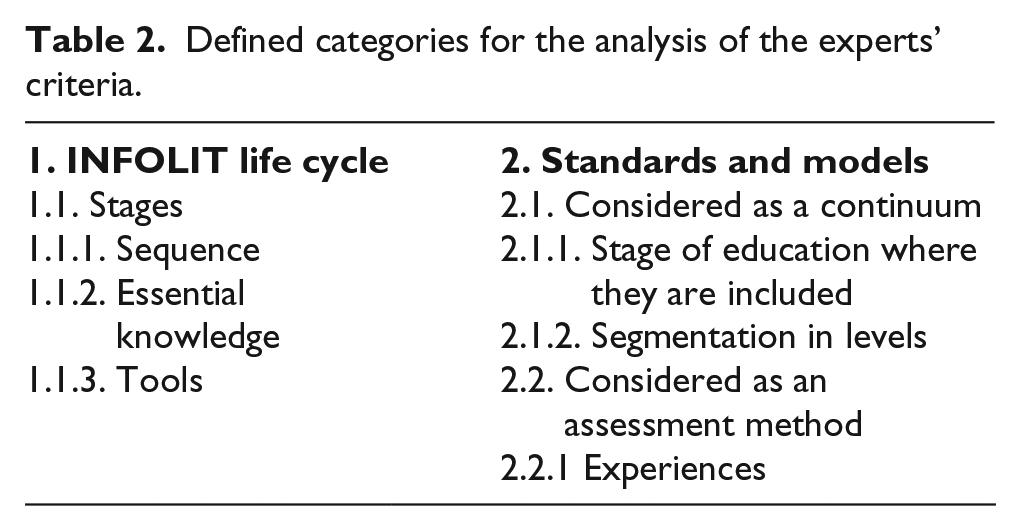
The results have been organized taking into account, on the one hand, the viewpoints on the INFOLIT life cycle, and, on the other, the standards and models supporting it (Table 2).
Defined categories for the analysis of the experts’ criteria.
INFOLIT life cycle
For the analysis of the criteria provided by the experts on the information literacy life cycle, we start from the following theoretical stance: information literacy is a process, made up of stages that allow the development of competences for the identification of information needs and the adequate management of information sources and resources. This has important implications for the social and professional development of people, because it promotes autonomy, critical thinking, values and a positive attitude towards lifelong learning. Rather than a paradigm, it is a philosophy that involves librarians, professionals and trainers in a learning process in order to maximize the benefits coming from information management and knowledge in diverse social areas.
Analysing the views of the experts on the concept “INFOLIT life cycle”, we perceive that there is no generally accepted use of this expression, because a significant number of experts (67%) considers that this is not the most appropriate term to define this process, as they consider it to be too extensive and uncertain in order to represent all the characteristics of the process. In this group we find experts from Spain, Costa Rica, Colombia, Peru, Uruguay and Chile.
It is interesting to listen to some statements by the experts:
2
I don’t agree with the term “life cycle”, it makes me think about something that begins each time, but I consider that anyone who begins the information literacy process acquires and incorporates skills that would not lead to the same beginning for each process of information searching, use and communication. I prefer to name it Information Literacy stages or modules. (Expert 5, Argentina) I haven’t seen very often that the INFOLIT stages are referred to as a “life cycle”. I prefer to name them stages or steps, and I would name the whole as a process. “Life cycle” seems too general a term. (Expert 15, Uruguay)
Of the experts, 25.5% agreed with the expression “information literacy life cycle”. Among them are all the experts from Cuba and Portugal. In the case of Mexico, Brazil and Argentina, the views are divided and diverse, according to the experts’ training and professional practice. Three experts (6.9%) did not reply to the question.
Some of the statements in support of the term include:
It is regularly used in training processes. (Expert 1, Argentina) I agree with this name because it is already widely used in other areas and it is quite understandable what it means regarding information competence. (Expert 10, Brazil) It is a wide concept and I agree with the term “life cycle” taking into account that the different stages and competences needed for a human being to be considered information literate are similar to the natural process of life, that is, they have to be developed in a progressive way. First, defining the need, then searching and assessing the sources, and so on. (Expert 21, Colombia) I consider that the “life cycle”, the phases or stages are related to the competences that have to be learnt to use information adequately throughout life. (Expert 39, Cuba) I agree with the name, indeed the stages have to be seen in a cycle because they depend on each other due to the integrative affect they have for the information literate person. (Expert 40, Cuba) As the life cycle of products (marketing) or from organizations (inputs – processes – outputs), I agree that lifelong learning processes are made up of stages (basic, intermediate, advanced) that open themselves to further complexity and participants’ awareness. I think that the structure of any programme for university students from diverse stages or life cycle makes more sense as a learning device and in order to assess processes between people. In INFOLIT, the processes of searching, analysis, communication and knowledge production involve diverse life cycles within learning contexts. (Expert 43, Portugal)
Notably, life cycle is associated, from a conceptual viewpoint, with a cyclical process that each person has to begin iteratively, and not as a sum of several moments that make up the information competences learning cycle. This is the main reason behind the experts’ disagreement with the term.
The contradictions that come from the very concept of information literacy are the basis for the objections raised regarding the concept of “life cycle”. Perhaps for this reason, in recent years those involved in this field have progressively searched for concepts that represent in a wider and more precise way the essence of a lifelong learning in which content is so diverse and changing as society develops.
Stages
Using a Likert scale (with values from 1 to 5), describing the different stages of Information Literacy, we asked the experts to point out their level of agreement regarding each one of them, and in which order they consider that the stages should appear, so that we could establish the importance given to each stage (Table 3).
Experts’ level of agreement regarding INFOLIT stages.
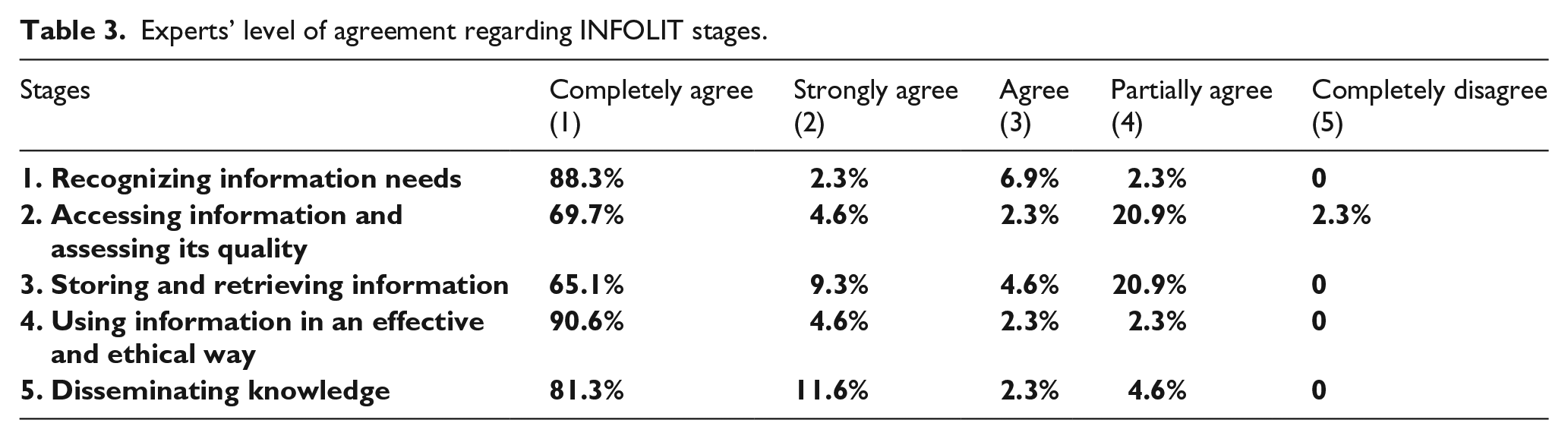
Of the experts, 74.41% agree with all the stages (ranging from the grades of Completely agree, Strongly agree and Agree). These experts come from the following countries: Brazil, Chile, Uruguay, Peru, Colombia, Mexico, Cuba, Portugal, Spain, Venezuela and Panama; 25.58 % of the experts disagree with some of the proposed stages.
It is significant that the 20.9% of the experts partially agree with the stage “Accessing information and assessing its quality”, providing the following statements:
Stages 2 and 3 should follow this order: locating, accessing, analysing, assessing the quality, storing and retrieving information. (Expert 6, Argentina) LOCATION is within ACCESS, and ASSESSMENT is related to information ANALYSIS. (Expert 17, Peru)
Though most experts declared that they completely agree with the five INFOLIT stages, the views provided show how complex and difficult it is to fit all the edges of this reticulated process into the given stages. The stages statement itself does not clarify the knowledge and skills that people should learn. Furthermore, the stages statement does not include the aspects that have been added as a result of the development of the information and ICT society.
Essential knowledge for each stage
In order to complete the view regarding INFOLIT stages, the coordinators of this study provided a list of knowledge issues that experts should relate to each stage, and we asked each participant to offer his or her own viewpoint. The results are shown in Table 4.
Knowledge issues proposed in INFOLIT stages.
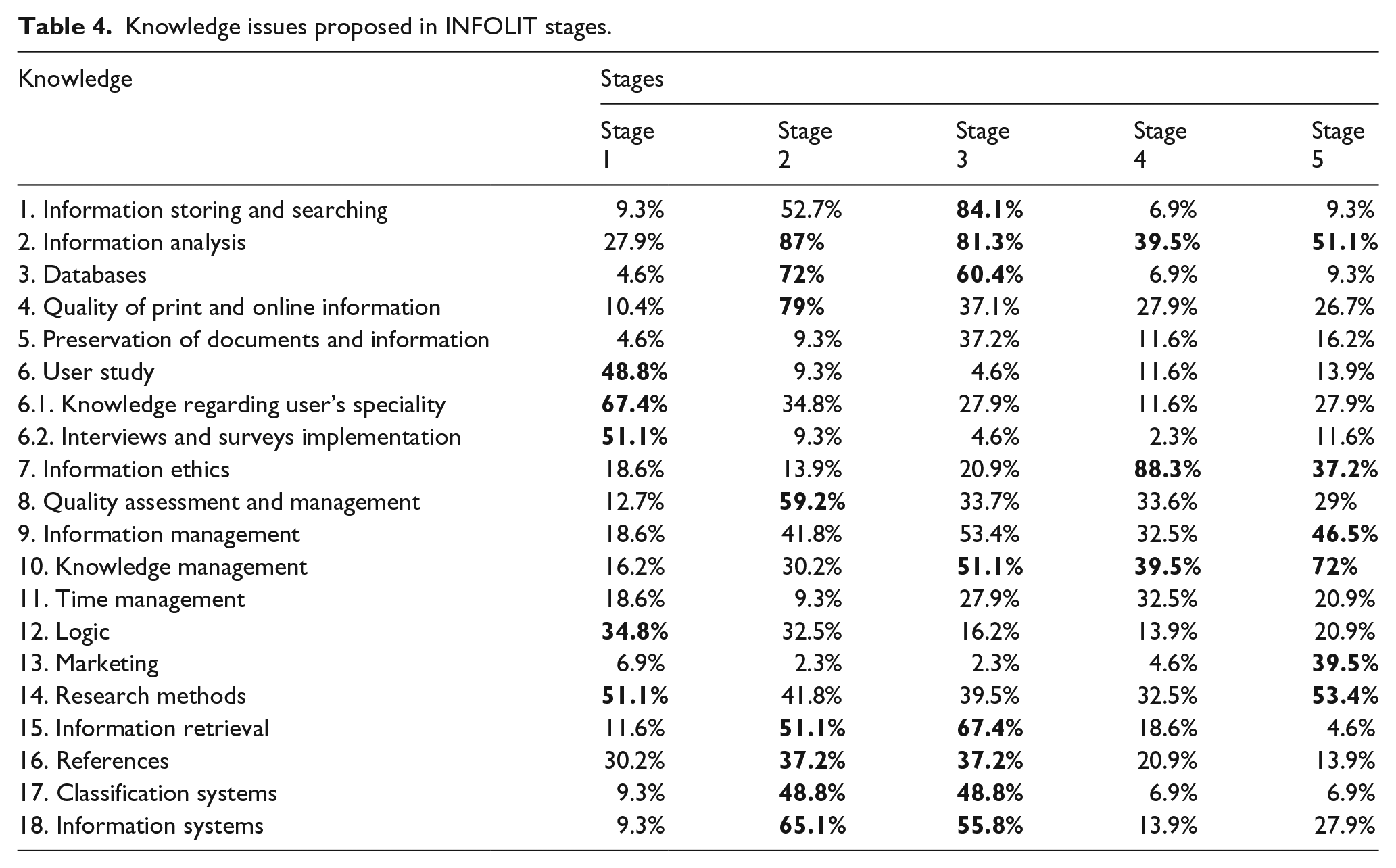
The analysis of the results regarding the knowledge needed for each information literacy stage allows us to conclude the following:
For Stage 1. “Recognizing information needs”, experts consider that the most important knowledge is that regarding the user’s speciality, user studies, interviews and surveys implementation and research methods. Also, experts (32.5%, from Spain, Portugal, Mexico, Peru, Brazil) think that there are more knowledge issues in this stage, related to the context where the information need is located, the knowledge of keywords, information sources, cognitive processes and information value.
For Stage 2. “Accessing information and assessing its quality”, the experts mainly identify the following knowledge issues: information analysis, quality of print and online information, and also assessment and quality management. To these issues, the experts (30.2%, from Brazil, Uruguay, Peru, Colombia, Mexico, Portugal, Spain) also add the following: technological surveillance, statistics, publication quality and basic thinking processes.
For Stage 3. “Storing and retrieving information”, the experts put forward knowledge related to storing and information searching, analysis and information retrieval. Eleven experts (25.5 %, from Brazil, Uruguay, Peru, Mexico, Portugal and Spain) suggest other issues related to information representation, information cycle, use of information managers, relevant content mapping and data mining.
For Stage 4. “Using information in an effective and ethical way”, the experts declare as essential knowledge regarding the ethics of information. Of the experts, 23.2% (from Uruguay, Peru, Mexico, Portugal, Spain, Brazil) also mention aspects related to authors’ rights, citation systems and the social and legal dimensions of each practice.
For Stage 5. “Disseminating knowledge”, the highest value is for knowledge related to information analysis, information and knowledge management and research methods. Of the experts, 37.2% (from Uruguay, Peru, Mexico, Spain) mention mass media, social media, information products design, Web 2.0 and collaborative work.
Regarding the order of the stages, some divergences arise in relation to the proposed criteria (location, assessment, retrieval and storing), essentially due to the competences model on which each expert has his or her theoretical basis and the field where they develop their work.
However, it is important to highlight the relevance the experts provide to the stages as essential tools in order to structure any training process on information competences, with a theoretical approach based on three main points:
The stages represent the process and they encompass the contents related to the learning goals of the information competences training programmes.
Each stage varies depending on its content.
Stages are not absolute. On the contrary, as part of a dialectic cycle (INFOLIT life cycle), their contents are related in a continuous flow of knowledge acquisition, skills development and creation of attitudes towards information use, both within professional contexts and social contexts in general.
Association between knowledge and fields
The results provided in Table 5 show a strong tendency to associate knowledge with the fields of Librarianship, Information Science, Documentation and Knowledge Management. As can be observed, the knowledge issues that get the highest scores are directly related to information treatment, storing, analysis and quality, closely attached to the information literacy life cycle.
Association between knowledge and fields.
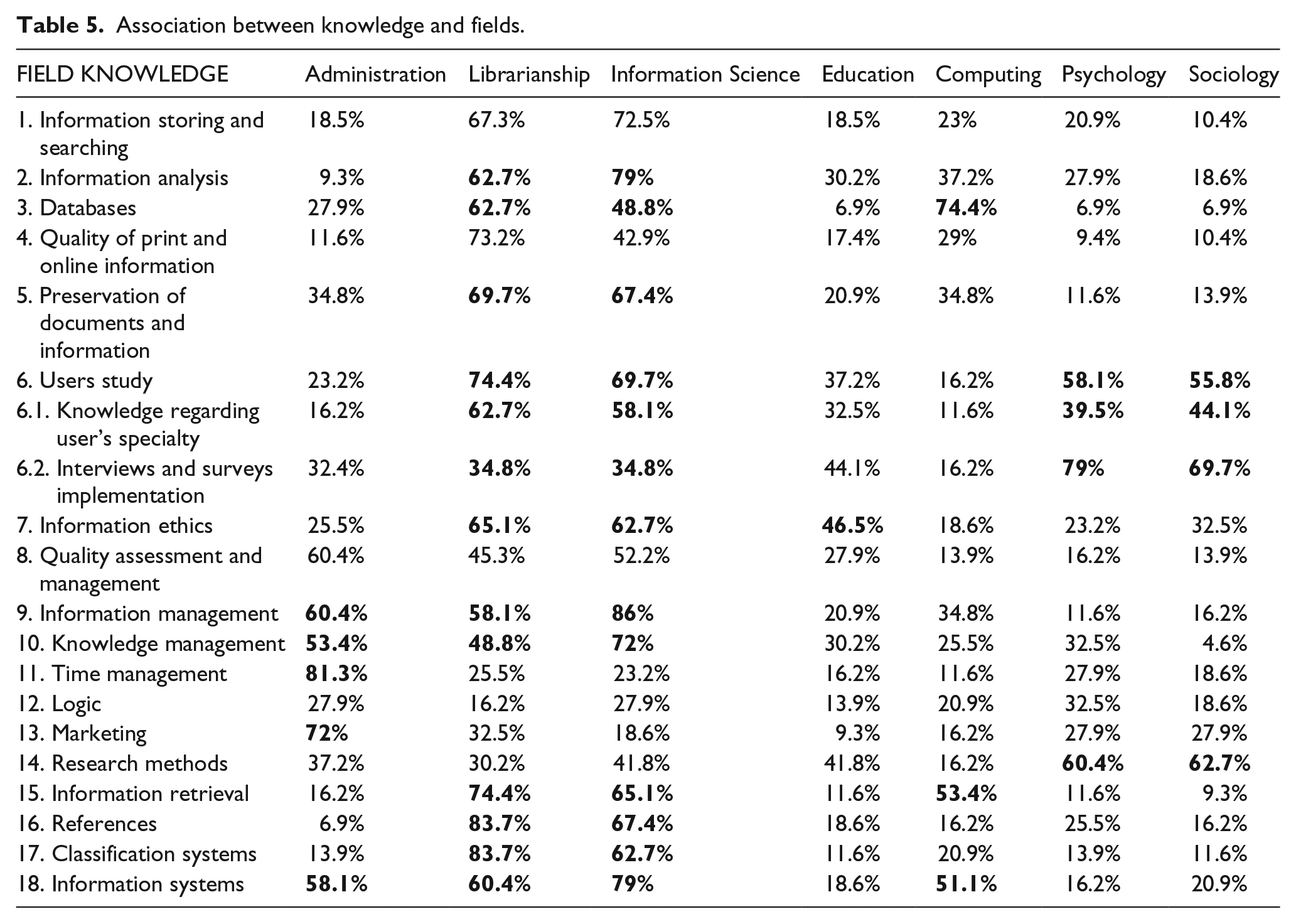
In a somewhat contradictory manner, the analysis shows high levels of dispersal regarding the experts’ criteria, when they associate a knowledge issue with all fields at the same time. This fact could be due to, on the one hand, the expert’s training to give a hierarchical structure to those knowledge issues that have been part of his or her professional training according to the subject matter and the final purpose, and, on the other hand, it can be due to the inter- and transdisciplinary features of the INFOLIT process and its approach as a complex phenomenon.
Use of tools
INFOLIT tools, described in Table 6, arising in the practice of diverse disciplines and fields, have been taken up by information literacy scholars and used in the development of INFOLIT stages. However, the literature on the usefulness of these tools for information competences training is scarce. Experts assume that all the tools mentioned are useful in different moments of information literacy development.
Relationship between INFOLIT stages and tools that could be applied.
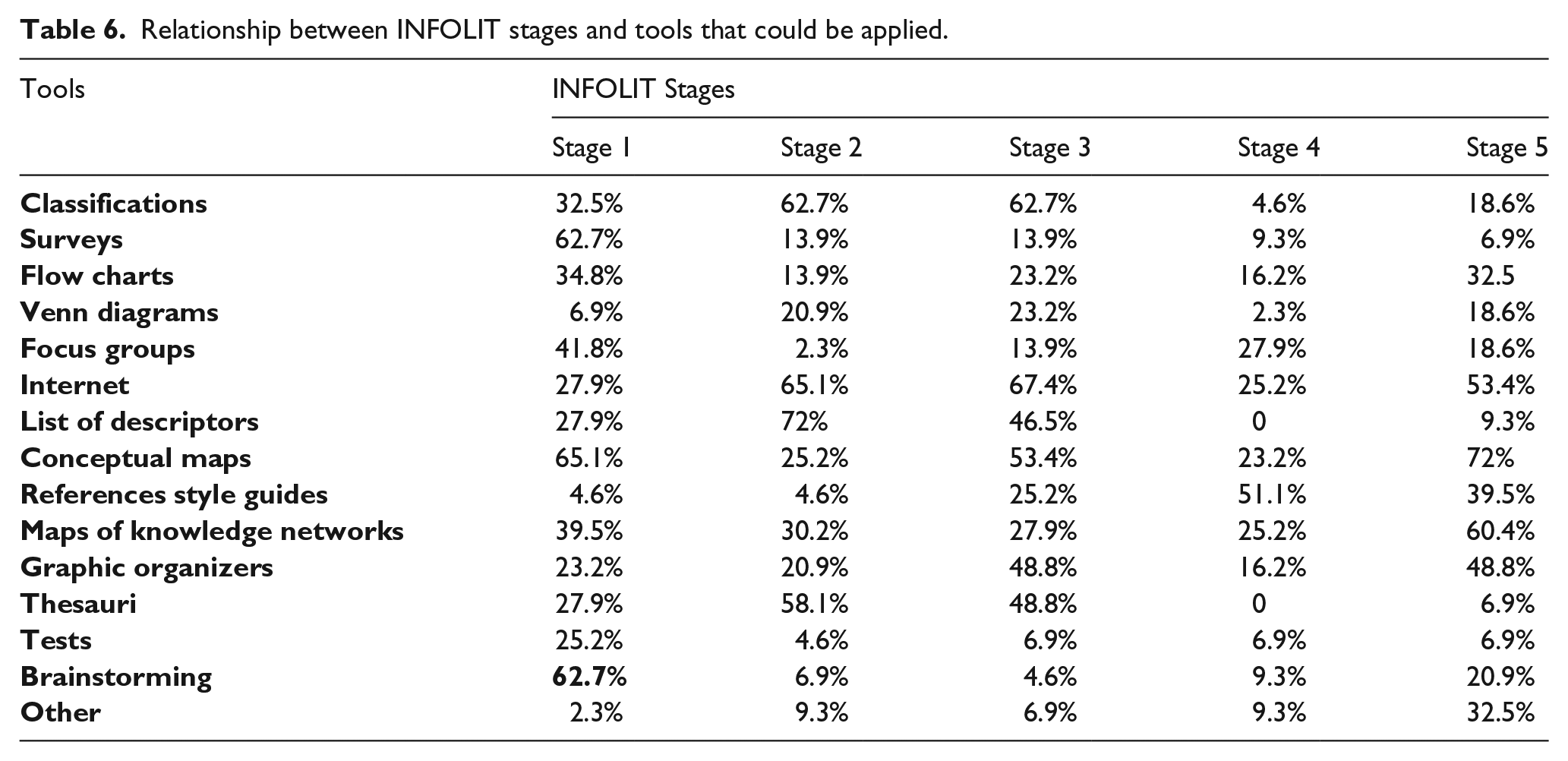
The results show that for Stage 1, “Recognizing the information needs”, experts emphasise the use of surveys (62.7%), conceptual maps (65.1%) and brainstorming (62.7%).
For Stage 2, “Accessing information and assessing its quality”, experts highlight the usefulness of the Internet (65.1%) and classifications (62.7%).
This is similar to Stage 3, regarding storing and searching, where the Internet is considered as the key tool for locating information sources, which is supported by the undeniable spread of ICT tools and the opportunities that the Internet provides for access and exchange among communities of users.
In Stage 4, “Using information in an effective and ethical way”, experts emphasise focus groups (27.9%), the Internet (25.2%) and knowledge network maps (25.2%); while for Stage 5 (dissemination knowledge), the highest scores highlight conceptual maps (72%).
When they refer to other tools, experts put forward, in a variety of ways, the need to have a tool that may take into account criteria or indexes to assess the information included in diverse media. Furthermore, they highlight the use of reference managers and software for processing text and spreadsheets. The experts also mention diverse ways to implement, from libraries, information literacy training issues that, though they could not be considered as tools, are basic for this process, such as: guided tours at the library, workshops, courses, learning portals, lectures and different methods of communication.
Information literacy standards and models
The debate on information literacy standards and models began with the following question: Do the experts agree with the idea that information competences are a continuum, due to the required skills at diverse levels of behaviour and also due to their integrative nature?
All the experts agreed with this statement. Some of their views are the following:
These are lifelong competences. (Expert 2, Argentina) They made up a learning process that includes skills, knowledge and values, related to a social and contextual dimension that is constantly changing. (Expert 10, Brazil) It has to be included in all training process. (Expert 15, Uruguay) It develops in a progressive way, beginning with basic competences that have to be further developed. (Expert 21, Colombia). INFOLIT is a life style, as to be trained and cultured. (Expert 26, Costa Rica) Information literacy is not a fixed goal to be achieved but rather a continuum made up of skills, knowledge and efficiency related to information use, and developed through increasing levels of command. (Expert 36, Mexico) It is a lifelong process … new knowledge is progressively integrated regarding ICT, information sources, reference managers and media. (Expert 39, Cuba) They are gradual, contextual and evolutionary. (Expert 46, Spain)
There are some representative concepts that emerge from the experts’ statements:
They are part of lifelong learning.
They make up a group of values related to a social and contextual dimension that is constantly changing.
They are included in training programmes and have to be adapted to each group or each person.
They follow a gradual transition that crosses all the training stages of a person.
They should be encouraged from pre-school education, enhanced in primary education and become consolidated in higher education.
It is a continuous, progressive and developmental activity.
It is a continuum of skills, knowledge and efficiency regarding information use, developed through increasing levels of command.
It is contextual, gradual and evolutionary.
A high proportion of the experts participating in the study agree that this continuum can span primary education to postgraduate education (81.3% of the experts on pre-school, 90.6% on primary education, 95.3% on secondary and 93% on graduate and postgraduate), as can be observed in Table 7.
Experts’ level of agreement regarding the presence of INFOLIT at the different education levels.
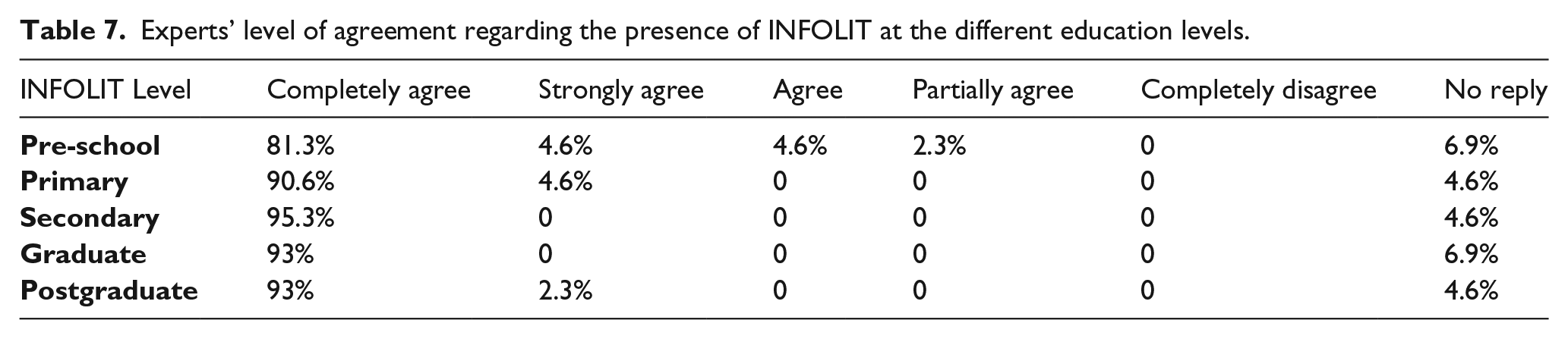
When we asked the experts their view of the possibility that information competences could be divided into different levels, 79% of the experts considered that the levels should be basic, intermediate, high and advanced; 4.6% did not agree with any segmentation level; and 6.9% did not agree with the advanced level; 9.3% did not reply to this question.
Regarding the possibility of giving priority to some competences at the four levels, the experts provide diverse views, displaying a disparity at this point. In general, they consider that all the competences should be taken into account for the four levels, and what has to vary is the depth they are dealt with. These are the main priority proposals, according to the level:
They consider that at this level it is necessary to include basic topics related to services, essential concepts, and the relevance of information as a resource for development and research; Computing competences are given priority; How to determine the information need/search/access is included.
development of information skills; Besides the basic level competences (how to determine the information need/search/access) it is necessary to add assessment, ethical use, knowledge creation and communication; how to identify the usefulness of information; use of online catalogues, databases and electronic resources.
Besides the basic and intermediate competences (how to determine the information need/search/access, assessment, ethical use, knowledge creation and communication) it is necessary to add skills in the management of technologies and the development of abstracting skills; cognitive skills (assessment, abstracting, and reflection), speed, confidence, problem solving, decision making, innovation, creativity; use of Web 2.0 tools; knowledge application.
self-sustainment skills; knowledge integration; problem solving; decision making; becoming an information literacy trainer; knowledge transfer.
The study also dealt with the knowledge the experts have regarding information literacy diverse standards and models. As can be seen in Table 8, they know and apply to some extent all the standards and models mentioned. According to the results, the Big6 is the best-known model, together with SCONUL and Seven Faces of Information Literacy, both at the level of institutions and of countries. When analysing the level of application at institutions, the proportion is low for all standards and models, and thus we may interpret that the standards and models are known but not used. If we analyse application in each country, Big6, SCONUL and Seven Faces of Information Literacy also take the first positions.
Experts’ knowledge and application of standards and models.
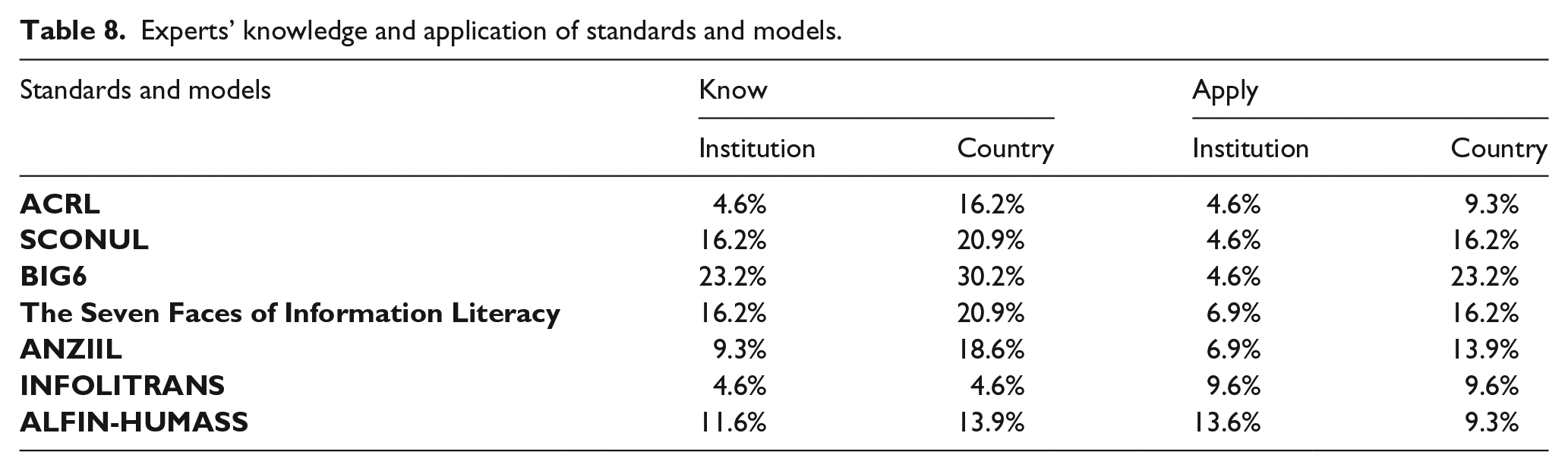
Regarding the experts who state they know the standards and models even though they are not applying them, it seems to be that the reason is the lack of institutional policies that may support the implementation of information literacy.
The experts also pointed out other standards and models that are regularly used in different contexts:
Loertscher Search Circular Model (Brazil)
Gavilán model (Brazil and Uruguay)
Marland model (Peru)
Tuning Project Recommendations for Latin America (Panama)
DHI/Mexico Standards, 2002 (Mexico and Costa Rica)
C12/ Working Group CRUE/TIC and REBIUN (Spain).
Out of these, those that are repeatedly mentioned by the experts are the Gavilán model (Brazil and Uruguay) and the DHI Standards, from Mexico.
Regarding the application of standards and models, we asked the experts if this could be useful as a method for the assessment of information competencies. Of the experts, 60% (from Spain, Mexico, Cuba, Panama, Colombia, Argentina, Brazil, Peru) considered that in general the standards and models were useful for this purpose, and 9.3% (from Argentina, Brazil and Spain) did not consider them as an assessment method; 30.2% of the experts did not reply to this question.
Finally, we asked about positive or negative experiences regarding the application of assessment, and the results were as follows: 48.8% declared some experience in this sense, 18.6% of the experts from diverse countries (Argentina, Chile, Uruguay, Peru and Venezuela) declared they did not have any experience, and 32.5% did not reply to this question.
The positive and negative experiences described by the experts regarding the application of standards and models are shown in Table 9.
Experts’ experiences with the application of standards and models.

Other views put forward by the experts regarding standards, models and their assessment dealt with their relevance in order to guide the information competences training process and the fact that it is necessary that these standards and models be adapted to the application context. They also added that this process has to go beyond the circle of information scholars and professionals, and it is necessary to use them in a more extensive way. Their application, all in all, should reach beyond the academic context.
Discussion
In a network of diverse concepts and views, this paper has analysed key aspects related to information literacy’s definition as a “life cycle”, the stages within this cycle, the knowledge involved in each stage, the fields related to this knowledge, the use of particular tools at different stages and the knowledge of INFOLIT standards and models.
Regarding the expression “INFOLIT life cycle” we observed the existence of diverse views. Revisiting the literature on this topic, it can be observed that there are also divergent positions on the term. According to Ward (2006: 397) “the concept of information literacy has always involved problems on its definition” while Duziak (2010: 18) similarly states: “There are barriers for the full comprehension and use of the concept. Firstly, due to the lack of general agreement regarding the term and its meaning…” (our translation).
Catts and Lau (2008: 16) began to see the concept as related to a cycle when they stated that:
The various IL standards share the principle that IL skills are a continuum both in terms of the capacities required at different levels of human endeavour, and also in the sense that the elements are utilised in an integrated fashion, rather than as a strictly linear process.
This fact seems logical, because it is related to the contextual perspective of each expert participating in the Delphi study, and his or her professional profile (librarian, teaching staff, researcher, communicator, educator, technologist, and so on). In Nazari’s (2011: 1) opinion:
This implies that IL means different things to different people and in different contexts, hence in order to conceptualize and practise it in different contexts, we need to holistically understand the context in which IL is designed. This requires a methodological approach that produces such a holistic and contextualized picture of IL.
When comparing the contents related to each INFOLIT stage, it can be observed that the literature on this topic shows several models that try to frame the content of each stage from different viewpoints (ALA/ACRL, 2000a, 2000b; ANZIL and CAUL, 2004; Bruce, 2003; Bruce et al., 2006; Council of Australian University Librarians, 2001; Markless, 2009; Markless and Streatfield, 2007; SCONUL, 1999, 2011). Nonetheless, since it was first coined by Zurkowski (1974), the essential elements that make up information literacy have changed and the technologies supporting it have developed. Thus, in a systematic manner, new challenges add to the process of information competences training.
In this context, in order to handle the complexities of today’s information environment, what is needed is a broad, multiple and complex concept of literacy. It should include all skills-based forms of literacy, but without limiting itself to them or to any particular technology or set of technologies. (Pinto and Sales, 2008: 416)
Regarding the essential knowledge for each stage, the experts considered that all the items present in the list we provided are relevant. Moreover, they also provided other knowledge aspects from diverse fields, reaffirming the interdisciplinary nature of information literacy. According to Shenton and Fitzgibbons (2010: 171):
The information professional should not be reluctant to draw upon concepts that have arisen in other disciplines to increase the width and appeal to learners of IL teaching. The introduction of ideas from other fields is, in fact, a growing trend in IL and one indicative of the area’s increasing maturity.
An analysis from the diverse dimensions of INFOLIT stages necessarily demands to be dealt with from the theory of complexity (Morin, 1992), as the idea is to find common points in concepts that come from diverse knowledge fields. This is a process where different elements (people, entities, and structures made up of several levels and activities) come together.
Regarding the order of information literacy stages, the results show that experts usually arrange the stages as follows: identification of the information need, locating, accessing and assessing, as found in many standards derived from the development of this process at an international level:
IFLA Guidelines (Lau and Cortés, 2004): define the information need, locate, assess.
SCONUL (1999): skill to recognize the information need, skill to distinguish the different ways for information treatment.
ALA/ACRL (2000a, 2000b): define the nature and scope of the information need, access.
CAUL (2001): define the nature and scope of the information need, access and assess.
ANZIL and CAUL (2004): define the information need, locate and assess.
According to these results, it can be stated that we are facing a complex and varied process, which requires a particular analysis in each context, to get an appropriate application of the standards and models that have arisen as a result of its development in diverse regions of the world.
Information literacy is not a linear process, as the Association of College and Research Libraries (ACRL, 2013a: 7) has explained:
Some models imply the information literacy process as step-driven and linear when in actuality individuals use different information literacy skills, at different times, with varying levels of sophistication. Adhering to a linear, fixed process alienates an individual from an authentic learning experience…
The value and priority of information literacy training processes for each individual have been highlighted in the analysis carried out by the experts participating in this study. This goes beyond the professional and personal development, and requires an analysis focused on the social dimension, that to a certain point is included in the five trends published in the last IFLA report (2013):
New technologies will both expand and limit who has access to information.
Online education will democratise and disrupt global learning.
The boundaries on privacy and data protection will be redefined.
Hyper-connected societies will listen to and empower new voices and groups.
The global information economy will be transformed by new technologies.
The concept of “transliteracy”, proposed by ACRL (2013b: 11) for the academic context, may contain the full scope of this topic:
Transliteracy is an emerging concept that challenges the current structures of information literacy and scholarly communication programmes alike. Transliteracy provides us with the new concept that may actually describe the most pertinent types of collaborations librarians with expertise in teaching and scholarly communication issues could develop to serve the needs of the next generation of students and scholars.
These previous arguments, which devise INFOLIT as a complex and varied process, are reinforced if we share the experts’ views when they refer to information competences as a continuum. There is a clear tendency to relate information competences with lifelong learning, enhancing INFOLIT as transversal and permanent in the social and professional development of each individual, as described by Webber and Johnston (2000), ANZIL and CAUL (2004) and Lloyd (2005).
By way of conclusion
This Delphi study has made it possible to discern the knowledge and use of INFOLIT standards and models in Ibero-America through the views of experts, taking into account both the standards and models internationally used as well as those developed in Ibero-America. In this regard this study fills a gap in the literature of the field.
The results indicate that all the participant experts, who refer to the ambiguous nature of the concept, do not use the concept of “life cycle”. This is not the case with the concepts of “phases”, “stages” or “information competences”, which are known and accepted by the professional community in Ibero-America. Also, there is a consensus about the fact that the essential stages of information literacy are: recognizing the information need, locating information and assessing its quality, storing and retrieving information, using information in an effective and ethical way, and disseminating knowledge. The experts do not completely agree about the order of the stages, and the most discussed stages regarding order are location, access and assessment.
We may conclude that in order to develop information literacy, knowledge from diverse fields is certainly needed, and this reaffirms the interdisciplinary and transdisciplinary nature of this process. Ibero-American experts generally agree that information competences are a continuum, and the debate on this fact includes the concept of lifelong learning and the need to relate INFOLIT training to specific contexts.
Finally, it becomes clear that the international INFOLIT standards and models are known. The most used are SCONUL, Big6 and Seven Faces of Information Literacy. But the experts also mention, consistently, the Gavilán model (Brazil and Uruguay), and DHI Standards, from Mexico. The usefulness of INFOLIT standards and models as an assessment method for information competences is also generally acknowledged.
The development of information competences training processes in diverse contexts of Ibero-America and the evolution of the very concept of information literacy is a challenge for librarians and scholars, who need to investigate the process. The diversity of models, approaches, definitions and tools are a source of knowledge and a topic of study that still needs to be discussed and applied. Research studies related to this topic need to be developed by colleagues from diverse disciplines and they should put forward the best practices, derived from the implementation of information literacy programmes beyond the English-speaking sphere in order to extend a matter of global interest. This is just a first step.
Footnotes
Declaration of Conflicting Interests
The author(s) declared no potential conflicts of interest with respect to the research, authorship, and/or publication of this article.
Funding
The author(s) received no financial support for the research, authorship, and/or publication of this article.