



Abstract
The study investigates whether information-seeking behavior models and theories obtained in previous research are applicable to more complex tasks. It also aims to gather students’ opinions on the importance and helpfulness of various traditional and online information sources in their thesis-writing process. This study would help to develop a better understanding of the roles and impacts of these information sources in the current networked academic infrastructure. Inspired by the Information Search Process model, we divided the process into six stages and conducted three separate surveys that covered students’ feelings, thoughts and actions, as well as other important factors that might affect their behaviors in each of the stages. Our study shows that both the feelings and thoughts of students changed during the different stages of the process, and that they were generally consistent with the descriptions in the Information Search Process model. The study indicates that it is beneficial to use the Information Search Process model as the starting point for studying the student thesis-writing processes. As the outcome of the study, we ultimately proposed a multi-stage model for Chinese undergraduate students’ thesis-writing process.
Keywords
Introduction
Seeking and using information has been an important behavior in people’s professional lives and leisure activities. In recent decades, with the rapid development of the Internet and information technologies, studying people’s information behaviors has become an active research topic. Ever since the beginning of human–information interaction, academic users and individuals interacting with academic information have been one of the most frequently studied user groups (Talja, 2002). There are three main clusters of studies on academic information behaviors. The first focuses on academic users’ common information-seeking behaviors. Such research often studied user groups, such as researchers, graduate students, domain-specific professionals and experts (Chaudhry and Al-Sagheer, 2011; Feng et al., 2011; Frias-Martinez et al., 2008; Jamali and Nicholas, 2010; Makri et al., 2008; Talja et al., 2007). The second cluster of research focuses on specific academic search engines, academic information portals or resource navigational sites (Nicholas et al., 2006). The third type is interested in a specific academic task, and examines scholars’ information-seeking behaviors in that task (Du and Evans, 2011).
The study presented in this paper belongs to the third type. We are particularly interested in one type of academic task that all undergraduate students in China have to perform: their senior year final project and thesis writing. As a major outcome of their studies, and before they can be awarded a Bachelor’s degree, every undergraduate student in China has to conduct a final thesis project with an adviser, and write and successfully defend their thesis. The final project and thesis writing (in short, “thesis writing”) usually lasts for several months, and often consists of selecting an adviser, writing a project proposal, conducting the project, and writing and defending the thesis. Therefore, this task is a complex academic process with a clear starting point and final outcome. It is an activity of mass participation, so any insights into understanding and supporting student information behaviors in this task would be of great benefit to a large number of undergraduate students in China.
Although there have been many studies on information behaviors in academic tasks in other countries, few studies have been conducted on Chinese students undertaking long and complex tasks. Our study aims to learn about Chinese students’ thesis-writing process so that we can obtain insights on guiding the thesis writing. For instance, an important objective of our study is to obtain students’ opinions on the importance and helpfulness of various traditional and online information sources in their thesis-writing process. This helps us to develop a better understanding of the roles and impacts of these information sources in the current networked academic infrastructure.
Among the many information behavior models developed over the years, several have the potential to provide theoretical guidance in our study. We selected Kuhlthau’s Information Search Process (ISP) model. Kuhlthau (1991) proposed the ISP model, now widely used, based on a study of college students’ information seeking over six years. In this model, a user’s information-seeking process is divided into six stages: Initiation, Selection, Exploration, Formulation, Collection, and Presentation. At each stage, the model also describes users’ feelings, thoughts, and specific actions for completing those stages (see Figure 1).

Kuhlthau’s ISP model.
We believe that the stages presented in the ISP model and the inclusion of users’ feelings, thoughts, and actions can provide us with appropriate instruments to capture the information behaviors of undergraduate students in their thesis writing. As a complex process, it is probably better to divide the thesis-writing process into multiple stages, and students’ feelings, thoughts and actions on various information sources can all be considered in the study.
In addition, the ISP model has been expanded and applied in previous studies to describe academic information-seeking tasks (Gu, 2008; Hyldegård, 2009; Van Kampen, 2003). We acknowledge that the ISP model was developed to represent an information search process, whereas Chinese undergraduate students’ thesis writing tends to be a much more complex process that can take much longer. Therefore, there is a question of whether and to what extent the ISP model can be helpful in this study, and this is one of the research questions that our research will address. We do not question the validity of the ISP model.
In summary, our paper focuses on studying the information behaviors of Chinese undergraduate students in their thesis writing, and we use the ISP model as the starting point to help us analyze the stages of the entire seeking process.
In the remainder of this paper, we first summarize the relevant literature, and then describe our research design. In the following sections we analyze and discuss our results. We present our conclusions in the final section.
Literature review
Academic information behaviors
There are three main groups of studies on academic information behaviors. The first focuses on the information-seeking behaviors of academic users, such as researchers, graduate students, domain-specific professionals and experts. The studies in this group include:
Research based on disciplines. Talja et al. (2007) found that different disciplines have varying research cultures, which have different effects on the use of electronic resources. Jamali and Nicholas (2010) investigated the effect of interdisciplinarity and the distribution of literature on the methods used by scientists both for keeping up to date and for identifying articles. In a survey of 114 doctoral students and staff, they found that those in the more interdisciplinary subfields and the disciplines with more scattered literature are more likely to use general search facilities, but that cross-disciplinary use of the literature is not necessarily an indicator of scattered literature.
Research based on professions. Chaudhry and Al-Sagheer (2011) studied the information behaviors and information needs of journalists in the areas of politics, culture, commerce, and sports, using a sample survey. Makri et al. (2008) used grounded theory to study lawyers’ academic information search behaviors, based on the Ellis (1989) model. Their results identified the phases and corresponding characteristics of lawyers’ information-seeking behavior.
Research based on users’ cognition. Frias-Martinez et al. (2008) utilized Riding’s (1991) cognitive style theory to divide users into different cognitive styles. They analyzed the connection between digital library users’ behaviors and their cognitive styles in the user experiment. Feng et al. (2011) divided users into field-independent and field-dependent groups, according to the Cognitive Style Figure Test. They asked users to complete a number of tasks in a simulation experiment to investigate different search strategies that students with different cognitive styles have when performing a database search.
The second group of studies on academic information behaviors has focused on specific academic search engines, academic information portals, or resource navigational sites. For example, Nicholas et al. (2006) conducted a large-scale log analysis of users’ behaviors when using electronic academic journals in two digital libraries: Emerald Insight and Blackwell Synergy. Employing deep log analysis (DLA) techniques, they studied the information-seeking behavior of nearly three million users, with the focus on the extent to which they penetrated the site, the number of visits made, and the type of items and content they viewed.
The third group of studies examined scholars’ seeking behaviors in a specific academic task. Some are based on real research projects; for example, Du and Evans (2011) studied the characteristics of real academic tasks and users’ information search strategies when conducting those tasks. Other studies have used methods based on virtual tasks set by the researchers in experiments to obtain the user logs for data analysis.
Application of the ISP model in academic information seeking
The ISP model reflects users’ feelings and behaviors during the information-seeking process. It has been widely applied in previous studies to model academic information-seeking tasks. Kracker (2002) found that a 30-minute presentation of Kuhlthau’s model could reduce the anxiety that is often associated with research paper assignments for novice researchers. Based on Kuhlthau’s ISP model, Van Kampen (2003) studied doctoral students’ mood changes when searching for information. He found that users in the first and third stages of the ISP model often had the strongest feelings of anxiety. Whitmire (2003) explored the relationship between undergraduates’ epistemological beliefs and their information-seeking behavior on the basis of the ISP model and four models of epistemological development from educational psychology. He found that epistemological beliefs affected several stages of the ISP model: topic selection, focus formulation, focus formulation, and collection. Beheshti et al. (2014) studied the information behavior of 44 Grade 8 students from the beginning of their class history project to the final presentation. Their study identified five factors that constitute information behavior characteristics (goals, knowledge of information management, consultation, positive emotions, negative emotions); these provide a stronger concept-based framework for future development of the ISP model.
Through the literature review we found that studies on academic information behavior have touched on various aspects of the academic information-seeking process, and considered factors such as disciplines, professions, and cognitive styles. However, no studies have investigated information behaviors in relation to complex academic tasks such as the thesis writing undertaken by Chinese undergraduate students. Thus, our study makes a novel and unique contribution to the literature.
Research design
Thesis-writing process
Thesis writing is a standard requirement in almost all universities in China. It takes place in the spring term of undergraduates’ senior year. Thesis writing is one of the most important steps in undergraduate training, and is viewed as a capstone component in undergraduate curriculum design that combines teaching, research, and practicum.
In general, the thesis-writing process involves several important steps. Initially, there are interactions between students and their potential advisers on selecting a research direction and focusing on a particular research topic for the thesis. Students then conduct the research project, and draft and revise their thesis. Finally, there is a formal defense for each student in front of a panel of faculty members.
Using the ISP model as the starting point for modeling the process, we divided the thesis-writing process into six stages, each of which reflected a stage in the ISP model (see Table 1). These six stages of thesis writing are:
research direction selection, where the students start to explore with their advisers the possible areas for their thesis projects;
topic identification, in which the students decide on the specific topic they will work on;
project execution, in which the students review the relevant literature and work on the necessary tasks for completing the project;
initial thesis draft writing, in which the students work on the first draft of their thesis;
thesis revision and finalization, in which the students revise and finalize their thesis; and
thesis defense, in which the students prepare and pass the formal defense of their thesis.
Relationship of the three surveys and students’ thesis-writing stages and steps.

However, we do acknowledge that although the ISP model gives us some guidance on this division, it is an open research question to see whether these six stages we proposed are reasonable and accurate.
Our second research question aims to obtain insights into undergraduate students’ feelings and thoughts, and into their use of information resources during the thesis-writing process. Again on the basis of the six stages, we try to understand whether their feelings, thoughts, and usage will change in different stages of the process.
In order to conduct our study, we recruited 69 senior year undergraduate students from the School of Information Management at a Chinese university, whose specific subject areas include library science, archival, information management and systems, publishing and e-commence. Of these, 59 finished the whole experiment, and three participated in the final interview. Because the students all come from areas related to Library and Information Science, we acknowledge that the outcomes of our study will be confined to understanding Chinese undergraduates’ thesis writing in this domain.
We employed two methods for collecting data from participants. The first involved three surveys on the same group of students on 25 March, 10 May, and 31 May 2013, while the second involved focused interviews with some of the participants.
Questionnaire design
In order to ascertain students’ feelings, thoughts, and actions in the different stages, the study we conducted contained three separate surveys, each of which covered roughly two stages, to reflect any inaccuracies in our model and the lack of clear boundaries between stages. As shown in Table 1, the first survey was conducted after the first two stages when the students moved from starting the selection of research directions to finishing the identification of a research topic. The second survey focused on the next two stages, which roughly covered project execution and initial thesis draft writing. The final survey targeted thesis revision and finalization, as well as the final thesis defense.
All three questionnaires were specifically designed to elicit participants’ views in four areas: their feelings in the particular stage, their thoughts on the tasks in that current stage, the actions they had taken, and the factors/information sources that had affected their behaviors in this stage. The questions were either single-choice questions or Likert scale questions. For example, in the second questionnaire we specifically designed the following questions to ask for the participants’ inputs on the project execution stage, of which the main task was to collect and read related literature:
Before starting to write the initial draft of your thesis, and during the process of collecting and reading related literature, what are your feelings? The choices for the students to select included: (a) progressing smoothly, feel happy; (b) cannot accurately express the information needed, encountering problems, so feel unhappy and anxious; (c) feeling confused and uncertain, and want to abandon the project.
Before starting to write the initial draft of your thesis, and during the process of collecting and reading related literature, what are your thoughts on your research design? The choices included: (a) have a comprehensive understanding of the research topic, the organization of the collected data, the basic layout of the thesis, and the proper research method; (b) am still in the process of understanding the research topic, the layout of the thesis is still vague (only have a rough outline), and the research method is not yet decided; (c) have absolutely no idea how to proceed.
Before starting to write the initial draft of your thesis, and during the process of collecting and reading related literature, what is the importance of the following information sources in helping you to understand the research topic? The choices of information source included: (a) search engines such as Baidu, Google; (b) Google Scholar; (c) Wikipedia, Baidu Baike; d) discipline-oriented academic portals; e) library databases; f) community-based Q&A sites (such as Baidu Zhidao, Yahoo! Answers); g) general website portals such as hao123.com.
Before starting to write the initial draft of your thesis, and during the process of collecting and reading related literature, how important are the following factors in affecting your research design? The choice of factors included: (a) retrieval skills for using search engines; (b) the findability of target information sources; (c) the number of collected information sources; (d) the recency of the collected information sources; (e) the subject areas of the collected information sources.
Similar sets of questions were also designed for each of the other five stages.
Structured interview design
After the students’ thesis defense, we conducted structured interviews with three participants using either online video conference tools or face-to-face meetings. All participants in the interviews had completed all three questionnaires. The goal of the interviews was to further understand the six stages in the thesis-writing process, and to ascertain whether or not these six stages are useful in modeling the thesis-writing process, and whether or not they are consistent with the ISP model. The questions asked during the interview included:
What is the participant’s view of his/her own thesis-writing process? Were there clear major stages in the process? If yes, what are they?
How was the thesis topic decided? Was it easy or difficult to decide on the topic?
What kind of preparation did the participant do between deciding on the topic and starting to write the initial thesis draft? Were there any difficulties?
What did the participant do between the initial draft and the final submitted thesis?
What did the participant do to prepare for the thesis defense? Were there any difficulties in the defense?
These were all aimed at gathering information that would be hard to collect from the questionnaire, but that would be useful in further understanding the thesis-writing process and its connections with the ISP model.
Data analysis methods
Our data analysis method included both quantitative and qualitative analysis methods. In the first questionnaire we collected basic information such as the student’s discipline, job perspective, etc. We used SPSS to perform relevant statistical calculations on the answers to each question, and used ANOVA for further statistical analysis. We used the ATLAS.ti qualitative analysis tool to code the interview recordings using content analysis methods.
Result analysis
Students’ feelings during the thesis-writing process
In their responses to the questions about their feelings in the research direction selection stage, 66.7% of the participants selected “identified ideal research direction, feel confident on the topic, and feel relaxed”; 26.1% stated that they “do not understand the selected research direction, and feel great pressure about it”; and 7.2% felt that they “have not found the right research direction, feel worried about the topic.” These results demonstrate that the majority of the participants were relatively sure about their work, which differs from the ISP model, in which the main feelings of users at this stage are uncertainty and apprehension because they first become aware of a lack of knowledge or understanding.
During the second stage – the selection of the research topic – 58% of the participants felt that “they have confidence that they can finish their thesis, so feel relaxed”; 31.9% felt that “they feel the time pressure, and the difficulty of the research topic, and feel a bit nervous”; and 10.1% felt that “they do not know where to start, cannot finish the thesis on time, and feel great pressure.” Comparing these feelings to those in the previous stage, the number of the participants who felt confident had dropped, and the pressure had increased. This is again different to the ISP model, because the feelings at this stage should be moving from uncertainty toward more positive feelings according to the ISP model.
The feelings in the third stage – project execution – varied greatly. At this stage, 45.8% stated that they “cannot accurately express what information they need, they encounter difficulties, so they feel low and anxious.” This change of feelings from more positive to negative ones is consistent with the third stage of the ISP model, which states that the users feel awkward, “unable to express precisely what information is needed”, and feelings such as “confusion, uncertainty, and doubt” (Kuhlthau, 1991).
In the fourth stage, once the students had started to write their initial draft of the thesis, 74.6% stated that “their uncertainty and doubts diminish and confidence increases.” This is consistent with the ISP model, which states that users in the formulation stage often feel uncertainty diminished and confidence increased.
In the fifth stage, during the finalization of their thesis, 52.5% of the participants stated that there were not too many revisions in their drafts, so they felt at ease and happy. However, 42.6% felt that there were still many revisions to work on, so they were slightly worried. The number of the participants who felt confident was certainly lower than in the previous stage, although it was still more than half of the participants. Therefore, it is consistent with the ISP model to some extent, which states that users’ confidence continues to increase as uncertainty subsides with increased interest in the project.
With regard to the participants’ feelings in the final stage, 78.7% said that “they feel relaxed about the thesis, but feel somewhat nervous toward the defense.” This again is consistent with the ISP model.
Overall, we observed that the students’ feelings changed in the course of the thesis-writing process, which suggests that the ISP model can be helpful in pointing out the importance of users’ feelings in relation to their information behaviors. However, we acknowledge that it would be incorrect to directly map the ISP model’s six stages into our study, particularly in terms of the early stages of thesis writing.
Students’ thoughts during the thesis-writing process
We also identified from the results the changes in students’ thoughts over the different stages. When they were asked about their thoughts on selecting research directions in the first stage, 73.9% of the participants selected “somewhat familiar, have taken related courses before.” This is to some degree consistent with the ISP model, which states that users’ thoughts in the initiation stage are around contemplating the problem, comprehending the task, and relating it to previous experience and knowledge.
When moving from general research directions to identifying specific topics in the second stage, the participants mostly thought about their own interest in the topic, the difficulty of the research topic, the requirements in terms of knowledge competency, and the accessibility of the relevant information (see Figure 2). The importance of these factors in this stage is consistent with the ISP model, which states that users’ thoughts in this stage “center on weighing perspective topics against the criteria of personal interest, assignment requirements, information available, and time allotted” (Kuhlthau, 1991: 278).
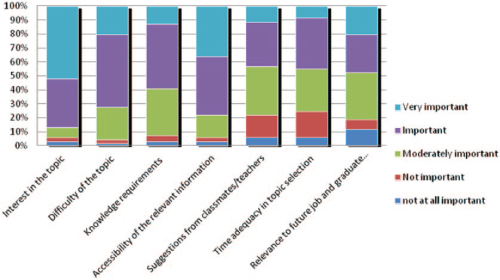
Factors affecting students’ thoughts in identifying a research topic for thesis writing.
In the stage of project execution, when asked about their thoughts on their research design, 69.5% of the participants selected “forming rough and vague focus, but still no concrete research method yet”; 28.8% selected “fully decided on the focus, collected relevant materials, formed a focus and research method.” Only 1.7% said that they “have absolutely no idea.” The ISP model states that users become oriented and sufficiently informed about the topic to form a focus or a personal point of view; thus, our results are consistent with the ISP model.
After starting to work on the initial draft of their thesis, 69.5% of participants stated that they have a “rough overall understanding of the thesis, and still need further clarity”; 30.5% thought that they had a clear understanding. This is consistent with the ISP model.
While revising and finalizing their thesis in stage five, 50.8% of the participants selected “data analysis results or experiment results are a little inconsistent with the hypotheses and theory,” and 45.9% selected “the outcomes of the results are clear, the methods are appropriate, and the result analysis is consistent with the theory and hypotheses.” These thoughts can be classified as being centered on defining, extending, and supporting the focus, which is consistent with the ISP model.
In the final stage, 82% of the participants thought that “they know reasonable well about their thesis in terms of structure and content, but still want to prepare more for the defense.”
Overall, it seems that the thoughts of the students changed a great deal over different stages, but the trend is the same as that described in the ISP model, moving from vague to focused, with the participants’ interest definitely increasing during the process.
Stages in the thesis-writing process
In addition to using students’ feelings and thoughts to help us to understand the different stages of thesis writing and comparing it with the ISP model, we interviewed several participants to ask for their views on the whole process. Using qualitative content analysis method and working with ATLAS.ti 6.0, we encoded the content with the focus on these participants’ views of the tasks they performed in each stage (the encoding result as shown in Figure 3). Based on this initial coding, we grouped the codes that are similar, and ended up with six major tasks that can be viewed as the stages. They are:
topic selection;
related work review and collection;
investigation and analysis;
writing initial drafts;
finalizing thesis; and
defense.

Coding of tasks mentioned in the interviews.
Based on the content analysis in this section and the results in discussed above, we can see that most students experienced six stages in their thesis writing, although the final classification and labeling of the stages is different to our initial naming. That is, there is no clear distinction between selecting research directions and identifying topics, but there is a specific investigation and analysis stage. Mapping this to the ISP model, it seems that the first stage (Initiation) and second stage (Selection) are often completed at the same time without a clear boundary. However, overall the sequence of most of the stages is roughly consistent with our initial modeling of thesis writing based on the ISP model. Therefore, the undergraduate students’ thesis-writing process can draw inspiration and some guidance from the ISP model, though the ISP model is not completely accurate for modeling purpose.
Factors and sources affecting students’ information behaviors in thesis writing
In this part of the analysis we focus on answering the second research question and consider the characteristics of students’ information behaviors.
Helpfulness of various information sources in the thesis-writing process. Among the various information sources, we asked for the participants’ views on seven sources in particular:
general search engines (GSE);
online academic databases such as Google Scholar (ODB);
online encyclopedias such as Wikipedia and Baidu Baike (OEC);
domain-specific academic portals (DAP);
library databases (LDB);
community-based Q&A sites (CQA); and
general website portals (GWP).
As shown in Figure 4, library databases (LDB) are viewed by the participants as being the most helpful information source in the thesis-writing process: around 90% of the participants thought LDB helpful or very helpful. This is consistent across the three stages for which we collected this information. General search engines (GSE) are overall the second most helpful information source; however, their helpfulness decreased as the thesis writing progressed. The same decrease in helpfulness was also observed in the participants’ view on online databases (ODB), which was viewed as the third most helpful information source in the research direction selection stage. Domain-specific academic portals (DAP) started as a moderately helpful information source in the research direction selection stage, but their helpfulness increased throughout the process of thesis writing. Online encyclopedia sites also started as a moderately helpful information source, and their helpfulness remained relatively constant across the whole process. Community-based Q&A sites (CQA), despite being interesting social web services, were relatively low in terms of helpfulness to students, although their helpfulness did increase a little by the end of the process.

Percentage of participants who view the source as being helpful or very helpful.
Importance of various factors in students’ information behaviors in thesis writing. In order to complete the entire thesis-writing process, students must complete certain tasks or obtain necessary outcomes at each stage. A number of factors can play influential roles in students’ decision making during the completion of these tasks. For example, in research direction selection, our participants demonstrated that they first focused on whether they were interested in the research direction, and whether the direction was related to their future job or graduate study. In addition, they were also interested in selecting the right advisers, including how much they knew about the adviser, the adviser’s research interests and reputation, etc. (see Figure 5). The goals expressed by the participants all related to discovering their needs, which to some degree means that in the thesis-writing process, selecting a research direction is like the ISP model’s task in the initiation stage (i.e. establishing the main direction of an information need).

Importance of different factors in students’ research direction selection.
During the project execution stage, in which students read widely and collect articles that are potentially useful to their thesis, the participants identified “retrieval skills for using search engines” and “accessibility of the target information sources” as the two most influential factors; whereas “the number of collected information sources,” “timeliness,” and “topic type” are the next tier of influential factors (see Figure 6).

Factors that affect students’ literature review in the project execution stage.
During the stage of writing the initial thesis draft, one important task is for students to form their own understanding of the research topic. Our experiment results show that the importance ranking of the information sources for this task is: latest development of the research topic in the literature >> related studies >> research history >> experts’ opinions >> definition of the concepts (see Figure 7).

Importance of information sources for forming students’ understanding of the research topic.
Also during the stage of writing the initial thesis draft, the participants remarked that stating their research opinions clearly is the action most often conducted, followed by deciding on the research plan or raising the research hypotheses, then using various appropriate methods to obtain data for analysis, and finally comparing the obtained results with the hypotheses or theories (see Figure 8).

Frequency with which actions are conducted in writing the initial thesis draft.
In the stage of revising and finalizing their thesis, the participants identified that the most influential factor is the adviser’s suggestions; tracking the relevant topic, understanding the defense requirements and mastering search engine skills are close to each other in the second tier. Following experts’ opinions is the least influential factor (see Figure 9).

Factors that influence revising and finalizing the thesis.
In the final stage – thesis defense – our study showed that the most important factors include familiarity with the defense requirements, understanding the thesis content, and talking to advisers and classmates. Tracking the latest developments in the relevant research topic and following experts’ opinions are viewed as much less influential (see Figure 10).

Factors influencing the preparation of the thesis defense.
Overall, there are many factors that affect students’ information behaviors in thesis writing, and the actual factors and their frequency vary greatly in the different stages. These factors include traditional as well as online sources. This demonstrates that thesis writing is a complex process that involves many parties collaborating with each other.
Discussion
Our study demonstrates that Chinese undergraduate student thesis writing is a complex process that involves multiple stages. Inspired by the stages in the ISP model, we started with a six-stage division of the whole thesis-writing process. Although we subsequently changed some aspects of the six stages, in general this multi-stage view of the whole process helped us to capture the different tasks, actions, and goals of the students at various points of the progress. Another important way in which the ISP model helped is in the examination of students’ feelings and thoughts. Our study shows that both the feelings and thoughts change according to the different stages of the process, and in many parts of the stages are consistent with what is described in the ISP model. Therefore, it is beneficial to use the ISP model as the starting point for studying the student thesis-writing process, although caution should be taken in applying the model in a situation for which it was not intended.
Proposed student thesis-writing process model
Based on the results obtained in our study, we propose the model shown in Figure 11 for the Chinese undergraduate student thesis-writing process.

Proposed model for the student thesis-writing process.
Our study demonstrates the importance of specific information sources in the student thesis-writing process. Despite the existence of various online resources, library databases were still viewed by almost all the participants as the most helpful information sources for thesis writing, and this was the case throughout the whole process. In contrast, generic search engines were only the second most helpful information source, and their helpfulness decreased as the thesis-writing progressed. Online databases, another set of sources that are viewed as a replacement for library databases, were considered only the third most helpful information source in the thesis topic selection stage, and were actually felt to be even less helpful in later stages of the process. All these findings demonstrate that library services and library resources are still essential in students’ academic life, and that online academic resources are helpful, but cannot totally replace library resources. Online academic social services, such as community-based Q&A sites, still have a relatively long way to go before they are considered helpful in student thesis writing.
Influential factors at different stages
Our study on the factors that affect students’ thesis writing shows that students focused on different influential factors at different stages. During the stage of writing the initial thesis draft, students often sought inputs from the latest developments in the research topic in the literature, and tried to articulate their own research opinions clearly, but in the revising and finalizing stage, the most influential factor was the adviser’s suggestions and more focused tracking of directly relevant topics. In the final defense stage, students sought information about defense requirements, and prepared to defend their thesis content by talking to advisers and classmates. At the same time, tracking the latest developments in the relevant research topic and following experts’ opinions were viewed as much less influential. These findings demonstrate the complexity of students’ information behaviors, and the impacts of different stages in the thesis-writing process on their behaviors. Dedicated studies such as this research are required in order to fully understand the whole task.
Comparisons between other researches and our research
Like studies conducted by other scholars, our research was also conducted using a case study with reference to the ISP model. However, many differences of research can be observed. Firstly, the other researchers mentioned have studied the information-seeking behavior not only of individuals but also of group members, whereas our study is committed to researching individuals’ specific information-seeking behavior. Secondly, the participants in these studies ranged from middle school to college, whereas our study focuses on undergraduates, who have better self-learning abilities and information-retrieval skills. Thirdly, with regard to the task in the case study, many researchers outside China selected a simple and short-term course assignment; our study, however, focused on long and complex tasks. Finally, we have proposed the Students’ Thesis-Writing Process Model based on the ISP model. Other research has produced new findings, with no revised model.
As to the information-seeking process and behavior, there are some similar results in the studies between other researches and our research. Firstly, the ISP model is not always fully fit for the information-seeking process and behavior of users, for example of group members and undergraduates faced with complex task. Secondly, feelings of users are more or less different from those in the stages in the ISP model. Of course, there are some different results. For example, van Kampen (2003) found that users in the first and third stages of the ISP model often had the strongest feelings of anxiety, while users are feeling low in the first and second stages but no apparent feeling in the third stage in our study. Besides, our study demonstrates the importance of specific information sources and different influential factors at different stages in the student thesis-writing process.
Limitations of our study
We acknowledge that our study has limitations. Firstly, all our data were collected from a relatively homogenous set of samples, namely undergraduate students in Library and Information Science from a single university. This limits the generalizability of the results we obtained. However, since ours is the first study to examine complex academic processes such as thesis writing, the results obtained can still be useful to the literature and follow-up studies. The second limitation is that we have not further examined factors that could affect students’ behaviors, such as their future career goals, the outcomes of their thesis process (such as the grade of their thesis defense and projects), and their cognitive characteristics.
Conclusion
In this paper we designed and conducted a long-term study on Chinese undergraduate students’ information behaviors during their thesis project and writing. Inspired by the ISP model, we divided the process into six stages, and conducted three separate surveys that covered students’ feelings, thoughts, and actions, and important factors that affect their behaviors in each of the six stages. Our results demonstrate that the ISP model provided reasonable guidelines for identifying basic stages and multiple aspects of students’ information behaviors.
Our study shows that students’ feelings and thoughts both change with the different stages of the process, and in general are consistent with the descriptions in the ISP model. Therefore, it is beneficial to use the ISP model as the starting point for studying the student thesis-writing process. We also propose as the outcome of this study a multi-stage model for Chinese undergraduate students’ thesis writing. Further, our study finds that library databases are still viewed by almost all of the students as the most helpful information source in the thesis-writing process. This is the case throughout the whole process. In contrast, generic search engines are only the second most helpful information source, and their helpfulness decreases as the thesis writing progressed. Online databases, another set of sources that are viewed as a replacement for library databases, are considered only the third most helpful information source in the thesis topic selection stage, and actually become less helpful in later stage of the process.
Overall, our study provides insights into an understanding of undergraduates’ information behaviors in a complex academic task – thesis writing – and is useful in terms of providing better support to students in their final critical project of their undergraduate studies.
Our future work will include a greater focus on the diversity of participants: we would like to include students from both Natural Sciences and Humanities so that we can learn the impacts of different disciplines on thesis-writing processes. In addition, we also want to study students’ collaboration in these tasks.
Footnotes
Declaration of Conflicting Interests
The author(s) declared no potential conflicts of interest with respect to the research, authorship, and/or publication of this article.
Funding
The author(s) disclosed receipt of the following financial support for the research, authorship, and/or publication of this article: This article is supported by National Program for Support of Top-notch Young Professionals in China.