



Abstract
The digital revolution has had a particular impact on the functioning of libraries: it has changed both the means of communicating with the users, and the nature of the service itself. In the case of academic libraries, an online presence is crucial due to the increased rate of Internet usage among their stakeholders, academics and students alike. From their perspective, library websites serve as digital gates to library services and resources. However, an academic library website may fulfil a wide array of functions and their importance can be variously prioritized. The purpose of our research was to find out which functions of academic library websites are viewed as the most important by a selected group of users: the students. To answer this question, we identified the main functions of academic library websites on the basis of desk research and designed a survey conducted among students of the University of Warsaw (Poland) and Vilnius University (Lithuania) (n=680). The picture of users’ information needs with regard to content of the academic library website revealed by our research allows us to draw conclusions about the functions of the academic library website distinctive from those already mentioned in the subject literature. From the perspective of a user-centric approach we distinguished five functions of the academic library website: (1) supporting the usage of the collection (online and traditional); (2) promotion of culture; (3) gateway for locating information on the Web; (4) education; (5) creation of library’s online image.
Introduction
The development of new information and communications technologies (ICT) has changed our reality in several ways, especially in those areas where efficient information flow is of key importance. Institutions responsible for organizing access to information, such as academic libraries, are now faced with new challenges, as providing services to users in the digital environment is one of their more important tasks today. The digital revolution has had particular impact on libraries because it has changed both the means of communicating with the users, and the nature of the service itself, along with the entire set of professional tools used by the librarians: the digital collections of academic libraries have already become as important as the more traditional ones. Griffis and Salisbury (2014: 592) noted: ‘The necessity for libraries to utilize the internet to communicate with stakeholders is even more important for academic libraries, as the rate of internet usage among those with college degrees continues to outpace that of the general population’. The information needs and requirements of library users are shaped by their experiences in the Internet environment, and the library’s offerings are evaluated against other online information sources. Successful functioning in the digital environment requires an increase in the competitiveness of offered services: libraries need to be able to redefine their role, justify the value of their services and fight both for an acknowledgement of their position and for their users. The quality of sources in the library’s offerings, especially with regard to academic literature, is still higher than the quality of commonly accessible online sources. The competitiveness of open access sources relies mostly on their ease of access. In this context, the organization of online services and resources is of crucial importance to the libraries that attempt to win users and develop and maintain a prestigious position as the main point of access to scientific literature in the digital world. The library website is a digital gate to those services and resources.
Theoretical background
The subject investigated in the present paper, i.e. the online presence of academic libraries, has produced rich literature. There are several publications that include general analyses of libraries’ online services offerings (Aharony, 2012; Comeaux and Schmetzke, 2013; Lewis, 2013; Manuel et al., 2010; Providenti and Zai, 2007), or tackle more detailed issues related to their digital offerings. An overview of the newest literature reveals a growing interest in subjects such as the use of Web 2.0 tools (Boateng and Liu, 2014; Lwoga, 2014; Vieira et al., 2013), organization of access to digital collections (Knight, 2013; Lewis, 2013; Noh, 2012; Yan et al., 2013; Zha et al., 2014;, services provided online (Dimitroff et al., 2011; Kaur and Singh, 2011; Kiran and Singh, 2008), or the use of social media by libraries (Castillo Diaz and Herrera Morillas, 2014; Kim, 2011; Margaix-Arnal, 2008; Park, 2010; Sewell, 2013) .
In the light of this research, the growing importance of academic libraries’ websites is obvious as websites constitute a point of access to the libraries’ digital offerings. This holds true especially for the environment where the competition between different sources of information is strong – almost 10 years ago Kuchi (2006) observed that users prefer to obtain information directly from the Internet, through popular search engines such as Google and Google Scholar, rather than the library. This reveals the Internet and its information resources as competitors to the library resources, including the digital ones and it does not seem that the state of things has changed much in the last decade. However, in the early stages of the Internet’s popularity, the view of the issue was slightly different. Stover (2001: 163) wrote: Along with their perceived expertise in organizing knowledge, librarians (especially academic librarians) are also viewed by some as potential authenticators of the authority of information on the Web. (…)While the role of librarians in the authentication of information may be a debatable topic, its very acknowledgment is relevant given the many concerns voiced today about the difficulty of locating authoritative information on the Web.
According to Stover, librarians (consequently also the library) should support the usage of Web resources, including those not connected to the library. All of this raises a question: what should be the role of the librarian and the library website in the digital world? Followed by another: how should such websites look and what information should be placed in those parts of the digital space that belong to the academic library so that it may appropriately fulfil its role?
Literature on the subject of academic library websites is rich and most of the published research analyses website design of particular libraries or groups of libraries (Alawiye, 2012; Bridges and Commander, 2014; Harinarayana and Raju, 2008; Rajani and Madhusudhan, 2010), or describes them from a particular perspective. Chen et al. (2009) examined 113 academic libraries of the Association of Research Libraries (ARL) to find out what Web usability Policies/Standards/Guidelines (PSGs) are established by the libraries and how they impact usability practice; the analysis indicates that having PSGs does not affect the amount of usability testing performed by the library. Little (2012) considered the issue of academic library website development since the first attempt to create an online presence. He states that what web designers wanted to promote in 2012 frequently did not differ much from what was promoted in the late 1990s, for instance, the library’s catalogue, news and events, opening hours, help for the researchers, including reference and instruction, locations, as well as support for the students and faculty (Little, 2012: 123). The fact that the functions and the mission of the libraries have not changed much in the last decade is one of the reasons why in many cases the library staff do not see any necessity to change the websites’ design.
The issue of academic library mission with regards to its website was also discussed in the subject literature: Kuchi (2006) conducted an analysis of 111 Association of Research Libraries (ARL) websites looking at how the library mission statement was communicated to the stakeholders through the websites. She highlighted the role of communicating the library mission to stakeholders. It allows for better understanding, especially in presenting new or modified programmes (Kuchi, 2006: 148). Griffis and Salisbury (2014), who share Kuchi’s opinion, 10 years later repeated her research stating that the awareness of the importance of providing a mission statement online had increased. However, while the mission of the library outlines in general the functions of the library website, it is not enough to precisely define them. The review of academic libraries website literature conducted by Blummer sheds more light on the problem of functions that the website should fulfil. The author concludes: ‘libraries used their websites to inform users about the library and its collections rather than to provide access to resources and services’ (Blummer, 2007: 52). This statement was made eight years ago but the problem it touches upon has remained valid for many libraries: how to use the opportunities of the library’s online presence most effectively? Are the information activities enough? Considering the wealth of the digital collections and the previously mentioned high levels of Internet use by academics and the students, the answer seems to be: no, those are not enough. Stover, who devotes a lot of attention to the topic of academic libraries mission, notes that the purpose and goal of the library website should be based on the mission of the library (Stover, 2001: 166) and proposes to interpret the library mission as follows: ‘The mission of the academic library is to support research, teaching, and service within the parameters of its parent institution’ (Stover, 2001: 169). Still, this does not give a precise indication as to what information and services exactly should dominate the library website content. More recent studies are also of little help: a survey conducted among library administrators in 2010 by Ithaka S&R about the functions of the library, distinguished general and diverse functions of the library: to support teaching activities, develop undergraduates research and information literacy skills, support the increase in the productivity of faculty research, pay for academic resources, store them and, finally, serve as a starting point or ‘gateway’ for locating information (Long and Schonfeld, 2010).
Although the main foundations of the academic library mission have not changed in the last decades, the technological revolution has influenced the functioning of the library website. The most striking are above all the changes in the search options. Libraries have attempted to experiment with different types of solutions aiming to make access to information resources easier and more effective. Many libraries implemented metasearch systems which shows results from different databases through a single interface. This solution has many drawbacks. Describing the redesign of search system in North Carolina State University Libraries, Lown et al. (2013) mentioned among others: a slow response time, incomplete coverage of important databases and limitation of search options with regard to native databases. Another problem was related to the incorrect use of these tools by users, especially students. Several studies indicate that students’ searching behaviour on library sites is highly influenced by the Google experience (Newton and Silberger, 2007; SaariKitalong et al., 2008; Woods, 2010). Consequently, they tend to use one search box for all their information-related purposes including those absent from the indexed content, such as administrative information, upcoming library events, research guides (Augustine and Greene, 2002; Swanson and Green, 2011). To deal with this problem many libraries turned to use solutions such as World-Cat Local or Summon discovery platforms. Libraries also try to remodel the way of presenting search results and the ‘bento-style’ design of search results is one of the solutions which has gain a lot of attention: the results are subdivided into different groups according to the type of media (books, articles, etc.) and related tools and services (library research guides, FAQs, other resources, etc.), which enables the redirection of users to dedicated search tools. The implementation of this solution has gained many positive responses (Tay and Feng, 2015; Lown et al., 2013), hardly surprisingly in the context of the already mentioned information-seeking habits of students. Swanson and Green (2011: 223) noted: ‘they are also more likely to just jump right in and search when they come across a search box than they are to browse through additional pages’. All in all, one may risk concluding that knowing which website content elements are viewed as the most important by the users, and including them in the indexed search results or on the main site, is essential for the effective functioning of the academic library website.
The array of possibilities to approach the investigated issue is wide and to solve this problem we decided that the only solution is to adopt the user-centered approach and proposed the following research question: what functions and, consequently, content elements of the academic library website are of the greatest importance from the users’ information needs perspective to support their research and learning activities?
The first step in answering our question was to outline in detail and as precisely as possible the array of functions that academic library websites may fulfil. The analysis of subject literature revealed numerous publications describing academic library websites but also a lack of deeper theoretical reflection on the topic. One of a few studies based on a wider theoretical analysis was presented in Benchmarking for Improving Academic Library Websites (Sapa, 2005). The extensive benchmarking research it describes was conducted among 25 top American and 25 Polish universities. Sapa (2005: 35) distinguished nine main functions:
providing online information about traditional library collections and services connected with the processes of making them accessible (i.e. regulations, information);
intermediation into access to online resources not integrated with the website;
access provision to online resources integrated with the website;
performing information services online,
educating information users;
communication space management for library users (also for lodging complaints),
promoting the library and its website and public relations tasks;
providing information needed for cooperation with the library and cooperation itself;
co-creation of online information space/environment of whole university.
We decided that Sapa’s distinction is a good basis to look at the functions of the library from the users’ perspective.
One must bear in mind, however, that users’ information needs research is dependent on several factors; furthermore, assuming the existence of homogeneous information needs among the studied group may result in false results (Foster, 2004, 2005: Kuhlthau, 2005; Wilson, 1997). Among the users of academic libraries, different information needs will be demonstrated by members of faculty and by the students. Both groups are of great importance and there is a need to dedicate to them separate investigations. As students constitute the more numerous group of library users we decided to dedicate our research to an investigation related to students’ needs
Taking into consideration the above mentioned aspects we decided that the purpose of our research should be the answer to the following question: which functions of the academic library websites are viewed as the most important by a selected group of users – the students.
Research methodology and framework
Details of the research
To answer the research question we decided to apply the following methods: during the first research stage, based on desk research we identified the main functions of academic library websites; in the subsequent step we designed and conducted a survey (the technique of paper & pen personal interview) among the University of Warsaw (Poland) and Vilnius University (Lithuania) students.
Our survey did not ask about any particular library website although we were aware the students’ own experiences might influence their evaluation. We believe that two libraries used by the participants of our survey might be compared because their way of functioning is largely similar: they are two academic libraries of the two biggest universities in the country which offer their students multidisciplinary collections. In both of them a large part of the printed collection is located in the open access areas; they also offer access to rich electronic materials online. The goal of our selection of respondents was to observe tendencies in evaluation of the importance of a website’s content elements shared by groups of students from different universities.
Research framework design
Desk research allowed us to identify Sapa’s (2005) Benchmarking for Improving Academic Library Websites as the most extensive publication containing an analysis of possible functions of library websites and correlating it with the function of the library itself. Aware of the fact that Sapa distinguished those functions a decade ago, we nevertheless found them to be still valid. As mentioned before, the library mission itself has not changed in the last 10 years although the development of ICT changed the way the library tasks can be performed as well as the users’ perception about which of them are most important to satisfy their information needs. What is more, the appearance of rich collections of valuable sources of information on the Web along with new tools and possibilities for organization and selection of information according to users’ needs has prompted changes with regard to users’ perception as to which functions of the library website are important. We decided that from the perspective of users’ information needs, the first six functions could be seen as significant while the last three are of importance to the library.
As we were focusing on the users’ perspective, we decided to transform Sapa’s website functions list into a list of functions important from the perspective of library users. We also distinguished types of content elements which allow to realize those functions and consequently should be included on the website. We decided that for the purpose of our research, a list of such content elements would be more useful and that during the quantitative research it would be productive to ask about the importance of particular content elements rather than about particular functions of the academic library website: an evaluation of the importance of particular content elements should give us a basis for conclusions about the importance of functions (or allow us to redefine them), whereas direct questions about the library functions as such could be misunderstood or prompt ambiguous answers from the respondents. As a result, we produced the following list:
Providing information about the library as an institution: location, opening hours information; contact list of the persons responsible for particular services; information about the library (history, statistics, reports); information about the library’s most precious items; information about the library’s cultural activities, events; floor map (open access, reading rooms, etc.).
Providing online information about traditional library collection and services connected with the processes of making them accessible: rules of using traditional collections (descriptions of the collections); information about the possibility of copying documents; catalogue; user account access (to order a book, etc.).
Intermediation for access to online collection/resources not integrated with the website: links to online collection/resources not integrated with the website.
Access provision to online collections/resources integrated with the website: online collections; rules of using online collections.
Performing information services online: ask the librarian online – live chat option.
Educating information users: webinars; information about courses organized in the library; subject guides, instructions how to use library collections/services.
Communications management for library users (also for lodging complaints): tools which enable feedback about library services; tools which allow communication between users.
We decided to add to Sapa’s list of academic library website functions the function of providing information about the library as an institution. In Sapa’s proposal this function was absent, although some of its aspects could be distinguished within other functions he mentioned. It seemed to us that from the perspective of library users, the function of providing information about the library as an institution is significant enough to be distinguished separately.
The list of content elements which allows the library website to perform the above mentioned functions was not meant as a complete one: we included only what seemed to us to be the most important content elements. As we were aware that the users’ perception of what is important may vary, our survey began with open-ended questions where respondents were asked to share their own ideas.
Research methodology and data collection
We conducted our research using the technique of paper & pen personal interview, where every respondent of the survey has to answer questions personally. The survey included two parts: open- and close-ended questions. The open-ended question was used to gather respondents’ own ideas about the library website content elements deemed to be of key importance. The form of the survey was constructed so that while completing part one of the questionnaire the respondent could not see our proposals and be influenced by them. In Part 2 (close-ended questions) respondents were asked to use a 10-degree Likert scale and rank how important to them were the types of content elements distinguished by the authors of the survey.
Before data collection, the validity of the questionnaires was tested with two groups of 30 students in Poland and Lithuania with the aim to verify whether the respondents understood specific questions and the formulations of the close-ended questions.
Questionnaires were distributed near the entrance to the University of Warsaw Library (UW Library) and the Scholarly Communication and Information Centre (the new part of Vilnius University Library – SCIC) where students entering or leaving the libraries were directed to a designated area where they could carefully read the survey questions and mark selected options.
In the academic year of 2014/2015 there were 44,700 students at the University of Warsaw, and 21,000 students at Vilnius University. We decided to select exactly the same number of the respondents from both universities to compare similarities and differences of the students’ preferences with regard to the academic library websites functions in the two countries. The total number of respondents was 680 – 340 students at each institution.
At the UW Library, data was collected in February 2015, at the SCIC in May 2015. A vast majority of the respondents represented Humanities and Social Sciences, as there is a greater number of study programmes in these fields both at the University of Warsaw and at Vilnius University.
Findings
Although our survey form starts with an open-ended question, for the purpose of the argument we will first present the results of the close-ended questions. The results revealed the main information needs of users with regard to academic library websites (see Figure 1). 1 The respondents were asked to rank how important to them was finding the listed content elements on an academic library website using a 10-degree Likert scale. As the differences between the opinions of Polish and Lithuanian students were in most cases insignificant, we decided that it was reasonable to analyse them based on the average score and divided into three groups: the most important website elements (average points 10–8), important website elements (average points 7.99–6), less important website elements (average points 5.99–).
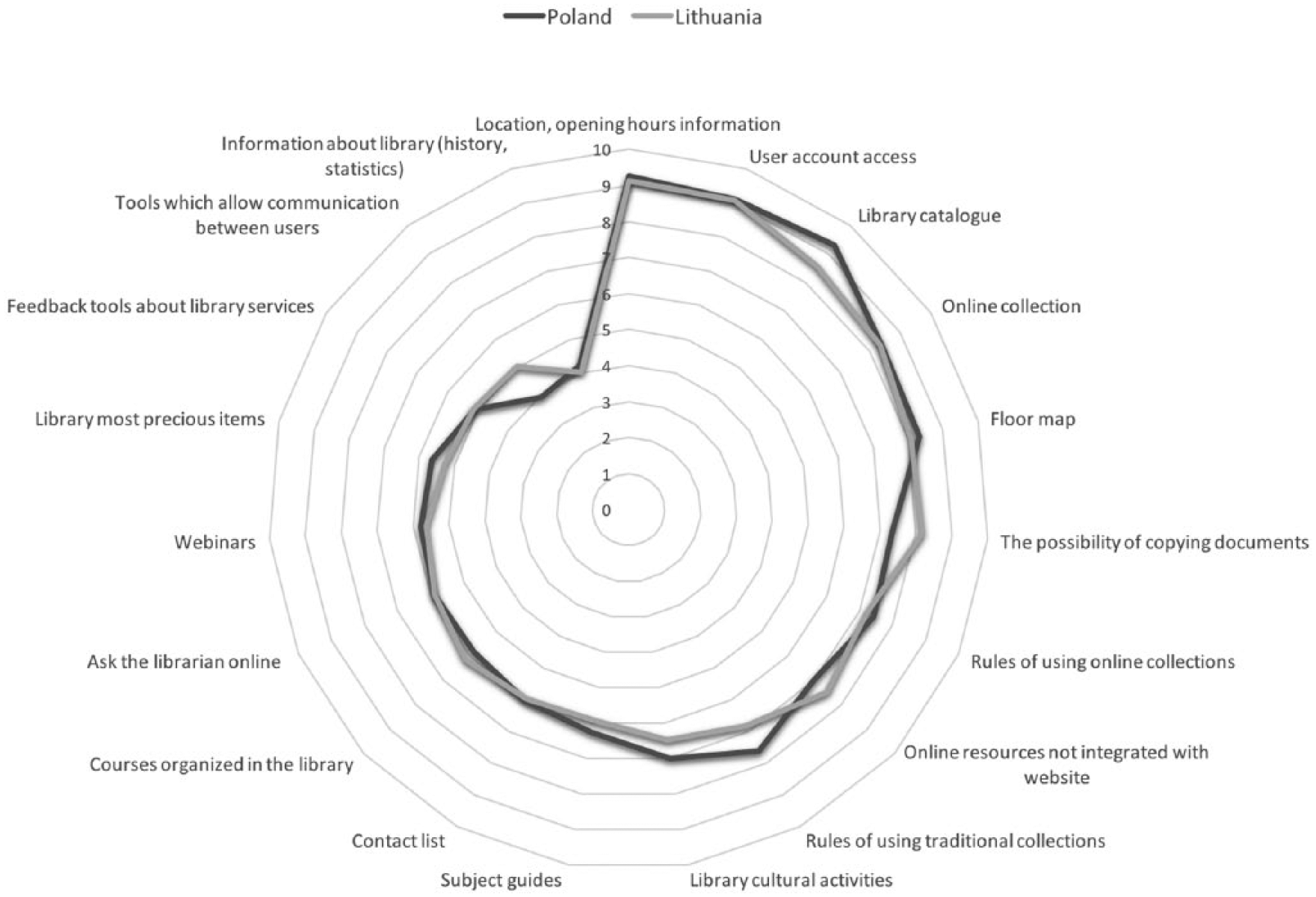
The importance of the library website elements. Close-ended questions results.
For the students of both universities (Polish – PL and Lithuanian – LT) the most important content elements on the library website included information about the library’s location and opening hours (9.26 PL; 9.12 LT), personal user account access (9.11 PL; 9.17 LT) and the library catalogue (average mark 9.31 PL; 8.54 LT). Online collections (8.38 PL; 8.34 LT) and floor map (8.31 PL; 8.09 LT) were rated lower than 9 but still relatively high in importance.
Among these results, the high score for information about the library location and opening hours came as the biggest surprise. We also realized that that we should not have put those two elements together (location, opening hours): the survey was conducted in the libraries so their locations were obvious to the respondents. We had assumed that the same would be true for opening hours (SCIC is open 24 hours; UW Library has stable opening hours, except holidays). However, consulting with the librarians shed more light on this issue – due to various cultural events or public holidays, both libraries are sometimes closed for users which takes place rarely but results in student dissatisfaction.
The second group of the elements of the website, those given between 8 to 6 points (average score for the two countries), mainly includes information and instructions on how to: use traditional collections (7.61 PL; 6.83 LT), use online collections (7.41 PL; 7.19 LT), copy documents (7.35 PL; 8.18 LT), use library collections/service (6.28 PL; 5.93 LT) and contact the library employees (6.04 PL; 5.96 LT). All those elements concern information on how one should function in the library. A different type of content elements represents information about library cultural activities (7.01 PL; 6.47 LT) and links to online collection/resources not integrated with the website (6.98 PL; 7.49 LT). Both of those scores are noteworthy: they show that students are interested in the cultural functions of the libraries and that they see the library website as starting point (or help) to explore other resources on the Internet.
While the results between the two universities were quite similar overall, in this subgroup of content elements the biggest difference concerns information about copying possibilities which may be explained by minor differences in the functioning of both libraries: the price of copying materials in the library (including also the printing and scanning of documents) in Lithuania is very competitive, in Poland quite the opposite – they are rather high. Discussing the differences in the evaluation one should also look closely at the library catalogue (9.31 PL; 8.54 LT) and the rule of using traditional collections (7.61 PL; 6.83 LT). Even though the difference is not very notable, it is one of the biggest found in our research – one could infer from this that Lithuanian students generally are less interested in traditional collection usage. Of course such a hypothesis needs further research: what may have influenced the students’ answers with regard to the catalogue is the way catalogue access is presented on the websites: in Poland there were two options to enter the catalogue: (1) through a separate link on the website or (2) by using general search engine of library resources (electronic and printed) and choosing the ‘e-catalogue’ option; in Lithuania only the second option was available.
The third group of analysed results consists of five elements. The option of online chat with the librarian earned a similar medium level of interest (6.02 PL; 5.87 LT) as did information about the webinars (5.79 PL; 5.64 LT). A small difference in the results was found in the evaluation of courses organized in the library (5.84 PL; 6.14 LT): the Lithuanians students were notably more interested in those. In order to explain this we should probably analyse the library courses’ offer and talk with the students about their experiences. The Polish students were slightly more interested in the most precious library items (5.63 PL; 5.25 LT) but it is noticeable that they appreciate practical information about the basic use of the library (opening hours, library catalogue, etc.) much more. The importance of tools to send feedback about library services is also not seen as a significant (5.08 PL; LT 5.12), and the history and the statistics about the library are viewed as even less important (4.22 PL; 4.03 LT). What it is interesting is the fact that the Polish (3.96) students do not see the point of tools which allow communication between library users when Lithuanian students (5.05) do not exclude the possibility of using them.
The first part of the conducted survey form contained an open-ended question where the respondents were asked to mention three content elements which in their opinion are of key importance among information to be placed on the academic library’s website. The paper form was designed so that the respondent could not see the list of library’s website elements which he/she was asked about in the next part of the survey so that they were not influenced by this information. Not all of the respondents completed this part of the form, and some of them listed only one or two important content elements so the total number of the results does not correspond exactly to the total number of 680 surveys collected - we gathered 1554 indications (nPL=736; nLT=816). This is why we decided to analyse those answers looking at how many (percentage-wise) among our respondents mentioned a particular element (for instance, the library catalogue was mentioned in this part of the survey by 63.9% of our respondents). In Table 1 we present all elements where the percentage of indications was higher than one. The italic type marks answers not mentioned in the close-ended part of the survey. Obviously, the students did not use the terminology and formulations that we used in the survey form so during the process of analysis we sorted them either into already existing categories or as new indications (i.e. ‘book search engine’ as library catalogue, or ‘electronic articles’ as online collection). With regard to the most frequently mentioned elements, the results were not surprising. The top five content elements listed as necessary on the website are exactly the same as those mentioned in the close-ended question; a greater interest in the catalogue and rules of using the traditional collections among the Polish students were also confirmed. Polish students paid more attention to the opening hours but, as mentioned previously, those change more often in Poland than they do at SCIC. Lithuanian students were also much more interested in online collections (17% PL; 30% LT). A hypothesis explaining such a result would have to be verified by qualitative research but we think that Lithuanian students have to use foreign language scientific literature much more often than Polish students due to the lack of Lithuanian translations. The majority of online collections in both libraries is available in English and this might be the reason for the different levels of importance attached to these items.
The importance of the library website elements. Open-ended questions results.

% of the all respondents’ number who indicated a particular content element.
One may notice again the students’ interest in the cultural activities organized or promoted by the library (9% PL; 11.5% LT). Another interesting observation can be made here about an element not mentioned in the close-ended questions, namely the booking of self-study rooms – important for the Lithuanian but not for Polish students. This is related directly to the difference in the functioning of the libraries: the UW Library offers only a few self-study rooms and the waiting list is always long. As there are more self-study rooms at SCIC, students use this option much more often. 2 Lithuanian students are much more eager to treat the library website as a gateway to useful information on the Web (0% PL; 5% LT): although both groups assign to it a similar level of importance in the close-ended question, the Polish students did not mention it in the open question at all. Another type of information which the Lithuanian students want to see on the library website concerns free places in the library – this need is related to the problems of the availability of places to work in the library, especially during the exam period. What is interesting, is that student complaints sent to the library indicate that a similar problem is also experienced at the UW library, although the Polish students did not realize that this situation could be alleviated if the library website displayed information about the current number of users. Polish students’ interest in the library’s non-cultural activities was related to activities such as paying library fines, etc. Other elements of the library website gained only a slight interest from the students.
Discussion
The picture of users’ information needs with regard to content of the academic library website revealed by our research might serve as a basis to rethink the list of its potential functions. We made an attempt to distinguish those functions by looking at them from the perspective of students’ needs as illustrated by survey results. The students proved to be a group of users with a very utilitarian approach.
The results show that according to the students the most important library website function is supporting the usage of the collection: online and traditional. Among the elements of the website allowing it to fulfil this function they listed, first of all, the online library catalogue, information about opening hours, user account access, online collections and the floor map. A wide array of other types of information supporting this function seems also to be important, even though those are not perceived as essential (i.e rules of collection usage, coping documents, booking self-study rooms, contact list, etc.). Those observations are in general in accordance with the traditional approach represented by the librarians, and described by Little (2012), to promote website elements such as the library’s catalogue, opening hours, help for the researchers including reference and instruction, locations, and support for the students and faculty. The main and very important difference concerns access to online collections which were ranked highly in open- and closed-ended questions. This shows that the tendency noticed by Blummer (2007) to inform users about the library itself rather than provide access to resources and services cannot be maintained by the libraries as a strategy for their online presence.
The next important library website function indicated in the students’ answers is the promotion of culture: respondents expressed interest in being informed about cultural events organized or promoted by the library. It is an observation of significance, as this kind of library activity is not obviously connected with the academic library’s basic tasks related mainly to supporting teaching, learning and research activities (Long and Schonfeld, 2010; Stover, 2001).
Another noteworthy observation is the students’ interest in the online collection/resources not integrated with the website. This can be related to the hope expressed in the literature from the time of the Internet’s early development – that librarians with experience in knowledge organization could be useful in the Web design process (Davidson and Rusk, 1996). Stover (2001: 163) stated: ‘With the explosive growth in the production of knowledge, society requires credible gatekeepers of information, and has entrusted some of that function to universities and its resident experts, not to information networks’ The survey by Ithaka S&R also indicated such a function, although ranked as the last among all library functions (Long and Schonfeld, 2010). Our research proves that the librarians may be seen by students as ‘gatekeepers of information’ and, thus, the authorization of the other web sources (an indication of the most valuable) could be seen as an important function.
The educational function of the library website (webinars, courses organized in the library) received some attention from the students but it is not essential from their perspective. The survey results also present rather slight interest in the communication function of the library website: students do not find tools to send feedback about the library or to communicate with other users useful, only online chat with the librarian received a marginally higher score (with regard to its importance).
The functions related to the promotion of the library or the creation of its online image are clearly of least significance to the students. Similarly, slight attention was paid to the library’s history, statistics or its most precious items. We did not ask the students directly about the importance of the mission statement on the website (presented on the SCIC website and absent from the UW ones), an issue that received much attention in literature ( Griffis and Salisbury, 2014; Kuchi, 2006), but none of the students mentioned it in their answer to the open-ended question. Those observations may reveal a bitter truth for library science specialists: it seems that at least the researched group of users – the students – is not interested in the ideological foundation or the broader background of the library’s work. Students’ attention could be gained only by further customization of the website content to their information needs. Our results may also raise the question whether particular content elements should be included in the library websites if students are not interested in using them. This should obviously be verified in relation to the academics’ needs, although here we cannot forget about two significantly less numerous groups of academic libraries: the community of librarians (potentially interested in library documents, statistics, etc.) and visitors from outside academia. Academic libraries often fulfil the role of touristic attraction and library history or its list of the most precious items may attract visitors’ attention. On the other hand, if similarly low interest in this particular function is proven as also characterizing the academics, it will be a clear indication for website design that such elements should be removed from the most evident website content.
Limitations
As with any survey, our results lack deep feedback from the respondents, and although we are able to rank the website content elements, we still lack the knowledge of how those elements should be accessed. This seems particularly important in the context of continuous improvements in search development. Metasearch systems are currently being used both at the UW Library and SCIC, but there are more user-friendly search options already available (see Lown et al., 2013; Tay and Feng, 2015). Still, while answering the open-ended question (what website content elements are the most important for you?) none of the users mentioned the multi-search options as needed on the website. Our respondents likely did not possess sufficient knowledge about those solutions and currently we are unable to say in what ways important website elements should be made accessible to the users.
Finally, our study does not include a very important group of users, i.e. the academics, and with regards to the students themselves, further research should include representatives from more countries to see if our conclusions could be generalized.
Conclusion
Our study included groups of students from two countries – users of two different academic libraries. Such research design allowed us to look for common evaluation tendencies in both. Naturally, we also distinguished elements marked as important but related directly to the specificity of the functioning of one of the libraries, and consequently less pronounced in the other evaluation (like the Lithuanian interest in the copying possibilities) – clearly, research into users’ information needs always has to take into account local considerations. However, in general, obtained results presented clear evaluation tendencies which allowed us to make conclusions about the functions of the academic library website distinctive from those already mentioned in the subject literature (Sapa, 2005). From the perspective of a user-centric approach we distinguished five functions of the academic library website (1) supporting the usage of the collection (online and traditional); (2) promotion of culture; (3) gateway for locating information on the Web; (4) education; (5) creation of the library’s online image. A strong interest in the first function was as evident as was a lack of interest in the last.
Further research should investigate the evaluation of those functions by scholars, an important group of academic library website users whose needs might be completely different.
Footnotes
Appendix 1
The importance of the library website elements. Close-ended questions results.

| Academic library website service/information | Assessment PL | Assessment LT | Average | |
|---|---|---|---|---|
| 1. | Location, opening hours information | 9.26 | 9.12 | 9.19 |
| 2. | User account access (order a book, etc.) | 9.11 | 9.07 | 9.09 |
| 3. | Library catalogue | 9.31 | 8.54 | 8.92 |
| 4. | Online collection | 8.38 | 8.34 | 8.36 |
| 5. | Floor map (open access, reading rooms, etc.) | 8.31 | 8.09 | 8.2 |
| 6. | Information about the possibility of copying documents | 7.35 | 8.18 | 7.76 |
| 7. | Rules of using online collections | 7.41 | 7.19 | 7.3 |
| 8. | Links to online collection/resources not integrated with website | 6.98 | 7.49 | 7.23 |
| 9. | Rules of using traditional collections (descriptions of the collections) | 7.61 | 6.83 | 7,22 |
| 10. | Information about library cultural activities, events | 7.01 | 6.47 | 6.74 |
| 11. | Subject guides, instructions how to use library collections/services | 6.28 | 5.93 | 6.10 |
| 12. | Contact list of the persons responsible for particular services | 6.04 | 5.96 | 6 |
| 13. | Information about courses organized in the library | 5.84 | 6.14 | 5.99 |
| 14. | Ask the librarian online – live chat option | 5.88 | 5.88 | 5.88 |
| 15. | Webinars | 5.79 | 5.64 | 5.71 |
| 16. | Information about library most precious items | 5.63 | 5.25 | 5.44 |
| 17. | Tools which allow send feedback about library services | 5.08 | 5.12 | 5.1 |
| 18. | Tools which allow communication between users | 3.96 | 5.05 | 4,5 |
| 19. | Information about library (history, statistics, reports) | 4.22 | 4.03 | 4,12 |
Declaration of Conflicting Interests
The author(s) declared no potential conflicts of interest with respect to the research, authorship, and/or publication of this article.
Funding
The author(s) received no financial support for the research, authorship, and/or publication of this article.