




Abstract
From the vantage point of user studies and the information literacy paradigm, a case study was conducted (at the Universitat Jaume I, Castellón, Spain) to analyse the information behaviour of first-year Translation trainees. The study takes into account what it is like to be a university student in the digital age, in order to investigate how they find, evaluate and use information for their course work. The study is located within the qualitative paradigm (using a semi-structured task to obtain direct data from the student body). A number of needs and weaknesses are identified within the student group as regards their information behaviour. It is hoped that this study will serve as a basis for the design and subsequent implementation of Information Literacy programmes specific to this interdisciplinary field.
Keywords
Introduction
Teaching is an interactive, dynamic process, and every lesson plan is subject to constant review as a class progresses. Moreover, nothing takes place in a vacuum and therefore it is also important to recognise that, for students, a BA degree programme is an in-depth course of study, in which it is our responsibility as teachers to ensure continuity between the different stages. This is certainly true in all circumstances, and it is even more necessary in the field of instruction in information and documentation as applied to different degree programmes in the context of higher education, where the match between teaching plans and the real needs of a community of students still leaves much to be desired in most cases.
Since every professional community generates, seeks, retrieves and uses resources and sources related to the cognitive structure being researched or studied and the tasks being performed, the need arises to undertake studies of this kind, which will make it possible to determine the real needs and behaviour of each user community.
Thus, we believe that studying the information behaviour or habits of specific communities is one of the objectives that need to be designed and planned by teachers of applied documentation, since this will help detect users’ needs, thus making it possible to introduce any modifications needed to respond effectively to those communities’ requirements and behaviour, while always seeking to improve both the teaching and the learning quality.
Information literacy (IL) clearly has a part to play in the effort to develop the generic competences of university students related to the cycle of the production, communication, retrieval and use of knowledge in context with the help of the information technologies. IL lies at the very core of lifelong learning, essentially because it empowers people in all circumstances to seek, evaluate, use and create information effectively in order to achieve their personal, societal, occupational and educational goals. Hence, it is also essential to remember that IL extends beyond current technologies to encompass learning, critical thinking and interpretative skills across professional boundaries, and empowers individuals and communities.
This paper delves into the process of searching for and processing information from the perspective of the IL learning of Translation trainees. With this purpose in mind, our work had its beginnings in the results of an activity carried out in the classroom as part of the subject Documentation Applied to Translation and Interpreting, taught in the first year of the Bachelor’s Degree in Translation and Interpreting at the Universitat Jaume I of Castellón (Spain), which consisted of carrying out and analysing the process of seeking information and documentation on a text in a foreign language (in this case, English).
The ultimate aim (in the short and medium term) of this research is to improve the proposals for instruction in information competences that are part of the course programmes for students of Translation and Interpreting, starting out from a diagnosis of the information behaviour of this community of practice. Thus, we wish to enrich the practice of information literacy (INFOLIT) in an area that, intensively and constantly, works with and needs information.
In sum, the specific aims of this research are the following:
investigate the information behaviour of Translation and Interpreting trainees when seeking information in order to carry out the process of documentation for a translation task;
determine what their information needs are and what sources they use most often;
diagnose the main problems facing Translation and Interpreting trainees when seeking information for the purposes of translation tasks, by analysing their process of documentary research.
In short, our aim is to diagnose the needs of translation students in the first stage of their training, as regards the information competences they need in their disciplinary domain, thus enabling us to redesign and project educational improvement initiatives that can address their lacks and weaknesses.
Literature review
Both the European Union and UNESCO have a growing interest in research focused on IL and lifelong learning, together with their impact on learning. All countries agree that their citizens must be prepared to deal with lifelong learning so as to be able to cope with the challenges and avoid the dangers of social and technological exclusion. The changes that the European model of convergence in higher education is currently bringing about have placed students’ competence-based learning at the centre of the whole teaching-learning process, along with their capacity to learn to learn and to learn by doing. The over-abundance of information and the important role played by the information and communication technologies (ICTs) have led to changes in the way students learn to read, communicate and generate content, while also giving rise to an anxiety that needs to be addressed by means of continuing education (Bawden and Robinson, 2009). Hence, most of those responsible for education have redefined the didactic aims of learning in terms of competences, which are understood as referring to the capacity to apply knowledge and skills in different contexts of use. One of the most significant are the information competences, as core competences that all graduates must know and be able to apply in their learning and professional settings. In this regard, then, Spanish universities have before them a two-fold challenge: on the one hand, to advance towards becoming e-Universities, with an adequate informational infrastructure and infostructure, within an equitable and sustainable context; and, on the other, to strive to become an organisation with a mission and a vision that make them information-literate universities that will provide benefits for all the stakeholders involved as well as for society itself. With regard to this second point, emphasis is placed on the fact that students must be competent in their command of, access to and use of information. Accordingly, information management has been included as a core competence in the current Bachelor’s degree courses (ANECA, 2004; CRUE-TIC/REBIUN, 2009; DESECO, 2002; Ministerio de Ciencia e Innovación, 2007).
In the international context, the integration of information competences within higher education studies is established in national education policy, as occurs in the United States (ALA, 1998, 2005; ACRL, 2000/2016) and Australia (ANZIL, 2004). In Europe, more and more countries are incorporating these competences within their new teaching plans: France (Ministry of National Education, 1997), Great Britain (SCONUL, 1999, 2004), Finland (University of Helsinki, 2004). Also worth highlighting are the efforts made by ENIL (European Network on Information Literacy) and the project entitled ‘Tuning Educational Structures in Europe’ (González and Wagenaar, 2003), focused on competence-centred training. In this project, the information competence of information management ranks fourth among the set of core competences, according to data from the 101 European universities that were surveyed.
In recent years, there has been a shift in the expectations of students attending Spanish universities, due to factors including the incorporation of the university system within the European Higher Education Area, the impact of the digital society, increased geographical mobility, and the changes that have come about in professional competences. These factors call for new skills related with the processing of information, with communication, with languages, with the capacity to solve problems and with the use and management of information.
As we have stated earlier, competence-based learning reflects the students’ capacity to put into practice, in an integrated manner, the skills, knowledge and attitudes required to successfully address and solve problems and situations. Moreover, this also makes it possible to assess their degree of preparation, sufficiency and responsibility. This represents a shift from a style of education based on teaching towards one focused on learning; at the same time, it involves a new approach in the role of educators and educational activities, and places greater emphasis on learning outcomes.
In this context, the study of Information Literacy and, therefore, the body of literature on the subject are growing at an exponential rate in international information and documentation studies. Despite this large amount of emerging literature, there is still a lack of in-depth applied proposals in specific subject areas and communities of practice. This is the challenge and the real need for the near future of IL instruction. In this regard, Clarence Maybee (2006) has argued that if training proposals in IL are to be truly targeted to users’ needs, the first step has to be a tailored analysis of those information needs, concepts and behaviours prevailing among those particular users with regard to seeking and using information. In other words, although there is growing advocacy for IL in higher education, comparatively little is known about how it is experienced by those who actually use information.
Studies such as those by Head (2008, 2013) and Head and Eisenberg (2010) are focused on the procedural aspects regarding the information-seeking strategies, research process and research difficulties of university students. Yet, our research is centred on a particular community of practice: Translation trainees. In this regard, this paper is part of a broader research project (Pinto and Sales, 2007, 2008; Sales, 2008), the main goal of which is to provide prospective translators and interpreters with a solid grounding in IL.
Translation students need to put into practice a set of information competences to be able to do their work, the most significant being the search for, assessment and processing of information. In this arena of application, it is important to remember that translators and interpreters are not only information users, but also information processors and producers. As Pinto (1999: 106–107) suggests, the translator’s documentary competence in the work environment needs to develop in terms of three complementary aspects, i.e. the translator is: (a) a user of information resources and sources; (b) a processor and transformer of original information; and (c) a producer of new documents. At the same time, the translator’s documentary competence has to evolve in three dimensions: the informational, the methodological and the strategic (Pinto, 1999: 108–110).
Translation is, above all, an expert activity that constantly requires information. Moreover, the nature of the information tends to be multilingual and specific, belonging to a range of disciplines, depending on the text to be translated. Indeed, the translator’s documentary activity is a vital instrumental link in the chain of mediation and transfer of knowledge that makes up translation, an indispensable part of translational know-how. Documentary competence is essential for the practice of translation, and therefore for the translator’s ongoing learning process. The documentary search conducted throughout the translation process entails learning how to locate, validate and correctly use the information sources offered by the library and the information technologies. Translators are faced with the challenge and the responsibility of becoming acquainted with and using the diverse means that now exist for the location, retrieval, handling and dissemination of information, by manipulating the new and extraordinary resources which ICTs have made available for their work. In other words, it remains up to the translator to find the data, the information source, and the translator is responsible for knowing how to use it. In short, to translate is to mediate between languages and cultures, to operate a constant decision-making procedure, and, above all, to know what documentation means. Otherwise, decision-making cannot be based on qualified information. If one is to translate, acquiring the right documentation means knowing how to identify the informational requirements of the text to be translated, and knowing how to find the appropriate solutions.
In short, in any process of transfer, the translator will have to develop information competence in addition to the other competences that make up what is known as translation competence. In other words, they will have to acquire the capacity to seek out information that is based on knowledge, abilities and skills. Authors such as Vienne (2000) consider information competence to be of vital importance within the framework of translation competence. A similar view is expressed by Pym (2003), who, reviewing the literature available on translation competence, highlights the importance of translators’ instrumental ability when consulting sources and, above all, the need to be able to evaluate them in a critical fashion in today’s electronic age. According to these authors, the most relevant skills a translator needs are, first of all, knowing how to analyse the translation situation and, second, knowing how to draw up an information research strategy to fit that translation situation.
Thus, without a doubt, information competence is essential right from the outset of any process of translator training, as part of one of the basic general aims of learning defined by Hurtado (1996: 35) for teaching translation, namely the assimilation of the fundamental principles underlying the professional translator’s style of working. This author subdivides this general objective into three specific aims: the translation market, the translator’s tools, and the stages of producing the translation. Also, Hurtado highlights the importance of making students familiar with the sources of documentary material that are of use to them, as well as the importance of knowing how to assess them in order to make translation decisions with a critical mind.
As regards research on the competence of searching for information among university students, over the last decade a number of studies have been conducted using a documentary approach (Cothey, 2002; Gross and Latham, 2008; Head and Eisenberg, 2010; O’Hanlon, 2002; Pinto, 2010, 2011; Pinto and Sales, 2007, 2008; Slaouti, 2002; Wen-Hua, 2000). Most of these studies measure the students’ skills in locating information using documentary research strategies, while others address students’ perception of the importance and self-efficacy of everything related to this competence (Borreson and Salaway, 2008; Pinto and Sales, 2015), where the positive self-concept they claim to have stands out above the skills they really have.
Likewise, it is known that conventional teaching methods do not lead students to search for and make efficient use of information or to develop critical thinking skills that enhance independent learning (Grafstein, 2002). For example, learning based on documentary resources is highly dependent on the capacity for cooperation that exists between teachers and librarians (Asher, 2003; Ivey, 2003; Rader, 2004), so that they can together seek opportunities that lead to a closer contact with library resources and services, such as course assignments, end-of-year projects, and so on.
Consequently, it can be seen that knowledge and a command of information competence are fundamental for students, and especially for the future professional working in Translation and Interpreting, who will frequently have to search for, assess and manage sources of information so as to be able to do their job. The acquisition of this competence will enable them to achieve the skills needed to know, on the one hand, how to define and structure an information need, by identifying the key concepts and the terms that describe the search profile that determine what kind of information is needed and what for, and, on the other, how to manage the strategies, techniques and tools for formulating the search and selecting suitable resources.
The information search includes all the competences required to be able to solve an information need, once the knowledge gap has been identified. When they are going to carry out a search, students must have a clearly defined idea of their information needs and know what the aim of the search is. They must determine what they know about the topic, so as to be able to clarify and define the limits of the search profile, what scope is required in terms of topic and time, what level of thoroughness/precision is wanted, what languages they wish to work with, what type of document is needed, what types of search tools they are going to use, etc. To deal with these requirements successfully the Translation and Interpreting student must acquire a set of core skills related to knowledge of the terminology of the subject matter, a sufficient command of suitable search strategies, the use of automated catalogues, databases and electronic sources of information, a command of strategies for searching for information on the Internet, and the use of informal sources of electronic information.
Although the search for information is a task that has changed a great deal in recent years, among other reasons due to the huge growth in the Internet which allows the user to retrieve thousands of resources almost instantaneously, libraries are places devoted to the search for information and over the years have developed retrieval systems and instruments for consultation, even though they are currently outshone by the surprising performance of new information technologies.
Despite being easy to use, the main tools for information searching, such as search engines, directories and metasearch engines, do not guarantee good results, due to errors, poor quality of the information, poor coding practices or to limitations in the query language, amongst other factors (Oppenheim et al., 2000). Yet, despite those limitations, students prefer to consult such tools (Bawden, 2007) rather than go to the library. Taking advantage of these circumstances, Google has launched, as an aid for teachers, the academic search engine Google Scholar, which offers high quality resources, and the tool Google Search Education, aimed at helping students to learn to carry out online searches in an appropriate manner and to discern the importance of the sources. In any case, the real situation is complex and the student who wishes to become infocompetent in the search for information will have to be knowledgeable in how to use the different query systems to successfully solve their information needs.
Another very relevant information competence for students of Translation is the evaluation of information, allowing them to check whether the resources meet the adequate quality criteria, which is understood as referring to the set of characteristics that the information must possess in order to satisfy or exceed the user’s expectations (Kahn et al., 2002). We know that quality is intangible, strategic and dependent on the context of use. Once the student has obtained the information resources that they consider potentially relevant, they must be able to evaluate the quality of the resources, discriminating the best, knowing how to recognise and interpret the idea held by the author of a text, knowing how to distinguish the relevant authors and institutions in their thematic area, and knowing how to organise their learning according to their level of previous knowledge and the time they have available. The evaluation of information also has to take into account the peculiarities of the Internet, which offers a vast amount of information that, because it is boundless and democratic, requires careful checking. Thus, the acquisition of this information competence requires training in a series of skills, such as knowing how to assess the quality of resources; recognising the author’s ideas; familiarity with the types of information sources; recognising how up-to-date the sources are; and knowing the most significant specialised sources.
It is equally important for students to have a command of the competences related to the processing of information, which enables them to codify knowledge using information-processing tools to schematise and summarise the information, organise resources with the aid of a personal bibliography management programme so that they can be monitored and used in the future, by extracting contents and data, and systematising them by means of databases, spreadsheets and statistical programs.
In sum, these three competences of searching for, appraising and processing information are interrelated in the documentation process performed by the student in carrying out the translation task, which is of vital importance to the success of the final piece of work.
The documentation process plays a key role in the translation process, since it is where the student-translator gathers and uses the most information (Hatim, 1998). It involves the following interrelated fundamental processes: reading the document, which is when the translator first comes into contact with the document, capturing the meaning, delimiting the context and determining what types of sources are going to be employed depending on the information needs; the search process, defining the strategies and techniques used (key words, short phrases, use of descriptors, advanced queries, etc.), analysis and evaluation of the results, establishing criteria for the discrimination and relevance of the sources; and the processing and localised storage of information so that it can be reused in other jobs. These are the processes that were taken into account when designing the semi-structured task that we used in this research, as outlined in the next section.
Methodological approach and design of the empirical study
The study we present here starts out from a research project undertaken within the framework of our teaching experience in the subject Documentation Applied to Translation and Interpreting, a compulsory subject in the curriculum of the Bachelor’s Degree in Translation and Interpreting in Spain. The subject is taught in the first cycle (first two years) of the Bachelor’s Degree and, more particularly, at the Universitat Jaume I of Castellón (Spain) where this study was conducted, it is taught in the first year. This is the specific subject in which students learn about the fundamentals of information competence applied to their field, Translation and Interpreting, although as a core competence it is present in any translation task they perform in any of the other subjects in the degree course. It is important to note that these students had no previous IL training, neither in primary nor in secondary school. The fact that Documentation Applied to Translation and Interpreting is taught at the beginning of the degree course has its advantages and disadvantages: it is an optimal way to make students aware of the relevance of information competence as the basis of any translation task and to teach them the foundations. It would, however, be necessary to reinforce this training with further subjects taught in later years, something which unfortunately does not occur at present, as this is the only subject on the matter that students have in the whole degree course.
With the intention of analysing students’ informational behaviour empirically, we designed a task consisting of recording the process followed while conducting documentary research for a text: ‘The Necklace’, a short story written in English (first foreign language for these students), by the Indian authoress Manju Kapur (2005). This particular text was chosen because it was short and complete (i.e. not part of a longer text), and because we think it presents a medium or medium-high degree of difficulty for students at the stage of training they are at when they take the subject. Thus, the text was not excessively simple and accessible, thereby ensuring that the documentation process to be followed represented a certain challenge for the student, as is the case on most occasions in the world of professional translation. The lecturer in the subject was aware that the text offered a variety of information needs for the students, both in terms of textual (linguistic) and contextual (historical and cultural) aspects. They did not have to translate the text, but instead carry out, step by step, the documentary research process that would be necessary if they were going to translate it.
Hence, in order to analyse students’ behaviour and information-seeking skills when it came to documenting themselves in the translation process, the students were asked to fill out a template in which they had to use their own words to describe how they carried out each of the stages of that documentation process in this particular case. We thought that, in this way, the students could express themselves freely and use their own words to narrate how they carried out these stages in a completely real context, and the information thus collected would be more relevant for understanding their behaviour (Wilson, 2000). As in Pinto et al. (2008), this study is therefore based on the premises of the action-research methodology, which advocates the use of the classroom as a laboratory, understanding that action research is a disciplined process that may help the ‘actor’ [our students, in this case] in ‘improving and/or refining his or her actions’ (Sagor, 2000: 3), as a means of influencing a continuous improvement upon learning processes. At the same time it enables problems or weak points to be detected and rectified, thus contributing valuable information for the scientific community.
As can be seen in Table 1, the template for collecting data was made up of five epigraphs, corresponding to the five fundamental stages of any documentary research process. These, in turn, were subdivided into a series of sub-processes, this structure being based on the process of documentation for translation discussed earlier, put forward by Hatim (1998), and on the information competences that, from the IL (ALA: 2005) paradigm, are considered to be essential. Accordingly, an information-literate individual is able to:
determine the extent of the information needed;
access the information needed both effectively and efficiently;
evaluate information and its sources critically;
incorporate the selected information into one’s knowledge base;
use information effectively to accomplish a specific purpose;
understand the economic, legal and social issues surrounding the use of information, and access and use information ethically and legally.
Template for the documentation process that was given to each student.

We focus on the first four items of the INFOLIT paradigm (identification of information needs; effective and efficient access to information; critical evaluation of information and incorporation of the information into one’s own knowledge base), to which we add, first of all, approximation to the text and its comprehension, which is essential in the field of translation we are dealing with here.
The task to be performed in some way joins together all the contents of the subject, and was carried out in the second part of the year, to be handed in at the end. Students did not have any pre-set time limit; rather it was the final assignment of the subject and they could start work on it from practically the beginning of the second semester, each of them could work at his or her own pace, and submit it at the end of the year.
The final sample consisted of 124 students, all enrolled in the subject Documentation Applied to Translation and Interpreting, taught in the first year of the Bachelor’s Degree in Translation and Interpreting at the Universitat Jaume I (Spain), during the academic years 2012–2013 and 2013–2014.
The vast majority of participants (92.5%) completed all the epigraphs, the others failing to fill out one or other section, although these were still included in the analysis since this fact was not considered to have any distorting effect on the results reflecting their progress.
After collecting the completed templates, all the information available was tabulated and the responses were submitted to a qualitative process of content analysis, with the aim of extracting and standardising the most significant aspects so that they could be analysed from a quantitative point of view. In addition to the descriptive analysis of the answers, they were also evaluated numerically in order to appraise their informational skills and to detect the students’ main shortcomings and weaknesses, as well as their strengths. Therefore, the research approach is a mixed one, combining both qualitative elements, by means of the analysis of the open questions, their categorisation and standardisation, and also quantitative elements, taking into account that the starting point is a structured template, whose elements have been scored and numerically treated. These standardisation and appraisal processes were performed in accordance with the following criteria and specifications.
First reading: Approximation to the document
The aim of this first stage is to identify the nature of the document to be translated and understand it. First, students were asked to identify the type of text, since its correct identification would determine how well they would carry out the subsequent stages. As we have outlined earlier, the text was a short fiction story in English and answers giving the literary genre (short story) were counted as correct and those that did not were considered incorrect.
In the next item on the template, the students had to use their own words to describe the general meaning of the text (purpose, topic, plot), thereby showing that they had understood it. This aspect was scored on a scale from 1 to 5, 1 being the lowest value, which would mean that they had failed to understand anything at all or they had misunderstood some aspect, or, perhaps, that they were merely lazy, and 5 was the highest, which would mean they had understood it correctly. Each student’s written account, their summary of the story and the level of detail developed were taken into account in order to score this appraisal.
In the last item of this stage, the students were asked to search for information with which to contextualise the document (the author, the period – of both the writer and the tale told in the story, since they are not the same – the setting, etc.) and to state what kinds of sources of information they used to do so, as well as the specific information sources that they resorted to. The sources used were standardised and classified according to their format (printed or digital) and their typology (monographic publications, encyclopaedias, dictionaries and other online resources), and they were given a score depending on their usefulness for contextualising the document.
Identification of information needs
In this stage the students had to analyse the text and detect their information needs, indicating, on the one hand, which words and expressions they were unfamiliar with and, on the other, which historical and/or cultural references they did not understand. The number and types of needs were submitted to a quantitative analysis, looking for any possible correlations among them, and the students’ level of prior knowledge was scored according to the needs that were identified.
Design of the documentation plan
In this stage the students had to plan the documentation process to be used to solve the information needs identified in the previous step, and state the type of source they would use to find information about ‘words and expressions’ and about ‘historical and/or cultural references’. A descriptive analysis of frequencies was performed and the adequacy of each type of source for each kind of information need was evaluated. This was carried out taking into account that the best sources are considered to be dictionaries, for the first case, and encyclopaedias and monographic publications, for the second.
Information search
In this stage students had to note down several aspects related to the process of searching for information with which to satisfy their information needs: which particular information source they used to solve each of their information needs, giving their appropriateness a score from 1 to 3; which characteristics of the sources of information consulted they appraised positively and negatively, with the aim of identifying their criteria when it comes to selecting and evaluating information sources; which information sources they would have liked to consult but were unable to access, with the aim of evaluating their capacity to access the sources of information that they did have access to; and, finally, what information needs they were unable to satisfy because they were not able to find an appropriate source that allowed them to solve them.
Information storage and management
Lastly, the students were asked to describe how they managed the information they had obtained in the previous stages so that it could be used in the future. To this end, they were asked to specify what systems and tools they used to store and organise both the document sources and the words and expressions whose meaning they were previously unfamiliar with.
Discussion of results
For the discussion of results, we are going to follow the same criteria put forward in the previous methodology section, taking into account the steps of the documentation process.
First reading: Approximation to the document
The identification of the text type was not found to be difficult by 97.5% of the students, who identified it correctly by stating that it was a work of fiction, and more specifically a short story in English. The students found capturing the general meaning of the text somewhat more difficult, which seems to suggest certain deficiencies in their reading comprehension abilities. Results showed that 8.5% of the students did not capture anything at all, as they only wrote two or three lines that outlined the text in very general terms; 62.4% only grasped a little, but at least the essence of the story; 21.4% managed to capture quite a lot and the remaining 7.7% caught the meaning of the text either to a large extent or perfectly well, which was reflected in their summary of the story as proof of that understanding.
It must be taken into account that the text was in English and that, rather than deficiencies related with their reading comprehension, their problems probably stemmed from the language involved. English is these students’ first foreign language, and it is assumed they have a good command of it because they need good grades to be accepted on the degree course and they also have to sit an entrance exam. This task, however, has shown that they still have some deficiencies in this sense. We also considered that the students were lacking in a certain degree of strategic competence, since they were not restricted in terms of the amount of time they could use to do the task, and they could have reviewed and improved the summary they had to write on their understanding of the text after having carried out the ensuing phases of the documentary search. This was explained to them on several occasions in class, as it was an activity that they could talk to the lecturer about whenever they wanted. They were told that they had to keep an account of their process, as though it were the black box of an aircraft or a personal diary, and they were to freely note down all the thoughts and considerations they wanted, including, for example, their first real reading of the text, and the review carried out after gathering information on the topic. It was found, however, that after carrying out the whole process it did not occur to them to revise the task in order to improve some of the gaps in this first point.
The students used several different information sources, of different types and formats, to be able to contextualise the text. It should be noted that they employed both digital and printed resources, although digital formats were used more frequently: all the students consulted at least one digital source and 91.7% also resorted to at least one printed source. The main types of information sources used to contextualise the text were encyclopaedias (94.2%), dictionaries (91.7%) and monographic publications (41.7%), with important differences in terms of the formats of the different sources. As can be seen in Figure 1, the printed format was still preferred in the case of dictionaries and monographic publications, whereas encyclopaedias were consulted mainly in the digital format.
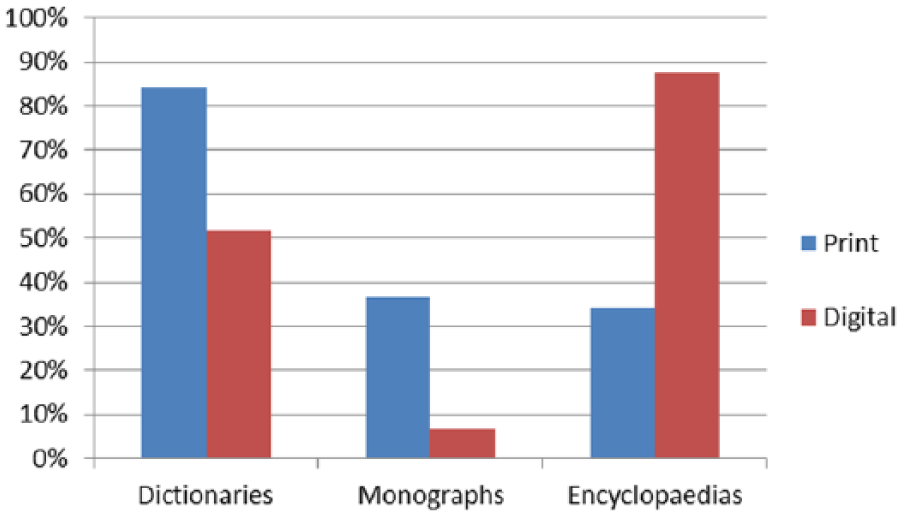
Formats of the information sources used in the contextualisation of the text.
The number of encyclopaedias and monographic publications consulted, which were foreseeably the most appropriate sources of information for contextualising a text, varied considerably, ranging from 1 to 8, with an average value of 2.4. More than 60% of the students looked up information in only one or two of these sources. Altogether 19 different encyclopaedias were consulted, Wikipedia being by far the most frequently used (93%), while more than 10% of the students failed to mention any others (such as the Encyclopaedia Britannica).
The most frequently consulted monographic publications were novels written by the author of the text (36%), handbooks on literature (32%) and history books (24%). After examining the appropriateness of the monographic works and encyclopaedias used by the students to contextualise the text (dictionaries were not considered appropriate for this task), it was found that many of the students did not make a suitable selection of these information sources. Scoring the sources used by each student on a scale from 1 to 3 yielded an average score of 1.75, and 33.9% of them made an inappropriate choice (by resorting to sources that had no relation whatsoever to the story), only 8.7% made appropriate choices and the remaining 57.4% were somewhere in between.
In addition to these traditional sources of information, nearly all the students (99.2%) also consulted some other type of document found on the Web by means of a search engine (essentially Google). These other sources were mainly blogs or personal websites, where they found some information about the author of the story (92%), although some students also consulted newspapers (36.6%), government websites (16.1%) and university websites (15.2%), which were not appropriate sources for these information needs. The number of other online resources was quite high, with an average of 4.5 resources per student within a range of 1 to 25. The selection of these online resources was also given a score for each student on a scale from 1 to 3, the average score obtained being slightly higher than in the previous case (1.93), where 17.4% of the students made an inappropriate choice, 10.4% a suitable selection, and the other 72.2% were somewhere in between.
Results showed that students obtained a better score on other online resources, that is, they resorted to more suitable sources in terms of encyclopaedias and monographic publications. This was due to the fact that, on the one hand, they do not know enough about what would initially be the most relevant sources of information (encyclopaedias, etc.), given their lack of experience in the discipline of Translation (remember they are first-year students), and, on the other, because their natural setting is essentially the Internet. The fact that they used, above all, Wikipedia as an encyclopaedia is revealing and illustrates this point.
We cannot forget that, taking account of the information user in context, this research is centred on first-year students, most of them are digital natives, or were ‘born digital, meaning that digital technologies have been a constant feature in their lives. For them, information literacy competences are always being formed, practised and learned’ (Head, 2013: 473).
Identification of the information needs
The specific information needs that were identified by the students (see Table 2) were very heterogeneous, in terms of both words and expressions, and cultural or historical references, which points to a high degree of variability in students’ previous knowledge, as well as in their level of fluency in the foreign language (in this case, English). The average number of words or fragments of text with which students were unacquainted was 27.5, while that of cultural references was 6.3, although no important correlation was found between them (0.41).
Students’ information needs.

On performing a thorough analysis of the information needs that were identified, one point that stands out is that many of the students, when it comes to classifying their needs, do not draw a clear distinction between those of a linguistic nature and those that are cultural. Hence, for example, several students classified information needs such as HMG, Government House, Muslim League Alliance, the Allies or the European front as linguistic information needs, whereas students with greater competence would have classified them as being more related to the need to contextualise such expressions, so as to cover the context of use and thus check how they would be used in the target language (Spanish, in this case). In other words, these expressions need to be investigated beyond the linguistic aspect, beyond dictionaries, in order to know the context they are used in and to check how they have been used in translated texts, since they have to do with historical aspects for which terminologically agreed translations will exist and should be maintained. Let us remember, again, that the sample of this study is composed of first-year students, and their lack of experience plays a decisive role when they initially identify nearly all the expressions they do not know in the foreign language as linguistic needs.
The results of the qualitative assessment that was performed on whether their real needs matched the level of students’ training, that is, the knowledge that they could be expected to have, reveal that 56% of them identified needs that could be expected and that were in line with their academic level, while 22% identified many more and another 22% far fewer. In other words, approximately half the students would display an information behaviour that matches their level, at this point, whereas a quarter of them would be seen to have a stronger grounding in the matter, and the other quarter would need to improve their level.
Design of the documentation plan
The sources that the students selected to find the particular information they needed can be considered as quite adequate in terms of its typology. As can be observed in Table 3, dictionaries and, on very few occasions, encyclopaedias and monographic works were mainly used to search for information about words and expressions. For the cultural references, the most frequently consulted sources were encyclopaedias and, albeit to a lesser extent, monographic publications and dictionaries.
Sources used for each information need.
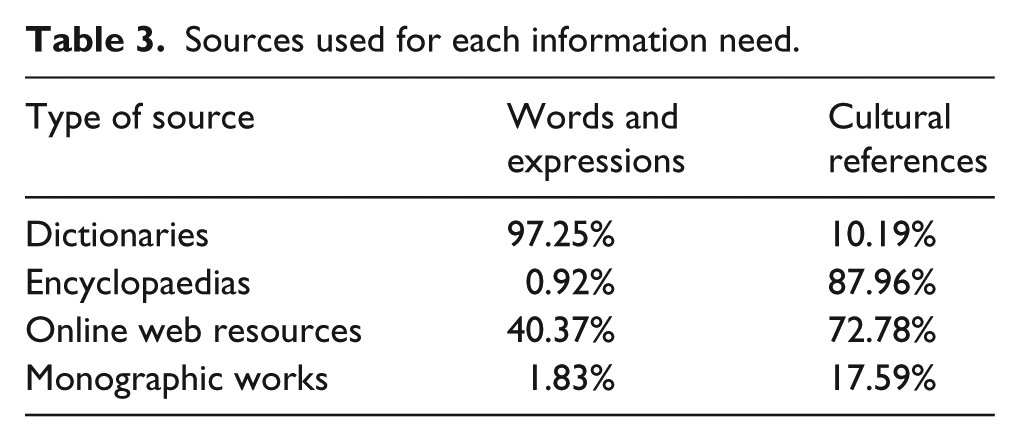
The use of other types of online resources was notable in both types of information needs, although greater and quite reasonable in the case of cultural references, and less and not so appropriate in the case of words and expressions.
Information search
A more detailed analysis of the adequacy of each of the sources used by the students for each information need reveals that, although in most cases they resort to a suitable type of documentation for each need, they have difficulty when it comes to choosing the specific sources that are most appropriate to their needs, especially in the case of cultural references. Table 4 shows the appraisal that was made of the different sources used in this stage, on a scale from 1 to 3 with 1 representing a poor selection and 3 an appropriate choice. It can be observed that in the case of words and expressions most of the students lie somewhere in the middle, and that more students have a good score than a poor one.
Appraisal of the adequacy of the specific sources.
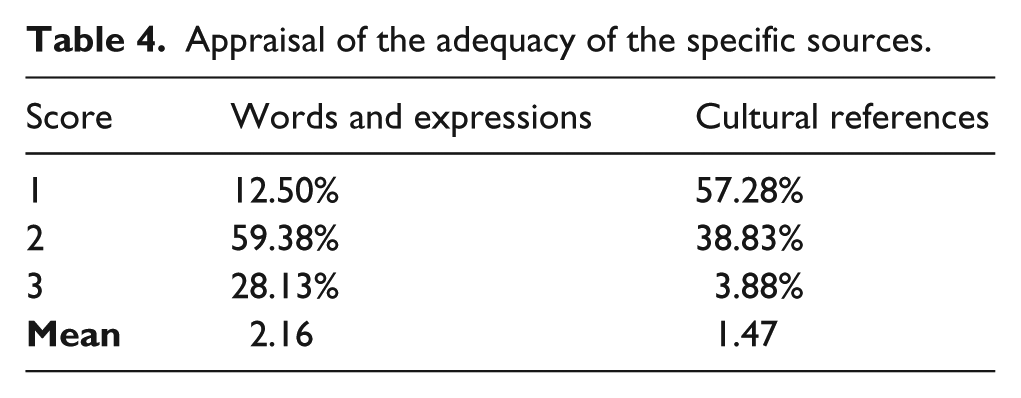
In the case of cultural references, however, most of them made bad choices and less than 4% of the students chose good sources. Hence, few of them resorted to productive sources, such as those focused on the time in the history of India in which the tale told in the story by Manju Kapur is set, i.e. the years immediately following the independence of India in 1947, or the Partition, which gave rise to the creation of Pakistan. There is a great deal of information about this topic, in both online and printed sources, and it is quite a simple matter to find documentary information about it, provided the search is conducted with an appropriate choice of keywords. Yet most of them limited themselves to searching practically exclusively in Wikipedia, as their ‘reference encyclopaedia’, and even in sources that have little or nothing to do with the cultural references in the text or the context in which it is set, such as UNICEF, Spanish national newspapers, general websites on literature, or UNESCO, to mention just a few examples.
Some students even consider Google as an information source, both as regards sources for their linguistic needs and in terms of historical and/or cultural needs. In other words, despite the fact that they have a module dealing with information sources as part of the subject, and another focused on the Internet, where it is explained to them that Google is a search engine, they continue to conceptualise it as a source.
On asking the students about the characteristics they took into account when it came to choosing a source to solve their information needs, the criteria used are seen to be quite appropriate (see Table 5), yet it seems they do not appraise them correctly. That is to say, they correctly point out the characteristics that information sources must have (reliability, effectiveness, etc.), but, as can be seen in Table 4, they do not select the sources in a very appropriate way (since they resort to sources that are irrelevant, not very reliable, etc.). It appears that they somehow know the theory, are aware of the quality criteria that should be taken into account in relation to sources of information, but fail to apply them later in practice.
The most highly rated characteristics of information sources.

As regards their capacity to access information sources, important deficiencies are also observed. On the one hand, 68% of the students mentioned some source that they were unable to access, and yet 23% of these sources were in fact available in the library, which shows that their principal resource is the Internet and many of them do not think about whether anything else exists beyond it. On the other, 70% of the sources were found on the Internet, which shows that they did not perform appropriate searches.
At the same time, and even more surprisingly, some of the sources they noted were invented, so to speak. In other words, they were not really sources that do actually exist or are known but which they were unable to access, but instead they ‘imagine’ a source that they consider would have been helpful to them, such as: A Hindu-English dictionary or machine translation service. This is made even worse by the fact that they use the term ‘Hindu’ to refer to the Hindi language, when Hindu is the culture or the religion, which shows the extent to which they failed to perform their documentary research. Another example is their references to generalities like official websites about Indian culture or databases about the period in which the tale is set.
A further 83% of the students mentioned information that they were not able to find in the sources consulted. In this regard, their main mistake consisted of conducting contextual-type searches (cultural references) in dictionaries, as well as considering sources of a general encyclopaedic nature, such as Wikipedia, as ‘dictionaries’. Moreover, as we have already discussed above, their lack of information competence sometimes leads them to consider Google as a type of source, rather than as an online search engine that gives access to specific electronic sources.
Information storage and management
As regards the procedures that the students employ to be able to reuse the information gathered throughout the documentation process in future work, 91.5% of them stated that they saved a copy of the documents that they considered useful, or of the most important fragments, generally on the hard drive of their work computer.
Regarding the organisation of the information, 14.4% use markers in the browser, 11% keep their own database, 22.9% keep a glossary of useful expressions and words, and a little more than half of them said that they did not use any kind of system to manage that information.
In other words, although the vast majority claim they keep a backup, over half of them do not write an account that really indicates that they organise the material with a view to optimising it. This was partly to be expected due to the fact that they are inexperienced students, in their first year, and also because of the over-abundance of information and sense of immediacy that digital natives have, which means it becomes necessary to highlight right from the beginning the relevance of organising their own knowledge base.
Concluding remarks
The training courses or activities dealing with information competence are delivered in essentially three modes: independent courses (extracurricular or complementary, generally of an optional nature), inserts in the curriculum as a university-specific subject or inserts in the curriculum through a discipline. This last option is especially interesting because it motivates students to learn skills based on the need to solve a problem or academic assignment within the context of use.
We believe it is important to constantly review and reflect on teaching, exploring the students’ real needs and deficiencies, from an action-research perspective that allows teaching improvement initiatives to be incorporated during the training itinerary of each group. Along these lines, we consider that it should come as no surprise to learn that designing IL instruction without incorporating the student perspective leads to what Webber and Johnson (2000: 381) call an ‘inappropriate pedagogic strategy’.
Thus, this research started out from an awareness of the crucial importance of developing, in the teaching context of university-level instruction in Translation and Interpreting, the factor of critical awareness with regard to information needs, uses, habits and behaviour. To this end, our theoretical-conceptual and pedagogic paradigm is that of IL, as this paper is part of a broader research, adding to previous works specifically focused on Translation trainees (Pinto and Sales, 2007; Sales, 2008), to keep on contributing to the scarce literature on this community of practice. Accordingly, our research has been carried out within a real context of information use in which the application of research results necessarily involves some degree of organisational change in didactic dimensions, which we are now working on, based on the findings of this project.
Indeed, some needs and weaknesses are identified within the student group as regards their information behaviour: Students in their first year of the Bachelor’s Degree in Translation and Interpreting course lack clear strategies for handling information needs and problem-solving searches. They rely for the most part on the Internet but lack a solid knowledge basis regarding the network itself, tending to conduct intuitive searches that are unstructured or poorly structured in nature and using well-known search engines, in fact only Google. They need a better knowledge of the range of information sources available to them, as well as of procedural and strategic skills in general (organisation and planning capacity) and IT and information skills (information management capacity and knowledge of IT as such). They also need to learn how to manage the information obtained so as to build up their own personal knowledge base.
The Internet is the information source that is most frequently used by students of Translation and Interpreting. However, it is very important to note how they seem to conceptualise the Internet as a somehow monolithic entity (Google, to say it more clearly), without further specification, thus revealing their need to know more about particular online sources and search engines.
At the same time, it should be noted that they are seen to possess an adequate collection of English-Spanish and English monolingual dictionaries, which they are given previously in the subjects English Language and General Translation, and which are also reviewed in the subject Applied Documentation. However, it can be observed that they are lacking in skills for extra-linguistic (historical and/or cultural) searches, which require greater information competence. This is to be expected at this early stage of their training, but the results clearly show how it is necessary to reinforce this aspect, because although they are students who arrive at university with ample access to information and technologies available to them, they do not know how to manage them in a discerning manner.
In general terms, if we refer to the three categories specified by Maybee (2006) – information sources, information processes and knowledge base – we can state that, in the light of the findings of the present diagnostic research, first-year Translation trainees need reinforcement in all circumstances, but they especially need to focus on their knowledge of sources, while beginning to become aware of the need to conceive information search, retrieval and management as part of a process, the most important aspect of which is the critical perspective that confers quality on the end-product. Nevertheless, at this stage, they are not aware of the importance of building and maintaining one’s own knowledge base. These findings are the core basis for the revision and design of future tasks to be developed in class.
Among the first-year students in recent years, as teachers, we have observed how they come to university with the feeling that by using the Internet they are going to find whatever information they need, and that the documentation needed for any translation task is not their biggest problem. The real situation is completely different, as those of us who work in professional translation, in any of its specialities, know. Asking students to perform a task like the one we designed for this research, in which they carry out the information processing of a text step by step and discover that they are unable to locate, manage and optimise their information needs adequately, seems to us to be a critical exercise that can be very productive, especially when they are in the initial stage of their training period. Thus, we were convinced that the task performed on the document processing would act as a mirror in which students could observe their information behaviour, and that it would at least sow some little seed within them that would arouse a certain degree of self-reflection about the deficiencies they have to solve, from the ongoing training perspective that we, as teachers, continue to work on.
All in all, the findings presented here clearly indicate the need for research efforts to focus on developing the pedagogy and curriculum necessary to facilitate improvements in student training in IL, which puts our work in line with Lupton (2004). Our aim is to offer our students a realistic and user-centred instruction service, and the present research is just one step in a fruitful engagement.
We believe this represents a rich line of work in which there still remains much to be done. Besides, we are now at a key moment for higher education within the information and knowledge society, in which IL is gaining an increasing amount of recognition. Thus, a working framework such as the one we propose to go on developing in the wake of the present project will be aimed at – and undertaken by us with a researcher’s pleasure and a teacher’s concern – achieving the transformation of possible weaknesses and threats into strengths and opportunities for the future. This is because, in line with Bruce et al. (2006), we consider that learning IL must be a process aimed at bringing about a qualitative shift in students’ knowledge, rather than a measure of their skills and knowledge. Therefore, students must be aware of their capabilities and weaknesses at the outset of their training in IL so that they can play an active role in their own learning process.
Footnotes
Declaration of Conflicting Interests
The author(s) declared no potential conflicts of interest with respect to the research, authorship, and/or publication of this article.
Funding
The author(s) received no financial support for the research, authorship, and/or publication of this article.