




Abstract
Knowledge has been widely recognised as the most valuable asset of an organisation and the creation of new knowledge as a prerequisite for improving service quality and achieving innovation. The current study, adopting a business-oriented approach, aims to explore the factors that affect knowledge creation in Greek academic libraries. More specifically, building on the findings of a preliminary study, it empirically tests the influence of knowledge enablers, namely organisational culture, organisational structure, human resource management and information technology, on both knowledge-centred strategy implementation and knowledge creation, using structural equation modelling. The results suggest that libraries must develop and implement a knowledge-centred strategy, supported by the proper social and technological context, to achieve the creation of new knowledge. Organisational culture emerged as the most important influencing factor, thus indicating that library leaders must focus on building a knowledge-conducive culture, characterised by collaboration and trust.
Keywords
Introduction
A notable number of conceptual and research papers have been published in the relatively new field of knowledge management (KM) (Handzic, 2015). A wide array of diverse definitions of this multidisciplinary field can be found in the literature – Dalkir (2011), for example, has accumulated over a hundred – depending on the perspective taken. Management science, computer science, library and information science (LIS), and sociology are but a few examples of the disparate disciplines KM is based upon (Dalkir, 2011). Despite differences in perspective in the field, KM has been recognised as an effective tool for reducing cost by eliminating redundant processes (Geisler and Wickramasinghe, 2015), improving service quality, producing innovative solutions and products (Nguyen and Mohamed, 2011) and achieving competitive advantage, through the successful exploitation of internal and external organisational knowledge (Nonaka and Takeuchi, 1995).
While KM programmes were initially adopted by businesses, the importance of managing knowledge assets was soon acknowledged by non-profit organisations, including libraries (Wen, 2005). In the past, libraries were considered to operate in a rather stable environment, devoid of competition, and their survival was not thought to depend on outperforming their rivals (Wen, 2005). Today, as information technology has facilitated the development of a variety of information services, libraries face the risk of losing their customers, if they fail to excel in services provision and innovate (Wang, 2006). As Wang (2006: 610–611) explains, libraries ‘need to attract users just as businesses need to attract customers’.
On top of competition, libraries must struggle with budget and personnel cuts coupled with a dramatic change in user needs and expectations (Johnson, 2014). Greek libraries also face fiscal pressures due to the economic crisis. A 2013 study of 81 Greek and Cypriot libraries revealed that 85% of the participating institutions experienced severe cutbacks, affecting both their collection development and operational ability (Giannakopoulos et al., 2014). The case of the National and Kapodistrian University of Athens – the second largest tertiary education institution in Greece with over 60,000 undergraduate and postgraduate students, 1 eight central libraries and numerous reading rooms – exemplifies the situation: its 2015 regular budget provided for only €5904 for library materials acquisition. 2 Moreover, in 2013 the Greek Government cut administrative staff allocations for tertiary education institutions by nearly 50% (1349 personnel) (ICEF Monitor, 2014), while almost one-third of the librarians working in six universities were placed on Diathesimotita, 3 i.e. ‘compulsory firings of public servants’ (Featherstone, 2015: 311); the remainder were faced with up to 30% salary reductions (Giannakopoulos et al., 2014). These forces have drastically reshaped the library environment, further increasing the need to implement KM initiatives (Massis, 2014), as a means to achieve more with less (Jain, 2013).
The latest trends with respect to KM implementation in academic libraries include Web 2.0 and social media, virtual reference services, institutional repositories and digitisation of library collections (Jain, 2013), suggesting that: ‘the focus of librarians has been mainly on information management and how information can be provided to library users in order for them to translate it into knowledge’ (Daland, 2016: 38–39). However, for KM to be effective and for knowledge creation to be achieved, information professionals should assume a broader role than that of information mediator and view themselves as ‘knowledge workers’. This would require them to cover the most expansive ‘possible range of existing knowledge … [namely] traditional library knowledge (library collection); internal knowledge (collaborators); customer knowledge (users); and external knowledge (partnerships)’ (De Bem et al., 2016: 8), to ‘envision future knowledge needs and present energetic knowledge activities’ (Huang, 2014: 436) and pay close attention to the context in which the knowledge cycle evolves. In that respect, KM constitutes ‘the creation and subsequent management of an environment that encourages knowledge to be created, shared, learnt, enhanced, organised and utilised for the benefit of the organisation and its customers’ (Abell and Oxbrow, 2001: 267). 4
The present study builds on and extends the findings of preliminary research on the level of presence of KM success factors in Greek academic libraries (Koloniari et al., 2015), which indicated that libraries have taken initial steps towards formulating knowledge strategies and fostering knowledge-conducive cultures, while making widespread use of ICT tools for communication and decision making. However, their knowledge-sharing efforts are not adequately backed up by incentive schemes or a collaborative working mentality. In this context, the current study, based on a business-oriented approach, attempts to explore the factors that affect knowledge creation, using causal modelling techniques.
Theoretical background and hypotheses
Knowledge creation
Knowledge creation is a continuous process of dynamic interactions between tacit knowledge (Nonaka and Takeuchi, 1995) – defined as ‘highly personal and hard to formalise […] deeply rooted in action, procedures, routines, commitment, ideals, values and emotions’ (Nonaka et al., 2000: 7) – and explicit knowledge – defined as ‘what can be expressed in formal and systematic language and shared in the form of data, scientific formulae, specifications, manuals and suchlike’ (Nonaka et al., 2000: 7). This interaction is called knowledge conversion (Nonaka, 1994) and includes four different modes to form the SECI model (Nonaka and Takeuchi, 1995). These modes are: Socialisation (from tacit knowledge to tacit knowledge), Externalisation (from tacit knowledge to explicit knowledge), Combination (from explicit knowledge to explicit knowledge) and Internalisation (from explicit knowledge to tacit knowledge). An upward spiral process, based on social interactions amongst individuals, groups and organisations, constitutes the knowledge creation process (Nonaka et al., 1994).
Socialisation is the process of sharing tacit knowledge through social interactions and shared experience (Nonaka, 1994). Tacit knowledge may be acquired by an individual without verbal interaction, through observation, imitation and practice, with experience being the key. It occurs beyond organisational boundaries, in informal social meetings, where mental models and trust are created and shared (Nonaka et al., 2000). Externalisation, on the other hand, is the expression of tacit knowledge and its articulation into explicit forms (Nonaka and Konno, 1998). The conversion of tacit to explicit knowledge becomes the basis of new knowledge, since tacit knowledge takes form and can be shared with others (Nonaka et al., 2000). Combination refers to the blending of explicit knowledge held by individuals to form new explicit knowledge (Nonaka et al., 2000). The key factors at this stage are the communication and diffusion processes, as well as the systemisation of knowledge (Nonaka and Konno, 1998). This mode involves three activity sets: the capture and integration of new explicit knowledge, originating from both inside and outside the organisation; the dissemination of this knowledge form, using presentations or meetings; and the editing or processing of explicit knowledge that makes it more usable (Nonaka and Konno, 1998). Finally, internalisation constitutes the conversion of explicit organisational to individual tacit knowledge, which in the form of shared mindsets or know-how can trigger a new spiral of knowledge creation (Nonaka et al., 2000).
The context in which knowledge is created is also of importance. Nonaka and Konno (1998) introduced the concept of ba – which in Japanese roughly means ‘place’ – to describe the environments and conditions under which knowledge is created. The authors define ba as a shared space or place, which can be physical (an office, a dispersed business space), virtual (an email or a teleconference), mental (including shared experiences, emotions, ideas and ideals) or any combination of these. In brief, an organisation creates new knowledge through the SECI process that takes place in ba, using existing knowledge. This new knowledge becomes part of the organisation’s knowledge assets, which trigger a new spiral of knowledge creation (Nonaka et al., 2000).
The current study adopts the SECI model to explore knowledge creation, since it is a widely acknowledged 5 integrative model that includes all the processes (i.e. capture, transfer, sharing, diffusion, organisation) through which knowledge creation is achieved.
Knowledge-centred strategy implementation
Based on the knowledge-based view, an organisation amounts to a set of knowledge assets and the fundamental activities adopted for creating and deploying those assets for value creation (Grant, 1996). In this context, strategy is essentially an organisation’s plan to create and deploy its knowledge assets (Zheng et al., 2010), or as Bierly and Daly (2002: 277) put it, knowledge strategy comprises a ‘set of strategic choices addressing knowledge creation’. Hansen et al. (1999) explain that organisational strategy designates the nature of the KM strategy adopted, while the latter guides organisational decisions on how to allocate human and technological resources. Therefore, organisational strategy and KM efforts can be nothing but aligned (Hansen et al., 1999; Lang, 2001; Liebowitz, 1999; Zack, 1999), whereas a clear, well-planned and well-understood knowledge strategy is of great importance (Coakes et al., 2010; Liebowitz, 1999).
Based on the above, the following hypothesis is proposed:
H1: The implementation of a knowledge-centred strategy has a positive influence on knowledge creation.
Knowledge enablers
The successful implementation of KM initiatives depends on some physical and logistical capabilities. These capabilities have been variably labelled as social and technical enablers (Lee and Choi, 2003), critical success factors (Ajmal et al., 2010; Wong, 2005) and KM capabilities (Lee and Lee, 2007). Of the different knowledge enablers identified in the literature, the current study incorporates some of the most widely accepted, namely organisational culture, human resource management (HRM) practices, organisational structure (OS) and information technology (IT).
Organisational culture
Organisational culture is: a pattern of shared basic assumptions that was learned by a group as it solved its problems of external adaptation and internal integration, that has worked well enough to be considered valid and, therefore, to be taught to new members as the correct way to perceive, think, and feel in relation to those problems. (Schein, 2004: 17)
To succeed in KM, organisations should foster a culture that enhances commitment to the creation and sharing of knowledge (Alavi and Leidner, 2001). Collaboration, trust among employees and between employees and the organisation, confidence and tolerance for mistakes are among the most widely cited cultural values promoting knowledge processes (De Long and Fahey, 2000; Jeng and Dunk, 2013). Studies have also indicated a strong relationship between organisational culture and knowledge strategy implementation (Rajasekar, 2014). Thus, the following are proposed:
H2: A knowledge-friendly organisational culture has a positive influence on knowledge creation.
H3: A knowledge-friendly organisational culture has a positive influence on the implementation of a knowledge-centred strategy.
Human resource management practices
Human resource management (HRM) deals with ‘the policies, practices and systems that a company can use to influence employees behaviour, attitude and performance’ (Gloet and Berrell, 2003: 83). Since employees are the ones creating and sharing knowledge, i.e. they are the core of organisational knowledge creation (Chase, 1997), the effective management of people who are able and willing to create and share their knowledge becomes essential (O’Dell and Grayson, Jr, 1999). As individuals are inherently reluctant to share their knowledge (Inkpen, 1998), devising the appropriate motivation schemes – such as reward systems and the inclusion of knowledge sharing in employee performance appraisals (Kim and Lee, 2006; Liebowitz, 1999; McDermott and O’Dell, 2001) – are key to reducing employee knowledge-sharing hesitation (Liebowitz, 1999). Thus, HRM practices play a vital role, being the means for aligning employee behaviour with the organisation’s knowledge strategy (Hansen et al., 1999). Hence, it is proposed that:
H4: HRM practices facilitating knowledge sharing and creation have a positive influence on the implementation of a knowledge-centred strategy.
Organisational structure
Organisational structure refers to ‘an enduring configuration of tasks and activities’ (Skivington and Daft, 1991: 46), comprising two dimensions: the formal configuration of roles and procedures and the informal structure of the organisation, mirroring the pattern of human interactions (Skivington and Daft, 1991). Organisational structure can both encourage and inhibit KM (Kim and Lee, 2006; Lee and Choi, 2003), depending on whether it supports social dialogue and open communication, which facilitate horizontal and vertical information flows (De Long and Fahey, 2000; Van den Hooff and De Ridder, 2004). Another important factor promoting knowledge sharing and creation is teamwork (Coakes et al., 2010; Lloria and Peris-Ortiz, 2014). Organisational members must work together to build on each other’s ideas and strengths (Nadkarni, 1995; cited in Chong and Choi, 2005) and help the organisation respond to change, adapt and innovate (Courtney et al., 2007). More specifically, flatter organisations, which ‘come about when employees don’t need to follow a particular order of communication, decision making, collaboration, and rules, thus minimizing the layers and the barriers between employees at the “bottom” and those at the “top”’, are more innovative and adapt to change faster (Morgan, 2014: 177). Organisational structure has also been recognised as an important factor influencing strategy implementation (Rajasekar, 2014). Thus, the following is proposed:
H5: A flatter organisational structure has a positive influence on the implementation of a knowledge-centred strategy.
Information technology
Information technology is another widely cited KM enabler, which not only supports search, access, storage and retrieval of explicit organisational knowledge, but also aids social connection, assisting knowledge sharing and creation (Alavi and Leidner, 2001). Many researchers have examined the relationship between IT and KM processes, such as knowledge sharing (Kim and Lee, 2006), while others focus on the way IT supports different KM strategies (Choi and Lee, 2002; Meroño-Cerdán et al., 2007). IT tools used in the codification strategy are decision support systems, groupware, document repositories, knowledge maps and shared databases, whereas video conferencing, yellow pages and discussion forums are mainly used to support the personalisation strategy (Meroño-Cerdán et al., 2007). Hence, the following hypothesis is proposed:
H6: Information technology in support of KM processes has a positive influence on the implementation of a knowledge-centred strategy.
Figure 1 represents the aforementioned hypotheses in a graphical format.
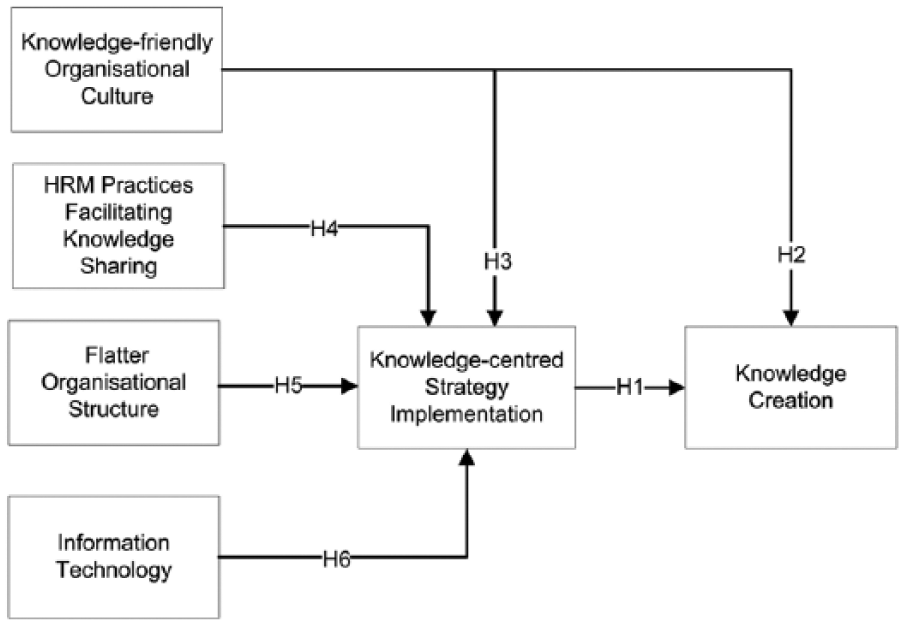
The proposed research model.
Research methodology
Sampling and data collection
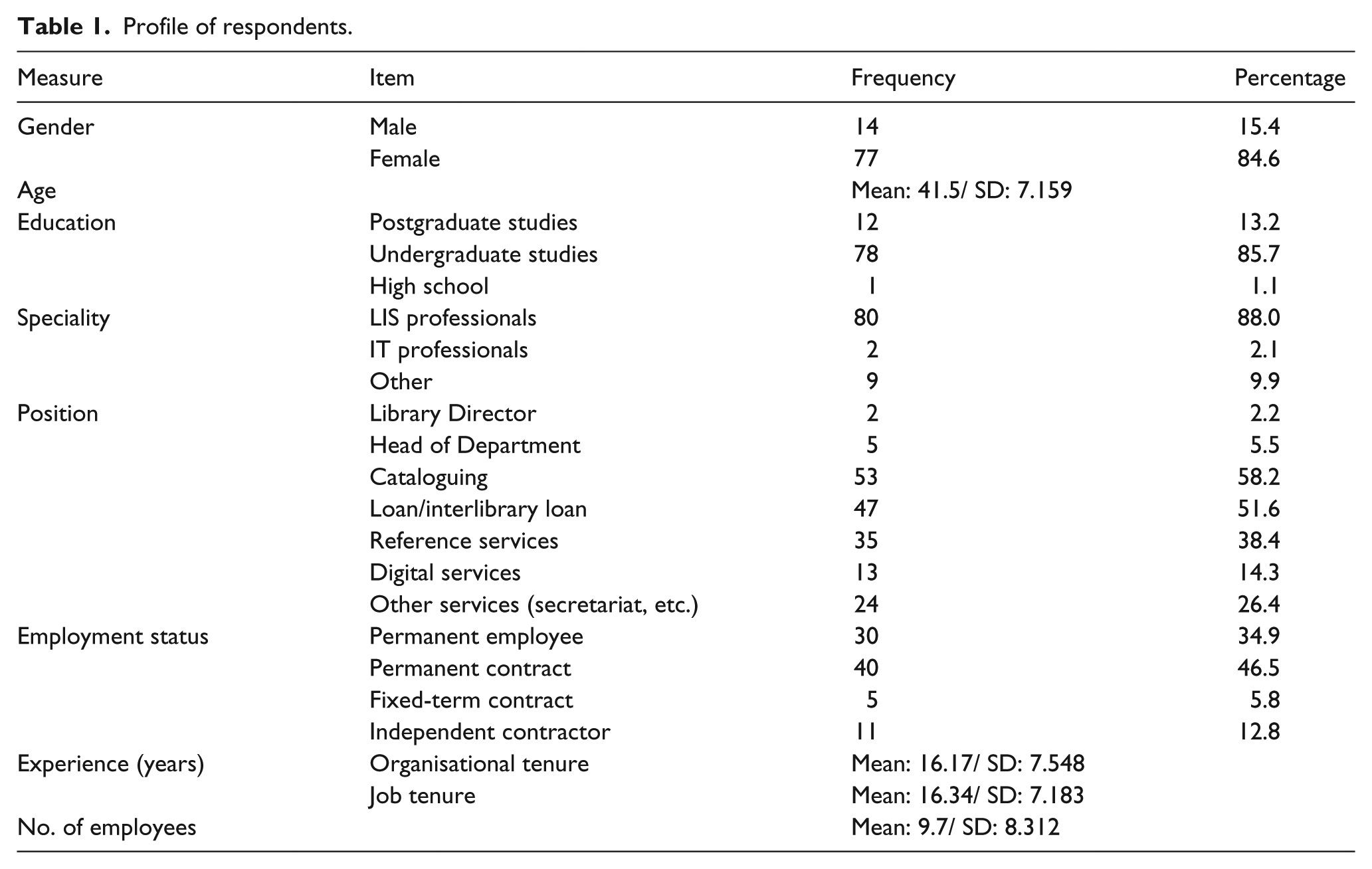
The target population of the present study included all personnel of the 10 academic libraries of the Attica prefecture of Greece. A total of 120 questionnaires were administered; of these, 91 suitable for analysis were returned (response rate: 75.8%). The demographic characteristics of survey participants are presented in Table 1.
Profile of respondents.
Measures
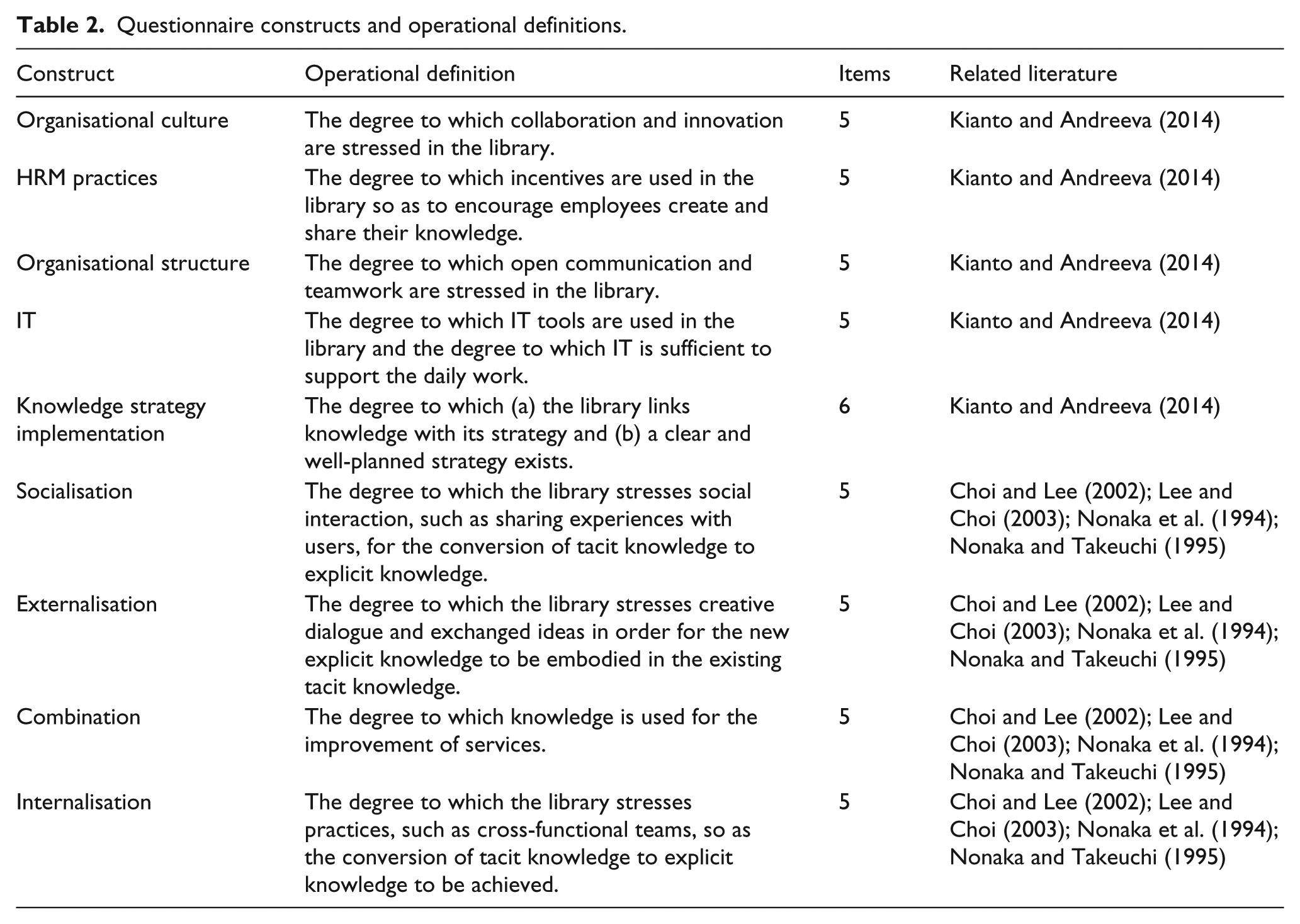
A structured questionnaire based on measures from previous studies was developed for the collection of primary data (see Table 2). Scale wording can be found in the Appendix. All constructs consisted of multiple items, measured using a 5-point Likert scale. The items were translated into Greek and slightly modified to reflect the library environment, as they were originally developed to be used in the business sector. The instrument’s content validity, i.e. ‘the subjective agreement among professionals that a scale logically appears to reflect accurately what it purports to measure’ (Zikmund, 2003: 302), was assessed through rigorous pre-testing. Two academics and five librarians participated in the pre-testing, which concentrated on question wording, in terms of clarity and readability.
Questionnaire constructs and operational definitions.
Statistical analysis
The analysis of the data was performed using the two-step approach (Anderson and Gerbing, 1988). The first step included a confirmatory factor analysis (CFA) to estimate the psychometric properties of the scales utilised to measure the model constructs (adequacy of the measurement model). Psychometric validation is ‘undertaken to provide evidence that the instrument is measuring what it is supposed to measure. It demonstrates the quantitative integrity of the instrument’ and usually includes validity and reliability testing (Elkin, 2012: 1). At the second step, the research model was tested using structural equation modelling (SEM), which offers several advantages in relation to traditional analyses, as structural equation models overcome the restrictive homogeneity assumptions, correct measurement error, offer a more complete modelling of the theoretical relations and are flexible and convenient (Bagozzi and Yi, 1989).
Data analysis and results
The measurement model
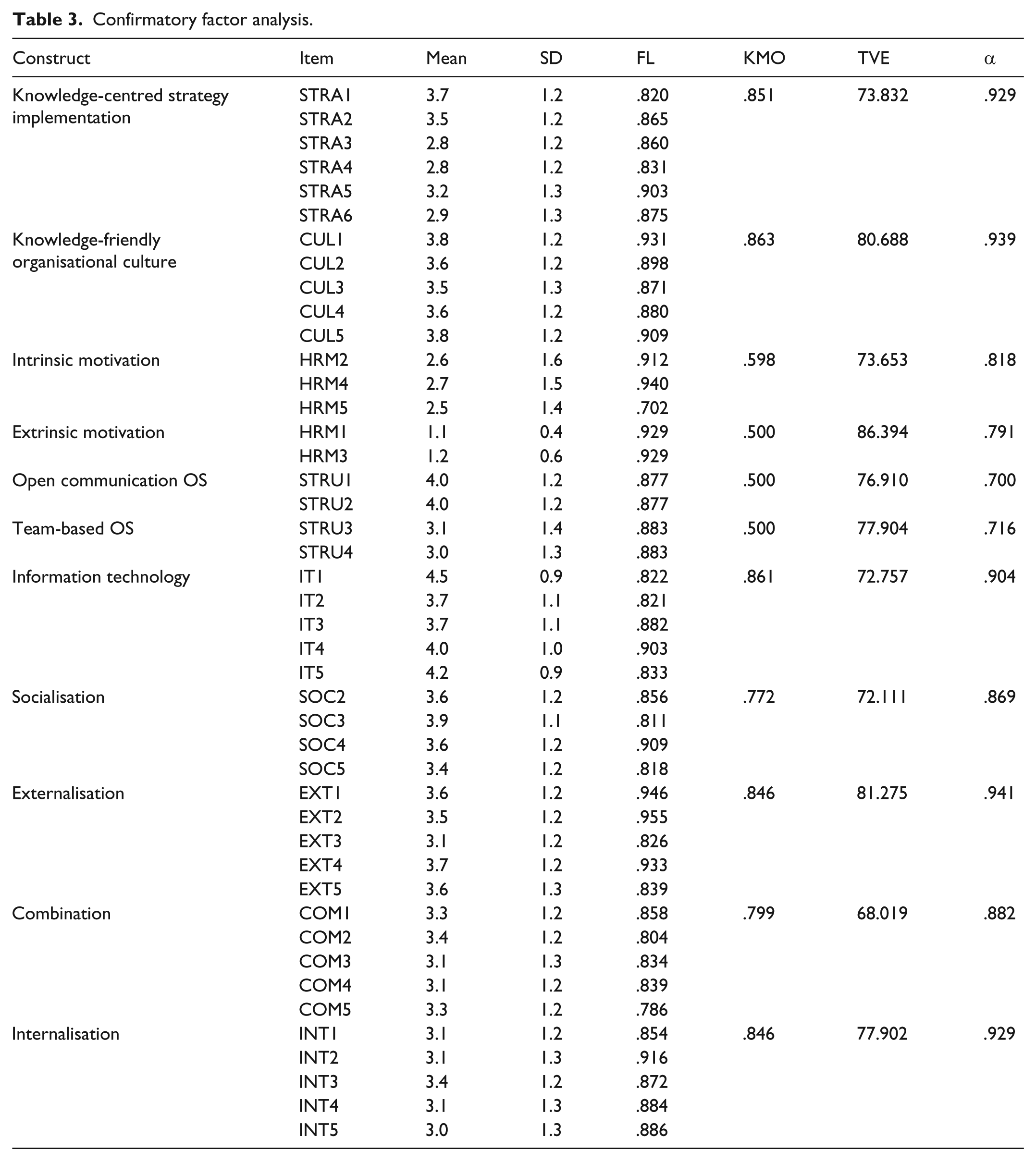
Validity or construct validity (Wainer and Braun, 1988), indicates ‘whether the means of measurement are accurate and whether they are actually measuring what they are intended to measure’ (Golafshani, 2003: 599) and can be tested in terms of convergent validity and discriminant validity (Straub, 1989). The former refers to a situation where items (questions) that measure the same factor correlate highly with one another and the later refers to a situation where measures among different constructs have low correlations (Zikmund, 2003). CFA was employed to statistically check for convergent validity, assessed via factor loadings (FL) and the total variance explained (TVE). The Kaiser-Meyer-Olkin (KMO) measure of sampling adequacy for each construct was also examined to ensure that factor analysis could be performed. Finally, Cronbach’s α coefficient was used to test for the internal consistency (composite reliability) of the constructs. This test assesses the extent to which related items (items within a scale) measure the same concept (Elkin, 2012). The minimum acceptable levels for the aforementioned indicators are: 0.5 for KMO (Hair et al., 1995) and TVE (Fornell and Larcker, 1981) and 0.6 for factor loadings (Fornell and Larcker, 1981) and composite reliability (Malhotra, 1999). Finally, the discriminant validity of the constructs was tested by examining the difference between the square root of the average variance extracted (AVE) of each construct and the correlation of the specific construct with any of the other constructs, as suggested by Fornell and Larcker (1981).
Table 3 presents the results of the factor analysis and reliability testing. Two (STRU1, SOC1) out of the 46 items had to be discarded, due to low factor loadings, while two of the initial constructs (HRM practices and flatter organisational structure) were divided in two different constructs each. More specifically, ‘HRM practices’ was divided into ‘intrinsic motivation’ and ‘extrinsic motivation’, while ‘flatter organisational structure’ was split to ‘open communication OS’ and ‘team-based OS’. All constructs have acceptable psychometric properties, as all reliability and validity measures are above minimum accepted levels. In more detail, KMO values range from .500 for extrinsic motivation, open communication OS and team-based OS to .863 for strategy; factor loadings from .702 (HRM5) to .955 (EXT2); TVE values from 68.019 (combination) to 86.394 (extrinsic motivation); and α values range from .700 for open communication OS to .941 for externalisation. In addition, a second-order confirmatory factor analysis was performed to test whether the four constructs, i.e. socialisation, externalisation, combination and internalisation, which constitute knowledge creation based on the SECI model, could be combined to form the ‘knowledge-creation’ hyper-construct. The results of the analysis indicated that the resultant construct possesses good psychometric properties (Table 4). Finally, as regards discriminant analysis, the results indicated that all model constructs possess discriminant validity (Table 5), as in all cases the square root of the AVE of each construct is higher than its correlations with the remainder.
Confirmatory factor analysis.
Second-order confirmatory factor analysis.

Correlations and square root of average variance extracted (AVE).
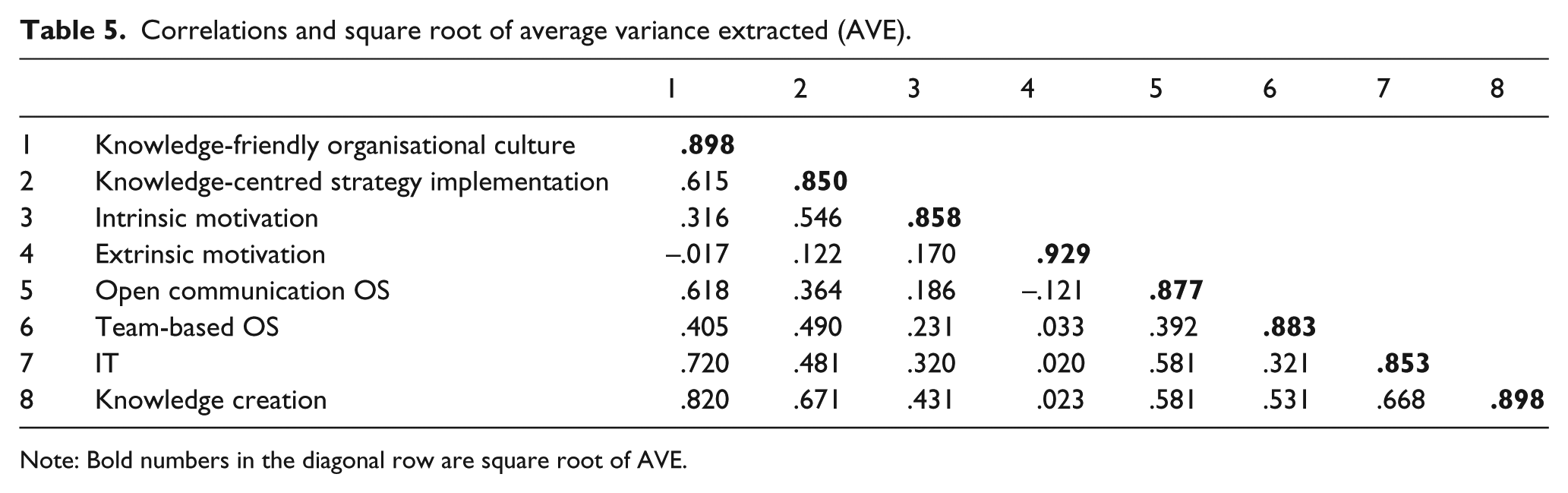
Note: Bold numbers in the diagonal row are square root of AVE.
The structural model
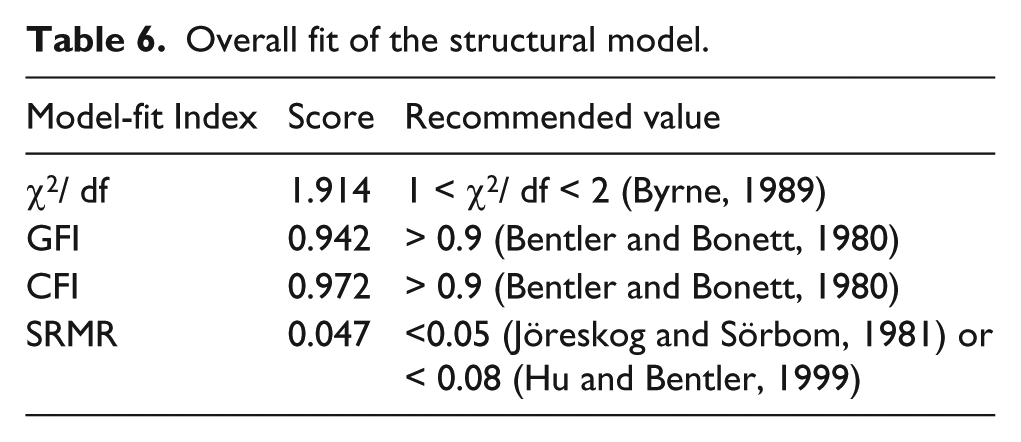
SEM was applied to test the proposed research model, using IBM® SPSS® Amos. To improve the statistical performance (fit) of the model (Figure 1), all insignificant paths were removed and new ones were introduced, based on the modification indices and residual covariance matrices provided by the software. Figure 2 represents the modified structural model, along with path coefficients and adjusted R2 scores. The fit of the modified model was assessed with four common fit measures: chi-square/ degrees of freedom (x2/ df), goodness-of-fit index (GFI), comparative fit index (CFI) and standardised root mean square residual (SRMR). Results (Table 6) indicated that measurement model fitted the data well, as all fit indices were within acceptable levels. Overall, the modified model accounts for 72% and 56% of the variance in knowledge creation and knowledge strategy implementation, respectively (see Figure 2).
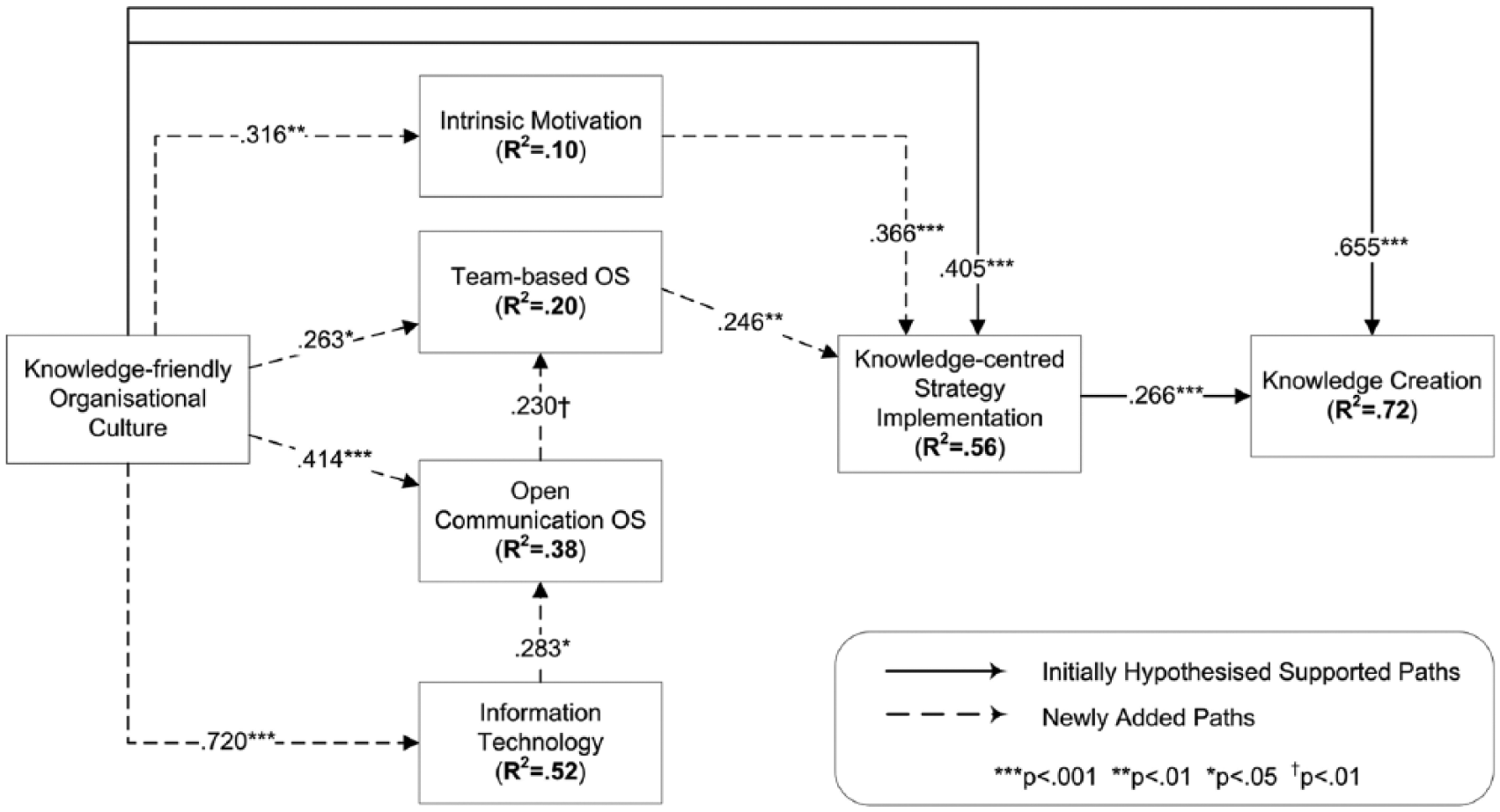
The modified structural model.
Overall fit of the structural model.
The validity of the hypothesised paths was examined using the statistical significance of the structural parameter estimates. The structural parameter estimates and hypotheses test results are summarised in Table 7, while Table 8 presents the direct (D), indirect (I) and total (T) standardised effects of the modified model constructs. Looking at total effects, organisational culture has the strongest influence on all constructs. More specifically, it has statistically significant total effects (both direct and indirect) on knowledge creation (β=.820), IT (β=.720), strategy implementation (β=.620), and open communication OS (β=.618). The results also indicated that culture directly affects intrinsic motivation (β=.316) and team-based OS (β=.263), while its influence on the latter increases further, taking into consideration the indirect effect (β=.142). As regards the hypotheses, three were accepted (H1, H2, H3), while three were dropped (H4, H5, H6).
Hypotheses testing results.
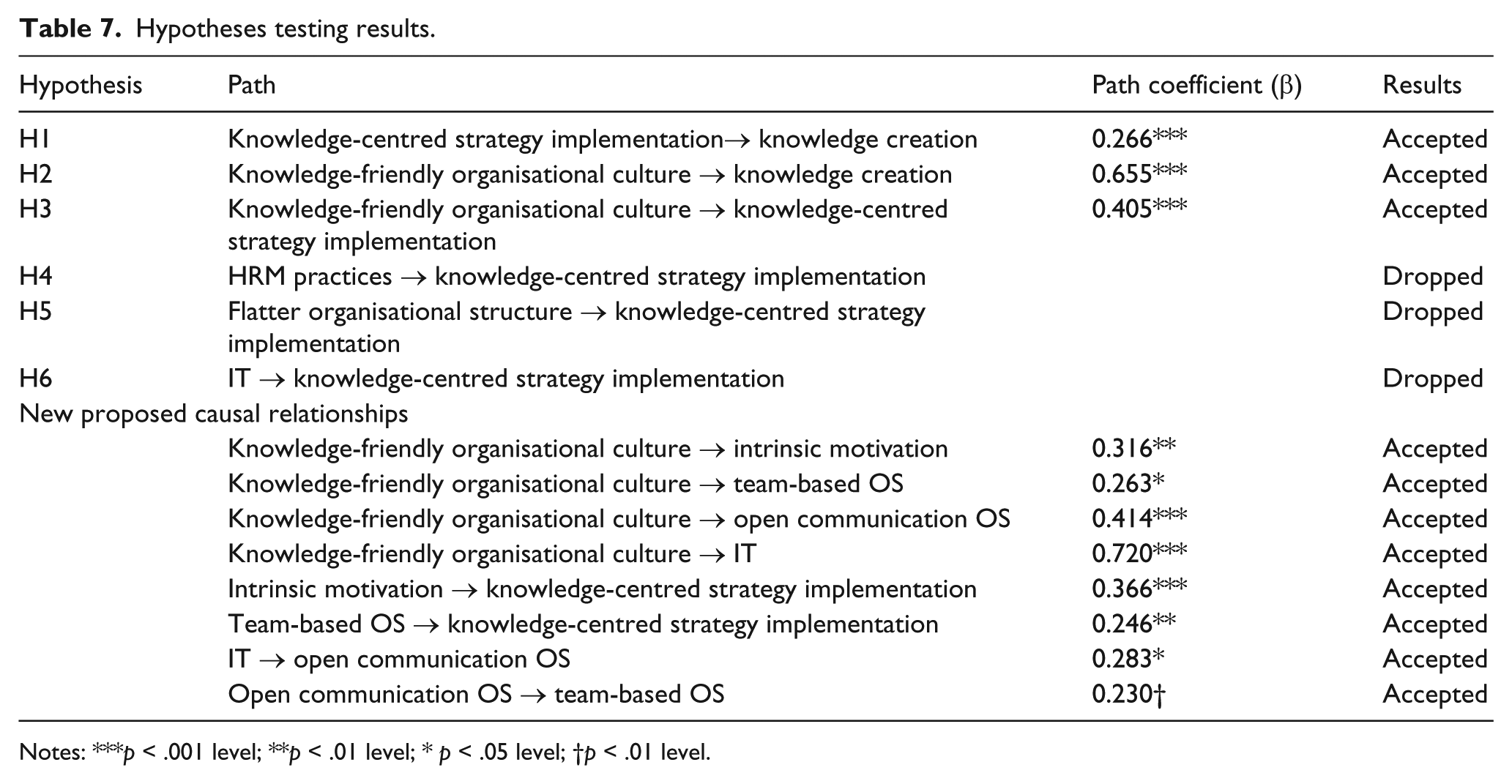
Notes: ***p < .001 level; **p < .01 level; * p < .05 level; †p < .01 level.
Effects table.
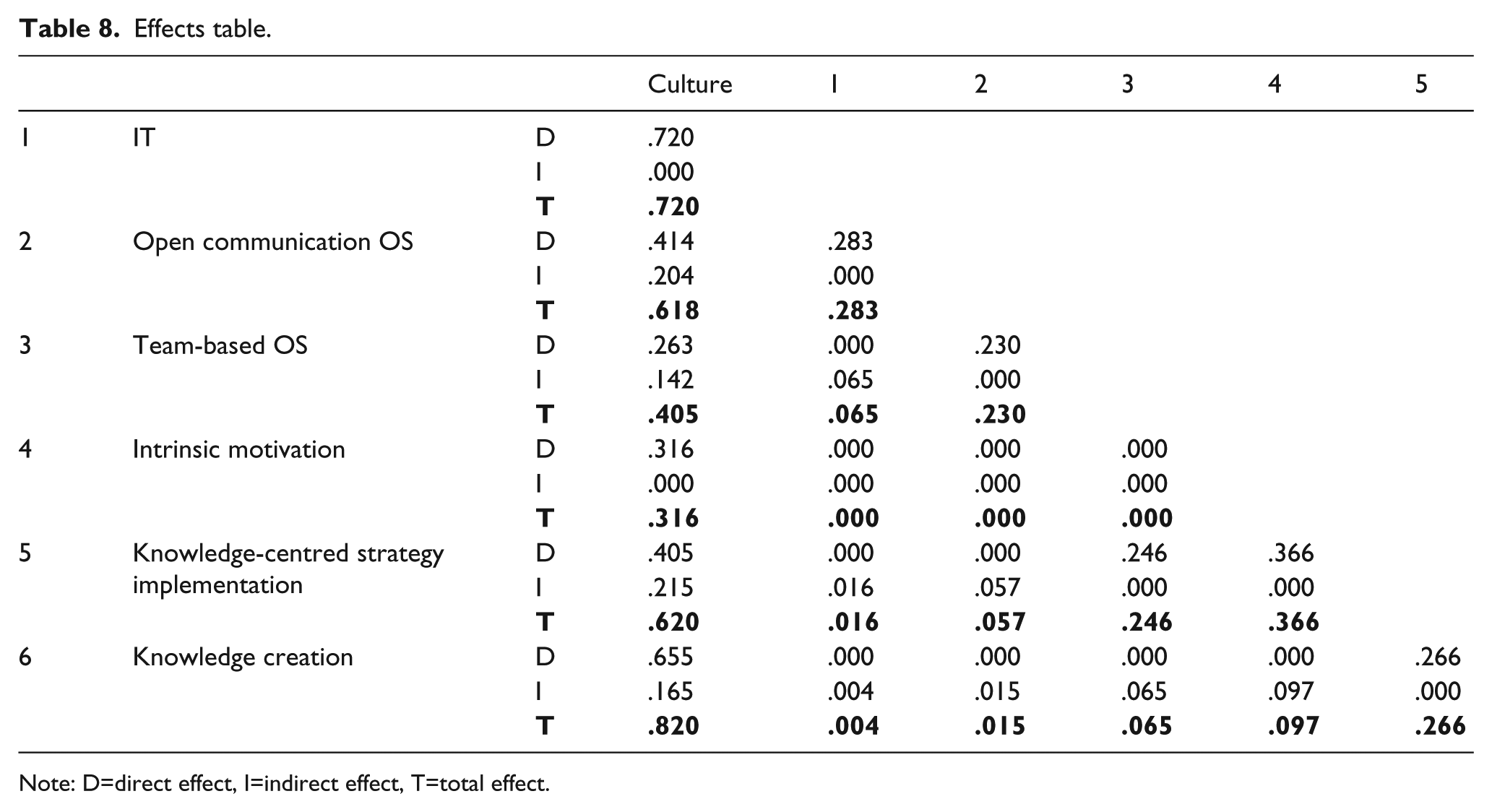
Note: D=direct effect, I=indirect effect, T=total effect.
Discussion
Analysis (Figure 2 and Table 8) indicated a positive direct effect of the implementation of a knowledge-centred strategy on knowledge creation (β=.266, p<.001). This finding suggests that the creation of new knowledge can be fully achieved only by implementing a strategy, in which internal and external both explicit and tacit knowledge are focal (Johannessen et al., 1999). This entails leveraging knowledge from both inside and outside the library, including employee and user knowledge (Islam et al., 2015), as well as knowledge about available tools and best practices in library services provision (Maponya, 2004). For example, knowledge accumulated by reference librarians (Gandhi, 2004) and knowledge about collection use and faculty interests and goals (Townley, 2001) should be captured (Maponya, 2004) and made available to library stakeholders (Townley, 2001).
Looking at strategy, literature has suggested that organisations should follow an 80/20 mix of the personalisation and codification strategies, based on their competitive stance, the nature of products offered and the type of knowledge employees use to solve problems (Hansen et al., 1999). However, newer approaches advocate the adoption of a knowledge strategy that integrates both strategic directions (Jasimuddin et al., 2005). As Scheepers et al. (2004: 201) explain, choosing a dominant strategy is useful for setting the initial strategic directions and relative priorities, but as goals are met, organisations should change their strategic mix to a point where a balanced approach is implemented, due to the ‘intertwined nature of knowledge processes’. By focusing solely on either the codification strategy, investing heavily on IT, or the personalisation strategy, organisations cannot take full advantage of KM benefits (Johannessen et al., 1999). In any case, it is important to align library strategies with the visions and goals of their parent institutions (Hijji, 2014).
As regards enablers, intrinsic motivation was found to directly influence knowledge strategy implementation (β=.366, p<.001), confirming the fundamental role of reinforcement, especially non-monetary, in the successful implementation of KM initiatives, as it helps to reduce employee reluctance to share and integrate their knowledge (e.g. Lam and Lambermont-Ford, 2010; Lin, 2011; Ma et al., 2014). Team-based OS also directly affects strategy (β=.246, p<.01); this is in accordance with Coakes et al. (2010), who argue that KM strategy both entails and enforces team working. Conversely, the remainder two enablers affect the implementation of knowledge-centred strategy only indirectly (see Table 8). More specifically, open communication OS influences strategy through team-based OS, suggesting that an organisational structure that allows open communication – not only among employees but also between employees and managers – and encourages team working plays a pivotal role in knowledge strategy implementation success. Flatter structures and team working, being more flexible, are generally considered more appropriate in times of change (Atkinson, 2003; Maponya, 2004; Moran, 2001). IT, on the other hand, has a weak positive influence on strategy via open communication OS. While this result provides support for IT’s central role in enabling inter-organisational communication, it also indicates that IT plays a far lesser role in KM strategy implementation (Rajasekar, 2014), especially compared to the role it plays in information management. As Holtshouse (1998: v) explains: Managing knowledge starts with stressing the importance of people, their work practices, and their work culture, before deciding whether or how technology should be brought into the picture. Information management, on the other hand, often starts with a technological solution first – with consideration of people’s work practices and work culture usually a distant second.
Finally, and most importantly, the current research provides further empirical evidence that organisational culture is an overarching factor in Greek academic libraries, as it was found to have a strong positive impact, both direct and indirect, on all model constructs. The extremely influential role of culture is supported by several previous studies; for instance, Zheng et al. (2010) found that it has a stronger effect on knowledge management, compared to structure and strategy. The positive relationship between culture and knowledge creation, as well as between the former and strategy have also received plenty of theoretical and empirical support in prior studies (Alavi and Leidner, 2001; Auernhammer and Hall, 2014; Jeng and Dunk, 2013; Lee and Choi, 2003; Rajasekar, 2014). Auernhammer and Hall’s (2014) research results, for example, indicated that for knowledge creation, creativity and innovation to be achieved, organisations should nurture an environment that values free communication, has tolerance for mistakes, provides intrinsic motivation and is open to change. The positive influence of culture on the remainder KM enablers that emerged also coincides with past study results. Indicatively, Bhatt (1998, 2001) argues that changes in organisational culture can create the balance between people and technology needed for knowledge to be effectively managed. The findings of the current study also confirm Hijji’s (2014: 13) suggestion that the successful implementation of an academic library’s strategy should be based on an organisational structure that ‘facilitates the optimal communication between all employees … [and an] organisational culture, which includes basic assumptions and values that must be shared by employees as the way to perceive, think, feel, and behave in the library’.
Conclusions and implications for library leaders
The role of KM in libraries has been discussed by many authors in recent years. Few studies (e.g. Biranvand et al., 2015; Huang, 2014; Siriprasoetsin et al., 2011), however, have empirically examined KM issues in the library context, adopting business models. The current research, using data from Greek academic library personnel, aimed to investigate how widely accepted enablers (social and technological) influence both knowledge creation and strategy implementation, through the application of SEM.
The research findings indicate that the creation of new knowledge in academic libraries is enhanced not only by the implementation of a clear and well-planned knowledge strategy, but first and foremost by the establishment of a knowledge-conducive culture and practices built on open communications, a team-based structure and supported by the use of technology tools.
Consequently, if academic libraries want to survive in the present challenging environment and better serve the needs of their patrons, library leaders should carefully devise and implement a knowledge-centred strategy, for the creation of new knowledge to be achieved. The factors that promote knowledge-related behaviours should also be seriously taken into consideration. Since organisational culture emerged as the most crucial knowledge creation enabler, library leaders must focus on shaping a cultural context that promotes knowledge sharing through the provision of appropriate incentives. Moreover, they should shy away from a tight, bureaucratic organisational structure, toward flatter, more flexible arrangements, where work is based on teams and open, upward and downward communication is encouraged. Finally, libraries should actively seek to capture, organise and disseminate tacit and explicit knowledge from employees, patrons and other information organisations. This expansive view of knowledge resources is necessary for innovative services provision. All of the above constitute cost-effective solutions for libraries; however, the real challenge for library leaders would be to transform the existing knowledge-conducive activities into systemic knowledge-creation practices.
The current research has some potential limitations; first, the study sample included personnel from the academic libraries of the Attica prefecture of Greece. Therefore, research should be expanded to include a nationwide sample. Second, although results largely concur with findings reported in the international literature, there is a possibility that the severe fiscal and human resources pressures faced by Greek libraries might have influenced the findings. A replication study in libraries of other countries would probably allow us to understand if the outcomes of the current research have been affected by the economic crisis.
Footnotes
Appendix
Questionnaire items.

|
|
|
| Our library (’s)… | |
| STRA1 | …has a clear understanding of our current core knowledge |
| STRA2 | …has a clear view of what knowledge and competences are the most relevant for the objectives |
| STRA3 | …knowledge and competences are evaluated systematically |
| STRA4 | …benchmarks our strategic knowledge against that of other libraries/information organisations |
| STRA5 | …explicitly recognises knowledge as a key element in the strategic planning exercises |
| STRA6 | …has a clear strategy for developing knowledge and competences |
|
|
|
| CUL1 | Openness and trust are valued in our library |
| CUL2 | Flexibility and a desire to innovate are valued in our library |
| CUL3 | Employees who take initiative of their own learning are highly valued in our library |
| CUL4 | Willingness to share lessons learned is valued in our library |
| CUL5 | In our library, lessons learned both successful and unsuccessful are considered valuable |
| CUL6 | In our library various units are encouraged to collaborate with each other |
|
|
|
| Our library… | |
| HRM1 | …specifically rewards knowledge sharing with monetary incentives |
| HRM2 | …specifically rewards knowledge sharing with non-monetary incentives |
| HRM3 | …specifically rewards knowledge creation with monetary incentives |
| HRM4 | …specifically rewards knowledge creation with non-monetary incentives |
| HRM5 | In our library, knowledge sharing is a component in employees’ performance evaluation |
|
|
|
| STRU1 | People from different parts of our library interact informally with each other in a frequent manner |
| STRU2 | In our library, open dialogs are common among/between employees and manager |
| STRU3 | In our projects, our library uses teams consisting of people with skills and expertise from diverse fields |
| STRU4 | In our library, we frequently use cross-functional teams and projects |
| STRU5 | In our library, we have purposeful overlap of functional responsibilities |
|
|
|
| IT1 | Our library uses technologies (e.g. Intranet, Internet, email, and e-learning) to facilitate employees sharing new ideas/knowledge with each other |
| IT2 | KM systems and tools in our library are widely accepted, monitored, and updated |
| IT3 | Our library’s ICT is capable of supporting management decisions and knowledge work |
| IT4 | Our library’s ICT architecture is capable of sharing data and information, knowledge, and expertise with all stakeholders in the organisation’s extended value chain |
| IT5 | Our library’s current ICT systems are sufficient to support the daily work |
|
|
|
| Our library stresses… | |
| SOC1 | …gathering information on services provided |
| SOC2 | …sharing experience with patrons |
| SOC3 | …engaging in dialogue with other information organisations |
| SOC4 | …finding new strategies and opportunities by wandering inside the library |
| SOC5 | …creating a work environment that allows peers to understand the craftsmanship and expertise |
|
|
|
| EXT1 | …creative and essential dialogues |
| EXT2 | …the use of deductive and inductive thinking |
| EXT3 | …the use of metaphors in dialogue for concept creation |
| EXT4 | …exchanging various ideas and dialogues |
| EXT5 | …subjective opinions |
|
|
|
| COM1 | …planning strategies using the current international knowledge |
| COM2 | …creating manuals and documents on services |
| COM3 | …building databases services |
| COM4 | …building up materials by gathering management figures and technical information |
| COM5 | …transmitting newly created concepts |
|
|
|
| INT1 | …enactive liaising activities with functional departments by cross-functional development teams |
| INT2 | …forming teams as a model and conducting experiments, and sharing results with entire departments |
| INT3 | …searching and sharing new values and thoughts |
| INT4 | …sharing and trying to understand management visions through communications with fellows |
| INT5 | …benchmarking |
Declaration of Conflicting Interests
The author(s) declared no potential conflicts of interest with respect to the research, authorship, and/or publication of this article.
Funding
The author(s) received no financial support for the research, authorship, and/or publication of this article.