




Abstract
Librarians of specialized institutions need to have solid knowledge of the scientific environment (impact of publications, use of citations and scientific references, etc.) related to the group for which they work in order to properly manage the collection of their libraries. The present research analyses the evolution of the use and types of references cited by academics in Library and Information Science and in Legal Medicine as an aid for specialist librarians in this sense. The study has a dual aspect: one is to determine how the behaviour of references, especially Web references, in relation to accessibility and use has evolved over 15 years in alternating periods (1999, 2004, 2009, 2013) in these two areas, and the other is to determine from the type of references scientists of prestige use in their publications whether they consider the Internet to be a reliable source of information for their research. Two journals with high impact factors according to Journal Citation Reports were selected from each category: Journal of the American Society for Information Science & Technology (JASIST) and Information Processing & Management (IP&M) corresponding to Information Science, and Regulatory Toxicology & Pharmacology (RT&P) and Forensic Science International (FSI) corresponding to Legal Medicine. The results showed greater accessibility and use of Web references in the Information Science community, but also considerable progress in these aspects in recent years in Legal Medicine.
Introduction
On numerous occasions, information professionals carry out their work in a particular area of knowledge or for a specific type of user, becoming specialized librarians. These professionals must, among other things, deal with the information needs of their users, and manage the knowledge and enrich the collection of their libraries, which obliges them to have an in-depth knowledge of the trends and behaviour of scientists from the area in which they work (Consejo de Cooperación Bibliotecaria Grupo de Trabajo sobre Perfiles Profesionales, 2013).
Given the importance of citation as a tool with which to measure the quality of work and as a sign of intellectual interaction among authors, professional librarians specialized in different scientific disciplines need to know how its use has evolved in recent years with the emergence of so-called Web references. Although the analysis of citations has posed some problems (MacRoberts and MacRoberts, 1989), for decades specialized librarians have used it as a method to plan and manage their library collection (Garfield, 1972; Haycock, 2004; Kohn and Gordon, 2014; Urbano-Salido, 2001). In an analysis of citations, it is essential to take into account the increase of electronic resources on the Web, and consequently the use of Web references in scientific works. It should be remembered that the use of information technology and of e-books (Vasileiou et al., 2012), and the selection of electronic materials in specialized libraries has been one of the main changes in the role of specialist librarians (Pinfield, 2001).
Web references constitute a compilation of sources of information available on the Web (Nisonger, 2004). As discussed by Estivill and Urbano (1997), the sources of information which are available on the Web and those which are not have characteristics in common with each other, but they also have palpable differences. Some of these are the use of certain descriptive elements in the sources of information available on the Web (in particular, elements of location or editing) because these sources usually do not stay definitively at a given location, and sometimes even disappear after a short time due to various causes and problems (Dimitrova and Bugeja, 2007; Lawrence et al., 2001; Sampath Kumar and Vinay Kumar, 2013; Wren, 2004). Although in this study we shall use the term ‘Web references’ (as is used by such authors as Lawrence et al., 2001; Moghaddam et al., 2012 and Spinellis, 2003), there are also other synonyms such as ‘electronic references’ (Wu, 2009) or ‘URL citations’ (Gul et al., 2017) which include articles from e-journals and all other forms of publication on the Internet.
Over the years, there has been research about the accessibility, permanence and reliability of the links within Web references on the one hand, and about the development of the use of such references in publications on the other. In relation to the first of these lines of research, Veronin (2002) and Maharana et al. (2006) noted in their articles that initially the problems researchers faced were focused on knowing with certainty whether the source of information they used was reliable, of quality and appropriate, but that no importance was given to the ease with which the links that redirected to the Web sources of information could rapidly disappear. However, this is not entirely true because certain authors had indeed already concerned themselves with the analysis of the stability and permanence of the links. For example, Koehler began studying the permanence and constancy of Web pages and sites (1999a) as well as the life cycle of Web documents (1999b), with these studies being extended some years later (Koehler, 2004, cited by Tajeddini et al., 2011). Germain (2000) noted an increasing decline in the accessibility of the references that directed to a URL. Wren et al. (2006) state that the instability of links, and, with that, of the information they contain, will continue to occur progressively until there are improved policies for the preservation and conservation of these links. Rochon et al. (2015) noted that, although the Internet presents many possibilities in terms of ease of access and being gratis, it also has drawbacks. Some of these drawbacks are not being able to access the right information due to the inability to locate the resource in cyberspace because it had been moved or had been deleted from the Web, or because it was on the Invisible Web. Some authors have tried to find solutions to these problems. Examples are: Spinellis (2003), Hester et al. (2004), Tajeddini et al. (2011), and Moghaddam et al. (2012) who opt for cooperation among all the participants in the process by creating an online archive with all the Internet material, to which all references are directed; Wren et al. (2006), Moghaddam et al. (2012), and Rochon et al. (2015) who consider that the links to digital objects should be reviewed before the document is published so as to prevent the premature decay of the said URLs; and finally, Spinellis (2003) and Tajeddini et al. (2011) who indicate that the creators of the information on websites should themselves keep copies of the material they have created so that, if needed, they could cooperate with those responsible for maintaining that website. For Wren (2008), this situation is unlikely because the authors of the information available on the Internet do not have enough time and expertise to perform this task.
With regard to research on the use of Web references in publications, Lawrence et al. (2001) observed an increase in their use in recent years, as well as the disappearance and invalidation of many links in the field of scientific research. Zhao and Logan (2002), following Youngen (1997), note an increase in the number of works of scientific research on the Web and, with this, a parallel growth of references to those works. Rumsey (2002), in a study of the use of Web references in Law Review Citations over a period of five years showed that the use of one or more Web references in law review articles increased by approximately 4.5% every year. Hester et al. (2004) studied the frequency of use and accessibility of Web references in journals in the field of oncology with a high impact factor, and noted that in the period of two years (2001–2003) the number of Web references increased by 7%. Bhat and Sampath Kumar (2008), after analysing nine scientific journals, concluded that approximately 80% of the academic articles published in them contained Web references. Wu (2009) noted that the number of Web references used in the articles in two Chinese academic journals increased by a factor of four in just five years (1999–2003). Tajeddini et al. (2011) studied the use, availability and persistence of the Web references in the Malaysian Journal of Library & Information Science, noting that 11% of all references were Web bibliographic, and that 64% of them were located at the URL cited. Sampath Kumar and Prithvi Raj (2012) noted that the Web references in academic papers have increased rapidly over recent years due to the ease of access to the content and because many Web resources are gratis for consultation and citation. This is reflected in the results of their study, carried out on articles belonging to the field of Library and Information Science (LIS) in India during the period 2001–2008, in which the Web references increased by a factor of six in a space of seven years, namely a difference of 23.24%. In the same year, Moghaddam et al. (2012) conducted a study of the availability and half-life of the Web references cited in the Information Research Journal, finding that 66% of the articles analysed had at least one Web reference. A year later, Prithvi Raj and Sampath Kumar (2013) presented another article analysing the trend in Web references in the communications in conference proceedings on LIS in India between 2001 and 2010, finding that the works with at least one URL increased from 39.10% in 2001 to 91.67% in 2010. Finally, Rochon et al. (2015) indicate that 70% of the articles in medical electronic academic journals contain at least one Web reference, and that therefore one can say that such Web references are widely used among medical researchers.
As we have just seen therefore, there have been various research studies conducted on the accessibility, durability, reliability and use of the links in the Web references of publications. However, none of them has studied these references comparing their use in different categories, information which could be of great help for specialized librarians. Therefore, the overall objective of the present research was to study the Web references used by scientists in their publications, the purpose being to respond to the following research questions: How have Web references changed in behaviour over 15 years, considering alternating periods (1999, 2004, 2009 and 2013) in two categories corresponding to quite different disciplines: Library and Information Science (a social science) and Legal Medicine (an empirical science)? Is it necessary for librarians specialized in these two categories to know the behaviour of the Web references in order to form their collections? Do scientists of prestige consider the Internet to be a reliable source of information for their research (taking into account the use of Web references in their publications), so that specialized librarians can check the appropriateness of their libraries’ electronic collection? And finally, will the use of Web references become more prevalent in the LIS field because of the latter’s traditional link with information and communication technologies (ICTs)? To answer these questions, we selected two scientific journals of impact in each category.
Data and methods
The research carried out in this work was aimed at comparing how scientists in two different categories use Web references in their publications, and to determine these references’ accessibility and use in alternating periods covering 15 years as a sign of the reliability of the Internet as a source of information for scientists. Specifically, the study is based on the analysis of four scientific journals. Two of these corresponded to the category of LIS in the 2013 version of the SSCI (Social Sciences Citation Index). They were the Journal of the American Society for Information Science & Technology – JASIST – and Information Processing & Management – IP&M. Both of these journals also belong to the Computer Science, Information Systems category, but the authors consider them to be two of the most significant and popular journals for LIS researchers, and therefore of significant value for the purposes of the present study. The other two corresponded to the category of Legal Medicine of the 2013 version of the SCI (Science Citation Index). They were Regulatory Toxicology & Pharmacology – RT&P – and Forensic Science International – FSI. We selected journals that are antagonistic in terms of their content but united by similar quality criteria in order to check what happens in different disciplines. The aim was to broaden the range of librarians who, among other things, must prepare thematic guides for different disciplines.
First, the period for the analysis of the journals was selected. This period covered 15 years from 1999 to 2013 (distributed into alternate five-year periods, except for the last of four years), and coincides in part with the life cycle of cybermetrics – a field which analyses, studies and measures all the types of information media that exist in cyberspace, using scientometric, bibliometric and informetric techniques (Shiri, 1998) – and therefore of Web references. In particular, 1999 corresponded to the start of cybermetrics (mid-1990s), 2004 and 2009 to its maturity, and 2013 to the development of new sub-disciplines such as altmetrics or semantometrics. As mentioned above, the last period is of four years instead of five because, at the time this study was conducted, the operational version of the JCR was 2013.
Second, the journals were selected considering whether they were in the first or second quartile of impact of the JCR (Journal Citation Reports) for each year of the analysis. This ensures that the articles published in them are of high quality, and therefore constitute a reliable indicator of the use of Web references by the community of prestigious scientists.
Once the journals had been selected, we proceeded to extract the Web references from the articles published during the years indicated (only the articles listed in the section of research articles were analysed – not reviews, notes, etc.). We then prepared the corresponding tables and graphs that will be presented in the Results section. Web references were identified through their URLs. In particular, 16 matrices were generated (4 journals × 4 years each). Their fields are listed in Table I.
Fields of analysis in the study.
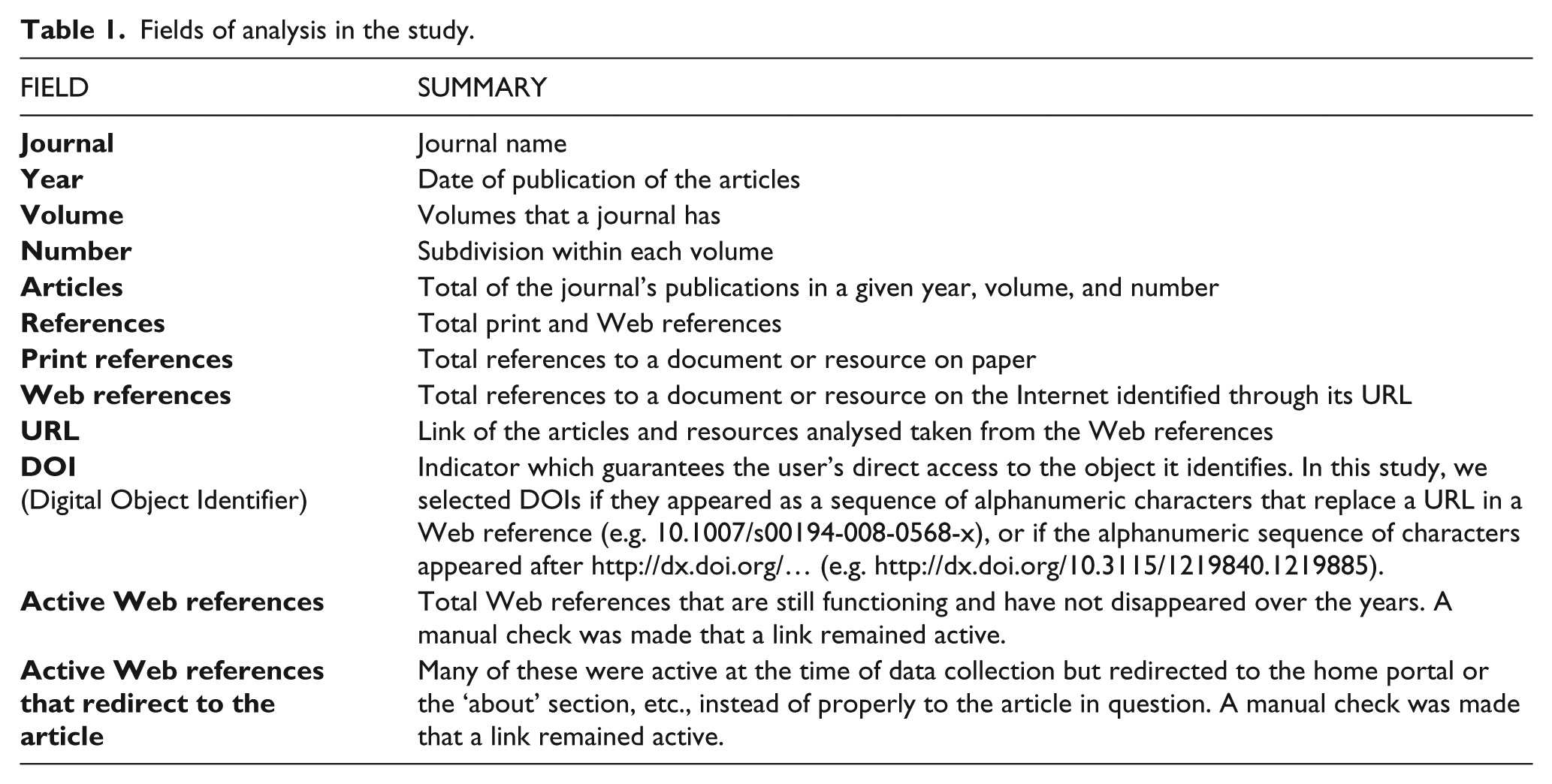
During the months of January, March and April 2015, we collected 71,219 references (4457 of them Web references) which were analysed in detail according to the fields indicated in Table 1, and which will be presented in the Results section. Specifically, to observe the temporal evolution of the data, the rate of variation from one year to another was calculated using the formula shown in Figure 1.

Rate of variation.
Results
Articles, references and printed references
First, we examined all the articles collected for the analysis (Appendix: Table 2). There were 2009 articles in total, with a greater proportion of Legal Medicine (60.73%) than LIS (39.27%). With regard to the total volume of articles per year, there was a progressive increase with a positive general rate of variation for 2013 compared to 1999 of 64.89%. The medical journal Forensic Science International (FSI) had the greatest percentage of articles (41.41%). This was understandable since this Irish journal, specializing in issues related to forensic science, its legal aspects and public health in general, published a high average of numbers in the years selected. The journal with the fewest articles was Information Processing & Management (IP&M) (11.10%), a British LIS journal especially dedicated to the recovery and processing of information as well as to resource management, systems, networks and information services. It publishes just six numbers per year. Analysing the evolution of the number of articles per journal over the years showed that all the journals had a positive rate of variation for 2013 compared to 1999. The values were very similar for JASIST 42.37%, RT&P 47.62%, and FSI 62.42%, but more pronounced in the case of IP&M 238.46%.
As for the total references found in the 2009 articles, their number amounted to 71,219 (Appendix: Table 3). In this case also, the Legal Medicine category obtained a greater percentage of references (54.30%) than LIS (45.70%). The total number of references per year experienced a progressive increase, with a positive general rate of variation for 2013 compared to 1999 of 132.24%. The LIS journal, Journal of the American Society for Information Science & Technology (JASIST) had the greatest percentage of references (33.88%) despite not being the journal with the largest number of articles. This American academic and technical journal has been publishing since 1950 everything related to information science and technology. Although all the journals present a positive rate of variation for 2013 compared to 1999 (JASIST 131.48%, IP&M 215.58%, RT&P 95.22%, and FSI 135.90%), IP&M and RT&P are the two which show a continual increase over the four years studied.
Out of the 71,219 references, 66,762 were print (93.74%) (Appendix: Table 4). By category, Legal Medicine accumulated a greater percentage of print references (55.40%) than LIS (44.60%). The total print references per year increased progressively with a rate of variation for 2013 compared to 1999 of 119.66%. The journal with the greatest number of print references was JASIST (32.71%) followed closely by FSI (32.37%). The rate of variation for 2013 compared to 1999 in the four journals was positive (JASIST 121.29%, IP&M 213.93%, RT&P 74.61%, and FSI 125.31%).
Web references, DOI, active Web references and Web references that redirect
Of the 71,219 references, only 4457 were Web references (6.26%) (Appendix: Table 5), i.e. references to an electronic document or resource on the Internet. If the journals analysed are compared by field, one can see that LIS had the more Web references, namely 62.28% compared with Legal Medicine with 37.72%, no doubt because of JASIST which accounted for 51.31% of the total Web references. In the case of the medical journals, it was Regulatory Toxicology & Pharmacology (RT&P), an American journal that deals with bridging the gap between scientific information and legal aspects related to toxicology and pharmacology, which had the greatest percentage (26.16%). The Web references increased over the years, with a very high general rate of variation for 2013 compared to 1999 (555.84%). The rate of variation for 2013 compared to 1999 in JASIST was 273.03%, in IP&M was 249.09%, in RT&P was 3205.26%, and in FSI was 17 900%. The rates of variation vary considerably between the two disciplines, being far greater in the case of Medicine, especially for the journal FSI, indicative of the progressive initial growth of the use of Web references in the sciences.
Once the data of both types of references (print and Web) had been determined, the total percentages of print and Web references were compared throughout the years. Although 93.74% of the total references were print and only 6.26% were Web, Figure 2 shows that there was a general decreasing trend in the percentage of print references versus an increasing trend in the percentage of Web references.
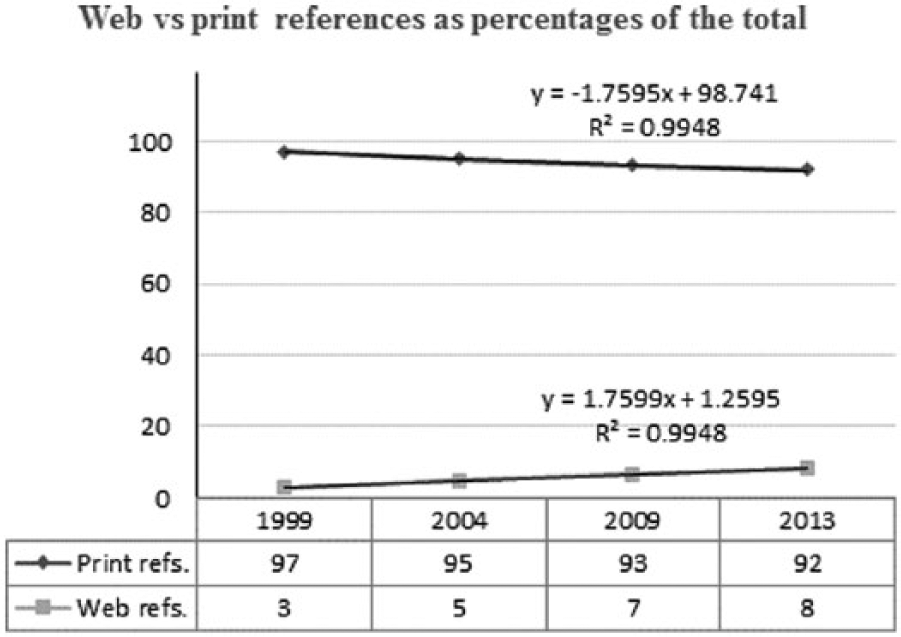
Total percentages of print references vs Web references: Temporal evolution.
Figure 3 shows the evolution by journal of the percentage of print references versus Web references, with, as mentioned above, there being a great predominance of print references for every journal and every year. Also, as mentioned above, the Web references in LIS journals outnumber those in Legal Medicine journals. One can see that, while in 1999 and 2004 the proportion of Web references in the JASIST and IP&M journals was significantly greater than in the medical journals, both of the medical journals (RT&P and FSI) showed continual increase in numbers of Web references over the years, whereas IP&M decreased considerably in 2013 compared to 2004.
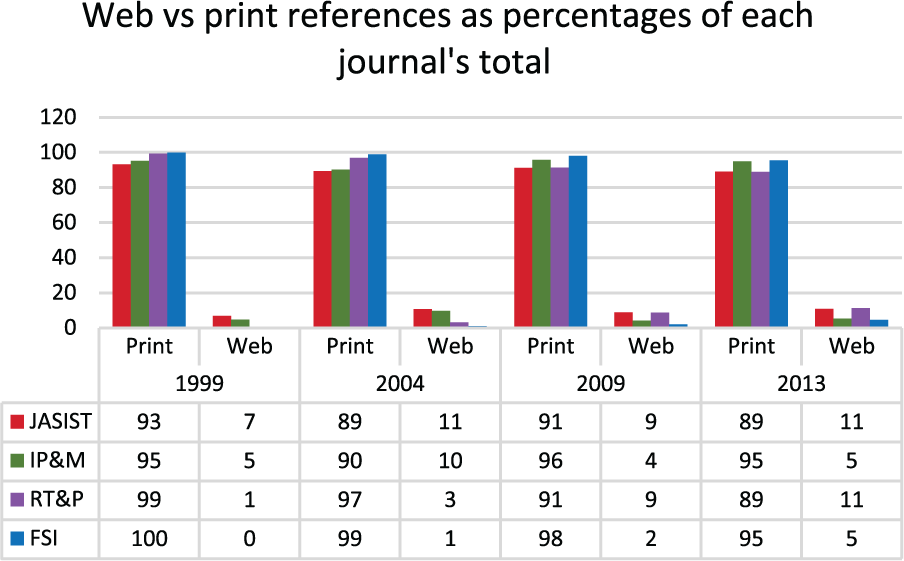
Percentage of print references vs Web references by journal: Temporal evolution.
With respect to the DOI references, among the Web references studied we found a considerable number of DOI. We therefore considered it appropriate to also study their particular evolution over the established period. Although the DOI was created in the mid-90s, it is believed that its imposition and use in Web references has grown in parallel with the growth of the Web on the Internet, so that its appearance in those references would have been progressive. As one observes in Appendix: Table 6, out of the 4457 Web references, 406 (9.11%) are DOI. By discipline, LIS used more DOI Web references (75.86%) than Legal Medicine (24.14%), an aspect that could be due to the tradition of LIS to incorporate standardization and identification elements in their documents, whether print or digital. The evolution of DOI Web references increased over the years, with an extremely high general rate of variation for 2013 compared to 2004 (the first year analysed with any DOI reference) of 7080%. This fact is marked by the progression of the DOI indicator itself, which went from more than 50 million DOI names in 2011 to 85 million in 2013, and had reached 100 million in 2014 (www.doi.org). JASIST was by far the journal with most DOI references (64.53%), and RT&P was that with the least (8.87%). In each journal, the percentage of DOI references relative to the total Web references was small (JASIST 11.46%, IP&M 9.41%, RT&P 3.09%, and FSI 12.04%; average = 9%), and the means of these percentages for the two disciplines were similar. These low percentages are no doubt due to the fact that extended use of DOI did not begin until 2009 in the journals studied. The rate of variation was very high in all the journals. Taking into account the first year that DOI references appeared, the rates of variation from 2004 until 2013 were 5975% in JASIST and 1900% in RT&P, and from 2009 to 2013 were 2100% in IP&M and 420% in FSI.
We also studied the quantity of Web references remaining active, i.e. still functioning over the years (Appendix: Table 7). Out of the 4457 Web references, 3052 remain operational (68.48%). If the journals analysed are compared by categories, it can be seen that those of LIS have the most Web references that remain active, namely 62.02% compared with 37.98% of Legal Medicine. We observed a progressive increase over the years of the total active references, with a very high rate of variation for 2013 compared to 1999 of 1740%. According to Spinellis (2003), the half-life of a URL is about four years, so that it is logical that the closer in time a check is made then the more Web references will be found that have remained active. The journal with the most active Web references was JASIST (51.02%), and the one with the least was IP&M (11.01%). Regardless of the categories, in all the journals similar proportions of Web references remained active: JASIST 68.08%, IP&M 68.71%, RT&P 68.27%, and FSI 70.49%; average = 68.89%, which indicated a similar behaviour in this regard in the two disciplines. In every journal except one there was a steady growth of the total active Web references. The exception was IP&M whose number decreased considerably in 2009, although it increased again in 2013. However, in all cases the rates of variation were very high, with RT&P standing out: for 2013 compared to 1999, JASIST 925.97%, IP&M 1161.54%, and RT&P 10 360%; and for 2013 compared to 2004, FSI 697.06%.
Within the Web references, as well as determining the evolution of the DOI and which Web references were still active, we considered it important to study the total number of active references that were not only accessible but also correctly redirected to the specific articles they referred to. In the Appendix: Table 8, one observes that, out of the 3052 active Web references, 2942 correctly redirected to the specific Web resource, i.e. a high 96.40% proportion. Comparing the categories, we found the journals associated with LIS to account for 61.59% compared to 38.41% accounted for by the Legal Medicine journals. From 1999 to 2013, there was a progressive increase in the total of active Web references that redirected to the correct resource, with a very high rate of variation for 2013 compared to 1999 of 1856.32%. Similarly to the previous case, it is normal that the closer in time then the greater proportion of references will be found that redirect correctly. The journal with the most active Web references that redirect correctly was by far JASIST (50.54%), and that with the least was IP&M (11.05%), followed closely by FSI (11.79%). As was the case with the active Web references, the percentage of Web references that redirected correctly was very similar for each journal, regardless of the discipline: JASIST 95.50%, IP&M 96.73%, RT&P 98, 37%, and FSI 95.59% (average = 96.55%). Again, as in the previous case, the total active Web references that redirected correctly increased steadily in all the journals except for IP&M, which decreased considerably in 2009, although it increased again in 2013. The rates of variation were very high for all the journals: for 2013 compared to 1999, JASIST 985.71%, IP&M 1250%, and RT&P 10 260%; and for 2013 compared to 2004, FSI 773.33%. The journal Regulatory Toxicology & Pharmacology (RT&P) stood out with a very high rate of variation, denoting the advance of Medicine in this sense.
Conclusions
Organizations that finance libraries are very interested in evaluating the performance of their services, both in general and in their specific aspects. One of these specific aspects is obviously the collection, considered an essential factor since without it the library would have no reason to be. Citation analysis represents an efficient method with which to study the use of information since it does not interfere with the behaviour of the group studied, and allows a far greater level of detail to be obtained in the information than other methods do. This is why specialized librarians have been using it for decades to configure their libraries’ collections. Nonetheless, the growth of Web resources and the possibility of their being cited in publications of impact has changed the perspective of librarianship so that it is now essential for librarians to stay abreast of trends in their own specific areas, so as to properly correct manage their collections.
In order to answer the first research question regarding the behaviour of Web references, with this study we observed a steady increase in the use of Web references over the years analysed (1999, 2004, 2009 and 2013) in both of the categories examined – LIS and Legal Medicine. The general rate of variation for 2013 compared to 1999 was 555.84%. This datum shows how researchers who publish in journals of impact, regardless of the discipline, have been adapting to the novel forms offered by the Internet, since the advantages provided by those forms are very attractive for scientists (access that, in many cases, is rapid, easy and free). This is despite the problems of accessibility, permanence and stability that may arise in finding a broken hyperlink or not having any connection. The datum also provides an answer to the second research question, and shows librarians the need to take the Web references scientists use into account in forming their library’s electronic collection or in preparing thematic guides.
As was shown in the literature review done for this study concerning the accessibility, stability and reliability of links, research until now has found only weak stability of the links associated with Web references. The present study, however, reverses this trend since we observed that the percentage of Web references that remain active in the four journals analysed was 68.48% and the percentage which correctly redirected to the original article reached 96.40%. This is indicative of a favourable tendency regarding the proper maintenance of the links that make up the Web references of articles published in journals of impact, and it strengthens librarians’ surety when it comes to using Web references in forming their collection.
Regarding the reliability of the Internet as determined by analysing the use of Web references, all the studies analysed in the Introduction section found an increase in their use, and this was confirmed in the present study with their use increasing progressively over the years (variation for 2013 compared to 1999 of 555.84%). This demonstrates that, despite the problems with the Web, researchers in both categories are increasingly likely to use the content provided on it, and thus consider the Internet to be a reliable source of information for their research with impact, thus answering the third research question on the use of Web references by scientists with prestige. Even so, print references are still the materials most used by researchers, with 93.74% of the total references compared to 6.26% of Web references. However, despite this high proportion, over the years analysed there was a slight progressive general decreasing trend of print references, and consequently a progressive increase in the percentage of Web references. This tendency adds to librarians’ surety for the need to consider Web references as indispensable elements in forming their collections.
Regarding the publications analysed, the Journal of the American Society for Information Science & Technology (JASIST) was the journal which had the greatest percentages in the variables related to Web references, thus determining its importance in this area.
In comparing the thematic categories, we observed the two Legal Medicine journals to be ahead of those of the LIS category in the three variables not directly related to Web references, i.e. the proportion of the number of articles (60.63%), the proportion of references (54.30%) even though the mean number of references per article was greater in LIS (40.2 vs 34.6), and of print references (55.40%). In contrast, the contrary was the case for the four variables concerning Web references, i.e. the journals associated with the category of LIS in all cases exceeded the journals in the category of Legal Medicine. Thus, the percentage of Web references in LIS reached 62.28%, the DOI Web references 75.86%, the active Web references 62.02%, and the active and correctly redirected references 61.59%. However, it is curious to note that the greatest variations for 2013 compared to 1999 in three of the four variables related to Web references occur in journals associated with the Legal Medicine category. In particular, the values were as follows: for Web references, FSI 17 900%; for active Web references, RT&P 10 360%; and for Web references that redirect correctly, RT&P 10 260%, all of them very high values of variation.
This behaviour is a reflection of the early use of Web references by scientists who publish in journals with impact in the category of LIS. Nevertheless, over time we observed a marked progressive increase of their use in journals with impact associated with the Legal Medicine category. Therefore, although the last question posed in this investigation can be answered affirmatively, noting that the use of Web references is more predominant in the field of LIS because of its traditional linkage with ICT, an important advance in this field has nonetheless occurred in Legal Medicine.
Recognition of the trends in the types of references used by prestige scientists in LIS and Legal Medicine that have been revealed in this investigation will help specialized librarians to understand how the two categories are currently evolving in order to properly manage the collection of their libraries. In particular, they would need to take into account aspects related to Web references (steady increase in their use and in the links associated with them) in order to periodically review and increase their electronic collections.
Footnotes
Appendix
Active Web references that redirect correctly by year and journal.

| Active Web references that redirect | |||||
|---|---|---|---|---|---|
| Journals | 1999 | 2004 | 2009 | 2013 | Total active Web references that redirect by journal |
|
|
70 | 182 | 475 | 760 | 1487 |
|
|
12 | 99 | 52 | 162 | 325 |
|
|
5 | 28 | 232 | 518 | 783 |
|
|
0 | 30 | 55 | 262 | 347 |
|
|
87 | 339 | 814 | 1702 | 2942 |
Declaration of Conflicting Interests
The author(s) declared no potential conflicts of interest with respect to the research, authorship, and/or publication of this article.
Funding
The author(s) disclosed receipt of the following financial support for the research, authorship, and/or publication of this article: The present work was financed by the Consejería de Economía e Infraestructuras of the Junta de Extremadura, and the European Social Fund as part of the Aid to Research Groups GR10019.