



Abstract
The study aims to investigate whether indices (e.g. SSCI/ SCI/AHCI/ESCI, SCOPUS, MEDLINE, HW Wilson, ERIC) include potentially fake journals (PFJs) identified earlier in Beall’s list. Fourteen indices were examined to find out if PFJs are indexed by indices. The study also aims to provide detailed data regarding which of these indices include such PFJs along with information about the number of issues and articles published per year and publication fees charged by PFJs indexed by ordinary indices. The universe of the PFJs is composed of those listed in the Beall list (n=2708
Keywords
Introduction
Bibliographic databases (BDs) play an important role in the dissemination of universal scientific knowledge as they systematically offer researchers scientific knowledge. In addition, BDs should play an active role in strengthening the quality control of indexed articles and journals (Frandsen, 2017). Also, researchers assume that the journals and the studies published in them are included in BDs after they are meticulously examined and filtered through a scientific filter. However, over the last few years, some researchers have argued that BDs neglect their vital roles.
This discussion was sparked off by the claim that potentially fake journals (PFJs), which are called “evil” by Das and Chatterjee (2017), “Trojan Horse” by Demir (2018a) and “pollution” by Beall (2016), are indexed by such BDs as SSCI/SC/AHCI, SCOPUS, MEDLINE, ERIC (Beall, 2016; Masten and Ashcraft, 2016; Roberts, 2016; Van Nuland and Rogers, 2016; Ward, 2016). Initially, no one in the scientific world other than some young researchers in developing countries respected them.
However, Shen and Bjork (2015) argued that the number of PFJs is increasing day by day and an estimated number of 53,000 so-called articles published in PFJs are indexed in DOAJ. In addition, Nelson and Huffman (2015) revealed that six PFJs are indexed in Academic OneFile, 55 in Academic Search Complete, 812 in DOAJ, and 299 in ProQuest Central. However, the studies by Shen and Bjork (2015) and Nelson and Huffman (2015) were ignored. In addition, until recently some researchers have argued that that PFJs are indexed by some indices is not correct (Eriksson and Helgesson, 2016; Masten and Ashcraft, 2016; Roberts, 2016; Van Nuland and Rogers, 2016; Ward, 2016). These researchers’ arguments are based on the assumption that PFJs are not generally indexed in indices like SSCI/SC/AHCI, SCOPUS, ERIC, Wilson, and PubMed index. However, Savina and Sterligov (2016) argued that 447 PFJs were indexed in SCOPUS as of May 2016. Similarly, Macháček and Srholec (2017) claim that 306,000 documents, published by 405 PFJs, were indexed in SCOPUS in 2004 and 2015. The world of science in particular was seriously shaken when Manca et al. (2017a) reported that some PFJs are indexed in PubMed.
Until now no researcher has been able to show that PFJs are indexed in indices (other than PubMed), though Kratochvíl and Plch (2017) argued that some PFJs can be indexed by some indices like Scopus and ERIC. However, this is still an assumption. Frandsen (2017) from a different perspective reported that so-called articles published in 124 PFJs indexed in SSCI/SCI/AHCI were referred to 1295 times. Based on qualitative data, Demir (2018a) reported that one basic factor that makes PFJs attractive for researchers in developing countries is that they are indexed by some indices. Demir (2018b) and Demir (2018c) found that researchers who tend to publish in PFJs for academic promotion state that they would not publish in these PFJs if they were not indexed by indices, which indicates that it is high time that the issue be considered. Furthermore, researchers call for a study on a current list of PFJs which are indexed by SSCI/SCI/AHCI and in Scopus, MEDLINE, ERIC, and Wilson, which are viewed as field indices in developing countries (Demir, 2018a; Demir, 2018c; Frandsen, 2017; Kratochvíl and Plch, 2017).
There are some studies indicating that PFJs are indexed in some indices (Demir, 2018a; Kratochvíl and Plch, 2017; Manca et al., 2017a, 2017b; Nelson and Huffman, 2015; Shen and Bjork, 2015). However, these studies have some limitations: (1) no study examined whether all journals in Beall’s list and predatory publishers were indexed in indices; (2) these studies examined whether PFJs were indexed in DOAJ, Academic OneFile, Academic Search Complete, ProQuest Central, and PubMed indices. However, according to Demir (2018c) the basic reason that encourages researchers to publish in PFJs is that they are indexed by SSCI/SCI /AHCI and in Scopus, PubMed, ERIC, and Wilson, which are regarded as field indices. Therefore, the aim of this study is to ascertain whether indices include the PFJs in Beall’s list.
With this aim in mind, this study seeks to answer the following research questions:
Are PFJs indexed by indices?
If they are indexed:
Which PFJs are indexed by which indices?
Do the annual numbers of articles PFJs indexed in indices publish differ from those of PFJs that are not indexed by indices?
Does the publication fee PFJs charge vary according to the indices in which they are indexed?
Related research
It is possible to categorize the studies on PFJs into five main categories: those focusing on the places where PFJs are founded/directed, those focusing on their basic characteristics, the countries which publish most in PFJs, the characteristics of researchers, and those studying the reasons why researchers publish in PFJs.
In the literature, it is frequently argued that PFJs often give developed countries as their addresses but they are mostly located in developing countries (Beall, 2015b; Gutierrezet al., 2015; Kurt, 2018). Demir (2018a), who examined 735 journals in Beall’s list whose websites are accessible, ascertained that 119 out of 735 PFJs use incorrect addresses according to WHOIS data and that 82.3% of the PFJS were located in developing countries.
Truth (2012) emphasizes that one of the basic philosophy of PFJs is “pay big, publish fast”. But some of the authors publishing in PFJs do not actually pay to publish. They are editors, invited writers or some writers who fall into the trap without knowing the features of PFJs. In the same way, Bohannon (2013) pointed out that PFJs publish for money and that the articles do not go through a robust editorial process and referee review processes. It has been claimed that a low quality referee examination process takes place, if any at all, and articles are published for money regardless of scientific concerns (Anderson, 2012; Poynder, 2013).
In a study by Demir (2018a), 24,840 so-called articles published in 2017 PFJs were examined and it was determined that researchers from 146 countries out of 195 countries in the world published in these journals and that mostly researchers from India, Nigeria, and Turkey published in PFJs. Simón (2016) argued that the highest number of researchers publishing in PFJs were from Nigeria which was followed by Turkey, Botswana, Jordan. The common point in the literature is that it is mostly researchers from developing countries who publish in PFJs (Demir, 2018a; Kurt, 2018; Lukić et al., 2014; Nwagwu, 2015, Nwagwu and Ojemeni, 2015; Omobowale et al., 2014; Raghavan et al., 2014; Simón, 2016; Truth, 2012).
Xia et al. (2015) and Lukić et al. (2014) asserted that mostly young and inexperienced researchers published in PFJs. In a study by Demir (2018b), it was determined that most of the researchers who published in PFJs in 2017 do not hold PhD degree.
Arunachalam (2006) argued that researchers who lacked research skills and/or had failed to publish in journals indexed in indices like SSCI/SCI tended to publish in PFJs. The pressure of “publish or perish” has been frequently cited as another reason that directs researchers to PFJs (Demir, 2018c; Kolata, 2013; Roberts, 2016; Shaw, 2013; Xia, 2015; Xia et al., 2015). While Kurt (2018) cites social identity threat, unawareness, high pressure, and lack of research proficiency as reasons that direct researchers to PFJs, Xia (2015) and Xia et al. (2015) argue that academic and socio-cultural environments in developing countries and the desire to make a reputation encouraged them to publish in PFJs. It is frequently claimed that the academic allowance paid to researchers for publications in journals, whether they are PFJs or not, is another factor that directs researchers to PFJs (Abraham and Minj 2007; Adomi and Mordi, 2003; Demir, 2018a; Pyne, 2017). Furthermore, there are also studies arguing that the desire to get promoted quickly causes researchers to publish in PFJs (Djuric, 2015; Lukić et al., 2014; Omobowale et al., 2014). Lack of awareness is also a factor (Darbyshire et al., 2017; Hadi, 2016; Kurt, 2018; Lukić et al., 2014).
Some researchers suggest fighting against PFJs (Anthony, 2015; Beall, 2015b; Betz, 2016; Clark and Smith, 2015; Demir, 2018a; Fitzpatrick, 2015; Flanagan, 2015; Kmietowicz, 2009; Mehrpour and Khajavi, 2014; Moher and Moher, 2016; Pickler et al., 2015). Beall (2015b) strongly emphasized that PFJs cause great damage to the scientific world and the academic culture. In line with this, the editors of some journals published warnings for researchers who want to avoid PFJs (Cartwright, 2016; Darbyshire et al., 2017; Fernandez-Llimos, 2014; Hadi, 2016; Lewis and Wulster-Radcliffe, 2014; Owens, 2015).
Method
Research design and procedure
As this study aims to determine whether PFJs are indexed by indices using quantitative methods, it employs descriptive survey design, which is a quantitative research method. The research process is shown in Figure 1.
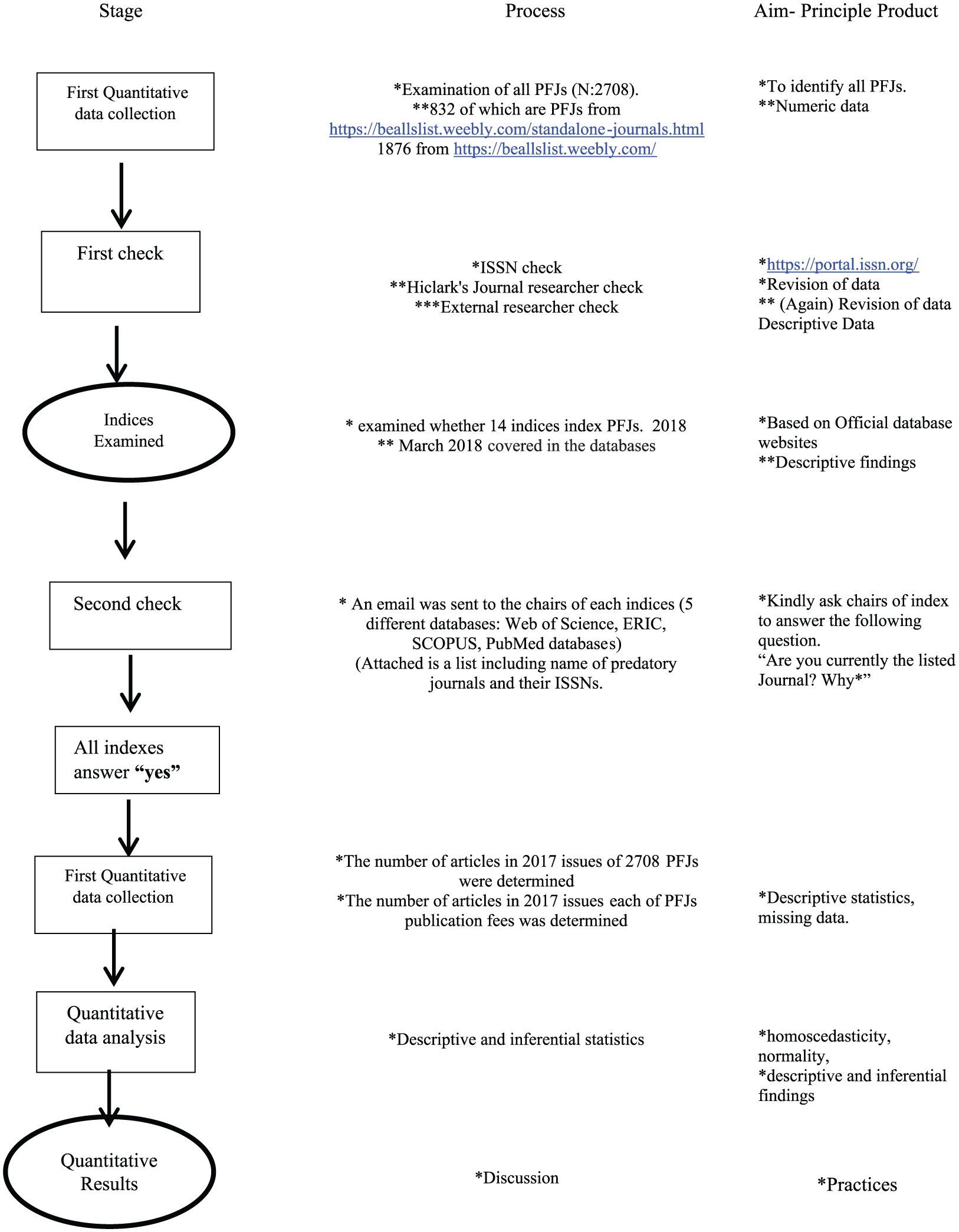
The diagram of the current study.
Data collection process
Identification of journals
First, the databases with PFJs were examined. There are several webpages where PFJs are listed, such as Cabell’s New Predatory Journal Blacklist, Beall’s list, etc. However, the list issued by Beall explains how these journals were chosen (Beall, 2015a). But there are some serious criticisms about Beall’s list (see Berger and Cirasella, 2015; Crawford, 2014b). Besides, the Beall list is actually a blog. Thus, it cannot be argued that it is a fully reliable list. In spite of these limitations, this study, like many others (e.g. Kozak et al., 2016; Shen and Bjork, 2015; Xia et al., 2015), examined the journals in the Beall list.
The study aimed to reach the entire universe instead of making do with a sample from the journals in the Beall list. Beall has curated two lists: (1) questionable, scholarly open-access standalone journals (see https://beallslist.weebly.com/standalone-journals.html) and (2) questionable open-access publishers (see https://beallslist.weebly.com/)
At this point, the researcher accessed the websites of the journals and publishers. It is actually possible to access the journals in the first list. The journals published by the publishers in the second list were also identified. There are a total of 3311 PFJs (Beall, 2018a, 2018b). However, the websites of 603 PFJs were closed or hacked. Therefore, 2708 PFJs were examined in the study, based on the February 2018 version of Beall’s blog.
Later, the ISSN of these journals were checked. The same procedure was also followed by another researcher. It was seen that there was 100% accordance between the researchers. Then the researcher checked if these journals were indexed in the related journals through the use of journal names and ISSNs. After that, the journals indexed in the related databases were listed. Web of Science and ERIC stated they included these journals as they meet their criteria for indexing. Those replies from the two indices which were allowed to be shared are as follows:
1. Web of Science
Thank you for your message you reference Beall’s list, which is no longer updated. Beall’s list identified potentially predatory publishers and should not be considered a definitive determination of whether or not a particular publisher did or did not engage in predatory behaviors. Clarivate evaluates journals using its own rigorous and intensive selection criteria, available for review at https://clarivate.com/essays/journal-selection-process Clarivate Analytics takes seriously the issues of scholarly and publishing ethics. We will investigate the issues you raise. Any resultant changes to a journal’s coverage will be communicated directly to the publisher.
2. ERIC
Thank you for your enquiry we conduct a formal review process to select journals for indexing in ERIC. In addition to reviewing the full-text content, we apply several best-practice activities to consider the affiliation of the editors and reviewers, and the journal’s selection and peer-review process. ERIC is currently indexing the 12 journals listed in your email. During the formal review process, we consider the merit of each journal. Each of the 12 journals met the standard and criteria outlined in the ERIC Selection Policy when they were reviewed. Our review process also includes consideration of the information available on Beall’s list of potentially predatory journals and publishers. The selected journals must continue to meet the standard and criteria outlined in the ERIC Selection Policy. We regularly monitor the publishers and journals indexed in ERIC, and will take another look at the journals you submitted in the next review cycle. If at any time a selected journal fails to meet our policy, ERIC will discontinue indexing it. Please see our Selection Policy for more information: https://eric.ed.gov/?selection Best regards
After the databases (Web of Science and ERIC) confirmed that the journals were indexed in them, the publication fee per article for each of the journals was identified. The researcher sent emails to the journals which do not provide publication fee information on their webpages and 79% of them responded. The data from journals which did not respond were regarded as missing data.
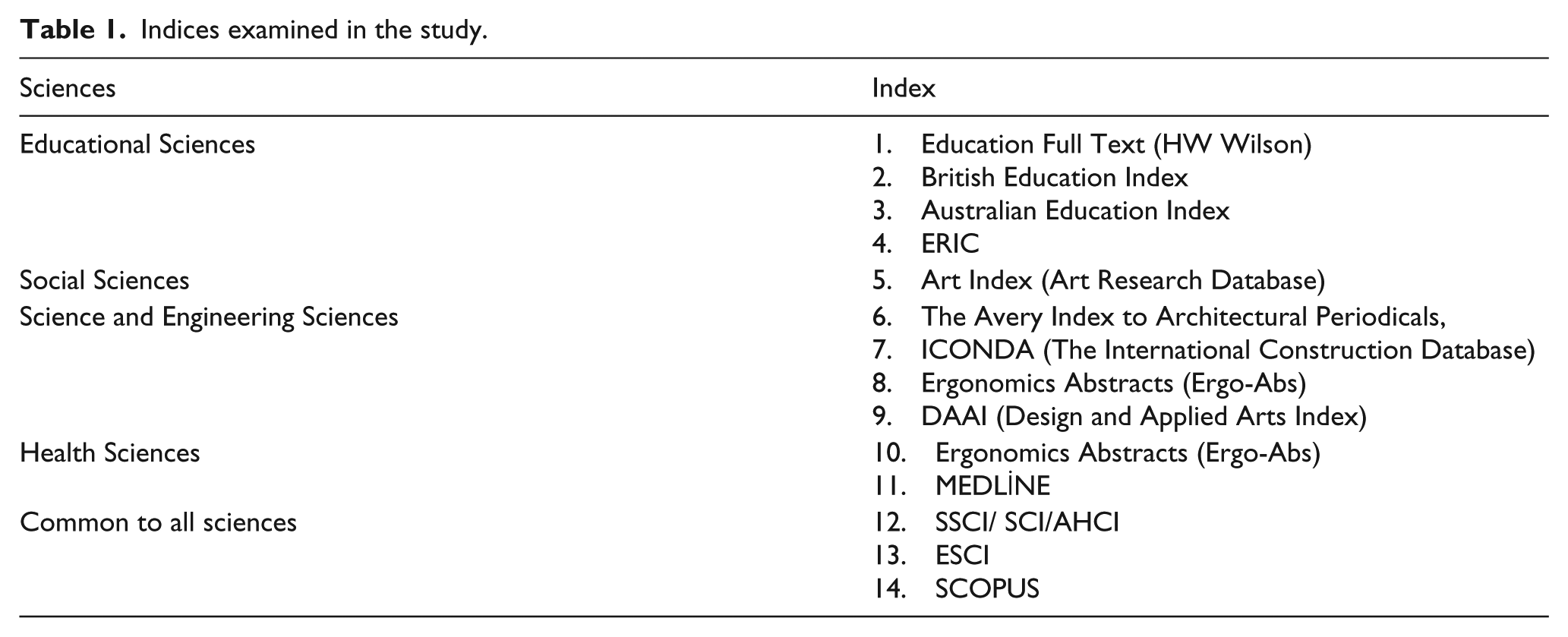
Then the researcher identified the number of articles published by each journal indexed in any of the indices presented in Table 1. The number of articles published was also verified using the records of the related indices.
Indices examined in the study.
Identification of indices
The countries that publish most in PFJs are India, followed by Nigeria, Turkey, the US, China, Saudi Arabia, Indonesia, and Iran, respectively and the indices to be mentioned below are considered as indices in all these countries. Furthermore, publications in these indices are required for academic promotion or for receiving a material incentive (Demir, 2018a). Therefore, this study examined whether these indices, which are also considered in the world, index PFJs. As can be seen in Table 1, this study examined whether 14 indices index PFJs.
Data analysis
After the data collection process, the data analysis process started. Quantitative data were analyzed using PASW 18 software. Initially, 2708 PFJs were categorized as those indexed and not indexed. In order to ascertain if the publication fees and total number of annual publication varied according to whether they were indexed in indices or not, the Mann Whitney-U test was used as data were not normally distributed. Furthermore, to determine if the number publications and publication fees varied according to the index, the Kruskal Wallis-H Test was used as data were not normally distributed. Moreover, the researcher collected rich descriptive data and presented them in tables throughout the paper.
Result
Web of Science (SSCI/SCI/AHCI, and ESCI)
The data indicated that only one PFJ out of 2708 PFJs was indexed in SCI Journal of Biomedical Nanotechnology (ISSN: 1550-7033), published by American Scientific Publishers. In addition, Genetics and Molecular Research (ISSN: 1676-56809) and Annals of Palliative Medicine (ISSN: 2224-5820) are indexed by ESCI.
SCOPUS
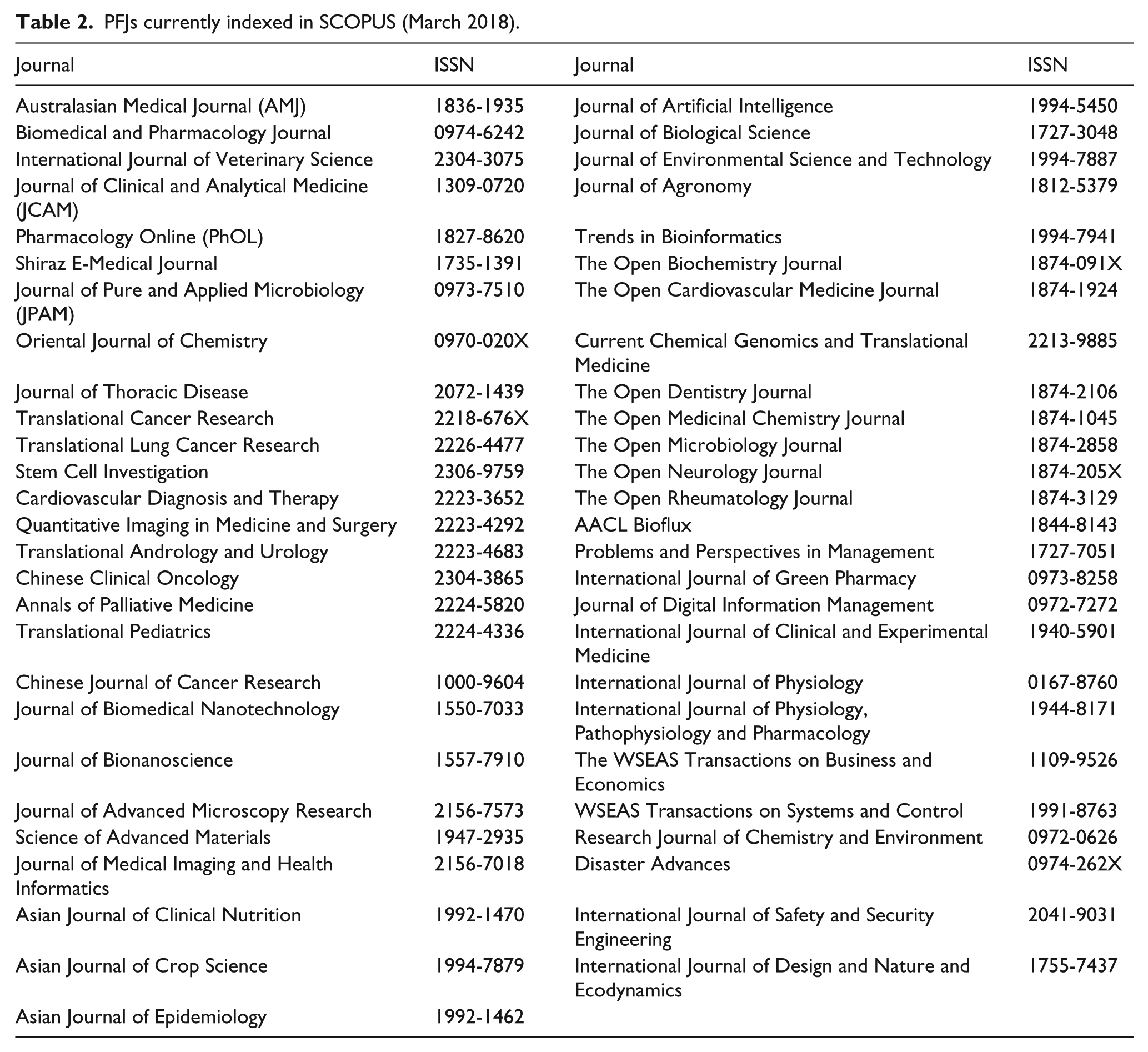
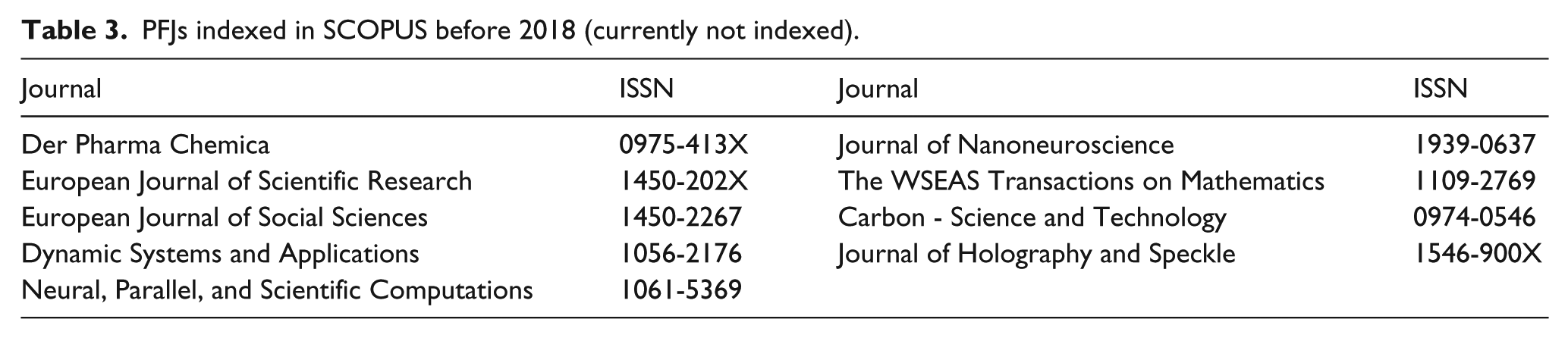
SCOPUS is an index in the scientific world. The data indicated that 53 out of 2708 PFJs were indexed in SCOPUS. It was also found that 9 PFJs previously indexed in SCOPUS are no longer indexed there. The mean publication fee charged by these PFJs currently indexed in SCOPUS is $667.5. However, the mean publication fee charged by the nine PFJs removed from SCOPUS is $121.4. The PFJs currently indexed by SCOPUS are presented in Table 2, while those indexed in it before 2018 (excluded in 2018) are presented in Table 3.
PFJs currently indexed in SCOPUS (March 2018).
PFJs indexed in SCOPUS before 2018 (currently not indexed).
ERIC
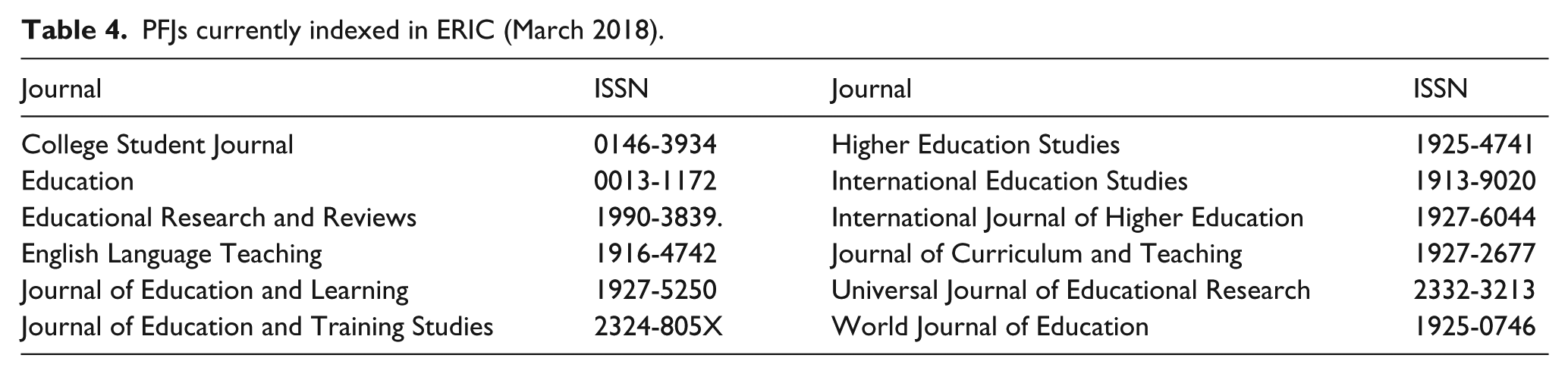
ERIC is an index in education sciences. Of the 2708 PFJs 12 are indexed by ERIC. The mean publication fee PFJs indexed by ERIC charge authors is $266.6. The PFJs currently indexed by ERIC are presented in Table 4.
PFJs currently indexed in ERIC (March 2018).
Education Full Text (HW Wilson), British Education Index and Australian Education Index
None of the PFJs examined in this study is indexed in Education Full Text (HW Wilson), British Education Index and Australian Education, which are regarded as field indices in education sciences in many countries in the world. The claim that one PFJ is indexed in HW Wilson is totally misleading.
ErgoAbs, ICONDA, DAAI, Art Index, and the Avery Index to Architectural Periodicals
None of the PFJs examined in this study is indexed in ErgoAbs, ICONDA, DAAI, Art Index, and the Avery Index to Architectural Periodicals, which are regarded as field indices in architecture and engineering in many countries in the world.
MEDLINE
Medline is an index in health sciences. Of 2708 PFJs six are indexed by Medline. The PFJs currently indexed by MEDLINE are presented in Table 5. The mean publication fee PFJs indexed by MEDLINE charge authors is $1386. Of the PFJs previously indexed by Medline, 48 were seen to have been excluded from the index. Those volumes or issues previously indexed by Medline are accessible for some journals (Table 6), while they are not for some others (Table 7).
PFJs currently indexed in MEDLINE (March 2018).

PFJs indexed in MEDLINE before 2018 (currently not indexed).

PFJs indexed in MEDLINE before 2018 (currently not indexed and not accessible).

Does the money PFJs charge vary according to the indices where they are indexed?
When the publication fee PFJs indexed by indices charge and the fee charged by PFJs that are not indexed by these indices are compared using the Mann Whitney U test, it was found that there was a significant difference in favor of the PFJs indexed by indices (see Table 8). In other words, PFJs indexed by journals charge significantly higher publication fees (U=12822.00; p=0.000; p<0.05).
The result of the Mann Whitney-U Test conducted to determine whether the amounts of money PFJs charge differed in terms of their being indexed in indices or not.

As a result of a Kruskal Wallis-H test conducted to determine if publication fees PFJs indexed by different indices charge differed, it was found that the fees significantly differed in favor of SCOPUS and MEDLINE (see Table 9). In other words, PFJs indexed by SCOPUS and MEDLINE charge higher publication fees (χ213.26; p=0.001; p<0.05).
The result of Kruskal Wallis-H Test Conducted to determine whether the publication fee charged varied according to the indices where PFJs were indexed.

Does the number of articles PFJs indexed in indices publish annually differ from that of PFJs that are not indexed by indices?
When the total number of publications in the PFJs examined in this study in 2017 were compared using the Mann Whitney U test, it was found that there was a significant difference in favor of PFJs indexed by indices (see Table 10). In other words, the PFJs indexed by indices publish more articles (U=14952 .00; p=0.000; p<0.05).
The result of Mann Whitney-U test conducted to determine whether total number of publications in PFJs in 2017 varied in terms their being indexed by indices or not.

Discussion and conclusion
The researcher received some spam emails from PFJs which claimed that they were indexed by ERIC and SCOPUS, and he wanted to find out if they were telling the truth. He realized that these PFJs are listed in Beall’s list. As a result of investigations in the databases of indices, it was seen that these two PFJs are indexed in these indices. This caused the researchers to ask the question: “How come these two PFJs are indexed in these indices?”, which led to a paradox in the mind of the researcher. This was the starting point for this study. Following from this, the researcher sought the answer for the question of whether the PFJs listed by Beall (2018 a and b) were indexed by indices or not.
Among the 2708 PFJs in the Beall list examined in this study, it was determined that one journal was indexed by SCI and two PFJs were indexed by ESCI. In addition, it was found that 53 PFJs were indexed by SCOPUS and 12 by ERIC. It was determined that six PFJs were indexed by MEDLINE, which is considered to be an index in medical sciences. This result is compatible with the result of the study by Manca et al. (2017a) that some PFJs were indexed by PubMed. Another important finding of the current study is that Education Full Text (HW Wilson), British Education Index, Australian Education Index, ErgoAbs, ICONDA, DAAI, Art Index, and the Avery Index to Architectural Periodicals do not index any PFJs.
In the literature, it is stated that it is mostly researchers from developing countries who publish in PFJs (Demir, 2018a; Kolata, 2013; Lukić et al., 2014; Roberts, 2016; Shaw, 2013) and these PFJs are founded in developing countries (Demir, 2018a; Kurt 2018; Lukić et al., 2014; Nwagwu, 2015; Nwagwu and Ojemeni, 2015; Omobowale et al., 2014; Raghavan et al., 2014; Simón, 2016; Truth, 2012; Xia et al., 2015). In a study by Demir (2018a), it was determined that one of the basic factors that makes PFJs valuable for researchers is that they are indexed by some journals. Furthermore, it was determined that young researchers who tend to publish in PFJs would not publish in these PFJs if they were not indexed by indices (Demir, 2018a). Therefore, arguing that “PFJs are local problems and the problem of developing countries” would be hiding one’s head in the sand since all the indices that include the PFJs are not located in developing countries but in developed countries.
Another significant result from the study was that the PFJs indexed in indices published significantly more articles and charged higher publication fees than those PFJs indexed in ordinary indices. In other words, PFJs included in indexes charge their authors more, and they tend to publish more articles in each issue, possibly due to economic concerns. This implies that indexes somehow support PFJs by including them in their databases and provide them with the prestige that they need to make more money without doing much.
It is not known why these indices include these PFJs, but considering the fees charged for acceptance and indexing processes the simplest and clearest explanation for this would be found in capitalist philosophy. However, the current study calls for further studies that will examine why indices include PFJs based on the statements of the indices themselves.
In line with the developments in ICT, it is now very easy to have access to information. Because researchers take it for granted that scientific data accessed through such databases are presented to the science community after they are carefully examined and filtered, scientists hardly question the reliability and academic value of studies that they access through indexes. Yet, the finding that 74 PFJs are indexed in indices indicates that the scientific community should question the validity and reliability of articles published in such PFJs.
Determining predatory journals and their publishers has been a hotly debated issue in the world of science. In line with this, some researchers carried out studies to determine PFJs based on some criteria (Beall, 2015a, 2016; McCrostie, 2017; Nicholl and Chinn, 2015; Nolfi et al., 2015; Vinny et al., 2016; Xia et al., 2015). However, the list and criteria determined by Beall have drawn more interest and several studies were carried out based on Beall’s list (see Eriksson and Helgesson, 2017; Frandsen, 2017; Hadi, 2016; Moher and Moher, 2016; Nelson and Huffman, 2015; Pyne, 2017; Shen and Björk, 2015; Ward, 2016).
The blog on predatory publishers and journals issued by Jeffrey Beall is followed by blogs in the world (Nelson and Huffman, 2015). However, there have been serious objections that some journals and publishers in this list are not actually predatory. For example, it is claimed that high quality journals published by some publishers known worldwide are included in this list (Crawford, 2014a, 2014b; Coyle, 2013; Emery, 2013). In addition, Crawford (2014a) argued that Beall favored western publishers with a Eurocentric perspective and was also prejudiced in Elsevier’s favor. Berger and Cirasella (2015) pointed out the benefits and restrictions of Beall’s list of “potential, possible or probable” publishers. They claim that Beall ignored the fact that less reputable and even trustworthy academic journals publish flawed or debatable articles. Besides, it was also claimed that Jeffrey Beall had reflected his biases in his list and that he was personally prejudiced against open access journals based on his cultural and linguistic beliefs (Anderson, 2015; Berger and Cirasella, 2015; Crawford, 2014a).
In addition, there are some serious criticisms about Beall’s list (Berger and Cirasella, 2015). For example, researchers argued that some criteria were not built on strong foundations and they were not completely explained and were inherently confusing (Berger and Cirasella, 2015; Crawford, 2014b). In line with this, it is possible that some journals in Beall’s list are not actually PFJs; therefore, this possibility should be born in mind when reading the results of the current study.
Limitations
This study is limited to 2708 accessible PFJs included in Beall’s list and 14 indexes There is some possibility that other PFJs are included in indices. The data collection process was completed at the end of March 2018. Therefore, the readers should note that the PFJs listed in this study with their ISSN numbers might be excluded from the databases mentioned.
Footnotes
Author’s contributions
SBD carried out the complete process.
Declaration of conflicting interests
The author(s) declared no potential conflicts of interest with respect to the research, authorship, and/or publication of this article.
Funding
The author(s) received no financial support for the research, authorship, and/or publication of this article.
