




Abstract
The study examined the information behaviour of Mzimba prison inmates focusing on the research themes which are information needs, sources of information, and the barriers to seeking and using information of Mzimba prison inmates. A qualitative approach was used coupled with a case study design. Data were collected through focus group discussions and interviews from 12 inmates and two prison teaching staff respectively. The study found that health information, education information and spiritual information are the major information needs of Mzimba prison inmates. The study also found that the majority of respondents agreed that the six popular sources of information are their friends, teachers, radio, television, books and newspapers. However, the study concludes that Mzimba prison (library) fails to fulfil its role as a source of information and in meeting the information needs of inmates due to challenges of lack of information resources, limited time available for inmates to search for information, poor services and lack of funding for the school and library. The study recommends that the Malawi Prison Service should engage some stakeholders such as the Malawi National Library Services, National Initiative for Civic Education and Mzuzu University Library and Learning Resources Centre to support prison libraries with the provision of information resources to meet the information needs of inmates. The study further recommends that the Malawi Prison Service Command should lobby for financial support in order to hire qualified and capable librarians and teachers to manage prison libraries and schools.
Keywords
Introduction and background
Prison systems have evolved over centuries into their current form with growing recognition on the importance of rehabilitation programmes across the globe (United Nations, 2017). There is a reaffirmed commitment of states to implement and enhance policies for prisoners that focus on education, work, medical care, rehabilitation, social reintegration and the prevention of backsliding. Lehman and Locke (2005: 17) define a prison as ‘any institution/facility where people are held in custody, incarceration, or detention for crimes committed against society and for their rehabilitation and reformation’. Prisons provide educational and recreational resources to inmates, through books, newspapers, magazines, movies and library programmes, with the hope that this will aid in the rehabilitation process (Coates, 2016). Article 26 of the Universal Declaration of Human Rights (United Nations, 2015) declares: Everyone has the right to education. This implies that the right to education and training applies to all persons, including those in prison (Vorhaus, 2014). Rubin (2017) explains that information is vital in the life of all individuals for optimal development and the realisation of socio-political and economic well-being. Prison education is a pillar of effective rehabilitation and gives individuals the skills to unlock their potential, gain employment and become assets to their communities (Coates, 2016).
The concept of information behaviour
Wilson (2000) defines information behaviour as a set of characteristics that an information seeker displays in the process of seeking and using information for different purposes. It encompasses people’s desire for information, their information need, their information use and the impact it has on their lives. Information behaviour is understood to be the purposive seeking of information as a consequence of a need to satisfy some goal (Wilson, 2000). Bates (2010) further claims that information behaviour is the current umbrella term being used to describe the many ways in which people interact with information, in particular the ways in which people seek and use information.
Sambo et al. (2017) and Chipeta et al. (2018) argue that an information need leads people to seek information from different sources to satisfy a need. This need arises out of individual uncertainties and belief that they can be satisfied or helped by information. Ajogwu (2006) and Eze (2014) established some common information needs of prisoners including legal, religious and health, educational, spiritual/religious vocational, recreational and financial. The prison library becomes an important part of the entire prison environment by providing the capacity for prisoners to seek information and address their information behaviour. Chipeta et al. (2018) established that people use information to manage their work, to solve problems or simply to survive. Campbell (2005) explains that information is of great use to an inmate as it means utmost relief from poor prison conditions if not from incarceration itself. He says for example that educational information could be used for job seeking upon release.
Problem statement
Satisfying the information behaviour of inmates stands out as most significant to achieving rehabilitation attempts (Coates, 2016; International Federation of Library Associations and Institutions (IFLA), 2003). A study by the United Nations Office on Drugs and Crime (United Nations, 2017) found that in many prison systems, few prisoners have the opportunity to learn or work and many high-income countries struggle with providing education, vocational training and work on a larger scale. The study also found that the extent of prisoners’ satisfaction in information-related behaviour is much smaller in many lower income countries (United Nations, 2017). Literature has proven that there are fewer developing countries that are on the right track in meeting the information needs of inmates. Drabinski and Rabina (2015) report that Brazil allows for prisoners’ reduction of their sentences by 5% if they pass a school year. Similar to this provision in Brazil, Ijiekhuamhen and Aiyebelehin (2018) reported that South Africa allows prisoners who are studying to use online services for their studies. Access to information remains a major hustle in Malawian prisons (Chirwa, 2001). It is not known to what extent Mzimba prison meets inmates’ information needs. Also, it is not known whether the Prison has a library with qualified staff in librarianship, or teaching professionals. This uncertainty justifiably led the researcher to conduct a study at Mzimba prison. Specifically, the purpose of the study was to ascertain the information behaviour of inmates at Mzimba prison, and the objectives are to find out the information needs, information sources used and establish the challenges faced by inmates at Mzimba prison in searching and using information with the view to offering recommendations.
Literature review
The literature used in this study includes both empirical and theoretical studies covering the three research themes of the study namely: information needs, information sources and challenges faced by inmates at Mzimba prison in searching and using information. The literature used was from both print and electronic sources in journal articles, books, conference proceedings, book chapters, technical reports and databases such as Emerald, Ebscohost and Google Scholar. International, regional and local literature have all been reviewed.
Information needs
Studies by Adegboye (2017), Ajogwu (2006), Emasealu and Popoola (2016), Eze (2014), Sambo et al. (2017) and Tarzaan et al. (2015) have explored the concept of information needs among prison inmates in Africa. The studies established that the major information needs were related to legal, religious/spiritual, health, literacy and moral education, vocation, recreation and finance. The studies reveal that legal aid, financial, spiritual and moral information were among the major information needs of prisoners, with scores of above 86%. In Asia, a qualitative study by Rafedzi and Abrizah (2014) on ‘Information needs of male juvenile delinquents’ in Malaysia reports multiple information needs of prisoners relating to prison operations, sex, health, recreation, legal support and academic operations. Information was needed for the physical and psychological survival of convicted persons as emphasised in correctional literature (Mfum, 2012). In the developed world, several information needs have also been identified and studied at length. A study by Drabinski and Rabina (2015) on information needs of prisoners in Croatia found that rights in the prison, family, life after prison and employment were the main information needs. Education, training and skill acquisition and religious needs were also found to be important for inmates. Similarly, Canning and Buchanan (2019) also revealed that information needs on education, health and employment were the major information needs among the prisoners in Scotland. The review of the above studies shows availability of literature on information needs of prison inmates, though the existence of such studies in Malawi is not known; therefore, it is the intention of this study to unearth such needs.
Information sources
Some studies by Tarzaan et al. (2015), Canning and Buchanan (2019), Finlay and Bates (2018), Davis (2017), Lim et al. (2013) report various information sources for prison inmates. For instance, Tarzaan et al. (2015) conducted a survey study on ‘Information needs and seeking behaviour of prisoners at the medium security prison’ in Makurdi Nigeria and found that the preferred information sources of prison inmates were their lawyers, television/radio broadcast, prison warders and health workers. Similarly, studies by Canning and Buchanan (2019), Bajic (2015) and Rafedzi and Abrizah (2014) revealed other information sources such as books, television, radio, fellow prisoners, family relations, teachers, librarians, healthcare professionals, chaplains and social workers. Internet and informal networks such as Facebook and WhatsApp have also been found to be among the major sources of information for the prison inmates as revealed in studies by Perkins et al. (2018), Kerr and Willis (2018), Lim et al. (2013) and Rafedzi and Abrizah (2014) in the United States of America, Singapore and Malaysia respectively.
Prison libraries have been identified as valuable sources of information (Adegboye, 2017; Emasealu, 2018; Folorunso, 2019; Lehman, 2011). A library contains information resources such as books, newspapers, dictionaries, pamphlets, maps, atlases, illustrated books, graphics and others, which can be accessed, communicated and shared to inmates even though they are confined to an environment by agencies of law (Adegboye, 2017). A study by Finlay and Bates (2018) in North America and Western Europe found that prison libraries offer access to educational, legal and recreational sources of information reflecting the needs of the prison population with unmet needs, which translate into a high demand for information, learning materials and self-improvement resources and that the library can play a vital role in meeting these needs (Lehman, 2011). Despite the valuable nature of the prison libraries, the majority of prison libraries in Africa and other developing world have been characterised by inadequate management policies and funding models (Simunic et al., 2016; Folorunso, 2019). Folorunso (2019) argues that agencies/authorities responsible for the prison library should ensure that the library is funded adequately and receives annual allocations to cover salaries, library materials, staff training and all other requirements. An analysis of the literature reviewed shows that there is lack of extant literature on information sources of prison inmates in Malawi except for studies focusing on the academic environment (Chawinga and Zozie, 2016; Chipeta et al., 2018).
Barriers to accessing and using information sources
Accessing and using information sources by prison inmates is not without some barriers. Some of the barriers as reported in literature are lack of Internet access (Bajic, 2015; Smith, 2012), stigma, self-esteem, trust, misinformation and disinformation (Canning and Buchanan, 2019; Emasealu and Popoola, 2016), language barrier (Campbell, 2005), and limited access to information resources (Drabinski and Rabina, 2015). Other barriers are censorship and lack of professional staff (Sambo et al., 2017; Tarzaan et al., 2015), hostile nature of prison workers, inadequate library materials and uncomfortable nature of prisons (Ijiekhuamhen and Aiyebelehin, 2018; Sambo et al., 2017), high cost of information materials, high rate of illiteracy, lack of awareness on the part of the prison inmates, absence of radio/television programmes, information centres and public libraries services (Tarzaan et al., 2015).
In contrast to concerns about poor prison conditions in most African states, Hola and Wijk (2014) and Ward et al. (2013) laud the prison conditions in Scandinavian countries as very prisoner-friendly. Nordic countries, namely Norway, Sweden, Finland and Denmark, are said to have favourable outcomes for rehabilitation and education of offenders such that prisoners have the right to attend school full time, whilst the United Kingdom waives fees to prisoners who make it into university (Ward et al., 2013). In most African countries, prison inmates find it hard to meet their information needs due to inadequate resources in libraries, and policies that prohibit access to the Internet and the hostile nature of prison workers. Coates (2016) argues that working as a prison teacher or librarian is a desirable and rewarding job in Nordic countries and in the UK in particular, and that the prison staff motivate the inmates in turn. Coyle (2010) reports that in most developing countries, problems that prisons face relate to under-sourcing, overcrowding and issues relating to prison staff such as low pay, poor training and little public respect for their job and, more often, the high presence of unreconstructed buildings housing prisoners.
There is a dearth of published literature on information behaviour of prison inmates in Malawi except for a few studies on students in the education sector (Chawinga and Zozie, 2016; Chipeta et al., 2018) and in the agriculture sector (Phiri, 2017). However, there is a rare mixed methods study in prisons by Chaima (2010) on the ‘Effectiveness of secondary school education in five Malawian prisons’. The study revealed insufficient availability of books and library materials and lack of physical space for use. The findings of these studies (Chawinga and Zozie, 2016; Chipeta et al., 2018) all point to unavailability of relevant books, poor Internet connectivity, students’ lack of computer and search skills, frequent power outages and underdeveloped ICT infrastructure, including low Internet bandwidth, as some of the inhibiting factors that respondents faced in accessing and using some information resources. This shows that the challenges faced by respondents in these studies in accessing and using information resources are to some extent similar to those faced by inmates as revealed by the studies. The findings in Malawi by Chaima (2010) are in contrast to studies in USA and Belgian prisons by Drabinski and Rabina (2015) and Brosens et al. (2015) where additional library materials are provided to prison inmates with a visit to any library once a week with the opportunity to borrow a book, CDs, DVDs and video games.
Theoretical framework: Wilson’s 1996 model of information behaviour
Several models and theories have been reported in the literature in the study of the information-seeking behaviour of different categories of people such as farmers (Phiri, 2017), students (Chawinga and Zozie, 2016; Chipeta et al., 2018), and prisoners (Mwuese et al., 2015). The most popular models are Wilson’s 1981 model of information-seeking behaviour (Al-Wreikat et al., 2015); Dervin’s 1983 sense-making theory (Chaudhry and Al-Mahmud, 2015); Ellis’s 1989 and 1993 behavioural model of information-seeking strategies (McDonald et al., 2015; Zhang, 2015); Kuhlthau’s 1991 model of the stages of information-seeking behaviour (Katuu, 2015); and Wilson’s 1996 model of information behaviour (Lavranos et al., 2015; Sahib et al., 2015), which expands his 1981 model through an analysis of the literature in fields other than information science. This study adopted Wilson’s 1996 model of information-seeking behaviour to study the information behaviour of inmates and staff at Mzimba Prison. The model is highlighted in Figure 1. This model has been adopted for the present study because it has been proven relevant in the study of information behaviour in general (Babu et al., 2012; Chawinga and Zozie, 2016; Elly and Silayo, 2013; Phiri, 2017) and information behaviour of prison inmates in a developing country like Malaysia (Rafedzi and Abridzah, 2014). In addition, the concepts of the model – information needs, information sources, and barriers in accessing and using information sources – are directly related to the concepts of the study such as information needs, information sources and barriers in accessing and using information sources. Furthermore, the present study also chose it because of its ease in the depiction and elucidation of users’ information behaviour.
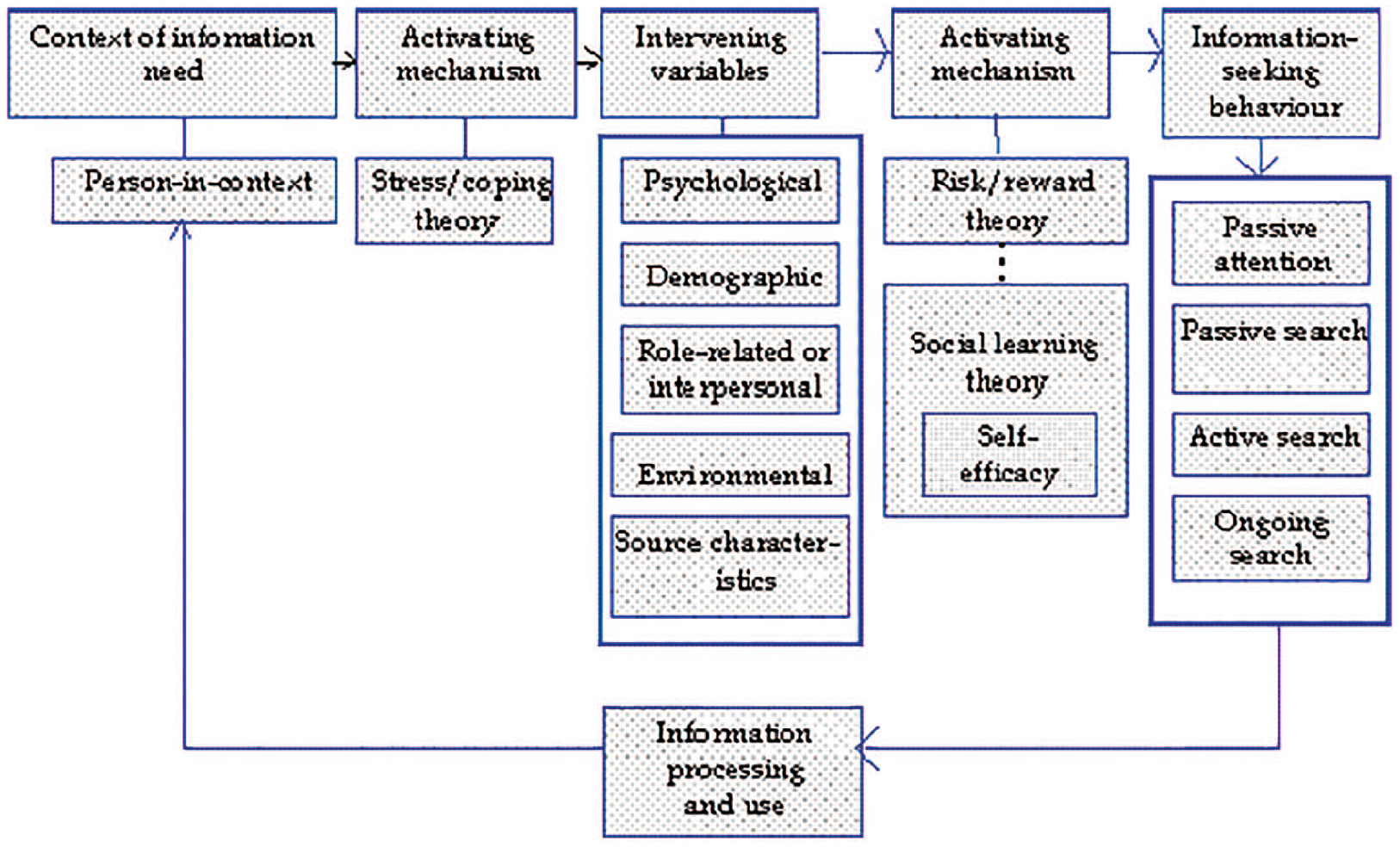
Wilson’s 1996 information-seeking behaviour model.
Wilson’s 1996 model of information behaviour advocates for attention to be directed towards understanding the context of the information needs of prison inmates (Wilson, 1999). It is the interest of this study to determine the information needs of prison inmates in their context at a particular time and sources of information used by the inmates. Wilson’s 1996 model of information behaviour explains the demographic characteristics of inmates which influences the sources of information they consult (Wilson, 1999). These demographic characteristics, also referred to as intervening variables to information behaviour, emanate from psychological, demographics, role-related, environment and characteristics of information. The study will adopt the following variables from the model: context of information need, activating mechanism, intervening variables and activating mechanisms. The variables have been selected based on their relevance to the research objectives. The study, therefore, endeavoured to ascertain the predominant information needs, predominant information sources and challenges experienced by Mzimba prisoners in seeking their information in order to satisfy their needs.
Methodology
The study targeted prison inmates and prison staff at Mzimba Prison in Malawi. The study had a sample size of 14. Specifically, the study purposively sampled 12 senior secondary school inmates. In addition, two prison staff were also purposively selected for the study. In determining the sample size, the study imitated similar studies by Rafedzi and Abrizah (2014), Canning and Buchanan (2019) and Lim et al. (2013) who also conducted qualitative research studies with a sample size of 14 in understanding information behaviour of prison inmates in their respective studies.
A qualitative approach accomplished through a single-site case study design of Mzimba prison was used to achieve a deeper understanding of the complex social phenomena of information behaviour of Mzimba prison inmates. Purposive sampling technique was used on one hand to choose the study area and on the other, to select Form 3 and Form 4 prison inmates and prison teaching staff as participants for the study. Haphazard sampling technique was employed to select senior secondary school inmates for inclusion in the focus group discussion. The choice of purposively selecting Mzimba prison was due to its modernity as it has a prison school supported by a library. Participants for the study were chosen due to their nature as learners. Data was collected through focus group discussions with Mzimba prison inmates in which one group had five inmates and the other had seven inmates. The study interviewed two prison staff that teach at the prison school and assist in the prison library to explore staff perceptions and experiences on inmates’ information behaviour. The items used in the instruments in the present study were adopted from the research studies by Canning and Buchanan (2019), Rafedzi and Abrizzah (2014) and Phiri (2017). The items that were used in the instruments were then adapted to the present study. Data was analysed thematically using NVivo version 10.0 for Windows to generate themes and sub-themes as the major findings of the study.
The researchers adhered to ethical issues related to this nature of study by deploying a gatekeeper’s letter to seek consent from the Office of Commissioner of Prisons and Mzimba Prison Officer-in-Charge to allow the researchers to collect data from the institution. A consent letter was written to participants informing them that their participation in the study was voluntary and that they were free to withdraw from the study anytime and that there were no rewards for taking part in the study. The study did not demand participants’ identities for purposes of anonymity. The data collected was used solely for the intended purpose and the recorded files and audio clips were kept confidential after analysing results.
Results and discussion of findings
This paper studied the information behaviour of prison inmates at Mzimba Prison. Specifically, the study examined the information needs, information sources and the information-seeking barriers of prison inmates at Mzimba Prison. The following sections present an analysis and discussion of qualitative data collected through focus group discussions and interviews with prison inmates and prison staff respectively. In some instances, the results of data analysed were reported verbatim.
Demographic data
Twelve male inmates (four being inmate teachers) aged between 20 and 40 were interviewed and participated in the study. Mzimba prison population is comprised mostly of middle-aged male prisoners between 20 and 40 years. All the inmate participants were in senior secondary school with six inmates in Form three and the other six in Form four. Six inmates indicated that that they had been in the prison for two years, four inmates had been in the prison for four years, one inmate had been in prison for five years and one other inmate had been in prison for more than eight years. Two prison staff were also interviewed: the head of the education section, and one prison teacher, both service the library for inmates. The staff participants represented the main members of staff that the inmate participants interacted with on an everyday basis in the prison school and library.
Information needs
The results in Table 1 reveal that most inmates indicated education and health information needs as the most highly needed information among their day-to-day needs. Inmates indicated that they needed education information to overcome their illiteracy, for their careers, school assignments and in preparation for exams and on curriculum change as they mostly use old curricula in their school. One inmate stated that: I need information about education careers such as medicine, law and engineering so that I could become one of those myself.
Another prisoner commented: We need educational information to reform since it’s one of the key factors to reformation.
Inmates at Mzimba prison indicated that they needed health information so that they were able to take good care of their lives, follow sanitation procedures, maintain physical fitness, healthy bodies and remain clear of diseases. Others indicated more specific health needs. One prisoner mentioned unmet needs relating to mental health as follows: After being diagnosed with mental illness, I value health information from medical practitioners such as those who come from St John’s Hospital as it helps me to live with purpose.
Another one commented that: I seek health information to know how to avoid different diseases since nowadays there is rampant outbreak of new diseases.
Similar findings from prison staff also revealed that education and health information were the major information needs. According to the prison staff, the other information needs important for the inmates deduced from their interactions with them included legal and human rights, family relations, entertainment, politics and general affairs. Prison staff revealed that this information was for their leisure and entertainment, self-interest, to acquire current and general information, and specifically to complete their education assignments and class work, live better lives and find jobs once outside. One prison staff mentioned that: Inmates have different priorities of information needs, as some would prefer entertainment, others would prefer spiritual information. Except for a few who are serious about their education, most inmates look for information just to pass their time and find pleasure or following their friends.
The findings are not surprising in the sense that educational and health information are very important for the inmates so that they can upgrade themselves with the huge of amount of time available to the inmates as well as for them to remain healthy as they serve their respective sentences. Similar findings are reported in descriptive survey research studies on information needs and seeking behaviour of prisoners in Nigerian prisons by Emasealu and Popoola (2016), Sambo et al. (2017) and Tarzan et al. (2015) who found information on education and health conditions as the most sought-after information by the prisoners.
Information needs.
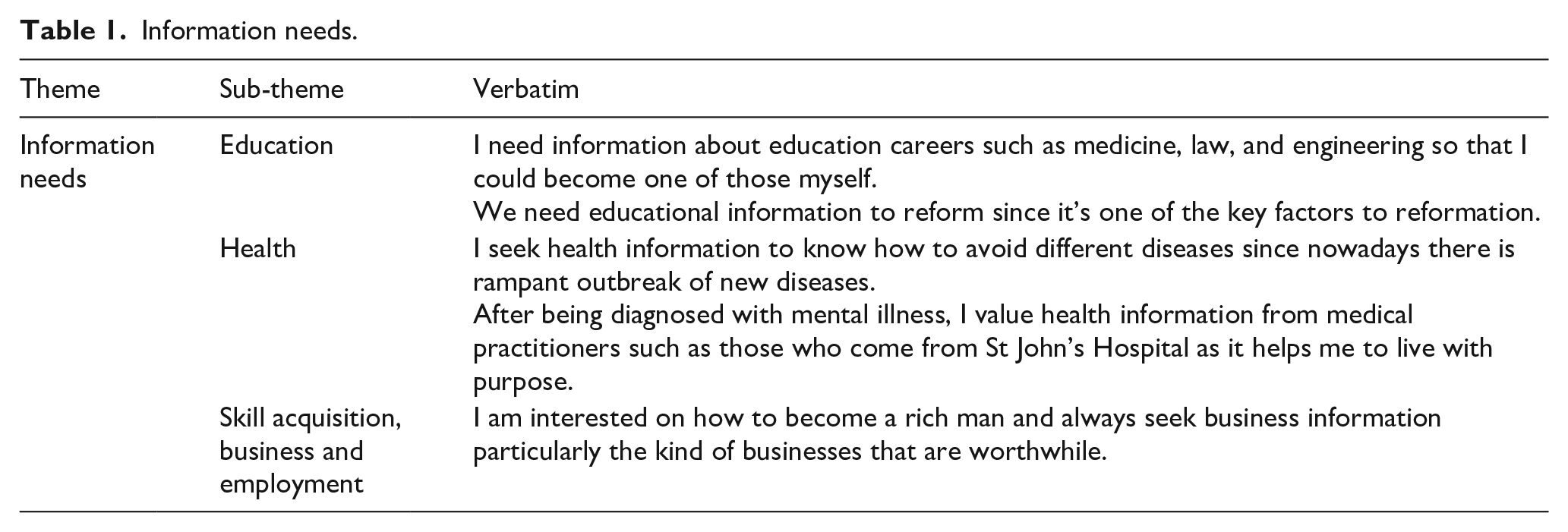
Wilson’s 1996 model theorises that context (environment) influences the information needs of a user. The findings also reveal that education and health are the primary needs which need to be satisfied with access to information sources (Wilson, 1999).
Spiritual information was the second preferred information need among most inmates at Mzimba prison. Inmates indicated that spiritual information is relevant for behavioural change and spiritual transformation, and important for rehabilitation, reformation and reintegration into society. Bajic (2015) in Croatia also found that religious needs were regarded as important for inmates. Most of the inmates at Mzimba prison reiterated that religious literature was very relevant and really needed in their small world. According to Sullivan (2008), religion and religious readings help to reform the character of inmates and have contributed to a number of redemptions. In relation to this, Eze (2014) reported in his study that prisoners admitted to having a dire need for information that could give them spiritual and emotional stability to be on good terms with their creator and other men, and become better citizens of society.
Some inmates also mentioned information needs related to skill acquisition, business and employment so that they were able to sustain and support themselves and afford their basic human needs such as food and clothing, live independent lives and contribute to the development of the nation. Similarly, Adegboye (2017) in North-Central states of Nigeria found that the most sought information need among inmates was that of skills acquisition. and other needs were on education, entertainment and health as second priority among inmates. Folorunso and Familusi (2012) in South-West zone of Nigeria also found information needs of inmates on skills acquisition, business and political issues/development. Thus, one inmate said: I am interested on how to become a rich man and always seek business information particularly the kind of businesses that are worthwhile.
The current research findings provide an insight into unrevealed and/or unmet emotional needs. The study found that whilst the prisoners did not explicitly identify emotional needs, such needs were evident in general discussions. Rafedzi and Abrizah (2014) in Malaysia and Canning and Buchanan (2019) in Scotland also found that many needs appear unmet, particularly those related to mental health and rehabilitation aspects. These findings on multiple unmet needs are similar to previous studies by Tarzaan et al. (2015), Emasealu and Popoola (2016) and Sambo et al. (2017). One possible explanation is that such needs are not yet fully formed or understood as information needs because the prisoners are able to cope with stress of the absence of information in order to satisfy the information need as theorised by Wilson’s 1996 model. The ability to cope with stress of the absence of information to satisfy an information need may not lead to information seeking by the user. Canning and Buchanan (2019) also argue that unrevealed/unmet information needs originate from the fact that such needs are in early visceral or conscious stages of development hence, not considered as needs by the user.
Information sources
The results in Table 2 reveal that inmates at Mzimba prison mostly use radio, friends and family, newspapers/magazines, television and books in that order as their information sources. These sources manifest the desire by the inmates to satisfy their information needs as revealed by the study in which education, health, spiritual and entertainment were the major information needs for inmates and staff. Access to various information sources is also motivated by the fact that the risk of not having the information seems high on the part of the prisoners such as failing to pass examinations and contracting diseases and capability to search for information from a databases or library. This is echoed by Wilson’s 1996 information-seeking behaviour model that a person may be motivated to search for information if the risk of not having it seems high and access to information sources exemplify the user’s belief in his/her capability to perform a particular task such as searching a database or information system (Wilson, 1999). Similarly, studies by Case and Given (2016) and Tarzaan et al. (2016) in America and Nigeria respectively found that books, radio, television, newspaper sources and prison warders are highly used information sources among inmates.
Frequency of using information sources.
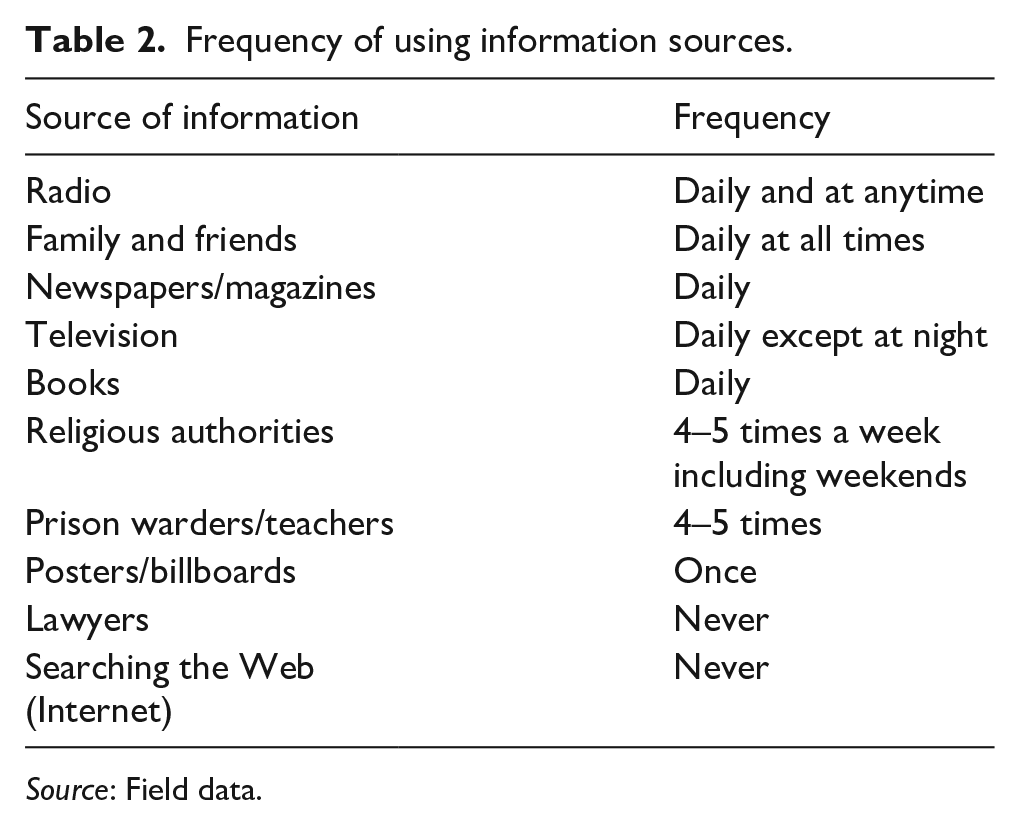
Source: Field data.
The current study also found that inmates consider prison staff as important sources of information, but their use varies according to staff role and individual relationships (Wilson, 1999). Prison teachers were considered approachable and helpful. Wilson’s 1996 model posits that interpersonal relationships and source characteristics such as ease of use, availability and cost have implications for access and use of information sources by the user. The inmates at Mzimba prison use a number of interpersonal sources and acquire information through interactions with prison staff, other prisoners and sometimes with family relations. Mzimba prison inmates always refer to staff whenever they are seeking particular information that they cannot find through reading, listening to the radio or through television. Most of these include emotional and personal needs such as handling finances, health issues and general wellbeing. Personal interaction with friends within the prison also helps in acquiring information. The prison provides television in prison cell blocks with a wide range of television programmes that entertain, educate and inform inmates on many aspects of life. The current study also ascertained that other prisoners are an important source of everyday prison-life information for experiential advice. Inmates’ families were also regarded an important source of outside world information but less accessible since interaction with them is always hard. The findings of the current study agree with those of Canning and Buchanan (2019) who found prison staff such as teachers, librarians, prison officers, healthcare professionals, chaplains and social workers, other prisoners and family relations as the most preferred sources. Bajic (2015) also found interpersonal sources of information namely family and friends and prison officers as the most used sources by inmates in Croatia.
Prison staff recognised themselves as important sources of information, approached on a regular basis, and on a wide range of topics such as health, education and general welfare. Concurring with inmates’ responses, prison staff interviewed agreed that they were important sources of information across a broad range of topics such as health, education and rehabilitation, and were approached based on approachability. Staff also recognised that inmates were selective on which staff they approached. Additionally, staff recognised that other prisoners were important information sources for prisoners. Whilst teaching staff and chaplains were considered approachable, prison officers, health and social welfare staff were considered much less so, and were discussed negatively. Canning and Buchanan (2019) argue that human information intermediaries play a major role in information provision and that a good relationship among inmates and prison staff is important in building trust conducive to effective information interactions.
In contrast to the findings of this study on information sources, Rafedzi and Abrizah (2014) and Lim et al. (2013) found that the Internet, informal networks and Facebook were the most preferred sources of information used by prisoners in Malaysia and Singapore respectively. One would argue that the difference in the findings between the current study and those of Rafedzi and Abrizah (2014) and Lim et al. (2013) could be attributed to the fact that Malaysia and Singapore are emerging Tiger economies with the capacity to utilise technology in searching and providing information to inmates in contrast to Malawi, a developing country. Rafedzi and Abrizah (2014) report that inmates who were studying diploma/degree distance learning programmes needed to use the Internet and e-library resources to search for information related to their educational needs.
Inmates at Mzimba prison are not prohibited from using the Internet, but the facility does not have the required ICT resources. In Malawi, inmates are not allowed to use phones in prisons for calling, hence it is not surprising that they never mentioned social media as a source of information. On the other hand, in developed countries inmates have access to the Internet and are able to access social media (Jewkes and Johnston, 2009; Lim et al., 2013; Perkins et al., 2018; Rafedzi and Abrizah, 2014).
The role of the library
The study found that most inmates were not satisfied with the prison library collections. Most of the materials found in the library are non-fiction books such as novels, textbooks for primary and secondary schools, children’s storybooks, dictionaries and encyclopaedias, bibles and other spiritual books and maps (atlas) but in limited numbers. The National Initiative for Civic Education (NICE) provides Mkwaso, Boma Lathu newspapers and the Lamp magazines to inmates, which is in partnership with the prison. The inmates who participated in the focus group discussions indicated that the main function of the library to them was to access information to support the prison’s reformation and rehabilitation programmes (Emasealu and Popoola, 2016). They also indicated that they used the library for reading or studying and to borrow books to read in their cells. Prison staff agreed with inmates that the role of the library was to enable inmates’ study and access information. They also stated that the role of the library was to disseminate information resources such as books and learning materials to prison inmates. Thus, the respondents commented: We as prison staff do not restrict any inmate (except those on remand) on how they use the library and how much time they spend provided it is open during the school hours and that there is a staff member to monitor them. However, our library does not offer any services except borrowing books and providing reading space to inmates.
Books make a good source of information for the inmates at Mzimba prison. This might be due to their availability and cost in accessing the sources through the library as theorised by Wilson’s 1996 information-seeking model that source characteristics such as cost, availability and format impact on their accessibility by the user (Wilson, 1999). The study found that inmates liked spending time in the library to read books and newspapers that helped them transform their attitude and personality. The findings of the current study relate positively with the findings of Finlay and Bates (2018) in USA and Europe which found that prison libraries were the main sources of offenders’ information for recreational, educational and informative material. However, the findings of a study by Rafedzi and Abrizah (2014) in Malaysia are in contrast as they revealed that formal information channels such as the library are not preferred, maybe because they are perceived as ineffective by inmates regardless of their types of information needs.
Although the findings of the current study show that inmates spend a considerable number of hours in the library, that does not translate access to information that addresses their information needs. This is also evidenced by the fact that the library is not amongst the list of sources of information frequently used by the inmates, neither are they satisfied with the prison library collection. The implication of this is that it offers the prison administration an opportunity to consider investing more resources and time in building the library collection that specifically addresses the needs of the prison inmates such as desire for educational information, health information, skill acquisition and business information. Therefore, an understanding of these information needs of inmates may consequently inform the collection development of the library in both the short term and the long term. The library could stock information resources in various formats such as educational textbooks, journals, business magazines as well as provision of facilities such as radio, television and computers for access to various messages for inmates’ preference.
Barriers to accessing and using information sources
The results as revealed by staff through interviews indicated that the barriers in accessing and using information sources included lack of information materials, poor funding of the facility, lack of professionals to manage the library, unavailability of Internet and computers and the abuse of resources in the library by prison staff that borrow books and never return them (See Table 3). The existence of the barriers is an indication that information-seeking efforts by the inmates are impacted by the intervening variables such as demographics, role related or interpersonal, source characteristics, psychological and environment (Wilson, 1999). The barriers experienced by the prison inmates at Mzimba prison also represent their desire to access and use information in order to address their information needs (Wilson, 1999).
Barriers to accessing and using information.
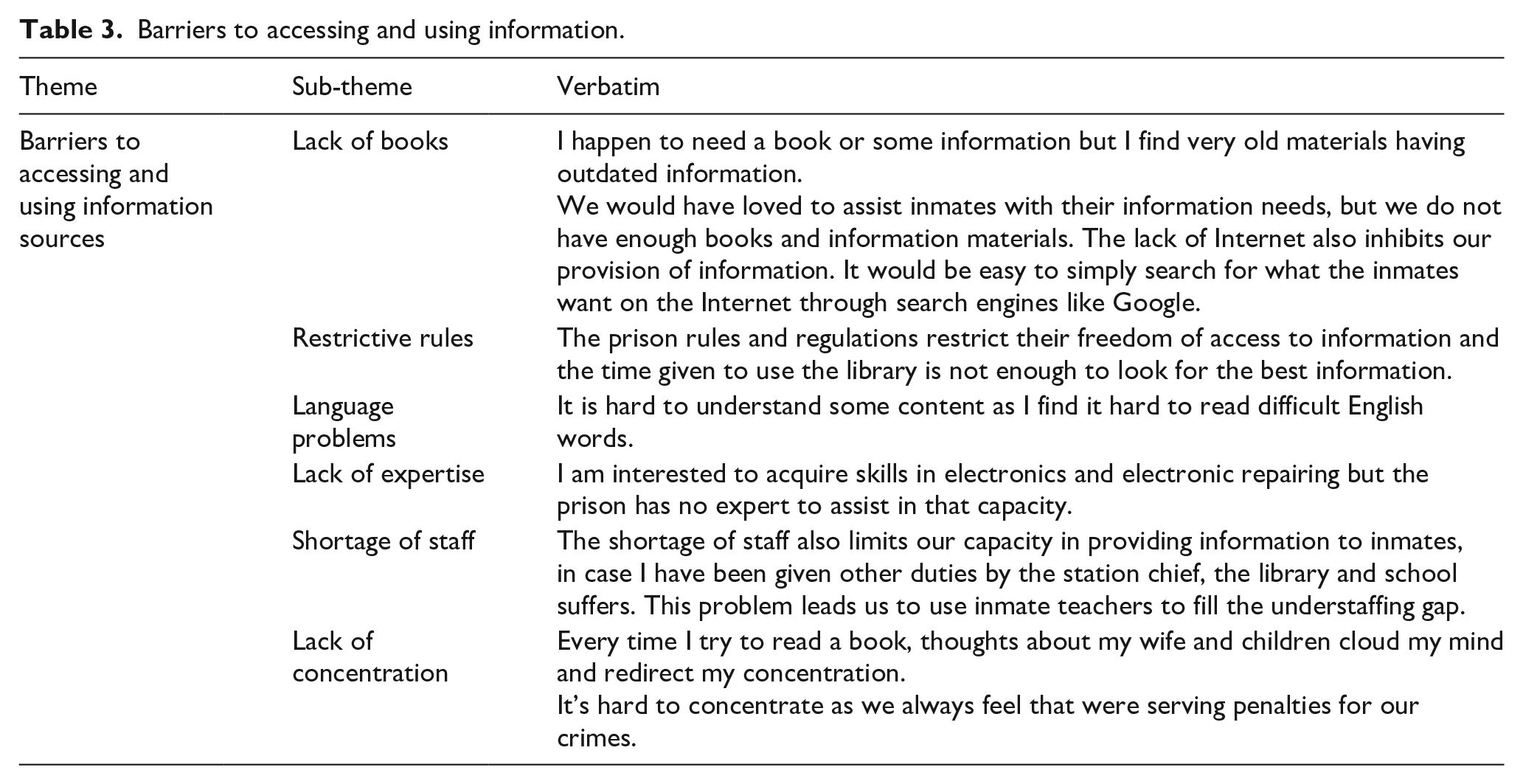
Such findings are similar to those of Drabinski and Rabina (2015) who established that the prevailing hardships for inmates to source information were mainly due to limited access to information resources and policies that prohibit (Internet) access and limit the kinds of reading materials deemed acceptable. The situation is different in USA prisons, which have better materials and its inmates access library resources. Drabinski and Rabina (2015) report that the New York Public Library (NYPL) provides additional library services to incarcerated individuals. Similar to the situation in USA, prisoners in Belgium are allowed to visit any library once a week and borrow a book, CDs, DVDs and video games (Brosens et al., 2015) with access to a wide range of resources. Tarzaan et al. (2016) and Sambo et al. (2017) identified time restrictions and censorship of prison materials as factors inhibiting access to information in most Nigerian and African prisons. Ijiekhuamhen and Aiyebelehin (2018) found similar barriers in Nigerian prisons. A similar study by Chaima (2010), which used a mixed method approach to assess the effectiveness of secondary school education in five Malawi prisons, found very poor access to sources of information by prisoners due to insufficient availability of books and library materials and lack of physical space to use them.
The inmates elaborated that coupled with the shortfall of textbooks, lack of computers and digital technologies, the library only had a stock of old curricular and outdated reading materials whose content was not fit for use. One respondent lamented that: I happen to need a book or some information but I find very old materials having outdated information.
One prison staff stated that: We would have loved to assist inmates with their information needs, but we do not have enough books and information materials. The lack of Internet also inhibits our provision of information. It would be easy to simply search for what the inmates want on the Internet through search engines like Google.
Another staff complained of the inmates, who had written their national exams this year: twelve inmates have written Malawi School Certificate of Examinations, but as their teacher and school head, I am not confident and satisfied, as they did not have enough resources to prepare for the exam.
It was revealed from the interviews with staff that the education section remained the least funded section of the prison as many a time its proposals are left unmet due to other priorities that equally need the support of the Prison authorities. Such sentiments echo those of Simunic et al. (2016) who in their study found that many prison libraries worldwide are faced with insufficient funding. Similarly, Folorunso (2019) found that prison library systems in Africa are characterised by inadequate funding and poor services due to poor funding. The Mzimba prison library relies mainly on donations from well-wishers and sometimes books bought by the prison headquarters. Poor funding was also an attribute that leads to poor development and poor service delivery of the school and library. For example, the facility fails to provide for computers and Internet even for the administration.
Secondly, the nature of the facility presents rules that prisoners must follow which presents little opportunity to access information. It was noted by inmates that they were only allowed to study during the school hours in the day and the library closed at 3pm during weekdays and it was not open during weekends and public holidays. Two inmates complained that: The prison rules and regulations restrict their freedom of access to information and the time given to use the library is not enough to look for the best information.
Prison staff echoed inmates’ sentiments that prison rules prohibited inmates from fully accessing resources and information, as inmates were not allowed full access to information resources due to censorship of certain information resources except for radio and television. Prison staff elaborated that current newspapers and political information were censored before being made accessible to inmates. Secondly, prisoners could be alone searching for information without being watched by prison warders knowing that the prisoners were serving their sentences. Additionally, prisoners on remand were not allowed to use the library, as they were deemed not part of the prison, which is an infringement of their right of access to information.
Other challenges cited include illiteracy and language barrier as most of the information resources are in English. The study found that most library books and materials are in English language, which is a third language to the inmates after Chichewa and Chitumbuka (the native lingua). The inmates therefore, complained that they could not understand much of the content. This finding is similar to a study by Campbell (2005) who investigated the information behaviour of prison inmates in the USA, and found language as a barrier to inmates’ quest for information as most prisoners in the USA are Spanish speaking and yet most of the information available is in English. The inmates also cited lack of skilled experts to impart skills and knowledge as well as to support the inmates’ needs, and individual initiatives. One inmate complained that: It is hard to understand some content as I find it hard to read difficult English words.
And another commented that: I am interested to acquire skills in electronics and electronic repairing but the prison has no expert to assist in that capacity.
Another finding of the current study as elaborated by staff is lack of a librarian who could work full time and offer his/her services for inmates’ information needs. This is a challenge to provision of information to prison inmates. Tarzaan et al. (2015) and Sambo et al. (2017) also found that lack of professional staff and poor staff training were some of the factors that inhibited access to information in most Nigerian and African prisons. Folorunso (2019) reports that at present, many prison libraries in Africa either have inadequate numbers of staff or have staff that are seriously under-educated. According to the IFLA guidelines, all prison libraries, regardless of size, should be supervised or managed by a professional librarian with the necessary qualifications and skills obtained through a university degree in library and information science or equivalent library school diploma (Folorunso, 2019).
In the present study, it has been established that the library remains closed whenever the staff members are not available. The education section head added that: The shortage of staff also limits our capacity in providing information to inmates, in case I have been given other duties by the station chief, the library and school suffers. This problem leads us to use inmate teachers to fill the understaffing gap.
The current study also found issues related to stress and anxiety as barriers that impacted on inmates’ information behaviours. Inmates complained that they were stressed with thoughts about their lives and families at home that affected their concentration in searching and using information. These findings are consistent with the findings of Canning and Buchanan (2019) who found issues of stigma, self-esteem, trust, misinformation and disinformation. The researcher observed that most inmates felt bad about themselves, often caught up in fear and had little trust in prison staff and fellow inmates, causing them to be aloof. Inmates elaborated that every time they were in the library or reading a book somewhere, they always thought about home, their families and the world they left behind. Some had this to say: Every time I try to read a book, thoughts about my wife and children cloud my mind and redirect my concentration.
Another one added that: It’s hard to concentrate as we always feel that we’re serving penalties for our crimes.
In summary, the findings from inmates’ discussions and interviews with prison staff revealed similar responses. In most instances, prison staff echoed what the inmates mentioned.
Conclusion and recommendations
The study investigated the information behaviour of prison inmates who attend school at Mzimba prison in Malawi. Understanding the information behaviour of prison inmates is important for prison authorities because it forms the basis upon which they can tailor their library collection and services towards meeting the information needs of the inmates such as health, education and spiritual needs. The study found some more specific health and unmet needs relating to mental health and rehabilitation aspects. These findings regarding multiple unmet needs provide empirical evidence and depth of insight previously lacking. The inmates rely on their friends, teachers, radio, television, books and newspapers for their sources of information. Through these findings, it has been revealed that Mzimba prison inmates do not have excessive sources for their information needs and therefore resort to the readily available sources such as their friends and teachers. Similarly, the radio is always within hand’s reach and they rely on it for information. The study has also found a number of barriers to information access and use. Such barriers include nature of the prison facility, limited time available for inmates to search for information and lack of funding for the school and library. The findings of this qualitative study prompt the researchers to conclude that inmates at Mzimba prison do not meet their information needs attributed to various challenges they face in accessing and using information. These findings, therefore, present an opportunity for the prison administration to consider investing more resources and time in building the library collection that specifically address the needs of the prison inmates, such as desire for educational information, spiritual information, health information, skills acquisition and business information. From such conclusion, the study makes the following recommendations:
The Malawi Prison Service should engage information stakeholders such as the Malawi National Libraries Services, National Initiative for Civic Education and Mzuzu University Library and Learning Resources Centre to support prison libraries with information resources to meet the information needs of inmates.
The Malawi Prison Service Command should recruit or hire qualified and capable librarians to manage prison libraries.
The Malawi Prison Service Command should recruit or hire qualified and capable psycho-social counsellors to meet the psychological needs of inmates.
The Malawi Prison Service should lobby for financial support in order to fund prison education and libraries.
Limitations and areas for further studies
The researchers reported on the practical constraints of a single prison and from the perspectives of adult male prisoners engaged with prison education. The current study recommends that future studies should investigate the information seeking behaviour of the wider disengaged prison population (i.e. those not attending prison schools), female prisoners and juvenile prisoners. There is also need for further research to examine issues of unmet emotional needs among prisoners.
Footnotes
Declaration of Conflicting Interests
The author(s) declared no potential conflicts of interest with respect to the research, authorship, and/or publication of this article.
Funding
The author(s) received no financial support for the research, authorship, and/or publication of this article.
