



Abstract
The United Nation’s 2030 Agenda for Sustainable Development identifies 17 goals as a shared blueprint for peace, prosperity, people and the planet. Australian academic libraries have started documenting and planning how academic libraries contribute to the Sustainable Development Goals (SDGs), including the identification of assessment frameworks and key performance indicators. In 2019, the University of Southern Queensland (USQ) Library stepped through an exercise of understanding how our day-to-day work and annual planning targets mapped to the SDGs. The article is a case study. The authors outline how an academic library’s services, projects and action plans were mapped to the SDGs and how the mapping exercise was communicated to the community. The article will situate this activity among the broader approaches being taken by the Australian library community, including the 2030 stretch targets for Australian libraries. USQ Library staff found that existing services, collections and projects correlated to eight of the 17 SDGs. Activities were mapped to these eight goals and reported to senior executive of the University. The mapping exercise increased the awareness of library staff about the broader cultural and societal implications of their roles. The communication strategy led to conversations that increased university leaders’ awareness of the SDGs and the value and impact of USQ Library in improving access to information as well as the library’s role in transforming the lives of USQ students and community. By undertaking an exercise to map collections, services and projects to the SDGs, USQ Library has been able to demonstrate how their knowledge and information infrastructures which enable student achievement and research excellence. The SDGs can be used by university libraries as a benchmarking tool and as a challenge to set stretch targets aligned with the United Nation’s 2030 agenda.
Keywords
Introduction
The United Nation’s 2030 Agenda for Sustainable Development is a shared blueprint for peace, prosperity, people and the planet (United Nations, 2015). It identifies 17 Sustainable Development Goals (SDGs) and 169 targets to drive global action at the local level. While the SDGs are not legally binding, the extensive global support and local appeal for action means they will be a major influencer on governments, businesses and organisations for the next decade (Sustainable Development Solutions Network Australia/Pacific, 2017). The SDGs have been welcomed by libraries across all sectors and library associations internationally as a way for libraries to articulate, focus and assess their contribution to their communities. This article will discuss approaches to measuring the SDGs within Australian university libraries and examine a case study of one university library’s work in mapping engagement with the SDGs. The 2030 agenda remains relevant in the wake of the impact of COVID-19 as international and local communities face the challenge of recovering economically, socially and inclusively from the pandemic.
Literature review
The mission of universities to support student learning and success, and excellence in research, has embedded within it the need to attend to issues of equity, inclusion and justice (Janicke Hinchliffe, 2019). Mori et al. (2019) argue that the education sector is one of the few sectors that can support, promote and contribute to all SDGs. The Sustainable Development Solutions Network proposes that universities have a critical role in the achievement of the SDGs through the provision of education, research and collaboration, and that the SDGs provide a framework through which universities can demonstrate their impact (Sustainable Development Solutions Network Australia/Pacific, 2017). The Times Higher Education (THE, 2020) Impact Rankings measured 850 universities against the 17 goals for the first time in 2020, with Australian and New Zealand institutions awarded the top four positions.
Building capacity and ownership for the SDGs in a university requires support, collaboration and engagement with a wide range of stakeholders, including students and student engagement teams, such as academic libraries, who can help develop, deliver and champion the SDGs (Sustainable Development Solutions Network, 2020). A reasonable share of the SDGs targets refers to the importance of information and, in doing so, underlines the importance of the services libraries provide (International Federation of Library Associations and Institutions, 2018). Academic libraries play an essential role in addressing and advancing the UN 2030 global sustainability challenges as they strengthen the impact of education, research and disseminate knowledge to power the world (Council of Australian University Librarians, 2019). The THE (2020) metrics considered public access to universities libraries and expenditure on arts and heritage, including libraries, as evidence of progress towards Goal 11: Sustainable Cities and Communities. Support and advocacy for open access to information and research is one example of the role academic libraries can play in the successful attainment of the SDGs (Mamtora and Pandey, 2018).
While the SDGs agenda and academic library performance assessment might be considered separate areas of interest and reporting, the continuing relevance and increasing prominence of the SDGs among funding bodies and stakeholders provides a driver for incorporating the SDGs into library assessment frameworks. The SDGs provide a framework for measuring social justice metrics within academic libraries, via the examination of local activities through a global lens. The 17 goals can be used for reflecting on and examining current practices, inspiring library development, planning, and organisational benchmarking (Janicke Hinchliffe, 2019). Bradley (cited in Streatfield and Markless, 2019) describes impact evaluation as the means to
evaluate our diverse activities using methods that work in different situations, countries and cultures,
show value to funders, potential funders and other stakeholders,
show the importance of libraries to users and society through success stories and case studies, and
demonstrate sustainability to advocate for funding.
While the SDGs are not the only social outcomes metric, they can be a valuable addition to the library assessment toolkit, used alone or in conjunction with other international, national, industry or organisation indicators to demonstrate value and impact of a library. To integrate sustainability into everyday library business, the SDGs provide a framework against which libraries can benchmark and identify opportunities and stretch targets. The International Federation of Library Associations and Institutions (2018), which contributed to the development of the SDGs, recommends a combination of metrics and narrative stories to report progress against the goals. The emphasis on narrative tools that value anecdotal evidence for impact assessment is a distinguishing feature of how researchers and libraries have endeavoured to identify their contributions to the goals (Ochôa and Pinto, 2020).
In the Australian library context, the Australian Library and Information Association is leading engagement with the SDGs in collaboration with national and state libraries, public, health and academic library associations (Australian Library and Information Association, 2018). The Australian Library and Information Association (2019) set 24 stretch targets aligned with 12 of the 17 SDGs. The targets overlap and interlink across the 17 goals and describe how libraries can fully contribute to a goal, collaborate with partners, or provide a supporting voice through advocacy (Australian Library and Information Association, 2019). Australian academic libraries, through the Council of Australian University Librarians, have also started documenting and planning how academic libraries contribute to the SDGs, including the identification of assessment frameworks and key performance indicators for its members (Council of Australian University Librarians, 2019). The Council’s programme priorities for the 2020 to 2022 period focus on four areas that can be related to the goals. They are
Advancing Open Scholarship (Goal 9: Innovation and infrastructure),
Enabling a Modern Curriculum (Goal 4: Quality education),
Respecting Indigenous Knowledge (Goal 10: Reduced inequalities), and
Inspiring Sustainability (All goals) (Council of Australian University Librarians, 2020).
By making library contributions to global sustainability visible, the Council of Australian University Librarians (2020) has committed to ensuring that academic libraries are recognised for their collective and individual leadership role in addressing global sustainability challenges.
Mapping and assessing the SDGs
There are varying approaches to measuring and assessing work towards the SDGs across countries and organisations. For example, Mori et al. (2019) used a four-phase approach in Australian universities to raise awareness, identify capabilities, identify opportunities for collaboration, and measure and report SDGs processes. Sustainable Development Solutions Network Australia/Pacific (2017) suggests five steps to start and deepen universities’ engagement with the SDGs:
Mapping what they are already doing
Building internal capacity and ownership of the SDGs
Identifying priorities, opportunities and gaps
Integrating, implementing and embedding the SDGs within university strategies, policies and plans
Monitoring, evaluating and communicating their actions on the SDGs.
While academic libraries and associations, such as Council of Australian University Libraries (CAUL), are beginning to map existing activities to the SDGs, there are currently no assessment frameworks developed for the academic library sector. However in the public library sector, Ochôa and Pinto (2020) have developed a library assessment model for public libraries in Portugal. Their model suggests that information and data demonstrate a library’s contribution to sustainable development when it is used:
To determine achievement towards a goal,
To show how initiatives align with a goal, or
To understand the impact on stakeholders.
Evidence can be gathered and validated at a number of levels from description, positive alignment, demonstrated causation, confirmation by independent evaluation and, at the highest level, recognition by national and international entities (Ochôa and Pinto, 2020). While designed and tested with public libraries, this framework provides a model that could be adapted and applied in academic libraries.
The main types of approaches to mapping described in the literature are desktop assessment, self-identification and keyword searches (Sustainable Development Solutions Network Australia/Pacific, 2017). The variety of assessment processes is one reason that the goals are difficult to apply and report on in libraries in general, and in the academic library context in particular (European Bureau of Library, Information and Documentation Associations (EBLIDA), 2020). While information and data become evidence when used to demonstrate a library’s contributions to sustainable development, causation may be difficult to prove when determining goal achievements, showing the alignment of initiatives or demonstrating the impact on stakeholders (Pinto and Ochôa, 2019). As such, adopting a mapping approach, rather than a measurement or assessment process, to projects and activities is an easier first step to working with the SDGs in academic libraries. A 2020 desktop assessment of Australian academic libraries’ websites found only two which referenced the SDGs. In both cases, the focus was on promoting the publications in their research outputs repositories that directly or indirectly relate to the SDGs (Griffith University Library, 2020; James Cook University Library, 2019).
The UN’s Sustainable Development Goals are measures that can demonstrate the role of academic libraries in their communities. A limited number of frameworks to measure the application of the SDGs have been developed for universities and public libraries, with none yet developed specifically for academic libraries. By adapting or using elements from the frameworks from these related sectors, academic libraries may be able to incorporate the SDGs into their planning, assessment or performance measurement targets and reporting.
Case study
University of Southern Queensland (USQ) is a multi-campus, regional university in south-east Queensland, Australia, with more than 27,000 undergraduate students (University of Southern Queensland, 2020). The profile of USQ students is largely mature-aged, studying online and part-time (University of Southern Queensland, 2020). USQ has a history of addressing equity as a provider of distance education for more than 40 years and as the largest provider of higher education into correctional centres in Australia, working with correctional institutions to provide online-like study experiences to students without requiring connection to the Internet (University of Southern Queensland, 2020).
USQ Library supports the learning and teaching and research outcomes of USQ students and staff. USQ Library provides access to information resources, digital fluency and academic study skills across three campus libraries and via virtual channels. USQ Library was the first academic library in the southern hemisphere to join the Open Textbook Network, an alliance of higher education institutions working to improve access, affordability and academic success using open textbooks. As an evidence-based organisation, USQ Library promotes an approach to professional practice and service delivery that is ongoing and reflective, in which library staff position themselves to respond readily to challenges or opportunities to improve within its environment (Howlett and Thorpe, 2018). Library leadership and staff employ a range of quantitative and qualitative measures to inform robust decision making, improve service delivery, demonstrate value and impact, and gain a deeper understanding of client needs.
In 2019, USQ Library staff stepped through an exercise to understand how our day-to-day work and annual planning targets mapped to the SDGs. The activity was undertaken as a proof of concept to determine whether it was possible to map the Library’s activities to the SDGs. Staff conducted desktop assessments and self-identification, gathering evidence through inference and observation to provide a clear description of library projects and activities, and their importance to the SDGs (Ochôa and Pinto, 2020). The process was led by the Coordinator, Evidence-Based Practice, who facilitated conversations with the 12 members of the Library Leadership Team. The conversations helped to map existing business as usual activities, project outcomes and annual performance targets that related to the goals. Mapping was conducted at the macro-level, focusing on the 17 goals, not the 169 targets. The activity began in April 2019, with a progress update circulated for feedback in June. The final reporting concluded in December 2019.
Findings
USQ Library staff found that existing services, collections and projects correlated to eight of the 17 SDGs. Core business activities and annual stretch targets were mapped to these eight goals. Attention focused on identifying those key initiatives or activities where goals and outcomes directly connected with one or more SDGs. The eight goals were
Goal 1: No Poverty
Goal 3: Good health and well-being
Goal 4: Quality education
Goal 5: Gender equality
Goal 8: Decent work and economic growth
Goal 9: Industry, innovation and infrastructure
Goal 10: Reduced inequalities
Goal 17: Partnerships for the goals
As an exercise, the high-level mapping activity and reporting was an educative and awareness raising opportunity, initially focused only on Library staff. The activity introduced staff to the SDGs’ relevance to the University and academic library contexts. The mapping exercise provided an opportunity to explore and understand how our day-to-day work and projects contribute to and impact the wider University’s strategic goals and, in turn, the SDGs. Initial mapping linked business activities to one or more goals. The mapping work was peer reviewed and draft measures were added as possible sources of impact evidence. The activity acted as a practical application of evidence-based practice, whereby numerous staff could begin to measure and self- and peer-assess their work against an existing framework. Supplemental Appendix 1 shows the results of the 2019 mapping exercise.
Applying key performance indicators or quantitative metrics to the eight goals relevant to USQ Library proved challenging. Supplemental Appendix 1 lists indicative metrics that could be used to measure the mapped activities. The metrics identified were drawn from CAUL’s annual statistical collection framework (CAUL, n.d.), CAUL’s own mapping exercise (Council of Australian University Librarians, 2019) plus USQ Library’s existing internal reporting targets. The 2019 mapping exercise did not extend to gathering data against the metrics due to time constraints. The applicability of quantitative metrics is yet to be determined for the local USQ Library context.
The results of the mapping exercise were reported in formal and informal ways. As the mapping process progressed, the results generated became a means of demonstrating the value and impact of the Library to the wider University leadership and community. A formal report was shared with the Pro-Vice Chancellor (Education) and the Vice-Chancellor’s Executive leadership team. As staff worked through this activity, consideration was also given to developing a meaningful way to share the results with the wider University community as well as other interested academic librarians, the higher education sector, other library sectors and professionals. Ever seeking opportunities to enhance staff digital literacy skills, the opportunity was taken to experiment with Microsoft Sway as a means of sharing this information widely. The results were structured to demonstrate alignment with UN SDGs while highlighting specific examples of outcomes achieved by USQ Library during 2019. Figures 1 and 2 show excerpts from the Microsoft Sway report.
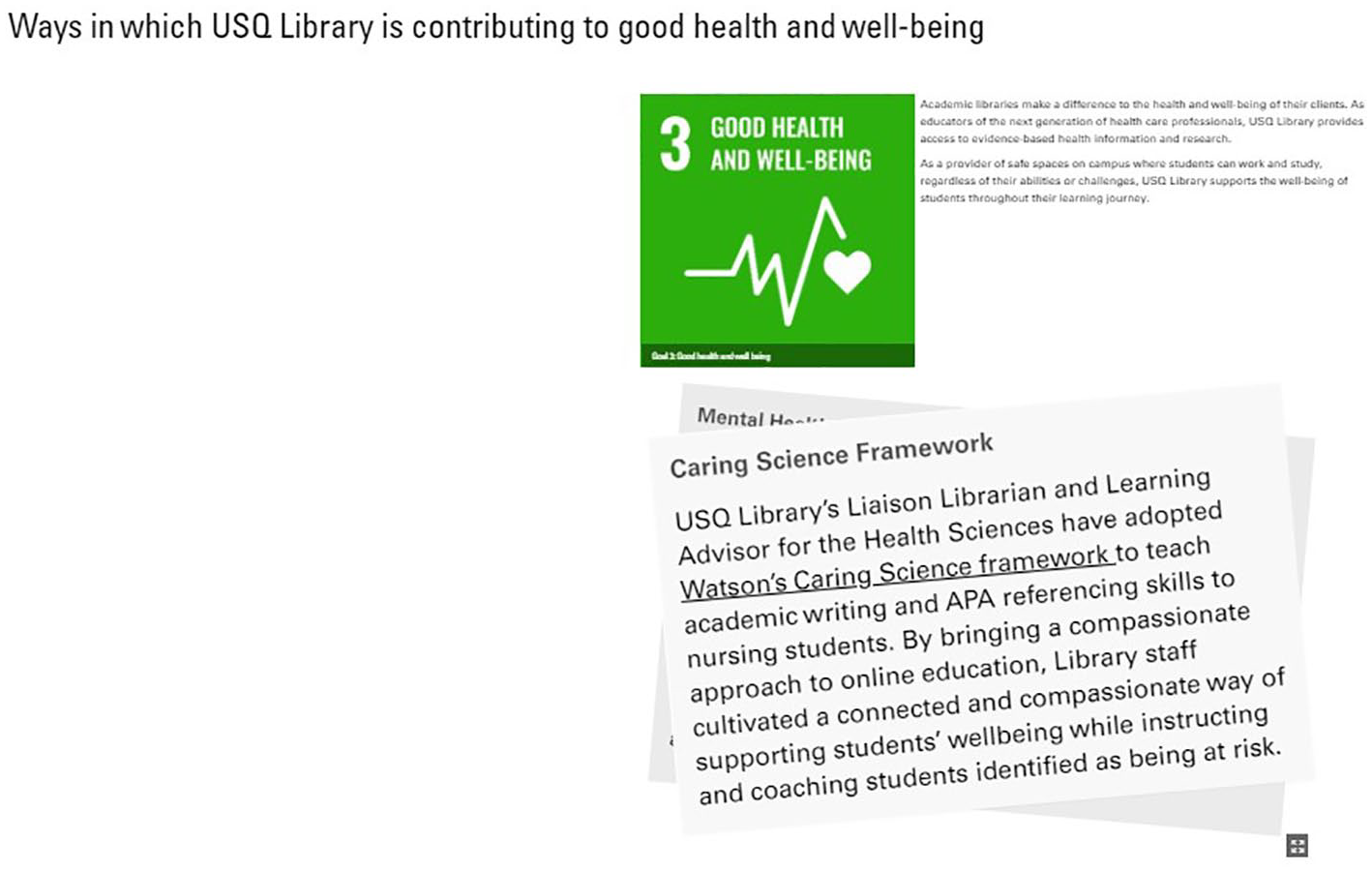
Screenshot from Microsoft Sway report – Goal 3 (Gunton and Thorpe, 2019).

Screenshot from Microsoft Sway report – Goal 8 (Gunton and Thorpe, 2019).
The online, interactive tool incorporated a storytelling approach to providing evidence and impact of USQ Library’s contribution to the SDGs agenda (Pinto and Ochôa, 2019). In identifying outcomes relating to a specific goal, stories of how the Library delivered positive impact for clients and the wider USQ community were gathered, documented and then incorporated into the online presentation. This intentional, reflective practice approach applied the recommendations of International Federation of Library Associations and Institutions (2018) by using narrative stories, to report on progress towards the goals, as well as quantitative metrics. By telling stories of projects and activities aligned with the SDGs, the informal Sway report served to communicate the broad reach of USQ Library’s leadership and partnership across the University, connecting the SDGs to the student learning journey and the experiences of researchers.
Discussion
The SDGs provide an opportunity for libraries to demonstrate their positive influence, value and impact on their communities. However, as Mori et al. (2019) argue, implementing and reporting on the goals should not be a checklist exercise. The SDGs should be used as a critical instrument for embedding sustainability into business strategies, decision-making processes, policies, and practices that will have a positive impact and will increase their accountability to stakeholders (Mori et al., 2019). The effect of undertaking this first mapping exercise led to ongoing conversations and an annual review of USQ Library’s activities and goals that positions the SDGs as a key external driver for future stretch targets, policies and practices.
It is not easy to map information about SDGs activities in libraries, particularly as many academic library services and projects straddle more than one goal (European et al., 2020). As a proof of concept exercise, the results demonstrated that it is possible to map core business, project outcomes and annual stretch performance targets to the 17 macro goals from a descriptive perspective. Digging deeper to identify quantitative and qualitative evidence to support the mapping required more staff effort and time than was possible during the pilot period. In conducting the mapping exercise, USQ Library teams and staff identified how they are working towards some of these wider community and global concerns. Staff and stakeholders have subsequently engaged in conversations about the challenges of sustainability. The formal and informal reporting strategies demonstrated that the SDGs can be used as an assessment framework to provide evidence of the ways in which libraries demonstrate positive impact (EBLIDA, 2020). By considering and evaluating the Library’s business against the 17 goals, a shared commitment to sustainability has developed among the Library’s leaders and team members.
Reflecting on Sustainable, Development, Solutions, Network, and Australia/Pacific’s (2017) five steps to engage with the SDGS, USQ Library has completed three steps:
Mapped existing activities – from business-as-usual tasks to annual strategic and operational goals.
Built internal capacity and ownership of the SDGs – by engaging staff at different levels across the Library to identify their individual contribution to the goals.
Monitored and communicated actions on the SDGs – through formal and informal reporting to a range of different audiences within and beyond the university community.
Mapping USQ Library’s activities and goals against the SDGs is one part of a structured process of collecting, interpreting and applying evidence-based practice. As an assessment tool, it positions the academic library in a broader context, demonstrating value and impact to the university, local and global communities. The SDGs framework provides a useful tool by which academic libraries can explore how the work they do impacts their clients, wider University communities, the world, and themselves. Evaluating the impact or success of the Library’s activities against the goals proved more difficult. Possible indicators were identified for some of the goals, such as employment diversity indicators, open access research publications, and attendance at learning and study support events. It is yet to be proven whether the proposed indicators can provide value of the academic library’s impact against the goals, and in doing so underline the importance of the services the library provides to the university community.
As well as increasing organisational awareness of the SDGs, the mapping exercise resonated personally with USQ Library staff members. Team members identified connections between the organisation’s strategic priorities and goals and their personal values and motivations. Staff developed a general understanding of sustainable development and the SDGs, including how their profession, skills and knowledge can contribute to the goals (Sustainable Development Solutions Network, 2020). The mapping process generated discussion around the values and purpose of the University and the Library, and how they aligned with the SDGs. This prompted some Library staff to consider how their individual roles and the work they do relates to their personal values and contributes positively towards these global sustainability goals. The nature of this kind of reflection taps into the importance that individuals place on their role in the world, be that in their work, study or homelife. The opportunity for personal reflection enabled staff to make connections with those SDGs that are meaningful for them and saw an increased interest in identifying and participating in Library initiatives that positively impact the relevant SDGs. Creating a connection between the SDGs and workplace tasks can give staff a stronger sense of motivation and purpose alongside personal responsibility and willingness to act.
Future directions
Using Sustainable Development Solutions Network Australia/Pacific’s (2017) five steps as a framework to deepen engagement with the SDGs, at the organisational level there is more work required to identify priorities, opportunities and gaps within the Library’s service offerings and project plans and to integrate, implement and embed the SDGs within the university’s strategies, policies and plans. Ongoing reflection on the mapping exercise and a review of the work conducted has raised questions about how activities are mapped to one or more goals and how to measure achievement towards and alignment with the goals. The next step will be to undertake a gap analysis to identify gaps that need to be filled, assess potential pathways for moving forward and identify resources and expertise that can support engagement with the SDGs. At the national level, identification of key quantitative indicators that directly relate to Australian academic libraries may be useful for benchmarking, collaboration and stretch targets. The Council of Australian University Librarians’ (2019) mapping exercise also adopted an awareness and narrative reporting approach. The Council’s annual statistics collection process may offer a way to identify data and trends of engagement with the SDGs across Australian and New Zealand academic libraries (Council of Australian University Librarians, n.d.).
Conclusion
The United Nation’s 2030 Agenda for Sustainable Development provides an opportunity for academic libraries to assess, demonstrate and communicate the breadth and depth of their contribution to quality education, reducing inequalities, supporting innovation and economic growth, and building communities. The Sustainable Development Goals provide a remarkable and unique common platform in which civil society, governments and organisations, such as libraries, can contribute to solving the world’s biggest sustainable development challenges (Mori et al., 2019). The crucial need for a global approach to sustainability is even more pressing in 2020 as a result of Australia’s devastating bushfires, extreme weather conditions and the COVID-19 pandemic (GLAM Peak, 2020). In the pandemic environment, organisations, such as the American Library Association (2020), have identified how libraries’ contributions to their communities during COVID-19 align with the 17 goals. As traditional assumptions about libraries, including those in the academic sector, are being re-questioned or reshuffled in the post-COVID-19 era (EBLIDA, 2020), the SDGs remain relevant as a way for libraries to demonstrate their value, impact and relevance to the communities they serve. USQ Library is interested in exploring and understanding how our day-to-day work and projects contribute to and make meaningful contributions towards the priorities identified in the SDGs. The goals provide opportunities to engage with staff and stakeholders in conversations about issues of diversity and inclusion, poverty, quality education and environmental sustainability. A strong academic library culture is one where sustainable development is embedded in everyday operations (Aytac, 2019). The SDGs provide a way to assess an academic library’s impact, to contribute to the sustainability agenda, to use evidence to advocate with influence, and to demonstrate the academic library’s role in empowering the lives of students and researchers for the good of the local and global community.
Supplemental Material
sj-pdf-1-lis-10.1177_09610006211005528 – Supplemental material for Assessing the United Nation’s Sustainable Development Goals in academic libraries
Supplemental material, sj-pdf-1-lis-10.1177_09610006211005528 for Assessing the United Nation’s Sustainable Development Goals in academic libraries by Clare Thorpe and Lyndelle Gunton in Journal of Librarianship and Information Science
Footnotes
Declaration of conflicting interests
The author(s) declared no potential conflicts of interest with respect to the research, authorship, and/or publication of this article.
Funding
The author(s) received no financial support for the research, authorship, and/or publication of this article.

Supplemental material
Supplemental material for this article is available online.
Author biographies
References
Supplementary Material
Please find the following supplemental material available below.
For Open Access articles published under a Creative Commons License, all supplemental material carries the same license as the article it is associated with.
For non-Open Access articles published, all supplemental material carries a non-exclusive license, and permission requests for re-use of supplemental material or any part of supplemental material shall be sent directly to the copyright owner as specified in the copyright notice associated with the article.
