




Abstract
The purpose of this article is to discuss competencies required for practicum supervision within the field of library and information science (LIS) education. In doing so, this study attempts to propose Practicum Supervision Competencies Framework for professionals working in libraries and similar information organisations. The study aims to contribute to the body of knowledge on supervision of experiential learning programmes such as practicum and internships in the field of library and information science. Constructivist Grounded Theory approach was used for collection and analysis of data. Qualitative data was collected through semi-structured interviews with 43 participants that included library and information science professionals and students. Using constant comparative method, suggested in the Constructivist Grounded Theory literature, the components of the framework were developed and then validated and strengthened through the literature on competencies for library and information science professionals. Qualitative data analysis software NVivo 12 pro was used to support coding, category development and constant comparison methods in the data analysis process. Results of this study propose a framework for library and information science practicum supervision competencies and signify its importance for the academia and industry. The proposed framework is composed of five distinct but interrelated components, that is, Interactive, Management, Pedagogical, Professional and Technology which are important for practicum supervision in the field of LIS. The study also discusses empirical insights about the significance of research on practicum supervision within the field of library and information science as a distinct area. Practical implication of research encompasses several dimensions: methodological, theoretical, managerial and academic. For example, the framework should attempt to help better understand gaps between potential and actual competencies required by practicum supervisors in the field of library and information science. Research results may lack generalisability because of the chosen research method. However, researchers in other regions of the world are encouraged to test the proposed framework further.
Keywords
Introduction
The practicum comprises supervised training experiences (often called fieldwork, apprenticeship, workplace learning, practice-based learning or graduate fellowship) which introduce students to the core competencies of the discipline, bringing classroom education to life in practical settings, and laying a groundwork for further training and professional development of new graduates. Practicum is an experience that requires the practical application of theory or conceptual knowledge (Huggins, 2017). General importance of the practicum has been recognised for years in the field of library and information science (LIS), when a guided-supervised work was first recommended by Melvil Dewey in 1879 as a part of library education (de Súmar and Ibarra, 2011). However, there has been an increased interest in the supervision of practicum programmes more recently (Huggins, 2017). Out of this interest has grown the need to identify the domains and levels of competence that should be central to the requirements of practicum supervisors. This study intends to address this need and introduces the Practicum Supervision Competency Framework (PSCF), an outline of competencies and skills required of LIS practicum supervisors.
Supervision is a general term meaning to guide, support and direct in order to make sure the supervisee learn according to expected standards within a particular field. A commonly agreed description of the term ‘supervision’ is to observe and direct the execution of a task or activity (Wierda, 2016). Practicum supervision in the field of LIS can be described as the bunch of activities, techniques, methods and procedures prescribed to ensure that implementation and achievement of the goals and objectives of practicum are effectively carried out. In particular, practicum supervision ‘involves the use of expert knowledge and experiences to oversee, evaluate and coordinate the process’ (Negasa, 2018: 2) of practicum in libraries. Practicum supervisors are often the LIS professionals selected by the library schools or deputed by the host organisation among the experienced staff working in libraries. Practicum supervisors are no doubt playing an important role by contributing to the student’s learning and finally leads them to do professional work unassisted. Thus, supervision of practicum programmes is an essential element of student’s satisfaction, productivity and professional development (Walczyk, 2016). Literature shows that practicum supervisors tend to develop competencies at their own, based on their awareness, experiences and personal beliefs because of the absence of knowledge and skills needs for practicum supervision (Huggins, 2017). Practicum supervision competency refers to the existence and importance of supervisory knowledge, skills and attitude required for supervising practicum students (Baldwin, 1991: 345). Khan and Qayyum (2019) argued that the ‘competencies required for practicum supervision [in the field of LIS] are often quite different from those required by a work supervisor’ (p. 8). Therefore, an identifiable set of competencies required for practicum supervision is no exception for supervisors. Such competencies refer to ‘the existence and importance of supervisory knowledge, skills & attitudes required for supervising practicum students’ (Khan and Qayyum, 2019: 8).
Several studies from the LIS literature, conferences and professional bodies (i.e. Australian Library and Information Association [ALIA], American Library Association [ALA], International Federation of Library Associations [IFLA]) have discussed generic, professional, subject-specific and personal competencies for LIS professionals (see, for example, Ameen, 2009; Ennis, 2010; Farooq et al., 2016; Gonzalez, 2010; S. A. Khan and Bhatti, 2017; Mohammad and Mukherjee, 2013). However, Khan and Qayyum (2019) argued that very little research has specifically focused so far on the competencies required for practicum supervision in the field of LIS. Thus, developing a core competencies skill set for practicum supervisors is important to build capacity of the LIS professionals and get maximum benefits from the professional training provided to the students at libraries. Because of the lack of research on LIS practicum supervision, the question remains what competencies do practicum supervisors and students perceive to be important for practicum supervision in the field of LIS?
The scope of this study was guided by the question identified above because there is not enough information to comment on specific skills required for practicum supervision in the field of librarianship. The purpose of this study, therefore, is to discover and describe the perceptions and experiences of LIS practicum supervisors about supervisory skills and produce an inductively derived framework that should inform LIS practicum supervision competencies. The scope is further narrowed by examining perceptions and experiences of librarians (working as practicum supervisors) and students of LIS who recently completed their practicum from academic, public and special libraries.
Related literature
To focus supervision in the LIS practicum literature, an open search was conducted on library-specific databases, that is, Library and Information Science Abstract (LISA), Library and Information Science Technology Abstracts (LISTA) and Library Science Database (LSD) using all the broader and narrower terms (e.g. experiential learning, practicum, internship, fieldwork, workplace learning, apprenticeship). An initial search on library-specific databases identified 838 publications published between 1965 and 2018 available via LISA and LISTA. The list of references along with full text retrieved from the respective databases and was imported in EndNote (reference management software) for thematic analysis. After removing duplicate entries, a list of 479 unique titles was obtained.
Initially, the retrieved full-text documents were analysed using NVivo’s (qualitative analysis software) ‘word frequency query’ combined with ‘matrix-coding query’. Results obtained from the broad categorisation of the keywords generated from 479 articles revealed that only a few studies (Arif et al., 2018; Ball, 2008; Bird et al., 2011; Brannon, 2015; Goodsett, 2018; McGurr and Damasco, 2010; McNeil, 2017; Nutefall, 2012; Pacios, 2013) mentioned about knowledge, attitude and competencies with respect to supervision or supervisor of practicum and internship programmes in the field of LIS. This initial overview of the literature illustrated that there has been a limited focus on competencies of practicum supervision in the LIS literature. Findings from the detailed literature review of the selected articles are presented next.
It is well established that a large body of literature in the field of LIS regarding practicum is lacking in research ‘concerning site supervisors, their contributions to students’ careers, the guidance they offer, and their assessment of their own performance as site supervisors’ (Brannon, 2013: 34). Researchers agree that practicum supervisors are often selected among the library staff from the management positions but supervision competency are sometimes quite different than those needed by a work supervisor (Baldwin, 1991; Dahl, 2011). In most cases, practicum supervisors are left to develop new competencies at their own as most organisations offer little support or help to them. Resultantly, practicum supervisors are tend to espouse their own individual methodology, based on their awareness, experiences and personal beliefs because of the absence of knowledge and skills needs for practicum supervision (Huggins, 2017). LIS practicum literature discusses supervision competencies in terms of supervisors’ lack of skills, attitudinal issues towards supervising students and lack of relevant knowledge of supervision.
Librarians often do not receive the level of training required to manage and supervise the practicum programmes (Jeske and Axtell, 2014) and usually develop their skills through workshops and through on-the-job experience (Brannon, 2014). Practicum supervisors have no formal training whatsoever, and therefore, the ‘sink and swim’ philosophy prevails till they spend 6–12 months on practicum supervision jobs (Baldwin, 1991). McNeil (2017) suggested the soft skills of human resources management, team-building and leadership as the foundation of successful fieldwork supervision. Researchers agree that supervisors only make a valuable contribution to the training of student and help students gain lifelong job skills when they have sufficient supervision skills (Simmons-Welburn, 2000). Yet, there is little evidence to inform the key competencies required for practicum supervision in the field of LIS. Malik and Ameen (2010) examined the perception of LIS practicum students in Pakistan and stressed that supervisors must attain time management skills, planning and organising skills and communication skills before taking students in practicum programmes. However, the study conducted by Malik and Ameen (2010) captured the viewpoints of students around effectiveness of practicum and there was no input gathered from the supervisors. Moreover, there was not discussion around supervision competencies in the aforementioned study. Aside from lack of research on skills relevant to practicum supervision in the LIS literature, several authors (Bird et al., 2011; Brannon, 2015; Dotson, 2007; Goodsett, 2018) have proposed that skilful supervision in such programmes leads to effective development of professional competence and future success of supervisors in practicum. Still, there is limited information available to comment on specific skills best suited or applicable for the practicum supervision in the LIS settings.
Concerning the attitudinal aspect towards learning of practicum supervisors, Bird et al. (2011) and Bilodeau and Carson (2015) noted that the practicum supervisors were less mindful of their own learning about how to perform as a supervisor. The authors suggested that to be engaged with the positive attitude of supervising students at their respective workplace is important for a good supervision. Authors also stated that practicum supervisors were of the viewpoint that they would be able to figure out how to do their work on their own and that they do not require any training. Supervising librarians in this situation often had to rely upon self-directed learning, or learning through problem-solving and trial-and-error (Kampa, 2017). Another study on practicum conducted by McNeil (2002) highlighted that the practicum supervision was singled out by many librarians as an important opportunity for getting the skills and practical exposure of teaching and mentoring that was absent from the rest of their positions they previously worked on. In short, only few studies have highlighted the viewpoints of researchers and practitioners about how supervisors feel and think in the position of being practicum supervisors.
In terms of knowledge required for LIS practicum supervision, recent studies highlight that content and context of practicum in the digital era posed particular challenges for the practicum supervisors such as knowledge of virtual collaboration with students, online social negotiation with faculty and metadata mapping (Raszewski et al., 2012). Moreover, Brannon (2015) stressed the need and training of LIS practicum/fieldwork supervisors in supervisory knowledge. Lacy and Copeland (2013), while examining the library work placements from the student’s perspective, noted that there appeared to have been less examination of the knowledge required to supervise such programmes. Similarly, Westbrook (2012) reported the lack of knowledge by the supervisors in use of free online tools – such as blogs, Google Tools and more – to recruit interns and manage an internship programme in University of Houston Digital Library. This study posed some questions about supervisory knowledge required to interact with remote students during online programmes, such as whether individual projects can be better supervised by the site supervisor? Or students need to work in collaborative groups which will require knowledge of collaboration in supervision process along with effective use of IT tools and applications. Whitver (2017) suggested that developing knowledge of supervision in practicum should be understood as an ongoing learning process by the supervisors.
To summarise, there is limited information to comment on minimal practicum supervision competencies in the LIS literature. There are few articles in the LIS literature reporting in case studies on how practice, academics and research recommend programmes and activities for students doing fieldwork (Banks and Lents, 1992; Kelsey and Ramaswamy, 2005; Moynahan, 1997; Quijano, 2015), with some studies offering tips to supervisors (Bernhard, 2016; Damasco and McGurr, 2008; Raszewski et al., 2012). Other studies do support and suggest that practicum supervisors should be competent but do not directly address the functional and foundational competencies needed for supervising LIS practicum students. In addition, little is known about specific set of competencies required for effective supervision to take place. Detailed investigation into the evaluation of supervisor’s competencies may provide a more reliable framework to inform LIS practicum supervision. A uniform set of core competencies required to supervise practicum students may lead towards quality and standardisation of practicum supervision practices within the field of LIS.
Methodology
By way of comparison among different qualitative methods, a superior fit of the grounded theory (GT) approach was found suitable for the current study because it is a well-established method that is pertinent in areas where there is scarcity of theoretical foundation such as practicum supervision in LIS. Specifically, the Constructivist Grounded Theory (CGT) approach was adopted because it helps to develop an explanation of how the basic social process [of supervision] happens in the context of [LIS practicum] environment (Creswell and Clark, 2017). Also, CGT is characterised to assess the subjective and descriptive experiences and understandings of the research subjects, that is, practicum supervisors and students.
CGT involves using multiple stages of data collection to refine the information and discover interrelationships between the various discovered categories of information (Charmaz, 2014; Corbin and Strauss, 2008). CGT is punctuated by techniques such as including theoretical sampling, coding, constant comparison, memo writing and theoretical saturation (Charmaz and Henwood, 2017). The use of CGT method was justified on the basis that it provides useful technique in developing context-based, process-oriented descriptions and explanations when there is little known about a particular phenomenon (Birks and Mills, 2015).
Since there is little information available from the literature about LIS practicum supervision competencies, the systematic and concurrent data collection and analysis process of CGT allowed the salient features of LIS practicum supervision competencies to emerge from the data. Detailed discussion of the research participants helped in conceptualising and categorising the main concepts that led the researcher to generate a conceptual framework and explain how LIS professionals and students perceive the skills required for practicum supervision within the profession of LIS. Such conceptual framework forms a theory that is grounded in data.
Participants and data collection
Data were collected through semi-structured interviews from 21 librarians (who have been working as practicum supervisors) and 22 students (who have recently completed their practicum) from public, special and academic libraries in Pakistan. During the interview, participants were asked questions about specific knowledge, skills and abilities (KSA) required of practicum supervisors to supervise practicum students in libraries and information centre. Research participants were encouraged to be open, elucidative and interpretative in sharing their perceptions, experiences and understanding of the practicum supervision. The purpose was to uncover the common elements in the subjective experiences of participants by questioning and making comparisons between emerging concepts. Average interview took around 60–90 minutes, were audio recorded and transcribed verbatim by the researcher. NVivo (a Computer-Assisted Qualitative Data Analysis Software) was used for coding and analysis of the transcripts.
The initial round of data collection from first four interviews (two supervisors and two students) and its analysis led the researcher to generate codes and identify potential concepts. The researcher followed up on topics which were explicit in an interview and remain implicit or absent in others (Charmaz, 2014). For example, the initial codes reflected a wide range of concepts around supervisors’ abilities and aptitude towards professional training. Thus, further sampling of participants took place based on the information emerged during the analysis.
Concurrent data collection and analysis continued until theoretical saturation was reached – when it was clear that no new themes had emerged. As the researcher gathered and analysed new data, similar instances began to appear over and over again. However, in order to objectively establish the data saturation, researcher used the node counting feature of the NVivo software. In order to illustrate theoretical saturation in this research project, number of nodes added to the project in different categories were retrieved in a tabulated form. Results were arranged in chronological order and the table was imported into Microsoft Excel to create a coding graph (see Figure 1). As shown in Figure 1, addition of new nodes gradually decreasing after 15th interview until it reaches to zero in the 21st interview with the supervisors. The same was followed in interviews with the students where no new themes could be found in the 22nd interview with the student. Thus, it made the researcher empirically confident that there are mounting instances of the same codes.
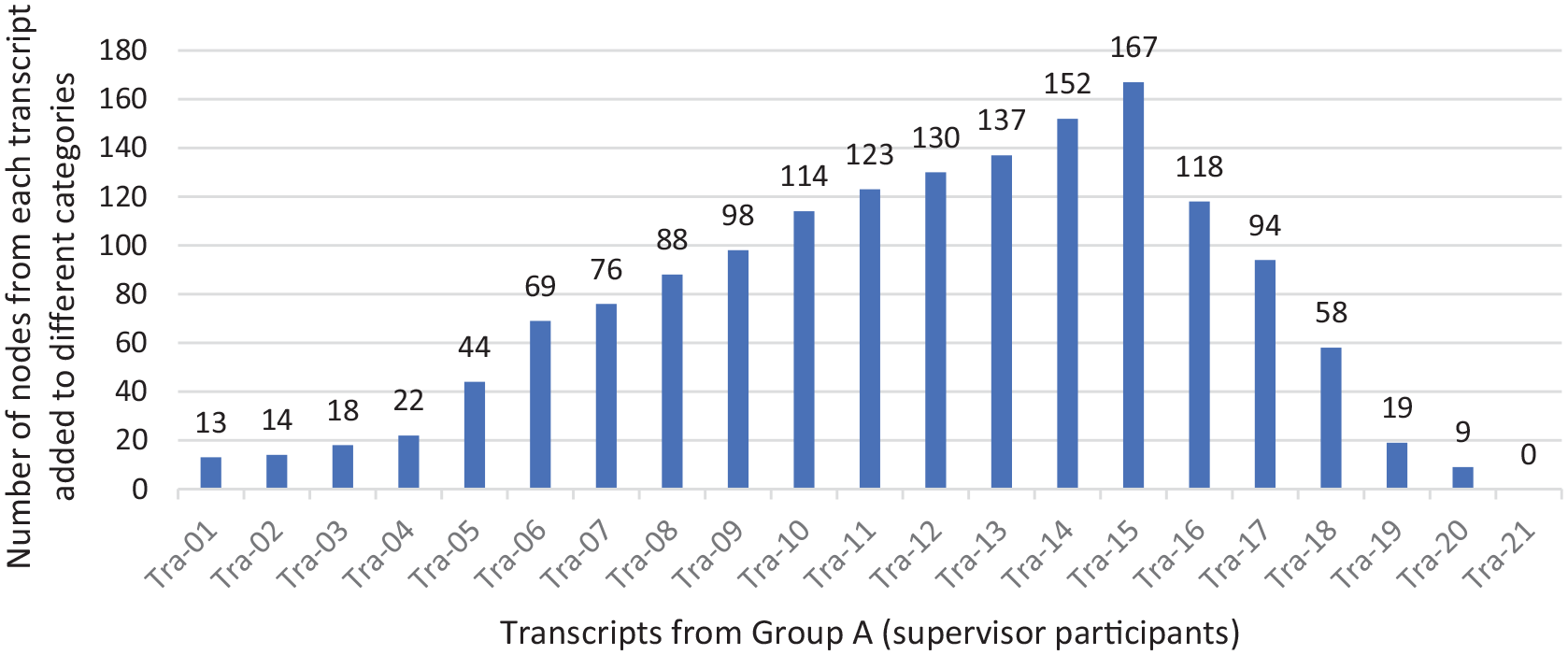
Coding graph to show theoretical saturation in this project.
Data analysis
In the first phase ‘initial coding’, specific incidents or ‘key points’ were identified through line-by-line coding (Charmaz, 2014). QSR NVivo ver 12 pro helped in generating an exhaustive list of words and phrases that facilitated line-by-line coding of the data. Similar concepts were identified and grouped together under a label called as ‘code’. In the second phase of coding ‘focused coding’, the list of labels (codes) was sorted and categorised into groups of concepts with similar meaning using NVivo’s node hierarchy feature. After coding the data as described above, the categories with their respective properties (characteristics) and dimension (possible variations of the properties) were brought together to form a major category. NVivo’s nodes represented a major category and child nodes represented properties and dimensions of that category.
Categories were further developed through identification of relationship between the categories (Charmaz, 2014). In order to group similar nodes, NVivo’s project mapping option was used which helped to see each incident as an item in a map and was easier to bring them closer to one another based on relevancy and/or similarity. The researcher returned to transcripts to validate consistency of the developed categories with the data. In the last phase, ‘theoretical coding’ core category of Practicum Supervision Competency was created by grouping the major categories and clarifying relationship between them (see Figure 2).

Development of major categories (pink box), properties (green box) and dimensions (without box).
Findings
CGT studies began with open-ended questions and a topic that the researcher was generally or intimately familiar with (Charmaz, 2014). Interview questions of this study allowed the emergence of an inductively derived framework that described specific skills required of LIS practicum supervisors and was co-constructed by the researcher and the participants as experiences were shared and data were analysed. As mentioned earlier, participants of this study consisted of two groups: supervisors and students. Data gathering sessions and analysis took place concurrently.
Group A consisted of 21 senior level librarians from Pakistan (16 male and 5 female) having 17 years mean work experience overall and 13 years mean experience of working as practicum supervisors. Group B consisted of 22 LIS students (7 male 15 female), who have recently completed their practicum within last 5 months and are enrolled in Master programme of LIS in Pakistan. Each group (supervisors and students) is represented by participant code, that is, ‘Sup’ and ‘Std’ followed by participant number in this section. Demographic details of the participants are summarised in Table 1.
Demographics of participants.

The iterative process of data collection and analysis was useful to identify KSA that the practicum supervisors believe are essential for the supervision of practicum students. However, data gathering from students was intended to explore their perceptions and experiences to identify KSA required of practicum supervisors.
Overall, the participants identified 74 items (42 items were identified by supervisors and 32 items by the students). However, 19 items were identified by both groups, that is, students and supervisors. Out of 19 items identified by both groups, 8 were considered to be critical because they appeared frequently and have been discussed by at least 1 participant in the study. Moreover, an agreement exists among participants about 8 critical items, suggesting its importance. These items are presented in Table 2.
Items identified important by the number of participants.

Based on their relevancy, individual skills identified from the data were grouped in eight critical items that form an axis for ongoing analysis. After creation of a list of items, the number of items identified by each participant was sent to the respective member to clarify item’s use, meaning and context. This process is called member checking and ensures the credibility of the results. Member checking not only helped to identify the relative importance attached to each item but also to reach a consensus as to the meaning and logic behind each item’s description. The critical items formed the basis of grouping similar skills and to develop major categories, properties and dimensions.
Five major categories Interactive, Management, Pedagogical, Professional and Technology were explicated from the respondents’ discussion in line with Charmaz’s (2014) suggestion ‘Categories may consist of in vivo codes that you take directly from your respondents’ discourse’ (p. 92). Codes have been raised to category by ‘breaking the data up into their component parts or properties’ (p. 50). As shown in Figure 2, pink boxes represent major categories, green boxes represent properties (characteristics) of the major categories and text without boxes represent dimensions (variation of a property). Collectively, five major categories correspond to LIS Practicum Supervision Competency Framework. Each category is further elaborated in Table 3.
Practicum supervision competency framework: categories, concepts and codes.
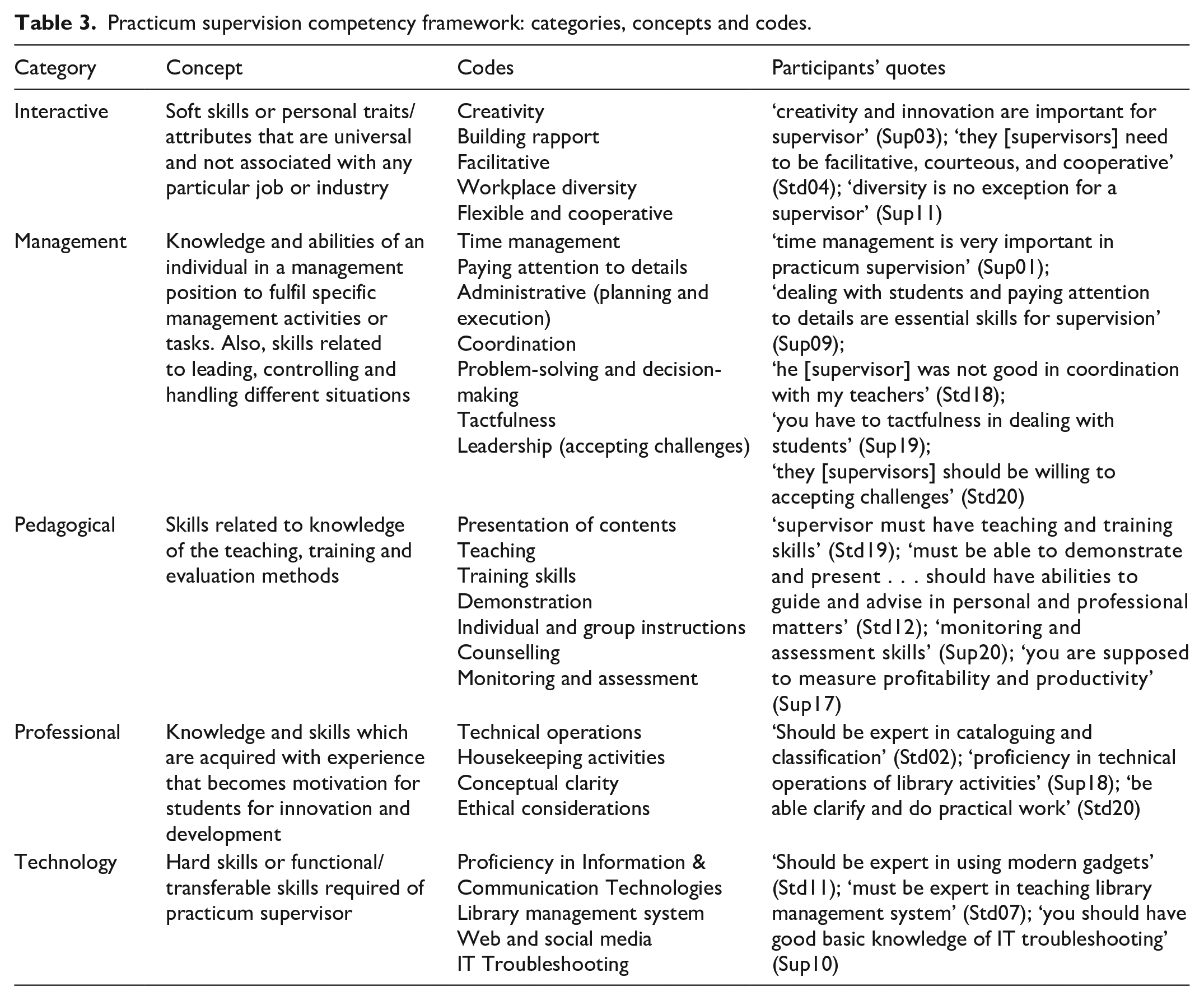
Table 3 presents the bottom-up process where participants’ quotes created codes that led to generating concepts, and concepts transformed into broader categories using constant comparison method of CGT. The participant code ‘Sup’ denotes the supervisor participant while ‘Std’ represents the student participant followed by the participant number (e.g. Sup01). Participants from Group A (supervisors) described the importance of items (knowledge, skills and attribute) variously, such as ‘would not be able to supervise practicum students’; ‘the most importance skill is’; ‘practicum supervision cannot take place without the skill of’; and ‘is a must have skill for supervisor’. For example, a participant asserted that ‘practicum supervisor should have knowledge of the subject matter and he must have practical experience of dealing with modern IT gadgets’ (Sup02). Similarly, the importance of items described by the participants from Group B (students) was determined by the quotes such as ‘I wish my supervisor had skills in’; ‘supervisor should have knowledge of’; ‘s/he should have been capable of’; and ‘knowledge and skills expected of my supervisor’. Few quotes from the participants are presented in Table 3. After determining the importance, meaning and usefulness of each item in the list, the researcher moved on to place them in respective categories based on their relevancy and relationship.
Proposed practicum supervision competency framework
To summarise, the newly developed PSCF is composed of five broad categories: Interactive, Management, Pedagogical, Professional and Technology. These categories were developed using bottom-up grounded theory approach described above. Each of the categories are defined and rationale given below.
Interactive
This category includes an individual’s soft skills or more generally personal traits/attributes that are universal and are not associated with any particular job or industry. Participants argued that to be an effective practicum supervisor, an individual should be able to build rapport, be flexible and cooperative. As one participant stated, ‘this is important that you [supervisor] should build rapport with your students to help them reduce workplace anxiety’ (Sup10). Another participant stated that, ‘supervisor needs to be facilitative, courteous, and cooperative . . . treat students like a teacher not like an administrator’ (Sup04). Also, participants contended around certain qualities for supervisors such as having good communication skills, workplace diversity, flexible behaviour and keeping in touch with students. The concepts included in this category depend more on an individual’s natural or developed personal attributes. The concepts presented in this category are well established in the relevant literature as essential attributes for LIS professionals (see, for example, Farooq et al., 2016; Khan and Bhatti, 2017; Myers and Rodriguez, 2016; ur Rehman, 2016).
Managerial
Managerial skills category includes the KSA related to the management, planning, controlling and execution of practicum programmes. Participants identified those concepts which are generally based on experiences or developed throughout an individual’s career. Skills related to handling difficult situations, be in supportive role, problem-solving, emotionally balanced, decision-making and tactfulness were regarded as the most important for practicum supervision. As the following quote is representative of what participants asserted about managerial skills ‘you can measure your own success by watching those who are working under your supervision . . . leadership and management is all about problem-solving, decision-making and emotional balance’ (Sup20). Other attributes, as identified by the participants of this study, were time management, dealing with students, paying attention to details and so on. Set of knowledge discussed by the participants in this category include abilities of an individual in a management position to fulfil specific management activities or tasks. The importance of problem-solving and decision-making skills (see, for example, Ameen, 2014; Cooper, 2013; Hall-Ellis and Grealy, 2012; Jeske and Axtell, 2014; Južnič and Pymm, 2016) and leadership skills (Blodgett, 2017; Hirsh et al., 2015; Malik and Ameen, 2017) for the LIS professionals are well established in the LIS literature.
Pedagogical
The majority of participants (38 out of 43 (88%)) highlighted that pedagogical skills, especially teaching, and training skills are no exception for supervisors. This category also includes guidance, support, counselling, knowledge of learning styles and career development techniques. Participants have used different terms such as ‘delivery and dissemination of knowledge’, ‘presentation of contents’, ‘use of teaching and training aids’, ‘demonstration’ and ‘individual and group instructions’ to indicate the required abilities in this area. One of the participants quoted that if ‘her [supervisor’s] aptitude and attitude towards training or teaching is not positive then the process of supervision is compromised’ (Sup04). Another participant stated that ‘training is at higher pedestal than teaching . . . practicum supervisor should have abilities and skills to train, guide, and advise students for their future career’ (Sup14). This category is cognizant with the LIS literature that recognises the need of pedagogical and information literacy skills for librarians (see, for example, Allen and Taylor, 2017; Babu, 2007; Burnett, 2013; Foster, 2020; Kasten-Mutkus, 2020; Nutefall, 2012).
Professional
Competencies included in this category are generally conceived as the domain-specific knowledge and skills for librarianship. These knowledge and skills are usually acquired during work experience in the field of LIS. Participants asserted that these competencies should be a prerequisite for the practicum supervisors. Participants also argued that competencies such as creativity and working relationship are more important for innovation and developing confidence of students to work independently in the field. As remarked by a participant, ‘practicum is all about preparing students to work independently in libraries and information centers, therefore, you [supervisors] have to be proficient in all professional and technical activities’ (Sup19). Participants pointed out that domain-specific knowledge and skills such as technical operations of library activities (e.g. classification, cataloguing, serial management), conceptual clarity of practical work and knowledge of the subject matter (philosophy and techniques of library operations) should be the core requirements for practicum supervisors. Hence, this category includes a synthesis of professional as well as technical knowledge and skills required of a librarian.
Technology
This category is more of a collection of hard skills or functional skills required of a practicum supervisor. Generally, they are transferrable skills and could be acquired through formal training and capacity building programmes such as proficiency in using ICT tools, web technologies, library-integrated management system, troubleshooting of IT equipment, and updated knowledge of information technology systems and services. In this regard, a quote from one participant seemed to capture the true essence of the importance of these skills, ‘technological proficiency is no exception in todays’ world . . . students are more tech savvy and you [practicum supervisor] must be cautious about it’ (Sup12). This category is a blend of skills and knowledge required of LIS professionals to work effectively in the digital era and often referred to as ‘ICT skills’ in the LIS literature (see, for example, Asundi and Karisiddappa, 2014; Bird et al., 2015; Chu, 2010; Franks and Oliver, 2012).
Relationship among categories and concepts
Relationship of concepts within a category can be described as an appreciation of knowledge, skills and attributes identified by the participants in terms of their dynamic interrelationship with each other. For example, use of teaching and training aids, demonstration, guidance, counselling, monitoring and assessment are some of the functions of pedagogical activities, whereas relationships across different categories can be subsumed as a balance of foundational and domain-specific competencies. For instance, looking at the categories, it can be subsumed that Interactive and Pedagogical categories act as ‘the foundation for LIS practicum supervision’. A blend of soft skills coupled with teaching and training abilities are the fundamental requirement for LIS practicum supervision. Other three categories, that is, Professional, Technology and Management, represent the competencies needed for ‘effective practicum supervision’. Thus, a blend of soft skills and training capabilities (Interactive and Pedagogical), domain-specific skills (Professional) and hard skills (Technology and Management) are inextricably intertwined to develop LIS supervision competencies framework. Most importantly, relationship among categories was evident from the participants’ discussion as well. As remarked by one participant, ‘supervisor need to manage, teach, interact with student gently, and I think it I more important to be expertise in professional and technical issues of the library and information science field’ (Sup06).
To summarise, the key components of the proposed PSCF were nicely grounded in the data which includes soft skills or personal traits/attributes that are universal and are not associated with any particular job or industry. Similarly, skills related to knowledge of the teaching, training and evaluation methods representing the Pedagogical skills viewed by the participants as obligatory for practicum supervision in the field of LIS. The importance of both the Interactive and Pedagogical KSAs are seen by the participants as inevitable for LIS practicum supervision, whereas the Professional skills and Technological skills are viewed by the participants as important for effective LIS practicum supervision to take place. Managerial skills category has its own standing in the required KSAs for practicum supervision where these KSAs are effectively in place to create relationship between managerial and supervisory abilities of the practicum supervisors.
Because the research sampling was done on the basis of evolving concepts, the conceptualisation of categories, properties and dimension emerged from the data. Also, the key components of the proposed PSCF were explicated from the participants’ voices. Hence, the framework is well grounded in the participants’ discourse.
Discussion
The new PSCF is built on five broad categories of KSA that constitutes required set of competencies for practicum supervision in the field of LIS. As discussed earlier, practicum supervision is a well-established practice in other fields of study such as counselling and medical sciences. Several models of supervision (e.g. Bordin, 1983; Holloway, 1987; Stoltenberg and McNeill, 2011) have been proposed in other fields of study. However, traditional supervision models are not directly related to what the LIS practicum supervisors do. For instance, existing models of supervision do not include supervision that focuses on the diverse roles and tasks required of information professionals, such as information seeking, information management, organisation of recorded knowledge, reference and user services, information architecture, sources and products. The discipline-specific problems and issues inherent to the practicum in libraries have an influence on supervision and warrant a diverse set of competencies that incorporates the distinct features of LIS practicum supervision and preparation. Moreover, the difference of practicum duration and the context of supervision is an important factor in determining the supervision competencies. For example, in clinical supervision, the supervisor and supervisee spend a long duration; therefore, the models of clinical supervision rely heavily on competencies in counsellor development, supervisory relationship and supervision methods/techniques. On the contrary, practicum supervision in LIS field is usually a short-term activity where the supervisor focuses on technical and professional development of students rather than shifting supervision styles with the developmental stages of the students. Therefore, the supervision competencies discussed in other fields of study offer limited scope of their applicability to LIS practicum supervision process.
The newly developed PSCF appears to be representing the knowledge, abilities and specific skills that LIS professionals need to effectively supervise the practicum programmes. Relevant to the supervisory functions in the LIS practicum, the PSCF predominantly represented interactive, pedagogic, managerial, technical and professional competencies. Among five categories mentioned above, Interactive and Pedagogical skills are viewed by the participants as obligatory for practicum supervision in the field of LIS. Overall, practicum supervision competency framework is a set of many foundational and functional competencies required of LIS professionals to perform effectively as a practicum supervisor. Moreover, this conceptualisation is consistent with the LIS competencies discussed and established in the literature.
Moreover, the duration, activities, scope and purpose of LIS practicum is much different from practicums in other fields of studies such as psychology, education, law and medical sciences.
Future directions
This article presents the result of the consensus of two groups, that is, supervisors and students regarding practicum supervision competency. Strengths of this contribution are that the members of group A (supervisors) represented a range of work experience, different types of libraries and levels of expertise in practicum supervision. On the contrary, the results from group B provided a holistic view on how supervisory skills are viewed as important from the perspectives of students – the direct beneficiaries. Components of this framework may be used to examine the current status of practicum supervision competencies of LIS professionals and to inform deficiencies, if any. Another line of research may be to devise a supervision model for LIS practicums. Through refining elements of the framework, a supervision competencies inventory may be developed as a way forward to standardise the supervision practices of practicum and internship programmes in the field of LIS.
Nevertheless, researcher of this study recognises that this work is but a first step to be a continuing effort to address practicum supervision competencies in the field of LIS. Accordingly, future works may consider detailed investigation into the areas of training needs, competency gap identification and capacity building of LIS practicum supervisors.
Footnotes
Declaration of conflicting interests
The author(s) declared no potential conflicts of interest with respect to the research, authorship and/or publication of this article.
Funding
The author(s) disclosed receipt of the following financial support for the research, authorship, and/or publication of this article: This research is part of the first author’s PhD studies funded by Australian Government Research Training Programme.
