



Abstract
This study aims to understand the citation behavior of LIS research graduates in terms of their citation practices, citation motivation with the perceived quality and trustworthiness of cited sources. The paper endeavors to gain an insight into their citation behavior to gender, age, qualification, and publications. An online questionnaire survey was conducted in July 2020 to collect data from researchers who have been studying or completed their research degrees from the Institute of Information Management, University of the Punjab, Lahore-Pakistan. Data showed that almost half of the researchers published articles in journals. They preferred to cite: the most recent sources, articles written by reputable authors, highly cited sources, and articles which contain high-quality references. Researchers were motivated to cite open access and impact factor journals. There was no significant relationship between gender and any of the variables of citation behavior. However, only qualification affected the citation motivation of novice researchers. The findings may guide the policymakers about fund allocation to research projects.
Keywords
Introduction
Citation behavior reveals not only the authors’ intention for citing particular scholarly document/s but also assists in evaluating the research process. Citation practices help to understand the researchers’ behavior by analyzing the content or context of the citation as to why the researchers choose to cite or not to cite particular works as they document their research activity. Citation behavior does include an acknowledgment of intellectual content; however, this process cannot be separated from the researcher’s position in network trusted social and research influence. Further, the researchers do regard the quality and trustworthiness of cited sources in choosing to cite (Thornley et al., 2015).
Previous literature revealed that citation-related studies have been conducted from different angles such as modeling the citation behavior (Mingers and Burrell, 2006); citation behavior models (Nadarajah and Kotz, 2007); citation analysis (Raza and Warraich, 2022; Sharif and Mahmood, 2004). Becker and Chiware (2015) reported that doctoral students preferred to cite recent electronic journals however masters students’ preferred monographs for citation purposes. Stephens et al. (2013) reported citation behavior of faculty members and they identified that journals were the favorite information source which has been followed by conferences. Books and book chapters were the third most cited information source. The study showed that faculty members preferred to cite the most recent source and they utilized the material of other disciplines/fields for their research purposes.
A recent study by Raza and Warraich (2022) explored the citation patterns of information management research graduates who submitted their theses during 2008–2017 in the University of the Punjab, Lahore. Citation analysis of 7013 identified references from 71 theses were conducted. Findings showed that both male and female research graduates frequently consulted and cited periodical literature, that is, journals (58.71%) followed by books and book chapters (20.72%). The authorship pattern of the citations showed the highest number of citations from single-authored work. Bradford’s law of dispersion was used to determine the list of core cited information sources with several citations used by research graduates. Another study by Warraich and Ahmad (2011) conducted the bibliometric analysis of a Pakistani only LIS journal, Pakistan Journal of Information Management and Libraries (PJIM&L), indexed in Scopus and ranked in X category of Higher Education Commission (HEC) of Pakistan. It analyzed different parameters of the journal including number of citation used per article, length of papers, and authors’ collaboration.
Ameen (2017) conducted a study to investigate the citation practices of researchers through the quantitative method. Researchers used a questionnaire for data collection. Major findings of the study revealed that Pakistani researchers feel confident in citing open access journals. They considered peer-reviewed journals important as compared to impact factor journals while taking into consideration the trustworthiness of sources for citation purposes. They disagreed about the trustworthiness of Wikipedia. They also disagreed in giving importance to ease of access as compared to quality. They disagreed with not citing open access journals due to low quality.
Although, over the years, plenty of literature has been published around the world to demonstrate the different aspects of citation analysis such as: making lists of core-cited material; to improve collection development; to analyzing the information behavior and research skills of students for assessment of library holdings, etc. Some studies have also through their emphasis to understand the needs of a specific users group such as graduate or undergraduate students and judge their citation behavior regarding the usage of the library resources. Therefore, in the Pakistani context, up until now it is one of the least explored areas of research and no comprehensive study has been conducted on this topic, so there is a need to conduct a study that explores the citing practices of the researchers to understand their citing behavior.
This study aims to identify the citation practices, citation motivation with the quality and trustworthiness of cited sources among novice LIS researchers in Pakistan. It also explores the factors affecting behavior in terms of citation practices, citation motivation, and the quality and trustworthiness of cited resources. Based on the objectives following research were formed:
What are the citation practices employed by novice LIS researchers in Pakistan?
What factors affected the citation motivation of novice LIS researchers?
How do novice LIS researchers perceive the quality and trustworthiness of cited resources?
What is the effect of personal factors (gender, age, qualification, and publications) on citation behavior in terms of citation practices, citation motivation, and perceived quality and trustworthiness of cited sources?
Problem statement
It is fact that citations have a key role in scientific research writings. Without citing relevant sources, it is not possible to develop theoretical knowledge in any domain/field of knowledge. Journal’s quality measuring indicators are primarily based on citation counts and other citation metrics.
Although citation practices and behavior in different disciplines have been measured globally in the extant literature, but few studies were conducted in Pakistan to explore citation practices (Ameen, 2017) and citation analysis (Raza and Warraich, 2022; Sharif and Mahmood, 2004).
However, no comprehensive study has been conducted to measure citation practices of LIS researchers in Pakistan. Due to the growing number of LIS literature of Pakistani authors at the national and international level, it is imperative to investigate the citation behavior of Pakistani LIS scholars and it is also necessary to know the factors that affect citation behavior.
Literature review
The citation has great value in academic work and there are many reasons to employ citations. Mansourizadeh and Ahmad (2011) exhibit the value and reasons of citation in the following way.
“Research writers employ citations with various rhetorical functions: to position their research in the right context; to show the significance and relevance of their research; to demonstrate their competence in their research field; to exhibit the adequacy and accuracy of methodology and procedures; to prove the legitimacy of their claims; to establish their argument and justify their findings, and ultimately, to persuade readers to accept their new claims as scientific facts and thus contribute to new knowledge based on prior knowledge within the field. Our study has proven that citations are employed differently by expert writers when compared to novice writers” (p. 160).
Xu et al. (2020) reported that the majority of Chinese researchers used Open Access Journals (OAJs) for citation and they trust OAJs for reading and citing. Abdullah et al. (2016) investigated the citation practices of Malaysian researchers. They identified five major citation practices of Malaysian researchers. Malaysian researchers tend to cite the most recent sources relevant to the topic, highly cited sources, articles written by reputable authors, sources containing high-quality references, and seminal work. Garzone and Mercer (2000) reported that researchers most frequently cited the documents of renowned scholars by whom they were strongly influenced/impressed and that supported their views, whereas, citation for critical purposes received a relatively low percentage. Tenopir et al. (2016) investigated the citation practices of a large-scale survey consisting of seven regions worldwide. They listed respondents’ top practices in citation were; the currency of sources, seminal sources, and highly cited sources. Other characteristics of citation practices were: sources relevant to the topic, citing material from books, newspaper articles, citing government documents, and sources that contain contrary arguments as compared to their work. The “least characteristic” citation practices were not peer-reviewed and open peer-reviewed sources.
The development in technology opened new ways for publishing such as self-publishing in the form of blogs, social media, and media publication in the form of a newspaper/s. In these publishing avenues, there are not any peer review criteria based on subject experts. Researchers were motivated to use non-peer-reviewed or less academic sources due to providing useful information to their readers. But it is rare to cite non-peer-reviewed sources. The use of social media sources among researchers was also found only for updating knowledge not for citing published work (Thornley et al., 2015). Despite the changes in the mode of accessing scholarly material, the criteria of trustworthiness and the quality of scholarly sources are still traditional. There are different factors for the trustworthiness of scholarly sources. These factors are the author’s credibility, the name of a journal, and the quality of contents. They further stated high-rated factors for deciding the trustworthiness of scholarly sources. These decision factors were the quality and soundness of contents and ideas, quality of tables and figures, and the reading of abstracts for credibility point of view (Tenopir et al., 2016). Jamali et al. (2014) identified that “scholars from developing countries such as India and China, compared to those from developed countries such as USA and UK, rely more on authority, brand and reputation as proxies for trustworthiness and credibility of research” (p. 201). Abdullah et al. (2016) identified citation practices of Malaysian researchers regarding the quality and trustworthiness of sources. The majority of the researchers have no problem inciting open access peer-reviewed journals and they prefer to cite open access articles published by reputable publishers. Respondents agree that open access journals provide help in decision-making for citations. Respondents give importance to the impact factor journals and they carefully select the sources for citation. A tendency of a citation for full-text available articles was found among Malaysian researchers. They did not show their agreement in citing the sources of those people whom they know. Tenopir et al. (2011) identified characteristics that researchers of 12 countries prefer while selecting articles for reading. High-ranked characteristics were the topic of the article, online accessibility, the source of the article, and journal-title. Other characteristics were the author’s reputation, publisher, and institution.
Previous literature argued three approaches of motivation in citation behavior. “Normative Theory” describes that quality of contents determines citation behavior. The length of an article, the popularity of the topic, and the collaborative degree are the factors for quality. The second approach is the “social constructive approach” which focused on author, article, and journal-related factors. The third approach is the “time-dependent approach” which argues that citation rate depends upon publication time since the article is published (Lee and Choi, 2013; Peng and Zhu, 2012). Bornmann and Daniel (2008) in their research paper review the research literature published on citing behavior of researchers. The study shows that there is an association between citation to scholarly work and other factors like rewards, honor, research grants, peer judgments, academic ranks, quality and prestige of journals, etc. that affect the research process. This research shows that it is very difficult to measure the citing behavior of a researcher as to what to cite or not to cite. The motivation is greatly affected by the language/cultural barriers and other social networks depending upon the intellectual and practical environment. According to the American Psychological Association (2004), “give credit where credit is due by indicating the sections of text in their published document that have been influenced by reception of other publication.” Case and Higgins (2000) carried out a study to investigate the reasons of authors’ motivation for citing a particular document/reference in the field of communication. High ranked reasons were: “this reference review prior work in the area,” followed by “this reference is ‘concept maker’—it represents a genre of study or a particular concept in the field.” Whereas “to promote the authority of one’s work,” and “negative citations” were fairly/relatively common reasons for citation.
Methodology
A quantitative study based on a survey method was conducted to examine the citation practices about the citing behavior of novice LIS researchers who have been studying or completed their research degrees (MPhil and PhD) from the Institute of Information Management, University of the Punjab Lahore-Pakistan since 2008. A questionnaire survey was conducted in July 2020. A questionnaire-based on (Abdullah et al., 2016; Vinkler, 1987) already tested and developed by CIBER’ exploratory research was adapted with some minor changes as per the local need, after getting prior authors’ permissions. The leading research degree program, MPhil (18 years) and PhD, in LIS was started in 2005 at the University of the Punjab, Lahore. It was according to HEC of Pakistan criteria and awarded the degree to its first batch of MPhil in 2008.
The questionnaire was mailed to all 120 research students/graduates from the Institute of Information Management. Authors received (N = 110) responses with a 92% response rate. Data was also collected through an online survey link. The authors made every possible effort (such as making phone calls, contacting the respondents through social media, that is, Facebook, WhatsApp, MSN Messenger, etc.) to get maximum responses from LIS researchers. Citation behavior was measured with the self-perception of LIS research students’ citation practices, citation motivation and quality, and trustworthiness of cited sources. This target population was instructed regarding research and citation practices in their coursework.
Data were analyzed in SPSS and descriptive statistics were applied to know the frequency and percentage of personal factors. The mean score of citation behavior of LIS researchers was also measured through descriptive analysis. Inferential statistics (multiple regressions and one-way ANOVA) was applied to know the effect of personal variables (independent variables) on citation behavior (dependent variables). Figure 1 shows dependent and independent variables.

Independent and dependent variables.
Findings and interpretation
General information
Data analysis revealed that the majority of the researchers were males 60 (54%), and female respondents were 50 (46%). The majority of researchers’ age was between 25 and 30, 35 (32%) proceeded by the age group of 31–35, 27(25%), and 36–40, 21 (19%). A lesser number of researchers fell in the age bracket of 41–45, 19 (17%) and 46 and above, 8 (7%) (Table 1).
General information = 110.

Data analysis regarding the qualification of researchers showed that the majority of respondents were MPhil 53 (48%) degree holders and 23 (21%) respondents were with PhD degrees in progress. MPhil in progress researchers were 16 (15%) and the percentage of researchers was less who had completed both of their degrees 5 (5%). The majority of researchers 60 (55%) had no publication and a few researchers 9 (8%) had 16 or more publications. Only 2 (2%) researchers had 11–15 publications (Table 1).
Citation practices
The data analysis of citation practices of LIS researchers showed the preferences of citation practices on a five-point Likert scale. Data analysis showed that researchers prefer to cite recent sources (M = 4.45), prefer to cite the article/s written by reputable authors in the discipline (M = 4.15), prefer to cite highly cited sources (M = 3.92), prefer to cite the articles with high-quality references (M = 3.92), prefer to cite first information sources (M = 3.76), and prefer to cite paper/s mentioned by reviewers (M = 3.59) (Table 2).
Citation practices of MPhil and PhD researchers (n = 110).

Scale: 1 – Strongly disagree; 2 – Disagree; 3 – Neutral; 4 – Agree; 5 – Strongly agree.
Respondents give their opinion as “neutral” on citations practices such as citation of non-peer-reviewed sources (M = 2.99), cite only journals from subscribed databases (M = 2.82), cite only journals from subscribed databases (M = 2.82), cite a pre-print before acceptance(M = 2.81), cite sources published in developed countries (M = 2.69), and cite sources published by Pakistani authors(M = 2.52) (Table 2).
Citation motivation
Data analysis in Table 3 showed the mean value of citation motivation that ranged from “neutral” to “agree.” LIS researchers agreed that they have no problem citing an article published in an open-access journal of peer-reviewed (M = 4.34) and reputable publisher (M = 4.18). Researchers also agreed that citation is truly needed for the understanding of the research (M = 4.26), citation supports literature review (M = 4.10), confirms and supports my paper (M = 4.10), and cited work is published in impact factor journal (M = 4.08).
Citation motivation of MPhil and PhD researchers (n = 110).

Scale: 1 – Strongly disagree; 2– Disagree; 3 – Neutral; 4 – Agree; 5 – Strongly agree.
Researchers are also motivated because cited work reviews prior work in this area (M = 3.95), it represents a genre of studies, or a particular concept in the field (M = 3.88), and a significant part of the cited work (theory, measuring methods) is utilized (M = 3.76). Citation motivation that showed “neutral” opinion of LIS researcher included: prestige, the reputation of source/authors persuading one to cite it (M = 3.47), ones work is based entirely on the cited work (M = 3.25), the paper is one’s own, and one wants to add publicity to it by citations. (M = 3.22).
Perceived quality and trustworthiness of cited sources
Data were analyzed to measure, how novice LIS researchers perceived the quality and trustworthiness of cited resources. Researchers agreed that they were very careful with the selection of sources they cite (M = 4.19), they tended to cite articles with full-text available online(M = 4.09), open access journals helped them in deciding to cite articles related to their research (M = 3.84), from a trusted perspective they were more open to what they read than what they cite (M = 3.77), and the references that they cited might ease the process of acceptance of their article (M = 3.76). Respondents give their opinion as “neutral” regarding Social media mentions/likes are indications of popularity only, not quality and credibility (M = 3.34), usage metrics are indications of popularity only, not quality and credibility (M = 3.17) (Table 4).
Perceived quality and trustworthiness of cited sources (n = 110).

Scale: 1 – Strongly disagree; 2 – Disagree; 3 – Neutral; 4 – Agree; 5 – Strongly agree.
Researchers also have a neutral opinion regarding citing people they know because they trust them (M = 2.95), citing those journals that previously published their articles (M = 2.79), and the ease of availability of a source is more important than its quality (M = 2.66). Respondents disagree in not citing articles published in open access journals due to low quality (M = 2.40) (Table 4).
Factors affecting citation behavior of novice LIS researchers
This section presents the effect of personal factors such as gender, age, qualification, and the number of publications on citation behavior of novice researchers in terms of citation practices, citation motivation, perceived quality, and trustworthiness of cited sources. Multiple regression analysis in Table 5 showed that gender (β = 0.28, p = 0.810), age (β = −0.08, p = 0.483), qualification (β = −0.54, p = 0.632), and number of publications (β = 0.01, p = 0.892) did not significantly predict citation practices.
Factors affecting citation behavior (ordinal regression analysis).

Dependent variables (citation practices, citation motivation, and perceived quality) are consisted of five-point scale, from “Strongly Disagree” to “Strongly Agree.”
Significant at 0.05.
Significant at 0.01.
Gender (β = 0.02, p = 0.869), age (β = 0.02, p = 0.839), and publications (β = 0.13, p = 0.253) did not significantly predict citation motivation. However, qualification (β = 0.27, p = 0.020) significantly predicted citation motivation.
Gender (β = −0.08, p = 0.474) did not predict trustworthiness but age (β = −0.22, p = 0.050), qualification (β = −0.28, p = 0.011), and publications (β = −0.34, p = 0.002) significantly predicted trustworthiness.
Magnitude of the relationship between variables
The magnitude of the relationship was measured by applying one-way ANOVA. The magnitude was measured of those variables which significantly predicted dependent variables in Table 5.
Citation motivation
The mean score of qualification of researchers in respect of citation motivation was according to the following order: MPhil in progress (M = 3.982, SD = 0.372), PhD in progress (M = 3.888, SD = 0.401), MPhil (M = 3.839, SD = 0.424), PhD (M = 3.796, SD = 0.438), and both MPhil and PhD degree holders (M = 3.771, SD = 0.382).
Trustworthiness
Regarding the age of researchers, those who aged between 25 and 30 (M = 3.404, SD = 0.480) were more careful as compared to other age groups 31–35 (M = 3.373, SD = 0.461), 36–40 (M = 3.260, SD = 0.487), and 41–45 (M = 3.263, SD = 0.474) regarding the trustworthiness of cited sources. Researchers aging 65 and above (M = 2.865, SD = 0.430) were less careful in the trustworthiness of cited sources as compared to other age groups. Qualification of researchers predicted trustworthiness of cited source according to following order: MPhil (M = 3.468, SD = 0.452), PhD in progress (M = 3.307, SD = 0.450), MPhil in progress (M = 3.216, SD = 0.341), both (M = 3.000, SD = 0.445), and PhD (M = 2.863, SD = 0.532). Researchers who had 1–5 publications (M = 3.448, SD = 0.488) were more careful about the trustworthiness of cited sources than other categories of publications. The researchers who had 11–15 publications (M = 3.346, SD = 0.271) were more careful than those who had no (M = 3.357, SD = 0.421) publications, 16 and above publications (M = 2.940, SD = 0.615), and 6–10 publications (M = 2.900, SD = 0.435).
Discussion
The purpose of this study was to understand the citation behavior of LIS novice researchers and the relationship between their demographic variables and citation behavior. Citation behavior consisted of citation practices, citation motivation, the quality, and trustworthiness of cited sources. Four variables gender, age, qualification, and the number of publications were treated as independent variables, and the variable extracted from citation behavior namely citation practices, citation motivation, citation quality, and trustworthiness were dependent variables.
LIS novice researchers preferred to cite the most recent sources and articles written by reputable authors. The findings relate to the findings of an earlier study conducted by Abdullah et al. (2016) which indicated that the researchers preferred to cite “most recent sources and articles written by reputable authors in the discipline.” Another recent study also reported similar findings of the major reasons for trust and authority of cited sources as recently published sources and the repute of the author (Singson et al., 2020). LIS novice researchers also preferred to cite highly cited sources, articles that contained high-quality references, and sources that contained first-hand information. The practice of non-peer-reviewed sources (e.g. personal correspondence, newspaper articles, blogs, tweets) and only journals from subscribed databases were less common among LIS researchers. The findings of earlier studies (Nicholas et al., 2015; Nicholas et al., 2016) are following the current findings. They reported no use of non-peer-reviewed sources.
Regarding citation motivation, a novice researcher has no problem in citing open access journal if it has been properly reviewed. These findings are in line with a previously conducted study by Ameen (2017) which reveals that Pakistani scholars have no problem in citing sources published in open access journals until and unless it is properly peer-reviewed. Arshad and Ameen (2017) also report the use of open access journals among Pakistani academics. Xu et al. (2020) also investigated that “Chinese researchers generally trust OAJs and both read and cite them frequently” (p. 247). Nicholas et al. (2015) argued that “researchers are pressurized by their institutions to publish in peer-reviewed journals” (p. 18). It may be a possible reason to choose peer-reviewed sources for citation. Rowley and Sbaffi (2018) also described that “peer review contributed significantly to the effectiveness of scholarly communication” (p. 1). Novice researchers are also motivated to cite the work published in impact factors journals. An earlier study (Tahamtan et al., 2016) also reported that the impact factor of the journal has an effect on the visibility of the journal “which leads to an increase in its citations” (p. 1213).
Perceived quality and trustworthiness show that novice researchers are found to be very careful with the selection of sources they cite. LIS novice researchers also tend to cite articles with full text available online. These findings are similar to earlier research which indicates that researchers do care about the selection of sources cited and they have a tendency to cite full-text available online (Abdullah et al., 2016). Moreover, researchers have a positive perception about open access journals and they disagree with not citing open-access sources due to low quality. A previous study (Ameen, 2017) also supports these findings. However, Nicholas et al. (2016) have a different position for determining the trustworthiness of sources. They report that Chinese researchers consider reading the abstract as the most important activity for this purpose.
The relationship between personal factors and citation behavior in terms of citation practices, citation motivation, perceived quality, and trustworthiness of cited sources were measured. Figure 2 indicates that gender did not predict any of the variables of citation behavior. The findings of the previous study revealed a contrary position that reported a significant difference between males and females regarding the quality and trustworthiness of outlets (Ameen, 2017). Age significantly predicted perceived quality and trustworthiness.
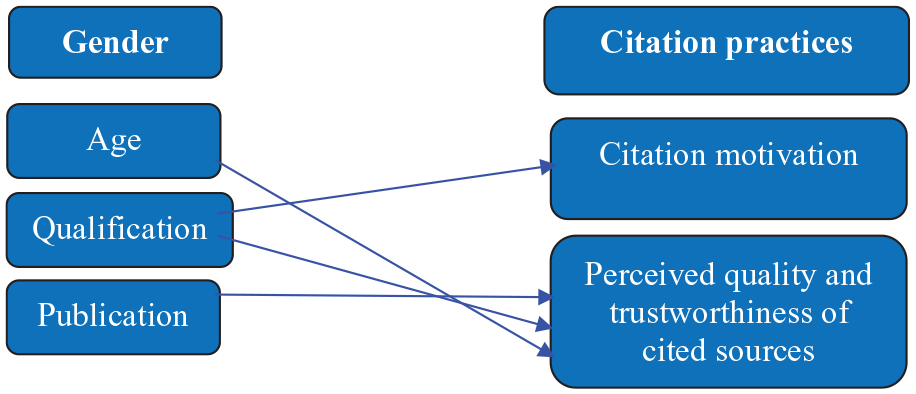
Direction of factors affecting citation behavior of LIS novice researchers.
Young researchers were found to be more careful regarding the quality and trustworthiness of cited sources as compared to other age groups. Qualification affected significantly citation motivation, the quality, and trustworthiness of cited sources. Citation motivation was high whose degrees MPhil or PhD were in progress. One possible reason is that they are currently going through the process of academic writing such as completion of their assignments, thesis, and research articles. MPhil degree holder researchers were more careful about the quality and trustworthiness of cited sources as compared to PhD degree holders. There was also a significant relationship between the number of publications, perceived quality, and trustworthiness of cited sources. The researchers who had no publication or fewer publications were more careful than those who had more publications. One possible reason for the more careful attitude of researchers who published less as they were not conversant with the sources. Consequently, they were found to be keener about the quality and trustworthiness of cited sources as compared to those who have published more. A finding of an earlier study (Ameen, 2017) confirms the results that identified significant differences based on publications regarding the quality, and trustworthiness of outlets. A previous study revealed a weak correlation between gender, age of the author, and the number of citations (Tahamtan et al., 2016). It indicated that people did not consider the age, and gender of the author while citing the sources. Recent research revealed that there were no significant differences in citation behavior of faculty members based on gender which confirms the findings of the current study (Singson et al., 2020).
Conclusion
The current study establishes that there is no difference in the citation behavior of male and female LIS researchers in Pakistan. Age, gender, qualification, the number of publications significantly affected the perceived quality, and trustworthiness of cited sources. However, only qualification affected the citation motivation of novice researchers. These novice LIS researchers were motivated to cite open access, and impact factor journals. They preferred to cite the most recent sources, articles written by reputable authors, and highly cited sources.
Findings represented the citation behavior of novice LIS researchers from one of the leading, and highly productive universities in Pakistan. The study should be expanded to the research students/graduates of other LIS schools in Pakistan. There is also a need to address the differences in citation behavior among researchers from various disciplines. To avoid inaccuracies, incompleteness of citations, standardized citation management tools (Medley, EndNote, Zotero) should be followed. Moreover, to develop a strong library collection, preference should be given to core cited information sources that meet the researchers’ scholarly needs. The findings will help in the assessment of the citation behavior of the researchers. The statistical data helps assess the quality, and quantity of research. Suggestions for further study include librarians’ need to organize more information literacy, and orientation sessions to make researchers more aware of information sources available in digital, and print format.
Limitations of the study
Data was collected from the research students/graduates of one school which was purposively selected due to its research outcomes in terms of quality, and quantity. However, these findings may not be generalized to other LIS schools in the country. Moreover, these findings are not related to established senior researchers of the field as the population consisted of those who have been studying or completed their research degrees (2008–2020) from the Institute of Information Management, University of the Punjab, Lahore-Pakistan.
Footnotes
Declaration of conflicting interests
The author(s) declared no potential conflicts of interest with respect to the research, authorship, and/or publication of this article.
Funding
The author(s) received no financial support for the research, authorship, and/or publication of this article.
