



Abstract
This study aimed to examine the publication trends of Scimago Journal & Country Rank (SJR)-indexed library and information science (LIS) journals by examining publication share growth by country and region. For this study, we used LIS journals indexed in the SJR in 2000, 2010, and 2020. The results showed that the most frequent publishers of SJR-indexed LIS journals are large commercial publishers. The top three publishers since 2000 were Taylor & Francis, Emerald, and Springer Nature, despite their publication share among SJR-indexed journals declining since this period. The top three countries in journal publishing were the United States, the United Kingdom, and the Netherlands. As the large commercial publishers have established themselves in these countries, the publication shares of these countries have also declined slightly because of the slowing growth rate of their publishers. Similarly, publication shares in both Northern America and Western Europe have declined slightly since 2000. However, the large commercial publishers, based mainly in the United Kingdom and the United States, are likely to take the lead in publishing SJR-indexed international LIS journals over the next decade. The results suggest that publishers from non-Western countries will need to publish significantly more international LIS journals indexed in the major databases to achieve a significant publication share. In conclusion, more innovative ways to support journals published in non-Western countries are needed in order to meet the essential selection criteria of the Scopus and Web of Science journal indexes.
Introduction
Journals play a crucial role in the dissemination of scientific knowledge. Globalization and the commercialization of journals continue to change the landscape of journal publishing. It is well known that large commercial publishers such as Elsevier have led the journal publishing market (Kim and Park, 2020). Most multinational commercial publishers conduct their businesses in developed countries and have a long history of publishing scholarly journals (Jaspers, 2014). In general, there is a great disparity in research production between Western and non-Western countries (Tennant, 2020; Vera-Baceta et al., 2019). A vast number of authors in developing countries also publish their research in reputable international journals, but these international journals are mostly published in Western countries (Oh et al., 2019).
In recent years, non-Western countries have made various efforts to increase their research output and improve their international standing in academic publishing (Vuong, 2019). Many countries around the world have sought to increase their research output by publishing journals domestically (Chan and Costa, 2005), and it has been shown that researchers generally tend to submit manuscripts to international journals published in their own country or region (Kim et al., 2021). In addition, editors and reviewers are likely to be particularly interested in topics addressing national or regional issues.
However, local journals need to be indexed in the Scopus and Web of Science databases to increase visibility and attract new manuscript submissions (Pulišelić and Petrak, 2006). These databases are considered authoritative sources for the academic community across disciplines (Tennant, 2020). The Scimago Journal & Country Rank (SJR, n.d.) includes journals indexed by Scopus thus adequately covering important journals in most research areas. Web of Science also provides several indexes: these include the Science Citation Index (SCI), the Social Sciences Citation Index (SSCI), the Arts and Humanities Citation Index (AHCI), and the Emerging Sources Citation Index (E-SCI). Journals included in SJR are not distinguished by these categories of Web of Science indexes, but they do include most of the journals indexed by Web of Science. Since the SJR represents the current ranking of international journals, including library and information science (LIS) journals, it not only influences journals’ success but also reflects the national and regional standing in terms of academic publishing. Although journals indexed in Scopus and Web of Science do not represent the entirety of academic knowledge available worldwide (Tennant, 2020), international journals and publishers have no alternative but to pay more attention to SJR rankings in order to increase visibility.
Previous research on LIS journal publications generally focused on the following topics: open access LIS journals (Hodonu-Wusu and Lazarus, 2018; Pujar, 2014), productivity and citations (Davarpanah and Aslekia, 2008; Liao and Chen, 2018), evaluation and ranking (Manzari, 2013; Murugan and Ravi, 2016), and topics and subject areas (Figuerola et al., 2017; Jarvelin and Vakkari, 2021). These studies used bibliographic records of journal articles or survey methods for their research. Murugan and Ravi (2016) used the SJR to identify the top 50 LIS journals, but their study did not investigate publication trends in LIS. While these studies provide valuable information on the characteristics of LIS journals, there is a dearth of studies attempting to evaluate the international standing of journals and publishers from non-Western countries and to identify potential contributing factors to underrepresentation. Comparing non-Western with Western LIS journals and publishers in terms of visibility as reflected by SJR inclusion is one possible way of gauging their international standing.
Furthermore, since scholarly communication is a core area of LIS (Hsiao and Chen, 2020), and journals are an essential element of scholarly communication and science research (Ware and Mabe, 2015), it is worthwhile to empirically examine the evolving international landscape of LIS with regard to publishers and journals, especially their inclusion in reputable indicators such as the SJR. An examination of trends in the publishing of international journals included in the SJR in relation to publishers’ countries and geographical regions allows us to identify major publishers and their role in the production of international scholarly journals listed in the major indexes. In recent decades, the number of journals indexed in Scopus has grown exponentially (Thelwall and Sud, 2022). Larivière et al. (2015) found that Elsevier, Wiley-Blackwell, Springer, and Taylor & Francis were able to increase their share of published output since the 1990s. Despite the prevalence of large commercial publishers in academic journal publishing, little is known about the publishers’ share of international LIS journals, particularly in recent years, and the potentially changing landscape of the LIS publishing environment. Hence, we aimed to use SJR data from the past two decades in order to analyze the growth and publication shares of different countries and regions in terms of publishers and journals included in the SJR.
Methods
In this study, we examined SJR indexed journals listed under the category of LIS. However, this category is extremely broad, as journals often overlap between disciplines, possibly for marketing reasons. Despite this limitation, the list of journals indexed in the SJR provides an overview of reputable international LIS journals. The total number of journals in the SJR has steadily increased over the last two decades (Pandita and Singh, 2019). We used SJR data from 2000, 2010, and 2020 to obtain an overview of developments in the past two decades. A total of 230 journals were listed under the LIS category in the SJR. To conduct this study, various journal information, such as h-index, number of published documents, and publishing country, was downloaded from the SJR.
However, not all data were available from the SJR. Some details about publishers were gathered from journal homepages and Wikipedia pages about them. This data included the size of the publisher, total number of published journals, type of organization, year of establishment, and location. Multiple sources were used to ensure the accuracy of information. When publisher information was not updated, or there was doubt about its accuracy, additional internet searches were conducted to ensure accuracy. The downloaded data were processed and analyzed using awk (Aho et al., 1979), which is a Unix scripting language, and Microsoft Excel.
The Growth of Publishers, Journals, and Articles
There are several elements relevant to the analysis of LIS journal publications. These include publishers, journals, and articles. In order to compare the growth rates of these elements over the past two decades, we measured the growth rate using the following formula:

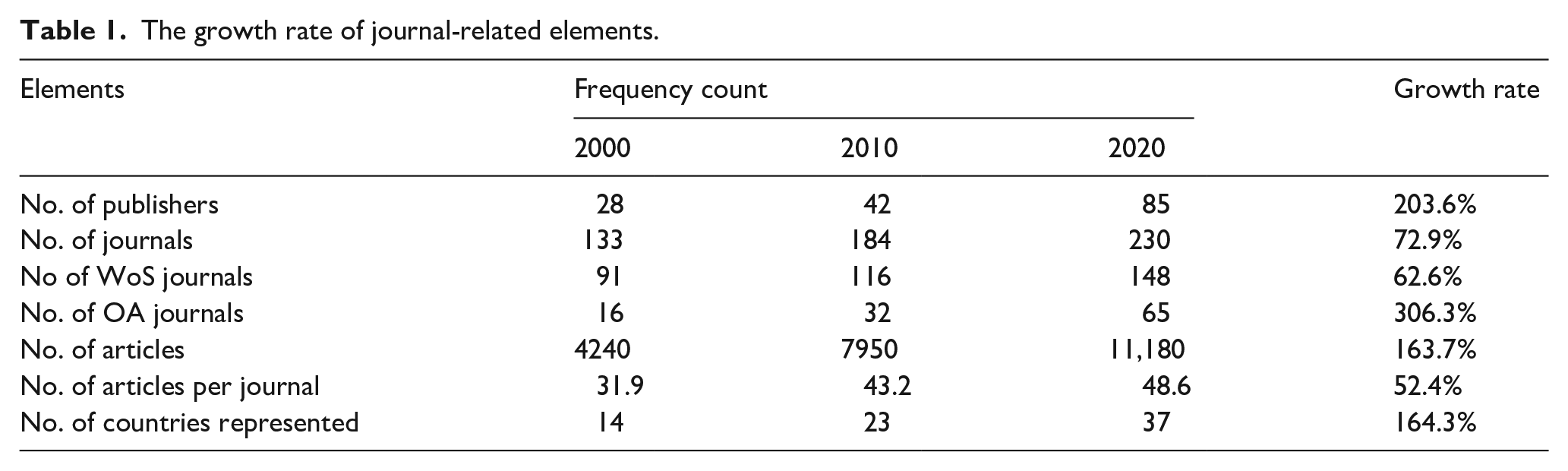
The value E represents the final year (2020), and B the beginning year (2000). As shown in Table 1, there has been considerable growth in all journal-related elements from 2000 to 2020. The number of journal publishers has grown by 203.6%, which was much greater than the growth rate of journals (72.9%). This indicates a higher diversity of publishers included in the SJR in 2020 than in 2000. Compared to other indicators, the growth of open access (OA) journals was the highest (306.3%), while the growth rate of the number of articles per journal was the lowest (52.4%). The number of articles grew much faster (163.7%) than the number of journals (72.9%) over the last two decades. Each journal published more articles in 2020 than in previous decades, as the number of articles published per journal increased by 52.4%. The number of countries was 14 in 2000 and 37 in 2020, a growth rate of 164.3%. However, a significant number of countries worldwide were not represented because their publishers did not produce any LIS journals indexed in the SJR.
The growth rate of journal-related elements.
Top publishers of LIS journals
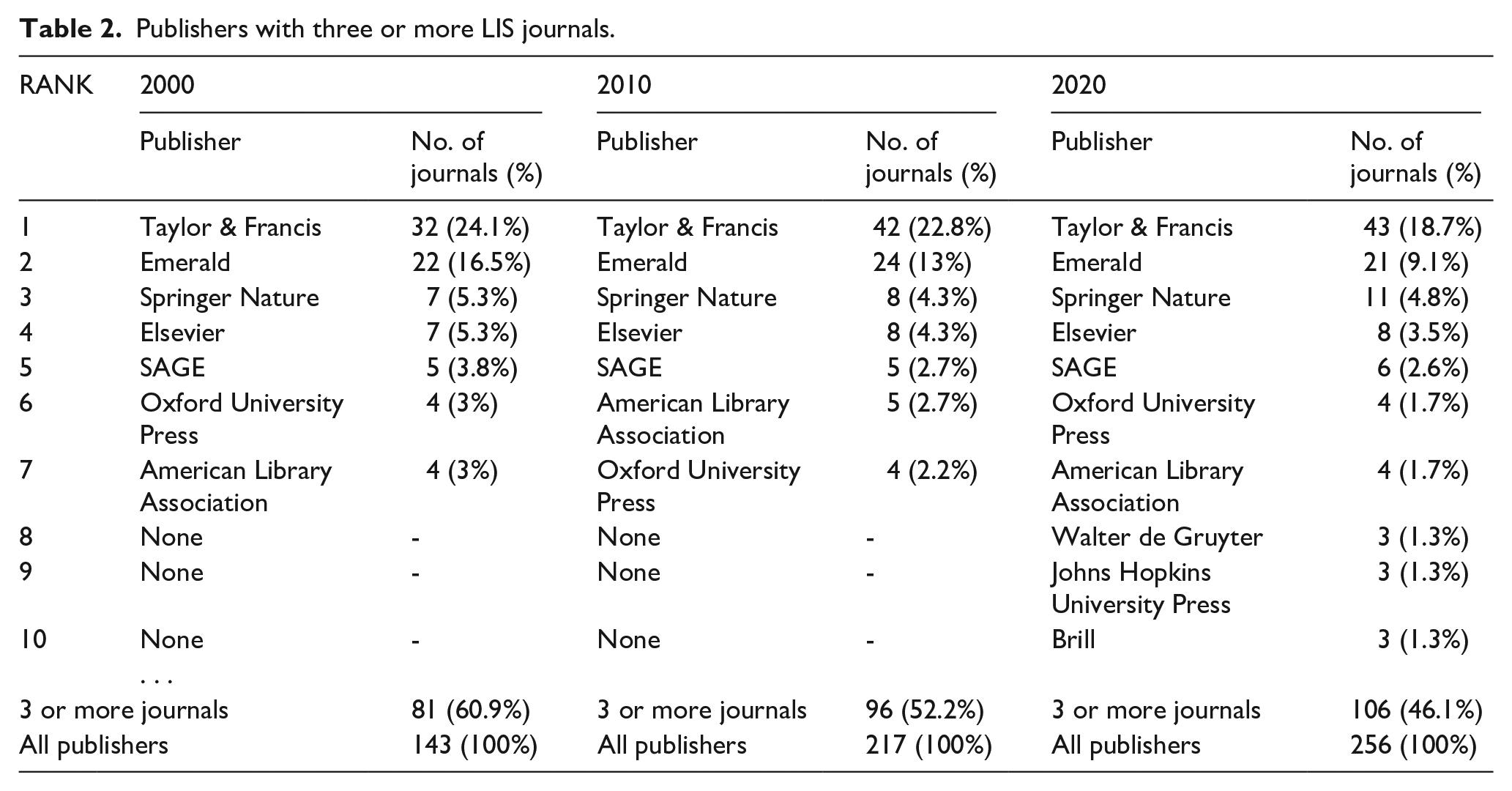
To investigate the characteristics of LIS journal publishers included in the SJR, we identified the top publishers that published three or more journals, as shown in Table 2. The top three LIS publishers since 2000 are Taylor & Francis, Emerald, and Springer Nature. To identify these top publishers, the names of publishers were normalized to their parent organization names after obtaining the parent organization information from the Scopus index. For example, “Routledge” was normalized to “Taylor & Francis” and “SAGE Publications Inc.” to “SAGE.” The percentages in parentheses indicate the publication shares of top publishers. Although the number of journals published by the top publishers has increased, their publication share has actually declined. For example, the number of journals published by Taylor & Francis was at its highest in 2020 (43 journals, 18.7%). However, its publication share has declined since 2000 (24.1%). In 2000, 60.9% of SJR-indexed journals were from those of publishers with three or more journals. In 2020, however, only 46.1% of journals were published by publishers with three or more journals. This means that the overall publication share of publishers with three or more journals has declined by approximately 14%. Thus, there are currently more LIS publishers included in the SJR than in the previous two decades.
Publishers with three or more LIS journals.
The characteristics of the top 10 publishers of LIS journals over the last two decades are presented in Table 3, including all publishers listed in Table 2. The ranks of these publishers range from 1 to 17 in the 2020 SJR index, indicating changes in their ranks over the past two decades. As shown, the publishers’ establishment years range from 1586 (Oxford University) to 1967 (Emerald), indicating that most publishers of multiple LIS journals have long histories of publishing. The table also shows that most of the top LIS journal publishers are commercial enterprises.
Characteristics of publishers with three or more journals in 2020.
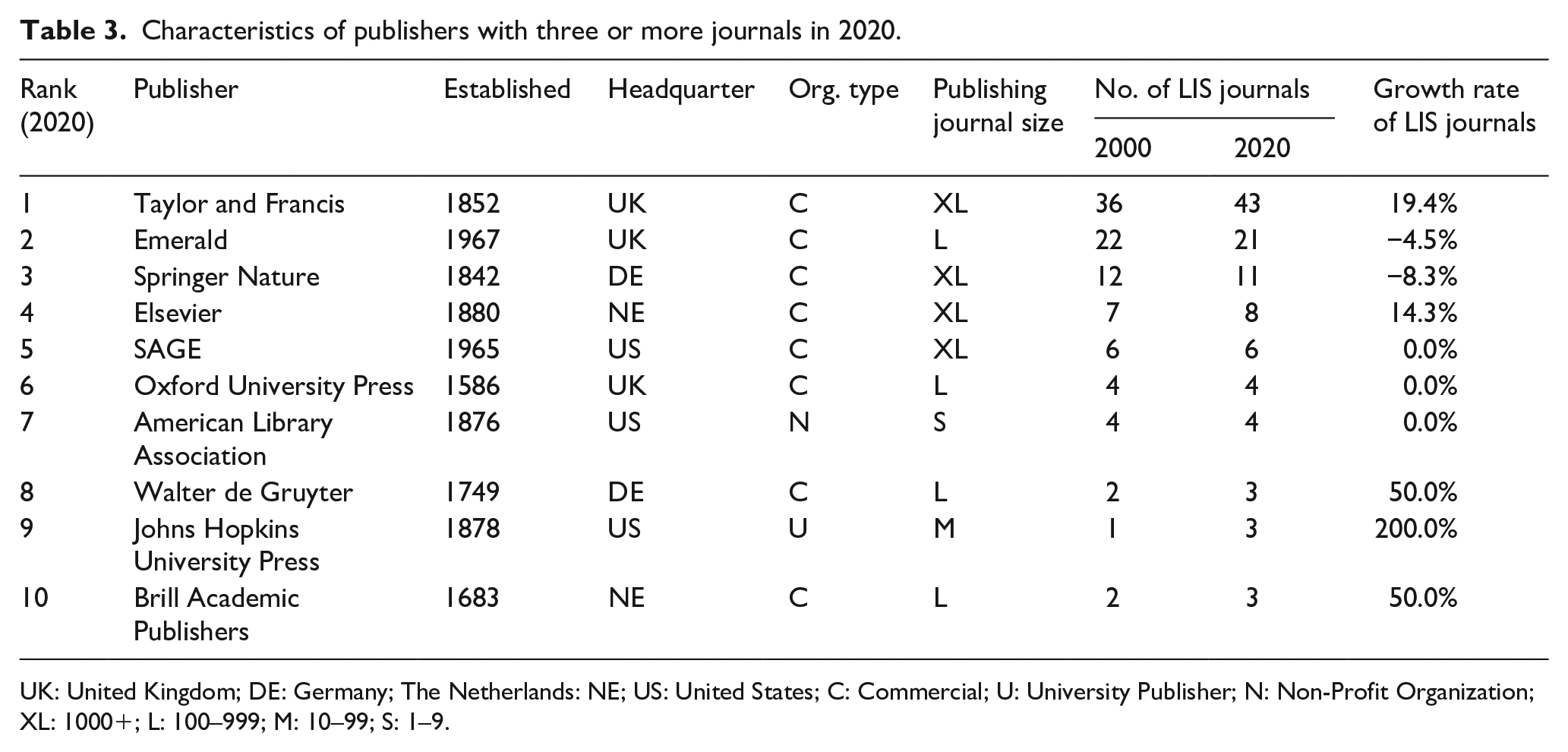
UK: United Kingdom; DE: Germany; The Netherlands: NE; US: United States; C: Commercial; U: University Publisher; N: Non-Profit Organization; XL: 1000+; L: 100–999; M: 10–99; S: 1–9.
The frequency of publication can serve as a rough indicator of a publisher’s size. Based on the total number of published journals, the size of publishers was divided into four categories: small (1–9 journals), medium (10–99 journals), large (100–999 journals), and extremely large (1000 + journals). As shown, nearly half of the publishers listed in the table are extremely large publishers. Except for Emerald, all the other top five publishers (Taylor & Francis, Springer Nature, Elsevier, and Sage) are extremely large publishers, publishing more than 1000 scientific journals in all fields. All of these publishers are based in Western Europe or Northern America, namely the United Kingdom, Germany, the Netherlands, and the United States. Although most publishers publish more journals than they did two decades ago, the growth rate of LIS journals varies widely among the leading publishers. Taylor & Francis added seven journals since 2000, which is the largest LIS journal increase among the top publishers. In terms of growth, Johns Hopkins University Press had the highest growth rate (200%). Only two publishers—Emerald and Springer Nature—had a negative growth rate, as their number of published LIS journals decreased by one since 2000.
Growth and publication shares of countries
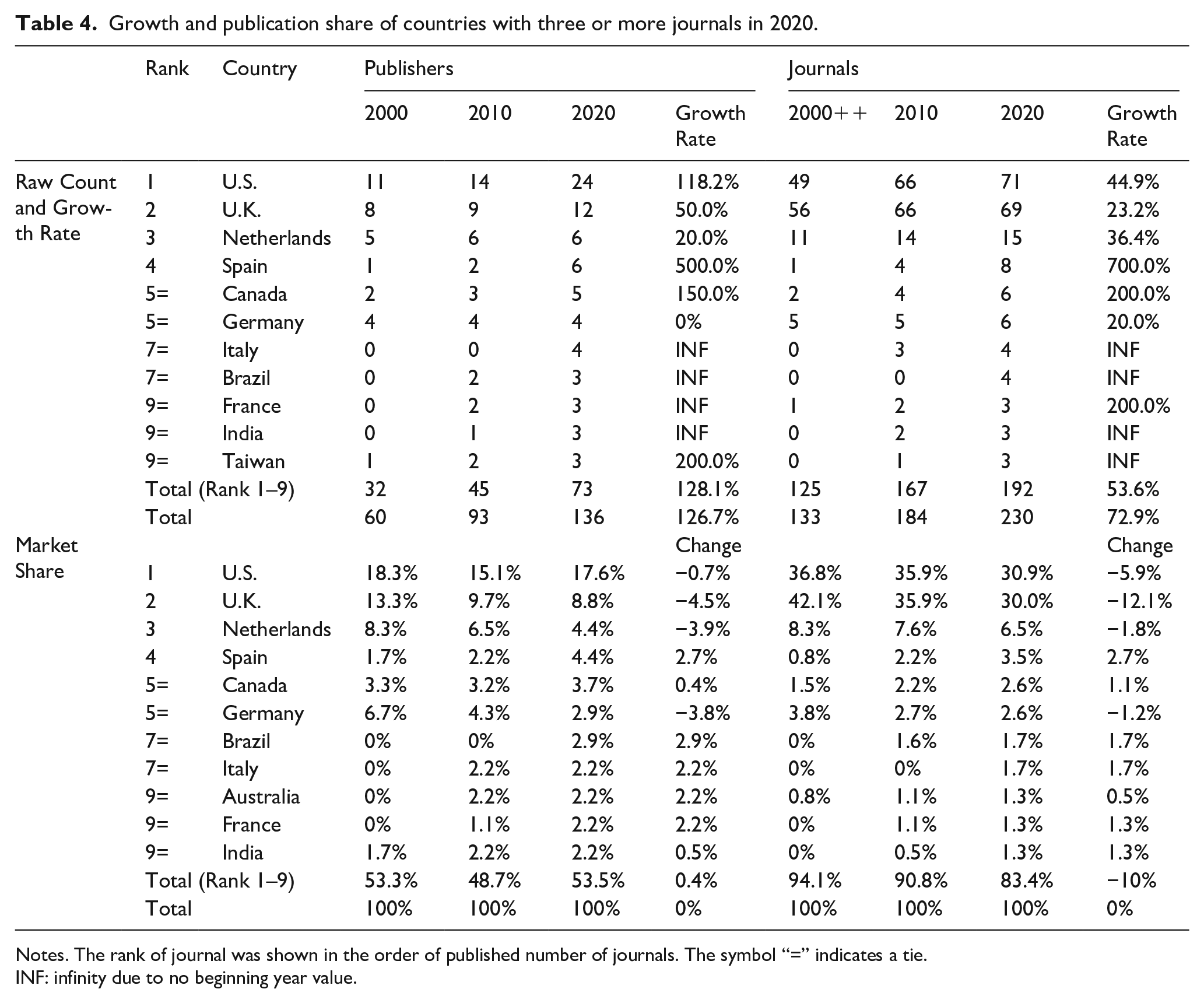
In 2020, publishers from 12 countries published at least three journals included in the SJR. Table 4 shows the details of the growth rate and publication shares of top countries in the SJR. The top four countries in terms of number of publishers and journals are the United States, the United Kingdom, the Netherlands, and Spain, which is consistent with the countries shown in Murugan and Ravi (2016). Among the top countries, Spain had the highest growth rate in terms of publishers (500%) and journals (700%) included in the SJR. Although Spain lagged behind the Netherlands in the number of SJR-indexed journals published in 2020, it has reached the same number of publishers and would be ranked third if only 2020 were considered.
Growth and publication share of countries with three or more journals in 2020.
Notes. The rank of journal was shown in the order of published number of journals. The symbol “=” indicates a tie.
INF: infinity due to no beginning year value.
We had expected the United States and the United Kingdom to be well ahead of other countries in the publication shares of SJR-indexed journals and publishers. However, their publication shares have declined slightly since 2000. As shown, the United States (−0.7%), the United Kingdom (−4.5%), the Netherlands (−3.9%), and Germany (−3.8%) have all lost publication share in terms of number of publishers, while the remaining countries have slightly increased their publication share. The four countries also showed declining publication shares in terms of number of journals. The decline of United Kingdom-based journals was the greatest (−12.1%), followed by that of the United States (−5.9%). The publication shares of the remaining countries increased slightly.
Growth and publication shares of regions
Table 5 shows the growth rate and publication shares of SJR-indexed journals by region. Because of the United Kingdom and the United States, Western Europe and Northern America were the leading regions in producing SJR-indexed journals. Western Europe had the highest publication share in 2020, exceeding Northern America, whose publication share was larger when measured by the number of publishers than by the number of journals. However, as shown, the Western European publication share in terms of publishers slightly declined from 2000 to 2020 (−8%). In terms of publishers, the publication share of Northern America has declined the most (−11.1%). Although the number of journals published in Western Europe and Northern America has increased since 2000, their combined publication share fell from approximately 81% to 61%. In contrast, the publication shares of all other regions in terms of publishers have increased. The Asian region experienced the largest increase in publication share (10.5%) when measured by the number of publishers, and the publication share of Eastern Europe grew the most when measured in terms of journals (5.2%). The number of SJR-indexed LIS journals published in Africa remains negligible, with only one such journal published in the last decade (0.4%).
Growth rate and publication shares of regions.
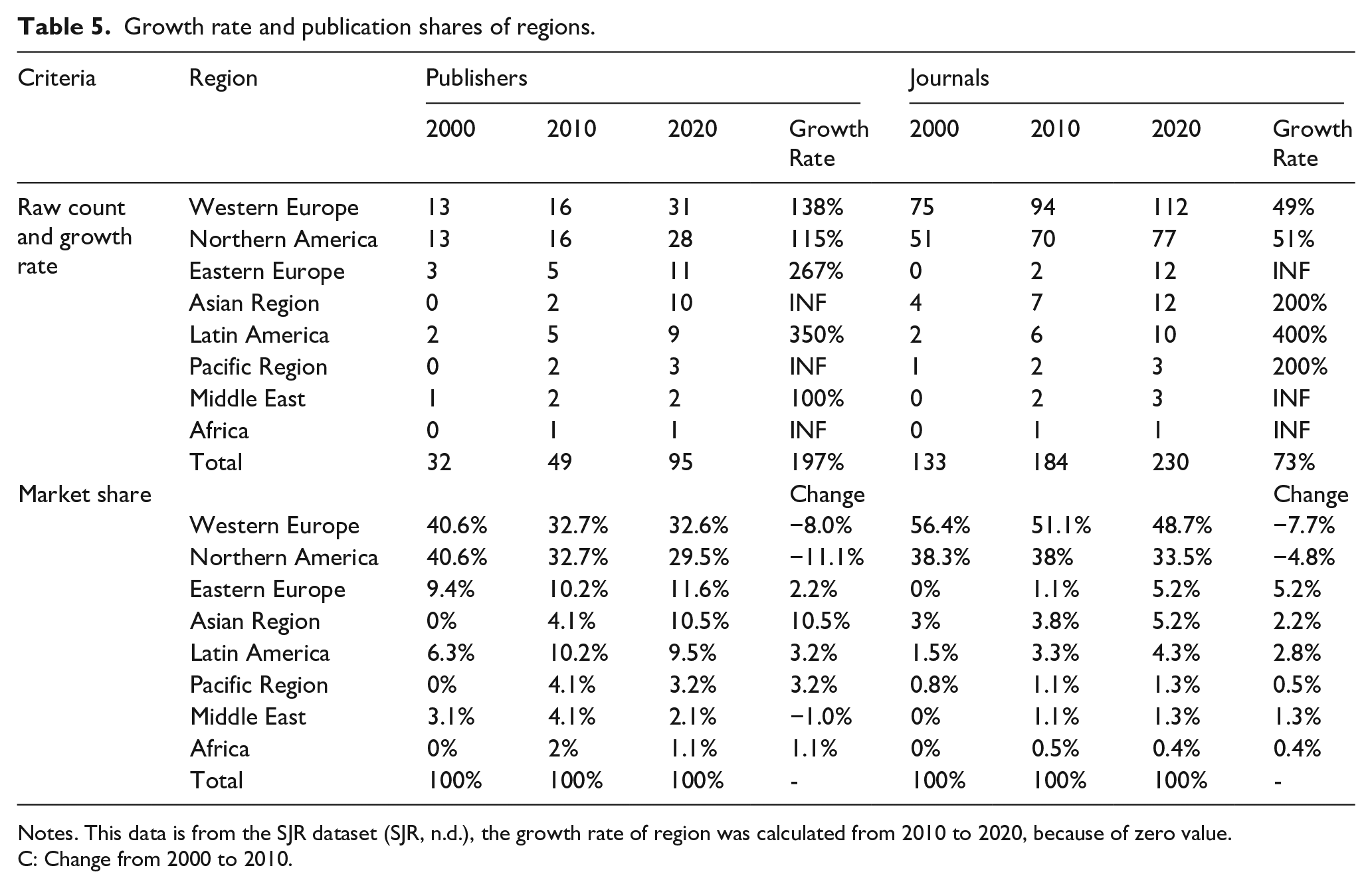
Notes. This data is from the SJR dataset (SJR, n.d.), the growth rate of region was calculated from 2010 to 2020, because of zero value.
C: Change from 2000 to 2010.
The change in publishers’ publication share can be compared to the change in journals’ publication share on a region-by-region basis. Regional increases in publication share that are larger for publishers than for journals would indicate an increase in diversity of publishers. On the other hand, a relatively larger increase in regional publication share for journals than for publishers would indicate that the number of journals published by the specified publishers has increased on average. In the case of the Asian region, the growth in publication share was greater for both publishers and journals (10.5% vs 2.2%), indicating an increase in the diversity of publishers relative to the journals they publish. In the case of Northern America, the result was the opposite. The region’s publishers are publishing more journals than before, as this region’s publication share declined more for publishers (−11.1%) than for journals (−4.8%), indicating a decrease in the diversity of publishers relative to the journals they publish.
Discussion and conclusion
The general trend in the past two decades showed increases in numbers of LIS journals, publishers, countries of publishers, and articles indexed in the SJR, with a consistent prevalence of large commercial publishers. The empirical results overall reflected the structure of the publishing industry in various regions of the world, and the details on the international publishing of SJR-indexed LIS journals and publishers are as follows.
First, as expected, the number of SJR-indexed OA journals has grown sharply in LIS. In 2009, Coonin and Younce (2009) concluded that OA journals might take a while to gain full acceptance in non-scientific disciplines. Since LIS is a non-scientific field, OA megajournal publishers, such as PLOS and MDPI, did not play a major role in publishing LIS journals. However, the results suggest that meaningful progress has been made in the last decade, with approximately 28% of LIS journals indexed in SJR being OA by 2020. With a current growth rate of 300%, OA journals are likely to continue to grow in the coming decade.
Second, the publication shares of countries where SJR-indexed publishers suggest that scholarly journal publishing has not yet been commercialized in developing countries. In particular, China was not included in the top 10 countries with the highest number of SJR-indexed publishers and journals, although a relatively high number of journal articles in international LIS journals are published by Chinese authors (Hodonu-Wusu and Lazarus, 2018). Further, African countries have not made meaningful progress in the last two decades, with only one African journal having been indexed in the SJR in 2020. We anticipated these general trends before analyzing the data, as the SJR offers several ways to search for and rank journals, including searching by country or region. Nonetheless, in developing countries, journals may be produced by independent research institutes rather than by large publishers.
Third, although the top three countries—the United States, the United Kingdom, and the Netherlands—remained the leading countries in terms of the number of SJR-indexed LIS publishers and journals, their publication shares relative to other countries represented in the SJR have declined slightly, with a slower growth rate. In terms of regions, the publication shares of Western Europe and Northern America fell considerably because of the decelerated growth rate of the SJR-indexed LIS journals produced by publishers in these regions. Similarly, the overall publication share of the top publishers of at least three SJR-indexed journals has declined by approximately 20%, which was somewhat unexpected.
Considering that the largest publishers are located in Northern America and Western Europe, the question arises as to the main causes for the declining publication shares of these regions’ SJR-indexed LIS journals. The expansion of journal coverage initiated by Scopus and Web of Science seems to be largely responsible for this change. With the introduction of the ESCI, the Web of Science has expanded its indexing in recent years (Somoza-Fernández et al., 2018). Similarly, Scopus has also increased its coverage over the years (Singh et al., 2021). All of this has led to an increase in the number of international LIS journals, publishers, and countries publishing LIS journals. Since SJR represents journals indexed in Scopus, the publication shares of countries and publishers largely depend on the coverage strategies of these major databases. If the coverage of Scopus expands further, countries other than the top three to four top countries in the SJR could have a better opportunity of increasing their publication shares both in terms of number of publishers and journals.
There are other possible factors contributing to the declining publication shares of Northern America and Western Europe in publishing SJR-indexed LIS journals. Many developing countries have adopted the OA model and internationalized their national journals over the past two decades (Gamba et al., 2015; Rhee, 2019). Some countries have succeeded in increasing their publication share of international LIS journals covered by SJR through this strategy. For example, countries such as Brazil, Taiwan, and India have a large share of OA LIS journals (Barik and Jena, 2019). The Asian region gained publication share more in terms of publishers than in terms of journals. This reflects the diversity of publishers of SJR-indexed journals in this region.
Lastly, this study’s results suggest that there is still an excessive disparity between the leading countries and the rest of the world in publishing SJR-indexed journals. Although many countries around the world gained publication share, the publication shares of the United States and the United Kingdom declined slightly. However, most countries in the world have not been able to close the large gap with these two leading countries because these countries host large commercial publishers. Significantly more publishers from non-Western countries need to have their journals indexed in the Scopus database in order to achieve a notable international journal publication share in the future.
Even though many countries other than the top three were able to gain publication share in LIS, journal publishers in developing countries face various challenges in publishing journals that could meet SJR inclusion criteria. Today, journal publishers are expected to use various technologies such as PDF production and printing as well as XML production (Huh, 2019). Large commercial publishers have extensive resources and considerable publishing expertise to deal with evolving platforms and the use of associated technologies. Advanced submission and publishing systems can attract a wide range of international submissions, but journal publishers in developing countries often face challenges in this regard (Vuong, 2019). In addition, the English proficiency requirement has become a problem for journals in non-English speaking countries (Huang and Miao, 2021; Teixeira da Silva, 2021). For these reasons, it is difficult for undercapitalized, lesser-known publishers in developing countries to compete with large commercial publishers (Demeter, 2019).
In sum, the reasons why non-Western countries lag behind Western countries in publishing SJR-indexed international LIS journals could be the following: (a) journal selection policies and indexing criteria of Scopus and Web of Science and Web of Science (Aksnes and Sivertsen, 2019; Tennant, 2020), which inadvertently favor large commercial publishers because of their superior resources; (b) the fact that large publishers that have always operated in Western countries are less willing to enter the consumer market in non-Western countries; (c) lack of economic and human resources, infrastructure, and experience in publishing reputable international journals; and (d) difficulties in publishing journals in English, which denies them access to the largest consumer market.
To internationalize local journals, some emerging countries have funded their local journals (Meneghini, 2012). However, improving a journal’s status requires several years of continuous effort. Only if a journal publishes valuable articles continuously over many years can it achieve a reasonable level of international visibility and receive citations. Although the use of citations for journal evaluation is a controversial topic (Pajić, 2015), it is a frequently used criterion for journal evaluation and is often included in various metrics such as the h-index (Hodge and Lacasse, 2011). Since journal visibility increases citations, working with commercial publishers has been suggested to increase the visibility of local journals in emerging markets (Asai, 2021; Huh, 2019). However, Asai (2021) also cautioned that it is necessary to monitor the interactions of small and large publishers, particularly in cases of acquisitions of small publishers by large publishers.
In conclusion, mitigating the previously mentioned problems in underrepresented non-Western countries and regions would help their publishers gain larger a publication share of SJR-indexed journals. Future studies and policymakers should therefore explore more equitable collaboration between smaller publishers in non-Western countries and large publishers based in Western countries. In addition, more innovative ways to support journals published in non-Western countries are needed in order to meet the essential selection criteria of the Scopus and Web of Science journal indexes. Including journal publications from more diverse countries in the major databases would allow researchers to access papers with a wider range of topics and foster diverse perspectives, ultimately improving scholarly knowledge in LIS.
Footnotes
Declaration of conflicting interests
The author declared no potential conflicts of interest with respect to the research, authorship, and/or publication of this article.
Funding
The author received no financial support for the research, authorship, and/or publication of this article.
