



Abstract
This paper discusses the present state of the art and forthcoming directions of digital library adoption (DLA) research over the past 30 years. By means of scientometric analysis, we synthesize 216 articles and conference papers published between 1992 and 2022 using visualization maps of prolific contributions, co-citation, co-occurrence, and thematic networks. The analysis reveals important findings concerning research evolution, models and theories, intellectual foundations, emerging streams, frontiers, and hotspots that inform DLA decisions. Moreover, the paper highlights future DLA research opportunities through addressing scarcely observed areas in the field. To the best of our knowledge, this is the first attempt that comprehensively oversees the breadth and depth of the DLA research over a long-time span.
Keywords
Introduction
Certainly, the emergence of digital technology has reshaped our social and working lives through increasing connectivity, accessibility and inclusion. Digital library (DL) is believed one of the hallmarks identifying the digital age and has been driven by innovation development and a societal necessity. For instance, the global Covid-19 pandemic forces new developments in DL to be put into action offering a golden opportunity for DL to flourish and innovate during unprecedented times to a point of no return (Begum and Elahi, 2022). Today, DL has transformed the way documents, professionals and users are described. From the accessibility view, DL can be defined as an online database of a blend of media formats (e.g. texts, videos, audios, images, etc.) that are digitally stored, organized, accessed, searched, retrieved, and transferred from a remote distance (Haq et al., 2022). Functionally, DL networks library operations, preserves knowledge collections and ownership, advances user services, avails library facilities, and manages institutional repositories and archives (Ikenwe and Udem, 2023; Khan and Shahzad, 2022). Technology adoption reflects the initial use or acceptance of new technology to explain and predict factors that affect the adoption behavior guided by a specific model or theory (Xu and Du, 2022). Digital library adoption (DLA) is a significant stream that has attracted a vast number of scholars from various areas (e.g. library, information system, computer science, business, etc.) which have augmented the field with diverse expert knowledge and helped advance theoretical and practical directions of library research (Alzahrani et al., 2019). We assume that an examination of the extant status and foundational structure of the DLA since the early nineties will yield valuable knowledge for vendors and managers to guide adoption decisions and provide significant opportunities for upcoming research efforts. Moreover, various models, theories and frameworks have supported the underpinnings of DLA shaping its triggers, outcomes, and processes in various settings (e.g. Rafique et al., 2020). Although there are relatively few studies have been published earlier to review DL research (e.g. Singh et al., 2007), to our knowledge, there has been no review of the extant DLA research capturing the intellectual structure, relevant models and frameworks, and emergent trends in the field given the multifarious nature of the topic. Even limited reviews that focused on the general stream of digital library research appeared to lack in-depth coverage and relevant implications. For instance, Singh et al. (2007) reviewed authorship, language, year, country, article and journal distribution, and indexing of DL literature between 1998 and 2004. The main findings indicated that most articles were single-authored, in English, and nearly distributed according to Bradford’s Law. Another study by Ahmad et al. (2018) reviewed DL research between 2002 and 2016. Their major findings pointed out that the year 2016 is the most productive year, the USA leads the DL research output, and Ina Fourie of the University of Pretoria is the most prolific author. While these studies accentuate a mounting interest in DL research, they did not cover the multifaceted aspects of the adoption stream in DL research, overlooked the breadth and depth of the review over a long-time span, and overlooked models, theories or frameworks employed. The urgent need for this review also coincides with the recent developments in DL research where new themes and trends have emerged (Li et al., 2019; Samarasekara et al., 2023). To wrap up this gap, our study makes a twofold contribution. First, we present the first comprehensive review so far of DLA research over the course of 30 years. Analyzing and synthesizing key DLA research strands show the evolution of the topic, influential authors, leading countries and institutions, dominant themes and intellectual clusters, keywords, research hotspots, and research frontiers which can be of great value for researchers and practitioners. Second, by employing the scientometric analysis approach, we are capable of capturing prominent concerns in DLA research and developing essential research questions that offer indispensable prospects for future venues to enrich the body of research and help guide its path. Hence, the seven main questions of this review are outlined as follows:
RQ1. What is the progress of DLA research performance?
RQ2. Who are the influential authors in DLA research?
RQ3. Which countries and funding institutions are significantly contributing to DLA?
RQ4. What are the influential papers, and contributing DLA theories and models?
RQ5. What are the intellectual foundations of DLA research?
RQ6. Which hotspots, research frontiers, and knowledge themes are guiding DLA research?
RQ7. What are the implications for future research in DLA?
While addressing these questions, the paper progresses as follows: The review method is discussed in the following section, while the findings and discussion in Section 3 are structured around answering the research questions. Then, conclusions and implications for future DLA research are advanced in Section 4, followed by research limitations in Section 5.
Methodology
Data collection
The data collection process follows the guidelines delineated by Aboelmaged and Mouakket (2020). First, the review is employed using the Scopus advanced database due to its broad exposure and global coverage of peer-reviewed documents and citations from various disciplines (Olmeda-Gomez and de Moya-Anegon, 2016). Second, the search query aims at capturing the maximum number of documents on DLA without restrictions by using the terms “digital library(ies),” “electronic library(ies),” “online library(ies),” “virtual library(ies)” in the “TITLE-ABS-KEY” sections. A total of 32,179 results were initially obtained. Third, the adoption terms have been added in the “TITLE-ABS-KEY” query following technology adoption reviews (e.g. Aboelmaged and Mouakket, 2020; Xu and Du, 2022) to limit the search scope to DLA. The terms include “adoption,” “intention,” “acceptance,” “willingness,” “diffusion,” and “readiness.” Accordingly, the search outcome was narrowed to 1862 results. Fourth, the documents were further funneled to exclude non-English language documents, notes, letters, reports, erratum, books, editorials, chapters, and surveys. This query returned 1461 documents that were further screened to rule out inappropriate documents, preserving 216 relevant documents for the scientometric analysis.
Data analysis and visualization
Analyzing and visualizing scientific research using graph theory has gained a significant reputation recently as an advanced scientometric analysis approach (Naveed and Anwar, 2022). CiteSpace v6.1 is employed to analyze the 216 documents and their references on DLA. The analysis employed key parameters to develop visualized knowledge maps equipped with relevant tables representing the status, intellectual foundation, emerging research frontiers and hotspots of DLA research. The parameters include a time span covering nearly 30 years (1992–2022); nodes (e.g. authors, countries, keywords, references, etc.); and visualization network selection using g-index or top 50%. In this respect, CiteSpace computes various indicators (Qi et al., 2021) including: (1) Modularity value (Q) (>0.3) to reflect the degree to which a network can be divided into distinct clusters; (2) Silhouette value (S) (>0.5) to specify the structural quality or homogeneity of clusters; and (3) Citation burst (b) to signify a significant rise in the citations within a particular time span, hereof authors or references with highest burst strength are not necessarily the same with highest citation frequency.
Findings and discussion
RQ1. What is the progress of DLA research performance?
Figure 1 presents the number of DLA documents by source from 1992 to 2022. There are some observations that can be inferred: First, the Interest in DLA has evolved over the past 30 years wherein an obvious trembling trend can be recognized. Second, most DLA research has been published in a form of journal articles (178, 82.4%); whereas conference proceedings account for only 38 documents (17.6%). Third, while there was a steady but rising trend in DLA publications over the period between 1992 and 2012 owing to journal publications and active conferences, the total number of documents declined significantly in 2013 with five documents only between 2017 and 2018. A plausible interpretation may be linked to a lack of research funds or an insufficient number of relevant journals and conferences that are indexed in prominent databases as a considerable number of papers can be found in Google scholar during these periods. Fourth, a swift upsurge in the quantity and variety of DL research was shown between 2014 and 2016 (45 documents) and between 2019 and 2022 (69 documents). This growth can be attributed to the active research output from developing countries such as China, India and Nigeria in the first wave, and the outbreak of the Covid-19 pandemic in the second wave wherein DL research has flourished in response to an ever-aggregating demand for knowledge spaces and information accessibility during the lockdown situation (Begum and Elahi, 2022; Zhou, 2022). Fifth, DLA research experienced another fall with only 13 journal articles and no conference papers as of September 2022 which may imply that DLA research has experienced a phase of maturity following Covid-19 syndrome. However, it is too early to expect that scholars’ attention to DLA may downturn constantly.
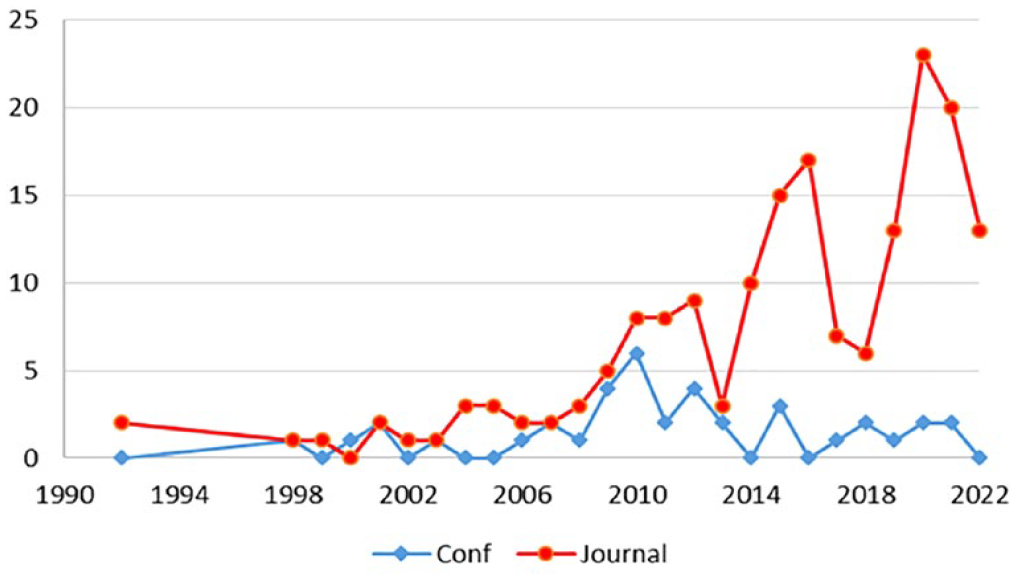
DLA research from 1992 to 2022.
RQ2. Who are the influential authors in DLA research?
DLA research is enlisted by the top (N = 50) most frequent authors as portrayed in Figure 2. Two authors are the most productive with nine papers each: Masrek, M. Noorman of Universiti Teknologi MARA Shah Alam in Malaysia and Zha, Xianjin of Wuhan University in China. This was followed by Yan, Yalan; Zhang, Jinchao; Khan, Asad; Albertson, Dan; and Ju, Boryung with seven, six, six, four, and four papers, respectively. The figure also shows that the co-authorship network has 854 links between 512 nodes with a density level of 0.0065 which infers that the collaboration among DLA authors is quite modest despite the adequate network’s silhouette (S = 0.9451) and modularity (Q = 0.9495) levels. The network also demonstrates that a wide range of scholars participated in LD adoption research rather than a dedicated few. The analysis reveals two co-authorship clusters emerged having 42 authors and covering (512/42, 8.2%) only of the total nodes. The largest cluster has a good homogenous structure (S = 0.941) that contains 25 members. It marks the interest of DLA authors in social media. The most relevant citer to the cluster is Zha et al.’s (2019) work on “comparing digital libraries with social media.” They advocated that the information quality and source credibility (reputation) of digital libraries are greater than those of social media. The second largest cluster has 17 members in a good structure quality (S = 0.951). Authors in this cluster spin around the label academic social libraries. The most relevant citer to the cluster is Theng et al. (2007) which focused on “mobile supporting collaborative learning.” The study applied the “technology acceptance model” (TAM) and “task-technology fit” (TTF) model to data collected from 39 students in a local secondary school. The findings suggested that mobile G-portal is a useful tool in digital libraries and mobile learning.
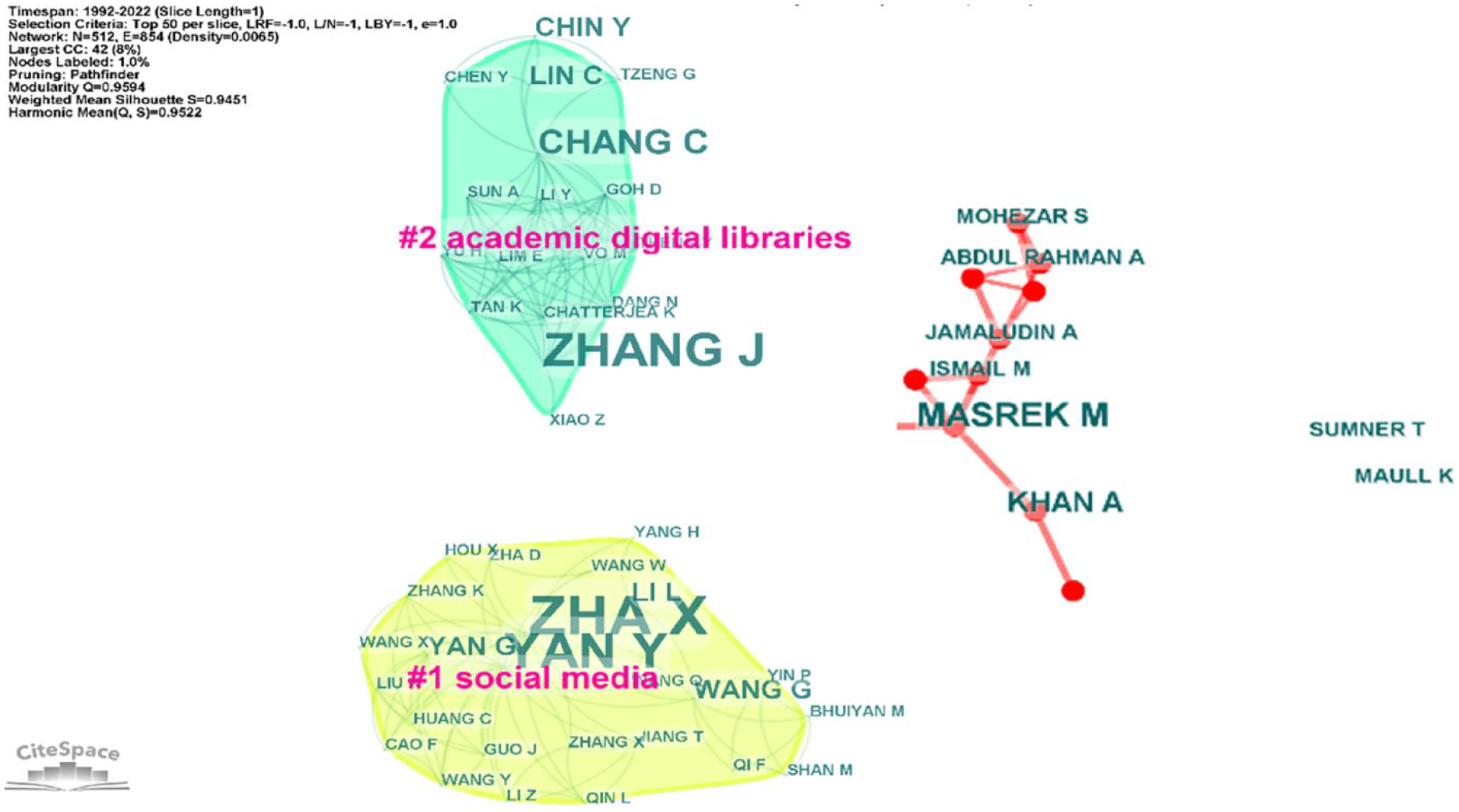
Visualization of active authors and authorship networks.
The citation burst of an author represents a sudden rise in his/her citation rate at a specific time frame which reflects notable attention from the scientific community to an author’s work. Figure 3 displays the top authors with the strongest bursts. Zha has the strongest burst (b = 2.91) between 2014 and 2017. This is followed by Zhang, Jinchao (b = 2.41) between 2014 and 2016. Both Zha and Zhang’s work shapes the DLA research with their work on e-quality, information seeking, and mobile context. The third strongest burst is Tam (b = 1.99) between 2001 and 2004. Tam’s work features determinants of user acceptance of DL in various contexts.
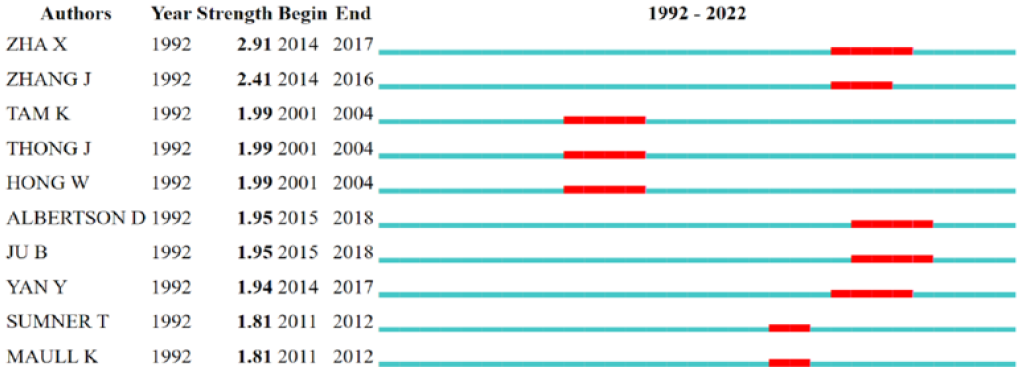
Visualization of top authors with citation bursts in DLA.
RQ3. Which countries and funding institutions are significantly contributing to DLA
Figure 4 shows that the country network in DLA research has an adequate structure given the Silhouette (S = 0.899) and the modularity (Q = 0.5105) values. A total of 49 nodes (countries) with 48 links between mark the country network where countries with greater than or equal to four papers are presented in Figure 4a. The color of node rings reflects the time of source co-citation from the past (darker color) to the present (brighter color). The USA leads with 52 papers (%24) with an average year of research (AYR) going back to 1998. China and Malaysia rank second with 29 papers and AVR in 2009 and 2004, respectively. Pakistan is the third with 19 papers and AVR in 2009 followed by the United Kingdom, Nigeria, and Australia with 12, 11, and 10 papers and AVR in 2009, 2009, and 2013, respectively. These efforts were made possible due to the active contributions of funding institutions involving the “National Natural Science Foundation” and “Fundamental Research Funds for the Central Universities” in China with nine and three papers, respectively followed by the USA institutions: “National Science Foundation” and “Defense Advanced Research Projects Agency” with six and three papers, respectively. Further funding institutions include “King Saud University” in Saudi Arabia and “Fundação para a Ciência e a Tecnologia” in Portugal with two papers each.
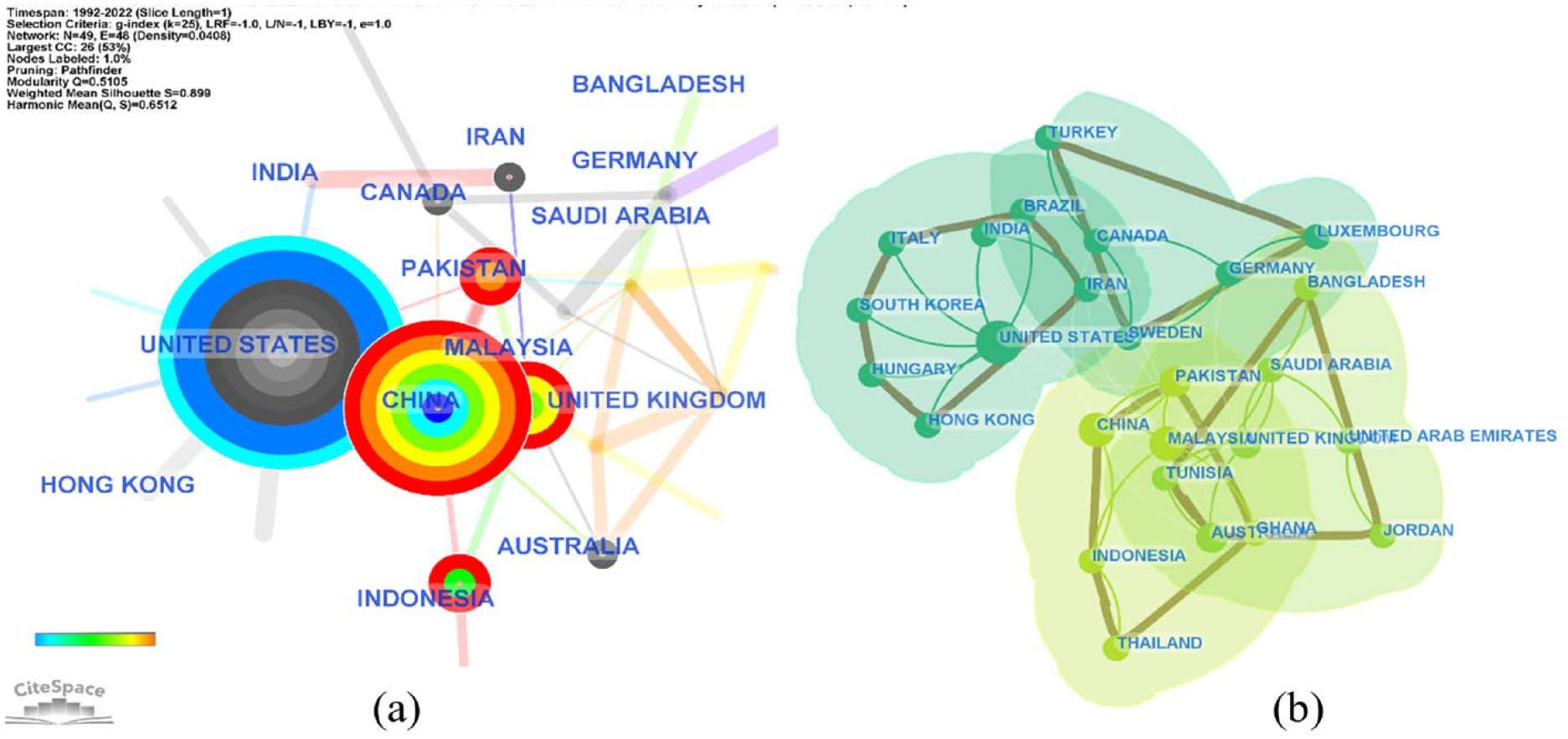
Visualization of (a) top countries and (b) their networks in DLA research.
The density level of 0.0408 infers that collaboration among countries in DLA is moderately recognized. The visualization map in Figure 4b shows four clusters wherein specific countries invest in cooperative efforts. The color of the cluster reflects its citation time from past (darker green) to present (lighter green). The largest cluster has nine countries forming a homogeneity structure (S = 0.979). The cluster is led by the USA with nine links followed by Iran and India with two links each, while South Korea, Italy, Hungary and Hong Kong have one link each. The cluster focuses on the social construction of DL as labeled by LLR whereas the most relevant citer is Kilker and Gay’s (1998) and Singh et al.’s (2016) work on social construction as a strategy for DL success. The second largest cluster has 7 countries forming a passable structural quality (S = 0.776). The cluster is guided by both the UK and Saudi Arabia with six links each, the United Arab Emirates and Australia with four links each, Tunisia with three links, and Jordan and Bangladesh with one link each. The cluster emphasizes DL acceptance in which the most relevant citer is Rafique et al.’s (2021) case study on the continuous use of DL. The third largest cluster has six countries guided by Malaysia and China with eight and seven links, respectively. This is followed by Pakistan, Indonesia, Thailand and Ghana with five, three, one, and one links, respectively. The cluster has a good homogeneity (S = 0.973) and is labeled as academic libraries. The most relevant citer to the cluster is Rahmat et al.’s (2022) paper on integrating the “technology readiness index” (TRA) into academic DL services. The final cluster contains five countries headed by Germany and Canada with four links each, followed by Sweden, Turkey and Luxembourg with three, one, and one links each. The cluster has a silhouette (S = 0.854) which reflects an acceptable structure. It is labeled as library engineering by LLR that reflects the DL infrastructure given the most relevant citer to the cluster: Innocenti et al.’s (2010) conference paper on DL infrastructure in science-based institutions.
Concerning citation burst, Figure 5 shows that Hong Kong has the longest burst duration (2001–2009) and the third burst strength which reflects a country’s influence during the realization period of DLA research. The USA is ranked first in burst strength with (b = 3.37) although a short burst duration ranged from 2015 to 2016. Remarkably, Malaysia has emerged as a significant player in DLA research in recent years (2018–2022) featuring the second top burst strength (b = 2.51).
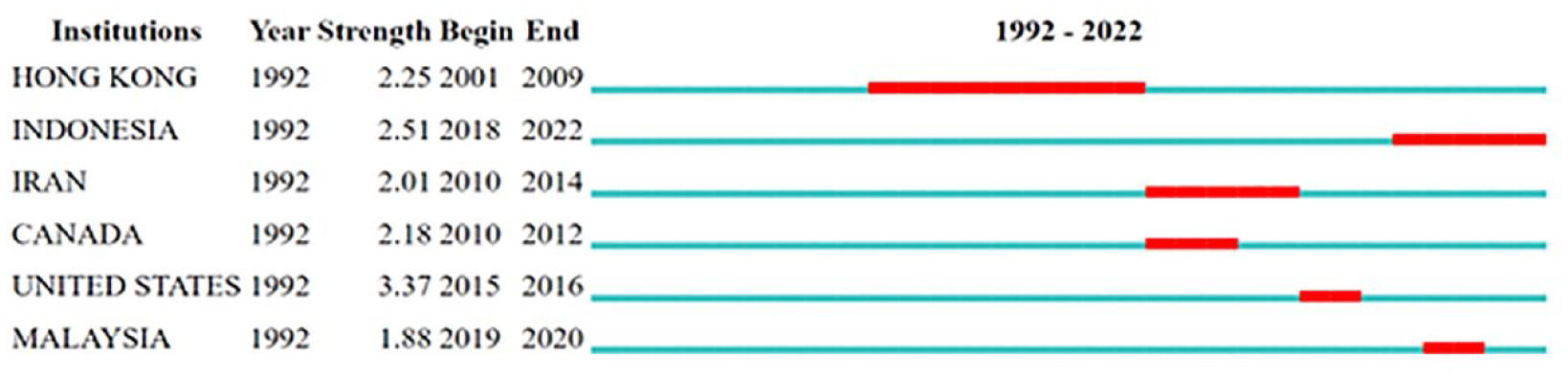
Visualization of top countries with citation bursts in DLA.
RQ4. What are the influential papers, and contributing DLA theories and models?
The 216 papers on DLA research have been recognized and cited 3679 times. Table 1 presents the top 10 cited papers along with their rank, citations, authorship, year, topic, adoption model(s): application context, sample, research method, and findings. It is evident from the table that the top-cited papers in DLA utilized the “technology acceptance model” (TAM) as their theoretical underpinning and followed a quantitative research approach to analyze survey data. Moreover, academic settings in universities and schools were the predominant application context in DLA research. Concerning influential DLA models and theories, Figure 6 illustrates the top 10 models and theories guiding DLA research including the “technology acceptance model” (TAM) as the most applied model (n = 34); followed by the “information system success” (ISS) (n = 23); “unified theory of acceptance and use of technology” (UTAUT) (n = 15); “diffusion of innovation” (DOI) (n = 12); “theory of planned behavior” (TPB) (n = 10); “social cognitive theory” (SCT) (n = 7); “theory of reasoned action” (TRA) (n = 7); “task technology fit” (TTF) (n = 6); “technology-organization-environment” (TOE) (n = 4); and “social capital theory” (SCPT) (n = 2). The following sections elaborate more on each of these models and theories.
Top 10 most cited papers in DLA.

DL: digital libraries; TAM: Technology Acceptance Model; PU: Perceived Usefulness; PEU: Perceived Ease of Use; ISS: Information System Success; UTAUT: Unified Theory of Acceptance and Use of Technology; TTF: Task-Technology Fit; TPB: Theory of Planned Behavior; DOI: Diffusion of Innovation; SCT: Social Cognitive Theory.
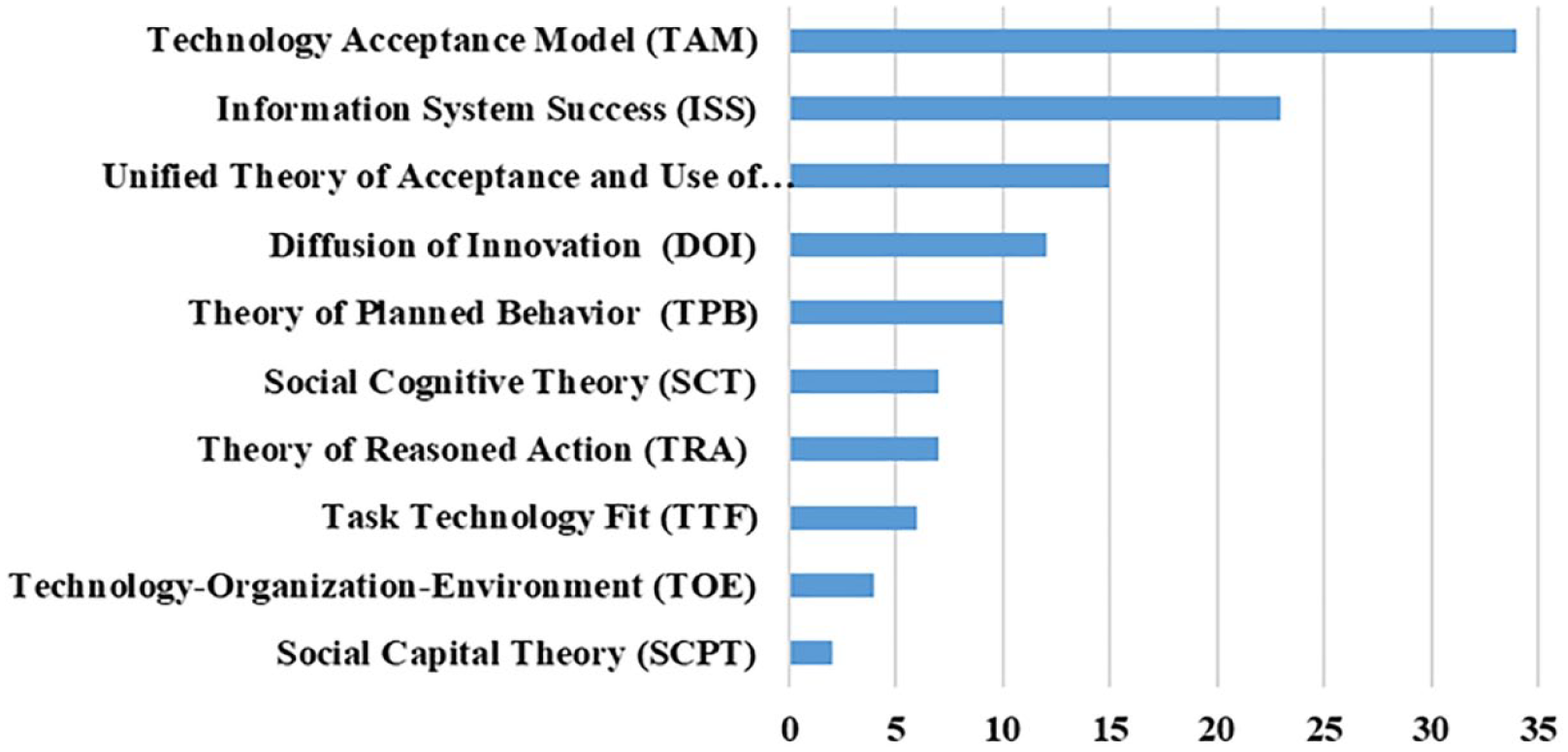
Top 10 most utilized DLA models and theories.
TAM-DLA
The TAM was initially advised by Davis (1989) to foresee technology acceptance using two perceptual beliefs comprising ease of use (PEU) and usefulness (PU) of a certain technology, wherein PU can be driven by PEU, and both directly influence users’ attitudes toward technology usage intention. Though the TAM has been empirically validated in diverse technology contexts to maintain its strength, numerous studies have incorporated ancillary variables into the model to increase its robustness. With respect to DLA, 34 papers (29 articles and 5 conference papers) have applied the TAM between 2001 and 2022. PU and PEU appeared to be the most prevailing factors in DLA-TAM studies. Although attitude is a core variable in the TAM and had greatly been applied in technology acceptance research, it was considered only in four DLA-TAM papers as researchers tend to link PU and PEU directly to intention. System characteristics and individual differences were the most employed ancillary factors in DLA-TAM, whereas organizational variables appeared to be overlooked. Furthermore, most studies focus on library customers rather than librarians. The most cited papers in the DLA literature are the ones applying the TAM. Hong et al.’s (2002) paper on factors influencing DL acceptance. The paper secured 518 citations as the initial attempt to apply the TAM to examine DLA on usage intention in an academic context. The paper also extended the model using individual differences such as self-efficacy and search knowledge along with features of the DL system including relevance and screen design. The findings supported the predictive power of the TAM model and confirmed the effects of individual differences and system characteristics on user acceptance.
The second most cited paper is by Thong et al. (2002) with 289 citations. The paper also applied the TAM model to explore the influence of system characteristics, organizational factors, and individual differences on user acceptance of DL. The findings demonstrated that while system features and individual differences influence PEU, organizational factors affect PEU and PU of DL. The third most cited paper is by Park et al. (2009) with 133 citations. The study examined the adoption of a DL system using the TAM model using a sample of 1082 from 16 institutions in developing countries in Asia, Latin America and Africa. The study emphasized the significant role of system relevance, library assistance, and English literacy in stimulating PEU and PU of DL. However, the findings revealed that only PU had a significant impact on the intention to use DL.
ISS-DLA
DeLone and McLean (1992) advised the ISS model to examine the effect of particular constructs that were believed to contribute to the success of an IS. These constructs involve information and system quality, user satisfaction, organizational and individual effect and system usage. Later, the authors integrated individual and organizational effects into “net benefit” and injected service quality as a new construct (DeLone and McLean, 2003). The ISS model has received remarkable status across numerous IS contexts. Extending to DLA, the model was linked to 23 papers (20 articles and 3 conference papers) between 2010 and 2022. Most papers focused on user satisfaction with DLA as an outcome of DL success. The most influential paper in this area is by Xu and Du (2018) with 94 citations. The paper employed structural equation modeling on a sample of 426 respondents to examine determinants of DL users’ loyalty and satisfaction in a university setting. They pointed out the significant effect of service and system quality on DL affinity, PEU and PU, which in turn significantly stimulate users’ satisfaction, thus shaping their loyalty. The study further confirmed the significant role of demographic variables (e.g. gender, education, and age) in determining DL users’ loyalty and satisfaction. Likewise, the paper by Alzahrani et al. (2019) has been recognized as the second-most cited paper in this area with 72 citations. The paper explored DLA through the lens of Delone and McLean’s model using data gathered from 978 academic users in Malaysia. The results asserted the significant impact of quality dimensions (system, service, and information) of DL on users’ satisfaction and intention to use the DL system. Information quality appeared to have the strongest effect on satisfaction, which in turn was deemed to exhibit the strongest impact on intention.
Utauta-DLundefined
Venkatesh et al. (2003) developed the UTAUT model as a product of a thorough integration of several theories and models such as the TPB, TAM and DOI. The model expounds that four exogenous factors involving expecting “effort” and “performance,” “social effect,” and “facilitating conditions” influence the intention to use a system or technology, which in turn shapes usage behavior. Later, Venkatesh et al. (2012) added demographic variables (e.g. gender, voluntariness, etc.) as moderators to all the proposed relationships to address the limitations of the original UTAUT. Moreover, the model was expanded to UTAUT2 to include three new constructs: hedonic motivation, price value, and habit. Literature on technology adoption validates the model predictability and pointed out it can explain the variance in user intention by 70% and the usage by 50% (Ramírez-Correa et al., 2019). Researchers have also incorporated other theories and variables into the UTAUT to reinforce its productivity power. The application of UTAUT in DLA was unveiled in 15 papers (11 articles and 4 concurrence papers) between 2008 and 2022. Facilitating conditions appeared to be the most revealed variable in this domain, then expectancy dimensions (i.e. performance and expectancy). The paper by Awwad and Al-Majali (2015) on DL acceptance in public universities using data collected from 575 students in Jordan seized first place with 35 citations. The results revealed that effort and performance expectancies and social influence determine DL usage intention, which in turn influences actual usage with facilitating conditions. The effect of performance expectancy was stronger with students who are undergraduate, younger and specialized in social disciplines, while the effect of effort expectancy was significant for students who are older and in applied disciplines. Rahman et al.’s (2011) paper is ranked second with 30 citations. The paper employed the UTAUT model to examine DL usage intention of Malaysian students. The authors pointed that the key role of information quality and effort expectancy and performance expectancy in triggering user intention to use DL. Contrarily, service quality unveils a negative effect on DL user intention. While the effect of gender and age appeared to have no significant moderating role, DL usage experience showed a significant moderating interaction with intention and effort expectancy in the DL context.
DOI-DLA
The DOI theory was initially advanced by Everett Rogers in 1962 proposing that the dissemination of a novel idea or system is a developing process that crosses several contexts until it looms up critical mass in a particular context (Rogers, 2010). According to the theory, the level individuals embrace a new system or innovation can range from laggards to innovators. It similarly advocates that innovation can be gaged by its relative advantage compared to other innovations being swapped with, compatibility with user’s needs, complexity or perceived difficulty, trialability before adoption, and observability or ability to produce visible results. Although it was introduced in 1962, the DOI theory has been extensively applied to numerous innovation contexts to date. Our analysis revealed 12 papers (nine articles and three conference papers) employed DOI in DLA between 2001 and 2020. Relative advantage and compatibility were the most cited attributes in DOI concerning DLA. Nevertheless, observability and trialability features of innovation were rarely examined in DLA. The theory has also been integrated with other models and frameworks (e.g. TAM and UTAUT) to fortify its predictive power. The most cited paper in this sub-domain is White (2001) with 40 citations. The paper explores the diffusion of digital reference systems in academic institutions using DOI theory. The paper advocated that a digital reference system offers a crucial service to users facing overwhelming issues concerning the evaluation of information, suggesting passable search strategies, and framing queries. Mudogo Mutula’s (2012) paper on DL in Sub- Saharan Africa is ranked second with 19 citations. The findings indicated that strategic support, stakeholder engagement, digital alignment, and capacity building were among the key factors that contributed to successful DLA in Africa. Yet, challenges like elevated user expectations, learning new skills, fear of losing jobs, increasing costs and networking bottlenecks were hampering such developments.
TPB-DLA
The TPB has received an extraordinary reputation through its application across countless innovations and settings. The theory was introduced by Ajzen (1991); 1991) advancing that a particular behavior is instigated by intention which is an outcome of an individual attitude, subjective norms, and control over challenges that may obstruct that behavior. Within the DLA research, the theory has been utilized in 10 papers (nine articles and one conference paper) between 2009 and 2022. The attitude was the most observed variable, followed by subjective norms and behavioral control. The TPB appeared to be strongly linked with different ancillary constructs as it forms the basis of various adoption models and theories such as the TAM, UTAUT, and ISS. For example, the top-cited paper in the TPB-DLA is Alzahrani et al. (2019) which is recalled in the ISS model above, while the second top-cited paper is Rahman et al. (2011) which is mentioned in the UTAUT model. Chang et al.’s (2009) paper on foreseeing information-seeking intention in DL is ranked third with 22 citations. The data were obtained from 224 students in Taiwanese universities aiming at predicting information-seeking intention in an academic DL using the TPB’s constructs. The results showed that behavioral control is better than the subjective norm and attitude in predicting user intention.
SCT-DLA
In the 1980s, the SCT model was established by Bandura (1986) as an extended version of the social learning theory which was developed during the sixties. It suggests that individuals are active agents who learn in different ways and interact with their environment (e.g. influencing or influenced). The SCT model offers prospects for social interaction through implanting critical factors to behavioral change including self-efficacy, self-control, expectations, and behavioral capability. While scholars have employed the SCT model to examine innovation usage intention, the utilization of the model in DLA research has been restricted to eight articles. The top-cited papers in this sub-domain have integrated the SCT model with other adoption models to increase its robustness. For instance, the work by Thong et al. (2002) is the top-cited with 289 citations. The paper integrated computer self-efficacy of the SCT model with constructs of the TAM model to explore users acceptance of DL. The findings demonstrated that computer self-efficacy is a key individual characteristic which influences the PEU of DL, which in turn stimulates its PU and usage intention. Similarly, Ramayah and Aafaqi’s (2004) work integrating TAM and SCT to assess determinants of DLA in Malaysia arrives second with 53 citations. Based on analyzing survey data of 704 students from public Malaysian universities, they found that self-efficacy significantly influences PU and PEU toward DL usage use when predicting e-library usage. The findings further revealed that PEU fully mediates the effect of self-efficacy on DL utilization. Omotayo and Haliru’s (2020) paper stepped forward with 30 citations securing the third position in this sub-domain. The paper integrated SCT with the TTF model to assess DLA in African universities using survey data of 402 Nigerian students. The findings found a significant effect of TTF constructs (e.g. technology and task characteristics) and SCT constructs (computer self-efficacy and attitude) on DL usage by students in Nigerian universities. Essentially, it is worth noting that while the self-efficacy construct enjoyed the citation lion’s share in DLA research, other SCT constructs such as expectations and self-control were rarely mentioned.
TRA-DLA
The TRA model was developed by Fishbein and Azjen in the sixties based on prior studies in social psychology to understand the fundamental motivation for an individual to act voluntarily (Fishbein and Ajzen, 1980). The theory implies that individuals’ behavioral intention predicts whether they do that behavior considering their attitude and subjective norms surrounding them. Thus, the stronger an individual’s behavioral intention the greater the effort to attain that behavior. Although the theory has accentuated the prominence of intention concerning behaviors in which individuals can maintain the right skills and resources, it does not consider situations wherein behaviors are not accessible by individuals (Eagly and Chaiken, 1993). Furthermore, intention does not necessarily link attitudes to behavior, mostly in situations where behavior does not need substantial cognitive skills (Bagozzi et al., 1989). Our analysis revealed seven papers (six articles and one conference paper) employed TRA in DLA between 2007 and 2021. The TRA has also been integrated with the TPB, TAM, and UTAUT to strengthen its explanatory scope. The most cited paper in this subdomain is Chang et al.’s (2009) which integrates TBP and TRA to examine information-seeking intention in academic DL, followed by Rosman et al.’s work on DL engagement in Malaysian universities with four citations only.
TTF-DLA
The TTF model suggests that people will utilize a technology if it properly matches the intended tasks it supports or the benefits it promises, regardless of their attitudes toward this technology (Goodhue, 1998). The main construct in the model is the task-technology fit, as the model’s title, which reflects the aptness degree between what a certain technology is capable of and the required performance. Attributes or features of task and technology are deemed to influence that fit (Goodhue and Thompson, 1995). However, the model has been criticized for its lack of emphasis on personal and situational variables and its complexity owing to the multi-dimensional constructs (Agarwal et al., 2000). Hence, it is widely combined with other behavioral and cognitive models to cover its shortcoming. The TTF model has been recently applied in six articles about DLA between 2016 and 2022. For instance, Omotayo and Haliru (2020): the highest cited paper in this sub-domain with 30 citations, combined TTF and SCT to predict academic DLA in Nigerian universities as mentioned earlier in the SCT-DL section. The paper by Moorthy et al. (2019) is ranked second with 18 citations. It incorporated TTF constructs with ISS and UTAUT to explain students’ behavioral intention to adopt DL in Malaysian universities using multiple linear regression analysis. The findings established the significant role of social stimulus, performance expectancy, hedonic stimulus, facilitating conditions, information quality, and habits in stimulating behavioral intention to adopt DL.
TOE-DLA
Tornatzky and Fleischer (1990) developed the TOE model as a generic archetype that assemblies three-dimensional factors believed to affect technology adoption. The first is the technology dimension reflecting the technical infrastructure of technology. The second is the organizational dimension which covers the structural features such as processes, resources, size, and managerial aspects. The final is the environmental dimension which encapsulates features of the market, environmental actors, competition, etc. The TOE model has been extensively employed to explore technology adoption in various contexts. However, within the DLA setting, our analysis discovered four papers only (three articles and one conference paper) wherein the model has recently utilized to predict DLA between 2020 and 2021. Singeh et al.’s (2020) study on the success factors of DL using the TOE model is the top ranked with nine citations. The study defined 53 TOE factors (16 technological factors, 13 organizational factors, and 24 environmental factors) that contribute to successful DL implementation. Because of the resemblances between the TOE and DOI, process complexity and software compatibility were repeatedly reported in the DL technology dimension, while structure and stakeholders including users were dominant in the organization dimension. Finally, policy issues and location/space factors were prevalent in the environmental dimension.
SCPT-DLA
Glen Loury first introduced the term “social capital” in the eighties as a refined version of the “social exchange theory.” Later, the theory has been developed by Bourdieu and Coleman in the mid-eighties (Littles, 2021). The SCPT is a generic model accentuating social interactions and cues as crucial resources for the development of human-technology relationships (Tsai, 2014). Thus, trust, social participation or engagement, social norms, voluntarism, and mutual relationships are reckoned to influence technology adoption (Liu et al., 2020). Although the SCPT model has considerably been applied to examine various technologies, its application to DLA has been limited to two papers only between 2014 and 2021, despite the promising utilization of the model in digital technology field such as digital networks (Smith et al., 2017); digital crowd (Eiteneyer et al., 2019); and digital service (Rey-Moreno and Medina-Molina (2016). In the DLA context, Vanwynsberghe et al. (2014) explored the significant role of professional experts in facilitating or hindering social media integration into public DL initiatives in Belgium. Israni et al. (2021) examined the factors that facilitate users’ interaction with community-based DL. They demonstrated that users’ shared identity online is insufficient to maintain interpersonal trust and social norms while sharing online resources. Both papers have obtained six citations only which indicate their narrow exposure to DL scholars. Nonetheless, the SCPT model can contribute to the DLA research through its emphasis on social resources and interactions at both user and institutional levels.
RQ5. What are the intellectual foundations of DLA research?
The intellectual base of a research domain can be detected through assessing co-cited references and keywords which help researchers develop deeper insights into the knowledge structure and frontiers of a particular domain. The co-citation networks reflect the citation frequency of two or more documents by at least one later document at the same time. The strength of the co-citation link is therefore dependent on the total citations.
About 8399 references are cited by the 216 papers on DLA. Figure 7 maps the co-cited references that had co-citations (C) ⩾5 accompanied by the first author and publication year. The color of node rings reflects the time of source co-citation from the past (black color) to the present (red color). Table 2 displays the top 10 co-cited references along with their authors, year, reference, degree, and cluster-ID. The degree (d) of a reference reflects the extent to which that reference is connected directly to other references; the higher the degree value the greater the reference intermediation centrality (Yu and Mu, 2022). Accordingly, the top ranked reference by degree was Venkatesh et al. (2003) (d = 72) followed by Davis (1989) (d = 57), DeLone & McLean (d = 52), Wixom and Todd (2005) (d = 51), and DeLone and McLean (1992) (d = 48). This finding reflects the greater proximity and intermediation centrality of references on technology acceptance and success models compared to other adoption models and frameworks.

Visualization of reference co-citation network in DLA.
Top co-cited references in DLA research.
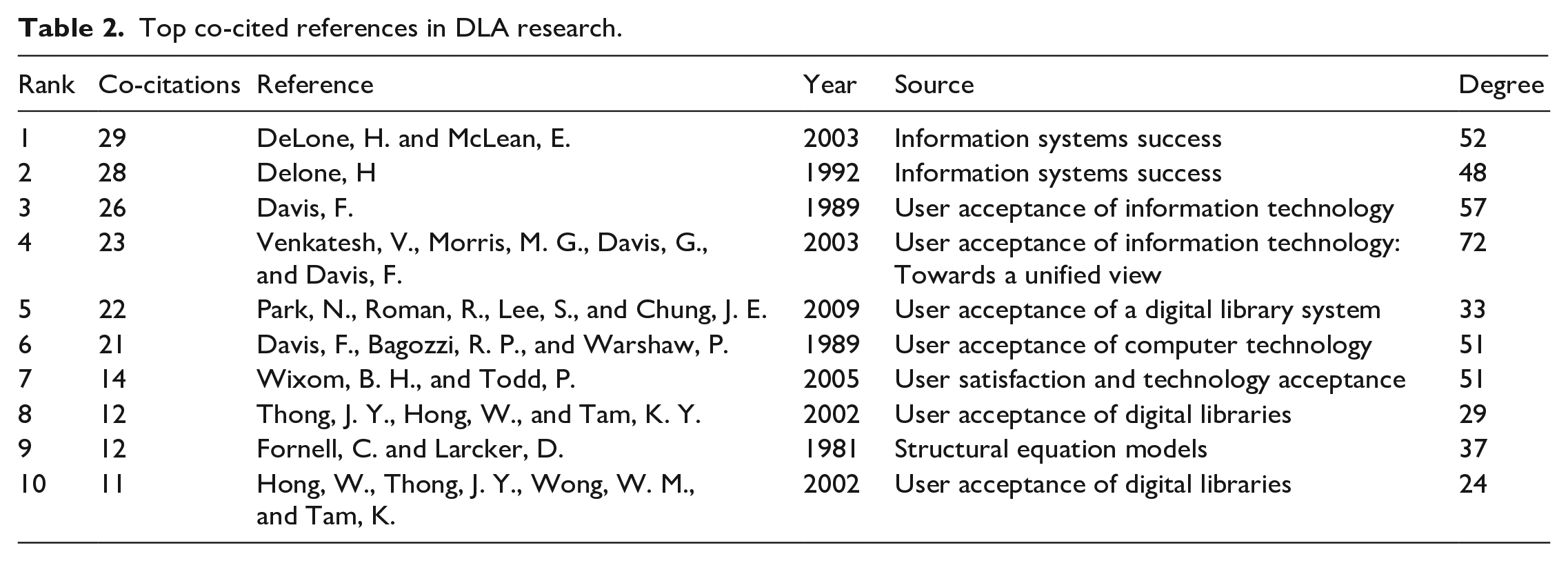
Concerning co-citations, studies of DeLone and McLean (2003, 1992) on “information systems success” are placed first (C = 29) and second (C = 28), respectively. These references set the ground for the ISS model in technology adoption research in general.
The references by Davis (1989) and Davis et al. (1989) on “user acceptance of information technology” are ranked third (C = 26) and sixth (C = 21): respectively. These seminal papers introduced the TAM model for the first time.
The fourth-ranked reference is by Venkatesh et al. (2003) on “a unified view of technology acceptance” (C = 23). The paper was the first to develop the UTAUT model that integrates several competing models and frameworks of technology acceptance.
Primary papers on DLA were also among the top co-cited references. Specifically, the works of Park et al. (2009) (C = 22); Hong et al. (2002) (C = 12); and Thong et al. (2002) (C = 11) are placed 5th, 8th, and 10th, respectively. These studies were among the first to introduce the TAM model and confirm the predictive power of its constructs in academic DL settings.
Other key references involve Wixom and Todd (2005) on linking user satisfaction to technology acceptance which is placed seventh (C = 14) and Fornell and Larcker’s (1981) contribution to “structural equation modeling” (C = 12) which is placed ninth. The first reference exhibited the integration of TAM, DOI, and TPB into one model to predict user intention and actual usage of new technology while the later stepped forward as a primary source in data modeling techniques.
Pertaining to citation burst in Figure 8, the reference titled “user acceptance of digital library system” by Park et al. (2009) has the longest burst duration between 2014 and 2022 which accentuates its remarkable influence as a key reference in DLA over nearly 10 years, while Alzahrani et al.’s (2019) work on “Modeling digital library success” has the highest burst strength (b = 5.05) within a short-time span (2020–2022). The study applied DeLone and McLean’s model to explore DLA using data collected from Malaysian universities. The results indicated that quality dimensions of DL have a significant effect on participants’ intention to use DL, which in turn influences their satisfaction. Moreover, seminal references on technology acceptance acted as “sleeping beauties” in the context of DLA given the long-time span between their publication year and the start of burst duration. For example, the seminal work of DeLone and McLean (2003) while started to burst in DLA research after 13 years (2016–2022). The burst period of Davis’s seminal paper on technology acceptance was between 2015 and 2022 although its introduction was in 1989, meaning after 16 years of sleeping. A possible reason may be due to the upsurge in quantity and variety of DL research between 2014 and 2016 and the outbreak of the Covid-19 pandemic in 2020 which exaggerated the demand for DL service and research.

Visualization of references with top citation bursts in DLA.
RQ6. Which hotspots, research frontiers, and knowledge themes are guiding DLA research?
Analyzing keyword co-occurrence and burst strength provides insights into significant contents and facets of literature on a specific domain which help stipulates the trajectory of research hotspots and frontiers (Bornmann et al., 2018) while integrating frequently co-occurring keywords into themes is valuable in forming the intellectual foundation of DLA research and guiding the forthcoming research in the area.
DLA hotspots and research frontiers
The analysis of keyword co-occurrence revealed a total of 524 keywords and 2676 links. The network modularity value exceeds 0.3 (Q = 0.6753) and the Silhouette score is greater than 7 (S = 0.8937) which indicates a reasonable structure (Su et al., 2019). Figure 9 visualizes the top hotspots (⩾5 co-occurrence) in DLA research. In view of the presence of highly frequent keywords over time, Figure 10 visualizes a time zone distribution considering DLA models and variables from 1992 to 2022. Further details are presented in Table 3 which highlights the co-citation counts, the average year of presence, degree of connectedness, and burst strength of the featured hotspots. The analysis reveals 20 hotspots forming the building blocks of DLA research. The “digital library” spot is ranked first and represented by a large node reflecting high co-occurrence counts (n = 141) since its initial appearance during the late nineties (See Figures 8 and 9). The node rings have various colors representing co-occurrence time ranging from past (dark color) to present (bright color). The second top co-cited spot is “academic library” with 25 co-occurrences and an average year of 2009. There were also 12 adoption models and variables among the most co-occurred keywords including “technology acceptance model (TAM),” “user satisfaction,” “information quality,” “perceived ease of use,” “technology adoption,” “unified theory of acceptance (UTAUT),” “self-efficacy,” “behavioral intention,” “information system success model,” “theory of planned behavior (TPB),” “diffusion of innovation (DOI),” and “continuance intention.”

Visualization of DLA hot spots.
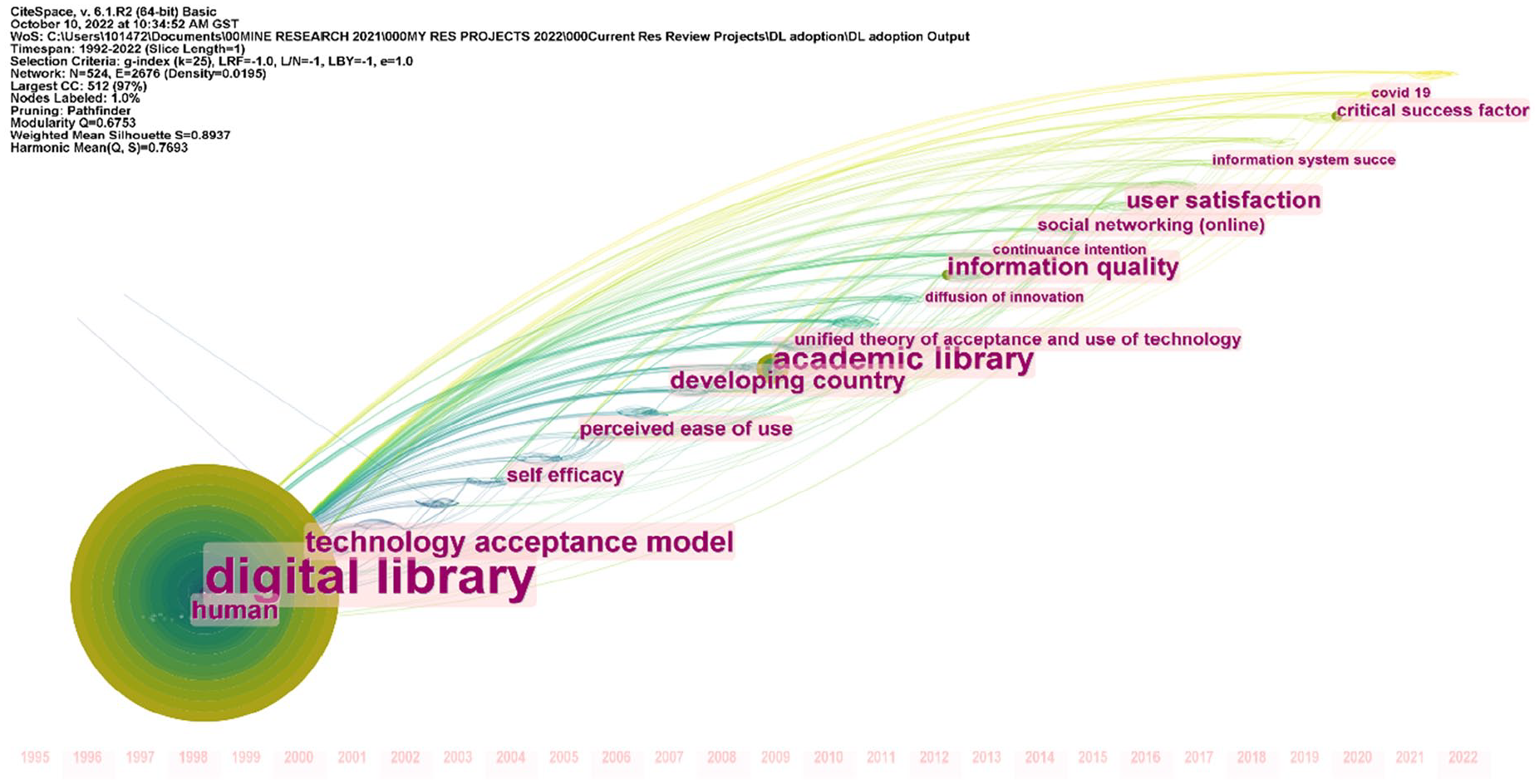
A time zone visualization of DLA hot spots.
Top 20 hotspots in DLA.
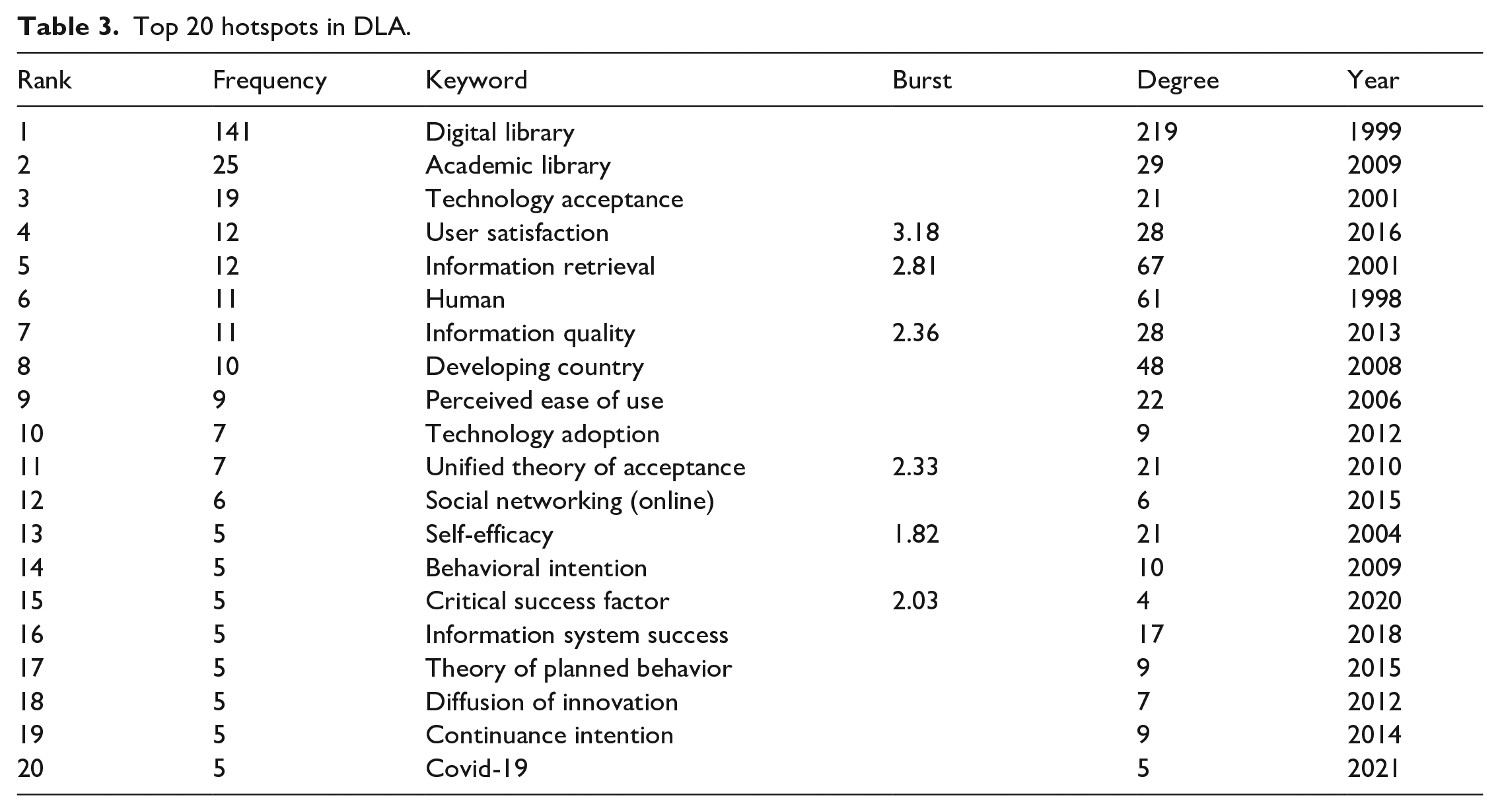
Chronologically, Figure 9 shows the hotspots “Human” and “Digital library” were featured in DLA keywords in the late nineties. The spot “Human” was featured by D’Alessandro et al.’s (1998) study on “barriers to use digital health library.” The study underscored lack of training, time consumption, distance to computers, and perceived difficulty of using computers as the most human-related barriers to DLA in rural areas. The second hotspot to emerge is “Digital library” in 1999 in Covi’s (1999) study on “situating digital library use in university” which explained the adoption of DL in a knowledge-intensive environment involving work characteristics and usage patterns. Afterward, the start of the new millenium witnessed the use of “technology acceptance model” (TAM) as the main drive of DLA research. The model was featured in Hong et al.’s (2002) study on determinants of users’ adoption intention of DL considering the significant effect of individual differences such as self-efficacy and system design and relevance.
In recent years, DLA research has focused on three hot issues. The first spot focused on the adoption of DL during the Covid-19 pandemic in 2021. For instance, Ali et al.’s (2021a, 2021b) cross-sectional study on DL acceptance emphasized a robust link between educational practices, dependency and reading habits during the pandemic and the adoption of DL. The second spot emphasized the role of DL success in enhancing customer satisfaction using the “information system success model” since 2016. Finally, the rise of social networking technology and platforms drew scholars’ attention to examine its adoption in DL context since 2015. Concerning the degree of connectedness (intermediation centrality): Figure 9 and Table 3 show that “digital library” is ranked first by the number of links through which the hotspot is connected directly to other spots (d = 219). This is followed by “Information retrieval” (d = 67); “Human” (d = 61); and developing countries (d = 48).
Keyword citation burstiness presents those keywords which are frequently cited within a precise duration. Thus, a keyword with a high burst during the early phase of a research domain pinpoints a research frontier, while a recently cited keyword with a high burst signifies an emerging research trend or a hot topic being presently examined. Figure 11 depicts the keywords with the citation bursts along with their burst duration and strength which reflect DLA frontiers between 1992 and 2023. Hence, several observations emerge: First, “information technology” and “information retrieval” are at the top with the longest burst durations which lasted nearly 10 years (1999–2010 and 2001–2010): respectively, which highlights a dominant information view throughout the recognition phase of DLA research. Second, “learning system,” “technology acceptance,” “unified theory of acceptance,” and “education” attracted scholars’ interest between 2005 and 2017. Third, “user satisfaction” has recently sprouted as an appealing research frontier between 2016 and 2020 with a high burst strength (b = 3.18). Fourth, the “China” research frontier managed to have the strongest burst value (b = 3.52) within a short-time span (2014–2017).
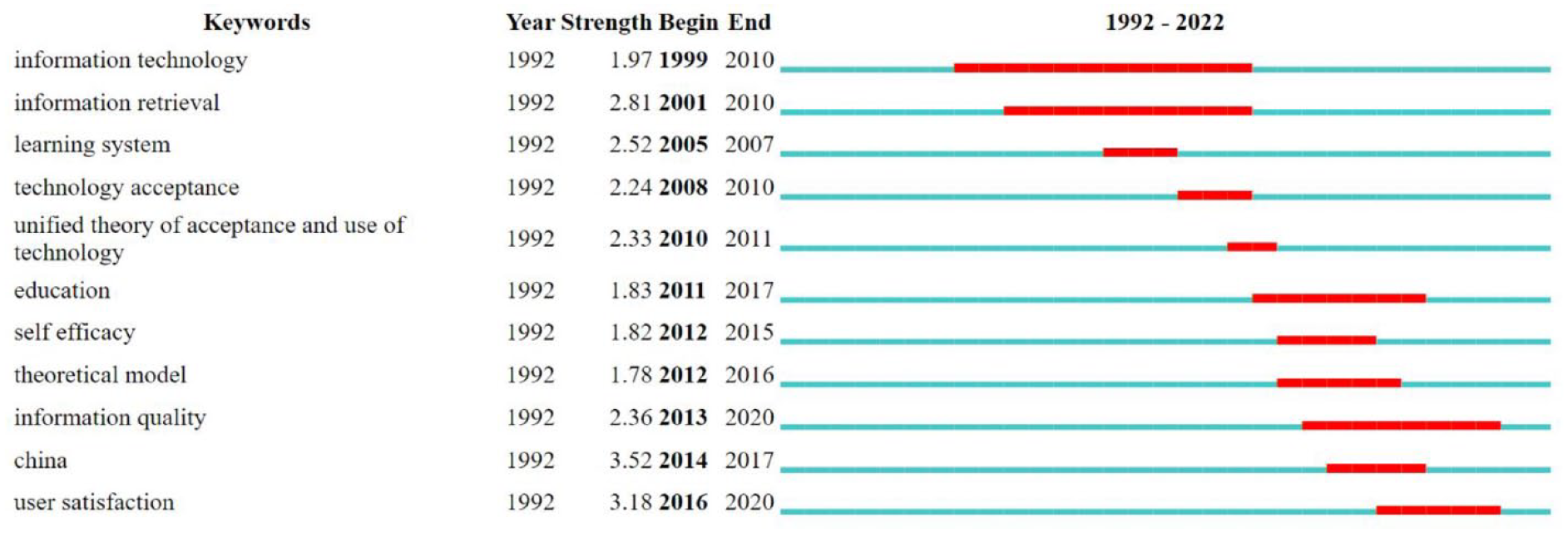
Visualization of DLA research frontiers.
Major knowledge themes and trends in DLA
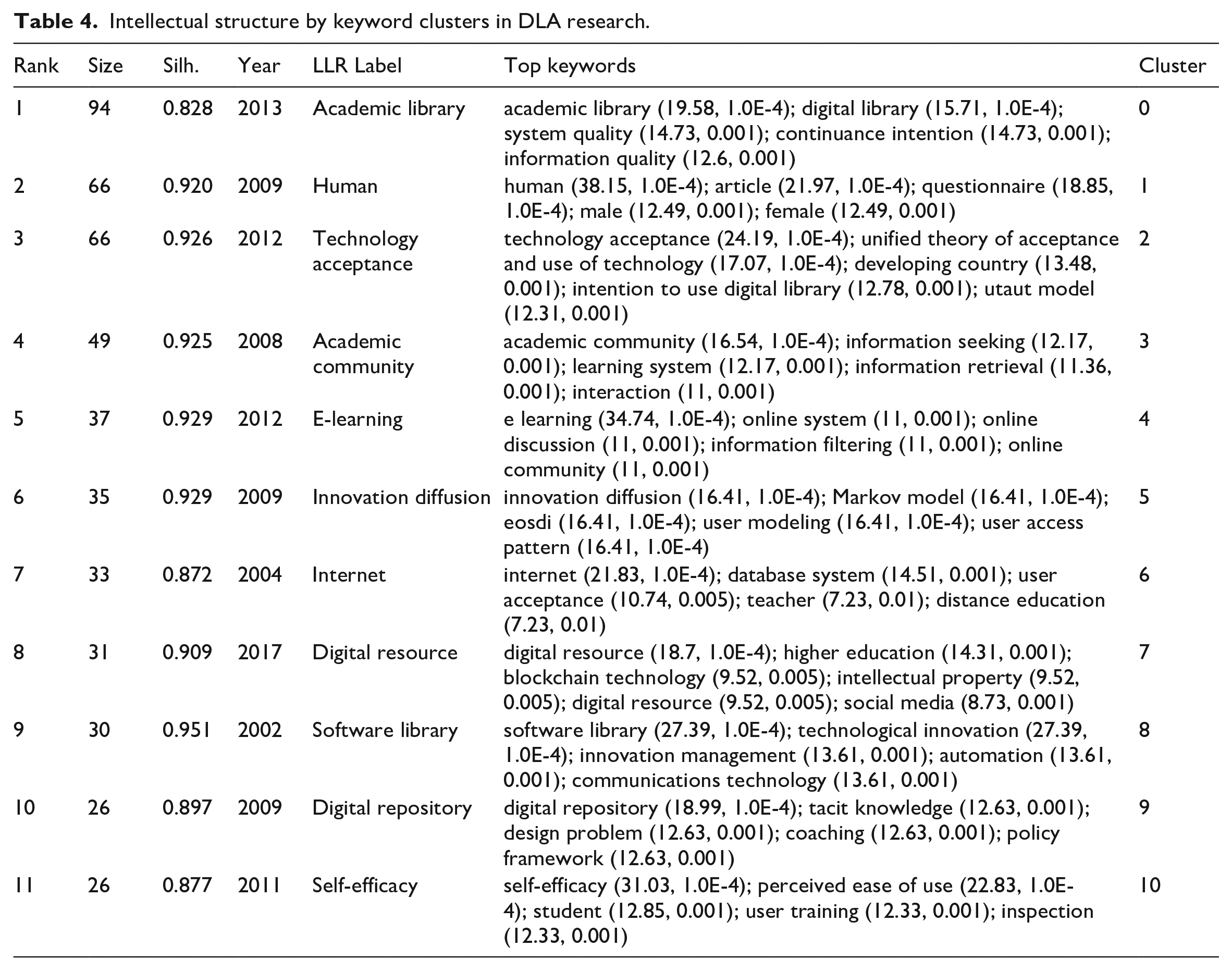
The analysis of keywords clusters helps explore the knowledge structure and trends of a particular domain (Xu and Du, 2022). Cluster analysis signifies the main themes of the study wherein highly frequent keywords were quantified, automatically labeled by the CiteSpace algorithm, and integrated into clusters or themes for further analysis. The analysis stipulates 11 clusters with overall modularity (Q = 0.6753) and silhouette value (S = 0.8973) levels which indicate an adequate degree of homogeneity among the members of each cluster. Figure 12 visualizes the clusters labeled using the LLR terms, while Figure 13 represents a timeline view of the clusters depicting how the keywords evolved from year to year. Moreover, Table 4 tabulates detailed information about each cluster including its rank, size, silhouette score, year, LLR Label, top keywords, and ID. It can be detected from the Table that all clusters achieve a silhouette value of more than 0.82, signifying a good clustering quality of DLA data. It is also observed that the first ranked cluster “academic library” is the most prevalent in DLA research with the largest size of papers (n = 94) and a mean year of 2013. Although the clusters “human” and “technology acceptance” are ranked second by size with 66 papers each, the latter is higher in silhouette score (S = 0.926). Chronologically, clusters “software library,” “internet,” and “academic community” were the earliest to shape DLA research given their average year of occurrence in 2002, 2004, and 2008, respectively. The “digital resource” cluster with an average year of 2017 was the most recent to contribute to DLA research. The findings of cluster analysis indicate that DLA research has evolved from theory to practice through three intertwined perspectives. First, a system perspective of DLA has blended topics related to features of information systems, information retrieval, software library and internet. For instance, the work of Lyman (2000) classified DLA based on using information artifacts produced in different system formats. Accordingly, four types of DL emerged including “(1) digitized documents from analog media; (2) “born digital” documents; (3) digital data; and (4) archives of network communications.” Second, a human perspective has encapsulated essential clusters embarking on the academic community practices using innovation diffusion and acceptance models which emphasize user perception and behavior. Dibie et al. (2012): for example, explored social behaviors that emerge among users of DL in an academic context. Singh et al.’s (2016) introduced a social construction strategy focusing on how DLA is shaped by human actions and social context involving social groups, closure, and interpretative flexibility. The third perspective casts an organizational context wherein the main emphasis is on digital resources and contextual influences. For example, Abdul Rahman et al. (2020) adopted an organizational view to examine contextual factors influencing the continued usage of DL in military organizations. Similarly, Oguz (2016) examined organizational effects on DLA decisions in the United States using qualitative data from five DL programs. Derived from these insights, Figure 14 illustrates a knowledge structure of DLA research.

Visualization of keyword clusters in DLA.

Timeline visualization of keyword co-occurrence network in DLA.
Intellectual structure by keyword clusters in DLA research.

Knowledge graph of DLA research.
Conclusions and implications for future research
Conclusions
To the best of the authors’ knowledge, this scientometric analysis can be deemed the first of its kind that covers the breadth and depth of DLA landscape. This comprehensive inclusion has offered a more exhaustive analysis and mapping of the scientific output of 216 papers with 8399 references on DLA over the past 30 years (1992–2022). The review adopts in-depth analysis of the research evolution, authors, countries, top-cited papers, references and keywords through Silhouette and Modularity algorithms, co-citation analysis, burst analysis, and cluster analysis of research themes. The paper not only elucidates the existing status of DLA but also prompts new directions that escort scholars and practitioners in the field. The paper wraps a central gap in the literature, which rarely conducted a holistic review of DLA from various aspects, and did not exhaustively unveil these aspects over time. The analysis divulges that DLA demonstrates aspects signifying a topic at a preliminary stage of progress, as it is broadly dispersed across different thematic areas while employing a narrow range of adoption models, some of which overlay. Yet, it is a dynamic arena shifting from theory to practice toward more focus on contextual adoption issues, particularly with the advent of new digital technologies such as social networking, blockchain, virtual reality, etc.
Implications for future research
With this background in mind, valuable implications emerge, which help reinforce interesting avenues for imminent DLA research that inspire scholars, practitioners, and policymakers:
First, DLA is a riveting field that could be rigorously explored in tandem with the dynamic nature of models and theories that were underrepresented in extant DL research. Yet, various influential models and theories such as “ability, motivation and opportunity theory,” “Absorptive capacity theory,” “knowledge-based view”, “resource-based view”, “institutional theory”, “social identity theory”, and “expectation confirmation theory” are not well-represented in current DLA research. These theoretical underpinnings help unearth various forces and outcomes of DLA which inject a fresh perspective into future research. Moreover, the criticisms linked to adoption models force researchers to apply more than one model to explore DLA wherein it is impracticable for prospective research to maintain a thorough view of DLA using a single model.
Second, most of the research on DLA appeared to focus mainly on the user’s level of analysis with a principal focus on individual views rather than structural and strategic mechanisms at the institution or library level which suggests a gap in DLA research pertinent to the level of analysis. Even the integration of two or more levels (individual, group, department, institution) is barely explored, which grants a further prospect for eventual research, particularly when the role of some determinants at multiple levels could also be evident.
Third, the analysis reveals that many countries (developed and developing) have placed remarkable effort into the elevation of DLA which reflects potent global attention to the topic. However, questioning the DLA situation in a specific country or region or examining the role of enforcing policies and regulations has been overlooked. Attending to these issues, continuous effort is essential, whether by extending research models or using different methods to capture the regional landscape. These concerns spur potential opportunities for research venues.
Fourth, scholars have been endeavoring to locate the determinants of DLA following causal or variance-based approaches, while the specifics of the adoption process such as planning the pre-adoption, mid-adoption operations or post-adoption assessment have remained blurred. Emphasizing primarily on snapshot estimation of relationships oversee the veracity of DLA in institutions, especially when the decision to adopt spans top managers at different levels. Thus, the process-based approach can unfold the complexity and interrelated interactions in DLA life cycle or development over time.
Fifth, most studies have examined the voluntary nature of DLA, while very little attention has been given to mandatory DLA. This may be owing to the claim that DL is a more voluntary innovation compared to other enterprise technologies such as “enterprise resource planning” and “customer systems” that are ingrained in the operational processes. These issues challenge conventional views and bestow an auspicious venue for forthcoming research.
Finally, there is an absence of research on the role of culture at both organizational and national levels in DLA research, even though many DLA initiatives are led by international efforts and groups. This gap advances research opportunities that may help define proper strategic actions to mitigate cultural conflicts.
Limitations
While this paper intended to perform a thorough review of DLA research using a comprehensive scientometric analysis that curtailed the setbacks to a great extent, the findings should be explicated with care in view of specific limitations. First, Scopus prestigious database was selected as a leading literature source due to its comprehensive coverage and quality research. Nevertheless, possibly linked DLA documents may be available in other repositories or databases. The authors also excluded some document formats such as books and chapters throughout the screening process. Therefore, future researchers may extend the findings of this review by using different databases or gaging other document formats than articles and conferences in their future work. Second, the selection of DLA literature in our review was restricted to precise keywords and entries and keywords, while an effort was sustained to evade missing important studies and establish that all relevant documents were identified. Third, caution should be maintained when interpreting documents published or accepted ahead of the final stage of this review as the referencing and citation data may vary.
Research Data
sj-ris-1-lis-10.1177_09610006231161143 – Supplemental material for A scientometric analysis of digital library adoption over the past 30 years: Models, trends, and research directions
sj-ris-1-lis-10.1177_09610006231161143 for A scientometric analysis of digital library adoption over the past 30 years: Models, trends, and research directions by Mohamed Aboelmaged, Samar Mouakket and Imran Ali in Journal of Librarianship and Information Science
Footnotes
Declaration of conflicting interests
The author(s) declared no potential conflicts of interest with respect to the research, authorship, and/or publication of this article.
Funding
The author(s) received no financial support for the research, authorship, and/or publication of this article.

Author Biographies
References
Supplementary Material
Please find the following supplemental material available below.
For Open Access articles published under a Creative Commons License, all supplemental material carries the same license as the article it is associated with.
For non-Open Access articles published, all supplemental material carries a non-exclusive license, and permission requests for re-use of supplemental material or any part of supplemental material shall be sent directly to the copyright owner as specified in the copyright notice associated with the article.
