



Abstract
Today, in order to remain viable and meet the needs and expectations of a global, entrepreneurial and learning society, public libraries must change and reinvent their roles in society, find new solutions for business, and actively engage in partnerships between education, business and local government. This paper presents the findings of qualitative research using an interview method and uncovers the possibilities of innovative services offered by public libraries to the business community. The qualitative analysis of the experiences of business representatives revealed that in order to become competitive organizations, public libraries need to focus not only on satisfying the needs of different communities, but also on providing innovative services to the business community by playing the roles of an information facilitator, an organizer of cultural and lifelong learning activities, a project partner and a developer of virtual social network.
Introduction
In today’s world, organizations face constant and diverse changes initiated by the emergence of new technologies, new markets, a changing legal framework, changes in the internal and external organizational environment, and changing consumer needs.
Lithuanian public libraries as non-profit public sector organizations also encounter the need to reconstruct their identity and revise their responsibilities and functions in providing innovative and high-quality services to society and business and creating public welfare.
However, in recent years, the following trends have been observed in Lithuania: more and more libraries are closed in rural areas, and library attendance is declining in cities, as consumers find them dull and uninteresting. The role of the library is still treated as traditional: its activities are related to the information services provided by the library (books, periodicals, public Internet access).
The researchers, however, urge for the changes of libraries’ role. A 2017 qualitative study conducted by US researchers Mehra et al. (2017) revealed that the modernization of library services would require a careful analysis of the socio-demographic characteristics of potential visitors. More than that, when focusing on the business community, that is, small businesses, it would be necessary to offer a package of services to start-ups (preparation of a business plan, registration of the business, legal information and assistance, tax and insurance) and those running them (assistance in solving personnel management, marketing and publicity issues, information literacy and IT training, database access and subscriptions).
In 2020, a study carried out by Slovenian researchers Zakrajšek and Vodeb (2020) also revealed that the social and demographic characteristics of potential visitors should be carefully analyzed when modernizing library services. The research by Potnis et al. (2021) in the US indicates that improving the competencies of public library administration and staff is essential to successfully meet the challenges and innovate in libraries in the future. And this is in line with the results of study carried out by Lee et al. (2020), who note that library staff faces significant challenges in implementing new technological tools or instruments (e.g. difficult to understand how these tools work and anticipate the possibilities of using these interactive technologies, etc.).
The Lithuanian national documents confirm similar ideas on the implementation of library changes associated with innovation and efficiency. The goal and priorities of the Lithuanian Innovation Strategy for 2010–2020 are closely related to the expansion of library functions, namely to strengthen knowledge and intellectual potential by contributing to the creation of a creative society and conditions for entrepreneurship and innovation (Lithuanian Innovation Strategy for 2010–2020). The strategic guidelines for library development for 2016–2022 also focus on the contribution of libraries to the socioeconomic well-being of society. The emphasis is placed on the integration of business, education, science, and culture through improved library infrastructure and new electronic services for socio-economic development based on knowledge, entrepreneurship, and innovation.
In 2015, the American Library Association noted that every library must become a center for community engagement, innovation, and lifelong learning (American Library Association, 2010). In recent years, this perception has expanded, formulating a new vision for modern libraries: the library must offer a variety of flexible services and become a multifunctional, innovative space for social interaction where the added value is developed in collaboration with education and research institutions and the business sector.
In the scientific context, the change of library paradigms and the search for new library concepts based on scientific methodology are also being updated. Researchers are actively involved in the debate, emphasizing the need for innovation in public libraries, which involves experimentation and risk-taking, open access to information, technology, services, support, and expertise for better serving diverse communities (Gorham and Bertot, 2018). As Nicholson (2017) states, it is believed that “through the application of new ideas and methods, libraries can develop a better, more responsive, and more valued service that meets the needs of today’s communities and the communities of the future.”
Other foreign researchers attribute changes and the implementation of innovation in libraries to the need for new roles for librarians (Lo and Stark, 2021; Potnis et al., 2020; Vanwynsberghe et al., 2015) or moving library services to cyberspace, especially social networks (Lee et al., 2020; Vassilakaki and Garoufallou, 2014). Lithuanian researchers (Juchnevič, 2016; Kulikauskienė, 2019), examining modern public library concepts and development opportunities, also identify the need to transform the traditional role of a librarian, from an authoritative information expert to an information consultant or/and an information literacy educator.
Kulikauskienė and Šaparnienė (2020) recommends that public libraries improve their activities to increase digital inclusion by expanding the availability of services, the diversity of content, and information dissemination initiatives. Biveinis (2022) identified one of the problematic issues of municipal public libraries: the insufficient relationship of libraries with other sectors that might help implement project activities as one of the means for changes in the library and modernizing library services.
Thus, in order to remain viable and meet the needs and expectations of a global, entrepreneurial, and learning society, libraries must change and discover new roles in society, seek new solutions for business, and actively engage in partnerships between education, business and local government. This implies that today’s libraries face a significant challenge, namely to strengthen cooperation not only with the scientific, cultural, but also with the business communities. Libraries have to expand special spaces and provide innovative services to business communities, especially newly established small business communities and small businesses. This obliges not only librarians, but also business and researchers, to discuss the topic and look for answers to these problematic questions: What innovative services could a public library offer to business? How would libraries contribute to building mutually beneficial and lasting relationships and developing cooperation with business?
These questions frame the aim of the paper, to explore the public library possibilities to provide innovative services for business.
Methodology
To explore the possibilities of innovative services provided by public libraries to business, a qualitative study based on phenomenological philosophy was carried out, with the focus of identifying the connection between the theoretical description of phenomenon (innovative services (means/forms) for business in public libraries) and its expression in social reality.
Qualitative research adopted a conversation approach, which provides the best insight into the individuals’ experiences, and an interview method, which allows us to get closer to the individuals’ perceptions, the meanings of the phenomenon, and the construction of reality (Creswell, 2007; Silverman, 2003). Participants were interviewed in a semi-structured face-to-face interview, that is, they were individually asked open-ended questions during the interview. The order and sequence of the questions in each specific interview were determined by the course of the interview and the views expressed by the participants. The research used purposive or criterion-based sampling, whereby certain settings, individuals, or events are deliberately selected to obtain relevant information that may not be available in other ways (Bitinas et al., 2008).
The study was organized around the most relevant parameters and the selection of individuals who could reflect these parameters. For example, the sample was as diverse as possible, covering small, medium, and large businesses operating in a wide range of economic sectors (services, trade, manufacturing) and industries (manufacturers in the household, furniture, glass and food industries, etc.; sellers of clothing, footwear, car parts, online sales, etc.; providers of advertising, recruitment, medical, transport, etc. services).
To broaden the sample, semi-structured interviews were also conducted with persons engaged in self-employed activities (e.g. creating websites for clients, selling handicrafts and/or jewelry, etc.). The sample for the survey consisted of 27 industrial, 21 commercial, and 38 service managers from small, medium, large and small business enterprises in various economic sectors at top, middle and bottom managerial levels. In total, more than 80 managers of industrial, commercial and service businesses operating in the region of north- east Lithuania were interviewed by semi-structured interviews. In the data processing, each respondent was given a code indicating the target group (industrial—[IND], trade—[TR], or service—[SER]) and a case number giving an example of the meaningful context of the statement.
The data analysis methods used to process the qualitative research data were phenomenological and qualitative content analysis. Phenomenological analysis sought to answer questions about the complex nature of the phenomenon by describing, characterizing, and understanding the phenomenon from a number of perspectives. Phenomenology served not only as a description, but also as an interpretation of the experiences of the informants related to the phenomenon in question. A qualitative content analysis method was chosen to process the texts and analyze the research data. The qualitative content analysis method was used to code and categorize certain meaningful examples (N) of empirical indicators (statements) from interview texts that reflect the experiences and attitudes of the informants in relation to the research questions.
Results
The analysis of the interview data revealed a wide range of informants’ opinions on the search for innovative forms and ways for public libraries to meet the needs of the business community, and, in particular, the possibilities of offering innovative services to business. Some of the companies that took part in the survey were rather skeptical: “I think there is a natural selection process going on now and that libraries will “die out” in the future. I don’t see the point of reviving them and coming up with innovative ideas. It would be like a life-support machine that sooner or later has to be switched off. The best thing to do would be to rearrange the library network and use the space for truly innovative solutions” [SER6], “A library is not innovative in itself, so what can it offer? <. . .>” [SER7]. Other informants were more positive about the potential of libraries to offer innovative services to businesses, but again highlighted the lack of information about library services (as mentioned above), stating that “<. . .> it is difficult to offer something at the moment when we don’t know what services the library provides. In this case, I think there is a need for a workshop between the business community and the library staff, which would directly generate ideas and encourage mutually beneficial cooperation and a willingness to do something together” [SER16], “<. . .> I really don’t have enough information to offer anything. The first thing is to know what the library can do or what service it can provide that would be useful and innovative for business” [IND3]. An informant from a service business had a different opinion, noting that “<. . .> the library already provides a lot of services, so it would be difficult to come up with something new and innovative” [IND7]. The latter statements of the informants reveal that the business community is not only ambivalent about the need for such services, but also about the library’s capacity and capability to develop and offer innovative services to business, which could serve as a basis for mutual cooperation. On the other hand, a study conducted in 2019 by the international market and media research company Kantar in cooperation with the Lithuanian National Martynas Mažvydas Library clearly shows the changes that have occurred in libraries over the past decade and reveals the value they create. The study shows that libraries not only contribute to solving the digital exclusion, but also provide real help to businesses in solving everyday problems, and stimulate the emergence of new products and services in different locations. This suggests that public libraries today are capable of creating and delivering innovative services to business, but this depends on the competences, initiative, potential and vision/ambition of the organization to become modern/innovative. This insight is confirmed by one of the participants of the study: “<. . .> in a rapidly changing world, businesses, educational institutions and, of course, libraries are changing with the consumer” [SER32].
The content analysis of the interview data resulted in five categories, the content of which reveals the experiences, attitudes and opinions of the managers of medium, large and small businesses in the service, trade and manufacturing sectors who took part in the study, on the potential of public libraries to offer innovative services to businesses, thus strengthening mutual cooperation.
The first category, Library ICT Infrastructure, reflects a potentially innovative format for public libraries to disseminate and present information to the business community using new communication technologies. There are two subcategories under this category (see Figure 1).
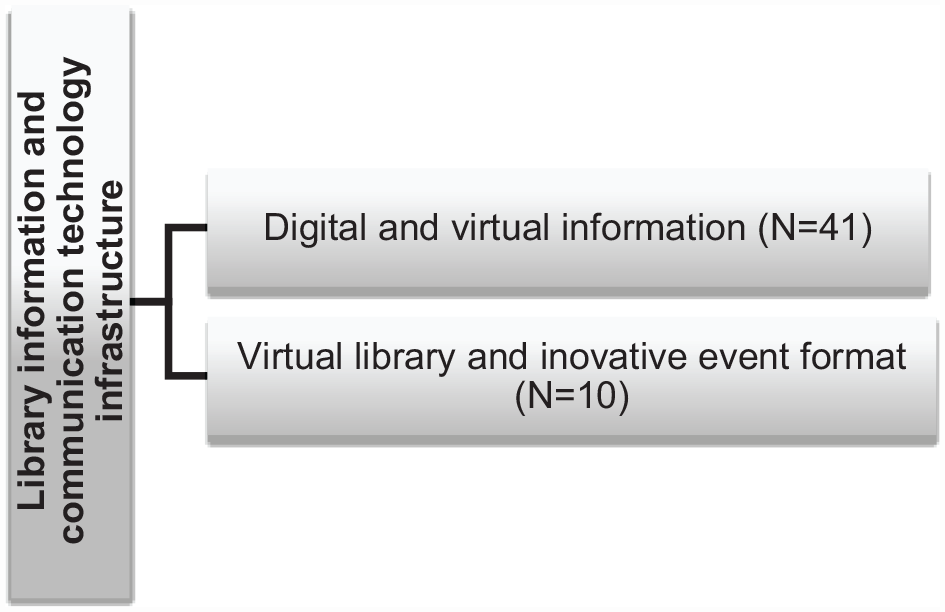
Elements of the library information and communication technology infrastructure.
According to the opinions of the business people surveyed, today’s public libraries could undoubtedly meet the need for digital and virtual information provision, for searching publications, books, databases and/or documents, and for more convenient and faster access to information, which is emphasized by many businesses. An informant suggests that the library should digitize the latest titles and books in the reading room and create a video library to host them: “<. . .> if at least some of the books would go online where you could read them, that would be very important” [SER4]. The other participant emphasizes the possibility to “<. . .> host library publications on the E-platform” [SER21]. The need for “<. . .> live e-help on the e-page, so that a library staff member can be contacted at any time online to guide the information seeker in the right direction” [IND5] was also mentioned. Several representatives from service providers who participated in the survey recommend that the library set up an online section on its website for publications (e.g. books, publications, etc.) and documents, where certain filters, contents, and sections would make it possible to find the necessary information quickly and easily. There are also more specific proposals for innovative services that public libraries could offer for businesses, such as access to specialized databases or documents: “<. . .> e.g. a virtual space created by the library, where it would be easy to find publicly available Lithuanian and foreign government documents related to the construction business” [IND5]; “<. . .> access to specialized databases of business, financial, statistical information is needed” [SER31]; “<. . .> there is a shortage of free access to scientific databases - most certified and original databases are only available for a membership fee <. . .>” [SER30]. A database that organizes and provides the following information would be of interest to start-up businesses: “<. . .> working logs, occupational safety documents, fire safety documents, etc..” [TR2]. Emphasis is also placed on the subscription of books or correspondence, online ordering (“<. . .> it is convenient to receive correspondence you order by email or to receive any useful reading material by e-mail without leaving your workplace” [TR9]) and their delivery and collection from businesses. It has to be admitted that many of the business community members who participated in the survey, when discussing innovative library services for business, strongly agree and recommend moving information services to a virtual space or platform and creating a virtual information portfolio. Moving library content to a virtual space would create a new relationship between the library and the user: the library would “go beyond” the traditional library, and information technology would provide them with new opportunities to manage, store and make documents and other information resources in different formats more accessible and more readily available to the user. This would not only increase the use of public library services in the business community, but also expand the range of new business users of library services.
The qualitative analysis of business managers’ experiences reveals that a virtual library and an innovative format of events could also be an attractive opportunity for the business community to learn more easily and quickly about the services and activities provided by public libraries. Participants in the study give their ideas: “Programmers could develop a library app to make it easier and faster to order and renew books” [SER18]; “”3-D tours <. . .>. Once you go to the library’s website, you could walk around the library to see what changes are happening. If there are artworks on display, admire them. I think this would increase the attendance of the website. Computer scientists/programmers should also be brought in to implement this idea. There would be an opportunity for businesses to collaborate with the library” [IND21], “<. . .> or to create a virtual platform; it would increase the number of readers very significantly, probably virtual ones” [SER4]. Several informants point out that it is a feasible and quite modern perspective for libraries to move and/or offer certain events in the virtual space, e.g.: “Moving library meetings, book presentations to the online space, thus attracting more interested people, as not everyone is able to attend” [SER1]; “<. . .> organizing video scientific conferences, if the library has the right equipment for it” [SER8], etc. As the participants in the study noted, today’s library is certainly competent to develop, for example, an interactive app for guided tours: “<. . .> an app where to find things, what events are taking place and a description of it <. . .>” [IND12] or an electronic platform where businesses could virtually meet young people, present their activities, advertise their jobs and career prospects, and post job vacancies. According to the survey participants, such innovative event formats as live webcasting, online seminars, virtual tours, or even recorded book presentations with celebrity testimonials as short films would enable public libraries to reach qualitatively new levels of performance, increase their visibility, openness to the user, and prestige, as well as stimulate interest and, indeed, the number of business users.
The second category, Library Educational and Cultural Activities, reveals that public libraries are seen by business representatives as social spaces that could contribute to the cultural - social integration, education, self-development, health and well-being of society and the business community. The analysis of the interview data identified two subcategories that elaborate on this category (see Figure 2).
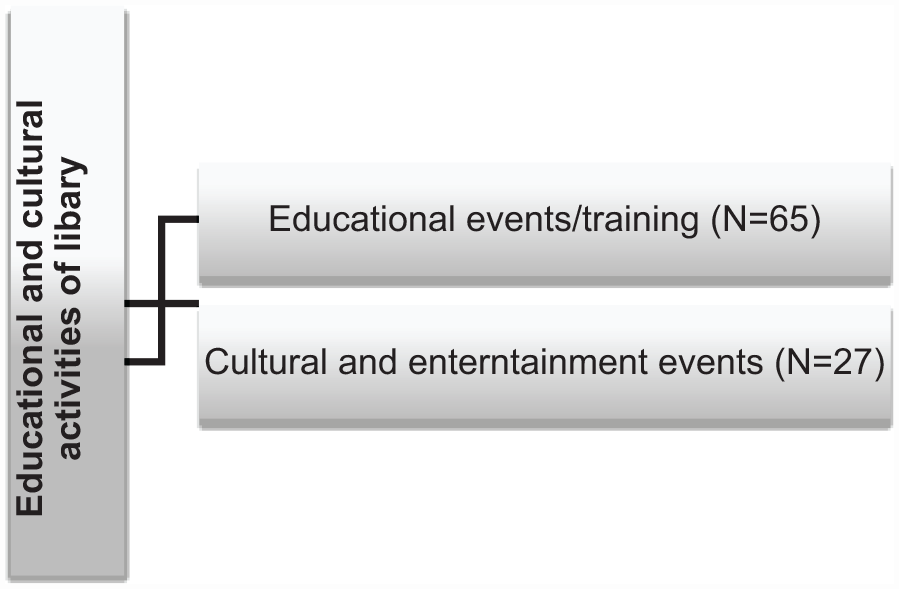
Elements of library educational and cultural activities.
The content of the subcategory Educational Events/Training reveals the thoughts of the representatives of business enterprises on the functioning of public libraries as high-quality educational centers in the North-eastern region of Lithuania, which could organize and provide relevant educational services to various social groups, including the business community. “<. . .> libraries could focus more on the training of the older generation of employees. This could include setting up smart classrooms to train older people in the use of smart technologies. This would help them to remain productive in the labor market for longer” [SER15], says an informant. Another business respondent notes, “Often during the festive season, employees go to theatres, managers buy tickets for a play, so why not treat your employees to something else, such as a library education program or training” [IND12]. This subcategory contains two notable nuances of the informants’ opinions. The library, by taking on the role of a provider of innovative educational services, could offer them to new businesses or those intending to start a business, because, as the representatives of the trading company point out, “<. . .> it would be interesting and useful for new businesses to do some training on business creation, development <. . . .> maybe a series of lectures, a one-day project” [TR14]; “<. . .> the library could offer seminars or lectures for those who are about to start their own business or for those who have failed with their first business. These would be very useful lectures and people would learn or understand where mistakes have been made, gain experience from those who have already tried etc..” [TR15]. On the other hand, the library, in cooperation with businesses, could involve business professionals in the process, who could contribute to the initiative by providing advice and/or training: “Training for manufacturing companies is relevant <. . .>, training in engineering applications by manufacturing professionals” [IND19]; “<. . .> training <. . .> in quality management. Such as 6S, LEAN, etc., with guest expert speakers” [IND27]. These insights lead to the identification of the need for specialized training (production, engineering, quality management) and seminars for employees of business enterprises, which is closely linked to the region’s ongoing business development strategy, reflecting the trends of Industry 4. A second topic that is mentioned quite often is the development of competencies required for managerial work with people and in the service sector. Businesses would like to receive training (including distance learning) on sales, negotiation and conflict management. The training should be delivered by specialists, such as a psychologist, who would share advice on “<. . .> how to better hear and understand the customer and his/her wishes. How to manage conflict situations that sometimes arise” [TR4], “<. . .> how to build a team, how to solve difficulties together, how to maintain mood and motivation <. . .>” [IND19]. An informant representing an industrial company states that “self-development, <. . .> art therapy sessions” [IND21] would also be useful. In assessing the business community’s discussions on the potential of public libraries to provide relevant and meaningful educational/training services for business, several positive aspects can be highlighted: the potential of library staff competences, the use of modern learning spaces, and the development of cooperation with business professionals.
The content of the subcategory Cultural and Entertainment Events reveals that members of the business community are very positive about the potential of public libraries to organize events that they would be happy to participate in themselves or to entrust to libraries. The themes of the events mentioned range from book launches and other new publications, meetings with celebrities, meetings with the most attractive employers in Lithuania, contact finding events for building business networks, team-building parties, and sporting activities such as walking tours. Public libraries could also organize Christmas or themed parties for businesses, organize brainstorming sessions or promote board games. One informant from a service business, based on his company’s practice, recommends that the library should organize movie nights: “I think libraries should have multimedia, cozy rooms with poufs, where movie nights can be held and librarians can suggest films, <. . .> followed by discussion nights” [SER10]. Another informant mentions board games: “they are really popular these days <. . .> and they should be really interesting activities that I think would be really interesting for the employees of many companies to take part in” [SER10]. The cultural events proposed by the survey participants representing business companies are not only seen as a leisure activity, but are also linked to relevant business goals: “The company produces sportswear, so it would be interesting to meet famous climbers, hikers, and athletes who wear the company’s products. They could organize joint events with them for teams, such as a common goal of walking 15,000 steps,” “<. . .> all the participants would dress up in Devold clothing and evaluate whether it is really that comfortable, warm, etc.” [IND15]. It should be noted that a significant number of informants expressed the need for educational events, especially for business and foreign visitors: “<. . .> it is interesting for foreign guests to get to know our region” [IND6], “<. . .> business clients’ educational trips. We have a problem when business partners arrive and want to present a city, region or country but lack information and knowledge” [IND4]. It can be assumed that the insights provided by the business leaders could be a great opportunity for public libraries to expand their services and to offer completely new cultural, educational or recreational leisure programs for businesses in cooperation with travel agencies, information centers or museums.
The content of the category Use of Library Spaces reflects the high level of appreciation among businesses for public library spaces that are modern and suitable for various activities and projects. The analysis of the interview data identified three subcategories within this category (see Figure 3).

Elements of use of library spaces.
Business representatives suggest a number of ideas for using library spaces to attract businesses. One of the possible innovative solutions, according to the survey participants, could be renting or lending library space for various business events, meetings or training sessions. Some of the informants, based on their company’s experience, see the possibility of renting the premises for events or various business gatherings: “renting the premises for events, lectures is very welcome” [SER33]; “renting the premises for a business event, a larger gathering” [IND7], “it would be interesting to have the premises for business discussions, to learn from each other” [IND1]. For others, renting space for training or seminars, conferences is more relevant: “Could rent a computer room for training” [TR6]; “to organize conferences with foreign business clients” [IND27]. One of the service sector managers gives a different suggestion to libraries: “<. . .> to set up spaces where businesses can present themselves and their services” [SER9]. It is worth noting that for the successful development of such new initiatives, the informants’ statements reveal some additional requirements for the library: “<. . . > of course, if they offer such services, they should also offer coffee and snacks, so that the participants are comfortable and don’t have to look for another company to take care of it” [TR6]; “When renting out spaces for business meetings, larger events or presentations to partners, it would be convenient to have a well-developed catering infrastructure, quality coffee and snacks during breaks” [SER32]. Thus, the members of the business community who took part in the survey acknowledge that public libraries are convenient, modern, interesting and attractive venues for business meetings, training or other events, for which they would be happy to make use of the library’s space rental service.
The analysis of the interview data reveals that the informants see similar potential to use public library premises as a temporary workplace (temporary office) for their own staff or for visiting business guests. Many informants agree that this new service would be useful when they have seconded professionals coming to their company and the company is unable to offer them a computerized workplace, or when the employee works on a freelance basis and often remotely. Such a workspace in the library would be attractive “as a private space for visiting business people to work” [IND23] or when there is a seasonality factor, for example, “twice a year when we are looking for staff, <. . .> there are not enough computers in the offices all the time, so if we took on an extra person, an employee, we would have a problem <. . .>” [SER2]. This is a popular practice abroad, where people work remotely, but do not have the facilities to work from home, so they use a temporary office. Informants note that in some cases the temporary workplace should be private, that is, separate from others using the service, and designed for meetings or conferences with “a larger group of people” [TR7] or for “remote working, office work” [IND23]. According to business managers who participated in the survey, such workplaces should be fully computerized, with basic office and technical facilities: “mini-offices, with a desk, computer, printer or other facilities” [TR15]. It is also important in this period to “make mini-spaces for people who do not disturb each other and are safe from covid” [TR15], and to ensure disinfection.
Another new alternative for public libraries to develop cooperation with businesses highlighted by the study participants is a place for business advertising. One of the participants in the study gives an example, which he illustrates from his own experience: “The library needed our services, so the library representative approached us first. In return for the service, they offered to promote our company” [SER28]. The representatives of the service company also share their experience and say that “the library provided space <. . .> for the company’s advertisement on its premises” [SER28], “<. . .> we as a company were given a space in the library for our advertising stand” [SER28]. Another informant sees even more opportunities for cooperation between the library and business: “<. . .> perhaps we can talk about mutual exchange. For example, a business company could support libraries and thus earn the name of a socially responsible business. Libraries could publicize this information in their spaces. Isn’t that good promotion too?” [SER9]. According to the participants, the business community would be interested in using the library infrastructure and spaces for a variety of purposes: direct work, educational activities, business meetings and events, advertising, etc. However, to ensure that this new library service is of high quality and meets the needs of the business community, libraries are challenged to provide catering facilities (coffee, snacks, lunch, etc.).
The fourth category, Partnership of Library and Business, is directly related to the search for new forms and ways of cooperation between public libraries and businesses. The analysis of the interview data led to the identification of two subcategories (see Figure 4).
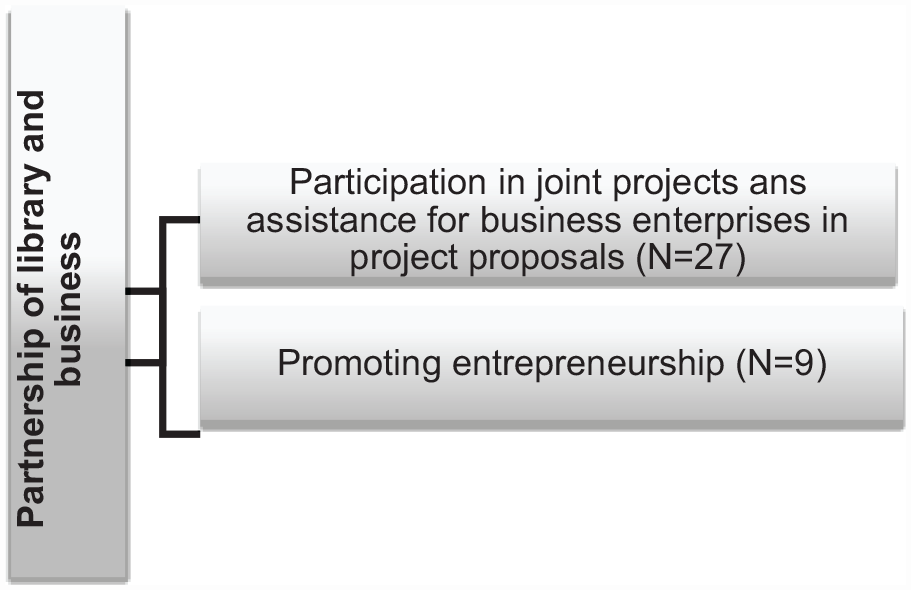
Elements of partnership of library and business.
Project activities are one of the key tools to bring about change in libraries, to renew or expand their portfolio of services, to innovate and to establish new links with other organizations as social partners. According to the informants, both businesses and libraries benefit from participating in joint projects: businesses increase the visibility of their products, while the library expands its social network, attractiveness and number of visitors. The cooperation of public libraries in the north-eastern region of Lithuania with business in project activities is still rather fragmented, but the business community sees many opportunities to join forces and participate in project activities together with libraries. The range of topics for joint projects with public libraries proposed by the businesses participating in the survey is quite broad, as they focus on the specifics of their activities or on the specific competences and “know-how” they possess. In addition, the projects could target a wide range of target groups: young people, seniors, young mothers. For example, a company that provides textile sales and sewing services would see an opportunity to “organize textile training for people in the city, introduce people to fabrics and their structure, perhaps teaching them to sew both manually and mechanically, to teach people the craft, to make clothes <. . .>” [TR12]. For example, a dental services company mentions joint educational projects with the library on oral health and dental care. Another company proposes to organize a monthly beauty week at the library, “<. . .> to introduce beauty trends, promote specific beauty therapy books and other publications, and educate about aesthetic issues” [SER30]. At least a few informants identified joint projects of cultural nature. For example, a gallery shop proposes to organize an exhibition of artworks, where “<. . .> paintings for sale could be displayed, thus encouraging people to buy and admire them” [IND21]. Still others would see an opportunity to join “<. . .> projects for young people in the library, such as various competence-building projects <. . .>, English language courses, English debates, etc.” [SER33], to participate in projects related to “ecology, urban image” [SER21]. It should be noted that the interviews also highlighted the need for assistance from the business community in the preparation of project proposals, which, according to the informants, could be fulfilled by public library professionals: “Our company is interested in filling in applications related to the European Union <. . . .>” [IND7]; “Writing projects is also difficult for smaller businesses, they could help with project proposals and writing” [IND2]; “<. . .> it would save us time if it were done by library professionals who really know what they are doing” [SER18]. The survey shows that, while the participation of public libraries and businesses in joint project activities is interpreted as a potential to strengthen partnerships in the future, it is positive that the business community has trust in the competences of library staff and sees libraries as equal social partners.
The content of the subcategory Promoting Entrepreneurship reveals the innovative suggestions made by the informants for the library to implement the function of business promotion and entrepreneurship education. In other words, “<. . .> a barter exchange” “Business for culture, culture for business” [IND9]. The analysis of the informants’ statements in this subcategory reveals an incentive for libraries to become more involved in or initiate business promotion and entrepreneurship education programs and projects, using a wide variety of tools or instruments suggested by the participants.
Some business representatives recommend involving famous and well-known business people (“<. . .> could introduce us to famous business people in the region, maybe they could start collaborating with each other” [IND2]; “The library could collaborate with business people, who could share their years of experience. <. . .> to communicate and discuss new business opportunities, learn from each other, and promote entrepreneurship in our country” [SER1]; “<. . .> meetings with foreign entrepreneurs, their lectures would help to broaden the knowledge of business development, perhaps help to find like-minded people and expand the circle of friends” [IND1]), who could share their success stories and thus “infect” others with the idea to start a new business, and also increase the visibility of their business enterprises. Other members of the business community who took part in the survey are considering the possibility of setting up a business club in the library, where managers/professionals from different fields of activity could meet and share their experience: “<. . . > sportsmen, entrepreneurs who have created successful businesses and are willing to share their success formulas, rather than sitting in offices and having no contact with the outside world” [IND19]; “Company managers, representatives could share their experience with business people who are not as knowledgeable about business” [IND27]. The proposal is that such a club could even be moved to a virtual space, where “<. . .> it would be possible to take an overview of all the established businesses in the region, categorizing them. This would make it easier and simpler for businesses to mediate or become social partners” [SER30]. A manager representing a service company justified his vision by highlighting the lack of such clubs in the region: “<. . .> there is a great lack of such platforms that bring together both large and small businesses, as well as customers of businesses in the region, to communicate, discuss and help each other, thus avoiding toxic competition and clarifying the services provided by businesses, and public libraries would be the ideal link for that” [SER30]. According to the informants’ opinions, public libraries could become an excellent business meeting place, where not only business but also city communities meet, and where the purpose of these meetings, discussions and idea generation is cooperation, business promotion and entrepreneurship development. As the business community expresses the need for such an initiative, the library could assume the role of initiator, thus contributing to adding value to business.
The qualitative analysis of business community experiences suggests that the accessibility of services provided by public libraries to businesses is not positively evaluated due to the lack of information in the public space or on the Internet. In addition, the lack of cooperation between businesses and libraries is also identified as a barrier. In order to find solutions to this problem, the informants provide a wide range of suggestions and approaches, which are directly related to the fifth category, Increasing the accessibility of libraries. Three subcategories have been identified under this category (see Figure 5).
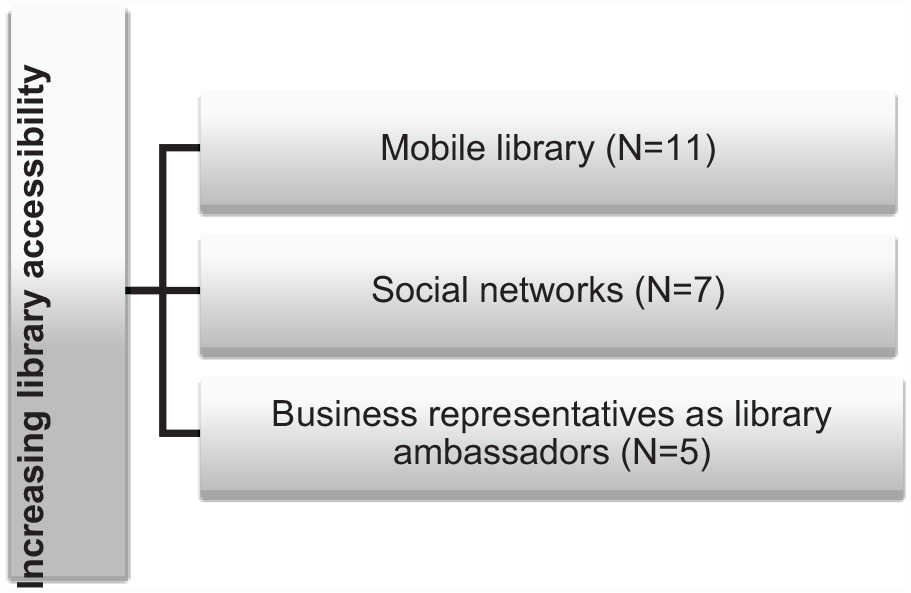
Elements of increasing library accessibility.
The mobile library is no longer identified as an innovation in European or global public library practice, but according to business leaders, public libraries in the north-eastern region of Lithuania could benefit from such a new alternative. The idea of a mobile library would be particularly useful in the business community, with its “always rushed and rushed staff” [SER4]. The informants give quite valuable examples of this possible service for businesses. In one interview, it is stated that “For example, library staff could bring the latest books from different publishing houses to organizations’ festivals and events, or make thematic book reading days or weeks” [SER9]. There is also a need to organize expositions of targeted business and scientific publications/journals in business enterprises, thus familiarizing employees and increasing the number of potential users. The mobile library would allow the library to promote itself and the business enterprises of the north east Lithuanian region. “Employees could order books and the mobile library would deliver them to the workplace” [IND8], “A service such as collection of used and discarded books would also be needed. You don’t want to throw books away because they are very valuable. Libraries provide book collection services, but the books have to be taken to the library itself” [IND7], stated the participants of the study. A participant from the service sector presents a rather original use of the mobile library service and explains his idea: “<. . .> maybe during events, fairs, the presentation, short or 3-D films on a bigger screen in the mobile library could be displayed. <. . .> organizations could produce and run videos of what they do, how they work and it might be interesting for the public to see inside an organization, the workflow, the production of a product, the facilities and equipment, the offices. However, this requires a good internet connection, good image quality, and a bigger screen” [IND21].
Many public relations and marketing experts believe that one of the most reliable ways to attract potential consumers and build a relationship with them is to promote a company’s services and provide information directly to current and, of course, potential consumers through a variety of communication channels and tools. The analysis of the survey data shows that on several occasions the representatives of the businesses in their answers to different questions highlighted the lack of information about the services provided by public libraries. They also admitted that they did not know which information channels and media to use to find information. The subcategory Social Networks is directly related to the new opportunity for public libraries to make themselves known, to publicize their activities and services through modern information channels and to connect with the business community, which spends most of its time in the virtual space. Although social networks are one of the most growing advertising channels recently, the analysis of the experiences of business managers reveals that they are the least likely to be reached by these sources of information about the library’s services. “Facebook, Google+, LinkedIn, Instagram, Twitter and other social networks allow businesses to communicate directly with their customers, but the obvious leader in social networking among Lithuanians is Facebook. Of the more than 80 informants in the study, only four found library information on social networks, but only one of them specifically mentioned it: “Once I saw information about planned library events on Facebook” [SER18]. This confirms that social networking as a new way libraries can make information about their services more visible and publicly available to businesses is very relevant and timely.
The content of the subcategory Business Representatives as Social Ambassadors of the Library is directly related to the support of the business community, as strong partners, in raising the prestige of public libraries and promoting their services to different groups of society. Today, there are many online and digital tools that businesses can use to provide information to their consumers, but there is no denying that word-of-mouth advertising, or what is known as personal contact advertising, is still the most important. The majority of the business managers interviewed say that they found out about the library’s business services “from colleagues working in a subsidiary <. . .>” [IND11]; “from conversations with colleagues in other organizations <. . .>” [SER11]; or “When visiting the library, our company’s employees find out what information is available, if they are interested, we try to match it up with them” [SER18]. An interviewee shares her good experience in more detail: “<. . .> I have friends who successfully organize events by renting the library space, the library is modern and the location is excellent, and it is a win-win situation to attract customers to the library and to promote your business and its services or products. <. . .> I think the best promotion of this place is word of mouth” [SER30]. This indicates that businesses can successfully play the role of social ambassadors for the library by kindly disseminating information and recommending the library’s services to other businesses. “We learned from a colleague. We were very interested and wanted to find out what else the library can offer. Because the only image I have of a library is to take a book to read <. . .>” [IND4]. This would be well served by, for example, a series of events for business, where libraries could share success stories of cooperation with business and present potential services to businesses.
Conclusions
The results of the qualitative research showed that the public library’s ICT infrastructure—digitized latest reading materials, books, video library, creation of a virtual information portfolio and new format of events (live webcasting, remote seminars, virtual tours, etc.) are seen as one of the most relevant services provided by the Lithuanian public library to the business community. The educational and cultural value of the Public Library is perceived by the representatives of business enterprises through the provision of relevant educational/training services, cultural and business events for various social groups, including business. The use of library space—renting or lending library space for various business events, meetings or training sessions, promoting business enterprises or providing a workplace for the community—is seen by the business community as an alternative to developing future cooperation with business.
Business representatives associate the Library’s partnership with business with a new form of cooperation - project activities and the need for assistance in the preparation of project applications, which will allow to strengthen the partnership relations in the future. The business community also expresses the need for the Library to become a business networking space, where companies from different fields of activity can come together and where managers/professionals from different specialties and professions can share their experience, which would promote cooperation and entrepreneurship.
The survey also revealed that Lithuanian public libraries need to increase the library’s accessibility to the business community—not only to provide a space for business events, meetings or trainings, but also to offer mobile library services and the opportunity to actively participate in virtual social communities. The use of modern information and communication tools (e.g. social networks, forums, online discussions, etc.) would allow libraries to promote themselves, their activities oriented toward the business community, and on the other hand, the business community would share information about the projects and/or activities being developed by the library, as well as about innovative and attractive activities for businesses, by playing the role of the Library’s ambassador.
Discussion
The search for the answers to the problematic questions raised in this paper - “what innovative services could a public library offer to business?,” “how could the libraries contribute to the development of mutually beneficial and long-term relationships and cooperation?” - revealed that Lithuanian public libraries are becoming not only a place for storing and lending books, but also an independent space for education, socializing and leisure, a provider of non-formal education and lifelong learning services for communities and for academic and business organizations. The latter trend is well illustrated by the four-space model of the library presented by researchers Jochumsen et al. (2012), which integrates the library’s engagement with society and different communities in line with their goals: to experience, participate, empower and foster innovation by creating spaces for meeting and communication, learning or working, action and inspiration (innovation). However, to become competitive, public libraries must focus not only on meeting the needs of different communities, but also on providing innovative services to the business community.
In particular, research on public libraries in recent years has focused on the value public libraries create for the community and the need for new services (Hicks et al., 2020), the purposes and circumstances of community members’ visits to public libraries (Noh and Chang, 2020), and the factors that encourage and ensure loyal behavior of library users (Tajedini et al., 2020). Researchers and practitioners are also interested in the ways library services are organized and delivered to vulnerable groups (Dowdell and Liew, 2019), while no studies have been found that analyze the demand for public library services from the perspective of the business community. The results of the research conducted by the authors of this paper initiate a new debate from a scholarly perspective that focuses on the changing roles of public libraries in providing innovative services to business communities.
The role of the public library as an information facilitator in partnership with the business community is seen as one of the most important, as it enables meeting the demand for information services (e.g. e-publication ordering and delivery, access to different databases or specialized information resources, a new format of live webcasting of events, virtual tours, etc.) to businesses. A study conducted by US researchers has also shown that the introduction of virtual reality in libraries, through technological tools, can be successfully used as a learning tool to foster social interaction between the library and its community (Lee et al., 2020). This suggests that the business community sees the library employee not as an information expert or teacher, but as a guide agent, able to provide direction and facilitate information searches and as an implementer or integrator of interactive technologies into existing library services.
The role of the organizer of cultural and lifelong learning activities is based on the concept of the library as a center for lifelong learning (Lo and Stark, 2021) or community life (Varniene et al., 2019). According to the insights of the business community, such a role of the public library is significant, but it should expand the offer of such services (e.g. training for manufacturing companies, educational spectacles focused on the specifics of business enterprises, sightseeing tours of the country for business guests, etc.) to business enterprises, which would increase the educational and cultural value it provides.
Project activities have recently been interpreted as one of the main tools for bringing about change in public libraries, transforming their services, introducing and disseminating innovations. The results of the authors’ study suggest that, although the cooperation of public libraries with business in project activities is still rather fragmented, the business community expresses the need for the library as a project partner (e.g. joint educational, cultural, social projects, library assistance in the preparation of project proposals, etc.). The study by Stasėnaitė and Orlakaitė (2018) on innovative services of Lithuanian public libraries through project-based activities also revealed that the library contributes to the development of new skills for future businesses and new career opportunities. The library’s partnership with businesses in project activities would enable the library not only to create and offer innovative and attractive products for businesses, but also to develop cooperation, thus ensuring mutually beneficial, long-term relationships with the business community.
With the ever-increasing number of internet users and the growing demand for e-publications, public libraries need to take on the role of developer of a virtual social network and offer businesses the opportunity to join and actively participate in virtual social communities for work, learning, leisure and collaboration. Researchers Karami and Collins (2019) argue that Twitter is a significant source of easily accessible information about public libraries’ services, events and training, and various social actions. It can be assumed that the use of modern information and communication tools (e.g. social networks, forums, online discussions, etc.) would help Lithuanian public libraries to create a virtual social network, where they would spread the word about themselves, their activities oriented toward the business community, and the business community, as the library’s ambassadors, would share the library’s projects, innovative and attractive activities for business.
Thus, it is worth noting that as public libraries move to the virtual space and focus on providing innovative services to the business community, there is a need for specialists with a different profile than the traditional librarian (e.g. programmers, system administrators, etc.). A study by Ahmed and Sheikh (2021) revealed that the success of improving library services is directly dependent on the ICT skills of library staff, such as computer literacy, information storage and retrieval, and the ability to use a variety of software. It is clear that future research has to focus on exploring the key competencies, based on high-quality, multifunctional knowledge, skills, and attitudes, of librarians and helping them to respond to the expectations of the business community to offer innovative service alternatives.
Footnotes
Declaration of conflicting interests
The author(s) declared no potential conflicts of interest with respect to the research, authorship, and/or publication of this article.
Funding
The author(s) disclosed receipt of the following financial support for the research, authorship, and/or publication of this article: The research was financed by Panevėžys City Municipality, Lithuania.
