



Abstract
The aim of this study is to contribute the knowledge concerning the demands of providing advisory research data management services. This study examines the challenges and expertise required in the day-to-day work of information specialists. The study is based on qualitative semi-structured interviews with six information specialists working in five different university libraries. Qualitative content analysis is conducted to analyse information specialists’ experiences on the challenges and expertise needs for providing research data management services. The challenges discussed by the information specialists were related to staff availability and competencies, client scholars’ attitudes and disciplinary practices, client scholars’ awareness of available services, and the organization and division of labour within data management support services. Areas of expertise include competencies in conducting research, knowledge of policies, legislation and research ethics, technological proficiency, and interpersonal skills. As organizations, research policies, funders, and publishers increasingly demand more comprehensive data management practices, the role of information specialists is to facilitate and support scholars in meeting these requirements. The growing need for services that support complex processes, and diverse disciplinary practices intensify the challenges. Consequently, new areas of expertise, including AI, are required within the profession to respond to these evolving demands.
Keywords
Introduction
Research data management (RDM) is a critical aspect of scholars’ information behaviour. It encompasses systematic practices for organizing, storing, and documenting data throughout its lifecycle, often with the aim of making data available for reuse by others (Borgman, 2017). RDM is essential for ensuring that research data is collected and utilized in a responsible, transparent, and efficient manner. In recent years, RDM has been increasingly shaped by organizational and political mandates, which require scholars to submit data management plans and archive their data (Cox et al., 2019; Van Den Eynden and Corti, 2020). However, fulfilling these requirements can be challenging. For scholars’ various policy requirements may feel overwhelming and just another task in their already busy schedules. Moreover, data practices vary significantly across disciplines (Borgman, 2017; Khan et al., 2023; Xu, 2025).
To support scholars in their work, academic libraries have established new RDM services. These services include both advisory and technical support, such as consulting on data management plans and setting up institutional data repositories (Tenopir et al., 2014, 2017). Although most studies highlight the success of these RDM services (Ho et al., 2026), various challenges have also been identified. These include limited resources, underdeveloped infrastructures, complex partnerships with diverse stakeholders, and a shortage of skilled personnel (Cox et al., 2019; Sheikh et al., 2025). Key skill areas requiring further development include data curation, information and communication technologies (ICT), research and disciplinary expertise, legal and policy knowledge, and research integrity (Cox et al., 2019). While several models and frameworks have been proposed to organize and assess the maturity of RDM services, more empirical research is needed to understand their ongoing implementation (Hackett and Kim, 2024).
The aim of this study is to contribute the knowledge concerning the demands of providing advisory RDM services. This study examines the challenges and expertise required in the day-to-day work of information specialists. Given the evolving nature of RDM services and the lack of qualitative research on this topic both in Finland and internationally, empirical research is needed to better understand and support the development of these services. In Finland, there have been substantial efforts in developing the RDM support services, yet research about how the services function is limited. The analysis is based on qualitative, semi-structured interviews with six specialists working across five university libraries in Finland. The research questions guiding this study are:
The article is structured as follows. First, we present a literature review of recent research on library-based RDM services, followed by the challenges and needs identified in the field. Next, we describe our data collection and analysis methods, followed by the study’s findings. The article ends with a discussion and conclusions.
Literature review
Research data management services
Research data management (RDM) has become an increasingly important aspect of scholarly work as datasets are digitalized and new data protection regulations and open science policies are implemented (Akers and Doty, 2013; MacMillan, 2014). Research funders, publishers, and research organizations now call for more comprehensive data management practices. For instance, funders often require scholars to submit data management plans that systematically outline how research data will be collected, organized, and shared throughout the project. Journals, on the other hand, may mandate data sharing, although policies vary across disciplines (Rousi and Laakso, 2020). Meeting these requirements is a demanding task, and scholars often need assistance and training. However, disciplinary data practices and needs differ significantly (Xu, 2025). Top-down policies have also led to resistance among scholars, who may feel alienated from these mandates (Lilja, 2021). In response, research organizations have begun offering RDM services to support researchers (Ho et al., 2026).
RDM services, also referred to as research data services, include support for organizing, storing, preserving, sharing, and reusing research data (Ashiq and Warraich, 2023). Academic libraries have played a key role in providing these services, as they are considered natural stakeholders in the process due to their traditional expertise in preserving library collections (Ducas et al., 2020). This development has led to the emergence of new professional roles and areas of expertise, such as data librarians (Ashiq and Warraich, 2023). The work requires demanding information-related skills aimed at ensuring the professional and careful management of data throughout all stages of the research process.
In the context of RDM, academic libraries offer both technical and advisory services. Technical services include, for example, the establishment of institutional data repositories, while advisory services involve consulting on data management plans, providing training, and creating guides to help scholars and students access and manage data (Tenopir et al., 2014, 2017). Nevertheless, the successful delivery of RDM services depends on collaboration with other units, including ICT services, legal teams, and research administration (Cox et al., 2019).
Challenges in providing RDM services
Earlier studies have identified several challenges faced by libraries in providing RDM services (Ashiq and Warraich, 2023; Cox et al., 2019). The most commonly reported challenges include a lack of skills and resources (Ashiq and Warraich, 2023; Cox et al., 2019). As RDM remains an emerging service in many academic libraries, both resources and expertise are still being developed to fully meet researchers’ needs. A lack of engagement from academic staff has also been noted, as disciplinary cultures, particularly regarding data sharing, vary significantly (Cox et al., 2019). For example, in the social sciences and humanities, data sharing practices are still evolving, and concerns related to personal and sensitive data persist (Khan et al., 2023; Late et al., 2024). Other common challenges include collaboration with other support services and underdeveloped infrastructure (Cox et al., 2019).
Expertise requirements in providing RDM services
To further develop RDM services, studies have investigated the expertise required (Sheikh et al., 2025). Providing these services demands a wide range of skills, including data curation, stewardship, governance, data literacy, quality assurance, and citation management (Tenopir et al., 2015). While traditional librarianship skills, such as information management and literacy, are considered relevant to RDM support, a key challenge lies in translating these competencies into the RDM context (Brochu and Burns, 2019; Sheikh et al., 2025). In addition to technical expertise, interpersonal skills such as strategic thinking, relationship management, leadership, advisory capabilities, and communication are increasingly recognized as essential for service provision (Matteson et al., 2016). Moreover, the evolving nature of RDM requires continuous skill development (Cox and Pinfield, 2014). Therefore, ongoing empirical research is needed to understand and support the development of these services.
Research methods
For the purposes of this study, research data were collected through qualitative, semi-structured interviews with six information specialists working in five university libraries in Finland. The interviews were conducted between May and June 2025, either face-to-face (2) or online (4), with online interviews preferred due to the geographical distribution of the participants.
Participants were selected through purposive sampling, using recruitment via personal contacts, web searches, and recommendations from other interviewees. We targeted information specialists whose work responsibilities included RDM services. By recruiting participants from different universities, we aimed to obtain rich data reflecting perspectives from diverse institutional contexts.
Prior to the interviews, participants were provided with information about the research project, including a privacy notice, and informed consent was obtained according to the Ethics Committee of the Tampere University guidelines. Analysed dataset is not openly available because all participants did not give their consent for data sharing. Most participants had extensive experience in consultative RDM services (five with more than 4 years of experience, one with 1 year). Their tasks included providing data support to researchers (6), consulting on data management plans (6), participating in ethics boards (5), and teaching research data management (5).
The interviews aimed to collect examples and gain an understanding of the current state of library RDM services from the perspective of data specialists. Based on themes identified in earlier literature (Ashiq and Warraich, 2023), the interview guide was developed and piloted. No critical issues were identified during the pilot interview; therefore, data collection proceeded as planned. The pilot interview was included in the final dataset. The interview guide consisted of three sections. First, participants were asked background questions related to their professional duties as information specialists, including typical tasks, length of experience, and collaboration practices. Questions also addressed the role of libraries in providing RDM support and recent changes in these services. The second section focussed on service provision related to social media data and data protection issues. The third section explored the expertise and skill needs of information specialists. This article primarily analyses data from sections 1 and 3 (see Table 1), although all relevant material was considered in the analysis. Data from the second section of the interviews will be examined in a separate publication.
Interview questions most relevant for the analysis.
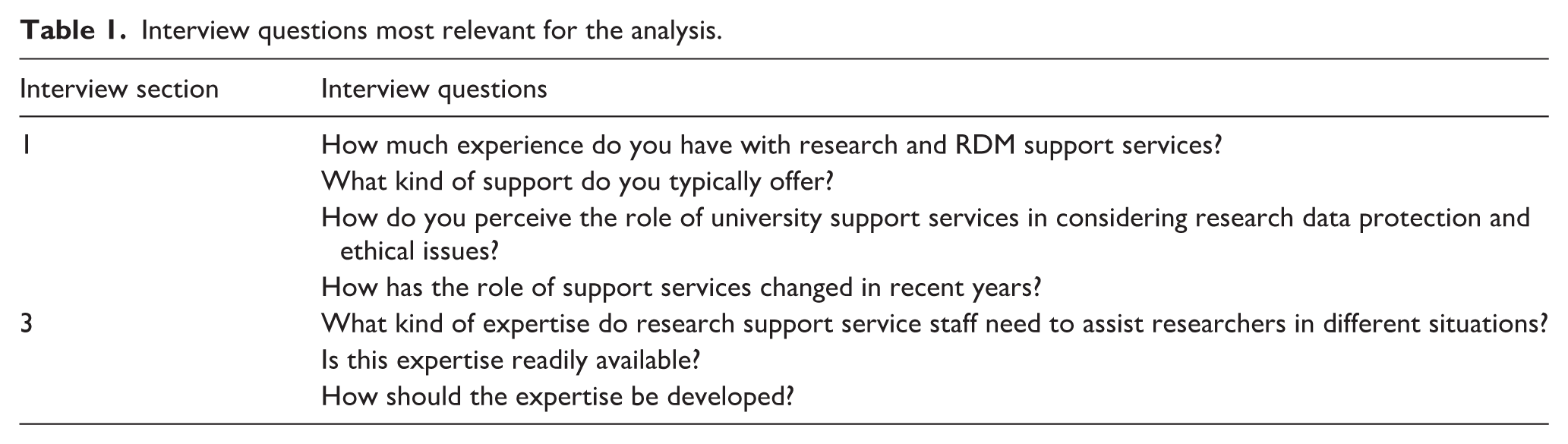
On average, each interview lasted 81 minutes, resulting in a total of 8 hours and 5 minutes of audio data. The recordings were transcribed for analysis. The data were analysed using qualitative content analysis (Strauss and Corbin, 1990). First, the transcripts were read multiple times to become familiar with the content. Second, sections relevant to the research questions (RQ1: challenges faced; RQ2: expertise needs) were identified and coded using Atlas.ti software. Third, themes related to RQ1 and RQ2 were inductively coded, followed by the development of broader categories, which are described in the findings. Excerpts from the interviews were selected to illustrate key points. These excerpts were translated from Finnish to English using DeepL Translator and edited as needed.
Findings
Challenges for providing RDM support
The challenges identified by the information specialists include limited staff availability and expertise, scholars’ attitudes and disciplinary practices in RDM, scholars’ lack of awareness of available services, and the organization and division of RDM tasks.
Staff availability and expertise
All interviewees had observed a growing demand for RDM services, driven by requirements from research funders, academic journals, and research organizations. Data management plans mandated by funders have become a formalized practice, with libraries playing a dual role: supporting researchers in drafting the plans and reviewing their quality.
Additionally, the need for consultation on ethical review and data protection issues has increased. This trend is influenced by the rising use of various types of digital research data, such as social media data, that often include personal information. Data protection legislation, such as the General Data Protection Regulation (GDPR) in Europe, has further accelerated the demand for support in navigating data protection concerns. Scholars are also becoming more aware of these issues and are increasingly seeking assistance from RDM services.
It is growing almost exponentially, as we have succeeded in making ourselves known and needed, and now it is beginning to feel like a mistake with the resources we currently have. Last year, we received 1,500 emails to our support address. Before that, we received 1,000, and before that, 500 per year. P3
These developments have been reflected in the allocation of staff dedicated to RDM services. However, in Finland, there is a lack of formal education in data stewardship, and relevant skills are typically acquired on the job and developed in practice. Traditional library and information science education does not necessarily meet the evolving needs of information specialists working in RDM. As a result, recruiting experienced staff on an ad hoc basis can be challenging. Furthermore, as RDM services have expanded and the questions posed by researchers have become more complex, the demands on staff expertise have increased. Information specialists are now required to possess multi-disciplinary competencies, including an understanding of various research methods, data types, tools, legislation, and licencing frameworks, among others.
Then perhaps it feels like you have to be an expert in so many areas [. . .] maybe people here in this organization think, the library takes on all these areas quite naturally and then support them, it feels a bit like you have to be really knowledgeable about many things, and then data management also plays a role in many things. For example, citizen science is a broad thing. P1
Overall, the information specialists highlighted the challenge of managing a wide variety of cases in terms of types of data and research settings, each requiring distinct expertise. Routine responses were rare, and most cases needed to be addressed individually. For example, social media data was considered particularly challenging due to the diversity of platforms and the variation in legislation across countries. The absence of national guidelines and legal precedents further hindered their ability to support researchers effectively.
I've noticed that I feel constantly anxious about social media, because I'm not active on it myself, so I think the challenge is that there are so many different channels. They change and evolve over time. Then, of course, there are different types of research, which may involve going through some interface to collect mass data, and then there are these small qualitative studies, and the level of sensitivity varies. And then, when there aren't necessarily clear instructions or clear interpretations, I feel like I'm just spinning things around. And I'm not saying anything very clear to our customers. Maybe they're even more confused about things after consultation. P5
Scholars’ attitudes and disciplinary practices
Another challenge relates to scholars’ attitudes, awareness, and expectations regarding RDM. Experiences with scholars’ engagement in RDM services varied among the interviewees. On one hand, scholars expressed appreciation for the support provided; on the other hand, underlying scepticism towards RDM was evident. For example, some scholars have voiced frustration with the requirement to prepare data management plans, perceiving them as bureaucratic tasks that hinder the progress of actual research.
Well, that's how it is. Maybe it is a lack of understanding why these things matter, that maybe you feel like this is just an extra work step or a burden that you just have to get through at some point to take care of all this boring information. So there's a bit of an attitude problem there too. P6
Additionally, some scholars may fear that data support services will question or reject their research designs and data collection methods, leading them to avoid seeking assistance.
I think that we conduct a lot more social media research than people dare to ask about, because they are afraid that it will be banned. P3
Sometimes, scholars do not fully understand the workload or time required for RDM. It is often treated as a task to be completed at the end of the grant writing or publication process, typically under tight deadlines. This can create pressure for both researchers and support staff. As a result, information specialists actively work to raise awareness about the RDM process and the time commitment it demands from researchers.
I wish I could control expectations. The statement will not be ready in three days. It is a terrible disappointment if you are starting your data collection in three days. Don't make plans like that. It kind of requires clarity and consistency on our part in terms of communication, that we have to do this so that we can get through this process together. P4
Understanding different disciplinary practices also poses challenges. When providing RDM support, it is important to understand the language and research methods specific to each discipline. This requires ongoing dialogue with researchers to build collaborative relationships. Furthermore, disciplines may differ in their approaches to data management and attitudes towards issues such as data protection. Competition for research funding and pressure to publish can lead researchers to overlook data protection concerns or make unrealistic promises about data sharing simply to meet funder requirements. Clearly, some disciplines have more established RDM practices, while others lack clear guidelines and experience especially when it comes to dealing with personal data.
It is definitely difficult to discuss data management with humanists, because humanists, as I said, don't have data, they don't understand how this relates to them, so it's based on their own research background and drive. Experience is definitely useful in being able to act as a kind of translator between the language of data management and the language of research. P2 And then there's the atmosphere in that discipline. I mean, in business studies, there's this kind of efficiency mindset that we don't have time to stop and ask for consent, because people in [other university] don't ask either, and they get more done than we do, and then we just listen from the sidelines, “But that's an insult to research integrity, like, do you want to hear this or not?” So, in some fields there's a genuine attitude problem, while in others it's just incompetence. P3
Scholars’ lack of awareness of available services
From the perspective of information specialists, a key challenge is how to reach out to scholars and convey the importance of RDM, particularly given the potential legal and ethical consequences of neglecting data management issues. Designing services and processes that align with scholars’ workflows and genuinely support their research is both demanding and essential. Increasing awareness and visibility of RDM services is crucial, as these services are often readily available, yet not all researchers are aware of them.
And probably the fact that the DMP would result in documents that are actually useful, because I believe that at the moment, they are just copying and pasting stuff that they think the funder would like to read. P4 The university needs to develop processes to ensure that researchers don't end up telling their colleagues that they can't submit an application to the ethics committee because it takes six months to process and there are 17 lawyers tearing it to pieces, so there is such a persistent misconception about what it is like from the perspective of those who have not done this. It's about spreading awareness. P3
Organization and division of RDM tasks
Another challenge concerns the division of responsibilities and roles among different actors involved in RDM support. RDM services are typically provided in collaboration with IT departments, legal services, and ethics boards, with the library often serving as the first point of contact for researchers seeking assistance. While the division of labour is generally well established, tensions may arise regarding the boundaries between the responsibilities of library staff and research staff. Information specialists recognize the pressure scholars face in acquiring knowledge about emerging RDM-related issues. However, questions remain about the respective roles of libraries and research staff, such as supervisors, in educating researchers on topics like research methods and data collection techniques. Many information specialists feel that responsibility is frequently shifted to the library, even when library staff may lack the necessary expertise or resources to fully address these needs. Library-led training is typically targeted at early-career researchers, yet senior researchers also require support to navigate new RDM requirements. The role of staff scientists or data managers was also brought up to support RDM at the project level.
I think it would be wonderful if we could get someone like a postdoc or staff scientist hired as a data
Expertise needs for RDM support
When discussing the expertise needed to provide RDM support services, interviewees emphasized skills related to conducting research, technological expertise, understanding of policies and legislation, and interpersonal skills.
Research skills
All interviewees highlighted the importance of research experience, noting that a basic understanding of how research is conducted is essential for delivering meaningful support. This includes expertise on disciplinary practices and ethical guidelines. Expertise and skills in computational research were emphasized. In fact, most participants had backgrounds in academic research but mostly in social sciences and humanities fields.
Many of my colleagues have a background in the humanities. This means that we are quite good at working with qualitative data, but when it comes to raw quantitative data, such as understanding algorithm code and what is actually happening there, we could be better. P3
Technological expertise
Artificial intelligence (AI) was frequently cited as a transformative factor in RDM. AI is influencing how research data can be collected and analysed, and scholars are already using large language models to generate data management plans for example. Therefore, information specialists advising RDM need expertise of emerging technology and AI, for example, which AI tools can be safely used for research purposes and what types of data can be analysed using the applications. Understanding issues related with personal and sensitive data and data protection in general are crucial in advising the use of AI tools. However, the interviewees remained cautious in assessing the impact of AI on their work.
Artificial intelligence is probably now [an important point of development]. . . I mean, I can't really assess how it affects the work in general, but it can probably affect my own tasks in many ways. The fact is that researchers will certainly make more use of AI in the future, which could be really interesting, how it will manifest itself in these kinds of tasks, so I think we should keep an eye on it. P1
Policies and legislation
Information specialists also need knowledge about the organization of research, particularly regarding funders’ and publishers’ policies. Citizen science was mentioned as an emerging topic influencing RDM demands. Knowledge of legislation, particularly GDPR and other EU data policies, was considered essential, as these are closely tied to data protection issues. Although university legal departments are primarily responsible for handling legal matters, such questions frequently arise in the daily work of information specialists. As a result, interviewees expressed a need for low-threshold access to legal experts within their teams to provide legal advice from an RDM perspective.
In other countries, DMPs don't necessarily deal with legal issues at all, they don't necessarily deal with GDPR requirements at all, it's a completely separate thing.But because in Finland the DMP base includes the GDPR, we have to be able to advise on GDPR matters. P4
Interpersonal skills
As RDM support services are inherently customer-oriented, interpersonal and communication skills were considered essential. Information specialists emphasized the importance of providing solution-oriented services that genuinely assist scholars in conducting their research. They also highlighted the need to understand the realities of researchers’ work and to approach their situations with empathy. As one interviewee described, her goal was to act as a “calming element” in a process that can often be stressful.
Skill to reading people a little bit [. . .] researchers may be in a state of panic or feel terribly rushed and hurried, so you have to be the calming element who says, hey, don't worry, everything will be fine. Or if there are unpleasant encounters, you know how to act professionally and diplomatically. P1
All interviewed information specialists emphasized the importance of collaboration in RDM services, noting that no single person can provide support across all related areas. Therefore, information specialists must maintain functioning networks with various stakeholders involved in RDM support and be able to identify the specific expertise of different actors in order to know whom to consult when needed. Information specialists have also observed a cultural gap between legal advisors and scholars. Collaboration challenges often stem from time constraints and the fact that legal professionals may lack research experience, which can result in overly rigid or abstract responses based on legal references. Consequently, information specialists often find themselves acting as intermediaries, translating between legal and research perspectives.
A big role in my work is that I act as an interpreter between the researcher and the lawyers, or the researcher and the ethics committee, or the researcher and the data protection officer, trying to convey to the experts what the researcher really intends to do and wants to do. And then, on the other hand, I try to convey that response back to the discussion, because they speak a completely different language, especially if we have to deal with lawyers. P3
Discussion
This study analysed the experiences of information specialists in providing advisory support in RDM to scholars across various disciplines. The research was based on qualitative interview data collected from specialists working in five university libraries. The analysis focussed on the challenges (RQ1) and expertise requirements (RQ2) identified by the specialists in the course of their work. Our findings largely align with previous studies (Ho et al., 2026; Sheikh et al., 2025), offering up-to-date information and qualitative insights into the day-to-day practices of information specialists.
Challenging role of data specialist
The challenges (RQ1) discussed by the information specialists were related to staff availability and competencies, scholars’ attitudes and disciplinary practices regarding RDM, scholars’ awareness of available services, and the organization and division of tasks within RDM support.
All the universities represented in the interviews have witnessed a significant expansion of RDM services over the past 5 years, which has led to an increase in staffing. However, universities in Finland have not yet established formal degree programs dedicated to educating RDM specialists, resulting in a shortage of experts in the field. Consequently, many specialists have acquired their expertise through workplace learning, self-study, and in-house training. Similar observations were made in an earlier study conducted already in 2012 (Faniel and Connaway, 2018), indicating a continued need for development, for example in library and information science programmes, to incorporate data stewardship. This finding also reflects the evolving nature of RDM services, where continuous skill development is essential (Cox and Pinfield, 2014).
An interesting finding from the study concerns disciplinary practices and attitudes towards RDM. Information specialists observed that researchers often perceive RDM, particularly the preparation of data management plans, as a bureaucratic obligation. As a result, specialists may face challenges in persuading scholars of the value and importance of RDM. One contributing factor may be that RDM support does not align well with researchers’ existing workflows. When RDM requirements are framed primarily as compliance obligations, researchers rationally minimize time spent on them. In such contexts, advisory services remain peripheral unless they are embedded into everyday research routines and aligned with what researchers perceive as immediate payoffs. Therefore, developing the services in collaboration with researchers is important (Sendra et al., 2026). Llebot and Rempel (2021) discuss the disciplinary cultures and importance of providing services also for research groups where RDM practices are often created. Placing a RDM expert in research groups would make the support activities closer to the actual work and help in making the RDM part of daily research processes. Indeed, collaborative nature of RDM practices is an interesting topic for future research.
Our data also highlighted disciplinary differences in scholars’ understanding of data protection and research ethics. Although earlier studies have often emphasized the underdeveloped RDM practices in social sciences and humanities (Tenopir et al., 2015), these fields have established practices for dealing with personal data for example. In other disciplines, where data sharing might be more common (Khan et al., 2023), understanding RDM from the perspective of personal data and data protection may be less developed. This suggest that “RDM maturity” is multidimensional and should not be reduced to openness or sharing frequency. Furthermore, various policy requirements from funders, publishers, and institutions may pressure researchers into making unrealistic commitments regarding data sharing. Also, earlier studies have witnessed the normative pressure for data sharing (Kim and Adler, 2015; Late et al., 2024). Therefore, the development of RDM policies should take disciplinary differences in knowledge production into account and maintain realistic requirements that are sufficiently flexible to accommodate disciplinary diversity.
At the organizational level, challenges relate to division of labour and growing expectations for expanding RDM services. Information specialists reported feeling pressure to provide broader support, including educating scholars not only on RDM but also on research methods. However, available resources and expertise do not always meet these demands. As a result, interviewees advocated for the inclusion of staff scientists or data stewards within research groups to address discipline-specific questions and provide more nuanced RDM support. Previous studies have also examined the distribution of responsibilities among various actors involved in RDM support (Perrier et al., 2018; Sendra et al., 2026). Cox et al. (2019) identified embedded roles, such as staff scientists, as representing the highest level of maturity in RDM service provision. Whether this responsibility should fall to the library or another unit, adequate resources must first be secured. Further, the current organization of the support services may be too far from the researchers work and therefore ineffective or underused.
New areas of expertise needed
In relation to RQ2, information specialists identified several areas of expertise as requirements for future RDM service provision. These include competencies in conducting research, knowledge of policies, legislation and research ethics, technological proficiency, and interpersonal skills. Next, we will discuss these needs in relation to expressed challenges.
Providing RDM support was described as demanding work that requires multi-expertise. Particularly when support is offered across various disciplines, knowledge of disciplinary practices, research methods, and diverse data types is essential. This expertise is evident for tackling challenges related with serving various disciplines and support the use of various types of data and methods. If library RDM support services are appointed new tasks such as teaching research methods, this expertise will be even more crucial. However, also previous studies have shown the insecurities information specialists have for broadening the services towards method education (Perrier et al., 2018; Sendra et al., 2026). Future research should follow this development and the expertise needs related with new roles of information specialists.
As various policies, mandates and legislations are guiding RDM, information specialists need expertise on the landscape. Although, university legal experts are available for supporting scholars, information specialists need to be aware of the development and guide the scholars. Therefore, this expertise helps for overcoming challenges related with collaboration and task division. Other studies have also recognized the challenges in collaboration (Sheikh et al., 2025). Interesting observation was also the specialists’ role as interpreters between scholars and lawyers helping them to understand each other. Indeed, speaking the same language with different stakeholders is important for creating working relationships.
The need for technological expertise was frequently emphasized, as many information specialists come from humanities backgrounds. As various earlier studies have identified need for IT skills (Ho et al., 2026; Sheikh et al., 2025), AI skills were mentioned by all interviewees as an emerging area in which specialists require further expertise. Researchers are already integrating various AI tools into their workflows, for example, in data analysis and writing, resulting in both positive and negative implications (Chubb et al., 2022). It is therefore evident that AI will influence the future demands of RDM support, especially in areas such as data protection and research ethics (Azeroual and Schöpfel, 2025). However, this topic remains underexplored in empirical research, and a deeper understanding of the role and requirements of RDM support in the context of AI is urgently needed.
Interpersonal skills emerged as an important area of expertise in RDM support work. Prior studies have likewise emphasized the role of “soft skills” in RDM support, linking them to workplace effectiveness, leadership, and research and teaching competencies (Andrikopoulou et al., 2022; Matteson et al., 2016). This emphasis is unsurprising, as RDM support is fundamentally a service-oriented activity in which collaboration, clear communication, and empathy are central. These skills may be particularly important given evidence that data management responsibilities can evoke negative emotions among scholars (Gregory et al., 2026). Recognizing and developing interpersonal competencies may therefore help increase awareness and uptake of RDM services and support closer alignment with scholars’ everyday workflows.
Limitations
This study has certain limitations. First, it is based on interview data from six information specialists working at five universities in Finland. Previous research has highlighted differences in RDM services across organizations and countries (Cox et al., 2019; Nahotko et al., 2023). While addressing issues across organizations, this study does not touch upon international research supports. Future research should therefore focus on additional countries and pursue international comparative approaches in order to account for country-specific requirements in RDM service provision. Additionally, the primary focus of the interviews was on data protection issues related to social media data, which may have influenced the context of RDM services analysed in this paper. Because interviews foregrounded data protection issues related to social media data, participants may have emphasized legal/ethical concerns over other aspects of RDM (e.g. long-term preservation, metadata quality, infrastructure constraints). Moreover, as participants were library-based specialists, the data may underrepresent views from IT units or embedded research-group roles. Future studies could triangulate perspectives across stakeholder groups. Nevertheless, the interview data provides timely and valuable insights into the challenges and expertise needs in RDM work from the perspective of specialists engaged in these issues in their daily practice.
Conclusions
As organizations, research policies, funders, and publishers increasingly demand more comprehensive RDM practices, the role of information specialists is to facilitate and support scholars in meeting these requirements. The overall aim is to foster high quality and responsible research. The study shows that this work is challenging due to the growing need for the services that support complex and evolving processes and diverse disciplinary practices. The challenges are overlapping and feeding each other related with researchers’ needs and practices and organizational structures and resources directed to RDM support and policies and mandates regulating the services. Consequently, new areas of expertise are required within the profession to respond to these evolving demands.
The findings of the study indicate topics for future research including the role of AI in RDM services, disciplinary differences and stances for RDM, and the developing expertise areas in RDM support services. The practical implications of the findings highlight the need for further development of higher education provision in the area of research data management in order to address both the challenges and the expertise needs identified. Also, the integrating the experts into the research groups may help adopt RDM into researchers’ daily work practices.
Footnotes

Ethical considerations
Following the guidelines given by the Ethics Committee of Tampere Region ethical approval process was not required, as the study participants were all adults, and no sensitive information was collected. Prior to the interviews, participants were provided with information about the research project, including a privacy notice. Head of Administration of the Ethics Committee of the Tampere Region Heikki Eilo,
Consent to participate
Informed consent for participation in the study, data collection, and publication was obtained from all participants. In accordance with Tampere University guidelines, consent was given verbally prior to data collection.
Consent for publication
Not applicable. The manuscript does not include any identifiable data from an individual person. Excerpts from the transcribed interview data are pseudonymised.
Funding
The authors disclosed receipt of the following financial support for the research, authorship, and/or publication of this article: This work was supported by the Research Council of Finland, grant number 351247.
Declaration of conflicting interests
The authors declared no potential conflicts of interest with respect to the research, authorship, and/or publication of this article.
Data availability statement
Data analysed in this study is not openly available.