




Abstract
This research is the result of 30 interviews with middle-management and senior executives from several different organizations in Madrid. The focus was on different aspects of time use in a professional context:
Monophasia or polyphasia, Time tangibility Attention to people.
The results indicate that the work style of modern executives in Madrid does not fall clearly into the category of a polychronic (P-time) culture (Hall, 1959, 1976, 1981 & 1990) on all the three dimensions, if it ever did so. Spanish business culture in Madrid was found to be definitely polyphasic, more time tangible than was expected, and stressed the aspect of attention to people as a work style.
Theoretical background
Perceptions of time
Differences in perceptions of time have become increasingly recognized as a source of misunderstanding, confusion or even conflict in the realm of cross cultural communication. Is our time orientation present, future, or past? Do we perceive time as cyclical or as a Roman road stretching endlessly from the past into the future? Is the focus on events or on the ticking of the clock? These are some of the questions posed to determine individual and cultural differences in the area of time perception and which have been documented by anthropological researchers such as Durkheim (1937 [1895]: 107), Landes (1983) and Flaherty (1999) who have demonstrated how the individual's temporal experience is formed by their social environment. The Anglo-Saxon and Northern European cultures view time as an asset to be spent and saved (Adler, 2002; Hall, 1976; Hofstede, 2001; Trompenaars & Hampden-Turner, 1998). Conversely, there are cultures which attach more significance to relations and consider that events transcend the importance of deadlines (Hall, 1976; Trompenaars & Hampden-Turner, 1998).
Monochronicity versus polychronicity
Edward Hall (1959, 1976, 1981 & 1990) was the first to classify cultures as either monochronic or polychronic. He defined monochronic cultures as those which were monophasic, one-thing-at-a-time oriented; time tangible or precise in relation to punctuality, schedules, deadlines and whose attention to people at work, tended to be limited to the formalized settings of meetings and schedules. Polychronic cultures, on the other hand, were polyphasic, favoured combining activities and projects, flexible or imprecise about punctuality, deadlines and schedules and valued devoting time and attention to people at work. Hall was concerned with explaining to his fellow Americans, Anglo-Saxons and Northern Europeans whom he claimed shared a monochronic orientation, how the contrary time orientation, the polychronic, shared by most other cultures, was not an arbitrary manner of behaviour, but a system based on the values of flexibility, multiple focus and people orientation. Hall's analysis assumed that monochronicity and polychronicity were isomorphic, that cultures had a tendency towards one or other orientation on all of the three dimensions: the combining or not of activities, time tangibility and the value attached to attention to people.
Questions of definition
Definitions of time tangibility have caused no discrepancies, it simply refers to precision in the use of time or the lack of it, intangibility. But the other two dimensions have provoked more debate. Polyphasia (originally referred to by Hall and others as polychronicity) has been defined by Bluedorn (2002) as ‘the extent to which people prefer to be engaged in two or more tasks simultaneously and are actually so engaged’. More recently, Poposki, Oswald and Chen (2008) have developed a new definition which states that polychronicity (polyphasia) is a non-cognitive variable reflecting ‘an individual's preference for shifting attention among ongoing tasks, rather than focusing on one task until completion and then switching to another task’. Both these definitions assume, in the main, a ‘preference’ for such systems of combining activities and it may well be that in some cultures this is not so much a preference as a ‘necessity’, stemming from the inherent characteristics of a culture's mode of working. The third dimension the value attached to ‘attention to people’ has tended to be redefined as high or low context. Context refers to communication style; to the extent to which a message is directly communicated, ‘low context’ or indirectly, ‘high context’. Although Hall discusses high and low context in some detail, he does not refer to the role of people in polychronic cultures as simply being characterized by high context. He makes it clear that members of those cultures not only tend to be high context; but further than that, he emphasizes that the role people play in organizations in these societies is outstanding for their involvement and inclusion. ‘They (P-time systems) stress involvement of people and completion of transactions rather than adherence to present schedules', (Hall, 1976: 17) or ‘Their (polychronic cultures) action chains are built around human relations. To be too obsessional about achieving a work goal at the expense of getting along is considered aggressive, pushy and disruptive’ (p.150). So, he is referring not only to a high context style of communication, but also to norms which surround the way people are treated, dealt with and attended to. Somehow this dual focus has been lost over the past 30 years.
More recently the isomorphism of the orientations was challenged by the work of Palmer & Schoorman (1999) who wondered if perhaps Hall's original classification had become outmoded as a consequence of the spread of the global market. Their research on 258 senior and middle managers in the United States was carried out employing Hall's original three dimensions time tangibility, mono/polyphasia and people involvement, although the latter was redefined as high or low context people (Bluedorn, 1998; Palmer & Schoorman, 1999). This means that the aspect of attention to, priority towards and involvement with people at work was not investigated in the research of Palmer & Schoorman (1999). However, Hall quite clearly emphasizes that this is an important aspect of those who were members of what he denominated as the polychronic cultures because of how it influences the other two dimensions, since devoting attention to people at work and allowing distractions and interruptions will affect time tangibility and is part of combining activities and shifting focus back and forth from one activity to another.
Research objective
According to previous research on cross-cultural differences Spain falls into the Southern European cluster along with Italy, France, Portugal, French speaking Switzerland and Israel. The cluster shares certain common cultural characteristics, one of which is assumed to be a polychronic time orientation, although virtually no research has been carried out on Spain on time and what exists has focused on future orientation, (Cottle, 1967; Javidan, Dorfman, Sully de Luque, & House, 2005). Nothing as far as we know has been done on mono/polychronicity. So, we decided to embark on this project with the intention of discovering what tendency there was on the mono/polychronic pole. We were also interested in discovering whether as Palmer & Schoorman (1999) had previously shown in their work if the three dimensions associated with mono/polychronicity were in fact independent in the Spanish context.
For this reason it was decided to examine the area of time use in Spanish organizations in three specific areas discussed above:
Mono/polyphasia Time tangibility Attention to people
Method
Interviews of 60-75 minutes were conducted with 10 Spanish women and 11 Spanish men from 13 organizations in Madrid which included foreign multinationals, a Spanish multinational bank, large, medium and small companies and a university. All of these were middle or senior managers with a variety of job titles. The interviews were held in Spanish, and recorded. Similarly interviews were held with nine foreigners, six women and three men, all of whom have been working in organizations in Madrid for many years; their cultural backgrounds included American, English, French, Moroccan and Russian. This was a convenience sample; subjects were all selected through previously known contacts on the basis of both, variety of organization, executive / managerial job and previous experience in Spain and abroad.
For the different aspects on time use, the questions were adapted from a questionnaire, also being used on the same areas, designed by Palmer & Schoorman (1999), with an additional section relating to attention to people and interruptions. Most of the respondents had completed the questionnaire prior to the interview and they were asked firstly for a personal appraisal of their behaviour in the areas mentioned (mono/polyphasia, time tangibility and attention to people), followed by a more general analysis of their colleagues, company and previous work experience. They were also asked to compare the present on these dimensions with the last 15 to 20 years and to comment about different types of organization.
In the interpretation of the data, we looked for commonalities within the three themes previously defined. If several respondents addressed a particular issue, we also paid attention to this, in order to establish new subthemes as they emerged.
Results
Polyphasia
The polyphasic nature of the Spanish work environment was verified by almost all the respondents, regardless of personal preferences. This is an ambience of multiple activity which combines working at one's desk, on the computer, on the phone, maintaining conversations and attending to visitors. This is not to suggest that there are not quiet or private moments, but the system for scheduling and separating activity is fairly loose, or, as the interviewees would probably claim, flexible. The reasons put forward for the prevalence of this work mode are the following:
Although times are set for meetings and seeing people, it is not common for instructions to be given not to be interrupted. The practice of specifying uninterrupted time to attend to clients, colleagues or visitors or similarly scheduling time for paperwork, preparing briefs or meetings etc is not normal procedure. There also exists a certain anxiety about missing something if a phone call goes unanswered or a person passes by unattended. The nature of the Spanish work style, which depends less on long term planning and more on working towards a final objective with an ‘on the spot intensity’, means that both ideas and plans need to be checked and sounded out during the work process, rather than before. As a woman manager from a multinational pointed out: ‘The Spanish don't plan because they are natural improvisers. We improvise better than anyone; he who improvises doesn’t plan, that’s how creative we are’.
Comments on Polyphasia
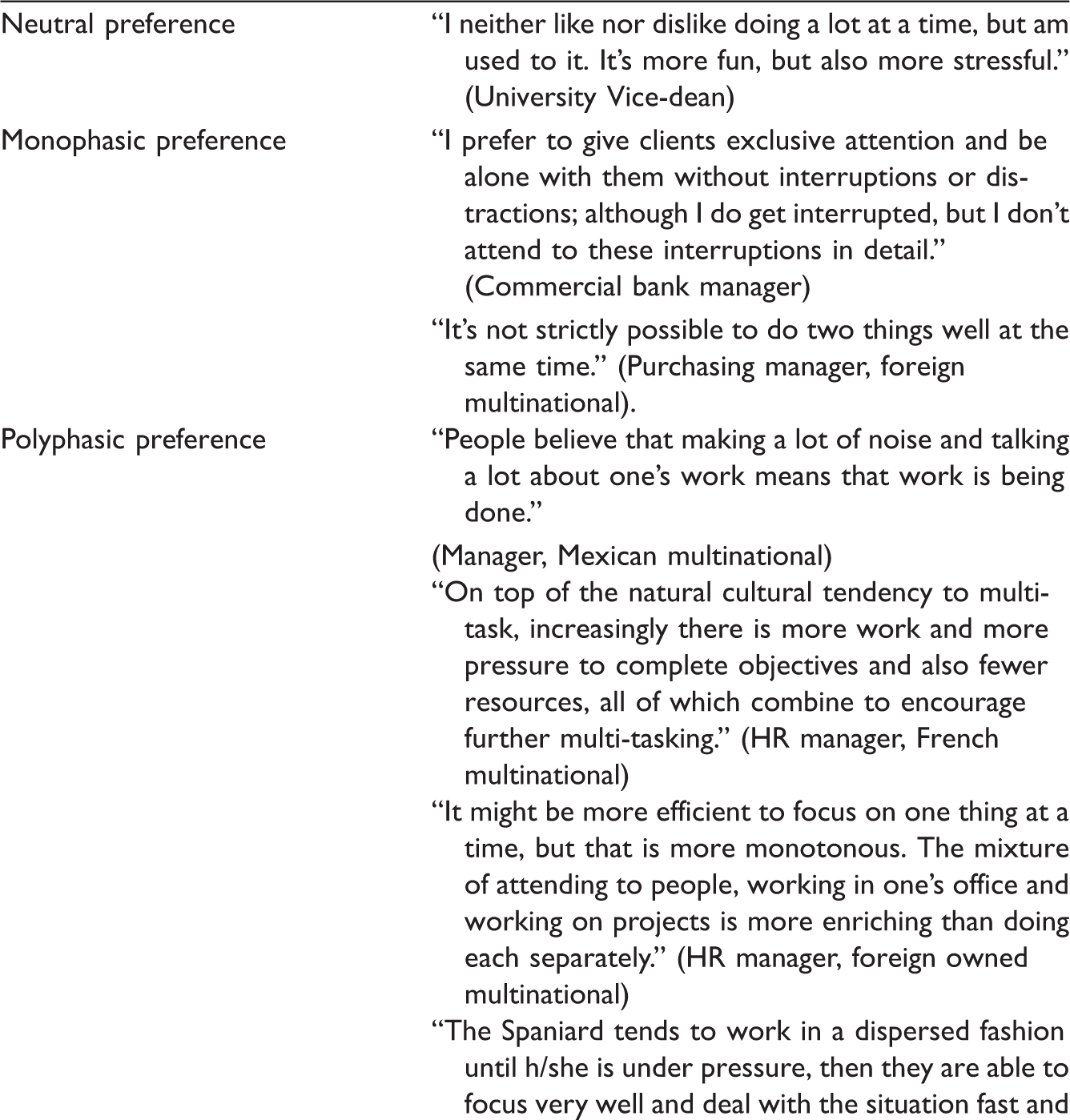
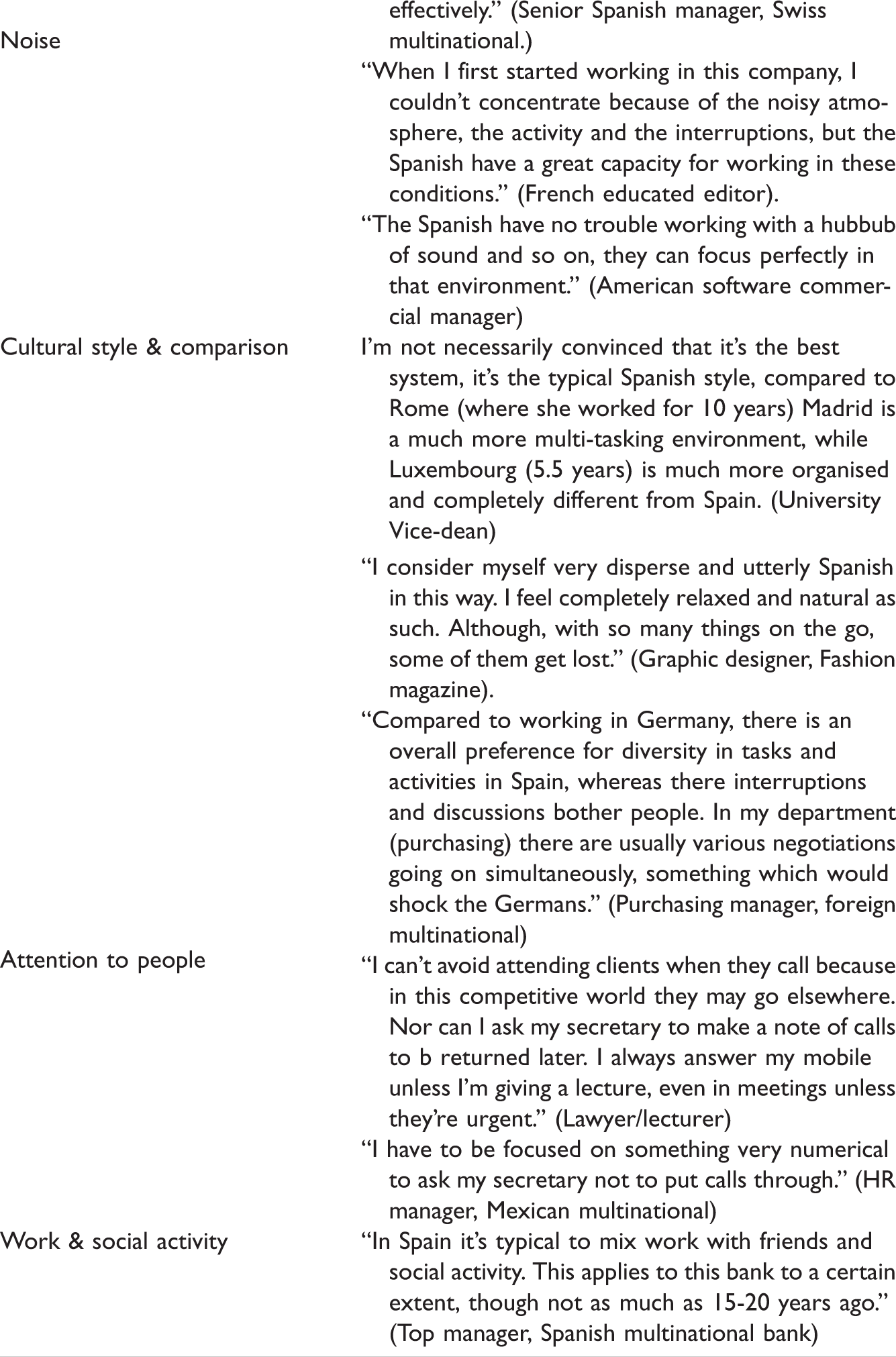
It was mentioned in the previous paragraph that matters border on the urgent rather than the important. Although this may seem to contradict the wisdom of modern literature on time management, and despite the efforts which have currently been made to include forward planning and the awareness that exists about modern planning tools and methods, the tendency to adapt plans, perhaps because insufficient time and attention have been devoted to the original plan, does mean that an impression of urgency often tends to envelop Spanish working environments which might prove to be a source of disorientation to those more familiar with Anglo-Saxon or Northern European contexts.
Time tangibility
Spanish people are informal about time, delays are common, timetables are not kept to rigidly, as a rule. (Lawyer/University lecturer)
Time tangibility – general comments
Punctuality
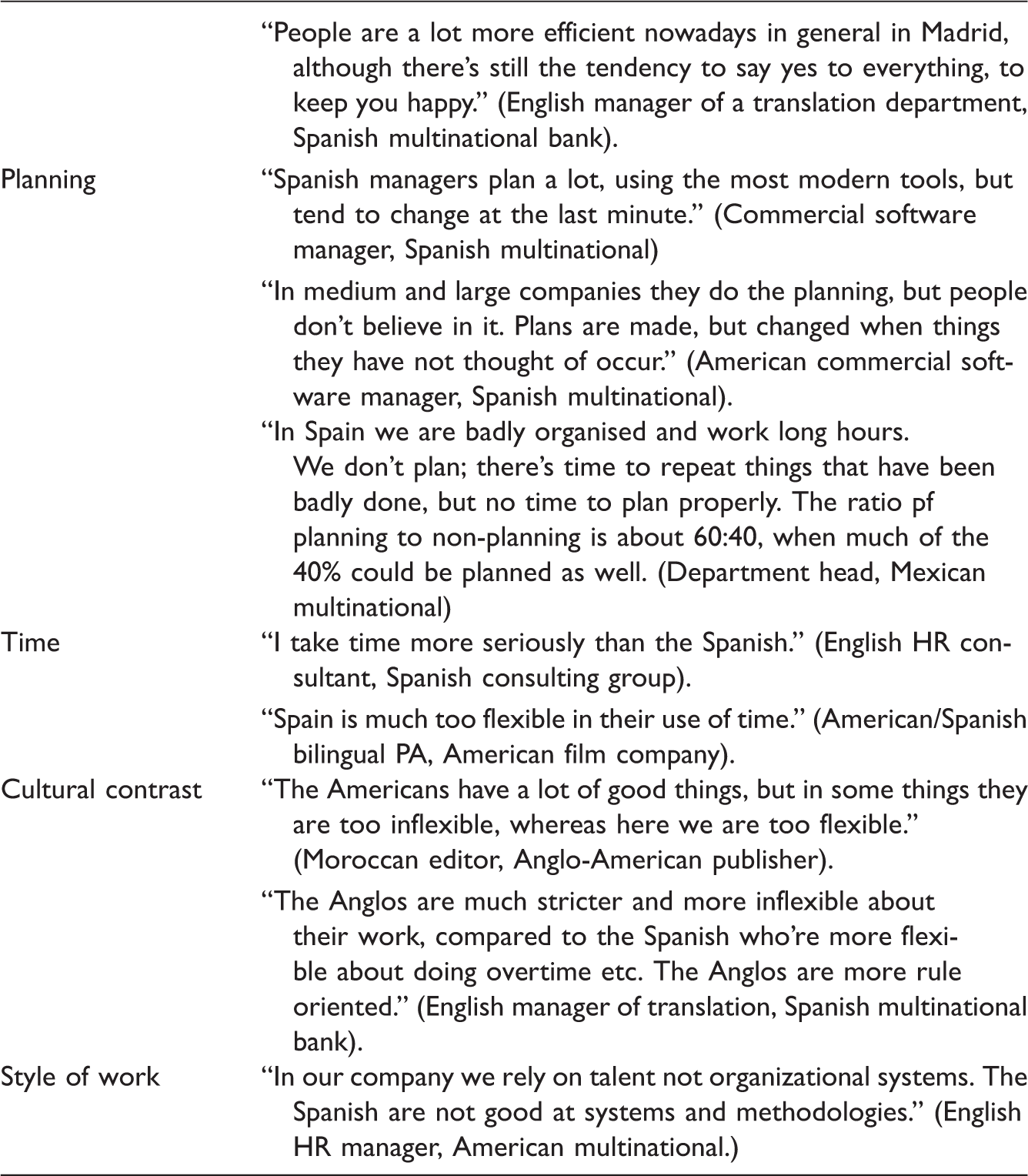
When Spanish people refer to time tangibility they frequently use the words ‘flexibilidad’ and ‘inflexibilidad’, rather than precise or inaccurate. Most people consider at least a certain amount of ‘flexibilidad’ to be a virtue. Although Hall (1959, 1976, 1981) does not mention these aspects in his discussion of time intangibility in reference to polychronic cultures, it seems reasonable to assume that a culture which has a leaning towards imprecision in time management accepts such inaccuracy to a considerable degree, otherwise there would be a conflict between norms and values. Trompenaars and Hampden-Turner (1998) in their analysis of different levels of cultures emphasise the fact that although behavioural norms do not always reflect values, a large disparity between the two could lead to cultural disharmony. Besides, polychronic cultures favour polyphasia and attention to people, both of which make time tangibility more difficult to achieve and thus leading to a certain tolerance of time intangibility.
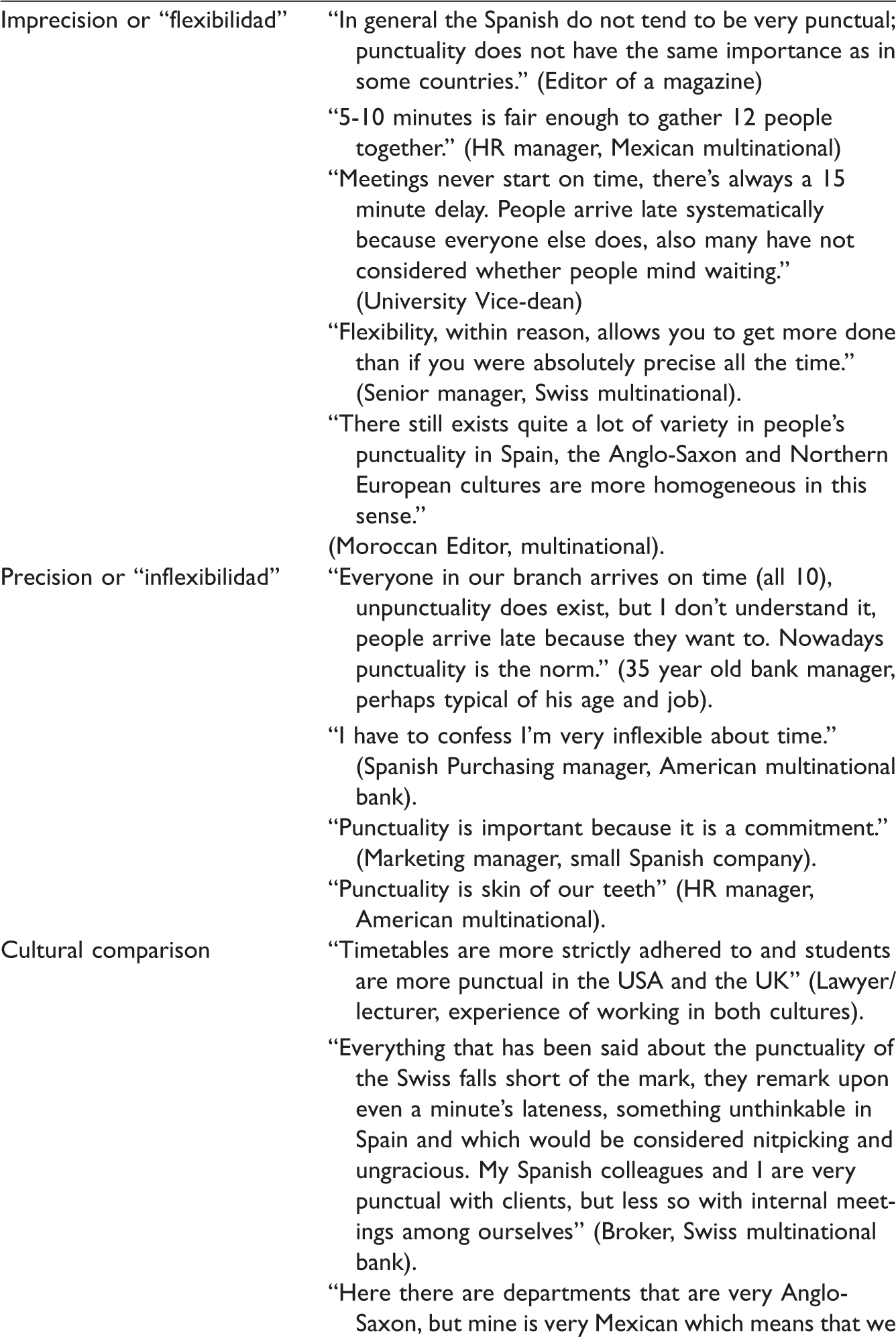
Since the notion of punctuality varies from culture to culture we need to establish what it means to the Spanish working in Madrid. On most occasions 5–10 minutes tardiness would not be considered unpunctual for the initiation of a meeting or event. There is also considerable variation according to the size and importance of the occasion or the type of organization involved. A meeting with a superior or one of obvious significance to those attending will receive a more punctual response. In multinationals respondents indicate that punctuality is the norm, but this can be taken to mean within a margin of 5–10 minutes. In medium and small companies a 10–20 minute delay is much more common, but anything later than that would be unusual nowadays. This was corroborated by a woman manager from a multinational car manufacturer who notifies only if she is going to be more than 20 minutes late, and further confirmed by an English HR consultant who was told not to bother to notify of anything less than 20 minutes lateness. Delay would be caused by:
Attention to any people at the end of the previous activity or on the way to the scheduled event, especially if those people were of higher rank or related to friends or family. Running late; there is a tendency to complete the previous activity at the expense of punctuality. A natural reluctance to be regimented by time and a rejection of that mentality. A positive working atmosphere would usually be put before insistence on precision punctuality.
Having said this, it is quite clear that behaviour is adjusted according to the context, for example:
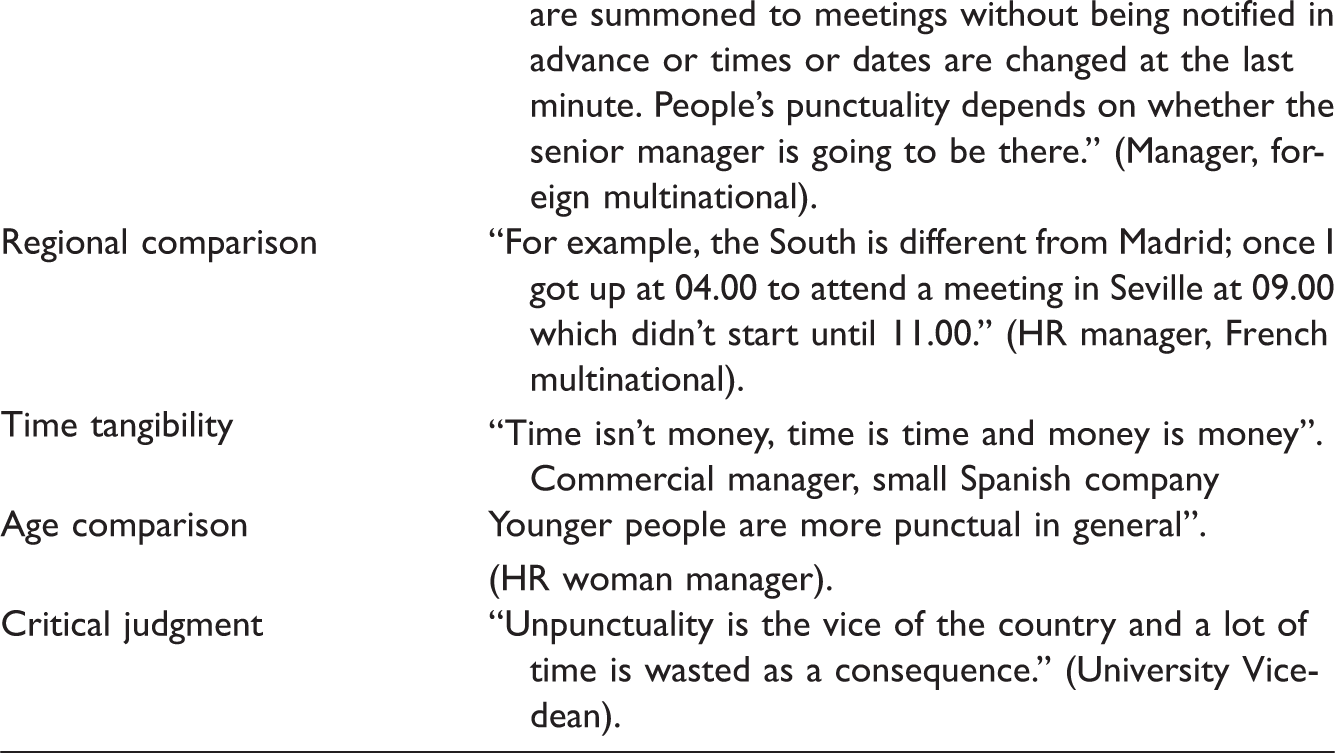
More effort will be made to be punctual when dealing with those cultures which are known to value it or that are considered to be superior (wealthier). A scale of precision can be perceived, starting with foreign owned multinationals and passing through, Spanish multinationals, big companies and medium and small companies. The more Spanish environments and the public sector tend to be most relaxed about time. Yet, Spanish banks, especially the big multinationals, such as the BBVA or the Banco de Santander also tend to be very precise. Younger people, many of whom have been influenced by their contact with the Anglo-Saxon and Northern European worlds, and women, who combine their jobs with running their homes and families, tend to manage their time more efficiently than men. Dentists, ministries and multinational dealerships not only make appointments, a rare occurrence 30 years ago, but often call you to remind you the day before. An overview of comments on punctuality is given in Table 3. Comments on Punctuality
Deadlines
Many respondents observe that there is some imprecision in the calculation of when tasks will be completed. There is a tendency to promise to do things fast which is sometimes unrealistic. It would seem that to show willing to complete as soon as possible is as important as being realistic. This is perhaps a cultural habit which some respondents indicated was changing. It is combined with the reluctance to be inflexible and the rejection of anything which rings the bell of military precision. As one of the foreign respondents commented, ‘There seems to be a “would like to do” attitude rather than a “will do” one’.
But time is becoming more tangible, most are agreed on that. The reasons are not so much that Spanish cultural values are changing, although their habits may be, but:
The Europeanisation of the working day. The adjustment to specific timetables which is not necessarily popular, especially among the over fifties The improvements in technology, especially e-mail and the mobile which help coordination to a considerable extent The influx of women into middle management positions. A number of female respondents commented that they had to complete their deadlines if they wanted to combine their jobs with their family responsibilities
Also, there are certain areas in which deadlines are inflexible and have to be kept:
The administration of the judiciary The management of loans, mortgages and tax returns Manufacturing and sales in certain foreign owned multinationals Public transport (generally on schedule) Magazines and newspapers Deadlines and meetings with clients
Although deadlines are respected in these realms, respondents remark that often the bulk of the work may be achieved in the closing stages. This is perhaps related to a more traditional Spanish culture of improvisation in which to quote a graphic designer, ‘… is one of improvisation, it’s impulsive and has a strong culture of play in life which overlaps into work’. He continues by saying that the big rush at the end that used to be common to complete deadlines is becoming less popular with the general increase of work and competition, and that longer-term planning is increasing as a result. However, in many other areas there is a certain ‘flexibilidad’ with regard to deadlines, for example, in university research projects or in internal company affairs.
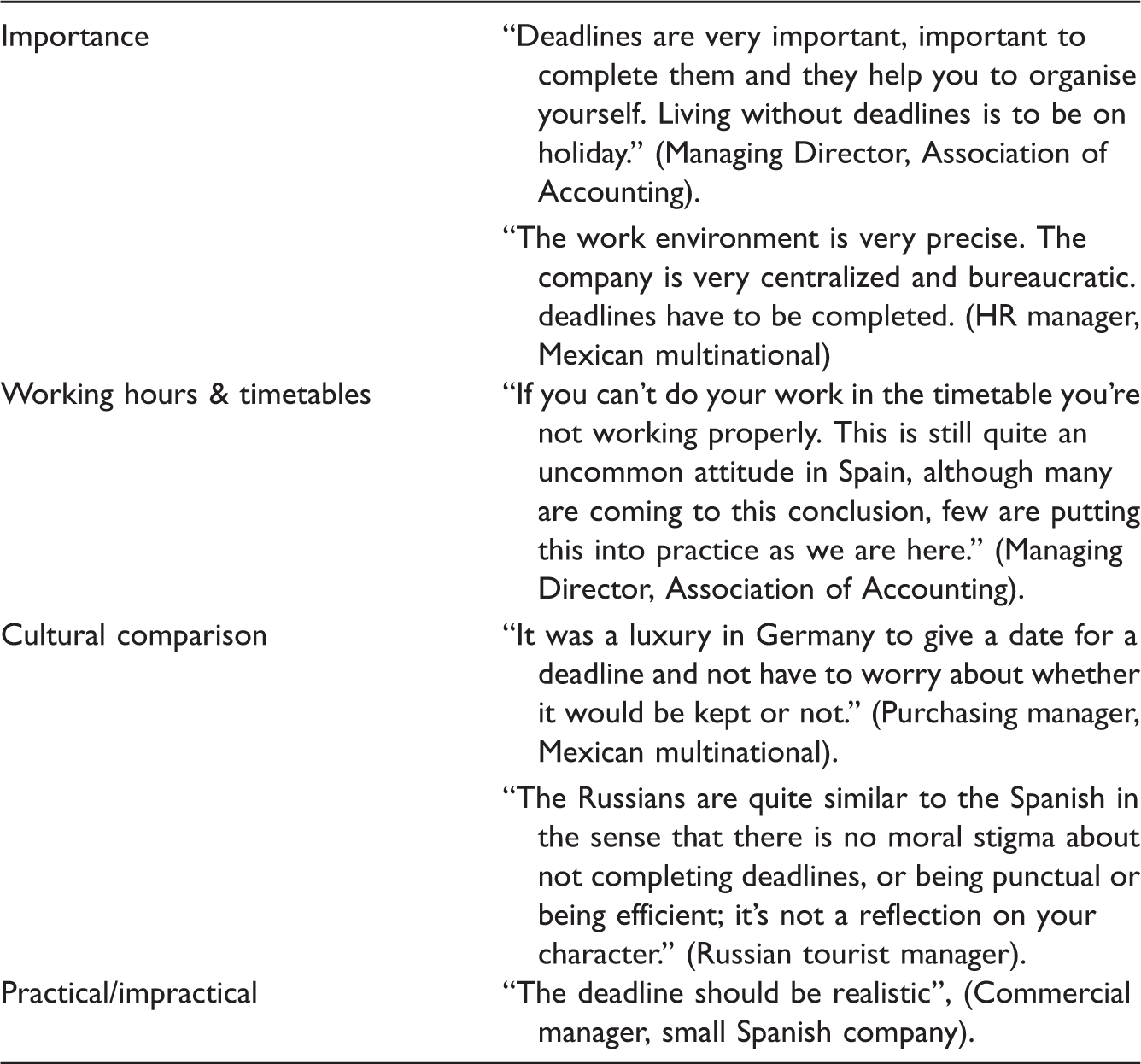
One manager from a firm of accountants with more than 4,000 associated members considers that the completion of deadlines is vital in a small private company such as his own, although he recognises that the public sector is a different model. In his view ‘living without deadlines is to be on holiday’. This is in contrast to a purchasing manager from a multinational, who comments that it was a luxury for her when she worked in Germany to give a date for a deadline and not have to worry whether it would be kept. Deadlines in her company are usually adhered to, but not because this is Spanish culture, but because it is company policy. She bases this opinion on her contrasting experience with German and Spanish suppliers.
Comments on Deadlines
Meetings
It has been widely observed in previous research and random comment that meeting procedure in Spain tends not to live up to the standards recommended in business management textbooks, the flaws tend to be:
No agendas No preparation or circulation of the information to be discussed which meansthat time needs to be dedicated to briefing in the initial stages Late starts and no finishing time No time limits provided to discussing items on agendas (if provided) Little or no notice given Taking mobile phone calls
Respondents indicate that lack of agendas is currently more a thing of the past, especially in multinationals and the more important Spanish banks and companies.
As far as fixing a limit to the duration of a meeting is concerned and specifying 10 or 20minute slots for discussing each item on the agenda, some respondents expressed reluctance to this ‘inflexibilidad’ and are worried that decisions will not be taken. Many also feel very constrained at the prospect of controlling time in this way and it goes against not only the grain but also their experience of functioning in groups which mixes ingredients of social activity and allows people to hold forth without interruption. So, although shorter and better organized meetings are welcomed and beginning to become more normal practice, many feel uncomfortable with a fully regimented style and they are concerned about how it might affect the atmosphere. As one manager put it, ‘having an agenda is fair enough, but limiting the time we have to discuss each item is going too far’.
Technological changes
The Spanish have benefited enormously from technological change. In the eighties when companies all over the world were becoming computerised in Spain it seemed to occur in the blink of an eye. The Spanish work style, reputedly characterised by immediacy, was suited to the changes involved, little long term planning or organization was required, once the decision had been taken to computerise, the machines were suddenly there, few people knew how to use them, but that did not matter. This was the kind of challenge that the Spanish appreciate and their very presence inspired the kind of learning and training that was necessary.
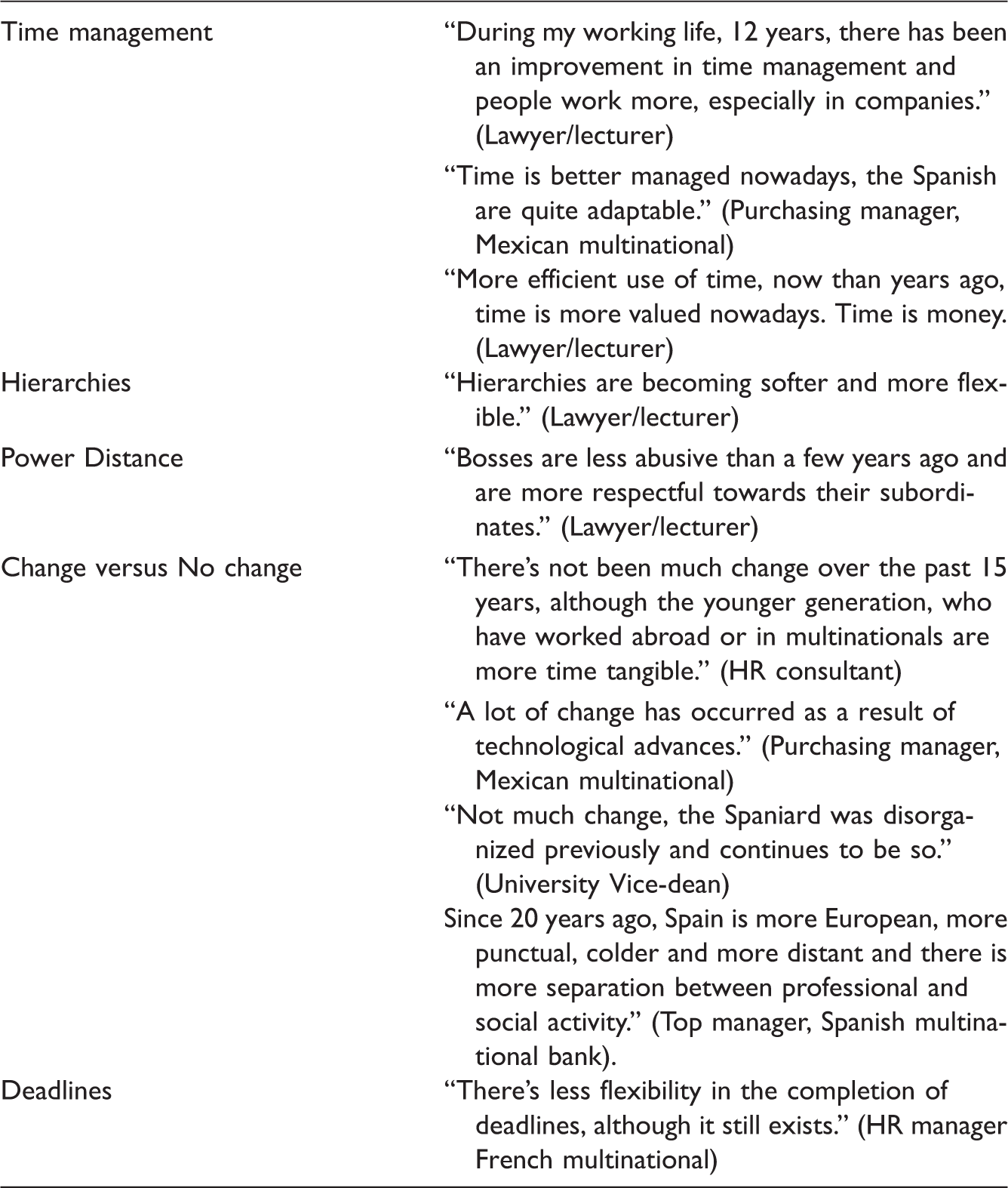
Comments on Change
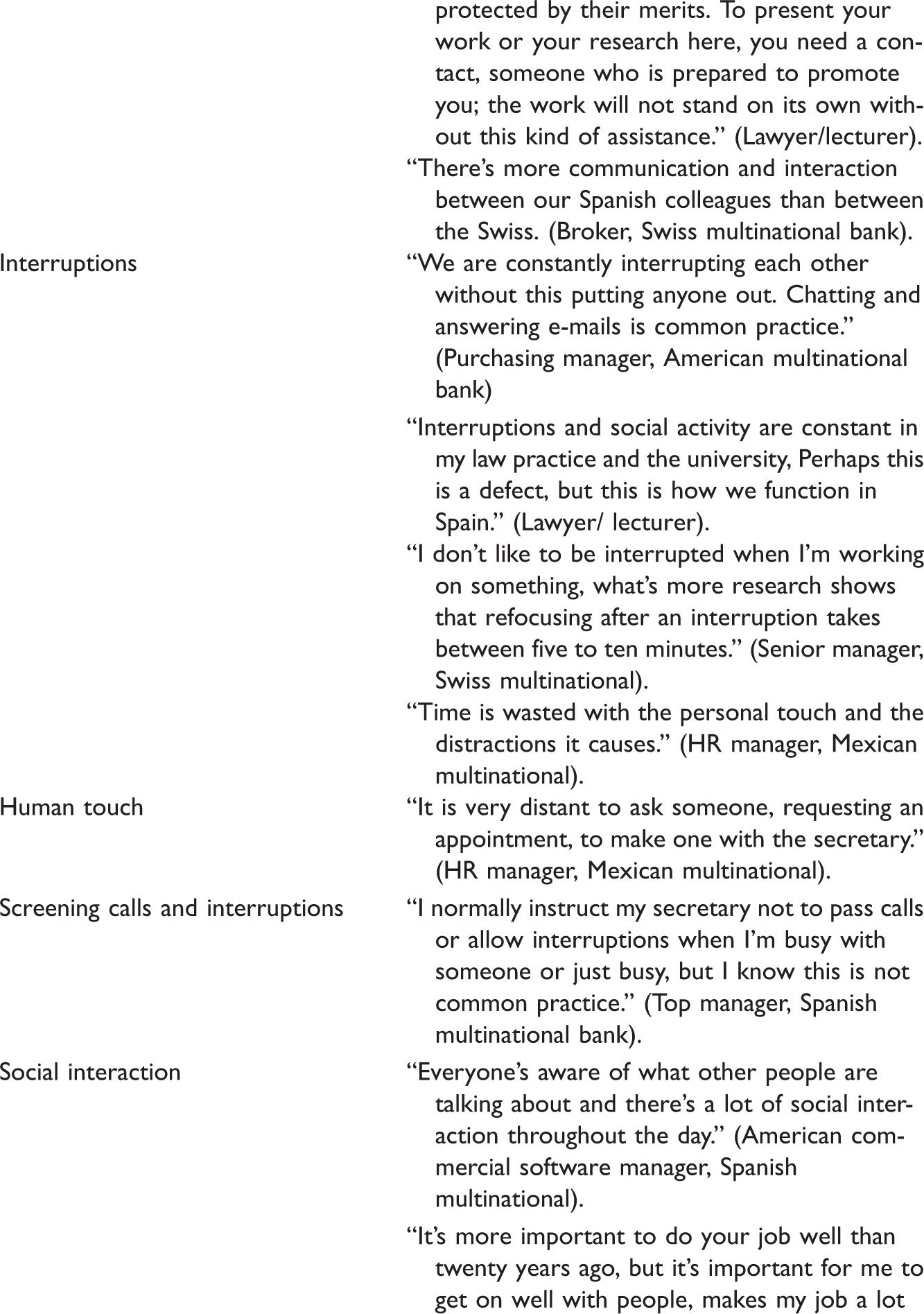
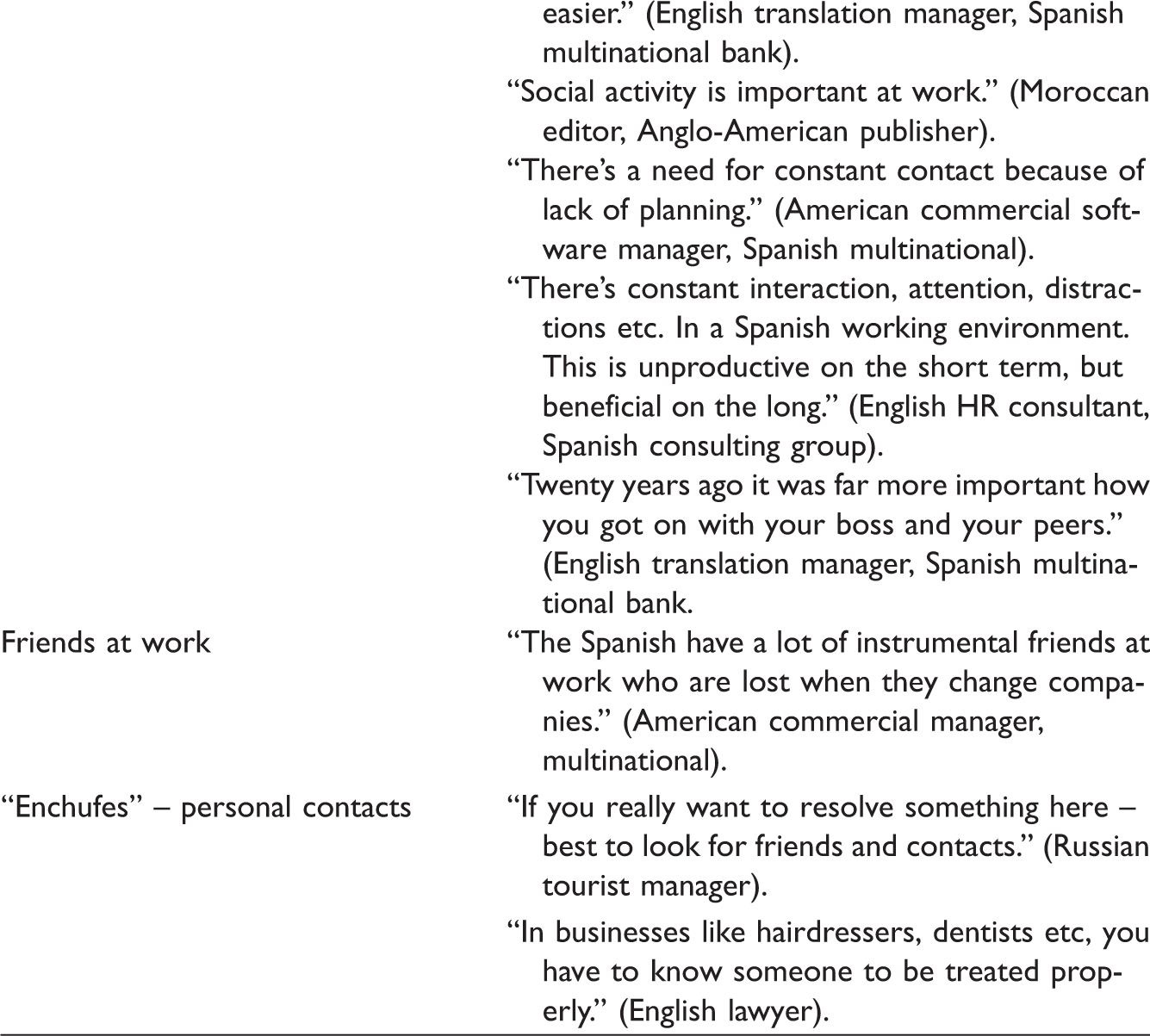
Comments on Attention to People
Attention to people
A major characteristic of what Hall (1959, 1976, 1981 & 1990) denoted as polychronic cultures is the importance attached to attention to people at work, compared to the monochronic Anglo-Saxon and Northern European. He particularly emphasised this attention as applied to family members, connections or friends and also important bosses, since these P-time cultures were characterized by high Power Distance (PD). PD refers to the extent to which decision making is shared within any group and if it is high there is more authoritarianism and less participation. It might be considered that the presence of high PD would be inconsistent with attention to people; however, this attention does not refer so much to consideration or participation in decision making, as to dedication of time and social interaction. There is also a hierarchy involved, superiors, family, friends and allies which is compatible with high PD.
Attention to people in these cultures comes before time tangibility. The priority is ‘people not precision timing’. This is a cultural preference; and it means that people or attention to them is more highly valued than being punctual, completing a deadline or keeping to a time table. It refers to the precedence granted to attending to people (in the work environment) both formally and spontaneously. This means that social interaction, from the most superficial (greeting and chatting) to more serious exchanges about work in progress, is constant and simultaneous. It is a communication style characterized by interruption and change of focus, and rarely shunned, except at moments of deep concentration on complex tasks, or where there is pressure to complete deadlines; and even then, rejection of interaction is expressed with regret and cordiality.
Of all the aspects of time use in this research in Spain, this is the aspect that appears to have changed least. The culture may be more time tangible, but the importance of attending to people on the spot, maintaining ongoing social contact and continually building relationships remains an essential feature, and is in constant motion. The reasons for the persistence of this characteristic in a professional context are the following:
The culture is sociable by nature. People value the building of relationships and prefer to do so, on a continuous basis. Despite democracy and the development of a more meritorious system, PD and Collectivism remain powerful elements in the culture. Who you know is important, developing contacts is useful. Time needs to be given to this and it happens at work. Long-term planning is not always a prevailing reality. The Spanish work style in its natural state, involves working in the present and working things out as you go along. This involves shifting focus and changing things, and requires much more spontaneous liaison than in a work style that involves a plan, a way to carry it out and regular periodic meetings to review progress. This means that the need to make contact with colleagues to discuss ongoing details (which often may be small) either in person, by phone, or by email is constantly necessary. The work style referred to here is often named ‘intended action’, as opposed to ‘planned action’ (Globe Project, 2005) which is more characteristic of Anglo-Saxon and Northern European cultures. However, many respondents insisted that long term planning was increasingly the norm and much more ‘European’ although others pointed out that long term plans were frequently scrapped and changed. It is very important to get on with your colleagues and of course especially your superiors (high power distance). The question of which was more important, to do your job well or get on with your fellow workers or your bosses, was one some respondents had trouble answering. Some answered that getting on with people was the most important, the majority that both were equally important. Socializing in Spain tends to be determined by context. The Spanish make a lot of instrumental friends at work who tend to get lost when they change companies. Also, as some of the foreign respondents mentioned, to get something done fast and efficiently you need to refer to a friend that works in that area or knows someone who does. These contacts are referred to as ‘enchufes’ (literally plugs) and play a prominent role in the system. In any situation whether it be a reception area, a bank, a bar or an office there is a tendency to inquire what people want when they appear, even if someone is being attended and others are waiting. This may give the impression to outsiders that the principle of ‘first come first served’ does not exist. But this ‘inquiry’ (attention) is primarily motivated by the need to make the new arrival feel attended, although he/she will probably have to wait his/her turn in due course. It also means that if the newcomer requires something small or easily facilitated, then this can be provided immediately and hence the problem is dealt with, although the original person being served may have to wait a little, while this is accomplished.
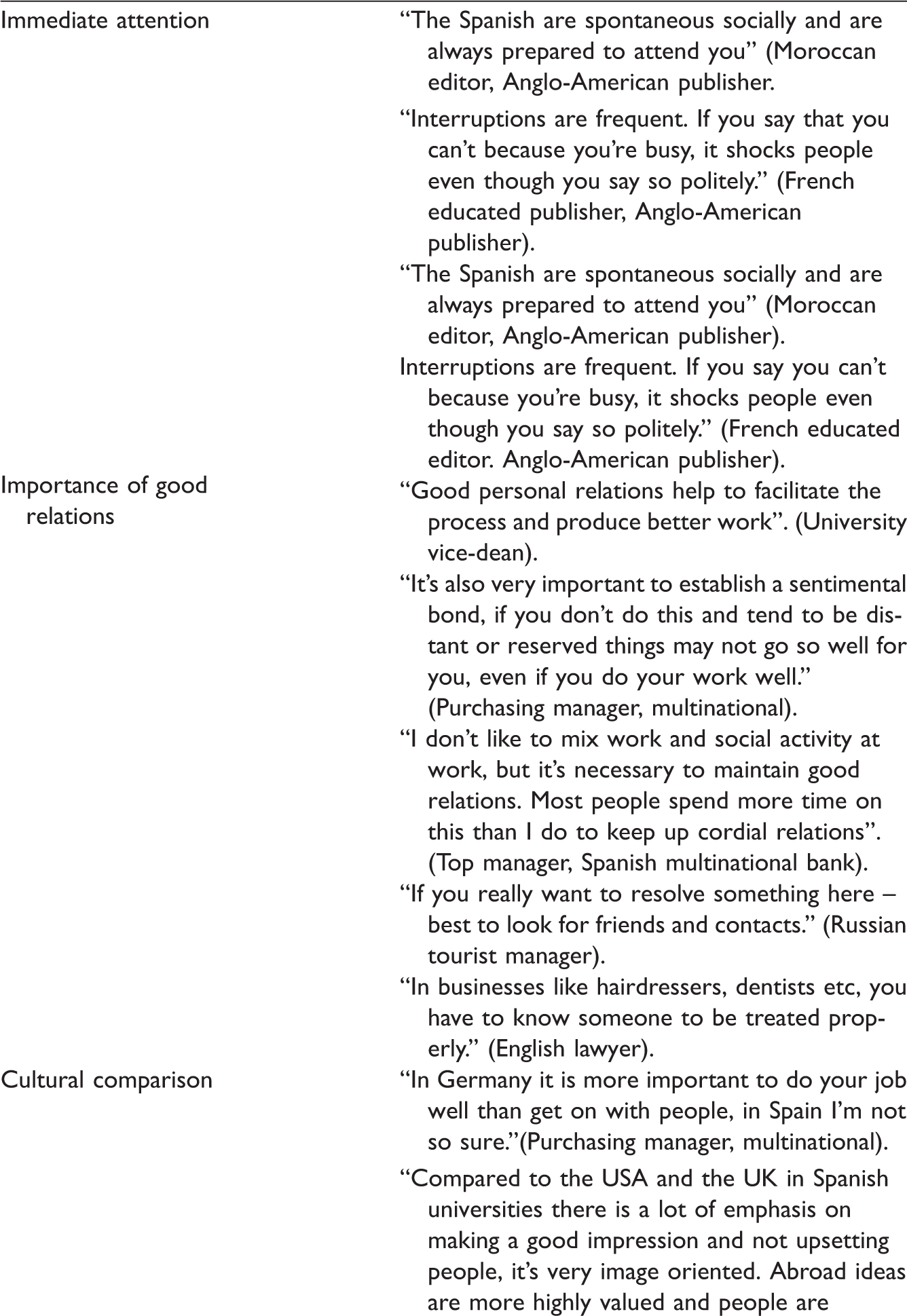
For respondent comments on attention to people see Table 6.
Discussion
Monochronicity-Polychronicity
Hall’s original theory, that all cultures have a tendency towards either a monochronic or polychronic orientation, has been questioned (Palmer & Schoorman (1999) on the grounds that whereas this may have been true in the fifties and sixties, when he initiated his research, that the emergence of the global market and the diminishment of the world, through technological improvements in transport and communication, have reduced Hall’s original twofold, isomorphic classification to an oversimplification. It is argued that the business and professional world has and is changing so fast that such rigid descriptions of time use are unrealistic, inaccurate and misleading.
In the case of this research in which we focused on the dimensions that make up polychronicity according to Hall’s original ideas, the results do not indicate that organizations in Madrid are polychronic in the original Hall sense, but neither does it indicate a change to a traditionally monochronic style. Rather, it would seem that on the background of a classical polychronic working culture a new style is being forged, what that is, precisely, we will attempt to determine in the following sections.
Polyphasia
This is the most common and the most favoured style of working and is as alive and well as ever, although its pace is probably more frenetic than before. All the respondents mention polyphasic activity and how it is manifested. The Spanish draw attention to the multi-focus and constant activity, but not, as the foreigners do, to the social undertone or the noise. The latter are clearly so obviously unremarkable to the Spanish that they do not deserve special mention.
Changes in plans are indicated as one of the contributory factors to polyphasic activity, especially by the foreign respondents. As mentioned previously, sophisticated modern tools and methodology are applied to planning in Spanish organizations, especially when referring to multinationals and the larger Spanish companies, also that considerable time is devoted to this facet. Yet, one wonders how much of this time is devoted to the first original plan, rather than constant re-planning. It is understood that in the current global marketplace that the pace is fast, that unpredictable elements are constantly appearing and that the need to adapt and alter planning is more paramount than ever before. However, respondent comments from both the locals and the foreigners seem to indicate that plan changing is often more than mere adaptation. It would seem that somehow the first original plan is not quite adequate; the reasons could be any or all of the following:
An unrealistic estimation of the various steps necessary to develop the project in hand A miscalculation of the time necessary to complete the various stages A failure to take into account unpredictable scenarios and how these would affect the first two A reluctance on the part of the managers to accept the validity of the plan and a tendency to wait and see so that they can leap in and make changes as time clarifies the panorama A reluctance on the part of employees to accept the original plan as the ‘real’ plan, since their experience may indicate that substantial changes will soon be instigated
Whatever the reason, considerable extra planning occurs in many Spanish organizations, which leads to a certain amount of improvization which in its turn helps to contribute to a polyphasic environment.
How to reach objectives is often not clearly specified, characteristic of ‘intended action’ as opposed to ‘planned action’ (Globe Project), previously mentioned. Understaffing in some organizations is another factor.
Finally, the necessity of being interrupted to attend to clients, emphasized by two of the foreign respondents and several of the Spanish is a further feature of the professional work scene which helps to propagate the polyphasic work style in Madrid.
Although the majority claimed getting on with people was more important than doing a good job, this does not mean that you can survive by doing a disastrous job, provided you get on well with everyone, it merely implies that within the range of excellent and quite mediocre work, the relationship factor will count. You will not be judged by your work alone which may be a standard expectation in other cultures.
As a consequence of the cultural tendency to socialise in context, the time and place for most socialising with work friends is at work, either in the office while working or in the canteen, or outside in nearby cafés or restaurants. Very few people socialise with friends from work at the weekend or after work. Most friends cease to exist when individuals change organisations. In the present context what needs to be emphasised is the nature of these relationships and the time they take up. They are basically instrumental and are an essential element of the polyphasic work environment in Madrid.
Women
Perhaps surprisingly, they are considered by both sexes to be more time tangible, better organized, though less creative than men in the sense of circumventing the rules and getting things done this way. Previous research conducted by Cotte and Ratneshwar (1999) comparing Anglo and Latina women on monophasia and polyphasia throws up an interesting contrast between their perception of the two dimensions. The Anglo women who employed a polyphasic style (the Anglo polys) conceived polyphasia in terms of a means to increase efficiency and to get more done or as a challenge which may complicate the situation, but if successful is more rewarding in terms of results. The Latina polys perceive polyphasia as something that exists and is there to be dealt with, more as natural state of affairs. We tend to interpret the situation for Spanish women similarly: polyphasia is a given, rather than a conscious choice to be more efficient. These differences in perception emphasize what may be an important difference between the traditional monochronic and polychronic cultures. The use of a polyphasic style has only recently begun to emerge in the Anglo-Saxon and Northern European cultures and is often referred to as multi-tasking. Its emergence has coincided with globalisation and work environments in which there has been an ever increasing pressure to achieve more at a lower cost and with fewer resources. This is in contrast to the traditional polychronic cultures in which polyphasia exists as a natural way of functioning and is manifested as multi-focus. Multi-focusing does not imply achieving more because activities are being carried out simultaneously, although it may do so. As Hall indicates in his interview with Bluedorn (1998); ‘in the strictest sense, a polychronic culture is a culture in which people value, and hence practice, engaging in several activities and events at the same time.’ (p. 110).
As far as the Spanish women in this study are concerned there was no indication that their style of polyphasia was any different from the men’s. What was consistently noted by both genders, however, was that they were more time tangible and better organized. The explanation for this was that their domestic and family responsibilities meant that they were more occupied than the men and consequently needed to be more aware of tracking time and organize themselves accordingly.
European statistics indicate that Spanish and Italian men are the least participative in those areas (El País November 18, 2008); the average man in Spain spends an average of one hour and 37 minutes on domestic activities, compared to a woman’s four hours 55 minutes. There is no way of discerning whether Spanish or Latin women, for that matter, have always been this way since we have no information about the past. We have some traditional impressions of the traditional Latin wife and mother as a strong domestic, maternal figure in the background, indulging her children and husband, but nothing to indicate that they were more time tangible than the men. However, it may be that these women have always been the organizational motor behind Spanish society, and that is only now that they have been released into the executive workforce that they are revealing their organizational talents. But, this is pure speculation and considerable more research needs to be undertaken before this puzzle can be unravelled.
It was previously mentioned that a few male respondents claimed that women lacked creativity. This was not a general observation and we should be cautious about pursuing it much further. Schneider and Barsoux (2003) in their analysis of the differences between Anglo and Northern European organizations and those of the less developed world, which coincide neatly with the monochronic/polychronic distinction, emphasize that in the former two lower PD clusters job description and task completion is prioritised and that flatter hierarchies permit considerable flexibility in terms of consultation and getting the job done. This is contrasted with the higher PD clusters in which hierarchies are more clearly defined and who has authority over whom is paramount. It was suggested that Spanish women were more conscious of abiding by the rules and perhaps more reluctant to use methods such as système D and in this sense could be considered as less creative in finding solutions to daily work problems.
The foreign respondents
It is difficult to detect much difference of the foreigners’ appraisal of the use of time in Spanish organizations from that of the Spanish themselves. Both Spanish and foreign respondents agree that that it is a multi-focused or polyphasic environment. Their assessment of the time tangibility does not differ and all are agreed that attention to people is a significant feature. There is also a general consensus that this is an environment which has become more competitive, more time tangible and much more intense over the past 30 years. However there are areas which the foreign respondents mention and discuss in more detail than the Spanish two of these are the areas of planning and ‘enchufes’ (internal contacts) which are discussed above . Other features which are emphasized are the noise, the social undertone and the need to pay attention to people and to establish and maintain relationships.
In the area of time tangibility, the respondents point out, as the Spanish do, that a certainly flexibility exists and is welcomed, and that this varies according to the size of the company, the managerial rank being dealt with and between internal or external affairs. The Anglo-Saxon respondents emphasize this difference in relation to their own cultures.
The foreign respondent contribution is useful, firstly, because it is informed, based on many years of living and working in Spain and secondly because their perspective has the double focus of comparison with their own culture. Consequently, it is gratifying that they not only confirm the comments and observations of their Spanish colleagues, but are also able to point out aspects of the Spanish working environment that are radically different from their own.
A new polychronicity
In conclusion, we would suggest that the use of time in organizations in Madrid has changed over the past 30 years, but not from polychronicity to monochronicity. The background style remains polychronic in the original sense that Hall described, but has evolved into a new version. This is characterized by greater activity, more urgency, an increase in dynamism and a greater awareness of how other cultures function with reference to time, especially in relation to time tangibility. Past observations of Spanish working culture from outsiders, before the recent modernization and democratization, have focused on idleness, the mañana syndrome, disorganization and lack of forward planning. Although some of these assumptions were exaggerated and even ethnocentric, it would not be unfair to have classified it as relaxed, slow and unreliable in contrast to the Anglo and Northern European cultures from which these criticisms proceeded. By no stretch of the imagination could the modern working Spanish executive be described as idle, average working hours in Spain exceed the European Community average (Eurostat Labour Force Survey, 2006), and middle and senior managers rarely leave their offices before 20.00 and often work later. The mañana syndrome has completely disappeared, things may be completed later than anticipated, but the sensation that nothing will ever get done has disappeared. Also, outside deadlines are almost always met, even if this entails lack of sleep or leisure. Finally, a more realistic sense of time tangibility in general, especially when dealing with those cultures who value it, has become increasingly evident. Here, ‘flexibilidad’ appears to be the virtue that was previously unmentioned in Hall’s work on polychronicity.
Having made the case for these changes, it should be emphasized that the style itself has not. Polyphasia is still predominant in this multi-focused environment, attention to people is still maintained and time tangibility could not be described as Germanic. For this reason we have dubbed it the ‘new polychronicity’ since it remains a polychronic style which is more urgent, more dynamic and more precise than before.
Recommendations for future research
Although Madrid has been the business capital of Spain since Franco centralized activity there in the 1940s, future research on organizations in other major cities such as Barcelona, Valencia and Seville and other major European cities within the European cluster (Lisbon, Rome and Paris) would provide an interesting contrast. The question of Latin women is an absorbing one. Previous research on women in the United States by Helgesen (1996) and Tannen (1990, 1994) showed women to be more high context than men, but no differences were found on time tangibility or polyphasia. What is the profile of Latin women compared to the men? And how do they compare with Anglo or Northern European women?
Time tangibility needs to be explored in more detail with reference to different cultures. It became evident during the interviews that elements such as punctuality and completing deadlines were more loosely understood than might have been expected; and follow up questions were required to determine precisely what they meant to the Spanish respondents.
The distinction between the work styles ‘intended action’ and ‘planned action’, the former indicating a style which focuses on getting on with things and adjusting plans during the process, and the latter making a specific plan which attempts to take into account all the information available and hypothetical unknowns is another area which deserves attention. It may be that a combination of the two is the most effective. But it would be useful to compare the two methods more precisely and to pin point their application in different cultures.
The points mentioned here emphasize to what extent differences still exist between and maybe even within cultural clusters despite our globalised market. Considerable more work needs to be done to unravel some of these to enable us to understand each other better as Hall points out in his interview with Alan Bluedorn, ‘I do believe that understanding the difference (between cultures) is absolutely necessary, it is usually a means, a part of the process that gets us to the real “cure”, mutual respect’. (p.113.)