




Abstract
Currently higher education strategies seem to concentrate on the expedient, developing skills that can secure employment in the world of work. This may have immediate advantages, but in totalising pedagogic practice, it may restrict our openness to people and to our own contentment with ourselves. Valuable as this may be as a way to satisfy politicoeconomic policy imperatives, it strays from education as an edifying process where personal development represents, through the facing up to distress and despair, an unsettling of our developing identity and a negation of our immediate desire satisfaction. Such an unsettling is not intended to give pleasure or satisfaction in the normative way in which the imperative of happiness has been used in student satisfaction surveys, nor in the wider societal context that this totalisation represents. What I propose for higher education is not a dominant priority to feed the happiness for others, but a mission to personal contentment revealed through realising student potentialities for them and so recognising their limitations, as part of seeking an attunement to contentment.
Introduction
Castriota (2006) proposes that the positive effects of education on happiness result from a variety of intermediary processes and, as a consequence: the quantity of material goods a person can buy becomes less important. It is reasonable to believe that a low education level reduces the chances of achieving a high level of job satisfaction and the probability to have a stimulating cultural life, and makes the purchase of material goods a more important determinant of the life-satisfaction. (2006: 3)
This echoes Seneca’s retort to his detractors in On a Happy Life, justifying his riches as enabling him to enact his virtues. He defends such a life, claiming: ‘I own my riches, your riches own you’ (54–62/2008: 157). This is a nuanced rendering by Seneca of the Stoic principle that values the simple life, reducing one’s needs in order that one might be fulfilled and achieve happiness. This was tested after his break with Nero. Of course, whilst educational institutions could support the desirability of education for economic, ideological and spiritual reasons, the questioning of institutional structures—let alone the desirability of what they package—assumes a certain worth. As Dearden (1968: 27) points out, ‘education may be broadly defined as the process of learning through which we come to an understanding and appreciation of what is valuable or worth pursuing in life, and happiness is no more than one among several final ends worthy of pursuit’. Dearden’s contribution follows the Aristotelian prescription of well-being that shares a focus on the distinctive human attributes of rationality and desire found in Augustine (2010), Epicurus (2013) and, more recently, in Mill (2008), Russell (2006), Dewey (2012), Noddings (2003), Standish et al. (2006), Dewey (1966), Haybron, (2009), White (2012) and Greve (2012). Indeed, Smith (2008) warns us against the ‘long slide into happiness’, if happiness is only considered as feeling good.
This paper is a preliminary to what is a derivative of the plausible nature of our being through Heidegger’s (1995) work on moods (Ratcliffe, 2010) and their attunement. I call this, after Heidegger’s work on profound boredom, profound happiness or contentment. 1 Profound moods determine how all things appear to us; they provide the context for temporary object-directed emotions. 2 Moods are taken in the Heideggerian sense as being the way we experience being part of our world and set the way in which we interpret it. They are fundamental and more primordial than emotions. According to Ratcliffe, ‘moods, for Heidegger, give sense to Dasein’s world and to the manner in which Dasein finds itself relating to the world’ (Ratcliffe, 2002). This distinguishes them from emotions that have an intentionality; they are brief episodes with specific objects, whereas moods are longer term states that either do not have objects or encompass a wide range of objects. Emotional states presuppose a world and background moods that make them possible (Ratcliffe, 2013). We have a number of fundamental moods that enable us to engage successfully (or otherwise) with our world and those within in it. Following on from this discussion, I suggest how higher education might facilitate one’s attunement to contentment.
Contentment
Contentment is not the happiness we might associate with consumerism, sensual desire satisfaction or, as Ahmed (2010) has illustrated, a happiness that we are obliged to embrace but, following Rousseau and Heidegger, a state of being content with oneself. Profound happiness is contentment in becoming what one wills one’s being to be, in the knowledge of one’s capabilities. The approach involves an educative process of developing potential capabilities and a realistic appreciation of what this means for one, being in the world with others. It is not fanciful and it denies that one can be whatever one fantasises, replacing this with a notion of contentment with what one might feasibly be (see Gibbs and Dean, 2014). To find our potential to be and to will its realisation requires disruption to this tranquillity, and a heightened awareness and a realisation of Nussbaum’s (2011: 33–35) core structural capabilities of critical thinking, confidence and citizenship that underpin 10 central capabilities. Securing these capabilities is emotionally unsettling, distressing and creates temporary negations to contentment but, in doing so, provided we experience them as part of our understanding of ourselves through attunement to mood of contentment rather than anxiety, these capabilities bring benefits for individual growth.
This approach differs from the two main thrusts of literature concerned with happiness studies: well-being and hedonism. It differs from judgements of well-being made retrospectively about an accumulation of satisfied lifelong desires, and to the explicit and normative directives of what is prudently good for one. In this sense, contentment is not strictly Aristotelian eudaimonia, which prioritises well-being based on moral, wealth or health imperatives, although it does retain notions of agentic directed growth, meaning and purpose informed by societal norms whilst not being restricted to them. I can be content and virtuous, but I don’t need to be virtuous to be content. 3
Hedonism also differs from the emotions of desire and pleasure satisfaction as the sustainable notion of happiness. Although it certainly finds a place for the presence of joy and momentary outbreaks of expression of delight and pleasure, it is not reliant on extrinsic directed and generated pleasures and is an intrinsic state of awareness. Contentment, then, is a blend of both these traditional forms of happiness theory, realised through one’s temporal being, and interpreted and understood from a mood of contentment with the living of a willed life plan. It is one’s mood that becomes attuned to one’s being within the consequences of one’s agentic capabilities. It is being able to strive realistically to know the best one can be, and not the best anyone else might want one to be. Moreover, if we crudely follow Rorty (1999) in that higher education’s duty is to encourage irony from the socialisation of compulsory education, then higher education and its institutions represent a space for this questioning to take place. Further, it might be claimed that higher education has a duty to offer such a space and not to close it out with the business of service delivery based on pleasure, entertainment and job grooming. It is in the Heideggerian sense of a fundamental attunement 4 to the world through the mood of contentment that we find ourselves disposed to be in the world with others; open to them and not constrained by the consumerism entrapment of a notion of belonging by consuming. Heidegger (1973: 107, authors’ brackets) talks damningly and directly about how consumerism is abandoning Being through letting one’s ‘will be unconditionally equated with the process [consumerism] and thus becomes at the same time the “object” of the abandonment of Being’. He continues in a prophetic attack on consumerism as the totalising power held by a few globalised leaders to negate our understanding of our being: the ‘circularity of consumption for the sake of consumption is the sole procedure which distinctively characterizes the history of a world which has become an unworld’ (1973: 107).
The form of consumerism that Heidegger envisioned had its roots in Rousseau, especially when he talks at length about how we can so easily live our lives through the approval of others and how ruinous this may be. For instance, at the end of Part Two of the Discourse on Inequality, he states ‘as a result of always asking others what we are and never daring to put the question to ourselves … . we have only facades, deceptive and frivolous(ness), honour without virtue, reason without wisdom and pleasure without happiness’ (Rousseau, 1984: 136). Rousseau also considers emotions, claiming that human understanding owes much to the passions (Rousseau, 1984: 89). This forms a conceptual link with Heidegger in the importance of emotion as the manifestation of fundamental moods and how taming these should be disquieting about the nature of technological way of civilised being.
Significantly, for Heidegger (1962: 176), the affectiveness of our being ‘has already disclosed, in every case, Being-in-the-world as a whole, and makes it possible first of all to direct oneself towards something’. These fundamental attunements shape how we experience the world and things within it and, together with discourse and understanding, determine how we make ourselves meaningful and grasp our world (Heidegger calls this ‘care’). The objects that the joy, happiness or sadness trigger are revealed because of a mood that determines the way of making one’s way in the world. These outbursts last for the duration of the stimulus and once gone, depending on our fundament attunement, leave us somewhere between distress and contentment. These eruptions are moments of insight into our fundamental way of being and offer a view of how we want to be for ourselves. 5 Applying an edifying exploration of these moments of vision provides the potential for us to seek and create our life project. The life project is an existential location of self within the flux of others and, taken seriously, it determines the person one wants oneself to be and is realised through our actions. Nurturing such an informed stance is enhanced by moments of vision but, if they are ignored or counted as events in themselves in order to favour the sameness of others, their value is no more than immediate desire gratification.
Importantly, I am not supposing that these insights reveal what might be prescribed as aspects of well-being—virtue, health and wisdom—ideal though these might be, as they are too restrictive in their universal meaningfulness. The contentment envisioned here requires personal awareness, but requires neither virtuous living (although it might be aided by it) nor dependency on a joyous life after death, although it may include both. A contented life a is not merely a matter of context and prescribed content worthy of satisfying well-being, for often we do not pursue that which would, in those terms, foster our long-term well-being (consider Kant’s extreme ascetic). Too often we make the wrong decision about what promotes our well-being, to the extent that Haybron (2009) argues that we might be described as pursuing our own unhappiness! Buoyed by societal pressures, our willingness to narrow our temporal horizons and detach ourselves from our primordial temporality allows us to put to sleep our fundamental attunement to happiness in favour of a fetish for having and consuming, despite the evidence presented later that this does not actually create happiness. This assertion would find favour with Simmel (1991), whose writing on the culture of consumption suggests that means actually become perceived as ends and ‘in the practical life of our mature cultures, our pursuits take on the characteristics of chains, the coils of which cannot be grasped in a single vision’ (1991: 3). The attunement to personal contentment is a multifaceted notion, revealed not in moments of pleasure or joy, but in the trajectory and feeling of accomplishment in becoming the being one wills through one’s temporal awareness (Gibbs, 2010a).
It is no easy task to will one’s being, to take a stance on one’s being, which is existentially sustainable and brings contentment. It is a role that higher education should facilitate through bringing an awareness of attunement to moods to its presentation of emotional as well as proposition knowledge. Understanding and interpreting one’s potential to be within one’s world requires education, vision, courage and tenacity. These are necessary if one is to ascertain how one’s being fits best alongside others without compromising one’s being for the sake of fitting in merely for the fleeting benefit of others’ comfort. Rousseau (1984: 167) is clear on the dangers of this. In the notes of Discourse on Inequality, he writes of entrapment of self-determination by amour propre, our need to be recognised by others as having value and to be treated with respect, and the damage to willed self-determination if not provided.
For Heidegger, this issue is embedded in ‘das Man’: our need to conform (at least in the development of a discourse) to the traditions and practices that make our world intelligible to us. If conformity becomes conformism, however, the need for conformity may also deprive us of an originality of purpose. Often it is only when we are forced to question what we take as the way to be; when, for instance, inconspicuous acts reveal themselves in failure that our conformity is revealed and we question our own stance and that of others.
I suggest here that education, and especially formal higher education, ought to be an environment in which amour propre can be recognised for what it is, relating to what one might be for oneself. Such contentment is neither transient happiness nor desire satisfaction, and is achieved by taking a willed stance on what, how and with what values one’s being can be realised in a social context. It does not require an ascribed notion of well-being, neither is it unbridled desire. It is a blend of passion (Rousseau) and attunement (Heidegger) with the rationality of self-appreciation. It is mediated by coexistence and collaboration with others. It is not, I suggest, that which is recorded in student satisfaction surveys, which at best measure what is pleasing and pleasurable about the context of education and not the searching for contentment that pervades one’s willed being.
Contentment, then, is necessarily neither a consequence of well-being nor the suffering for some sense of eternal contentment after mortal life. It is about finding and knowing one’s place in the world; fitting in through self-meaningful ways. It comes about by engagement and questioning, and requires the development of capabilities upon which these questions might be based and responses interpreted. Higher education, I propose, ought to give students the privileged space to pursue what one wants oneself to be. By making this proposal, I am asserting that surely a purpose of higher education must be the development of a criticality of the student, both of the circumstances in which one finds oneself and of one’s own action within these circumstances. Providing such a context for reflection ought to be a responsibility of higher education institutions, and taking such time to step aside from the totalising consumerism of our everydayness is the obligation of the student to this gifted time. To misuse the privilege in busying oneself with what is, rather than what might be, I would suggest, is an abuse of privilege (see Gibbs, 2009). Indeed, many strive for this, with some achieving it, but it is not something higher education can gift. It requires personal engagement from students. I am not, of course, proposing that higher education ought not to have an economic purpose, amongst others, but that this has become an overpowering discourse. Nor am I suggesting that happiness is not evident in higher education alongside satisfaction (although they are not the same thing’ (Gibbs and Dean, 2014). Rather, contentment should be considered as a goal for higher education alongside other goals, to be set against the needs of the institution in measuring student satisfaction.
Perhaps the most important book directly linking contentment to education is Rousseau’s Emile. It remains an important text, variously interpreted as a soft, permissive doctrine of education (see Mintz, 2012); of being rather than knowing of compassion (Jonas, 2010); as a fable for moral interdependence (Lewis, 2012); as a justification for education as an economic imperative (Gilead, 2012); and as a critique of postenlightenment modernity. Certainly, the central measure of a balance of desire and power, of self-determination and of the need for education to prepare one for the knocks of life in order to be happy, has resonance with Heidegger’s famous pronouncement to teachers to ‘let students learn’.
Temporality of contentment
Moods, according to Heidegger, along with the other aspects of care, are to be analysed in terms of temporality: ‘The primordial unity of the structure of care lies in temporality’ (Heidegger, 1962: 375). The tripartite structure of time (Gibbs, 2010b) utilised identifies the temporality of being in the world in three senses. In the first, ordinary time—the time of emotion—time is calculative or experienced as a present extended in time, in external measurable time. In this state of temporal isolation, our past and our future operate with ‘in-the-moment’ of joy or despair. We risk violating our being if we do not reconnect with the primordial temporary of Care, the temporal form of contentment. The second form of temporality, world time, is spatial time. Here events are located with respect to other events, not by their duration as measured in clock time but in terms of their temporal juxtaposition. Past, present and future all play a role in the location, but not the experience, of present time. Last, the temporality of mood (originary temporality) is that of the integration of past, present and future in the moment of being. As Gibbs (2010b: 392) suggests, ‘all three modes of time are bound together degeneratively and dependently; ordinary time is a degenerative form of world time, and world time is a degenerative from of originary temporality’.
Like Heidegger’s profound boredom, the phenomenon of contentment may take three distinctive forms, I suggest, reflecting their temporality. The first is emotional eruptions of joy, pleasure, gratification, bliss, lust or ecstasy, when there is a specific focus for an explicit show of happiness in an episodic fashion; a happiness directed towards something. The second manifestation of an underlying happiness is a feeling akin to a shallow cheeriness without substance; a cheeriness or musing that is empty, not evoked by any specific external event but by a state of limbo, a temporal standing (Heidegger, 1995: 122). This might be called ‘whatever’ happiness. It is a satisfying state that is a reproduction of exciting norms of society and specific to each epoch—consumerism, being the current epoch.
The third is ontological and is an attunement to our own being’s happiness, the fundamental happiness of willing and then enacting one’s being. The contentment this represents is revealed in one’s engagement with one’s being by taking a stance on fitting into that being, so that ‘I am happily me’. This sentiment is fundamental in that, once a stance is taken, its engagement and action is essential to one’s being. In willing such a being, successful accomplishment is not constant and stable, but does endure. This notion can be found in the fifth walk in Rousseau’s Reveries (1992), where he discusses the sentiment de l’existence and happiness’ source is ‘nothing external to use, nothing apart from ourselves and our own existence’ (1979: 89). It is clear that if any attunements fix one’s world view in a semipermanent and dominant way, one’s ability to deal with the world is inhibited and leaves one dysfunctional. Normally, when one is frustrated or fearful, these transitory moods (attunements) are appropriate to the changes in the environment that disrupt our contentment towards willed becoming. Attunement may also create an engagement with others and, in this sense, it is a ‘kinesthetic and emotional sensing of others knowing their rhythm, affect and experience’ (Erskine, 1998). As Heidegger observed, the effect is to create an atmosphere that can change the disposition of everyone in the vicinity. Compassion, as advocated by Rousseau, is one such attunement and, unguarded by prudence, can lead to unsubstantiable promised futures.
Contrasting forms of happiness.
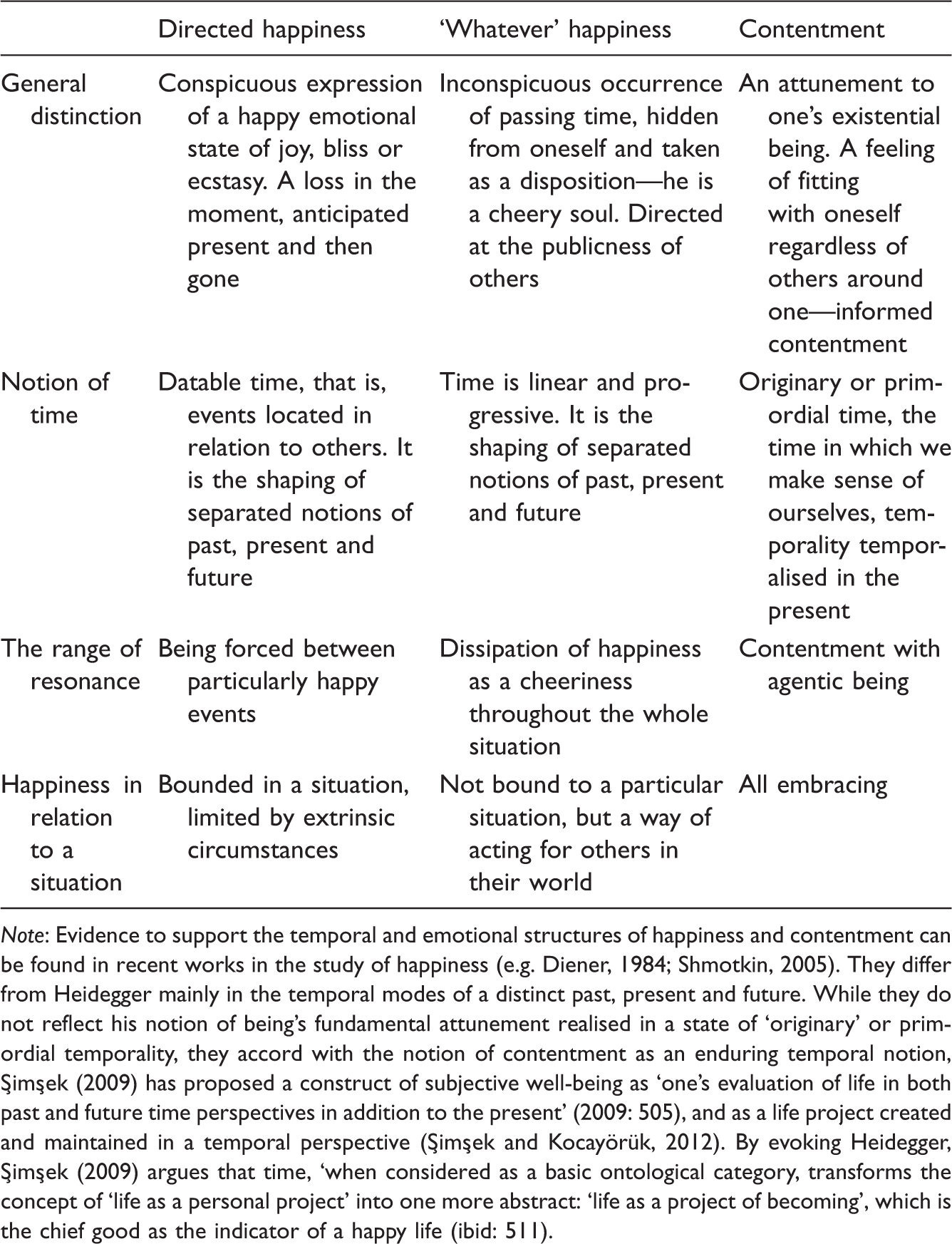
Note: Evidence to support the temporal and emotional structures of happiness and contentment can be found in recent works in the study of happiness (e.g. Diener, 1984; Shmotkin, 2005). They differ from Heidegger mainly in the temporal modes of a distinct past, present and future. While they do not reflect his notion of being’s fundamental attunement realised in a state of ‘originary’ or primordial temporality, they accord with the notion of contentment as an enduring temporal notion, Şimşek (2009) has proposed a construct of subjective well-being as ‘one’s evaluation of life in both past and future time perspectives in addition to the present’ (2009: 505), and as a life project created and maintained in a temporal perspective (Şimşek and Kocayörük, 2012). By evoking Heidegger, Şimşek (2009) argues that time, ‘when considered as a basic ontological category, transforms the concept of ‘life as a personal project’ into one more abstract: ‘life as a project of becoming’, which is the chief good as the indicator of a happy life (ibid: 511).
To feel content demands taking a stance on one’s being, seeking and then making a choice as to what one can achieve. In so doing, one breaks from the view of human nature that: embodied most plainly in mainstream economic thought, has helped to create a set of very strong and persuasive presumptions about the value of certain freedoms for human welfare, and, in turn, about the kinds of policies and social forms that tend to promote well-being. (Haybron, 2009: 250)
Happiness is the freedom of self-determination within the context of a chosen world view. Fundamental happiness, as distinct from episodic happiness—whether intense joy, eruptions of trivial pleasure or scrutinised notions of what is good for one—is not restricted to what others think and attempt to determine but to one’s own stance. It is not the satisfaction of exciting preferences, but the securing of one’s action in a life plan of one’s being. This position allows for happiness to be cross-cultural and embraces faith as well as pragmatism, all in a noneconomic stoic form of willed intention. It is about one’s fit within one’s being, so as to flourish in the world of, but not resolved by, others.
These ideas have resonance with existential phenomenological ontology literature, especially works by Kierkegaard, Heidegger and Sartre. Sufficient for now, however, is that there is psychological evidence to support an ontological notion of happiness as fulfilment that has both philosophical and psychological support (Şimşek and Kocayörük, 2012). But how do we go about being in this world? Raibley (2012) offers a way into this problem through his notion of the flourishing agent, able to bring capabilities and values to bear successfully on the stance taken on their being. Given that this is plausible, then one may ask how to enable the agent to flourish. One source of such enabling is education. To take such a stance presumes that we have abilities and capabilities, and are empowered by opportunities for them to function in our willed way of being. These capabilities are decisions of potentiality that can be revealed and investigated through, amongst other experiences, formal higher education.
Troubling students to encourage profound happiness
The notion that education is the provision of intellectual and emotional desire satisfaction has tended to become a driver of university strategy, reflecting how institutionalised education (in some but by no means all cases) has been interpreted in this consumerist epoch. Roberts (2013) writes that education now seems actually to be about promoting desire satisfaction, often in ways that are not implicit for contentment but that create pleasurable and measurable experiences. Somehow the fetish of the unquestioned metric prompts comparisons that lead to invasions of pedagogical practices and policy. Satisfaction indicators are used to build reputation, inform educational policy and create conformity. Moreover, they represent an agenda for desire satisfaction that is an extravagant, imagined sea of opportunity (favoured by advocates of education for jobs), not one where a tempered desire for happiness is achieved through balancing compatibilities (Rousseau). Returning to Heidegger, it is possible to consider the current context of education as creating not contentment but anxiety and fear for one’s future.
As was mentioned earlier, Heidegger links our understanding of the world as a futural orientation and our ability to engage with it. This is through a discourse; a hermeneutic reading of the world foregrounded in our mood. Heidegger also maintains that modes of interpretation enabled by discourse can serve to determine the range of possible moods. For instance, as Ratcliffe (2010) suggests, ‘immersion in public ways of doing things—aspiring to achieve what one ought to achieve and interpreting all of one’s activities in terms of preprescribed public norms—restrict the kinds of moods that one can have, the ways in which this can matter’. Contemporary interpretations of higher education institutions as a service provider to satisfy customers enforce a consumerist notion of one’s future. By interpreting education as a consumable good, encouraging students to feel that they will miss out in life if they do not consume the best brands, does not induce a mood of contentment to engage in transformative study, but deliberately induces a mood of anxiety and a fear of missing out. Students are put in a position to judge how satisfied they are with educational practice, not in terms of the practice’s essential edifying consequences (for they have limited knowledge or patience to assess this), but in the terms with which they are familiar as consumers: brands, entertainment and excitement. Where the experience falls short of the standard of other consumer activities they are fearful they are missing out on something that is lacking compared to others and, in response to this fear, service providers seek to satisfy this consumer demand ever more. Fear is also induced by a government whose educational discourse is damning for future life chances, should one not achieve a higher education experience and a certain level of qualification. Equally problematic is whether, once a qualification is obtained, the promised job does not materialise. Bauman (2007: 25) talks of those who do not have the resources necessary for socially approved activities as ‘collateral victims of consumption’. Being in a world and afraid of missing out, if stigmatised, encourages a mood of anxiety both in those excluded from higher education and those struggle to find the elusive status it is meant to provide.
Rather than an economic acquisition agenda (see Lewis, 2012) that has resulted in practices that deny students potentially valuable educational experiences, a university should challenge students to develop the capabilities to optimise their potential to make responsible choices. This may often be achieved through more space in the curriculum to ‘potter about’, to follow the byways of their curiosity and not to worry about learning outcomes or assessment criteria—all the things that are designed to fill up time, to create the urgency of immediate demand and to induce a fear of forgetting who you are. Such adventures may often be painfully uncomfortable but, in and of itself, this does not diminish the mood of contentment but strengthens students’ resolve to create personal identity within the context of being a member of society. As Heidegger (1998: 167) claims, ‘real education lays hold of the soul itself and transforms it in its entirety by first of all leading us to the place of our essential being and accustoming us to it’.
Education ought to provide an arena for the development of our potential and a place to be unsettled—unhappy, if you will—in the realisation that one has yet more to learn, and in this way to discuss what are realistic potentials rather than any ungrounded imaginary choices one might be able to fantasise about. To do this, one must be in the ‘right’ mood: a mood of contentment. In order to be plausible, the choices we make need to be adapted to and tested against personal circumstances, not to predetermine or to truncate options, but to allow the development of feasible ways to plan to be. We need to evade the impositions of others’ moods and to learn to find for ourselves the right mood with which to replace them (Heidegger, 1962: 175). This can be unpleasant, creating short-term dissatisfaction. As Todorov (2001) identifies in Rousseau’s works, man has a contradictory ideal; that of an individual and that of a citizen, and his unhappiness is caused by plunging into (his ‘fallen-ness’, in Heideggerian terms) the social state. This fall creates a state of despair (see Roberts, 2013) from which we cannot find happiness either through solitude or immersed citizenship. Both can be facilitated by education, but are neither a totalising type of public education that matters more to the state than the individual (accompanied by intense surveillance), nor a solitary kind of study that renders one isolated in a world of social activity to such an extent that it renders real solitude impossible. To repair the rupture between nature and society, in Emile, Rousseau proposes a method of reconciliation through domestic education as preparation for social life. He suggests a two-stream approach of moderation, a laying down of personal willed and primordial happiness that fosters contentment when realised in social relatedness. Unlike for Sophy, whose happiness is an intent realised towards others and being a good wife to please her husband, the mood of contentment pervades the way things appear and is nondirectional.
In Book II of Rousseau’s Emile, we find a detailed discussion on how contentment is more than pleasure and can be nurtured within, albeit in a virtuous male societal context. For Rousseau (2013: 37), such contentment is not to the exclusion of pain; indeed, when talking of Emile he states that ‘to bear pain is his first and most useful lesson’. He suggests that a ‘man who knew nothing of suffering would be incapable of tenderness towards his fellow creatures and ignorant of the joys of pity; he would be hard-hearted, unsocial, a very monster among men’ (Rousseau, 2013: 44). Minz offers three reasons why suffering is introduced by Rousseau: First, and most importantly, he must learn to bear the arbitrary blows of nature and endure the inevitable turmoil associated with social attachments. Second, Emile suffers because it is instrumentally useful in facilitating learning. Third, Emile must experience compassion, which involves suffering at the suffering of another, because compassion provides a positive and stable foundation for social relations. (Mintz, 2012: 255)
Of course these are intended to apply to preuniversity studentship, yet they might equally serve as reasons to ensure that students at higher levels of education are troubled so as to endure contentment. Bringing discomfort into education today is risky, even if enabling personal, willed self-determination.
Where this analysis leads is to consider that discomfort is fearful only when is it interpreted as such from an attunement to anxiety and, as moods constitute the ways in which things matter to us, if we change one mood we change the way they matter. For example, if learning is consumption and consuming is a never-ending requirement of consumerism, then failing to learn fast is a failure of consumption and to be feared. However, if failure to learn quickly reveals issues about oneself that can be explored over time, it might bring deeper understanding or even acceptance that something is personally unlearnable. Either way, one is content with the educational struggle when one accepts its reality. Such contentment does not seek an end to learning. It is a moving and ceaseless state of learning, ready to face the unanticipated future resolutely as oneself.
Heidegger’s interpretation of Aristotelian dunamis (our capability, learnt so as to realise our potential) is revealed through a manner of being-at-work (1995). It is a mode of practice where the poles of action and holding back form a mode of disclosing and affirming within oneself what is understood to be practised. Such disclosing is through our attunement to a mood. When this is contentment, it brings a sense of hope (Rorty, 1999). To manage this issue requires expertise in the teacher and openness in the student, for ‘true happiness consists in decreasing the difference between our desires and our powers, in establishing a perfect equilibrium between power and the will’ (Rousseau, 2013: 39).
Conclusion
How then should higher education provide an educative environment for the development of contentment in the face of the anxiety of consumer demands? It first needs to take its own stance on what is an edifying experience, one where the economic imperative of improved human capital is not allowed to become a quest to make learning just pleasurable, painless and easy to consume. For Heidegger (1971: 143), teaching and learning are about putting ‘oneself on a journey, to experience, means to learn’. The teaching of philosophy as exemplified in the Socratic dialogues with Theaetetus would be a good example, as would the teaching of literature and drama, through which students became engaged with human contexts and emotions. Learning is about thinking and addressing that which confronts us and may be painful, frustrating and negative. It is about dealing with the world and being prepared to act. Education should not be to hide the uncomfortable or the despair of unrealisable goals behind a consumer imperative, and to break away from this enframement of the anxiety supports and embraces an openness to the world. An attunement to contentment rather than anxiety, of course, applies equally well to staff as to students, in order that what truly matters in education may be revealed.
Roberts (2013: 464) suggests that to be ‘educated is, in part, to be aware of one’s despair, accepting of it, and able to work productively with it’. This, I have argued, is not found in an attunement of anxiety where notions of consumer satisfaction are directed at education, but in a preexisting mood of contentment where things that matter are not viewed as fearful or fearless. Rather they are viewed as contributing, positively or negatively, to one’s explored sense of being oneself open to, but not enslaved by, others. This, I believe, is at the core of the common good that many still suggest is a function of higher education. Obtaining such good (Marginson, 2014) will not accrue to us if we follow the hegemony of the knowledge of the powerful rather from confront that which is accepted to understand why.
Footnotes
Conflict of interest
None declared.
Funding
This research received no specific grant from any funding agency in the public, commercial, or not-for-profit sectors.