



Abstract
Aim
The “time perspective” becomes increasingly relevant in psychological assessment, but time constraints sometimes prevent the use of the popular Zimbardo Time Perspective Inventory (ZTPI) in its full extent. This study focuses on short versions (ZTPI–short), comprising 3 items for each scale, 15 items in total (18 when Future-Negative is added). Objectives included testing the psychometric properties of the abbreviated ZTPI and optional balancing of the Future scale with its negative counterpart.
Method
Two modifications were used, the five-scale form, structurally corresponding to the original ZTPI (Past-Negative, Past-Positive, Present-Hedonistic, Present-Fatalistic, and Future scales), and a six-scale adaptation with a Future-Negative scale added. Both versions were verified on nationally representative samples in the Czech Republic and Slovakia (N = 2068).
Results
Psychometric properties proved to be good with or without the Future-Negative scale as corroborated by adequate scale distribution, by consistency (Cronbach's alpha), reliability between short and long versions, validity of short and long versions with respect to the sociodemographic profile, by results of structural equation modeling confirming international invariance in a comparative multigroup perspective as well as good fit (confirmatory factor analysis) of five- and six-factor model for the Czech and Slovak ZTPI–short (separately or with a pooled sample). The five-scale ZTPI–short had a slightly better model fit than the six-scale version, the Future-Negative scale correlated strongly with the Past-Negative scale.
Conclusion
The ZTPI–short is a quality instrument for assessing time perspective and can be recommended for further use.
Introduction
The phenomenon of time has been a traditional puzzle for philosophers, physicists, educators and, particularly, psychologists. Paul Fraisse stands out among the early time researchers with his extensive monograph Psychology of Time (1967). Within two decades, as McGrath and Kelly (1986) noted, there were over 200 different approaches to “time perspective.” Time perspective (TP) turned out to be a crucial standpoint from which to structure the perception of human existence. Comprehension of TP and a proper balance between the past, present, and future are now considered preconditions for success, mental health, and personal happiness (Boniwell and Zimbardo, 2004; Drake et al., 2008; Gruber et al., 2012; Stolarski et al., 2013; Zhang et al., 2013a). Conversely, misperceptions of TP, lack of future vision, and imbalance among the three time zones tend to cause individual failures and social conflicts (Gruber et al., 2012; Zimbardo and Boyd, 2008).
Zimbardo Time Perspective Inventory—ZTPI
A breaking point in understanding and utilizing of TP arrived with Zimbardo's conceptualization of TP, popularization of its significance and, most importantly, with a well-publicized tool for its assessment—the ZTPI (Gonzales and Zimbardo, 1985; Zimbardo and Boyd, 1999). ZTPI narrowed down TP into time dimensions and operationalized them into Past-Positive, Past-Negative, Present-Fatalistic, Present-Hedonistic, and Future TP. The generally recognized concept of TP with readily accepted dimensions inspired a creative use of the inventory. Its validity and reliability were tested both in the U.S. and abroad, and it found practical applications from general education to treatment of posttraumatic stress disorder (Sword et al., 2014; Zimbardo et al., 2012), or guidance for Alzheimer caregivers (Potgieter, 2012).
ZTPI in practical applications
Plentiful studies indicate that particular time orientations and/or ZTPI method are useful in diverse areas especially of clinical and counseling practice. Just recently, in this decade, van Beek et al. (2011) demonstrated the relationship of TP to psychopathology, among others to depression and neuroticism; Anagnostopoulos and Griva (2012) and Gilbert and Sifers (2011) found significant relations to mental health; Zhang et al. (2013a) described significant links to subjective well-being. Barnett et al. (2013) documented connections between TP, substance use, and abuse. Sansone et al. (2013) clarified the relationships between future orientation and smoking behavior. TP was used in many studies to explain or predict various forms of health behavior, particularly dieting and exercising (Gellert et al., 2012; Guthrie et al., 2013; Hall et al., 2012) and relevance to quit smoking (Hall et al., 2012). TP is also involved in diverse forms of psychosocial functioning (Laghi et al., 2012), interpersonal relationships (Bernstein and Benield, 2013), and career decision making (Taber, 2013).
ZTPI in translations
The ZTPI questionnaire has been not just translated, but also validated in multiple languages. The currently available versions include the French (Apostolidis and Fieulaine, 2004), Italian (D'Alessio et al., 2003), Spanish (Díaz-Morales, 2006), Russian (Sircova et al., 2008), Greek (Anagnostopoulos and Griva, 2012), Lithuanian (Liniauskaitė and Kairys, 2009), Czech (Lukavská et al., 2011), Swedish (Carelli et al., 2011), and a Portuguese version developed in Brasil (Milfont et al., 2008). Some of these versions were tested on large representative samples, e.g., the Lithuanian (N = 1529) and Czech versions (N = 2030). Finally, the ZTPI was scrutinized by cross-cultural comparisons (Sircova and Mitina, 2008; Sircova et al., 2014).
The validation studies confirmed that the translations are useful tools in psychological practice and generally match the original inventory on the significant items of each scale. These items manifested high correlations to their scales and respective high loadings in exploratory factor analyses. Nevertheless, some “ambivalent” items tend to correlate lower with their own scales and, occasionally, relate to a different scale than expected from the model (Lukavská et al., 2011). This phenomenon has obvious implications for goodness of fit of the confirmatory factor analysis (CFA) models. This experience led us to an assumption that in diverse cultural contexts, shortened versions of the ZTPI, containing just several key items for each scale, might provide a more valid and practical tool.
Balance of the past and future
A proper balance in TP is generally recognized as a fundamental prerequisite for psychological health, happiness, and efficiency (e.g., Stolarski et al., 2013; Zhang et al., 2013a). Interestingly, the equilibrium among the very ZTPI subscales has been repeatedly discussed and challenged. Although the theoretical framework divides TP into the three basic orientations (the past, present, and future) and takes into account both their positive and negative aspects, the ZTPI lacks a corresponding symmetry: whereas the past has its positive and negative forms and the present has its hedonistic and fatalistic components, the future factor in Zimbardo's ZTPI has only a solitary form, a distinctly positive one from the point of view of the Protestant work ethic. This positive future orientation reliably correlates with such socially desirable phenomena as academic achievement (Barber et al., 2009; Peetsma and van der Veen, 2011), health behaviors (Gellert et al., 2012; Henson et al., 2006), optimism, and less psychopathology (Zimbardo and Boyd, 1999).
Nevertheless, in real life, the future is not mere positive achievement and adherence to deadlines. The future is also often associated with worries and generalized anxiety. This tempted some scholars, e.g., Zalesky (1996), Nurmi (2005), Worrell and Mello (2007), Carelli et al. (2011), and—last but not least—Zimbardo and Boyd (1999) themselves, to also consider a counterpart for the Future-Positive TP, a negative Future-Negative twin related to such phenomena as fear, anxiety, and doubts.
Objectives of the present study
The current literature discusses several methodological topics relevant to ZTPI. Among others, there is a debate over the role of individual time dimensions, their relationship and equilibrium (e.g., Webster, 2011; Zhang et al., 2013a). A question was raised whether Zimbardo's five scales cover TP in its entirety or whether an additional dimension is required. It appears that the dimension of negative future (Future-Negative) is absent; Future-Negative might well complement and balance the single future dimension (F) which has a distinctly positive meaning. With Future-Negative, the time universe might be more complete. However, the full ZTPI already sometimes fails to be included to testing batteries due to its length. Abbreviation of the original questionnaire either by excluding (D'Alessio et al., 2003) or by shortening original scales (Fieulaine et al., 2010 submitted; Zhang et al., 2013b, cf. Sircova et al., 2014) might further encourage its practical use.
Thus, the literature as well as our previous work led us to the following objectives for this study (a) to develop a short version of the ZTPI; (b) to supplement the inventory with a future negative factor; and (c) to compare various ZTPI versions and their psychometric properties.
We were privileged that a well-established market research agency, Focus was willing to cooperate with us in this academic pursuit and collect quality data representative of the Czech and Slovak Republics. We also had a unique opportunity to compare our results not only with those of the original American study but also with a Swedish study that contained the Future-Negative scale within the ZTPI/64 items/six subscales version and, additionally, with our previous studies that assessed TP of a nationally representative Czech population with the ZTPI/56 items/five scales.
Method
Participants
The ZTPI–short was administered in the Czech and Slovak Republics to representative samples of 1032 Czech and 1036 Slovak adults (including minority Hungarians), respectively. Respondents were recruited by quota sampling to attain nationwide representativeness of gender, age, nationality, and urban–rural ratio. The fieldwork was executed February 21–March 12, 2012. Interviews were conducted face-to-face, typically in respondents' homes. The ZTPI was incorporated into a monthly Omnibus survey by the Focus agency. Six respondents missed the whole ZTPI battery and thus were eliminated.
Our sample included a total of 2062 participants, NCzech = 1027 and NSlovak = 1035; there were 1079 females (52%) and 983 males (48%) aged 18–90 years (M = 44.15, SD = 16.82, medians [Md] = 43).
The original data set contained occasional missing values. The incidence of missing data in the Czech sample was rather low as a result of the CAPI data collection (computer-assisted interviewing). There were only 4.5% respondents with at least one missing in the ZTPI battery. The Slovak data were collected by pen and paper technique and thus the missing data were more frequent; 16% respondents had at least one missing answer. As many as 90% participants of the pooled Czech and Slovak sample responded to all ZTPI items without any missings, 5% missed one item, 2% missed two, and 1% missed three items.
We analyzed the missing data to verify their randomness. Using analysis of variance, we systematically tested correlations of missings with all 10 demographic variables. In the Czech sample, only a single demographic variable (age, p = .060) approached the significance level; in the separate Slovak sample, 5 of 10 demographic variables correlated with missing values; 2 of these variables interacted also in the combined Czech and Slovak sample.
Most ZTPI factors were immune to the occurrence of missings. From the six ZTPI factors, only two (Present-Fatalistic and Future-Negative) showed some sensitivity to missing values in case of the Slovak sample. In the Czech sample, the Present-Fatalistic and Future-Negative TP appeared to have been influenced by missings.
The stringent Little's test refuted the presence of missing completely at random (MCAR) pattern of missingness (Chi-square = 1883.54, df = 1574, significance <.001 for the pooled sample with significance < .001 for Slovak and significance = .003 for the Czech sample). Therefore, for several further comparative analyses using a corresponding Statistical Package for the Social Sciences module, we applied the expectation-maximalization (EM) imputation method to the pooled Czech and Slovak data set (see Table 3 with the maximum likelihood (ML) estimates).
Measures
ZTPI–short, the abbreviated version of ZTPI, consists of five or six scales—the Past-Negative, Past-Positive, Present-Fatalistic, Present-Hedonistic, Future-Positive and the new Future-Negative scale. Each scale is comprised of three items from the original ZTPI (Zimbardo and Boyd, 1999), which manifested high loadings in exploratory factor analysis; the additional three items for the Future-Negative scale were chosen from the Future-Negative scale of a Swedish study by Carelli et al. (2011).
Our aim was to design a short ZTPI inventory applicable also for international use. For its construction, we used not just the original version of ZTPI (Zimbardo and Boyd, 1999), but also experience from the existing language modifications and their psychometric verifications. Our item selection was based mainly on psychometric qualities of items contained in: (a) the long (56 items) Czech version administered to a representative sample of 2030 respondents (Lukavska et al., 2011), (b) the original ZTPI (Zimbardo and Boyd, 1999), (c) Lithuanian ZTPI version (Liniauskaitė and Kairys, 2009), (d) French ZTPI version (Apostolidis and Fieuleine, 2004), (e) and the Swedish ZTPI version (Carelli et al., 2011) significant for us since it contains the Future-Negative scale.
While primarily focusing on the psychometric properties of the items, we also tried to maintain the content diversity of the scales. The item correlation to its appropriate scale was the primary criterion for item selection; we took into account both the American original (Zimbardo and Boyd, 1999) and also other available national versions. All items that were chosen for ZTPI–short represent the original ZTPI high-ranking items with strong loadings (0.5 or higher) to their appropriate factors (exploratory factor analysis by Zimbardo and Boyd, 1999). There was only one exception, item #16 (loading 0.44). Similarly, all but two ZTPI–short items (#7 and #14) loaded 0.5 or higher in the exploratory factor analysis (EFA) performed on the French ZTPI (Apostolidis and Fieuleine, 2004) and all but two items (#10 and #16) loaded 0.5 or higher and were among the top five in the Lithuanian EFA (Liniauskaitė and Kairys, 2009).
Basic characteristics of the ZTPI–short items administered to Czech and Slovak representative samples in their national languages with Cronbach's alpha of relevant scales, means of items (M), their standard deviations (SD), medians (Md), correlations to respective scales (r), and standardized weights (Beta).

Note: ZTPI, Zimbardo Time Perspective Inventory; SEM, structural equation modeling.
M and SD describe the pooled Czech and Slovak sample. Analysis of variance, biserial correlations, and t-tests proved very small or no difference between the Czech and Slovak ZTPI scores. For instance, the Czech vs. Slovak effect sizes, as expressed by biserial r2, were weak (between <.001 and .025). The simple correlations (r) may be biased upward due to mere three to four items per scale. For that reason, we are also including estimated loadings (Beta) of confirmatory factor analysis (CFA) without errors.
Procedure
Statistical analysis began with the identification of basic characteristics of the ZTPI–short and its 18 items: means, standard deviations, Mds, and correlations to scale. Cronbach's alpha was used to assess the internal consistency of scales, and correlations between scales were calculated. We also calculated reliability of both short and long ZTPI forms and their correlations. 1
The goals of this study included the comparison of the psychometric properties of the ZTPI–short with those of the original longer version and the augmented ZTPI–short with the Future-Negative scale. Accordingly, we performed CFA with both the full information maximum likelihood (FIML) estimation (data set including missing values) and maximum likelihood (manipulated data set) using the AMOS 21 program (Arbuckle, 1999, 2011). Where appropriate, we evaluated the covariance structure models with several goodness-of-fit indices: chi-square (e.g., Saris and Satorra, 1993), the comparative fit index—CFI (Bollen, 1989), the root mean square error of approximation—RMSEA (Steiger and Lind, 1980), the Tucker–Lewis index—TLI (Tucker and Lewis, 1973), and the standardized root mean square residual—SRMR (Jöreskog, 1973). The difference between the nested (constrained and unconstrained) models was tested by a strict delta log-likelihood ratio test as well as by a more permissive delta CFI.
Two models were examined: (1) the ZTPI–short with 18 items in six scales (i.e., with the Future-Negative scale added) and (2) the ZTPI–short with 15 items in five scales only (without the Future-Negative). We compared model fit values (a) to the Swedish six-scale ZTPI, which consists of the same scales as our first, augmented model but, in contrast to our short version, has overall as many as 64 items (Carelli et al., 2011); (b) to the original ZTPI with five scales and 56 items, which was described by Zimbardo and Boyd (1999) and tested by Worrell and Mello (2007); and finally, (c) to the Czech version of the ZTPI, which has the identical five-scale structure and length as the original ZTPI (Lukavská et al., 2011).
Results
The psychometric properties of ZTPI–short
The basic psychometric properties of the ZTPI-short are listed in Table 1. All scales had normal or almost normal distribution: (a) maximum absolute skewness was .677, and maximum kurtosis was .865; (b) the distribution of responses was fairly symmetrical and close to a normal curve. Intercorrelations were low or of middle intensity (maximum r = .579) with no apparent danger of multicollinearity. Each item demonstrated a relatively strong correlation to its scale and loaded relatively high on its respective factor.
The internal consistency of scales measured by Cronbach's alpha varied from 0.65 to 0.78. These values are close to a conventionally accepted threshold of .700 and comparable to values for the ZTPI with all 56 items used in an analogous Czech study (N2003, 2008 = 2030) with alpha from 0.66 to 0.85 (Lukavská et al., 2011). These values are also consistent with other ZTPI translations noted above, such as the Lithuanian study (0.63–0.79), the Spanish (0.64–0.80), French (0.70–0.79), and the Swedish study (0.65–0.84). Whereas the Swedish eight-item Future-Negative scale had a good internal consistency of 0.75 (Carelli et al., 2011), our new Future-Negative scale, consisting of just three items, reached a lower, although still acceptable, value of 0.65.
The (bivariate) reliability of both 15-item ZTPI–short and 18-item ZTPI short forms (i.e., including Future-Negative) is very high, rkk = .996. The 56-item (full) ZTPI form's reliability is also very high, rkk = .995. Moreover, correlation of short and long form shows a very close, completely satisfactory relationship (rfs = .992).
Correlations between mean scores of the ZTPI–short scales.

Note: ZTPI, Zimbardo Time Perspective Inventory.
p > 0.05.
p < 0.01.
p < 0.001.
Analogous significant positive correlations were also found among positive scales, namely between the Past-Positive and Future-Positive scales, to a lesser degree also between both past scales (Past-Negative and Past-Positive) and between both present scales (Present-Hedonistic and Present-Fatalistic). Somewhat surprisingly, similar resonance was not found between the future scales. While our study demonstrated a significant negative correlation between the Future-Positive and the Future-Negative, the Swedish study did not report any significant correlation between the two future scales (r = 0.05), indicating their independence.
We thoroughly analyzed mutual relationships of the scales. We conclude that the ZTPI–short scales seem to relate to one another much the same as the original (long) ZTPI scales did.
CFA constituted the core step in the analysis of the six- and five-scale ZTPI–short models. Our two structural equation models (SEM) implemented by FIML included also five and four correlated error terms. The intercorrelated errors were associated with two situations: (a) item meanings were closely related, such as “ZTPI_17|Past-Negative I think about the bad things that have happened to me in the past” and “ZTPI_18|Present-Fatalism My life path is controlled by forces I cannot influence”; “ZTPI_7|Past-Positive Happy memories of good times spring readily to mind” and “ZTPI_8|Present-Hedonistic It is important to put excitement in my life”; “ZTPI_6|Present-Fatalistic Since whatever will be will be, it doesn't really matter what I do” and “ZTPI_13|Present-Hedonistic I take risks to put excitement in my life”; (b) item meanings were in contradiction such as “ZTPI_2|Past-Negative I often think of what I should have done differently in my life” and “ZTPI_17|Past-Negative I think about the bad things that have happened to me in the past.”
Although some of these intercorrelations cross the factor boundaries, their intensity is not high (r between −0.19 and 0.26), especially if compared to the strength of factor loadings (≥0.57 and ≥0.54 for six- and five-factor models, respectively).
Goodness-of-fit coefficients for the short ZTPI in comparison with the original.
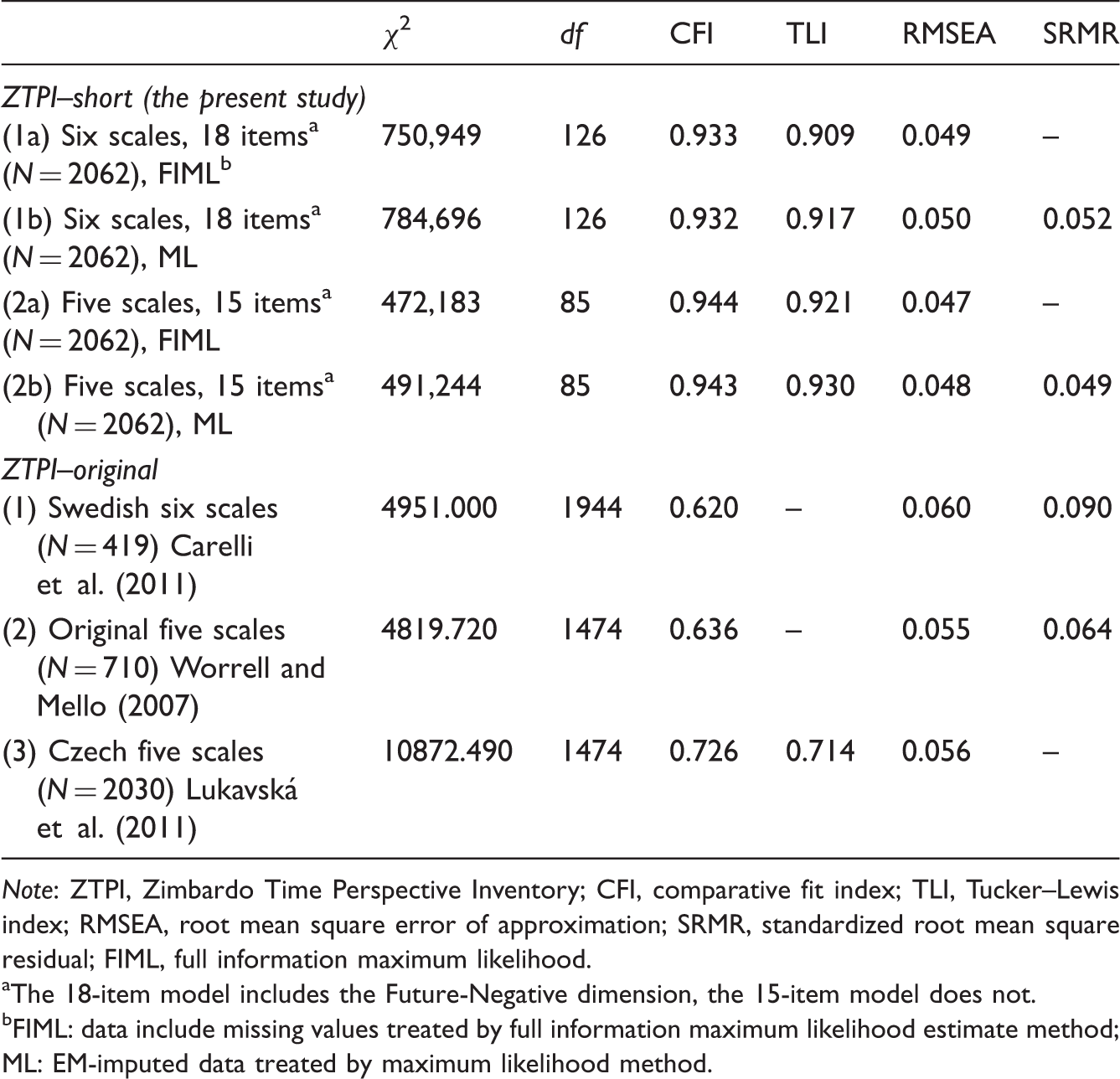
Note: ZTPI, Zimbardo Time Perspective Inventory; CFI, comparative fit index; TLI, Tucker–Lewis index; RMSEA, root mean square error of approximation; SRMR, standardized root mean square residual; FIML, full information maximum likelihood.
The 18-item model includes the Future-Negative dimension, the 15-item model does not.
FIML: data include missing values treated by full information maximum likelihood estimate method; ML: EM-imputed data treated by maximum likelihood method.
We further evaluated the effectiveness and accuracy of the short scales compared to the originals and reanalyzed data from the Czech 56-item ZTPI version obtained on a large representative sample of N = 2030 (Lukavská et al., 2011). To test the efficiency of the short scales, we selected the corresponding items from the long version and compared the scores in short and long versions by Pearson correlations. The correlations of short and large scales were quite high: Past-Negative r = 0.882, Past-Positive r = 0.824, Present-Fatalistic r = 0.861, Present-Hedonistic r = 0.848, and Future-Positive r = 0.796. In general, the short scales with three items explained 63–77% of the variance of longer scales with 9–15 items.
To account for a possibility that these correlations are confounded (as short scales are subsets of the long ones), we repeatedly (B = 500) and randomly split the sample into 70% (training sample) and 30% (test sample) and used the linear regression on the training sample to estimate the (multivariate) correlation between the long and short scales. The Md correlations across all replications did not significantly differ from the values of the simple correlations we obtained earlier (all differences below 0.0013).
Significant standardized regression coefficients (Beta) for ZTPI–short factors in the pooled Czech and Slovak sample (N = 2061).
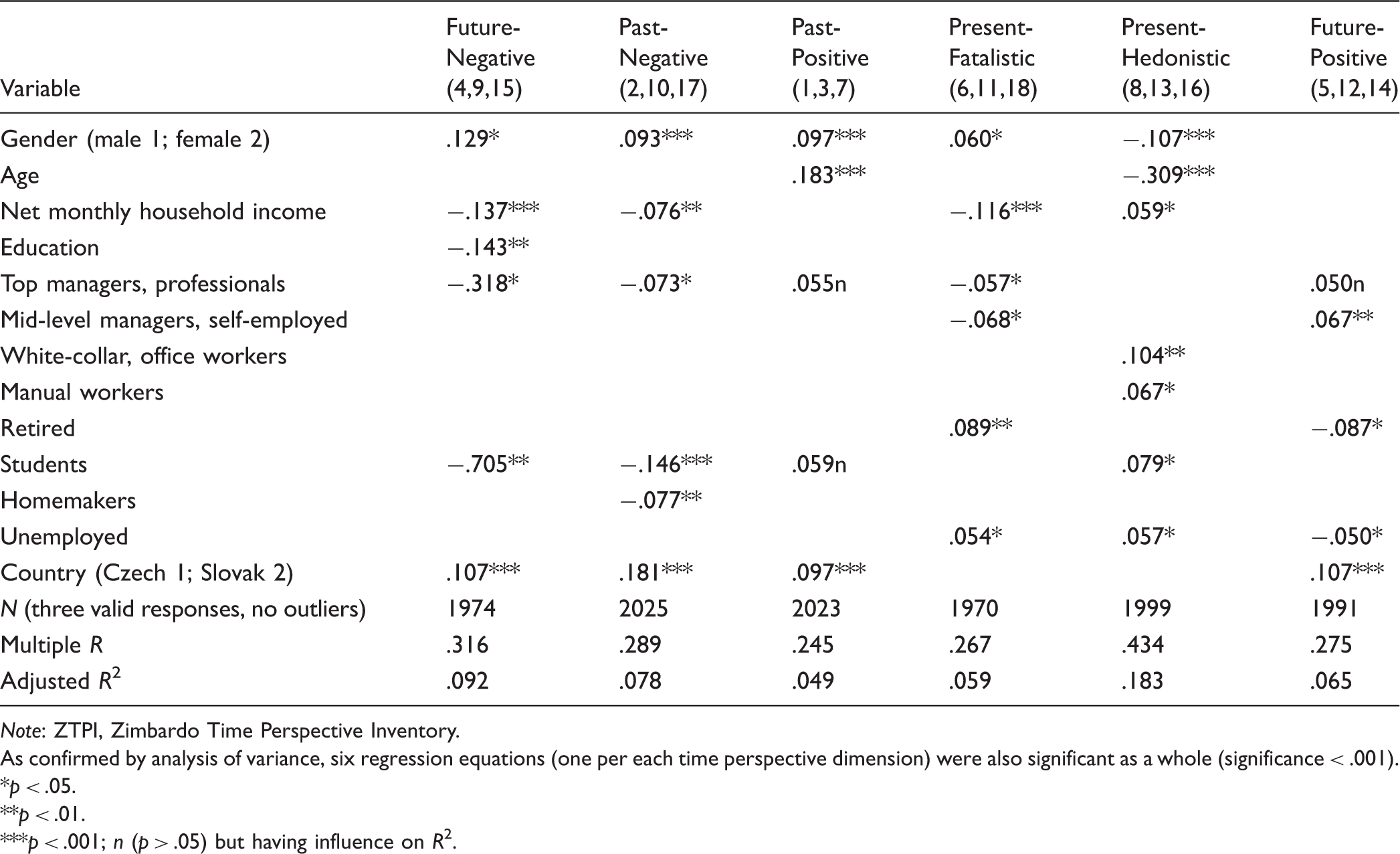
Note: ZTPI, Zimbardo Time Perspective Inventory.
As confirmed by analysis of variance, six regression equations (one per each time perspective dimension) were also significant as a whole (significance < .001).
p < .05.
p < .01.
p < .001; n (p > .05) but having influence on R2.
As another validity indicator, we analyzed correlations of both short and long forms with available criteria, finding similar patterns of relationships. 2 We found only very small differences between expected correlation based on ZTPI in the full extent and the observed correlation of ZTPI–short. These differences were between 0.005 and 0.104, i.e., amounting to 0.042 on average. Although concurrent and predictive validity of ZTPI–short and its usefulness in various areas of psychological practice has to be further studied, our preliminary probes and analyses have been very satisfactory.
Invariance
The reliability of the CFA results was confirmed by a multiple-group comparison. The comparison's main goal was to ascertain the invariance for both the five-factor and six-factor models, i.e., that the Czechs and Slovaks generally understood the ZTPI in the same manner.
Our large pooled data sample (N = 2068) constituted an appropriate basis for invariance testing. Perhaps the most rigorous among the SEM specialists, Prindle and McArdle (2012: 366), require that “a sample size of 1,450 is necessary for the RMSEA calculation of model fit” although most comparative studies use smaller samples (Crayen et al., 2011, etc.).
The SEM software was used to test equivalence by multiple-group comparison; the results by AMOS 21, FIML, estimation method indicate satisfactory invariance across Czech and Slovak respondents for both ZTPI–short versions (the six-dimensional ZTPI with the Future-Negative as well as the five-dimensional model without the Future-Negative scales). As a rule, the invariance is measured by log-likelihood ratio and by Delta CFI, which should be either below the 0.01 value (Byrne, 2004: 12; Byrne, 2010: 223; Chen, 2007: 482; Cheung and Rensvold, 2002) or, by a more rigorous criterion, below 0.002 (Lee et al., 2011: 59–60).
Thus, in our study, no difference was found between the Czech and Slovak six-factor models with or without constraints on loadings (delta 2 = 0.002 and p = 0.209; delta CFI = <0.001) and with partial constraints on intercepts (delta 2 = 0.002 and p > 0.001, i.e., 0.005; delta CFI = 0.001). (Equality constraints across both country data were put on each pair of weights and on at least one pair of intercepts per each dimension.) All loadings on the six dimensions of both constrained and unconstrained models were quite high with β at least .588 and significantly different from zero at the .001 level, just showing sufficient level of convergent validity. Additionally, the exploration of the five-factor solution (without the Future-Negative) yielded estimates of all factor loadings, intercorrelations, and error terms as significant at least on .001 level. In fact, this five-factor model appears to have the best psychometric properties (fit coefficients) of all models that we compared in this study, i.e., generally the highest loadings (β > .584). Several intercorrelations between error terms were theoretically expected and also justified as a partial overlap in meaning of particular pairs of items. See discussion of this aspect in Byrne (2001: 186): “Scrutiny of the items associated with these error terms revealed highly overlapping content across each aberrant pair of items. Such redundancy can reflect itself in the form of error covariation”. For instance, ZTPI item (2) “I often think of what I should have done differently in my life” and item (17) “I think about the bad things that have happened to me in the past” correlate between r = −.128 and −.185 showing an essentially adverse relationship. (Detailed comparative tables are available on request as well as comparisons of loadings and covariances between individual items of the five-scale and six-scale models.)
Discussion and conclusions
In the present study, Czech and Slovak ZTPI–short data separately and in the pooled sample of both countries exhibited very good model fit. All goodness of fit coefficients lay within the recommended range; all loadings were sufficiently high (between r = .588 and .768) and significantly different from zero (p < .001). (Due to limited space, path diagrams and detailed tables are available on request.) No cross-loadings were implemented into the model to attain its fit. All parameters were estimated precisely, with low standard errors. Variances of estimation errors for all 15 ZTPI items (or 18, respectively) are neither excessively high nor low. Considering that the original long ZTPI with 56 items usually manifests only an acceptable level of model fit (Apostolidis and Fieulaine, 2004; Liniauskaitė and Kairys, 2009; Lukavská et al., 2011; Worrell and Mello, 2007), the abbreviated version promises a significant improvement.
Two forms of the ZTPI–short were tested: the five-scale form followed the original structure proposed by Zimbardo and Boyd (1999); the six-scale modification contained an additional Future-Negative scale that in its long (eight items) version was earlier included by Carelli et al. (2011). They added the Future-Negative scale while they validated the Swedish ZTPI (the original future scale became Future-Positive, and the Future-Negative scale was created from eight new items), and they proceeded with comparisons of the original five-scale solution with the new six-scale model.
In the Swedish study, the six-scale solution provided almost the same model fit as the original five-scale solution. RMSEA, SRMR, and χ2/df indices suggested a good or acceptable model fit; however, CFI values were quite low. It is likely that our model fit values are better especially due to the shorter length of the inventory rather than because of our larger sample (N > 2000 as required for RMSEA, in contrast to 400 used in the Swedish study) and its better representativeness (we used a national representative sample, the Swedish study a solely urban population).
When Carelli et al. tested the standard-length ZTPI both in its five-scale and six-scale forms (with and without the Future-Negative scale), they obtained an almost identical model fit for both. Our results suggest that the five-scale ZTPI–short has a better model fit in all measured indices than the six-scale ZTPI, although the difference is rather small. Moreover, correlations indicate a strong relation among the Future-Negative and other negative scales, namely, the Past-Negative and, to a lesser extent, the Present-Fatalistic. Concurrently, the Future-Positive relates to the Past-Positive factor although their correlation is not high (r = −0.19), acknowledging that these are two different factors. Thus, there is a question of dimensionality between the Future-Negative and the Past-Negative, further accented by the SEM analysis showing a very high correlation between them, which also confirms the Swedish findings (Carelli et al., 2011: 223–224). Nevertheless, despite a high correlation of both negative scales, the Future-Negative may show its discriminative power and autonomy in future research.
Our analysis of the ZTPI–short demonstrated that both forms (with or without the Future-Negative) have very good psychometric properties. The ZTPI–short models meet the good fit criteria of CFA better than available standard ZTPI versions.
We can conclude that the shortened version of the ZTPI, the ZTPI–short, was shown to be a quality instrument for TP assessment. Moreover, the six-scale ZTPI eliminates the two most frequent objections—a poor model fit and the asymmetry of the inventory—which so far had only one future factor but pairs of factors relevant to the past and present time. We can therefore recommend the validation and use of the ZTPI–short either in English or in translation.
The practical need for a short form of the ZTPI scale is apparent. Another short version of ZTPI was recently published by Zhang et al. (2013b). Their inventory consists of 15 items in five scales. Unlike our short version, it does not include the Future-Negative scale. Zhang et al. (2013b) also selected their items from the original ZTPI (Zimbardo and Boyd, 1999), but they did not seem to have utilized the experience with other administrations of the scale, namely, with the foreign versions of ZTPI and their psychometric properties. Only seven items of ours and Zhang's et al.'s (2013b) inventories overlap; these are #4, #10, #14, #20, #26, #40, and # 50 from the original version of Zimbardo and Boyd (1999).
Our analyses indicate that several items from the Zhang's et al. (2013b) version appeared problematic when they were used in other studies or in other cultural contexts. 3 In summary, although driven by a similar logic as the team of Zhang, our team opted for rigorous items selection from both the American and the international perspective and the usage of inventory in translations. We tried to avoid items that appeared problematic in various national contexts. A difference was also in the layout of the inventory. Zhang et al. presents the items in consecutive groups, according to each scale. We liberated the items from the factor groupings in a similar way as they are presented in the original ZTPI (Zimbardo and Boyd, 1999). In the present study, we additionally rotated the items during administration to prevent any artifacts caused by the item location in the questionnaire.
Limitations and Future Research
Both those who construct an abbreviated method as well as those who plan to use it are facing a trade-off: Shortening of the scales means an inevitable narrowing of the construct, among other losses. In this case, the Present-Hedonistic scale was shortened the most as its original version contained 15 items and to represent its core well, we had to sacrifice some of the construct diversity; only items containing “excitement” were chosen for the short version. Thus, we have left aside more subtle indicators of a bon vivant life.
Further effort should be focused in particular on verification of convergent validity of the method, using personality assessment techniques (e.g., the Big Five, sensation seeking scales, consideration of future consequences, and various behavioral variables (e.g., risk taking, health behaviors, academic achievement). Clinical studies could reveal applicability of this technique, i.a., in psychotherapy.
To contribute to the current debate on balanced TP (Boniwell et al., 2010, Stolarski et al., 2013; Zhang et al., 2013a), ZTPI–short should be administered with an additional measure of subjective well-being, emotional intelligence or life satisfaction. Further study is needed to test the possibilities and limits of this promising new version of ZTPI.
Footnotes
Acknowledgements
The authors wish to thank the Focus agency (the Czech and Slovak Republics), namely Ivan Dianiška, Martin Šlosiarik, Roman Skotnica, Jarmír Volek, and Filip Rozsíval, for their friendly and gracious support of this study. We also thank Vladislav Šolc and Miroslav Litavský for their help with the Slovak translation.
Authors’ note
The research data, sampling information, and additional models can be obtained at this email address:
Declaration of Conflicting Interests
The author(s) declared no potential conflicts of interest with respect to the research, authorship, and/or publication of this article.
Funding
The author(s) disclosed receipt of the following financial support for the research, authorship, and/or publication of this article: This research was supported by RVO 68081740 and GA UK grant 684112.