



Abstract
The purpose of this paper is to outline the “ecology of social time” as an empirical concept of time to bridge the gap between theory and empirical research in the sociology of time. First, this paper proposes that social time could be considered as an institutionalized referential mechanism that enables social interactions to occur at a specific time point by coordinating the social actions of various agents. Examining the condition of temporal coordination and diagnosing its fairness critically may be the tasks involved in the sociology of time. Second, this paper suggests that the ecology of social time is a useful concept for integrating the theses and tasks applied in the sociology of time. Finally, this paper presents an ecological model of social time as a possible framework for subsequent empirical research in the sociology of time.
Time is one of the most crucial topics worth discussing in the field of sociology. In the past decade, sociological studies on time have been conducted vigorously and have yielded fruitful results (cf. Bergmann, 1992; Nowotny, 1992). These achievements can be divided into two dimensions.
One of these dimensions is the theoretical dimension. At the primary stage of the development of sociology, numerous authors have studied time as a central theme. Karl Marx’s Capital (Vol. I), for example, describes how capitalists exploit the surplus value of laborers by extending working time and how laborers must strive to obtain free time. Therefore, time is a critical aspect of the class struggle (Marx, 1968). In The Protestant Ethic and the Spirit of Capitalism, Max Weber cites Benjamin Franklin’s well-known saying “time is money” to demonstrate that “using time efficiently,” which he considered as an aspect of the protestant ethic, is one of the core elements of capitalism (Weber, 1993). In The Elementary Forms of Religious Life, Émile Durkheim asserts that time is an abstract social framework that regulates the collective rhythm of life (Durkheim, 1965); this viewpoint is considered crucial as an initial concept in the sociology of time.
The number of discussions focusing on time in modern sociology is increasing. Talcott Parsons emphasizes that the key to describing social action is clarifying the temporal process of social action (Parsons, 1949: 43 ff.). Although Parsons does not elaborate on this topic, other sociologists who have studied the concept of social action have not ignored the importance of the relationship between time and social action. Alfred Schütz, for example, stresses that time is a unified, single flux because the working action that is projected in the inner consciousness based on previous actions participates in the outer world and thereby connects the past and present with practical future objectives (Schütz, 1945; Schütz and Luckmann, 2003). Luhmann (1980, 1981), who was profoundly influenced by Parsons, contradicts Schütz’s concept of unified time by considering time as a difference; more precisely, a unity of the difference of “past and future” that is differentiated by the present deciding action. Giddens (1984) also emphasizes the connection between social action and time. According to his theory, the structuration of society is based on routinization, the temporal repetition of social actions in everyday life. In addition, he suggests that time in relation to social life should be divided into three categories—durée, Dasein, and longue durée—to prevent the concepts of time from being misinterpreted (Giddens, 1987: 144ff.). Giddens’ theory has received much attention and influence, and cannot be ignored (Adam, 1990). 1
In addition to the theoretical dimension, the empirical dimension plays a role. Empirical studies on the sociological aspects of time can be conducted by considering “time as an inner consciousness” or “time as a duration of outer actions” (Bergmann, 1992; Dux, 1989).
Regarding temporal consciousness, a widely investigated subject is how humans perceive the lapse of time and how temporal perception affects behavior, or vice versa, from the perspective of social psychology (Doob, 1971; Levine and Norenzayan, 1999; Morgenroth, 2003). In addition, various temporal concepts developed by distinct ethnic groups can be analyzed through field research from the perspective of anthropology (Bourdieu, 1990). Analyzing the historical changes of temporal consciousness through the study of conceptual history is another crucial theme (Koselleck, 2000; Lübbe, 2009; Luhmann, 1980, 1997; Rammstedt, 1975).
The most widely used approach in conducting empirical sociological studies of time may be the time-use survey, in which time is primarily construed as a dimension of the duration of actions. 2 The purpose of using the time-use survey is to describe the patterns and allocation of human activities by examining how people spend their time on various activities during certain time intervals (Blass, 1990: 55). The main components of the time-use survey include stylized time-use items within conventional questionnaires, the experience-sampling method, continuous observation, and time-use diaries (Gershuny, 2011). In addition, the establishment and improvement of the statistical databank of time use are crucial tasks in the sociology of time. The first large-scale survey pertaining to time use was conducted in the former Soviet Union during the 1920s. Since the Hungarian social scientist Alexander Szalai directed the first cross-national survey of time-use in the 1960s, the paradigmatic and influential results of which were published under the title, The Use of Time, the time-use survey has become a common national research topic in numerous countries (Blass, 1980: 22ff.; Gershuny, 1990; cf. Szalai, 1972).
Although the sociological studies of time have attained numerous achievements, all of these studies contain one problem: the gap between theoretical and empirical approaches. Although many social theorists have posed diverse theories regarding time, these theories are seldom compared and are often extremely abstract, as if the understanding of time is only a philosophic interest and is not relevant in everyday life. Consequently, the abstraction of time renders the findings of these theoretical studies inapplicable or unable to be analyzed in empirical research (Rosa, 2005: 21ff.). However, even if empirical studies incorporate the time-use survey to obtain a large number of data on the temporal activities of humans, these surveys generally lack applicable theoretical foundations. Although “time” is the topic of these surveys, it is rarely defined comprehensively and is conventionally and arbitrarily used as a variable or index of action. Therefore, time often plays an ambiguous and secondary role in empirical studies on time (Szalai, 1977: 1.2). Furthermore, because of the deficient theoretical basis of sociological studies on time, only quantitative or interpretive descriptions are provided instead of analyses, critiques, and constructive suggestions (Blass, 1980: 31).
However, time is neither merely a type of research variable nor a theoretical enigma removed from social reality. People can easily understand that time-related matters affect everyday life and often become critical concrete problems, such as deadlines and the scarcity of time (cf. Luhmann, 1971). Therefore, the sociology of time must provide theoretical concepts that relate to actual social life directly and can be used to guide empirical studies in conducting sound and critical analyses.
Based on these deficiencies, the purpose of this paper is to outline a new theoretical concept of the sociology of time that can be concretely related to social life and can be used as an analytic framework of empirical research on time. This paper is organized as follows: (1) the concept of time is reexamined and redefined and corresponding theses based on the fundamental concepts of sociology are proposed; (2) the sociological definition and theses of time are integrated with the ecological perspective to develop the “ecology of social time” concept, which may be a useful term in future sociological studies of time; and (3) an ecological model of social time is established as an analytic framework of empirical research, and implications and research topics for future studies related to the sociology of time are provided.
The sociality of time and relevant theses
Most discussions on time either consider time as a type of measurable objective phenomenon or a type of constructive subjective consciousness (Elias, 1984: Xff.; Heidegger, 1957: 405). However, a distinct perspective on the sociology of time can be developed because, as mentioned previously, Schütz, Luhmann, and Giddens indicate the inseparable relationship between action and time. Because time is inseparable from social action, and following the Weberian tradition of defining social action 3 as the basic constitutive element of society, time can be considered its social dimension. Nevertheless, because Schütz’s theory of social action depends considerably on phenomenology, time in his theory is more philosophically conceptual than empirical. Luhmann ignored social action in his later works and thus rendering the theory of time in his system theory extremely abstract and disassociated from social action (cf. Luhmann, 1997). In Giddens’ theory, time is viewed as a philosophic or physical dimension of social action and the sociological aspects are not considered. Although Schütz, Luhmann, and Giddens provide a crucial starting point for understanding time from a sociological perspective, their theories of time are disconnected from empirical observations of social action and, thus, the distinct sociological perspective of time has not been comprehensively studied. Therefore, the concept of social action and its relationship with time have to be reexamined in this paper at first.
According to Weber’s definition, social action refers to human behavior that an agent or agents associate with subjective meaning (Sinn) and relates to the actions of other agents (Weber, 1964). Although this definition is paradigmatic, it can still be extended. For example, Norbert Elias proposes that the agent is reduced to an individual in Weber’s action theory and, consequently, the interdependence of the actions of numerous agents is ignored (Elias, 1993: 125ff.). In an example provided by Weber, a collision between two bicyclists is not considered a social action unless the two bicyclists attempt to avoid a collision or wrangle after the collision. However, according to Elias’s criticism, Weber does not consider that humans are not born with the knowledge of how to ride a bicycle or how to conflict after the collision. Whether this critique of Weber’s theory is appropriate or not, Elias advances an argument worth considering: the core element of social action is meaning, but the command of the meaning is not a human instinct. From birth, humans demand certain necessities to survive, and in the process of growing up, humans must learn how to express these demands understandably, that is to say, to learn to act meaningfully, in order to obtain support from significant others. Therefore, meaningful social action is not only an individual behavior that is connected with subjective intention in relation to other people’s actions, but is also taught and learned for obtaining support from other people for survival (Elias, 1987: 214f.; cf. Mead, 1967).
In addition, even if a human does not require support from significant others after reaching adulthood, living alone in a complex modern society is nearly impossible. The numerous social actions involved in the life of an agent generally presuppose the support provided by others. Regarding the aforementioned cycling example, a person cannot ride a bicycle without other people first teaching him or her the necessary riding skills, producing and selling the bicycle, and placing asphalt on the road. Furthermore, agents can provide reciprocal support for the actions of other agents in an ideal situation (cf. Schütz and Luckmann, 2003: 456). For example, a buyer spends money but obtains a bicycle, whereas the seller spends time to provide service to the buyer but receives payment. Therefore, a social action is not an action of an individual agent, but is the result of a network of interactions composed of numerous supporting and supported actions of multiple agents (Elias, 1993). 4
Agents, however, do not always encounter each other naturally and subsequently interact with each other. To enable the interactions, the agents must establish and understand the shared referential mechanisms for coordinating their actions (Habermas, 1989: 571ff.). The shared referential mechanisms of social interactions vary. However, Durkheim (1965: 23ff.) proposed a specific coordinating mechanism that enables social interactions to occur at a specific moment, such as “3:20 pm on December 25”; this mechanism is generally called “time.”
In this context, time is not directly established through intuition but from artificial construction and learning. In addition, time is associated more with the optimal moment in which people interact than with the past, present, future, or duration. In other words, time as a coordinating mechanism of social interaction does not primarily focus on “how long,” which is discussed by philosophers and physicists abstractly; rather it focuses on “when” (time-when), which is defined as the moments in which encounters and interactions are planned and realized, and therefore relates to the concrete practices conducted in everyday life (Sorokin and Merton, 1937: 618).
The methods for defining and referring to time have varied throughout human history. 5 In the pre-modern society, although people also use a calendar to indicate the day, month, and year, they primarily identify the time by referring to natural phenomena; for example, “we’ll go home when the sun goes down.” Nevertheless, in modern society, the time is rarely determined according to natural phenomena and is primarily indicated by a watch or clock; for example, “we’ll go home at 3:20 pm.” Time is not a subjective construction of consciousness because a person cannot close their eyes and know that the time is “3:20 pm” merely through rational consciousness. However, time is not completely a result of measurements conducted objectively by physicists either. Indeed, the time “3:20 pm” is determined by measuring the motions of celestial objects and we can use a watch to measure time. But in everyday life, the time “3:20 pm” is not determined based on measurements; it is information announced by certain social institutions (presently, the primary institution is the Bureau International des Poids et Mesures (BIPM)). Currently, this information is generally effective because it is considered as a standard and people use watches and clocks set to this standard for planning encounters and interactions and organizing their lives. 6 If there is no network of interactions to establish and utilize the referential coordinating mechanism for interactions, the time in relation to “when” such as “3:20 pm” is impossible.
In this context, time concerning “when” and actual social life is neither subjective nor objective but results from a network of interactions (cf. Elias, 1984). Time, to borrow Durkheim’s definition (Durkheim, 1966), can be considered only social, and is thus termed social time, which can be defined as a referential mechanism that is constituted by society and enables social interactions to occur at a specific moment by coordinating the social actions of various agents (Gurvitsch, 1990: 69; cf. Jürgens, 2003: 46). 7
This definition does not suggest that time contributes to individual interaction. In the process of civilization, society has institutionalized time using calendars, standard time zones, and working-time regulations to establish a large-scale network of social interactions and maintain its stability in the process of complex social differentiation (Elias, 1984). These institutionalized forms of time can be established through government provisions or can be unwritten conventions. At the microlevel, these institutionalized forms of time are generally unable to compel people to perform a specific action at a specific moment. However, institutions can establish expectations to influence when people perform certain actions (Levine, 1997). In various situations, these expectations can restrict the actions of a person to a certain degree. For example, being late for work does not typically endanger an employee’s life, but because punctuality is expected to be observed, the salary of the employee may be reduced as punishment. At the macrolevel, these institutionalized forms of time enable a collective life rhythm to be established (Durkheim, 1965; cf. Simmel, 2001; Zerubavel, 1985). For example, a person is capable of knowing when other people will perform certain actions, and can understand how society operates during various time intervals by applying these institutionalized forms of time. This is probably the reason people typically first look at a clock when they wake up (Honoré, 2004: 19). Nevertheless, the collective life rhythm is not determined solely by institutionalized forms of time. Institutionalized time does not involve compulsory regulations. Similar to other social institutions, accepting and obeying the time institutions are crucial in establishing the validity of these institutions (cf. Durkheim, 1966; Elias, 1984; Giddens, 1984; Shove et al., 2012).
By considering time as being institutionalized by society and that institutionalized time is validated by people obeying these conventions, a distinct sociological concept of time can be defined: time is not abstract; it is a social fact, specifically, a social phenomenon that can be investigated empirically through the analysis of time institutions and through the observations of interactions and the context of social actions (cf. Shove, 2009; Southerton, 2009).
One additional point cannot be ignored: the institutions and social practices of time are not consistent because they change throughout history. For example, numerous holidays are celebrated, but no day is established as a holiday by nature. Calendars have continually changed for religious, political, or economic reasons to enforce or reinforce ideologies. Thus, days may be designated as holidays based on the historical context. 8 The historical changes in the manner in which time is expressed indicate that time is not neutral but varies according to the purpose for which time is used. Time is a coordinating mechanism used in interactions and people use this mechanism to plan and realize these interactions, but that an agent must use time to interact with others suggests that this agent has demands that can be satisfied only by a certain interaction that occurs at a specific time point. The demand that drives agents to use time can be defined as temporal demand. For example, certain countries must designate an election day for holding an election and employers must determine the time when employees begin and finish work for synchronizing the work performed by all employees. Therefore, “action needs time” does not mean “action spends time” as what Parsons argued; rather, an agent requires a type of mechanism that can stipulate a “when” to coordinate and interact with other related agents. Furthermore, a social action generally involves a corresponding temporal demand because, as mentioned previously, an action presupposes the simultaneous actions of other agents who provide support. Therefore, when an agent performs actions to satisfy a demand, numerous related agents support this action simultaneously.
In the ideal situation, the interaction is reciprocal. For example, an election day facilitates the democratic procedures of a country and enables citizens to exercise voting rights. However, in real scenarios, these interactions are not necessarily reciprocal. In numerous situations, interactions benefit only certain agents and do not benefit other agents. For example, an employer may designate an extremely early time at which employees begin work and a late time at which they finish work to exploit the employees and obtain additional profit while the free time of the employees is reduced. The ability of an agent to compel other agents to sacrifice their temporal demands to support the temporal demand of the agent during the interaction can be defined as temporal power. The concept of temporal power suggests that empirical research on time should not merely involve determining “when and how long does a person perform an action” but should examine “how an agent compels other agents to perform or not perform an action to fulfill the temporal demand of this agent during an interaction.” Similar to other types of power, a social process of checks and balances exists to regulate temporal power, which is also the reason for the changes in the institutionalized forms of time (Elias, 1984). 9 However, the type of temporal demands people have and how the social process of the checks and balances of temporal power is conducted vary based on the historical context and location. In addition, achieving the goal of a just social environment for preventing the abuse of temporal powers and satisfying temporal demands is based on the investigation of social context. These factors can be clarified only by conducting empirical studies and critical analyses.
Therefore, four theses on the concept of social time are proposed:
Time is a referential mechanism for coordinating the social actions of multiple agents. Time is not an object that can be owned and sold by an individual; rather, it exists among social relationships and is involved in social interactions. Time is not an abstraction; it is a type of social fact that is defined by social institutions and social practices. Every agent has temporal demands that are expressed during social interactions. Time as a social fact is a dynamic process because of the checks and balances of temporal power. Thus, time must be involved in the question of fairness among the social actions of various agents during interactions.
Once these four theses are synthesized, a distinct research category in which time can be investigated empirically and analyzed critically can be presented in the field of sociology. The present paper suggests that this category can be integrated with the conceptual term “ecology”; therefore, this category can be named the “ecology of social time.” 10
The basic concepts of the ecology of social time
Neither applying the ecological perspective to sociological study nor proposing the ecology of (social) time is the original proposition of the present paper. “Ecology of time” has at least two meanings in the field of sociology because of the various interpretations of the concept of ecology. However, the existing meanings of ecology of time, are flawed or incomplete and, therefore, not suitable for this paper. Before the ecology of social time is discussed, the previous definitions of the ecology of time are introduced and the reasons and methods for applying the ecological perspective in this paper are explained as follows.
The word “ecology” was first posed by the German biologist Ernst Haeckel, and is derived from the Greek word “οἶκος” (home). Literally, ecology means the science of a household, but Haeckel provides a more clear definition: We understand ecology as the total science of the relationship between an organism and its surroundings, by which we can estimate all “conditions of existence” to a further extent. (Haeckel, 1866: 286)
In the past century, ecology has become a discipline involving specific research objects and a distinct perspective. The primary objects of ecological study are the relationship of bioorganisms with the natural environment. Humans are one of the organisms in the natural environment. The interaction among humans and other organisms as well as the natural environment influences and can be influenced by the ecological unity of nature. Based on this framework, the ecology of time (Ökologie der Zeit) was first proposed by Karlheinz A. Geißler and Martin Held.
Geißler and Held considered that the everyday life of humankind in a civilized society has its own social rhythm, which has been to a great extent detached from nature. Nevertheless, people are often compelled to lead an excessively busy life in contemporary society, which is characterized by speed. The time in which tasks are accomplished is reduced, the pressure of life increases, and the health of people in contemporary society declines. Furthermore, the quality of life is gradually eroded by the fast pace of society. Therefore, reestablishing the original life tempo of humankind is crucial. Geißler and Held combined the perspectives of ecology and chronobiology to argue that humans originated in nature and can never completely separate themselves from the natural environment; thus, the original life tempo is deeply associated with the rhythm of nature. When the sun rises, people wake up; when night comes, people sleep. The optimal temporal order of everyday life is the temporal order of nature (Held, 1993). Therefore, the ecology of time is understood as follows: The definition of the temporal dimension is central for understanding the role of human beings in nature and culture (including technology and the economy). […] Ecology (in the field of natural science) is the study of the interactions between living organisms and their environment; therefore, space and time are the central categories. If the spatial perspective can be used to establish the ecology of landscapes, then the temporal perspective can be used to establish an ecology of time as well (which is ignored so far). (Geißler and Held, 1995: 194)
Although the concept of time ecology proposed by Geißler and Held is well received, it nevertheless contains several problems. For example, the purpose of time ecology is to enable humans to return to the rhythm of nature. However, the feasibility of this program is doubtful. Natural rhythm has constantly been critical. The decision to wear a short-sleeved shirt or a sweater always depends on the weather and seasons. However, how and to what extent the modern human can live entirely according to a natural rhythm without considering the rhythm of modern society remains uncertain. In addition, the main problem considered in the present paper is that the concept of time in this ecology of time lacks an optimal sociological definition. This ecology of time is derived from a sociological concern, but the corresponding empirical studies have been undertaken primarily by natural ecologists (cf. Matz, 2011) and, consequently, the meaning of time in this context has not been comprehensively clarified, or has been construed as simply a physical dimension. Thus, this ecology of time is based on natural ecology, which investigates physical phenomena (including physical time (i.e. time-how-long)) rather than social phenomena. This approach is clearly unsuitable for analyzing the concept of time proposed in the present paper and, therefore, cannot be adopted as a reference. As mentioned previously, if the sociality of time is ignored and time is merely considered a physical dimension, time and its potential problems related to actual social life cannot be analyzed effectively in the field of sociology.
Although the subject of ecology is primarily the physical phenomena of nature, and the methods involved are improperly applied in the sociology of time, this does not indicate that sociology should be completely separated from ecology. The concepts of ecology inspire the sociology of time, and this inspiration may be relevant to the research topic from an ecological perspective (cf. Bronfenbrenner, 1993).
One of the differences between ecology and biology is that ecological studies concentrate on both individual organisms and the unity of the environment (Tansley, 1935). The unity of the environment comprises a network of interactions in which every organism influences or is influenced by other organisms. If the interactions are reciprocal, then the demands of every organism can be satisfied and ecological unity can be achieved and maintained. Based on this concept, the objective of an ecological study is to investigate how organisms interact with each other, including how an organism benefits from (or exploits) other organisms and how it benefits (or is exploited by) other organisms. The size of the unified environment has no standard boundaries and depends on the observations and discussions conducted by researchers. The unified environment can be a garden, forest, river basin, or the entire planet. Furthermore, the environment is not static. When the interaction mechanism of organisms varies, the environment changes and the organisms form a new adaptive action mechanism; this is called evolution (Begon et al., 2006).
From the ecological perspective, the purpose of ecological study is not necessarily to investigate only natural phenomena, and the studied organism is not always a bioorganism either. As long as any individual or element exists and coexists in a network of interactions, this network as a means of environmental unity can be researched and analyzed from the ecological perspective. Numerous social scientists have been inspired by the ecological perspective and have established original study categories that differ from the ecology of the natural environment. For example, the mass communication researcher Postman (2000) proposed “media ecology.” Media ecology does not mean the study of how mass media operates in the natural environment. Instead, media ecology is the study of mass media as a unified environment consisting of the interaction among related elements such as communicating people, culture, material communication instruments, symbols, and information processing models. The objective of media ecology is to discuss how these elements interact with each other in the environment of mass media and how a balance can be achieved among these interactions. Another example is the “ecological systems theory” proposed by the developmental psychologist Bronfenbrenner (1979, 1992; cf. Darling, 2007). This theory emphasizes that the growth and development of children and youth are affected by the interactions among family, school, culture, and social change in the developmental environment. In addition, the use of organizational ecology, which has been comprehensively developed, as an approach in organizational sociology is widely recognized in which social phenomena (rather than physical natural phenomena) are analyzed from the ecological perspective (Hannan and Freeman, 1989). In economic and management studies, Moore (1993), who propounded the business ecosystem, suggested that researchers must pay attention to all the relationships among the elements of a business, including suppliers, lead producers, competitors, and customers, from the ecological perspective.
If time is not considered as a physical dimension of the natural environment, as Geißler and Held did, but analyzed as a social fact from the ecological perspective, which was used in Postman’s study in the field of media ecology, in Bronfenbrenner’s ecological systems theory, in organizational ecology, and in Moore’s concept of business ecosystem, a new definition of the ecology of time can be formulated. Jürgen P Rinderspacher was the first author to combine time and ecology from the ecological perspective. He indicated that Time affluence in a system related to the
Although Rinderspacher’s original definition of time ecology is incomplete, the proposed concept is illuminating because he emphasizes that scientific social research on time must focus on the balance of interactions among numerous agents in the social environment. This opinion is similar to the theses proposed in this paper. Furthermore, he suggested that the ecological perspective is valuable in studying time. By improving Rinderspacher’s original concept and combining it with the four theses of social time proposed in the present paper, the ecology of social time can be outlined clearly: the basis of social time ecology is that time refers to the social environment in which the temporal demands of all agents should be satisfied reciprocally and the domination of temporal power must be prevented. Furthermore, the objective of the ecological study of social time is to examine the condition of temporal coordination among the social actions of various agents, and diagnose the fairness of the condition critically through the analysis of institutionalized form of time and the investigation of social actions and interactions.
By analyzing the sociality of time and the ecology of social time, the objective of the sociology of time is determined to be the analysis of interaction networks based on certain institutionalized forms of time (i.e. to analyze the context in which people coordinate their actions and interact with each other by using certain institutionalized forms of time). However, this definition raises the following question: Analyzing interaction networks is more complex than measuring the duration of actions; therefore, when considering complex interaction networks, how should an ecological study of social time begin? Today, ecological studies often begin with a model, which can be used to refine the research subject and systemize the analysis by dividing the interaction network into levels. The subsequently developed ecological model can be helpful in the ecological study of social time.
An ecological model of social time
One of the characteristics of the ecological perspective is that a stable environment consists of reciprocal interactions among individuals or elements constituting the environment. But the environment is not a disordered assemblage. From the ecological perspective, the interaction between organisms and a unified environment is divided into conceptual levels, which compose an analytic framework used in contemporary ecological research on the natural environment (Begon et al., 2006: xiff.).
The first and basic level is the individual organism. In natural ecology, the individual organism generally refers to a single bioorganism such as a worm or a blade of grass.
The second level is the population. A population is a delimited colony that consists of the same species. Coccinella septempunctata and Solanum tuberosum are each considered a population. An individual organism is certainly classified into a population.
The third level is the community. A community comprises several large, small, similar, or diverse populations that relate to each other through direct interactions. For example, Myzus persicae eats Solanum tuberosum and is eaten by Coccinella septempunctata; therefore, a potato farm can be considered an ecological community that comprises these animals and plants.
The final level is the ecosystem. 12 An ecosystem is a united environment with distinct borders in which all communities coexist interdependently. But there is no fixed standard range exists for the ecosystem. The demarcation of an ecosystem depends on the research subject. A forest, mountain, island, or the earth can each be defined as an ecosystem. 13
Even if the ecology of social time is not related to the natural environment, the ecological levels can serve as a conceptual framework and be used for constructing a research framework when analyzing a complex united environment. By using this conceptual framework, an ecological model of social time comprising four levels can be used as an analytic structure in the sociology of time.
The first level of the proposed model of social time is the ecological individual of social time. The individual refers to the individual agent, namely a person.
Each person has distinct temporal demands and plays diverse social roles in different situations, and these social roles involve distinct tasks and various types of temporal demands. Although every person is unique, people can have the same temporal demands when playing the same social role. Social roles can be considered the ecological population of social time and the second level of the ecological model of social time. For example, two people with differences in age and gender who are both teachers play the same social role and, thus, have the same temporal demands during work and belong to the same ecological population. Teachers, lawyers, managers, men, and fathers all play a social role and can be considered an ecological population. No individual can avoid playing a social role. Therefore, the ecological individual level is included at the population level.
Among the ecological populations of social time, certain social roles have interdependent relationships and form a close interaction network (cf. Merton, 1968: 423ff.). The interaction network, which consists of relational ecological populations of social time, can be defined as the third level, namely the ecological community of social time. For example, school principals, deans of studies, teachers, and students are distinct ecological populations of social time, but all of them are members of the school. They maintain interdependent relationships, their temporal demands affect each other, and potential problems related to temporal power presumably exist among these social roles. Consequently, these social roles can be ascribed to schools, which serve as an ecological community of social time.
The final level is the ecosystem of social time, which is a unitary category within the ecology of social time that comprises several populations or communities that are based on a common institutionalized form of time. This ecosystem is characterized by a particular operation mechanism (of time) and an ideal typical boundary that can be adjusted according to the research subject. In the ecosystem of social time, the temporal demands of populations or communities can be satisfied or sacrificed because of the reciprocal or unequally distributed temporal powers exhibited during interactions. If an educational organization is defined as an ecosystem of social time, this ecosystem can consist of several communities such as kindergartens, elementary schools, junior high schools, senior high schools, colleges, and ministries of education. Furthermore, the ecological communities of social time can contain related populations, such as officials in the ministry of education, school principals, deans of studies, teachers, students, and parents. In the ecosystem of education, all institutionalized forms of time—the starting and ending time of class periods, the length of a class period, the dates of holidays for schools, the date terms begin, and the date of graduation—are recognized by all of the ecological individuals of social time and can influence the fulfillment and sacrifice of the temporal demands of all populations. Similarly, gender, family, the labor market, science, religion, art, law, politics, the economy, and traffic can be considered ecosystems of social time.
The advantage of the proposed ecological model is that it defines the range of investigation, systematically clarifies the research subjects and their relationships, and provides a framework for study and analysis by using logical stratification (cf. Scott, 1998: 125 ff.). Nevertheless, when borrowing the ecological model from natural ecology for the sociology of time, the difference between the ecology of social time and the natural ecology must be considered. The major difference is that the model of natural ecology is functionalist; each level within the model is clearly divided and the elementary levels function as components that support the higher levels during the ecosystem operation (Begon et al., 2006). Therefore, the ecological model of nature can be drawn using concentric circles (see Figure 1).
Ecological model of nature.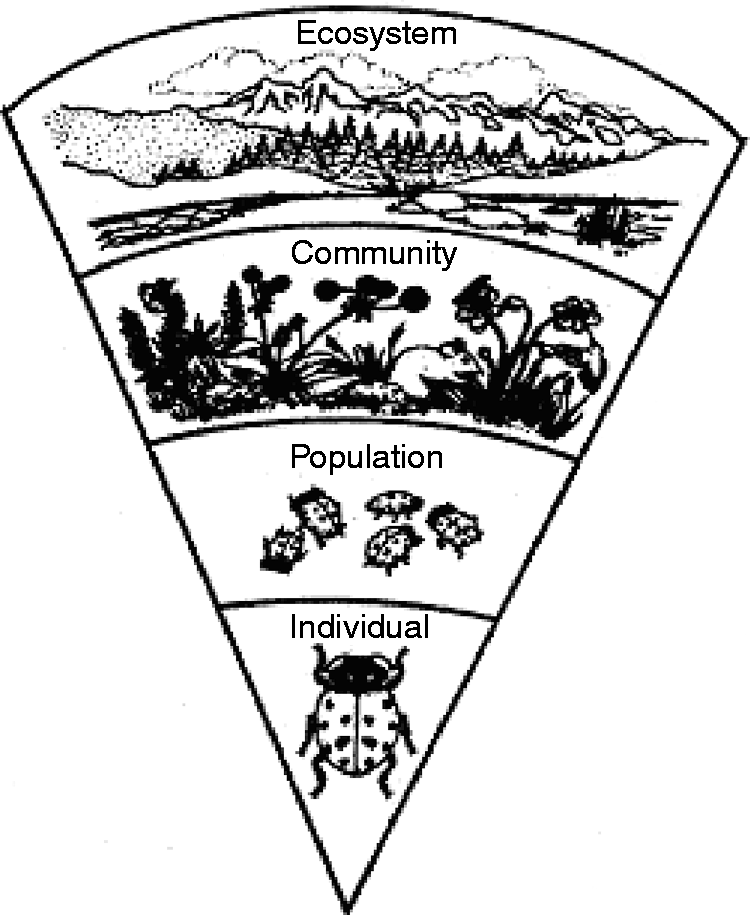
The ecology of social time does not involve a functionalist model that can be described using concentric circles. Time is a referential mechanism of action and interaction, and results from an interaction network. Every agent is a mesh of the network, and the occurrence of the social action and interaction is the realization of the entire interaction network, which is similar to the ecosystem of social time. The dissimilarities between an agent and the entire interaction network are based on various perspectives and the priorities of research interests rather than the functional difference. Therefore, the ecological model of social time should not be described using concentric circles. It is a model of observation and a framework of analysis. Therefore, Elias’ suggestion that the interaction network should not be understood using concentric circles but considered as a figuration composed of the actions and interactions of various agents is worth considering. The individual agent and the figuration “can be considered separately, but not as being separate” (Elias, 1993: 88; cf. Elias, 1987; Honneth, 2010). Elias drew a reticular figure of the figuration to replace the inappropriate image containing concentric circles (Elias, 1993: 11). Although Elias’ figure of the figuration does not relate to time directly, it can be used in presenting the ecological model of social time, if the figure is modified based on the concepts of the ecology of social time described in the present paper (see Figure 2). In this figure, the dissimilitude between the model levels results from dissimilar aspects rather than substantial and functional differences. No level is an elementary functional component of another level. From one aspect, the individual is the basic unit of the collectivity; from another aspect, the support from a collective relational network is the foundation of the individual agency.
Ecological model of social time.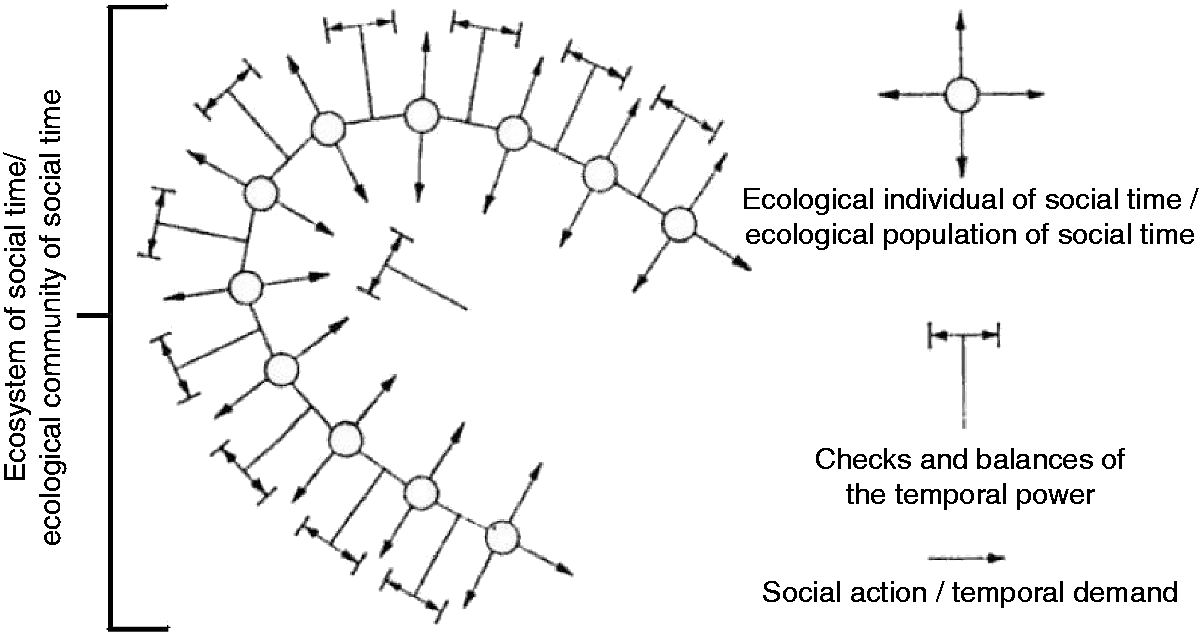
The difference between the two figures indicates that the contents of the ecological levels of social time and the relationships among the levels exhibit several features that differentiate the ecological study of social time from natural ecological study. These features satisfy the following guiding operational principles for the empirical research of social-time ecology.
First, at the individual level, an individual organism in the natural environment can belong only to a population. If a bioorganism is identified as Coccinella septempunctata, it can belong to only Coccinella septempunctata. An individual identified as Coccinella septempunctata cannot also belong to Ovis aries or Rosa rugosa. However, in the social environment, a person frequently plays multiple social roles. Thus, an ecological individual of social time can belong to several populations. A person can be a man in the social-time ecosystem of gender, and can also be a father in the social-time ecosystem of family, a laborer in the social-time ecosystem of class, and a driver in the social-time ecosystem of traffic. An ecological individual of social time has various temporal demands and represents the relationships among ecosystems. These temporal demands can overlap, contain other temporal demands (e.g. the temporal demand of a father in the social-time ecosystem of family can contain the temporal demand of a man in the social-time ecosystem of gender), or be incompatible with each other (e.g. when a man goes to work and plays the social role of a laborer, thereby entering the social-time ecosystem of capitalist enterprise, he must separate himself from the role of a father; therefore, he cannot consider his temporal demand related to the social-time ecosystem of family). Therefore, if an ecological study of social time focuses on the ecological individual level, the primary operational principle is to define: (1) which social roles a person plays and whether the temporal demands involved in each social role contain or exclude other temporal demands; and (2) whether the study focuses on the satisfaction or sacrifice of a social role in an ecosystem of social time or on the context in which an ecological individual of social time arranges various temporal demands based on their inclusion in multiple populations.
Second, at the population level, in natural ecology, a stable environment depends on whether each relevant population functions appropriately in the ecological pyramid. A balanced natural environment is the positive consequence of evolution. In social-time ecology, however, the interactions among ecological populations of social time should not be deemed an evolutionary process toward balance, but as a dynamic relationship among temporal powers. An ecological study of social time should involve the critical scrutiny of the balanced or unbalanced temporal powers of populations. For example, if an ecological social-time study is conducted on the time budgets of a husband, wife, and their children, describing the time use of each family member (which numerous previous studies have done) is insufficient. The manner in which family members influence the temporal demands of each other and the type of temporal power the familial relationship implies must be analyzed further in the study of social time. 14 Accordingly, articulating the relationships among ecological populations of social time can be the second operational principle of the ecological study of social time.
Third, at the ecological community level of social time, a unitary relational network composed of the ecological populations of social time can be described as an ecological community of social time. However, if the community is the final level of the social-time ecology model, this unitary relation network can also be defined as a social-time ecosystem. Because the range of the social-time ecosystem can be adjusted according to research interest, the difference between a community and an ecosystem is dependent on the research interest. A community can be considered an ecosystem once it is designated as the final unitary category of the ecological social-time model by the researcher; furthermore, an ecosystem can be defined as a community if it belongs to a larger ecosystem. In a microlevel or mesolevel study in which the focus is the temporal coordination between populations, no level of the ecological community of social time or the ecosystem of social time exists. Nevertheless, both communities and systems are derived from the unitary relational network. Unity means that the relationships among the ecological populations of social time cannot be established at random and without limit. The third operational principle of the ecological study of social time is that the relational networks of the ecological populations of social time must be limited by an ideal typical boundary based on a conceptual unitary category to ensure that the focus of the study is clear, despite social roles being related to innumerable relevant or irrelevant social roles directly or indirectly in reality. For example, the interaction between the temporal demands of a married couple can be influenced by the married couple, by their child, their parents, their jobs or colleges, their neighbors, the traffic situation of the city in which they live, and the political or economic context of the society in which they live. However, during an empirical study, a researcher must delimit and concentrate on the related roles, such as those of their child and their parents, based on a conceptual unitary category such as family.
Finally, at the ecosystem level of social time, the difference between the ecological community of social time and the social-time ecosystem is flexible; however, this does not indicate that the delimitation of an ecosystem of social time is arbitrary. The interest of many macrosociologists in social problems has derived from the synchronization or desynchronization between various social systems that are equal to numerous social time ecosystems. For example, social acceleration theorists have discussed in detail that the democratic policy-making process in political systems frequently falls behind the accelerated pace of other social systems, such as economic and scientific social systems, and therefore, the political system cannot effectively react to the changes in the social environment (e.g. Eberling, 1996; Rosa, 2005; Scheuerman, 2004). However, in these discussions, the delimitation of the social time ecosystems lacks empirical ground. Based on the aforementioned definition of the ecology of social time, an ecosystem of social time is determined based on shared institutionalized forms of time. Therefore, the fourth operational principle is that the social-time ecosystem must be defined according to the concrete institutionalized expressions of time in an ecological investigation of social time, regardless of whether time is expressed through government provisions or unwritten conventions. In addition, a social-time ecosystem is never isolated. Any system can interact with its environment, specifically, with other surrounding systems, similar to how a family with children, a social-time ecosystem of family, ineluctably interacts with the social-time ecosystem of education. Furthermore, an ecosystem of social time is not an entity but a limit of the range of research. Thus, multiple ecosystems of social time can overlap in the empirical dimension. For example, family is typically a crucial component in the gender division of labor (i.e. the social-time ecosystem of family overlaps the social-time ecosystem of gender). If an ecological study concentrates on the ecosystem level of social time, then the subject can be defined as the interaction among the populations or communities within a social-time ecosystem, or the interaction among the (overlapping) social-time ecosystems.
By clarifying the features of the ecological model of social time, this paper presents a unique empirical study framework of the sociology of time. This framework is useful in defining research subjects and their relationships, and in critically analyzing these relationships based on a valid theoretical foundation. Thus, the sociology of time can be used to identify actual social problems, and provides the possibility of determining the solutions to these problems.
Conclusion: Applying the sociology of time in empirical and critical analyses
Time is a relevant topic in the field of sociology. This paper outlines a new concept to bridge the gap between the theoretical and empirical dimensions of the sociology of time. This paper proposes that social time should be considered a referential mechanism that enables social interactions to occur at a specific time point by coordinating the social actions of various agents. Determining whether temporal demands are satisfied in the absence of unbalanced temporal powers should be the primary task in the sociology of time. In addition, this paper suggests that the ecology of social time can be a useful concept for integrating the proposed theses and the tasks involved in the sociology of time. Finally, this paper proposes an ecological model of social time comprising four levels, the ecological individual of social time, ecological population of social time, ecological community of social time, and social-time ecosystem, as an analytic framework for subsequent empirical research related to the sociology of time.
Although the ecological model of social time is an analytic framework for the empirical study of the sociology of time, the ecological model of social time is more of an epistemological concept than it is a methodology, such as time geography. As mentioned at the beginning of this paper, numerous empirical research methods, both quantitative and qualitative, can be applied to the sociology of time. Currently, the problem of the sociology of time is not how to conduct a sociological and empirical study on time but how to determine the sociological meanings and importance of time empirically. Therefore, this paper indicates that time must be considered a type of social fact, and the sociological and empirical study of time must involve the examination of the temporal demands and temporal powers among agents. Furthermore, although this paper emphasizes that social time is not a physical object that can be measured quantitatively, time can be investigated and presented quantitatively. The key point is that time cannot be considered as only a physical dimension that is attached to actions. If the research on time is undertaken based on the perspective of the ecology of social time to discuss the mechanism of power, which enables social interaction to occur at a specific time point, time can be considered a worthwhile and beneficial topic in the field of sociology.
However, the ecology of social time has not been completely established. The ecology of social time described in this paper is an outline; therefore, numerous concepts and details still require clarification. In the future, the ecology of social time will certainly be elucidated through numerous practical situations observed in additional studies. In addition, the definition of a sound social environment in social-time ecology must be established. This question concerns both the sociology of time and social justice and fairness, which cannot be comprehensively described in detail in this paper. However, this does not mean that this question is not critical. This topic deserves to be discussed in any field of sociology, and the sociology of time may be expected to contribute to this topic in the future.
Footnotes
Declaration of Conflicting Interests
The author(s) declared no potential conflicts of interest with respect to the research, authorship, and/or publication of this article.
Funding
The author(s) disclosed receipt of the following financial support for the research, authorship, and/or publication of this article: This research was supported by “the Fundamental Research Funds for the Central Universities”, SWU1409329.