



Abstract
In industrialized nations, patterns of behavior such as attending work or school are strongly predicted by the seven-day weekly calendar. The weekly cycle can be disrupted by unexpected events (e.g. familial death) or planned days off (e.g. vacation). Because the weekly cycle typically begins on Monday, people should expect others who experience disruption to re-enter the weekly cycle on Mondays in order to synchronize with the conventional weekly pattern. Study 1 examined expectations for returning to work after the death of a spouse, Study 2 examined expectations for returning to university classes after the death of a parent, and Study 3 examined preferences for Monday versus Friday holidays from work and from classes. All three studies showed an overwhelming expectation for returning to work or class on Mondays, and people explained this expectation by referencing time (e.g. it's time to get back to routine). Expectations of return times other than Monday were explained by referencing emotion (e.g. she's upset and can't think straight). Conceivably, expectations to synchronize behavior to the beginning phases of a cycle hold across daily, weekly, and annual cycles.
The busy have no time for tears. – Lord Byron
After a period of mourning and settling of affairs, bereaved individuals are expected to resume the rhythm of their lives: return to work, keep busy, go back to school, find a hobby, mow the lawn. Although a few cultural traditions provide guidance about when to resume routine after losing a loved one, the temporal expectations for grieving in contemporary industrialized society are largely vague. The length of funeral leave, for example, varies across organizations; leave is not a government-mandated right in most nations, but only (sometimes) is part of an employee benefits package. Analogously, school systems and universities vary with respect to length of allowable student absences, as well as policies for making up missed work. When do people expect bereaved individuals to resume obligatory routines? And what reasoning underlies such expectations?
In a word: Monday. I argue here that people explicitly expect bereaved individuals to synchronize their daily routines with the weekly cycle, specifically by resuming activity at the beginning phase; when expecting Monday returns, people further invoke time-focused explanations for their expectations. In the less common instances in which they anticipate an “out of phase” return, I argue that explanations are less time-focused and instead focus on the bereaved person's emotions. Two studies illustrate an overwhelming expectation of Monday return to work and classes after a familial death, as well as a preference for time-based explanations for Monday returns but emotional explanations for out-of-phase returns. A third study examines expectations for returning to work or classes from holiday, in order to generalize these beyond the domain of grief.
Synchrony and the weekly cycle
Biological or behavioral systems can synchronize with external oscillating patterns (i.e. zeitgaber or “time-giver”). The typical pattern among humans of sleeping at night and being active in the daytime, for example, synchronizes the sleep-wake cycle to the dark-light cycle created by the earth's rotation (i.e. a circadian rhythm). Behavior also can synchronize volitionally with artificial patterns (e.g. tapping to a metronome; McAuley et al., 2006) or with phases that have shifted (e.g. adjusting to a new time zone; Sack, 2010). The seven-day weekly cycle (i.e. circaseptan rhythms) may or may not have an underlying biological basis (for a discussion, see Larsen and Kasimatis, 1990), but the pattern prescribed by the weekly calendar in industrialized societies is difficult to deny. Some businesses are only open on weekdays, some sporting events primarily occur on weekends, and many major religions hold services on weekend days. Synchrony with a seven-day weekly cycle is observed in temperature and blood pressure (Tuomisto et al., 2006), alcohol consumption (Studer et al., 2014), sleep patterns (Taylor et al., 2008), sense of hurriedness (Tuomisto et al., 2006), and mood (Larsen and Kasimatis, 1990). Not surprisingly, many people rely on weekends to restore themselves from an effortful week: they sleep, drink, and play. Then they return to work and school on Monday.
The weekly cyclical pattern can be disrupted by unexpected events, such as illness or death of a loved one, or disrupted by planned events such as holidays and vacations. This paper argues that people generally expect others to return at the beginning phase of the cycle. There are several reasons why this might be the case. First and foremost, there are some advantages to being “in sync” with the rest of the world (and, indeed, evolutionary history may have favored organisms that synchronized to external clocks; Cereijido, 2001). Behavioral synchrony, in which people coordinate their actions with others, is associated with positive interpersonal consequences such as prosocial behavior, liking, and kinship signaling (see Wheatley et al., 2012 for a review). Being in sync also presumably facilitates shared experiences, which also have positive interpersonal consequences (Pinel et al., 2006). Even a match in general sense of urgency among group members is associated with helpfulness and satisfaction (Jansen and Kristof-Brown, 2005). Second, at a more abstract level, people may expect synchrony with the weekly calendar simply because they are biased toward the status quo (Eidelman and Crandall, 2012): The working phase of the week historically and typically begins on Monday, which makes it a logical re-entry point. Finally, people expend considerable effort and attention to beginning phases of task cycles (e.g. Rosenbaum et al., 2014; Touré-Tillery and Fishbach, 2012); to the extent that they assume other people have similar preferences as their own (Ross et al., 1977; e.g. Dunn et al., 2012; Flynn and Wiltermuth, 2010), people may expect others to return on Monday so that effort can be exerted at the usual point in the cycle. Thus, when the weekly cycle is disrupted by circumstance or design, people likely expect others to re-enter the cycle at the beginning phase.
If asked why they expect others to return on Mondays, people may not fully articulate reasons such as the value of synchrony, status quo, or patterns of effort (Nisbett and Wilson, 1977). That said, the weekly cycle arguably is a consciously recognized and strong regulator of behavior, and people's reports of their thoughts can give insight into how events are construed (Ericsson and Simon, 1980). For example, people who are primed to think of time as repeating cycles (rather than as a linear progression) use phrases such as “go back to,” “return to,” and “as before” when describing recovery from grief (Ruscher, 2012). In like fashion, people who expect others to return on Monday should be thinking about time and, consequently, should use temporal references in their explanations. Such references might range from explicit recognition of the weekly cycle (e.g. It makes sense to go back on Monday) to more general expression of elapsed time (e.g. A week is long enough). Such statements would support the notion that people are cognizant of the social convention of synchronizing with a weekly cycle and expect others to yield to this situational pressure.
There will, of course, be instances in which people report out-of-phase returns. Violation of a strong situational convention typically would point to more internal explanations (Jones and Davis, 1965; Kelley and Michela, 1980). In the case of grief, those internal explanations by and large comprise negative emotions. Grieving individuals who appear not to be moving on with routine tasks are perceived as waiting for negative emotions to dissipate (Ruscher, 2011). In the less common instances in which Mondays are not preferred, the explanations therefore should focus on emotions. (e.g. She can't go back while she is so upset). Like time-focused statements for Monday returns, emotion-focused statements for an out-of-phase return would support the notion that synchronizing to the work week is a strong social convention (and that an internal factor such as emotion provides a suitable reason for breaking convention).
Study 1
Overview
Study 1 examined people's expectations about a woman returning to work after the death of her spouse, first considering a weekend death then considering a death during the work week. The survey asked participants to select a return date in each case, to advise on time card completion (e.g. use of vacation days), and then to explain their reasoning. An advantage of allowing participants to select any date on the calendar is that this method did not bias them toward any particular day of the week nor duration away from work. I predicted the participants would expect the woman to return on a Monday and to provide time-focused explanations for such selections. Other proposed return days should be more rare but accompanied by emotion-focused explanations.
Method
Participants
Twenty-six female and 21 male college-aged students (Mage = 18.94) participated. The sample primarily was White (85%). Self-reported religion included 40% Christian and 28% Jewish. Participants received credit in their psychology courses in exchange for completing the surveys.
Procedure
A White female experimenter naive to hypotheses administered the surveys to groups of 10 participants or fewer. A cover sheet informed participants that the study examined when an employee might return to work following the death of her spouse; it reported that the company provided three days of paid bereavement leave, that the employee had two vacation days remaining through the end of June but no remaining paid sick days in May. The survey presented participants with a calendar for the month of May, then asked them to imagine that the spouse died on Saturday, May 13. Participants were instructed to prescribe a return date as well as time card completion strategy (i.e. which days should be bereavement leave, vacation days, and/or unpaid days). Next, it asked them to imagine that the spouse died on Tuesday, May 16 and again to prescribe a return date and recommended time card completion strategy. Finally, the survey asked for a single explanation of their answers, particularly with respect to the similarities and differences between their responses for the two dates-of-death.
Coding
The specific return date was recorded for each date-of-death. This allowed a measure of number of days absent, number of unpaid days absent, and planned day-of-week for the return.
After participants' responses to return dates were blocked out on survey photocopies, an expert coder categorized participants' reasoning as either time-focused or emotion-focused. A second coder also categorized the responses, yielding cross-coder agreement of 89%; k = .79. Time-focused explanations focused on the need to resume a schedule (e.g. the person needs to continue a normal lifestyle) or commented on the time frames without reference to the target's emotional experience or grieving (e.g. it should take about a week to return to work). Emotion-focused reasoning focused on feeling bad or needing time to grieve (e.g. if she was really in love with her partner, she would be unable to anything days after his death; All my answers give her as much continuous time as possible for grieving and recovery).
Results
Day-of-week
Calendars presented to participants for reference when recommending how the bereaved person should complete her timecard for the weekend death and the weekday death.
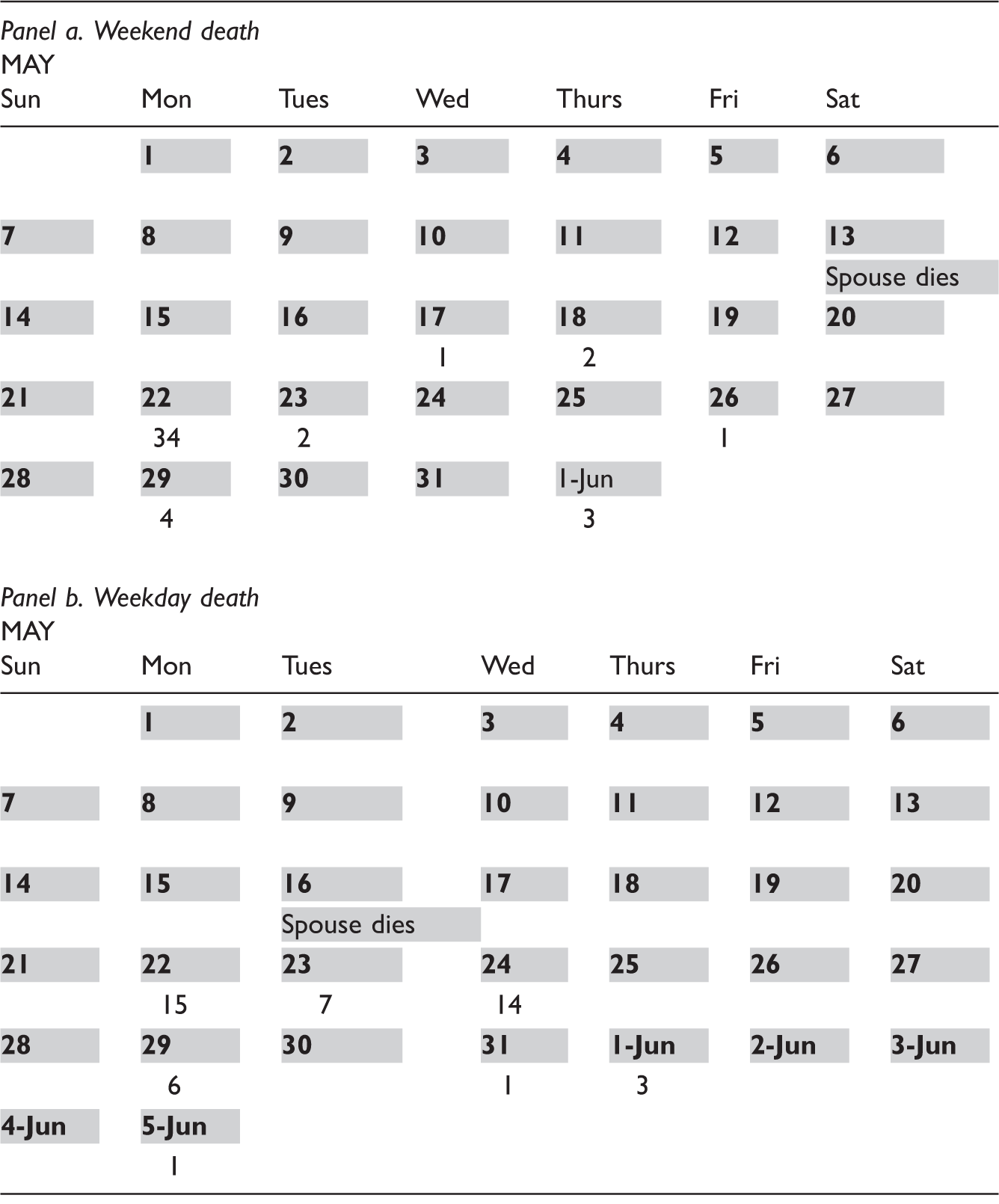
For exploratory purposes, χ2 tests of independence also examined possible relations between day-of-week (Monday versus Other weekdays) and gender or religion (Jewish, Christian, non-Judeo-Christian). These tests were non-significant.
Duration
Recommended number of days off using bereavement leave, paid vacation, or unpaid leave, as a function of whether the death occurred on the weekend or on a weekday (Study 1).

Temporal reasoning
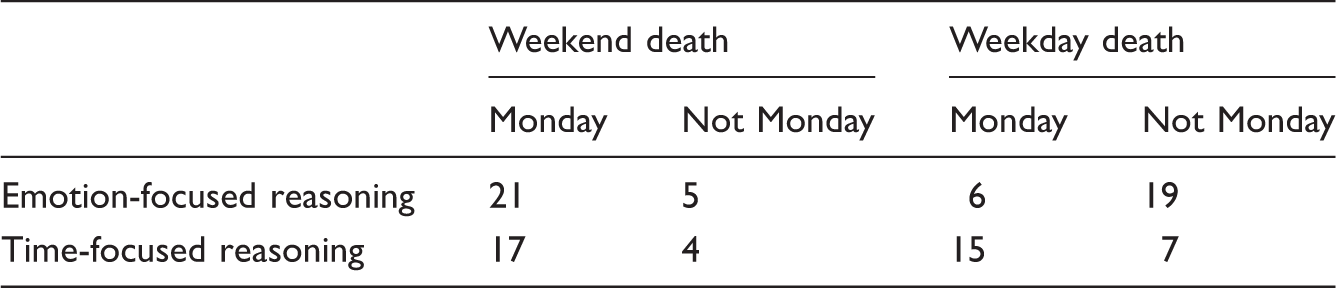
Number of people who used emotion-focused or time-focused reasoning, as a function of their expectations that the bereaved person would return to work on a Monday (Study 1).
Discussion
Study 1 showed strong expectations for returning to work on Monday. When the death occurred on a weekend, participants typically advocated use of three days bereavement leave and two vacation days to allow a Monday return. When the death occurred on a weekday, participants not surprisingly advocated use of bereavement leave; there was variation in use of vacation and unpaid leave. Advocacy for returning on days other than Monday was associated with emotion-focused reasoning (e.g. she needs time to be sad), whereas advocacy for Monday return was associated with reasoning focused on time and routine (e.g. it's good to get back into a routine).
One of the disadvantages of the hypothetical situation in Study 1 is that college-aged students may not identify easily with the situation of full-time employment, bereavement leave, and balancing paid versus unpaid leaves. Study 2 sought to replicate these patterns with a situation that more easily resonates with a college sample (i.e. death of a parent during the academic year). The date-of-death was imagined at three different points in a semester (to minimize the possibility that Monday only is preferred at particular points in the semester cycle). I again expected a preference for Monday returns, which would be characterized by temporal explanations. Expectations of other return times should be explained by emotion-focused explanations.
Study 2
Overview
Study 2 examined people's expectations about a student returning to university after the death of her father, at three possible points in the 15-week term (eighth, second, fourteenth). The survey asked participants to select a return date in each case, then to explain their reasoning for similar or different responses. I predicted the participants would expect the student to return on Mondays more so than other days, and that preference for Monday would be associated with time-focused explanations. Preference for other return times, though less common, should be associated with emotion-focused explanations.
Method
Participants
Thirty-eight female and 32 male college-aged students (Mage = 18.90) participated. The sample primarily was White (83%). Self-reported religion included 51% Christian and 23% Jewish. Participants received credit in their psychology courses in exchange for completing the surveys.
Procedure
A White female experimenter naive to hypotheses administered the surveys to groups of 10 participants or fewer. A cover sheet informed participants that the study examined when a college student might plan to return to college after the father passed away during the fall semester; it also indicated on which days the fall semester began and finals began (which were identical to the participants' university). The survey then presented them with calendars for September through December, including dates and labeled days of the week. It then asked them to imagine the father passing on three dates during the eighth, second, and fourteenth week of a 15-week semester. For each date, an open-ended question asked when they expected the student to return to classes and a 7-point Likert type question asked how likely it would be for her to wait until the spring semester to return. Finally, a single question asked about their reasoning for the answers that they gave, particularly with respect to similarities and differences.
Coding
Expected number of days absent easily was recorded for most cases because participants recorded a specific date from the four-month calendar (e.g. “November 19th”). Participants also sometimes gave non-specific dates, which comprised finals, spring, next fall, and never. Number of days absent was estimated to the first day of fall final exams, to first day of spring semester, and to first day of fall semester; never appeared only once and was not estimated. Day-of-week was not estimated for any non-specific return dates.
As in Study 1, after participants' proposed return dates were blocked out, an expert coder categorized participants' reasoning as either time-focused or emotion-focused. The second coder also categorized the responses, yielding cross-coder agreement of 88%; k = .76. Time-focused explanations focused on the need to resume a schedule (e.g. After taking two weeks off she is going to be behind and needs to get caught up) or commented on the time frame without reference to the target's emotional experience (e.g. Placement within the school year affects how long until she returns). Emotion-focused reasoning focused on the target feeling bad or needing time to grieve (e.g. Having a parent die takes a while to adjust to; to lose an important person is hard, has to get along with it by time).
Results
Day-of-week
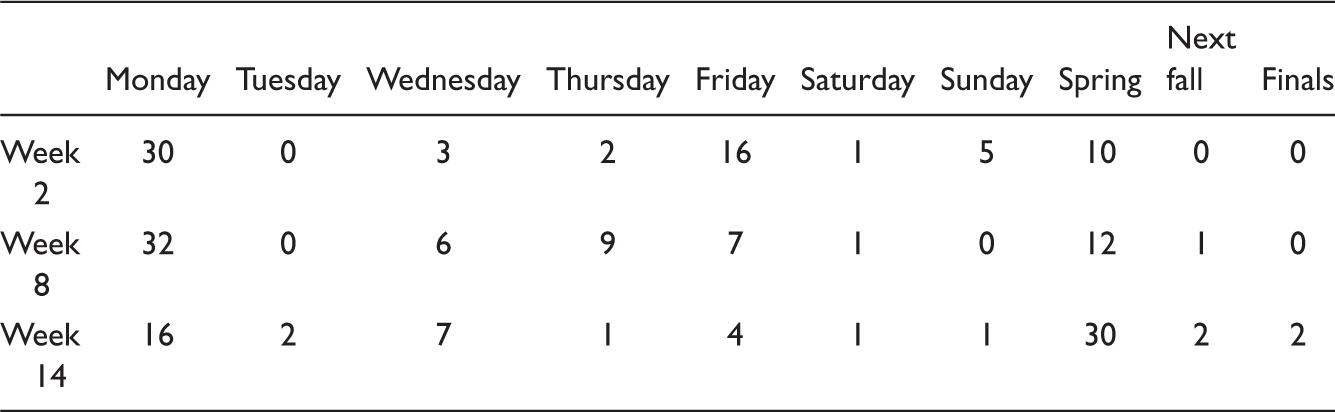
Number of people expecting a bereaved student would return to university on specific days of the week or non-specific later cycles, depending on whether the parent died the second, eighth, or fourteenth week of the term (Study 2).
Duration
The anticipated number of days absent is similar for a death at week 2, 8, or 14 (Ms = 36.90, 34.00, and 33.40, respectively). Sixty-six of the 70 participants provided either a specific date or a response that allowed an estimated return (e.g. spring semester) for all three dates, which allowed a 2 × 2 mixed-model gender (male, female) by week-of-death analysis of variance. Only a marginal effect of gender was detected, F(1, 63)=3.89, p < .053, wherein female participants (M = 42.63) tended to expect longer absence than did male participants (M = 26.90). An analysis using religion (Christian, Jewish, Other) as the between-subjects factor detected no significant effects on duration of absence.
Seasonal cycle
Finally, all 70 participants responded about the bereaved student's likelihood of waiting until spring to return. That perceived likelihood increased as the semester progressed (Ms = 3.40, 4.10, and 4.80), F(2, 138)=13.33, p < .001. Notably, this preference for the seasonal cycle is consistent with the open-ended date choices reported in Table 4.
Temporal reasoning
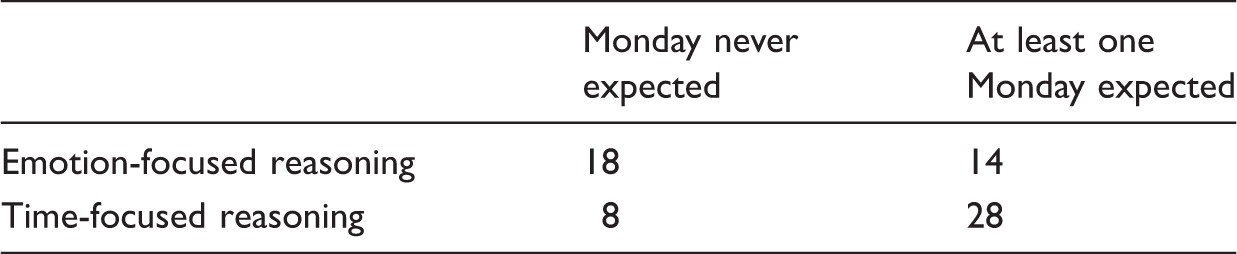
Number of people who used emotion-focused or time-focused reasoning, as a function of their expectations that a bereaved student would return to university on a Monday.
Discussion
As in Study 1, participants evinced strong expectations of Monday return dates. As the semester progressed, there was a notable shift to expecting return at the beginning of the next semester. Preference for Monday return dates again favored the time-focused reasoning suggestive the people anticipate synchrony with the weekly cycle, whereas proposing return dates other than Monday again was associated with more internal emotion-focused reasoning.
An establish cycle, such as the work/school week, can be disrupted by unexpected events such as a familial death. Together, these first two studies suggest that people generally expect others to “get back in sync” by re-entering the cycle at the beginning phase. Their reported thoughts in that case support the notion that people are thinking about time, which is a powerful regulator of behavior. When people predict an out-of-phase return, their reported thoughts indicate that they are focused on the emotional experience of the person who is grieving: People who violate the norm of following the weekly cycle presumably are driven by internal forces.
Planned events also can disrupt the weekly cycle. People take vacations throughout the calendar year, and established holidays are built into work and school calendars. For example, a Monday holiday postpones the start of the work week, whereas a Friday holiday hastens the end of the work week. If people expect synchrony with the usual beginning of the weekly cycle, they should prefer Friday holidays (i.e. to begin work or school on Mondays). Such expectations again should be associated with time-focused explanations. In contrast, when people report a preference for Monday holidays, which violates the convention of beginning the week on Monday, explanations should focus on internal preferences. In this situation, internal preferences comprise feelings about specific days of the week.
Study 3
Overview
Study 3 examined preference for holidays from class or work. Given the likelihood that people prefer three-day weekends to a holiday mid-week, the survey asked for their preference for Monday versus Friday. I expected a preference for Friday holidays (i.e. beginning the work week on Monday), for time-focused reasons. Individuals who expressed preference for Monday holidays (i.e. violating the convention of beginning on Monday) were expected to provide emotion-focused reasons (i.e. feelings about days of the week).
Method
Participants
One hundred and fifteen female and 44 male college-aged students (Mage=19.04) participated. The sample primarily was White (82%). Participants received credit in their psychology courses in exchange for participation.
Procedure
A white Female experimenter naive to hypotheses administered the surveys to groups of 10 participants or fewer. Participants indicated whether they thought people preferred Fridays or Mondays for a three-day weekend from work (1 = prefer Friday; 5 = prefer Monday) and wrote an explanation of their answers; they then answered a similar question about having a three-day weekend when enrolled in a Monday–Wednesday–Friday class and again provided an explanation.
Coding
A coder naive to hypotheses categorized participants' reasoning as either time-focused or emotion-focused. A second naive coder also categorized the responses, yielding cross-coder agreement of 84%; k = .62. Time-focused explanations focused on weekly routines, shortening the week, lengthening the weekend (e.g. this would start the weekend early; it's best to keep the weekly routine; I could sleep in after watching football on Sunday), without referencing emotions or preferences. Emotion-focused reasoning focused on feelings about the weekday or time period (e.g. People hate Mondays; Everyone is happy on Friday).
Results
Day-of-week for holiday
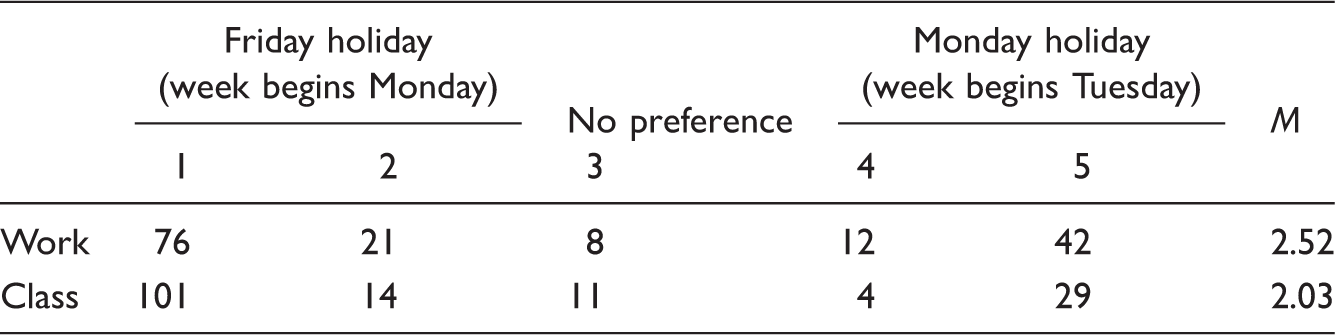
Number of people advocating Friday versus Monday for a day off from work and from classes (Study 3).
Temporal versus emotional focus
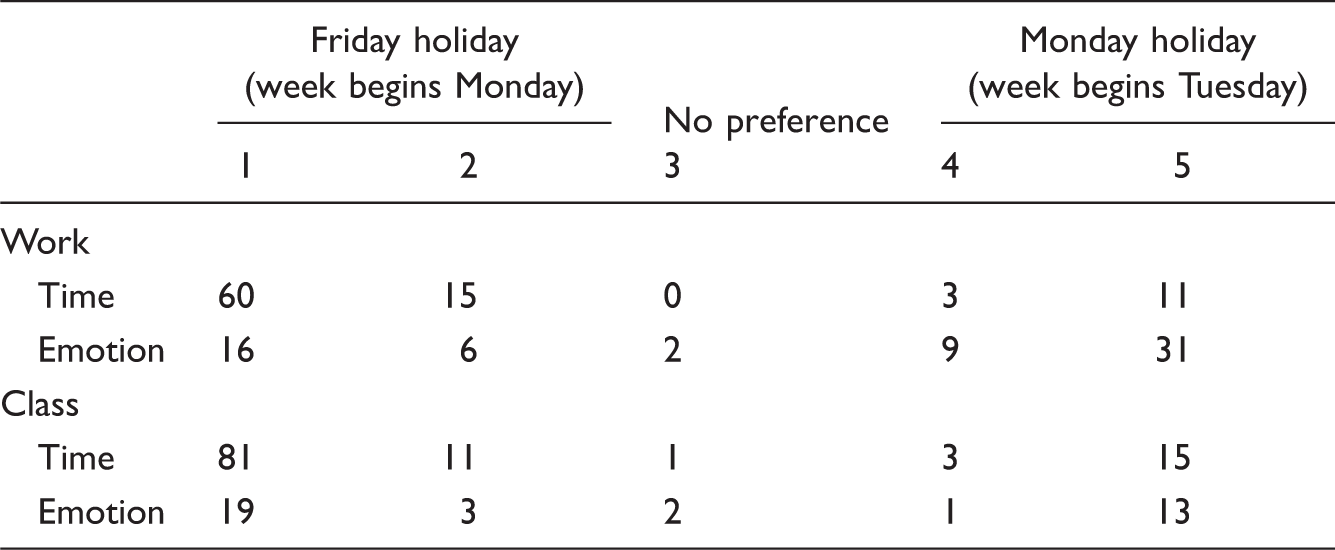
Number of people using a time-focused versus emotion-focused explanation, per their preferences for Friday versus Monday holiday from work and from classes (Study 3).
Discussion
As with an unexpected disruption, planned disruptions to the weekly cycle showed a preference for retaining the usual Monday start time; time-focused explanations were invoked for this preference. Out-of-phase returns evoked emotion-focused explanations for work but not for class. Anecdotally, some of the time-focused explanations for not returning to class on Monday involved the perception of extending time to complete assignments. Overall, however, the findings are consistent with the previous two studies about an unexpected death.
General discussion
The current research showed a consistently strong expectation for people to return at the beginning of the weekly cycle following disruption. Although external constraints such as paid leave and time-of-semester modified the magnitude of these effects, expectations for Monday returns arguably are a strong convention and those expectations are explained with explicit references to time. Perhaps more interesting, violations of the return-on-Monday convention generally were explained in terms of emotional factors. Bereaved individuals who are not expected to return on Mondays are seen as still overwhelmed by grief. Similarly, preference for Monday rather than Friday holidays from work is explained in terms of emotions; these explanations include the perception that people dislike Mondays, whether or not mood actually is more negative on Monday than on other days (e.g. Stone et al., 2012).
A limitation of the current work is the reliance upon a college student sample in a single country. It is conceivable that the expectation of Monday returns is less strong in populations who are not so ingrained to the Monday through Friday schedule (i.e. college students in an industrialized nation). Workers or students with less traditional schedules—whose behaviors are not synchronized to the conventional weekly schedule—likely would not respond in the exact same fashion. That said, they still may show expectations that others will synchronize behavior to the beginning phase of the cycle that is salient to them. Some previous work hints at such expectations. For example, a study of Australian workers with 8-hour versus 12-hour shifts showed that both had a strong preference for a Monday–Friday work week (Baker et al., 2003). Similarly, in a study of Dutch workers, most workers who report sick return to work on a Monday (Roelen et al., 2011); although this pattern in part may be exacerbated by sick-leave policies, it is suggestive of expectations of re-entering a cycle at the beginning phase.
Another possible limitation of this research derives from reliance on self-reports about hypothetical situations: It does not speak forcefully about whether people actually re-enter the weekly cycle on Mondays nor whether people would hold such expectations of specific individuals in their personal lives. What people actually do is a different question than one of expectations and might be better addressed by archival data (e.g. attendance records). The disadvantages of studying expectations for specific individuals are the relative infrequency of the relevant events: researchers would need to wait for enrolled participants to learn of a familial loss within their social-professional network, and there would be considerable variation in participants' relationships with the bereaved person (e.g. supervisor, friend, acquaintance). The advantages of the current method are a standard situation across participants, as well as accessing general expectations for behavior.
When an individual falls out of phase with a cyclical pattern, she or he also falls out of phase with other people who retain synchrony with that pattern. Peers continue to attend classes while the person deals with grief, and co-workers cover duties while the person is on vacation. This disrupted synchrony might produce some level of discord. For example, increased family conflict (i.e. disruption) predicts adolescents' shift toward eveningness (i.e. going to bed later and rising later); the adolescent being out of phase with the family, in turn, might exacerbate or create further conflict (Díaz-Morales et al., 2014). Similarly, disruption to new parents' sleep patterns by high levels of infant night waking predicts couple's negative feelings about each other and their co-parenting relationship (McDaniel and Teti, 2012). By extension, people who share a weekly cycle may be stressed when someone's re-entry to the cycle is prolonged or ineptly timed. Re-entering the cycle at the beginning phase may benefit both the returning person as well as others in the social network.
Thus, the current research adds to a growing understanding of how people may synchronize behavior to the beginning phases of temporal cycles. For example, university students living at similar latitudes within the same time zone (i.e. Heidelberg and Warsaw) entrain their early morning activities to solar time but then shift to clock time for work and classes (Jankowski et al., 2014). Similarly, upwards of 50% of American adults make New Year's resolutions (for a discussion, see Norcross et al., 2002), which can be interpreted as efforts to link a new pattern of behavior to the beginning of the annual cycle. Conceivably, the expectation to synchronize to the beginning cycle phases holds generally across daily, weekly, and annual cycles.
Footnotes
Acknowledgements
The authors thank Rachelle Melancon, Chloe Renshaw, Lauren Fouch, Emiliya Adelson, and Aisling Mahoney for their assistance with data collection and coding.
Declaration of Conflicting Interests
The author(s) declared no potential conflicts of interest with respect to the research, authorship, and/or publication of this article.
Funding
The author(s) received no financial support for the research, authorship, and/or publication of this article.