




Abstract
This article explores the experiences of temporality. It argues that experience of time is a key and undervalued feature of practice; a feature that furthers understandings of how practice becomes normalised. Practice theory advocates that experiences of time are experiences of practice. This article does not wish to refute this claim, rather it aims to extend it by exploring the complexities of the relationship between practice and temporality. Drawing upon an empirical study of a hair salon and women’s hair appointment practices, this article unpicks the drivers of shared practice from the physical to the normative, to the notion that experiences of time spent engaging in practices drives their performance. Introducing the concept of self-time, it makes three main arguments. Firstly, that exploring and prioritising experiences of time (how time spent doing a practice feels) illuminates further elements of collective practice. Practices may not be what they seem and seemingly obvious outcomes, such as showering to clean the body, are also undertaken because of other subsequent intentions. Secondly, that practices and their most recognisable outcomes (showering to clean the body) legitimise the time spent engaging in them. Thirdly, and most importantly, that experiences of time are a key feature of practice and one that should not be overlooked in the drive to understand how practices become normalised and collective activities.
Introduction
Practice based accounts are fundamental to many contemporary academic debates about consumption and temporality. Reckwitz’s (2002: 250) key definition of the elements of practice, including ‘bodily activities … mental activities, ‘things’ and their use,’ has propelled a slew of research on the mundane and everyday aspects of life. Likewise, Theodore Schatzki’s (2002) notion that sociality is created through practice, has enabled researchers to explore how the ‘blindingly obvious’ structures societies and cultures. Yet even practice theorists advocate that ‘it is necessary to make reference to more than practice itself in order to understand it’ (Barnes, 2000). In recent years attention has turned to how practices are bound up with temporality – most notably through habits and routines (Shove, 2012; Southerton, 2006, 2013). Shove et al. (2012) suggest that experiences of time are experiences of practice. Yet, whilst this is an accurate observation, practice is always the fundamental, baseline unit of social analysis (Reckwitz, 2002); temporality and practice are not equal. In continually evaluating practices in such a way, temporality is continually side-lined or consumed by practice.
Yet, decoupling time from practice is a near impossible task, thus, in what follows, this article will invert the traditional approach to studies of practice, by putting temporal experience at the centre of its account, rather than practice. In other words, how does studying experiences of time add to debates on temporality and practice? Alan Warde (2014: 295) concludes that there is a ‘relative neglect of the processes lying behind the normalisation of practice’. I argue that by appreciating experiences of time as a feature of practice makes progress in addressing this lacuna, as does appraising other practice drivers. As the article illuminates, temporal experience is tightly bound with personalised rhythms, collective norms and values, alongside non-human materials and objects, to configure practices as multi-faceted, hetereogenous networks of temporalities, materialities and activities. Thus, time is always an element in driving the enactment of practice. To understand how time drives practice, one must understand how it is folded into other potential drivers of practice – in other words, the factors which motivate people to perform and repeat practices.
A focus on experience does suggest a focus on the individual. Unquestionably, a key facet of practice theory is its opposition of theoretical approaches based on individualism – such as structuralism, semiotics, methodological individualism and cultural expressivism. For Reckwitz (2002) there is no individual hidden deep inside – thoughts, emotions and bodily activities are all part of social practice. However, whilst this article begins with and draws upon personal articulations of experiences of time (how time feels when enacting practice) these are always still embedded in practice (Schatzki, 2000). As the article illustrates, the experiences discussed are collective, just as are the practices which are enacted; thus producing normalised shared habits. To illustrate these arguments this article will draw upon an empirical study conducted by the author on hairdressing and hair care practices.
Hair is an ideal vehicle with which to explore experiences of temporality through practice. As the article illuminates hair has its own temporal dynamic. Operating at the margins of the body (Kwint, 1999: 9) it is constantly evolving and changing – growing, getting greasy and altering with varying climates. In his work on the material practices of glamour, Thrift (2008: 19) notes how hair ‘is the easiest part of the body to alter. It grows so must be cut.’ Hair has a persistent vivacity which requires repetitive maintenance and repair. Hence, hair care practices are constant and demanding. What is more, as most hairdressers would claim – everyone’s hair is unique. Thus, hair is described in the article using the archaeological concept of the palimpsest – an inimitable material record.
The article is divided into three main themes. Following a discussion on the methodological approach used in this research and an overview of previous relevant literature, the first key thematic focuses on the physical and collective drivers of hair care practice. With regard the former, this explores how the body physically drives practice. In the example of hair this is looked at through the notion of the palimpsest of hair and hair’s agency. The latter explores the collective norms and ideals with which practices are propelled, with notions of morality, cleanliness and respectability taking centre stage with regard to hair. The second theme builds upon the first to examine time also as a driver of practice. This is explored through the temporal lens of rhythm – frequency, temporal location and tempo of practice. Following on from this, the third and final key thematic introduces the notion of ‘self-time’. Building upon investigations of tempo, self-time focuses on appreciations of experiences of time engaged in practice, particularly in instances where time, not practice, becomes the prioritised outcome. It argues that collective rhythms can persist because of experiences of time engaged in practice, and, furthermore, that practices and their drivers (collective/physical) help to legitimise the experience of time, ensuring that practices are shared and normalised.
Methodology
The hairdressing example used within this article, stems from 12 months research spent working in a hair salon. The salon, which will be referred throughout by the pseudonym ‘Kirby’s’, is an independent salon based in the North West of England. At the time of the research the salon employed 13 members of staff, all but one of which were female. Customer footfall would on average be approximately 20–30 people per day, rising to up to 70 at busy times. Ninety percent of clientele were female. My role within the salon was as a voluntary salon junior. This would involve performing typical junior type tasks, such as sweeping up hair, making coffee, washing hair, answering the phone and cleaning. The staff and customers were aware of my research agenda. During my time at Kirby’s I kept a field diary, recording daily events and conversations. These were corroborated by my use of visual methodologies, including photographs and video to record some of the key hair practices which took place in the salon.
In addition to working in Kirby’s, I also conducted 10 focus groups with participants recruited using a snowballing technique through customers of the salon. These groups centred upon probing hair care practices and thoughts about hairdressing, the hairdresser and hair care. Each focus group consisted of three to five people, eight groups were all female and two were all male. Following the focus groups I conducted in depth interviews with one person from each group exploring individual hair care practices and relationships with hair and the hairdresser further. This gave a two sited approach to the research – examining hair care practices both within the salon and also at home. The focus group, interview data, along with my field notes, were all transcribed and thematically coded and analysed using etic and emic codes. These methods have enabled a comprehensive engagement with the temporal experiences of practice. The observation, field notes and visual materials have captured the embodied, lived experience (O’Connor, 2007) of narratives of time, whilst the focus groups and interviews have given voice (Madge et al., 1997) to the participants’ experiences enabling ‘thick’ descriptions of time spent engaging in particular practices.
Temporality, materiality and practice
Temporality and its links to consumption has been a subject of academic study for several decades. Thompson’s (1967) famous work on clock time introduced the notion that time is a currency with which to be spent. Similarly, Veblen’s (1953) earlier work on ‘the leisure class’ concluded that how time is spent operates as an indicator of social status. Whilst Barbara Adam’s (1994, 1995, 2004) comprehensive study of time over the last 30 years has aided a generation of social scientists to recognise the value in studying time and its relationship to key themes such as consumption and employment. In more recent years, work on temporality and consumption has focused upon ‘time being squeezed’ (Southerton, 2003; Southerton and Tomlinson, 2005), and the ‘harriedness’ of contemporary living (Southerton et al., 2001). Such accounts draw upon changes to leisure practices, technological innovations and economic circumstances as increasing temporal pressures upon individuals and households. Building upon this, other studies have discussed how temporality is gendered (Bittman and Wajcman, 2000; Hochschild, 1997; Jurczyk, 1998; McKie et al., 2002; Shaw, 1998; Sullivan, 1997). The ‘dual burden’, ‘the second’ or ‘secret shift’ all refer to the added pressures working women with families face, as they juggle paid work with tending to the needs of their dependents.
The contemporary connection between temporality and consumption is fused together by a focus on practice and materiality. Every day practices such as showering (Hand et al., 2005), doing the laundry (Shove, 2003) or using a freezer (Hand and Shove, 2007) are drawn upon as habitual and routine activities made possible by the appropriation of objects and technologies. Further work discusses the interchangeable nature of the terms ‘habit’ and ‘routine’ and their ambiguity when used to describe the temporality of practices (Shove, 2012; Southerton, 2013). The collective temporal nature of consumptive practices also forms part of these debates, with recent work suggesting that collective temporal rhythms are being eroded by the 24/7 society (Rosa, 2003) and also greater flexibility of institutionally timed events such as meal times or working hours (Southerton, 2006). Dale Southerton’s (2013) work concludes that collective rhythms are superseded by personalised temporal strategies, such as doing practices faster and simultaneously. Practices are held stable by temporalities, being both configured and conditioned by ‘dispositions towards, and procedures and sequences of, action’ (p. 350). This includes culturally derived orientations (differential dispositions) and also tacit knowledge and embodied skills (procedures). Southerton’s emphasis on personalised temporal strategies is an original approach and a step towards prioritising time as a means to understand practice. Such a focus explores the temporal structure of practice – the rhythms, frequencies, temporal locations (day/time of week) and tempos of activities. However, practice still takes precedence in such accounts, reinforcing the boundaries around how time is articulated. For instance, ‘I do X practice, on X day, for X length of time’. The only part of such temporal structures which enables a more personal articulation is that of tempo – how it feels to perform a practice – fast, slow, dragged, hurried. By drawing upon the experience of time spent engaged in practice, this article will build upon tempo to elucidate how time enacting practice feels. In doing so, it will illuminate how practices are not always what they seem.
A further strand of work on temporality, consumption and practice has focused upon the practices of object maintenance and repair (see Campbell, 2005; Gregson et al., 2009; Watson and Shove, 2008). As Graham and Thrift (2007) discuss, ‘things’ only become visible when they become inoperable and require work to be done on them. Most work in this arena concentrates upon the non-human – objects/technologies – and the practices they require to function adequately. Whilst practice literature has attended to the body (see Shove and Pantzar, 2005; Warde, 2005), most practice based studies tend to focus upon the body at work through practice, with the emphasis firmly on the practice and its interactions with materials/objects. Embodiment is ‘regularly re-iterated’ within practice based accounts, but ‘bodily experiences and their consequences’ remain unaccounted for (Warde, 2014: 294). Even less developed are practice based accounts which explore the body and its temporalities (with the exception of Wilhite (2012) and his work on practices, habits and the body). Although earlier consumptive studies note the constant, ever changing temporality of the body (Featherstone, 2000; Shilling, 1993), such work endorses the ‘symbol over substance’ (Gregson and Crewe, 1998: 40) approach aligned to the individualist accounts, which practice theory so strongly refutes. Whilst further work has attended to the experiences of maintaining the body and its blurred, incoherent boundaries (for example Crossley, 2005; Mol and Law, 2004), a specific focus on bodily management practices and how these are intertwined with temporalities remains undeveloped. Through its focus on hair, hair practices and the tools and objects which furnish such practices, alongside the overarching emphasis on time, this article unites temporality with practice, materiality and bodily experience to push further at how practices become normalised and are understood.
Physical and collective drivers
In his work on the material practices of glamour, Thrift (2008: 19) notes how hair ‘is the easiest part of the body to alter. It grows so must be cut.’ Operating at the margins of the body (Kwint, 1999: 9), hair has its own temporal dynamics. Unlike non-human objects and materials, it is constantly evolving and changing, requiring continuous maintenance work. Drawing upon the work of Latour (2000: 119), hair ‘acts back’. It is a ‘quasi object’; ‘much too disputed’ and ‘uncertain ….to play the role of a stable, obdurate and boring’ entity. It grows, gets greasy, it changes with varying climates. It has agency. Yet, paradoxically, whilst always being in a state of flux, hair also acts as a material reminder of the past (Holmes, 2014). Hair stores previous practices upon it: a previous colour which affects how another will take; a particular style meaning a wait for hair to grow to try another; or the remnants of a perm which leaves hair with a persistent kink. Similarly, the twinkling of grey hairs remind of a time gone by, of hair of another colour. What is more, everyone’s hair is unique: from its colour (dyed or natural), texture, strength or degree of curl, no two people’s hair is the same. Thus hair can be described using the archaeological concept of the palimpsest – an inimitable material record consisting of layer upon layer of evidence of previous practices. To use the term palimpsest to describe something which is always changing may seem somewhat contradictory. However, the palimpsest of hair conveys the convergence of hair’s temporalities. As Serres and Latour (1995) suggest time is fluid, folded in on itself, whereby one moment of time is a multiplicity of other times. The palimpsest represents the temporalities of hair in such a way – previous hair practices become folded into each other to create one particular hair moment. A moment which has gone as soon as it arrives with hair’s tireless vivacity.
Thus, hair requires work in the form of hair care practices to keep on top of its unique temporality, a temporality which becomes apparent when hair stops being manageable: It’s due to be cut and I can really tell. It’s driving me mad at the moment …. It’s all behind my ears tonight. I’ve got loads of hair here and I’ve just had to wet it down and put it all behind my ears. (Nancy, Focus Group 7) Cos like I’ll go to the gym like tonight and my hair is clean and if I went running I’d have to wash it – my hair would be horrendous, it would be wet. (Eileen, Interview)
Showering, doing the laundry, engaging in do it yourself (DIY) have all been described by academic accounts as ‘everyday practices’; activities many of us engage in and which can have a somewhat routinized and habitual nature to them. Such practices are understood as being infused with and propelled by collective norms and ideals. For instance, showering is imbued with notions of cleanliness, convenience and morality (Hand et al., 2005); DIY with notions of restoration, competence, make-do and mend, craft and home improvement (Gregson et al., 2009; Watson and Shove, 2008). Whilst the palimpsest of hair acts as a physical driver of hair maintenance there are numerous collective values which also act as a push factor in the repetition of hair practices. The desire to control one’s hair is very much wrapped up in notions of morality, class, respectability and conformity. As Beverley Skeggs (1997: 82) notes, in her work on respectability, ‘the respectable body is white, desexualised, hetero-feminine and usually middle class’.
Throughout the research, greasy hair or obvious roots were described as markers of overt sexuality, lack of cleanliness and morality. One participant was teasingly referred to as ‘a dirty bitch’ (Focus Group 7) for only washing her hair once a week, whilst another said she would look like ‘a troll’ (Focus Group 1) if she had obvious roots; both conveying the perceived necessity to control the temporality of one’s hair and appear ‘respectable’. Similarly, many participants discussed the need to colour grey hair. This links to a vast reservoir of literature on mainstream notions associated with the ageing body and femininity (see Bartky, 2002; Bytheway and Johnson, 1998; Fairhurst, 1998; Symonds and Holland, 2008; Twigg, 1997, 2000, 2002; Weitz, 2004). As Frida Kerner Furman (2000: 16) notes: the older female body is considered ‘unattractive and inadequate’, hence concealment of the ageing process, through practices such as hair colouring, becomes a desirable and achievable ideal. There will be other normative values associated with hair practices and hair colouring per se, but this highlights how alongside and intertwined with the palimpsest of hair and its physical drivers, there are numerous collective drivers ensuring the repetition of practice. In the instances of hair (and the body) these are often also temporally motivated – particular with regard to the length of time you leave between maintenance practices, or more abstractly the desire to remain in control of time – to not look one’s age or reveal the true temporality of the material of one’s own body. In the next section I examine time as a driver of practice more closely, beginning, firstly, with how time is generally evaluated in practice based accounts – that is by examining the rhythm of a practice– before moving on to examine ‘time as experienced’ as a driver of practice. All of this is explored through the practice of hair colouring.
Time as a driver
It has already been noted how time is always an element in driving practice, particularly practices upon the body, because practices require repeating to ensure maintenance and upkeep. Thus, there is a continual temporality associated to them. Often this temporality is examined through the structure of rhythm – frequency, temporal location and tempo – of a practice to reveal its habitual or routine character. In this section the article turns to hair colouring to examine its rhythm and reveal how a further focus on temporal experience reveals much more about the practice. As Elizabeth Shove (2012: 108) notes, habits can be ‘sticky’ and their ‘stickiness’ depends on the ‘forms of capture involved’. For some the practice of hair colouring is not the least bit habitual, rather it is ad hoc and sporadic: I’ll notice in the mirror, I’ll think “Oh the twinkling, it’s time to go to the hairdressers.” (Amber, Focus Group 2) I can always tell when my colour’s growing out because it gets greasy. I’ll like wash it and dry it and it will be greasy again. It looks greasy and I think right best book in the salon. (Lena, Focus Group 1) I go every six weeks religiously to get my colour done ….once I’ve had my appointment I book in again. Always on a Thursday. (Lara, Focus Group 2) Every five weeks and I’ll actually make an appointment in advance. I don’t like it if the hairdresser is away or anything. It’s a crisis if the hairdresser is on holiday. I need my hair doing. (Rebecca, Focus Group 2)
Yet it is the way tempo is evaluated within the practice of hair colouring which is of most interest. Unlike frequency or temporal location – tempo is a personal analysis of how time spent engaging in a practice feels. Whether it is/was fast, slow, rushed, dragged and so on: Amber: Yeah it’s (.2) I just find it like really boring ….it’s just a whole load of faffing around, sticking highlights in your hair, doing an all over colour ….And so yeah I like the head massage bit but other than that it’s just like two – two and half hours where I’d rather be doing something else. Lisa: I’m with Amber. I kind of stopped having highlights because it just took too long. I just couldn’t be arsed sitting there for three hours on a Saturday afternoon. (Focus Group 2)
Yet again in contrast are those who want the tempo to slow down: You know sometimes when they say “Oh sorry we’ll be with you in a few minutes.” I’m like “It’s fine, take your time. Don’t worry.” I do I love it. It’s like a little relax and a little break, it’s lovely. (Jennifer, Focus Group 2) My hairdresser is dead slow. But I don’t care because I’ve got kids. I can chill out for a few hours. (Louise, Focus Group 8)
Self-time: A collective driver producing collective rhythms
‘Time out’, ‘pamper time’, ‘luxury time’ and ‘me time’ were just some of the many articulations of time spent in the salon whilst undertaking hair practices. All of which I argue fit under the umbrella of ‘self-time’. The following quotes illustrate some of these experiences: Like it’s a bit of pamper time and like for me, I don’t get any time to myself at all. That’s the only thing I do where I can go and not have to worry about anything else for like two hours. (Verity, Focus Group 1) Kelly: But is it something for you to look forward to as well in your diary? Louise: Yes. Cos I get six weeks and then I get four hours of just me time … (Focus Group 8) I think for me, it’s an escape from the chores of mundane life ….I just really like the time out. I love it once they leave you there with the colour on and a magazine and a cup of tea and you can just spend ….sometimes they forget about you, and I can be left for an hour, and I love that. (Jennifer, Interview)
Furthermore, these collective experiences can sometimes also have a collective rhythm; thus, challenging recent literature which suggests that collective rhythms are being eroded by the 24/7 society (see Garhammer, 1995: Rosa, 2003) and greater flexibility of institutionally timed events such as working hours, eating or shopping times (Southerton, 2006). Figure 1 shows data from the salon appointment book documenting the number of types of appointments/hair practices by day of the week during the months of April and May 2009. As it clearly shows there was a marked rise in nearly all practices the salon offers on a Friday. Of particular significance is the increase in blow waves, and cut and blow appointments. It has been documented by other salon studies that Fridays are notably the busiest day of the week (see Gimlin, 1996; Kapp Howe, 1977). Yet the connection has not been made as to why this is the case. Focus group participant, Heather, a former hairdresser, explains: My mum was a hairdresser ….she moved abroad recently, but for the last 20 years she’s had the same clients, at the same time every Friday … They call them ‘The Friday Club’ … they have their hair done every Friday … ready for the weekend. (Heather, Focus Group 8)
Snapshot from the salon appointment diary over April and May 2009.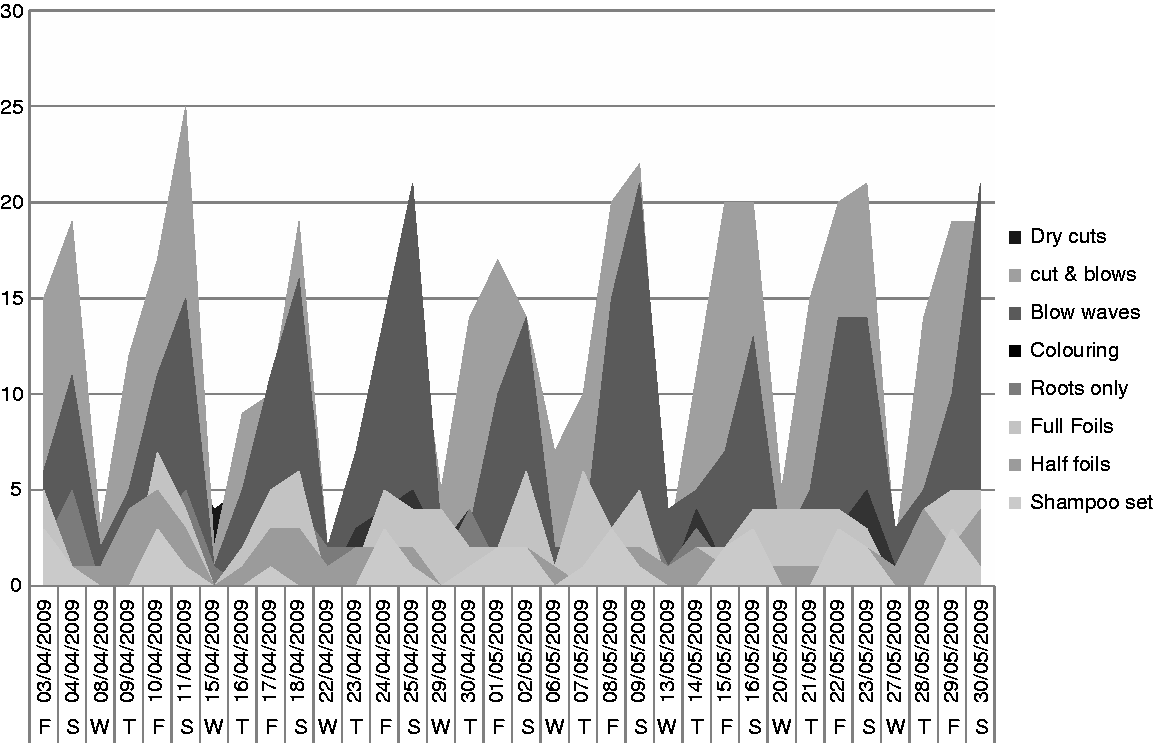
What is more, I argue that such collective rhythms endure because of the collective experience of that particular ‘Friday time’ in the salon. I like going out. Like today’s the only day I can just flit around on my own, come here, get a taxi back home …. if I wasn’t coming here, if I wasn’t coming down, I wouldn’t come out at all, but I do enjoy my little walk ….I don’t spend money on anything else, I don’t go out, I don’t smoke, I don’t drink, so this is my little pleasure. It’s out of my pension not his! (Interview, Mrs B) Parr: Does Mrs B go out on a Friday? Why does she always come on a Friday? Author: She used to go out but she doesn’t anymore. Beth: Yeah cos she used to go out for a meal or the pub or …. Patricia: It’s cos she’s still in that erm sort of …. Parr: Routine (Salon Focus Group)
I contend that Mrs B’s shampoo and set Friday appointment once again highlights another instance where the enjoyment of self-time spent engaging in a practice is as valuable as the intended outcome. Kirby’s staff noted a different atmosphere in the salon on a Friday, with salon owner Patricia describing it as having a ‘buzz’ about it as everyone prepares for the weekend and being ‘different from the rest of the week’. Former hairdresser Heather adds that the Friday Club arrange Christmas parties or go out for someone’s birthday. The practice of getting one’s hair done on a Friday not only revives and reinforces a collective rhythm with a particular temporal location, but it also fosters a particular sociality. These women come together on a Friday not just to get their hair done, but to be part of this salon atmosphere, to enjoy that time. As Mrs B illustrates, it is this social element, the enjoyment of that time which keeps the practice alive, even if the original purpose of the practice (preparation for the weekend’s leisure activities) is no longer valid. Thus, this is a collective experience of time, producing a particular collective rhythm all of which helps to normalise and furnish collective practice.
In addition, a key facet of this argument is that the practice – to get one’s hair done – is secondary to the collective experience of time. Instead of being central, the practice becomes the means through which the time, and the experience, is legitimised. There has been a great deal written about the gendering of time and the notions of the ‘dual burden’ or the ‘double shift’, particularly with reference to the time pressures faced by working women with families (see Bittman and Wacjman, 2000; Carrigan and Duberley, 2013; Jurczyk, 1998; Maher, 2009; Shaw, 1998). As Paula Black (2002: 5) concludes, in her study on beauty salons, ‘time is the commodity being bought in the salon’ by women often juggling the competing pressures of paid employment and families. Even Mrs B’s, who no longer has the demands of childcare and employment, feels the need to justify her weekly visit to the salon – ‘I don’t spend money on anything else’ … ‘[this is] the only day I can flit around on my own’. This time in the salon can be legitimately taken and enjoyed because of the physical and collective drivers pushing the practice. The palimpsest acts as a physical driver of the salon appointment, whilst the pressure of collective norms – not wanting to be seen with roots, or messy, greasy hair – also drives the practice along. These, coupled with the institutional setting of the salon and the fact that practices which take place there require a financial exchange, all help to legitimise that time and ensure its subsequent enjoyment – it is time which is allowed because of the practice which is taking place.
Whilst time understood as a resource, or something to be bought, is not a new concept (Southerton, 2013), this notion of time as a ‘legitimate commodity’ is crucial to this discussion. It highlights how the enjoyment of the time spent doing the practice can be just as valued as the outcome of the practice (in this case, regularly getting one’s hair done), even if that enjoyment effectively involves ‘doing nothing’. In other words, the intended outcome, the habitual practice of having your hair coloured, may even become somewhat secondary to the pleasure of experiencing self-time. The same could be said for numerous other practices, including those which do not involve a gendered approach to time or an overt monetary exchange. Showering, for example, is a habitual practice to get the body clean, yet showers are not always undertaken with cleanliness as the primary driver. There are a variety of other notions showering is imbued with, such as restoration, relaxation, and again the possibility of self-time. It is possible that people shower habitually simply for the enjoyment of spending that time engaging in that practice, regardless of its perceived, collective intended outcome. This is about regularly engaging in a practice not just because of what that practice does, but how time passed engaging in that practice feels. Such experiences of time are a feature of collective practice which should be recognised and accounted for. Moreover, they also act to drive practice and normalise its enactment.
Conclusion
This article began by discussing how practice based accounts tend to side-line temporality. Even though temporality and practice are recognised as being inextricably bound together by many studies on practice, the activities of practice always take centre stage. Yet, this article has illustrated how experiences of temporality are not only a feature but also a driver of habitual practices. Alongside other drivers, including collective norms and ideals, and, in the case of the body, physical and material drivers such as the growth of hair, or the build-up of dirt on the body, temporality pushes practices to be enacted, repeated and normalised. Furthermore, through the article’s exploration of ‘self-time’, it is apparent that practices are often not what they seem and can be enacted for a variety of reasons other than the intended outcome. Vitally, the practice legitimises the experience of time and its enjoyment and/or the subsequent outcomes. Hence, as Shove et al. (2012) conclude, experiences of time are experiences of practice. Without the practice the experience of time would not take place, but likewise it is equally argued that practices may persist in part because of the experiences of time they enable. How engaging in a practice feels can ensure that practice remains ‘sticky’, conveying other habitual and routine features of ‘sticky’ practices in terms of its rhythm, frequency and tempo. Furthermore, as illustrated in the example of the hair salon, exploring experiences of time engaged in practice can illuminate collective rhythms – practices performed at the same temporal location (same time on the same day each week) because of the experience of time during that practice.
Thus, the crux of this article is that experience of time is a valuable and underdeveloped feature of practice that should not be ignored when exploring practices and their enactments. Whilst experience of time adds an additional level of complexity to practice theory approaches, it is nonetheless an element which can further explanations as to why practices take place, and why they become legitimised and normalised. As this article has illustrated, using an experience of time approach means beginning with personal articulations of time as experienced. This is by no means a move towards individualism within practice, but rather these personal articulations are merely a means to understanding how temporal experience is embedded within collective practice. In other words, this is about beginning with the personal to appreciate and make sense of the collective. Opening up practice by prioritising time and temporal experience, as opposed to temporality merely being an added consideration, can give new insight into how and why practices persist and endure. Consequently, this approach can add a further and valuable layer to practice theory approaches, particularly with regard to practices which appear to have highly personalised temporal strategies, such as those that involve the body and its maintenance.
Footnotes
Acknowledgements
Many thanks to Nicky Gregson, Durham University and Jen Whillans, Manchester University for their invaluable help and comments.
Declaration of Conflicting Interest
The author(s) declared no potential conflicts of interest with respect to the research, authorship, and/or publication of this article.
Funding
The author(s) disclosed receipt of the following financial support for the research, authorship, and/or publication of this article: ESRC Postgraduate Studentship Award (PTA-031-2006-00255).