



Abstract
The aim of the present research was to explore the role of individual differences in time perspective (TP) in predicting two relationship quality indicators: general relationship satisfaction and sexual satisfaction, in romantic heterosexual couples. A total amount of 100 dyads took part in the study. Our study revealed that relationship satisfaction indices are predicted by partners’ time perspectives; both actor and partner effects proved significant. For instance, past-negative was related to lower general relationship satisfaction, whereas past-positive proved detrimental to sexual satisfaction. Higher relationship (but not sexual) satisfaction was related to a more balanced time perspective. Moreover, we demonstrated that the role of some time perspective dimensions may change with relationship length, e.g., a relationship between future-positive (FP) time perspective and females’ relationship satisfaction proved to change across relationship course from significantly negative to strongly positive. Contrary to our hypotheses, we found no evidence for assortative mating effects for time perspective dimensions. The present results provide evidence for the role of psychological temporality in relationship functioning and suggests potential utility of time perspective theories in practical interventions aimed to improve romantic relationships’ quality.
Keywords
Introduction
Nowadays, people are increasingly aware of the role and meaning of time in their lives. We live in a high-speed society (Rosa, 2003), and time seems now even more important than when Benjamin Franklin claimed that “If time be of all things the most precious, wasting time must be the greatest prodigality” (1848: 2). Forming and maintaining satisfactory relationships undoubtedly need time (Rusbult, 1980), but traditionally (i.e., physically) understood time itself may be not sufficient. It is possible that to create a stable, satisfactory interpersonal relationship partners need to meet each other not only in the physical time but also in various dimensions of psychological time. Therefore, in the present paper, we provide an in-depth look into associations between partner’s time perspective (TP) profiles and relationship outcomes.
Each relationship, even a recently formed one, has its own past, present, and future: in this aspect, relationships and time are inseparable. At the very beginning, partners are predominantly focused on their joint present: they often live here-and-now, as if the rest of the world could have not existed (cf. Zimbardo and Boyd, 2009). Over time, a common past and shared expectations for relationship future become more and more pronounced. Time spent together usually deepens a relationship, enhancing commitment (Rusbult, 1980). On the other hand, long-lasting relationships carry the risk of weariness and routine (e.g., Mathes and Wise, 1983), as the earlier experienced passion and mutual fascination often robustly decrease (Sternberg, 1986). Present relationship satisfaction, representations of a relationship past, and expectations for common future remain under continuous reciprocal influence (Alea and Bluck, 2003). All these processes make the issue of potential relationships between time perspectives and romantic relationship outcomes interesting and worth detailed investigation.
Time perspective
Philip G. Zimbardo have claimed that time perspective, “the often nonconscious process whereby the continual flows of personal and social experiences are assigned to temporal categories, or time frames, that help to give order, coherence, and meaning to those events” (Zimbardo and Boyd, 1999: 1271), remains one of the most powerful influences on our lives (Zimbardo and Boyd, 2008). time perspective in its nature is a dynamical cognitive process that enables to structure individual and social experiences, referring to past experiences, present situation, and expected future events. People usually develop a habitual bias toward one or more time horizons (Zimbardo and Boyd, 1999). One of the time horizons, or time frames, may thus become a dominant point of reference for one’s cognitions, emotions, and behaviors. Therefore, psychologists often investigate relatively stable individual differences in various time-related traits (e.g., Strathman et al., 1994; Worrell et al., 2013; Zaleski, 1994), including time perspectives (Nuttin and Lens, 1985, Zimbardo and Boyd, 1999).
Time perspectives distinguished by Zimbardo and Boyd (1999) in their time perspective theory.

In addition to the dimensions described above, recent studies (e.g., Boniwell et al., 2010; Drake et al., 2008; Zhang et al., 2013) emphasize the importance of an ability to create what is considered balanced time perspective (BTP). In this “ideal” temporal perspective, the attitudes to the past, present, and future flexibly interlock depending on situational demands, values, and needs (Boniwell and Zimbardo, 2004). This complex construct emphasizes harmony rather than a predetermined “norm,” and it has proved to be a significant individual characteristic, predicting a large amount of variance of subjective well-being (Boniwell et al., 2010; Zhang et al., 2013). Techniques for measurement of time perspective and BTP are further discussed later within the Method section.
Linking time perspective with interpersonal relationships quality
Romantic relationships are among the most fundamental social structures, underlying contemporary societies (Baumeister and Leary, 1995; Jamieson, 1998). Therefore, psychologists have often sought for dispositional and situational determinants of relationship quality and durability, revealing numerous factors influencing relationship characteristics, e.g., attachment styles (Pistole, 1989), personality similarity (Gonzaga et al., 2007), coping strategies (Ptacek and Dodge, 1995), and emotional intelligence (Stolarski et al., 2011b), among many others.
Despite of a robust predictive power of time perspective in predicting crucial social outcomes, e.g., well-being (Zhang et al., 2013), substance use (Keough et al., 1999), environmental behaviors (Milfont et al., 2012), or escaping homelessness (Epel et al., 1999), a research on the role of time perspective in the context of social and personal relationships is scarce. Studies in the area carried so far, include a study by Holman and Zimbardo (2009), who showed that low social support and high conflict with family characterized past-negative (PN) time perspective, whereas large social networks and high support from family distinguished past-positive (PP) time perspective. Moreover, large networks with more support and companionship from friends/acquaintances typified present-hedonistic (PH) time perspective, while having highly supportive significant others was associated with elevated future time perspective. More recently, Bernstein and Benfield (2013) showed that PN and PP time perspectives predicted rejection sensitivity, even after controlling for the Big Five personality dimensions, social support, and experienced marital and parental violence, once more emphasizing a prominent role of past time perspectives (Zimbardo and Boyd, 1999). Moreover, Akirmak (2014) demonstrated that more balanced time perspective was negatively associated with romantic anxiety, romantic avoidance, and positively with secure attachment.
Beyond Zimbardo’s TPT, Lang and Carstensen (2002) showed that priority of goal domains is differently associated with a size, composition, and perceived quality of personal networks depending on future time perspective. Prioritizing emotion-regulatory goals was associated with greater social satisfaction and less perceived strain with others when participants perceived their future as limited. The authors emphasize the importance of future time perspective in the self-regulation of social relationships. In her theory of socioemotional selectivity, Carstensen and colleagues emphasize that the perception of time plays a fundamental role in the selection and pursuit of social goals: when time is perceived as open-ended, knowledge-related goals are prioritized, whereas when time is perceived as limited, emotional goals assume primacy (Carstensen et al., 1999).
The above-mentioned results highlight the role of time perspective in social functioning. However, the issue of the role of time in close romantic relationships has never been investigated before. In their book, Zimbardo and Boyd (2008) formulate some predictions regarding the potential role of time perspective in forming and maintaining close relationships, basing on the nature of each time perspective.
First, they claim that future-oriented individuals reveal stronger need for higher partner’s predictability, as well as take under consideration potential gains that they may achieve in the relationship. On the other hand, “Futurists” usually do not seek passionate, exciting, and romantic relationships, which is quite opposite than present-hedonists, who prefer spontaneous relationships fulfilled with passion and physical closeness. However, there are also some serious drawbacks of being present-oriented: According to Zimbardo and Boyd (2008), hedonists often experience within-couple conflicts. They usually delay serious relationship engagement, because they simply do not reflect on joint future. Past-oriented individuals may, in turn, focus on partner’s trustworthiness. They will also spend their time on “what if” thinking, deliberating on relationships, which could bypass them and comparing their ex-partners to the current one.
Further, Zimbardo and Boyd (2008) make predictions regarding the role of time perspectives in relationship dynamics. The very beginning of a relationship is by its nature “present-oriented,” mainly due to high affective loading accompanying this phase (Sternberg, 1986). Lovers are focused on here and now for they usually share neither any joint past experiences nor future goals. Over time partners gain a common past, and, usually, begin to construct more or less far-reaching plans for future. Such state of affairs has a direct impact on how people with differently biased time perspectives behave in the course of relationship. And thus, present-hedonists should be definitely in better position in the early phases of relationship, as they do not trouble their heads with future: they are then able to completely immerse themselves in the present while enjoying their relationship. Future-oriented people are presumably much worse in dating and making love as they are permanently focused of future consequences; they may have huge difficulties in achieving the state of romantic flow with their partner. On the other hand, futurers’ tendency to plan everything may prove substantial for later phases of relationship, especially when children appears and effective time management is necessary to find some time for celebrating the relationship. Zimbardo and Boyd (2008) do not mention it, but low impulse control of hedonists may prove strongly maladaptive in later phases of relationship, when intentional efforts are necessary to maintain a positive emotional attitude toward one’s partner (Sternberg, 1986). Thus, future orientation may prove desirable from a long-term relationship standpoint, whereas present time perspective would result in higher satisfaction in the early stages of a relationship, consequently losing its positive influence over time.
Finally, Zimbardo and Boyd (2008) strongly emphasize the role of “temporal matching”: they claim that partners differing in their time perspective profiles may be much more susceptible to a lack of mutual understanding or various conflicts. The authors present a nice parallel, comparing such couples to lovers speaking different languages, who may truly love each other, but in fact live in two separate worlds. Temporally mismatched couples are even in worse situation for they are usually not aware of the true cause of their problems. Presumably the most dangerous combination is a couple consisting of a typical futurist and a “pure” present-hedonist. Such a temporal discrepancy may prove destructive for a relationship, because of the obvious differences in partners’ motivations, their ways of interpreting experiences, as well as different ways of decision making.
Of course, the future–present combination is only one of a number of potentially possible combinations of partners’ time perspectives. Moreover, it should be emphasized that due to a dimensional character of time perspectives, as well as due to their relative orthogonality, it is possible to develop almost any combination of individual time perspectives. Thus, for instance, one may score high on both present-hedonism and future dimension, whereas others could reveal low levels of these two time perspectives.
Zimbardo and Boyd (2008) focus mainly on just two time perspectives. On one hand it seems justified, as PH and future time perspectives proved to have the biggest influence on actual behaviors (e.g., Keough et al., 1999, Milfont et al., 2012). On the other hand, this is certainly a shortcoming of their considerations, because the remaining time perspectives may also significantly influence relationship dynamics and satisfaction. For instance, a high PP individual will strive for recalling the “old, good times,” celebrating numerous anniversaries, etc., and expecting the same from their partner. Again, if both partners share positive view of their past, it may strengthen their relationship; if not, the effects may be deplorable. Present-fatalism will, in turn, result in externally located control and passivity toward problems appearing in a dyad, and thus may lead to maintaining long-lasting, but low-satisfying relationships. PN time perspective is related to depression, anxiety, and tension (Stolarski et al., 2014; Zimbardo and Boyd, 1999), and thus it may result in projecting these maladaptive states on one’s relationship appraisals. On the other hand, PN time perspective may be enhanced in dissatisfying relationships. Maintaining a long-lasting, low-satisfying relationship may enhance present-fatalistic (PF) time perspective; thus, causes of interrelationship between particular time perspectives and relationship satisfaction may be bidirectional.
The assumptions formulated by Zimbardo and Boyd (2008) are based solely on theoretical analysis of time perspective dimensions and thus remain completely speculative. We found them important with regard to area of research on personal relationships, but definitely demanding empirical verification. Therefore, in the present paper, we attempt to answer a question whether time perspective is related to self-reported relationship satisfaction, as well as to declared sexual satisfaction. Using a classic dyadic design, we investigate both actor and partner effects, as well as a potential role of partner’s similarity in time perspective profiles. We also investigate whether the role of particular time perspective dimensions varies across a relationship length. Finally, we take an in-depth look into a role of a balanced time perspective in determining the relationship outcomes.
Aims and hypotheses
The main aim of the first study was (1) to verify whether partner’s time perspectives determine partners’ relationship and sexual satisfaction, including both actor’s and partner’s effects (Kenny and Cook, 1999). Further, following Zimbardo and Boyd’s (2008) assumptions, we analyzed (2) whether the time perspective-satisfaction associations change over relationship duration. Moreover, one of the most important areas in the field of research on personal relationships is the issue of assortative mating. The term is defined as the nonrandom coupling of individuals, based on their resemblance to each other on one or more characteristics (Buss, 1984). Thus, we intended to determine (3) whether an assortative mating effect (Vandenberg, 1972) for time perspectives exists and, if it does, whether it is a matter of initial assortment or convergence.
Method
Participants
The sample consisted of 100 sexually active heterosexual couples, recruited by a team of specially trained pollsters who invited participants using social media and personal connections. To take part in the study, both partners had to declare that their relationship has lasted at least one year, and that they have been sexually active since at least six months. These inclusion criteria were emphasized by our pollsters during the recruitment procedure; to ensure that the criterion was met, we asked questions about (1) relationship length and (2) a time since the first sexual intercourse with the present partner on the opening page of our questionnaire booklet. All participants filled a set of measures in the presence of a pollster, who took care to disable any communication between partners. Partners were also not allowed to compare their results with each other. Participants were not awarded, and have all expressed an oral consent to take part in a “study of the role of attitudes towards time in romantic relationships.” Female partners were aged between 19 and 47 years (M = 27.3, standard deviation [SD] = 6.1), and males between 20 and 50 years (M = 29.3, SD = 6.9). Twenty-six couples were married, relationship length ranged between 1 year and 21.5 years (M = 5.3, SD = 4.6).
Measures
time perspective
Time perspective dimensions were measured using the Zimbardo Time Perspective Inventory (Zimbardo and Boyd, 1999), in Polish version provided by Kozak and Mażewski (2007). It has five scales: PN, PH, Future (F), PP, and PF. Cronbach alphas for the scales reported by Zimbardo and Boyd (1999) are .82, .79, .77, .80, and .74, respectively (in the present study: .83, .81, .80, .70, and .71, respectively). Additionally, we used Future Negative (FN) items provided by Carelli and colleagues (2011), and, consequently, we reduced the F scale by two items, which are included in FN, leaving what Carelli labels Future Positive (FP) scale. Finally, individual level of time perspective balance was assessed using the Deviation from Balanced Time Perspective (DBTP) coefficient introduced by Stolarski et al. (2011a) and validated by Zhang et al. (2013). The DBTP is a measure of difference between individuals’ time perceptions and the optimal time perspective profile as stated by Zimbardo and Boyd (2008), which indicates how ill-balanced the time perspective of each person is (see Stolarski et al., 2015b, for exhaustive reasons for this method for calculating balance). The DBTP is usually normally distributed and could be treated as a meta-level time perspective dimension.
Sexual satisfaction.
Sexual satisfaction was assessed with the Index of Sexual Satisfaction (ISS; Hudson et al., 1981). This self-report one-scale inventory contains 25 items (e.g., “Our sex life is very exciting,” or “My partner seems to avoid sexual contact with me”), which are rated on a 5- or 7-point Likert-type scale, respectively to version of the questionnaire. In this study, we used a 7-point scale, ranging from 1 (none of the time) to 7 (all of the time). Originally, ISS was developed for clinical use, measuring the degree or magnitude of sexual discord or dissatisfaction of one’s relationship with a partner, so higher scores indicate greater degrees of sexual discord. In the present survey, we used an inverse answer coding, so that higher scores indicate greater sexual satisfaction. This operation was made to simplify the interpretation of later statistical analyses. Psychometric properties of the Polish version of the questionnaire are high (i.e., Cronbach’s α = .94; correlations with intercourse frequency Spearman’s ρ = .57 for both men and women in validation studies in Poland; in the present sample Cronbach’s α = .92).
Relationship satisfaction
General relationship satisfaction was measured with the Relationship Assessment Scale (RAS; Hendrick, 1988). This 7-item self-report scale is one of the most commonly used measures in the research of relationship quality. Respondents answer each item using a 5-point scale ranging from 1 (low satisfaction) to 5 (high satisfaction). In the present study, a high internal consistency of the measure was confirmed (i.e., Cronbach’s α = .88). Its correlation with sexual satisfaction measured with ISS was r = .61, p < .001.
Results and discussion
First, we tested for gender differences in the measures variables. Females scored higher in PP, t(198) = 2.633, p < .01, PH, t(198) = 2.006, p < .05, and PF, t(198) = 2.152, p < .05. The former is consistent with the results mentioned by Zimbardo and Boyd (1999), whereas the latter two seem specific for Polish sample. We found no evidence for significant sex differences in both measures of satisfaction, FP, FN and PN time perspectives, as well as in time perspective balance.
Further, we tested whether relationship length is related to both partners’ scores in each of the time perspective dimensions. We controlled for participants’ age to exclude the obvious influence of this variable on time perspective scores (see Zimbardo and Boyd, 1999). We obtained significant result only for PH dimension in women, r(97) = −.23, p < .05 in females, and an analogical result, but only at tendency level for males, r(97) = −.17, p = .09. Thus, it seems possible that levels of present-hedonism slightly decrease throughout relationship duration. The effect may be a manifestation of a generally more hedonic nature of early phases of romantic relationships (see Sternberg, 1986). We also performed analogical analyses for both satisfaction measures, but, surprisingly, we have not obtained any significant correlations between relationship length and satisfaction, neither in men nor in women.
Assortative mating
Further, we attempted to test the hypotheses regarding assortative mating effects. Naturally, we proved that partners were similar with respect to relationship satisfaction, r(98) = .66, p < .001, and sexual satisfaction, r(98) = .63, p < .001, but this result should be treated simply as the study’s validity indicator. Surprisingly, we found no evidence for any assortative mating for time perspective: the within-couple correlations for each of the time perspective dimensions and the DBTP coefficient were all nonsignificant and below .10 level, with an exception for PN, for which we obtained a tendency-level relationship, r(98) = .16, p = .06, but only when we applied a one-tailed test of significance (which was justified in this case, as we expected similarity assortment, not complementarity). As time perspective depends on individual experiences (Zimbardo and Boyd, 2008), we then tested for a moderation effect of relationship length on the relationship between partners’ time perspective dimensions, to test for the eventual effects of convergence (Luo and Klohnen, 2005). Neither of the moderation effects of relationship length proved significant; thus, we assume that partners do not become increasingly similar in their time perspectives throughout their relationship duration.
Also, we applied continuous parameter estimation method (CEPM; Gorsuch, 2005) to test whether convergence or similarity in any of considered time perspective dimensions is related to increased scores in applied satisfaction measures. However, we have obtained no significant effects suggesting that between-partner coherence or discrepancy in particular time perspectives could influence relationship satisfaction.
Time perspective and satisfaction
Actor’s and partner’s time perspective effects on male and female relationship and sexual satisfaction: Standardized β coefficients of those dimensions which remained in each model after applying backward elimination procedure.
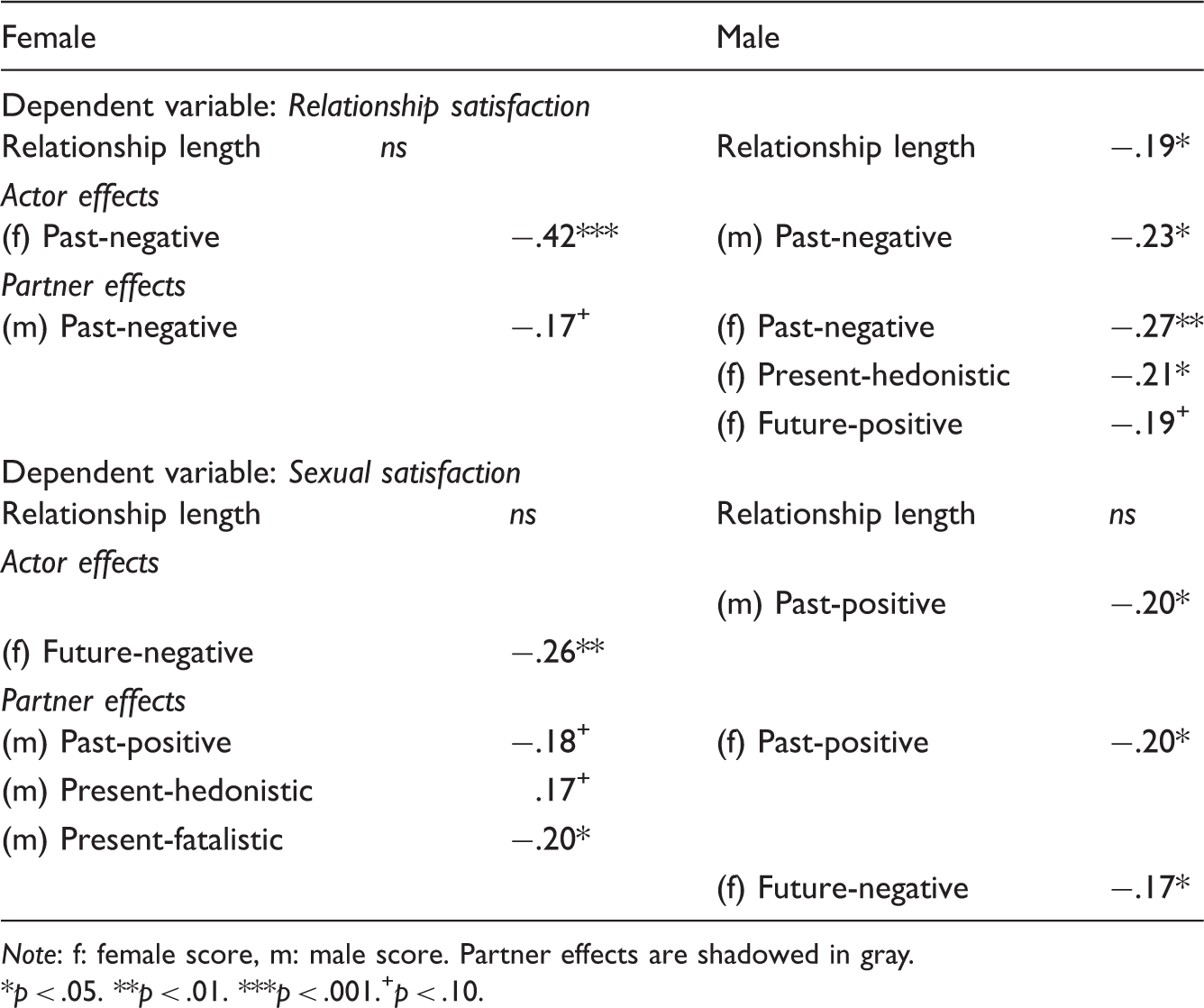
Note: f: female score, m: male score. Partner effects are shadowed in gray.
p < .05. **p < .01. ***p < .001.+p < .10.
The regression analyses revealed significant actor and partner effects of time perspectives on both satisfaction measures. The final models (see Table 2) accounted for 23% of relationship satisfaction in females (16% in males), and 21% of sexual satisfaction (11% in males). Probably the most consistent result was the one for PN time perspective and general relationship satisfaction. We obtained relatively strong actor and partner effects both in women and in men, proving that increased levels of the negative view of past are related to significantly lower assessments of overall relationship quality. Naturally, this result does not have to be causal, in a way that PN influences satisfaction, because negative within-relationship experiences can naturally lead to a more negative view of past. However, it is highly possible that having a strong PN bias leads to assessments of one’s life experiences (including within-couple ones) in a way consistent with this scheme (Zimbardo and Boyd, 2008). Some results suggest that recollections of emotional memories (which seem crucial for relationship satisfaction level) may be biased in individuals with strong PN time perspective (Stolarski et al., 2014). Also, having a highly PN partner may be also detrimental for relationship satisfaction, as such a partner will more often complain on their past (Zimbardo and Boyd, 2008). Moreover, people scoring high on the PN dimension are more anxious, aggressive, and generally more neurotic (Zimbardo and Boyd, 1999), and having a highly neurotic partner is related to lesser relationship satisfaction, both in males and in females (Watson et al., 2000).
Other effects for relationship satisfaction were observed only in males, and concerned solely partner effects. Those males whose female partners were more present oriented proved less satisfied with their relationship. This result may seem counterintuitive, but it could be explained in at least few ways. First, hedonic orientation of a female partner may lead to increased expectations toward a male partner regarding satisfying her strong hedonic needs (e.g., sexual, but also material, including various purchases, requiring relatively big amount of money). These demands may be difficult to meet, which in turn may lead to decreased general satisfaction with a given relationship; the opposite effect is not observable probably due to cultural stereotypes of male responsible to satisfy female partner’s material needs (Sprecher, 1989). Further, we have also found a surprising (albeit rather weak) negative partner effect of female FP time perspective on general male satisfaction. The effect is interpretable in terms of females’ presence in their homes: being more future oriented, i.e., striving for career success and long-term goals, often leads to lesser time spent with partner/family which may in turn lead to decreased partner satisfaction. A lack of opposite effect in females may again result from stereotype gender roles: whereas, spending huge amount of time at work by males has been accepted in most western cultures, women are typically expected to sacrifice more for their families (Gutek et al., 1991). Not fulfilling such expectations by future-oriented females may lead to lesser relationship satisfaction of their male partners. Finally, this gender role stereotype may result in disadvantageous social comparisons. Having a strongly future- and career-focused partner may be detrimental for some males’ (typically those which are not satisfied with their own careers) levels of self-esteem.
For sexual satisfaction, the revealed set of predictors was completely different. Surprisingly, we found that PP time perspective was a negative predictor of sexual satisfaction: the results provide evidence for actor effects in males and for partner effects in both genders. In other words, man with a positive view of their past, reported lower levels of sexual satisfaction. It is important to remember that this result does not imply that a negative view of past enhances sexual satisfaction, as both past time perspectives are only weakly correlated; it rather suggests that habitual focus on the positive aspects of a male’s own past may hinder them achieve higher levels of sexual satisfaction. The partner effects broaden this interpretation: having a positively past-oriented partner is also detrimental for one’s sexual satisfaction. These results are rather difficult to explain, especially taking into account that PP time perspective proved positively related to emotional intelligence (Stolarski et al., 2011a) and is considered an effective strategy for regulating one’s own moods (Stolarski et al., 2014). One interpretation that seems plausible is related to one of the core features of PP time perspective, i.e., traditionalism/conservatism. Research shows that using many sided sexual techniques is one of the most important predictors of sexual satisfaction, in both males and females (Haavio-Mannila and Kontula, 1997). Traditional attitudes and values may lead to lower tendency to seek for novelty and diversity in various areas of life, including sexual functioning. If sexual life of individuals scoring high on PP is indeed less varied, their satisfaction may be lower; however, this is only a hypothesis that would have to be tested in further studies in this area. An alternative explanation regards a mechanism of standards of comparisons (e.g., Schwarz and Scheuring, 1988). Although taking PP perspective is generally considered as emotionally adaptive (Matthews and Stolarski, 2015), an enhanced focus on positive aspects of one’s past may result in development of highly demanding standards of comparisons, which are used in appraisals of current sexual activity. Given that these standards do not fully reflect actual past experiences, but may be cognitively reconstructed and thus positively biased (Stolarski et al., 2014), making such comparisons may significantly worsen assessments of one’s sexual satisfaction.
Furthermore, FN time perspective in females is related to lower sexual satisfaction in both themselves and their partners. This might be related to increased anxiety and poorer mood in high-FN women (Stolarski and Matthews, under review), which may be extrapolated on sexual intercourse and result in lower satisfaction, also in their partners (see Butzer and Campbell, 2008). Feeling insecure about one’s relationship may make it difficult to derive pleasure from a sexual intercourse undertaken within that relationship (Waite and Joyner, 2001).
Finally, present orientations of males proved significant predictors of female sexual satisfaction: Women whose partners were less fatalistic and more hedonistic proved more satisfied. This effect may be understood in terms of helplessness and sexual motivation: PF time perspective is reflected in helpless attitude toward life and external locus of control. Present-hedonism, in turn, is related to sensation and novelty seeking, and increased energy (Stolarski et al., 2014; Zimbardo and Boyd, 1999). It seems that to obtain higher levels of sexual satisfaction, women need more active than passive and more sexually enterprising partner. An analogical effect was not observable for males, suggesting that gender role motivations may play a significant role in predicting sexual satisfaction (see Sanchez et al., 2012).
Moderating effects of relationship length
Zimbardo and Boyd (2008) suggested that PH and FP time perspectives could differently influence relationship satisfaction depending on relationship duration. When we take a deeper look into love dynamics postulated by Sternberg (1986) in his triangular theory of love, we can come to similar conclusions: a component of passion intensively increases, and then rapidly decreases. Such decrease should be particularly painful for present-hedonists, for whom this type of love seems the most important. Quite opposite, components of intimacy, and particularly commitment, require a long-lasting view of a relationship and special preventive efforts, aimed in maintaining a satisfying relationship. Thus, we expected that future-oriented individuals will start to receive gains resulting from their future-oriented efforts in later phases of a relationship, when the level of passion is no longer as high as it used to be. To test these hypotheses, we conducted a series of interaction analyses predicting satisfaction measures in both males and females, introducing relationship length as a moderator, and FP or PH as a focal predictor. Naturally, we have tested for both actor and partner effects. Significant effects were illustrated using floodlight technique (Spiller et al., 2013). The method tests effect of primary predictor on dependent variable at all levels of the moderator (starts at low and goes to high score on moderator). To identify Johnson-Neyman region(s) of the moderator where the effect of the primary variable is (non)significant, Hayes’ (2013) PROCESS software was applied. Results of the analysis are provided in Figure 1.
Estimated effects of time perspectives on satisfaction indicators for different levels of moderator (relationship length). Regions for which the effect was significant are shadowed in gray.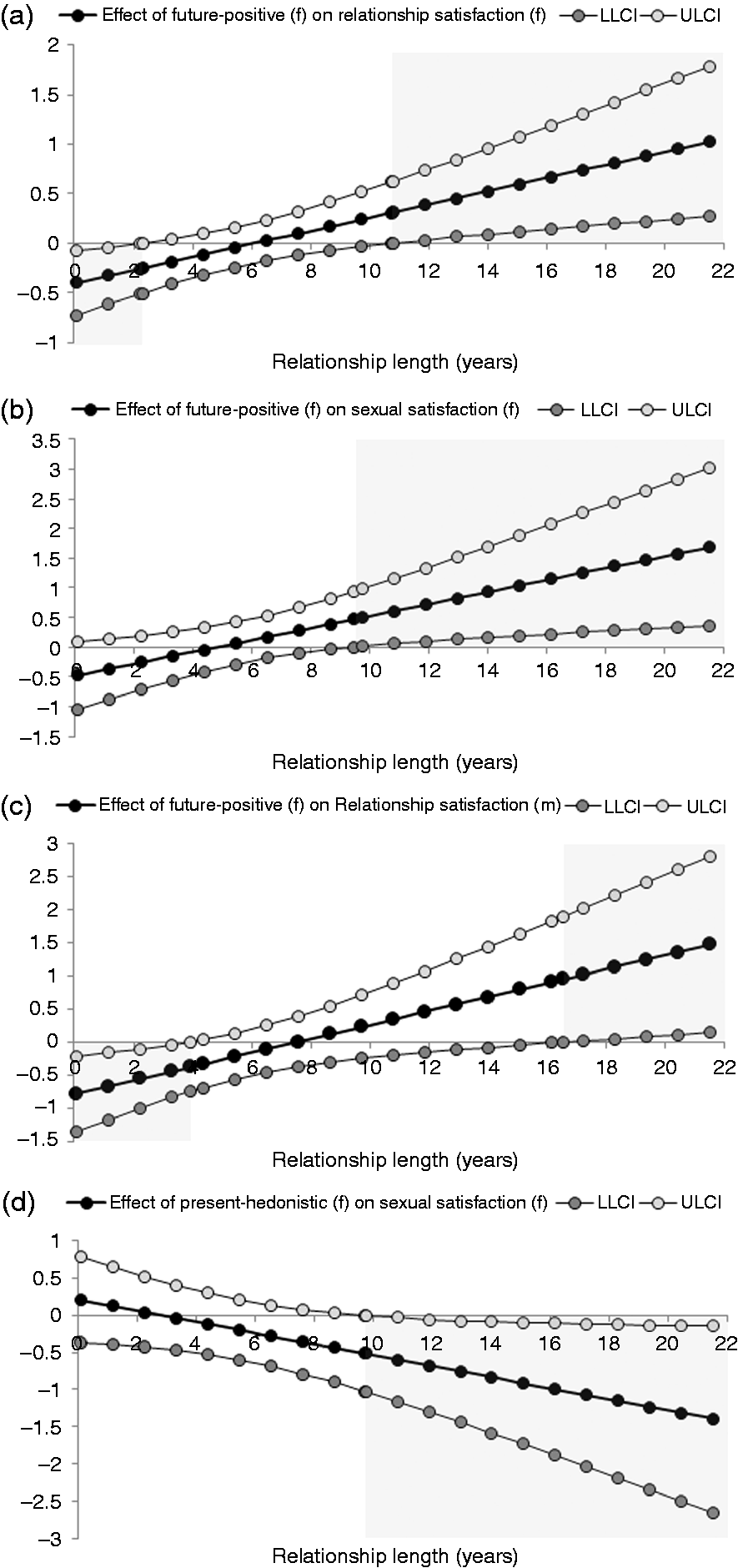
We found a rather strong confirmation of the predicted effects in women. The moderating effect of relationship length on the association between FP and general relationship satisfaction proved significant, β = .33, p < .01 (see Figure 1(a)). Interestingly, the effect of FP proved negative in newly established couples (up to 2.3 years), nonsignificant in medium-length dyads (2.3–10.7 years), and significantly positive in more experienced couples (over 10.7 years). Analogic effect was observed for sexual satisfaction in females. Again the actor effect of FP was moderated by relationship length, β = .21, p < .05 (see Figure 1(b)). The relationship varied from negative (albeit nonsignificant) for females in inexperienced relationships, to positive and significant in more experienced (over 9.5 years) dyads.
Although we have not found any evidence for the moderating effect of relationship duration on the association between PH and general relation satisfaction in females, such effect was observed for sexual satisfaction, β = −.18, p < .05 (see Figure 1(d)). In inexperienced couples, the effect was positive, but weak and nonsignificant, whereas for experienced couples (over 9.7 years), it was negative, showing that elevated present orientation may be detrimental for female sexual satisfaction in later phases of relationship.
The results obtained for females confirmed our expectations; however, we found no evidence for respective interaction effect in males, suggesting that the changes of significance of FP and PH time perspectives related to relationship length are specific for females. Further, we tested for analogical moderation effects of relationship length regarding partner effects. No significant interaction was found for the relationships between female satisfaction and male partner’s time perspectives. However, we obtained a significant interaction between female FP time perspective and relationship length in predicting male general relationship satisfaction, β = .27, p = .01 (see Figure 1(c)). Again, in the early phases of relationship (up to 3.9 years), the effect of FP was significant and negative, whereas in experienced couples (over 16.6 years), it proved opposite. It seems that in early stages of relationship, men expect something different than being future oriented (i.e., considering long-term consequences, striving for career successes) from their female partners. Surprisingly, this effect observable only for overall, not sexual satisfaction.
This analysis revealed that changes in the associations between time perspectives and satisfaction regard mainly female time perspectives. Thus, we may conclude that being future-oriented female, even if not advantageous in early stages of relationship, bears fruits when a couple is more experienced, both in her own and her partner’s satisfaction. Quite opposite, it is better to be not too hedonistically focused female, especially when the time goes by, and the relationship becomes more experienced. Presumably, in later phases of relationship, satisfying hedonic strives, including needs for excitement and novelty, becomes more difficult. If these motives are strongly elevated and unsatisfied, it results in decreased assessments of one’s relationship.
Balanced time perspective and relationship satisfaction
Correlations between measures of relationship satisfaction and DBTP index.
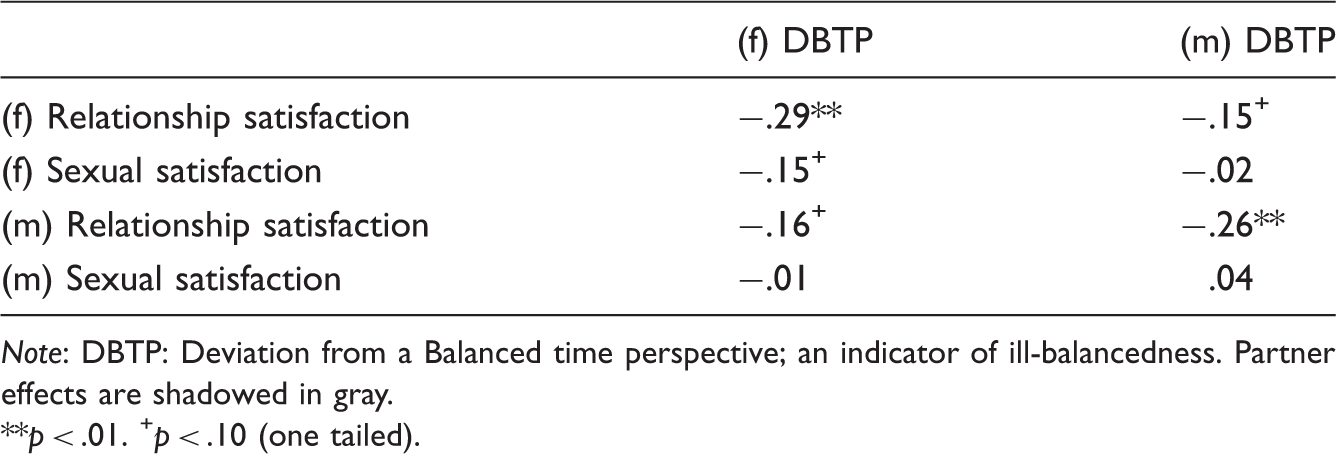
Note: DBTP: Deviation from a Balanced time perspective; an indicator of ill-balancedness. Partner effects are shadowed in gray.
p < .01. +p < .10 (one tailed).
The effects of BTP proved weaker than one could expect basing on hitherto research on the role of temporal balance in general well-being measure (e.g., Zhang et al., 2013). However, this index of temporal harmony and flexibility (Stolarski et al., 2015b) proved significant for appraisals of general relationship quality. This positive influence of BTP may be exerted via increased capability to adjust to dynamically changing situation in one’s relationship through effective switching between particular time horizons depending on situational demands (Zimbardo and Boyd, 1999).
Conclusions
The present research aimed to explore the role of individual differences in time perspective in relationship quality among heterosexual couples. Obtained results provide quite strong evidence for importance of partners’ time perspective profiles for both general relationship satisfaction and sexual satisfaction in both females and males. Balanced time perspective proved significant but only for general, not sexual satisfaction. We obtained significant actor and partner effects, providing evidence for complexity of the time perspective foundations of relationship quality. We also showed that the pattern of time perspective-satisfaction associations may vary across relationship length. Contrary to our hypothesis, we found no evidence for an assortative mating effect for time perspectives. Partners’ similarity in temporal orientations for relationship quality also did not prove to influence their relationship satisfaction. In the light of the present results, we may conclude that individual differences in time perspective may to a certain degree influence relationship quality.
Limitations and future research
Although the present study brought several interesting results, we are aware of its certain drawbacks. The first, and probably the most obvious, regards the investigated sample: early-stage couples were overrepresented, which makes it difficult to extrapolate the obtained results to the whole population of heterosexual romantic couples. Moreover, that fact forces us to be cautious with drawing far-reaching conclusions about the moderating effects of relationship length on relationship satisfaction.
The obtained effects might have been actually weakened by the fact that we took into account only existing relationships—if some time perspective dimensions or within-couple combinations of time perspectives were really destructive for relationship quality, then such couples already broke down, and were not included in the sample. This is a common problem of studies, which apply cross-sectional designs on couples, thus future research on this topic should apply a longitudinal methodology (e.g., Bradbury and Karney, 2004). Also, we did not control for a number of children and educational level of participants—factors that might be important for both relationship and sexual satisfaction.
Since time perspective is strongly related to age, such a big discrepancy in terms of age is a major flaw of the study. Future research should replicate the present findings within one age group (e.g., 30–35 years) with diverse relationship length.
Another problem regards causal interpretations. We have already mentioned it while commenting the obtained results, but it should be clearly stated that the present result does not allow to determine a causality of obtained associations, especially when we take into account Zimbardo and Boyd’s (2008) claims about rather environmental/social than genetic/temperamental roots of time perspective. On the one hand, particular time perspectives, as well as an overall temporal harmony, operationalized as a BTP, may influence relationship satisfaction via increasing probability of related ways of responding (cf. Zimbardo and Boyd, 2008), induction of particular emotions or moods (Stolarski et al., 2014), or through enhancing focus on particular aspects of perceived reality (Zimbardo and Boyd, 1999). For example, qualitative characteristics of memories of a relationships’ past (e.g., amount of emotion or level of detail) may even be predictive of future satisfaction and relationship maintenance (Buehlman et al., 1992). The latter result supports the explanation endorsing the causal effect of time perspective on relationship outcomes. On the other hand, time perspectives may, at least in part, result from current relationship features. Although time perspective is dependent on numerous other factors, including personality, religion, nationality, etc., still some part of time perspectives’ variance result from one’s life experiences, including relationships and attachment styles (Kazakina, 1999; Zimbardo and Boyd, 2008). For example, memories may be biased in the direction of current relationship satisfaction. Karney and Coombs (2000) showed that wives who perceive their marriage as improving over time remember the past as more negative than it was. In this case, memory seems distorted in order to serve the function of bolstering current satisfaction. Although this influence was rather limited to relationship-related memories, taking into account the fundamental role of intimate relationships in creating one’s identity and satisfying one’s basic needs (Baumeister and Leary, 1995), it is possible that current perceptions of one’s romantic relationship may influence their time perspective profile. For instance, a single traumatic between-partner experience may elevate PN, whereas inability to force a partner to change their bad habits may foster PF. In all, although along our consideration, we mainly focused on potential influence of time perspective on relationship outcomes, some reciprocal or even opposed causalities are also possible. Again, longitudinal designs would allow to resolve these issues.
The present results could be used a source of ideas for some practical applications. TPT is increasingly used as a framework for various practical interventions (see Stolarski et al., 2015a), thus it would be valuable to determine its utility in couples therapy or counselling. For instance, facilitating PH perspective in the early phases of relationship, and future orientation in later phases seem to be an interesting idea, which we can derive from the present results. Further, weakening past focus may prove advantageous in couples experiencing problems in the sexual aspect of their relationship.
Also, it would be interesting to explore the nature of the relationships obtained in this study, for instance through identifying potential mediators (e.g., conservatism in the relationship between PP and sexual satisfaction, or conflict resolutions strategies for the relationship between female PH and male relationship satisfaction). Future studies could seek for other relationship outcomes that may be influenced by partners’ time perspective profiles, including relationship stability, communication styles, and conflict resolution patterns, among others. Replicating the present results in different cultures and among other sexual orientations would provide an important information about the generality of the present findings.
Footnotes
Declaration of Conflicting Interests
The author(s) declared no potential conflicts of interest with respect to the research, authorship, and/or publication of this article.
Funding
The author(s) disclosed receipt of the following financial support for the research, authorship, and/or publication of this article: Primary support for this work was provided by a grant no. 2014/13/D/HS6/02951 by National Science Center, Poland.