




Abstract
Social class and the labor market, traditional emphases of sociological analysis, are insufficient to explain variations in modes of professional insertion among young people. Arguing against the dominant understanding of young adults as project-less prisoners of presentism and an uncertain labor market in Argentina, this article reveals the existence of multiple forms of youth temporalities underlying the ways in which young adults are able (or not) to project themselves into the future and enter the working world. Drawing from longitudinal qualitative data, I have identified four types of youth temporalities: planners, executers, dormants and opportunists. This typology brings variation to the way subjects experience time and how this experience helps to examine career choices, thereby opening a new analytical path that connects with broader analyses of dominant temporal frames of professional insertion.
Introduction
Distinct and multiple forms of temporalities underlie the construction of work careers and transitions in adulthood among young adults in Argentina, a country whose history of social instability and recent industrial and institutional transformations have accentuated a general feeling of uncertainty among young people. Indeed, the instability and the uncertain, common traits of political, economic and social life in Argentina have created the context in which work careers are constructed. Yet, contrary to the dominant view of young people as passive prisoners of uncertainty, this article reveals the existence of multiple youth temporalities. These distinct positions of young adults in relation to predominant social and temporal frameworks provide an overlooked yet key entry point to our understanding of variation in work careers among young people.
Time is a fundamental dimension of biographical careers (Bidart and Longo, 2010; Elder, 1994; Longo, 2010; Phoenix et al., 2007; Portelli, 1993; Saraceno, 1989; Shirani and Henwood, 2011). Much like other social phenomena, trajectories involve a succession of events that explain or describe the occupational, familial, educational, residential, affective or other social positions of individuals and groups. Moreover, careers also reveal change and mobility in a sequential manner, constituting in this sense a temporal deconstruction of social change (Balán and Jelin, 1979).
Since the 1980s, multiple scholars have raised the question of the differentiation and increased complexity of careers, particularly in terms of employment and transitions in adulthood (Alheit, 1994; Cicchelli et al., 2006; Galland, 1990; Gautié, 2003; Melucci, 1998; Morch et al., 2002; Roberts et al., 1994). This differentiation has become increasingly visible in a historical context characterized by deep transformations in production and a shift towards more flexible, unstable and precarious employment, particularly for young people. Transformations in the productive sphere have been accompanied by the breakdown of main socializing institutions such as the family (Jelin, 1998) and schools (Dubet, 2002; Tedesco, 2005), diminishing their integrative functions for young people.
The differentiation of careers has also been linked to a series of mutations in social and individual use of time. The contemporary world is characterized by the “acceleration” of production and consumption processes, the disintegration of time and space following the introduction of new technologies, the primacy of the urgent, instantaneous “presentism”, the “de-synchronization” of most biographical careers and a strong increase of uncertainty (Brose, 2004; Hartog, 2003; Lechner, 2002; Rosa, 2010; Zarifian, 2001). Thus, time is central to the definition of careers, and issues of time are both a main consequence of current social transformations and a key to the interpretation of individual actions and means of social integration. As highlighted by Rosa (2010), modernization is above all the structural and cultural transformation of temporal structures and horizons.
This analysis draws on a qualitative and longitudinal study of 85 young men and women, 1 and so this paper begins by describing the social and temporal context in Argentina and defining the theoretical elements concerning the notion of “youth temporalities”. Our Methodology describes the survey and develops the dimensions used to construct the four categorical types for analyzing the young people in this study. The way in which each type of youth temporality can be linked to work careers is explained in the Results section, and finally, this paper discuss observations related to youth temporalities and their contribution to explaining young people’s entries into the working world. 2
Theoretical and social landmarks
Time constitutes an essential instrument for the orientation of human beings (Elias, 1989), as well as being a means to regulate and systematically orientate one’s individual and social life. The social organization of time particular to different historic periods has been conceptualized as temporal regimes (Hartog, 2003) or temporal cultures (Grossin, 1996). Social temporalities express the recurrent norms, frequencies and periodicities of certain spheres and activities within a given social group or society. Such temporal regimes or cultures constitute the dominant social time that frames individual constructions of time based on distinct experiences.
Unstable and flexible context
Since the fall of the Berlin Wall in 1989, “presentism”, or the predominant focus on the present as our main relation to time, has come to characterize the contemporary era (Hartog, 2003). Within this temporal regime, the future is associated with risks, and social and natural threats, and thus the past ceases to be a source of certainty for life in society. Some scholars have also approached the predominance of the present with the use of other concepts: the extended present (Nowotny, 1994), the perpetual present (Adam, 1995), the omnipresent present (Lechner, 2002), the presentification (Leccardi, 2005; Rampazi, 1989) and the reduced social horizon (Kosselleck, 1993; Zarifian, 2001).
This predominance of the present over multiple time spans takes place within other phenomena such as the “acceleration” of technology, the rhythm of daily life and social change (Lechner, 2002; Rosa, 2010). Everyday life hastens, decomposing the temporal structures that are familiar and blurring the limits of previous constructions of order. Moreover, new technologies and globalization stimulate the experience of time compression, i.e. the apparent reduction of time to a single instant no matter where we are.
Temporal frames are a means of regulation imposed and proposed by political, economic and social institutions (Grossin, 1996). In this sense, current social time has become socially embodied in different forms. Argentina has a particular socio-historical framework; the country’s multiple social, political and economic crises have established instability and insecurity as an imposing characteristic of everyday life.
Indeed, the last political dictatorship (1976–1983) produced not only generational ruptures following the disappearance and assassination of a segment of the population, but also an environment of mistrust towards political institutions, thereby deeply aggravating their instability. This institutional frailty did not improve with the return of democracy. During the 1980s, institutions were further weakened by state reforms that fragmented their functions, reduced their public budgets, decentralized their responsibilities, and privatized goods and public services, thus creating a concentration of wealth, deindustrialization, and increased foreign debt. These reforms weakened the capacity to buy property and obtain social security that had previously been guaranteed by the Argentinean Welfare State. During the 1930s, industrialization, through the so-called model of import substitution, had developed a relatively homogeneous and stable social and wage structure, which resulted in upward social mobility.
Nevertheless, the concentration of capital derived from state reforms and changes to wage structures resulted in a social, political, and economic crisis in 2001, which left its imprint on multiple generations and social categories. The privatization of public services (e.g. water, electricity, gas, transportation, retirement plans) is one of the best examples of these neoliberal policies, characterized by urgency, short-term vision, and opportunism. This process was imposed as an immediate option to accelerate economic growth without having any real projections for the future (Santiso, 2002).
This institutional and economic context had an impact on shared temporalities and living conditions for Argentineans, particularly in relation to the reduction of their temporal horizons. In 2009, nearly half of the adult population was incapable of developing or planning projects beyond the “everyday” (Observatorio de la Deuda Social, 2009). Beyond material difficulties, the instantaneous, the immediate, the reduction of expectations became part of the Argentinean cultural environment motivated by the appearance of new information and communication technologies (Sarlo, 2003). Presentism became the main characteristic of the return of democracy (Santiso, 2002).
In terms of employment, labor law deregulations during the 1990s were another expression of the instability, flexibility, and uncertainty of this period. The deregulations reduced social benefits and employee compensations from 50% to 100%, and created new and more flexible contract forms and hiring policies of fixed duration (Perez, 2008) that conditioned Argentineans’ projections of the future as well as their construction of stability. This was particularly the case for young people under 25 faced with short contracts such as “professional internships”, “work and study programs”, “internships” outside legal protection, prolonged “trial periods”, “permanent part-time”, or “training contracts”. Even if some of these modalities were eliminated afterwards, they did not allow the incoming workers to have protected and lasting employment that previous generations had had. During the 1990s and the beginning of the 2000s, these policies deconstructed the preexisting employment model and aimed to increase labor market flexibility and reduce employer contributions to fight unemployment in a country where unregistered or “informal” work had grown by 50% in 2003 (MTEySS, 2006). Neither was the educational sphere spared the fluctuations caused by economic and political instability. Several educational reforms (the most important in the 1990s, with another reform of the educational system in the 2000s) failed to reach their goals of integrating more young people for longer, of increasing the quality of training and, by extension, of preparing them better for their professional lives (Salvia, 2003).
This is the unstable, uncertain, flexible and reversible temporal framework within which young Argentinean people attempted to begin their professional insertion at the moment of this research. Young Carla, like others, states:
The labor market? Pretty dismal, because most of the work is informal, with not many long-term jobs. Also the formal work, the protected work, is unstable. You go to work and they say: well, we take on a number of people and then we have to let them go; sorry you have to go. There is always a risk of losing your job whether it’s formal or informal.
Moreover, the latter unstable context is caracterized by social inequalities. The 2001 crisis reinforced prexisting inequalities after the dictature. Poverty is the evident result of this: in 2003 poverty affected 4 in every 10 households in Buenos Aires, the largest area in Argentina (Salvia et al., 2014). Nevertheless, social class differencies marked access to education and employment for young people. Even if, at the secondary level, Argentina had better rates than other Latin-American countries, social class differencies were pronounced: around 50% of poor young people (13 - to 18-year-olds) had access to secondary level education, while more wealthy young people reached more than 80%. Moreover, while the 19 - to 25-year-old bracket registered a 30% dropping out of education, poor young people of the same age reached 70% (Montoya, 2005). Nevertheless, Perez et al. (2013) showed an improvement in statisticts as regards employment and precarity between 2003 and 2010. However, when comparing lower, middle and upper class young people, the latter were overrepresented in employment and underrepresented in unemployment, with inequalities persisting between social classes. 3 The same authors also highlighted that with the same education level, social class inequalities decreased, although they did not disappear (Perez et al., 2013).
Uncertainty for all? Multiple individual experiences of time
Nevertheless, individuals have different ways of incorporating dominant social time depending on the diversity of both their positions and experience. There is a great variation in how individuals experience time, which depends on the rapidity of events and movement, their decisions, and how they are able to manage the unpredictible (Bauman, 2003). Hence, there are existing alternatives to dominant time or “temporalities”.
Temporalities are individual internalizations of temporal forms shared by other members of society (Lasen Diaz, 2000; Mercure, 1995). Particularly in the case of young people, “youth temporalities” express a group of practices, representations and time dispositions elaborated and experienced by youths. These represent young people’s modes of social time appropriation that frame their careers. The experience of time, understood as the representations associated with temporal structures and the social organization of time, is a point of intersection between individuals and society (Rosa, 2010).
Youth temporalities have been the subject of multiple studies and the focus of multiple sociological debates. They have been analyzed from different perspectives emphasizing numerous aspects including representations, uses, mediations, and narratives of biographical time construction. Some studies emphasize individual experiences in one of multiple temporal dimensions (past, present, or future). They may analyze the social experiences of memory, that is, the ways in which time is reconstructed and represented as a way of approaching experienced temporalities (Rampazi, 1991). Yet, the future has been privileged in studies on young people. There are multiple ways of studying future temporalities: feelings and “attitudes towards the future” (Grossin, 1974), “future images” (Nilsen, 1999), representations, expectations, and self-perceptions (Aisenson, 2002; Corica, 2012; Filmus et al., 2001; Kornblit, 1995; Mercure, 1995). There is room for debate over the nuanced definition of several notions used in the study of future temporalities: hopes, dreams, luck or chance, projects, guidelines, and life plans, among others (Anderson et al., 2005; Leccardi, 2005, 2005b, 2006, 2008; Merico, 2009; Nilsen, 1999; Nilsen and Brannen, 2002, 2007). Other scholars focus on youth life projects as a means to observe temporalities (Béret and Di Paola, 2003; Bidart and Lavenu, 2001; Rampazi, 1989). The notion of life projects is usually evoked as a means to articulate the present and future of a given trajectory. One problem of these studies is that they limit young people’s perceptions to one temporal dimension: present or future or past only. However, temporal dimensions are built simultaneously; there is a constant remodeling of the past and projections by the actual situation, and by present conditions (Leclerc-Olive, 2007). A second problem appears when these scholars consider plural dimensions of time without necessarily associating them. For example, we learn about future or social time representations but not about their relationships and their effects on careers.
Yet, other scholars focus on young people’s temporalities, the characteristics of modern times leaving present–past–future dimensions aside. Starting from the premise of destructuring young people careers, Leccardi (2005) and Shirani and Henwood (2011) analyze the way in which young people respond to uncertainty. However, the problem of distance with empirical reality appears because most of the time scholars consider uncertainty as an a priori to analyzing young people’s perceptions, which is in fact ignored by the young people themselves. In this case, young people’s compliance to the temporal context is indirectly admitted. Nevertheless, there are other ways of approaching experienced temporalities that express how individuals incorporate institutional and social temporalities, and this is this article’s line of attack.
Finally, another study emphasizes the importance of considering various dimensions of time simultaneously in the individuals’ experience. Grossin (1996) uses the notion of “temporal equation” to analyze experienced temporalities and unveil the specific nature of individuals’ “temporal architecture”. “No man resembles another. Nevertheless, common adherence and collective behaviors” can be observed (Grossin, 1996: 125). The notions of “temporal regimes” (Demazière and Dubar, 2005) and “temporal forms” in biographical narratives (Demazière, 2003) accentuate this matter. Inspired by Hartog’s (2003) notion of temporal regimes, cited above, these scholars have identified the temporal forms of biographical narratives. Temporal regimes show that “temporalities are plural and the ways of articulating their (the) past, their (the) present and their (the) future are multiple” (Demazière and Dubar, 2005: 105). The “temporal forms” developed by Demazière (2003) explore the multiple aspects of biographical time in people’s “verbalizations” (mises en parole) drawn from in-depth interviews that do not explicitly aim at time. This notion helps us to understand young people’s relationships both with social time and their personal history concurrently, and through the latter, temporalities and careers are associated, thus enabling us to analyze them. In his study, Demazière demonstrates that the conditions for producing narratives have consequences on the temporality of the narrated trajectory, constituting an implicit temporal plot of their story. He argues that the biographical narrative implies “an organization of both time and the narrative” (Demazière, 2003: 79). Thus, in this article, we analyze the temporal plot of these narratives, yet we also sought to question young people openly on their conceptions of time. Time was questioned implicitly through a narrative analysis and explicitly through specific questions in the interviews.
Consequently, a review of this literature helped to identify several problems and issues such as the centrality of the present and the uncertainty of social time as well as the challenge of escaping to future dimension while taking into account individual temporalities. Actors’ experiences versus social determination was also – as in other sociological domains – a key issue concerning time research on young careers. Consequently, the literature raised some questions that helped to structure the study: How can multiplicity be observed without reducing young people’s experiences of dominant social time? How do young people manage and combine the different temporal characterisics of their social and professional contexts? How can one understand and clarify young people’s career constructions in terms of temporalities? The hypothesis was that multiplying dimensions to study individual time through individual experience and then combining them would improve our understanding of time effects on work careers among young people.
Methods: Data and multiple dimensions of « youth temporalities »
The “Careers, worklife dispositions and youth temporalities” longitudinal survey began with a questionnaire, comprising 422 standardized questions that focused on the last year of the young people’s educational pathways. Besides answering short questions about their future plans, they also expressed their will to engage in a longitudinal research program.
Initially, in 2006, the young men and women were aged between 16 and 20 and lived in Buenos Aires, the most populated and heterogeneous area of Argentina. The first set of semi-structured interviews was conducted in 2006 with the 85 young people; 79 of them were interviewed in 2008 and 50 in 2011. This longitudinal component allowed us to deconstruct the temporal complexity of the careers in order to clarify issues of duration, order and sequence.
These young people came from nine different educational institutions. Even if there are studies that focus on the institutional effects on careers (Jacinto and Millenar, 2009), despite the weakening of socialization institutions like schools through the 20th century, institutional entry was a tool to support practical decisions with regard to empirical frameworks and approach social differences. First, institutional entry allowed a large sample of cases to be included, from which we would choose the young people to follow in the future. Second, institutional sampling also helped to assure the common characteristic of being at the end of a cycle, such as at the end of an educational program; a time of important decisions such as continuing studying, starting work, or doing both, etc. Third, this criterium helped to clearly differentiate cases by type of educational pathways: general secondary school, technical secondary school, or vocational training for those who did not finish secondary school. Differentiation by type of education is important in the Argentinian context, because social, educational, and labor segmentation has increased during the last decades (Tiramonti, 2004). However, educational pathways cannot replace social class: with the same education level, social class inequalities between young people decrease without disappearing (Perez et al., 2013). Despite the latter, different social classes can be associated with each of these types of education 4 in both private and public 5 institutions 6 (Graph 1): generally young people in private general secondary or technical secondary schools come from middle and upper class families; young people in public general secondary or technical secondary schools come from middle and lower class families and young people in vocational education come from a lower social background. The study tried to assure similar proportions of different educational categories.
This study collected data on the young people’s practices and representations of their academic and professional careers, their job changes and characteristics, a report about their professional and temporal perceptions, choices and projects concerning work, as well as including all aspects of their lives, residence, family, love, and biographical turning points. These included not only stories but also biographical schedules, objectively tracing the situation of these young people in all these areas, month by month (over a 72-month period) throughout the duration of the study.
Moreover, the general aim of the survey was to explain the increasing differentiation in young Argentinians’ employement careers. After observing the effects of classic factors such as social origins or diplomas, we then researched additional factors in the labor and non-labor sphere. This led us to understand both the weight of worklife dispositions (Longo, 2014) and the special importance of young people’s temporalities. But the challenge of studying temporalities without reducing them to a single, isolated, fixed dimension or without disconnecting them from contextual empirical description by the young people themselves was of significant importance. We started exploring multiple dimensions (past dispositions, personal and social future, future representations, future terms, optimism-pessimism, uncertainty, agency), and finally chose the four dimensions of youth temporalities in this study: temporal concatenation of events in a trajectory, control over biographical time, disposition to elaborate projects, and future terms. Reasons were several: these dimensions were the most salient aspects revealed by the empirical analysis of the young people’s narratives and practices in relation to their ability to establish similarities, proximities, and differences in their careers (Glaser and Strauss, 1967). On an individual level, they have also contributed to extending the sociological debate on youth temporalities in general. Moreover, these dimensions helped us to contextualize youth temporalities in the particular temporal context of Argentinean society within which young people construct their work careers.
“Temporal concatenation of events in a trajectory” refers to the way in which the young people conceived the passage of time and the development of their trajectory. This dimension sought to engage the debate on uncertainty and question the unavoidable immersion of the young people in it, particularly those who had not been socialized within stable social frames. Although uncertainty appeared to be a central characteristic of the contemporary world, it was not perceived by all the young people in the same way. We found variations in the situations we observed.
On one hand, biographical narratives tended to present life careers as an unpredictable series of events taking place randomly, following no previous logic. These young adults prefered to “let time pass” instead of grabbing it: “I’m the kind of person who lets time lead the way” (Gimena, vocational training in computer sciences, 2008). This position corresponded to a broader conception of how life unfolds: contingent, open, and flexible. In these statements, uncertainty came to life and constituted a part of reality that needed to be confronted.
On the other hand, we observed another way of conceiving the articulation of stages and events in a trajectory: organizing and planning everything. These statements challenged uncertainty with plans. The progressive planning of events in the life cycle was primordial to those who referred to careers as something that had to be planned. Luis (private technical secondary school, 2006) stated: “I have my plan. Let me tell you, when I’m 30, I’ll have a stable girlfriend, something serious. I’ll get married when I’m 32 and have 5 children.”
“Control over biographical time” refers to the role an agent plays in his/her development as either protagonist or simple spectator of his/her trajectory. The role of a subject’s agency is central to analyzing order in careers. This dimension questions an individual’s ability to control the temporal sequences of a trajectory.
Thus, this dimension led us to investigate what resources the young people were able to mobilize in order to confront the unequal, unstable, changing and uncertain Argentinean context; considering oneself to be an agent capable of exerting control over one’s trajectory was key. Thus, following this criterion, it was possible to discern two types of statements:
On one side of the spectrum, we found those who were active in terms of exerting control over their biographical time. The young “protagonists” were sure of themselves and were not afraid of making decisions and choices. Convinced of their abilities, skills and resources, they were able to make their way through life: “I believe in myself, I believe in what I am and can become” (Fabian, private technical secondary school, 2006).
At the opposite end of the spectrum, we found young people who were mostly passive, “spectators” of their unfolding life stories. These were subjects who were overwhelmed by the social temporalities and events surrounding them. Given the feeling they had of not being able to control their trajectory, they became immersed in endless doubts and clung to the foreseeable points of departure or arrival. For example, Marcelo (public technical secondary school, 2008) explained: “We arrive at a certain age when we can not be without a job. We come to life, we have to study, to work and work and work until retirement. This is not a choice. This is the law of life.”
“Disposition to elaborate projects” refers to the way in which the young adults planned their careers. Their future was particularly relevant at the precise moment that we interviewed them; at that time, planning was perceived as a social pressure for they had been given incentives to make decisions that could have long-term results (training, insertion, employment, residence). This pressure existed in parallel with a social time dominated by presentism and individual difficulties of projecting oneself into the future, particularly in the Argentinean context where the careers were constructed within a socially and politically unstable environment. In this sense, the perception of instability seemed to provoke an incapacity to plan, to refer to the future in terms of projects, and thus became central to our analysis.
Data showed that multiple projects (study, work, housing, family, love, leisure, political participation, associations) converged into individual careers. Nevertheless, the main difference found among the young people was not the existence or absence of these projections, but rather the significance, precision, and commitment invested in real and stable projections of time. Some launched multiple indeterminate projects, while others invested their efforts in one single project. Thus, the amount of importance given to the energy invested by these young people in multiple projects varied greatly. Depending on their resources and means, some of the young adults would define a project as likely or unlikely from the beginning, which would exert an influence on the likelihood that it would come to fruition.
We established a series of binary models to characterize and classify the different ways in which these young people projected themselves: few/multiples projects; precise/imprecise projects; strong/weak; likely/unlikely; continuation/abandonment/achievement of a project two years later.
“Future terms” refers to the future dimension as a temporal horizon for young people. The three previous dimensions can vary according to the terms in the future under consideration. Some projected themselves into the near future; others into a distant future, while other young adults were unable to acknowledge it. Future terms varied according to the individual and illustrated the game of likely and possible situations for the young people as they distanced themselves from the present. “Now”, “tomorrow”, “in a year”, “in 25 years”, “all my life”… their narratives expressed different marker points characterizing the future. I don’t know … I don’t know what will happen I don’t like to think about the future because there is so much uncertainty, and if I focus on the future I may miss what is happening I can’t really say, but I think this job could be
The four aspects we developed reveal the different ways of approaching youth temporalities. The first two temporal dimensions can help us understand broadly the relationship of young people to time, while the last two are particularly concerned with their representations of the future and the practices derived from these representations. Moreover, these four dimensions question the temporal characteristics of the dominant social framework (uncertainty, lack of control over life course, planning difficulties, presentification, and the short-term as an integral part of the Argentinean context).
Results: Youth temporalities and work careers in Argentina
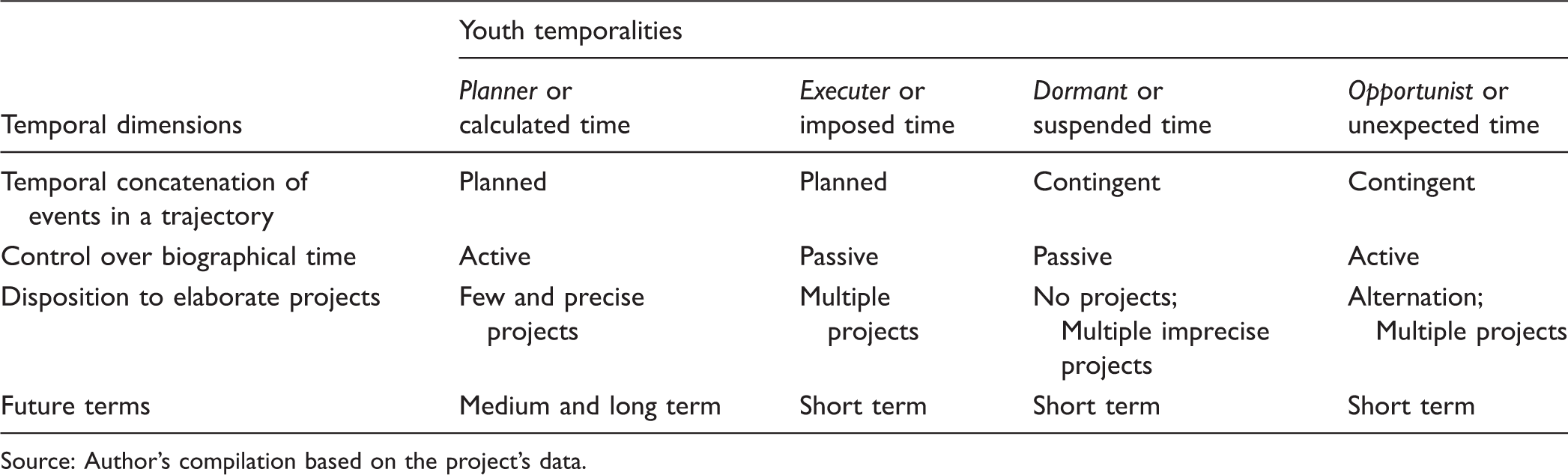
Temporal dimensions and youth temporalities.
Source: Author’s compilation based on the project’s data.
The first type of temporality is that of the planners. In this case, young people have a perception of their trajectory as something that has to be planned. When faced with unstable and uncertain social frames, they respond by planning and taking action. Their projections are short, medium and especially long-term. They follow the idea of having an agenda, of organizing a concatenation of events and sequences in order to attain their objectives. In this way, the subject controls and organizes the waiting period. Planners make decisions and avoid becoming dispersed in multiple objectives. Even if the short term is imposed on them by their surrounding temporal frames, these young people extend their temporal horizons beyond it and focus on the long term. Their projections are few but punctual, aiming at some form of training or precise profession. In the follow-up interviews of this panel, planners showed continuity and carried out their projects. We can say that their relationship to time was to calculate it. An example of this temporality was the young man named Sebastian, who had just graduated from a private general secondary school. During the first set of interviews, he only had two projects: to finish university (law) and work later as an attorney. “You need one or two projects, pursue them and your life really must turn around them.” He was sure of the advantages of planning: “I would like to finish university, then start working, after, have a home, get married, and have children.” He was optimistic about the labor market because he was sure of his success “In fact I think about the labor market rationally and calmly. I'll try to look for something that meets with my expectations.” In the second set of interviews, he was studying law and working for a telephone company at the same time to make money. This job was subordinate to his education. “The first thing I am thinking of doing is finishing university, this is my aim.” His agency was further reinforced by this comment: “I like the idea of making my own decisions, of being in charge of my own life.” During the third set, he had maintained his projects, interests and optimism, and defined his career as linear and unoriginal: “I think I am very straightforward, I’m not reckless. I'm normal … I try to have everything totally organized.” Long-term perception of time dominates: “It s an age when you start planning for the rest of your life, in the medium and long-term.” Sebastian’s life was organized so as to program and control his objective.
The second type of temporality corresponds to the executers. When faced with uncertain or unstable contexts, this group of young people adopts “imposed” careers from outside. They believe their paths are organized beyond their control; events and temporalities transcend them. Their careers seem predictable and programmed to them, either because they believe in destiny or because they believe that their past social origins condition their future. In either case, according to them their careers seem predetermined. Although they project themselves into different time-frames of the future, the short term is predominant. Instead of waiting, there is permanent action. Sometimes, they have extremely precise projects, at other times they have multiple imprecise projects. The latter is less important for this type of temporality given that a trajectory’s coherence is external and not only based on individual projections. An example of this temporality is a young girl named Cecilia. During the second set of interviews, she had not finished secondary school (public, technical) and had started working. She was working for a telemarketing company and was overwhelmed by the obligation to work even though her mother had advised her to continue her studies: “I cannot, unfortunately I cannot tell myself to stop working.” Despite her various educational and career projects (history teacher, hotel industry, events management, finishing secondary school …), she followed a short six-month training course in cookery, to help increase her confidence: “Why? First, to know that I can study, that I can graduate … and that I can construct a project.” Even if she was not sure of continuing with her projects, she said with a kind of conformist optimism that destiny controlled her career: “I think things have already been decided, you know? I mean, you’re born and things have already been decided and that’s why (…)I always thought, if you must die young, you die young, or if you need to finish high school, you have to follow the things that you should do, it's already written, this is fate. I strongly believe in destiny.” Executers seem to resign themselves to social time, which is beyond their control.
The third type of temporality is that of the dormants. They inhabit the short term and the urgent. This group of young adults regard time as contingent, yet simultaneously feel overwhelmed by events and social time. Their lives evade both planning and control. This group is heterogeneous and projections are disparate. On one hand, we observe young people who are not interested in elaborating projects and who consider themselves satisfied, established in some definite stage (worker, mother). On the other, we observe young people with multiple vague projects (work, education, leisure). They go in all directions unable to foresee the trajectory path they will follow, which is also unclear to the analyst. Although these two profiles seem to be opposite, they actually converge owing to the fact that having multiple imprecise projects is also a way of not carrying out any of them, revealing in both cases the inability to extend the temporal horizon. Dormants consider themselves incapable of making decisions in a world that is overwhelming, and are paralyzed by the possibilities and limits beyond their control. For example, Paola graduated from public general secondary school. Despite a confused present and imprecise future, she multiplied training projects during the first set of interviews: “I would like to study history, or psychology, and after I think I would like to become a nursery teacher … but I do not know what to do … I am afraid because I ‘m not sure of the course, but I know I have to study….” In addition, she suffered from her mother's expectations about a possible social promotion “I see education as an obligation. My mother told me that I have the opportunity to study and I must take it and not become a cleaner like her.” In the second set, Paola had abandoned all her projects. Her life had come to a turning point and everything that had happened to her seemed to belong to the order of the unexpected for her: she had a child; she had never worked and studied to become a teacher in primary school. In addition, she lived with her mother (who works as a maid) in her employer’s house. She was divided in her decisions and overwhelmed by her mother’s projects, who wanted her to finish her education; by the support of her mother’s employer, who helped her by babysitting for her child while she studied and also paid for a careers advisor; by her boyfriend’s proposal of living in Peru, and finally by her own personal projects as a mother, to do the best for her child. She said hesitantly, unsure of herself, “Sometimes I ‘m afraid of not being able to continue … yet I continue but I think … sometimes I wonder if it would have been better for me to start working. It would have helped me to become aware of what I like most.” Dormants live in a dormant time where temporalities are “suspended” in the present in the sense that they do not know how to navigate or prolong their situation beyond it.
The final type of temporality is that of opportunists. These young adults conceive the context they move in as contingent. Like the previous group, their careers contain multiple unexpected events but they differ in that they are active and consider themselves protagonists in their careers. They feel confident in their ability to face uncertainty, contingency, instability, and reversibility and they try to adapt and use these to their benefit. Their strategy vis-à-vis these temporal frames is to make multiple choices. They have multiple projects or rather they have multiple “guidelines” 7 and sometimes numerous skills and resources to navigate them. They do not project themselves far into the future, their discourse is short term and they prefer it that way. These are opportunists, for their strategy is to measure opportunities and assess what is convenient for them, to adapt themselves to the circumstances and remain open to change in their projects (imprecise or precise but changeable). They are very optimistic with regard to their individual future. Their notion of time is detached from the past and future but is constructed in such a way as to produce advantages from both. Nevertheless, this can be disconnected should either become an obstacle to any action undertaken. An example of this is young Santiago, who illustrates this temporality. As from the first set of interviews, Santiago was defined by movement and flexibility: “I'm always hyperactive, I will want to change, change jobs” and “I chose management because it is a very versatile profession.” He had clear guidelines for his life: to be attentive to the opportunities of context “the work situation is improving from day to day (…) I try to adapt myself et never complain (…)You never know when it will get better.” The short-term perception of time also dominates: “I have learned to live from one day to the next.” During the second set, he was both studying and working for a large multinational company. His passage through the university opened new doors and he took advantage of it. Furthermore, employment opportunities, training plans, and projects with his new French girlfriend opened up. He multiplied and diversified his projects “I have plan A, and plan B.” These projects overlapped with time but it was not a problem for this young person, whose strategy was “Darwinian”: “I'm a chaotic person because I am somebody who has to have a lot of projects. I have plans, I do things to achieve them all and then I see which one works better and therefore I pursue. It is as if I had a lot of options.” Personal and strong confidence was added to his quiet and optimistic attitude towards the future, and he showed himself to be sure and seemed to be in control of his life: “I am always trying to make more and more decisions.”
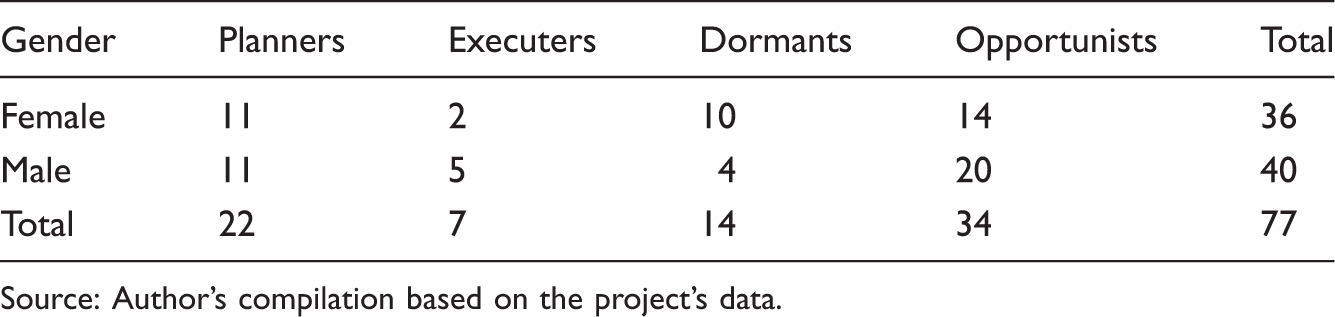
These combinations and temporalities are already an interesting first result. However, the plurality of time models was observed without affirming an undefinable multiplicity. There were in fact two dominant temporality models (planners and opportunists) and two minority models (executers and dormants).
Moreover, further analysis continued to link youth temporalities to careers. One way of testing this relation was to analyze youth temporalities and their work careers together. Indeed, we observed that opportunists showed longer and more mobile work careers. Meanwhile, planners tended to delay or resist entering the labor force; they either remained inactive for a period of time or began work while studying and then stabilized. We saw that dormants had careers with high turnover in precarious conditions or, inversely, they remained inactive or unemployed during the period of our study. The executers began work at an early age without questioning the possibility of ceasing to do so. Thus:
Planners delay and sometimes resist hasty insertion into the labor force; they will plan out every detail of their decision in terms of education and work. Careers combining work and education are less frequent and we find that education takes priority. Nevertheless, transition into the labor force, when it happens, follows a more traditional trajectory: further education and career development lead to increased specialization. They begin by taking jobs perceived as temporary, hoping to find a “real job” when they graduate. They are particularly interested in the advantages of employment stability. In an uncertain context, they tend to avoid risk even at the expense of loosing flexibility in how they manage their insertion. Executers are characterized by rapid insertion in informal and unstable jobs. These transitions into the labor force often take place at the expense of abandoning their studies. Careers of work and education are frequent and give preference to work. Most of the young people in this category dropped out of secondary education, although this does not mean that they will not finish later. However, the lack of diplomas will certainly block their trajectory development and accentuate some of the youth labor market characteristics experienced by most young people: unprotected work, schedule flexibility, high turnover among jobs that are already unstable. Multiple entries and exits from the labor market are common. Most of them follow the dominant rhythms and norms of labor market insertion: urgency, rapid insertion, and combination of work and study. Dormants have inactive careers or careers that shift continuously between formal employment and unemployment stemming from maternity leave, unexpected events, or career doubts. They either begin work at too early an age or delay their insertion. They frequently express doubts or fears towards their transition into the labor force or the implementation of projects. Breaks, interruptions of study or work, and unexpected events interfere in their decisions and stop them from carrying out their projects. Thus, work and study careers are less frequent given the long breaks in either work or education. The linguistic expression “it all depends …” is frequent among this group, as if numerous conditions were necessary to act. Opportunists take advantage of rapid insertion into the labor force; that is, they have the longest work history. They frequently follow a work and study trajectory, which enables them to increase their insertion, career, and specialization opportunities. This also helps them to expand their ability to change their personal situation if they want to. We observed two situations: either stability can be achieved quite rapidly or there is fluctuation between different jobs so as to increase resources such as knowledge, experience, and contact, even at the expense of taking often precarious jobs. Thus, the transition into employment is either abrupt or progressive. In the second case, the long professional experience acquired simultaneously to secondary education is followed by an easy combination of work and study, and the adjustment to one or the other depends on the possibilities.
There is then a relationship between the way in which young people approach the working world and their temporalities. This is not necessarily a causal relationship, as we might expect from a causal analysis. Youth temporalities are themselves a product of a social position, shaped by biographical careers and thus socially constructed.
Gender distribution through youth temporalities in the study.
Source: Author’s compilation based on the project’s data.
Educational pathway distribution through youth temporalities in the study.

Source: Author’s compilation based on the project’s data.
Discussion and conclusion
In this article, we have revealed multiple elements involved in four types of youth temporalities. First, each temporality is composed of different aspects that must be disaggregated: four key dimensions emerged in our analysis. Nevertheless, these dimensions alone are not enough and so must be combined to grasp the complexity of youth temporalities. For example, awareness of the instability of a given context can generate advantages for active young people’s careers (adaptability), while it may paralyze passive young people. For the latter group, visualizing a trajectory as something that must be planned can impede them from doing what they want to: some may feel subjected to following a traditional career sequence (entering the work force after completing ones’ studies), while others may propel themselves into the labor force although under unfavorable working conditions (work schedules reducing the time needed for studies; abandoning studies for work).
Our typology of youth temporalities also offers a new opening to the debates on young people’s futures in Argentina (Corica, 2012) or debates arguing that young people in Latin-America are project-less prisoners of presentism or that they unavoidably subject themselves to uncertain contexts (Perez Islas, 2008). We have seen that responses to uncertain and unstable frameworks are variable: some escape them by seeking stability; some get carried away by them; others are paralyzed and remain in a dormant stage; still others use them to advance their careers. Temporal forms highlight not only young people’s biographical diversity but also social, educational and work segmentation observed in Argentine (Miranda, 2007).
Moreover, each temporal dimension questions or confirms some thesis in sociological debates. The “temporal concatenation of careers” reveals that even if uncertainty is a sign of our times, not all young people experience it in the same way in their individual careers (Leccardi, 2005). The “control over biographical time” points to the existence of inequalities: not all individuals have the same resources to face social temporalities (Bauman, 2003). Young protagonists and spectators mobilize the greatest or most meagre resources they have to face uncertainty or instability in the short or long-term.
“Dispositions to elaborate projects” reveal that young people are not consumed by presentism, instantaneity, and urgency (Hartog, 2003). On the contrary, they elaborate plans for each sphere of their lives and they do it in multiple ways: with more or less realism, precision, force, and likelihood of success. The future has not yet arrived. It is there waiting to be defined, to be carved into reality. Finally, “future terms” show that the short-term is not the only temporal horizon for young people, as other authors have suggested (Boivin et al., 2008). Although urgency does exist in some youth contexts, it does not engulf the way in which young people project themselves from short- to long-term work insertion, education or family projects.
In sum, we developed a typology to adequately capture the variation we found in youth temporalities: planners, executers, dormants, and opportunists. Despite relative stability, these types are dynamic, not fixed, and young people may change over time, through life or professional experiences. Therefore, not only historical time varies, but also individual experiences of social time changes over time. The evolution of youth temporalities could be a subject for a new paper.
Youth temporalities help us to visualize simultaneously both dominant temporal frameworks and the various ways in which they are experienced by subjects. They enable us to analyze the social time dominating youth labor insertion in Argentina: early insertion, massive trend to enter the labor market upon completion of studies, combining work and studies, and a high turnover and rotation of work linked to occupational instability, among others. Moreover, they offer an insight into the ways in which time is articulated with individual temporalities: delayed insertion, early insertion, reversibility from employment to unemployment, the gradual passage through temporary jobs, and rapid or slow progression to stability. Like others, temporal forms are therefore essential to our understanding of shifts in the working sphere (Carrasco and Andreu Recio, 2001; Harsløf, 2007; Leccardi and Rampazi, 1993; Pronovost, 2000; Abbott, 2001). The articulation of temporal frameworks and labor practices among young people in our study ultimately revealed that youth temporalities constitute a key entry point to our understanding of work trajectory variation among young adults.
Young people in the study: distribution by educational pathways and social class. Source: Author’s compilation based on the project’s data.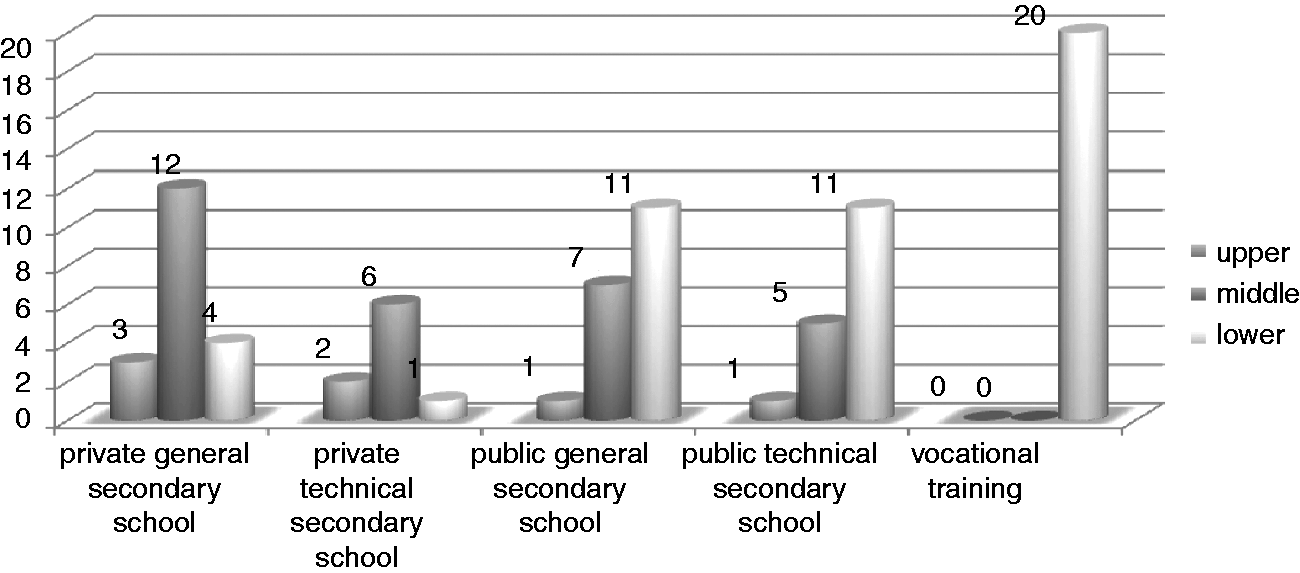
Footnotes
Declaration of Conflicting Interests
The author(s) declared no potential conflicts of interest with respect to the research, authorship, and/or publication of this article.
Funding
The author(s) received no financial support for the research, authorship, and/or publication of this article.