



Abstract
Prior research on time issues has demonstrated that the value of time is subjective and shows that different evaluations of time (as a valuable or as an undefined resource) correspond to different attitudes, behaviors, and emotions. Based on recent research on the relationship between time and motion, the present research aimed to investigate the relationship between locomotion orientation (i.e., proclivity toward movement and change) and the evaluation of time as a resource. Two studies were conducted with 313 (244 students and 69 workers) and 139 (students) Italian participants, respectively. In the first study, The Locomotion Regulatory Mode Scale and the Mental Account Scale (Time version) were administered, while in the second study, participants were presented with two scenarios of a transaction where prior investments of time led to negative outcomes. The results of the two studies confirmed the hypotheses that (1) locomotion orientation is associated with the existence of a mental accounting process for time investments and (2) locomotion orientation is associated with greater disappointment from negative consequences of poor time expenditures. Theoretical and practical implications are discussed.
Introduction
At least once in a lifetime, one will be impatient or feel frustration thinking about meaningless activity: people do not like to waste time because they consider it as a resource. As a resource, time is a medium essential for the attainment of things; it can be considered our most valuable possession, although quantifiable and measurable, it can be effectively used or wasted (Kruglanski et al., 2015).
A popular quote by Benjamin Franklin states: “Time is Money”; time is very precious because of its limited nature (i.e., everyone has the same amount of time in a day), and it is non-fungibility (i.e., gains and losses of time cannot easily be transferred or exchanged; Leclerc et al., 1995). However, the evaluation of time changes across situations and is subjective (i.e., it is associated with individual differences). Prior research on time evaluation has mainly focused on conditions under which people are sensitive to the value of time (e.g., equating monetary value with time; DeVoe and Pfeffer, 2007b) as well as on the role that hourly wage payment plays as a major antecedent of individual-level differences in the evaluation of time and in the reactions to events that take time (e.g., DeVoe and House, 2012).
However, to our knowledge, individual differences, related to personality traits or other chronic dispositions, that may explain differences in perception of the value of time have been relatively understudied.
Evaluation of time affects individuals’ behavior (e.g., they are less likely to engage in tasks that do not produce monetary gain), organizational outcomes, and emotional aspects (e.g., they are less likely to experience happiness and more likely to experience impatience when time has been perceived to be wasted; DeVoe and House, 2012; DeVoe and Pfeffer, 2007b, 2009). Therefore, it is imperative to enrich the knowledge of antecedents of the view of time as a resource. The present studies are based on previous research on the association between locomotion orientation and temporality; this previous research argued that individuals with a locomotion orientation are more likely to view time as a quantifiable resource (Kruglanski et al., 2015). Since locomotion orientation is the proclivity to move into novel physical and/or psychological states, then locomotors are motivated to have and deploy psychological and material (e.g., time) resources in order to efficiently progress towards new states.
The intrinsic motivation to movement (Kruglanski et al., 2000; Pierro et al., 2006) leads locomotors to maximize their efforts in order to attain their principal goal: to maintain movement. Speed (i.e., to be faster on the tasks), speed potential (i.e., choose goals that have high probability to be quickly attainable), promptness (i.e., to be more prompt in task initiation), time management (i.e., utmost utilization of available time in maximal activity), and multitasking/polychronic behavior (i.e., performing multiple tasks simultaneously) are all time-related behaviors that locomotors use as means to reach their “keep moving” goal, in order that they may quickly reach new states. At the same time, these time-related behaviors are associated with viewing time as a resource that should not be wasted.
We argue that locomotors’ concern for movement and their consequent evaluation of time as a limited and precious resource, already postulated in the literature (Kruglanski et al., 2015), have not just behavioral consequences but also cognitive and emotional consequences. Specifically, we suggest that two time-related phenomena (i.e., mental accounting of time and disappointment with wasting time), which have been shown to be affected by the evaluation of time (Okada and Hoch, 2004; Soman, 2001), should be more likely to occur among people with a high (vs. low) locomotion orientation.
In the following section, we present previous research on the consequences of considering time as a valuable resource and on the relationship between locomotion and issues related to time. We then present our hypotheses in more detail and report two empirical studies that test these hypotheses.
“Budgeting time”: Is time a limited resource?
Several studies have shown that people treat time as a limited resource under certain situations, and that this evaluation affects numerous aspects of human functioning (e.g., cognitive, behavioral, and emotional). The value of time is salient when it is perceived to be scarce (e.g., when they have a close deadline to meet and are still far from completion); under conditions of scarcity, time has a priceless value (De Serpa, 1971; DeVoe and Pfeffer, 2011; Jacoby et al., 1976). In turn, scarcity of time is consequential for numerous outcomes. For example, perceived time scarcity is associated with perceived time pressure (DeVoe and Pfeffer, 2011; Robinson, 1990). The amount of time devoted to a task increases as the value of time increases (i.e., as the deadline approaches); consequentially, procrastination behaviors decrease (Fischer, 2001).
Another behavioral consequence of thinking about time as a resource in time pressure situations (i.e., considering the opportunity cost of delaying decision) concerns decision-making strategies and time use: people decide to be less accurate but faster in their tasks (Payne et al., 1996). Also, the perceived scarcity of time results in the implementation of numerous time-saving techniques and devices, in order to manage time as efficiently as possible (Hessing, 1994; Nickols and Fox, 1983) as well as an increased multitasking (Godbey et al., 1998; Kaufman-Scarborough and Lindquist, 1999).
With regard to the cognitive aspects, recent research has shown that people treat time as a resource by budgeting time (i.e., creating mental accounts of time expenditures), in order to check the appropriateness of time allocations and to balance time budgets in their assignment of activities (e.g., work vs. non-work activities) (Navarro and Fantino, 2009; Rajagopal and Rha, 2009). It is important to note that the mental accounting of past time investments is not always an immediate process and that some individuals lack the proclivity to account for time, unless they receive specific instruction about economic approaches to time (e.g., by associating time with another resource, such as money; Soman, 2001). However, it seems plausible that some people could be more able than others to account for time investments. Nevertheless, this possibility has not yet been investigated. The evaluation of time as a valuable resource is also associated with important emotional consequences: when people think about time as a resource, they are more likely to become impatient (DeVoe and Pfeffer, 2011; Durrande-Moreau and Usunier, 1999), frustrated in the face of delays, and to feel less happy during non-paid leisure time (DeVoe and House, 2012). In this sense, it is reasonable that people who treat time as a precious resource will be more disappointed with wasting time, and they should experience greater negative feelings in response to poor time expenditures.
Locomotion and time as a valuable resource
Locomotion “constitutes the aspect of self-regulation concerned with movement from state to state and with committing the psychological resources that will initiate and maintain goal-related movement in a straightforward and direct manner, without undue distractions or delays” (Kruglanski et al., 2000: 794). Locomotion can operate chronically as a stable individual difference characteristic (Higgins et al., 2003), and it can also be a function of situational factors (Avnet and Higgins, 2003; Higgins et al., 2003). Individuals high on locomotion could be defined as “persons of action” or “doers,” because of their tendency to commit to action without waiting, their persistence in pursuit of a goal in the face of distraction, and their effort in performing a task until its completion (Kruglanski et al., 2000).
This orientation is moderately correlated to, but cannot be encapsulated within, other constructs that have been shown to be related with time-related behaviors. For instance, locomotion is correlated with conscientiousness (e.g., Pierro et al., 2006), in that locomotors – as people with high conscientiousness – are concerned with preference for organization, persistence, and ability to work hard (Barrick and Mount, 1991; Kruglanski et al., 2000). However, within a general personality architecture (Cervone, 2004), locomotion belongs to the category of self-regulatory systems identified by Mischel (1973), focusing on how the action is regulated toward goal pursuit. Locomotion consists in carrying out acts believed to promote rapid advancement toward goal attainment (i.e., moving and switching from state to state), regardless to the value of the goal (Kruglanski et al., 2000, 2009) and external cues of motivation (Pierro et al., 2006). Differently, conscientiousness is linked to the outcome of action and is positively correlated with extrinsic motivation (Pierro et al., 2006). Conscientiousness constitutes a broad personality dimension that relies on achievement motivation (i.e., concern with a standard of excellence) and dependability (e.g., Dunt, Mount, Barrick, & Ones, 1995).
Similarly, the tendency of locomotors to “rush forward” is positively correlated with present and future time orientations, rather than with a past orientation (Amato et al., 2014a). At the same time, locomotion, present, and future time orientations are distinct concepts because locomotion highlights a motivational concern with managing the process of movement (Kruglanski et al., 2015) whereas the preference for a time perspective has a cognitive nature (i.e., they emerge from cognitive processes and, if overemphasized, can became a cognitive temporal bias) (Zimbardo and Boyd, 1999).
With regard to the association of locomotion with constructs related to time, it is interesting to note that Mannetti et al. (2009) have shown locomotion to be associated with less far-sighted inter-temporal choices; locomotors prefer early rewards rather than increased, but delayed, rewards. On the contrary, both conscientiousness and future orientation have been shown to be associated with greater patience in the financial discounting task (Daly et al., 2009). 1
The last decade of research has shown an intimate relationship between locomotion and action (i.e., movement and progress from one state to another) (Higgins et al., 2003; Kruglanski et al., 2000, 2013; Pierro et al., 2011). Because action requires investment of time and locomotors are individuals predominantly oriented toward action, people with a high locomotion orientation are more preoccupied with time and with spending it efficiently, in order to move into as many new states as possible. This could be a signal that time is a limited and important resource for locomotors (see, Kruglanski et al., 2015, Postulates 1–4). The assumption that locomotors are aware that time is a limited resource, and that they are motivated to efficiently manage their time, has support from a considerable body of evidence. In one such study (Amato et al., 2014b), it was found that individuals’ use of time management strategies – in order to perceive a sense of control over their time – increased with their locomotion orientation. This can lead locomotors to avoid procrastination (Pierro et al., 2011) as well as to engage in multitasking (Pierro et al., 2013). Interestingly, locomotors, like individuals who perceive time as a precious resource, are prone to faster-paced in pursuing their goals, to the extent that they are faster and less accurate in their activity (Mauro et al., 2009; Pierro et al., 2012). Therefore, past research on locomotion and time-related behavior reveals that individuals with a high locomotion orientation treat time as a scarce resource that should be used as efficiently as possible. In addition, some individual difference variables that are positively associated with locomotion are also associated with the evaluation of time as a valuable resource. For example, locomotion orientation was found to be correlated with the Type-A personality, which includes impatience and a sense of time pressure (Kruglanski et al., 2000). At the same time, time pressure and impatient behavior, as noted earlier, are positively associated with the perceived scarcity and value of time (DeVoe and Pfeffer, 2011; Durrande-Moreau and Usunier, 1999).
In light of the above, it is plausible that a high (vs. low) locomotion orientation would be associated with an increased likelihood to perceive time as a quantifiable and valuable resource.
The present research
As mentioned previously, the present research aimed to investigate the relationship between dispositional locomotion orientation and the evaluation of time as a resource. We posited that the two time-related phenomena, the absence of which had previously evidenced individuals’ general tendency to ambiguously evaluate time, could also evidence the tendency of locomotors to perceive time as a valuable resource. Specifically, Soman (2001) used the measure of mental accounting of time costs to suggest that people are insensitive to the time investments in retrospective evaluations, because of their perception of time. Then, we supposed that locomotors’ perception of time as a valuable resource should emerge as a high tendency to mentally account for past time investment.
Okada and Hoch (2004) demonstrated that ex post accommodation with negative outcomes of a previously poor time investment is a good indicator of peoples’ lack of ability to assess the opportunity costs of time, given by the ambiguous nature of time. Then, we supposed that locomotors’ perception of time as a valuable resource leads them to be more conscious of opportunity cost of time.
Based on the above logic, we hypothesized that locomotors tend to “budget” investments of their time, and that they take it into account when deciding upon a course of action (Hypothesis 1). Also, we hypothesized that locomotors should be disappointed (i.e., experience greater negative feelings) when they do not effectively use their time (Hypothesis 2).
In order to test these hypotheses, two studies were conducted.
Study 1: Mental accounting of time investments
The purpose of Study 1 was to investigate whether locomotion orientation is positively associated with a greater tendency to track and record past time expenditures. Individuals with high (vs. low) locomotion should be particularly able to keep a mental account of their time investments. This basic prediction has been tested in the study described below.
Method
Participants
Participants of the study were from two different samples: one of undergraduate students and other of workers. We used these two different samples in order to test if our hypothesis on the relationship between locomotion and value of time as resource yields valid results both outside (in the case of students) and within (in the case of workers) the workplace (i.e., where usually losing time is also losing money).
The number of participants was determined in advance on the bases of previous studies on evaluation of time in which the samples were constituted by about 250 students and 60 workers (e.g., Pfeffer and Devoe, 2009).
A total of 244 students from the Department of Psychology at the University of Rome (134 women and 110 men) and 69 workers in Rome (34 women and 35 men) participated in the study on a voluntary basis according to a convenience sampling method. The mean age was 22.81 years (SD = 2.59) and 37.09 (SD = 8.43) in the student and worker sample, respectively. Most of the worker respondents were single (58%); 41% were university graduates. Of participants from the worker sample, 52.2% were freelancers, 42% worked in organizations in non-managerial positions (henceforth “non-managers”), and 5.8% were managers; the most common annual income ranged from 15,000 to 28,000 Euros (37.7%). Employed participants (75.8%) had an hourly wage (15.6%) or a monthly wage (84.4%). The rest of workers (24.2%) had neither an hourly nor a monthly wage: 9.1% were paid for each unit produced or action performed regardless of time (e.g., piecework), 9% were paid on commission (i.e., they were paid on the basis of a percentage of the goods sold), and 6.1% were paid by profit sharing (i.e., they were paid with a company component as well as with a share of the firm’s global net income).
Participants were presented with the following questionnaires. 2
Procedure and instruments
The interviewer explained that the purpose of the study was to investigate individual differences in the experience of time investments and explained the procedure. Participants were then asked to complete the Locomotion Scale, developed by Kruglanski et al. (2000), and the Mental Accounting Scale (Time version) (MAS-T), developed by Soman (2001). The Locomotion Scale is a 12-item instrument designed to measure individual differences in the tendency toward locomotion. The scale requires respondents to rate, on a six-point Likert scale ranging from 1 (Strongly disagree) to 6 (Strongly agree), the extent to which they agree with statements reflecting their proclivity toward movement from state to state (e.g., “I’m a doer”; “When I decide to do something, I can’t wait to get started”). We computed a composite score based on the average response across all completed items. Previous studies (Kruglanski et al., 2000) have demonstrated that this scale has satisfactory reliability (α = .80 in the American sample; α = .73 in the Italian sample). In the present samples, Cronbach’s alpha was .82 and .77 in student and worker sample, respectively.
The MAS-T aims to assess the perception of time by measuring evaluations of time expenditures. The MAS-T is an eight-item self-report measures in which respondents rate their endorsement on a nine-point scale ranging from 1 (Strongly Disagree) to 9 (Strongly Agree) on a number of different statements associated with time costs (e.g., “If I have wasted time on a particular activity or item, I try to save it on another activity or item”; “I try to keep track of past expanses of time”). This scale has shown good reliability (α = .82) in previous studies (DeVoe and Pfeffer, 2007b). In the present samples, the scale exhibited good reliability in both the student (α = .80) and worker (α = .88) samples.
The scales went through a translation and back-translation procedure between English and Italian.
Participants also responded to the questions on sociodemographic variables, such as age and sex (student and worker samples), marital status, education, occupation (employee, non-manager, or manager), and annual income (worker sample). Workers also indicated their salary (piecework, commission, or profit sharing) and if they were paid by the hour. Previous studies revealed that these variables could influence perception of time (DeVoe and Pfeffer, 2007b, 2011; Folbre and Bittman, 2004; Hamermesh and Lee, 2007; Pfeffer and DeVoe, 2012; Stalker, 2014).
Results
Descriptive and correlations between variables, study 1.
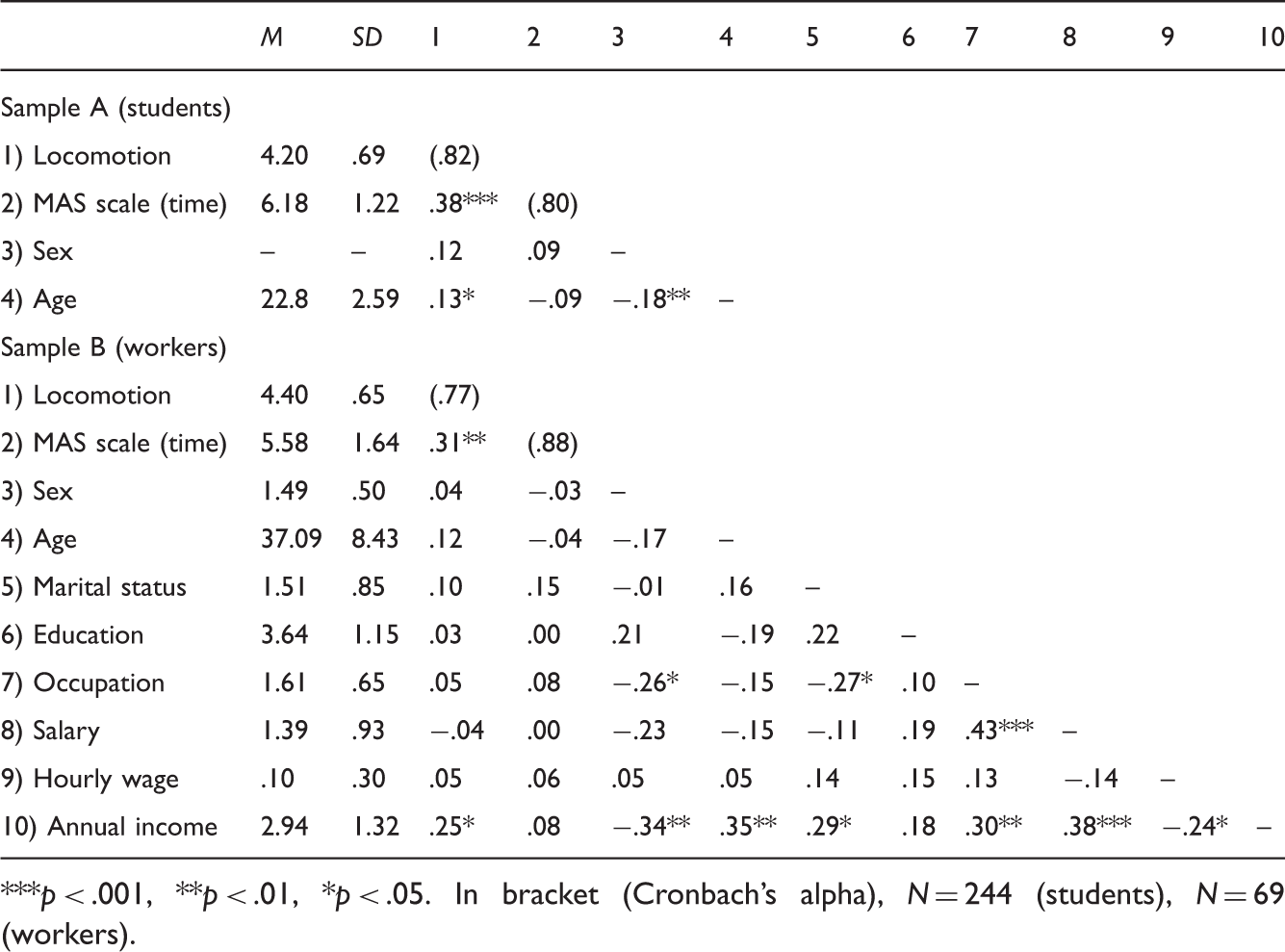
p < .001, **p < .01, *p < .05. In bracket (Cronbach’s alpha), N = 244 (students), N = 69 (workers).
Regression model with Mental Account for time investments regressed on locomotion (controlling for sex, age, marital status, education, occupation, salary, hourly wage, annual income).
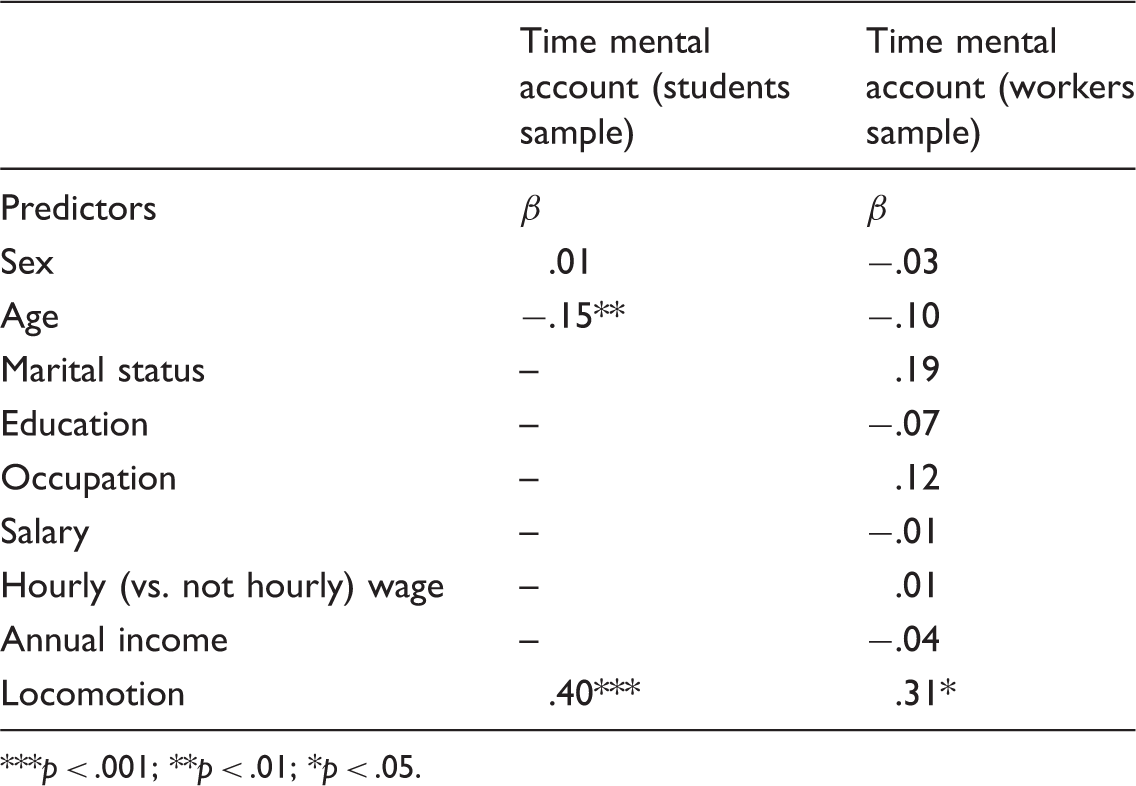
p < .001; **p < .01; *p < .05.
Study 2: Emotional reaction to poor time investment
The aim of Study 2 was to further address the evaluation of time as a resource by testing the prediction that individuals with high (vs. low) locomotion orientation feel more negative emotions when they are faced with negative consequences of prior time investments. The purpose of this study was to test if the opportunity cost of time is particularly important for locomotors. Specifically, participants were presented with two scenarios where they have already consumed a product that they had previously acquired through the expenditure of time. After each scenario was described in a very unfavorable way, participants were asked to rate their level of negative feelings about their poor time investment. We expected that if individuals with high (vs. low) locomotion orientation have a bad experience with the product they bought with their time investment, then they should experience greater negative feelings because of their evaluation of time as a valuable and precious resource. Since Study 1 showed no differences between students and workers samples, we conducted the second study with a student sample, controlling for their employment status (employment vs. unemployment).
Method
Participants
A total of 139 undergraduate students of the University of Rome (74 women and 65 men) participated in the study on a voluntary basis. Their mean age was 22.11 years (SD = 2.66). Of the students interviewed, 21.6% were also employed; of these, 33.3% were employees and 66.7% were freelancers. Regarding salary, 60.7% had hourly remuneration, 17.9% had monthly remuneration, and 14.3% received piecework payment; 7.1% of respondents did not specify the kind of salary they received.
Procedure and instruments
The interviewer explained that the purpose of the study was to investigate individual differences in the experiences of everyday life situations. They were told that the duration of the experiment was 20 minutes; they were also specified that they had unlimited time to complete the study. Then, all respondents were administered a questionnaire including the same Locomotion Scale used in Study 1. In this sample, the Cronbach’s alpha for the Locomotion Scale was .72. Finally, participants were presented scenarios developed by Okada and Hoch (2004). In those scenarios, the participants were instructed to imagine that they had already consumed two products (a dinner for two and a pair of athletic shoes) previously acquired through the expenditure of their time (4 hours of their work).
The experiences depicted in the scenarios were described in a very unfavorable way. The example of a negative outcome appears below: [Negative outcome for the restaurant scenario] “When you arrived at the restaurant for dinner, you right away disliked the ambiance. The table where you were seated was tight and right next to the noisy service station. The service was very slow and rude, and the food was horrific, the worst you’ve had in a long time. Your friend and you had an awful time. You would definitely never go back there again and would discourage any family or friend from ever going there.”
The Cronbach’s alpha was of .84 for reactions towards poor time expenditures. Finally, participants responded to sociodemographic questions: age, sex, employment status (employment vs. unemployment), and salary (hourly remuneration, monthly remuneration, or piecework payment). 4
Results
Preliminary analysis
A 2 × 2 analysis of variance was performed to ensure that the presentation order of the two scenarios did not reflect effects on the dependent variable (negative feelings associated with poor time investments). The results revealed that the effect of presentation order was not significant (F(1,137) = 1.928, p = .167). Participants presented at first with “athletic shoes” scenario (M = 5.76) rating similar to participants presented at first with the “restaurant” scenario (M = 5.97) in consequent negative feelings.
Main analyses
Descriptives and correlations between variables (Study 2).
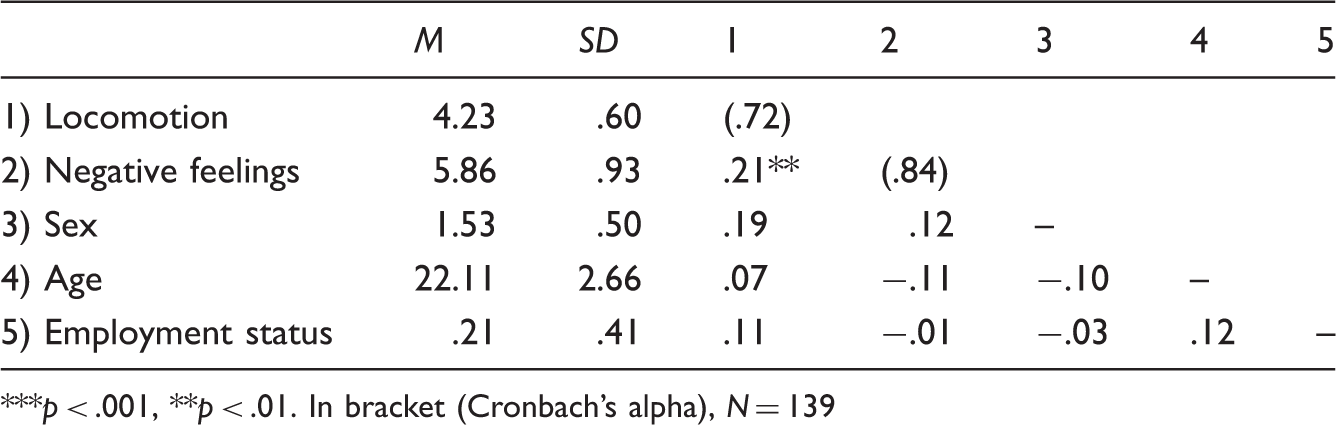
p < .001, **p < .01. In bracket (Cronbach’s alpha), N = 139
Regression model with emotional reaction to poor time investments regressed on locomotion (controlling for sex, age, employment status, occupations, salary).

p ≤ .01.
Discussion
Our findings confirm that locomotion orientation is positively associated with a perception of time as a valuable and limited resource. For people with a strong locomotion orientation time matters: it is a necessary resource to move from one state to another. Given the high value they place on time, locomotors tend to have a mental “budget” of their time and they tend to attempt to recover past “investments” of time. If a previous investment of time has a negative outcome, and if they cannot recover the lost time, they are more likely to be particularly frustrated. As such, the present findings provide us with new evidence of the intimate relationship between time and motion. Additionally, this pattern of results emphasizes the importance of individual differences in studying subjective experience of time as a resource.
The literature on the psychological aspects of time issue has been mainly focused on the flow aspect of time (e.g., studying individual differences in the temporal orientation towards past, present or future; e.g., Zimbardo and Boyd, 1999). Past research has relatively under investigated time as a resource but instead have focused on comparisons between time and money (Abdellaoui and Kemel, 2014; Leclerc et al., 1995; Okada and Hoch, 2004; Pearson, 2009; Saini and Monga, 2008; Soman, 2001; Zauberman and Lynch, 2005) and on the economic evaluation of time (i.e., putting a price on time units) (Pfeffer and DeVoe, 2012). Although these studies can help understand how to increase the value of time, and how it is possible to manipulate perception of time as a resource, they do not offer many insights into how time could be particularly salient for some people more so than others.
We hypothesized, and found, that locomotors – who have an intrinsic motivation to be active (Pierro et al., 2006) and to achieve goals in a straightforward manner – budget their time investments attempting to recover lost expenses. When they lose their time beyond repair, they experience negative feelings (i.e., they feel disappointed, unhappy, and irritated) more than people with a low locomotion orientation.
There could be three potential explanations for our results. First, high (vs. low) locomotors – as a result of their disposition towards locomotion – are more likely to perceive time as invaluable. This explanation was foreshadowed by the research of Soman and Shi (2003), who found that individuals who were primed with the concept of locomotion (i.e., were presented with several alternatives for moving from one state to another) tended to perceive time as a salient feature (i.e., they preferred alternatives which had the least idle time).
Second, locomotors want to use time resources as efficiently as possible. In light of this, wasted time represents very high opportunity costs for locomotors, who might otherwise use time more efficiently. This explanation is consistent with studies on locomotion and multitasking (Pierro et al., 2013) and time management (Amato et al., 2014a). These studies showed that locomotors want to use time resources as efficiently as possible. This is also consistent with research on locomotors’ intolerance of delay (Kruglanski et al., 2000) as well as with previous findings on locomotors’ alertness towards opportunities (Amato et al., 2016). In this sense, wasting time could mean wasting a potential opportunity. This is reflected in research by Payne et al. (1996), who concluded that “delay can result in lost opportunities” (p. 131).
However, another important alternative explanation for the relationship between locomotion orientation and experience of negative feelings in front of time losses still remains. Since the results of the present studies suggest that locomotors perceive that the opportunity costs of time are particularly important, it is possible that they could be less prone to use accommodation (i.e., adjust the value of temporal expenditures to whatever is the realized outcome) and rationalization (i.e., lower value of time in order to increase level of satisfaction with received outcome, for example, by thinking “It cost me no money, just time”) strategies studied by Okada and Hoch (2004). The accommodation and rationalization strategies were found to be associated with perceiving the value of time as ambiguous and were habitually used by people to cope with poor investments of time.
Future research should investigate the mechanisms underlying the positive relationship between locomotion and the evaluation of time as a resource. For example, it could be particularly interesting to explore the possible moderating roles of accommodation and rationalization, or the opportunity costs of wasted time for locomotors. Other relationships, like the potential mediating role of time pressure, could also be tested.
Since the locomotion orientation can be situationally induced (Avnet and Higgins, 2003), it is important to mention that the present positive relationship between locomotion and the evaluation of time as a resource could lead to potentially useful applications in organizational settings. Of course, as Mohammed and Harrison (2013) suggest, how members think about, and value, time can profoundly influence performance, either positively or negatively. In particular, it could be beneficial to understand the circumstances under which employers act like locomotors, as this could improve the time and motion dynamic of the workplace. This dynamic has been studied since the advent of scientific management. Like locomotion orientation, the time and motion dynamic is associated with efficiency in the use of time.
Though the present results are consistent with the literature and offer interesting insights, the studies conducted here have some limitations. These studies rely on correlational data that limits the use of causal inferences to describe the relationship between locomotion and perception of time as resource. Future research should clarify these causal links by manipulating participants’ locomotion orientation in a laboratory setting. This study investigated one aspect of individuals’ perception of time as valuable resource; future studies could observe other related behaviors in everyday life (e.g., investigating if people are willing to pay for a time-saving service).
Moreover, the present study focused on positive effects of thinking about time as a resource. Further studies, basing on recent findings, which suggest that the evaluation of time as a resource is not always desirable (e.g., thinking about time as precious decreases environmental and prosocial behaviors; DeVoe and Pfeffer, 2010; Pfeffer and DeVoe, 2009; Whillans and Dunn, 2015) might can consider negative outcomes of the relationship between locomotion and the view of time as a limited resource. Also, measures were not counterbalanced in our studies; perhaps, future researches could present measures in different order to participants to limit the potential influence of the order effect.
Finally, future contributions can attempt to extend our findings to other material resources than time (e.g., money). For instance, previous research suggests that people who value time as a resource do an equivalence between time and money (DeVoe and Pfeffer, 2007b). In this vein, it is possible that locomotors value time and money equally important. Nevertheless, it could be also possible that in some situations, locomotors value time more than money (e.g., near to a deadline they could be willing to pay someone to help them in order to finish a task in-time and quickly “go on” on an other one). Investigating these hypotheses could be interesting; on one hand in order to clarify the relationship between locomotion and the other potential means to reach goal of movement, and on the other hand to specify to what extent time (vs. money) is important among locomotors.
Footnotes
Declaration of Conflicting Interests
The author(s) declared no potential conflicts of interest with respect to the research, authorship, and/or publication of this article.
Funding
The author(s) received no financial support for the research, authorship, and/or publication of this article.