




Abstract
China’s economic and political reforms since 1978 represent one of the biggest institutional changes in the last century. Because most research has focused on the economics of institutional change rather than the evolution of political institutions, a theoretical framework to explain China’s rapid economic development is lacking. To understand the successes and failures of China’s institutional change, we reviewed China’s innovative political and economic practices during the past 30 years. We found that the country’s political and economic institutions combine to form a dynamic equilibrium that can explain the impressive economic results. China’s leaders dream of new institutions that will improve upon traditional Western capitalism, based on a combination of central planning with traditional capitalist approaches that increase the system’s flexibility. If China’s leaders can combine this approach with decreased social costs compared with previous socioeconomic systems, this will represent a new era and a model that other nations can follow.
Keywords
Introduction
Since the late 1970s, China has undergone a fundamental transformation from a centrally planned economy based on public ownership of all capital to a market-oriented, increasingly private-sector economy (Lin, 2002). This has led to China’s “economic miracle,” in which economic growth rates averaging close to 10% per year have been maintained despite serious obstacles such as foreign sanctions after the 1989 Tiananmen affair, the death of Deng Xiaoping in 1997, the 1997 Asian financial crisis, and the 2003 severe acute respiratory syndrome outbreak (Whyte, 2009; Zhang, 2006). China has even avoided the most serious impacts of the Western financial crisis that began in 2008. This phenomenon is puzzling to many people because it is difficult to explain based on mainstream Western economic theory (Zhao, 2006). This raises the question of how to explain China’s dramatic turnaround and spectacular economic success.
Despite what the West sees as a lack of change, China has implemented major political reforms since 1978. These reforms have focused on measures to encourage rapid economic development, but not via the democratization that is believed by Western economists to be the best way to achieve this goal (Zhang, 2006). China is functioning as a laboratory—the largest in human history—in which economic, social, and political change are being tested, and the success of the Chinese experiment will depend greatly on whether the country’s political institutions can adapt sufficiently rapidly to preserve the rapid growth. China is a particularly interesting case because it is more likely to draw on, not copy, the Western experience. The resulting institutional change will not be a transition from socialism to capitalism, but rather an evolution from an “imperial” and hierarchical structure to an innovative approach that combines the benefits of central planning with a market economy that allows considerable independence at a local scale.
“Evolution” has been proposed to operate on socioeconomic systems, not just on natural systems, based on the hypothesis that competition will eliminate inferior institutions and allow only the “fittest” solutions (those that can best solve human problems) to survive (Hou and Hou, 2002). In the present paper, we will review several strands of past research on China and its socioeconomic development, examine key features of China’s approach during the post-1978 period, and provide insights into how economic development interacts with the evolution of political institutions to achieve a dynamic equilibrium. The Chinese case indicates that viewing economic guidance as the dichotomy of being provided by markets versus by governments can be highly misleading, given that these two institutions are tightly linked and cannot realistically be considered in isolation. China’s political and economic coevolution will, if it can reduce the human costs compared to previous institutional changes, represent a new era in which the balance between these two institutions creates a new and innovative model for other developing nations.
Fostering economic development through political evolution
China’s institutional changes since 1978.

Agriculture was one of the first sectors (in December 1978) for which substantial reforms were implemented (Lin, 2002). This focused on abolition of the commune system as part of Deng’s successful program of rural reform, which freed millions of Chinese peasants from the formerly rigid system of political, economic, and administrative control that had impoverished them for decades (Zhang, 2006). Farming households, which accounted for 82% of the population at the time, were given rights to the formerly collectively owned land under long-term leases, along with the right to sell their surplus produce on the open market (Ding and Knight, 2009). This incentive rapidly increased agricultural productivity and output (Zheng et al., 2009). This and other reforms gave the average Chinese citizen far more freedom of choice than at any time since 1949. Individuals gained the right to make their own choices of jobs, housing, school, marriage, and leisure, and to move freely within the country or even travel abroad if they could afford to do so (Zhang, 2006).
Simultaneously with the rural reforms, several key political reforms were implemented. In 1979, the cities of Shenzhen, Zhuhai, Xiamen, and Shantou were chosen to test an institutional change towards market economics. The success of these initiatives led to adoption of similar approaches elsewhere in China. In 1981 and 1982, respectively, China’s leaders offered Taiwan and Hong Kong a measure of self-determination, as a form of decentralized local democracy, in return for rejoining China. (Taiwan did not accept this offer.) Similarly, in 1983, Hainan Island was given a measure of self-determination to test an institutional change towards market economics. In 1993, a decentralization initiative based on fiscal reforms gave local governments more power to collect taxes and plan regional development, but reminded them that the central government still called the shots and could rewrite the rules in its own favor. In 1997 and 1999, respectively, Hong Kong and Macao were returned to China, but retained some of their powers of self-determination. In effect, China has surprisingly developed a form of market-preserving federalism.
Considerable economic policymaking powers were delegated to local authorities. For example, local governments gained the right to approve investments and the entry of enterprises into markets, collect tax revenues, and manage public expenditures. Local governments now deliver a wide range of services, including education and health care, through state-owned enterprises that they control (Li, 2011). Inevitably, a form of fiscal federalism has emerged in China, and the country’s written constitution, which mandates a unitary, centralized state, no longer resembles the de facto constitution (Ip and Law, 2011). The emerging federalist political structure allowed liberalization of local regulations based on the belief by central government reformers that local governments best understood their local conditions and were thus best suited to create institutions that would support the emerging market economy (Montinola et al., 1995; Qian and Weingast, 1997). The central government’s political patronage became less important than the efficiency of the local economy in furnishing revenues for local governments, and the overall influence of central government ministries in economic regulation declined drastically (Weingast, 1995). Indeed, local officials often ignore central government policy recommendations in areas such as planning of economic growth and resource management, especially since most tasks imposed by the central government are either underfunded or not funded at all (Ip and Law, 2011). Unfortunately, one consequence of this approach is that the quality of Chinese institutions varies significantly among the provinces, leading to large variations in economic growth and political processes (Ji et al., 2014; Li, 2011).
Evolution of a dynamic equilibrium between economic and political institutions
Since the reforms began in 1978, China’s political and socioeconomic institutions have coevolved, and it is difficult to determine which of the two institutions has driven changes in the other institution at any given time. Federalism emerged gradually from 1980 to 1993, accompanied by the development of an ideology and policies based on market economics, leading to a recognition that both the market and central planning play crucial roles in economic development. The reform of state-owned enterprises was a key sign of this evolution. During the second wave of reforms from 1985 to 1992, managers and workers in state-owned enterprises were gradually given greater incentives to improve their efficiency. Township- and village-level enterprises flourished, encouraging a major reduction in the rural labor force as former farmworkers looked for employment in booming urban industries (Zheng et al., 2009). The “principal agent problem” that is inherent in state ownership, in which a monopolist that faces no competition has no incentive to improve its efficiency, limited the efficiency of state-owned enterprises but was overcome by the gradual emergence of competition from other market participants; these were initially village- and township-level enterprises, but competition from domestic and privately owned foreign enterprises as well as from imports grew steadily (Ding and Knight, 2009). It is important to note that the 1999 reform of state-owned enterprises and the associated markets was not the result of a vote cast by the people’s representatives. Instead, it resulted indirectly from a “vote” cast by market competition (Zhao, 2006; Zheng et al., 2009).
Based on these reforms and the resulting changes, it is clear that during the early 1980s, China was evolving from a centrally planned economy to a federalist market economy based on political decentralization (Montinola et al., 1995; Qian and Weingast, 1997; Weingast, 1995; Zhou, 2012). This was achieved by providing local governments with both power over their own economy and with economic incentives, such as the ability to collect tax revenues and use them locally to support development. The decentralization also achieved a secondary purpose of mitigating the risk of political instability associated with economic reforms (Zhou, 2012). Efforts to expand the revenue base have led local officials to mobilize local resources and bend existing rules to promote market-oriented activities by local enterprises that compete with enterprises promoted by governments in other regions (Lin, 2002). This has been accompanied by the mobilization of a huge population of migrant workers and an increasing mobility of capital, because local governments wanted to attract both human and financial resources to promote local development (Montinola et al., 1995). Province-level longitudinal data suggest that the mobility of domestic capital (mostly private capital) between provinces has been strong and has increased steadily since 1993 (Zhou, 2012).
Despite unfavorable national regulatory policies, private entrepreneurship grew rapidly during the early stages of these reforms, in part because of the development of a more liberal local regulatory environment (Zhou, 2012). The number of private enterprises (excluding self-employed individuals) increased from 0 in 1980 to 5.92 million in 2013 (China Statistics Bureau (CSB), 1985–2013). In addition, this sector has increasingly contributed to the national economy. A report prepared by the International Finance Corporation in 2000 suggested that the share of national industrial output accounted for by the private sector increased from 2% in 1985 to approximately 34% in 1997, and its share of national non-farm employment increased from about 2% in 1981 to 18% in 1997 (Zhou, 2012). Chinese statistics (CSB, 1985–2013) reveal that the numbers of employees of private enterprises and self-employed individuals increased from 0.15 million (both categories combined) in 1978 to 69.7 and 132.0 million, respectively, in 2006 and 2012. These values represent 0.002, 1.08, and 1.93 times, respectively, the number of employees working for state-owned enterprises (Figure 1).
Changes in the number of employees of state-owned and private-sector enterprises (private enterprises and self-employed individuals) in China from 1975 to 2012.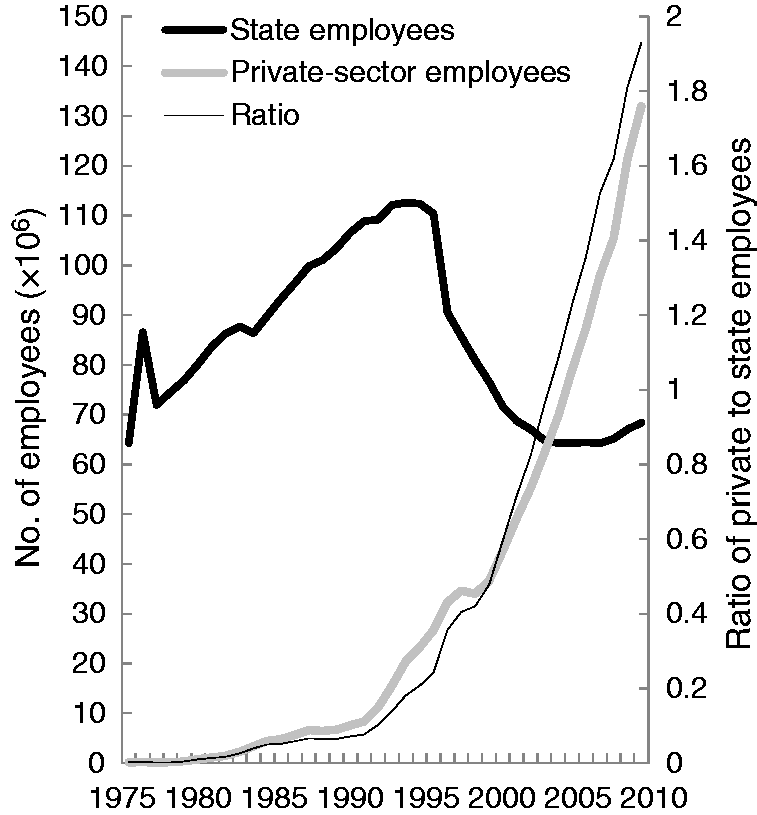
Lessons from China’s political evolution
Political institutions generally focus on governing, and stability is a key objective. In contrast, economic institutions are more individualistic and their top priority is development, with the goal being to move beyond mere survival towards improvement of the quality of life (Hou and Hou, 2002). In reality, the political and socioeconomic systems are two sides of the same coin: both are, at their heart, social institutions. Therefore, a dynamic equilibrium can exist between the two when their innovations are consistent, leading to simultaneous interactions and adjustments for both groups of institutions. Under these conditions, the actions of the political and economic sides of society can be complementary and mutually beneficial, leading to good social and economic performance. This equilibrium is also likely to reduce society’s overall costs for defense, transactions, and transformation. It is possible, but not certain, that a series of institutional arrangements will also be introduced to improve efficiency (Zhao, 2006).
China’s process of institutional change challenges the belief that informal institutions, including values, beliefs, and social norms, tend to change gradually and that formal institutions may not change often but can change rapidly when the pressure for change is sufficiently high (Li, 2004; Roland, 2004). China’s institutional reforms have caused economics and politics to evolve in parallel. Since knowledge and culture accumulate slowly, over millennia in the case of China, conditions that promote interactions with diverse cultures that have their own large stocks of accumulated knowledge may create a high potential for institutional change. This has been the case during China’s recent opening to the West.
Although gradual institutional evolution is suitable for both economic and political institutions, sometimes the pressure for change becomes so great that change occurs rapidly. One reason for China’s successful balance between slow and rapid change is a national policy of testing solutions on a limited scale to ensure that they work, then implementing them over wider areas in a modified form that is most suitable for each region (Cao, 2012a). However, institutional change is not always effective. China’s massive afforestation policy provides a counter-example that shows how overly rapid change can fail to achieve its goals (Cao, 2012b; Wang et al., 2010). In addition, China is experimenting with its own institutions for the market economy instead of importing Western institutions. As in the case of American federalism, which has been described as a “laboratory of the states” (Roland, 2004), some regions initiate and experiment with innovative institutions, which may then be adopted by other regions. The results of China’s experiments may also be imitated by other states.
Competition is both a fundamental response to China’s reform of corporate ownership and a stimulus for improvements in economic efficiency, and it also has important implications for reforming choices by the public sector, since it can lead to improved efficiency in policy development (Zhao, 2006). When a policymaker faces many choices, they are likely to choose the option that maximizes their utility (Lin, 2002). Compared to the central government, local governments have a weaker ability to monopolize power. Since the amount of locally retained government tax revenues (i.e. the share that is not transferred to the central government), as well as the political future of local bureaucrats, is determined by local economic performance, bureaucrats in different regions compete fiercely for resources such as investment capital, workers, and technology that can be used to develop their local economy (Zhou, 2012). Therefore, competition among local governments has become a form of market-based competition in China. This competition forces local governments to learn quickly and well to ensure that they are not outcompeted by other governments and to ensure that local enterprises do not “vote with their feet” (Zhao, 2006).
Institutional diversity may be as important for long-term survival of a socioeconomic system as biological diversity is for the survival of an ecosystem, and many lessons can be learned from both successful efforts and failures (Ostrom et al., 1999). In complex systems such as a society, it extremely challenging to find optimal rules and may sometimes be impossible. Therefore, an important advantage of China’s approach is that it allows the self-organized governance regimes of different regions, acting in parallel, to seek these rules through trial and error; although this does not reduce the probability of error for any one region, it reduces the risk of disastrous errors for the country as a whole, and gives regions that fail an opportunity to learn from regions that succeed (Cao, 2012a; Lin, 2002; Ostrom et al., 1999). Even though China has not yet provided secure private property rights, the overall improvements in competition, opportunities, and incentives have fostered hard work, entrepreneurship, and innovation, and this trend is sufficiently strong that it is sustaining China’s economic dynamism in ways that securing private property rights alone could not provide (Whyte, 2009). China’s federalism illustrates more diversity, inclusivity, and flexibility than many Western forms of federalism. Led by Deng’s “cat theory,” economic efficiency has become the primary standard for institutional reform. China’s federalism both allows and encourages the evolution of diverse political institutions, such as a more socialist approach in most of China coexisting beside a more capitalist approach in Hong Kong and Macao, each with different economic institutions (planning and marketing) and property rights (state-owned versus private enterprises).
Just as plants produce new roots, shoots, and leaves from previously existing tissues, new institutions evolve from the old ones. However, some old institutions survive the growth of the new ones if they can avoid conflict and find ways to coexist with the new institutions (Cao, 2016). During the initial phases of China’s reforms, the Communist legacy formed the source of the new growth of institutions. Some Communist legacies were retained, at least in part, whereas others were abandoned or adapted (Zhang, 2006). This flexible matrix of institutions, with a tendency to generate new economic institutions in response to changing social and economic conditions, will continue to adjust in response to technological and demographic changes and learning from both successful and failed experiments in different regions. The resulting increase in institutional flexibility will eventually lead to sustained economic growth (Davis, 2010). As is the case for a natural ecosystem, in which diversity increases the system’s long-term stability, supporting diverse institutions will increase social stability and smooth socioeconomic development both during the current period of rapid change and in the future. China’s liberalization of its economic institutions has been a significant positive factor that is responsible for the current economic growth (Zhang, 2012b). However, social stability is not guaranteed, and the slowing pace of political innovations creates a risk of greater instability in the future.
Perspectives
There are both similarities and differences in political evolution between China and Europe. In medieval Europe’s feudalistic society, production factors such as land were not market commodities, and it was not possible to change one’s status through economic activities. China’s economic development during the Western Zhou Dynasty (1046 to 770 B.C.) followed a similar path (Hou and Hou, 2002). Western Europe took several centuries to transform from feudalism to a democratic political structure, and this change was accompanied by ongoing conflict (Roland, 2004); this resembles the process in China during the Eastern Zhou dynasty from 770 to 256 BC, when China’s political hierarchy changed to create a strong, long-lived empire based on Confucian principles for the first time. China’s history was dominated by the politics of an imperial hierarchy for more than two millennia, until the Qing Dynasty collapsed in 1911. The current institutional change in China is not just a transition from socialism to capitalism, but rather a continuation of the evolution of political institutions from this ancient imperial hierarchy to a new political system that blends a centralized socialist state with aspects of a Western market economy. As is the case for any institutional innovation, China’s institutional changes have not always been smooth. However, since the changes that began in 1978, the 1989 Tiananmen incident has been the only major internal political crisis (Zhang, 2012a). Because China’s leaders’ dream of developing a new institution that is more advanced than the current form of Western capitalism, China is testing an approach to federalism that they hope will be more diverse and flexible than the Western example.
However, China’s political innovations have far-reaching social and political consequences, and not all of these consequences are beneficial; for example, society has become more stratified between the rich and the poor, and social and political issues are multiplying. China’s political reforms largely stopped after Deng died in 1997 (Table 1). China’s State Department began developing policies specifically for the benefit of the government. As result, government revenues had increased to 13 times their 1990 level by 2011, versus an increase of only 4.6 times for the private sector (Cao, 2016). The federalism that has accompanied China’s market reforms greatly facilitated economic growth, but also created an opportunity and incentives for local authorities to abuse their powers. This has significantly increased the costs of maintaining political stability and encouraging the development of a national market (Heinemann and Tanz, 2008; Ip and Law, 2011). Additional challenges include increased social inequality, many environmental crises, the risk of political instability (Knight, 2013), a rising crime rate and rising unemployment, and widespread corruption (Dong and Torgler, 2013; Wang and You, 2012). These changes have been accompanied by growing numbers of commercial disputes, protest movements, growing rural poverty, and the spread of HIV and other infectious diseases (Whyte, 2009; Yang, 2006; Zhang, 2006; Figure 2).
Crime levels, the gap between urban and rural per-capita net income, and the gap between changes in government and private sector revenues from 1978 to 2011. Source: NBS (1985–2015).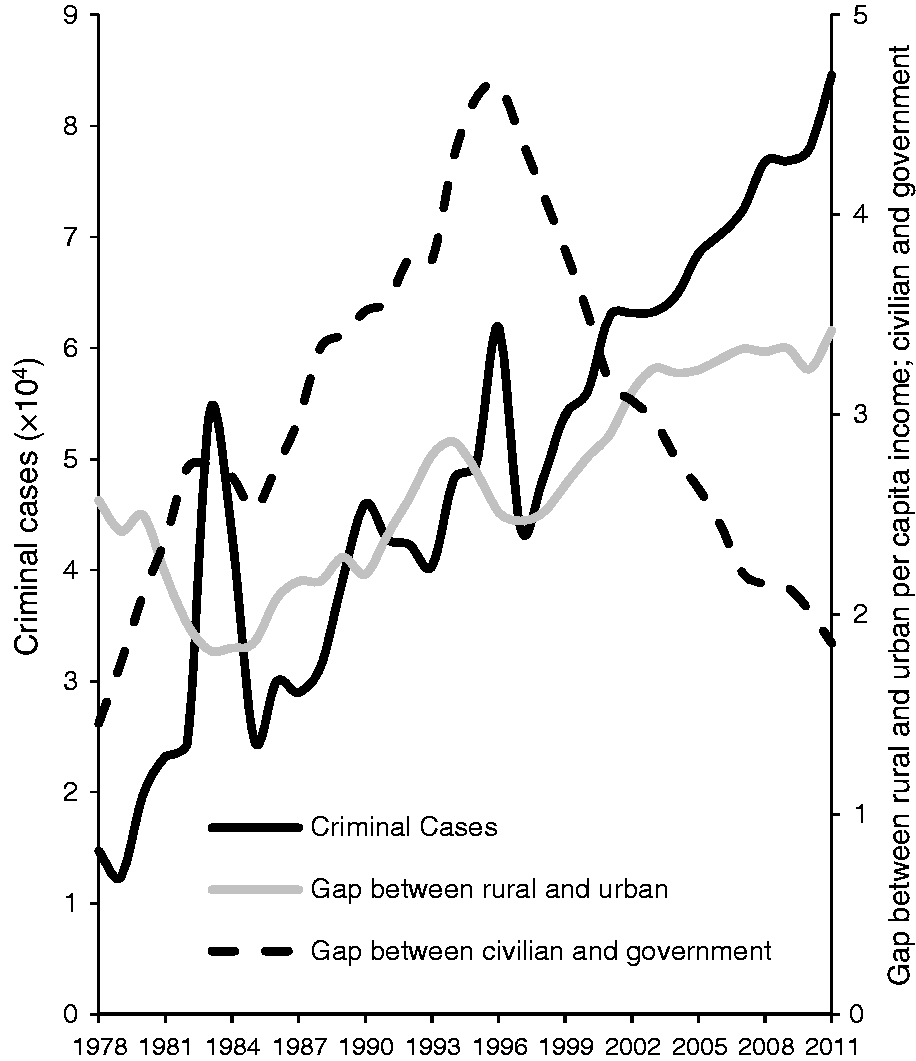
China should learn from the experience of the pre-collapse Soviet Union during the 1990s (Kokushkin, 2012). The lack of democratic accountability at a local level is manifested in the absence of genuine electoral mechanisms that might allow citizens to collectively express their preferences and in the lack of an independent judiciary that can enforce legal and social contracts against the government and corrupt officials. A lack of political innovation is the root cause of many problems that have occurred in China since 1997 (Cao, 2016; Ip and Law, 2011). These problems may lead China into a period of increased social turbulence. From 1978 to 2010, the Gini coefficient has risen by 118%, and the crime rate has risen by 475% (Jiang et al., 2016); the two parameters have also been strongly and significantly correlated during this period, and although correlation does not always imply causality, there is a plausible causal relationship in this case (Figure 3). The central government must directly attack the developing institution of an administrative monopoly that has shifted from the national level to the local level if it wishes to reduce the heavy costs that the government now bears. The evolution of China’s special economic zones and Hong Kong’s current governance structure may provide good models to follow, particularly since they follow the Chinese philosophy of testing innovations in one region before implementing them in others.
Results of a linear regression of the crime rate against the income gap between urban and rural residents showed a strong and positive correlation (R2 = 0.6–0.85, p < 0.05–0.01). Although correlation does not imply a causal relationship, the correlation could be causal in this case: when a group lacks sufficient money to survive, they may resort to crime to provide the necessary money.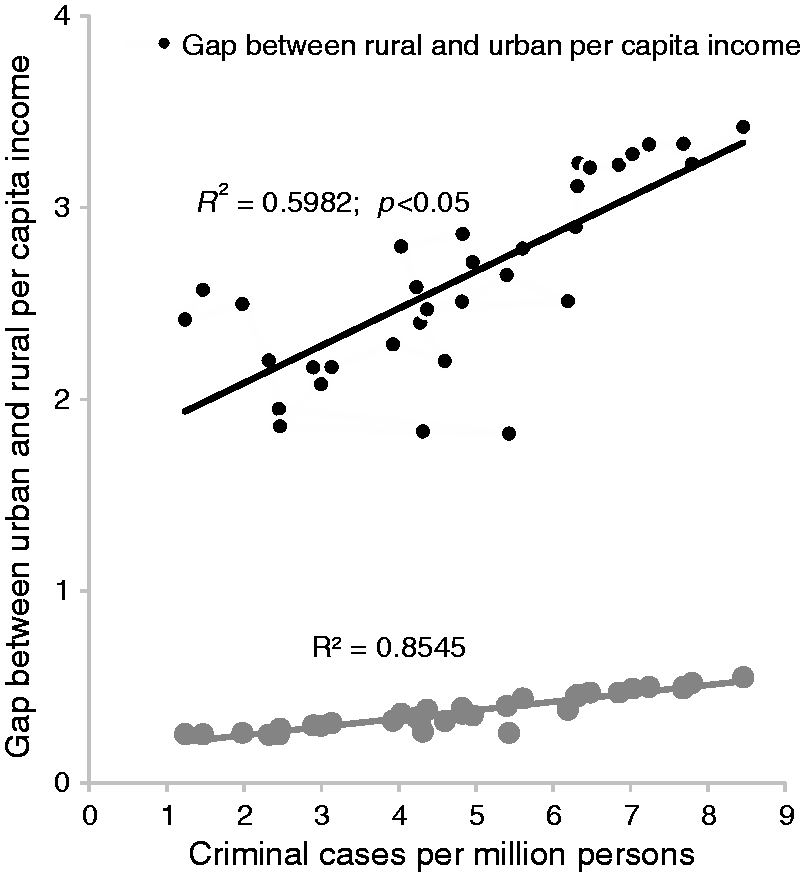
Despite China’s distrust of Western-style democracy, the country’s experiences since 1978 have involved a considerable increase in the prominence of democratic elements: rehabilitation of former political prisoners, greater social mobility, the evolution of more diverse value systems, a relaxation of strict ideological standards, a slow reduction of the state’s power over the economy, implementation of more laws and legal institutions designed to protect individuals, increased energy among delegates to meetings of the people’s congresses, and a relaxation of cultural restrictions (Zhang, 2006). Since the 1980s, China has transformed itself from a highly centralized regime to one that emphasizes decentralization as a result of the transfer of substantial powers to local bureaucrats who are responsible for running the country’s 31 provincial-level units, which are home to an average of 42 million people per unit (Ip and Law, 2011). However, institutional change has acquired so much momentum that it cannot be stopped; China will have to continue along this path. As president Xi Jinping recently said, China’s reforms may not be perfect, but they will continue. China’s experience during the past 30 years has shown that parallel evolution of the country’s economic and political institutions represents a powerful and successful approach to socioeconomic development. If China can combine this progress with decreased social costs, it will provide the model for a new era, both for China and for other nations.
China’s experience demonstrates that institutional change is a slow process both for politics and for economics. However, China’s ability to combine changes in its political and economic institutions to form a dynamic equilibrium has been the key to its successful institutional change. From historic times to the current era, China’s institutional change has resulted from ideological changes that led to economic changes, which in turn led to political changes. For example, when the ideological focus of China’s government policy shifted from class struggle to economic development after 1978 under Deng Xiaoping, the pragmatic principle of “seeking truth from facts” led to drastic economic reforms (Lin, 2002). The resulting economic growth and political stability led to institutional changes in government, such as the decentralization policy, that strengthened local governance while also improving social development. In contrast, political institutional changes that jeopardize economic growth may increase poverty, lead to economic weakening or even collapse, and lead to destabilization of social systems, possibly leading to a revolution, as occurred in the Soviet Union during the 1990s (Jiang et al., 2016). Indeed, economic institutional changes that are not accompanied by compatible changes in political institutions may expand the gap between the rich and the poor, intensify social conflict, and threaten political stability; symptoms of this risk may be evident in the negative social changes that have occurred in China since 1997 (Figure 2). Therefore, China faces the problem of finding an equilibrium between political and economic institutional change that will protect the remarkable gains the country has made since 1978.
Footnotes
Acknowledgements
We thank Geoffrey Hart of Montréal, Canada, for his help in writing this paper. We are also grateful for the comments and criticisms of an early version of this manuscript by our colleagues and by the journal’s reviewers.
Declaration of Conflicting Interests
The author(s) declared no potential conflicts of interest with respect to the research, authorship, and/or publication of this article.
Funding
The author(s) disclosed receipt of the following financial support for the research, authorship, and/or publication of this article: This work was supported by the National Key Technology R & D Program (No. 2012BAC08B05). The opinions expressed here are those of the authors and do not necessarily reflect the position of the Government of China or of any other organization.