



Abstract
Scope of research
In a sample of 316 Chinese MBA students, the influence of Time Perspective on two types of unethical behaviors was tested. We differentiated between rule-based and social-concern issues. Time Perspective was measured by using a Chinese version of the Zimbardo Time Perspective Inventory. Participants’ evaluation of the issues as ethical—or unethical—and their behavioral intention to violate business ethics were measured.
Hypotheses
We assumed that Past-Positive and Future will enhance ethical orientation, whereas Past-Negative, Present-Fatalistic and deviance from balanced time perspective (DBTP) will reduce ethical orientation (evaluation of unethical practices as ethical and high behavioral intention to apply unethical practices).
Results
For evaluation of rule-based issues, Past-Positive, Present-Hedonistic and Future significantly influenced in the predicted direction, whereas no significant effects of time perspectives for social concern issues were observed. According to behavioral intention, only Present-Fatalistic reached significance for both types of ethical issues in the predicted direction. Further, it was shown in a mediation-model that the influence of DBTP on behavioral intention to show unethical practices is mediated by the evaluation as ethical/unethical in the case of rule-based issues (in the case of social concern, the factors reached no significance or only nearby significances, respectively). Chinese managers with a high deviation from a balanced time perspective showed reduced evaluation of unethical practices as unethical, and an enhanced behavioral intention to show unethical practices. Other potential variables of influence, such as age, gender, the size of company, and the degree of globalization were considered, and their influences were controlled.
Conclusions and limitations
Time perspectives are of relevance for business ethics, but the relationship was only shown for rule-based issues. In the case of social concern, the relationship was only shown for Present-Fatalistic on behavioral intention.
Keywords
Scope of the study
Responsible decision makers inside companies face a great challenge with changing globalized markets. The activities of companies have an influence on society, on those who work inside these companies, on consumers, and on those who are directly or indirectly affected in national as well as international markets. Whether this influence is predominantly characterized by positive aspects or by severely negative consequences depends to a considerable extent to the violation of business ethics. We test, in the current study, the influence of time perspectives on business ethics. With respect to time perspectives and business ethics, it can be assumed that an easy short way and a difficult long way are essential for moral orientation. Taking into account the research on the ZTPI and the paradigm of delayed gratification (Mischel and Ayduk, 2004; Mischel et al., 1989), we assume, in a similar way, that a manager could choose between violating business ethics (e.g. taking a bribe) to gain an immediate benefit (e.g. access to a new market), or remaining persistent in their pursuit of goals in the long run without violating business ethics. As outlined in more detail in the section about the derivation of hypotheses, it can be assumed that time perspectives play an important role for the violation of business ethics. The topic of business ethics is hitherto discussed with different approaches which, however, show often inconsistent results. With respect to moral judgment, many studies have assumed gender differences and the relevance of other socio-demographic variables. One approach assumes different moral conceptions of men and women (Flanagan and Jackson, 1987; Gilligan, 1982). Stedham et al. (2007) have quoted Gilligan et al. (1988), who assume that women and men differ in their business ethics. According to these approaches, ethics have different functions for men and women. Men rely on rules and laws to guarantee justice and avoid conflict, whereas women base their ethical judgments on the needs of other parties in a more contextually oriented way (cf. Lam and Shi, 2008: 464). These gender differences are often explained by the stronger competitive orientation of men (McCabe et al., 2006). However, the empirical observations of gender differences are inconsistent: many studies have observed no gender-effects (e.g. Radtke, 2000 or Trevino, 1992, both cited in Lam and Shi, 2008). A meta-analysis by Jaffe and Hyde (2000) only revealed a small amount of support for the different moral orientations of women and men.
More obvious results have been obtained by the variable of age. Lam and Shi (2008: 465) summed up that most researchers report a positive effect of age on ethical orientation, but they also quote deviant studies, such as those of Hetherington and Feldman (1964) and Lane and Schaupp (1989), which could not verify these assumed age differences.
We assume that these above-mentioned socio-demographic variables may only reflect other psychological factors as well as situational factors that correlate with them. Already, Lam and Shi (2008) issued the possible important role of context variables by referring to studies by Derry (1987, 1989) and Trevino (1992). We suggest time perspectives as a new approach of explanation. The concept of time perspectives is introduced in the next section. Afterward, we will feature how different time perspectives can be assumed to affect the violation of business ethics.
The concept of time perspectives
Inspired by prior conceptions (Lewin, 1942, 1948, 1951), Zimbardo and Boyd (1999) developed and tested the concept of time perspectives that consist of five distinguishable and independent dimensions (core concepts displayed in parenthesis): Past Positive (emphasis of good experiences and positive memoirs especially from one’s childhood), Negative Past (bad or even traumatic experiences and regret of missed opportunities in the past), Present Hedonistic (emphasis on the immediate satisfaction of needs based on a hedonistic principle), Present Fatalistic (perceived non-contingency between behavior and consequences, emphasis on fate, luck, and other external factors), and Future (persistent goal and long-term oriented behavior). The relevance and impact of the corresponding combinations on a wide range of behavioral domains have been demonstrated in many studies within the last decade. One focus is on studies that have shown that a low Future perspective and a high Present Hedonistic perspective could facilitate problematic behaviors—such as driving a car at high speed (Zimbardo et al., 1997) or smoking and drug use (Keough et al., 1999; Petry et al., 1998), and poor self-control achievement (Fieulaine and Martinez, 2011). Further, Willis et al. (2001) issued the relationship between time perspectives and drug abuse as a type of dysfunctional stress-coping. A second focus of empirical research was on psychological well-being as a consequence of the different combinations of time perspectives, which in turn could influence human thinking and behavior (Boniwell et al., 2010; Boniwell and Zimbardo, 2004; Drake et al., 2008; Zhang et al., 2013). Essential in this context is the particular aspect of deviations from an assumed optimum balanced configuration of time perspectives, which is named deviation from balanced time perspective (DBTP) (Stolarski et al., 2011). The DBTP is based on the assumption that each of the five time perspectives has an optimal value for well-being and human functioning. Thus, the DBTP is a result of how the time perspectives deviate from their assumed optimum. This allows us to distinguish between favorable and unfavorable overall configurations of the time perspectives.
Time perspectives and business ethics: Derivation of the hypotheses
Homann and Blome-Drees (1992) have suggested that decision making and enterprise action are generally located in tension between morality and profitability. This leads to the dilemma of profit in the short run by violation of business ethics. However, it is important to emphasize that the profit maximum principle is not automatically in contrast to morality per se. Instead, it has to be differentiated—and this is central in the current study—between profits in the short run and profits in the long run. The violation of business ethics may result in fast profits in the short run (but it may also imply some personal as well as economic risks), whereas operating a persistent, honest business in accordance with business ethics may result in sustainable profits in the long run, which is clearly superior to the first option. It is obvious that a person with a long-term orientation can come to this conclusion with a much higher probability than a person with a short-term orientation. One may further imagine that in the long run, an honest company is more profitable than those companies that choose to violate business ethics. On the other side, dilemma situations can be easily imagined when expected fast or presumably fast profit gains stand in contrast to business ethics and morality. In some cases, the dilemma is reinforced by corresponding insecure law structures, corruption, and high levels of competition. Zimbardo and Boyd (2008) quote the case of Enron as an illustrative example of actors with a presumably high Present time perspective. In their reasoning, the managers of Enron showed strictly highly unethical behaviors because of their Present time perspective. Thus, long-term goals took a backseat and short-term goals (as short-term gains), and supposed but doubtful advantages came to the fore.
For Past perspectives, two completely different types are distinguished: reminiscing about the good old days (Past Positive) versus regretting the missed opportunities and emphasizing the unpleasant experiences of the past (Past Negative). Further, both—Present Hedonistic and Future can have advantages and disadvantages in terms of well-being and success in life. Nonetheless, we can clearly state, with respect to the pursuit of general goals in life as well as economic goals, that Present and Future time perspectives do have divergent consequences. In terms of participating in unethical behavior in the context of business life that could also be accompanied by breakdowns of self-control, having a high Future perspective is clearly an advantage that helps an individual refrain from doing so. Instead, having a high Present perspective enhances the possibility of breaking ethical norms and values if the potential long-term consequences are not considered. We assume that individuals with a Present-Hedonistic orientation will seek short-term gains, because they will ignore the possible disadvantages, which will presumably only occur in the near or far future if at all (like sanctions for violations of business ethics). Consequently, a Present-Hedonistic time perspective is harmful for the fulfillment of ethical standards, whereas a Future perspective could be assumed as a helpful inhibiting factor. Further, we assume that Past-Negative and Positive have opposing effects on violating business ethics, because of their destabilizing (Past-Negative) and stabilizing effects (Past-Positive) on personality. Finally, we assume that Present-Fatalistic, due to reduced feelings of responsibilities and opportunities, will enhance violations of business ethics. In the context of issues like life satisfaction and well-being, the importance of balanced ratios between time dimensions is emphasized (Stolarski et al., 2011). We similarly hypothesize that deviations from an optimal balanced configuration enhance the violations of business ethics.
In summary, the formulated hypotheses will be tested on our general assumption that time perspectives and their overall configuration (as measured by the DBTP) are essential for the high- or low-pronounced fulfillment of ethical standards in China.
Summary of hypotheses
H1: A high Future perspective will reduce the evaluation of unethical practices as ethical and will reduce the declared intention to apply unethical practices. H2: A high Present-Hedonistic perspective will increase the evaluation of social-concern-based unethical practices as ethical and increase the declared intention to apply unethical practices. H3: A high Present-Fatalistic perspective will increase the evaluation of unethical practices as ethical and increase the declared intention to apply unethical practices. H4: A high Past-Negative will increase the evaluation of unethical practices as ethical and increase the declared intention to apply unethical practices. H5: A high Past-Positive will decrease the evaluation of unethical practices as ethical and decrease the declared intention to apply unethical practices. H6: The higher the DBTP, the higher the evaluation of unethical practices as ethical and the higher the readiness to execute unethical practices (declared intention).
We further assume that the influence of DBTP on declared behavioral intention (H6) is mediated by the evaluation of these unethical practices (H7). As such, a mediator-model (cf. Baron and Kenny, 1986) tests if the possible direct effect of DBTP on declared behavioral intention operates via the measured evaluation of unethical practices and thus is mediated by this variable. We tested all of the hypotheses separately for the two types of unethical behaviors: rule-based and social-concern items (cf. for this distinction, Lam and Shi, 2008).
Method and procedure
As a minimum, all of our participants work in junior management positions in enterprises with some administrational competence or decision-making authority. Our data collection involved different regions of East China, including participants from enterprises located in Beijing, Shanghai, Hangzhou, Fuzhou, Xiamen, and several others. Besides the evaluation, we added a second part, in which the participants were asked if they would actually be ready to execute the 19 corresponding examples of unethical behaviors (declared intention). Although the possibility of receiving unbiased responses free from the effects of social desirability in the case of the reported hypothetical behavior is limited, we sought to enlarge the scope of our study to differentiate between evaluation and declared readiness to execute unethical behavior. All of the participants were recruited from MBA courses in several schools of management throughout East China. Besides organizational reasons of practicability, this has two advantages: we first ensured that the participants had administrative positions to some extent, particularly junior managers. Second, the conduction of the survey in the groups of MBA students enabled us to ensure a stable and standardized survey situation. The data collection was enabled by different cooperating universities. The survey itself was conducted by trained Chinese co-workers. For the data-collection, the students of MBA-courses were asked to participate voluntarily in the survey. They filled out the questionnaires in group-sessions that took place before their regular MBA-courses. Anonymity and voluntariness were declared to the participants at the beginning of each session and ensured by using a box similar to a ballot-box in which they put their questionnaires when they had finished. Only a small number of the MBA-students that were asked did not participate in the study. A total number of 13 participants refused to take part. Ten cases of missing values of time perspectives, as well as five of evaluation of business ethics, were discarded from the analysis. All of the sessions were conducted by Chinese coworkers in cooperation with the academic staff of the corresponding schools of management.
The participants
The sample consisted of n = 316 (163 were females; and 5 refrained from indicating their gender) Chinese MBA students (MAGE = 28.0 years, ranging from 25 to 55). According to branches of the sample, production (16.3%) and finance (12.2%) were most frequently mentioned, followed by electronic communication (9.9%) and construction industries (9.0%). The following branches ranged between 2% and 7%: energy, retail and wholesale, advertising, real estate, pharmaceuticals, and social services. The remaining 27.3% was spread across, accommodation, logistics, chemical industries, water and gas supply, entertainment, and others. Thus, a wide range of different branches was covered. The participants indicated their functions as follows: 21.1% had a leading position in production, 16.2% worked in the finance department, 13.4% worked in management, 5.15% worked in marketing, 4.2% worked in human resource management, and 37.1% had other leading or administrative functions.
Measurement of ZTPI
In our study, we used a validated Chinese version of the ZTPI (cf. Sircova et al., 2014). The scale consists, as with the original American version (Zimbardo and Boyd, 1999), of 56 items that measure the five time dimensions.
Measurement of DBTP
Stolarski et al. (2011) have developed an approach to measure the degree of imbalance of the overall configuration of time perspectives of the ZTPI by defining optimal values in accordance with an assumed balanced time perspective. These are for Past Negative (1.95), Past Positive (4.60), Present Hedonistic (3.90), Present Fatalistic (1.50), and Future (4.00). Based on these values, the overall deviance from the optimum is calculated by the following formula:

Measurement of evaluation and declared behavioral intention for rule-based and social-concern issues
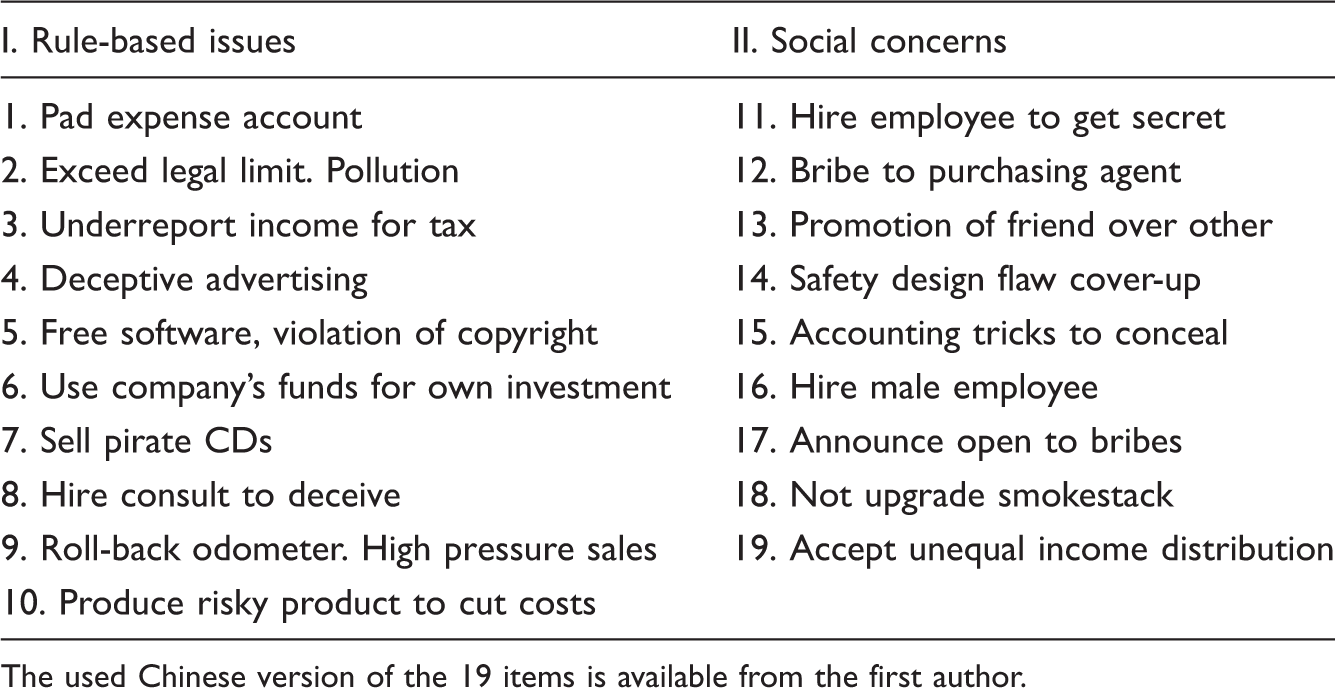
The dependent measurement contains rule-based and social-concern issues. The differentiation used is based on work by Smith and Oakley (1997). They differentiated between violations of rules (which involve the violation of legal aspects to a greater extent) like: “use company’s funds for own investment” or “produce risky product to cut costs.” The social-concern violations refer to personal and social interactions like: “announce open to bribes” or “accept unequal income distribution.”
The items for rule-based and social-concern issues (cf. Lam & Shi, 2008, p. 467).
The used Chinese version of the 19 items is available from the first author.
The exact wording of the first question, for the 19 unethical items that had to be evaluated with a seven-point scale (ranging from 1 [totally ethical] to 7 [totally unethical]), was as follows: “To what extent do you think the following practices are ethical or unethical?” The wording according to the reported behavioral intention to the 19 unethical items was as follows: “Would you be prepared to apply them in your daily business life if necessary?” (1 = in any case, 7 = not at all). The reliability remained sufficiently high for the rule-based (α = .914) as well as for the social-concern issues (α = .924). The coding of the evaluation measurement was reversed for the analysis to make both comparable (thus, high values indicated a high ethical orientation in both measurements).
Results
Linear regression by companies size, age, gender, education, future present, hedonistic present, and negative present on evaluation of rule-based items.

p-values are for one-tailed test. R2 = 0.10; dependent variable: evaluation of rule-based items.
Linear regression by companies size, gender, age, education, future present, hedonistic present, and negative past on evaluation of social-concern based items.
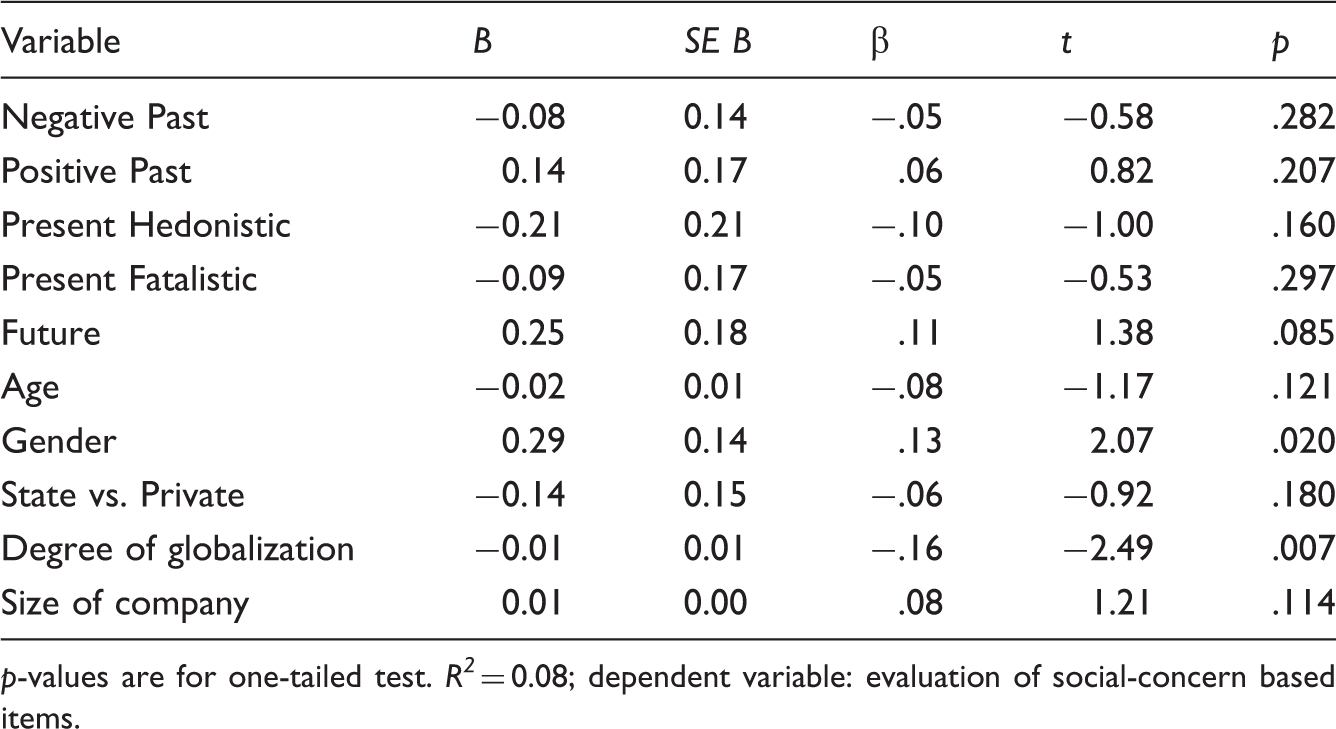
p-values are for one-tailed test. R2 = 0.08; dependent variable: evaluation of social-concern based items.
Linear regression by companies size, degree of globalization, education, future present, hedonistic present, and negative present on declared behavioral readiness of rule-based items.

p-values are for one-tailed test. R2 = 0.09; dependent variable: declared behavioral readiness of rule-based items.
Linear regression by companies size, age, gender, education, future present, hedonistic present, and negative present on declared behavioral readiness of social-concern based items.

p-values are for one-tailed test. R2 = 0.10; dependent variable: declared behavioral readiness of social-concern based items.
Analysis of DBTP
Mediator analysis for DBTP and evaluation of rule-based and social-concern issues predicting behavioral intention to show rule-based and social-concern unethical behavior.

p-values are for one-tailed test. The model without mediator is displayed in the third line of the test of the prerequisites. The Sobel-Test statistics were as following: z = − 2.75, p < .003 (one-tailed) for rule-based items and z = − 1.55, p < .061 (one-tailed) for social-concern items. R2 = 0.49 for the mediator-model in the case of rule-based issues and R2 = 0.48 in the case of social-concern issues; dependent variables: declared behavioral intention to show rule-based and social-concern unethical behavior.
DBTP: deviation from balanced time perspective.
As can been seen, all of the three prerequisites were fulfilled in the case of rule-based issues, all βs > 0.12 all ts ( > 301) > 2.20, all ps < .015. If the mediator evaluation was introduced into the analysis, the significance of DBTP dropped from p = .014 in the model without the mediation to p = .358 (cf. Table 5). Thus, the influence of DBTP on behavioral intention is fully mediated by the evaluation in the case of rule-based issues. In contrast, only two out of three prerequisites were fulfilled in the case of social-concern issues: where the influence of the evaluation on behavioral intention clearly reached significance, β = 0.70, t(310) = 17.09, p < .001 reached the influence of DBTP on evaluation, β = − 0.08, t(304) = − 1.47, p = .071 as well as DBTP on behavioral intention, β = − 0.08, t(301) = − 1.35, p = .089, only a nearby significance for the one-tailed test (cf. Table 6, right side). In the model with evaluation, the almost significance of DBTP (p = .089) disappeared totally and dropped to p = .333.
With respect to the different results of multiple regressions and mediator analysis (especially the striking differences in the R-squared values, cf. Tables 2–6) the following argumentation might explain the striking results: The DBTP is a deviation measure, whereas the Present Fatalistic is a depositional measure. Thus, the nature of DBTP can be described as a composite variable. Although they are highly correlated, they are different constructs. Stolarski et al. (2011) argued that the DBTP is the most powerful predictor of the tendency to delay gratification comparing with other single ZPTI dimensions.
Some problematic issues of a Sobel-Test (cf. Figure 1) were discussed in the literature (cf. Preacher and Hayes, 2004). These authors recommend, beside a Sobel-Test, using a bootstrap procedure to test for the significance of the indirect effect of the mediator. Thus, we additionally conducted a bootstrap procedure to ensure the results of the mediation analysis. For the bootstrap analysis, we calculated 1000 samples for each of the two mediation models on the basis of the 95% interval: the indirect effect of the DBTP on declared behavioral intention via evaluation of rule-based items was significant (z = − .19, CI 95% = − .43, 02; N = 1000 re-sample). The same procedure was computed for the social-based index: again the indirect effect of the DBTP reached significance (z = − .11, CI 95% = − .33, .08; N = 1000 re-sample). Thus, both bootstrapping procedures confirmed the significance of the indirect mediator effect.
Mediation-model for the influence of DBTP on behavioral intention with evaluation as mediator for rule-based and social-concern issues.
Descriptive analysis of conspicuous items: Which aspects of business ethics are most critical in China?
With respect to the question of the general acceptance of unethical business behavior, the following pattern was observed: first, the index of rule-based evaluation 1 shows a mean clearly right from the middle of the 7-point-likert-type scale (M = 6.90; SD = 1.14). This implies that there is a tendency of the participants to evaluate most of these 10 items as unethical. A similar picture can be drawn from the same analysis of social-concern issues. Again a clear tendency to evaluate the items as unethical was observed (M = 5.98; SD = 1.17). In general, this reflects quite high ethical standards of the managers, especially compared to the mean values reported by Lam and Shi (2008: 467) for the general working population of Mainland China, which range from 2.29 to 4.12 (in contrast, the means for the 19 single items in our sample range from 5.39 to 6.44). Next, we asked if there are some “critical” items outstanding in terms of showing a low evaluation as unethical (so being more accepted compared with other practices). The mean-values do not deliver any outstanding differences or conspicuous items. More informative for the identification of the neuralgic points of business ethics in China could be the consideration of percentages of those who evaluate the practices at stake as ethical or as “somewhat ethical” (indicated by choosing the numbers between the extreme point of 1 and the middle of the scale). For this, we chose the cumulative percentages including the scale-points of 1–3 and those including 1–4 (reported in parentheses). We detected the following rule-based items with conspicuously higher percentages: 2 (a) Item 1 “Pad expense account” with 11.7% (23.4%); (b) Item 3 “Underreport income for tax” with 14.9% (28.8%); (c) Item 5 “Free software, violation of copyright” with 18.4% (38.6%); and (d) Item 7 “Sell pirate CDs” with 14.6% (29.7%). According to the social-concerned items, similar high percentages were shown by: (e) Item 13 “Promotion of friend over other” with 17.1% (25.3%); (f) Item 16 “Hire male employee” with 12.0% (20.3%); and (g) Item 19 “Accept unequal income distribution” with 10.8% (24.4%). All of the other items beside Item 12 showed percentages lower than 7% (11%). Item 12 “Bribe to purchasing agent” with 8.9% (19.9%) showed a somewhat vague identification as conspicuous or not.
We can summarize that rule-based items, especially those focused on individual interests, seem to play a critical role. The second aspect seems in line with issues in the public media and deals with copyright-violations. For the social-based items, Item 13 reflects the guanxi-philosophy (Chan et al., 2002; Su and Littlefield, 2001; Zhang and Zhang, 2006), and item 16 reflects the relevance of the gender question in Chinese workplaces (cf. e.g. Shaffer et al., 2000). According to item 19, this might be an indicator of the actual general diverging income development in China, and it maybe a reflection of an, at least partly, acceptance of it by the junior managers. According to possible discrepancies between the evaluation of the practices as ethical-unethical and the corresponding declared readiness to execute them, no anomalies were observed: the highest correlations reached item 13 with r = .697. All of the other correlations of the items ranged between r = .435 and r = .646.
Summary of results
The above presented results have revealed four core-findings. First, in accordance to the evaluation of rule-based and social-concern issues, three confirming significant effects of time perspectives were observed: Positive Past and Future enhanced the evaluations as unethical; whereas, as hypothesized, a high Present Hedonistic perspective in turn enhanced the acceptance of unethical practices as ethical. However, no significant effects were observed for Negative Past and Present Fatalistic. In the case of social-concern issues, only a nearly effect in the predicted direction was observed for Future. Second, the analysis of the behavioral intention showed the outstanding role of the Present Fatalistic perspective, which was the only Time Perspective that reached significance for both types of business ethics—rule based as well social-concern issues. Third, the analysis of the role of DBTP showed for rule-based issues that the influence of DBTP on behavioral intention is full, mediated by the attitudinal evaluation of these issues whereas in the case of social-concern issues, the prerequisites could not be clearly observed, although the pattern tends to be in the direction of a full mediation at the basis of (nearly) significances. But in a strict sense, the mediator-hypothesis was only confirmed in the first case. Finally, the rule of the considered control-variables that differ across the four measurements (cf. Table 2–5) was as follows: women showed significantly less readiness to show rule-based as a social-concern related behavioral intention. In respect to evaluation, the women evaluated social-concern issues less ethically, but there was no clear significant difference observed for rule-based issues. Further, age showed a nearly significant enhancing effect on behavioral readiness in the case of rule-based (p = .080), and a significant effect in the same direction for social-concern (p < .001). Further, participants from private companies showed less evaluation of rule-based issues as unethical, compared with participants from state-owned or partly state-owned companies (similar observations were reported by Fryxell and Lo, 2001). A possible explanation may be a higher prevalence of traditional Chinese values in state-owned companies. For rule-based evaluations, a significant effect in the same direction was observed for the degree of globalization: participants from highly globalized firms evaluated unethical rule-based issues as less unethical. An explanation for this may be that the value orientation is affected by globalization, e.g. by enhanced competitive pressure. Difficulties in business ethics caused by globalization are discussed by Suen et al. (2007: 262–263). Both explanations are, however, speculative and should be addressed in future research in a more systematic way. No other effects for control-variables were observed.
Limitations and discussion
Our analysis revealed that deviations from the assumed balanced time perspective concept facilitate the (declared) readiness to show unethical business behavior in the case of both considered types of violations (rule-based and social-concern). As has been shown in the current study, the approach of time perspectives delivers a causal explanation on the level of personal traits. In respect to attitudinal evaluation, a significant influence of Present-Hedonistic and Future was observed, but only for rule-based and not for social-concern issues. Besides this and the striking role of DBTP, we would like to stress the essential role of the Present-Fatalistic factor for the intentional readiness to show unethical business practices. It stands to reason, that attitudes of helplessness and the rejection of responsibilities were of central importance for the behavioral readiness to violate business ethics. However, overall, we have to state that the small R-squared (only about 10% for the regression-models with the five time perspectives) indicate that further research is necessary to clarify the role of time-perspectives on business ethics, especially in terms of interaction with other potential factors of influence. Thus, especially organizational variables might play an essential role, which might reinforce Present-Fatalistic tendencies like an authoritarian leadership style or by situations that seem to force the actors to violate business ethics. However, on the other side, the observed low R-square is not interpreted as a non-existent influence of the time perspectives as is outlined next: a demonstrative explanation of this case is given by Frost (2014). He delivers two cases of a simple linear regression plot, showing either a graph with a high or a variance from a linear regression line with the same skewness. “The low R-squared graph shows that even noisy, high-variability data can have a significant trend. The trend indicates that the predictor variable still provides information about the response even though data points fall further from the regression line” (Frost, 2014: 1). This case fits in with our observation, with a significant effect and a relative low R-square for the overall-model. On the basis of these considerations, two reasonable interpretations can be given: in our sample, the method of data-collection through the use of MBA-groups might have caused the high heterogeneity because the participants came from different MBA-schools, and as shown in the description of the sample, e.g. many different branches were covered throughout the sample. This also implies a high heterogeneity within the sample. Thus, it can be reasonably concluded that our R-squared values might increase if a more homogenous sample would have been used. Thus, we highly recommend the replication of studies within one company or at least within one branch. The second conclusion we draw out of the low R-square, and out of theoretical consideration, is that our observation of the influence of the time perspectives on the evaluation and declared behavioral intention of unethical business behavior should be connected to an institutional context. In this context, we think that the following considerations and research questions might be fruitful paths for future research: (a) how do time perspectives change in institutions over time?; (b) are there any selection effects by differences of employees in choosing different jobs by having different time perspectives?; (c) This might also imply the question of how success at the workplace is influenced by different time perspectives; and (d) how is the relationship between time perspectives and institutional pressure?
To make these considerations more illustrative, we want to add some speculative thoughts about possible examples for each of these mentioned domains. We think it can be assumed that an initial high Future orientation and an initial low Present Fatalistic time perspective might be reversed into the opposite under unfavorable conditions, like a negative working climate or a dislike of the leadership style. For example, an experienced lack of autonomy at the workplace can enhance feelings of fatalism, and thus they can enhance a Present Fatalistic orientation in the long run. Further, it is intuitive that people with different time perspectives will choose different jobs and as a consequence different time perspectives will prevail in different jobs or branches. Finally, job pressure (perceived stress as well as objective critical challenges) might spoil a Future perspective to cope with these challenges, or it could result in a lowered Future and an enhanced Present Fatalistic if the actors feel overburdened by these challenges. Future research might test how time perspectives intervene with institutional factors, and also specify how the relationship between socio-demographic variables and unethical behavior—as outlined in the introduction—can be explained by different time perspectives.
One debatable point of our research-design might be the differentiation between rule-based and social-concern-based items. We used the differentiation by Lam and Shi (2008), because we think that it is one possible reasonable way to capture different types of unethical behavior. However, we have to admit that other differentiations that were not considered in the current research are just as conceivably justified so they might be addressed in future research. These alternative typologies could be based, for example, on the classification of unethical behaviors as (potentially) beneficial 3 or unbeneficial for the organization (cf. Umphress et al., 2010), or on the subject of differentiation if they are legal or illegal (although this last dichotomous typology would have some overlap with the rule-based vs. social-concern based items differentiation).
One important limitation of our study is the self-reported survey character of our research. Also according to the evaluation of unethical business behavior and especially according to the second dependent measurement (declared behavioral intention), we have to consider the effects of the social desirability that consists of the two factors of self-detection and other-deception (Nederhof, 1985; Randall and Fernandes, 1991). Thus, we highly recommend that future research use behavioral measurements, at least in realistic scenario approaches or the inclusion of items that measure social desirability in the case of survey studies. Especially for the last case but not exclusively, Nederhof (1985) prefers to combine prevention and detection methods. Scales like the widespread Marlow-Crown-Social Desirability Scale (MCSDS; cf. Crowne and Marlowe, 1964) offer an opportunity to detect respondents with a high bias of social-desirability (cf. for problematic aspects of the scale Beretvas et al., 2002). One might also carefully consider techniques of prevention like bogus-pipeline forced items and proxy subjects (cf. e.g. Nederhof, 1985). Johnson and van de Vijver (2002) argue further in the context of cross-cultural research that in some cases if the analyzed construct is highly related to the social desirability, corrections techniques should be used very carefully because of the danger of decreasing the validity of such cross-cultural comparisons.
Further, the consideration of other variables of influence and their relatedness to time perspectives might be the scope of future research. First, organizational variables, such as the perceived level of competition, influence of leadership styles, or working climate, are of relevance here. Interactions with time perspectives or altered time perspectives by organizational factors can be considered. Second, the consideration of situational factors that could be assumed as important sources of unethical business behavior is of relevance for future studies. Also, we were able to confirm the hypotheses in the current study, where we have to clarify that we did not directly measure actual business behavior. This leads to a third possible path of future research, which comes from the main limitation of our current study: we highly recommend an enlargement of this research by experimental designs in which the participants are confronted with ethical dilemma situations and have to decide between several options differing in their degree of business ethics violation. Such experiments could be operationalized, for example, as business scenarios in the context of management training programs. Many other approaches like using records about legal violations or considering the cooperate success of firms at stake are also conceivable. Finally, our current study was conducted in China. In China, the development of a formal education of business ethics for managers is still in its initial stages. Instead, one can assume a strong influence of values via the implicit internalizing of traditional Chinese values (cf. Suen et al., 2007). Studies in other cultural settings as well as in multi-cultural firms are needed to confirm the observed role of time perspectives.
Our current piece of research only captures a part of business ethics at the individual level. As already outlined, future research studies can account for the relationship between time perspective and other personal traits like the risk-proneness of managers and the relationship between time perspectives and institutional factors. We have included type of firms, size of firms, and degree of globalization, but due to the relatively small sample in our study size these aspects should be readdressed in follow-up studies with higher sample sizes like, e.g. using nationwide representative studies if possible. The level of violating business ethics can also differ as a function of the position of a decision-maker within a business. To reach a comprehensive understanding of the phenomena of business ethics violations, future research could further benefit from the consideration of the legal and institutional framework of a society and its cultural or religious traditions. For China traditions, deeply rooted in Confucianism (Lam, 2003) and Daoism (Lu, 2009) are of essential importance for business ethics (cf. Busch et al., 2013). In any case, the high relevance of business ethics for business life and society as a whole is a highly practical and, at the same time, fascinating issue that requires further understanding of its determinants. Our study has shown that time perspectives and DBTP are factors of influence on the readiness to violate business ethics, but more research is needed to understand how this influence exactly works and how time perspectives are interrelated to other factors of influence.
Footnotes
Acknowledgments
We like to thank Prof. Qizhou Lu (School of Economics and Management, University of Fuzhou, China) for enabling data-collection at his and cooperating institutions in China. We would also to thank the two anonymous reviewers for their valuable comments and suggestions which helped us to improve this manuscript.
Declaration of Conflicting Interests
The author(s) declared no potential conflicts of interest with respect to the research, authorship, and/or publication of this article.
Funding
The author(s) received no financial support for the research, authorship, and/or publication of this article.