




Abstract
Future time perspective is a personality trait that involves people’s thoughts, feelings, and actions related to their futures. However, no multidimensional measures of future time perspective have been developed within Chinese cultural context. This study examined the structure of future time perspective by developing and validating a Future Time Perspective Scale for Adolescents and Young Adults in middle school and college student samples. Exploratory and confirmatory factor analyses resulted in a final measure that included 28 items loading onto six factors: Future-negative, future-positive, future-confusion, future-perseverant, future-perspicuity, and future-planning. The six-factor structure with high reliability and strong patterns of validity estimates was established. Future Time Perspective Scale for Adolescents and Young Adults will be useful in studies testing adolescents’ and young adults’ future time perspective. Future directions for the study of future time perspective in adolescents and young adults and limitations of the current study were discussed.
Keywords
Introduction
Human beings will go to great lengths to prepare for and ensure that they have a bright future – for example, by saving for retirement, investing in stocks, and planning weddings and even funerals. They do so even when they must sacrifice immediate benefits such as pleasure or convenience in the process (Husman and Shell, 2008; Lv, 2014; Mischel and Ayduk, 2004; Strathman et al., 1994; Zimbardo and Boyd, 1999). Seginer (2003) pointed out that “Future orientation, or the image individuals have of the future, provides the grounds for setting goals and planning, and therefore is considered an important adolescent developmental task.” In short, individuals’ conceptualization of and connection to the future is referred to as future time perspective (FTP) (Husman and Lens, 1999; Nurmi, 1991), which has been studied for decades in the field of time psychology and time personality (e.g., McInerney, 2004; Nuttin, 1985; Seginer, 1988, 2003; Seginer and Lens, 2015).
The definition of FTP as an important individual-difference variable has early roots with Lewin (1939), who defined FTP as “the scope of time ahead which influences present behavior” (p. 879). Generally, FTP has been examined separately in the areas of cognition (Lewin, 1951; Nuttin, 1985; Seginer, 2003), emotion or feeling (Lv, 2014; Zimbardo and Boyd, 1999), and behavior/motivation (Nuttin, 1985; Seginer, 2003; Zimbardo and Boyd, 1999). However, FTP is a multidimensional construct that not only refers to thoughts about one’s future but also includes behaviors/motivation and feelings regarding one’s future (Lv, 2014; Seginer, 2003; Seginer and Lens, 2015; Zimbardo et al., 1997). Therefore, we define FTP as a personality trait that involves cognitions, feelings, and actions towards one’s future psychological time.
FTP plays an important role in the development of adolescents and young adults for several reasons (Nurmi, 1991; Seginer, 2003). First, adolescents are faced with a number of normative age-specific tasks (Dittmann-Kohli, 1986), set by their parents, peers, and teachers, most of which concern expected life-span development and which, therefore, emphasize the importance of thinking about the future. Second, adolescents’ (and young adults’) future-oriented decisions, such as those related to career, life style, and future family, crucially influence their later adult life. As a person’s “model of the future,” FTP (or future orientation) provides the grounds for goal-setting, planning, and making commitments, and consequently guides the person’s developmental course (Nurmi, 1991; Seginer, 2003; Trommsdorff, 1983). Third, how adolescents and young adults see their future plays an important part in their identity formation (Marcia, 1980). Moreover, adolescent problem behaviors, such as delinquency and substance abuse, are likely related to how young people see their future. Adolescents reporting higher levels of future orientation are less likely to engage in alcohol use and drug use (Keough, 1999); and also exhibit lower levels of delinquency (Stein et al., 1968).
Much of the research on FTP has been conducted outside China, primarily in Europe and North American contexts, however. Given that Chinese people are generally believed to be past oriented (Guo et al., 2012), together with the fact that FTP has not been systematically investigated in Chinese adolescents and young adults, it is crucial to better understand how FTP operates in Chinese samples. Although some instruments have been created to measure aspects of FTP (Carstensen and Lang, 1996; Shell and Husman, 2001; Zimbardo and Boyd, 1999), a comprehensive measure of FTP constructs, regarded as a kind of personality traits, has not yet been available. Also, many existing FTP instruments have unsatisfactory reliability and construct validity (Husman and Shell, 2008). Developing a measure of FTP for use will assist in understanding the development of adolescents’ and young adults’ thoughts and feelings about their futures.
The research presented here is the first attempt to develop and validate Future Time Perspective Scale for Adolescents and Young Adults (FTPS-AYA) in the school context of China. To that end, we investigate the psychometric properties of the FTPS-AYA, focusing on the following: (1) scale development, including individual interview and open-ended survey, item information collection, and exploratory factor analysis (EFA); (2) analysis of internal alpha consistency and test–retest reliability; and (3) analysis of construct-related validity, convergent validity, discriminant validity, criterion-related validity, and structural validity assessed via confirmatory factor analysis (CFA).
Study 1: Scale development
Method
Participants
Participants for interview and open-ended survey
A total of 12 participants (6 females, 6 males; mean age = 19.5, standard deviation (SD) = 1.98) were recruited from Southwest University in China for individual interviews; 159 participants from Southwest University (65 males, 94 females; mean age = 20.6, SD = 2.35) and 56 students from a middle school located in Henan province, China (32 males, 24 females; mean age = 15.6, SD = 0.79) were recruited to complete an open-ended questionnaire. Parental consent was sought from the participants recruited from secondary schools (mean age < 16 years).
Participants for the first survey
In order to explore the structure of FTP and select items, the first survey was conducted in one middle school, one high school, and six colleges. A total of 716 valid responses (249 males, 465 females, 2 unspecified) were obtained (mean age = 18.7, SD = 3.3), consisting of 92 middle school students (mean age = 14.65, SD = 2.6), 96 high school students (mean age = 16.73, SD = 1.4), and 528 college students (mean age = 19.8, SD = 1.76). Parental consent was sought from the participants recruited from secondary schools (mean age < 16 years).
Procedure
Individual interview and open-ended survey
In order to explore the psychological structure of FTP and develop a questionnaire appropriate for adolescents and young adults, we designed two open-ended questions based on the conceptualization of FTP: “Please describe your future in five sentences,” and “Say something about what you plan to do in the future.” During the individual interviews, the research assistants administered these questions. During the open-ended survey, participants answered these questions within selected classrooms after being provided standardized and detailed instructions by research assistants. Participants answered all questions within 5–10 minutes and returned them to the research assistants upon completion. Informed consent was obtained from all participants before any assessments were carried out.
Item information collection
After analyzing the results of the individual interview and open-ended survey, we obtained 532 valid descriptions about FTP. Two authors analyzed the descriptions and generated three categories for 532 descriptions independently. The first category was related to positive vs. negative affect (29.80% of items). The second category was concerned with behaviors (32.52% of items), which reflect persistence in the future as well as planning for the future. The third category reflected whether the individual is perspicuous or confusional about the future (37.68% of items). Therefore, the structure of FTP is hypothesized to include six factors: Positive future, negative future, future persistence, future planning, future perspicuity, and future confusion.
Preliminary questionnaire development of FTP
Based on the six-factor structure presumed by above analysis and a consideration of related scales (for example, Zimbardo Time Perspective Inventory (ZTPI)-Future subscale, Lv, 2014; Zimbardo et al., 1997), 45 items were obtained. A total of 15 undergraduates evaluated and revised the items. Then, three professors and two doctoral students in personality psychology further evaluated the items according to the dimensions that the items were to assess. Finally, 39 items were compiled into a Preliminary Questionnaire of FTP with a five-point Likert scale (1=strongly disagree, 5 = strongly agree).
Well-trained research assistants and the first author collected measures from participants in the selected classes after providing standardized and detailed instructions for completing the FTP questionnaire.
Results
Item analysis
All items displayed satisfactory item-discrimination indices, indicating that each item of high scores (27% of samples with high scores) on the scale was different significantly (p < 0.001) from each item of low scores (27% of samples with low scores). The majority of corrected item-total correlations were greater than 0.40. The item reliability indices varied from 0.30 to 0.56 and most of them were greater than 0.40, providing evidence that the items exhibited acceptable internal consistency and produced a good distribution of responses.
Exploratory factor analysis
Exploratory factor analysis.
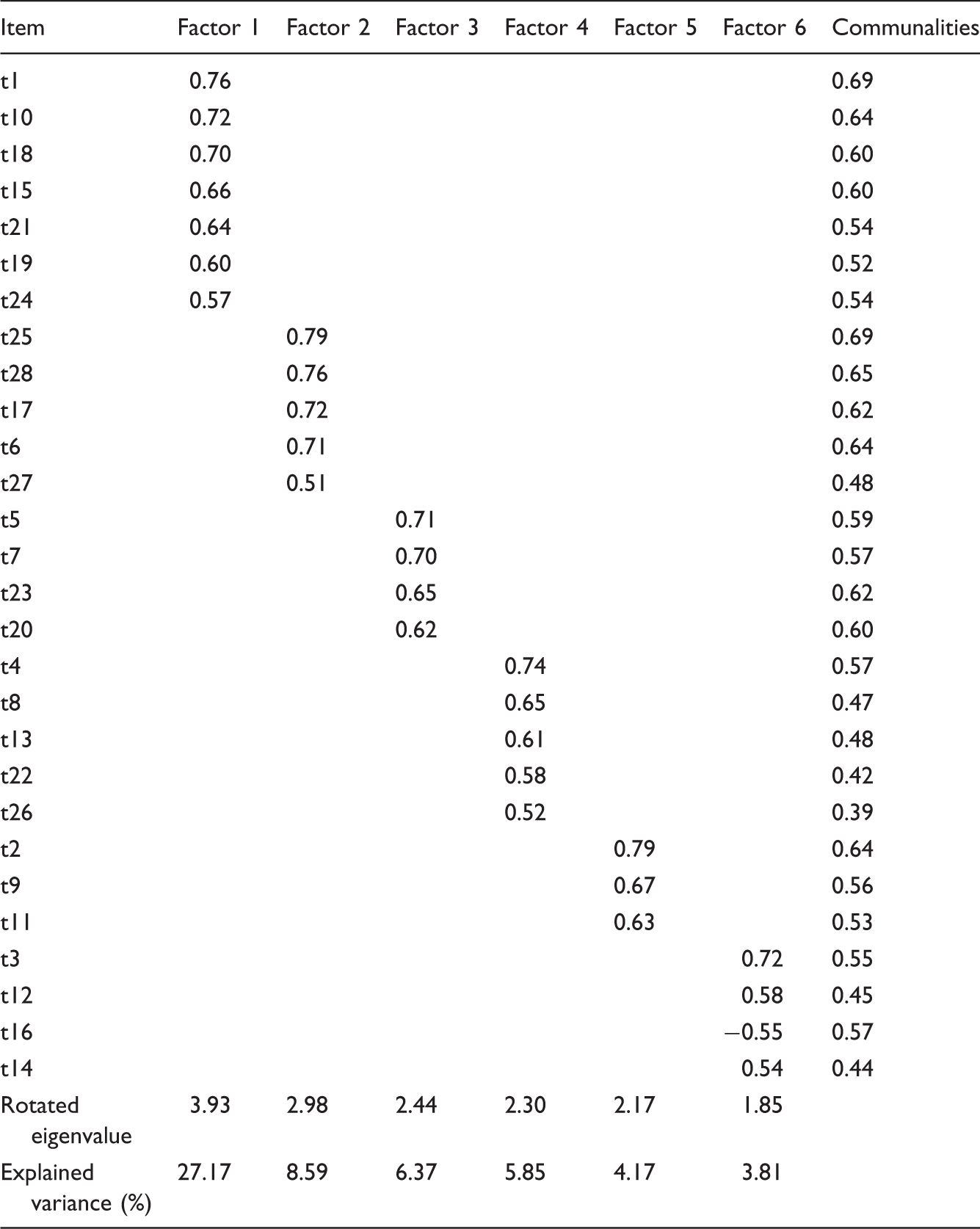
Factor 1, future-negative: The seven items from the first factor involve a predominantly negative vision of the future and reflect generally negative, aversive, and pessimistic feelings about one’s personal future. Future-negative individuals may be fearful of future or think that the future is not promising or hopeless. Previous research has shown that future-negative is associated with depression (Zimbardo and Boyd, 1999), fear, anxiety, and uncertainty (Carelli et al., 2015). Factor 2, future-positive: The five items from the second factor embody a generally positive, warm, happy, and meaningful attitude and emotion toward the future. It seems reasonable to associate future-positive with hope, success, and related attributes (Nurmi, 2005; Zaleski, 1996). According to Boyd and Zimbardo (2005), more future-positive individuals are more optimistic and able to anticipate positive outcomes and are likely to cope with negative life situations more effectively. Factor 3, future-confusion: This factor can be defined as a confused and unclear state of the future. The four items from the factor reflect general confusion and uncertainty about one’s future. Future-confusion individuals usually do not know what to do in the future and always feel that they cannot control their own future. Factor 4, future-perseverant: This factor is a representation of perseverance for the future and entails working strenuously toward challenges, maintaining effort and interest over years despite failure, adversity, and plateaus in progress. Factor 5, future-perspicuity: The three items from the fifth factor reveal an explicit and clear attitude toward the future. Future-perspicuity individuals believe that there are many opportunities for them and clearly understand what to do in the future. Factor 6, future-planning: The four items from the sixth factor reflect a present anticipation of future planning and future goal setting and suggest that behavior is dominated by a striving for future goals and rewards. According to Zimbardo and Boyd (1999), the ZTPI-Future subscale is characterized by planning for and achievement of future goals. Therefore, future-planning is predicted to be associated with ZTPI-Future and other-related variables.
The factor structure of FTPS-AYA not only demonstrates the multidimensional nature of the construct but also shows some contradictions (e.g., positive vs. negative, perspicuity vs. confusion). It is perhaps not surprising, as adolescents experience considerable ups and downs that may lead them to exhibit conflicting thoughts, feelings, and behaviors related to the future.
Study 2: Reliability and validity analysis
Participants
Participants were recruited from 21 colleges and 10 middle schools around China to complete the survey. A total of 4448 valid responses were obtained, consisting of 2619 females and 1797 males (32 participants did not report gender, mean age = 17.75, SD = 4.3); 1480 participants’ data were randomly selected for CFA. The participants’ recruiting from secondary schools (mean age < 16 years) was parental consent sought.
In order to obtain test–retest reliability, participants were selected from one middle school, one high school, and one college, and they were asked to fill out their names. Four weeks later, the participants completed the FTPS-AYA questionnaire again. A total of 489 valid responses were obtained.
Measures
The following measures were used to test the validity of the FTPS-AYA.
Temporal Orientation Scale
The Temporal Orientation Scale (TOS) (Jones et al., 1999) is a 15-item questionnaire, with a seven-point Likert scale (1 = not at all, 7 = very great extent), consisting of three factors: past, present, and future. Cronbach’s α of the scale in the present sample was 0.70. Examples of TOS are “I think about the past a lot” and “I try to live one day at a time.”
Beck Depression Inventory (Chinese version)
The Beck Depression Inventory (BDI)-Chinese version contains 21-item groups (each group contains four items scored from 0 to 3), based on how participants have been feeling over the last two weeks (Wang et al., 1999). The items are summed so that higher scores reflect higher levels of negative cognitions associated with depression. Cronbach’s α of the scale in the present sample was 0.86. Examples of BDI are “I don’t feel sad (scored 0); I feel sad (scored 1); I am always sad and unable to be self-restraint (scored 2); I am too sad or unhappy to endure (scored 3)” and “I am not disappointed with my future (scored 0); I feel dispirited to my future (scored 1); I feel my future looks bleak (scored 2); I think my future is hopeless and cannot be improved (scored 3).”
Future Time Perspective Scale
The FTPS (Carstensen and Lang, 1996) contains 10 items that are assessed on a seven-point scale (1 = very untrue, 7 = very true). Cronbach’s α for the scale in the current study was 0.73. Examples of FTPS are “Many opportunities await me in the future” and “I expect that I will set many new goals in the future.”
Zimbardo Time Perspective Inventory
The ZTPI (Zimbardo and Boyd, 1999) is a 56-item scale ranging from very uncharacteristic (1) to very characteristic (5) that measures five components of time perspective: past positive (PP), past negative (PN), present fatalistic (PF), present hedonistic (PH), and future (F). For the present study, only the future and PF scales were used. Cronbach’s α for the future subscale in the current study was 0.70 and for the PF subscale was 0.75. Examples of ZTPI are “Fate determines much in my life” and “I believe that a person’s day should be planned ahead each morning.”
Time Management Disposition Inventory
Time management disposition was assessed with Time Management Disposition Inventory (TMDI) developed by Huang and Zhang (2001). It is a 44-item questionnaire assessed on a five-point Likert scale (1 = strongly disagree, 5 = strongly agree). TMDI measures three dimensions of time management disposition: sense of time value, sense of time control, and sense of time efficacy. Cronbach’s α for the three dimensions in the current study were 0.72, 0.78, and 0.83, respectively. Examples of TMDI are “I believe ‘time is money’ is correct” and “Making full use of time is very important to me.”
Procedure
Well-trained research assistants collected the self-reported measures from participants in the selected classes. Participants completed all scales within 25–35 min and returned them to research assistants. Informed consent was obtained from all participants before any assessments were carried out.
Results
Reliability
Cronbach’s α coefficient and test–retest reliability of FTPS-AYA.
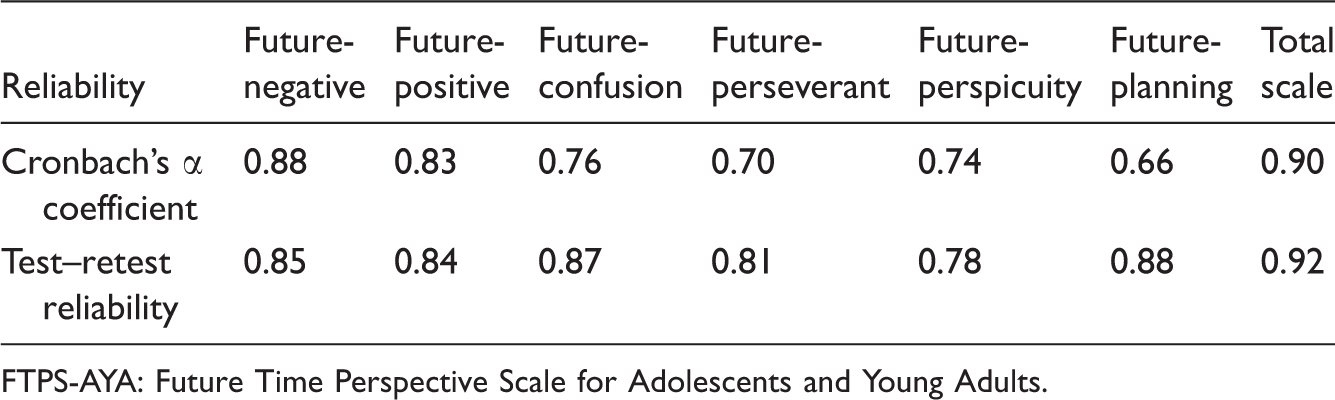
FTPS-AYA: Future Time Perspective Scale for Adolescents and Young Adults.
Validity
Construct-related validity
Correlations between factors and total scale.
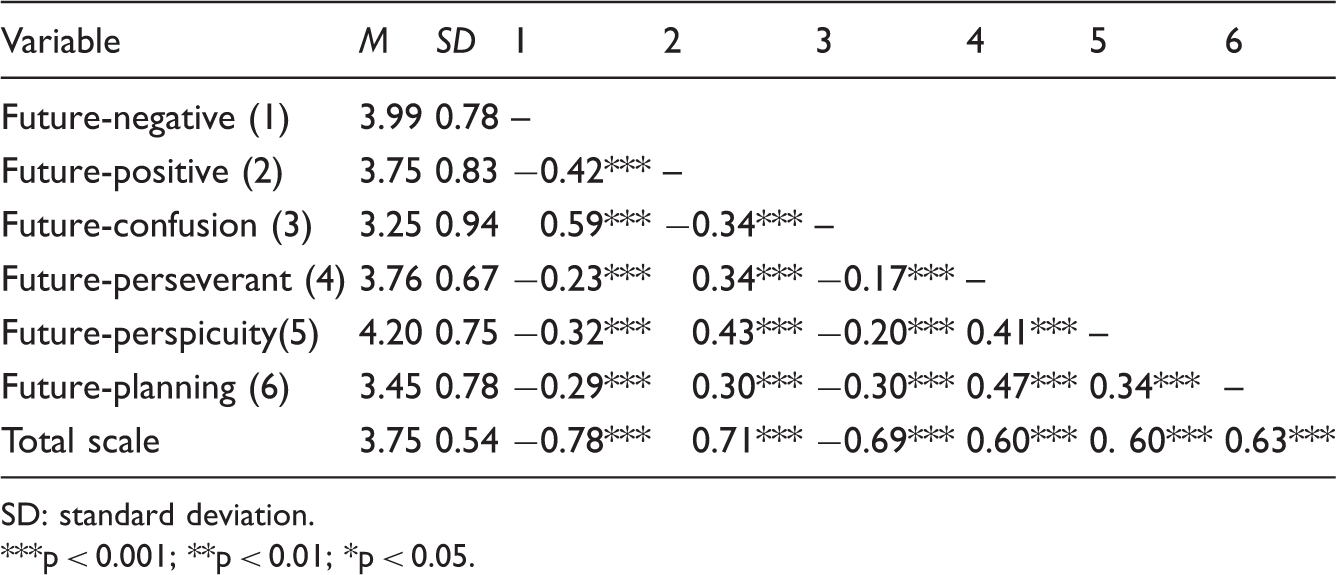
SD: standard deviation.
p < 0.001; **p < 0.01; *p < 0.05.
Correlations between factors and criteria.
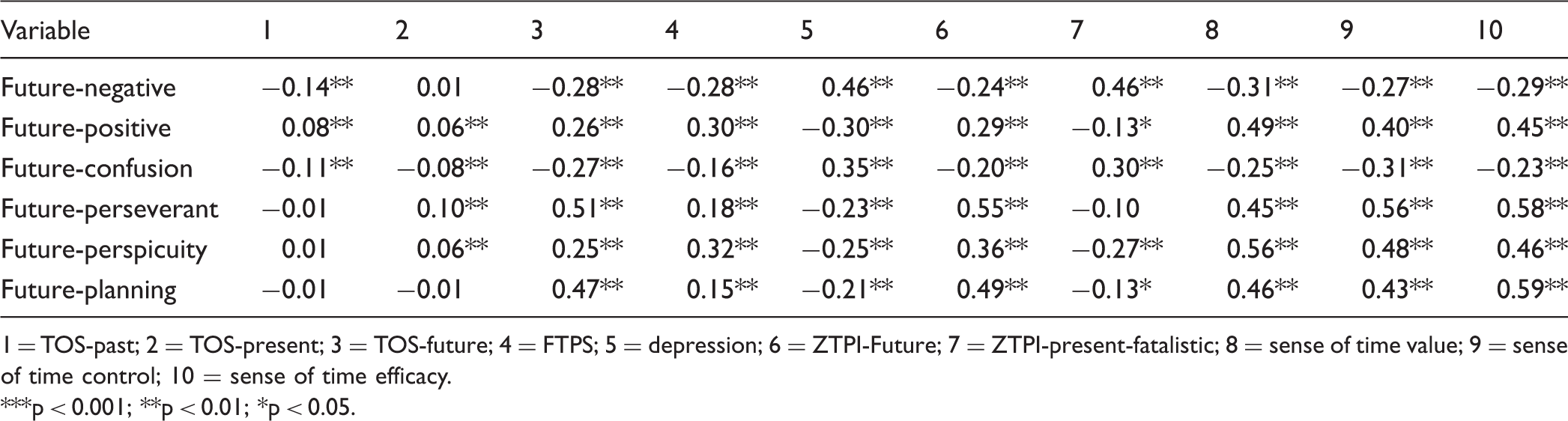
1 = TOS-past; 2 = TOS-present; 3 = TOS-future; 4 = FTPS; 5 = depression; 6 = ZTPI-Future; 7 = ZTPI-present-fatalistic; 8 = sense of time value; 9 = sense of time control; 10 = sense of time efficacy.
p < 0.001; **p < 0.01; *p < 0.05.
We assessed discriminant validity by correlating the subscales of FTPS-AYA with TOS (past and present subscales). As shown in Table 4, each factor of FTPS-AYA was either weakly associated or not associated with the TOS-past and TOS-present, providing evidence for discriminant validity.
Criterion-related validity
Previous research has shown that future-oriented individuals do not believe the future is determined by fate and are characterized by less depression, less anxiety, less sensation seeking, and higher self-control (Keough, 1999; Strathman et al., 1994; Volder and Lens, 1982; Zimbardo and Boyd, 2008). In the current study, the six factors of FTPS-AYA (with the exception of the future-perseverant factor) were strongly associated with scores on the depression scale and the ZTPI-present-fatalistic subscale, which provides evidence for good criterion validity of FTPS-AYA.
Confirmatory factor analysis
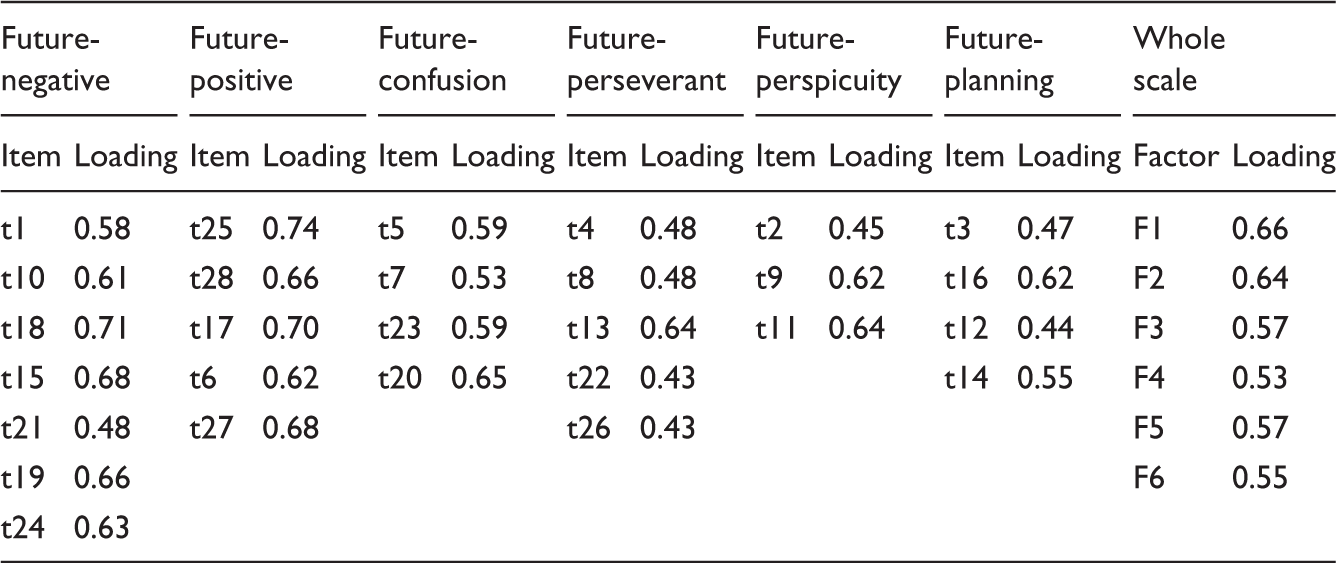
Confirmatory factor analysis (loadings).
Discussions
Psychological structure of the FTPS-AYA
Whereas some thoughts, feelings, and behaviors about the future are situationally determined, others are relatively stable over time (Lv, 2014; Zimbardo and Boyd, 1999). The present study developed the FTP scale in order to measure chronic individual differences in people’s perspectives on the future. The FTP scale helps to elucidate the nature and development of adolescents’ and young adults’ FTP and can be used to compare and evaluate different adolescent groups.
According to the results of open-ended surveys and individual interviews, FTPS-AYA was assumed theoretically to contain six dimensions. The factor structure of FTPS-AYA not only demonstrates the multidimensional nature of the construct but also shows some contradiction in some aspects of the construct (e.g., positive vs. negative, perspicuity vs. confusion). This is perhaps not surprising, as adolescents experience considerable ups and downs that may lead them to exhibit conflicting thoughts, feelings, and behaviors related to the future.
It is well known that FTP exerts a dynamic influence on many important judgments, decisions, and actions of adolescents (Zimbardo and Boyd, 1999). We argue that cognitions about the future act as the foundation to produce positive or negative feelings, and that these cognitions and feelings in turn result in different behaviors related to the future. This model and the consequences of FTP for specific actions should be tested in future research.
Reliability and validity of FTPS-AYA
In the current research, the internal consistency reliability for the six subscales of FTPS-AYA was uniformly good. Alpha coefficients were mostly above 0.70 (Table 2), and the internal consistency of the whole scale was 0.90. This provides evidence of satisfactory psychometric properties of FTPS-AYA. Test–retest reliability of FTPS-AYA was examined with an independent 489-student sample with a four-week interval. The autocorrelations ranged from 0.78 to 0.88, and the test–retest reliability of the whole scale was 0.92 (Table 2). Thus, temporal reliability of the scales was established.
Based on CFA, we found support for our model in which FTPS-AYA is represented by six latent factors. All of the items had high loadings on the latent factor on which they were expected to load, and all six factors loaded highly on FTP (0.55–0.66; Table 5). However, the goodness-of-fit index, χ2/df = 5.31, was a bit greater than the threshold value (2.0) suggested by Qiu and Lin (2009), due to a drawback of χ2 test that critical values are sensitive to degrees of freedom and large number of sample sizes. When sample sizes are reasonably large, models are rejected even though they fit the data well from a practical standpoint (Bentler and Bonett, 1980; Shipp et al., 2009). In our model (n = 1,480), traditional goodness-of-fit index, χ2/df = 5.31, was not an appropriate test of our model’s fit because of the large sample. Therefore, we also examined other fit indexes (GFI = 0.93, AGFI = 0.92, PGFI = 0.77 > 0.50, TLI = 0.87, RMSEA = 0.041, RMSEA LO = 0.047, RMSEA HI = 0.05, RMR = 0.05, PCLOSE = 0.92 > 0.05), which fall within the acceptable ranges and suggest that the data are consistent with our proposed six-factor model.
Three types of strategies were used to evaluate the validity of FTPS-AYA. With regard to content validity, the appropriateness of all items was evaluated by independent professionals and students and showed that each item was adequate to measure the factor to which it belongs, which evidenced good content validity. As to construct validity, apart from evaluating the correlations between factors and total scale (as shown earlier in Table 3, the absolute value of correlations between each factor and total scale falls between 0.60 and 0.78 and is greater than that of correlations between each factor, indicating the initial good construct validity), convergent validity and discriminant validity were also taken into consideration. Correlational analyses with measures of TOS-future, FTPS, ZTPI-Future, sense of time value, sense of time control, and sense of time efficacy supported the convergent validity of FTPS-AYA, because six factors of FTPS-AYA, TOS-future, FTPS, and ZTPI-Future measure the same construct (for details, see Table 4). Discriminant validity was also supported by our results. As shown in Table 4, correlations between subscales of FTPS-AYA, TOS-past, and TOS-present were found to be low though significant, or not significant. This pattern of correlations suggested that the subscales of FTPS-AYA, TOS-past, and TOS-present measured different constructs.
Regarding criterion validity, six subscales of FTPS-AYA correlated significantly with TOS-future, FTPS, ZTPI-Future, and three subscales of time management, providing good evidence of criterion validity. According to previous studies (Keough, 1999; Lv, 2014; Strathman et al., 1994; Volder and Lens, 1982; Zimbardo and Boyd, 1999), future-oriented individuals do not believe their future is determined by fate but firmly believe that their goals will be achieved by hard work. These individuals are characterized by less depression, less anxiety, less sensation seeking, and higher self-control. Therefore, the depression and ZTPI-present-fatalistic are appropriate to serve as predictive criteria. As seen in Table 4, besides that future-perseverant was not significantly correlated with ZTPI-present-fatalistic, the six subscales of FTPS-AYA correlated significantly with depression and ZTPI-present-fatalistic. Given that individuals who have higher scores on future-perseverant do not believe in fate and are good at overcoming difficulties, resisting temptation, and weighing the costs against the benefits, it is reasonable to get non-significant correlation between future-perseverant and ZTPI-present-fatalistic.
Limitations and future directions
Despite many benefits, the present study was subject to some limitations. First, although in the analysis of the FTPS-AYA validity, TOS, FTPS, and ZTPI-Future were used to as validity index, we missed other measures. For example, Future Negative Scale developed by Carelli et al. (2015) is expected to be correlated with some dimensions of the FTPS-AYA in present study, which could be a good validation scale. Further studies would benefit from adopting Future Negative Scale to test the validity of the FTPS-AYA.
Second, for the theoretical underpinning of the Future Negative the approach of Zaleski (2005) seems relevant, especially his thoughts about the relationship between FTP and anxiety. According to Zaleski (2005), on an individual level, people differ in their length of FTP and the intensity of Future Anxiety. The question of whether higher scores of future-negative can lead to a higher level of anxiety, or whether a higher level of anxiety can causally influence and impact on a person’s sense of a negative future, remains open. Future research aiming to examine the association of FTP and anxiety would contribute to provision of good evidence for validation of the FTPS-AYA.
Third, although the purpose of the current study is to develop a new FTP scale, it remains one interesting question of how this new scale is related to CFC (Strathman et al., 1994) as well as ZTPI. Strathman et al. (1994) suggested that CFC reflects an intrapersonal struggle between present behavior and immediate outcomes vs. future outcomes. It is reasonably predicted that the dimensions of FTPS-AYA would be associated with CFC. In China, there exist two already validated or pretested Chinese versions of ZTPI (both Chinese versions are reported by Sircova et al. (2014)). So, it might be interesting to know how both approaches—ZTPI and the new FTPS-AYA—can be combined in future research.
Fourth, previous studies have shown that FTP predicts and correlates with other variables, such as delay discounting (Daugherty and Brase, 2010), academic achievement (Volder and Lens, 1982), substance use (Keough, 1999), goals, social relationships, and socialization (Lang and Carstensen, 2002; Trommsdorff, 1983), positive health practices (Mahon et al., 1997), human immunodeficiency virus risk (Rothspan and Read, 1996), and risky driving (Zimbardo et al., 1997). However, the mechanism through which FTP predicts these variables has yet to be investigated. Further studies examining the relationships between the FTP and above variables will provide evidence of the predictive validity of the FTPS-AYA. Moreover, most studies on correlations of FTP and other psychological variables were conducted outside China. Future research aiming to investigate possible relationships between the construct of FTP and other variables should include samples of different ages and education levels, and with diverse social or cultural attributes in China, since cultures with more individualistic focus tend to be more goal-focused and future-oriented than those emphasizing collectivism (Anagnostopoulos and Griva, 2012).
Conclusions
The structure of adolescents’ and young adults’ FTP consists of six factors: future-negative, future-positive, future-confusion, future-perseverant, future-perspicuity, and future-planning, measured by 28 items. The FTPS-AYA has promising reliability, validity, and considerable potential utility in research on adolescent and emerging adult samples.
Footnotes
Acknowledgements
We would like to thank Kimberly Rios for feedback on the manuscript, Philip Zimbardo and Laura L. Carstensen for advice and support. We also acknowledge Youguo Chen for his assistance with data collection and analysis.
Declaration of Conflicting Interests
The author(s) declared no potential conflicts of interest with respect to the research, authorship, and/or publication of this article.
Funding
The author(s) disclosed receipt of the following financial support for the research, authorship, and/or publication of this article: This work was supported by the National Social Science Fund of China (14BSH080), Research Team Projects of School of Psychology at Southwest University (TR201201-2), The Scientific Research Foundation for Returned Overseas Scholars (1503000030), and the Fundamental Research Funds for the Central Universities of China (SWU1509389).