




Abstract
Territoriality has primarily been seen as a spatial rather than temporal phenomenon. In this paper, we want to investigate how time functions in territorialising processes. In particular, we are attracted by the multi-temporality that is co-present in each process of territorialisation (i.e. processes in which time and space are used as means of measure, control and expression). The article is divided into two main parts. In the first part, we draw inspiration from Gilles Deleuze’s book Logic of Sense, as well as from authors such as Simmel, Whitehead, Benjamin and Jesi, in order to articulate three different types of the present (Aion, Kronos and Chronos). In the second part, we move to a short case study of the collector John Soane and the establishment of his house-museum. The case is used to exemplify how these three presents can be used to discuss and temporal aspects of territorialisation in general, and the production of a specific sort of territory – the house-museum as a new building type in particular.
Keywords
Time–space territorialisations
Scholarship on human territoriality has been traditionally keen on emphasising two principal dimensions of territories, namely space and power (Sack, 1986). From this point of view, territorial phenomena would come about as strategic attempts to exert control upon given spaces, that is, using space as a means of power. Territoriality has also been linked to the claiming of space, so that territories have been regarded as spatial objectifications of specific assertions, requests and their ensuing arrangements (Malmberg, 1980). In the study of territorial formations, time and temporality have often been neglected, even though the process of territorialisation has always been about time as much as about space. The project of a general territoriology, we believe, should also include a careful consideration of time and the temporality of territories (Brighenti, 2010a, 2010b; Kärrholm, 2007). Regarding territories as events, as territoriology invites us to, inherently draws the researchers’ attention on their – either predictable or unpredictable – rhythmical formative dimension, considering territories temporal as much as spatial modulations and envelops, i.e. as space-times (Kärrholm, 2017).
In this paper, we investigate how time functions in territorialising processes. By doing so, we aim to strike a fairer balance between the spatial and the temporal dimensions in our understanding of territorial phenomena. In particular, we are attracted by the plurality of temporalities that are co-present in each process of territorialisation. In a wider sense, territorialisation can perhaps be described as a process in which time and space are used as means of not only control but also measure and expression. Certainly, Merriman has argued against that idea of time–space as an a priori measure of social phenomena, stating that the unfolding of events, movement and change, cannot be reduced to pre-defined time and space (2012: 21). We partly agree, yet also suggest that territorialisation could be seen as a way of producing time and space as much as a way of using them as means of measure and expression. In other words, timing and spacing – rather than time and space – are the structures deployed by social actors to stabilise events and territorialise them as well as, ultimately, territorialising themselves in those events.
The aim here is to investigate time as a measure of territorial becomings, or more precisely, the multi-temporality and simultaneous presences of territorial production. Because we are particularly interested in the temporality of the present, we aim to be sensitive to its richness. We believe the present is a specifically ‘rich’ time, as well as a ‘generous’ time. To highlight how the present is a time of fruition for territorial undertakings of all sorts, in this piece, we play with the two senses of the word ‘present’, namely (a) the here-and-now and (b) a thing given to someone as a gift. Thus, we entertain with the idea that time presents us with a present that is always a surprising, albeit often excessive, gift. If time gifts us with something, the present can be said to constitute its most genuine outcome. The title of this piece, evoking ‘three presents’, thus derives from the threefold articulation of the temporal present that we are going to discuss. We advance three visions of the present tense or, we may also say, three facets of it. It is important to remark that such facets of the temporal present should not be understood in isolation from each other. Every empirical situation contains simultaneously, to various degrees, all the three forms. In other words, these forms of present can be regarded as analytical traits to grasp a range of differing actual situations. It is also quite likely that there are more presents than those discussed here. In this sense, our current exploration is not meant to be reductionist, rather, is proposed as a simply preliminary inquiry into a more rounded theory of temporality that might be suited for social-spatial studies.
The article is divided into two main parts. In the first part, we articulate the three facets of the present to be examined in-depth. We draw inspiration from the philosophy of Gilles Deleuze, especially his 1969 essay on the logic of sense (better, the logic of meaning) as well as other authors in social theory such as Simmel, Whitehead, Benjamin and Jesi. A few illustrations will also be sketched to help visualise the discussed notions, before moving to a more extended case study in the following section, where we hope to show how the three presents may enrich our social-scientific temporal lexicon. The second part is indeed devoted to the peculiar case of the collector John Soane and the establishment of his house-museum, as well as, more generally, of the house-museum as a type of building. Notably, Elizabeth Grosz (2001) has argued that utopian architecture cannot be understood apart from its specifically temporal dimensions. In light of this, our discussion revolves around the process of ‘specialisation’: the production of a specific sort of territory and building type, the house-museum, within a specific urban context – London of the 18th and 19th centuries. The nature of the case also allows us to focus on the changing material infrastructure of territorial stabilisation as well as the slow, dynamic and multi-temporal processes that are inherent to it. Time might not always, as we shall see, go together with space, but like space it is certainly dependent on movements, becomings and acts of ‘making present’. This is because territorialisation is integrally about making time and space present, turning them into a venue of attention that is constantly conductive to new events.
Three types of presents
The first present we want to discuss is Aion. We symbolise it with the Greek letter α (alpha). Aion is probably the most difficult temporal notion to explain, yet arguably not the most difficult to understand. Properly speaking, it is the linear yet atopic present of the eternal becoming. Definitional attempts, however, might mislead us into thinking that α is an abstraction. Quite on the contrary, we believe, it is a most concretely immediate, even mundane – although disembodied – experience, notwithstanding the fact that its applications might turn out to be counter-intuitive. Aion is the endless infinitive line of the instant. In Process and Reality (1978 [1929]), Whitehead calls it ‘feeling’. A feeling is, in Whitehead’s parlance, the manifestation of a relational ‘engagement’ of an actual entity or actual occasion with reality. ‘An actual occasion’, explains Whitehead (1967 [1933]: 204), ‘never changes, it only becomes and perishes’. Arriving and going is what the actual present understood as becoming does. What is peculiar about the endless infinitive line of the instant, is that it does not move forward without concurrently moving backward. This is why α looks so unfamiliar from an everyday understanding of the temporal flow. Using an expression which features prominently in Lacan’s inquiry into the unconscious, Deleuze writes that the instant manque à sa place – it lacks from its proper place. The point is that, precisely, the ‘place’ of the instant cannot be found anywhere. Insofar as it is atopon, without place, α is ipso facto incorporeal. The instant, in other words, never corresponds to a state of things or the succession of states of things. In the memorable opening page of his treaty, Deleuze connects aeonic time to the adventures of Alice in Wonderland, as she magically changes size: When I say ‘Alice becomes larger,’ I mean that she becomes larger than she was. But the same token, however, she becomes smaller than she is now. Certainly, she is not bigger and smaller at the same time. She is larger now; she was smaller before. But it is at the same moment, by the same stroke, that one becomes larger than one was and smaller than one becomes. This is the simultaneity of a becoming whose characteristic is to elude the present. Insofar as it eludes the present, becoming does not tolerate the distinction of before and after, or of past and future. It pertains to the essence of becoming to move and to pull in both directions at once: Alice does not grow without shrinking, and vice versa. (1969: 9)
In this sense, we suggest, α is also a time ‘by subtraction’, a present whose proper operation is counter-effectuation. The notion of counter-effectuation will become clearer by comparison with the operations carried on by the other presents. For now, let us content ourselves with saying that the aeonic present is a momentum – not the things that happen, but the very ‘truth’ that they are happening. In a musical register, α equates to pure improvisation, an absolute yet absolutely mundane type of abstraction which, for instance, jazz players and listeners praise so highly. As the existentially ‘momentous’ aspect of time, α best reveals itself in all those peculiar experiences that exceed and simultaneously punctuate the everyday. The existential experience of the city is full of similar sensations. At a gig or concert, for instance, the audience tends to produce unique instants which have the effect of, so to speak, ‘amplifying’ the world while eschewing its actuality. Not by chance, the experience of the momentous present is often remembered as a dream-like or hypnotic state, as a unique and distinctive bubble of existence which is just as impossible to define as it is undeniably self-evident (a ‘firstness’, in Peirce’s sense). While usually associated with a sense of ‘fullness’, instants are, in fact, better understood as incredibly void and hyaline. The power of α is not fulfilment, but emptiness – potency, instead of power. Aion presents us with an incorporeal time of the pure event, a perspective from which corporeal things are already gone and simultaneously yet to happen. Literature offers important testimonies of this. In Victor Hugo’s Le dernier jour d'un condamné (1829), for instance, the man sentenced to death declares, ‘Je ne suis pas préparé, mais je suis prêt [I’m not prepared, but I’m ready]’. Photographs can similarly conjure up the aeonic present: suffice to recall the comment by Roland Barthes in Camera Lucida (1980) about the 1865 photographic portrait of the failed conspirator Lewis Payne: ‘He is already dead and he is going to die’. Aion is thus a divergent present. Similarly, Deleuze (2001: 28 ff.) points to a scene from Dickens, who describes the sudden care people show for a disreputable man, just because he is dying. In a way, they are caring, Deleuze suggests, for a life rather than for this specific life. It is an in-between moment, a presence where the becoming of a death also brings a becoming of a life. One does not enter the de-singularisation of death without a concurrent de-singularisation of life. Aion is thus the present caught as Jetztzeit, ‘now-state’ (as opposed to Gegenwart), or what in quantum physics is also called an ‘eigenstate’.
The second present to be introduced is Kronos, which we symbolise with κ (kappa). In ancient Greek, the verb κραίνω (kraino) is a quite complex verb encompassing several different significations. In our hypothesis, the truth about κ is somehow encapsulated inside a semantic triangle that comprises the following denotations (we are selecting among several more): (1) to accomplish, fulfil; (2) to reign over, govern; (3) to come to an end, terminate, result in. Kronos is not a chronological, but a chronic time. It is chronic in the sense in which certain medical conditions are said to be chronic: they come and go, but never pass. From this point of view, κ seems almost the antithesis of α: whereas the latter eschews the present state of things, the former can never supersede it and is constantly riddled with it. κ is probably the most difficult temporal notion to understand, insofar as its inner logic is mythological, rather than historical. Indeed, its structure is pre-Olympic. Kronos as Cronus, the Titan of the Harvest, lives before the establishment of order – the reign of Zeus – yet his presence is incipient and even immanent to that order. For all the disorderliness of κ, no order could be conceivable without it. So, here we have a sense of a coming power that can be prepared by bringing struggle and disorder to an accomplishment. This is precisely what Titan Cronus does.
1
Cronus embodies that type of accomplishment which makes the order of sovereignty possible. Some important remarks in this respect are made by Deleuze in one of his lectures on cinema. Deleuze notes orally that κ is a very excited time. It is the time of generations that clash against one other, which overturn one another. It is a savage time. It is really savage time, I mean an unleashed time, a undomesticated time … I’d nearly say that what belongs to the myth is such savage and undomesticated time. In other words, a time of the abyss from which successive generations come and in which they struggle against each other – it is a terrible time, a time of terror, a time without foundation, a groundless time of terror and struggle amongst the gods.
2
(07 February 1984)
Mythology is not, in any case, a thing of the past. On the contrary, there is definitely a present of mythology – nowadays and always. Such is the thick, viscous present of subversion. Kronos is the ominous present of revolution, understood as effective principle of ordering without acceptance of any possibly realised order. More precisely, following Furio Jesi, we should distinguish between revolution and revolt, recognising in κ the present of the revolt: I use the word ‘revolt’ to designate an insurrectional movement that differs from revolution. The difference between revolt and revolution does not lie in their goals. Indeed they can have the same goal, such as the seizure of power. What distinguishes the revolt from the revolution is, rather, a different experience of time. If, on the basis of a relatively common understanding of these two words, the revolt is a sudden insurrectional explosion, which can certainly be inserted into a larger strategic design but which by itself does not entail any long-term strategy, and if the revolution is, by contrast, a strategic complex of insurrectional movements which are coordinated and oriented towards certain distant final goals, one could say that the revolt is an actual suspension of historical time. The revolt suddenly introduces a temporality in which everything that is done has value in itself and for itself, regardless of its consequences and it relations with the complex of transience or endurance which makes up history is made. (2000 [1969]: 19) We usually place the general law of things in a certain way outside of things themselves: as partly objective, in that its timeless and spaceless validity [zeit- und raumlose Gültigkeit] makes it independent from the chance of its material entanglement [materialen Verwirklichung] in time and space, partly subjective, in that it is purely an object of thought and does not appear to our sensuous energies that will always perceive but the particular, never the general. This separation is what the concept of the Ur-phenomenon aims to overcome: it is the timeless law itself, but in a temporal observation [das zeitlose Gesetz selbst in zeitlicher Anschauung] – the general immediately accessible in a particular form. (1913: 57) Origin, although a thoroughly historical category, nonetheless has nothing to do with beginnings … The term origin does not mean the process of becoming of that which has emerged, but much more, that which emerges out of the process of becoming and disappearing. The origin stands in the flow of becoming as a whirlpool … its rhythm is apparent only to a double insight. (Benjamin, 1977 [1928]: § I: 22)
There is an on-going struggle to assert when is the present, i.e. to answer the question ‘When are we?’ For we know that, far from being a given, what we call ‘contemporaneity’ is something that must be produced. Kronos is time of clash and revelation that opens up when a radical interrogation on contemporaneity is vociferously raised. It is a ‘pregnant’ present of dissatisfaction and discontent. The attributes of animosity and clash, however, do not necessarily refer solely to the large scale, visible struggles of politics. Instead, we should also consider all the ‘tiny catastrophes’ of the everyday as manifestations of κ. As well put by Kracauer (1978: 252), ‘we must rid ourselves of the delusion that it is the major events which have the most decisive influence on us. We are much more deeply and continuously influenced by the tiny catastrophes that make up daily life’. It is in this sense that the temporality of κ encompasses an array of mundane practices that entertain a specific relation to space–times and measures, such as collecting. Not by chance was Benjamin himself a fond collector; not by chance, was his mythical urban explorer, the flâneur, a peculiar collector of urban memories, like a vertical probe cast deep into the sedimented urban strata: But the great reminiscences, the historical shudder – these are a trumpery which he [the flâneur] leaves to tourists, who think thereby to gain access to the genius loci with a military password. Our friend may well keep silent. At the approach of his footsteps, the place has roused; speechlessly, mindlessly, its mere intimate nearness gives him hints and instructions. He stands before Notre Dame de Lorette, and his soles remember: here is the spot where in former times the cheval de renfort – the spare horse – was harnessed to the omnibus that climbed the Rue des Martyrs toward Montmartre. Often, he would have given all he knows about the domicile of Balzac or of Gavarni, about the site of a surprise attack or even of a barricade, to be able to catch the scent of a threshold or to recognize a paving stone by touch, like any watchdog. (1999 [1927–1940]: 416 [M1,1])
The answer lies in the third type of present, Chronos, which we designate with χ (chi). As opposed to Kronos, Chronos is the cyclical present of chronological return. Schedules, calendars, plans and all other means of rational temporal organisation only make sense as properly chronological endeavours. As organised time, time tamed thanks to organisational devices, χ is the – only apparently simple – present of effectuation. As such, it stands in opposition to α, the time that counter-effectuates and liberates. Chronos is time productive of measure, for a measure can only be defined by a unit, and a unit can only be defined by a return – the homogeneous return of the minute, the hour, the day, the year. As opposed to κ, χ is reassuring time, time that flows, sequential time: scheduled, predictable, stabilised time. However, we should not be misled and overlook the fact that χ also harbours its specific oppressions and obsessions: deadlines, to mention just one example, are the deadly production of chronology. The example also makes us attentive to the fact that it is χ that provides the link between time and morality. Through chronology, the present becomes ‘ought’, it becomes moral time. Morality, as well as psychic disorder, for there is a special affinity between χ and the neurotic attitude. The endless return of chronological cycles is a tiresome, burdensome, exhausting return. That is why a nostalgia for the great freedom and the great emptiness of α, a nostalgia for counter-effectuation, cannot but punctuate the chronological present of effectuation.
The origins of χ are probably pre-Hellenic. The image of the swirling serpent, often spiralled around a shining egg or biting its own tail, seems to be Egyptian. We know, in any case, that the serpent is a very ancient symbol strictly associated with chthonic gods and rivers. These are local gods of the Earth. Since the late antiquity, the snake biting its own tail is employed to evoke the seasonal aspect of time. In his masterful work on the Orphic tradition, the classical Greek scholar Martin Litchfield West observes that: The Orphic scheme of an aboriginal watery abyss (Oceanus and Tethys?), from and within which is born an eternal creator in the form of a winged serpent (Chronos) paired with a female counterpart (Ananke), can thus be related to ancient Egyptian mythical antecedents … The serpent form of Chronos may have its origins in Egyptian fantasy, but in Orphic poetry it took on a symbolic significance which justified its retention and elaboration. Chronos was represented, we are told, as a winged serpent with additional heads of a bull and a lion, and between them the face of a god. (1983: 189–190) In 1857 there was still a coach departing from the Rue Pavee-Saint-Andre at 6 A.M. for Venice; the trip took six weeks. (1999 [1927–1940]: 431 [M7,9])
In summary, Figure 1 encapsulates the dynamic relationship between the three presents discussed so far.
Diagram of the three presents.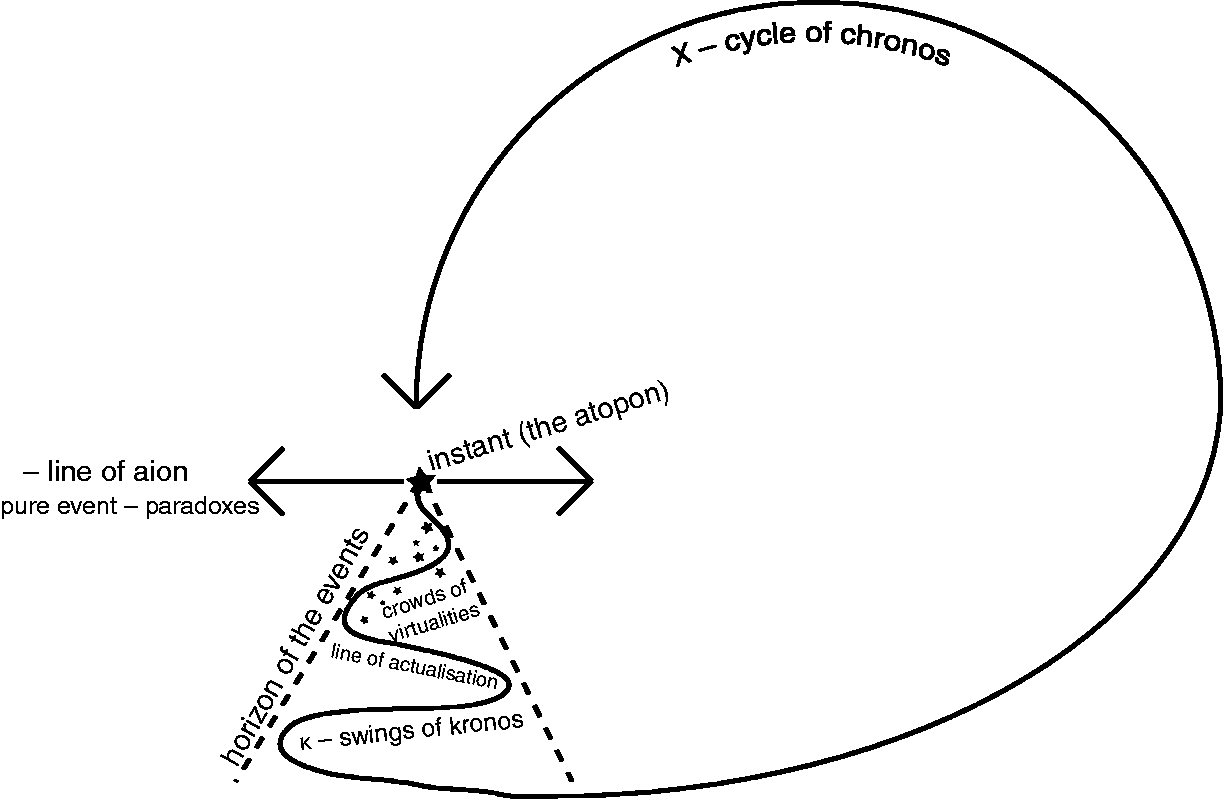
The gift of John Soane
The architect John Soane’s house in London was at the time of his death (1837) a veritable conglomerate of different architectural and building types. A building type is a territorial formation one of us has previously called a ‘territorial sort’ (Kärrholm, 2013). As Furján has summarised, Soane’s complex territorial formation was simultaneously a domestic residence, an expression of cultivation and taste, a museum and archive, a space of amusement (a collection of faux period rooms and a theatre of effect and atmosphere), a teaching collection and apprentice’s studio, an architectural office, a model townhouse, a cenotaph and, finally, a public monument. (2009: 90)
John Soane bought a townhouse at 12 Lincoln’s Inn Field in 1792, much helped by the money that his wife Mrs Elizabeth Soane recently had inherited from her father (see Figure 2). The house was already from the beginning also a working studio and full of Soane’s collections. After becoming a Professor in Architecture in 1806, Soane ‘began to arrange the books, casts and models so that the students might have the benefit to access them’ (Watkin cited in Dorey, 1999: 150). In 1807, he consequently bought the adjacent house, No. 13, in order to expand his collections and construct a proper museum area. The building of this museum area in 1809 (Feinberg, 1984) can perhaps be seen as the first official attempt to open Soane’s house to the public and started a steady stream of more or less irregular visits from scholars and students. In 1824, he extended his museum further after buying No. 14. The first guide-book of the museum was published during Soane’s lifetime, in 1827, whereas the first official opening hours seem to have been established just after his death, in 1837. Today, the museum counts more than 100,000 visitors per year (Knox, 2009: 44).
The main entrance to Sir John Soane’s Museum, Lincoln’s Field Inn, London (photo by courtesy of Jesper Magnusson).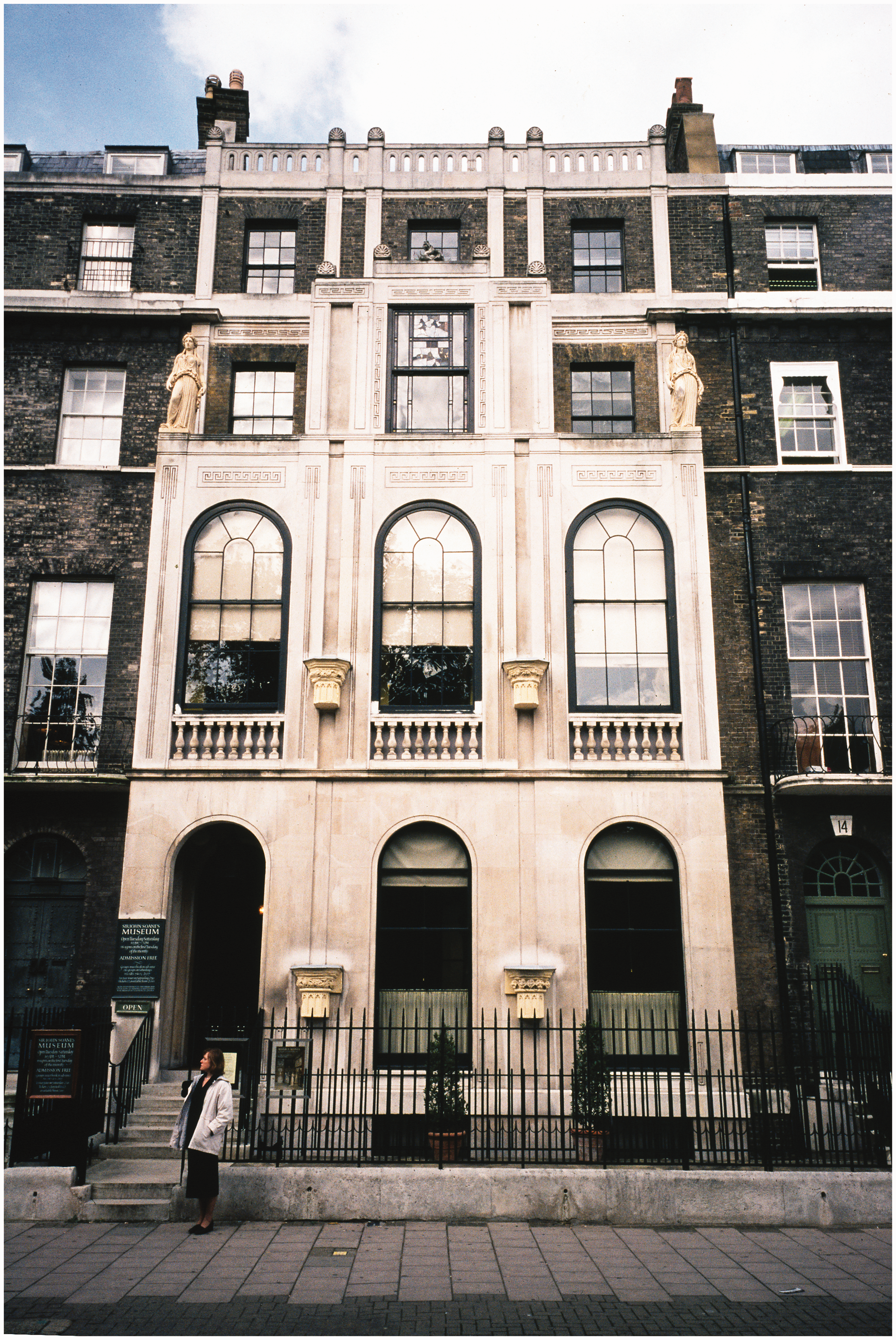
After providing such basic information about this curious enterprise, we can now go through the three different presents presented above using them as tools for investigating some of the temporal aspects of this process of territorialisation. To this aim, a useful driving question is: when did the building become a house-museum? Of course, it could be argued that it was one already in 1809: From the moment Soane made the decision to link his office to his house through a museological space, to the moment he made a gift of all its spaces, scenes, and spectacles to the public, it remained a hybrid being, one that could never be entirely private again, and conversely one that, as it became increasingly public (or dedicated to a public stage), could never be free of the private. (Furján, 2004: 76)
These questions of birth hint to the many different ‘presences’ of the house-museum itself. Many are the different temporalities to take into account. The process definitely started much earlier in Soane’s life, when he received a scholarship from the Royal Academy and left London at 5.30 a.m. on 18 March 1778 for Italy and his Grand Tour, not to return to London until two years later. Throughout his life, he longed to get back to Italy, but eventually never did. In many ways, his house seems to have become a compensatory testimony to that wish. John Soane’s house cannot be seen as a domestic ideal (which otherwise is common among architect’s houses on display). It also sits uncomfortably with a traditional museum space. From the beginning, it was a machine for the production of architectural ideas (Furján, 2009: 107), an assemblage of fragments, a miniature world, or perhaps more specifically a spatio-temporal Grand Tour neatly packed, displayed and enacted in the middle of London city. Soane’s territorial project can only be grasped by taking into account the rich production of spatialised temporalities and presences that criss-cross and overlap in his vision. As an architect, Soane was always interested in the deconstruction of classical rules and forms, and the displays at his house can be seen as an inspiration to that aim (cf. Middleton, 1999: 35). The Grand Tour was in its day a vast undertaking in terms of time, space and expenditure, and Soane’s place at Lincoln’s Inn Fields can in a way be described as the Tour itself compressed inside the walls of an urban townhouse; a compression of time–space but also, as we shall see, a territory of simultaneous presences that can learn us about the role of temporality in the conjuring up of territorial sorts.
Looking at the implementation of the house-museum, there is one presence that the museification of Soane’s house cannot do without, the present of Aion that, as seen above, eludes the present of states of things. Because of its aeonic quality, territorial production does not conform to Baudrillard’s distinction, recalled above, between accumulation and collection: both procedures are essential here, and the one is neither inferior nor superior to the other. In fact, accumulation (perhaps even more than collecting) is about being in the present, about celebrating the interstitial qualities and the parallel becoming of the now with the becoming of the past and the future. It is an unplanned opening in both directions that reconfigures simultaneously the past and the future. As hinted above, collectionism is grounded in a specific form of territorialisation. On the one hand, it entails an addictive thrust towards increase and expansion, yet on the other, it spins around a specific rhythmicality of acquisition. Between these two forces lies its pure, aeonic ‘eventality’. The folding of the Grand Tour is a remarkable aeonic achievement; the aeonic presence in Soane’s place also becomes clear in those on-going moments of potency when the owner-dreamer reassembled his material claims, buying new objects, adding new spaces, selling his country estate, etc. In 1824, he bought the Egyptian alabaster sarcophagus of King Seth I, outbidding the British Museum. This moment of acquisition plays an important role in the founding of the museum (see Figure 3). The sarcophagus seemed to immediately have posed questions about the nature of John Soane’s house. Are a mansion’s spaces grand enough for this sort of piece? Because the question must be answered in the negative, the sarcophagus initiated the redoing of the household offices into catacombs and a sepulchral chamber (Knox, 2009: 34 ff.). From a strictly architectural point of view, Soane’s place is neither properly a house nor properly a museum, and yet, as soon as we observe its becoming (as a house-museum), we realise that – just as Alice cannot grow without shrinking – it cannot become a house without concurrently becoming a museum, and vice versa. Territorial production thrives on the presence of Aion, the interstitial moment of possibilities and virtuality, a double bind that tames the has-been in the light of the to-come. At the core of this collecting and exposing enterprise, there is a purity of becoming that is the great emptiness of the instant. It is through such empty present, through the charm and potentiality of the yet-not spatialised instant of α that a history of the territory slowly establishes itself, reproduces, and changes in unpredictable ways.
Looking up at the Dome from the Sepulchral Chamber (photo by courtesy of Jesper Magnusson).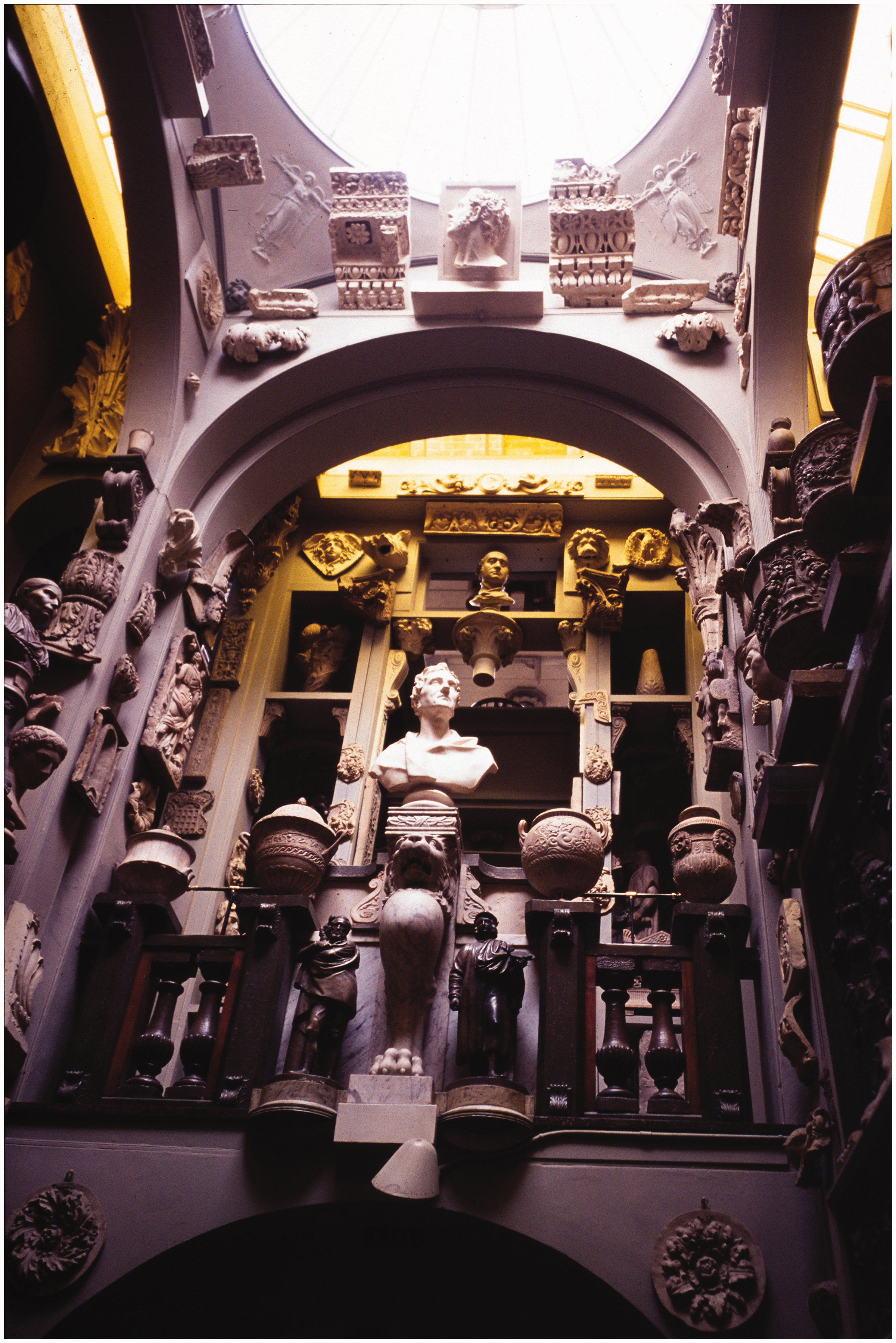
Secondly, we detect the presence of Kronos. After buying the sarcophagus and finally turning domestic chambers into public exhibitions, Soane held a three-day party with almost 900 invited guests (Darley, 1999: 25). This party was giving body to the moment of acquisition, one of many tiny revolts in the evolution of the museum. The sumptuous exaggeration of the feast is clearly a manifestation of sovereignty. But the sarcophagus was not just a moment of potency, it was also a revolting moment that brought an end to the domestic quarters of the basement. In a similar sense, Soane’s fight with his sons must also be seen as a revolt; indeed as a chronic (anti-chronological) moment par excellence. The house-museum rests on a fight between generations, the revolt of the sons against Soane as a father, the revolt of Soane against his sons (the disinherited), but also, the revolt of Soane against the social expectations of parenthood and generational succession, as he left his sons and grandchildren without economical support or inheritance, investing all assets in his own museum – including a mausoleum for his wife and her dog. To a certain extent, the violent break between the father and the sons can be seen as the very founding stone of the home-museum. Soane emerges as a new Cronus, ‘the son-eater’, revealing the ‘dirty birth’ of the institution. The infamous origin is chronically made present by the framed cursing letters of the son, still venomously hanging on the museum walls. 5 It is a revolt against an existing order that gave birth to an uncanny territory that stood across different and mutually incompatible spaces, such as the private-domestic and the public-urban. The presence of a chronic temporality is evident in the fetishism of the unsettling moment – in the form of the narcissistic three-day party and the even-more-so posting of the two letters – but the production of the museum also depends on a thousand additional tiny revolts, for example, the ones brought about by every new object or space that breaks the flow of time by questioning the established order. The present of κ is impregnated by the chronic megalomania of the founder as it swirls in the fullness of things accumulated and deeds accomplished.
The third presence, Chronos, is perhaps the one most often associated with the process of territorialisation. The cyclical recurrence of χ makes itself heard in many different voices. If we yet again take the sarcophagus of King Seth I, a most costly and grandiose purchase, one might ask if the museum was turning from an Italian into an Egyptian fantasy. In fact, we find that the museum is manifesting itself as a coalescence of uncoordinated fragments that cannot be totalised in any way (hence, again, a chronology that is riddled with chronic aspects). However, one of the most important rhythms of Soane’s new spatial order started with his announcement that students were welcome ‘to his house the day before and the day after his lectures to inspect the drawings and other collections’ (Dorey, 1999: 150). We know that, at some point, the place was open at Thursdays, which testifies to the instalment of a hebdomadal, predictable rhythm. After 1837, the museum was then open three days a week, from April to June, and two days a week from February to March, and from July to August. This went on until the 1920s (Richardson, 1999: 52). While these may look like minor details, in fact they are quite important in that they reveal how, by linking up to a chronological present of scheduled procedure, a given process of territorialisation may acquire a specific identity. Just as the rhythmical acquisition of objects is the measure of the Soane the collector, the recurrent visits of students and scholars – and, later, of a general public of visitors – is the measure of Soane the curator.
As all territorial endeavours, the production of a house-museum is not something done once and for all, but an on-going venture. Soane is perhaps best known as an architect who worked with complex spatial interiors, light, mirrors, openings (cf. Figure 4). It has also been said that Soane’s greatest quality was his way of designing interior spaces (Middleton, 1999: 29). In the case of John Soane’s house-museum, we are dealing with a formidable labyrinth, neatly packaged in a uniformly designed box; a folded spatio-temporal Grand Tour, where the inner complexity of the picturesque landscape stands in sharp contrast with the uniform exterior – especially if we compare it with the plans for the greater extended museum (which never was completed), comprising Lincoln’s Inn Field from No. 12 all the way to No. 16 in a symmetrical and palace-like façade. To be in the presence of the museum is a multimodal adventure – a gift of time as much as a gift of space. Soane worked with the presenting of times and spaces from far away (like ancient Greece or Egypt) through his exhibitions, and with less distant times and spaces through his architecture, anticipating the next room or moment of the Tour through the use of mirrors, vistas and perspectival openings between floors. His architecture was always as much about time as about space. Furján, in this sense, has documented how Soane worked with the contrasting practices of distraction and absorption, of passive reception and active participation – a theme much later investigated by Benjamin and Kracauer, and usually more often attributed to the 20th rather than the 19th century (Furján, 2004: 73 f).
The Breakfast Room in No. 13 Lincoln’s Inn Field. A series or mirrors and openings allow glimpses from adjacent rooms and museum spaces (photo by courtesy of Jesper Magnusson).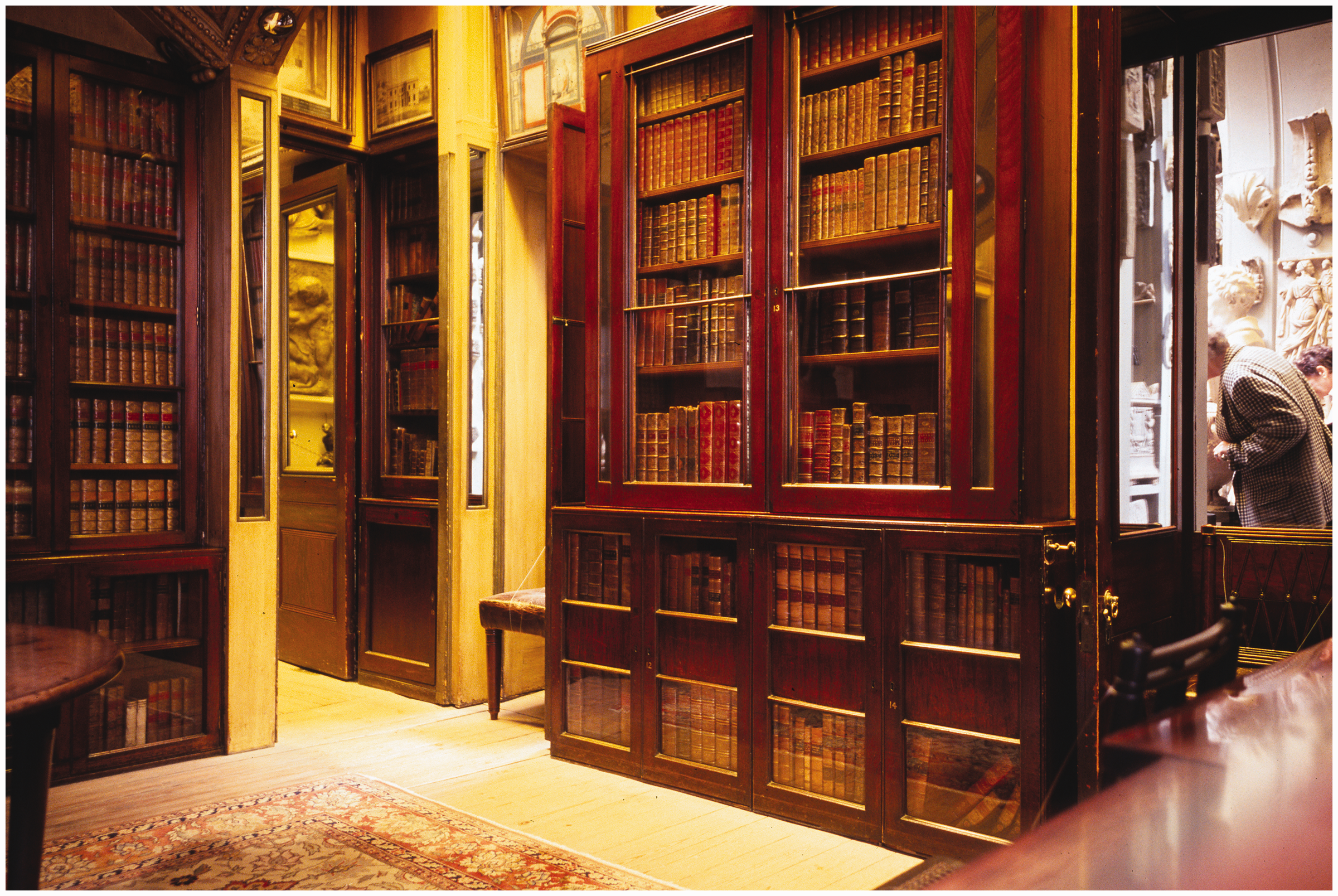
Conclusions: Three gifts of time
The presence of different forms of ‘present’ in Soane’s project is revelatory, we believe, of something more general about territorial production. From the suspensive and generative crack in private space induced by Aion (α), through the association of the Grand Tour and the cluttered accumulation of objects and spaces, to the sometimes violent revolts against societal demands and the domestic order that contradistinguish Kronos (κ), finally stretching to the rhythmical return of exhibited objects, visitors, opening hours, funds, new guide books and directors, under the regime of Chronos (χ), Soane’s house-museum provides us with a vivid illustration of the multi-temporality that is inherent to territorial phenomena. In this sense, Soane can be used as an intriguing case to back up our claim about the requirements for a general science of territories. As said at the outset, territoriology needs to attend temporality no less than spatiality, that is, both the spacings and the timings that give way to territorialised space-times. Territorialisations are always time–space territorialisations.
As we have seen, the plurality of temporalities that are co-present in each process of territorialisation is precipitated in the complexity of the present tense, or, the time of presence. In this article, we have explored the present as a time of richness. The three forms of present we have called, respectively, Aion, Kronos and Chronos are the veritable presents (i.e. gifts) of the present. The present is a gift insofar as it embodies a kind of majestic realisation. Whether we like or dislike the megalomania of the gesture, Soane’s gift cannot be separated from the ‘material grandiloquence’ of its presence, especially considering that his place probably never became what he had in mind. This also means that his house-museum as we can see it today may no longer be aeonic or chronic enough. With all due differences, looking at Soane’s house today is a bit like looking at Simon Rodia’s Watts Towers. Both are testaments, but if we insist on the theme of the gift, it is because we believe that the fullness of the present cannot be reduced to any prearranged scheme, of either a calendar-celebration type or of a clear-cut conflict type between opposing parties or generations. The gift of the present lies in its very overflow. In many cases, we literally do not know what to do with such abundance of life which unconventional figures such as Soane make us encounter. In anthropological theory, especially in Mauss’ (1950 [1924]) classic yet endlessly inspiring take, each gift is always filled with hau, the spirit of the giver that surveils the exchange in order to sooner or later settle the score. The spiritual presence that looms large over the given gift, the present gift, is of animistic type. The gift can thus even become a Gift in the German sense of the word, a poison.
Certainly, the gifts of the present are not always wanted. In this sense, there can be an excessive abundance in the temporal present – as the Soane case illustrates. This is why we have insisted on the tension between aeonic emptiness and chronic fullness. The activity of collecting, we have suggested, is largely played out in this domain of tensions. The present, we have argued, raises an issue of measure that cannot be solved in either Aion or Kronos. The mediating role of Chronos is essential. It is the present of the latter that enables measure and control, or mastery, over the presence and temporality of territories. On the other hand, however, the needs of expression in both the spiritual-existential and the political sense cannot be deduced from, reduced to, or granted by any chronology. Soane’s dream and, ultimately, his gift to us, lies in making us aware that territorialisations entail that time and space not only become means of measure and control but also of expression and transformation.
Footnotes
Declaration of Conflicting Interests
The author(s) declared no potential conflicts of interest with respect to the research, authorship, and/or publication of this article.
Funding
The author(s) received no financial support for the research, authorship, and/or publication of this article.