




Abstract
There has been significant interest of late into how academics spend their time during both their working and personal lives. Inspired by research around academic lives, this paper explores the narratives of 25 early career academics in Australian institutions across the country. Like several others, we propose that one of the fundamental aspects of time in academia is that of labour spent doing formal, instrumental and bureaucratic tasks. This impinges on the other side of academic life, the writing, research and discovery that bring subjective value to the academic. Using a Weberian framework however, we argue that there are two distinct rationalisations of these ‘times’ occurring. One is the formal, instrumentally imposed rationalisation of the university itself and the second is a more personally defined subjective rationalisation of research and writing. In terms of the latter, we argue that younger academics are not only seeing these times as important for their sense of self in the present but also for their projected vision of what they will become later in their professional career.
Introduction
Time in academia has attracted significant interest for some time now. There has been a plethora of papers written investigating the sources, engagements with and experiences of academic temporalities. Several key studies, some published in this journal, have sought to divide academic labour into categorised ‘times’, which academics seek to control, create boundaries between and protect through certain legitimate activities (Ylijoki and Mäntylä, 2003). Heavy emphasis has been placed for instance on the divide between time that is formal, rigid and designed for short-term goals such as moneymaking for the institution, and that which has more impact on academic subjectivity (Archer, 2008a, 2008b; Davies and Bansel, 2005; Hey, 2001; Kelly and Burrows, 2012; Marginson, 2008; Noonan, 2015; Parker, and Jary, 1995). Described as ‘timeless time’ by Ylijoki and Mäntylä (2003: 62) in this journal, there is a significant concern for the accelerating speed of the academy and the ‘time bind’ that is threatening temporalities where academics can engross themselves in discovery motivated by their own ‘enthusiasm, fascination and immersion in their work’ (Ylijoki and Mäntylä, 2003: 62).
Indeed there is a tendency in more recent work across disciplines to see academic labour as increasingly subjugated to a host of bureaucratic mechanisms, metric systems and justifications for times spent in the service of the university. This heavy ‘time pressure’ is considered the result of the continued neoliberalisation of the sector, which is pervasive but also reliant upon the willingness of individuals to engage enthusiastically through their own neoliberal identities (Davies and Bansel, 2005; Guzmán-Valenzuela and Barnett, 2013; Menzies and Newson, 2007; Ylijoki, 2013). This is certainly evident in the discourses in Archer’s (2008a: 282, 2008b) studies where younger academics display illustrations of ‘neoliberalism’s governmentality of the soul’. As Davies and Bansel (2005: 51) also find, the ability to control and manage one’s own time is compulsory for academics living in the neoliberal university. Even when academics complain of a ‘lack of time’, it is exhibited as a ‘personal failure to find time’ (Davies and Bansel, 2005: 51). Of course, academia is not immune from the changing conditions that surround the ivory tower in relation to time pressures (Adam, 1995; Agger, 2004; Hochschild, 1997; Schor, 1998; Sennett, 1998; Tomlinson, 2007).
However, it is clear that academia is changing as academic work is increasingly quantified and made more visible to managerial staff. As Kelly and Burrows (2012: 148) argue in their summation of the discipline of sociology, ‘measuring the value of sociology […] involves multiple mutual constructions of reality within which ever more nuanced data assemblages are increasingly implicated’. Furthermore as Noonan (2015: 114) has noted, ‘changes’ to the academic frameworks of worktime and what constitutes labour are ‘both extensive and intensive’ altering the very ‘internal structure and experience of academic work time’. Academic labour is becoming increasingly complex creating a time-space that is ‘not only time compressed […] it is fragmented and then recombined as many-layered moments through multi-tasking’ (Menzies and Newson, 2007: 92). For Ylijoki (2013: 250), it seems that our working lives are punctuated by ‘wasted time’ where ‘short-term, fragmented … unconnected episodes are compressed into the here and now’.
Underlying the core concern with the trajectory of academic time are concerns over what it means to be a ‘scientist’ in today’s universities, vis-à-vis the passion or calling for research and discovery (Cannizzo, 2015a). Those writing in this area often cite this as times that are under threat from more formal, short-term orientated and ‘money-making’ activities (Noonan, 2015). For Ylijoki and Mäntylä (2003: 63), the ‘timeless times’ that are set aside for thinking and research requires ‘personal commitment, deep dedication and long-term concentration’. It requires, ‘formal protection of the right to pursue streams of research that oppose the ruling money-value system, but it also requires the time to do so’ (Noonan, 2015: 115).
Unlike Ylijoki and Mäntylä (2003), Noonan (2015: 115–119) argues that ‘timeless times’ are better understood as ‘thought-time’ that is juxtaposed against ‘money-time’, with the latter being associated with ‘the imposed requirement to serve the production of money value’, and the former the ‘surplus time as the material condition of experiencing oneself as a subject capable of deciding between different possibility for activity’. For Noonan (2015: 125), it is the short-term interests, but also intensification, of ‘money-time’, which is restricting opportunities for quality ‘thought-time’, halting the development of the academic’s subjective enjoyment of work as ‘all of one’s time is dominated by the short-term demands that one’s thought and action make money’.
For others, divvying up temporalities in this manner discounts the nuanced nature of everyday working life for an academic. Spurling (2015: 386) recently argued that ‘the sequencing, duration, rhythm, pace, recurrence, flexibility and rigidity of particular activities and events are shaped as work-life boundaries, intrinsic practice rhythms and organisational structures’. For Spurling (2015), it is therefore important to examine the everyday practices of temporalities as well as the social structure that support and reproduce them. The uneven distribution, for instance, of ‘qualities of time’ mean that some academics, especially younger ones, can find it much more ‘difficult … to move a career forward’ (Spurling, 2015: 386), as work that ostensibly contributes to their future prospects, such as publishing, must be juggled with duties, such as teaching, and the pursuit of ongoing intellectual interests (i.e. ‘slow research’). Academic temporalities do not exist in a vacuum, but are constructs of both the individual’s goals and ambitions, and the structures that oversee the governance of temporalities. As Spurling (2015: 386) argues, while larger universities in the UK are able to provide funding for the buyout of teaching, research technical staff and so on, time is experienced in very different ways in smaller institutions with little funding.
With an emphasis on these ‘shared time perspectives’, Spurling (2015: 371), argues that ‘qualities of time’ are made in everyday work and organisational practices. The ‘temporal ordering of daily life’ and the theoretical work of the likes of Zerubavel (cited in Spurling, 2015: 371) provide a theoretical resource much more complex than used in other works. Thus for Spurling (2015), it is important to understand the ‘rhythms and times’ of academic labour individually, as thus can help us to understand how certain temporalities are valued over others, and how this impacts on social reproduction within the university system itself.
We argue that underpinning experiences of academic times, especially for early career academics (ECAs), is a sense of maintained division between two areas: that of everyday instrumental tasks and those substantive times that are in-tune with their own academic interests and projected sense of self. In other words, rather than repeating what has been said by Ylijoki and Mäntylä (2003), we argue that underpinning how ECAs engage with academic labour are rationalisations that feed into an idealisation of what the ECA wants to become later. In our interviews, there is an underlying shared narrative amongst younger academics about what an academic is, what they are and where they want to be. And for our respondents in this study, as will be shown, the academic self that is sought for is one that is research orientated and feeds deeply into their sense of identity, and underpins their future success. Yet, ECAs are highly aware of the increasingly ‘bureaucratic’ forms of labour that impinge on their success in this area. Hence, as Ylijoki (2013) argues, boundary work is undertaken to protect the temporalities that will enhance their prospect of a future ideal academic self against the modern pressures of academic life.
In order to make sense of this relationship between the ECA and academic labour, we turn back to Max Weber’s classical sociological thinking on rationalities, which has attracted some attention in this journal (Adam, 2009; Lee, 2010). We argue that the initial divides that the ECA presents between their everyday instrumental tasks and labour that serves to authenticate their identities, as academics as well as protect a future ideal academic self, bears resemblance to what Weberian scholar Mommsen (1989) describes as the split between formal and substantive rationalities. Much has been written on this and there is scarcely enough room to do it justice here. However, it is well known that for Weber (1904 [2012]), one of the trends endemic to Western modernity is that of the rationalisation of everyday life, the breaking down of the irrationality of premodernity and the disenchantment of our social worlds through the use of impersonal and technical explanations and guides in more and more spheres of life. God and myths were increasingly being replaced with the cold-hearted calculability of science and intellectualism as well as an ever-growing bureaucratisation. Unfortunately, there is a tendency in the social sciences to believe that Weber meant that modernity was attuned into an all-encompassing monolithic process of rationalisation that created a homogenous ‘iron cage’ that everyone was trapped in (du Gay, 2008: 131). However, as du Gay (2008: 131) has argued, rationalisations, or the turn to goal-orientated action, happens at different levels and do not ‘follow the same path, towards the same end’. Weber (1920 [2002]): 365–366) himself made this very clear when he argues that there a ‘great many different things’ that can be ‘understood by this work (rationalisation)’ and that even ‘mystical contemplation’ follows its own trajectory of rationalisation. For Weber (1920 [2002]: 365–366), modernity creates ‘different spheres of life’ (Lebenssphären), which ‘can be rationalised from extremely varied perspectives and aims’. The main point here is that rationalisation occurs in different spheres of life, which at times are quite independent though can come into conflict with each other (Weber, 1920 [2002]).
The Weberian scholar Mommsen (1989: 156) provides us with a more theoretical flesh to cover the bones of our argument. In his recounting of Weber’s rationalisation thesis, he argues that the process again is not uniform, but is underpinned and differentiated by values, beliefs and goals. It is worth citing him at length to illustrate his point; Now history was the embodiment of a plurality of competing processes of rationalisation, directed either by the immanent dynamic of material conditions and institutional structures, or by ideal interests which draw their energy from otherworldly and subjectively absolutely binding ideal values anchored in particular world-views which have found a concrete base in the life-conduct of social groups. These world-views are in a perennial struggle with one another. This was true for rational Western civilization of Weber’s own day just as much as for former historical formations. (Mommsen 1989: 164, italics added)
Methods and theory
Our article draws on research conducted in 2015 with 25 ECAs across a host of disciplines in Australian universities. Our motivation for considering this group only is twofold. Firstly, the younger generation of academics coming through the system are arguably facing a far different institutional context through neoliberal reforms than prior generations (Archer, 2008a). This includes stricter and more precise measurement of research and teaching performance than anyone else in the history of the university sector (Archer, 2008a; Kelly and Burrows, 2012). As Archer (2008a: 282) argues in her excellent research, younger academics embody the very institutions that they inhabit as ‘subjects cannot exist outside of the conditions and locations within which they are located and by which they are constituted’. Secondly, we also wish to understand how younger academics experience the everyday aspects of temporalities in relation to planning for their everyday working lives and their future ambitions.
Cohorts by gender and type of university working for.

While we knew anecdotally and from other research that Australian ECAs were actively enrolled into neoliberal institutional frameworks (see Archer, 2008a), we were unsure as to how this would impact upon their temporal experiences of university life. We were further aware that much of the workforce in Australia is moving towards casualisation or short-term contractual positions not unlike other institutions overseas (Ylijoki, 2013). As such we sought to gain the experiences of those in a variety of roles so we could ascertain the nature of their temporalities and how these influence everyday work life in comparison to those who are relatively more settled in their career.
Nevertheless the main agenda of this research was to undertake a thorough examination of ECA temporal life in Australia and furthermore how they envisaged their careers progressing. By doing so, it was anticipated that we could gather information on how times are used in the present to imagine a future self. This, as has been argued elsewhere, provokes questions of authentication and what it means to have ‘passion’ as an academic (Cannizzo, 2015a). Understanding the temporal nature of ECA’s everyday life enables us to have a snapshot into their own understanding of what academic life is and perhaps tap into what they think it ‘ought’ to be.
Interviews were conducted via video conference programs due to time constraints and the difficulties of distance. However in some cases, they were conducted face to face in the campuses of those we interviewed. The interviews once transcribed were analysed using a grounded theory approach wherein theories were not tested but rather derived through the systematic interpretation of data through coding (Babbie, 2013; Strauss and Corbin, 1998). In short, we were hoping to follow an inductive approach to this project. Specifically, we followed an open coding style wherein data were ‘broken down into discrete parts, closely examined and compared for similarities and differences’ (Strauss and Corbin, 1998: 102).
The narratives of the text, through the use of NVivo, were placed into categories such as ‘work/life’ or ‘time’ and then reanalysed using an axial coding strategy where data are ‘regrouped’ and ‘more-analytic concepts’ are explored (Babbie, 2013: 389). Using this coding strategy allowed us room to be creative and consider further how ECAs talk around concepts of time, order, schedules, private spheres and everyday working conditions. This allowed us to consider theoretical implications for our research and resonated with the theories of Weber as outlined above.
The location of the ECA in relation to instrumental and substantive times
Distinction of activities between instrumental and substantive times.
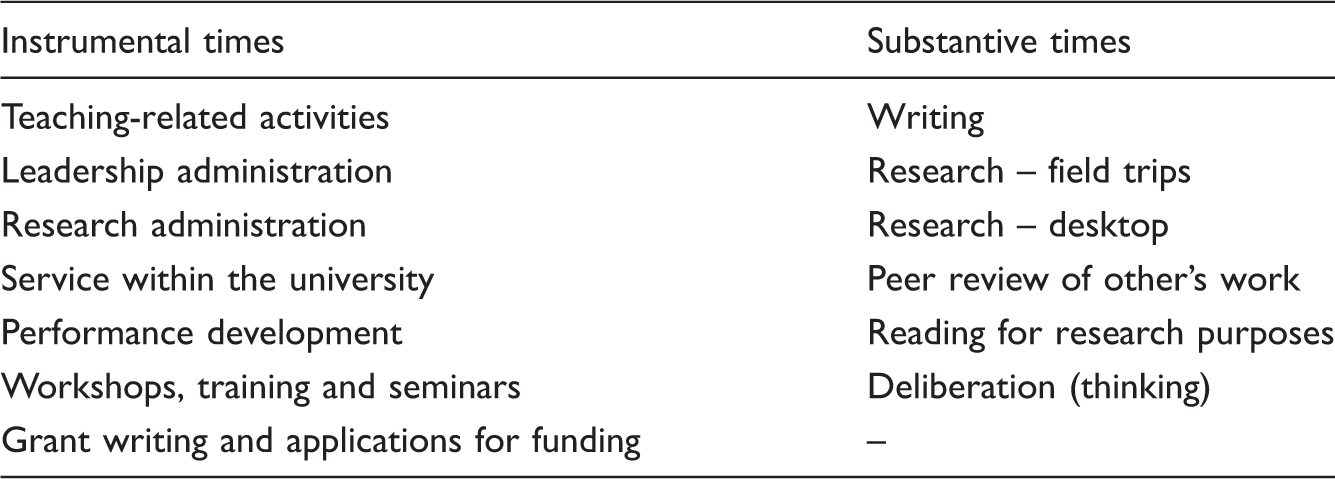
Instrumental times
We begin with the more immediate short-term processes, which have also been labelled ‘schedule time’ and ‘money-making time’ (Menzies and Newson, 2007; Noonan, 2015; Spurling, 2015; Ylijoki and Mäntylä, 2003). For the purposes of this paper, and bearing in mind Spurling’s (2015) arguments about making distinctions between temporalities too strict, we argue that Weber’s work on instrumental rationality as outlined by Mommsen (1989) above provides us with some significant theoretical opportunities to talk about the conditions of academia (see Table 2). These times we characterise similar in a sense to that of Ylijoki and Mäntylä’s (2003: 60) ‘scheduled time’, which is ‘externally imposed and controlled timetables, such as project deadlines, lecturing hours and administrative meetings’. From a Weberian standpoint however, this is a type of time that is rationalised formally, through bureaucratic structures and emblematic of modernity more generally. Universities require bureaucracies in order to acquire profit (especially in Australia), though also embed values of prestige and status into their composition of structure in order to increase their rankings in world-wide indicators such as that published by Times Higher Education (Cannizzo, 2015b). For the ECA however, this time is not recognised in a similar manner. It is one imposed upon them which is divided from that which provides true satisfaction. It is as one of our participants describes, time that you ‘don’t have to pay as much attention’ in relation to ‘creativity’ and deep thinking.
Several of our participants describe this time as something that they need to get out of the way in order to get to the more satisfying aspects of their jobs. Vivian, a lecturer from a large regional university, describes his workday as a process of eliminating the mundane tasks that are imposed upon him first thing in the morning. Recently obtaining a position in leadership, Vivian exemplifies what Spurling (2015) describes as the qualitative differences in time scapes that different academics experience. Regional universities in particular tend to be short on staff within disciplines and Vivian, still an ECA, was quickly called upon to be head of his discipline. He comments; I tend to try and knock over all the email and admin stuff first, which I increasingly know is a mistake. I should be trying to do creative stuff first and worrying about other people’s stuff later but feel the pressure specifically as the head of discipline to look after everyone, other’s needs so that I’m not holding them up. So yeah, teaching and admin emails, and then hopefully clear some space in the afternoon to do research stuff.
These impositions placed upon Vivian are what we are describing as the more formal aspects of academic life, or the increasing rationalisation of responsibilities for institutional demands. As Vivian describes it, this is endemic of the ‘professionalisation’ of the university sector where academics become multi-taskers managing funds, filling out paperwork, answering emails from stakeholders or students, attending meetings and supervising other staff including casual teaching staff. For him, getting skilled at regulating these times is an important part of learning how to succeed in academia. He comments further that he has ‘become … more efficient in teaching and I suppose as I’ve grown into the role of being an academic. I’m much more confidant now with teaching with less preparation’.
Spending time engaging with the instrumental components of academic life in order to rescue time for research is a recurring theme in the narratives of our participants (cf. Ylijoki, 2013). For Michelle, a recently employed ECA at a large metropolitan university, carving out time for these activities means regulating whole days on activities related to administrative and teaching tasks. I tend to keep my research days to Thursdays and Fridays. And I try to fix them, I try to preserve them as much as possible. So that means if there’s a teaching day I try to fit in a whole lot of different things around teaching that is related to teaching.
We will return to the question of research time later, but returning to Spurling’s (2015) point it is evident that some of our participants do not have the luxury of containing and controlling their instrumental labour time. Specifically those who are on research only contract positions. For Ylijoki and Mäntylä (2003: 65), people on ‘contracted time’ are continually orientated towards a sense of ‘time as something that is terminating combined with an uncertainty with the future’. For those of our participants in research positions working on other academic’s projects, it also results in an inability to control aspects of instrumental times. For Jennifer, a research fellow at a large metropolitan university, this means a constant and heavy stream of uncontrolled administrative tasks being required to continue rolling over contracts. Coming from outside the sector into academia, she suggests that, I’ve found academic work to be a lot more commanding … a lot more stressful, the parallel expectations that you collaborate produces a set of challenges … the main thing that I find really difficult is to advocate for resources and build strong research teams. We’re constantly having to do administrative work, and employ research assistants on short contracts … in any other organisation you’d cobble together resources to keep people on board and secure, but it’s very hard to do that at a university. I’m paid to work on particular projects but I obviously still need to try and publish from my PhD which is a totally different area of study. I do also, if I have time, try and do PhD-related publications when no one’s watching.
Much like these two participants, Melinda, who is an ECA from a medium-sized metropolitan university and research fellow on other people’s projects, views instrumental time as less controllable than our teaching/research academics. As a project manager of sorts, she describes her workload as far less structured, or in her words, being ‘like herding cats’. She comments, So like, especially we work a lot internationally with partners in the US, Canada, India, so yeah you sort of have attached to that yeah, I got to get up look at emails, think about what’s eventuated, overnight … Yeah, ok, day to day life, it’s pretty ad hoc, not really stock standard in any way and it’s sort of very reactive, as opposed to, it’s not planned out, or strategic … I’m quite reactive to whatever leadership is wanting at certain points in time.
While this is not the experience of everyone, these stories reflect the nature of academic temporalities. In respect to the ‘instrumental’ activities that academics have to engage with, it is clear from our participants that everyone felt the increasing tempo and intensification of these activities in their everyday lives. However, for some, there was an ability to control these, putting aside time for research, which most of our participants claimed to have some higher substantive value (see below). As Spurling (2015) argues, the unevenness of this distribution ought to be considered further as the ability for some of our ECAs to carve out some space for value in their labour is not shared amongst the whole cohort. From Mommsen’s (1989) standpoint, this is also where we see a conflict between a formal rationality, one that requires adhering to rules and regulations with that which provides substance to the academic, and even authenticates their experiences. We have seen already this conflict play out in the above statements from our interviewees. We turn now to those temporalities that provide substance to the ECA and that which they believe will enhance their future opportunities to be what they desire the most.
Substantive times
Ylijoki (2013: 247) suggests that boundary-work, as noted above, is something that at times is planned for through various techniques where one can remove themselves from the pressures of instrumental times, and engage with ‘timeless time’ (Ylijoki and Mäntylä, 2003). Discussing her participants she argues that, there are some, although few, academics whose descriptions of their working practices fit with the categories of ‘timeless time’ and ‘slow time’. In spite of the acceleration in academia, they have succeeded, through sabbaticals, research grants and other special arrangements, in attaining space and time for long-term concentration on and immersion in research, enabling them to follow the ideal of total commitment to the full. (Ylijoki, 2013: 248) Such inquiry needs to take account of individually pursued purposes, values and beliefs as well as socially constituted ideals, rules and moral codes. This entails understanding (verstehen) of the teleology of action, not losing sight of the futures that guide actions in the present, and providing explanations that render the futurity of these actions intelligible.
We start with Beck, a recently hired lecturer at a large regional university, who had worked previously for a number of years as a research assistant in a larger metropolitan university. Beck describes her new role as a bit ‘manic’ and yet describes her feelings about her research in particular in this way, Work (research) for me is part of who I am. I don’t really have many hobbies or interests, so engaging with questions in my research is … well I’m not just doing it because it is my work, I’m doing it because I’m passionate about these issues that I deal with in my work. Even on Facebook, the issues I find myself drawn too are those that relate.
One short case exemplifies this point. Terry is an ECA at a medium-sized metropolitan university and has a very structured day. He comments that he immediately engages with research and writing not long after waking up in the morning as this is when he can be free to explore creatively. However, when pressed about the value he places on this time and on this experience he comments, You know work is a central part of my life. I often see what I do, particularly my research and writing, as not particularly work. I’d probably do it to some degree even if I wasn’t at a university, or I wasn’t getting paid. It’s something that gives me joy. So yeah, I don’t really mind too much that, you know, the work is ever present.
While time spent writing and publishing in particular can be very satisfying and authenticating to the participants, it is not without rational goals and objectives. This is where we argue that for many of our participants, research is seen as a way of establishing themselves for some future ideal self. Several of those in the study comment on their ideal pathway from here which is inherently determined by their research both current and into the future. This is where publications, citations, grants and other important indicators or metrics become important especially to provide pathways towards this idealised sense of self. In some regards, while cynical at times about the neoliberal structures of the university system in Australia for formalising and measuring outputs, ECAs also embrace these as gateways to opportunities for funding, promotions and other indicators of success, that lead them eventually to a teleological point where they become their idealised self.
One of our participants for instance, Genevieve, an ECA from a large metropolitan university, took active steps to enhance her research profile by leaving a higher role in a teaching position to a lesser research only placement, which for her was the only way she could ‘get traction with my research and eventually start to build’ and ‘succeed more’. The strategy in doing so has led her to begin to envisage two potential career pathways. One is future leadership, for instance she claims ‘people think I would be a good Dean or Director’. Another is more appealing, she states, Do I just want to be a research professor in my office writing my books, which sounds really, really appealing to be honest and having my PhD and Masters students and having a great time doing workshops and going out with them and making them cups of tea or whatever … So yeah I’m ambitious and I’m not. I don’t want to stay comfortably where I am. I want to keep pushing, I want to move forward, I want to develop my track record.
However, these goals are not necessarily short term. ECAs make comment that they are fully aware of and understand what good academic capital is for the purposes of promotions. Jeffrey for instance exemplifies this (as did Olivia above) in the following statement about spending too much time on teaching; I’m doing that again (teaching) next semester and you know I won’t be spend nearly as much time on it, probably because I’ve prepped the hell out of it, you know. I’m a bit savvy where priorities lie especially when it comes to promotions and things like that. And it’s certainly not regarded that highly in terms of teaching. I mean you have to have it of course and you have to be good, but they don’t really care.
This theme is repeated for Vivian but again demonstrates how difficult it can be for some to minimise the impact of instrumental time in their ambitions for research. In short, there is a conflict between the two rationalities. He suggests; I have specific goals that I want to do in research stuff that I’ve got a fairly solid plan mapped out and I think that might, you know, happen but it’ll probably happen slower than I want to, because of all of the other admin teaching stuff that you have to do and that sort of thing … So I don’t really have any specific clear goals apart from doing the research that I think is important and hopefully minimizing the crappier parts of our job that allows that to happen.
We conclude with the participant who inspired the title of this paper, Sarah, who provides us again with yet another interesting take on the type of person she works on now to become in the future. After outlining her research interests and describing writing as a process of ‘immersing’ herself into a highly authenticating experience for her, she contemplates her future strategies in this manner; I’d like to go on study leave, apply for a DECRA (a national grant awarded for early career researchers), win a DECRA, do some research, writing some books and papers, and then go from there … I would like to be an academic. It’s in my plan. I don’t plan on leaving academia … it fits for me. It’s who I am I think. So I’d like not to become stagnant teaching only, B Level academic forever but having those kinds of ambitions makes people suspect of you and people think you’re just out [for] fame and fortunes. And it’s about trying to balance those things while being a nice person while still doing the things that you need to do to get ahead in your career.
Conclusion
What we have attempted to achieve in this paper is twofold. Firstly, it is to demonstrate that there is in our participant’s stories a sense that short term, institutionally imposed and at times mundane labour is engaged with by ECAs with a sense of calculation and regulation. The point here being, as Weber (1920 [2002]) might argue, that this life world of the academic may well be intensifying, but it is also increasingly distinguished from the other side of academic life: research, or what we have described of as substantive labour. What is important here though, as Spurling (2015) so astutely observes, is that the ability to control and negotiate ‘instrumental labour’ is largely contingent on a number of factors leading us to conclude that when conducting discussions into academic time, we need to recognise that this can often be tiered, leaving some ECAs struggling to attain the same level of success as their peers can.
Secondly, and related, we have identified that one of the recurring themes amongst ECAs is the passion and the desire they have for their chosen areas of research. This is certainly not a new finding as Archer’s (2008a, 2008b) studies have found (Cannizzo, 2015a; Davies and Bansel, 2005). However, it is the way in which these academics use research not to just authenticate their experiences as intellectuals now, but also in the ways in which they imagine themselves through research goals into the future. For many of our participants, research is the gateway to an ideal self, where one can have greater time for research, at times esteem, and contribute to their discipline in meaningful ways. It is also geared towards what Weberian scholar Mommsen (1989) describes as ‘substantive’ goals, which do not feed into short-term instrumental bureaucratic agendas, but a sense of self and imagined future that is esteemed and highly active in the research that holds deeper meaning to the ECA now. In order to attain this future imagined self, our ECAs make plans and set goals such as publications, obtaining grants and other objectives, which will eventually lead them to this place.
Of course, as outlined earlier, academic time cannot be merely carved into two distinct types like this. The notion that substantive time is merely a carved out segment of the day wherein the academic sits down and writes is afforded only to a very few. Furthermore, as many of our respondents suggest, the research brain never really switches off. Yet acknowledging further the imposition that ‘instrumental labour’ has on the long-term ambitions of ECAs is important for further discussion about where the university system in Australia is heading and what satisfaction younger academics will have within it. As funding begins to dry up for research, and competition heats up for limited pools of money even within the institutional structures, ECAs are increasingly becoming concerned about the future of the industry and how it aligns with their passions. To sum up in conclusion, our participant Genevieve exemplifies this when she says, I don’t know what the university will look like in ten, twenty years, they might look like the place where I just don’t want to work. So I guess that for me is a slight concern, because I’ve invested so much into this career.
Footnotes
Declaration of Conflicting Interests
The author(s) declared no potential conflicts of interest with respect to the research, authorship, and/or publication of this article.
Funding
The author(s) received no financial support for the research, authorship, and/or publication of this article.