




Abstract
Globalization represents an intriguing new way to increase global prosperity. However, it represents a dramatic contrast to events in previous centuries, both in the West and in China, when most unions resulted from warfare and conquest rather than from peaceful negotiations. This can be seen in the increase in military conflict and decrease in political stability in many parts of the world in recent years. Therefore, achieving a union of nations through economic methods may reduce the risk of military conflict if nations can find ways to turn conflicts into a mixture of national cooperation and healthy competition (“coopetition”), leading to the evolution of a new world political order. Unlike previous efforts to create peaceful unions, such as the Global League of Nations, the new union of nations may succeed because it emphasizes the political and economic self-interest of each member state, thereby offering the possibility of win–win solutions. Through this process, conflict can become cooperation because the union of political powers with different ideologies under a unified regime will provide a dispute resolution mechanism and mitigate the risk of conflict. To achieve that goal, it will be necessary to develop a new way of thinking that emphasizes peaceful cooperation and competition rather than warfare.
Expansion by the absorption of adjacent states has historically been a dominant pathway for the evolution of a country. For instance, the region that is now modern China was divided among 71 mutually independent feudal states for 275 years (from 1046 to 770 BC) during the Western Zhou Dynasty (Fan, 2015). After the period from 770 to 221 BC, a period of more than 500 years of warfare, China became a single unified empire through military conquest (Fan, 2015; Sit, 2010). Similarly, more than 500 European nations, territories, and independent political entities merged through nearly continuous warfare into only 30 countries in late Medieval Europe (Bowles, 2012). In the 19th century, Napoléon Bonaparte went to war with the rest of Europe to expand the French state, and in the 20th century, World Wars I and II caused conflict throughout Europe and Asia (Hellenthal et al., 2014). From this historical perspective, the expansion of national territory and reduction of the number of independent regimes appears to be a dominant characteristic of political evolution (Jackson and Deeg, 2008).
However, in the last half of the 20th century, international institutions such as the United Nations have seemingly prevented such large-scale warfare. In its place, other conflict processes have arisen, such as the Cold War between the United States and the Soviet Union. But in the 1990s, the collapse of the Soviet Union and the rapid growth of the Chinese economy changed the equilibrium among nations and regions. Because of the size of these two nations and their desire to play a greater role globally, these changes created a growing risk of conflict (Davis, 2010; Krasner, 2011). Recent examples include the Russian interventions in the Ukraine (https://en.wikipedia.org/wiki/Russian_military_intervention_in_Ukraine_(2014%E2%80%93present)) and the conflict between China and Japan over ownership of the Diaoyu (Senkaku) Islands (https://en.wikipedia.org/wiki/Senkaku_Islands_dispute) and prosecution of China by the Philippines over the construction of artificial islands in the South China Sea (Watkins, 2016). On the surface, these examples appear to illustrate the ongoing contention over resources and over demarcation of historical boundaries between nations, but looking deeper, we can see a different reason for the intensification of the conflict: both Russia and China have been expanding their political power and attempting to establish dominance over wider areas to support that expansion.
Globalization is currently the most fashionable word in economics. Through globalization, nations develop increased reliance on foreign resources, leading to the development of huge trade networks (Hellenthal et al., 2014) to meet the growing demand for resources created by the world’s growing population when those needs cannot be met by local resources (Cao, 2015a). Capitalism’s market economy has become the dominant global form of social and economic development, supported by rapid scientific and technological progress (Huisman, 2007). During the modern capitalist period, the volume of global trade has increased from US$0.1 × 10¹² in 1900 to US$16.4 × 10¹² in 2015, an increase of more than 160 times in a period of only 115 years (WTO, 2015). The steady increase of trade that has resulted from globalization now plays a leading role in shaping modern economies and the societies they support (Spencer, 2010).
Although globalization represents an intriguing new way to increase global prosperity, it also represents a dramatic contrast to events in previous centuries, both in the West and in China, when most unions resulted from warfare and conquest rather than from peaceful negotiations (Hellenthal et al., 2014; Hou and Hou, 2002). However, trade protectionism and unfair competition by various countries, driven by the goal of maximizing profits, have had negative impacts on global trade by increasing its cost. Although competition among nations has promoted the evolution of political institutions, often in beneficial ways, it has also increased the risk of warfare due to imbalances in the economic and military strength of countries with different political systems and different goals (Cao, 2015b). This can be seen in the increase in military conflict and decrease in political stability in many parts of the world in recent years. In this context, the trend toward globalization has created a huge political challenge: how to prevent the increasing competition for resources, land, and power from transforming economic conflicts into regional military conflicts. For example, the Arab Spring continues to disrupt stability in the Arab world, and conflict between China and its neighbors (e.g. over the ownership of islands in the China Sea) has led Western leaders, including former American president Barack Obama, to adjust their global economic and national security strategies to focus on the Asia-Pacific region (Ross, 2012). This will have important consequences for global stability because of growing fears of a change toward a more militaristic policy by rapidly advancing developing countries in the region. It is urgently necessary to find ways to ease those fears and find solutions that will avoid military action (Pollack, 1980; https://news.usni.org/2015/05/26/document-chinas-military-strategy).
Despite these tensions, there are signs that China and other international powers are seeking outcomes that do not involve warfare. For example, President Xi Jinping proposed the New Silk Road Economic Belt development strategy (https://en.wikipedia.org/wiki/One_Belt,_One_Road) in 2013 (Figure 1) as a way for China to refrain from direct economic competition with the United States during international trade in eastern China (Cao, 2015b; Peng and Mao, 2015). The establishment of the Asian Infrastructure Investment Bank (http://www.aiib.org/) in 2013 has also created a new way for China and its neighboring countries to cooperate, promote development, and build economic unions that create the possibility of win–win relationships (Hasan et al., 2009). These initiatives have overlapped the creation of the Eurasian Economic Union (https://en.wikipedia.org/wiki/Eurasian_Economic_Union), which united Russia with Armenia, Belarus, Kazakhstan, and Kyrgyzstan in 2014. Subsequently, Russian president Vladimir Putin visited China on 25 June 2016 and proposed an expanded Eurasian Economic Union that would include China and surrounding countries (Figure 2) and that would represent a stronger response to the tight trade relationships between the United States and the European Union.
China’s proposed “New Silk Road” and “One Belt, One Road” strategies are intended to connect eastern China with the rest of Asia and with Europe and Africa, thereby establishing a regional economic union that can avoid direct competition with the United States in the Pacific Ocean region. The red route contains China, Russia, the Republic of Belarus, Poland, and other countries in northern Asia and represents the “one belt” part of the name. The yellow route contains China, Kazakhstan, Uzbekistan, Turkey, and other countries in western Asia and represents the “one road” part of the name. The blue route contains China, Singapore, India, Iran, the Kingdom of Saudi Arabia, and other countries in southern Asia, and represents the “New Maritime Silk Road.” Map of the expanded Eurasian Economic Union (red area) proposed by Russian president Vladimir Putin. This huge union would combine all states of the former Soviet Union, China, and the neighboring countries.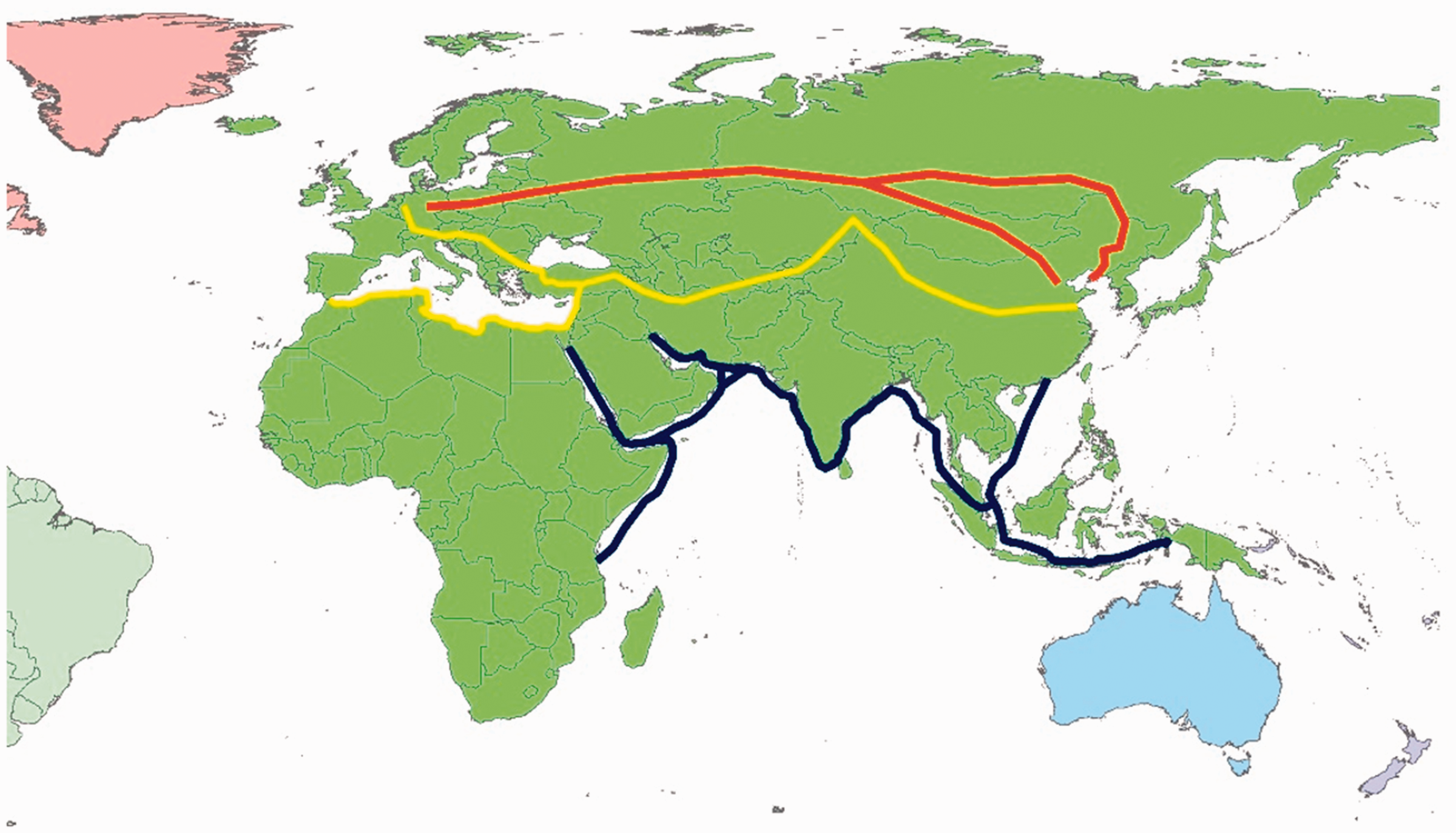

These initiatives represent an important alternative to the wars that have affected most regions of the world in previous centuries. They will succeed if nations can find ways to turn conflicts into a mixture of cooperation and healthy competition (“coopetition”), leading to the evolution of a new world political order. Unlike previous efforts to create peaceful unions, such as the League of Nations and the United Nations, new unions of nations such as the European Union and the Eurasian Economic Union may succeed because they emphasize ways to protect the political and economic self-interest of each member state, thereby offering the possibility of win–win solutions. Currently, the Eurasian Economic Union has only achieved economic integration and is progressing slowly toward greater integration (e.g. the adoption of a unified currency, as in the European Union). However, in contrast with traditional unions, in which participating countries have no permission to interfere with the domestic affairs of developing countries or with regional conflicts, greater military integration has been proposed. The proposed new union would give developing countries a rare opportunity to acquire economic support in exchange for giving developed countries greater influence on the military and domestic affairs of the union. In principle, this will reduce regional conflicts and create a more peaceful and stable environment for international trade and development. For example, with membership expanded to surrounding countries such as the Ukraine and military integration, Russian’s intervention in Crimea might have been prevented.
Under the proposed unions of nations described above, members of a union would avoid regional military conflict and compensate for a shortage of the funds required for socioeconomic development as a reward for their participation. These unions will act, in effect, as a kind of super-nation, anchored by one or two economically powerful central nations and supporting a group of less powerful nations that receive investments and support from the central nations. Such a union offers a single unified set of diplomatic and military policies and can respond to international issues as a single organization. To make the union more attractive to the less developed nations and encourage them to sacrifice some portion of their sovereignty in return for participation in the union, the central nations will offer funding and other support to promote socioeconomic development. To guarantee that the less powerful countries retain some sovereignty, each retains independent rights to manage its own political, economic, cultural, religious, and social affairs, as they did before joining the union. In addition, as part of their contribution to the union, the leader of each country (usually represented by a senior member of the State Department or a Minister responsible for a national government ministry) can participate in the union’s central management agency and can help to administer the union and develop its policy. Such participation can take the form of leading key committees (e.g. trade, health and welfare). In addition, the smaller nations contribute taxes to fund the operation of the union. The Eurasian Economic Union is being developed through several processes.
First, countries that join the union of nations will be rewarded through investments and financing, with a particular emphasis on the construction of local infrastructure. Nations will explore possible paths toward political unions that guarantee the continued existence of each nation, while uniting the nations under a single trade regime. Through this process, conflict can become cooperation because the union of political powers with different ideologies under a unified regime will provide a dispute resolution mechanism and mitigate the risk of conflict. In effect, the powerful central nations act as arbitrators to resolve disputes among the less powerful members of the union, thereby transforming conflict into negotiated cooperation. For example, China’s government plans to invest trillions of RMB to support neighboring countries through infrastructure construction and education projects, the establishment of industrial parks that stimulate local economic growth, and expansion of commercial markets within a framework of political integration (Cao, 2015b).
Second, to anticipate and prevent the damage caused to multinational political unions such as the European Union by events such as the recent Brexit vote in the U.K. and the debt crisis in Greece, countries in the union will need to integrate their management structure, currency, and military forces more closely through ongoing negotiations designed to form a more durable political union. The affected nations can learn from the American example, in which a strong central authority manages international affairs while allowing its component states autonomy in their local affairs. A possible approach may be to choose one or two key countries to formulate the political or economic policies of the union, while leaving other members free to comply with the rules in ways that preserve their autonomy and allow them to develop solutions that account for key local characteristics and constraints. Other developed countries capable of providing funding may join in the union in a supporting or guiding role but will have less influence on policy development and implementation than full members of the union. The result would be a tighter union in which members would develop similar policies and attitudes toward international affairs.
Finally, to avoid the risk of warfare and the destruction of the good things that have been accomplished by the Eurasian Economic Union, Russia should work to involve China in establishing a unified mechanism for resolving political disputes through friendly negotiations and should extend invitations to countries in the surrounding regions to join the resulting union. China and Russia, as the most powerful countries in the proposed expanded union, are likely to act as the union’s central nations and provide overall guidance for the other members. The result of these negotiations and the ensuing development of dispute resolution mechanisms offer the possibility of a nonmilitary response to the pressures that both China and Russia feel from each other and from the United States.
Nations are social systems that organize and manage the resources and people within distinct territorial limits and develop a certain shared culture and shared institutions (Cao, 2015b). Governments represent the parts of a nation that organize the nation’s functions and that manage national issues to avoid conflict with other nations (including warfare), while also trying to expand the nation’s access to resources (Bowles, 2012). To create a successful international union that reduces the risk of escalation of conflicts, weaker countries can be strengthened by sacrificing some of their independence to form a union that is stronger than any of the individual countries. This will require changes in their governments and institutions that are designed to protect the benefits to citizens by weakening the factors that lead to conflict (Acemoglu et al., 2011; Zhang, 2012). This will be facilitated by governments that promote economic development and improve the livelihoods of their citizens, thereby gaining their support. Because both the governments and the citizens benefit from such arrangements, there is a strong incentive to participate, even if doing so requires them to relinquish some former freedoms, and this becomes an effective way to promote peaceful global political evolution (Popkin, 2011).
The disintegration of the former Soviet Union and the end of the Cold War left the United States as the dominant power in international political affairs. This powerful role has led to resistance from other countries and regions and has encouraged cooperation between weaker countries such as China and Russia with other nearby countries as less powerful partners to establish political alliances such as the New Silk Road and the Eurasian Economic Union that can compete effectively with the United States (Beddoe et al., 2009; Myerson, 2011). However, the recent history of the European Union illustrates how international unions may weaken and become less stable. It is our hope that the cooperative strategies that are emerging among China, Russia, and their surrounding nations will avoid this fate by delegating decisions to the strong central nations (i.e. acting as arbitrators) rather than allowing individual nations to determine the results through conflict, thereby creating a stabler and more durable union.
Political science researchers should pay close attention to the resulting political evolution in China and its neighbors to detect warning signs before they can lead to disruption of the unions or even warfare, thereby offering a chance to find peaceful and mutually beneficial ways to resolve disputes. Globalization, despite its problems, offers the potential of introducing a new era of international cooperation. To achieve that goal, it will be necessary to develop a new way of thinking that emphasizes peaceful cooperation and competition rather than warfare. Regional unions such as the ones described in this paper offer a new way to accomplish this goal.
Footnotes
Authors’ Contribution
SC designed the research; JZ drew the pictures; and SC and XZ wrote the paper.
Acknowledgements
We thank Geoffrey Hart of Montréal, Canada, for his help in writing this paper. We are also grateful for the comments and criticisms of an early version of this manuscript by our colleagues and by the journal’s reviewers.
Declaration of Conflicting Interests
The author(s) declared no potential conflicts of interest with respect to the research, authorship, and/or publication of this article.
Funding
The author(s) disclosed receipt of the following financial support for the research, authorship, and/or publication of this article: This work was supported by the National Key Technology R & D Program (No. 2016YFC0501002).