



Abstract
Given the known relationship between eveningness and sociosexuality among females, the aims of this study were: (a) to analyze this relationship in four countries using midsleep time on free days and morning affect measures of morningness–eveningness and (b) to test the role of dark personality and other relevant control variables in this relationship. Data from 1483 females were collected from Poland, Spain, Germany, and Slovakia. Adjusting for age, relationship status, country, age at first intercourse, and Dark Triad traits, the most universal findings were that females with later sleep timing were less sociosexually restricted (3% shared variance with sociosexuality). Sleep timing played a greater role in sociosexuality compared to morning affect. This finding showed that Dark Triad personality is not involved in association between morningness–eveningness and sociosexuality and it added a value to the importance of sleep–wake habits in mating preferences.
Introduction
Sociosexuality and morningness–eveningness
Individuals differ along a continuum of reproductive strategies. Those emphasizing parenting have a slow reproductive strategy, whereas those emphasizing mating have a fast life strategy. Sociosexuality is defined as individual difference in willingness to engage in uncommitted sexual relations and is defined by three aspects: behavior, attitude, and desire (Penke and Asendorpf, 2008). People with unrestricted sociosexual orientation report more casual sex encounters, and multiple and concurrent sexual partners.
Morningness–Eveningness (M/E) is an important aspect of individual differences (Adan et al., 2012; Di Milia and Randler, 2013) related to the preference for different times of day for mental and physical activities. Morning types prefer early bed and rise times and reach their highest performance early during the day, while evening types prefer later bed and rise times and reach their peak performance in the afternoon, evening, or at night. Evening-oriented men show higher number of sexual partners (Piffer, 2010; Randler et al., 2012) and have higher saliva testosterone levels, which is a physiological correlate of a higher mating success (Ellison, 2003). Also, mating success is higher in evening compared to morning men, indicated by a higher number of lifetime partners, more extra-pair matings and an earlier age at the loss of virginity (Randler et al., 2012). Using more comprehensive measures of sociosexuality, instead of only single sociosexual activities indicators, revealed that evening-oriented females appear to be less sociosexually restricted in their behavior, attitude, and desire compared to morning-oriented females, while in men no such association appeared (Jankowski et al., 2014b). Additionally, in a previous study (Randler et al., 2016b), short sleepers tended to be less sociosexually restricted, while sleep timing (midsleep time on free days, MSF) accounted for a higher percentage of variance in sociosexuality than any other aspect of M/E – morning affect (MA; freshness and energy after waking up). Thus, sleep timing, morningness and sociosexuality are interrelated.
Dark Triad links to sociosexuality and M/E
The Dark Triad (DT) is an emerging personality concept that focuses on the socially aversive (“dark”) side of personality without being a clinical concept and DT traits are considered within the range of normal functioning (Furnham et al., 2013). DT comprises three conceptually distinct but empirically overlapping personality domains: Machiavellianism, narcissism and psychopathy. DT traits have been related to sexuality and relationship commitment (Foster et al., 2006), specifically, people characterized by DT are short-term mating oriented (Jonason and Kavanagh, 2010).
Unrestricted sociosexual orientation has been related to personality traits such as greater impulsivity and risk-taking, openness to experience, higher extraversion, lower agreeableness, and conscientiousness (for an overview see Jankowski et al., 2014b; Randler et al., 2016a). People scoring high on the DT traits scored higher on sociosexuality (Jonason et al., 2009), and eveningness (Jonason et al., 2013; Rahafar et al., 2017). Furthermore, evening types are more likely to follow a short-term mating strategy compared to morning types (Maestripieri, 2014). The above studies indicate that personality profile of sociosexually unrestricted people and the personality profile of evening-oriented people share common characteristics. Although there is evidence that less restricted sociosexuality appears to be higher in men than in women (Jankowski et al., 2014b; Schmitt and Shackelford, 2008), the links between sociosexuality and personality traits are similar in both sexes (Holtzman and Strube, 2013).
Current study
Recently, evening females were found to be less sociosexually restricted than the morning ones, while the results in males were less consistent (Jankowski et al., 2014b; Randler et al., 2016b). Jankowski et al. (2014b) concluded that employing specific measurements of sociosexuality – for example, revised Sociosexual Orientation Inventory (SOI-R; Penke and Asendorpf, 2008) – instead of asking for the number of partners (a mating success indicator) might provide a broader image of the link between sociosexuality and eveningness regarding sexes, since they failed to show this link in males. Consequently, they suggested to retest this link in females of other countries varying in sociosexuality levels (Schmitt, 2005) to find out if it is culture-specific or universal. Therefore, in the present study, we focused on females and aimed to extend previous findings, specifically, (a) to consider behavioral (MSF) and affective (MA) measures of M/E and (b) to test if sociosexuality is associated with MSF and MA when controlling for other important variables such as DT traits, age, relationship status, country of origin, and age at first intercourse (AFI). The association of DT with both chronotype and sociosexuality was earlier discussed. As individuals age, they become more morning oriented (Roenneberg et al., 2004) and less sociosexually restricted (Jankowski et al., 2014b). Younger AFI can be considered a manifestation of unrestricted sexual behavior and the analyses were also adjusted for country of origin due to cultural differences in sociosexuality (Schmitt, 2005). The cross-cultural approach used in the present study allows achieving a higher level of generalizability on one hand, and provides information on local specificity of psychological aspects of sociosexuality on the other.
Methods
Participants
The samples included 1483 female university students aged 16–57 years (M = 21.9, SD = 4.11) from Poland (26.4%), Spain (14.2%), Germany (33.9%), and Slovakia (25.4%). The Polish sample was composed of 392 female students aged from 18 to 37 years (M = 21.6, SD = 2.17). Regarding family status, the 42.1% was single and 57.9% was in a relationship.
The Spanish sample was composed of 211 female students aged from 17 to 41 years (M = 23.9, SD = 4.81). The 79.7% was single and the 20.3% was in a relationship.
The German sample was composed of 503 female students aged from 17 to 57 years (M = 22.36, SD = 4.11). The 28.1% was single and the 71.9% was in a relationship.
Finally, the Slovak sample was composed of 377 female students aged from 16 to 55 years (M = 20.6, SD = 4.79). The 39% was single and the 61% was in a relationship.
Variables and instruments
Demographic data
Participants were asked for age, sex, and whether they are single or in relationship (relationship status). Further, we asked for AFI.
Morningness–eveningness
MA was used as a measure of affective facet of M/E trait, that is, the relative freshness and energy after waking up. It is composed of items 3, 4, 5, and 12 from the Composite Scale of Morningness (CSM; Smith et al., 1989). A sample question is “Assuming normal circumstance, how easy do you find getting up in the morning?” MA is an aspect of morningness found in different countries in exploratory and confirmatory factor analyses. In the present study, the reliability of MA (Cronbach’s alpha) was: .83 (Poland), .76 (Spain), .84 (Germany), and .75 (Slovakia). MA was derived from cultural adaptations of CSM, in German (Di Milia and Randler, 2013), Polish (Jankowski, 2015), Spanish (Díaz Morales and Sánchez-López, 2004), and Slovak (Randler et al., 2015).
Midpoint of sleep
MSF was used as a behavioral measure of M/E because it is estimated based on the time when participants from different countries go to bed and wake up without restrictions of work schedules. Specific questions were: “What time do you usually go to bed on weekends?” and “What time do you usually wake up on weekends?” MSF was calculated as follows: bedtime + the half of sleep length on weekends. MSF used here (the midpoint between bedtime and wake up time) is a proxy for often used MSF basing on the midpoint between sleep onset and waking up (Roenneberg et al., 2003). Higher scores in MSF indicate a delay of sleep–wake rhythm, i.e. a tendency to eveningness.
Sociosexuality
Sociosexual orientation was measured with the revised SOI-R (Penke and Asendorpf, 2008). The coding was based on a 1–5 Likert type scale. The scale consists of nine items, with three items per facet, SOI-R behavior, SOI-R attitude, and SOI-R desire. The reliability of each dimension (Cronbach’s alpha) in each country (Poland, Spain, Germany, and Slovakia) was as follows: behavior: .78, .73, .79, and .80; attitude: .79, .81, .84, and .72; desire: .85, .80, .83, and .73. The alpha for the total score of sociosexuality was .83, .76, .85, and .75 accordingly. Translations of SOI-R for Germany, Spain, and Slovakia were provided by Penke (2011), while the Polish adaptation of SOI-R was provided by Jankowski (2016).
Dark Triad
Dirty Dozen scale (Jonason and Webster, 2010) was used to evaluate DT. It is composed of 12 items and participants are asked to rate the degree to which they agree (1 = disagree strongly; 9 = agree strongly) with statements reflecting narcissism, Machiavellianism, and psychopathy. Cronbach’s alphas in Poland, Spain, Germany, and Slovakia were: Machiavellianism (.84, .86, .76, and .82), psychopathy (.68, .73, .60, and .84), and narcissism (.89, .87, .76, and .88). For Spain and Slovakia, the translations were created for the purpose of this study, the German version was provided by Küfner et al. (2015), and the Polish version was provided by Czarna et al. (2016).
Procedure and data analyses
Participants were encouraged to voluntarily participate in the research by advertisements posted online and the study was also conducted online. In order to test the factorial invariance across countries, a multiple group confirmatory factor analysis using LISREL 8.51 software (Jöreskog and Sörbom, 1993) was used (see Appendix 1). Multiple analyses of variance (MANOVA) were performed to test country differences in all variables of study. Partial eta-squared (ηp2) was used as a measure of: .01–.05 low, .06–.13 moderate, and above .14 high effect size (Cohen, 1992). Finally, one linear regression model was carried out aiming to test whether MA and MSF contribute to SOI-R variability, while adjusting for age, relationship status, country of origin, AFI, and DT components. These analyses were conducted using the SPSS 22.0.
Results
Preliminary analyses
Prior to comparing mean levels of target variables between countries, factorial equivalence of SOI-R, DT, and MA between countries was tested. Specifically, at first we conducted confirmatory factor analysis of SOI-R, DT, and MA in each country separately (see Appendix 1 for detailed results). In short, configural measurement invariance across countries was supported for SOI-R and DT, and metric measurement invariance was supported for MA. However, considering the comparative fit index (ΔCFI = .01), the overall results indicate the factor loadings to be the same across the groups (Cheung and Rensvold, 2002).
Differences between countries
Significant differences between countries in all variables except for MA appeared (Table 1). The highest levels in DT traits appeared in Poland, while the lowest values were observed in Spain, especially in psychopathy (the largest effect size, ηp2 = 0.30). Polish females reported higher scores in Machiavellianism and narcissism, with effect sizes low and moderate, respectively (ηp2 = 0.04 and 0.08). Spanish females reported later sleep timing, while Slovak ones were the earliest (ηp2 = 0.10). Slovak females had the lowest levels in all facets of SOI-R (low effect size, ηp2 = 0.01–0.06), and Polish females were oldest at their first intercourse (low effect size).
Means, standard deviations, number of participants, F, and significance levels in all variables of study according to country.
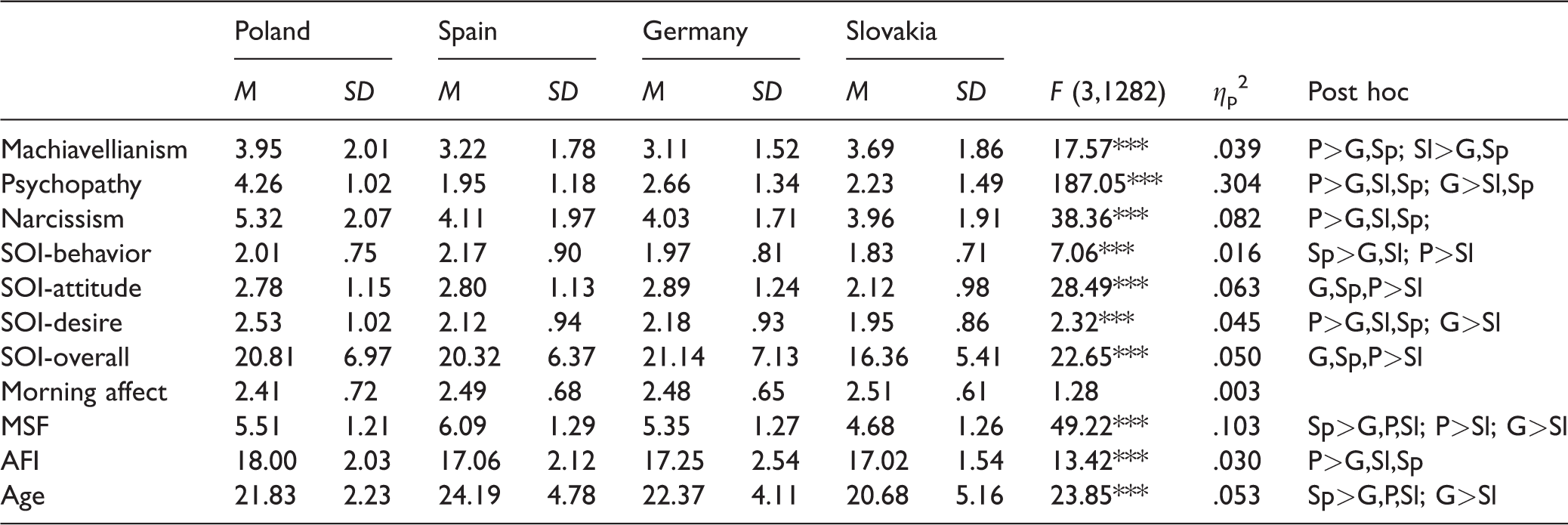
Post hoc: with Bonferroni correction, reported are only differences at p < .001; SOI: revised Sociosexuality Orientation Inventory; AFI: age at first intercourse; MSF: midsleep time on free days; P: Poland, Sp: Spain, G: Germany, Sl: Slovakia.
***p < .001.
A multiple regression predicting total score in sociosexuality adjusted for age, relationship status, country, Machiavellianism, psychopathy, narcissism, and AFI (first block), with MA and MSF as independent variables in the second block was run. Since country was a categorical variable with more than two levels, we recoded it into three dummy-coded variables and considered Spain as the reference country since it seems most culturally different from Germany, Poland, and Slovakia. The coefficient of each country was compared to the coefficient of reference group to judge its predictability power (see Table 2).
Regression models (standardized betas and significance levels) with SOI-R total score as dependent variable.

Relationship status: 0 = single and 1 = in relation; AFI: age at first intercourse; MSF: midsleep time on free days.
Amongst control variables, AFI was the strongest predictor of SOI-R. After controlling for the first block variables, MSF, but not MA predicted higher sociosexuality (more unrestricted). Regarding the predicting role of DT components in sociosexuality, only Machiavellianism and psychopathy seemed to predict sociosexuality, and among countries, Germany appeared to be a significant predictor, which means that females from Germany had higher SOI-R total scores compared to Spain. Slovakia was marginally (p <0.051) negatively related to SOI-R. All predictors together explained 22% of the SOI-R variance of which 3% was unique contribution of MSF.
Discussion
This study provided a picture of the role of DT, sleep timing, and MA in sociosexuality across four different nations. Principal finding was that the role of sleep timing in sociosexuality seems generalizable, whereas the role of dark personality depends on country.
Regarding the consideration of behavioral (MSF – sleep timing) and affective (MA – freshness and energy after waking up) measures of M/E, it turned out that MA did not vary significantly across the countries; however, different degrees of MSF were reported for the countries with Spaniards having the latest sleep timing and Slovaks the earliest. Considering relation of M/E with sociosexuality, the results confirm previous findings obtained in Germany, where MSF accounted for a greater percentage of variability (7%) in sociosexuality compared to sleep duration (4.1%) and M/E preference (3.9%) (Randler et al., 2016b). This relationship seems universal or at last, generalizable across countries. Present results also add to existing data on cross-cultural similarities in sleep times and sociosexuality. Existence of cross-country differences in MSF with a lack of differences in MA scores is in line with the results of a study comparing German and Polish students (Jankowski et al., 2014c) and supports a general observation that MSF is more sensitive to light environment being a resultant of geographic location (later MSF on the west of a given time zone).
Slovaks appeared to exhibit the least sociosexuality compared to the other countries. This finding was expected regarding the “strategic pluralism theory” (Gangestad and Simpson, 2000) contending in countries with difficult life situation and lower welfare a greater need for biparental care would raise which in turn leads to monogamous mating and, consequently, lower sociosexual behaviors. This theory was earlier fully supported by Schmitt (2005) across 48 nations. Schmitt (2005) proposed some indexes of familial stress, economic resources, mortality, and early and prolific reproduction to test their relationship with sociosexuality. Five out of nine criteria were met by Slovaks. Slovakia had the lowest rank in life expectancy, gross domestic product, and human development index, and highest rank in infant mortality rate and adolescence pregnancy rate among the other countries in this study. For child malnutrition, only the data from Germany was available (Human Development Report 2016; data available at: http://hdr.undp.org/en/2016-report). Lower health conditions are also cross-culturally seen as the possible cause of limited sociosexual behaviors due to higher risks of prevalence of infectious diseases (Schaller and Murray, 2008).
Polish females reported oldest AFI. Poland seems to be a more religious and less atheist country compared to Germany and Spain (no data from Slovakia present: http://www.wingia.com/web/files/news/14/file/14.pdf) and a study involving 56 nations backed the cross-cultural link between higher personal religiosity and lower sexual permissivity (Schmitt and Fuller, 2015).
Being single (Germany, Poland, and Spain) and older (Germany and Spain) predicted more permissive sociosexuality. Schmitt (2005) in his big cross-cultural study showed that relationship status had a significant effect on sociosexuality and both males and females reported higher sociosexuality as they aged (at least up to age 46).
Regression analyses turned out that even when controlling for age, relationship status, AFI, country of origin, and DT components, sociosexuality was still predicted by later MSF across all countries and MA did not influence sociosexuality, suggesting that sleep timing plays a greater role in sociosexual activities compared to MA. The lack of associations between sociosexuality and MA suggests that functioning after awakening (MA) was not impaired in unrestricted women. Namely, it seems that their unrestricted sociosexual orientation does not impair their sleep, which fits the observation that preferred and actual time for sexual activity in females occurs mainly during late evening (Jankowski et al., 2014a). Another explanation is that even though sociosexually unrestricted orientation may lead to delayed sleep times and shortened sleep duration (attendance to parties where searching for sexual partners is facilitated), this does not have to lead to impairment of morning functioning, as it has been shown recently that shortened sleep duration does not explain observations of evening types being in worse mood during the day (Díaz-Morales et al., 2015). In another study (Gunawardane et al., 2011), it was also revealed that morning males tended to go out and party more often than evening ones; however, evening ones reported higher proclivity for flirtation behaviors in later hours of the day. This might suggest that M/E per se does not eventuate in mating success/failure but its related factors such as time perspective might mediate this relationship. Ponzi et al. (2015) indicated that time perspective mediated the relationship between M/E and sociosexuality among males; i.e. evening ones were more present oriented with greater short mating orientation and sexual experience. In line with this, Randler et al. (2016b) corroborated the greater contribution of gender (being male) than chronotype (eveningness) in the variance of sociosexuality.
In conclusion, later sleep timing remained a significant predictor of sociosexuality (about additional 3% shared variance with sociosexuality) after we controlled some important variables linked to sociosexuality and M/E. This finding added value to the importance of sleep/wake habits in sociosexuality and mating preferences.
One of the limitations of this study that could be indicated is using short measures such as Dirty Dozen. This short scale is likely to have limitations to capture all socially aversive characteristic behaviors for DT traits, such as impulsivity, deception, or lack of empathy, which can be evaluated using more extended measures (Miller et al., 2012). The same reasoning could be applied to the MA scale, given that previous studies have used full measures of M/E (e.g. CSM by Smith et al., 1989). In future research, peer reports could be particularly useful in this type of study because they reduce the social desirability effects that often influence self-reports (Holtzman and Strube, 2013). Future research are also highly advised to control for menstrual cycle and contraceptive use in females as these factors can influence both circadian rhythms (Tonetti et al., 2008) and sociosexual preferences (Marcinkowska et al., 2015).
Footnotes
Authors' Note
Author Pavol Prokop is also affiliated to Institute of Zoology, Slovak Academy of Sciences, Dúbravská cesta 9, Bratislava, SLOVAKIA.
Declaration of Conflicting Interests
The author(s) declared no potential conflicts of interest with respect to the research, authorship, and/or publication of this article.
Funding
The author(s) disclosed receipt of the following financial support for the research, authorship, and/or publication of this article: Part of this work was supported by research grants from the Ministerio Ciencia e Innovación (PSI2008-04086) and Ministerio Economía y Competitividad (PSI2011-26967) of Spain to JFDM and the project No. IP2015 026774 (KSJ).