




Abstract
Since 1972 a leap second has been introduced into global time standardization systems, due to the discrepancy between Coordinated Universal Time and International Atomic Time. Until recently, the leap second has been a consensual, if mildly uncanny adjustment, a para-governmental temporal wobble. Google's explanation of its actions with regard to the insertion of a leap second smeared into its Network Time Protocol servers is couched in terms of a period extending initially over 20 h, ultimately reaching 24 h. Google is intent on taking ownership of the smear and transducing it into a technologically stabilised change. Although there are a number of different strategies of smearing time, Google advocates for its standard smear that it wants other digital giants like Bloomberg, Amazon and Microsoft to replicate. In this paper we first analyze Google's temporal strategy in terms of its affinities and departures from the classical view of time in Aristotle's core considerations in the Physics Book IV, in terms of a consonant enumeration but in our example at variable speeds/intervals, and then in terms of Wolfgang Ernst's conception of time-critical media. Leap seconds conform to Ernst's sense of kairotic time, an auspicious micro-moment that is both techno-mathematically pre-defined and decisive for ensuring operationality. Google executes smeared time-critical processes but wants to establish mastery over the measurement and manipulation of humanly imperceptible microtemporal events by inhabiting temporal ontology itself, proposing its practice, based on misleading its servers, as a model for other digital hegemons.
Preface: It is about time
Since 1972, a leap second has been positively introduced into global time standardization systems, neither so much an addition exactly nor a subtraction, due to the discrepancy between Coordinated Universal Time (UTC) and International Atomic Time (TAI). Due to the slowing of the Earth’s rotation and hangover (a few milliseconds) of the length of a diurnal day just beyond 24 h, UTC is behind the hyper-accuracy and stability of the mean time of hundreds of atomic clocks located around the world. The programmed insertion of compensatory time on New Year’s Eve of 2016 marked the 27th occasion on which such positivity was required. It may not be the final one. There is now a difference of −37 s between UTC and TAI, or 27 insertions beyond the original difference of 10 s. In both measures, a second is not defined astronomically, but atomically, in accordance with standard units of measure maintained by the Bureau International des Poids et Mesures (Bureau International des Poids et Mesures, 2014), but the clocks used by humans, as they are not actually atoms (utilizing cesium or rubidium), cannot sustain the mutual coherence that would save us from the leap anomaly. The potential insertion of leap seconds can also be deferred, as in June 2018 according to the Service de la rotation terrestre [Earth Orientation Center] de l’IERS observatoire de Paris, and the whole system is up for review in 2023. It is in light of this impending moment, where time will be bureaucratically changed again, that we wish to consider how time is already, even always already, caught up in strategic and increasingly technical adjustment.
What is intriguing is how time itself is not only malleable but also a product as much as a thing. What this article wishes to explore, in the vein of speculative materialism, is just how time smearing—the insertion of a leap second spread across a long duration before and after the change from one year to the next—constitutes an ontological intervention, one that undermines ontology entirely, in favor of a simulated, contingent, yet still actual, temporality. Where Google—the company that has invented a novel smearing protocol for its servers by adding 4 h extra to its previous approach, bringing the total smear to 24 h in length—wades in, supplanting governmental and scientific authorities, we position its practical solution to be a temporal intervention based on its brute power to influence the adoption of its protocol, one that will filter through all time which will either be Google time or will not work. This drive to make time functional is a parody of 20th-century relativistic time modelings such as those offered by Bergson, Ernst, and Einstein. In order to show just how effective Google’s strategy is, over what seems an insignificant portion of time, and just how sweeping its ontochronological power grab is, we reintroduce the modeling proposed by Aristotle, pass by the eternal return of Nietzsche, pause on time conflicts past and their accompanying myths, and then use that gravitational torque to conclude on the Foucauldian deep materialist power that is the spread of error time. Error time is always relational in the sense that the reference clock displays a time different from the running clock, but error in our usage indexes a specific lie that time smearing tells to servers so that they do not react.
Google’s explanation of its autonomous temporal actions in the context of the global leap second requirement, with regard to the insertion of a leap second into its Network Time Protocol servers, is couched in terms of a temporal smear that crossed midnight of New Year’s Eve and, thus, over two calendar years for a period of 20 h. Within the machine worlds of its servers, Google’s smear began at 2 p.m. GMT (Greenwich Mean Time) on the 31st of December 2016 and continued until 10 a.m. on the 1st of January 2017. During the smear, Google’s server clocks ran slower than usual. As suggested above, Google wants to move to a 24-h long smear in 2020–2021.
Until recently, the leap second has been a consensual, if mildly uncanny adjustment, para-governmental temporal wobble. But Google is intent on taking ownership of the smear and transducing it into a technologically stabilized change. The demands and complexification of information technology networks and systems made the Great Leap Backward of one whole second a risk factor; that was the lesson of the glitchy 2011 leap. So instead of one “massive” jump backward of one whole second, Google sought and realized a long, dispersed leap that became a chronological coating or frosting, a schmear (both spread and lie).
Although there are a number of different strategies of smearing time involving different durations (20 and 24 h) and start and stop points before or after a leap, Google advocates for a standard smear that it wants other digital giants like Bloomberg, Amazon, and Microsoft to undertake in the near future on 31 December 2020 and 1 January 2021. A longer smear further minimizes frequency change and keeps it within the range of error for quartz oscillators and has the added benefits of simplicity, calculability, and stability. It is known within the Site Reliability Engineering group as a “cool workaround” (Pascoe, 2011). Ironically, though, what Google has actually achieved is the insertion of error across a long period of time, rather than take a 1 s hit. One second is, of course, epochal in code time, but the scale of error insertion is properly colossal, as wrongness hits over and over in the course of the smeared day. This is why Google has had to disable the capacity of its servers to detect leaps, and any smear must not attract correction that normally happens when abruptness of any sort occurs. This fractal time could have consequences if we live in the Nietzschean phase space, as the eternal return is stretched into oblate “nows” that do not quite match actual time. When Nietzsche (1968) suggested that the reality of time was one of every single second repeating forever, he had not imagined that time would be broken down into quantum incident, material atom decay, and technological “accuracy” that would spawn even more endlessly returning moments. Beyond that expansion of his already mind-, space-, and time-blowing idea, we now have the recognition that any moment, recurring or otherwise, real or otherwise, will be subject to adjustment. As the leap second is never over and done, all time bends around it, in need of the error-inducing way of counting that humanity has devised. It may also be inducing a potentially infinite number of temporal micro-universes that bud and bubble out of a relatively steady (rhythmical yet static) eternal return of the same. Further, it seems that “real time” is inherently drift-based, and the smear may constitute a neo-temporal reality principle. Watchmakers have known this for some time, since the so-called “quartz revolution” in clocks of the 1920s and later in wristwatches in the late 1960s (Landes, 1983: 342ff). Quartz crystals constituted an initial, if temporary, triumph over drift (variation) because, literally, they did not themselves have moving works. Stone time became the basis of the clock as digital device—which is where the drive to smear initiated, ultimately.
In this article, we first analyze Google’s temporal strategy in terms of its affinities and departures from the classical view of time in Aristotle’s core considerations in the Physics Book IV, that is, in terms of a consonant enumeration but in our example at variable speeds/intervals. Google seems to have settled on a linear as opposed to a cosine smear. The difference is subtle: In a cosine smear, smearing picks up speed very slowly and accelerates in the middle of the window period, slowing down near the end, whereas in a linear scenario, the server clocks run slower than usual and in relation to UTC they run behind at the outset and ahead toward the finish, while the offset is reduced over the course of the window so that smeared time agrees with leaped UTC time at the end of the smear (see Figure 1). Both seem strange in Aristotelian terms as they involve temporal speeds and slowness, yet reflect in a radical manner the enumerative aspect of time. Instead of acceleration as squared velocity over time, time itself becomes a function, a derivative of an acceleration process that needs, in some ways, to be thought of as anti-time. Atomic, unsmeared Coordinated Universal Time and smeared time. Source: Google Public NTP https://developers.google.com/time/smear.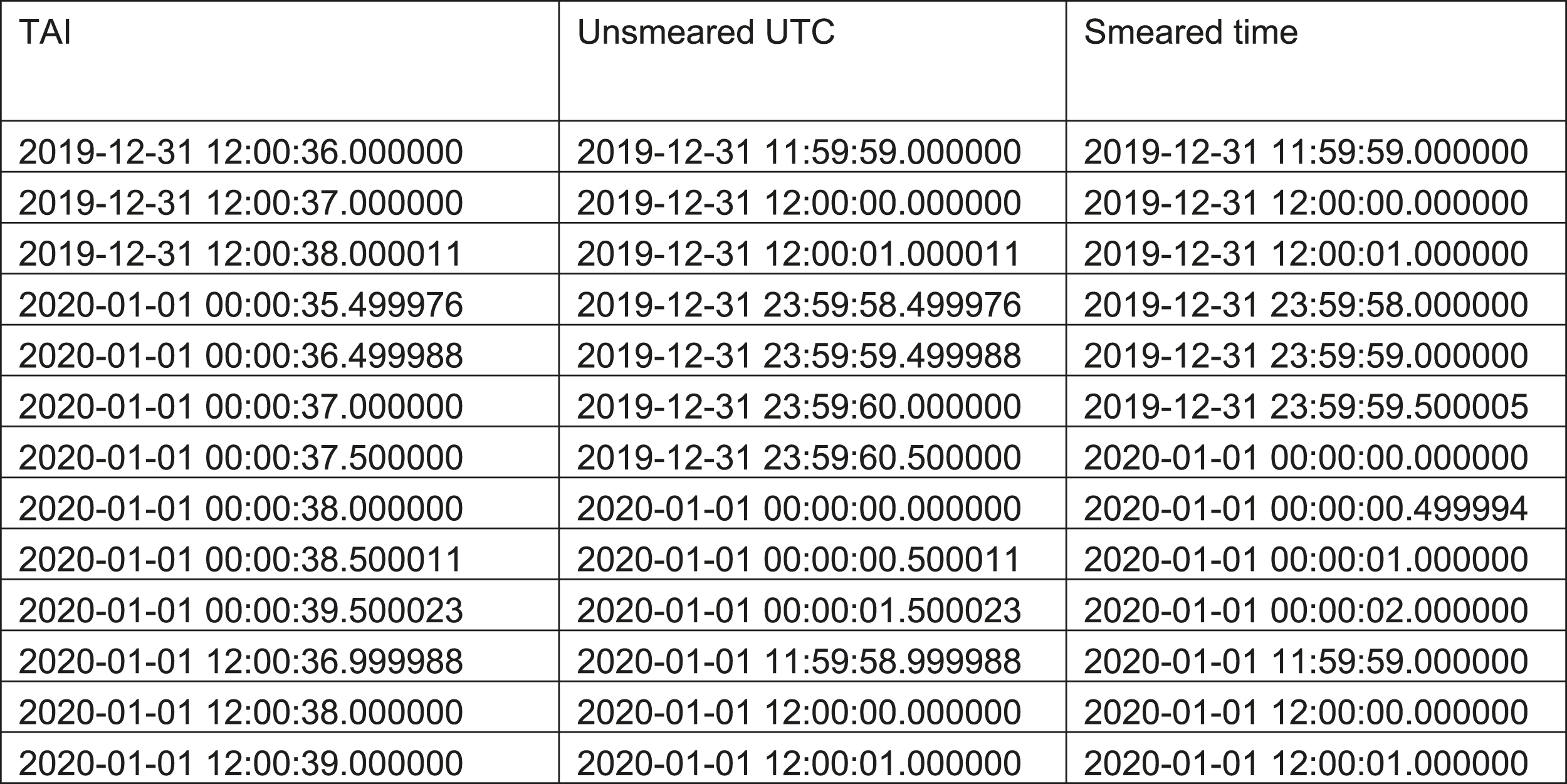
We then shift from the classical framework and consider the introduction of leap smears within the Google chronosphere as an example of Wolfgang Ernst’s conception of time-critical media in his book Chronopoetics. Leap seconds conform to Ernst’s sense of kairotic time, an auspicious micro-moment that is both techno-mathematically predefined and decisive for ensuring operationality (Ernst, 2016: 7). Google’s execution of time-critical processes, especially its refinement from 2012 to 2020 of leap smearing, establishes its mastery over the measurement and manipulation of humanly imperceptible micro-temporal events. Measurement is crucial to time criticality, and a leap second can be further divided into smaller units and precisely distributed across the smear. Google reasserts the primacy of the relation between time and number and the enduring legacy of Aristotle for media archeology, which distances itself from Bergsonian duration in order to embrace techno-mathematical time, a point underlined by Ernst (2016: 48) first in relation to Bergson’s rejection of Aristotelian countable time. In fact, Bergsonian duration is shown by Google’s smear tactics to be a vacuous, humanist comfort temporality, an extended philosophical spa treatment in which one bathes in the fluid passages of experiential flows. At the same time, it adds up to a radical rejection of Einsteinian space–time (and other models that build on it) in favor of a fully parochialized time. Maybe this is how we can make time great again.
We will be working toward a conclusion that smearing introduces a neo-temporal principle that surpasses Ernst’s sense of time criticality intrinsic to media, not by reintroducing the history in the form of a mass consciousness of the effects of computer time such as Y2K (where computer date calendars across the world were found not to have been ready for the transition to a new century, spawning much panic about the collapse of computing through lack of projective time capacity), but as a 21-st century corporate power flexing its leadership muscles by reformatting not damage, but making ontology a matter of technological control through plasticization of time’s passage. What does it mean to master the drift of “real time” (UTC) or even “really real time” (TAI) by imposing a management strategy on all of the cybersphere?
Smearing time and avoiding abruptness
The focus on the deconstructed leap second itself is at the heart of Google’s reasoning. Whether or not this will be taken up generally will be seen in the years to come, but it is thought to be an improvement over the backward jump application, which may disrupt time synchronicity between software and server clocks, causing havoc in certain sectors (including satellite communications, air-traffic control, ticketing, etc.). Already in 2011, the official Google blog published this statement by site reliability engineer Christopher Pascoe: Very large-scale distributed systems, like ours, demand that time be well-synchronized and expect that time always moves forward. Computers traditionally accommodate leap seconds by setting their clock backward by one second at the very end of the day. But this “repeated” second can be a problem (Pascoe, 2011).
Pascoe is of course making some very basic presumptions about time that are belied pragmatically, philosophically, or in terms of physics. For many of these realms, time does not move; it is the mark of movement, the basis of movement, or the way in which humans understand movement. For Lee Smolin in his authentically conservative Time Reborn (2014), time is the line along which things happen (including many interesting phenomena such as evolutionary universe development)—thereby adopting a strategic position “before” the Einsteinian construct “space–time.” If time itself moved, things would be a lot stranger. The time smear creates time as movement, so Pascoe’s idea becomes correct at exactly the point where something exceptional is happening to time.
For Google, problem avoidance required telling what is called a “small lie” to its servers, preventing them from activating a leap indicator field requiring the final minute of the day to have either 61 or 59 s, and instead, milliseconds are smeared over the course of a set duration during every update, relentlessly maintaining the false instruction (or correct instruction, on false premises, in an uncanny time-parody of Althusser’s model of ideology) that no server response is required. Note, however, that there is no designation of leap second insertion as a bug. The corporation’s engineers think their servers remain “blissfully unaware” of the leap. Servers in most locations are time-determining, not time subject, so it is hard to see how they could be usefully “fooled,” but this anthropomorphic talk is for public consumption, it should be recalled. Servers operate at a level of time both deeper (i.e., faster and fuller) and thinner (time is a product of colossal finite series of code choices). This thin time is the one defined by processing actions, and not vice versa—and servers burrow stochastically into time.
If this seems abstract, remember that the most powerful part of the global economy is run by this sector of machine time. Entrepreneurial time distorters reminded us of the materiality of time in developing (in 2009) a superfast cable between Chicago and New York to gain 4 ms in trading time. Unlike the time smearing strategy, these temporal marketeers of high-frequency trading (HFT) relied on the constancy of time and a predictable relativity of space–time (Lewis, 2014). The constructive collision was between slow and fast processing capacities—the fast HFT processors dominating the slow, protective legislation that set standards for determining share prices.
Although smeared time suggestively evokes the soft clocks of Salvador Dali and asks to be narrativized, clock smears are a digital upgrade of this fascination and paranoia about time’s progress. Google’s time lies play with the countability of time, one of Aristotle’s core considerations in the Physics Book IV about time: “time is not movement, but only movement insofar as it admits of enumeration” Aristotle (219b 2–3). Time is marked by befores and afters, and the non-simultaneity of nows, whereas “change is always faster or slower, whereas time is not” (218b14–15). Google’s leap smear highlights the countability of time by managing discrepancies, but it does so in a manner that would shock the Stagirite: It manages the speed of time, manipulating server clocks to achieve agreement. Any difficulties in such agreement threaten data integrity. Aristotle insisted that “one now cannot be next to another” (218a 19), yet we are struck by the machinic suspension of not only simultaneous but also nonidentical nows across Google’s diagramming of the progression of disagreements and agreements of atomic, universal, and smeared times: We may still be marking befores and afters, but with discrete micro-moments involving time stretched this way and that so as to cohere in the end. Contemporary ontologists such as Alliez (1996) have recognized in interest bearing capital and the accrual of wealth that Aristotle discovered in his Politics, a “counternatural” strategy of wealth emerged that disturbed temporality in money’s infinite potential (interest divorced from need and good living). Time is knocked “off its rocker” (Alliez, 1996: 14) when it is no longer subordinate to the motions it measures. Instead of belonging to movement, aberrant motion inhabits it. In addition to managing by minimizing frequency change, time is stretched by either slowing down (Google’s preference) or speeding up (if a negative leap smear is required).
Not only that, but what Google’s smear action tells us is that time is no longer universal, despite the existence of and insistence on UTC which incorporates the concept of the “leap second” to manage a totalized time system. The smear reveals that this time is in fact malleable precisely when institutions, organizations, cults, or followers of professional football’s transfer deadline periods try to mesh with universal time. Google attempted to fix time through its long fudge and tried to help fixed time stay that way in so doing.
Time has been, throughout the 20th century and to the present, generated in multiple locations in accordance with international scientific standards organizations as well as national government agencies. In the era of network time, corporations acquired atomic clocks and began to promote their own timekeeping services as the new gold standards. The point of reference for public master clocks has slowly shifted from international inter-governmental organizations to corporate time services. Facebook is the latest to get into the game with a rival Network Time Protocol service (Obleukhov, 2020).
Once we accept that time is only a construct, there are no limits to how we could manufacture it. The early 20th century witnessed a materialization of time in relativity, in space–time, and this tells us that the constructedness of time is not about truth or falsity, but about simulation, about making something real, the real itself–an almost ultimate “agential realism,” to borrow Karen Barad’s term (2007). Many of us, for boring evolutionary reasons, do not take into account the scientific understanding of time as completely contingent yet not at all false, as reactive animal form works on the basis of temporal change as evidenced in the material interior, and that threats emerge in time, as impending. Neither has it been of much evolutionary use for humans to physically recognize that as an interactive phenomenon, time can be something that runs either forward or backward (at least). We could have private time, pirate time, corporate time, corporeal time, faith-based time, local time, philosophically positioned time, relativistic time, curved time, flat time, enfolded time, etc., but with Google’s smear, we have the gleeful embrace of corporation-induced error time, hidden so that even the servers whose “senses” could track its incursion are “fooled” into not seeing it. We contend that Google exemplifies a drive to exceed all universalist and contingent theories of time to impose a technological realism based on willful error and that this is not “false” time but instead the new manufacture of time, at least for now. Or “now.”
Time-critical processes
Everyday encounters with time-critical processes of analog and digital technologies abound: buffering, refreshing, rewinding, pausing, and fast-forwarding. These are what Ernst would describe as second-level human–machine interactions, involving “the temporal affects in people that are induced by the re-play of stored recordings. People are addressed through media in their existential (not historical) sense of time” (2016: 3). The third level of media archeological analysis according to Ernst is that agential media help to make history. A third-level process pits the proper times of media against historical accounts or typologies of media ages, refusing to rehearse both of the dual discourses of selecting master media of a period and presenting history as the story of technological progress (i.e., increasing innovation rates). However, the Google time smear is what Ernst calls a first-order level of analysis as it is intrinsic to network servers, functional, measurable, logical, and below human perception, yet mathematically expressible. Both digital and analog media contain and actualize time-critical processes. These may be captured by measurements such as chronophotography. Ernst displaces Chronos for Kairos, two of the three ancient deities invoked regularly by media theorists and philosophers of communication: Chronos signifies age or era, seasons, orbits, cycles, mythic narrations of passages, whereas Kairos is signal time pure and simple, technical temporal events that allow machines to work—“the right thing at the right time.” Ernst looks at temporal processes that are decisive for operationality and describes them in terms of a-signifying, that is, signaletic (signal processing), non-symbolic, non-narrativized terms. While he points out that there are few examples of mass awareness of time-critical events beyond Y2K, to which may be added the prospects of the end of the line in 2038 for 32-bit processors because their calendars will end, and we are not arguing that time smearing as such has mass potential, although there is an important qualification about this to come; profound redeployments of time’s arrow would get everybody’s attention, if the combination of ingredients in a recipe could be unmixed, for instance, or time’s arrow could be tied in a knot that changed the pattern of causality, and at the end of the proverbial day, everything cohered.
One of Ernst’s most poignant insights is that “the more precisely time-critical processes are analyzed, the stranger so-called historical time appears” (2016: 43). Key parts of “historical time” are subject to recontextualization and core markers—dates, times, periods short, long, conceptual, or pragmatic—mesh into a thinner time continuum based on the refusal of “real time” to adequately map, or map on to a “real.”
The leap second is not the first adjustment of time that looks like human intervention into “real” time. Its 37 iterations in 45 years is still nothing compared to the transition (in Europe) from the Julian to the Gregorian calendar, operational in 1582 in many countries for the first time. This change was designed to allow for the gradual drift between human and astronomical calendars and ended up moving everyone who adopted it forward by 11 days. While it seems that Britain (introducing it only in 1752) did not riot about this as widely half-remembered, propagandized, and imagined—“the riots, like the Snark, are universally known but defy detection” (Poole, 1995: 101) —many in that country at that time did believe they were 11 days closer to death as a result of the change. Maybe in a few years, that increasingly marginalized island will have its own Brexit time, one that is not really running properly, a historical calendar made all-the-more strange by the effects of time-critical media operations, which will be a sad and defining irony after Britain’s role in pioneering standard time to enable the coordination of rail travel (1840–1848), leading into the space–time land grab of the zero meridian, that is, GMT, accepted internationally in 1884. Alternatively, maybe it will reveal that if space–time was imperial before it was relative, it can be so again, and border-happy nations will attempt to reassert this over the dominion of “cosmopolitan-corporate” time.
The Gregorian calendar is not the only one, even if it arbitrarily underpins UTC. So, time coders need to deal with more than just that concept of time. That still could be limited to say a few dozen leading time brokers, but time is now open. Perhaps, we should see time as something akin to torrents: distributed, seeding, and leeching. Perhaps, time is being manufactured by the unwitting info-workers clicking and jabbing it into being through covertly exploited labor.
For us, the question is not so much does Google have power similar to the British Parliament in introducing the “Calendar (New Style) Act” in 1750, with its premonitory declaration of the future loss of 11 days, programmed two years ahead. Rather, it is to ask what kind of power that would be? What would its modality be, once it was in and of time? This is not just about controlling time from above, but a Foucauldian network of time as potency. Smearing time is a disciplining measure, and it is about saving time that would otherwise has to be devoted to “inspecting and refactoring code,” a recurring exercise and expense that Google wants to avoid (Pascoe, 2011). Aristotle (223a 22–3) wondered whether there might be a need for a soul to count time, and if one did not exist, time may not exist, or at least be uncountable. He thought this was a serious, albeit sophistical, question, and we have waited for an answer until Google engineers appeared as our new Aristotelian souls, or Boltzmann Brain–style observers, playing with time and playing for time before the lie breaks down and a huge resource allocation is required to fix it, perhaps triggered by other hegemons of the digital community that will or will not get into line in the Google chronosphere.
Has Google begun to mess with time’s arrow? A recent work in physics on the challenge of rewinding time on an IBM quantum computer (Lesovik et al., 2019) underlines the significance of the ontological question regarding irreversibility and the highly artificial conditions under which it may be modified. In this experiment, time-reversing quantum algorithms were successfully tested and a backward evolution demonstrated, defying entropic decline, if only momentarily. Our central question is what does an example like Google time smearing augur in terms of time’s potential plasticity? Although Google’s leap smear is a product that provides a business solution to a problem, one of its selling features is that it ensures that time does not run backward in a detrimental manner. However, since the smear is built around the avoidance of server panic by a double strategy of telling small lies and massaging clocks down until they reconcile, there is no reason to assume that a day could not also be shortened by a reverse leap, while also avoiding any time-critical panic, but responding, perhaps, to the speeding up of the earth’s rotation, or some other calamity, experimentally constructed or otherwise.
The experience of the speeds and slownesses of the Internet (i.e., the almost “live-analog” real-time transmission of simulcasting) understood to be a second-level experience in Ernst’s terms, or mediatic massage in McLuhan’s, is a primer for appreciating time’s plasticity. But a level 1 apprehension suggests something more: “digital real time is no longer simply the time of the clock, but rather that of a discrete time field” (Ernst, 2016: 187). The divisibility of data into time-stamped packets, individually transmitted, each with time sensitivities as a limited time-to-live hop between routers, prevents endless circulation. For Ernst, history beyond chronology no longer matters at the level of the micro-moment as real time is program readiness in framed time windows.
Ernst shifts away from time-based media approaches to timing in media, therefore displacing the media bias theory of Canadian economic historian Harold Innis. His staple theory (1950) of media considered time-binding media such as clay and stone and their influence on social organization, in a dialectical relation with space-binding media; the differences in governance types, dominant tools, styles of writing, knowledge management and dissemination, and degrees of religiosity favored space over time and led him to write a plea for time (Innis, 1964). The overwhelming challenge that Ernst is setting out is “not to write media archaeology and genealogy exclusively according to the model of history” (2016: 4). Thus, reformulating media history in terms of Kairos, which is media archeology’s penchant, focuses on the small moments of time, having moved from discursive to nondiscursive frameworks of understanding of what is temporally decisive for media machines.
This does not mean that we are done with culture and history. The ontological question of time’s plasticity has a complicated lineage that encompasses even the conceptualization of groups which would lengthen the now. “Serious longevity” has pride of place in the cyber-counterculture of the clock of the Long Now Foundation: Daniel Hillis’s vision of a clock that would tick for 10,000 years (Brand, 1999). This inverts the media archeological preference for “opportunistic” Kairos and reasserts the primacy of Chronos as an infinite play. Borrowings from the Greek are contested and contestable, especially as Ernst (2016: 7) himself claims that time-critical analysis is “largely un-Greek,” anyway.
Discrete time: Temporary conclusions
Smearing requires technical adjustments of temporal speeds that are relational with unsmeared time (UTC) and distinct from TAI. This is not a question of the constancy of the speed of light but of parameters of stretchiness in the service of synchronization. This is a good example of Ernst’s sense of chronopoesis, technically ordered passages framed by a variety of international standards and measures, and for the sake of operationality, all of which is highly predefined, but not inevitable as the question of further insertions of leap seconds was tabled until a later date at a recent meeting of International Earth Rotation and Reference Systems Services (IERS). Yes, decisions about defining time can be deferred. And with this kind of deferral, we slip out of media time into the historical time of culture of a scientific bureaucracy. But we need to take this further. Might the international time keepers find themselves susceptible to a process that is less Kairotic, and more in the sphere of convulsive, Aionic flux? (the third ancient deity of time that has the role of disrupting synchronicity). Is this precisely what they have always wanted to prevent? Is it inevitable if Google fails to dominate the chronosphere of smears?
In 1950, Alan Turing posed a cryptic challenge. Are discrete state machines with discontinuous binary encodings really possible? His answer was that there is continuous movement between binary states. He defined discrete state machines as “machines which move in sudden jumps or clicks from one quite definite state to another. …Strictly speaking there are no such machines. Everything really moves continuously. But there are many kinds of machine (i.e., digital computers) which can profitably be thought of as being discrete state machines” (1950: 439). The time smear demonstrates why this is so as it seeks to avoid the abruptness of the digital, the raggedness of flip-flops, attention-grabbing, and alert-triggering irregularities. Remember that Turing was wondering in his article whether a discrete state machine could pass as a continuous state machine in the imitation game that he set out, inaugurating one branch of artificial intelligence debate regarding how human androids may become. Another way to put this is can a long smear outwit a discrete state server? The answer is yes, as long as the server is dumbed down, a point that would not have occurred to Turing.
Can the smear outwit and redefine the Nietzschean phase space of the eternal return? It is far from separate and offers an interference in the steady-state universe Nietzsche unwittingly proposed where everything happens, always, all the time. Google’s smear does not rupture this, but buds into it, every cell of event space trademarked with a slight yet infinite adjustment.
Does Google have designs on more than its own servers? Playing with the temporal continuum of clocks positions Google’s strategy as focused on the leap second itself smeared over 72,000 s (and eventually, over 86,400 s) rather than tacking it onto its beginning or end, ameliorating the machinic incomprehensibility (non-representation) of a 61st second. Sub-second smearing is a form of fractional dilation of each second. The Google slow slew of time is a bold step in its capacity to exercise sovereignty over innovations in mediatizations of time. In Political Theology, Carl Schmitt argued that the “sovereign is he who decides the exception” (2006: 5). In other words, to decide on exceptionality is to decide when we are in the non-exception. If Google can decide on the exception that is the leap second, with its concatenation of smoothed errors, it will also decide when the exception is not current and will control all other time. At this juncture, Google could then act selectively, parceling out its smear asset to those it prefers by any criterion it decides to use. Google could very well manage this resource in a number of different ways, setting the terms of its global technicization of leap seconds while suppressing competing solutions. In Transductions: Bodies and Machines at Speed, Adrian MacKenzie (2002) points to a precedent. MacKenzie’s approach to the technicity of time is similar to Ernst’s in that his concern is with the management of incompatibilities at infrastructural levels, and provisional resolutions to the inherent metastability of time constructs. He takes up the question of the role of signals within the Global Positioning System (GPS), and how signal oscillations may be perturbed by a variety of factors concerning gravitational fields, solar winds, distortions, etc. In passing, he mentions an intervention: “Selective Availability (the deliberate manipulation of the satellite clocks and navigational data by the US Department of Defense to ensure the highest levels of signal accuracy are only available to authorized users)” (MacKenzie, 2002: 110). Here is an example of the developer of a system altering satellite clock signaling to the benefit of those it prefers or authorizes, in the name of a tactical purpose. The power of the developer to manipulate its system’s outputs to punish, for instance, those who do not adopt it, by leaving them no choice but to manage glitches, exemplifies the contemporary quandary around the leap second since it introduces a corporate intersection into an already complex scenario. Imagine, however, in an anti-corporate counterculture, the emergence of smear jammers and spoofers targeting specific industries, like airlines, in the same manner as GPS interference.
The discourse of a time grab is not reducible to Google’s former European and current American antitrust problems. Corporate standard setting diverges from typical national and international governmental and cooperative scientific endeavors. Time has been periodically subject to aggressive standardization and recalibration on a global scale. Although we have cited a few examples from the history of calendars, an equally salient example would be the establishment in the late 19th century of standard time. What we take away from Fleming (1885) strident pronouncements about the necessities of “one standard of absolute time,” the Universal Day, and 24-h clock, is the relevance for our study of his metaphysical reach: “Cosmic Time” was precisely about the annihilation of all nonstandard, that is, local time; the promotion of the forgetting of am and pm designations and the reduction of plurality to unity, not to mention the elimination of solar noon, were all included in this sweeping imperial vision (Fleming, 1885). Fleming’s discursive construction of Cosmic Time exposed the stakes in how time would be computed and the promotion of a specific version of exactness, which would spread across zones of practice. Google’s gambit is to impose its own smear as a unity and to standardize leap smearing on its error time model, selectively reducing or producing diverse practices and local solutions, whenever its interests are best served. This ambition inverts time-critical process into a historical-corporate insertion of its standards for all standards. The broad implication is that all non-exceptional time—all models of that time run by other agencies—will slowly become nothing other than non-smeared time. Google’s vision is of a future populated with its own corporate ontology, to be embodied in its mini-city-states that arise in the wake of the recently canceled Toronto’s Quayside development. This kind of project is a version of Foucault’s (1977: 307) networks of mutually assured normalization, what might be called a carceral data city, built on strategic alignments of power/knowledge in one of the fundamental categories of experience. One rather pressing question remains: What will a Google branded space–time look like?
Footnotes
Declaration of Conflicting Interests
The author(s) declared no potential conflicts of interest with respect to the research, authorship, and/or publication of this article.
Funding
The author(s) received no financial support for the research, authorship, and/or publication of this article.
