




Abstract
This article explores how scientists make and feel time in the context of the chronobiological laboratory. Like other scholars who have tracked the temporal regimes of scientific knowledge making, I am interested in the kinds of times produced in and around experiments performed by the scientists who study circadian rhythms. During gruelling ‘time point’ experiments, chronobiologists attempt to mould their own rhythmic, biological bodies to a scientific temporality that emphasises exactness and regularity to facilitate almost continuous data collection. Within this complex ‘timescape’, scientists tinker with time itself in order to navigate the multiple temporalities produced by their research. They deploy a scientific time convention known as ‘Z-Time’ or ‘zeitgeber time’ as a method of ‘time work’ that allows them to customise the temporal experience of their working lives and their experimental subjects, lab mice. I argue that a case study of the chronobiology lab questions the extent to which time can be ‘worked’ in the context of biological research. I explore what the tension between scientific and embodied times can tell us about the role of temporality in making ‘good science’ and the ‘emotional culture’ that time point experiments foster among chronobiologists.
Introduction
This article explores how scientists make and feel time in the context of the chronobiological laboratory. Chronobiology is a scientific field that studies the intersections of time and biological systems. It focuses on periodic physiological phenomena at different scales, from the circadian (daily) to the infradian (monthly, yearly). Like other scholars who have tracked the temporal regimes of scientific knowledge making (Traweek, 1988; Mirmalek, 2008; Walford, 2013; Bruyninckx, 2017), I am interested in the temporalities produced in and around chronobiological experiments. The experimental study of circadian rhythms in the laboratory is a particularly rich area in which to explore scientific temporalities because time itself (the body clock) is its central subject of interest. At the bench, layers of competing temporalities meet – the carefully constructed temporal protocols of the lab, the rhythms of the solar day, the work schedule of scientists, the technological times of equipment, and the embodied time of experimental mice. During gruelling, often ‘round-the-clock’ experiments, chronobiologists attempt to mould their own rhythmic, biological bodies to a scientific temporality that emphasises exactness and regularity, in order to achieve almost continuous data collection. Within this complex ‘timescape’ (Adam, 1998), scientists tinker with time itself in order to navigate the multiple temporalities of their research. They deploy a scientific time convention known as ‘Z-Time’, or ‘zeitgeber time’, both as a part of their experimental protocols and as a tool for managing their own working lives. In this article, I will explore Z-Time as a method of ‘time work’ (Flaherty, 2003, 2011) that allows circadian scientists to customise their own temporal experience as well as to navigate the times produced by and enacted upon their research into circadian rhythms. 1
In order to unfold the enmeshed temporalities of chronobiology in practice, this article follows a group of scientists carrying out what are known as ‘time point’ experiments at a scientific centre in the Danish capital of Copenhagen. The term ‘time point’ refers to an experimental protocols where scientists take tissue samples from laboratory mice at regular, pre-determined times in the 24-hour day in order to track the oscillations of the body clock. Following the scientists as they work around the clock, I track the way they are both subject to (feel) and manipulate (make) different forms of time as a part of their research into circadian rhythms. The ability to manipulate and customise temporal experience is integral to the way that chronobiologists carry out their work – going so far as to produce time for their experimental objects (typically lab mice) by manipulating their temporal experience using special equipment. I argue that a case study of the chronobiology lab, and in particular time point experiments, demonstrates the limits of biological agents to do ‘time work’. While scientists use the Z-Time system to control their temporal experience by customising their work patterns, the agency of biological times (of scientists and of mice) resist malleability to round-the-clock experimental schedules. The conflicting times of precise, repeatable scientific practice and unruly, rhythmic bodies are figured by the scientists as a threat to ‘good science’. Here I do not mean science that is ‘good’ in the sense of ‘ethical’ as some have explored (Druglitrø, 2017) but rather the value in science placed on ‘precision, replication and objectivity’ (Daston, 1995). In the context of the chronobiological laboratory, ‘good’ science is inherently timeless – occurring at a nearly continuous pace at any time of day, regardless of the rhythmic, biological nature of the scientists who perform it.
In this article, I am primarily interested in the way that chronobiologists make and feel time in the context of their time point experiments. However, the scientists are far from the only actors in the laboratory. Therefore, I attend to the other kinds of embodied temporalities enmeshed in these protocols – in particular technologies (the scantainer) and experimental animals (mice). While my goal here is not specifically to contribute to the growing literature on animals (and insects) in the lab (Greenhough and Roe, 2011; Svendsen, 2016; Druglitrø, 2017; Greenhough and Roe, 2019; Bangham, 2019), it would also be an oversight to ignore more-than-human actors in the context of rhythmic research. The lab in the biological sciences is composed of dense ‘relations between animals and people’ (Greenhough and Roe, 2019: 369), which need to be kept in view to understand the complexities of temporalities at play. Therefore, while ultimately this is an article about the temporal experiences of (human) scientists, I will also draw attention to the influence of ‘mouse times’ on chronobiological time work (Roe and Peres, 2021).
I will begin by introducing the conceptual framework of agentic time in the lab, followed by the context and methods of the study. Next, I will introduce the ‘time point’ experiment and the concept of Z-Time which is used by scientists to manage these temporally focused protocols. I then carry out an ethnography of Z-Time in practice, following a group of circadian scientists through an experiment in order to draw out how they make time in the lab. I consider the ways chronobiologists carry out ‘time work’, observing the complexities of working with manipulated, scientific times and the resistances presented by the embodied times of the experimental subjects themselves. Then, I turn to the affective results of these multiple and competing temporalities – how the scientists feel Z-Time, emotionally and physiologically. Finally, I will conclude by reflecting on the extent to which time can be ‘worked’ in the context of biological research, and what the tension between scientific and embodied times can tell us about the role of temporality in making ‘good science’ and the ‘emotional culture’ that time point experiments foster among chronobiologists (Dror et al., 2016).
Time work in the laboratory
The laboratory is a place where time is manipulated and produced for scientific ends. Foundational works in science and technology studies like Andrew Pickering's Mangle of Practice (1995) and Karin Knorr Cetina's Epistemic Cultures (1999) both grapple with science as a process occurring in ‘real-time’. As Knorr Cetina (1999: 26–33) has observed, laboratory science ‘rests upon the malleability of natural objects’ – where scientists use different techniques to ‘stage real-word phenomena’ at the same time as they reconfigure ‘workable objects in relation to agent of a given time and place’. This manipulation of the ‘objects’ of the natural world on scientists’ ‘own terms’ extends to time. In Knorr Cetina's (1995) words, ‘natural order time scales are surrendered to social order time scales’ of the laboratory. Outside of scholarship specifically interested in the study of the laboratory, scientific spaces have formed a part of a broader interest in time and work within anthropology, in particular the cultural practices through which workers perform and construct their daily schedules (Bijker and Law, 1992; Law, 1994).
What exactly these temporal practices look like varies significantly across scientific fields – with physics, and its drive for measuring ever smaller units of time, playing a central role in recent studies (Traweek, 1988; Barad, 2007; Finkleman et al., 2011; Vostal et al., 2019). Physicists’ relationship to their instruments and the temporal patterns created by competition for scarce resources like high-energy particle beams and bespoke software highlight the layered temporalities of experimental research practices (Traweek, 1988; Mirmalek, 2008; Leavitt Cohn, 2019). Whether Mars time or beam time, there seem to be as many forms of scientific time as there are scientists. Despite the richness of the subject area, Filip Vostal et al. (2019) have recently observed that studies of the specific temporalities of scientific labs and working groups remain few and far between. Analyses of time in the biological sciences are especially sparse, with a few notable exceptions (Knorr Cetina, 1999; Rheinberger, 2002; Nathan, 2021). Studies of the working practices of chronobiology are as rare (Cambrioso and Keating, 1983; Williams et al., 2021; Shackelford, 2022). In the case of chronobiology, the subject under consideration is the ‘biology of time’ itself (Williams et al., 2021: 4) – and unsurprisingly, the chronobiological laboratory specialised in rendering biological time into a malleable object of scientific enquiry. In this article, I will focus on the scientific time convention of Z-Time or zeitgeber time, and in particular its application in ‘time point’ experiments – subjects to which I will shortly return.
In this article, I will argue that Z-Time is deployed as a form of ‘time work’ by chronobiologists. It is used by the scientists to optimise their experimental protocols and work schedules to better fit a standard working day and the needs their own rhythmic bodies, which require food and rest. Thinking in terms of ‘time work’ draws on a growing literature within temporality studies which emphasises the agentic nature of time. Over several decades, the sociologist Michael Flaherty has explored the intentional and unintentional ways that people ‘control, manipulate and customise aspects of their temporal experiences’ (Flaherty et al., 2020: 5). Rather than viewing time as something which happens ‘out there’, Flaherty follows psychologist and philosopher William James, who observed, ‘My experience is what I attend to’ (quoted in Flaherty, 2003: 17). Flaherty argues that there are many different ways that individuals might ‘customise’ their time experience – from adjusting the allocation of time to certain tasks to changing the duration of others or toying with temporal sequence. Of course, Flaherty is just one of several thinkers who have been interested in the experience of time as ‘culturally and historically determined’ (Sewell quoted in Flaherty, 2003: 19). As Wanda Orlikowski and JoAnne Yates (2002: 684) have argued, in a practice-based paradigm, ‘temporal structure[s] are understood as both shaping and being shaped by on-going human action’ therefore uniting subjective and objective perspectives on time by emphasising the agentic role of actors in creating and modifying their temporal experiences. There is also notable work within anthropology on time ‘tricking’, which like time work reveals the ways that people intervene in their experience of time (Ringel, 2016; Morosanu and Ringel, 2016).
A study of Z-Time can contribute to the growing literature on ‘time work’ in practice by demonstrating the way that circadian scientists customise time in their experiments and personal experience. At the same time, imagining Z-Time as time work also serves to highlight some of the limits of the concept. While it may be possible to ‘work’ or ‘trick’ time perception, it is very difficult to truly customise time with reference to biological systems, who have their own in-built timing mechanisms. As generations of chronobiologists have explored, living systems, whether humans, animals, insects or plants, have their own endogenous timing systems which have evolved over millennia. One need only imagine the feeling after a long-haul flight to know that the body clock is not easily ‘tricked’. In the chronobiological lab, bodies rebel against scientific ‘time work’. After a 24-hour long experiment, scientists feel groggy and jet-lagged, struggling with exhaustion and often sacrificing their personal lives. What is more, their tiredness threatens to undermine the production of good-quality scientific data – which demands constant vigilance to produce standardised, repeatable and precise measurements, regardless of the time of day.
Context and methods
This article follows the working practices of chronobiologists at a basic scientific research centre located in Copenhagen. A relatively new institution, the centre focuses on the subject of metabolic health, with a strategic goal to improve human health and combat metabolic disorders through cutting edge research. The centre is home to several different research groups, of which a small portion of staff is dedicated to the scientific study of biological rhythms, or ‘chronobiology’. Defining chronobiology can be a challenging task. As Williams et al. (2021: 4) have recently observed, even this label ‘risks not only simplifying but rendering as “unified” what is in fact “highly heterogeneous”’ (quoting Pickersgill, 2013: 324). In the 20th century, scientists working across fields from genetics to neuroscience to physiology became interested in biological time and timing (Shackelford, 2022). Researchers wondered whether observable behaviours like sleep, fluctuations in body temperature and urinary rhythms, and the seeking of food were responses to the environment or endogenous to living systems. Terms like ‘circadian rhythms’ and ‘chronobiology’ were explicitly developed in the mid-20th century to provide some sense of cohesion to an interdisciplinary and disputed field (Cambrosio and Keating, 1983). The discovery in the 1980s of the genetic basis of biological rhythms was a turning point in the field, and culminated in the 2017 Nobel Prize in physiology or medicine being awarded to Jeffrey C. Hall, Michael Rosbash and Michael C. Young for their isolation of the PER protein in drosophila (Nobel Prize, 2017). For the purposes of this article, I define chronobiology to be ‘the science of biological rhythms’, although in this context, the centre's researchers are specifically interested in the rhythmic elements of metabolic health.
Over the course of 12 months between 2020 and 2021, I shadowed a scientific research group studying exercise and muscular rhythms through physiological experiments on laboratory mice. I participated in regular lab meetings where scientists discussed plans for as well as the results of on-going experiments, observed the patterns of the centre by working in the office spaces, and attended eight different circadian ‘time point’ experiments of varying length – lasting from only a few hours to 24-hours straight. These observations produced field notes as well as films and photographs of experiments and equipment. This observational work was complimented by six semi-structured interviews with the chronobiologists. While an interview guide was prepared in advance with questions related to time management, scientific careers and experimental protocols, conversations were also permitted to wander to follow the interests of the individual interlocutors. The participants were a mixture of genders, scientific backgrounds and career stages, from PhD to PI (Principal Investigator). Together, these ethnographic methodologies allowed me to observe chronobiology in practice and the implicit routines of the scientists at work. Of course, ethnographic work is subject to its own temporal demands – and my period of field work was disrupted by repeated lockdowns of the COVID-19 pandemic, which prevented me from carrying out the number of interviews I had originally intended. Nevertheless, this corpus of materials drew my attention to the importance of Z-Time as a tool of time work, deployed to manage both experimental protocols and the scientists own working lives.
Chronobiological temporalities: Z-Time and time point experiments
This article centres on the concept of Z-Time which is deployed by scientists to organise their experimental protocols, in particular time point experiments, as well as their working lives. The term Z-Time is short for ‘zeitgeber time’. A ‘zeitgeber’, German for ‘time giver’, is a central concept in chronobiology. A zeitgeber is any strong environmental cue that fine tunes or synchronises the body clock to its surroundings. While recent scientific work has demonstrated that biological rhythms are endogenous (internal) to humans and other organisms, they also exist in conversation with their environment. This means that the body clock can (to some degree) be manipulated with the introduction or shifting of these time cues. While the relative importance of different zeitgebers is still disputed among scientists, light, food, physical activity and temperature are generally considered to be the most influential on the body clock. Z-Time takes this zeitgeber principle (that body time is environmentally influenced) and turns it into a system for tracking the passage of time. Put simply, Z-Time indicates hours since the introduction of a zeitgeber. While this could arguably be any kind of zeitgeber, in practice Z-Time almost always refers to the time since an organism has been exposed to light. Similar to C-Time (Circadian Time) and HALO (Hours After Lights On), Z-Time is a convention used for tracking time in laboratory contexts where experimental organisms like animals and cells are not exposed to natural day/night cycles, but the lights on/off cycle of the laboratory (Koukkari and Sothern, 2006: 86). This schedule varies from lab to lab, with one respondent observing that in the centre, this is 6am to 6pm, reflecting the relatively early Scandinavian working day, elsewhere it might be 7am to 7pm or even 8am to 8pm, depending on cultural norms around working time. The use of Z-Time serves to standardise across lab facilities across the world and in different time zones. As researcher Matthew
2
clarified to me in an interview:
You can't just give a clock time and expect everyone to be on the same page, but when you have a Z-Time and you give that information and the information of the photoperiod, so 12 hours lights on 12 hours lights off, then for most photoperiods you've got all the information.
At its core, Z-Time is simply a way of marking the passage of time. Counted in hours and minutes, Z-Time differs from clock time only in its starting point – which is not midnight or noon, but the introduction of a zeitgeber. Here I am interested in the ways that scientists use Z-Time as a form of ‘time work’. If time is environmentally relative, as Z-Time implies, then it can also be manipulated to create experimental schedules that suit the working and social times of the scientists themselves. Scientists make use of Z-Time through experimental protocols called ‘time point experiments’ which focus on the control of biological time through the modification of zeitgebers (often but not exclusively light exposure). The term ‘time point’ here refers to particular times of scientific interest where the scientists attempt to capture the action of the body's rhythms at a pre-determined point in the 24-hour cycle of the day, generally by taking tissue samples from the model system under examination.
How many time point samplings are necessary in order to get an accurate or exact picture of the rhythmic body at a molecular level? As one postdoc remarked in an interview:
I mean there are some people who do insane things where they'll do sampling every few minutes or something over these periods. In humans they'll have in-dwelling cannulas so they can sample continuously… we're very interested here in sort of metabolic organs so often we need to get tissue out and therefore we can't really do repeated samplings. So, the most hectic one I've ever done is every three hours over a 24-hour period.
As this quote indicates, most time point experiments observed at the centre consist of dissecting tissue from mice repeatedly over the course of a circadian (24-hour) cycle. This places a pressure on the scientists to organise as many time points as is feasible. In an ideal world, the collection of data would be nearly continuous to ensure that a complete picture of rhythmicity around the clock is acquired. However, as the interlocutor remarks here, we encounter an immediate clash between ‘good science’ (near continuous data collection) and the physical restrictions of the scientist's own human bodies, with their own need to sleep and eat. Acquiring tissue samples from ‘metabolic organs’ (like the liver, brain or muscle) requires the scientists to undertake a lengthy and precise process of dissection – they can only work so quickly to kill (sacrifice) mice and obtain their samples, while still remaining close enough to the appointed ‘time point’. In order to provide data that can be said to be reflective of the rhythmic state at that particular time, samples must be collected and flash frozen within a one hour period. In lab meetings, the desire for a greater number of time points was often a point of contention amongst the scientists who have to do the work. For example, it might be debated whether collections every 6 hours could be permitted rather than a more punishing every 3 or 4 hours, which leaves little time for breaks in between dissections. How many time points are selected for experimental designs is a compromise between accuracy and the ability (and willingness) of the scientists carrying out the simultaneously skilled and monotonous tissue collections.
Making time ‘work’ for scientists
As we have seen, Z-Time is a system of tracking time since the introduction of a zeitgeber. However, it can also be used as a form of ‘time work’ by using the environmentally relative nature of biological time to manipulate and produce new forms of time in the lab. Much of the uniqueness of chronobiological work comes from devising, controlling, and tracking the subjective time as a part of experimental protocols. The zeitgeber principle can be exploited to modify and manipulate the timing of experimental ‘time points’ to better suit the typical scientific working day as well as to ask new scientific questions about, for example, the physiological effects of seasonal changes of light. At the centre, this ‘tricking’ of biological time is achieved through the use of ‘scantainers’. Scantainer is a brand name for a circadian ‘cabinet’ – in essence, a piece of furniture with closing doors used to store experimental animals like mice. Inside, an internal lighting system allows for the modification of the timing of the day–night/light–dark cycle (Figure 1). In the scantainer, night can become day, and day night, at least from the perspective of the mice, regardless of the lights on-off cycle of the laboratory. A photoperiod can be modified by a few hours or reversed completely, depending on the needs of the scientist. One scientist suggested the procedure is like ‘faking’ or ‘playing with’ the time: ‘We can decide that day is when we want and night is when we want for mice.’ The solar day–night cycle becomes the subject of mimesis in this laboratory setting.

Handwritten sign on a ‘scantainer’ indicating a modified light–dark cycle is in place. Author photo.
So what does this look like in practice? A model system like a mouse might be placed on a cycle of 18 hours of light and 6 hours of dark to mimic the seasonal summer photoperiod in Scandinavia, or vice versa for a winter cycle. Animals can even be slowly adapted to an entirely reversed light–dark cycle, experiencing night-time when in the laboratory, outside the scantainer, it is day. The purpose of adjusting the perceived daily photoperiod can be a part of the scientific question under consideration. For example, scientists might alter the light–dark cycle to study the metabolic effects of seasonal changes. But, the same protocols can also be used to manipulate the subjective time of the mice as a way of compressing experiments into the typical working day conventions of the scientists. So, rather than needing to come in overnight, night becomes day, and scientists can carry out their work within standard, roughly daytime, working hours of the laboratory. Biological time can be ‘worked’ for the purposes of science and scientists, facilitated by the circadian cabinet.
I will now draw on my field notes to follow the scientists to the bench and observe Z-Time at work. In so doing, I will attend to multiple times at play, and the way that scientists make Z-Time to navigate these often competing temporalities of mice, researchers and technology. As a time point experiment is developed, one scientist will be designated to serve as the ‘manager’ or ‘lead investigator’ of the experiment. This responsible individual serves as the experiment's manager – booking rooms, checking mice, creating spreadsheets, prepping materials, ordering and/or breeding mice, and recruiting colleagues to assist in the collection. Depending on how the mice are breeding or how busy the rooms are or how in demand the machines may be, planning such experiments could take months. How demanding the experiment will be is determined by how many time points are required – that is to say, how many times in the day will tissue samples need to be dissected from the mice. The more time points are required and the more mice to be sacrificed, the greater the number of hands that will be needed to complete the work in time. On the appointed day, the team will head to the animal facility where blacked out rooms and scantainers are available to carry out the collections at the specified time points.
At its heart, the time point experiment is composed of a carefully choreographed collection of data. In the experiments I observed, this ‘data’ took the form of tissue samples dissected from mice who had been placed in adjusted photoperiods. As I mentioned previously, it is essential that the tissue be removed and flash frozen as close to the appointed time point as possible, which means scientists must work quickly and in teams to process the animals in time. Watching a circadian collection in practice is something akin to an assembly line (Figure 2). At each time point, the scientists will file into their specialised, darkened room and take their places along a bench. Depending on how many times they have done this already in a day they might make preparations or confirm their tasks with each other, or perhaps if it is late at night after many round, just silently begin to work as soon as the clock shows the appointed hour. A timer beeps, and the first mouse is sedated via a lethal injection of an anaesthetic drug.
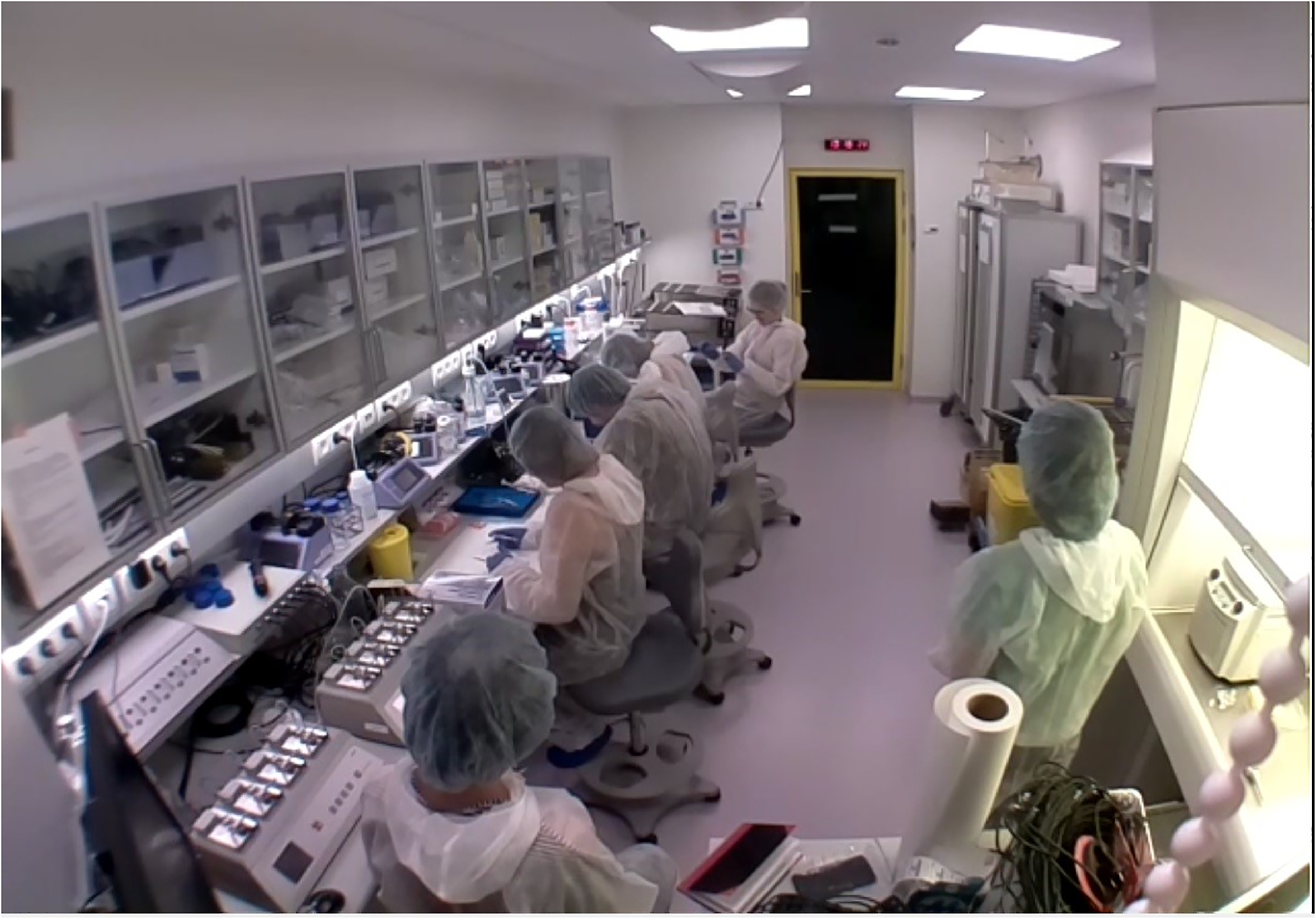
Scientists at work at the bench during a circadian harvest. Author photo.
Once dead, the animal is handed from person to person in a careful rhythm: ‘the mouse is yours’, they often say quietly as it goes down the line. To dissect a large number of mice in a team and under intense time pressure requires then not only this corporeal know-how but an ability to synchronise one's body with others. A liver sample must be dissected in the exact same way, regardless of who is doing it and at what time of day or night. This work happens largely in silence, except for the occasional small talk from a scientist or a crack as the spine is separated from the head of a mouse. At the bench, each scientist is responsible for the extraction of a particular kind of tissue. The mouse is slowly dissected – samples of the brain, muscles, and liver carefully removed and weighed, then placed in labelled tubes for freezing. This work is often done by special red lights – the red colour of the light doesn’t act as a zeitgeber on the mouse's brain, preserving their carefully manipulated Z-Time from the light cycle of the lab (Dauchy et al., 2015). The darkened room is at once active and sleepy – the red light also lulling the scientist's bodies in to a sleep-like state. The reddish glow gives way suddenly to a bright yellow electric light, causing everyone to wince. The electric light, though jarring, is easier on the eyes of the scientists and provides a necessary boost of energy (a zeigeber jolt to the system) after many long hours of delicate dissection work.
At times, the work flows easily, a dead mouse arriving in the scientist's hand just as another has been passed on. They are working ‘against the clock’ – for an animal's tissue to be useful it needs to be collected as close to the correct Z-Time as possible, at a minimum within the hour. Once extracted, tissues are immediately flash frozen in liquid nitrogen – effectively frozen at that time point. Frozen tissue samples are stored in minus 80 degree freezers and can be kept for decades – used in analyses by the same scientists or shared between labs across the world. In other moments, the rhythm is impeded – someone is working more slowly than normal, there is confusion over the number of the mouse being dissected, a scale has stopped working, a tube has been accidentally dropped in the wrong receptacle. In one particularly poignant moment, the flow of work was disrupted when one mouse was not anaesthetised in the time allotted. How long it takes for the anaesthesia to work depends on many factors – including the weight of the mouse. For ethical reasons, it is important that the mouse be completely unconscious before work can proceed. On this occasion, the scientist sat quietly with the mouse, gently stroking it, waiting patiently to be sure the experiment could proceed. The rest of the work completely stopped for long enough for another scientist to complain about the hold up. But holding firm, the time was taken for the mouse to expire.
Z-Time emerges within these experiments as a form of ‘time work’ undertaken by the chronobiologists which imparts control and customisability to the working lives of scientists. Adjusting Z-Time alters the subjective time experience of experimental animals and can allow researchers to tailor the start time of experiments to suit their schedules. It can offer a method for avoiding lengthy collections (by cleverly adjusting the time of multiple cohorts of mice) or by bringing experimental time points within the typical working hours of the lab. As postdoc Benjamin described:
We have to try and come up with creative ways of doing it. For example my colleagues have been using different light cycles. Then we are able to collect all our samples in a 12-hour period rather than a 24-hour period, so you can then do 48-hour periods in two days rather than two days and two nights. They've optimised that even more in their last trial where instead of inverting the light dark cycle they staggered it a bit so instead of doing collections at 8am and 8pm they are doing them at 8am and then the second collection is at 3pm. There's ways of manipulating the light dark cycle for different groups of mice that would allow you to make your life a lot easier.
The limits of ‘time work’
Biological time is everywhere interwoven in the time point experiment – the life time of the animal which has come to its end, the altered light–dark cycle to which the mice have been acclimatised in the weeks or even months leading up to the collection day, the scientist who has to repress their hunger or need to sleep (or pee) in order to capture the biological data they need at the correct time point. However, to what extent is it possible to ‘work’ biological time? How malleable are the multiplicity of embodied factors which meet at the bench? Navigating within the temporalities of the chronobiological laboratory is frustrating, disorienting, challenging and often fraught with errors. Small mistakes like a tissue sample accidently thrown in the nitrogen canister or a mislabelled mouse can invalidate the results of a gruelling and carefully planned experiment. While Z-Time seems to offer to scientists a precise system for ensuring ‘good science’ through their time-based experiments, its effectiveness is limited by the conflicting biological times at play, as well as the challenges which come from the scientists having to think and work simultaneously in experimental Z-Time and clock time.
While at first glance ‘Z-Time’ seems to closely mirror the standard 24-hour clock, as scientists start to ‘work’ time schedules in ever more complex time point protocols, bridging the gap between experimental time and clock time becomes increasingly difficult. Frequently the scientists I observed would have to stop and think carefully in order to calculate the correct Z-Time relative to the clock time. Mila, a postgraduate researcher at the centre, recalls her trouble in planning cell-based experiments according to Z-Time:
So if I synchronise them [the cells] at 8 in the morning, then for me its 8 but for the cell its 0. And when the cells are 12, for me it's 8 in the evening, and when the cells are 18 for them it's… 2am, right? 8 plus 4, yeah and I don't want to come in [to the lab] at 2am.
During an experiment, the scientists often have to cope with multiple cohorts of mice effectively functioning on altered ‘times’ – all while attempting to orient these times with the typical working day of the lab. As Matthew reflected, ‘It is difficult, especially when you start having multiple different times. It's not even all the mice are on one time and you are on your time. Say three groups of mice with separate time and that's different to our time’.
Flaherty (2020: 20) has observed, ‘Time work is typically laborious. It entails deliberation, effort, and execution. With time work, one aims to revise problematic circumstances’. Here the scientists are engaging in a very literal form of time work – creating and navigating across different forms of time, often with considerable difficulty. Fortunately, they have developed tools and systems for supporting this work. As group leader Richard explained to me, ‘Everyone will sort of adopt their own system. I think in the same way when you go to high altitudes you have to have sort of tricks to maintain orientation’. Spreadsheets loom large in the preparation for time point experiments. They are essential to ensure that the right mice are sacrificed at the right time point. Extensive data sheets are created which detail the numbers of the mice to be culled, their cages and tag numbers, what light–dark cycle they have been kept on, their diet, body weight and more. The scientists take care to order the cages within scantainers in a logical way so that they can work quickly without needing to seek out the next mouse, sometimes in the dark. Collection tubes are carefully labelled, both ease of identification during the dissection process but also for later location in the freezer. The time of sacrifice (the Z-Time) is central to these preparations – often written directly on collection tubes (Figure 3). Throughout a circadian collection the scientists call out the number of the mouse currently being dissected to each other to make sure they are working accurately – although late at night, or after repeated samplings, mistakes can still occur. Like other night or shift workers, circadian scientists attempt to order their bodies into a strict discipline in order to deliver their work without errors, no matter the time of day.

Phials prepared with labels for different Z-Times are ready to receive tissue samples. Author photo.
But of course, it is not only the scientist's bodies that are at play here. The main ‘work’ of the time point experiment is to act upon the subjective time experience of experimental mice by adjusting their perceived photoperiod in the scantainer. Once altered, the scientists need to carefully preserve the times of mice. During a harvest, they speak in low voices, cannot play music, or look at phones to avoid introducing any potential zeitgebers. The mice might also resist, to an extent, their malleability as temporal object. For example, in the dim red light, a mouse is harder to catch. Or as we have seen, even after the injection of an anaesthetic drug, each individual mouse takes their own time to die. These ‘mouse times’ (Roe and Peres, 2021) play a central role in the temporality of the experimental biological sciences, particularly for the technicians and scientists who tend to them. As mentioned previously, my intention here is not to focus on the experiences of lab animals – however, theirs is an important temporality in and amongst the layered time scape of the chronobiological lab.
Feeling embodied times in the laboratory
During time point experiments, scientists are constantly forced to grapple with the limits of their own rhythmic and ‘unruly’ bodies, which place limits on how much and what kinds of work they can carry out. I use the term ‘unruly’ for its ability to invoke a feeling of tension between order and disorder and the ways in which bodies struggle against categorisation or disciplining (Scott-Fordsmand, 2021). As one scientist remarked to me [paraphrased], ‘there's a difference between what the science wants, and what is physically possible’. What circadian science wants, in order to be the most accurate and to most closely capture the rhythmic 24-hour oscillations of a living system, is to carry out continuous sampling. However, such a feat is nearly impossible for human scientists who must rest, eat and whose performance fluctuates across the day. Unlike their mouse subjects who are carefully acclimatised to an altered light–dark cycle in the scantianers, the scientists are required to span these modified times of the lab and the time of the outside world. The mismatch of these different times means that scientists also feel Z-Time.
Within the centre, the work of the chronobiologists is perceived by their colleagues as physically challenging and disruptive to both work and social calendars. While scientists very often need to work late at night or at the weekends to complete their experiments, time point experiments require repeated technical and difficult dissection work at many different time points across the day – including the late night and early morning. As group leader Richard reflected in our interview:
I think in some respects circadian biologists are pitied. Every other researcher who is an experimental biologist knows what goes into it. When I started my group we were basically 50/50 and I was in the lab doing circadian studies. And now, I mean maybe 2 out of the 10 projects right now are circadian and it can be because it takes a certain type of person and a mentality to want to do the actual research.
The ‘actual research’ is at once glamorised and highly mundane and repetitive. One postdoc I spoke to observed that from the outside circadian science seemed exciting and different from other kinds of science. For example, the practice of working at night by bright red lights gives the work an otherworldly aesthetic completely different from the typical brightly-lit laboratory. Indeed, even the late-night hours might be considered a source of envy, as the teams often have social dinners together. However, once she started doing such experiments herself, she recalibrated her thinking, suggesting, ‘then you have to actually perform the experiment and we're just [thinking] why did I put myself through that?’ It was a sentiment often expressed to me by researchers who described their work as painful, annoying or boring. According to one scientist it is even ‘hell on earth’, although more moderately, others suggested circadian collections were not too bad as long as they happen infrequently.
Whatever their personal opinions on night work, the scientists I observed were greatly pre-occupied with the issue of potential mistakes in data collection as sleep deprivation sets in. In a context where circadian collections are undertaken by a group of scientists sometimes working in shifts, there can also be an undesirable ‘batch effect’ – a term used to refer to non-biological factors (like technical or human error) that can alter results. For example, one researcher might take samples in one way which isn’t matched by another person in the team taking the same tissue at a different time point. The method of extracting tissue and the pace at which the dissection is undertaken can influence the results of the experiment. Can a human body work in the same way at any time of day? The answer, as has been abundantly demonstrated in studies of fatigue, error and shift working, is no (Rhéaume and Mullen, 2018; Roets and Christiaens, 2019). However, some of the scientists suggested in conversation that there were other factors which might ‘even out’ performance differences between day and night time. While they may be more tired during late night dissections, they have ‘warmed up’ their fine motor skills for dissecting over the course of many previous time points – corporeal habit taking over, helping to ensure that the work is carried out in the same way. As Knorr Cetina (1999: 99) has explored, to dissect a mouse requires deep embodied knowledge – a ‘corporeal memory’ carefully cultivated by scientists over time. Performing repeated dissections at time points around the 24 hours hones this corporeal memory, and going some way to ensure that the tissue collection generates the ‘good’, accurate data that the scientists’ hope for, despite the limits of their own biological bodies functioning in a state of exhaustion. Overnight, some participants will attempt to catch short bursts of sleep in between experiments – sleeping under desks or in darkened conference rooms. Others prefer to stay awake the entire night, observing that some sleep only makes them groggier.
The physical feeling after an all-night or lengthy circadian collection is frequently described by the scientists as akin to ‘jet lag’ – with the researchers experiencing tiredness, disorientation, or digestive upset. When I asked postdoc Sarah how she feels the day after an overnight experiment, she replied, ‘Oh it feels awful. It's not so different from just staying up all night where you just have that jet-laggy [feeling], your body just doesn't feel right… I feel it in my stomach – it's not that it hurts it just feels weird’. Another senior researcher recalling an intensive circadian experiment earlier in his career described the ‘super disoriented’ feeling after a night attempting to get snatches of sleep, followed by leaving work in the bright sunshine. ‘My brain was trying to say its daytime, get your day started and I could not think of anything other than sleeping’. In these descriptions, the scientists echo many of the symptoms experiences by shift workers finishing a night shift – what some researchers have called ‘circadian time sickness’, characterised by desynchronisation of metabolic and behavioural timing (Van Ee et al., 2016). This kind of circadian disruption experienced over a long period can result in the serious metabolic pathologies like diabetes that these scientists are attempting to understand. However, scientists carry out these challenging overnight experiments only occasionally and long-term ill effects on their health are unlikely.
Working with Z-Time also has consequences on the social lives of circadian scientists. During an experiment, it is not uncommon to hear a research remark on a missed dinner date, a skipped football game, or a frustrated partner. When asked whether circadian work gets in the way of their private life, one researcher sarcastically replied ‘what private life?’ In her perspective, circadian science was not so different than many other branches of scientific work – where the science comes first. At centre meetings, it is often said that science is a ‘vocation’ rather than an occupation. However, Z-Time can provide a way to ‘work’ circadian experiments into the hours of a ‘typical’ working day. A carefully constructed time point experiment might leave wide enough gaps that social activities can be slotted in around the science. Here Mila describes blending her social life and on-going cell work:
In this case I'm trying to put it [the experiment] on the Friday night so I can go eat with friends and go for a drink, and then I go back to the lab at 11, and I don't feel that I got stuck in the lab because I just went out and I had some food. I'm always kind of planning to do that, so sometime I was planning my time point for [when] I was going ice skating. So after ice staking I come back to the lab. And then I don't feel that I got stuck in the lab.
Careful preparations and cleverly designed time points can assist in avoiding the worst of ‘circadian time-sickness’ and disruption to personal lives. However, the main way that scientists cope with the challenges of time work is team work. Working in teams has both practical and emotional benefits which makes circadian collections more bearable. The greater the number of team members, the more mice can be sacrificed and tissues in the appointed time – making for better data. Team members can also work in shifts – relieving each other so that the burden of the collections is shared out among a greater number of people. In one experimental design in which time points were spaced every four hours between 6am and 8pm, a team of three was used – with the experiment ‘lead’ working the entire day and a ‘morning’ and ‘evening’ assistant, changing over at midday. ‘We don’t need two miserable people’, Sarah commented on the arrangement.
‘Emotional Cultures’ of chronobiology
Working together in these difficult conditions of complex and often competing temporalities creates a strong ‘emotional culture’ of support and friendship among chronobiologists at the centre (Dror et al., 2016: 14). In conversation, several scientists referred to a ‘comradery’ or ‘band of brothers’ feeling about the teams that they work with in time point experiments. The time point structure means that for as many hours as there are in the lab, there are almost as many for waiting, socialising and chatting between dissections. Overnight circadian collections can be highly social places, where team members eat together, have coffee, and share stories. These bonds are emotional as well as practical – obtaining the help of colleagues to carry out future experiments is often a matter of personal ‘favours’. To paraphrase, ‘You put up with my late night collection and I might be willing to assist at yours’. In my time with the scientists, I observed the development of a core group of circadian researchers who assisted in each other's experiments and frequently socialised together outside of work.
It is far from new to suggest that emotion plays an important role in scientific work. While in the past emotions were seen as lying outside the rational, empirical world of science, a growing interest in affect has led scholars to think about the role of feeling in scientific practice (Daston, 1995; Barbalet, 2002). Whether it is the ‘joy’ of discovery, the ‘anxiety’ of experimentation, or a ‘gut feeling’ about a project – there are many emotions at play in contemporary science (Dror et al., 2016). In following Z-Time in practice, I would like to suggest making and doing time in the laboratory creates an ‘emotional culture’ unique to chronobiology, derived from the experience of intense and disorienting work as well as lively comradery. This observation is in line with Ulrike Felt's (2022) recent work on research cultures, which suggests that distinctive temporal regimes are a potent force in community creation within disciplines. One PI from the centre remarked on the importance of fostering this kind of supportive research culture in his own research group inspired by his experiences of chronobiological experiments earlier in his career:
I have to say, I do look back somewhat fondly [on early career experiments] because the people that you get to do those studies with, it really is a band of brothers type mentality. And I think for me when I started my group and tried to get people inspired to do these studies, I really tried to make it that and create that environment because I think when you feel like you are in it together then the sort of, the gruelling part of it doesn't seem as bad.
The experience of working in Z-Time is therefore not just done but also felt. The embodied disruptions of sleeping and eating schedules necessitated by round-the-clock experiments can cause physical discomfort or exhaustion, while working to exacting time point schedules can result in distance from friends and family. However, the temporal demands of chronobiology research can also forge a feeling of closeness which creates a reprieve from the lack of control over working times. It is important to point out that like most other branches of the experimental science, the round-the-clock work is typically carried out by more junior staff like PhD students and postdocs. Assistant and associate professors are often involved only at the planning stages. The level to which one is able to work time in science is influenced by power and social standing – with PIs accruing their right to have greater control over their work and personal time as their career progresses. Nevertheless, the felt experience of carrying out challenging circadian collections seems to remain with scientists – influencing how they manage their teams and creating strong networks of friends and colleagues which can span a lifetime. This shared experience of being and having a rhythmic body disrupted by doing circadian science contributes to a unique ‘emotional culture’ amongst chronobiologists. Feeling the physical and emotional effects of working in and with the scientific temporalities of chronobiology bonds this community of scientists.
Conclusion: Agency in biological time work
In this article, I have explored Z-Time as something which is made and felt by circadian scientists who study the rhythmic oscillations of biological systems in the laboratory. Developed with the aim of creating an environmentally relative but still linear, scientific, and reliable form of time keeping, Z-Time forcefully orders the bodies of scientists and mice during a time point experiment, and can be used to alleviate the emotional or physical challenges of doing chronobiological work. These researchers must become expert time workers – managing their working day, personal lives, the lifecycles of their mice and their equipment, and the temporal demands of ‘good science’ which pushes them towards almost continuous data collection. Working in and with Z-Time has physical, psychological and social consequences as the researchers attempt to mould their own circadian rhythms to experimental time. It seems ironic that the very purpose of the research undertaken by chronobiologists at the centre is to mitigate the negative metabolic health effects disruptions the 24-hour body clock caused by a modern 24/7 lifestyle. At the same time, Z-Time allows the selected ‘time points’ to be adjusted to suit the scientist's personal and professional needs. The stakes for navigating these often conflicting timescapes are high for circadian scientists – mistakes in dissection or data collection threaten to undermine the ultimate value of the experiment.
Unfolding the practice of time point experiments highlights the limits of ‘time work’ as a concept that is able to grapple with biological times. Mouse and human bodies resist the seemingly infinite malleability of Z-Time. Circadian rhythms in mammals, and indeed most living things on the planet, evolved over millennia in the context of our 24-hour solar light–dark cycle. They can be difficult, if not impossible, to shift. For example, the challenge of adapting the human body to the altered Martian day is a key research area for chronobiologists working with space agencies (Scheer et al., 2007). However, I do not wish to support a deterministic view of temporality in biology. Indeed, as Flaherty (2020: 14) himself has argued, ‘temporal experience is a complicated mixture of determinism and self-determinism’. Circadian rhythms may be genetic but, as Z-Time demonstrates, they can (to an extent) be adjusted and adapted. During time point experiments, chronobiologists push the rhythmic, biological demands of their bodies to the limit – needing to plan and prepare carefully to mitigate the consequences of sleep deprivation and exhaustion. As PI Richard reflected on planning circadian experiments with his research group, ‘the personal toll - that really has to be taken into account’.
Filip Vostal et al. (2019: 787) have recently called upon scholars to attend in greater detail to the ‘contours of scientific temporality’. The case of chronobiology and its time point experiments can be used to reflect on the ways that biological time and laboratory times meet. The time(s) inherent in the circadian collection seem to multiply at an enormous rate – time in the scantainer, of the working day, mouse times, human times, sleeping times and solar times. The times of the chronobiological lab are layered and complex – sometimes carefully produced or manipulated, and other times, rebellious and ‘unruly’. The attempt to order these biological times into a regimented, repeatable and adjusted time of the lab is a negation – with unruly rhythmic bodies potentially threatening ‘good’ science. Time work practices like Z-Time can help to navigate these temporalities – but only to a certain degree. Whether inside or outside the lab, the times of nature are a force with which even the most stringent of scientific protocol struggles to completely master. The case of chronobiology in practice serves as an example of the utility of looking closely at biological, embodied times and the way they encounter the (supposedly) standardised and regulated times of science, industry and capitalism (Adam, 1998). It is in this meeting that that scientific times are made and felt by the people (and mice) who make science happen.
Footnotes
Acknowledgements
This article began as a short conference paper for the Material Life of Time conference in March 2021 – many thanks to the attendees of that conference for their helpful feedback in developing these ideas. I am especially grateful to the other authors in this special section for their constructive comments and suggestions. Thanks are also due to Marisa Leavitt Cohn who read and commented on earlier versions of this article. Finally, I would like to acknowledge the contributions of my participants – the scientists who gave me such open and honest access to their experiments and to their personal and professional lives. This research would not have been possible without you.
Declaration of conflicting interests
The author declared no potential conflicts of interest with respect to the research, authorship, and/or publication of this article.
Funding
The author disclosed receipt of the following financial support for the research, authorship, and/or publication of this article: This research was funded through the International Postdoctoral Program of the Novo Nordisk Foundation Center for Basic Metabolic Research (CBMR), an independent research centre at the University of Copenhagen partially funded by an unrestricted donation from the Novo Nordisk Foundation (NNF18CC0034900).
