




Abstract
Studies on time and timing in language often adopt psychological or cognitive perspectives. This work aims to study the relationship between time, religion, and family discourse. An interactional sociolinguistic approach was used to collect data from spontaneous family interactions to study how religious activities govern how family members in Saudi Arabia organize their day and simultaneously how different times of day are organized though religious activities. This study draws on Gordon’s study of family discourse, Van Leeuwen’s concepts of timing and Goffman’s concept of framing to investigate how family members organize their time in what can be referred to as religio-temporal framing and religio-social synchronization, and how this plays a role in the co-construction of Muslim identity.
Introduction
The interplay between time, religion and language provides the basis for an interdisciplinary field of academic inquiry. The objective of this study is to investigate the complex interrelationships between these three essential components of human existence, which collectively impact society, culture and individual behavior. The interrelationship of time, religion and language is readily apparent in various religions, including Islam. It exemplifies the complex dynamics by which time, religion and language collectively shape the lived experiences of countless individuals across the globe. Islam in particular serves as a notable example, highlighting the profound influence of these elements within a major world religion and a comprehensive way of life that significantly affects temporal perspectives, linguistic expressions and cultural norms.
Islam has a unique conceptualization of time, mostly revolving on the daily prayer schedule, the lunar calendar and significant annual religious practices like Ramaḍan. Temporal markers have a tremendous impact on the daily lives and routines of Muslims, playing a critical part in structuring their ideas of time and impacting their organizational practices. Acquiring a full comprehension of the significance of time within the context of Islam offers valuable insights into the manner in which religious practices impact the temporal dimensions of individuals’ daily lives.
The examination of family interaction provides a foundation for comprehending the intricate relationship between time, religion and language, specifically in the realm of Islam. This interplay has considerable consequences for family dynamics, communication patterns and the conveyance of cultural and religious values within Muslim households. Scholars of this domain have the opportunity to investigate the influence of these variables on familial dialogues and practices, thus emphasizing the significance of this interdisciplinary inquiry in relation to familial discourse within distinct cultural and theological frameworks.
In this article, I investigate the relationship between the concept of time in the construction of Muslim identity in family talk in Saudi Arabia. The analytical framework here draws upon the concepts of framing (Goffman, 1974), socialization and natural and social synchronization of time (Van Leeuwen, 2008), as will be explained in further detail below. I propose two Muslim identity construction strategies used in the family context that are relevant to time, which are: religio-temporal framing and religio-social synchronization.
The importance of the concept of time in understanding and organizing the world in which people live is undisputed, yet not easily understood. According to Langone (2000: 7): Of all the scientific intangibles that shape our lives, time is arguably the most elusive – and the most powerful. As formless as space and being, those other unseen realms of abstraction on which we are helplessly dependent, it nonetheless affects all material things. […] Without it we could barely measure change, for most things that change on this Earth and in the universe happen in time and are governed by it.
Moore's work (2014: 3) focuses on “the spatial construals of time” from the perspective of conceptual metaphor theory and draws upon other studies linking time to the concept of space which come from linguistics and psychology, where it was found that people tend to use one conceptual domain to talk about another (Boroditsky and Ramscar, 2002; Gentner et al., 2002; Lakoff and Johnson, 1999).
These studies are based on tackling the concept of time from mainly psychological or cognitive perspectives, which are different from the one intended for this article. Van Leeuwen (2008) carried out a study linking the concept of discourse to time, where he presented a systemic functional description of English discursive resources for representing and regulating the timing of social practices: the time summons, social synchronization, natural synchronization and mechanical synchronization. He argues that work by the sociologist Norbert Elias (1992) on how we understand time has succeeded in transforming the ways in which this notion is perceived and talked about. Time itself is now understood as a product of the activity of timing, i.e., “the activity of measuring one kind of activity or event sequence against another kind of activity or event sequence” (Elias, 1992: 43). This is also relevant to the concept of time synchronization in which “the location and/or extent of social activities are timed in relation to other social activities, or to events in the natural world, or to artificially created events, such as the passing of time on a clock” (Van Leeuwen, 2008: 78).
The concept of framing has also been used in a number of studies relating to family discourse. Framing was originally introduced by Bateson (1972), who argued that any communicative move, whether verbal or non-verbal, is dependent upon participants’ understanding the meta-message of what is happening in that move. Working within the field of sociology, Goffman (1974, 1981, 1997) later developed this concept further, describing framing as the answer to the question: “What is going on in the interactional situation?” Goffman suggested that the ‘frame’ of an activity can be thought of as the organizational structure within which participants fit their actions, and he proposed that ‘frame analysis’ could be used to offer a means of understanding this ‘organization of experience’ (1997: 155). He also described how everyday activities could be organized into differently framed episodes that are the result of quickly changing frames during interaction. Goffman analyzed verbal interaction with the aim of illustrating how spoken language is influenced by various social presuppositions that govern “who can say what to whom, in what circumstances, with what preamble, in what surface form” (1997: 189).
Moreover, Goffman (1974) argued that linguistics offered the means of accounting for the variety of ways in which everyday interactions are framed in multiple layers, on the grounds that this discipline “provides us with the cues and markers through which such footings become manifest, helping us to find our way to a structural basis for analysing them” (157). Goffman (1974) developed the levels and types of framing that constitute everyday interaction and then later linked these ideas to the concept of footings (Goffman, 1981) as a means of detecting shifts in the multiple layers of framing that exist in everyday life.
Tannen (1993) demonstrated how the term ‘frame’ is related to concepts such as ‘script’ and ‘schema’ and argued that frames could be seen as one of the structures of expectation associated with situations, people, objects and so on. She coined the term ‘interactive frame’ to refer to people's understanding of what they think they are doing when they talk to each other.
Data and methodology
Interactional sociolinguistics (IS) is an interpretative approach to the study of language use in interaction which draws on the disciplines of linguistics, anthropology and sociology (Gordon, 2012). The foundation of IS and its central principles can be attributed to the work of two key individuals: Erving Goffman (1967) and John J Gumperz (1982, 2001). It also has links to Dell H Hymes’ (1962) work on the ethnography of speaking and communication.
The IS approach, which can be described as qualitative in nature, is based on “the search for replicable methods of qualitative analysis that account for our ability to interpret what participants intend to convey in everyday communicative practice” (Gumperz, 2001: 215). The principal contribution of IS as an approach to discourse analysis is that it aims to account for speaking not only as a “process of encoding and decoding messages drawing exclusively on grammatical parameters and denotational meaning of lexical items” (Bijeikienė and Tamošiūnaitė, 2013: 146), but also as “an ongoing process of negotiation, both to infer what others intend to convey and to monitor how one's own contributions are received” (Gumperz, 2001: 218). Thus, IS provides a particularly useful methodological framework for analysing face-to-face interaction and for exploring a range of cultural, societal and linguistic phenomena (Schiffrin, 2006).
The primary data for this study were collected from naturally occurring conversations that were recorded in the Eastern Province of Saudi Arabia. The conversations were recorded in different settings during several sessions from August 2014 to January 2015. The exact duration of the recorded material featuring interaction between the participants is 23 h and 27 min, with each session lasting between 50 and 60 min. The extracts in this research were selected to answer the particular research question of this study, i.e., how the concept of time contributes to the construction of Muslim identity.
In order to collect data, a number of Saudi families residing in Saudi Arabia were approached and invited to participate, and two extended families agreed to partake in the study. All individuals belonging to these families are Saudi nationals originating from and residing in the Eastern region of the country (in the cities of Al Ahsa and Al Khobar). The nature and the purpose of the study were explained to the participants, and subsequently written consent forms were obtained from the adult participants and the parents of the children. Both families are affiliated with the Sunni Sect and adhere to Islamic religious practices, including ṣalah (prayer), zakat (charitable giving) and fasting during Ramadhan. In both families, it is customary for men to attend the mosque for prayer five times a day, whereas women typically engage in prayer within the confines of their homes. Socially, both families can be described as well-educated, with a good income. The adult males in both families work in jobs requiring graduate-level qualifications and all the adult female members of both families are also educated to at least graduate level and are employed outside the home.
In total, there are some 16 participants in this study. They can be divided into three age groups: three participants (AF, AM and BU) are all aged over 60, 10 participants (AW1, AS1, AS2, AS3, BF, BD1, BD2, BD3, BD4 and BN) are aged 18 to 40, while BG1, BG2 and BG are between three and 10 years of age.
The audio-recording of conversations was carried out using two strategies: participant and non-participant observation. Participant observation is “a qualitative method of social investigation, whereby the researcher participates in the everyday life of a social setting, and records their experiences and observations” (Coffey, 2006, p. 215). This strategy was used when the researcher was able to be physically present in the settings of the recording sessions. Non-participant observation, when the researcher is not present in the setting (Williams, 2008), was employed in cases when the recording took place at a time of day when, firstly, it was difficult for the researcher to be present due to the time at which the interaction occurred (early in the morning or late at night) or, secondly, the presence of the researcher in the setting could have had a direct impact on the data gathered.
Religio-temporal framing: marking the beginning and the end of the day
In this section, I will explore the links between time and how the participants in interaction perform non-mandatory religious ritualistic activities, drawing on the concept of what Van Leeuwen (2008: 6) refers to as the “natural synchronization” of time. This is one of three kinds of time that Van Leeuwen (2008) identified in his work, namely, social, natural and mechanical. The term is used by him to refer to how “activities are synchronized with natural events, starting or ending (or lasting as long as) specific observable phenomena in the natural environment (the movement of planets and stars, the flight of birds, etc.)” (6).
Here, I discuss two examples which show how two different mothers (BD3 and BD2) manage the timing of socializing their children into performing non-mandatory religious activities, by synchronizing these with the natural events taking place in the morning and the evening that mark the beginning and end of their children's daily routine. This socialization results in what I call the religio-temporal frame that simultaneously organizes the reciting of liturgical language around different times of day and at the same time organizes the time of day around liturgical language. By adopting this religio-temporal frame, these parents attempt to ensure that their children are socialized into the performance of various religious activities that they believe play an important role in maintaining religious moral order. At the same time, they actively participate in the construction of religious identities, based both on their own individual identity and that of the family unit as a whole.
The data I present here takes the form of two extracts (1 and 2) in which patterned discourse is based on the intertextual repetition of specific religious texts and formulaic expressions. I chose these two extracts as examples in this instance since they illustrate how the same activity can be repeated in an almost identical pattern on a daily basis. This patterned discourse revolves around parenting work, which is carried out through child-centered activities such as getting children ready for school in the morning and tucking them up in bed at night. In these extracts, these routine activities are carried out by the mothers and their children using a parenting frame that allows them to socialize their offspring into the performance of religious rituals that, in turn, instil religious values and norms in the children, ultimately for the purposes of establishing and maintaining moral order.
In both of the situations discussed in this section, the timing of the activity is based on natural time synchronization, in the sense that the morning activity marks the beginning of the child's day while the evening one brings to an end the child's activities for the day. The two mothers featured in these extracts both adopt the parenting task-based frame in order to socialize their offspring into specific routines: the performance of the non-obligatory religious ritual of adhkār. 1 This involves reciting/repeating some specific religious texts at particular times and although this practice is not considered farḍ (mandatory) in Islam it is highly regarded by many observant Muslims.
Rosowsky (2008) notes that when recited in this way, these texts act as linguistic amulets and they can serve “spiritual or worldly functions” (164) such as seeking protection from evil or achieving success in one's endeavors. He Rosowsky (2008: 163) also observes that many Muslim homes “contain texts and textual artefacts that are considered to have properties of protection for those living there.” In some Islamic cultures, this practice extends to individuals wearing metal amulets inscribed with these texts or small leather pouches in which these texts are carried. However, the latter practice is generally considered to be shirk (associating partners with Allah) and therefore regarded as non-Islamic by Sunni Saudis.
In Table 1, almuʿūidhat (amulets) is the title given to a set of three short verses from the Quran, namely, alfalaq (Daybreak), alnas (Mankind) and alikhlaṣ (Sincerity). Sunni Muslims believe that when these are recited regularly, together with other forms of duʿāʾ (supplications) believed to have been passed on by alsalaf alṣaliḥ (the pious predecessors), 2 this practice provides protection from danger as indicated in various ḥadith, i.e., the collection of texts that are attributed to the prophet Mohammed. According to Islamic tradition, reciting adhkār also provides believers with spiritual succour and blessings and instils a sense of morality.
Extract 1 from Livingroom interaction (Mother and Young Child).

Here, I argue firstly that these ritualistic religious activities are based on natural synchronization of time (i.e., they coincide with the beginning of the day). This is reflected in the first religious text that the young child BD3B is able to recite from memory unaided: “Oh Allah, by your leave we have reached the morning” (line 4). However, the time synchronization reference used by the mother BD3 (Table 2), “What do you say before you go to school?” (line 3) can be considered to be an example of “social synchronization” (Van Leeuwen, 2008: 5). According to Van Leeuwen (2008: 5), this occurs when “activities are synchronized with other social activities. They start and end at the same time (or before, or after) other social activities.” In this instance, BD3 specifically links the religious ritual of reciting adhkār to the performance of another morning routine that is secular in nature, that of getting ready for school. This is illustrated in what the mother says (lines 1–3) immediately prior to the child's recitation of the morning duʿāʾ.
Extract 2 from Livingroom interaction (Mother and Young Child).
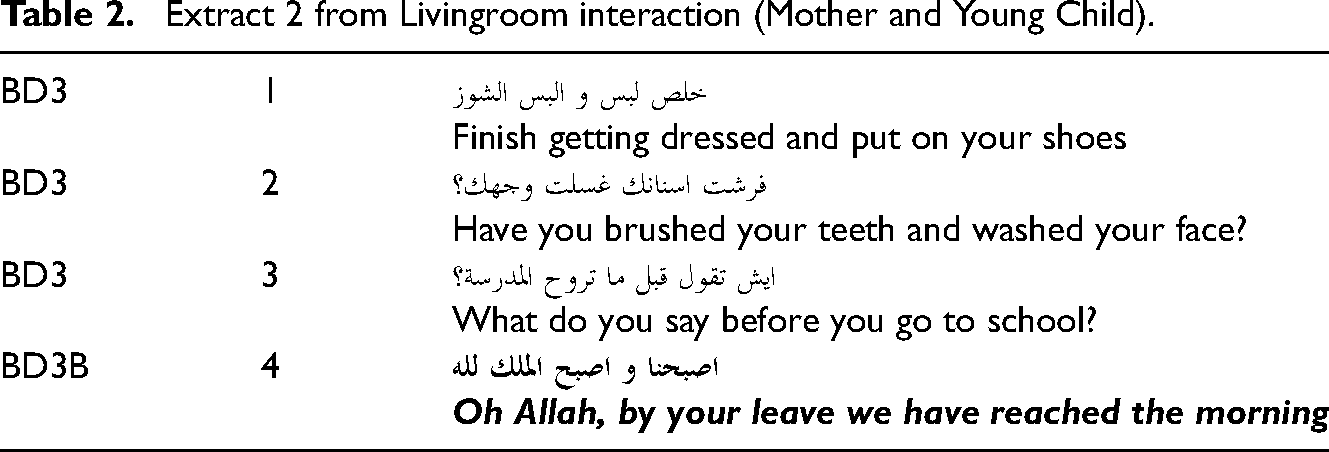
After checking if her child has performed the usual pre-school routine of teeth-brushing and face-washing (line 2), the mother prompts her child about a further act that forms part of the morning ritual before leaving for school. When the mother asks her child, “What do you say before you go to school?” (line 3) her question marks the beginning of the ritualistic religious activity of reciting the morning duʿāʾ. The fact that the child immediately responds by reciting from memory the opening morning prayers (line 4) clearly suggests that this activity occurs recurrently at a specific time (Van Leeuwen, 2008). This can be clearly seen in the sequential manner in which the mother leads the child through the ritual recitation activity to mark the beginning of another day and also in the way in which the child is able to understand what is required and to follow her lead when prompted. The way in which she frames her question suggests that this recitation of adhkār forms an integral part of the daily routine in this household, and this is confirmed by the child's response (line 4), showing that he immediately recognizes what he is being prompted to do and is able to recite the first element of duʿāʾ alṣabaḥ (the morning supplication) unaided since he has already committed this to memory. In this way, the mother is able to ensure that a spiritual dimension also frames the mundane activities typically associated with the beginning and the end of the child's daily routines.
In Table 3 the mother and the child continue with their recitation of a series of morning duʿāʾ. However, in this instance the child is initially unable to reproduce the whole of the duʿāʾ recited by his mother for several reasons. Firstly, this is much longer and it must be remembered that this is religious discourse, reflected in the use of Classical Arabic, which is difficult for the child to pronounce let alone fully comprehend. Furthermore, the series of supplications are produced by the mother at a relatively fast pace and in what I assume to be an automatic fashion. Consequently, the mother makes the decision to divide the duʿāʾ in two, reciting just the second element again for the child to hear and repeat (lines 7–8). This back-tracking by the mother to repeat the phrase for the child to recite also suggests the importance that is placed on the ritualistic aspect of this discourse. Every element in this spiritual linguistic routine is as important as the various elements that make up the mundane morning routine. Repeating the remaining element of the duʿāʾ, another relatively short phrase, appears to pose no difficulties for the child.
Extract 3 from Livingroom interaction (Mother and Young Child).
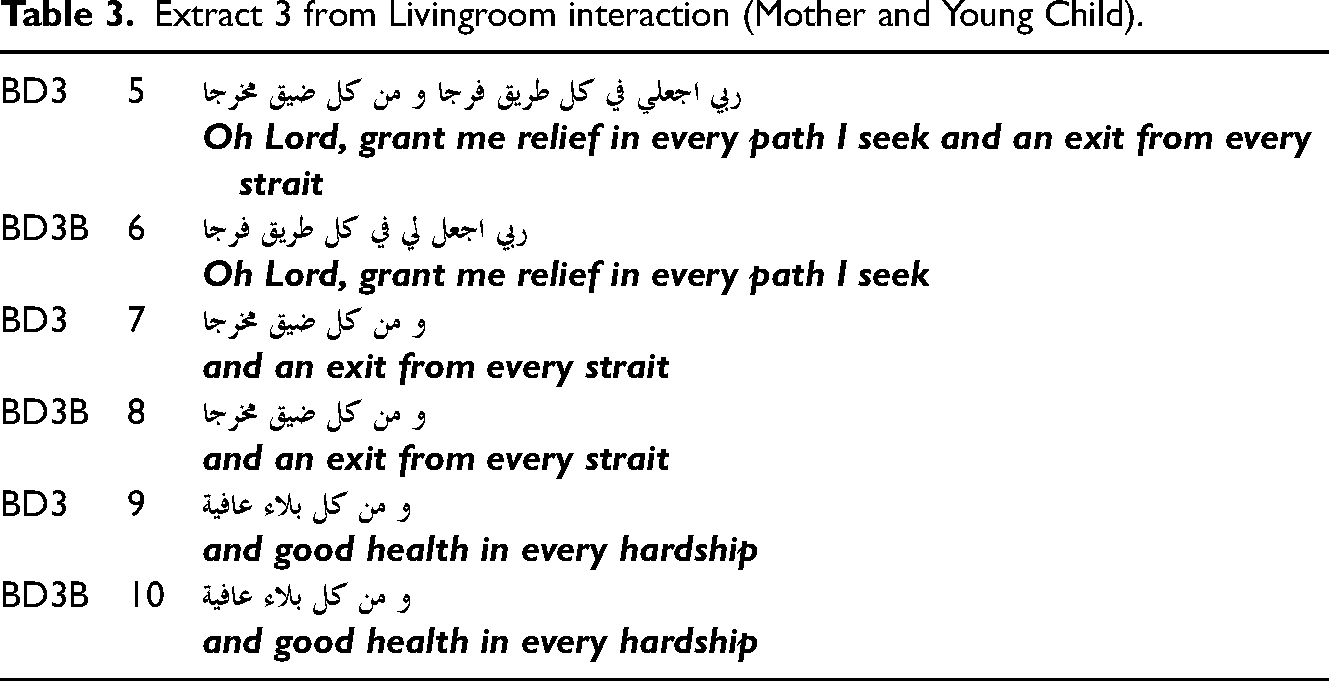
For believers, each of these pious formulae is deemed to have a specific purpose, with this particular duʿāʾ (lines 5 and 9) being used for the purposes of beseeching tayseer (divine intervention). The interaction between mother and child then switches to a pattern in which extracts from the Quran are first recited by the parent and then repeated by the child. This includes the verses from the last three chapters of the Quran—alfalaq, alnas and alikhlaṣ —collectively referred to as almuʿūidhat (the amulets), which, as mentioned above, are commonly used to ask for divine protection.
In Table 4, the same alternating pattern occurs, with the mother first reciting the Quranic verse from alnas and the child then repeating it (lines 11–12). Again, the almost perfect tone and the accuracy with which the child is able to recite these verses suggests that he is accustomed to this practice, marking it an activity that forms part of a recurrent routine.
Extract 4 from Livingroom interaction (Mother and Young Child).

The end of this series of mother–child interactions forming part of a non-obligatory religious routine is concluded by another switch from recitating Quranic verses to the formulaic expression used in duʿāʾ which is intended to ask for divine acceptance of the religious activity that has just taken place (see Table 5).
Extract 5 from Livingroom interaction (Mother and Young Child).
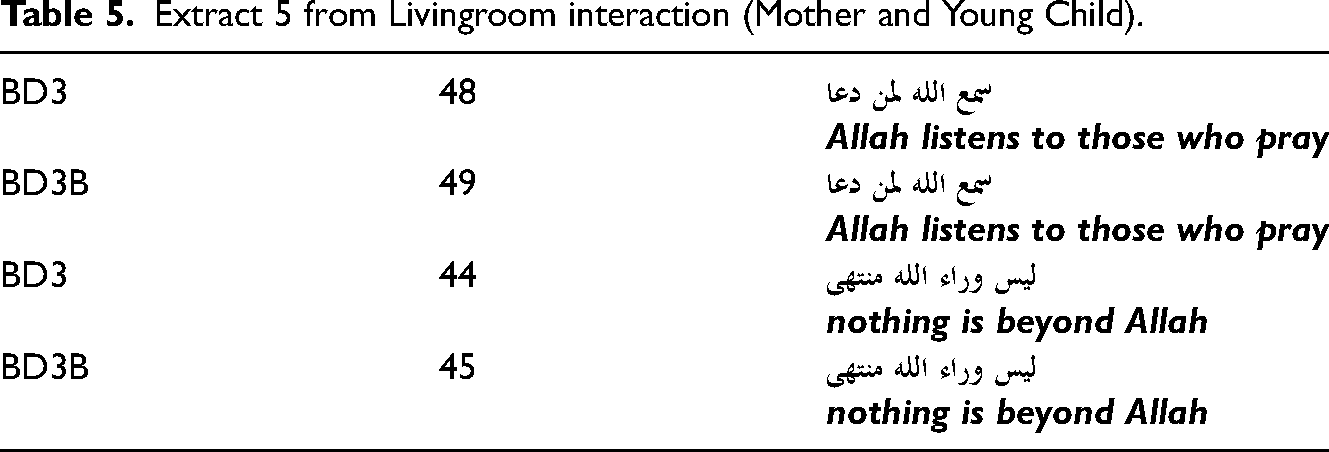
Throughout these extracts the parenting frame continues, with the religious discourse serving the purpose of socializing the child into life in a faith-based community in which the performance of this type of ritualistic activity is believed to play a key role in the construction of moral order. As soon as this recitation/repetition interaction has been concluded with an appropriate supplicatory duʿāʾ, the mother–child interaction switches back again to the monitoring of the mundane morning activities, the final stage in the completion of the daily pre-school routine checklist (Table 6).
Extract 6 from Livingroom interaction (Mother and Young Child).

As noted, there are various indications in this series of parent–child interactions (Tables 1 to 6) that suggest that this practice of reciting the morning adhkār forms an intrinsic part of a routine which occurs on a daily basis in this household:
Child getting dressed Child putting on shoes (in preparation for leaving the home) Child brushing teeth Child washing face Mother reciting opening duʿāʾ alṣabaḥ /child repeating this Mother reciting almuʿūidhat /child repeating this Mother reciting concluding duʿāʾ/child repeating this Child washing hands Child leaving for school with father
It is clear that this pre-school checklist seamlessly incorporates both secular and religious elements, showing that although the practice of adhkār is not mandatory for Muslims, unlike performing ṣalah (the five obligatory daily prayers), in this family it is still considered to be an important part of the daily routine.
Tables 1 to 6 illustrate how natural time (the beginning of the day) is synchronized with social time (the series of household routines for the child that take place before transition to the routines of the school day). Within a parenting frame, the child's performance of these morning routines is subject to monitoring to ensure that they have been satisfactorily completed, whether these child-centered activities fall into the category of secular or religious.
A similar synchronization of natural time and secular/religious socialization can be observed in Tables 6 to 9, which take place in a different household at night-time and in the bedroom setting. In this case, another mother (BD2) leads her two children (male and female siblings BD2B and BD2G, respectively) in the recitation of well-known verses from the Quran followed by adhkār, an interaction that represents the book-end of the children's day. The mother calls both the children to participate in a collective recitation of almuʿūidhat, using the plural pronoun as an involvement strategy (line 5) followed by “say with me” (line 7) to reinforce the sense that the mother and the children are a team, which in turn reinforces solidarity with them and helps to construct their religious identity as observant Muslims. This routine interaction based around religious discourse begins with the mother reciting a verse from surat alikhlaṣ (line 8).
Extract 7 from Bedroom interaction (Mother and Young Children).

Extract 8 from Bedroom interaction (Mother and Young Children).
Extract 9 from Bedroom interaction (Mother and Young Children).
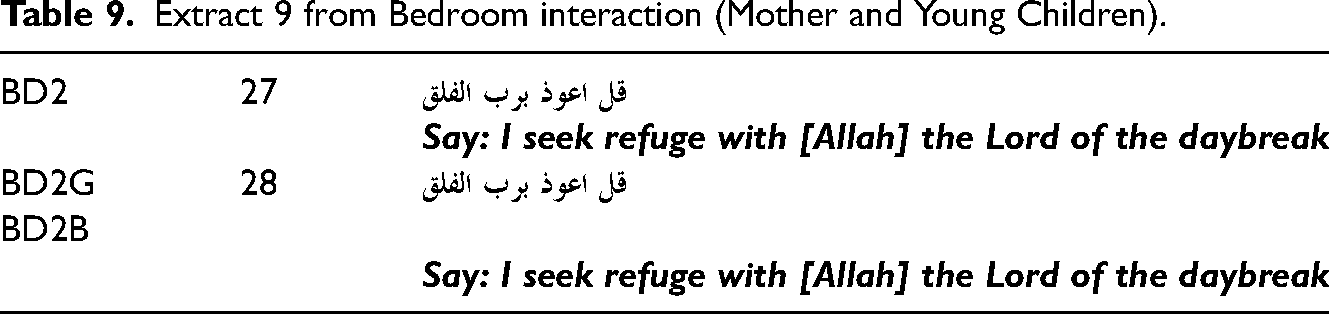
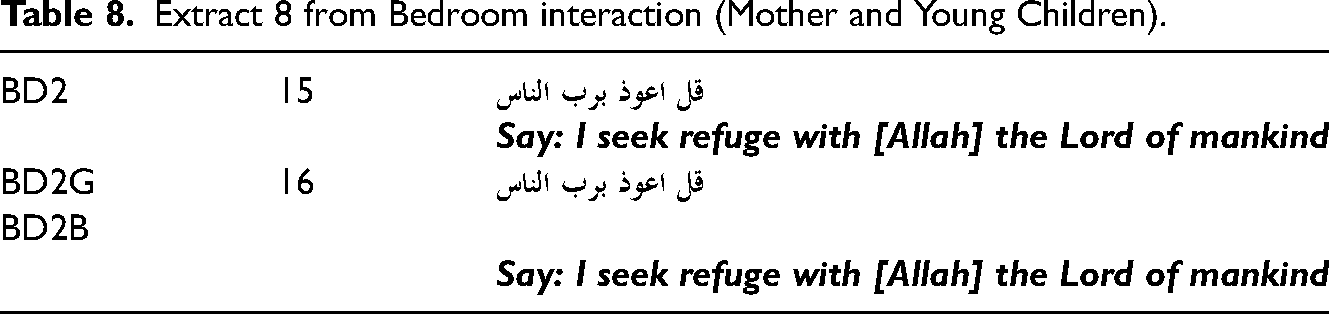
After reciting this Quranic verse, the mother, as initiator of the interaction, then moves on to recite another verse, this time from the section known as alnas (line 15). The same alternating pattern that involves the mother reciting the verse and her children repeating this can be seen, and the siblings appear to need no prompting to do this, suggesting this is a regular occurrence.
The pattern of interaction continues as the mother then recites another Quranic verse, this time from the section entitled alfalaq (line 27).
After the usual sequence of Quranic verse recital/repetition, the mother leads the children in reciting another night duʿāʾ before they are finally ready to be tucked up and go to sleep for the night (Table 10).
Extract 10 from Bedroom interaction (Mother and Young Children).
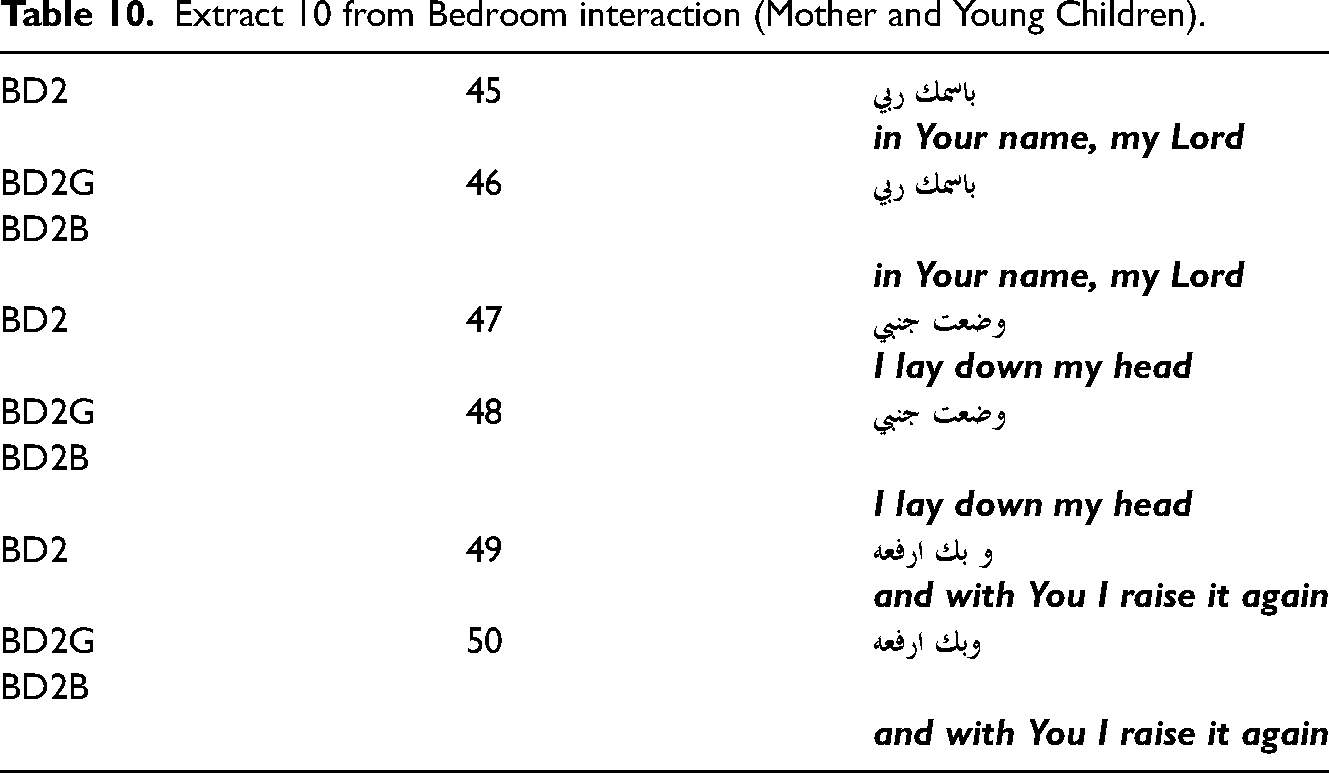
Tables 7 to 10 illustrate once again how natural time (the end of the day) is synchronized with social time (the series of household routines for the children that occur before the end of activities and transition to sleep). As in the previous example (Tables 1 to 6), within a parenting frame, the children's performance of these bedtime routines is carefully monitored to ensure that they have been completed to their mother's satisfaction, regardless of whether these child-centered activities can be categorized as secular or religious.
It is worth noting here that this series of parent–children interactions happened after the two siblings had completed their preparations for getting ready for bed. These included the standard bedtime rituals such as the brushing of teeth and putting on pyjamas. As previously, with BD3, analysis of these examples shows that the mother (BD2) uses a parenting frame to construct the bedtime rituals and this combines both secular and religious activities (verbal or otherwise) based on a natural synchronization of the concept of time. Again, these involve non-mandatory religious practices which recur on a regular basis within the household in question. These child-centered activities incorporate the repetition of religious texts, specifically Quranic verses and duʿāʾ, to socialize the children into the performance of these religion-related activities. This interaction also adheres to a time frame which creates a temporal moral order that in turn serves to construct the children's religious identity.
Religio-social synchronization: the organization of time in accordance with religious practices
Another recurrent pattern that I found in my data is related to the organization of time on the basis of religious practices. This prompts me to suggest that in the Saudi context the participants’ family life is organized in relation to a particular kind of social synchronization, one in which “activities are synchronized with other social activities [and thus require] awareness of the social environment, attentiveness to what other people are doing” (Van Leeuwen, 2008: 5). In this case, it is important to consider the extent to which the management of time can be viewed as “a social practice — an integrative practice, vital for the coherence of social life, for holding together most, if not all, of the social practices of a society” (Van Leeuwen, 2008: 12). This is particularly the case in an Islamic country as Saudi Arabia, as social synchronization has a specifically religious meaning that controls many aspects of how the daily life of individuals is organized and how all social practices are scheduled.
The examples below (Tables 1 to 4) show that for these Saudi Muslims, the routines of religious observance frame the structure of the day to such an extent that they serve as a commonly understood point of reference for measuring time in relation to secular social and domestic activities without any need for using ‘clock time’. This ṣalah (prayer)-centered temporal framework is used as the basis for arranging everything from family meal times to shopping trips. It is important to note here that this religio-social synchronization can also be said to be grounded in natural synchronization since obligatory prayers for Muslims are timed to be spread over the course of a day, from sunrise to evening.
It can also be argued on the basis of evidence found in the data collected that the prevalence of this religio-social synchronization of daily activities results not only in the construction of a moral order intended to be the foundation of an Islamic identity, but also that these same religious practices produce a social order that applies to both Muslims and non-Muslims alike in Saudi Arabia, as indicated by the example of the non-Saudi car driver who may actually be a practicing Hindu but who has learnt to arrange his activities according to ṣalah times. This illustrates the power of religion in a country like Saudi Arabia that applies Islamic sharīʿah, as this effectively becomes the organizing principle for the daily activities of all those living in the Kingdom.
As might be expected, given that ṣalah is a compulsory duty for Muslims, and one which for males must ideally be performed in jamaʿah i.e., as part of a congregation in the mosque as a collective act of worship, there were frequent examples in the data showing how daily activities, including family meals and shopping, need to be scheduled around prayer times.
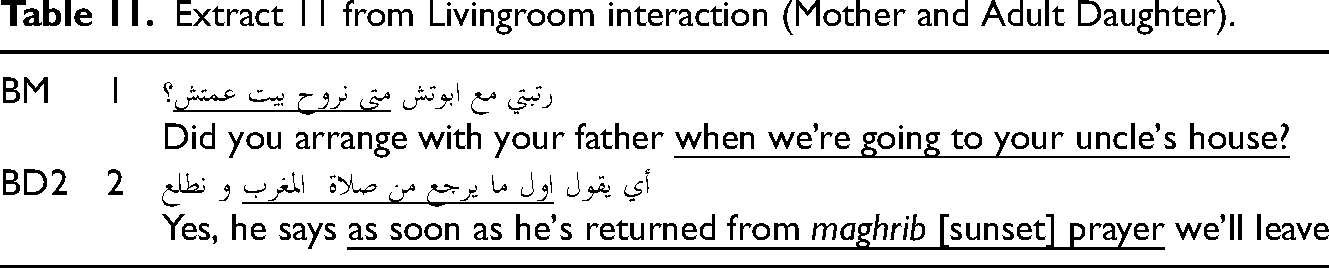
Table 11 is the first example selected to illustrate how the management of time is based on social synchronization with a religious practice, in this case specifically maghrib prayer which forms part of ṣalah. This extract from the discussion between BM and BD2 (the mother and her daughter) reveals how an ordinary social activity such as arranging a visit to a close relative (“when we’re going to your uncle's house,” line 1) must be synchronized with the timing of a religious activity: the visit can only take place after the head of the household has returned from finishing maghrib prayer (line 2). The daughter's response in this case indicates this temporal synchronization by including the use of the time clause “as soon as” (line 2). Note here that the time reference originally used by the father to indicate when they will depart, i.e., immediately after he has finished maghrib, and the daughter's relaying of this information to her mother without any further explanation suggest the frequency of the use of religious time rather than secular clock time for planning social activities. In this instance, it is clear that both mother and daughter have a shared understanding of the time that maghrib takes place and also that this prayer will be performed by this male family member outside the home in the mosque.
Extract 11 from Livingroom interaction (Mother and Adult Daughter).
In Table 12, another family activity — the time at which lunch is to be eaten — is also governed by religio-social synchronization arranged in reference to ṣalah. In this example, AF is telling his wife when to schedule lunch. Once again in this example, the time reference used for a social activity (eating family lunch) is to a religious activity, ṣalat jamaʿah, i.e., Friday prayer, which takes the form of a collective act of worship in the mosque. In this extract, AF simply refers to ‘jamaʿah’, not even thinking that it is necessary to preface this with ‘ṣalah’ since he knows that his meaning will be clear to his wife. This again suggests the frequency with which religious practices are used as a temporal frame of reference for social activities in this religiously observant family and among Saudis more generally.
Extract 12 from Livingroom interaction (Father and Mother).

Another issue which merits discussion here in the context of religio-social synchronization of time is that of gender. It can noted that in both Tables 11 and 12, the timing of social activities is synchronized with male religious practices, i.e., when the men in the household have finished praying since they are urged by Islam to perform ṣalah in the mosque. This suggests a power element in the fact that in this context males effectively decide when social activities are to be performed. According to Van Leeuwen (2008: 4), the “right to time has always been a sign of absolute power.” In Table 12, the reference to the timing of lunch is realized by a verbal process clause (“return from [performing] juma‘ah”) spoken by an authoritative figure (AF the father), with the timing of the activity as the projected clause (“find lunch on the table”). The father also acts as the spokesman for other males in the household (“the boys and I”). However, for the purposes of politeness, the order that AF addresses to his wife is mitigated by the fact that he prefaces it with a formulaic religious expression: “May Allah bless you with good health” thus reducing its authoritarian intensity. In summary, the two examples discussed here reveal not only that both moral and social order are synchronized with reference to religious activities but also that this synchronization has a gender-related aspect since the timing of the performance of ṣalah for males in the mosque effectively determines when social activities relating to the whole household take place.
Before I discuss Table 13, I would like to introduce some contextual information about life in Saudi Arabia at the time of the data collection. In Saudi Arabia, all shops used to close at prayer times, meaning that effectively the time frame for secular commercial activities had to be adjusted to conform with that religious ritual, and this affected all citizens, Muslim or not. The practice of closing shops in Saudi Arabia during prayer times has had a notable influence on the perception and conceptualization of time within the kingdom. For several decades, the act of prayer served as the predominant means of timekeeping for a significant number of individuals in Saudi Arabia. Furthermore, the practice of temporarily closing stores during prayer hours has further solidified the dependence on religious timekeeping within society.
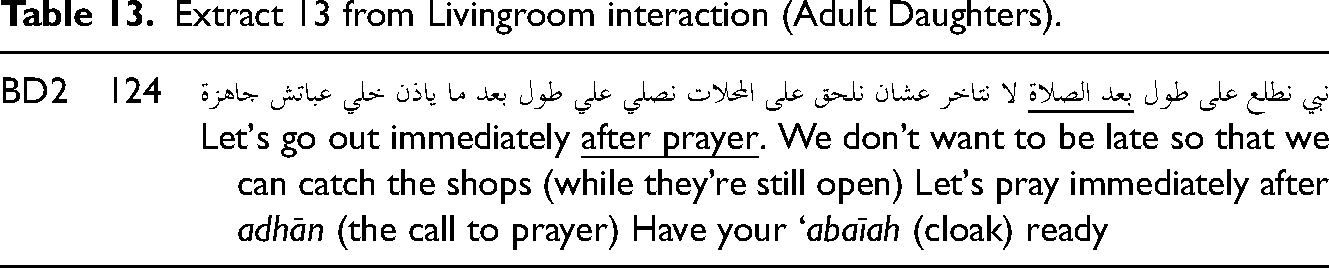
Extract 13 from Livingroom interaction (Adult Daughters).
This phenomenon fostered a heightened level of awareness of time within society since the call to prayer was used as a means of regulating people's daily routines, encompassing religious observances and occupational engagements. In addition, prayer hours were used to organize social gatherings and various other events. Non-Muslim individuals were also required to adapt their schedules in accordance with the designated prayer times. Thus, the previous regulation of operating hours in relation to prayer times in the past posed certain complications. For instance, businesses encountered challenges in achieving operational efficiency when they had to suspend operations for extended periods of time on a daily basis.
In sum, the implementation of the formal regulation of commercial operating hours during prayer times in Saudi Arabia has had a significant influence on the structuring of time and everyday routines. Nevertheless, the current policy of allowing shops to operate during prayer hours is expected to foster a deeper comprehension of temporal dynamics within the context of Saudi Arabia. In today's Saudi Arabia, individuals are now required to possess knowledge of both religious and secular timekeeping systems to effectively organize their engagements.
Table 13 provides another example of how the management of the timing of social activities is religiously synchronized with prayer times. This extract is taken from a dialogue between two sisters (BD1 and BD2) who are making plans to go to their local shopping center, and BD2 is clearly eager to ensure that they arrive before the shops close. In this case, the scheduling of their shopping trip is realized by using a main clause (“let's go out”) and a time clause (“immediately after prayer”). Note here that the speaker does not specify which prayer she means, simply referring to ṣalah, but the time of the recording and the context of the discussion suggest that this is likely to be ‘aṣr (afternoon), which must be performed in the mid part of the afternoon. BD2 does not need to specify to her interlocutor which prayer she is referring to (this depends on other factors as well as the time and the context of the conversation) or explain to her that the religious duty of performing prayer must be factored into their plans for a shopping trip, and this is evidence of their shared understanding of the extent to which prayer times used to set the rhythm of the day in Saudi Arabia and condition the organization of social life. BD2 also makes it clear to her sister that the only flexibility they have relates to the time at which they begin to pray.
This religio-social synchronization is illustrated in Table 14, in which the female speaker (BD1) is explaining to her sister (BD2) why it was not possible to return the clothes that she had bought to the shop. The driver she refers to here acts as a chauffeur for the family, a relatively common practice in urban areas of the Kingdom. It was also possible to glean from elsewhere in their conversation that this driver is not a Muslim, which may go some way to explaining why he did not attend the jama‘ah prayer at the masjid. There are other potential explanations that could account for the driver's inability to reach the shop during its operating hours. First, Islamic prayer hours vary throughout the day due to their reliance on the sun's position. Islam prescribes five daily prayers, each of which is to be observed within a certain time range. Hence, these prayer times fluctuate on a daily basis in accordance with observations of the sun's position. Other explanations are that the driver got stuck in traffic or simply was not able to reach the shops during the brief interval between two prayers since it was often difficult to predict when the shops would be open - and both Muslims and non-Muslims would often struggle with this.
Extract 14 from Livingroom interaction (Adult Daughters).

Tables 11 to 14 provide evidence of the shared cultural understanding among Saudis concerning how the timing of social activities must be organized around prayer times, which is a form of religio-social synchronization. This is indicated in the first three extracts by the fact that none of the participants in the conversation asks the interlocutor to be more precise about the timing of the proposed social activity (such as visiting relatives, eating lunch or going shopping) by providing a specific ‘clock time’, due to their shared understanding of the link between religious routines, secular activities and the time of day.
Another feature of the language used in Tables 11 to 13 is the fact that speakers often follow their time expressions with phrases that imply urgency such as “
Discussion
Analysis of the extracts considered in this section suggests that there is evidence in my data that the relationship between religious practices and time takes two distinct forms. The first relates to the performance of religious activities which can be based on a natural synchronization according to the time of day, and whether these are considered obligatory (e.g., ṣalah) or not (e.g., reciting adhkār). These extracts show that parents are eager to socialize their children into performing different religious activities based on this natural synchronization by employing what I refer to as religio-temporal frames that enable them to monitor both the religious behavior of their children and their more mundane morning and evening routines. It is important to note that these frames are not limited to children but are also used by adults. In Muslim communities, it is common to recite different kinds of duʿāʾ (supplication) at the beginning and end of different activities, such as entering and exiting the house, entering and exiting toilets and the start and end of meals. It is common to see these supplications in small books called adhkār almuslim (the Supplications of the Muslim) or ḥuṣn almuslim (the Fortification of the Muslim) that serve two purposes: to be mindful of Allah and to keep evil away. They are usually recited silently and individually.
The second relationship entails what I have referred to here as religio-social synchronization, meaning that in an Islamic country such as Saudi Arabia the timing of social activities (whether visiting relatives, eating family meals or shopping) is governed by the need for observant Muslims to perform religious duties, ṣalah in particular, at strictly specified intervals throughout the day.
This discussion has also highlighted the fact that the prevalence of religio-social synchronization as a means of temporal organization in Saudi Arabia can be seen in the ways in which those participating in conversations in these extracts display a shared understanding of how time is organized in their interaction with each other. This is further evidenced by the fact that a non-Muslim living in the Kingdom relied on this form of temporal organization rather than ‘clock time’ because when data was collected, all shops used to close during prayer times. However, shops are free to remain open during prayer times, and this practice is no longer mandated because numerous reforms are being implemented around the country to bring it more into line with modern standards. As a result, it is essential to conduct fresh research to determine how these recent changes will impact the way in which individuals perceive the passage of time.
While the scope of this study is narrow and the results of the analysis cannot be generalized, it sheds light on the intersection of time, language and religion in terms of how temporal synchronization plays a significant role in various religious practices. The concept of time holds deep theological and experiential significance in many religions, influencing the order, timing and behaviors. Therefore, further investigation of religious time and timing is required. More studies are needed to investigate religio-temporal frames and religio-social synchronization in different religions, cultures and broader social settings.
Footnotes
Acknowledgements
An earlier version of this paper appeared in the author's PhD thesis “Investigating Religious Identity in Family Discourse in Saudi Arabia: A Study of Moral Order, Narratives, Power and Solidarity” (Lancaster University, 2019). This research was financially supported by Imam Abdulrahman Bin Faisal University which granted me a scholarship to pursue my PhD at Lancaster University. I would like to thank my supervisor, Dr Karin Tusting, who provided insight and expertise that greatly assisted the research.
Declaration of conflicting interests
The author declared no potential conflicts of interest with respect to the research, authorship, and/or publication of this article.
Funding
The author disclosed receipt of the following financial support for the research, authorship, and/or publication of this article: This work was supported by the Imam Abdulrahman Bin Faisal University (grant number PhD scholarship at Lancaster University).
