



Abstract

Introduction
In all practices, the basic management functions need to be undertaken by either a manager, partner, senior receptionist, nurse, pharmacist, physician assistant or even a paramedic. Indeed, some practices use a combination of the above and include contracted specialists, be it a payroll agency or human resource management consultancy. Practices working in federations, part of another NHS entity (hospital or community trust), private entity, be they formal or informal, are begining to share many of these functions. This section aims to give guidance on several essential management skills that are appropriate to all practices, irrespective of the management structure.
Most practices work as small to medium-size businesses, and this demands a more professional approach to income and expenditure as well as cost-effective use of resources. In order to run larger practices effectively, a manager is a necessity. Even single-handed GPs and small practices have been appointing managers as the benefits become clear and the administration needed to deliver primary care becomes more complex. This trend began in the early 1990s with the then ‘new’ contract, fundholding and the new General Medical Services (GMS) contract (2003), and has continued with NHS organisational changes in recent years. As one example for practices in England of the sources of income has gone from a single place such as Primary Care Trusts to at least three different places: NHS England, Clinical Commissioning Groups and the Local Authority. One additional group has emerged. In England, since 2019, as part of the ‘NHS Long Term Plan’ that has replaced the Five Year Forward View’ there has been an emergence of Primary Care Networks (PCNs). PCNs are a collaborative of practices receiving funding previously allocated for enhanced services that are shared amongst the network. This in itself for many practices has created volumes of work chasing paper trails of claims that didn’t exist in the recent past. Whatever the cause, the ongoing changes within the health service must be interpreted and controlled, and the need for competent managers is growing, not decreasing.
The manager can be promoted from within the organisation, or may be someone with a business background specifically recruited for the post. The specific job description can be tailored to match the priorities of the practice, but the main objective is to remove the burden of management from the partners. (There is a sample job description in Section 4, ‘Employing and managing people’.) There are a number of titles for managers of practices, from the traditional practice manager to executive manager/partner, business manager, finance manager and general manager. For the purposes of this section, we will use ‘practice manager’ or ‘manager’ to encompass all the various options.
The role of the manager
As all practices are different, there is no such thing as a ‘typical’ practice manager. The traditional model of a practice manager is one of an individual employed by GP partners to run a single partnership on their behalf and under their direction (Figure 7.1). Thus the manager’s hierarchical position is neither as an equal to a partner nor exactly a member of staff. However, with the last major GP contract implemented in 2004, new models of general practice began to evolve. Some practice managers manage several practices under a single management umbrella; others are partners in the practices that they manage and have equal status to the GP partners and a profit share (see Section 2, ‘Primary health care team’); still others work for larger organisations running practices composed of salaried GPs and nurses employed by the practice, primary care organisation (PCO) or private commercial organisations. In England, the Care Quality Commission (CQC) recognises the importance of this role as such for registration and inspection purposes adds an additional responsibility to the importance of this role.

The position of the traditional ‘practice manager’
Practice management is a constantly changing job. The GP contract is regularly updated. New models of community care are being developed, and the role of general practice, and thus also that of the practice manager, must adapt to meet each new challenge. Personal flexibility needs to be high on the list of the manager’s personal attributes and continuous professional development, as well as being a requirement for the Quality and Outcomes Framework (QOF), is as essential for practice managers as for any other team member. We have gradually moved away from the old image of the proverbial accidental practice manager who was enthusiastic to a real professionalisation of the role. Today there are courses run for those wishing to obtain formal qualifications such as the Diploma in Primary Care and Health Management (DPCHM). Some areas have taken on Vocational Training Schemes (VTS) for GP managers akin to the GPs’ own training schemes. In today’s modern practice, having a Master of Business Administration (MBA) degree or with other industry experience is desirable.
Manager or administrator?
Of course, a manager is both. The role can be viewed as two halves that work in harmony, not in competition:
The ‘management’ aspects usually relate to the management of people within the organisation.
The ‘administration’ to the systems and procedures that provide the infrastructure.
Most of the tasks in a manager’s workload are a combination of both management and administration. The purpose of trying to separate the two elements is to see what can be delegated. Every member of the team has a level of routine administration that is appropriate to their responsibilities. The key is to delegate certain routine tasks (that do not require a manager’s input or interpretation) to a receptionist or clerk, leaving the manager more time to devote to the things that they are better placed to do, such as training. Many practices operate a diverse workforce inclusive of pharmacists, physicians associates and paramedics who will have slightly differing adminstrative needs. In fact the digital age, with virtually all practices now offering electronic medical records, requires more technology literacy than ever before. Any of the new skill mix within the workforce may now be able to undertake tasks such as updating the practice website, staff-training logs and ensuring that comments are responded to online.

Permission to manage
Although most practices now have a practice manager, allowing that manager to take over tasks for which the partners have customarily been responsible can be quite daunting. It may also be true that each partner has a different view of the manager’s role, some expecting them to be administrators and others wishing to treat the manager as an equal, and to seek their guidance and advice on matters of policy. Without an agreed job description, this difference will be impossible to reconcile. The basics of sound employment practices apply as equally to the manager as to any other member of the ancillary staff, and all should have a job description and contract of employment. This will avoid misunderstandings about issues such as holidays and, most embarrassing of all, salary scales and pay reviews.
It is useful to hold a meeting with the partners when a new manager has become established, usually after about 3 months, to give and receive feedback. This can be formalised by using the job description as a discussion document to prioritise the manager’s duties and to set objectives for the coming year. The partners may not initiate such a meeting and the idea may have to come from the manager. Thereafter, an annual review and appraisal of all practice-employed non-clinical staff should now be the norm, and points are available for doing this within the QOF. This includes appraisal of the practice manager.
The other major point is the amount of autonomy that a manager can assume. This may be set in financial terms, e.g. any item of expenditure exceeding an agreed amount must be referred to the partner for finance, or in terms of delegated authority. An example of this would be the disciplinary procedure, in which a manager may uphold routine standards up to the verbal warning stage, thereafter gaining the agreement to progress to a written warning at a partnership meeting. These trigger points will vary from practice to practice and be influenced by the manager’s own experience. It is not unusual for the parameters to be quite narrow to begin with, slowly widening as the manager proves his ability and gains the confidence of the partners. A large proportion of partnerships consists of partners who typically work in a portfolio manner with specific interests both clinical and non-clinical (managerial). This translates into partners who have specific roles with whom the manager may have differing relationships, such as a partner who is the lead for diabetes where anything impacting on practice pathways or income related to diabetes requires their authority. Alternatively, some partners are leads on finance or human resources and will become the authoriser and the key person for the manager to seek counsel from. For large practices, it would be good practice to pair up a partner with an administrator who supports the manager in the specific arena with the partner. As the manager is an employee, the role will always involve an agile but delicate tightrope walk.
Management skills and functions
Management is the process of designing and maintaining an environment in which individuals, working together, efficiently accomplish selected aims. Managers are charged with the responsibility of taking actions that will make it possible for individuals to make their best contributions to group objectives. As managers, people carry out the managerial functions of planning, organising, staffing, leading and controlling.
Managerial skills are important in order for this to happen. Managers need technical skills. They need to know how to carry out the various elements that their job comprises. For example, they need to know the skills needed to be an effective receptionist if they are to train receptionists to do their jobs. Managers also need people skills. It is important that a manager can work with people in a way that gets the best out of them. Managers need design skills, and the ability to solve problems in an effective and efficient way that works towards the group objective. Finally, managers need conceptual skills. In order to plan for the future and run an effective and efficient practice, the manager needs to be able to see the ‘big picture’.
Planning
It is the ability to forward plan that distinguishes an effective manager from an average one. The introduction to this handbook highlights the need for practice aims and objectives. In this section we will look at some practical ways in which such objectives can be agreed and subsequently implemented by the whole team. This team is increasing in the breadth of the multi-disciplinary approach. With the diversity comes the challenges of bringing together the group on planning as each will hold a slightly different perspective. The process of strategic planning will bring members of a practice closer together and define a clear sense of direction. It will coordinate all of the strengths and weaknesses of a practice and convert them into an action plan. However, the path may not be entirely smooth. Talking openly about potentially sensitive issues such as workload and finance may expose deep differences of opinion. These must be resolved if the practice is to progress. The inspection regime by the CQC in England is an example of stress that can affect the entire practice. Planning based on previous inspections are critical with full staff involvement.
At practice level a strategic plan should:
evaluate the current situation
evaluate the environment
identify resources and skills
identify opportunities and threats
plan for growth and change
set longer-term objectives
illustrate how the practice will work with the local health economy.
There are several benefits of having a strategic plan. It will offer structure to the organisation by developing reporting lines, and clear levels of accountability and responsibility. The collective performance should improve as each member of the team has clearly defined aims that contribute to the overall objectives for the practice. Detailed knowledge of each individual’s skills will make the delegation of tasks more effective. The planning process can be motivating and constructive. By including every member of the team in the discussions it develops a sense of ownership and better team working. Staff will feel valued because their contribution is recognised and their views are seen as important. The planning process never really ends, as there must be continuous reviewing to see whether objectives have been reached and, if they have not, modifications or new aims need to be agreed on. Even so, the planning process will give the team confidence in the future. A modern acceleration of this is building agile working. Essentially this takes this process into shorter, faster cycles. Agile involves moving away from year long planning cycles to get work done to short bursts of work lasting no longer than 2-4 weeks as ‘sprints’. The sprints are short cycles of change that the whole practice can see as an implemented change which marks the end of a sprint.
Watching the outside world
The competent manager must understand the structure of the NHS, the roles and responsibilities of each organisation within it, and the place of primary care and each practice within the whole NHS structure. The manager of a practice must keep up to date with changing NHS guidelines, and evaluate them and their effects on the practice. This may mean contacting other people within the health service, such as the PCO or a local manager, to seek clarification or advice.
Note: Most practices have moved to making the fax machine an obsolete relic, and electronic mail being the norm for all communication to a secure generic inbox that requires constant monitoring. It is important to ensure that the manager has access to official documents that may have a bearing on the management of the practice and that arrive addressed to individual GPs. Much of this is sent by email, and the generic inbox monitored email should be on all relevant mailing lists!
Structure of the NHS in England
Primary care organisations: See section 9 for a detailed explanation of the role of related primary care organisations and other PCOs. Figures 7.2, 7.3, 7.4 and 7.5 describe the broader structures from a high level perspective.
Reviewing the practice within the wider environment
A practice may be affected by:
political factors, e.g. Britain leaving the European Union, transport, taxation, employer’s National Insurance, education and training, resources allocated to the NHS, or changes in NHS structure
economic factors, e.g. impact of recession and unemployment on health service demand, accountability for NHS costs, or monopolies and mergers
social factors, e.g. influx of refugees, aging population, aging workforce, or changing expectations of doctors and patients
technological factors, e.g. electronic prescribing, greater access to health information, or unified health record, electronic mobile text communications directly from the electronic medical record
legal factors, e.g. General Data Protection Regulation (GDPR), health and safety, employment legislation, or product liability
ecological factors, e.g. practices on flood planes or during winter being affected by snow, environment-friendly practices, or animal testing.

The structure of the NHS, explaining how providers are regulated and commissioned, and how the money flows.

Structure of the NHS in Scotland (http://www.healthscotland.scot/our-organisation/about-us).

Structure of the NHS in Wales (http://www.wales.nhs.uk/nhswalesaboutus/structure).

Structure of the NHS in Northern Ireland (http://online.hscni.net/home/hsc-structure/).
Analysis of these factors (PESTLE analysis) may help practices to plan ahead for the future. At first sight, some of these items may appear to be irrelevant to general practice, but all have a bearing on the future, such as the following:
Education and training
• Changes in funding for further education may affect the numbers training for medicine in the future, possibly aggravating recruitment problems.
Increase in digitally enabled working
• If the proportion of people working from home via computer links increases significantly, it may encourage a change in traditional consulting times. At the time of writing this there are already four providers of ‘electronic - consultations’ and the NHS in England has already launched one of these as a practice with an equivalent contract to take patients from anywhere. There are two schools of thinking where it could be highly disruptive in a positive way or highly negative by cherry-picking the ‘easy’ ones starving traditional practices to look after the complex ones for even less. At the time of writing this there are ongoing reviews taking place on these style of services.
Monopolies and mergers
• There have been a number of mergers within the pharmaceutical industry. What impact will this have on the cost of drugs and the investment in research? In a similar fashion to industry, for practices, as pressures rise where economic and skill sustainability comes into question, practice mergers are increasing. There are super partnerships and large PCOs that host over 200,000 patients. The advent in England of PCNs have started to lean in on joint working groups of above 50,000 that seek to promote collaborations. The PCNs are seen as either an evolution of GP provider organisations such as GP Federations, or a replacement of them where there isn’t a functioning one. Will single-handed practices be relegated to the history books?
Transport
• The cost and availability of public transport may affect the mobility of patients and, in rural areas, potentially increase the demand for home visits. Increasing the availability of electronic consultations may solve this.
The business or development plan
Business or development plans are an important tool for the effective management of any business. The plan might be used to explain to the PCO (or even the CQC) or patients what the practice aims and objectives might be over a given period. It might be used to make a business case for funders of loans, or it might be used in the context of locality-based commissioning or as part of your local GP federation or your PCN. Another area where the development plan has become critical lies around practice mergers. This entails establishing what is good about existing practices, their respective challenges, and most importantly the value of bringing both (or more) practices together in the collective. Some parts of the business plan will be financial, as outlined in Section 3 (Finance). Other elements will include staffing structure, partnership changes, aims for patients, audit requirements and longer-term ambitions. Not every item will have a definite solution and some questions will remain for regular discussion. The business plan must be well considered, explicit and comprehensive.
The process cannot begin until the current situation has been evaluated. This requires some accurate data collection, financial information, and information about practice demography.
Example 7.2
Suggested information for the practice business plan:
aims and objectives of the practice
patient services
current and future
performance on the QOF
CQC Statement of Purpose Patients’ Charter.
3. GP structure:
structure of GP workforce (e.g. partners/salaried)
number of doctors to workload
balance of male and female doctors
particular strengths, e.g. GP trainers, GPs with special interests
outside commitments
known turnover.
4. Other clinical staff structure:
number of other clinical staff and roles
particular strengths, e.g. nurses with prescribing qualifications, specialist fields.
5. Non-clinical staffing structure:
cost effectiveness
strengths and weaknesses
training needs
known labour turnover.
6. Premises:
are they adequate?
utilisation of available space
potential for growth.
7. List size:
growing or decreasing?
balance between list size and income.
8. Equipment:
communications technology
medical
cost of replacement or upgrading
level of computerisation.
9. Clinical performance:
analysis of patient complaints
audit
written protocols for all clinicians, including nurses.
10. Finance:
methods of income generation
GMS and non-GMS income
target payments
financial trends
core and non-core services.
11. Overall strengths and weaknesses of the practice and its management and organisation (SWOT analysis).
12. Objectives:
short-term (the coming year)
medium-term (within 2 years)
longer-term (within 5 years).
13. External forces that may affect the practice.
Formulating a business plan
Setting aside sufficient time to discuss each element of the business plan is crucial to the success of the exercise. Too often, the job is left until the last minute and delegated to the manager or a partner, with little or no time for discussion. This can lead to a biased plan that largely reflects the views of the author and not those of the partnership team. It is also a wasted opportunity to involve all the doctors and staff, as well as capitalising on their ideas and innovations.
There are a number of ways in which a practice can tackle strategic planning, either by holding regular partnership meetings or team meetings, or by having an ‘away day’. We will look at the merits of each one in turn.
Partnership meetings: It is a general belief that there are already too many meetings in general practice that detract from patient care. Business planning is an ongoing process and it will need a number of meetings to finalise the plan and then to review progress, and perhaps to modify the original plan. It is unlikely that anything less than a quarterly meeting will be effective. Trying to devise a business plan under these circumstances will be subject to some logistical problems, e.g. partners’ holidays. Maintaining enthusiasm can also be a problem and, if time is limited, discussions may be superficial. Occassionally, if there are strong partnership personalities it is easy to fall into groupthink, where behaviours manifest that detract from a constructive work through on the business plan.
Team meetings: Ideally, everyone’s views should be considered when writing a business plan. Those doing the job will have better-informed suggestions for improvements, new staff may be able to spot obvious solutions, and a pooling of ideas can only enhance the finished document. The same need for frequent meetings applies, and to get the entire team assembled will be even more difficult than just assembling the partnership team.
Away days: The term ‘away day’ simply describes the concept of taking the team away from the practice to an alternative venue to work together on a specific task. The benefits are many: uninterrupted time away from telephones and routine demands, the chance for team members to talk and exchange views, improved relationships and an opportunity to view the entire practice objectively.
Usually a practice tries to find a pleasant venue and to secure the services of a facilitator. Some PCOs have funded these kinds of initiatives through practice development funds or more recently through the allocations made for PCNs in England. The facilitator’s role is to design a day to meet the needs of the practice, chair discussions and keep the day running to time. They also take on the burden of organisation on the day, away from the practice manager, thus allowing the whole team to participate fully.
There is no standard template for an agenda as each practice will have individual needs and circumstances. The facilitator should be able to ‘tailor-make’ a programme to meet these specific objectives. This may involve some method of gathering information prior to the away day. It may be that the facilitator visits the practice to meet key members of the team, attends a practice meeting, or asks each participant to complete an anonymous questionnaire. To find a skilled facilitator, a practice should seek recommendations from their Local Medical Committee, PCO, postgraduate centre, or local GP tutor. It is then advisable to ask for a CV or professional resume and ask for names of other practices for whom the facilitator has organised an away day, in order to obtain feedback.
The team members who attend the away day will be totally dependent on the aims and desired outcome. There are logistical problems in releasing the whole team, i.e. employing locums, planning the appointment system to avoid routine consultations, and finding relief reception cover. However, if the day is intended to strengthen the team and improve communication and relationships, then by its nature the whole team needs to be present.
In order to gain the maximum benefit from an away day, it is essential that everyone enjoys the experience and gains something from it. There may be some initial fears that need to be allayed in advance, and the agenda should be a balance of input from the facilitator to prompt thought and debate, group work, and written plans that are agreed by the assembled group.
Example 7.3: Aims of away days
These are only examples intended to give the reader some ideas of formatting an away day. The topics are not exhaustive, as an away day can be used as a vehicle to address any issue that the practice wishes to discuss.
Partners only
educational
to provide an opportunity to address specific major issues, e.g. the need for new premises, a new partner, a merger or joining a GP federation
to address conflicts over workload or finance
consideration of a new initiative, e.g. a new enhanced service
to provide an opportunity for business planning and strategic decision-making.
Whole team
team-building
to improve communication and understanding of the roles of others
to clarify practice aims and objectives.
Key staff within a practice function or discipline that gets carried out*
to use representatives from each area of the practice to discuss and propose solutions to current problems
to formulate action plans to implement new initiatives or systems.
*This style is commonly adopted by larger teams where it is almost impossible to release the entire team.
Planning techniques
There are some standard methods, used widely in industry, to analyse an organisation’s performance. The best known is a SWOT analysis, which looks at the strengths, weaknesses, opportunities and threats. A SWOT analysis proforma is shown overleaf. All of these factors are important to any strategic plan for the following reasons:
Strengths – knowing the strengths of the practice helps individuals to feel confident and enables the practice to capitalise on existing resources.
Weaknesses – recognising weaknesses enables the practice to avoid unwise decisions and enables strategic planning to overcome identified weaknesses.
Opportunities – identifying opportunities enables the practice to work towards exploiting them, e.g. by investing money to provide a new service.
Threats – detecting and anticipating threats enables the practice to take defensive action in good time.
Once the factors have been captured on a SWOT analysis they need to be prioritised. The strategic element of planning revolves around the opportunities and threats as they will be affected by external forces and have longer-term implications. Each item is rated on a points system according to its probability and impact. There may be major events, such as a partner’s retirement. That will have a high probability score, but if it is 10 years away it will only gain a low impact score. Within 2 years of the partner’s retirement, the impact score will rise dramatically. On a scale of 0 to 10, any factor that scores more than 5 for both probability and impact will be in the immediate priority zone (see Figure 7.7). Once the immediate priorities have been identified, plans can be made to convert the theory into action. In a parallel discipline, around project management, SWOT is typically referred to as an SVOR, which stands for Strengths, Vulnerabilities, Opportunities and Risks. SVOR tends to be more formulaic and in primary care slightly harder to score.

SWOT analysis proforma

An illustration to focus on how to immediately prioritise work
Action plans
Too often, the planning process falls down at the implementation stage. Decisions are made and objectives set and agreed, but if the next steps are ignored there will be no resulting action. There are normally several ongoing projects in a general practice at any one time. These are often within the remit of the manager, but this is not always the case. In order to cope with the complexities of the situation it is essential to have a written plan for each initiative. This will ensure that vital tasks are not overlooked and that the total plan is completed within the given timescale.
A standard tool being used across the public sector is a methodology called PRojects IN Controlled Environments version 2 (PRINCE2). There is specific training to qualify for foundation or as a practitioner. The methodology is robust and for primary care it is sometimes perceived as too complicated. However, the logic sequence is critical to help understand project working. Below we will continue with themes of areas that will provide an immediate sequence for you.
To maintain the awareness and compliance of the team, it may be helpful to make the plans public. For example, for a big project such as the building of new premises, it may take the form of a large poster, with the target completion date and all of the lesser dates in between. These may include dates for planning permission, when colour schemes and office furniture need to be chosen, regular on-site meetings with the contractors and the date for the opening party. For more routine plans an A4 sheet should be adequate, and Figure 7.8 gives a suggested format. This can also be displayed in a place that is accessible to all the staff and partners.

A table to help keep track of the impactful activities
It is essential to identify the person responsible for completing any given task. This coordinator role has a number of facets attached. It carries the duty of making sure that the given task is completed on time and that any difficulties are brought to the attention of the rest of the team to enable them to monitor progress. It may be that unforeseen circumstances impose a review of the main objective, thus changing the timescales, or even adapting the original plan. We live in a constantly changing environment and there must be structure in place to allow flexibility and audit.
In conclusion, strategic planning can only benefit a practice. When the partners and practice manager demonstrate that they are in control of the practice by being seen to be decisive and anticipating events that may have an impact on working methods and systems, the whole team will have confidence in their leadership. If the entire team is consulted about important decisions, communication will improve and everyone will be working towards the same goals.
Leadership
The practice manager is in a position of trust and authority, but this will not naturally evolve into respect until the individual’s technical and personal abilities are proven. The most powerful influence on any team is the leader’s standards. If they are high the team will aspire to reach them; if they are low the overall standards will drop.
Certain standards are obvious – personal grooming, dress code and attitude towards other people. These are communicated, by example, to the whole team. To maintain high standards requires self-motivation and self-discipline because they must never be allowed to drop. There is also an element of credibility involved, as it is difficult to reprimand a subordinate for faults displayed by the manager. For example, if the practice wishes to treat all patients courteously and calmly then the practice manager must do the same – even though the practice manager is most likely to meet patients who are already upset and wish to make a complaint.
Sadly, some managers have a poor personal reputation because they do not see things through, or they shy away from situations that require a direct approach. Examples include:
the partner who is rude to a receptionist in front of patients and other staffa dispute between two partners that needs addressing
promising training at an appraisal interview
the member of staff who is disruptive and uncooperative
agreeing to devise computer data-entry protocols
the receptionist who has an abrupt telephone manner
patient complaints following the complaints process.
In all of the above situations the manager is being watched and judged by the team. Failure to deliver promises will be seen as disinterest or inefficiency, failure to deal with difficult personnel issues will be seen as weakness, and a failure to tackle partners who have been unfair or rude will be perceived as lack of support for the team. The attributes of a successful ‘people’ manager are endless, and many of them cannot be taught – they are instinctive. These qualities include tact, sensitivity, diplomacy, resilience, flexibility, clarity of thought, the ability to prioritise, an equable approach and a sense of humour.
Team building and motivation
It does not matter how efficient a manager may be, or how high the standard of clinical care – the practice will only function effectively and harmoniously if all members of the team are working together. A practice that develops a real ‘team’ approach will be able to deal with adversity and have fewer problems than a practice that does not foster such an atmosphere. The downward pressure on staffing budgets and central resources means that every practice has to get the most from each individual.
Staff are the most valuable asset of any organisation and general practice is no different. They form the lion’s share of the practice expense base, as with many businesses. Teams that work cohesively are in a much stronger position than those that do not enjoy a corporate approach. However, a team is not a natural result of a group of people who happen to work in the same place. It takes careful management and constant reinforcement. In this section we shall review some ways to build and motivate a team, using techniques that every practice can put into place. These methods will be backed up by some management theories that will explain and support the guidance given. This is one of the most challenging, and potentially most rewarding, aspects of a manager’s role.
Why do people work?
Abraham Maslow’s hierarchy of human needs can offer some insight into why people work. Maslow maintained that there are seven basic human needs, the most powerful being the physiological, and the least, self-fulfillment:
Physiological – food, water, temperature control, e.g. earning sufficient money to be able to eat and maintain a home.
Safety – security, freedom from threat, e.g. a salary that allows an individual to meet financial obligations.
Social – love, affiliation, acceptance by others, e.g. social contact with others through the workplace.
Esteem – prestige, status, respect from others, e.g. being respected for doing a job well.
Cognitive – knowledge, understanding, curiosity, e.g. further training, enabling an individual to acquire skills, or qualifications to gain promotion.
Aesthetic – beauty, art, structure, e.g. having a routine for each day.
Self-fulfillment – achievement, realisation of potential, e.g. being congratulated for achieving success.
This theory may go some way towards explaining why some staff are motivated by salary increases, and others by the prospect of promotion and increased responsibility. It also explains why blanket initiatives to motivate staff are not usually universally successful, because each individual responds to a different driver.
Another theory that has taken to explaining motivation is called Herzberg’s motivation-hygiene theory. This offers a different dimension from that of Maslow in that the stacking of one need on top of another does not follow a linear process. Herzberg put forward his two-step theory, which introduces the term hygiene factors needing to be met before an individual could be motivated. An example in primary care with GPs is around their work setting. Hygiene factors today include the expected requirement of having a desk, a computer and usually a chair each for you, the patient and the patient’s carer. If none were in place then no amount of marginal monetary inducement would work as the GP would be dissatisfied due to the absence of items necessary to his/her work. However, if hygiene factors are met, a non-monetary motivator could be a mid-surgery cup of tea distributed to pull you through the 3-hour surgery, which could lighten the work and keep you motivated. In some practices, this is a mandatory 15- minute break in the meeting room to discuss difficult cases. These practices will refer to how much more productive they are as well as how strong the team spirit is.
If a manager has an in-depth knowledge of each team member, he or she will be able to tailor-make a package to get the most out of that particular team member, without creating unfair precedents. The ideal time to discuss these issues is during an appraisal (see Section 4, ‘Employing and managing people’).
Team definitions, vision statements and team functions
A team can be defined by a group of people working towards a common objective. Modern understanding brings in the complexity of teams forming where organisational structures may not exist. A leading professor, Amy Edmonson from Harvard Business School, refers to the concept of ‘teaming’. She defines this eloquently as ‘Teaming is a verb, it is a dynamic activity, not a bounded, static entity’.
In general practice the common aim is to deliver patient care and every individual has a role to play. The first step in establishing a team is to set a common goal, often referred to as a ‘vision’ or ‘mission’ statement. The reasons for formulating a vision statement are varied, as shown in the following, for example:
GPs, nurses and managers do not always share the same goals. Even if they do, they don’t always communicate these to each other. As a result, others have difficulty in identifying what such goals are. Consequently, decision-making is compromised and prioritising becomes more difficult.
Primary care teams are becoming larger and more complex, and so require a clear focus and more effective management.
Primary care teams are being asked to handle more complicated tasks (e.g. managing budgets and providing patient services within a given area).
There may be a general resistance to change, with many seeing it as a threat rather than an opportunity.
Traditional education and audit activities do not address these issues and are often unable to meet the needs of teams and their members. If these problems are to be tackled, each team must have a clear idea of its direction. All the members must understand and share the aim, and the way the team operates must reflect it.
One method of initiating the process is to formulate a vision statement for the organisation. Below is an example of a general practice vision statement, with the common aim reflected in the objectives for each aspect of the team’s activity.
The process of formulating aims and objectives is not without risk. It may expose fundamental differences of opinion that will need to be resolved if the practice is to move forward. It is important to have diversity in thinking that adds to the richness of the tapestry of the multi-disciplinary primary care team. A vision statement will remind everyone of what the organisation is striving for, especially if the statement is prominently displayed in the practice entrance, offices and reception/administration areas.
Example 7.4
Practice vision statement
We aim to deliver a high quality of care that is readily accessible to all patients.
Doctors: We aim to treat each patient professionally, by maintaining and improving our clinical skills, and with respect.
Manager: I aim to manage the practice safely, efficiently and cost-effectively, and to monitor the wellbeing of doctors, staff and patients.
Practice nurses: We aim to support the doctors in their clinical care of patients by offering a comprehensive range of health promotion and preventive care activities.
Administration team: We aim to provide an efficient administrative and organisational service to support patient care and to enable prompt access by patients to clinicians.
Computer manager: I aim to facilitate accurate computerised medical records that can be used by doctors in the consulting room, and to standardise methods of data entry for audit purposes.
A team has six main functions:
Providing emotional support: Professional responsibility can be very rewarding, but it can also be isolating. Ideally, every team member will be trained to undertake a particular role and be encouraged to use their initiative and make decisions within given parameters. Unfortunately, not all situations are black and white – there are many shades of grey! There are numerous occasions when an individual needs to discuss his/her actions and be reassured – this applies to doctors just as much as administration staff. Moral support can be extended to personal worries, and practices should be wary of eliminating all social chit-chat because this can provide a safety valve for the team.
Coordinating interaction: A team provides a structure to allow things to happen. Everyone has a designated role which, when combined with regular meetings, can translate ideas into practical actions. This process ensures that everyone is informed about current practice projects, and duties can be distributed according to skills, not job titles.
Orienting members: The best example of orientation is the induction training given to every new team member. It makes newcomers feel welcome and gives them access to information in a planned way. This also makes good business sense as the newcomers will be able to contribute more quickly, rather than picking up bits of training in an ad hoc manner. First impressions of an organisation, i.e. what is and what is not acceptable, will set the standard for the future.
Generating ideas: ‘Think the unthinkable!’ A practice that makes it clear that suggestions for improvements are welcome, even trying them for a short period of time, will elicit lots of ideas from the team. Sometimes very good ideas can be generated by giving staff the freedom and opportunity to suggest ‘mad’ ideas. Using staff meetings to brainstorm a problem can be very useful, as one idea often leads to another. Even seemingly unworkable ideas will have some merit as they can sometimes be modified and adjusted. Ideas can be encouraged by introducing a suggestion scheme and a cash bonus if the idea is implemented. Some multinational companies routinely gather new ideas by running initiative groups and problem-solving groups.
Making collective decisions: Involvement is the key to reducing resistance to something new. The team that is fully consulted and informed is much more likely to embrace change positively.
Identifying strengths, weaknesses, opportunities and threats (SWOT): The SWOT analysis is discussed in detail under ‘Planning’ (page 7-05). The reason it is included in this list of team functions is that in performing this overview of the practice, the team can become more aware of skill shortages and options for the future. A personal SWOT is covered by appraisal as it performs the same function as an organisational analysis.
Stages of team development
There are many ways at looking at the workforce that, from the GP lens, looks like it is shrinking with age, but the mix of bringing in pharmacists, physician assistants and paramedics opens up a new team of members who think differently. When looking at roles there are natural preferences that individuals will adopt.
Meredith Belbin (https://www.belbin.com/about/belbin-team-roles/) identified nine roles and you can see which one resonates best with you too:
— Plant: generates ideas.
— Resource Investigator: networks and links people.
— Co-ordinator: the typical chair person.
— Shaper: motivator and task orientated.
— Monitor Evaluator: brings objectivity into the team.
— Teamworker: the glue keeping everyone together.
— Implementer: translates ideas into specific actions.
— Completer Finisher: the standard bearer for what good looks like.
— Specialist: subject matter expertise in a given area.
The point being differences make the team stronger rather than a predominance of one type of team skill or preference.
Another perspective is to consider a team to have a natural progression of development, which Bruce Tuckman, in his classic article, Developmental Sequence in Small Groups (https://psycnet.apa.org/record/1965-12187-001 Overly quoted but original source from 1965), describes as:
forming
storming
norming
performing.
Team dynamics are not static – they change constantly in response to new members and initiatives. We will examine each of Tuckman’s stages in turn and explain why changes within a team often have an unexpected impact. The opportunities to create a completely new team are limited, and in general practice they are usually restricted to forming a project team to tackle a specific initiative. The stages apply equally to existing teams as well as to newly formed ones.
Forming
Most people can relate to being a new person in an established team and the feelings and behaviours that go with the situation. The greatest wishes are to be accepted and to not make any mistakes. A team that is forming has the following characteristics:
individuals ‘test’ one another to compare attitudes and approaches
feelings are usually hidden to avoid ‘saying too much’ that may be regretted later
people are watchful, absorbing the codes of conduct and standards
there is a wish to conform; this can apply to dress code as well as to attitudes to patients and colleagues
there is a degree of political manoeuvering, i.e. seeking out the power bases within the team (which are not automatically the most senior staff).
Storming
When the team moves out of the forming stage some subtle shifts can be detected:
with contact and shared experiences the barriers begin to drop and individuals become more confident in expressing opinions
a natural pecking order begins to emerge
there is a desire to establish the roles and responsibilities of each member
this is the stage with the greatest potential for conflict.
This is probably the most uncomfortable stage of team development because it exposes differences of opinion and priorities, which can generate conflict. A manager or team leader will inevitably get drawn into discussions about comparatively minor issues – this is all part of the process to draw demarcation lines and highlight specific functions.
Norming
The beauty of this stage is the movement away from personal concerns towards team concerns, making management much more proactive:
the team members recognise each other’s strengths and weaknesses, without animosity
there is a general recognition of the limits of each individual’s capabilities
the team members learn together from shared experiences
self-satisfaction becomes less important
team performance becomes a matter for concern and pride.
One way in which a manager may realise that his/her team is at this stage will be the interest in wider issues. The team leader may face unexpected questions and comments and must be prepared to share information, even if this was previously considered irrelevant by the staff.
Performing
To reach the performing stage a team must be settled and have enjoyed a period of stability.
relationships are established and there is mutual trust
there is collective competence
the team becomes self-regulating
communication improves
the team becomes capable of managing its own development
everyone contributes.
These characteristics describe a strong team, and the amount of management problem-solving needed decreases, although clear leadership and support are still necessary. The atmosphere in a practice at this level is positive and high standards are achieved.
It is interesting to note that when there is a change of personnel the team reverts to the initial stages for a period of time. If the new person is a partner or manager it is likely to take longer to get back to the performing level as their effect on systems and expectations is greater.
Building a team
There are a number of ways in which a team can be maintained and motivated. These fall into five categories:
Leadership
Communication
Appraisal and development
‘People’ protocols
Incentives and penalties.
These areas are all closely inter-related and some items may appear under more than one heading.
Leadership
The main function of a leader is to ensure that everyone understands the future direction of the practice and the role they have to play to achieve that aim. There will be occasions when the staff will question decisions, probably because they disagree with them. It is not uncommon for a number of the senior team, i.e. partners and manager, to be asked the same question in an attempt to establish whether there is any room for manoeuvre. When practice policies are agreed, it is essential that a ‘party line’ and method of announcement are also agreed. If the team disapproves of a new policy and they perceive that they can play one partner off against another, or if they can undermine a manager, they will!
Leadership does not stop at setting objectives and giving clear directions; in fact, this is only the starting point. The obligation to monitor and support the team members is ongoing.
This may take the shape of training, counselling, constructive criticism and introducing systems to ensure that the leader is constantly updated on progress. There will be times when plans need to be modified in the light of new information or changing circumstances, and the leader must be flexible enough to encompass this.
Communication
A team leader who does not provide a forum for the exchange of views, information and ideas will quickly become remote. Consulting all relevant parties before making a major decision will always have advantages. It will raise awareness, generate ideas, ensure that everyone understands the background and pave the way for implementation. Managers are often disappointed, though, when a staff meeting is arranged and there is a noticeable absence of comment, or it degenerates into a ‘grumble session’. This does not mean that the decision to hold a meeting was wrong, simply that the staff need more encouragement to participate. It may signify the stage of the team’s development, or that they are not confident that they can speak freely without reprisals.
Some conflict is inevitable and healthy. Without alternative views an organisation is unlikely to grow and move forward. The average manager finds staff disagreements the toughest part of the job, and guidance can be found elsewhere in this section. Unresolved conflicts or those that are not openly recognised will fester and gradually eat away at the team’s confidence in each other and its leadership.
The team leader will also, on occasions, need to give negative feedback, and many find this difficult to do. We can all identify those individuals who have great difficulty in delivering unwelcome news and who will tell people what they think they wish to hear. This, of course, does little for their personal credibility, or for the organisation as a whole. Constructive criticism can have beneficial effects. It can raise the performance of an individual and therefore the team and also sets standards that the whole team knows they must meet or exceed. When giving negative feedback:
always have examples to back up comments
agree the most appropriate person to give the feedback
never publicly criticise
choose an appropriate time and environment
seek the views of the individual
set clear standards and expectations
agree a plan to overcome the problem.
However, a competent team leader will do much more listening than talking. By establishing open relationships he/she will know the mood of the team and what obstacles will need to be overcome in order to strengthen it. During the course of a working day we hear a number of comments on a variety of issues – the skill is to make an informed judgement on what needs to be taken seriously and acted upon. Over-reaction to one-off comments can be just as dangerous as ignoring well-founded ones!
Appraisal and development
‘A learning organisation harnesses the full brainpower, knowledge and experience available to it, in order to continually evolve for the benefit of all its stakeholders’ (‘The Power of Learning’ by Mayo and Lank (1994)). In order to do this, the strengths and weaknesses of each individual must be identified and training be provided to better equip that individual to meet the needs of the team and the organisation.
The importance of ongoing learning cannot be stressed enough. The process of education begins within induction and never ends, but why should we do it? Some reasons are:
to achieve and maintain the desired level of performance
to develop each individual to attain their full potential
to create a cost-effective team
to motivate by encouraging a sense of belonging
to increase job satisfaction by making the individual feel valued
to prepare for future challenges.
Ideally, every team member should have a personal development plan and a record of their training. These should both be appraisal-driven and relevant to both current and future needs (see Section 4, ‘Employing and managing people’). Methods of education are described elsewhere (Section 5, ‘Education’).
‘People’protocols
Teams need clear guidance on the acceptable codes of performance and behaviour. These are delivered in a number of ways:
Job descriptions: This is one of the most fundamental documents in employment. It gives written guidance to each individual on their range of tasks and responsibilities; it is the basis of an appraisal. A manager can devalue the document by not keeping it updated in line with new tasks, different priorities and changes within the organisation (see Section 4, ‘Employing and managing people’).
Contracts of employment: These set out the terms and conditions of employment and can become a useful training tool
Routine discipline: Once standards have been set they must be upheld uniformly—to allow exceptions will start a slow process of decline, which will be difficult to correct.
Incentives and penalties
From the hierarchy of human needs we know that different people respond to different types of rewards; some will be motivated purely by financial gain and others by recognition. We need to address what individuals see as ‘hygiene factors’ in order to set ‘motivator factors’. As organisations become larger, motivator factors are no longer the aspiration of partnership. Other factors become critical. Here, we look at some of the options available to team leaders to motivate and reward their team members.
Salary policy: Any salary policy must be available to staff to reassure them that they are paid in accordance with their role and that there are differentials. It does not matter which scale is used as long as there are clearly defined links between pay and level of contribution. More details can be found in Section 4.
2. Long service and loyalty: Some practices are lucky enough to have long-serving members of staff who still fulfil their role to everyone’s satisfaction. Loyalty is a quality that is hard to define, and the only sensible yardstick is the amount of service. For this reason many organisations recognise certain milestones, e.g. 10 years, 20 years, etc. The ideal salary structure would have these milestones built in by awarding a salary increase, or additional benefits, e.g. extra holiday entitlement. If this type of recognition is considered too expensive then a simple gesture, like a bottle of champagne presented by the senior partner, will still make the individual feel valued.
3. Perceived promotion: It is difficult to define a career path for practice staff; the hierarchy and numbers are such that the opportunities for promotion are limited. However, there are always tasks that are considered more prestigious than others, and these can be used to reward and motivate. This ‘perceived’ promotion gives the individual greater status within the team.
Performance-related pay: The concept of performance-related pay has been present in industry for many years. The schemes range from giving an additional percentage salary increase for achieving personal objectives, to ‘ranking’ staff performance into ‘excellent’, ‘satisfactory’ and ‘poor’ and giving a different remuneration for each. As a general rule, those who were under-performing would not receive any increase. The benefit of such a system is the flexibility it offers a manager to reward those who give that bit extra. The disadvantage is that the judgement can be very subjective and potentially unfair. The recommendation to any manager considering the introduction of such a system would be to make the criteria simple and evidence-based.
Bonus schemes: There are times when a practice wishes to reward the team, but on a one-off basis rather than a longer-term increase in the total salary bill. It must be stressed that a bonus should always be in addition to an annual salary review, not instead of it. Practices who have traditionally given a ‘bonus’ at Christmas may find that it is now considered part of the conditions of employment as it has become ‘custom and practice’. The original intention of thanking the staff has probably been lost in the mists of time! Bonus payments are most effective when they are linked to the achievement of a specific goal, e.g. attaining QOF points or moving into new premises. It should be remembered that the staff may have to pay tax and National Insurance on bonus payments, and advice should be sought from the practice accountant.
Profit sharing: Some large organisations have had profit-sharing arrangements in place for many years. The intention is to make the whole team aware of the financial progress of the company and stress the part they can play in increasing profits by reducing expenditure and generating income. Companies such as John Lewis have a long tradition of rewarding staff in this way. However, it can be a complicated area and practices considering such an initiative should seek financial advice before implementation.
Disciplinary procedures: If there are rewards for good performance there should also be penalties for poor performance. A disciplinary procedure should be included in every contract of employment and enforced fairly. This is the only way to ensure a baseline of standards (see Section 4).
Delegation
What happens when a manager tries to explain that they are very busy and cannot take on an additional task at this moment? ‘Easy’, someone says, ‘delegate’, as though it is the answer to all problems. It is a technique that has to be learned and practised, because poor delegation will cause more problems than it solves. By delegating the routine tasks, the staff concerned will become more aware of the overall running of the practice, which in turn gives them training and increased job satisfaction. However, there are some sensible guidelines to observe.
The manager is probably the most expensive member of the ancillary team, and certain tasks, like going to the bank or post office, are a complete waste of that resource. There is a difference between the manager ‘pitching in’ when staff are under pressure and the manager doing mundane things automatically. There is a danger that continually doing things that other team members are supposed to do will eventually undermine their confidence and foster a belief that they are not trusted. Everyone within the practice team should be encouraged to use their initiative and accept responsibility for their area, within agreed criteria. Bringing a problem inappropriately to the attention of the team, or management may highlight an inability to accept such responsibility, or lack of confidence, and some coaching or training may be needed for that team member.
The temptation is to delegate the tasks that are boring and uninteresting, but this is not the best reason. Some things, like checking the quarterly income statements, are uninspiring, but a key part of the manager’s role. Therefore, managers must be clear about the reasons for delegating a job, having established how much time will be saved and how that time will be used.
Delegation can be a crisis management reaction and the instructions given in a hurry – this is a recipe for disaster! The basic level of understanding that a manager acquires may not be shared by others in the practice and clear guidelines are essential. This takes time, and the best way to check that the task has been completely understood is to ask the staff member to repeat it back ‘parrot fashion’. In order to raise the level of competence and job satisfaction the whole job must be delegated, not just the boring or time-consuming bits.
It is unfair to expect a member of staff to take on an additional task without dedicating adequate resources. This includes time, training, working space, materials and a review of their original workload to ensure that another priority is not overlooked. Anyone undertaking a task for the first time needs support and guidance, but not necessarily interference. There should be points built into the task at which the person to whom the task has been delegated refers back to the manager for a progress check. This will allow the manager to retain control and to offer on-the-job training if necessary. Even though a particular task is being delegated the manager remains responsible for the outcome, and it is important to communicate this fact at the outset. This does not, however, prevent the manager from giving the credit for the work to the person who actually did it.
Should the person to whom the task has been delegated make an error, or exhibit poor judgement, they need to be corrected, but this should only be done in private. To criticise publicly will de-motivate the individual and make them reluctant to try anything new in the future. Wise managers use delegation as a means to criticise their own performance. There may be a task that the manager knows they do not perform particularly well, and by delegating it to someone else they can observe the process and learn. This type of personal development has the advantage of being discreet and the manager does not have to openly admit shortcomings. Simple delegation guidelines are as follows:
Never do work that others can do.
Think carefully why you are delegating.
Ensure complete understanding.
Delegate the whole job.
Delegate adequate resources.
Set out the process for review and control.
Retain responsibility for the results.
Use delegation to criticise personal performance.
Management of change
The process of change – ‘evolution, not revolution’
Change is a part of life, and happens continuously at work and at home; even our own personal attitudes are modified as we experience and learn more. However, change can be perceived as negative, rather than as a natural positive progression. In this part of the chapter, we will review some techniques that help managers to manage change and minimise disruption. The first step in moving an organisation forward is to have objectives that are clear, simple and easily communicated. Change only becomes a threat when it is imposed, in other words, without discussion with those affected and without the necessary support training. There are two ways to approach and manage change:
proactive – anticipating the change, planning for it and taking control
reactive – sometimes referred to as ‘crisis management’, ‘fire fighting’ or ‘knee jerk’ management, when the change dictates to the organisation.
Reasons for change
There are a number of reasons for change, but they can be divided into two main types:
External forces
These often prompt a reactive management style because they are beyond the control and influence of the average GP. Examples include:
— general elections and changes in government policies, e.g. primary care becomes the ‘problem’ scapegoat reducing funding overall
— new legislation, e.g. Health & Safety at Work requiring a CQC update
— changes in local NHS structures, e.g. payment structures are reconfigured requiring new claims processes, e.g. PCN formation.
When laws governing employment are amended, the practice has no option but to comply or risk prosecution. This applies to several aspects of the organisation, e.g. tax regulations, employment legislation, GMS Contract amendments, etc. Although the practice may not be able to challenge the decisions, the implementation can still be managed effectively.
Internal forces: These are much easier to control because they are instigated by the practice for a variety of reasons. Examples include:
— the need for a new partner
— changing computer systems
— the need for a new staff member or manager
— new practice policies
— a major practice innovation, e.g. new premises
— the need to review an ineffective system or procedure.
Recognising the need for change
The need for a change is sometimes obvious, e.g. a partner retiring, but sometimes it is more obscure, e.g. a feeling that things should work better. Those around us can convey their own levels of dissatisfaction by their behaviour, without actually voicing their fears or concerns. A manager needs to recognise certain behavioural characteristics and find ways to deal with them. Within a group the following manifestations may signify a deeper problem:
Disinterest – fulfilling the criteria of the job without enthusiasm.
Unexpected behaviour – when people behave out of character, compared with their usual ‘norm’: outgoing or reserved, helpful or uncooperative, calm or volatile.
Lack of cooperation – refusing to conform to established guidelines.
Excessive destructive criticism – blocking new ideas by being totally negative and critical, or deliberately exaggerating the weaknesses of an individual or a situation.
Labour turnover – when people feel the disadvantages outweigh the advantages of working in the practice and choose to go elsewhere.
Absenteeism – a pattern of odd days off, usually for non-specific reasons.
Sarcasm – this is a particularly difficult trait to handle. When challenged it gets explained as humour, but it has an undermining effect on colleagues.
Steam-rollering – best described as ‘bullying’, when someone insists that their view is correct and refuses to listen to any other perspective.
Frequent references to ‘the good old days’ – when individuals make it clear that they are unhappy with modern trends and would like to turn the clock back!
Inflexibility – sticking rigidly to rules.
Low morale – it is easy to take good morale for granted and ignore it. However, we always know when it is missing. It is best described as an absence of goodwill.
Non-attendance at meetings – using a worthy excuse to avoid a forum where sensitive issues may be discussed, or the individual may be criticised.
Pre-occupation with trivia – picking on the finer details of a scheme rather than taking in the wider implications.
Poor performance – this applies to a competent person who suddenly starts making small errors that imply a lack of concentration or pride in their work.
Poor punctuality – it may be said that some people find it very difficult to be punctual, but in a work sense it does suggest that they do not wish to be there at all if they consistently arrive late.
Formation of cliques – small, like-minded groups which attempt to put pressure on others. In some practices there may be an element of ‘lobbying’ when major decisions are being taken.
Backbiting – making snide and critical comments about, rather than to, another person.
Refusal to conform – agreeing to policies and procedures publicly, but refusing to follow them.
No acceptance of responsibility – this applies when mistakes occur and the individual refuses to accept any personal responsibility, often blaming someone else, or the circumstances.
If a group starts displaying one or two of the above symptoms of conflict it does not require too much attention, but if several start occurring over a short period of time then the manager would be well advised to try to get to the root causes of any dissatisfaction.
Announcing proposed change
The aim, when introducing change, is to secure the compliance of the whole team to work towards a shared goal. This task will be much easier if the team is consulted, or, if this is not appropriate, has a briefing to hear an explanation and an opportunity to ask questions. Such team meetings have to be properly prepared and chaired like any other. If the issue is contentious it is useful to have thought through all the likely questions and have answers formulated; these must be agreed by all the partners to avoid one partner being played off against another. Too often a situation is only seen from one perspective. Table 7.1 (page 7–29) can be used as a guide to anticipate the more general concerns.
Implementation of change
The implementation of change can be categorised into three groups, although they are always interdependent:
the people
the physical space
the equipment.
The people: The key to eliminating the stress involved with change is to involve all staff. Give information as freely as possible, listen to the responses and then be prepared to deal with the areas of concern. Handled well, change can increase motivation and self-esteem, improve morale, performance and attitudes, and create a ‘team’ atmosphere and harmony. There needs to be an acknowledgement that change creates uncertainty and can result in heightened anxiety. This needs to be tailored for individuals, as some can see a brave new world whilst on the contrary some are paralysed by the fear of the unknown. There isn’t a ‘one solution fits all’ answer, and a checklist is provided as a guide.
Manager’s checklist
Be clear about what you are trying to achieve.
Allow enough time to research and involve everyone in the planning stages.
Listen to staff concerns and make plans to deal with fears.
Show concern for the staff and give them as much information as possible.
Reassure.
Set up effective training to implement change, then ‘top up’ as skills develop.
Review salaries or bonus payments. Do the changes result in increased responsibility? Should this merit an increase in salary?
Seek ideas and opinions at all stages.
Correct inaccurate rumours quickly.
Fix a date for the change to come into effect.
Monitor progress, and do something positive if a change has not worked as planned.
Say ‘Thank you’ and give praise when things have gone well and the desired objectives have been achieved.
The physical space: New systems usually involve some degree of physical re-organisation. However, the people are still affected and this checklist should be used in conjunction with the previous one.
Audit carefully what activities, or group of activities, are carried out in each area.
Are there enough electrical sockets, work surfaces, or desks, chairs, lighting, etc.?
Could existing working areas be improved to obviate the need to move staff physically to another area?
If different personalities will be working together, will they get on?
Is each area an acceptable working environment?
Have the staff got the right equipment to help them to do their jobs properly with a minimum of wasted effort?
The equipment: New skills and working routines are the inevitable result of technology. Again, this checklist should be used with the others as changes of this nature affect both the staff and the physical arrangement of space.
Involve staff with the choice of new equipment. Wherever possible, have the new equipment on loan, or visit practices where it is already in use.
Research the best piece of equipment for the job.
Check costs with several suppliers.
Find out what training will be available.
Formulate a time plan for the introduction of new equipment linked with training.
Can existing staffing levels cope with the new equipment? Will more staff be needed?
Does the equipment meet the long-term plans for the practice?
Check the procedure for breakdowns.
Is there a maintenance agreement? How much does it cost?
Are there any other hidden costs?
What are the costs of supplies?
The manager’s ultimate question: ‘Is it cost-effective?’
Change should never be allowed for its own sake. Every change should be evaluated and agreed before ‘going public’ to the staff, preferably with all partners at a practice meeting. Improvements of any sort result in increased costs, or a significant investment of capital and resources. Part of the manager’s role is to balance the perceived improvement against the costs; some changes may be too expensive to make the benefits worthwhile. Thorough research is essential. Too often plans can be overturned when the hidden expenses come to light. This does nothing for the credibility of the decision-making process of the practice.
Dealing with imposed change and uncertainty
General practice has always had to deal with change, and the nature of health care is that it always will. The GMS Contract is subject to regular review and the review process has resulted in large changes in the requirements that GP practices have to meet to maintain their incomes. That is set to continue, and political pressures over GP income and the need for competition and multiple models of service provision mean that the position of the traditional GP practice is becoming increasingly insecure. Practices will have to work together to secure their share of the primary care market and we are already seeing the signs of successful cluster arrangements. The latest iterations in England are PCNs based on the latest strategic NHS document, ‘the NHS Long Term Plan’. It is easy, during this difficult time, for practices to put off developments and initiatives ‘until they see what is going to happen’. Staff are not replaced, patient services not developed and the practice team has, in many cases, become demoralised, feeling that the future of the practice has been taken out of their hands.
However, there are ways that practice managers can overcome this danger, and make sure their practices are in the best possible position to face the future:
Being informed – read all the information available about the possible proposed changes and keep informed of the political debate and commentary on the coming changes. Often draft changes are released for debate before a definitive change is made. Read the draft. It is likely to change only in terms of minor details. Then develop a strategy for making sure that the practice is in the best possible position for the anticipated change.
Communicating changes to the practice team – complex imposed change becomes less threatening with greater understanding, even if you don’t agree with the changes.
Analysing how any possible change fits with the practice’s own development priorities. Some changes will support existing plans, some will not. Imposed change can be made to work for the practice by identifying mutually supportive aims.
Analysing whether any imposed changes create new opportunities for the practice which the practice would be in a position to exploit.
Re-writing the practice development plan to take imposed changes into account – this helps the team feel that they are still in control of the future of the practice. Although practices need to adapt to imposed change, that does not mean that their own priorities for the practice should be lost.
Identifying likely changes to the practice team and their job descriptions allays anxiety about job security and identifies educational and training needs. Resistance to change often comes from a perceived threat to existing roles.
Learning from experiences of similar change. For example, when a new clinical domain is added to the QOF, learn from the way in which other established clinical domains are managed. This avoids making the same mistakes twice.
Effective meetings
Meetings consume valuable practice resources, not only the direct cost of salaries for those who attend, but also the lost opportunity costs. In other words, what income would have been generated if those personnel were continuing their normal work? Meetings are useful communication and problem-solving tools, but it is essential to get good value for money by ensuring that meeting time is maximised and not wasted. Although the collection of individuals within a meeting may influence its outcome, there are a number of ways in which a manager can improve the likelihood of success. These fall into three main stages – before, during and after. These principles apply to all types of meeting, although the examples are based on partnership meetings. The key factors are the calibre of the chairperson, proper preparation and follow-up.
Before
Decide the purpose of the meeting
This may sound obvious, but often the required outcome or decision is not clear and the participants are poorly prepared for the discussion. Also, the purpose of the meeting will affect some other organisational matters.
Decide the time, venue and those who need to attend
It is likely that each practice has an established pattern of meeting participants and times: these may be lunch times, evenings, or at times to suit the practice schedule. There are occasions when this pattern has to be broken, e.g. a sensitive issue that may prompt heated debate is not suitable for a time-limited meeting. The venue may also need to be changed to match the type of discussion. There are some topics that are more appropriately discussed away from the practice, especially if a comfortable and confidential room is not available in the practice.
Give adequate notice
The participants should receive adequate warning of a meeting and this can best be communicated via an agenda. If key people are not able to attend and a decision cannot be reached without them or their advice, there are two options. The first is to reschedule the meeting; the second is to ask them for a full report that can be circulated prior to the discussion. It is essential to establish a set day and time for regular important meetings as this will allow participants to plan their diaries to ensure that they are free (e.g. the partnership meeting is on the first Monday of each month at 6.30 p.m. in the practice common room).
Compile an agenda
The importance of the agenda should not be underestimated. The participants should be canvassed in advance, the purpose of raising an item clearly stated and the responsible partner identified. The quality of problem solving or policy setting will improve if information is circulated with the agenda to give the background and research on each item. This allows the participants time to assimilate the data and give some thought to their own views. Too often, valuable meeting time is eaten up by general informing. Some managers may find it useful to gain agreement that no last-minute items can be placed on the agenda – everything must be notified at least 1 week in advance and supported by the relevant documentation.
Prepare a meeting room
The following checklist will act as a reminder for the person responsible for preparing the meeting room:
adequate chairs
flip chart and pens
refreshments
‘Do not disturb’ sign for the door
paper and pens
inform reception to stop telephone interruptions.
Decide who will be leading the meeting:
The role of the chairperson is vital to a successful meeting. In some practices the responsibility to chair meetings is a specific duty allocated to one partner, although this could be for a definite period of time and then rotated to someone else. Sound chairing skills are not automatic, but they can be learned. It is only fair to ensure that the person nominated to lead any meeting knows in advance so that they can check the preparation and be made aware of any important background information, such as the minutes of the last meeting.
During
The chairperson’s aim is to keep the meeting to time, maintain order and ensure a balanced discussion. The role of the chairperson is divided into four main tasks:
Ensure that all participants have an opportunity to state their point of view – this may include managing the noisier personalities!
Summarise the key points.
Summarise any agreed action.
Allocate tasks and agree deadlines.
Differing views of change.

There may be occasions when there is not sufficient information available to make a decision. In these instances the chairperson must decide exactly what is needed and delegate the research to an individual or small group.
To chair practice meetings is a learning opportunity as it can offer a wide insight into how the practice works. If the chairperson rotates, e.g. annually or bi-annually, the overall level of knowledge will increase.
After
Circulate minutes
Timeliness of this action is critical whilst thoughts are current in participants’ minds. Within 2 working days is good working practice. There are a number of ways to present meeting minutes:
as full minutes of each participant’s views and the agreements
as edited minutes giving the highlights of the discussion and subsequent agreements
as an action plan detailing only the decisions and delegated tasks.
Follow-up
There must be a mechanism to implement all decisions taken at a meeting; otherwise the same items will appear time after time with no progress in between. By nominating one person to deal with each task the risk is minimised, but there still needs to be some follow-up before the next meeting. This is part of the chairperson’s role. The chairperson should check the minutes at least a week before a meeting to catch up on any outstanding points.
Ensure outstanding points are carried forward
Those who attend lots of meetings are familiar with the phrase ‘matters arising from the minutes’. This may be a very traditional idea, but it is still relevant. By going through the previous minutes it should become obvious which points remain unresolved and need more attention or time. It also provides a disciplined framework so that everyone understands that issues will not be overlooked.
The staff meeting
The staff are the most valuable resource of any organisation and they should be involved in the decision-making process whenever possible. Given the right environment in which to express themselves, the staff can provide solutions to problems and generate ideas, especially because they have first-hand experience of all the systems and the faults. They may have a completely different perspective from the partners and manager, which can only improve the quality of decisions and secure compliance.
However, handing all the decisions to the staff is not desirable; there are some occasions when clear leadership is vital. The numbers and working hours of staff may make whole-team meetings during the day very difficult to arrange. A high percentage of part-time staff makes it even more important to have regular meetings; this will avoid fragmentation and help to develop team spirit. One of the most effective methods is to hold regular staff meetings where all staff (for major decisions like outlining the practice strategy for the forthcoming year), all clerical staff, all clinical staff, or any other combination of staff linked by a common purpose meet. Ideas for organising staff training meetings include the following:
close the surgery for one lunchtime each week
evening meetings once a month
small groups during the quiet part of the afternoon
involve key members of staff and give them the responsibility to represent and inform other named members of staff
away days.
Several of the options above rely on staff giving up their leisure time to attend training. It is essential that meetings are considered a normal part of employment within the practice, so if the session cannot be arranged during working hours then payment should be made. It may also encourage staff to attend if refreshments are available and provided by the practice.
Effective meetings exercise
How many meetings, and what type, have you attended in the last month? How many of these
meetings were effective? Review the ineffective meetings and decide what actions you could take to improve them. How much does a meeting really cost?
To get a group of people together can be expensive – consider the factors below and estimate the cost of:
— a partnership meeting (2 hours)
— an in-house meeting for the whole team (2 hours)
— an away day for the whole team (7 hours).
Costing factors (not all will be appropriate to each type of meeting):
— cost of salaries
— opportunity costs, i.e. potential income lost through attendance
— room hire
— refreshments
— cost of facilitator or speaker
— time taken to produce an agenda and minutes.
Problem solving
Problem solving is a process with distinct steps involved (Figure 7.9).

Steps to problem solving
What are the distinctions between problems, solutions and plans?
A problem exists only when it has been identified as such and something needs to be done.
A solution is only one possible way of resolving one particular problem.
A plan sets out how to translate the decision into action.
Controls ensure that decisions are implemented according to the plan, with built-in review points to allow for modifications.
Defining problems and generating solutions
Problems are often complex and solutions not immediately obvious. By rushing in with a ‘quick fix’, the original problem may lead to several others caused by lack of thought and research. This has a number of effects on the team, the most serious being a lack of confidence in the decision-makers and general confusion as policies are published and overturned in rapid succession. In order to tackle a complex issue an analysis is essential. As a manager’s experience within a practice grows, his/her ability to judge what type of problems exist increases, usually based upon similar situations in the past. Solutions that have worked well in the past are also likely to work again in the future, and some managers find it useful to record successful actions in a diary. This avoids having to re-invent the wheel.
Some problems may benefit from a more analytical approach. There are certain ongoing issues that affect every single practice, the most obvious being the best way to manage patient demands and, in particular, matching the patient demand for doctor appointments with the number of consultations available.
To reach any conclusions some factual data have to be collected, such as:
number of requests for appointments – preferred day and time
number of appointments available
number of requests for a specific doctor
number of ‘extras’
number of ‘urgent’ appointments
number of home visits
seasonal variations, e.g. summer peaks due to temporary residents in holiday areas.
This type of data would ideally be collected for at least 3 months to ensure that the results were not unduly influenced by short-term problems, such as a doctor away sick.
When the outcomes of such an exercise are known, the debate to find solutions can begin. The challenge is trying to find a ‘new’ solution to an ‘old’ problem. It is a case of finding a balance between meeting patient demand and avoiding the creation of additional demand, or raising expectations by being too available. The ‘right’ solution will vary from practice to practice and will be influenced by what the partners consider to be a sensible workload to produce sufficient income, the number of practice nurses, good clinical practice, and any special provisions operating in the practice (e.g. nurse triage system).
No matter how experienced the individual may be in general practice matters, everyone gets into the habit of seeing things from one perspective based on personal attitudes. In order to break out of this and to harness the ideas of the team it can be useful to hold a creative brainstorming session. The process is uncomplicated and requires only a flipchart and pen to be available in a team meeting. The problem is posed to the group and everyone considers it for a few moments and suggests some solutions. These initial thoughts are not edited, just written on the flipchart as they are announced. When the ideas have been exhausted they are then considered in turn. Although some of the original ideas may appear to be totally unworkable, they often provide a key to help develop a concept into a practical solution.
Another way to generate ideas is by visiting other practices to see how they approach similar situations. Here, a manager can utilise his/her networking groups and personal contacts. If a visit is inappropriate, other managers may be willing to complete questionnaires to disclose the relevant information, which can be followed up by a telephone call.
Probably the most powerful management instinct is gut feeling. It is that inner voice that tells an individual that they are not getting to the root of the problem, or that they are tackling the wrong issue. This cannot be undervalued, especially when a manager is experienced and has a sensitive understanding of the practice team.
Barriers to effective problem solving
They are limitations that hinder effective problem solving – some are imposed by others, some are a result of the adoption of traditional attitudes and behaviour patterns. Below are the most common barriers, and managers need to be able to identify these on a personal level, as well as recognising them during discussions with partners and staff:
Tunnel vision: Taking a narrow perspective during the creative and exploratory stages of the problem-solving process.
Inability to deal with complexity: Being unable to cope with different types and sources of information at the same time.
Lack of mental discipline: The failure to impose logical thought processes and anticipate the impact of possible solutions on all areas of the practice.
Lack of creativity: Being unable to generate unusual options and perspectives.
Poor evaluation: Paying insufficient attention to research and data gathering when identifying the cause of a problem, followed by a failure to examine all the options thoroughly.
Indecision: At some point a decision must be made, especially if a problem is recognised by the whole team and there is a general wish for a solution. Often a decision is avoided if it is perceived likely to have an adverse effect on one or more individuals. In these cases the needs of the whole practice must be placed ahead of the feelings of the minority. (See ‘Management of change’, page 7–23.)
Project management
Projects are a popular management method that builds on problem-solving skills and allows for specific tasks (or problems) to be given priority and adequate resources, and to have quantifiable end results. It is important that projects are clearly defined and not confused with routine management procedures. An example of a project would be the building of new premises, or an extension to existing premises; both have a start and an end point. The flow chart on page 7-40 (Figure 7.10), shows the various steps, which are explained in more detail later in this section. As mentioned earlier in the chapter the public sector industry standard is PRojects IN Controled Environments version 2 (PRINCE2). However, this can be perceived as being a little heavy handed for the size of changes within primary care. The sub-sections listed below offers a more pragmatic approach using more modern thinking from agile approaches which anticipates that projects never follow true linear processes.
What is a project?
It will create change.
It has specific goals and objectives.
It is unique.
It is limited in time and scope.
It involves a variety of resources and a range of skills, competencies and responsibilities.
When there is a need to solve a problem or to implement a specific change, it may be appropriate to define the task as a project. When the objective has been reached it will cease to be a project and become an ongoing system.
Define the project and its key objectives
At the outset a project must have clearly defined aims and these must be SMART:
Specific
Measurable
Agreed upon
Realistic
Time-framed.
All objectives must meet the five SMART criteria. For example, ‘to improve our telephone answering’ is not an objective because it does not fulfil the above SMART criteria. ‘To answer every telephone call within three rings by 1 January’ is an objective that does meet the criteria. The process of doing this will achieve two things:
It will focus yourself and your team on the target.
It will create agreement and commitment about the desired end result of the project.
Write a project synopsis
It is usually the planning stage that lets any project down, or allows it to fall by the wayside before completion. This stage of the process is critical and must be given sufficient time and attention. It also gives the project manager a sound base from which to run the project and gives the project team a clear brief. If the project objectives and parameters are poorly defined, it will be impossible to judge the success of the outcome.
Remember:
• Perfect planning prevents poor performance.
• Planning is a continuous process throughout the project and goes into greater detail over time.
• The synopsis should include comments under each of the following headings:
— Who has sponsored the project and what is the level of authority required by the project team?
— Objectives
— How does the project relate to practice aims?
— Assumptions
— Strategy
— Scope
— Costs/budget
— Resources
— Project phases and timescales
— Risks
— Outcomes
— Project team (i.e. expertise needed)
— Roles and responsibilities
— Reporting mechanisms (e.g. monthly/weekly updates to the sponsor).
Gain approval
The level of approval needed will depend upon the scope and implications of each individual project. Some vetting is necessary to ensure that a new project does not duplicate another project that is already active – this would waste resources. When approval has been secured action can commence – nothing should be done until this stage.
Appoint a project manager and project team
The appointment of an appropriate project manager is pivotal to a project’s success. The person must have good interpersonal skills that will allow him/her to motivate, encourage, monitor and communicate throughout the life of the project. Technical abilities are an advantage, but not essential. The project manager must be supported by a team that offers the correct combination of experience and expertise. This may include people who have not worked together before, and may be drawn from all areas of the practice and associated personnel. Some skills may only be needed for small parts of the project, and may result in a ‘core’ team supplemented by co-opted members.
The role of the project manager
The project manager must keep the project on track and communicate effectively to all the relevant people. He/she must be able to plan, organise, coordinate, control and lead. He/she must also have sufficient authority to make decisions and drive the project forward, because there will be a need to negotiate with other people for resources and deal with any obstacles. It is the project manager’s task to deliver the promised outcomes, and his/her personal credibility will rely upon the ability to do this.
Write a detailed project plan
This stage builds upon the original synopsis by translating it into a practical working plan by identifying:
the activities that make up the project
the order in which the activities must be undertaken
the timing of each activity
the resources needed at each stage
clear specification of the role and responsibilities of the project team members
monitoring systems and reports.
At this point it may become clear that there are several mini-projects that contribute to the whole and these must be coordinated. Taking the previous example of improving the telephone answering, there could be the following breakdown:
Each part of the project must be properly prioritised, timed and delivered if the goal is to be achieved.
Project management planning tools
There are two traditional methods of planning a project that are widely used to determine the critical path. This is simply the identification of the critical activities over the shortest time span.
Gantt chart: This is usually the most appropriate method to plot projects that are not too complex and has the added advantage of giving an instant overview of progress. Project managers are advised to highlight those tasks that have been completed and place the chart on a notice board to keep everyone informed. A Gantt chart is essentially a dated planner with tasks listed on the left and blocks through the dates when these tasks are scheduled to commence and finish. Activities are either sequential (one following another) or parallel (two or more running at the same time) – most projects will have a combination of both.
Network analysis: More complex projects require a more sophisticated planning tool, and Network Analysis can provide this. Network Analysis is a pictorial method of charting tasks that are interdependent to determine the shortest possible time in which the project can be completed.
Guidelines to observe:
Proceed from left to right.
Number events from left to right.
There is only ever one entry and one exit point.
All activities must be preceded by a tail event and succeeded by a head event.
No activity can start until its tail event is finished.
An event is not complete until all activities leading to it are complete.
All relevant activities must be included in the network.
No loops (i.e. progression of activities in time).
Allocate responsibilities
Too often, projects fail or fall behind schedule because they rely too heavily on one person to complete a particular stage. If anything prevents that person from delivering (e.g. holidays, sickness, unexpected absence, etc.), the whole process is compromised. To avoid this, it is advisable to appoint a deputy for each task. This not only helps to communicate the project to a wider audience, but also guarantees that progress will continue unhindered. It can be a training method for those individuals who may take a key role in future projects.
Identify milestones and events
Milestones are the significant checkpoints that mark clear progress towards the project objective
Events are the smaller checkpoints that contribute to the milestones
To maintain enthusiasm and commitment it is a good idea to celebrate the milestones in some way – it does not have to be extravagant! This will raise the profile of the project and the credibility of the team.
Monitoring methods
The project manager is responsible for ensuring that robust systems are in place to constantly monitor the progress of the project, and there are several ways of doing this. It is likely that all of the methods will be appropriate at different times and under different circumstances.
Written project reports
The purpose of written reports is to document and communicate progress. They should be submitted on a regular basis that is agreed at the detailed planning stage. A standardised format will ensure that only the key information is included and will keep the team focused on the tasks and timings. A standardised format will also help the compilation of a summary of activities.
Formal presentations
For major projects it may be necessary for the project manager to make formal presentations to other parts of the group, or at board meetings.
One-to-one meetings
The purpose of one-to-one meetings is to assess progress and discuss issues. A sequence of individual meetings may be time-consuming, but it is probably the best way of assessing individual progress and each individual’s abilities. One-to-one meetings also provide an opportunity to inspect quality and evidence. One-to-one meetings need to be formalised and to concentrate on the positive, i.e. praise not blame.
Project team meetings
The purpose of team meetings is to report progress with all the relevant parties present at the same time. They encourage team spirit. They also ensure that everyone is aware of all parts of the project and how their roles interact. However, there may be reluctance for individuals to disclose problems publicly.
‘Walk about’
This is the most effective way of finding out what is actually happening. The project manager will gain a great deal of informal information and feedback. This informality will encourage those team members with concerns to seek advice or guidance. It will also demonstrate the project manager’s interest and maintain standards.
Project evaluation
At the end of a project the team must be debriefed and the success evaluated by answering the following questions.
Were the objectives met? What was the degree of success?
How were they met? Did the plan work? On time?
Organisation of the project — Project manager’s performance? — Appropriate team membership?
Team and individuals — What did we learn? — What went well? — What improvements could be made? — Any training needs highlighted?
Project overview — Summing up and reflection
What next? — How will the objectives be maintained? — Who takes ongoing responsibility?
Summary
Project management success factors:
Be sure of the goal before starting any activity.
Be clear about objectives, ensuring that they fulfil the SMART criteria.
Make written plans to clarify the concepts and to provide a foundation for the project.
Plan continuously and in increasing detail, highlighting the events and milestones.
Assess progress by measuring forward, i.e. what still needs to be done?
Divide every task into the smallest elements of activities and resources.
Communicate to all of the people all of the time.
Manage time effectively by maintaining a prioritised ‘to do’ list.
Delegate effectively.
The project manager’s role is to see that the overall objectives are delivered on time to an acceptable standard and within budget.
Time management
The motivation to look at the way time is used comes when time seems to run out and at the end of the day we appear to have achieved nothing. This situation becomes very frustrating, especially when there is not enough time for the more enjoyable tasks.
There is no magic in managing time. It is simply a question of deciding how time should be spent, and what prevents this happening. Here we come to personal target setting and reviewing the way we approach our workload. Start by quantifying what actually happens. A simple time sheet dividing the day into times and tasks will show how time is used. By completing a time evaluation sheet for a period of at least a week various trends will emerge, and the time spent on each task can be converted to a percentage.
Whenever we look at our time and try to plan it to allow ourselves time to meet personal objectives, it is important to build in ‘thinking’ time. To avoid discontentment with our lot we must feel in control, i.e. use proactive management. The opposite of this is reactive management, i.e. running from crisis to crisis. The latter is destructive and is often the seed that develops into resentment if others do not seem to be suffering to quite the same degree.
Time spent thinking and planning is extremely valuable and we should not feel guilty about sitting still from time to time. If the time analysis proves that the workload is impossible it must be aired at a practice meeting. It may be that others have found themselves in a similar situation and can share their solutions.
Saving time
There are some routine steps that can be taken to avoid any unnecessary waste of time. The first task is to measure how our time is actually spent by monitoring activities using the time analysis form at the beginning of the section. The second element is to set quite clear daily, weekly and monthly objectives to allow measurement of the effectiveness of the use of time. The third task is to quantify how each member of the team feels about their personal management of time. This will often highlight that those who look most ‘in control’ feel most ‘out of control’, and conversely, help those who think they are in control realise that there is room for improvement.
Time-management questionnaires are an excellent training aid and can lead into discussions about the benefits of looking into individual styles before leaping to the normal solution of delegation, or making a case to employ additional staff. See example 7.5 (page 7–40).
Hints to make better use of time
List goals and set priorities. Divide tasks identified into those that are necessary and need to be done now, those that are necessary but can wait, those that can be delegated to someone else and those that do not need to be done at all. Try to spend most time doing necessary tasks.
Make a daily ‘things to do’ list, preferably at the end of one working day to ensure a good start to the next one.
Stick to priorities.
Ask the question – what is the best use of my time at this moment?
Handle each piece of paper only once!
Deal with small queries immediately, as they have a habit of growing when left unanswered.
Train staff to deal with routine enquiries.
Avoid unnecessary interruptions by instructing reception staff to hold telephone calls during important meetings or conversations.
Make good use of electronic diaries and make it public, i.e. so that everyone is aware of the ‘good’ and ‘bad’ times in the day or week.
Make good use of IT solutions to manage personal workload.
Negotiating skills
We all use negotiating skills as a matter of routine, either in the consulting room when treating patients, or in our dealings with practice staff. The negotiating process is essential to all of our dealings with staff, patients, colleagues and outside organisations when we wish our own point of view to take precedence over others. Handled badly, it can lead to a breakdown in communications and make others perceive us as stubborn and self-opinionated. Handled well, it can educate, enlighten and make others aware of our parameters and more tolerant of our position. The following section is intended to recognise and refine those skills to achieve a positive outcome, especially in areas of conflict.
Definitions of negotiation
‘The process of discussing something with someone in order to reach an agreement with them, or the discussions themselves’(https://dictionary.cambridge.org/dictionary/english/negotiation)
We see many examples of this in general practice, e.g. appraisal interviews, formulating contracts and staff holiday bookings. In most situations it is important to recognise the interdependences that necessitate the need to negotiate. What is the relationship you have with those you negotiate? There are two broad links:
distributive: agreeing on the share or dividing up a fixed limited resource such as annual leave
integrative: the opportunity to create something new that the collective effort offers greater than the sum of individual contributions, such as identifying a new process flow of dealing with correspondence (using the skill mix of the practice).
Negotiating is a process, and as with all processes it can be broken down into component parts:
Preparation
Openings
Testing
Concessions and bargaining
Conclusions and agreement
Review or audit.
1. Preparation
The main purpose of the preparatory stage is to establish exactly what issues are to be resolved, and not to get bogged down by irrelevant details. This will lead to a set of objectives. It is unrealistic to expect that all objectives will be satisfied, as the other party may have a conflicting list. Hence the need to decide what would be an acceptable ‘fall back’ position.

A flow chart to help define and follow through on a project
It is essential to think carefully about, and possibly research, the other party. In this way it is possible to anticipate questions and plan suitable responses. Analyse the strength of your own position and your weaknesses as well as those of the other party. When negotiating with outside agencies, be sure that you are negotiating with the person authorised to reach an agreement and sign any resulting contract.
2. Openings
This is the opening phase of the negotiation. In order to create a positive atmosphere ensure that the surroundings are suitable and that a few minutes are set aside for introductions and ‘small talk’, e.g. ease of travel, traffic, etc. To reinforce this positive approach begin the interview by presenting the agenda and identify all the common ground and shared objectives.
3. Testing
This phase includes asking questions that begin with ‘What if’, or ‘If you … then I’. In other words, confirming the current situation and challenging any inaccurate assumptions. Listen effectively to make maximum use of any contradictions from the other party’s own statements. This is the time to point out weaknesses on both sides and outline your objectives – try to link these with the other party’s objectives and identify clear areas of conflict.
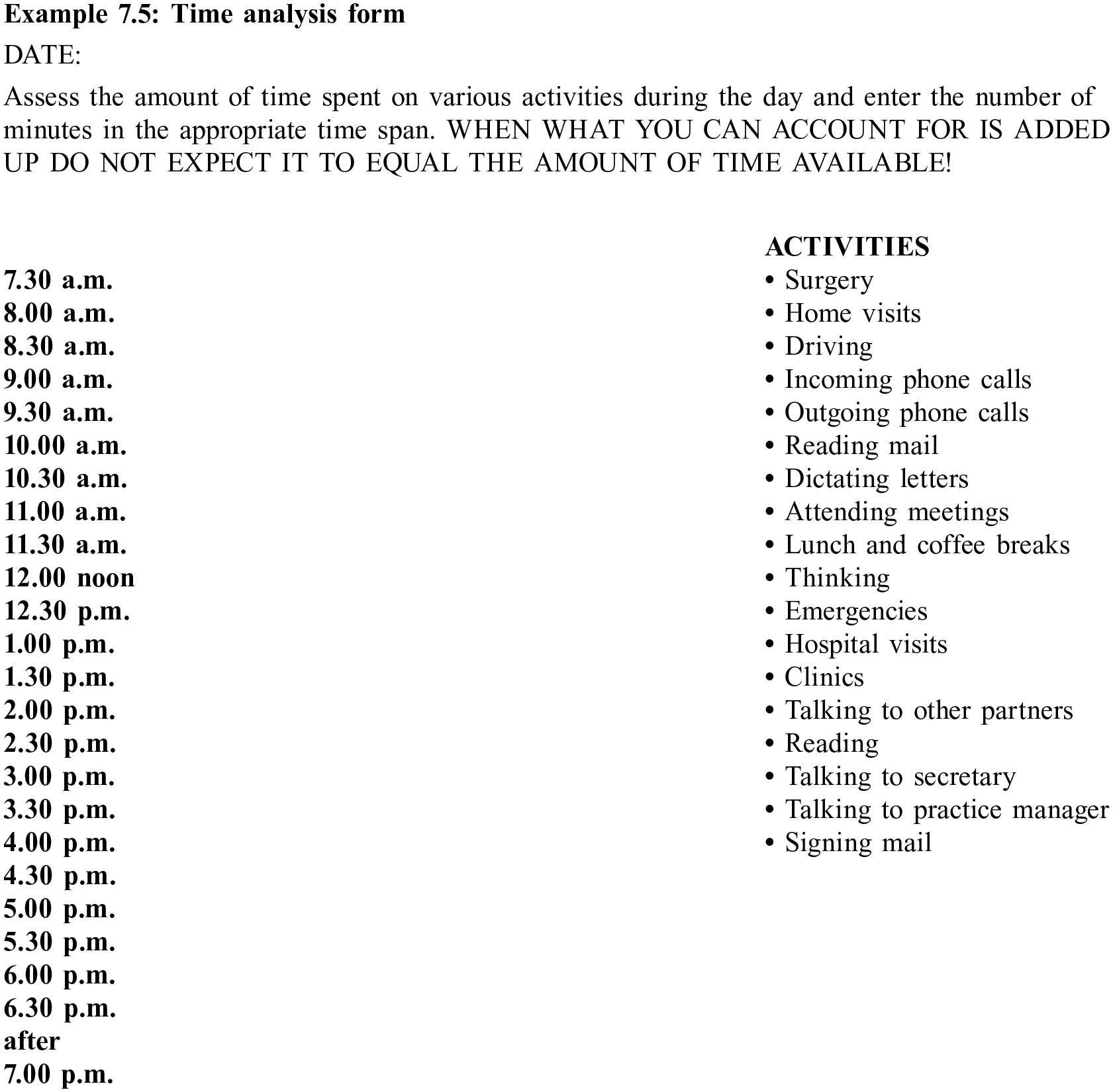

I feel I am in full control of the day
I have a written plan for every project
I have a written plan for every day
I know what my priorities are all the time
I achieve my daily aims
I achieve my deadlines
I manage my bosses
I keep telephone calls brief
I avoid interruptions
I use my subordinates well
My desk is organised
I can find everything
The filing is up to date
I control meetings
I can create time for difficult tasks
I can relax away from work
SCORE
TOTAL
THE AIM IS TO HAVE ALL THE TICKS IN THE FIRST THREE COLUMNS, AND AS HIGH A SCORE AS POSSIBLE
4. Concessions and bargaining
This is the most exciting part of the negotiating process as the element of bargaining is introduced. Every persuasive skill needs to be employed to encourage the other party to offer concessions and move away from their original position and closer to yours. Maximise the importance of any concession you offer and minimise the others. Always confirm the concessions offered, and do so with thanks and appreciation. In order to advance your own objectives use time pressures, humour, threats, knowledge of the other party’s situation and assumed disappointment at their refusal to compromise.
5. Conclusions and agreement
When both parties have reached the end of their bargaining any conclusions need to be summarised and confirmed in writing. If one party has made a number of concessions that were perhaps described as impossible at the outset of the interview, help them to save face, by remaining polite and appreciative. If agreement cannot be reached avoid one party walking out of discussions as this signifies total failure in the negotiating process. It is better to identify failure and offer a date for a further meeting when more investigations have taken place.
6. Review or audit
Analyse the outcome against the original objectives and fall-back position. Look critically at the discussion to identify what was handled well and what could be improved for future reference. It may be that the other party was a more skilful negotiator and that things could be learned from their performance. Set up a system to monitor the effects of any agreements over a period of time. If a further discussion has been agreed and specified, start again in preparation for the new level of negotiation.

A chart to illustrate how to track project progress against a proposed plan

A flow chart to clarify the process of work
Negotiating techniques
Compromise:
— meet half-way
— ‘split the difference’
— only effective on a single issue
— quick
— aim high to settle at desired point.
Bargaining:
— move slowly
— indicate firm position
— avoid making unnecessary concessions
— ensure that each concession gives a worthwhile return
— use ‘If you … then I’ questions.
Coercion:
— threats
— using power
— think of the consequences before employing
— ‘Put yourself in my shoes’
— ‘Don’t force me to place my business elsewhere’.
Emotion:
— fear
— gaining sympathy
— anger (assumed or real)
— irritation.
Logical reasoning:
— using information and statistics to support argument
— credibility of logic.